
Blog

  • Shiba Inu Coin Burn Mechanics: How Many SHIB Coins Have Been Burned so Far?

    Shiba Inu Coin Burn Mechanics: How Many SHIB Coins Have Been Burned so Far?

    You’re about to explore the fascinating mechanics behind the Shiba Inu coin burn, a process that’s been going on since Shiba’s launch in 2020. With over 410 trillion SHIB tokens already removed from circulation, the journey of how these burns influence the coin’s dynamics is far from over. 

    As we go over strategies and community efforts that drive these burns, you’ll gain a better understanding of the broader implications for SHIB’s future. Let’s explore the scale and significance of these burns, and what they mean for the Shiba Inu ecosystem.

    Key takeaways

    • Over 410 trillion SHIB tokens burned, approximately 41% of the initial supply.
    • The total value of burned SHIB tokens exceeds $2.35 billion as of March 2026.
    • Community-driven initiatives contribute to the burn, with over 180 billion SHIB tokens burned.
    • Shibarium Layer-2 solution automates SHIB burning, potentially increasing the burn rate and affecting supply.

    What is the Shiba Inu coin burn?

    The Shiba Inu Coin burn mechanism is a strategic process designed to reduce the total supply of SHIB tokens by sending them to “burner” addresses, which are fundamentally unspendable wallets without private keys, thereby permanently removing these tokens from circulation. For practical purposes, these tokens disappear forever. 
    This deflationary tactic is essential for creating scarcity in the Shiba Inu ecosystem. Since its inception in 2020, the SHIB burn rate has been significant, with over 410 trillion SHIB tokens already removed from the initial total supply of 1 quadrillion tokens. Other meme coins that are trying to be the next Shiba Inu have also adopted similar strategies.

    This accounts for approximately 41% of the total supply, which makes it one of the largest coin burns in the cryptocurrency space. The current total supply now stands at approximately 589 trillion tokens after accounting for these burns.

    The effectiveness of the burn mechanism is continuously monitored, and recent statistics show a notable increase in the Shiba Inu coins being burned, particularly through community-led initiatives and the introduction of new mechanisms like Shibarium. This indicates a strong desire to sustain the burn rate and continue with the deflationary practice. 

    Let’s explain what Shibarium is.

    Shibarium and automatic burns

    Shibarium is an innovative Layer-2 solution launched in 2023, which is a great addition to the Shiba Inu Coin burn dynamics. Essentially, it automates the process. This blockchain technology boosts transaction speeds and systematically facilitates the burning of SHIB tokens through its built-in mechanisms.

    With 70% of base transaction fees on Shibarium allocated to SHIB burns and priority fees directed to validators, every transaction contributes to reducing SHIB’s circulating supply.

    Also, BONE tokens accumulated in Shibarium’s burn contracts are converted to SHIB for burning upon reaching predetermined thresholds. This is good news because it makes the SHIB token even more scarce.

    As more applications leverage Shibarium’s infrastructure, the burn rate is anticipated to escalate.

    While early indications show Shibarium’s effectiveness in automating burns, the extensive impact on SHIB’s market value is still unfolding. A lot of it depends on broader adoption and sustained community-driven initiatives.

    Benefits of burning SHIB tokens

    Burning SHIB tokens offers several key benefits that contribute to the token’s long-term value and market stability.

    Burning causes a significant reduction in supply, which promotes scarcity. This makes SHIB potentially more attractive to investors who seek limited assets. New investors then buy more SHIB tokens, which means there’s more SHIB burned, and you can start to see the pattern.

    Furthermore, regular burning activities help mitigate market volatility due to its deflationary effect.

    Overall, the burning mechanic is a good sign for the Shiba Inu price prediction, but there are still various other factors at play. 

    History of the Shiba Inu coin burn

    Over 410 trillion SHIB tokens have been burned since the coin’s inception in 2020. The most notable burn event was initiated by Vitalik Buterin, who single-handedly removed 41% of SHIB tokens from circulation. 

    Obviously, this drastically alters the supply dynamics.

    Community-driven initiatives have also played a fundamental role, which have contributed to over 180 billion SHIB tokens being burned. 

    Shiba Inu burn addresses explained

    As mentioned, Shiba Inu employs a burning mechanism by which SHIB tokens are sent to burn addresses. This basically removes them from the circulating supply, since those tokens can never be recovered from those addresses. These addresses are essential for controlling the token’s scarcity and value perception.
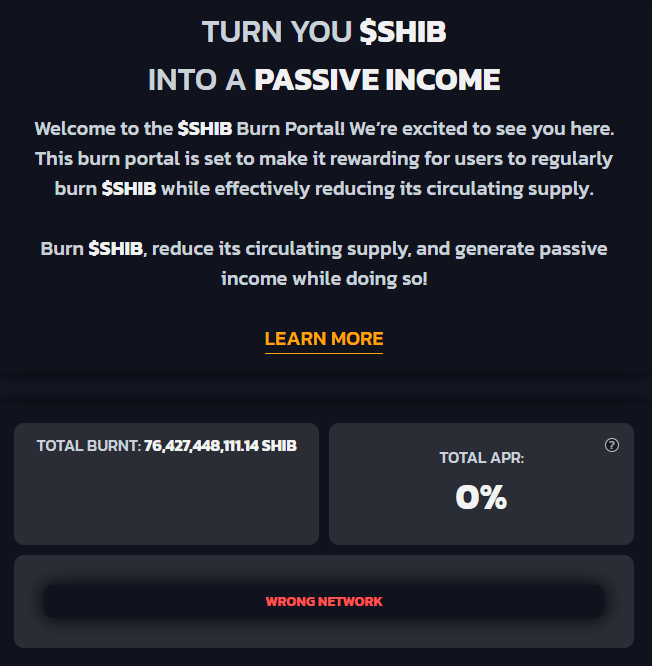
    • Burn addresses are wallets without private keys, making the tokens sent to them inaccessible forever.
    • Vitalik Buterin and the Shiba Inu team have utilized three primary burn addresses to incinerate SHIB tokens.
    • Over 410 trillion SHIB tokens have been burned, considerably impacting the original quadrillion token supply.

    The three burn addresses are:

    1. Burn Address 1 (used by Vitalik Buterin to burn his SHIB)
    2. Burn Address 2 (also used by the Shiba Inu team for ShibaSwap listings)
    3. Burn Address 3 (this address is sometimes called the Black Hole)

    Be warned: any tokens you send to these addresses will be lost forever. 

    SHIB tokens burned so far

    The significant reduction in supply has been due to the initial burn by Vitalik Buterin, but also by collective efforts through community initiatives that have contributed to over 750 billion SHIB tokens burned. 

    The total value of burned SHIB coins exceeds $2.35 billion as of March 2026.

    Recent statistics highlight an increasing burn rate, with a 299.60% increase compared to previous periods.

    Impact on SHIB price and scarcity

    The burning of SHIB tokens impacts the scarcity and potentially the price of the cryptocurrency. Here’s how:

    • Reduced Supply: With over 410 trillion SHIB tokens burned, representing about 41% of the initial supply, the burning mechanism noticeably reduces the available supply. This creates scarcity.
    • Market Dynamics: Despite the massive burning efforts, SHIB’s price remains volatile, recently seeing a 8% decrease over the week. This shows us that while burning can influence scarcity, other market factors still play a more relevant role in price action.
    • Economic Impact: The total value of burned SHIB exceeds $2.35 billion. However, the relationship between burning and price isn’t straightforward.

    The bottom line

    You’ve seen how the Shiba Inu community has actively burned over 410 trillion SHIB tokens, worth more than $2.35 billion. This process, involving sending tokens to inaccessible addresses, aims to reduce circulating supply and potentially increase scarcity and value. The introduction of Shibarium has further streamlined burns, making the process more efficient. As the community continues to engage in these strategic burns, it is likely that the deflationary effect these burns have will continue to take its toll.

    If you’re looking to learn more about meme coins, make sure to check out our article explaining how to find new meme coins early.
  • Bitcoin Price History in 2009, 2010, 2011, 2012, 2013, 2014 & Beyond

    Bitcoin Price History in 2009, 2010, 2011, 2012, 2013, 2014 & Beyond

    Bitcoin’s beginnings go back to 2009, which means it’s been around for over 15 years. Imagine buying Bitcoin for a fraction of a cent back then, only to see it skyrocket to tens of thousands of dollars in the years that followed, with the current price over $120,000. 

    Let’s take a journey through the key milestones in Bitcoin’s price evolution, year by year, and uncover the factors that drove its dramatic fluctuations. We are going to examine Bitcoin’s eventful past and highlight the most important events and developments in its 16-year history. 

    Key takeaways:

    • Bitcoin started in 2009 with an initial value of effectively $0 and saw its first recorded market price at $0.00099 per coin in October.
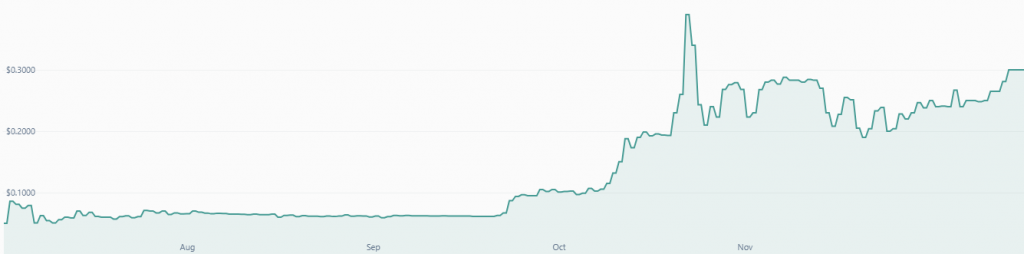
    • In 2010, the price fluctuated from $0.0008 to a peak of $0.39, ending the year at $0.30.
    • Bitcoin’s price in 2011 began at $0.30, peaked at $29.60, and ended at $5.27, showcasing high volatility.
    • The year 2012 saw a 152% increase, starting at $5.27 and ending at $13.30, with the first Bitcoin halving event in November.
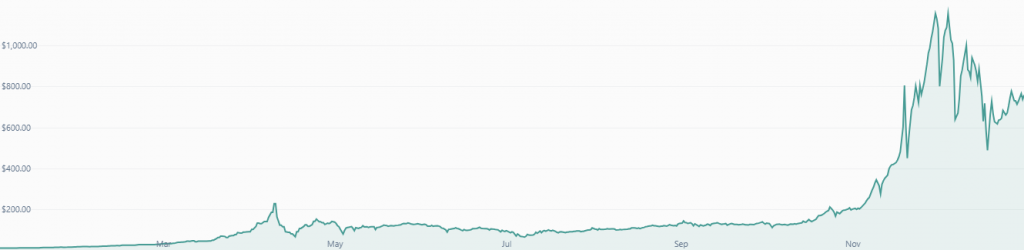
    • Bitcoin’s price surged significantly in 2013, from $13 to a peak of $1,156, a rise of over 8,800% within the year.

    What was the price of Bitcoin in 2009?

    Bitcoin’s journey began in 2009 with an initial value of effectively $0, as it hadn’t yet been traded on exchanges. You might be wondering what the first “above zero” price of Bitcoin was in 2009.

    Well, the first recorded market price for Bitcoin occurred in October 2009, when it was valued at about $0.00099 per coin for a small transaction. Just for perspective’s sake, if you had invested only $10 in Bitcoin back then and kept it until now, that investment would now be worth around $5 million.

    In Bitcoin’s early years, there was minimal public awareness of it and there was very little trading involved. In fact, the first real-world transaction didn’t happen until May 2010, which we will talk about in the next section.

    What was the price of Bitcoin in 2010?

    In 2010, the price of Bitcoin began to show signs of life, starting the year at approximately $0.0008 and demonstrating noteworthy early volatility.

    For most of 2010, Bitcoin traded under $0.10, with its price peaking at $0.39 in early November 2010. This marked a notable increase from its starting value earlier in the year. By the end of 2010, Bitcoin closed the year at about $0.30, which was a remarkable increase of approximately 500% since the beginning of the year.

    bitcoin price 2010

    One of the most notable events in 2010 was the first real-world transaction, where 10,000 Bitcoins were used to purchase two pizzas, effectively pricing Bitcoin at $0.0025 each at that time. This transaction highlighted Bitcoin’s potential as a medium of exchange and marked an early step toward broader adoption.

    Throughout 2010, Bitcoin’s price fluctuated considerably. It was a reflection of the asset’s speculative nature during its early days. The price movements of Bitcoin in 2010 laid the groundwork for its future growth and the increasing interest in this digital currency.

    What was the price of Bitcoin in 2011?

    The year 2011 was a vital moment for Bitcoin, as it experienced its first major rally. You see, Bitcoin’s price history in 2011 began with a value of around $0.30 and ended the year at approximately $5.27. Throughout the year, Bitcoin’s price was characterized by significant volatility, including fluctuations between $0.30 and $30.

    bitcoin price 2011

    The price surged to a peak of about $29.60 in June 2011, marking a substantial increase from its starting point. This volatility was influenced by various factors, including market sentiment and regulatory shifts.

    As Bitcoin gained wider attention beyond early adopters, its market cap increased substantially. This, in turn, prompted more public and media interest in the cryptocurrency. This increased visibility contributed to Bitcoin’s price surge in 2011.

    The year witnessed notable price fluctuations, reflecting the inherent volatility of cryptocurrency markets. Despite the fluctuations, Bitcoin’s price history in 2011 laid the groundwork for its future growth and adoption.

    What was the price of Bitcoin in 2012?

    From the significant price fluctuations of 2011, where Bitcoin’s value surged to a peak of about $29.60 in June and ended the year at approximately $5.27, we move to the following year, which saw a different trend.

    bitcoin price 2012

    In 2012, Bitcoin’s price started the year at approximately $5.27 and ended at around $13.30. This was a growth of about 152% over the year, which would be considered astronomical in any market that isn’t crypto.

    This price increase was influenced by the first Bitcoin halving event in November 2012, which reduced mining rewards from 50 BTC to 25 BTC.

    Throughout 2012, Bitcoin experienced fluctuations between approximately $4 and $16 as it gained traction among early adopters and investors.

    What was the price of Bitcoin in 2013?

    2013 was an absolutely pivotal year for Bitcoin. Its price skyrocketed from around $13 to a peak of approximately $1,100 in December. This was an astonishing increase of over 8,800% within the year, a truly ludicrous amount even by crypto standards. 

    bitcoin price 2013

    This significant growth was partly due to increased media exposure and the rise of cryptocurrency exchanges, which contributed to Bitcoin’s market popularity surge.

    By the end of April, Bitcoin’s price had surpassed $200, and by December, the price hit the peak of $1,100. The year ended with Bitcoin closing at around $730 after experiencing substantial volatility throughout the year.

    The price movements in 2013 were heavily influenced by several events, including the shutdown of the Silk Road marketplace and growing interest from both retail and institutional investors. 

    As part of Bitcoin’s price history, 2013 stands out as a year of remarkable growth and increased recognition in the financial and technological communities. Arguably, this was the first time the term Bitcoin was starting to be ushered by regular people who aren’t investors or finance professionals.

    What was the price of Bitcoin in 2014-2015?

    The years 2014-2015 are mostly a part of Bitcoin’s story that shows resilience and gradual recovery.

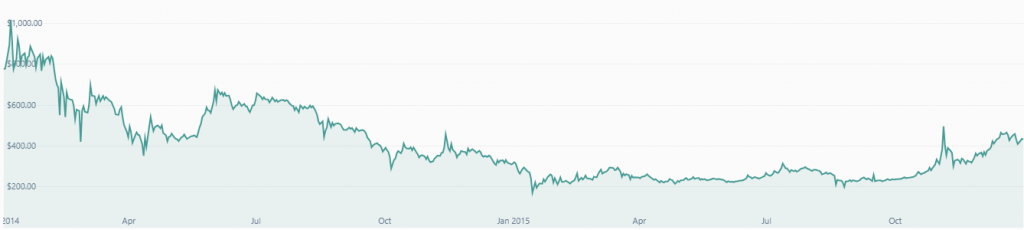
    bitcoin price 2014-2015

    In 2014, Bitcoin’s price started at approximately $770 but fell considerably throughout the year, ending around $315. This decline was largely due to the Mt. Gox exchange hack and increased regulatory scrutiny.

    The price fluctuation in 2014 saw Bitcoin dip to a low of about $200 before initiating a small recovery towards year-end. 

    At the end of 2015, Bitcoin’s price closed out at around $425, a significant decrease from the highs of 2013, but still much higher than where it first started.

    What was the price of Bitcoin in 2016-2017?

    In 2016, we saw the price of Bitcoin grow steadily throughout the year. It starts at around $430 and closes at approximately $960. Unlike previous increases in price, 2016 was quite tame by Bitcoin’s standards, without much in the way of volatility that crypto is known for.

    This steady growth was a reflection of increasing confidence in Bitcoin’s potential and improving market conditions.

    In 2017, Bitcoin’s price history took a dramatic turn.

    By January, the price had surpassed $1,000, a significant psychological milestone. The year witnessed a massive bull run, with Bitcoin soaring to nearly $20,000 by December 2017. This surge was fueled by rising public interest, media coverage, and increased investment, both institutional and retail.

    bitcoin price 2016-2017

    The dramatic price swings during this period also reflected expansion into alternative cryptocurrencies, and it is at this point that the term “altcoins” started to be more widely used.

    2017 was a perfect example of the aggressive volatility of Bitcoin.

    What was the price of Bitcoin in 2018-2023?

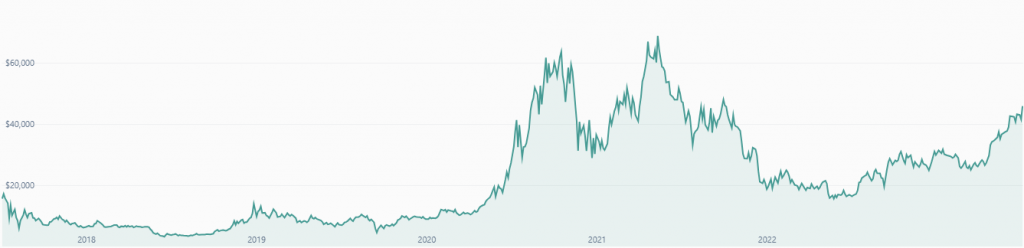
    By 2018, Bitcoin’s price was near $13,880 but saw a significant decline to around $3,200 by December, marking a drop of nearly 77%. The following year, Bitcoin recovered some ground, fluctuating between $3,200 and $14,000 before closing at approximately $7,200.

    In 2020, Bitcoin’s price surged dramatically, driven by increased institutional interest and a favorable macroeconomic environment, ending the year at around $28,993, which was a 416% increase from the beginning of the year.

    bitcoin price 2018-2023

    It reached new all-time highs in 2021, peaking at around $69,000 in November before experiencing notable corrections, ultimately closing at around $46,200.

    2022 and 2023 have, for the most part, not been great for Bitcoin’s price. For the better part of those 24 months, the price was oscillating between $16,000 and $40,000, roughly. However, towards the end of 2023, specifically in November and December, the price finally started gaining upwards momentum and broke above $40,000.

    Bitcoin’s 2024 bull run to $100,000

    Bitcoin 2024 price

    Bitcoin’s price in the first 3 months of 2024 has seen significant increases and even broke the previous all-time high in March, setting a new ATH of around $73,000.

    The second and third quarters were not as impressive, though they were far from disappointing either. The price had been ranging between $57,000 and $71,000 for most of the mid-year.

    This early surge in 2024 can be attributed to the continued growth of institutional interest and regulatory changes that positively impacted the market. The peak itself was likely influenced by the approval of several spot Bitcoin ETFs early in the year, which helped boost investor confidence and drive up demand. Also, the aftermath of the banking crisis in early 2023 saw Bitcoin experience a notable rebound, climbing from around $28,038 to its mid-2024 levels.

    However, the final months of 2024 completely changed the narrative. In November, Bitcoin’s price surged again following the U.S. presidential election, which sparked renewed optimism in the crypto markets. BTC quickly climbed to a new all-time high of $94,837, before breaking the $100,000 barrier in December, reaching a record $106,052.

    By the end of 2024, Bitcoin had established a new price floor, holding above $90,000 and closing the year at around $93,647 — marking a remarkable 222% increase from the start of the year.

    Bitcoin’s price in 2025

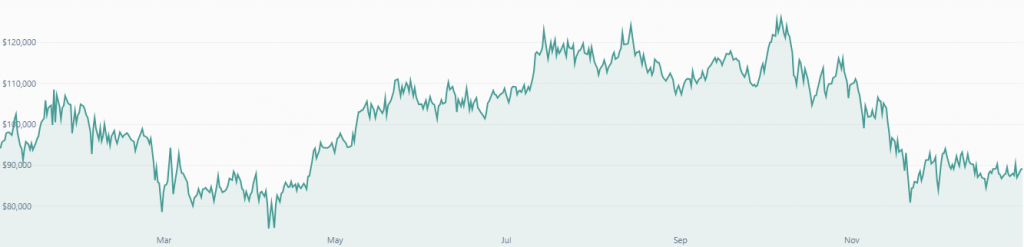
    Bitcoin carried over the momentum from 2024, reaching a new local high of $106,198 in January. However, that rally was short-lived. Over the following months, Bitcoin entered a sharp correction, dropping to levels many believed were no longer possible – first falling below $95,000, then $80,000 just two weeks later, and eventually bottoming out at $76,352 in April. Many analysts proclaimed this to be the end of Bitcoin’s bull run, while a few contrarian investors saw it as a rare opportunity to accumulate Bitcoin at a discount.

    Those investors turned out to be right. Bitcoin shocked the market with a massive reversal shortly afterward. By May, the price had regained the psychological $100,000 level, signaling renewed market strength. The momentum didn’t stop there — Bitcoin’s rally accelerated, breaking through $110,000, briefly pulling back to $100,000, and then surging past $120,000.

    After another short dip to $110,000, Bitcoin climbed once again to reach a new all-time high of $126,000 in October. The rally was driven by continued institutional demand, ETF inflows, and growing retail participation fueled by positive macroeconomic sentiment.

    As 2025 drew to a close, many investors believed it could reach $150,000 or even higher by year’s end. However, the price would begin dropping sharply after the $126,000 peak. It fell below the $100,000 mark in November and headed into 2026 below the $90,000 level, effectively bringing Bitcoin back to roughly the same price range where it started 2025.

    Bitcoin’s price in 2026 so far

    Bitcoin continued the bearish momentum from 2025 to the current year. The price held steady around $90,000 until February. In a mere week, the price dropped to $65,000 levels, where it has been trading for the rest of February. It remains to be seen where the price of Bitcoin will go later in the year, but many analysts are optimistic about Bitcoin’s future and see the current price drop as a mere road bump.

    If you want to check algorithmically generated forecasts, make sure to visit our Bitcoin price prediction page.

    The bottom line: Bitcoin started at less than a tenth of a cent, now comfortably above $120k

    You’ve seen Bitcoin’s price history, from its negligible value in 2009 to its meteoric rise over the years. In 2010, it peaked at $0.39, then hit $30 in mid-2011. The price has continued to fluctuate, reaching above $1,100 in 2013, dropping, and then growing again to almost $20,000 through 2016-2018. 

    Despite volatility, Bitcoin has shown steady growth, with its price continuing to rise through 2026 and (very likely) beyond.

  • 5 Best Crypto Airdrops in 2026: Get Free Coins

    5 Best Crypto Airdrops in 2026: Get Free Coins

    parachutes

    Imagine receiving free cryptocurrency just for completing a few easy steps – no strings attached. That’s the magic of airdrops, which has grown into a popular promotional strategy in the blockchain world. Airdrops allow crypto projects to distribute tokens directly to users as a way to reward loyalty, expand their community, and generate buzz. 

    Participating in airdrops can be a simple and rewarding way to grow your crypto portfolio. In this article, we’ll explore the ins and outs of crypto airdrops and take a look at some of the best crypto airdrops to look out for in 2026. 

    List of 5 best crypto airdrops in 2026:

    1. OpenLedger – A decentralized data network that enables users to contribute and monetize data for AI development through blockchain-based infrastructure
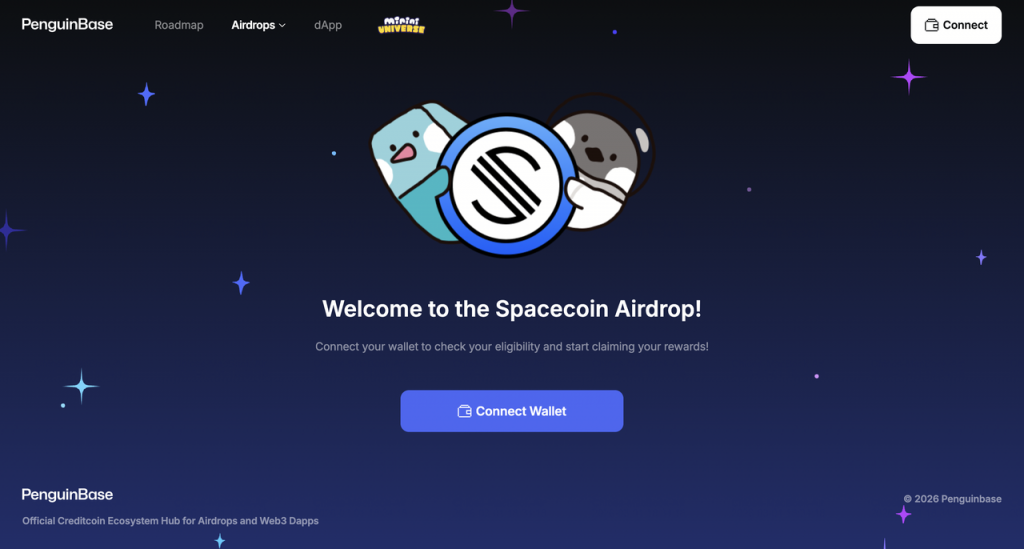
    2. Spacecoin – A project building a decentralized satellite internet network designed to deliver global connectivity using blockchain incentives
    3. DeFi Dollar – A decentralized stablecoin protocol designed to maintain a soft peg to the US dollar using a basket of crypto collateral and algorithmic mechanisms
    4. Genius Terminal – An AI-powered crypto research and trading platform that provides real-time analytics, insights, and tools for discovering early-stage projects
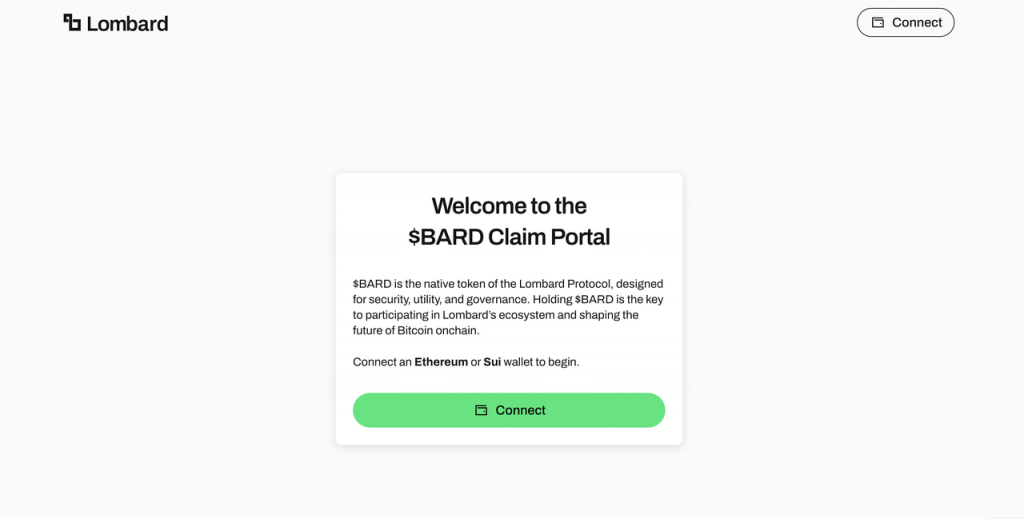
    5. Lombard – A Bitcoin restaking protocol that allows users to earn yield on BTC by securing DeFi applications through liquid staking derivatives

    5 best crypto airdrops: Examining the top airdrop crypto projects for 2026

    As good as it is that crypto airdrops have become very popular, there’s a downside to it – it can be hard to differentiate between the good and the bad.

    That’s why we’ve compiled a list of the 5 best crypto airdrops that you can find in 2026. Bear in mind, some of these airdrops are already confirmed, while some haven’t been 100% confirmed, but we feel confident they will be confirmed.

    1. OpenLedger – A blockchain network for sharing and monetizing AI data

    OpenLedger is a blockchain infrastructure project focused on building a decentralized data network for AI and machine learning applications. The platform allows users and organizations to contribute data to a shared network while maintaining ownership and earning rewards through token incentives. By combining blockchain with AI data pipelines, OpenLedger aims to create a transparent and community-owned ecosystem where datasets can be securely shared, verified, and monetized.

    In March 2026, OpenLedger begins its second distribution phase, allocating 15 million OPEN tokens to eligible participants. The airdrop primarily targets users who qualified in earlier rounds and held sufficient BNB at the snapshot used for eligibility. Tokens are distributed automatically based on points accumulated through activity and holdings, with no manual claim process required. This second phase accounts for 15% of the total token supply dedicated to community rewards, reinforcing OpenLedger’s strategy of incentivizing early adoption.

    2. Spacecoin – A decentralized satellite internet network powered by blockchain incentives

    Spacecoin is a decentralized physical infrastructure network (DePIN) project that aims to expand global internet access using satellite-based connectivity. The project combines blockchain incentives with satellite communications to create a distributed network where participants can contribute resources, infrastructure, or development support. By aligning contributors with token rewards, Spacecoin seeks to build a community-driven alternative to traditional satellite internet providers.

    The project’s second token unlock phase is scheduled for March 2026 and will distribute SPACE tokens to users who qualified through earlier snapshots. Eligibility is tied to BingX accounts that held CTC tokens during the official snapshot period, along with participants who contributed to the ecosystem through testnet activity or community engagement. Rewards are based on the points accumulated during these earlier participation phases, with claim details expected to follow the unlock event.

    3. DeFi Dollar – A decentralized stablecoin protocol pegged to the US dollar

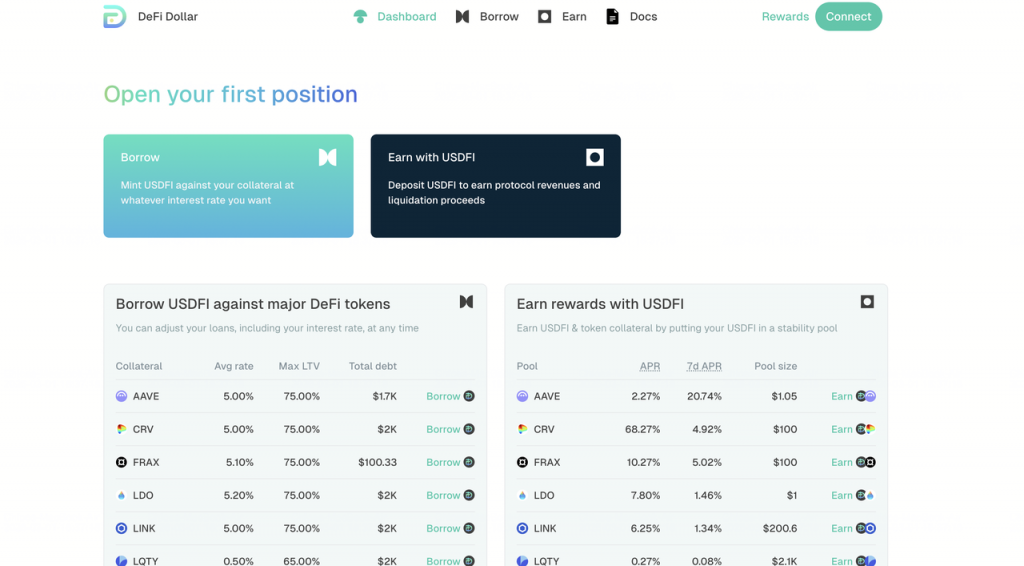
    DeFi Dollar is a decentralized stablecoin protocol designed to maintain a soft peg to the US dollar through a combination of crypto collateral and algorithmic stabilization mechanisms. The platform integrates DeFi liquidity incentives and trading activity into its ecosystem, encouraging users to support the protocol’s stability while earning rewards. By distributing governance and utility tokens to early contributors, DeFi Dollar aims to strengthen its liquidity layer and user base.

    The project’s liquidity incentive program concludes in early March 2026, marking the distribution of DFD rewards to participants who contributed to the ecosystem. Eligible users include those who provided liquidity to the protocol, participated in testnet activities, or engaged in spot trading campaigns designed to bootstrap early adoption. Participants can connect their wallets to claim rewards and mint the DeFi Dollar OG NFT tied to the incentive program.

    4. Genius Terminal – An AI-powered crypto research and analytics platform

    Genius Terminal is an AI-driven crypto analytics and trading platform designed to help users discover early-stage opportunities and analyze market trends. The platform combines automated research tools, data insights, and trading metrics to assist users in navigating the rapidly evolving cryptocurrency ecosystem. By integrating AI-powered analysis with user activity incentives, Genius Terminal aims to build a research-focused community around its ecosystem.

    The first season of the platform’s rewards program concludes in mid-March 2026, with participants receiving digital tokens based on the number of points earned through platform activity. These tokens are non-tradable and are primarily designed to unlock perks, platform benefits, or access to features within the Genius ecosystem. To qualify, participants must meet activity thresholds and maintain eligible account status as of the March 16 snapshot.

    5. Lombard – A Bitcoin restaking protocol that allows BTC holders to earn yield

    Lombard is a Bitcoin-focused DeFi platform that enables users to stake BTC and participate in decentralized finance while maintaining exposure to the underlying asset. The protocol integrates staking, liquidity incentives, and ecosystem participation to generate yield opportunities for Bitcoin holders. By bringing BTC deeper into DeFi infrastructure, Lombard aims to expand the utility of the world’s largest cryptocurrency beyond simple holding.

    The platform’s Season 2 campaign runs through March 2026, with the final snapshot determining token allocations for participants. Rewards are distributed to users who contributed through staking, trading fees, or broader ecosystem activity before the deadline. The distribution includes several allocation pools, such as points-based rewards for active users, a bonus pool for those who hold or stake their airdropped tokens throughout 2026, and additional incentives set aside for ecosystem growth. Stakers receive rewards based on the time-weighted duration of their positions.

    What are crypto airdrops?

    Crypto airdrops are free distributions of cryptocurrency tokens or NFTs to a predefined set of people in hopes of increasing the token’s visibility and usage. These distributions often serve as marketing tools for projects to build a community and stimulate trade.

    How airdrops work

    Airdrops can be broadly categorized mainly into holder airdrops and bounty airdrops.

    • Holder airdrops involve automatically dropping tokens into the wallets of users who hold a specific coin at a particular time or snapshot.
    • Bounty airdrops reward users with tokens for completing tasks, such as joining Telegram groups, retweeting, liking posts, and referring new people.

    Prominent projects like Uniswap have distributed governance tokens to their early users, which greatly boosted their adoption and value.

    If you participate in these free giveaways, you not only gain free crypto tokens but also contribute to the project’s growth and liquidity.

    And just to make it clear, when we say “free,” we mean that you typically don’t pay for it with money, but you do pay for it with something, either engagement on social media, inviting other people, or using their tools. 

    Where to get the latest crypto airdrops?

    There are several reliable sources that provide up-to-date information and opportunities. These are the best websites for crypto airdrops that aggregate the latest crypto airdrops, making it easy to find and participate in current and upcoming distributions.

    Also, communities on various platforms actively list and discuss upcoming airdrops, and you can get valuable insights and resources. 

    Can you earn money from crypto airdrops?

    Earning money from crypto airdrops is possible for sure, though it depends on how well you understand and engage with the airdrop mechanisms. Projects can offer airdrops to reward early adopters and community contributors by providing free tokens or NFTs. These tokens can be sold on cryptocurrency exchanges, potentially generating income.

    Just imagine if you were given a crypto airdrop of a highly successful project, e.g., Uniswap. You would have gotten a small fortune, assuming you were patient enough to wait for the price of the token to take off. 

    So, yes, staying active in project ecosystems, following airdrop announcements, and participating in required tasks can help you earn money from crypto airdrops.

    Are crypto airdrops safe?

    Engaging with crypto airdrops can be a lucrative opportunity, but it also involves significant risks. Airdrops are ‘free’ distributions of new cryptocurrencies to existing users, typically to generate buzz and increase community participation. However, they can attract malicious activities such as phishing scams, wallet hacking, and rugpulls.

    In many instances, users are required to complete tasks that expose their sensitive information, which makes them vulnerable to fraud. Moreover, airdropped tokens may have little to no value initially, so you end up holding worthless assets for a long time (or potentially even forever).

    The lack of regulations in the cryptocurrency space exacerbates these risks, as fraudulent projects can exploit users without facing legal consequences. 

    Always make sure that the airdrop is conducted by a reputable developer, and never submit sensitive information unless absolutely necessary. Stay informed and careful, and remember – it’s always better to err on the side of caution. 

    The bottom line – Participating in crypto airdrops allows you to earn free crypto

    Cryptocurrency airdrops are one of the most popular ways of earning free crypto, but they are not the only way. Cryptocurrency faucets are another method for earning free crypto and using them to test various dApp use cases. Solana faucets and BNB faucets are among the most popular. 

    Also, don’t forget that there are risks involved with crypto airdrops, and while they’re a great way to get crypto, don’t forget to do your due diligence.

  • Transacta Partners with CryptoJets to Support Growing Demand for Crypto Payments in Private Aviation

    Transacta Partners with CryptoJets to Support Growing Demand for Crypto Payments in Private Aviation

    Tallinn, Estonia, March 4th, 2026, Chainwire

    CryptoJets, a global private jet and helicopter brokerage, has announced a partnership with Transacta to support the growing demand for cryptocurrency payments in private aviation. 

    The growing demand for fast and secure crypto payments

    Demand for cryptocurrency payment options in luxury travel continues to grow as wealth shifts toward younger generations. The private aviation sector is increasingly embracing digital currencies, driven by both practical needs and broader market development.

    Built for travelers who value privacy, speed, and flexibility, CryptoJets operates with access to a global network of more than 5,000 charter operators, providing on-demand private jet and helicopter services to clients worldwide. 

    As the volume of crypto-funded bookings continued to grow, the company identified the need to further optimize payment speed, settlement reliability, and geographic coverage. Through its partnership with Transacta, CryptoJets is expanding its route network and operational capacity across 180 countries while offering clients a more streamlined way to process high-value charter payments. 

    “Crypto payments have already been part of how our clients prefer to pay,” said Erik Rand, Head of Operations at CryptoJets. “This partnership allows us to process those payments faster, improve settlement across markets, and scale our operations without compromising on compliance or client experience.”

    Expertise in settling high-value transactions for luxury merchants worldwide

    Built on years of experience working with luxury businesses, Transacta delivers payment solutions for merchants handling large, complex deals — without operational friction and under bespoke client requirements.

    Transacta‘s financial rails allow CryptoJets to process large transactions in crypto and settle them in fiat to their bank account within 1–2 business days, meeting all legal requirements.

    “We’re starting a new chapter together with CryptoJets. And for us, this partnership is a challenge we’re excited to take on — improving the speed and overall quality of payment processing for high-value charter transactions.” said Dmitrijs Maceraliks, CEO of Transacta. 

    About Transacta:

    Founded in Estonia in 2018, Transacta (previously Transcrypt OÜ) offers a regulated payment infrastructure that enables merchants to accept crypto payments with instant fiat settlement. Transacta is licensed by the Estonian Financial Intelligence Unit, registered with FinCEN in the U.S. and FINTRAC in Canada, and operates under FINMA supervision.

    Contact

    Brand Manager
    Tetiana Tkachenko
    Transacta
    media@transacta.com

  • Threshold Launches All-in-One Bitcoin Liquidity App

    Threshold Launches All-in-One Bitcoin Liquidity App

    New York, United States, March 3rd, 2026, Chainwire

    Threshold Network, the decentralized blockchain protocol behind tBTC, has introduced an update to its decentralized application featuring an all-in-one Unified Bitcoin App that enables users to route Bitcoin across major chains through a single interface.

    This new unified routing interface brings minting, redeeming, bridging, tracking, and native BTC swaps into a single application: The Threshold App. Users can now move Bitcoin across ecosystems through a coordinated system, rather than stitching together multiple tools or navigating between different Decentralized protocols.

    This release simplifies how Bitcoin enters and moves across DeFi, offering a more user-friendly on-chain experience with tBTC. Whether a transaction requires a swap, a bridge, or multiple steps, execution is seamlessly coordinated through a single interface

    Coordinated Execution Instead of Fragmented Workflows

    Historically, moving BTC into tBTC and across chains required multiple disconnected workflows: minting in one app, bridging via another protocol, swapping on separate exchanges, and manually checking the best price for each transaction. This fragmented process introduced friction, higher execution risk, added costs, and unnecessary complexity for users attempting to access DeFi with Bitcoin.

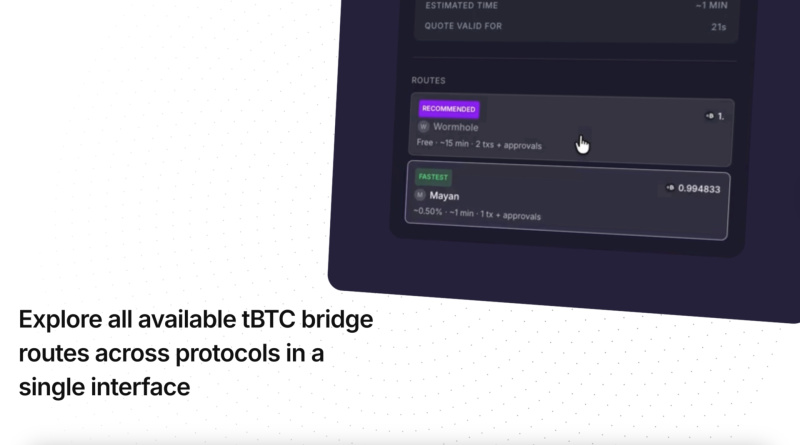
    The Threshold All-in-one Bitcoin Liquidity App streamlines this experience by consolidating minting, bridging, swapping, and cost tracking into a single coordinated interface. Instead of manually comparing bridges and liquidity venues, users receive optimized routing options based on cost, speed, and reliability, such as the fastest or lowest-cost path: all within the Threshold Network App.

    By abstracting multi-step transactions into a single seamless flow, the router significantly lowers the barrier for Bitcoin holders to use BTC across major ecosystems, including Ethereum, Arbitrum, Base, Sui, Starknet, and other integrated chains. The result is a simpler, more efficient way to move Bitcoin into DeFi.

    Native BTC Execution with Deep Liquidity
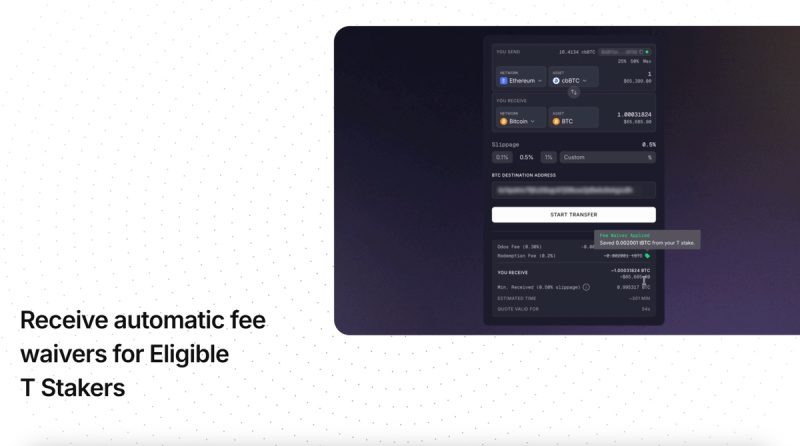
    Native BTC swaps are integrated directly into the routing engine, leveraging deep Ethereum liquidity to deliver competitive pricing and more efficient execution compared to fragmented, chain-specific pools.

    “Capital should move efficiently across chains without requiring users to manage infrastructure decisions,” said MacLane Wilkison, Co-Founder of Threshold Network. “The new Threshold Bitcoin app coordinates liquidity sourcing and settlement behind the interface, enabling more efficient Bitcoin deployment across ecosystems.”

    The update also strengthens the utility of Threshold’s token (T). The App tracks staked $T from the connected wallet and automatically applies minting and redemption fee waivers for eligible users. Gasless minting remains available as an opt-in feature, further reducing transaction costs.

    Additionally, the router enables streamlined conversions from assets such as WBTC and cbBTC directly into tBTC on the destination chain, providing more direct and efficient access to Bitcoin liquidity across DeFi ecosystems.

    Integrated Infrastructure Across Major Networks. Currently, the router connects Bitcoin, Ethereum, Arbitrum, Base, Sui, and Starknet within one coordinated framework. It integrates native tBTC mint and redeem flows, established bridging infrastructure, and DEX aggregation to ensure reliable settlement across chains.

    All transactions are tracked in real time and are fully resumable. If a user disconnects or closes a session, progress is preserved. Fee logic is staking-aware, with eligible T stakers seeing applicable redemption fees waived directly within the interface.

    New Features:

    • Unified Routing Interface: Enables minting, redeeming, swapping, and bridging from a single entry point. Users select source and destination assets, and the system automatically constructs the optimal execution path.
    • Multi-Chain Connectivity: Supports Bitcoin, Ethereum, Arbitrum, Base, Sui, and StarkNet within a single coordinated framework. Users can move BTC or tBTC across ecosystems without managing separate bridge interfaces.
    • Smart Route Discovery and Ranking: Automatically evaluates possible transaction paths and ranks them by cost, speed, reliability, and simplicity. Users are presented with clearly labeled best options.
    • Native BTC Swaps: Provides direct access to BTC liquidity with competitive execution, while enabling seamless conversion of assets such as cbBTC or wBTC into tBTC on a user’s chosen destination network.
    • Integrated Liquidity and Bridging Stack: Connects tBTC mint and redeem flows with established bridging infrastructure and DEX aggregation to coordinate multi-step transactions seamlessly.
    • Resumable Transactions: Persists in-flight operations, allowing users to refresh, disconnect, or return later without losing progress. Reduces failed cross-chain flows and operational friction
    • $T Staking-Aware Fee Display: Recognizes T staking status and surfaces fee waivers directly in the interface, reinforcing participation incentives.
    • Unified tBTC Explorer and Transaction Tracking: The new explorer section of the app consolidates historical mint, redeem, bridge, and swap activity into a single view, improving transparency and user oversight.

    Impact for Users and Stakeholders

    This release expands the utility of tBTC across six ecosystems while increasing throughput across minting, bridging, and swap flows. By embedding routing intelligence directly into the protocol interface, Threshold captures more activity within its infrastructure and further strengthens staking incentives tied to network usage.

    With this launch, Threshold advances its role from Bitcoin asset issuance to core infrastructure for Bitcoin mobility, coordinating capital movement seamlessly across chains and unlocking more efficient access to decentralized finance.

    Users can explore the new Bitcoin App today at https://app.threshold.network

    About Threshold Network

    Threshold Network is the decentralized protocol behind tBTC, a non-custodial, 1:1 Bitcoin-backed asset secured by a 51-of-100 threshold signer model. tBTC enables native BTC to move across chains like Ethereum, Base, Sui, Arbitrum, and Starknet without requiring custodians or compromising security. With over 6 years of proven security and about $5.1B in bridge volume, Threshold offers the most battle-tested, trust-minimized Bitcoin infrastructure onchain.

    Contact

    Threshold Network
    contact@tnetworklabs.com

  • Paradex Signals Upcoming $DIME Token Generation Event

    Paradex Signals Upcoming $DIME Token Generation Event

    Toronto, Canada, March 3rd, 2026,

    Paradex has announced that the Token Generation Event for its native token, $DIME, is expected to take place soon. The launch represents the next phase in the exchange’s development.

    Institutional Background and Market Growth

    Paradex was developed by the team behind Paradigm, an institutional crypto derivatives liquidity network that has processed more than $1 trillion in trading volume. That background is reflected in Paradex’s focus on execution quality, capital efficiency, and market structure.

    Since launching their on-chain perpetuals exchange, Paradex has recorded:

    • Over $250 billion in cumulative trading volume
    • Approximately $550 million in open interest
    • More than 75,000 users
    • Peak daily trading volume above $3 billion

    The exchange operates with an offchain central limit order book (CLOB) for matching, and settles transactions through a high-throughput Layer 2 appchain secured by zk-STARK proofs on Ethereum.

    Focus on Market Structure and Privacy

    A key differentiator for Paradex is its approach to information exposure. On transparent blockchains, position sizes and liquidation levels can often be observed publicly. Paradex encrypts sensitive state data prior to settlement while using zero-knowledge proofs to maintain validity. Access to detailed account information is restricted to verified users.

    In addition, the exchange incorporates:

    • Zero trading fees for retail participants
    • Retail Price Improvement flow segmentation
    • A no auto-deleveraging risk model
    • Onchain vault infrastructure for yield strategies

    These features are designed to reduce execution friction and mitigate structural risks that have historically limited institutional participation in decentralized derivatives markets.

    $DIME and Network Alignment

    According to Messari’s research coverage, $DIME will launch on Paradex’s spot market and will serve as the native gas token of Paradex Chain.

    Messari notes that the token is structured to reduce the traditional conflict of interest between equity holders and tokenholders by directing economic value accrual to the $DIME token itself. Rather than implementing automatic buyback formulas, Paradex intends to conduct buybacks on a discretionary basis, with decisions guided by market conditions and ecosystem considerations.

    Token Allocation Overview 

    Messari outlines the following allocation structure for $DIME:

    • 25.1 percent Core Contributors
    • 25.0 percent Community Airdrop
    • 20.0 percent to Season 2 XP holders
    • 5.0 percent to Pre-Season and Season 1 XP holders
    • Fully unlocked at launch
    • 21.6 percent Ongoing Community Rewards
    • 13.4 percent Paradigm Shareholders
    • 10.4 percent preferred equity investors subject to a 12-month linear unlock beginning one month after listing
    • 1.0 percent common equity holders
    • 2.0 percent reserved for Paradigm’s balance sheet
    • 6.0 percent Foundation Budget
    • 5.0 percent Liquidity Programs
    • 3.9 percent Future Core Contributors and Advisors

    80% of the tokens allocated to Core Contributors and Paradigm shareholders are subject to performance-based unlock conditions. The remaining 20 percent follows a time-based vesting schedule, with 25 percent unlocking one year after listing and the remainder vesting monthly over the following 36 months.

    This structure is intended to align long-term incentives between contributors and the broader community.

    Looking Ahead

    Paradex has stated that it plans to expand beyond perpetual futures into spot markets, options, real-world asset products, and more. The $DIME TGE represents a shift toward a network model in which the token underpins economic coordination and value accrual across the platform.

    With measurable trading activity, defined tokenomics, and a focus on privacy-preserving infrastructure, the upcoming launch of $DIME will provide a clearer view into how Paradex intends to scale its on-chain derivatives model over the long term.

    Further details regarding timing and listing specifics are expected to be released in the coming days. Users can check Paradex’s socials for more information.

    About Paradex

    Paradex is a privacy-focused decentralized perpetual futures exchange built on its own high-performance Layer 2 appchain using the Starknet stack. The platform combines an off-chain central limit order book for execution with zk-STARK-secured on-chain settlement to deliver centralized-level efficiency within a self-custodial framework.

    Developed by the team behind Paradigm, an institutional crypto derivatives liquidity network that has processed over $1 trillion in trading volume, Paradex emphasizes market structure, capital efficiency, and position confidentiality. The exchange currently supports more than 100 markets and integrates features such as Retail Price Improvement flow segmentation, a no auto-deleveraging risk model, and on-chain vault infrastructure.

    Paradex aims to expand its ecosystem beyond perpetual futures into spot markets, options, real-world asset products, and more, positioning itself as a broader on-chain financial infrastructure platform.

    For more information, users can visit Paradex’s official website and social channels.

    Contact

    PR Lead
    Joshua Nwaelleh
    Paradex
    Joshua.nwaelleh@paradigm.co

  • What Is Pi Network? How It Works and What to Know in 2026

    What Is Pi Network? How It Works and What to Know in 2026

    Pi Network is a cryptocurrency project that lets you mine Pi coins using your mobile phone. Launched in March 2019 by Stanford graduates Nicolas Kokkalis and Chengdiao Fan, Pi Network aims to democratize cryptocurrency mining with minimal energy consumption. 

    The ecosystem has grown to over 60 million users, largely due to its unique mobile mining mechanism, and the community-driven initiatives that keep users engaged. But what about its mainnet launch and its potential implications for the Pi coin price?

    Key Takeaways

    • Pi Network’s Open Network officially launched on February 20, 2025, at 8 AM UTC, allowing users to trade Pi Coin on exchanges.
    • OKX and MEXC have listed Pi Coin, with more exchanges possibly following after the Open Network launch.
    • Pi Network now has over 70 million users and has been expanding its ecosystem with developer incentives and hackathons.
    • Since its listing on major exchanges, its long-term value and adoption have been somewhat questionable.

    What is Pi Network?

    Pi Network is a cryptocurrency project launched in March 2019 by Stanford graduates. It focuses on mobile mining to make crypto more accessible.

    The network uses the Stellar Consensus Protocol for secure and energy-efficient mining, which allows users to “mine” Pi coins via a mobile crypto mining app.

    To guarantee readiness for the mainnet launch, users must complete a KYC process, a requirement that some privacy conscious users won’t like but that says something about the network’s commitment to regulatory compliance and security.

    Pi Network roles

    Engaging with the Pi Network ecosystem means you’re part of a diverse group of users who contribute in various ways, depending on your role within the network. 

    • As a Pioneer, you’re an entry-level user who mines PI coins by regularly engaging with the mobile app. This role incorporates over 60 million engaged global users who contribute to the ecosystem’s growth and stability.
    • Contributors earn better mining rates by expanding their security circles and helping to secure the network. By maintaining a reliable and stable security circle, Contributors play a crucial role in the network’s overall security and integrity.
    • Ambassadors grow the network by inviting new members to join and earn rewards for their efforts.
    • Nodes are users who operate a decentralized network by running Pi Node software, contributing to the network’s infrastructure. Node Ambassadors recruit developers to build decentralized applications (dApps) on the Pi Network. 

    These roles, supported by the Pi Core Team and driven by the community, promote the continuous development and security of the Pi Network.

    Pi Network roadmap

    The Pi Network has laid out an ambitious roadmap. It aims to democratize cryptocurrency mining by allowing users to mine PI coins directly on a crypto mining app without high energy requirements.

    Launched in March 2019, the project has been developed in phases. The Pi network roadmap outlines a change through App launch (2018), Testnet launch (2020), and the Mainnet launch, which happened in February 2025 after many delays due to regulatory compliance and user dissatisfaction issues.

    The shift to the Mainnet allowed users to convert Pi coins into other assets. This means that users who wish to do so can cash out on exchanges like OKX and MEXC. 

    The Pi network roadmap also emphasizes the need for ecosystem building, with a goal of integrating at least 100 applications into the network by the launch of the Mainnet.

    Initiatives like the Pi2Day Challenge help foster participation and readiness for the mainnet change, despite community frustrations from repeated postponements.

    Pros and cons of Pi Network

    Pi Network gained traction by allowing users to “mine” PI tokens through a mobile app without draining battery or requiring specialized hardware. This low barrier to entry helped the project build a massive global user base and made crypto participation accessible to people with little technical knowledge. The project also reports millions of KYC-verified users, which demonstrates strong community engagement following the mainnet launch.

    On the downside, liquidity and trading access have been ongoing concerns since mainnet went live. While PI is now live, exchange availability, regional restrictions, and limited ecosystem development have raised questions about real utility. Compared to more established blockchain ecosystems, Pi still lacks a robust selection of DeFi apps, games, and on-chain tools that drive demand for a token.

    Despite the challenges, Pi Network boasts a large community of over 12 million KYC-verified users. This strong participation is proof of the network’s engagement as it approaches the mainnet launch.

    However, uncertainties around the future value of Pi coins and potential price volatility post-launch remain concerns for investors and users alike.

    Pros:

    • Wide accessibility: Users can mine via smartphones with low battery and data usage.
    • Strong community: Over 12 million KYC-verified users participate actively.
    • User control: Features like the Lockup mechanism enhance stability and user control.

    Cons:

    • Privacy concerns: The Pi mobile app requires a significant amount of user data.
    • Repeated delays: Frustration from repeated mainnet launch delays affects user morale, even post-launch.

    Pi coin price potential

    According to our Pi Coin price prediction, its price could surpass $0.46 by the end of December 2026, with its price expected to drop to $0.37 by the end of February 2026, which is still a massive +115.70% increase compared to its price today.

    Is Pi Network worth it?

    Initially expected to launch in late 2023, the mainnet launch date was postponed due to technical challenges and was finally released in early 2025.

    The Pi coin’s price is currently in a downtrend (though to be fair, pretty much everything is), but speculators predict potential increases in value post-mainnet launch. Here are three key factors to examine:

    1. User engagement: Pi Network has maintained strong user engagement through initiatives like the Pi2Day Challenge, which encourages participation and readiness for the mainnet shift.
    2. Users and KYC: Over 12 million users have completed KYC, with a target of 15 million set for the anticipated Open Mainnet launch.
    3. Future prospects: Despite past delays, the network continues to develop and expand, with new applications, integrations, and strategic partnerships being announced, which could enhance its value and utility in the future.

    Your investment decision should reflect these factors and the potential future success of Pi Network.

    Is Pi Network safe?

    Pi Network is generally considered safe, having undergone security reviews with no major vulnerabilities discovered. To guarantee your assets are secure, the KYC process is mandatory. This enhances user verification and security, helping to mitigate potential risks.

    Here are some key points to note about the safety of Pi Network:

    AspectSafety MeasuresBenefits
    KYC ProcessMandatory for retaining Pi coinsEnhances user verification and security
    Official App SourcesMinimize risks of fraud and scamsProtects from unofficial apps
    Ongoing Community EngagementTransparency to maintain trust and credibilityKeeps users informed and engaged
    User InformationBe cautious of phishing attemptsProtects personal data
    Phishing AttemptsBe wary of scam emails or messagesAvoids potential fraud

    The bottom line

    Pi Network is a cryptocurrency designed for mobile mining, launched by Stanford graduates in March 2019. It aims to make crypto accessible by allowing users to mine Pi coins with minimal energy consumption. Community-driven initiatives keep user engagement high despite delays and uncertainties about the coin’s future value.

    If you’re also interested in cryptocurrencies other than Pi Network, make sure to take a look at our shortlist of the best crypto to buy now.

  • The Best Bitcoin Mixers in 2026 — Level Up Your BTC Privacy

    The Best Bitcoin Mixers in 2026 — Level Up Your BTC Privacy

    A Bitcoin mixer is a service that Bitcoin holders can use to make their BTC transaction history more difficult to trace. There are many Bitcoin mixing services available on the market, but not all of them are worth your time.

    To help you narrow down your search, we have selected the 5 best Bitcoin mixers available right now.

    Before we take a closer look at the list of the best Bitcoin mixers, let’s first learn about why Bitcoin is not actually very private and why Bitcoin mixers even exist. 

    List of the best BTC mixers in 2026:

    1. Mixero.io – A Bitcoin mixing service featuring an advanced privacy mode
    2. Wasabi Wallet – A Bitcoin wallet designed with privacy enabled by default
    3. Mixer.money – A Bitcoin mixer offering two distinct mixing options
    4. Tornado Cash – A decentralized cryptocurrency mixer built for Ethereum
    5. Railgun – A blockchain privacy solution powered by smart contracts

    Bitcoin isn’t truly private

    Some people who are new to cryptocurrency believe that Bitcoin is fully anonymous. That assumption isn’t entirely accurate.

    At a basic level, Bitcoin appears anonymous because users don’t need to submit personal details to create a wallet or send transactions. The protocol itself doesn’t recognize real-world identities, as Bitcoin addresses are simply strings of characters with no inherent personal information attached.

    However, Bitcoin operates on a fully transparent blockchain. This public ledger records every transaction ever made on the network. Anyone can use a blockchain explorer, such as Blockchain.com, to view transactions dating back to Bitcoin’s launch in 2009.

    As a result, it’s incorrect to assume your Bitcoin activity is private just because your name isn’t directly tied to your wallet address on the blockchain.

    For instance, if you purchased Bitcoin using fiat currencies like USD or EUR through a regulated exchange, you likely had to complete identity verification. When you withdraw your BTC to a personal wallet, the exchange maintains a record connecting your identity to that withdrawal address — even if the information isn’t publicly visible.

    This data could potentially be exposed through insider leaks, cyberattacks, or legal requests from authorities. In short, while the blockchain itself doesn’t require identity information, real-world interactions often create traceable links.

    What Bitcoin mixers do

    Bitcoin mixers aim to improve privacy by making it difficult to trace where coins originated. In simple terms, mixers combine BTC from multiple users, shuffle them together, and redistribute equivalent amounts back to participants. They often randomize transaction sizes and introduce delays to complicate tracking.

    The general concept is straightforward: you send BTC to a mixer and later receive roughly the same amount back (minus service fees), but the returned coins are much harder to associate with your original transaction.

    The best Bitcoin mixers in 2026

    Before using any mixing service, review the laws in your country. Crypto regulations vary significantly, and services that are permitted in one jurisdiction may be restricted in another.

    Here’s our overview of the leading Bitcoin mixers available in 2026.

    1. Mixero.io – Advanced privacy with optional Monero integration

    Mixero.io is a CoinJoin-based Bitcoin mixing platform. It also offers an “advanced” mode that routes BTC through Monero (XMR) before converting it back to Bitcoin, providing an extra layer of obfuscation. This enhanced option comes with higher fees.

    Users can increase their fee to prioritize their transaction and speed up processing. The standard CoinJoin fee starts at 0.7% plus a fixed 0.0003 BTC charge. The advanced XMR bridge option begins at 1.6% and can go up to 4.7% for faster execution. Users can also delay transactions for up to 168 hours (7 days).

    In addition to BTC, Mixero supports ETH mixing, which may appeal to users seeking privacy tools for multiple major cryptocurrencies.

    Key features:

    • CoinJoin-based mixing with optional Monero bridge
    • Advanced XMR mode for stronger privacy at higher cost
    • Adjustable fees for faster processing
    • Fees starting at 0.7% (standard) and 1.6% (advanced)
    • Optional transaction delays up to 7 days
    • Supports both BTC and ETH

    2. Wasabi Wallet – Privacy-focused Bitcoin wallet

    Wasabi Wallet is a non-custodial Bitcoin wallet that includes built-in CoinJoin functionality. As a non-custodial solution, users retain full control of their private keys.

    CoinJoin transactions through Wasabi incur a 0.3% coordinator fee, in addition to standard Bitcoin network fees. However, the coordinator fee is waived for CoinJoin transactions under 0.01 BTC.

    By default, Wasabi routes all network traffic through the Tor network to enhance privacy, though users can disable this option.

    Key features:

    • Built-in CoinJoin integration
    • Non-custodial wallet with user-controlled keys
    • 0.3% coordinator fee (waived for small transactions)
    • Tor-enabled by default for network privacy

    3. Mixer.money – Two privacy-focused mixing options

    Operating since 2016, Mixer.money is a long-standing Bitcoin mixing service offering a simple interface and two primary modes: standard mixing and “complete anonymity.”

    The standard option charges a randomized fee between 1% and 1.5% (to enhance privacy) and typically completes within two hours. It supports transactions between 0.001 and 1 BTC and uses funds from its user base for mixing.

    The “complete anonymity” mode provides stronger privacy protections but costs between 4% and 5% and may take up to 10 hours. This mode sources liquidity from cryptocurrency exchanges.

    Mixer.money is accessible via both the regular web and the Tor network. It also provides a Telegram bot that allows users to initiate mixing directly within Telegram.

    Keep in mind that Mixer.money is centralized and therefore requires trust in the operator.

    Key features:

    • Active since 2016
    • Two mixing modes (standard and enhanced privacy)
    • Available through Tor
    • Telegram bot support

    4. Tornado Cash – Decentralized Ethereum-based mixer

    Tornado Cash is a decentralized mixing protocol primarily built on Ethereum. It breaks the on-chain connection between sender and receiver by using smart contract pools.

    Users deposit fixed amounts (such as 1 ETH or 100 ETH) into shared pools and later withdraw funds to a different address. Because many users deposit identical amounts, linking deposits and withdrawals becomes extremely difficult.

    Tornado Cash supports multiple tokens and networks, although most activity occurs on Ethereum. By standardizing deposit amounts and pooling liquidity, the protocol strengthens anonymity as participation increases.

    As of December 2025, Tornado Cash holds over $1 billion in total value locked, with ETH accounting for most of the funds, alongside assets like TORN, BNB, and DAI.

    Key features:

    • Smart contract-based privacy protocol
    • Fixed-denomination deposit pools
    • Multi-token and multi-network support
    • Over $1 billion in total value locked

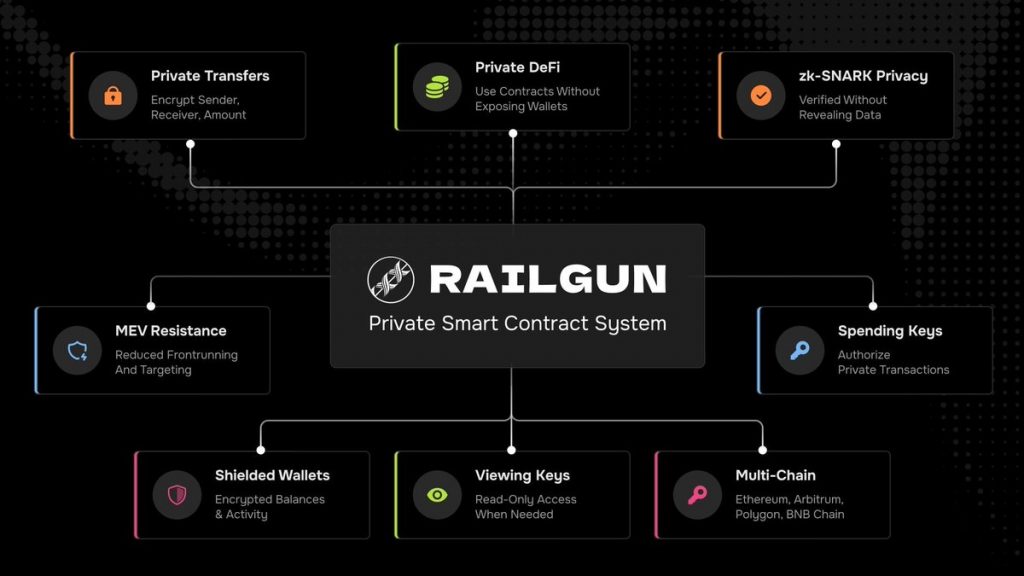
    5. Railgun – Smart contract-powered privacy system

    Railgun is a privacy-focused smart contract system that shields transaction data directly on-chain. It conceals key details such as sender, recipient, token type, and amount using Private Balances, which form a shared anonymity pool.

    Transactions within the Railgun ecosystem appear to originate from this collective pool, making it challenging to determine who initiated a transfer or which assets were used.

    Privacy improves as more users participate, increasing the anonymity set. Popular tokens like USDC or DAI generally provide stronger privacy due to higher usage compared to less common assets.

    Railgun can be accessed through compatible wallets such as Railway Wallet, which supports zk-SNARK-powered private transactions without exposing balances.

    Key features:

    • Shields sender, recipient, token, and amount
    • Uses Private Balances to expand anonymity set
    • Privacy increases with user participation and TVL
    • Accessible via zk-SNARK-enabled wallets

    Are Bitcoin mixers legal?

    In many countries, Bitcoin mixers are not explicitly illegal. However, most do not implement Know Your Customer (KYC) or anti-money laundering (AML) procedures, placing them in a regulatory gray area.

    Unless a service is specifically prohibited, users typically won’t face legal consequences simply for using a mixer. That said, authorities have shut down numerous mixers over the years, and several operators have been arrested.

    While mixers can serve legitimate privacy needs, they are also used by criminals — for example, hackers attempting to launder stolen funds. This association has made them highly controversial.

    Notable enforcement actions include:

    • Bestmixer.io shut down by Europol and Dutch authorities (2019)
    • Bitcoin Fog operator arrested and charged in the U.S. (2021)
    • Tornado Cash sanctioned by OFAC (2022), with sanctions lifted in 2025
    • ChipMixer taken down by U.S. and German authorities (2023)

    Are Bitcoin mixers safe?

    Safety largely depends on the specific service used. Centralized mixers require trust that operators will not misappropriate user funds.

    It’s also important to recognize that mixing does not guarantee perfect anonymity. The effectiveness of privacy measures varies by implementation, and blockchain analysis tools continue to evolve. In some cases, investigators may still trace coins that have passed through mixers.

    Additionally, some cryptocurrency platforms and businesses may flag or restrict wallets associated with mixing services.

    Conclusion: Mixers address Bitcoin’s privacy limitations

    Bitcoin is pseudonymous rather than fully anonymous, and transactions can be traced under close examination. Mixing services aim to make blockchain activity more difficult to analyze, giving users greater financial privacy.

    However, because mixers are sometimes used for illicit purposes, they remain controversial and frequently attract regulatory scrutiny — even in jurisdictions where they are not outright banned.

  • Best Ethereum Mining Apps for Android – Can You Earn ETH on Your Phone?

    Best Ethereum Mining Apps for Android – Can You Earn ETH on Your Phone?

    There are no legitimate Ethereum mining apps on the market, because the Ethereum cryptocurrency does not use mining. Whenever you see a mobile app that promotes itself as a cryptocurrency miner, you should be very careful since mobile phones are not powerful enough to mine cryptocurrency profitably.

    Despite this, there are mobile apps that will allow you to earn some additional ETH either through staking or lending, which are completely legitimate methods of earning ETH rewards. To be clear, you will need to already have some cryptocurrency if you want to grow your ETH holdings in this way.

    We’re featuring 6 Android apps that will help you earn extra ETH without trading or investing additional money.

    Before we continue, however, let’s explain exactly why there are not legit ETH mining apps and why you should stay away from any apps that advertises itself as offering Ethereum mining.

    Are there any legit Ethereum mining apps?

    No, there aren’t any legit Ethereum mining apps. The reason for this is that the Ethereum network does not use mining, but uses a Proof-of-Stake system (staking). Ethereum did use mining in the past, but moved away from it in September 2022, when an upgrade called The Merge introduced a Proof-of-Stake consensus mechanism to replace the old Proof-of-Work consensus mechanism.

    If you see any apps for Android or iOS that advertise themselves as Ethereum mining apps, you can safely disregard them as false advertising. At best, they might offer some other functionality and earn money by displaying ads. At worst, they might be a scam that will ask you to invest your money with promises of Ethereum “mining” rewards.

    We found a handful of applications on the Google Play Store that advertise themselves as Ethereum mining apps. Although most of them have a high rating, a closer inspection quickly reveals that most of the positive reviews are fake, while the negative reviews come from disgruntled users who actually tried the apps. Not only are these apps not actually mining Ethereum, but they often attempt to market completely different products to their users.

    One of the most common user complaints regarding apps that advertise themselves as Ethereum mining apps is that they are trying to sell users a crypto wallet app, which is advertised as giving access to the ETH coins that the users supposedly earned through mining. 

    This is almost assuredly a scam, as there are countless high-quality Ethereum wallets available on the market completely free of charge – there is no good reason for anyone to ever pay for cryptocurrency wallet software.

    Best Android apps to earn ETH

    Now, let’s take a look at 6 Android apps that will allow you to earn ETH legitimately. We have selected a diverse range of high-quality apps that will give you access to Ethereum staking, lending, or both. 

    1. Kraken Pro – Mobile app from one of the world’s safest crypto exchanges
    2. Binance – The leading cryptocurrency exchange in the industry
    3. MetaMask – The gold standard for Ethereum wallets
    4. Coinbase – Popular and reliable cryptocurrency exchange
    5. Trust Wallet – Secure multi-currency crypto wallet
    6. Ledger Live – Earn ETH staking rewards with the added security of a hardware wallet

    1. Kraken Pro – Mobile app from one of the world’s safest crypto exchanges

    Kraken is one of the most well-established cryptocurrency exchanges, as it has been in operation for over a decade. The exchange has earned a very good reputation in the cryptocurrency community thanks to its strong security measures, which have successfully safeguarded users’ funds from crypto wallet hacks or other types of security breaches.

    If you hold ETH, you can easily stake it through the exchange’s Kraken Pro app and start earning staking rewards. The process of staking Ethereum through Kraken Pro is very straightforward, although it does come with a downside – when you stake ETH on Kraken, you can’t access the liquidity of your coins until you unstake. 

    In comparison, some other exchanges allow users to still access the liquidity of their staked ETH through liquid staking tokens or other solutions.

    Overall, Kraken Pro is arguably the best app to use if you hold some ETH and want to earn extra rewards on it.

    2. Binance – The leading cryptocurrency exchange in the industry

    Binance is the top cryptocurrency exchange in terms of trading volume, user count and features. The exchange provides a wide range of services for crypto investors, including Ethereum staking. If you have ETH, you can stake it on Binance to earn passive rewards.

    When you stake ETH on Binance, you receive WBETH tokens, which stand for your staked ETH. Over time, the conversion rate between WBETH and ETH shifts in favor of WBETH to reflect the staking rewards earned by Binance on your behalf.

    To get access to your ETH again, simply redeem your WBETH tokens in exchange for ETH. The amount of ETH you can earn depends on the size and duration of your stake. The larger and longer the stake, the higher the rewards.

    3. MetaMask – The gold standard for Ethereum wallets

    So far, we have highlighted two apps created by centralized cryptocurrency exchanges. While those apps offer a way to earn some extra ETH through staking, they require the user to trust that the exchange will take good care of their funds. Meanwhile, many cryptocurrency investors prefer a more decentralized approach where they have more control over their crypto assets.

    If you want to stake Ethereum in a more decentralized way, you will need a non-custodial Ethereum wallet (a non-custodial wallet is a wallet where the users controls their own private keys). One such option is MetaMask, a highly popular Ethereum wallet that also offers an Android app. 

    MetaMask provides a convenient staking option within its portfolio feature, allowing users to stake their ETH via liquid staking protocols like Lido and Rocket Pool.

    The advantage of using MetaMask over a cryptocurrency exchange is that you maintain control of your private keys and do not need to rely on a third party to secure them. By using liquid staking protocols, you will also get to retain the liquidity of your staked ETH and use it in various decentralized applications.

    4. Coinbase – Popular and reliable cryptocurrency exchange 

    Coinbase is a great cryptocurrency exchange that’s broadly recognized as one of the best options for crypto beginners. It offers an Ethereum staking service which makes it possible for ETH holders to passively grow their holdings through staking rewards. 

    If you have ETH on Coinbase, you can choose to “wrap” your coins and receive cbETH tokens in return. These tokens accrue Ethereum staking rewards, and you can later redeem them to access your ETH again.

    For long-term ETH holders looking to make their idle coins productive, staking through Coinbase is a good option to consider. Staking through Coinbase makes a lot of sense especially if you already have an account with the exchange.

    5. Trust Wallet – Secure multi-currency crypto wallet

    Trust Wallet is a widely used multi-cryptocurrency wallet available as both a browser extension and a standalone desktop application.

    One of Trust Wallet’s key advantages is its support for a broad range of cryptocurrencies, which goes beyond just EVM-compatible blockchains. You can use Trust Wallet to store Bitcoin, XRP, Solana, and many other popular cryptocurrencies.

    The wallet features a user-friendly interface designed for both beginners and advanced users. It allows easy navigation to view portfolio value in your preferred currency, track transaction history, and manage multiple wallets seamlessly.

    Trust Wallet also enables you to securely hold your ETH and participate in liquid staking protocols to earn rewards. Similarly to MetaMask, Trust Wallet is a non-custodial wallet, meaning you retain control of your own private keys.

    6. Ledger Live – Earn ETH staking rewards with the added security of a hardware wallet

    Ledger is the most popular crypto hardware wallet brand in the world, and for good reason. Its devices are relatively affordable while offering a very high level of security for your cryptocurrency holdings. A hardware wallet keeps your private keys offline and uses them to sign transactions securely, which greatly reduces the risk of hacks compared to storing crypto on an internet-connected device.

    By keeping sensitive information offline, Ledger wallets add an extra layer of protection when managing your assets. Transactions are created on your phone or computer but must be physically confirmed on the hardware device itself. This setup ensures that even if your smartphone is compromised, your private keys remain protected.

    If you own a Ledger device such as the Nano S Plus or Nano X, you can use the Ledger Live app on Android to stake your ETH and earn rewards. The app integrates directly with Ethereum staking providers like Lido and Kiln, allowing you to start staking with any amount of ETH while maintaining full control over your private keys.

    The bottom line

    We hope that we’ve clarified why there are no legitimate Ethereum mining apps on the market today. Still, this doesn’t mean that you can’t earn ETH through an app on your phone. You can stake your ETH through a crypto exchange app or use a non-custodial Ethereum wallet such as MetaMask to stake your ETH coins through liquid staking protocols like Lido. 

    If you want to learn more about Ethereum, we invite you to take a look at our article explaining the Ethereum rainbow chart.