Dubai, UAE – February, 2026 – PlanX 2026 will take place on April 27–28, 2026 at the Grand Hyatt Dubai Conference & Exhibition Centre, bringing together more than 3,000 founders, investors, and advisors who want more than a single jurisdiction can provide.
As the global landscape evolves, with rising wealth taxes, tighter financial controls, and geopolitical unrest creating volatility and complexity, individuals and enterprises are seeking new ways to secure freedom, flexibility, and resilient growth.
Many founders operate globally but keep a local setup: one passport, one bank, one entity. This can feel comfortable and stable but fragile in the real world. Then payments get delayed, your bank starts asking new questions, or your government changes the rules overnight. Suddenly you are reacting instead of choosing. PlanX is for building real options before you need them.
PlanX gives you access to a curated room representing $10B+ in capital and enterprise value. Built for clarity and outcomes, it connects high-intent founders with vetted experts and strategic partners you won’t find in public feeds or open networks. Sharper conversations. Direct introductions. Clear next steps, ready to execute.
“Most founders are not underprepared. They are under-structured. When your whole setup lives in one place, small changes create big consequences. You can read theories online. The 1% trades in proximity. PlanX is where you stop guessing and start aligning.” — Frankie Ngo, Founder of PlanX
PlanX will bring together a network of innovators, investors, and advisors across fintech, migration services, offshore structuring, and digital finance, with topics spanning golden visas, offshore banking, crypto and Web3, digital assets, stablecoins, AI, and more. The program will feature over 50 speakers and sessions built around the four pillars of the PlanX Playbook – Citizenship, Compliance, Capital, and Commerce – covering second residency options, asset protection, offshore operations, banking and payments, and compliant tax strategy.
Attendees will also have access to more than 70 exhibitors and curated deal rooms, creating a high-trust environment for networking, deal-making, and real-world collaboration. PlanX uses targeted touchpoints and curated introductions to match high-intent attendees with speakers, partners, and exhibitors, turning conversations into deals and long-term setups.
Dubai is home to over 81,000 millionaires and ranks among the top 20 cities for millionaires globally in 2025, according to the World’s Wealthiest Cities Report 2025 by Henley & Partners.
With its strategic location between Europe, Asia, and Africa, coupled with zero income tax, world-class infrastructure, and pro-business regulation, the UAE provides an ideal setting for PlanX 2026.
“PlanX is more than just a two-day event. Our vision extends into policy, infrastructure, and execution by connecting decision makers, operators, and institutions through year-round content, partnerships, and real-world frameworks.” said Ngo.
OP-ed disclaimer: This is an Op-ed article. The opinions expressed in this article are the author’s own. CoinCheckup does not endorse nor support views, opinions or conclusions drawn in this post and we are not responsible or liable for any content, accuracy or quality within the article or for any damage or loss to be caused by and in connection to it.
XRP is a unique cryptocurrency that has one of the most devoted communities in the crypto and blockchain space. Although it could certainly be a strong performer in the future, it’s practically impossible for Ripple to reach $10,000.
In this article, we will explore potential future price targets for XRP and explain why you shouldn’t expect XRP to ever reach a price of $10,000, or anywhere close to it, for that matter. We will also consult some XRP price predictions to get a better idea of where the price of XRP could head in the near to medium term.
Could Ripple reach $10,000? Here’s why it’s impossible
The reason why XRP won’t ever reach a price of $10,000 is not complicated – the supply of XRP is simply too large. XRP has a maximum supply limit of 100 billion coins. While not all XRP coins are currently in circulation, the coin still has a substantial circulating supply of 60.92 billion.
Even if we take the more conservative figure of 60.92 billion circulating XRP coins, the implied market capitalization if XRP were to trade at $10,000 would be $609.2 trillion.
To illustrate why this figure is impossibly large, we should point out that the GDP of the United States is $25.4 trillion, and the world’s largest company, Nvidia, has a market capitalization of $4.47 trillion.
To draw a comparison from the cryptocurrency space, we can note that the highest market cap ever reached by Bitcoin was $2.48 trillion. If XRP traded at $10,000, its market cap would be 245 times larger than Bitcoin’s market cap at its historical peak.
So, even if XRP became the world’s largest cryptocurrency, it would be extremely unlikely to hit a price of $10,000. The only realistic scenario for that to happen would be a drastic reduction in the XRP supply through a redenomination or a major burn program.
Although a small amount of XRP is already being burned with each transaction, the burn rate is simply not fast enough to decrease the supply to an amount where $10,000 would be a realistic price target for XRP.
The XRP Ledger has been in operation for over a decade, but only about 12.2 million XRP have been burned through this mechanism. This is only 0.012% of the maximum supply of XRP.
Now, let’s consider various XRP price targets and what they would mean for the market capitalization of XRP. This is a good way to quickly gauge whether a certain price target is realistic or not. We calculated the figures both for XRP’s current circulating supply, as well as its max supply.
XRP price
Implied market cap (60.92B XRP)
Implied market cap (100B XRP)
$0.50
$30.46 billion
$50 billion
$1
$60.92 billion
$100 billion
$5
$304.6 billion
$500 billion
$10
$609 billion
$1 trillion
$50
$3.07 trillion
$5 trillion
$100
$6.09 trillion
$10 trillion
$500
$30.7 trillion
$50 trillion
$1,000
$60.9 trillion
$100 trillion
$5,000
$304.6 trillion
$500 trillion
$10,000
$609 trillion
$1 quadrillion
When it comes to speculating about the potential future valuations of altcoins, we believe that using the historical market cap of Bitcoin is the best idea since it’s a benchmark that has already been demonstrated as possible for a crypto asset to achieve.
To reach Bitcoin’s historical market cap peak of $2.48 trillion, XRP would have to trade at a price of $40.7 (assuming the current circulating supply of 60.92 billion XRP coins). We believe that this is the upper bound of what is possible for XRP to achieve, although it’s of course still unlikely, as it would require a 70.2x increase from the current price of XRP, which is $0.58 at the time of writing this article.
XRP price prediction for 2026 & 2027 – How high can XRP go?
According to our XRP price prediction, we can expect to see a decline in the price of XRP in the short term. The forecasted bottom is $1.44, which is expected to be hit towards the end of February 2026.
However, the medium-term prospects are much more promising, at least as far as the price prediction on CoinCheckup is concerned. XRP is forecasted surpass the $2 price level and reach a price of $2.29 in August of 2026. This would represent a 54% increase from the current price of XRP. The forecasted XRP rally is expected to be fairly short-lived, as the coin is predicted to undergo a correction back under the $1.70 mark.
This trend continues heading into 2027, as XRP is expected to continue trading around the $1.80 price level in February 2027.
Will XRP go up?
It’s fair to say that XRP has been displaying an impressive performance in the past year, even when compared to other leading cryptocurrencies. While XRP is yet to improve upon the all-time high it set in early 2018, it came fairly close in July 2025, reaching $3.64.
An important factor that allowed XRP to approach its all-time high is the conclusion of the legal battle between Ripple and the U.S. Securities and Exchange Commission (SEC). The SEC accused XRP of being an unregistered security that Ripple issued and sold, a claim Ripple disputed.
The cloud of regulatory uncertainty hanging over XRP has naturally led to hesitation among some investors about investing in XRP. Additionally, in response to the lawsuit filed by the SEC, numerous cryptocurrency exchanges opted to delist XRP, aiming to sidestep potential regulatory complications.
Despite these challenges, the outlook for XRP might still be optimistic. Should the legal battle conclude in Ripple’s favor, it’s possible that XRP will start building up momentum in the markets.
Of course, we also have to mention fundamental developments that are improving the capabilities of the XRP Ledger.
For example, the Xahau sidechain allows developers to create smart contracts that can interact with objects and balances on the XRP Ledger. This functionality is implemented through a feature called Hooks. Thanks to Hooks, developers can write smart contracts in different programming languages, and the contracts are then compiled into WebAssembly.
In addition, many users might not know that the XRP Ledger now has an AMM (automated market maker) feature. This makes it possible for users to swap between different assets issued on the XRP Ledger, similarly to how Uniswap enables token swaps on the Ethereum blockchain.
The bottom line
Even though you shouldn’t expect Ripple to hit $10,000, XRP could certainly still have a bright future ahead of it. For realistic price targets, the best idea is probably to take a look at the historical market capitalization of Bitcoin and consider how certain XRP price targets would compare to it.
If you want to learn more about the crypto markets, make sure to take a look at our article showcasing the best cryptos to buy now.
Jumper Exchange has launched an upgraded smart routing engine designed to reduce slippage and network fees for users swapping or bridging assets across multiple blockchain networks.
As decentralized finance has expanded across chains such as Ethereum, BNB Chain, Base, and Arbitrum, liquidity has become increasingly fragmented. Traders are often required to compare prices and execution routes across multiple decentralized exchanges and bridge protocols, a process that can result in sub-optimal execution and higher transaction costs. Jumper Exchange said the upgraded routing engine is intended to address this fragmentation by dynamically selecting efficient execution paths at the time of transaction confirmation.
According to the company, the routing engine continuously scans integrated decentralized exchanges and bridge protocols, simulating multiple combinations of pools and routes before a transaction is submitted on-chain. Rather than relying on a single venue, the system can split an order across multiple paths when doing so results in improved aggregate pricing, or avoid pools where limited liquidity would increase price impact.
The upgraded smart routing engine is available through the Jumper Exchange interface at www.jumper.exchange. The company said it plans to continue expanding routing support to additional blockchain networks and assets over time.
For users, routing decisions are handled in the background, while the interface presents a single quote that includes expected slippage and fees. In a typical cross-chain transaction—such as transferring assets from BNB Chain to Ethereum—the engine evaluates multiple route options and selects the path designed to deliver the most favorable effective rate when the transaction is executed.
“Retail and professional users alike are looking for consistency in execution rather than spending time comparing quotes from individual platforms,” said Jordan Neary, Marketing Lead at Jumper Exchange. “Our smart routing engine is built to focus on net outcome—the amount the user actually receives in their wallet after fees and gas—while keeping the experience as simple as a single click.”
Neary added that the upgraded routing system is also intended to make cross-chain trading more accessible for less experienced decentralized finance users. “Many people still see cross-chain swaps as complex or risky because there are so many protocols and bridges to navigate,” Neary said. “By abstracting that complexity away and clearly showing the route and expected output, we want to make it easier for users to feel comfortable moving liquidity wherever they need it.”
The routing logic is combined with additional platform features including support for multiple wallets, non-custodial swaps, and transparent route visualization. Users can review the proposed execution path before confirming a transaction, including the protocols and blockchain networks involved.
Security remains a central consideration for the platform. Jumper Exchange aggregates liquidity from established decentralized exchanges and bridge protocols and does not take custody of user funds at any stage. Assets move directly between user wallets and the underlying protocols throughout the transaction process.
The company also supports gasless transactions on select routes, reducing the need for users to maintain native token balances across multiple networks. For users evaluating options to bridge to Hyperliquid, the routing interface presents route details and expected outputs before execution, allowing users to assess execution paths in advance.
About Jumper Exchange
Jumper Exchange is a cross-chain trading aggregator that enables users to swap and bridge digital assets across more than 50 networks through a single interface. By integrating leading decentralized exchanges and bridges, Jumper Exchange focuses on delivering efficient execution and a simplified multi-chain user experience, while remaining fully non-custodial and permissionless.
Contact
Marketing Lead at Jumper Exchange Jordan Neary Jumper Exchange seoexperiment.agency@gmail.com
George Town, Cayman Islands, February 17th, 2026, Chainwire
Zircuit, a security-first digital asset company backed by YZiLabs, Dragonfly, and Pantera, today announced the launch of Zircuit Finance. Incubated by a team from Quantstamp, Zircuit Finance is a secure platform for institutional-grade strategies, a stablecoin vault designed to generate yield on USDC and USDT, with a stated target range of 8–11% APR, subject to market conditions and variability.
Historically, access to professional asset managers and institutional strategies required significant minimum investments and long lockups. Zircuit Finance removes those barriers with a simplified, cross-chain interface that provides access to institutional-grade yield strategies through a single interface, enabling deposits and withdrawals across multiple chains while supporting diversified exposure.
“The future of DeFi isn’t about chasing the highest yields, it’s about building the most secure foundation for capital to grow,” said Dr. Martin Derka, Co-Founder of Zircuit. “Zircuit’s vault is part of a broader shift to create a more stable, transparent, and trusted on-chain economy where users can move large sums of capital efficiently and safely.”
Zircuit Finance vaults allocate a portion of assets to Monarq Asset Management, which manages regulated institutional-grade arbitrage and delta-neutral strategies. Monarq has a proven track record managing the Monarq Digital Asset Opportunities Fund, and the team includes professionals from Tower Research, LedgerPrime, BlockTower, UBS, and Bank of America.
Zircuit Finance also integrates Fidelity’s tokenized money market fund, Aave, and Morpho for diversified exposure across both regulated and decentralized venues.
Complementing this institutional framework, Zircuit Finance is partnering with Forteus, an FCA-regulated asset management division of the Numeus Group, which is headquartered in Zug, Switzerland, with offices in London and New York. The partnership develops digital asset investment portfolios focused on generating risk adjusted returns on Ethereum and Bitcoin, leveraging Forteus’ investment strategies and institutional risk management capabilities.
Zircuit Finance will also integrate with FalconX as its prime broker and infrastructure provider, enabling institutional-grade execution, custody, and risk management. FalconX, a digital assets prime brokerage, provides a globally recognized institutional platform trusted by leading hedge funds and asset managers. Its infrastructure supports efficient capital deployment and compliance-aligned operations across multiple venues.
The core features of Zircuit Finance include:
Targeting 8–11% APR on USDC and USDT, with multi-chain deposits and withdrawals. The vault maintains a portion of capital for fast withdrawals (often within 24 hours for smaller requests) while deploying the rest to generate yield. Larger requests may take up to 14 days as capital is being withdrawn from deployed strategies.
Cross-chain messaging infrastructure provided by LayerZero technology. This architecture enables secure, omnichain access to vaults and partner strategies across multiple chains, all from a single interface.
“As liquidity flows into DeFi at scale, the platforms that will lead are those delivering both performance and safety while bringing institutional-grade strategies accessible on-chain. Our collaboration with Zircuit Finance reflects Monarq’s commitment to powering that next phase of growth, anchored in deep liquidity, disciplined risk, and operational transparency,” said Shiliang Tang, Managing Partner of Monarq Asset Management.
Zircuit Finance is built by cybersecurity veterans who secured more than $200 billion in assets and conducted over 1,100 audits. The team behind Zircuit Finance brings unmatched security expertise to DeFi, with $3 billion in TVL previously staked through the Zircuit Staking program.
Zircuit Finance is now open for deposits. Additional information on depositing USDC and USDT is available at finance.zircuit.com.
ABOUT ZIRCUIT
Zircuit is a security-first digital asset company founded in 2022 by experts from Quantstamp. Zircuit builds secure onchain products designed to help users deploy capital safely and efficiently. Backed by deep cybersecurity expertise, the team has secured over $200 billion in assets and conducted more than 1,100 audits. Zircuit Finance is the company’s institutional-grade platform offering yield on stablecoins and major digital assets.
Disclosure: Zircuit Finance vaults are not bank accounts or insured deposits. Yields are variable and not guaranteed. Participation may be subject to digital asset risk, including smart contract and market volatility. Users should conduct their own due diligence before investing. Past performance is not indicative of future results.
Contact
Head of Communications Jennifer Zheng Zircuit jen@zircuit.com
Bitcoin mining stocks can be an interesting option for the portfolio of investors that are bullish on cryptocurrency. These stocks provide an alternative way of gaining exposure to Bitcoin, and can even outperform BTC in certain contexts.
The 6 best Bitcoin mining stocks to invest in 2026:
CleanSpark – A Bitcoin miner focused on low-carbon energy sources
Riot Blockchain – A major Bitcoin miner with a fleet of over 100,000 miners
Cipher Mining – A Bitcoin mining company launched by Bitfury
Core Scientific – A Bitcoin miner that has re-emerged from bankruptcy
Hut 8 Mining – A diversified Bitcoin mining company with strong infrastructure
Exploring the top 6 Bitcoin mining stocks in 2026
As the next Bitcoin halving approaches, the subject of Bitcoin mining is likely to get a significant boost in exposure. Therefore, it’s important to stay up to date with the latest developments in the Bitcoin mining industry.
Without further ado, let’s explore our list of the best Bitcoin mining stocks in 2026. We’ve focused on Bitcoin mining companies that are publicly traded in the United States, which makes it possible for any US investor to invest in them.
1. Marathon Digital Holdings – The biggest US-listed Bitcoin miner
Marathon is a major United States-based Bitcoin mining company, sporting 28.7 EH/s of operational hash rate as of February 17, 2026. Marathon’s mining fleet, which is distributed across 11 mining facilities, has an impressive efficiency of 18.6 J/TH.
The company is listed on the NASDAQ stock exchange under the ticker MARA. As of February 2026, Marathon has a market capitalization of roughly $2.82 billion, which makes it the most valuable US-listed Bitcoin mining company.
Marathon is also notable for the significant Bitcoin holdings in its treasury. As of October 2, 2025, Marathon owned 52,850 BTC, which translates to $3.58 billion at the current Bitcoin price ($67,700).
In March of 2024, Marathon unveiled a new two-phase immersion cooling system for data centers called MARA 2PIC700.
Ticker
MARA
Stock price
$7.55*
Location
United States
Hashrate
66.5 EH/s (Feb 2026)
*As of February 17, 2026.
2. CleanSpark – A Bitcoin miner focused on low-carbon energy sources
CleanSpark is a United States-based Bitcoin mining company that places an emphasis on mining with the use of low-carbon energy sources such as wind, solar, nuclear, and hydro power.
The company is fostering a sustainable energy framework by buying premium renewable energy credits and connecting to low-carbon power sources on the grid.
The company mines Bitcoin across 9 operations, primarily in the Southern part of the United States. CleanSpark owns and operates 8 mining operations and uses co-location services offered by one mining operation.
CleanSpark is publicly traded, as it’s listed on the NASDAQ stock exchange under the ticker CLSK. At the time of writing, CleanSpark has a market cap of $2.41 billion.
As of January 2026, CleanSpark had 133,963 ASIC miners in its fleet, and achieved an efficiency of 16.1 J/TH. The company’s fleet had a hashrate capacity of 50.0 EH/s. The company also had Bitcoin holdings of over 13,500 BTC.
Ticker
CLSK
Stock price
$16.93*
Location
United States
Hashrate
16.4 EH/s (Mar 2024)
*As of February 17, 2026
3. Riot Blockchain – A major Bitcoin miner with a fleet of over 100,000 miners
Riot Platforms, previously known as Riot Blockchain, is one of the leading Bitcoin mining entities in the United States, boasting more than 100,000 ASIC miners. The company has demonstrated a consistent ability to generate profit and has been on a fast track of expansion.
In addition to mining Bitcoin with their own ASIC miners, Riot Blockchain also provides infrastructure for Bitcoin mining and data center hosting. This is particularly aimed at institutional clients, facilitated through its inaugural large-scale Bitcoin mining center located in Rockdale, Texas.
This facility boasts a total developed capacity of 1.2 gigawatts, showcasing Riot Blockchain’s commitment to supporting the broader Bitcoin mining ecosystem and its scalability for institutional needs.
Riot has a purchase agreement with ASIC miner manufacturer MicroBT through which the company has purchased 8,320 M56S++ miners and 24,960 M56S++ miners.
Ticker
RIOT
Stock price
$14.49*
Location
United States
Hashrate
30.8 EH/s (Nov 2024)
*As of February 17, 2026
4. Cipher Mining – A Bitcoin mining company launched by Bitfury
Cipher Mining is a Bitcoin mining company in the US that’s focused on operating data centers used in Bitcoin mining and strengthening the infrastructure powering the Bitcoin network. Cipher Mining is a subsidiary of Bitfury.
As of June 2025, Cipher Mining had roughly 70,000 deployed mining rigs and an operating hash rate of 16.8 EH/s. This allowed the company to mine 234 BTC during the month.
Cipher Mining is listed on the NASDAQ, where it trades under the ticker CIFR. The company has a relatively small market capitalization of $6.09 billion, which could make it a compelling option for those who want to invest in a smaller Bitcoin mining company.
Ticker
CIFR
Stock price
$15.37*
Location
United States
Hashrate
16.8 EH/s (July 2025)
*As of February 17, 2026
5. Core Scientific – A Bitcoin miner that has re-emerged from bankruptcy
Core Scientific is a Bitcoin mining company founded in 2017. The company is listed on the NASDAQ stock exchange, trading under the ticker symbol CORZ.
Core Scientific operates 6 data centers across the United States. Besides using the data centers to mine Bitcoin, the company also offers premium hosting services.
Core Scientific has a market capitalization of $5.48 billion, which makes it one of the bigger US-listed Bitcoin mining companies in terms of market cap.
It’s worth noting that Core Scientific filed for bankruptcy in December of 2022, citing low Bitcoin prices and surging energy costs, among other factors. However, the rising Bitcoin prices in 2023 allowed the company to re-emerge from bankruptcy. In January of 2024, Core Scientific received approval to exit bankruptcy and implement a restructuring plan.
Ticker
CORZ
Stock price
$17.67*
Location
United States
Hashrate
18.1 EH/s (March 2025)
*As of February 17, 2026
6. Hut 8 Mining – A diversified Bitcoin mining company with strong infrastructure
Hut 8 Mining (HUT) is a Canada-based Bitcoin mining company operating a fleet of more than 115,000 ASIC miners. The company is considered well-positioned ahead of the next halving thanks to its solid balance sheet and strong gross margins. Hut 8 has also been broadening its geographic footprint, expanding into markets such as the United States and Germany.
In 2025, Hut 8 is expected to acquire up to four natural gas–powered power plants in Canada with a combined capacity of 310 megawatts (MW). The company also plans to purchase a new mining site from Validus Power Corp. These developments follow its merger with US Bitcoin Corp., which was completed in December 2023. CEO Jaime Leverton said the acquisitions align with Hut 8’s infrastructure-first strategy and provide the company with added flexibility heading into the halving.
In November 2024, Hut 8 revealed plans to modernize its ASIC fleet by ordering 31,145 BITMAIN Antminer S21+ units at $15.00 per terahash, with delivery scheduled for early Q1 2025. The upgrade is expected to increase the company’s self-mining capacity by roughly 3.7 EH/s.
Ticker
CORZ
Stock price
$17.67*
Location
United States
Hashrate
18.1 EH/s (March 2025)
*As of February 17, 2026
The bottom line
In 2023, the Bitcoin mining industry experienced significant growth, with many leading companies in the sector witnessing their values more than double over the course of the year. Although the Bitcoin halving will decrease the amount of BTC earned by miners, it could also help boost the price of BTC, which would work in favor of mining companies.
If you want to explore deeper into the world of investing, make sure to check out our article comparing crypto vs stocks.
ISO 20022-compliant cryptocurrencies could benefit substantially in the future. They will be prime candidates for financial institutions looking to expand their offerings with the unique advantages offered by blockchain technology. Our ISO 20022 crypto list will help you identify the best cryptocurrencies that comply with the ISO 20022 standard.
In this article, we are going to explain what ISO 20022 is in simple terms and go over cryptocurrencies that are currently compliant with the standard.
Key takeaways:
The ISO 20022 standard streamlines data interchange between financial institutions, enhancing automation, reducing errors, and improving cash flow visibility.
As of the latest reports, about 26.4% of banks have achieved ISO 20022 compliance, with others required to comply by November 2026.
Cryptocurrency companies that have adopted the ISO 20022 standard, like XRP and Stellar, offer easier integration with financial systems and potential industry adoption.
The adoption of ISO 20022 in cryptocurrency projects like Algorand, Quant, and Hedera enhances compatibility with traditional finance, fostering wider acceptance and technological integration.
What is ISO 20022?
According to SWIFT, ISO 20022 is a methodology for standardizing the interchange of data between financial institutions. ISO 20022 can be used in various areas, including the clearing and settlement of payments, trading and settlement of securities, cash management, account management, and more.
In essence, ISO 20022 addresses the problem of financial institutions using different formats and protocols for electronic data, which leads to inefficiencies. By adopting ISO 20022, financial institutions can cut costs, reduce the likelihood of errors, and reduce the complexity of data interchange.
Here are some of the main benefits of the ISO 20022, according to SWIFT:
“Thanks to its structured and richer data elements, ISO 20022 enables counterparties, intermediaries, and beneficiaries to increase automation in transaction processing, reducing costly manual interventions, and improving visibility on cash flows and cash positions, for example, in payment transactions.”
The benefits of adopting ISO 20022. (Source: JPMorgan)
It is important to highlight that not all institutions have fully implemented the prerequisites for ISO 20022 readiness. As reported by The Banker last year, approximately 26.4% of banks have achieved ISO 20022 compliance.
For those institutions that have yet to undertake the essential measures to attain ISO 20022 compliance, they will have until 2026 to make the necessary adjustments.
The best ISO 20022-compliant cryptos
Some cryptocurrencies have been designed with the ISO 20022 standard in mind so that they can potentially be integrated into broader financial systems more easily. When we say that a digital asset is an ISO 20022 crypto, we mean that it incorporates messaging language as defined in the ISO 20022 standard, allowing for simpler data exchange between its blockchain and other financial systems such as SWIFT.
ISO 20022 coins could have a head start when it comes to adoption in the financial services industry, as they will be much easier for companies to integrate than cryptocurrencies that weren’t designed with this standard in mind.
Below, you’ll find a list showcasing the ISO 20022-compliant cryptos:
XRP – Highly efficient cryptocurrency suitable for cross-border payments
Stellar – Fast and cost-effective blockchain with built-in DEX
Algorand – Pure Proof-of-Stake blockchain with smart contracts
Cardano – Research-driven blockchain with a focus on scalability, security, and sustainability
XDC Network – Hybrid blockchain optimized for enterprise and trade finance applications
Quant – Platform enabling interoperability between blockchains
Hedera Hashgraph – A highly efficient DLT based on Hashgraph architecture
Coreum (COREUM) – A blockchain specialized for RWA tokenization and smart tokens
1. XRP – Highly efficient cryptocurrency suitable for cross-border payments
XRP is a cryptocurrency that uses a unique consensus algorithm called the XRP Ledger Consensus Protocol to provide extremely fast and cost-effective transactions. This makes it suitable as a bridge currency that can enable liquidity between different fiat currencies.
While the XRP Ledger doesn’t offer advanced smart contract functionality, the platform is optimized for payments and can offer the performance and efficiency that are required by global financial institutions.
The main entity spearheading the development of the XRP ecosystem is Ripple, a United States-based company that uses XRP in its cross-border payments products. Ripple is part of the ISO 20022 Standards Body and was the first blockchain-focused company to join it. By adopting the ISO 20022 standard, Ripple can offer its RippleNet solution to a broader range of customers.
XRP summary:
A distributed ledger using the XRP Ledger Consensus
XRP can handle 1,500 transactions per second
Transactions cost fractions of a cent
Ripple has partnerships with numerous leading financial institutions
2. Stellar – Fast and cost-effective blockchain with built-in DEX
Stellar is a cryptocurrency that was initially launched as a modified version of XRP. One of the co-founders of Stellar is Jed McCaleb, who also played a role in the creation of XRP. The Stellar blockchain also offers extremely fast and efficient transactions.
The Stellar blockchain can be used to make transactions with the platform’s native currency, XLM, but it also offers built-in decentralized exchange functionality to seamlessly swap between the different assets issued on the Stellar blockchain.
Given its emphasis on interoperability between financial institutions, Stellar is poised to readily embrace the ISO 20022 standard. Through the integration of ISO 20022, Stellar will enable more efficient cross-border transactions and foster improved communication with conventional financial systems. XLM is poised to become one of the leading ISO 20022 tokens on the market.
Stellar summary:
A cryptocurrency with similar properties to XRP
Built-in decentralized exchange feature
Useful for cross-border payments and stablecoins
Smart contracts functionality through the Soroban platform
3. Algorand – Pure Proof-of-Stake blockchain with smart contracts
Algorand is a blockchain platform that supports smart contracts and employs a sophisticated Proof-of-Stake consensus algorithm that allows all ALGO holders to participate in the consensus process. The Algorand project was founded by renowned computer scientist Silvio Micali.
The Algorand mainnet made its debut in 2019. Since then, Algorand has seen multiple enhancements, including improved smart contract functionalities and the capacity to support custom tokens, among other features. Algorand is intentionally structured to be an environmentally conscious and highly efficient blockchain and offers some of the lowest transaction fees among all cryptocurrencies.
Through the incorporation of the ISO 20022 standard, Algorand has the potential to improve its compatibility with conventional financial systems, enabling effortless integration with pre-existing infrastructure.
This could lead to wider adoption of Algorand’s technology, potentially attracting a greater number of developers and enterprises to engage with and build upon the platform.
Algorand summary:
Pure Proof-of-Stake blockchain
Supports smart contracts and custom tokens
Very low transaction fees
Environmentally friendly
4. Cardano – Research-driven blockchain with a focus on scalability, security, and sustainability
Cardano is a blockchain platform built on rigorous academic research and a layered architecture to enhance scalability, security, and sustainability. Developed by IOHK and led by Ethereum co-founder Charles Hoskinson, it aims to provide an efficient and sustainable blockchain ecosystem for enterprises and individuals.
Cardano’s Ouroboros Proof-of-Stake (PoS) consensus ensures energy efficiency while maintaining high security. Its dual-layer architecture separates ADA transactions from smart contract execution, enabling flexibility and scalability. The Plutus smart contract platform and Hydra layer-2 solution further boost network efficiency and adoption potential.
By aligning with ISO 20022, Cardano strengthens its compatibility with financial systems, making it a strong candidate for integration into traditional banking and enterprise applications.
Cardano summary:
Proof-of-Stake blockchain with a research-driven approach
Scalable and energy-efficient, designed for long-term sustainability
Layered architecture enables seamless upgrades and enhanced security
Supports smart contracts through the Plutus platform
Hydra scaling solution to significantly boost transaction speeds
ISO 20022 integration enhances interoperability with financial systems
5. XDC Network – Hybrid blockchain optimized for enterprise and trade finance applications
XDC Network (XinFin Digital Contract) is a hybrid blockchain that merges public and private architecture, making it ideal for enterprises and institutions. It is specifically designed to enhance trade finance, supply chain operations, and cross-border settlements with fast, secure, and cost-effective transactions.
Using a Delegated Proof-of-Stake (DPoS) consensus, XDC Network ensures high throughput, low latency, and minimal energy consumption. Transactions settle in two seconds, with fees significantly lower than Ethereum.
A key advantage of XDC Network is its ISO 20022 compliance, enabling seamless integration with banks and financial institutions. It supports smart contracts, tokenization, and interoperability with legacy systems, facilitating real-world financial applications.
As trade finance digitizes, XDC Network stands out as a fast, transparent, and regulatory-compliant blockchain, bridging blockchain technology with traditional finance.
XDC Network summary:
Hybrid blockchain that combines public and private blockchain features
Optimized for enterprise and trade finance applications
Delegated Proof-of-Stake (DPoS) ensures fast and energy-efficient transactions
Finality within two seconds and low-cost transactions
ISO 20022-compliant, making it bank-friendly and interoperable with financial institutions
Supports smart contracts, tokenization, and seamless integration with legacy financial systems
6. Quant – Platform enabling interoperability between blockchains
Quant is a blockchain platform that enables interoperability and establishes seamless connections among multiple blockchain networks. It relies on the Overledger protocol to facilitate the exchange of information between different blockchain ecosystems. The Quant platform enables collaboration and innovation, empowering developers and enterprises to launch decentralized applications that can interact with a multitude of blockchains.
Through the adoption of the ISO 20022 standard, Quant aspires to boost its compatibility with traditional financial systems, streamlining the secure exchange of data across various networks. Achieving ISO 20022 compliance could position Quant in a pivotal role, bridging the divide between various blockchain platforms and strengthening its role in the blockchain ecosystem.
Quant summary:
Blockchain focused on enabling interoperability
Allows developers to launch mDApps, which are decentralized applications that function with multiple blockchains
Supports a variety of blockchains, including the likes of Bitcoin, Ethereum, and XRP
Designed for financial institutions and SMEs
7. Hedera Hashgraph – A highly efficient DLT based on Hashgraph architecture
Hedera Hashgraph is a decentralized network that provides functionality similar to blockchains but is based on an innovative architecture called a hashgraph. Hashgraph provides an alternative and arguably superior way to achieve distributed consensus.
The platform offers transaction fees as low as $0.001, and transactions on Hashgraph achieve finality in between 3 to 5 seconds. According to Hedera Hashgraph’s development team, the platform can facilitate upwards of 10,000 transactions per second.
The Hedera Hashgraph platform supports smart contracts that are compatible with the Ethereum Virtual Machine, making it a suitable platform for developers who are accustomed to building with the Ethereum ecosystem’s smart contract tools.
Through its adoption of the ISO 20022 standard, Hedera aims to bolster its compatibility with conventional financial systems, enabling the smooth integration of decentralized applications (dApps) with the pre-existing infrastructure.
Hedera Hashgraph summary:
Distributed ledger based on Hashgraph technology
Can process over 10,000 transactions per second
EVM-compatible smart contracts
Low fees, transactions achieve finality in 3-5 seconds
8. IOTA – DAG-based network for IoT use cases
IOTA is another distributed ledger platform that forgoes the traditional blockchain architecture in an effort to achieve superior scalability. In the case of IOTA, the platform is built using a directed acyclic graph (DAG) architecture, which allows it to support zero-fee transactions. IOTA’s DAG network is called the Tangle.
The network’s immense efficiency makes IOTA a suitable candidate for Internet of Things (IoT) applications where handling large amounts of data in a short period of time is of the utmost importance.
By incorporating the ISO 20022 standard, IOTA strives to establish a framework for standardized and secure data transfers among Internet of Things (IoT) devices. This strategic choice aims to facilitate the effortless integration of IOTA into the wider IoT ecosystem, ensuring a consistent and secure flow of data among IoT devices.
IOTA summary:
Distributed ledger platform based on a DAG architecture
Fee-free transactions
Suitable for IoT applications
Can handle around 1,000 transactions per second
9. Coreum (COREUM) – A blockchain specialized for RWA tokenization and smart tokens
Coreum is a high-performance layer 1 blockchain built with the Cosmos SDK, focused on real-world asset tokenization, decentralized applications, and programmable digital assets. Powered by the Tendermint consensus engine and WebAssembly smart contracts, it delivers higher throughput and lower latency compared to many older networks. A key innovation is its Smart Tokens, which allow developers and businesses to create customizable, programmable assets with built-in logic and controls.
The project launched in 2021, founded by Dubai-based entrepreneurs Bob Ras and Rezza Bashash. Coreum places a strong emphasis on interoperability, including integration with the XRP Ledger through a dedicated bridge. The network’s native token, COREUM, is used for staking, transaction fees, and governance. A large portion of the initial supply was distributed to the community through airdrops and incentive programs.
Coreum summary:
WebAssembly smart contracts enable fast, secure, and flexible dApp development
Smart Tokens support advanced asset issuance with programmable features and compliance controls
Built on Cosmos for scalability, performance, and modular design
Cross-chain connectivity through IBC and custom bridges enhances interoperability
The bottom line
We hope that our ISO 20022 crypto list helped you understand the ISO 20022 standard and how it relates to the cryptocurrency space. As we can see, the list of ISO 20022-compliant crypto tokens mostly consists of projects targeting enterprise use.
Many of the coins featured on this list feature extremely low transaction fees, which allows them to be used in enterprise-grade applications that require handling an extremely large number of transactions in a short period of time. To learn more about this topic, make sure to check out our list of the cheapest cryptos to transfer.
The cryptocurrency market’s unpredictability and volatility make it a fascinating option for day trading, which is an approach where traders make multiple trades within a single day in an attempt to capitalize on short-term price movements.
We’ve analyzed the crypto market to find the best cryptos to day trade. When selecting the best day trading cryptocurrencies, we considered a number of factors, including but not limited to liquidity, volatility, market cap, and availability on cryptocurrency exchanges.
What should you look for in a day trading crypto?
Day trading is very different from traditional investing, and the qualities of a good day trading asset don’t necessarily align with the qualities of an asset that’s suitable for long-term investing.
However, there’s still quite a bit of overlap between many of the best cryptos to day trade and the cryptocurrencies with the strongest fundamentals, as they tend to have the most liquidity and can be traded with a broad variety of instruments such as futures and options in addition to standard spot trading.
Here are some of the qualities that you want to be on the lookout for when choosing the best cryptos to day trade:
Volatility: Volatility is important for day traders, as a volatile market provides more opportunities for day traders to benefit from short-term price swings.
Liquidity: When trading a cryptocurrency with deep liquidity and strong trading volume, your orders will be executed quickly and you won’t lose money due to slippage.
Trading products: Trading products such as futures contracts and options unlock new strategies for day traders
Availability on exchanges: A cryptocurrency that’s listed on many exchanges will have a more robust market, and you’ll also be able to trade it regardless of which exchange you have an account on.
Market cap: Trading a cryptocurrency with a significant market capitalization is safer, and will reduce the chances of sudden crashes triggered by negative news or technical issues.
Based on these factors, we’ve selected the following coins as the best cryptos to day trade:
Market cap
Average daily volume over last 30 days
30-day volatility
Exchange listings
Bitcoin
$1.36 trillion
$68.5 billion
12.17%
141
Ethereum
$238 billion
$43.9 billion
18.44%
141
XRP
$89.1 billion
$6.12 billion
13.9%
142
Solana
$48.5 billion
$9.66 billion
18.9%
126
Litecoin
$4.23 billion
$849 million
11.26%
131
Polygon
$1.14 billion
$157 million
13.3%
106
Chainlink
$6.24 billion
$717 million
16.1%
162
Dogecoin
$16.78 billion
$2.59 billion
12.1%
134
Data as of February 17, 2026.
The best cryptos to day trade
Now that we know what to look for when it comes to cryptocurrencies that are suitable for day trading, let’s get right to our list of the best cryptos to day trade.
1. Bitcoin
Bitcoin is a great cryptocurrency to day trade, as it has very strong liquidity while still displaying the kind of volatility that day traders are looking for in the cryptocurrency markets. In addition, there is a huge selection of different products for trading Bitcoin, including various types of futures contracts and options.
In addition to spot markets, you can trade Bitcoin using perpetual futures contracts and standard futures contracts, and there’s a broad range of options available when it comes to settlement.
BTC is by far the most liquid cryptocurrency (if we exclude the USDT stablecoin). In February of 2026, Bitcoin has been seeing $68.5 billion in daily trading volume on average while the next closest competitor, Ethereum, had $43.9 in average daily volume during the same period.
2. Ethereum
Ethereum is the second-largest cryptocurrency by market capitalization, and the second most liquid as well. Over the last 30 days, Ethereum has had a similar volatility profile to Bitcoin, although February 2026 has admittedly been a very high volatility period for crypto market standards.
ETH is a highly liquid cryptocurrency that’s listed on practically all crypto exchanges, and the project has an extremely strong community of both users and developers that ensures it will remain a relevant player for years to come.
One particularly interesting aspect of ETH is that there’s a variety of decentralized applications and protocols that can potentially unlock new trading strategies. For example, it’s possible to use ETH as collateral to borrow DAI stablecoins on the MakerDAO platform, which can be a way of accessing leverage. It’s also possible to trade ETH derivatives directly on the blockchain thanks to protocols such as dYdX and GMX.
3. XRP
XRP is a unique cryptocurrency that offers very fast transactions and low fees, which makes it suitable for cross-border transactions and other types of transactions where traditional payments systems display a lot of inefficiency.
The XRP cryptocurrency is closely related to the fintech company Ripple, which develops XRP-based products for financial institutions such as banks and payments providers.
The connection between XRP and Ripple has its positives and negatives. While Ripple is the key player driving the development of the XRP ecosystem, Ripple’s involvement with XRP has sparked concerns about decentralization, and there’s an open question of whether XRP is a security issued by Ripple or not.
4. Solana
Solana is a blockchain with smart contracts support and extremely efficient transactions. Solana’s native asset SOL has become a mainstay of the cryptocurrency top 10, and Solana is considered as one of the most credible competitors/alternative to Ethereum, which is currently the undisputed king of blockchain-based smart contracts.
The markets for SOL are extremely active, as the coin has been displaying $9.66 billion worth of trading volume on average in the last 30 days. This is very impressive considering that the market capitalization of SOL is $48.5 billion. Combined with its 30-day volatility of 18.9%, Solana is definitely worth exploring for those who are looking for new cryptocurrencies to day trade.
5. Litecoin
Litecoin is one of the most established “altcoins”, as it has been on the scene since 2011. LTC is similar to Bitcoin in many ways, but is designed to be more useful for day-to-day transactions. Crypto community members often say that Litecoin is the silver to Bitcoin’s gold.
Litecoin is a solid choice for crypto day traders, as it has relatively deep liquidity, a lot of exchange listings, and a variety of futures trading products. In the last 30 days, it has seen more volatility than BTC.
In comparison to Bitcoin, Litecoin has a 4 times faster block time, 4 times larger supply, and a different hashing algorithm. Litecoin transactions are generally cheaper and faster than Bitcoin transactions, which makes LTC a popular option among merchants accepting crypto.
6. Polygon
Polygon is a project that’s creating scalability solutions based on Ethereum. The project’s flagship product is the Polygon PoS platform, which is an Ethereum-compatible blockchain that offers much lower fees and faster transactions to users.
The POS token is used as the native token across the platforms developed by Polygon. The token has strong liquidity, with an average daily trading volume of $157 million in the last 30 days. Those who are looking to trade POS with leverage have access to a variety of POS futures products on crypto exchanges like Binance.
7. Chainlink
Chainlink is a blockchain project that’s building a variety of web3 services, most notably oracles that allow on-chain smart contracts to be connected to reliable real-world data sources.
The Chainlink decentralized oracle network acts as a bridge between blockchain smart contracts and external data sources, APIs, and payment systems. It enables smart contracts to access and interact with real-world data, making them more versatile and capable of executing a wide range of applications beyond the blockchain.
The Chainlink team has also released CCIP (cross-chain interoperability protocol), a protocol that allows different blockchain platforms to interoperate.
Chainlink’s LINK token has high liquidity, strong exchange support, and relatively high volatility, which makes it worth exploring for day traders.
8. Dogecoin
Dogecoin is one of the most well-known cryptocurrencies on the market, originally launched in 2013 as a lighthearted alternative to Bitcoin. Despite its origins as a meme coin, DOGE has grown into a large-cap crypto asset with deep liquidity and strong exchange support, making it a viable option for short-term traders.
DOGE is based on Litecoin’s code and uses the same Scrypt hashing algorithm. It features fast block times and very low transaction fees, which makes it suitable for small payments and tipping. Unlike Bitcoin, Dogecoin does not have a hard supply cap, as new coins are continuously issued through mining.
The markets for DOGE are highly active, with strong spot liquidity and a wide selection of perpetual futures products available on major exchanges. Dogecoin is known for experiencing sharp price movements during periods of heightened social media attention, which can create attractive volatility conditions for day traders.
The bottom line
We hope that our selection of the best day trading cryptos has helped you identify which crypto assets are worth your time if you’re pursuing a day trading strategy in the cryptocurrency market.
If you’re looking to invest in crypto instead of day trading it, our article featuring the best cryptocurrencies to buy right now can get you started in the right direction.
At a time when much of the blockchain industry is still recovering from one of its harshest downturns, a small number of companies are quietly moving in the opposite direction: expanding, building, and positioning themselves for the next era of adoption.
Public Masterpiece, a Cyprus-based real-world asset tokenization company, has announced PMT Chain, its own purpose-built Layer 1 blockchain. Alongside the announcement, the company confirmed a strategic repositioning: PMT, once short for Public Masterpiece Token, will now stand for Public Masterpiece Technology.
The timing is notable. Crypto did not simply experience a correction, but a $1.1 trillion stress test that dismantled inflated narratives and exposed weak token models. Many projects will not return.
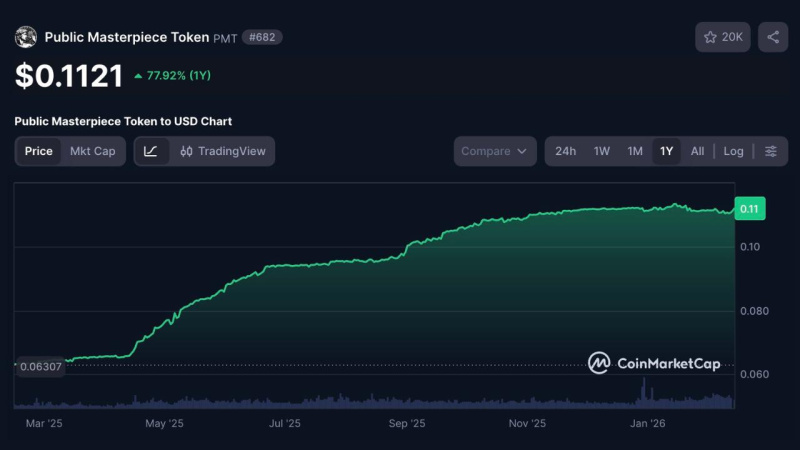
Public Masterpiece is positioning itself as one of the exceptions. Even before revealing its Layer 1 ambitions, the company built traction through its Layer 2 presence on BNB Chain. Over the past 12 months, PMT has reportedly increased in price by 75%, outperforming 86% of the top 100 crypto assets, including Bitcoin and Ethereum, while trading above its 200-day moving average and remaining near its all-time high.
CoinMarketCap Screenshot of the Public Masterpiece Token Chart as of 13.02.2026
PMT Chain is designed specifically for real-world asset tokenization, with the company positioning the network as infrastructure for internationally renowned museums, galleries, private collectors, and global brands seeking secure and transparent certification solutions.
At the center of the ecosystem will be a Certification Hub in the UAE, staffed by evaluators, art experts, and historians. The goal is to establish an international framework for authenticating and evaluating physical artworks on-chain, addressing long-standing issues such as forgery, provenance manipulation, and the illegal trafficking of art, artifacts, collectibles, and historical goods.
CEO Kamran Arki described the mission with clarity:
“The last market cycle proved one thing: narratives collapse when foundations are weak. PMT Chain was built for real-world value and long-term trust. Museums, collectors, and brands need transparency, security, and permanence. That is exactly what we engineered.”
Public Masterpiece revealed that PMT Chain has been built over seven years, with five years dedicated solely to research and development, a timeline that stands in sharp contrast to the rapid-launch culture of the blockchain sector.
COO Garen Mehrabian emphasized the broader responsibility behind the project:
“Web3 will not reach mass adoption if it feels like a casino. Builders have the responsibility to create systems people can trust and understand. We didn’t build PMT Chain to ride a wave. We built it to create an ecosystem that survives every wave.”
Public Masterpiece Keynote Presentation at the main Stage of the RWA BUILDERS SUMMIT 2025
While art remains the cultural foundation, Public Masterpiece confirmed that PMT Chain is designed to scale beyond it, including real estate tokenization and broader RWA deployment. The network will also offer white-label tokenization and certification solutions, enabling institutions and companies to integrate blockchain infrastructure without building their own systems from scratch.
Perhaps most notably, Public Masterpiece confirmed that several governments are already in discussions regarding PMT Chain implementation. No names have been revealed, and the company has not announced a launch date. While the blockchain is reportedly ready, the founders have stated it will go live only when the timing is strategically optimal.
In a market where speculation has been punished and confidence is scarce, Public Masterpiece is betting that the next era of blockchain adoption will be defined by infrastructure, not hype.
About Public Masterpiece
Public Masterpiece is a real-world asset tokenization company building blockchain infrastructure designed to support tokenization, certification, and provenance for physical value across art and broader real-world asset markets.
Bitcoin’s drop below the $60,000 level has once again placed volatility at the center of crypto market discussions. Yet among institutional participants, the reaction appears less focused on short-term price pressure and more on how the industry continues to mature beneath the surface.
That underlying shift was evident in Hong Kong this week, where KuCoin Institutional hosted its first Premiere 2026 gathering. The event convened more than 100 institutional clients and partners from across global markets, offering a forum to discuss how digital asset infrastructure is evolving during a subdued cycle.
While previous market rallies often framed institutional adoption around growth metrics and expanding allocations, the tone in Hong Kong reflected a recalibration. Executives and institutional representatives spoke less about upside momentum and more about durability, governance, and operational standards.
In his address, KuCoin CEO BC Wong emphasized that credibility in digital assets is not forged during bull markets but tested during periods of contraction.
“Volatility is a natural feature of digital asset markets. Long-term credibility is built not in periods of expansion, but through discipline, transparency, and robust risk management when market conditions are challenging.” — KuCoin CEO BC Wong
The message underscored a broader industry transition. Institutional engagement, once heavily correlated with price appreciation, is increasingly tied to structural considerations such as compliance alignment, liquidity management, counterparty evaluation, and security oversight.
KuCoin COO Ethan Cheng pointed to this change as a defining characteristic of the current cycle.
“Institutional engagement in digital assets is increasingly driven by structural fundamentals rather than short-term price movements. Periods of volatility reinforce the importance of long-term alignment and risk-aware participation.” — KuCoin COO Ethan Cheng
Throughout the evening, conversations among attendees centered on how institutions are refining internal frameworks for digital asset exposure. Portfolio construction, execution efficiency, liquidity fragmentation, and custodial safeguards featured prominently in discussions. Participants exchanged perspectives on how to balance opportunity with prudence in an environment where price swings remain pronounced.
The setting itself carried symbolic weight. Hosting an institutional-focused event amid uncertain market conditions signaled continuity rather than retreat. By maintaining engagement during a quieter phase of the cycle, KuCoin Institutional positioned itself within a segment of the industry that views downturns as opportunities to strengthen foundations rather than pause development.
Market observers note that such gatherings increasingly reflect crypto’s convergence with traditional finance norms. In legacy markets, downturns often catalyze improvements in governance, reporting standards, and risk oversight. A similar pattern now appears to be emerging in digital assets.
Bitcoin’s sub-$60K move may dominate headlines, but the discussions in Hong Kong suggested a longer-term reorientation. Institutional players are less inclined to chase momentum and more focused on ensuring that infrastructure, transparency, and operational controls can withstand prolonged volatility.
As digital assets continue to integrate into global financial systems, the durability of institutional frameworks may prove more consequential than short-term price thresholds. The takeaway from KuCoin’s inaugural institutional gala was clear: market cycles fluctuate, but the push toward structural maturity continues regardless of sentiment.
In that sense, volatility is not merely a market condition. For institutions navigating crypto’s evolution, it has become the proving ground for governance and long-term commitment.







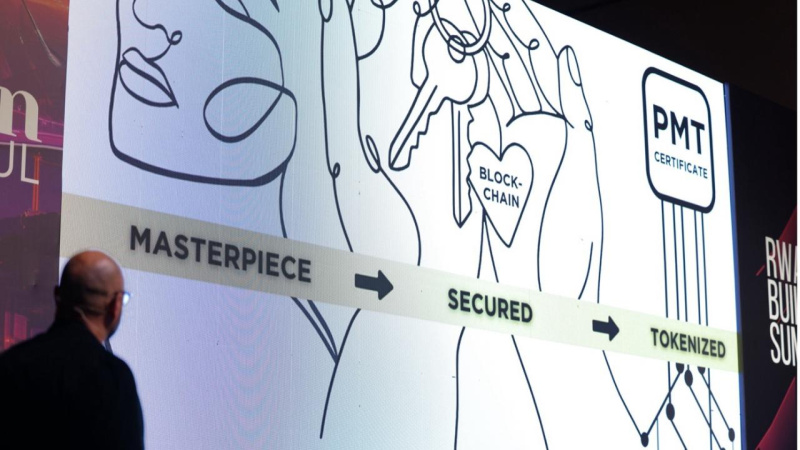 Public Masterpiece Keynote Presentation at the main Stage of the RWA BUILDERS SUMMIT 2025

