$EV presale sold out in three minutes, raising $1.2 million at a $30 million valuation
Community burned 72 million SDEX tokens to gain early access to $EV
Everything.inc introduces a unified DeFi architecture merging trading, lending, and leverage functions
Everything protocol begins rollout after rapid $EV presale
Everything.inc, the team behind the next iteration of the SMARDEX (SDEX) protocol, has successfully completed an exclusive community presale for its new EV token, marking the protocol’s first major step in its migration to a more consolidated decentralized finance (DeFi) framework.
The presale offered early access to SDEX holders and reached its $1.2 million fundraising target within three minutes, based on a $30 million valuation. A total of 72 million SDEX tokens were permanently removed from circulation through a burn-to-invest mechanism, signaling a strong commitment from the community to support the transition.
In addition to the main round, a secondary presale—worth $450,000 and representing 1.5% of the total $EV supply—was quietly conducted for the existing community. This unannounced round sold out in under 10 minutes, further underscoring demand among early supporters.
The rapid sell-out also drew attention on social media. The X account @DeItaone, known for real-time financial news updates and broad market commentary, posted about the presale, reflecting how quickly the event circulated beyond core DeFi circles.
The confirmed listing valuation for the $EV token has been set at $150 million.
“The response to this community round confirms that our users understand the magnitude of this shift. By burning 72 million SDEX, the community did not just invest, it actively reduced supply to power the new EV economy and align incentives for the transition ahead.” — Jean Rausis, co-founder of Everything.inc
New protocol architecture focuses on unified liquidity
More than a token swap or rebrand, the move from SMARDEX to Everything reflects a broader overhaul of protocol design. Everything.inc aims to replace fragmented DeFi experiences by integrating spot trading, lending, borrowing, and leveraged trading into a single smart contract system.
One of the key innovations is the introduction of a unified liquidity pool that supports multiple functions, reducing capital inefficiencies often seen in siloed protocols. Instead of relying on price feeds from external oracles, Everything uses an internal, mathematically linked asset system to help mitigate risk from oracle-related attacks.
This architectural redesign is intended to improve the user experience for both traders and liquidity providers while lowering exposure to systemic vulnerabilities that have plagued other DeFi platforms.
With the presale concluded, the next rollout phase includes a pre-market launch where a limited portion of $EV tokens will be made available. This stage will support early access to the protocol’s lending, borrowing, and leveraged trading features. Token vesting for presale participants will begin in May during the token generation event, with a gradual release schedule.
Conclusion
The swift sell-out of the $EV presale and the community’s willingness to burn tens of millions of SDEX tokens highlight a strong belief in Everything.inc’s direction. With a unified DeFi infrastructure on the horizon, the project now shifts toward executing its broader roadmap—one designed to streamline trading and liquidity, and reduce reliance on external components across decentralized finance.
What Brave helped mainstream for private browsing, Anuma brings to AI with private, user-owned memory and AI Portal-based interoperability powered by ZetaChain 2.0.
ZetaChain today announced the beta launch and public waitlist for Anuma, a privacy-first AI interface built on ZetaChain 2.0. ZetaChain also introduced ZetaChain 2.0, a new AI interoperability layer designed to help developers build applications and agents that work across AI models, preserve private user context, and monetize globally without backend infrastructure.
ZetaChain Core Contributor Ankur Nandwani previously co-created Basic Attention Token (BAT), which powers the Brave browser ecosystem with over 100M monthly active users. Brave helped mainstream privacy-first browsing by blocking trackers and ads by default. Anuma applies that same “privacy and user control by default” approach to the next major consumer interface of AI where context and memory increasingly define user experience.
ZetaChain was built to address fragmentation in Web3 by enabling universal apps — applications that can natively access assets like BTC and execute across multiple blockchains through a single platform. In 2025, the ZetaChain network scaled to more than 11.5 million users and processed more than 225 million transactions. With ZetaChain 2.0, ZetaChain is extending this unification thesis to AI so applications can operate across both chains and models, with permissions and private context built in.
ZetaChain 2.0 is composed of two core components:
AI Portal: A unified routing and execution layer that allows applications to access multiple AI model providers without lock-in, with built-in support for availability, fallback, and cost-performance optimization.
Private Memory Layer: A protocol-level memory system designed to keep user context encrypted and permissioned, enabling persistent experiences across sessions while maintaining user control over what applications and agents can access.
Developer SDK and Platform
ZetaChain 2.0 is designed to scale as a developer platform. Alongside the protocol components, ZetaChain is releasing a developer SDK that packages private persistent memory, cross-model interoperability, and monetization primitives into a single toolkit. The goal is to make it straightforward to build privacy-first apps and agents that can maintain continuity across sessions, connect to multiple model providers, and support global monetization rails from onchain settlement to traditional payment processors without requiring teams to build bespoke infrastructure.
Anuma: First Consumer Showcase
Anuma is the first consumer AI interface built on ZetaChain 2.0. The product provides access to multiple leading AI models through a single experience, supports switching between models without losing context, and is designed so memory remains private and user-controlled. Users can request early access through the public waitlist.
“Brave and BAT proved that privacy-first defaults can win at consumer scale,” said Ankur Nandwani, Core Contributor at ZetaChain. “We’ve already unified the blockchain experience at scale, powering more than 225 million transactions. ZetaChain 2.0 extends that same approach to AI, enabling the next generation of apps and agents that run across models and chains with private, permissioned memory and global monetization by default.”
In 2023, ZetaChain announced a $27 million funding round with participation from Blockchain.com, Human Capital, VY Capital, Sky9 Capital, Jane Street Capital, VistaLabs, CMT Digital, Foundation Capital, Lingfeng Capital, GSR, and others.
About ZetaChain
ZetaChain is the universal layer for AI and Web3, letting developers build apps that run across chains and models, keep memory private, and monetize without infrastructure. With native connectivity across major blockchains and an AI interoperability stack powered by a Private Memory Layer, ZetaChain is building the foundation for the next generation of apps, agents, and experiences.
While the NFT sector is far removed from its market cap peak in 2022, NFTs are far from dead. There are more projects than ever leveraging NFT capabilities and an ever-increasing number of enterprises and artists using the proof of ownership stored on the blockchain to issue digital items.
Non-fungible tokens (NFTs) gained immense popularity since their inception in 2014, captivating artists, collectors, and investors. Recently, however, the NFT sector has experienced a significant downturn, characterized by declining sales and item prices. The once-thriving market, where staggering amounts were spent on popular NFT collectibles, now finds itself at a crossroads as brands, artists, and collectors reevaluate their participation in the NFT sector amidst a bearish crypto market sentiment.
Despite the recent downturn, proponents argue that NFTs are still a very promising subgroup of cryptocurrency. They usually emphasize the technology’s potential for democratizing the art world, empowering artists with new revenue streams, revolutionizing how we perceive ownership, and drastically changing the culture of collecting.
In this article, we delve into the current state of the NFT market, investigate potential factors that could contribute to its recovery, and seek to answer the question that is surely on every reader’s mind: “Are NFTs dead?”
The NFT Market Peaked in Q1 2022
Before delving into the decline of the NFT sector, it is important to explore the factors that contributed to the initial popularity of these tokens.
The real rise began in the latter half of 2021, when the NFT market witnessed a surge in high-profile sales. These included pieces from Beeple’s “Everyday: The First 5000 Days,” a digital artwork that fetched an astonishing $69 million, and Pak’s “The Fungible Collection,” which included the renowned “Clock” piece, which sold for $52 million. These and several other outstanding sales pushed NFTs into the mainstream spotlight and paved the way for a very successful start to 2022.
Moreover, celebrities and influencers played a crucial role in promoting NFTs and driving the initial hype. Figures like Eminem and Jimmy Fallon, for example, openly endorsed projects such as Bored Ape Yacht Club (BAYC). Simultaneously, the rise of NFT marketplaces like OpenSea and Rarible facilitated the buying and selling of NFTs, attracting seasoned collectors and newcomers alike.
All these factors caused the NFT market to post record-breaking stats in Q1 2022. Data from The Block shows that in the first quarter of 2022, NFT sales on OpenSea alone accounted for more than $4.87 billion per month. Naturally, the number of NFT sales and the number of wallets participating in NFT trading were also either very near or at an ATH at that time.
Understanding the Reasons Behind the Decline of NFTs
The initial enthusiasm surrounding NFTs eventually waned, resulting in a significant downturn in the market. Several factors contributed to this decline:
Speculation: The evolution of events showed that the surge in NFT valuations was driven largely by speculative investors rather than genuine appreciation for the art or digital assets. This led to volatile prices and increased market instability.
A recent bull market: In November 2021, Bitcoin surged to its then-highest price of $ 68,770, which means that investors who liquidated their crypto holdings in Q4 2021 had plenty of money for high-risk investments or to simply splurge on luxury unnecessary items. This facilitated NFTs reaching outrageously high prices.
Rise in scams and fraud: As the NFT market grew rapidly, so did the number of fraudulent projects. Scams and “rug pulls” eroded trust among investors and collectors, casting doubt on the legitimacy of NFTs as a whole.
Oversaturation of the market: Eventually, the influx of numerous NFT projects flooded the market, making it difficult for investors to differentiate between valuable and less valuable assets. Oversaturation contributed to a correction in the market.
Regulatory scrutiny: Governments worldwide were grappling with how to regulate NFTs, and the potential for increased regulations has created uncertainty among investors, dampening market sentiment.
These factors resulted in a significant downturn, resulting in a sharp decline in NFT sales in the second half of 2022. Many NFT holders incurred substantial losses during the NFT bear market. One such example is Justin Bieber, who bought a Bored Ape NFT for $1.31 million in January 2022. Today, he would be lucky to get $17,000 for his Bored Ape collectible.
Are NFTs dead? Where does the NFT market stand today?
To better understand the landscape of the NFT sector in 2026, we will analyze current trading data, explore the most popular blockchain networks utilized for NFTs, and analyze the market share of different NFT marketplaces.
Monthly NFT trading volume falls below $1 billion
Monthly NFT trading volumes have slipped below the $1 billion mark, highlighting the sector’s prolonged downturn after its 2021 peak. Data from The Block shows that NFT activity has been trending lower for several years, with only a brief recovery period recorded in 2023.
After that short-lived rebound, trading volumes resumed their decline, first falling below $1 billion per month and later dropping under $500 million. The contraction accelerated through 2024 and 2025 as speculative interest faded and fewer high-value collections entered the market.
By the end of 2025, combined Ethereum-denominated trading volume across major NFT marketplaces barely exceeded $100 million in a single month, underscoring how far the sector has retreated from its previous highs and signaling a sharp reduction in liquidity and user activity.
Ethereum blockchain dominates in terms of NFT trading volume, most NFT sales are, however, facilitated by Polygon
Ethereum blockchain remains the top choice for the majority of high-value NFT creators and buyers. Data gathered by Dapp Radar in January 2026 shows that the popular network holds a commanding 81% market share in terms of NFT trading volume. However, when it comes to the percentage of all NFT sales, Ethereum’s share decreases to just 5.7%. This suggests that Ethereum is primarily utilized for conducting large-volume sales, positioning it as the preferred platform for the “NFT aristocracy.” Data also shows that Ethereum is slowly bleeding out its market share to other blockchains emerging in the NFT market.
Solana blockchain takes the second spot, with 6.7% of the total trading volume and a 13% share in the number of NFT sales. Close behind is Polygon, with a trading volume share of 5.4% and a significant 26.9% dominance over the number of conducted NFT deals. Polygon’s high number of NFT sales can be attributed to its strategic moves to become a preferred choice for launching NFT projects with a low entry price. Additionally, Polygon has attracted numerous games with NFT mechanics, such as Planet IX, The Sandbox, and Oath of Peak, further bolstering its position in the market.
OpenSea NFT marketplace lost its long-held top spot to newcomer Blur
Since its launch in mid-October 2022, Blur has steadily gained popularity among NFT collectors and traders. However, it was in February that the marketplace experienced an explosive surge in popularity, surpassing OpenSea as the largest NFT marketplace for some time.
The surge in Blur’s market share in February can be attributed to the airdrop event for the BLUR token. This event involved rewarding loyal Blur users with BLUR tokens, with the maximum airdrop amount reserved for those who exclusively used Blur to list their NFTs. This incentive mechanism provided a clear motivation for NFT users to choose Blur over other marketplaces like OpenSea, which lacked similar incentives. While it’s challenging to measure the exact impact of the BLUR token launch on the broader NFT market, the rise in total NFT trading volume also coincided with its introduction. This indicates that the launch of the BLUR token played a significant role in boosting Blur’s importance in the NFT ecosystem. That being said, OpenSea has since reclaimed the top spot by a large margin, polling in around $90 million of ETH NFT transactions.
Is it too late to invest in NFTs?
While the market data may currently suggest a decline in the NFT sector, it is important to recognize that the developers and creators within the NFT space continue to create and innovate. Despite the current trends, the potential for new opportunities and emerging trends to surface remains. As the technology surrounding NFTs advances and adoption expands, investors may find enticing prospects in emerging projects, talented artists, or unique collectibles.
To correctly identify the next big NFT collection, it is crucial to remain attentive to the evolving landscape of NFTs, as an unforeseen opportunity may arise at any time. Therefore, even amidst a perceived decline, the dynamic nature of the NFT sector leaves room for future developments and investment potential. But as with any investment, careful research, evaluation, and consideration of personal financial goals is of paramount importance.
To put it in layman’s terms: no, you are not too late to invest in NFTs, but potentially profitable collections may be significantly harder to find today as compared to the golden era of NFTs. If you don’t want to invest in NFTs directly but still want exposure to NFTs, you can consider investing in the next cryptocurrencies to explode, many of which are focused on developing NFTs products and services.
The Bottom Line: The NFT sector is not dead
While the NFT sector has experienced a significant decline, it is important to note that it is not dead. In the latter half of 2022, the NFT trading volume suffered due to various factors, including the broader crypto market downturn. However, there was a notable resurgence in the first quarter of 2023. In February, the trading volume skyrocketed to an impressive $2 billion. It would be an exaggeration to claim that an industry generating such a substantial monthly trading volume is dead.
At the same time, it is undeniable that the current state of the NFT sector falls short of its peak popularity enjoyed in late 2021 and early 2022. But even in this harsher NFT landscape, opportunities continue to exist for those who follow the latest trends in the industry and are capable of informed decision-making. For example, there are several sports-focused NFT projects that are collaborating with sports stars, including Binance’s collaboration with Cristiano Ronaldo and Sorare’s partnership with FIFA.
A BNB faucet is a tool that will give you free testnet BNB tokens. A BNB faucet is an example of a crypto faucet, which are websites provide a small amount of mainnet or testnet crypto for free.
For example, it was possible to get BTC coins for free when Bitcoin was still in its very early stages. Nowadays, you likely won’t be able to find mainnet faucets for big cryptocurrency projects, although there might be a mainnet faucet available for small projects with a low market capitalization.
At the moment, a faucet for mainnet BNB tokens doesn’t exist. If you want to get some free BNB, you’ll have to settle for testnet BNB tokens, which don’t have any monetary value and are used on the BSC testnet. However, testnet BNBs are still useful if you want to try out how Binance Smart Chain works, or even deploy your own smart contracts for testing.
We’ll show you how to use a BNB testnet faucet to get some free testnet BNB tokens that you’ll be able to use right away.
The Binance Smart Chain testnet
Before we show you exactly how you can get some free testnet BNB, let’s quickly explain what the Binance Smart Chain testnet is.
The Binance Smart Chain testnet is a blockchain network created to replicate the environment of the BSC mainnet. Programmers and regular users can access the testnet to experiment with decentralized applications and assess their performance prior to their launch on the mainnet. Tokens on the Binance Smart Chain testnet possess no monetary value, which means that you can experiment freely without the fear of potentially losing something valuable.
We should reiterate that there’s currently no faucet that distributes mainnet BNB tokens for free. If anyone claims that they will give you mainnet BNB tokens for free, you’re likely dealing with a scammer and should be very cautious.
How to get BNB with MetaMask on the BSC testnet?
If you want to use the BNB faucet, you will first need to set up a crypto wallet that will work with the BNB Chain testnet. You will be using this wallet to receive testnet funds.
We recommend that you use the MetaMask wallet, but you can choose any other wallet you wish. For example, another wallet that can be used to access the BSC testnet is Trust Wallet, but we’ll be using MetaMask in our example.
1. Access the “Networks” section in your MetaMask wallet
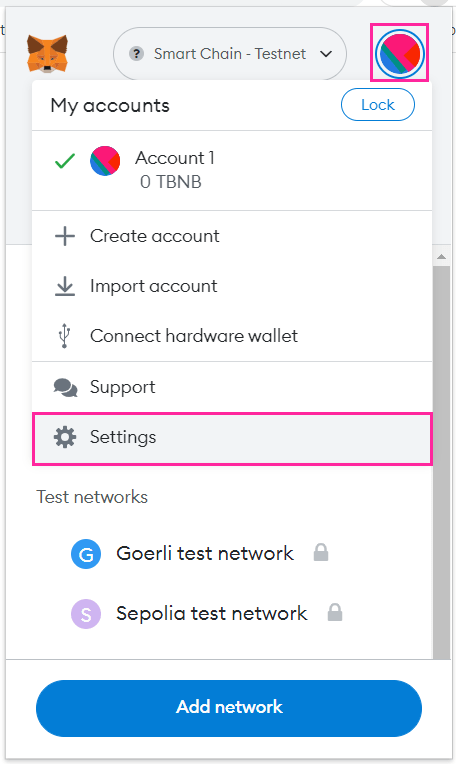
The first step is to add the Binance Smart Chain testnet network to your MetaMask wallet. Click your avatar icon in the MetaMask wallet, and go to “Settings”. Then, select “Networks”.
In the “Networks” tab, choose “Add network”.
2. Provide the necessary info about the Binance Smart Chain testnet
In order to add a new network to your MetaMask wallet, you’ll need to provide some information so that your MetaMask wallet can connect successfully. Here’s the info you need to add the Binance Smart Chain testnet to MetaMask:
Network name: Smart Chain – Testnet
New RPC URL: https://data-seed-prebsc-1-s1.binance.org:8545/
Chain ID: 97
Currency symbol: tBNB
Block explorer URL: https://testnet.bscscan.com
Enter the required details and click on the “Save” button. Once completed, your MetaMask wallet will have the ability to establish a connection with the BSC testnet.
The website will prompt you for a brief verification process, which serves as a precautionary measure against automated bots spamming the faucet with token requests. Once the verification is successfully completed, you will be able to enter your BSC testnet address to receive test tokens.
4. Claim your testnet BNB
Next, click on “Give me BNB” and select the amount of testnet BNB to receive. At the moment, the only option offered by the BNB faucet is 0.1 BNB.
After a few seconds, you should receive your testnet BNB tokens in your wallet. As you can see, we have 0.1 tBNB in our account now.
Now that you have some testnet BNB, feel free to experiment with any DApps on the Binance Smart Chain testnet. You can use the BNB faucet for gas if you run out of testnet BNB to pay for your transactions.
A list of popular BNB faucets
Our example showed you how you can get testnet BNB tokens using the faucet at binance.org, which is generally regarded in the community as the “official” BNB faucet. However, there’s also other BNB faucets that you can use to get some testnet BNB.
Regardless of which BNB faucet you choose to use, you will need to have a wallet set up that’s configured to use the BNB Chain testnet. So, steps 1 and 2 outlined in the guide above still apply regardless of which BNB faucet you’re using.
Now, let’s quickly highlight some of the alternative BNB faucets you can use.
Triangle BNB faucet: Triangle’s BNB faucet is a simple testnet BNB faucet where you only need to provide a BNB Chain testnet address. However, you should keep in mind that this faucet only distributed 0.001 BNB at a time, which is a relatively small amount.
QuickNode BNB faucet: QuickNode offers a popular BNB faucet that you can use to get some free testnet BNB. Keep in mind that your wallet must hold at least 0.001 ETH to request testnet BNB through this faucet. This is done to prevent spamming.
BitBond BNB faucet: In order to use the BitBond BNB faucet, you need to connect your wallet and complete your profile. This includes selecting an avatar and providing an email address. Once you complete these steps, you’ll be able to request a small amount of free testnet BNB.
What are testnet BNB tokens used for?
Testnet BNB tokens are exclusively utilized for testing and have no monetary value. They are useful because they allow users to simulate using a mainnet, without the associated risks.
Even if you accidentally create a buggy smart contract that causes you to lose funds, there is no harm on the testnet since your testnet tokens have no value anyway, and you can get more of them for free.
When the BSC testnet receives an upgrade, it’s possible that users testnet BNB balances are reset. If this happens, you should get some more testnet BNB tokens using the process we provided above.
Is it safe to use the BNB Chain Faucet?
The BNB Chain Faucet is perfectly safe to use. As long as you stay on the BNB Chain testnet network, you can safely interact with the faucet. Just make sure that you’re using the correct BNB faucet URL (testnet.binance.org/faucet-smart/) and input the correct BNB Chain testnet information into your wallet — see step 2 in the step-by-step guide above.
What’s the BNB faucet limit?
Even though testnet tokens are designed to have no economic value, that doesn’t mean that faucets give out unlimited amounts of testnet tokens. Practically every BNB faucet limits how many testnet BNB tokens it distributes to a single wallet in a day. Many faucets also require users to solve a CAPTCHA challenge. These limits are implemented to prevent abuse.
Most BNB faucets will distribute less than 1 testnet BNB in a single transaction. Faucets will also occasionally adjust the amount they give out per day, depending on how many testnet BNB tokens they have at their disposal. For example, the “official” BNB faucet used to distribute 0.5 testnet BNB, but now only gives out 0.3 testnet BNB tokens.
The bottom line
Using a BNB faucet is very simple, and all you need to get started is to install a wallet that’s compatible with the Binance Smart Chain testnet. We recommend you use MetaMask, but you can also choose Trust Wallet or any other compatible wallet.
You can use the BNB faucet multiple times, although the website does have some restrictions in place in order to fend off spammers.
If you want to use the mainnet BNB Chain, you’ll have to buy some BNB tokens first, as there’s no such thing as a mainnet BNB faucet at the moment. Learn why we’ve featured BNB as one of the best altcoins to buy.
Crypto presales allow investors to support early blockchain projects before their tokens hit the market. While risky, some presales can yield significant returns, as seen with Ethereum’s token sale, where ETH went from $0.30 to over $3,400—an increase of over 1,000,000%.
Identifying promising projects among thousands of launches each year is challenging, and not every presale will replicate Ethereum’s success.
In this article, we highlight six presales with strong growth potential. While not guaranteed, they could provide valuable investment opportunities.
List of the best crypto presales for 2026:
Bitcoin Everlight – A lightweight Bitcoin payment layer for fast and low-cost BTC transactions
Apemars – A community-driven crypto project blending ape culture with space-themed branding
Sonami – A blockchain analytics platform for tracking and monitoring on-chain activity
Zero Knowledge Proof – A privacy-focused crypto platform based on zero-knowledge cryptography
HeyElsa – An AI-powered Crypto Agent Layer for automated trading and portfolio management
5 best crypto presales for 2026 – Discover top high-risk, high-reward investment picks
In the following sections, we will explore five cryptocurrency presales that we believe have the potential to provide significant investment opportunities. Each project has been carefully selected based on its innovative approach, community engagement, and potential for future growth.
1. Bitcoin Everlight – A lightweight Bitcoin payment layer for fast and low-cost BTC transactions
Bitcoin Everlight is a Bitcoin-focused payment network designed to make BTC transactions faster, cheaper, and easier to use without relying on complex payment channels. Built as a lightweight confirmation layer anchored directly to Bitcoin’s blockchain, Everlight aims to simplify everyday Bitcoin payments while preserving Bitcoin’s core security model. The project targets users who want predictable transaction speeds and fees without needing technical knowledge or advanced wallet setups.
The BTCL token plays a functional role within the Everlight network, supporting transaction routing, node participation, and access to operator tooling. The project uses a fixed 21 billion token supply with zero inflation, positioning BTCL as a utility asset rather than a yield-driven token. During the presale phase, BTCL is issued as an ERC-20 token, with a planned migration to a native Bitcoin-based chain once the mainnet goes live.
Everlight’s roadmap focuses on gradual network rollout, starting with presale distribution and initial node registration, followed by expanded routing capabilities and ecosystem tooling. Staking BTCL allows participants to operate network nodes and earn variable rewards based on uptime and performance, with short lock periods designed to maintain flexibility. With its emphasis on Bitcoin-native settlement and simple payment infrastructure, Bitcoin Everlight positions itself as an accessibility layer rather than a replacement for existing Bitcoin solutions.
2. Apemars – A community-driven crypto project blending ape culture with space-themed branding
ApeMars is a narrative-driven meme coin project built around a 23-stage presale that mirrors a symbolic journey from Earth to Mars. Rather than focusing purely on utility from day one, ApeMars leans heavily into storytelling, community engagement, and structured progression, with each presale stage representing a new chapter in the mission. The project is clearly aimed at traders and communities drawn to high-energy meme culture combined with long, well-defined presale mechanics.
The APRZ token supply is capped at 70 billion tokens, with half allocated to the presale and the remainder split between staking rewards, liquidity, ecosystem growth, and community incentives. ApeMars introduces scheduled burn events at key presale milestones, permanently removing unsold tokens to reduce supply over time. A high-yield staking system offering up to 63% APY is planned post-launch, with lockups designed to limit early sell pressure.
Following the presale, ApeMars plans to transition into a broader ecosystem phase, introducing additional utilities, community missions, and long-term brand expansion under its space-themed identity. While the project remains meme-first in nature, its structured roadmap, audited smart contracts, and clearly defined token distribution add a layer of discipline often missing from similar launches. ApeMars is positioned as a speculative presale with strong emphasis on engagement, pacing, and post-launch retention.
3.Sonami – A blockchain analytics platform for tracking and monitoring on-chain activity
Sonami is positioning itself as Solana’s first Layer 2 network, aiming to improve scalability, cross-chain compatibility, and network efficiency within the Solana ecosystem. The project markets itself as a next-generation infrastructure layer rather than a standalone meme token, with a focus on supporting high-throughput applications and future multi-chain integrations. Sonami’s presale targets users interested in early exposure to Solana-based scaling solutions.
The SNMI token is central to the Sonami ecosystem, supporting staking, network participation, and future utility across the Layer 2 environment. The presale is structured with incremental price increases across stages, encouraging early participation while maintaining a transparent pricing model. Staking rewards of up to 53% are advertised, positioning SNMI as both a network utility token and an incentive mechanism for early supporters.
Sonami’s roadmap emphasizes gradual rollout, starting with presale funding, followed by mainnet development and exchange listings. While the project is still in its early phases, its Layer 2 narrative aligns with broader scaling trends across major blockchains. Sonami stands out among presales by focusing on infrastructure rather than pure speculation, though its long-term success will depend on execution and adoption within the competitive Solana ecosystem.
4. Zero Knowledge Proof – A privacy-focused crypto platform based on zero-knowledge cryptography
Zero Knowledge Proof is a Layer 1 blockchain project focused on private, verifiable AI computation using real-world hardware rather than purely virtual validators. The network is built around zero-knowledge proofs, allowing data and AI models to remain confidential while still being verifiable on-chain. ZKP positions itself as infrastructure for privacy-preserving compute, targeting use cases in AI, data marketplaces, and decentralized research rather than consumer-facing applications.
A key differentiator is ZKP’s Proof Pod system, which uses physical devices to provide compute, storage verification, and network security. Proof Pods can be purchased and connected with minimal setup, allowing participants to earn ZKP coins by running real workloads instead of traditional staking or speculative mining. The network combines Proof of Intelligence and Proof of Space, supporting both EVM and WASM smart contracts, with ZKP serving as the native utility token for compute validation, marketplace access, and protocol incentives.
The ZKP presale uses a daily on-chain auction model, releasing up to 200 million tokens per day with unused supply burned, creating a transparent and participation-driven pricing structure. There are no private allocations or insider rounds, with distribution designed to favor open access and visible on-chain activity. With a live testnet, shipping hardware, and a clear focus on verifiable privacy infrastructure, Zero Knowledge Proof stands out among crypto presales as a hardware-backed network rather than a purely token-driven launch.
5. HeyElsa – An AI-powered Crypto Agent Layer for automated trading and portfolio management
Elsa is an AI-powered crypto trading assistant designed to simplify on-chain activity across multiple blockchains. Instead of relying on complex interfaces, Elsa allows users to interact with crypto markets through natural language commands, covering tasks like swapping tokens, managing portfolios, bridging assets, and executing advanced trades. The platform targets both beginners who want a simpler entry point and experienced users looking to streamline routine on-chain actions.
The assistant supports a wide range of networks, including Ethereum, Arbitrum, Base, BSC, Polygon, Optimism, Solana, and several emerging chains. Users can perform actions such as cross-chain swaps, portfolio analysis, yield discovery, and leveraged trading using conversational prompts rather than manual execution. By abstracting away wallet navigation and contract interactions, Elsa aims to reduce friction while keeping users in control of their assets.
Elsa’s presale focuses on building out its AI trading infrastructure and expanding supported chains and features ahead of broader adoption. The project positions itself at the intersection of AI and decentralized finance, where usability remains a major barrier for many users. If execution matches its vision, Elsa could appeal to traders who want faster, more intuitive access to DeFi without sacrificing flexibility or multi-chain coverage.
The bottom line: Crypto presales offer a high potential upside, but can be very risky
Crypto presales are a great investment opportunity for investors that don’t mind taking on risk and subjecting their portfolio to volatility. The reality is that most cryptocurrency projects fail to deliver on their lofty goals in the end, with early investors brunting much of the financial burden. However, when projects do succeed, presale investors are those that can benefit massively and potentially make life-changing amounts of money.
If you find crypto presales a bit too volatile for your taste, we suggest you build your portfolio around a combination of cryptocurrency staples and smaller but exciting projects – check our weekly updated list of the best cryptocurrencies to buy for more ideas. If you don’t mind taking on additional risks, however, you could try your hand at investing in promising meme coins.
It’s impossible for the Shiba Inu coin to reach $1 at its current circulating supply. Given that there are 589 trillion SHIB in circulation, Shiba Inu would have a market cap of $589 trillion at $1 per coin, which is more than the value of all equities, fiat currencies, and other assets in the world combined many times over.
However, that doesn’t mean that Shiba Inu cannot or never will reach $1. In fact, the recent developments in the Shiba Inu ecosystem, namely the launch of the Shibarium layer 2 solution, are related to burning SHIB tokens and bringing the supply down, which could make each token that much more valuable down the line.
In this article, we will explore the factors that could influence the price of SHIB and discuss the possibility of it reaching the $1 milestone.
Shiba Inu: From rags to riches
In 2020, Ryoshi launched the Shiba Inu cryptocurrency as an alternative to Dogecoin. Unlike the original meme coin, SHIB is based on the Ethereum blockchain, giving it more potential use cases, as it can easily be deployed in DeFi applications.
For the first year and a half after release, the token was mostly unknown. Only traders who had the knowledge to find new meme coins early were able to acquire SHIB for extremely low prices at the time. Funnily enough, it was Dogecoin that ended up making SHIB popular. It was quite simple – Dogecoin rallied massively in 2021, and many investors were looking for cryptocurrencies with similar potential and settled on SHIB as the next best thing.
The current price of Shiba Inu is $0.00000804, which is 125,000x times less than $1.
Will Shiba Inu coin reach $1?
Shiba Inu reaching 1 dollar at current token supply levels seems impossible. However, that doesn’t mean that SHIB might not reach $1 in the future, especially if the recent blockchain changes become more far-reaching.
In the following sections, we are going to present the arguments in support and in opposition to SHIB reaching $1.
What could help Shiba Inu reach $1
The main reason why many SHIB investors and quite a few analysts believe that Shiba Inu could reach $1 in the future is Shibarium, a layer 2 solution that makes transactions in the Shiba Inu ecosystem both faster and cheaper. Not only that, each Shibarium transaction burns SHIB tokens, effectively reducing the supply of the token. According to ShibBurn, a total of 44,623,604,014 tokens were burned in 2024, which does sound impressive, but it’s still very far off from being a significant amount that could dent the total supply.
According to the Shibarium documentation, each transaction on the layer 2 platform incurs a basic fee, out of which 30% is set aside for network maintenance, and 70% for the token burn. Initially, the transaction fee is paid in Bone ShibaSwap (BONE), which accumulates in the smart contract designated for token burns. BONE is then transferred to Ethereum (the native blockchain of SHIB), where it is exchanged for SHIB and burned using the relevant smart contract operation. The swap between BONE and SHIB is included in the burn mechanism directly, and no manual interaction from users is required.
In May 2023, a prominent Shiba Inu community member who goes by the name “ShibInformer” on Twitter posted a “preview of the user interface of the SHIB burn mechanism in Shibarium.” It shows the amount of BONE ready to be burned and the option to “Initiate burn.”
As of January 2026, ShibTorch is currently undergoing maintenance to enhance its burn mechanism. While burns are supposedly happening in the background, the site still shows that only around 360 million SHIB have been burned so far. This number has actually not changed since the portal went under maintenance a few months ago.
The obstacles that could prevent Shiba Inu from reaching $1
While it is impossible to predict the future price of any cryptocurrency with certainty, reaching $1 represents an impossible milestone for SHIB. It is crucial to consider the circulating supply of SHIB tokens, which is in the trillions. The table below demonstrates Shiba Inu’s implied market cap at different hypothetical price levels.
SHIB price
Shiba Inu Market Cap
0.00000804 (current price)
$4.78 billion
$0.0001
$58.9 billion
$0.001
$589 billion
$0.01
$5.89 trillion
$0.10
$58.9 trillion
$0.50
$294.5 trillion
$1
$589 trillion
*Based on the 589 trillion SHIB circulating supply
Meanwhile, here are the market capitalizations of prominent assets and companies:
As we can see from the table above, Shiba Inu reaching $1 at the current circulating supply is completely out of the question.
Furthermore, the price of SHIB would need to overcome numerous resistance levels as it progresses toward $1, facing potential sell-off pressures and profit-taking along the way. Such milestones are influenced by various factors, including those mentioned earlier, and sentiment can change rapidly within the cryptocurrency market.
Shiba Inu price prediction 2026: $1 is out of the question, as is 1 cent
According to our Shiba Inu price prediction algorithm, the price of SHIB is expected to increase slightly by May to reach the year’s high of $0.00001237. After that, SHIB could proceed to retrace toward the end of the year and reach $0.00001007.
So, can Shiba Inu reach $1?
If nothing dramatically changes with the Shiba Inu tokenomics, there is no chance that SHIB will ever reach $1 or even lower price milestones like 1 cent. However, if the proposed Shibarium changes come into effect soon and burn a substantial amount of SHIB, we could see the Shiba Inu coin massively increase in value. This potential for price growth is one of the reasons why Shiba Inu is featured on our list of the best penny cryptos.
With its impressive bull run in 2021, Shiba Inu has demonstrated that there is a considerable market for meme coins, spurring other cryptocurrency projects to follow in its footsteps and leading many investors to wonder which meme coin might be the next Shiba Inu.
According to current estimates, the next Bitcoin halving will take place sometime in Q2 2028, though the exact date isn’t yet known. Meanwhile, the most recent Bitcoin halving took place on April 20, 2024, which reduced the reward from 6.25 BTC to 3.125 BTC.
Bitcoin halving is a pre-programmed event that happens roughly every 4 years (210,000 blocks, to be exact) and reduces the rate at which new Bitcoins are created and introduced into circulation. The original reward for mining a block was 50 BTC when Bitcoin was first created. With the upcoming halving, the reward will be cut from 3.125 BTC to 1.5625 BTC.
In this article, we will explain when the next BTC halving will happen, examine the Bitcoin halving cycle history, and look into what the future might hold for the upcoming halving.
Key takeaways:
The fourth Bitcoin halving happened on April 20, reducing the reward from 6.25 BTC to 3.125 BTC.
Bitcoin halvings, seen as bullish events, reduce BTC inflation and enhance its value, making it a promising long-term investment.
Previous Bitcoin halvings occurred in 2012, 2016, 2020, and 2024, each time significantly reducing mining rewards and leading to price increases.
When is the next BTC halving?
According to most estimates, the next Bitcoin halving, the fifth so far, will take place in Q2 2028, though the exact date isn’t yet known. The speed at which new Bitcoin blocks are produced is determined by the network’s difficulty adjustment algorithm and the collective computing power of miners in the network.
Bitcoin halving dates are one of the most important events in the crypto market. Bitcoin has climbed higher every halving cycle so far. If the historical trend were to continue, the Bitcoin Rainbow Chart predicts that BTC could trade between an upper price bound of roughly $765,638 and a lower bound of $68,945 during the next halving cycle.
According to the Bitcoin Rainbow Chart, BTC will change hands at an average price of $229,755 in Q2 2028 (the time when the next BTC halving is expected to occur).
Bitcoin halving dates history
The first Bitcoin halving took place in 2012, the second in 2016, the third in 2020, and the fourth one in 2024, with each halving cycle seeing BTC climb to new heights. In the following sections, we are going to examine the price movements of BTC during each cycle and check how the Bitcoin halving rewards decreased.
BTC halving dates:
Date
Block height
Block reward decrease
BTC Price
First halving
Nov. 28, 2012
210,000
from 50 BTC to 25 BTC
$12.3
Second halving
Jul. 9, 2016
420,000
from 25 BTC to 12.5 BTC
$680
Third halving
May 11, 2020
630,000
from 12.5 BTC to 6.25 BTC
$8,590
Fourth halving
Apr. 20, 2024
840,000
from 6.25 BTC to 3.125 BTC
$64,025
BTC price lows and highs during each cycle:
Lowest price
Highest price
First halving cycle (Nov. 2012 – Jul. 2016)
$12.4 (Dec. 2012)
$1,170 (Nov. 2013)
Second halving cycle (Jul. 2016 – May 2020)
$535 (Aug. 2016)
$19,400 (Dec. 2017)
Third halving cycle (May 2020 – Apr. 2024)
$8,590 (May 2020)
$85,320 (Apr. 2024)
Fourth halving cycle (Apr. 2024 – Q2 2028)*
$49,436 (August 2024)
$ 126,025 (Oct. 2025)
*The lowest and highest price is subject to change as the 4th halving cycle is not yet completed.
Pre-halving period (January 3, 2009 – November 28, 2012)
The period between the launch of the Bitcoin network in January 2009 and the first halving in November 2012 is sometimes referred to as the “pre-halving period”. During that time, the reward for successfully mining a new Bitcoin block was 50 BTC.
During that time, Bitcoin was known only to a niche audience, primarily consisting of programmers and cryptographers. In addition, 10.5 million BTC were mined during that time (exactly half of Bitcoin’s total supply of 21 million coins). Bitcoin inventor Satoshi Nakamoto is believed to have mined the most coins during the period, with some estimates attributing more than 1 million BTC that were mined to Nakamoto. Interestingly, they never moved or sold any of that BTC in the time since.
BTC reached a high of $29.6 during the pre-halving period.
First Bitcoin halving cycle (November 28, 2012 – July 9, 2016)
Following the period after the Genesis block, during which mining rewards were set at 50 BTC, the first Bitcoin halving ever took place on November 28, 2012. The rewards were cut to 25 BTC.
While Bitcoin was still in its infancy, a wider circle of people became interested in the digital currency that had already made some early investors millionaires. Bitcoin was first featured in mainstream outlets, particularly in November 2013, when the currency broke the psychological price barrier at $1,000.
About a year into the first halving cycle, BTC reached a high of $1,170.
Second Bitcoin halving cycle (July 9, 2016 – May 11, 2020)
The second BTC halving occurred on July 9, 2016, reducing Bitcoin mining rewards from 25 BTC to 12.5 BTC. About a year after the halving event, Bitcoin reached an all-time high above $19,000.
At this point in time, cryptocurrency became mainstream. Thousands of new cryptocurrencies were launched during the second halving cycle. Initial coin offerings (ICOs) became very popular during that time, giving investors the opportunity to participate in new projects by committing their BTC and other funds. The so-called “ICO craze” became big enough to draw attention from the US top financial watchdog, the Securities and Exchange Commission (SEC), which ultimately prohibited ICOs for US customers.
Bitcoin reached an all-time halving cycle high of $19,400 in December 2017.
Third Bitcoin halving cycle (May 11, 2020 – April 20, 2024)
The third Bitcoin halving occurred on May 11, 2020, reducing the block reward to 6.25 BTC and pushing it into single-digit territory for the first time. During this cycle, Bitcoin’s market capitalization surpassed $1 trillion for the first time, while BTC went on to reach an all-time high of $73,628.
The period was defined by rising institutional interest, with more sophisticated investors entering the market alongside a surge in retail participation driven by rapidly increasing prices. It was also marked by the launch of spot Bitcoin ETFs from major financial firms such as BlackRock and Fidelity, making Bitcoin exposure more accessible to institutional investors.
Compared to previous cycles, the third halving phase stood out as BTC reached its peak price much later than usual. In earlier cycles, Bitcoin typically set its cycle high within about a year of the halving event, whereas this time the peak occurred closer to the end of the cycle.
Bitcoin reached its then-highest price at the end of the third halving cycle, climbing to $73.628.
The fourth Bitcoin halving took place on April 20, 2024, reducing the block reward to 3.125 BTC. Although the cycle is still in its early stages, early price action has closely followed patterns seen in previous halving periods. As with earlier cycles, Bitcoin did not rally immediately after the halving and instead experienced a period of consolidation.
Roughly six months later, BTC pushed to a new all-time high, peaking at $109,079 in January 2025. Since the halving, Bitcoin has traded within a wide range, with prices falling as low as $49,436 before rebounding to new highs, with the most recent ATH reached in October 2025, when BTC climbed up to $126,025.
Bitcoin’s newest ATH ($126,025) was reached in October 2025, during the fourth halving cycle.
Bitcoin price prediction 2026-2028: Here’s what to expect until the next BTC halving
Current projections point to a prolonged bearish phase for Bitcoin throughout 2027, with prices expected to trend steadily lower over the course of the year. Forecasts suggest BTC could fall from the low-$80,000 range at the start of 2027 to the mid-$50,000 area by year-end, reflecting continued downside pressure and weak medium-term momentum.
This downward trend is expected to extend into early 2028, where Bitcoin is projected to bottom out before sentiment begins to shift. From February 2028 onward, forecasts indicate a sharp reversal, with prices accelerating rapidly as markets begin pricing in the fifth Bitcoin halving.
The projected rebound intensifies through the first half of 2028, with Bitcoin expected to reclaim six-figure levels by March and potentially exceed $200,000 by late spring. This pattern aligns with historical cycles, where extended drawdowns are often followed by aggressive rallies once halving anticipation starts to dominate market behavior.
According to our Bitcoin price prediction algorithm, the price of BTC could rally sharply in anticipation of the 5th Bitcoin halving, possibly climbing over $150,000.
The bottom line: The next BTC halving will occur in Q2 2028
Bitcoin halvings are widely perceived as bullish catalysts not only for BTC but for the crypto market as a whole. Since they reduce the amount of new BTC entering circulation, halvings effectively reduce Bitcoin’s inflation rate and thus ensure that each BTC is more valuable, thanks to deflationary mechanics. This makes Bitcoin one of the best long-term crypto investments and, with the next halving quickly approaching, one of the best cryptos to buy right now.
Miami, Florida, USA, January 23rd, 2026, Chainwire
TokenFi, a next-generation platform focused on tokenization for real-world assets and digital economies, has launched a major branding and awareness campaign across Italy ahead of the 2026 Winter Olympics.
The four-week campaign will begin Jan. 26 and is strategically designed to capture the attention of a global, high-net-worth audience traveling to Italy for the Games.
As part of the initiative, TokenFi has secured a full digital arrivals takeover at Venice Marco Polo Airport, one of the primary international gateways for Olympic visitors, along with two fully wrapped trams operating across central Milan.
Targeting a premium global audience
The Winter Olympics draw a diverse international audience, including professionals, athletes, and spectators, some of whom are showing growing interest in blockchain and digital asset technologies.
With foot traffic across Italy’s airports and public transportation systems expected to surge during the Olympic period, TokenFi aims to position its brand in front of millions of international travelers aligned with the future of tokenized assets.
At Venice Marco Polo Airport, immersive digital displays will introduce arriving travelers to TokenFi from the moment they land, placing the brand front and center during one of the busiest travel periods Italy has ever experienced. In Milan, the fully wrapped TokenFi trams will operate on major routes throughout the city, serving as mobile billboards in Italy’s financial and cultural capital.
A shift toward real-world visibility for crypto brands
For the global crypto community, the campaign signals a broader shift in how blockchain companies approach brand building. Rather than relying solely on digital-native channels, TokenFi is placing its presence in iconic, high-traffic physical environments.
This approach has been pioneered by TokenFi and Floki, which have focused heavily on mainstream brand recognition as the digital asset industry matures.
“The 2026 Winter Olympics present a rare opportunity to place TokenFi in front of a truly global, highly influential audience,” Pedro Vidal, a TokenFi spokesperson said. “This campaign isn’t just about visibility, it’s about validating the role of tokenization on the world stage and energizing the crypto community as we enter a pivotal era for Web3 adoption.”
Positioning tokenization on the global stage
TokenFi’s presence across Venice and Milan underscores its ambition to play a leading role in the global tokenization movement. As interest in real-world asset tokenization accelerates among both institutional and retail investors, the company is using the Olympic spotlight to reinforce its brand at the intersection of finance, technology, and global culture.
The campaign will run throughout the Olympic season, maximizing exposure during peak international travel and setting the stage for TokenFi’s next phase of global growth.
About TokenFi
TokenFi is an innovative platform for crypto and asset tokenization, enabling users to launch or tokenize assets effortlessly. TokenFi is committed to revolutionizing the trillion-dollar tokenization industry by offering a user-friendly interface that requires no coding expertise.
The world of cryptocurrencies has witnessed explosive growth over the past decade, with Bitcoin taking center stage. However, the landscape of digital currencies also includes a diverse array of altcoins, some of which offer very exciting opportunities for investors.
By definition, altcoins, or alternative cryptocurrencies, are digital assets that evolved after the pioneering of Bitcoin. These emerging cryptocurrencies often introduce innovative features or aim to solve specific problems. It is also because of these unique use cases that altcoins tend to be a riskier, yet at the same time also potentially more lucrative investment.
The best altcoins to buy in 2026:
Ethereum – The largest altcoin and the crypto of the leading smart contract blockchain
Zcash – Established privacy-focused cryptocurrency
XRP – The leading blockchain for international money transfers
Solana – A fast and low-cost blockchain for decentralized apps and finance
BNB – The largest Exchange token and the top challenger to Ethereum’s DeFi supremacy
Litecoin – A Bitcoin fork aimed at minimizing the cost of transactions
Hyperliquid – Highly efficient DEX with leveraged trading
Bittensor – A leader in decentralized AI and machine learning
Top 15 Altcoins to Invest in Now: Exploring the Best and Newest Altcoins in 2026
In this article, we delve into the top altcoins of 2026 and highlight each coin’s unique features, development progress, and potential for growth. By exploring the innovative altcoins on the rise, we aim to provide insights into the evolving landscape of cryptocurrencies and offer a fresh perspective on the best investment opportunities available in 2026.
1. Ethereum – The largest altcoin and the native asset of the leading smart contract blockchain
As the second-largest cryptocurrency and the largest and dominant DeFi platform, Ethereum (ETH) is an essential component of every altcoin-oriented portfolio.
Ethereum is an open-source blockchain that pioneered smart contract functionality in 2015. While the Ethereum network can also facilitate transfers of value between different Ethereum addresses, its key added value is in the execution of various smart contracts. Throughout their existence, Ethereum’s smart contract capabilities have facilitated numerous blockchain-powered innovations such as ICOs, DeFi, NFTs, and DAOs. In addition to the native asset (Ether), the Ethereum network hosts numerous ERC20 tokens (from exchange tokens to DeFi tokens and stablecoins), which further extend the Ethereum environment’s reach, liquidity, and utility.
With its successful transition to Proof-of-Stake and upcoming scalability improvements, Ethereum has become significantly more energy-efficient and is poised for increased transaction capacity.
Despite countless challengers, such as Cardano, Solana, TRON, and Cosmos, some of which were even dubbed “potential Ethereum killers”. Nevertheless, to this day, Ethereum still reigns supreme as the leading smart contract platform. In fact, Ethereum takes the top spot with a substantial margin in terms of total value locked, leaving all other competitors far behind.
Why is Ethereum a good altcoin to buy in 2026?
Ethereum remains the core platform for smart contracts, supporting much of the activity across DeFi, NFTs, tokenization, and decentralized applications. The shift to Proof-of-Stake reduced energy consumption and created a foundation for ongoing scalability improvements. Upcoming upgrades, including danksharding and deeper Layer-2 integration, are designed to lower transaction costs and improve throughput while preserving the network’s security and decentralization.
Ethereum also benefits from strong network effects. Many of the largest DeFi protocols, stablecoins, and tokenization projects continue to operate on Ethereum or its Layer-2 networks, sustaining demand for ETH as a utility asset. As Layer-2 adoption grows, more transactions ultimately settle on Ethereum, reinforcing its role as the base settlement layer and supporting demand for ETH in staking and fees. Combined with increasing institutional exposure and sustained interest in ETH ETFs, Ethereum is often viewed as one of the more stable large-cap altcoins looking ahead to 2026.
Zcash is a decentralized, peer-to-peer cryptocurrency launched in 2016. It follows a Bitcoin-like design while adding additional privacy and security functionality that is uncommon among public blockchains.
ZEC was the first cryptocurrency to integrate zk-SNARKs, a zero-knowledge proof system that allows transactions to be verified without revealing sensitive details. This technology has been widely cited as a major advancement in cryptography and blockchain privacy.
New ZEC enters circulation through mining, as the network currently uses a Proof-of-Work (PoW) consensus mechanism. Zcash has a fixed supply of 21 million coins and follows a halving-based issuance model similar to Bitcoin’s. Long-term, the project has discussed a potential transition to Proof-of-Stake, with both the Electric Coin Company and parts of the community expressing support for such a shift.
Why is Zcash a good altcoin to buy in 2026?
Zcash offers users a choice between transparent transactions and privacy-preserving “shielded” transfers, allowing it to serve different use cases within the same network. This optional privacy approach differentiates Zcash from fully transparent blockchains while avoiding the mandatory privacy model used by some other privacy-focused coins.
Interest in ZEC has increased alongside renewed attention on privacy-related cryptocurrencies, driven by broader conversations around data protection, financial surveillance, and digital autonomy. With a long operating history, recognizable brand, and established cryptographic foundation, Zcash remains a relevant option for investors considering privacy-enabled assets going into 2026.
3. XRP – The leading blockchain for international money transfers
Launched in 2012, Ripple (XRP) is a cryptocurrency developed by David Schwartz, Jed McCaleb, Arthur Britto, and Chris Larsen. Up to this day, the majority of XRP supply is placed in escrow accounts owned by Ripple Labs, initially known as the OpenCoin company.
The Ripple Network utilizes the Ripple Protocol Consensus Algorithm (RPCA), which relies on trusted validators instead of independent decentralized nodes to validate transactions and secure the blockchain. This allows Ripple to offer fast and low-cost transfers, particularly suitable for remittances and international payments. Naturally, Ripple has also integrated XRP into most of its products, including On-Demand Liquidity (ODL), which facilitates efficient cross-border money transfers in collaboration with cryptocurrency exchanges.
Why is XRP a good altcoin to buy in 2026?
XRP remains a well-established asset in the cross-border payments space, built to support fast and low-cost international transfers for banks, fintech companies, and payment providers. Transactions on the XRP Ledger typically settle within seconds, offering a more efficient alternative to traditional systems such as SWIFT. As interest in blockchain-based settlement solutions continues to expand, XRP’s long-standing focus on enterprise payments keeps it relevant looking toward 2026.
Regulation remains a key factor shaping XRP’s outlook. Ripple’s extended legal dispute with the U.S. Securities and Exchange Commission has weighed on XRP’s market performance in recent years, but the regulatory environment in the United States has shifted following the 2024 elections. A more accommodating stance toward digital assets is contributing to greater regulatory clarity and has supported the introduction of XRP exchange-traded products, which Ripple executives have positioned as a logical step after Bitcoin and Ethereum ETFs. Continued regulatory easing could improve XRP’s ability to attract institutional interest and support broader adoption over the longer term.
4. Solana – A fast and low-cost blockchain for decentralized apps and finance
Solana is a blockchain platform best known for its scalability and efficiency. With a remarkable throughput of 65,000 transactions per second (TPS) and low fees, it poses strong competition to Ethereum. Solana achieves this through an innovative proof-of-history consensus algorithm and timestamping system.
This scalability has made Solana a preferred choice for NFT projects and decentralized finance applications. The platform’s backing from prominent investors like Polychain and Andreessen Horowitz provides the necessary resources for future ecosystem development, making it even more attractive to blockchain developers and also investors.
Why is Solana a good altcoin to buy in 2026?
Solana is widely used as a high-throughput blockchain, known for fast transaction speeds and low fees that support use cases ranging from DeFi and NFTs to payments and gaming. The network is designed to handle thousands of transactions per second, making it suitable for applications that require speed and low latency. As more developers focus on performance-oriented applications, Solana continues to be viewed as a practical alternative to Ethereum for certain use cases.
The Solana ecosystem has also seen renewed activity. Growth in DeFi usage, increased stablecoin volumes, and sustained interest in memecoin trading have driven higher network utilization. Projects such as Jupiter and Tensor, along with a growing number of consumer-focused applications, have contributed to Solana’s positioning as a platform with active user engagement. If this momentum continues and developer adoption remains strong, SOL is likely to remain a closely watched large-cap altcoin through 2026.
5. BNB – The largest exchange token and Ethereum’s top challenger
BNB is a cryptocurrency that was launched by Binance, one of the largest cryptocurrency exchanges in the world. Initially called the Binance Coin, this ERC-20 standard token was used to pay for trading fees and other services on the Binance exchange with a discount. However, Binance launched its own blockchain, the Binance Chain, in April 2019, and BNB was migrated from the Ethereum blockchain to the Binance Chain shortly thereafter.
This is how BNB became the native asset of the BNB chain and was granted a whole new range of utility. The BNB chain is a smart chain that facilitates fast transactions and lower fees compared to the Ethereum network, which made it a popular choice among users and developers. BNB has a limited supply of 200 million coins.
Why is BNB a good altcoin to buy in 2026?
BNB remains a prominent large-cap cryptocurrency, closely tied to the broader Binance ecosystem and BNB Chain. The token has several utility roles, including discounted trading fees on Binance, transaction and smart contract fees on BNB Smart Chain, and use across a wide range of decentralized applications, DeFi platforms, and blockchain-based games. Its integration across multiple products and services has helped sustain consistent on-chain and exchange-related demand.
BNB Chain continues to attract developer activity, supported by regular network upgrades and ongoing application launches. Low transaction costs and stable performance make the network accessible for teams building scalable applications. Binance’s global reach also contributes to BNB’s liquidity and availability across markets. With continued ecosystem development and steady usage, BNB is often viewed as one of the more utility-driven large-cap altcoins looking ahead.
6. Litecoin – A Bitcoin fork aimed at minimalizing the cost of transactions
Litecoin, one of the earliest altcoins launched in October 2011, is heavily based on Bitcoin’s codebase as it emerged through a direct fork of the Bitcoin chain. While Litecoin shares a lot of similarities with Bitcoin, such as using Proof-of-Work for consensus, it also has several key differences that offer some notable advantages over Bitcoin. If Bitcoin is considered to be “digital gold”, then Litecoin is without a doubt “digital silver”.
Litecoin is often favored for its lower transaction costs and faster processing, making it a more practical choice for everyday payments. Litecoin also utilizes a different cryptographic hash algorithm: the script hash function as opposed to Bitcoin, which makes use of the SHA-256. Litecoin has a four times higher maximum coin supply (84 million) and a faster block time of 2.5 minutes. Litecoin also supports MimbleWimble privacy technology, which Bitcoin doesn’t.
Why is Litecoin a good altcoin to buy in 2026?
Litecoin continues to be widely used for payments, particularly for transfers that benefit from faster settlement and lower fees compared to Bitcoin. It is supported by most major cryptocurrency exchanges, wallets, and payment processors, making it one of the most accessible digital assets for everyday transactions. Litecoin has also been used as a testing ground for upgrades later adopted by Bitcoin, including Segregated Witness (SegWit) and Lightning Network integrations.
While Litecoin does not rely on rapid feature expansion or aggressive marketing, its longevity and consistent uptime have helped it maintain relevance in a crowded market. Ongoing developments around privacy enhancements, such as optional MimbleWimble-based transactions, add flexibility for users who value transaction confidentiality. With its established brand, predictable monetary policy, and continued use as a payment-focused network, Litecoin remains a consideration for investors looking at established cryptocurrencies heading into 2026.
Monero is a community-driven cryptocurrency that launched in 2014, originally emerging from a Bytecoin-based codebase. The project did not conduct an ICO or pre-mine, resulting in a distribution model centered on open mining participation. Since its launch, Monero’s technology has evolved significantly, and the network now differs substantially from its early implementations.
Privacy is central to Monero’s design. The protocol uses a combination of ring signatures, stealth addresses, and confidential transactions to obscure sender, receiver, and transaction amount data. These features prevent third parties from tracing payments and ensure that all XMR units are fully fungible, as transaction histories cannot be distinguished on-chain.
Monero is mined using the RandomX algorithm, which is designed to resist ASIC mining and favor general-purpose hardware. This approach aims to reduce mining centralization by allowing individuals to participate using consumer-grade CPUs, rather than specialized equipment.
Why is XMR a good altcoin to buy in 2026?
Monero functions as a digital payment system that prioritizes privacy and self-custody, enabling users to transact without intermediaries or on-chain exposure of financial data. Its privacy guarantees make XMR suitable for use cases where confidentiality and censorship resistance are important, including personal payments and financial privacy preservation.
Interest in privacy-oriented cryptocurrencies has increased alongside broader discussions around surveillance, data protection, and transaction monitoring. As one of the longest-running privacy-focused networks with active development and a large user base, Monero continues to occupy a central position in this segment. With its consistent track record and well-established technology, XMR remains a key asset to watch among privacy-focused cryptocurrencies heading into 2026.
8. Optimism – A leading Layer 2 scaling solution for Ethereum’s network
Optimism is an Ethereum layer 2 solution that utilizes Optimistic Rollups technology to alleviate the congestion on the layer 1 blockchain. By offloading a significant portion of transaction and computation data, Optimism enables faster and more cost-effective operations. This scalability enhancement opens up new possibilities for decentralized finance (DeFi), non-fungible tokens (NFTs), gaming, and other use cases that can become prohibitively expensive when executed on the main Ethereum chain.
The Optimism (OP) token was introduced in May 2022 and serves as the native token and governance token of the Optimism protocol. Holders of OP gain the ability to participate in crucial decision-making processes concerning project incentives, protocol upgrades, and the allocation of treasury funds. The OP token was launched simultaneously on various cryptocurrency exchanges, including Binance and KuCoin, recognized as reputable platforms and the best places to buy altcoins.
Why is Optimism a good altcoin to buy in 2026?
Optimism is a promising altcoin investment for 2026 due to its significant transaction growth, scalability advantages over Ethereum, and unique governance mechanics. The Optimism network saved over $1 billion in gas fees since its launch, and this number will only keep growing as more DeFi and blockchain gaming projects build on Optimism or migrate to this cheap and efficient Ethereum Layer 2 network.
In addition, Optimism recently underwent the Bedrock upgrade, which significantly reduced transaction fees (up to 47%), provided greater network security, and enhanced Optimism’s compatibility with Ethereum. Because of all these developments, Optimism deserves its spot on our list of the best altcoin investments you can make in 2026.
9. Render Token – The native token of the leading decentralized GPU-powered platform
Render Token (RNDR) is the utility token of The Render Network, a pioneering provider of decentralized GPU-based rendering solutions. As an ERC-20 token, RNDR serves as the primary means of payment for animation, motion graphics, and VFX rendering on The Render Network.
The Render Network operates through a synergistic combination of three essential components: creators, node operators, and OctaneRender. By leveraging the Render Network, creators gain access to the immense computing power of GPUs, enabling them to render final images at significantly faster speeds and reduced costs compared to traditional methods. Node operators play a crucial role by renting out their unused GPU capacity to creators. In exchange for their contribution, node operators receive RNDR tokens as compensation for the time spent rendering. This decentralized model allows for the seamless integration of GPU compute power and establishes a connected economy of 3D assets within The Render Token network.
Why is Render Token a good altcoin to buy in 2026?
The biggest advantage of The Render Network and the associated Render Token is that the project offers a solution to a real-world issue. The Render Network creates a decentralized marketplace for GPU power, which has not existed before. In addition, both creators, as well as owners of powerful GPUs, can benefit from using The Render Network. In addition, the need for GPU power and, thereby also, Render Network’s services could surge in the near future because of the rapidly growing adoption of AI-powered tools. Certain aspects of prominent AI technologies like ChatGPT rely heavily on substantial GPU resources, which can be effectively harnessed through the Render Network’s crowdsourcing approach.
In fact, The Render Network has already integrated the Stable Diffusion deep learning model, which allows users to generate AI-created renderings using decentralized GPU power. To conclude, The Render Network stands at the very forefront of transformative technology and fills in a very specific market segment with its unique GPU-sharing solution.
10. Aptos – A highly scalable enterprise-grade Layer 1 blockchain and one of the best new altcoins
Aptos, a novel cutting-edge layer 1 blockchain, seeks to revolutionize the internet and facilitate a seamless transition from Web2 to Web3. Developed by former Meta (previously known as Facebook) employees who were involved in the Diem stablecoin project (initially called the Libra project), Aptos showcases high levels of innovation.
Although Aptos is a relatively new player in the cryptocurrency industry, this super-efficient blockchain has already left an undeniable impact since its mainnet launch in October 2022. With the ability to process up to 100,000 transactions per second (TPS), Aptos surpasses the transaction capacities of prominent cryptocurrencies like Bitcoin and Ethereum, as well as traditional payment processors such as Mastercard and Visa.
Why is Aptos a good altcoin to buy in 2026?
Aptos stands out as a compelling altcoin investment due to its impressive capabilities, such as the blockchain’s remarkable throughput and low latency. In fact, Aptos boasts a median Time to Finality (TTF) value of less than a second, which makes it one of the fastest major blockchain networks. In addition, Aptos is developed by experienced ex-Meta developers and incorporates several innovative scaling solutions like internal and homogeneous state sharding, which further enhance its performance.
Aptos’ design is modular, which allows frequent and seamless deployment of upgrades. Last but not least, Aptos enjoys strong financial support from major crypto investors, including Binance Labs and Jump Crypto. This backing not only provides valuable resources but also adds credibility to the project. All these factors make Aptos a highly promising cryptocurrency poised for success in the ever-evolving blockchain landscape.
11. Shiba Inu – The second most popular meme cryptocurrency
Shiba Inu (SHIB) emerged in August 2020 as a blockchain platform, originally conceived as an experiment in decentralized community development. However, the project’s amazing initial performance quickly captured the attention of the market. The investments and developmental efforts have, over time, transformed Shiba Inu from a mere experimental blockchain into a fully operational ecosystem accommodating various decentralized applications.
Within this ecosystem, you can find the native ShibaSwap decentralized exchange, the SHIB Burning Portal, as well as several NFT and metaverse projects. Supporting this thriving ecosystem are three tokens: SHIB, LEASH, and BONE. SHIB, which is the primary incentive token of the platform, is firmly positioned within the top 25 cryptocurrencies in terms of market capitalization. The project is overseen by a pseudonymous figure called Shytoshi Kusama, who serves as a volunteer project lead, and boasts an extensive social media following known as the “Shib Army.”
Why is Shiba Inu a good altcoin to buy in 2026?
Shiba Inu (SHIB) has the potential to generate strong returns due to factors such as the upcoming launch of a Layer 2 network called Shibarium, which will improve transaction speed and reduces the costs of transactions and the operational costs of the network in general. In fact, Shibarium’s testnet called “Puppynet” is already live and is showing some promising activity with over 20,000,000 transactions and 16,700,000 unique wallet addresses interacting with this layer 2 test network in the first month of its existence.
Shibarium will also further lower the barrier to entry into the Shiba Inu environment, which could potentially open the doors to decentralized gaming and NFT projects. When fully deployed, Shibarium will utilize the BONE token for gas fees, but the BONE proceeds will be used to purchase and burn SHIB. Additionally, the “Shib Army” seems dedicated to burning as many SHIB tokens as possible through SHIB burning parties. Both of these burning “mechanisms” could actually decrease the SHIB supply enough to drive up the token’s value. SHIB is also one of the best cheap altcoins to buy in 2026.
12. Gram – A high-performance blockchain initially developed by Telegram
Gram (prev. Toncoin) is a third-generation proof-of-stake blockchain designed for rapid and efficient transactions. GRAM’s development started in 2018. At that time, the project was led by the Durov brothers, the founders of Telegram Messenger, and the TON acronym stood for Telegram Open Network.
In October 2019, Telegram faced significant legal challenges in the form of a lawsuit filed by the United States Securities and Exchange Commission (SEC). The SEC alleged that the initial coin offering (ICO) conducted by Telegram to fund TON violated securities laws. As a result of the lawsuit, Telegram decided to halt the development of TON, and the project did not fully launch as originally intended. Nevertheless, users and developers joined forces to form an open TON community, which has since supported and continued the project’s development. Toncoin (TON) serves as the native cryptocurrency of The Open Network.
Why is TON a good altcoin to buy in 2026?
Toncoin (TON) represents a compelling altcoin investment opportunity, driven by recent developments surrounding The Open Network. In April 2023, The Open Network achieved integration with Telegram, the company that initially spearheaded TON’s development. This integration introduced a new crypto feature, enabling users to purchase a premium subscription using Toncoin (TON) directly within the Telegram platform. This move indicates that Telegram has not abandoned The Open Network and suggests the potential for further utilization of TON within Telegram or other platforms in the future.
Moreover, in May 2023, The Open Network (TON) launched the TON Accelerator Program, which will allocate up to $25 million in funding to projects within the TON ecosystem. The primary focus of the program is to support key projects, especially those in the decentralized finance (DeFi) sector, with investments ranging from $50,000 to $250,000 per project. The program not only provides funding but also offers partnerships and mentorship. Accelerator partners such as Gotbit, Web3port, Tonstarter, TEB, and Cypher Capital will contribute their expertise to the program, further enhancing its potential for success.
Aster is a decentralized protocol designed to support an open marketplace for artificial intelligence services. The platform is built on a modular structure, where individual AI modules specialize in areas such as natural language processing, data analysis, and predictive modeling. These modules operate independently while contributing to a shared ecosystem of AI-powered tools.
The network uses an evaluation mechanism that allows participants to assess the performance and usefulness of AI models available on the platform. Models that demonstrate stronger results and higher reliability can gain greater visibility and earn more rewards, helping guide the development of the broader ecosystem over time.
Computational tasks such as running and training AI models are handled by node operators, who provide hardware resources in exchange for Aster’s native token. Users access AI services by paying with the same token, creating a usage-based incentive structure that supports ongoing development, infrastructure maintenance, and model improvement.
By combining decentralized infrastructure with AI-focused tooling, Aster aims to provide a scalable and cost-efficient environment for deploying and accessing artificial intelligence services without relying on centralized providers.
Why is Aster a good altcoin to buy in 2026?
Aster sits at the intersection of two growing sectors: decentralized finance and artificial intelligence. As demand for AI-driven services increases, decentralized alternatives that allow transparent access, open competition, and permissionless participation may attract greater attention. Aster’s token plays a central role in this system by coordinating payments, rewards, and network participation.
If decentralized AI continues to gain traction as an alternative to centralized platforms, Aster could benefit from increased usage across its marketplace and infrastructure layers. With a clear utility model tied to computation and service access, Aster remains a project to watch among AI-focused blockchain tokens heading into 2026.
14. Hyperliquid – Highly efficient DEX with leveraged trading
Hyperliquid is a blockchain platform specifically designed to handle decentralized trading with high efficiency, resulting in low fees and minimal slippage. Thanks to its focused design, the Hyperliquid platform can handle around 100,000 orders per second and delivers an experience similar to using a centralized crypto exchange.
At the time of writing, Hyperliquid can be used to trade more than 30 different cryptocurrencies, and the platform allows traders to access leverage of up to 50x. On top of that, Hyperliquid also provides a copy trading functionality, which is practically unheard of in the decentralized exchange landscape.
The Hyperliquid platform has its own native token called HYPE, which was introduced in November of 2024 through an airdrop to over 90,000 traders. The airdrop allocated a significant portion of the HYPE token supply to the Hyperliquid userbase and had no venture capital participation, which resulted in a positive reception from the crypto community.
Why is Hyperliquid a good altcoin to buy in 2026?
While decentralized exchanges have been steadily growing in popularity in recent years, the user experience on most DEXes is still rather clunky when compared to top-tier centralized trading platforms such as Binance and Coinbase. Hyperliquid is a DEX that can truly rival centralized exchanges in terms of user experience and offers easy access to leveraged trading.
If we also consider the platform’s HYPE token, which has been received very positively by the crypto community, Hyperliquid is a project that all crypto investors and traders should have on their radar in 2026.
Recently, the Hyperliquid team introduced staking utility for the HYPE token. The feature allows HYPE holders to stake their tokens and contribute to the security of the network while earning additional HYPE tokens in return. This staking functionality makes HYPE an even more attractive proposition than before, and positions the token well if there will indeed be an altseason in 2026.
15. Bittensor – A leader in decentralized AI and machine learning
Bittensor is a platform designed to provide a peer-to-peer marketplace for artificial intelligence and machine learning. The Bittensor platform supports a diverse range of AI and ML-powered applications, as it consists of over 60 subnets specialized for specific tasks (for example image generation, voice generation, geospatial AI, protein folding and more).
The Bittensor platform incorporates the Yuma consensus protocol, in which validators on the network’s subnets can prioritize what the network should learn.
In Bittensor, miners provide the computational resources for machine learning tasks, and earn TAO tokens in return. Users who want to access this computational power have to pay with TAO as well.
Why is TAO a good altcoin to buy in 2026?
Bittensor is a fascinating altcoin for those who are banking on a 2026 altseason because it’s positioned in both AI (artificial intelligence) and dePIN (decentralized physical infrastructure networks), which are two of the most exciting investment themes in crypto at the moment.
The Bittensor network already consists of 64 subnets, allowing the platform to be extremely flexible. In addition, Bittensor can quickly adapt to the emergence of new use cases for AI and ML by introducing new specialized subnets.
We can expect Bittensor to remain highly relevant if there is an altseason in 2026, but TAO could be a good long-term hold even if the markets surprise us with a more bearish turn.
The bottom line: You should also consider these things when picking your next altcoin investment for 2026
While we have featured only the top 15 best altcoins for 2026, there is a plethora of other cryptocurrencies available, some of which might even be a better fit for some specific types of investors. This is because the investment decisions of each individual investor are ultimately based on his/her own financial goals and risk tolerance. Investors with a very high-risk tolerance might consider exploring more speculative investments or even try to successfully identify the next Shiba Inu in their hunt for substantial returns. More reserved investors, on the other hand, will steer clear of highly volatile memecoins but likely find more sense in buying cryptocurrencies with strong long-term potential.
Anyhow, if you try to identify the next potentially lucrative altcoin on your own, make sure to do your own research (DYOR). To successfully weed out scams and pump-and-dump projects that are doomed to fail, it is necessary to take several factors into account. These include, but are not limited to, the development team, the underlying technology, potential use cases, and market demand and adoption of the project’s solution.


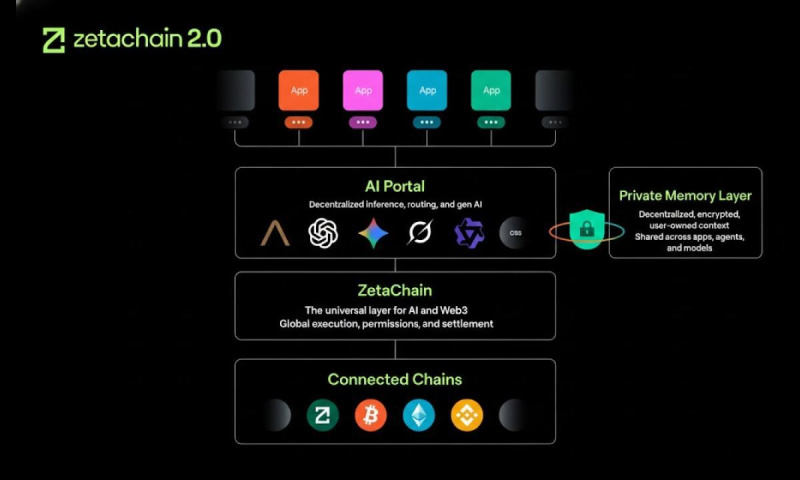 Anuma: First Consumer Showcase