Argentina-based private banks Banco Galicia and Burbank have started offering cryptocurrency trading services
Both banks provide access to Bitcoin, Ethereum, and USD Coin
The rollout of new trading features comes amidst high inflation in the country and a growing rate of crypto users
Two Argentina-based private banks introduce crypto trading features
Banco Galicia, one of Argentina’s largest private banks announced on Monday the rollout of cryptocurrency trading functionality that will allow its 4.2 million clients to buy, sell, and store Bitcoin, Ethereum, XRP, and USD Coin.
In a Tweet posted yesterday, the bank shared screenshots showing the newly-launched feature.
On the same day, Burbank, a digital bank launched in 2017, announced it is also adding cryptocurrency trading features. The bank currently supports virtually the same selection of coins as the Buenos-Aires-based Banco Galicia, apart from offering Multi-Collateral Dai stablecoin instead of XRP.
The addition of cryptocurrency trading functionality by the two popular Argentinian banks comes at a time when the country’s local currency Argentine Peso is suffering from a high degree of inflation. The South American country has been caught in a vicious cycle of a double-digit inflation rate for the better part of the past decade.
Argentina’s inflation rate over the past five years. Source: tradingeconomics.com
According to a Yahoo report published last year, the country’s economic downturn has acted as a catalyst for crypto adoption. Between 2020 and 2021, the number of cryptocurrency investment accounts in Argentina has increased by 10-fold, according to digital asset exchange Binance.
Digital currencies had a fantastic year in 2021. Significant investment from financial institutions and High-tech companies has helped Bitcoin reach new highs. The second-largest cryptocurrency, Ethereum, also hit record highs. Along with rising investor interest in digital assets, numerous nations are expected to become cryptocurrency hotspots by 2022 and beyond. We’ve compiled some of the top countries for crypto adoption in the coming years.
United States
Studies show that interest in cryptocurrencies has risen dramatically in the previous five years in the USA. It is estimated that 6% of the population owns or uses cryptocurrency. Almost a quarter of Americans trust a digital currency. Miami is now hosting one of the year’s most significant blockchain events.
UK
The UK has long supported Bitcoin and other cryptocurrencies. In fact, the UK government is exploring ways to regulate digital currency usage. Currently, the country is ranked 11th in Europe’s most regulated cryptocurrency countries. It plans to meet with Japan, the European Central Banks, and other financial organizations to discuss the topic.
Czech Republic
In the Czech Republic, Bitcoin is a rising star. This new technology’s potential is attracting larger groups of people aware of its benefits. Even the number of free Bitcoin-QT downloads has climbed to near-record levels.
The Netherlands
This country is one of the most outspoken advocates of cryptocurrencies and has long been a hub for crypto enthusiasts. It enables businesses to trade cryptos for goods and services. However, the government is now trying out other options and learning more about how blockchain works and what it could be used for.
Vietnam
Out of 74 countries polled, Vietnam had the second-highest percentage of respondents who said they used or owned cryptocurrency in the past year. However, many Vietnamese users are concerned about the government’s ability to regulate safe usage.
Philippines
The country’s use of crypto-friendly products has grown since its adoption in 2021. The government even suggested investigating Bitcoin in more depth so the country can expand with the crypto in different industries.
Why is crypto adopted in so many countries?
Cryptocurrency is a new financial asset born in 2009. Thanks to the decentralized Blockchain system, most cryptocurrencies lack a central authority, payment provider, or company owner. And as it is peer-to-peer, people can deal directly. Straightforward and private transactions, security, short settlement times, low fees, and other advantages make crypto the best currency for countries and companies to conduct their businesses. Among such businesses, we should note gambling, which we will shortly discuss in the following paragraph.
Gambling in crypto-friendly countries
All the benefits and qualities mentioned above make crypto an excellent payment option for many industries, including online gambling. As a result, more and more casinos are beginning to accept Bitcoins as a form of payment. One of the best examples of such Bitcoin casino is FortuneJack, which is, without a doubt, one of the first crypto casinos on the globe. It is licensed in Curacao and offers several advantages and bonuses that you may find at their website.
Conclusion
As we can see, in recent years, Bitcoin adoption has soared. The diversity of nations that contributed to this shows that cryptocurrency is already a genuinely global phenomenon, which covers many industries, among which is gambling.
Over 65,000 ETH (worth approx. $205M at current market rates) out of 173,600 ETH stolen in the Ronin attack have already been moved
The attacker is sending ETH to Tornado Cash, a popular anonymizing service that breaks the on-chain link between source and destination addresses
Ronin Bridge was exploited from over $600M in ETH and USDC in late March in what was the biggest hack of its kind to date
Almost a third of ETH stolen in the Ronin Bridge hack has been sent to new addresses
In late March, the Ronin Network was exploited for more than $600 million worth of Ethereum in what was the largest DeFi attack to date. At the time, the team behind the Ethereum-linked sidechain of the popular crypto game Axie Infinity stated that the attacker gained access to the majority of validators nodes and was able to sign transactions, and made away with 173,600 ETH and 25.5M USDC.
Roughly three weeks after the initial attack, more than 65,000 ETH have been transferred out of the Ethereum wallet associated with the Ronin Bridge hack. It is currently presumed that the attack originated from North Korea, although some in the crypto community believe that the attack was carried out by a single person not associated with state actors.
Whoever was behind the attack has already moved roughly a third of the stolen funds to new addresses, according to Etherscan. What’s more, the attacker is upping the amount of transferred ETH with each subsequent transfer. The largest transaction at press time was approved on April 19 and amounted to 18,256 ETH, worth over $57 million at the time of the transaction.
The list of outgoing ETH transfers as of April 20. Image source: Etherscan
The funds transferred to new addresses have been sent to Tornado Cash in 100 ETH increments. The attacker is apparently using the popular decentralized service to mask his transactions and make it possible to cash out stolen funds.
In the aftermath of the Ronin Bridge attack, Axie Infinity’s creators Sky Mavis raised $150 million in a funding round that was led by Binance and saw participation from Animoca Brands, a16z, Dialectic, and Paradigm. The Sky Mavis team said the funds will be used to reimburse victims of the unfortunate attack and to enhance security of its blockchain platform.
Ethereum developer Tim Beiko has announced The Merge won’t take place in the second quarter of this year, as was originally planned
The Merge is a highly anticipated upgrade that will see Beacon Chain and the Ethereum mainnet merge and usher in the era of Proof-of-Stake (PoS) consensus
Ethereum currently uses a power-hungry and up to 99% less efficient Proof-of-Work (PoW) consensus mechanism
Proof-of-Stake on Ethereum won’t go live before the second half of 2022
The Merge, a phase when the Ethereum mainnet will merge with Beacon Chain and transition from the Proof-of-Work (PoW) to Proof-of-Stake (PoS) consensus mechanism has experienced another setback. According to Ethereum developer Tim Beiko, The Merge will take place a “few months after” June.
It won't be June, but likely in the few months after. No firm date yet, but we're definitely in the final chapter of PoW on Ethereum
The news comes just days after the developers implemented the first-ever mainnet “shadow fork” to test Ethereum’s ability to handle smart contracts and on-chain transactions ahead of the highly-anticipated upgrade.
According to Ethereum Foundation developer Parithosh Jayanthi, the aim of the test was to “allow the community practice running their nodes, deploying contracts, testing infrastructure, etc.” “We hope it’s helping the community get a sense of the post merge world,” Jayanthi added on Sunday, a day before the network testing took place.
While many people in the community saw the implementation of the mainnet shadow fork as a sign that the Q2 2022 implementation of The Merge is still on the table, Beiko’s Wednesday statement put an end to that theory.
Didn't expect my tweets from yesterday to cause such a reaction 😅 I appreciate that it can be hard to parse the progress on The Merge when you aren't deep in the process.
In a post shared on GitHub, Beiko listed the main reasons for the delay. For starters, shadow forking of the mainnet apparently revealed “issues in clients,” which need to be addressed before the team proceeds with the Beacon Chain integration.
The second thing to consider is the difficulty bomb, a process regulating mining difficulty on Ethereum, which will raise block generation up to 20 seconds by August. Beiko explained that the inability to implement The Merge “before block times are slowed too much,” will mean that the process will be further delayed.
Ethereum’s transition to PoS, formerly known as Ethereum 2.0, was first slated for 2019. If everything goes according to plan, we may see a much improved and efficient Ethereum network before the end of this year. In the meantime, Layer 2 scaling solutions, such as Polygon and Optimism, will have to compensate for high network congestion resulting in high gas fees and slow transactions.
Ethereum developers have tested the network’s ability to handle smart contracts and transactions in preparation for The Merge
The Merge is the highly-anticipated Ethereum’s mainnet transition from PoW to PoS consensus mechanism
The devs used “shadow forking” to identify potential bugs and other problems in the code
Developers implement “shadow forks” to test PoS consensus in a secure environment
The transition from an energy-intensive Proof-of-Work (PoW) consensus protocol to a much more efficient Proof-of-Stake (PoS) algorithm, dubbed ETH 2.0, has been one of the biggest storylines surrounding Ethereum in recent years.
On Monday, the Ethereum developers made a huge leap towards the mainnet launch of the PoS consensus as they implemented the first-ever “shadow fork”. The active testing of PoS on Ethereum was confirmed by Ethereum Foundation developer Marius van der Wijden ahead of the “first mainnet shadow fork ever.”
According to Ethereum Foundation developer Parithosh Jayanthi, the shadow fork provides a secure environment for teams and developers to stress test the network by “running their nodes, deploying contracts, testing infrastructure, etc.” in hopes of “helping the community get a sense of the post merge world!”
Speaking on the Bankless podcast earlier this year, Ethereum founder and lead developer Vitalik Buterin explained The Merge as the transition from PoW to PoS consensus mechanism that will significantly reduce the power consumption and provide greater transaction throughput and scalability. At the time, Buterin said The Merge could take place as early as Q2 2022, although no official mainnet release date has been announced.
Once The Merge is complete, the Beacon Chain that launched in December 2020 will merge with the Ethereum mainnet, change the way transactions are validated, and usher in the era of a faster, more secure, and less expensive Ethereum network.
According to data from Staking Rewards, nearly $33 billion worth of ETH, about 9% of the total circulating supply, is currently staked on the Beacon Chain, and will become withdrawable sometime after The Merge takes place.
Bitcoin and Ethereum have today plunged to their respective multi-week lows after having accrued double-digit losses in the past seven days
Apart from Monero, virtually all top 50 largest market cap coins have been trading in the red zone over the last week
Layer 1 DeFi platforms Terra, Solana, and Cardano have suffered the largest losses
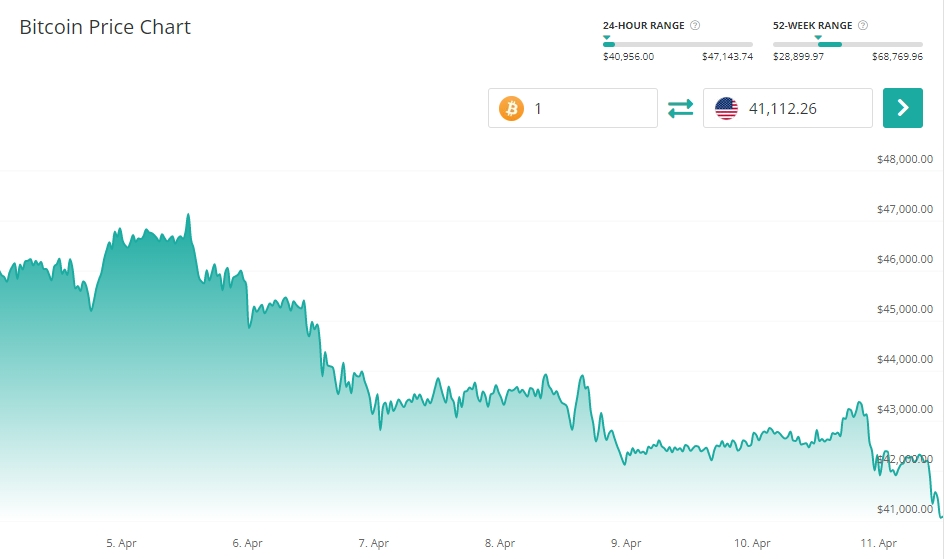
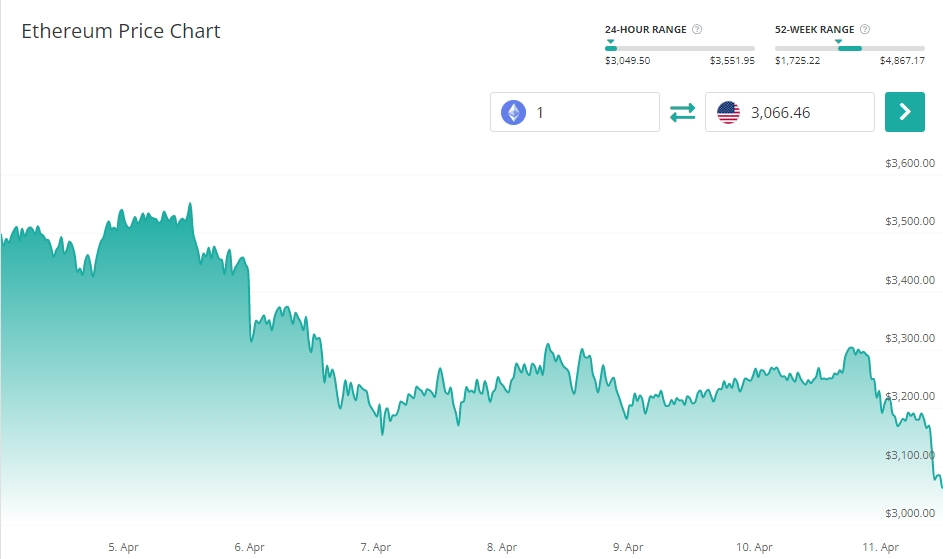
The markets have been in a state of a gradual pullback over the last seven days. During that period, the value of most major digital currencies has diminished by double digits, including Bitcoin (-10.7%) and Ethereum (-11.8%). Consequently, the total value of all digital currencies in circulation shrank from $2.21T on April 4 to $1.98T on April 11.
Bitcoin finds new support at $41,000
In the past couple of weeks, Bitcoin’s price movement was emblematic of the broader market trend permeating the industry. After reaching its highest YTD price point of just shy of $48,000 at the end of March, the world’s largest crypto has been caught in a sell-off mode, which has pushed its value to the $41,000 level.
Last week, the popular crypto analytic and private fund manager behind the Twitter handle Gaah highlighted the importance of Bitcoin retaining the $44,400 level. He argued that a descent below that crucial price point could spell a further drop to the $37,000 zone and bears claiming the upper hand.
3/3🧵
If the price breaks $44.4k the risk of the Structure breaking dramatically increases.
The probability from this is the Bears will try to control the short term trend once again at $37k.
While it is impossible to predict with certainty how Bitcoin will perform over the coming days, an algorithmically generated Bitcoin price prediction from CoinCodex shows a drop below the psychological $40,000 level could be a real possibility.
Major altcoins are down over 20% in the last 7 days
Several altcoins trading in the crypto top 10 have experienced even more severe pullbacks than Bitcoin. Case in point, Ethereum has lost over 11% in the last seven days and dropped to the $3,000 level, its April low.
However, Ethereum was far from being the worst-performing top 10 coin of the past week. That unfortunate title goes to Terra, which lost 22.8%. Other Layer 1 smart contract platforms, including Solana, Cardano, and Avalanche, didn’t fare much better and also lost more than 20% since last week.
Excluding stablecoins, Monero (+3.3%) was the only digital asset among the 50 largest market cap projects to not lose value over the previous seven days.
In the coming days, it will be interesting to observe whether Bitcoin and Ethereum manage to consolidate above the $40,000 and $3,000 psychological levels, respectively. If not, we could see bears extending their dominance in the short term.
CEO of Tesla and Space X, Elon Musk, offered general tips on how to invest money when inflation rates are high
Musk explained that owning physical things is best, but added that he still owns and will not sell his digital assets holdings
The price of Dogecoin jumped by 8% as a result
Musk believes owning real estate and stocks is preferable to dollars, says he won’t sell his BTC, ETH, and DOGE
On Sunday, Tesla CEO Elon Musk took to Twitter to ask his followers about their thoughts on the rising inflation. Out of thousands of replies, the answer of Microstrategy’s CEO Michael Saylor caught Musk’s attention.
“USD consumer inflation will continue near all-time highs, and asset inflation will run at double the rate of consumer inflation. Weaker currencies will collapse, and the flight of capital from cash, debt, & value stocks to scarce property like #bitcoin will intensify,” wrote Saylor, who is well-known for his pro-Bitcoin stance. For context, Microstrategy is the largest publicly-traded BTC holder, with over 125,000 coins in its treasury.
As a general principle, for those looking for advice from this thread, it is generally better to own physical things like a home or stock in companies you think make good products, than dollars when inflation is high.
I still own & won’t sell my Bitcoin, Ethereum or Doge fwiw.
Musk noted that he is not at all surprised by Saylor’s response and offered his view on how to best protect against rising inflation rates and currency devaluation. The CEO of futuristic companies such as Tesla and Space X remarked that investing in “physical things” is better than holding onto dollars “when inflation is high.”
Despite his inclination to invest in stocks and real estate, Musk is still holding onto his Bitcoin, Ethereum, and Dogecoin holdings in the face of rising inflation.
“I still own & won’t sell my Bitcoin, Ethereum or Doge fwiw.”
Musk mentioning Dogecoin on social media has historically sparked sudden and considerable price upswings. Remember last December and how the price of DOGE catapulted by more than 20% after Musk teased a possible integration with Tesla’s online shop (which, to be fair, did eventually materialize). Or last March, when Musk’s announcement he is working with Dogecoin developers sent the price flying to its then local high.
DOGE’s nearly 10% spike came after Musk’s comments.
A similar thing took place on Sunday – shortly after Musk said he is not selling his memecoin allocation, the price of DOGE spiked by over 8% in a matter of minutes. The rally was short-lived, however, as DOGE quickly retraced and is now trading just 1.35% up for the day.
The European Union parliamentarians are set to vote on a bill that could severely limit Bitcoin and PoW mining in the member states
The provision calling for PoW chains to shift to PoS was reintroduced in a “last-minute” change
The vote will take place later today at 1:45 PM (CET)
EU legislators are voting on a bill that could have sweeping ramifications for PoW mining
On Monday, the EU Parliament will be voting on the Markets in Crypto Assets (MiCA) bill, which features provisions aimed to limit the energy-intensive Proof-of-Work (PoW) mining in the Union. For context, Bitcoin, Ethereum, and a number of other digital belong to the PoW category.
If the vote passes, Bitcoin mining in member states would essentially become prohibited. The provision in the MiCA bill calls for PoW to be phased out in favor of a more environmentally friendly Proof-of-Stake (PoS) consensus mechanism. Currently, it is not exactly clear if trading of PoW digital assets would also be forbidden.
Small-scale PoW mining would reportedly be legal under the new provisions. However, there are no parameters in the bill describing what exactly classifies as small-scale.
The provisions targeting PoW mining first surfaced last week. While they were quickly dropped due to widespread criticism, the language prohibiting PoW coins ultimately found its way back into the bill’s final draft mere hours before the vote.
The broader crypto community was obviously enraged by the “last-minute” change. Patrick Hansen, a blockchain advocate and head of Strategy and Growth at Unstoppable Finance, took to Twitter to voice his frustration.
Jeremy Allaire, one of the co-founders and CEO of Circle, the issuer of the USDC stablecoin, called the vote “extremely high stakes” and remarked that it’s “extraordinarily concerning” that the vote made it this far in the legislative process.
Extremely high stakes vote in the EU. That such a proposal made it this far is extraordinarily concerning and unlikely to stand up to practical reality. https://t.co/t8xA0EnVfE
— Jeremy Allaire – jda.eth / jdallaire.sol (@jerallaire) March 12, 2022
According to Galaxy Digital’s research, the Bitcoin network has an energy footprint of 113.8 THw/yr, or roughly 0.05% of the global energy consumption. Per Cambridge University, Europe accounts for less than 15% of the global Bitcoin hashrate, with the highest concentration of miners residing in Germany and Ireland.
While Bitcoin’s reliance on fossil fuels is undoubtedly problematic, there are plans of shifting the network towards carbon-neutral energy sources in the coming years and drastically lowering the network’s carbon footprint.
The MiCA vote is scheduled for later today, at 1:45 PM (CET). You can follow the vote in real-time through a web stream.
UPDATE (March 16, 12:35 UTC):On Monday, the Committee on Economic and Monetary Affairs (ECON) voted against a provision limiting PoW digital currencies being included in the MiCA bill.
Investment banking giant Goldman Sachs has started offering its clients access to an Ethereum institutional fund managed by alternative asset management firm Galaxy Digital. According to the form filed with the Securities and Exchange Commission (SEC) on Tuesday, the bank is in it for the long haul, as the filing shows that the offering will last at least one year.
Key takeaways:
Galaxy Digital issued the “Galaxy Institutional Ethereum Fund” early last year. The company that specializes in bridging the world of traditional and blockchain finance has since sold over $50 million of its pooled fund to 28 interested clients.
According to the filing, a minimum investment is capped at $250,000, while the aggregate net asset value and expected revenue range were not disclosed.
Goldman Sachs has repeatedly expressed its bullish outlook on Ethereum in recent months. Last July, the bank praised Ethereum as the dominant smart contract platform and wrote in a note to its clients that ETH could become the most popular store of value going forward.
In November, Goldman Sachs’ Global Markets managing director Bernhard Rzymelka predicted that Ethereum would reach as high as $8,000 by the end of the year. Rzymelka’s prediction later turned out to be far off the mark as ETH finished 2021 trading in the $3,700 range.
In addition, Goldman Sachs’ senior analyst Zach Pandl told its clients last year that Bitcoin could reach the elusive six-figure price tag and grow past $1.8 trillion market valuation.