Wormhole Network, a DeFi bridge connecting Solana and Ethereum was exploited for more than $300 million
The hacker was able to mint 120,000 wETH (worth $313M at press time) by falsifying authentication in Solana’s smart contract code
The Wormhole team is offering a $10 million bounty in hopes the attacker returns the stolen funds
Smart contract exploit leads to a $300 million attack on the Wormhole Network
Wormhole, a blockchain bridge allowing transfers between Solana and Ethereum has been a victim of one of the largest crypto hacks ever. In the early hours of Wednesday, the Wormhole team took to Twitter to share the unfortunate news that its blockchain interoperability solution “was exploited for 120k wETH.”
The wormhole network was exploited for 120k wETH.
ETH will be added over the next hours to ensure wETH is backed 1:1. More details to come shortly.
We are working to get the network back up quickly. Thanks for your patience.
The team immediately patched the vulnerability in the smart contract code that made the attack possible and stated they are hard at work to bring the network online “as soon as possible.”
The magnitude of the hack has sparked massive investigation efforts by a number of blockchain experts and ignited a heated discussion over the Solana network security. Kelvin Ficther, a software engineer working at Uniper who goes by a Twitter moniker “smartcontracts”, was among the first to piece together the events that led to more than $300 million worth of stolen crypto funds. He documented his findings in a Twitter thread.
Alright. I figured out the Solana x Wormhole Bridge hack. ~300 million dollars worth of ETH drained out of the Wormhole Bridge on Ethereum. Here's how it happened.
According to Ficther, the attacker took advantage of Solana’s approach to smart contract validation that allowed it to deposit 0.1 ETH and mint 120,000 wrapped ETH without drawing the attention of the network’s security systems. The attacker was able to falsify the signature of network guardians in order to create new wETH, without having to deposit an equivalent amount of ETH.
“After that point, it was game over. The attacker made it look like the guardians had signed off on a 120k deposit into Wormhole on Solana, even though they hadn’t. All the attacker needed to do now was to make their “play” money real by withdrawing it back to Ethereum.”
Ficther added that the attacker made a single withdrawal of roughly 80,000 ETH and an additional, approximately 10,000 ETH withdrawal shortly after. The address connected with the attack currently holds 93,750 ETH, worth $243.5 million at current market rates. In hopes of reclaiming the stolen funds, the Wormhole team is offering a $10 million reward to the attacker if he comes forward and returns the loot.
Last August, Poly Network became a victim of one of the largest crypto attacks in history, when an anonymous hacker made away with $612 million worth of DeFi assets. Luckily for the Poly Network team and users affected by the massive exploit, the attacker turned out to be a “white hat” hacker and ended up returning the stolen funds. We can only hope that Wormhole’s unfortunate situation resolves in an equally amicable manner.
The price of Solana’s native SOL token took a beating once the news of the hack became widely publicized. In a matter of 8 hours SOL’s value diminished by more than 12%.
Prominent blogger and hacker Jane Manchun Wong found clues of a potential Solana integration by reverse-engineering the OpenSea website
Leaked screenshots show the option for the popular Solana wallet, Phantom, and display Solana among the current selection of available chains on OpenSea
NFT market has exploded in the past year, generating over $23 billion in trading volume
While the world’s largest NFT marketplace, OpenSea, is primarily hosting digital collections created on Ethereum, newly-leaked screenshots suggest that support for Solana-based non-fungible tokens (NFTs) might be coming soon.
Renowned hacker found evidence for Solana support in OpenSea’s hidden code
Jane Manchun Wong, a prominent blogger and hacker who earned her fame by uncovering hidden features buried in the code of some of the more popular online products and services, has shared her findings on OpenSea’s Solana integration in a Tuesday’s Twitter post.
The leaked OpenSea screenshots show support for the widely-used Solana wallet, Phantom, while also displaying Solana among the list of supported blockchains, next to Ethereum, Polygon, and Klaytn.
Talking to Decrypt, Wong unveiled that she managed to acquire the images by reverse-engineering the OpenSea’s webpage and added that whoever was working on the new features went to great lengths to “try to hide it.”
OpenSea spokesperson told Decrypt that Wong’s revelation is “old speculation,” and said that the leading NFT marketplace will share further information about Solana integration “when we have something to say.”
NFTs exploded in 2021, the trend continues this year
According to blockchain analytics firm DappRadar, the NFT market generated more than $23 billion in trading volume in 2021, with the vast majority of NFT activity taking place on the Ethereum blockchain. In the first three weeks of 2022, NFT trading volume on Ethereum surpassed $9.5 billion, while Solana-based NFT activity generated “only” $157 million, according to data from The Block.
The growing popularity of NFTs has led to OpenSea having its best month to date only two weeks into January, handily beating previous trading volume, user activity, and fee-generated records from last August. Additionally, the recently concluded $300 million financing round has raised the Silicon Valley startup’s value to more than $13.3 billion.
Earlier today, YouTube CEO wrote in a letter to the community that the video-streaming giant is considering adding support for NFTs. The news comes a week after Twitter unveiled deeper NFT integration on its platform, and the announcement of Meta’s Facebook working on NFT features.
The cryptocurrency market capitalization recorded an 8% gain in the last 24 hours
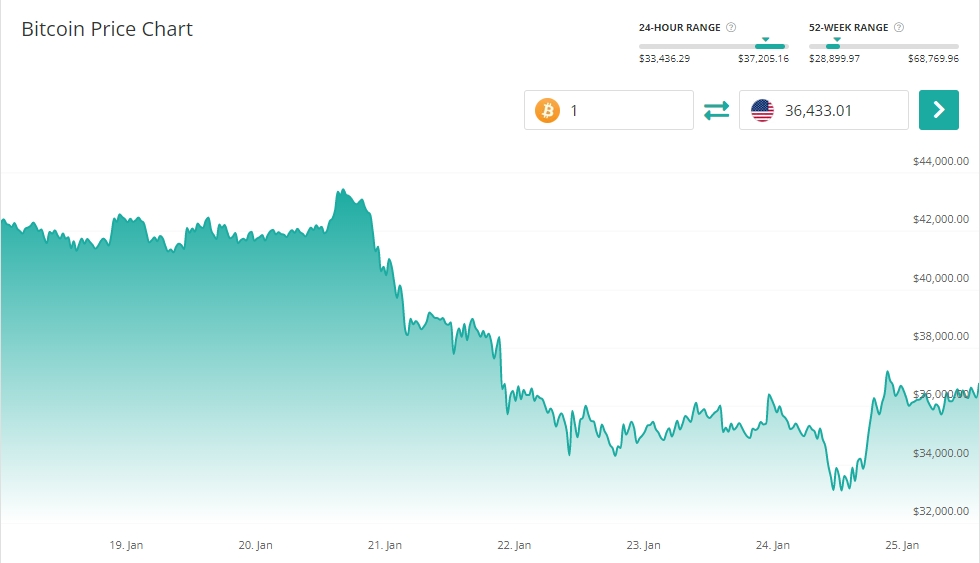
Bitcoin encountered strong support at the $33,000 level and recovered all of its yesterday’s losses within 12 hours
Fantom and Pocket Network were the biggest gainers in the crypto top 100, having gained more than 20% in the last 24 hours
The cryptocurrency market has entered a much-anticipated recovery after yesterday’s selloff. Over the course of the last 24 hours, the cumulative value of all digital assets in circulation has increased by more than 8%, which led to virtually all coins in the cryptocurrency top 100 being traded in the green zone.
Bitcoin bounced off the $33,000 bottom and gained 13% within 12 hours
The world’s largest crypto was in free fall since Friday, when the flash crash saw Bitcoin lose over 10% in the span of 12 hours. The bearish momentum carried over to the weekend and into the beginning of this week – on Monday, BTC reached its lowest value in six months, bottoming out at $33,063. Thankfully, Bitcoin encountered robust support at the $33,000 price level and managed to mount a strong, 13% bounce back that pushed its value to pre-weekend levels.
At the time of writing, Bitcoin is changing hands at $36,433, still down 15% from its Friday’s top. Friday’s selloff that plunged the value of Bitcoin to six-month lows was a culmination of several macroeconomic factors.
For starters, both the stock and crypto market still haven’t shaken off the negative sentiment sparked by the Fed roughly two weeks ago, when it announced an interest rate hike and an end to massive economic stimulus programs designed to ease the effects of the coronavirus pandemic.
Additionally, the central bank of Russia recently called for a blanket ban on crypto, which would outlaw all crypto-related activities in the third-largest Bitcoin mining country. Prominent Russian tech and political executives have voiced their opposition to the proposed ban and fear it could have a devastating effect on the country’s IT sector.
As the price of Bitcoin neared its cycle low yesterday, a number of blockchain market analysts pointed out that the crypto has entered the “oversold” zone as key market signals, including NVT and IRS, turned green and started indicating that the local bottom has been reached.
Ethereum leads broader altcoin recovery, Fantom and Pocket Network top the largest gainers chart
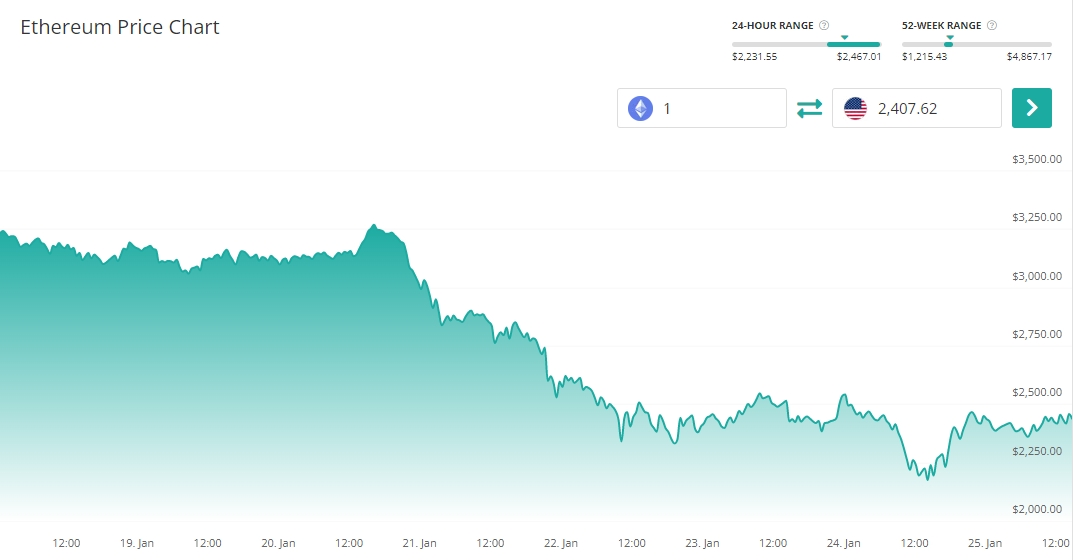
Ethereum lost over 30% of its value between Friday’s top and Monday’s bottom. Since then, ETH gained over 10% and is currently trading at $2,407, almost exactly 50% removed from its all-time high reached last November.
As the price of the second largest crypto started recovering, other altcoins followed in its tracks. Pocket Network has been the best performing coin in the last 24 hours and managed to break into the cryptocurrency top 100 on the tailwind of 33% gains.
Ethereum Layer 1 competitor Fantom impressed with 22% gains and is now modestly in the green for the year, despite getting caught in the broader market pullback. Yesterday, Fantom reached a major milestone – it flipped Binance Smart Chain (BSC) in terms of the total value locked (TVL) on its network to become the third-largest decentralized finance (DeFi) ecosystem in crypto.
Oslo-based internet company Opera has released a beta version of its “Crypto Browser Project” on Wednesday
The crypto-centric browser offers a powerful suite of Web3 features, including a native non-custodial crypto wallet and a dedicated crypto hub
Opera intends to add support for Layer 2 solutions in a bid to become the go-to browser for crypto users
Opera launched a beta version of its “Crypto Broser Project” on Wednesday, four years after the first version of Opera’s web browser with cryptocurrency wallet and rudimentary Web3 support was released in 2018.
Opera believes web browsers will be even more important for Web3 as they were for Web2
The Opera Crypto Browser Project offers native support for decentralized applications (dApps), which far surpasses the basic functionality of a regular web browser with a digital wallet add-on installed.
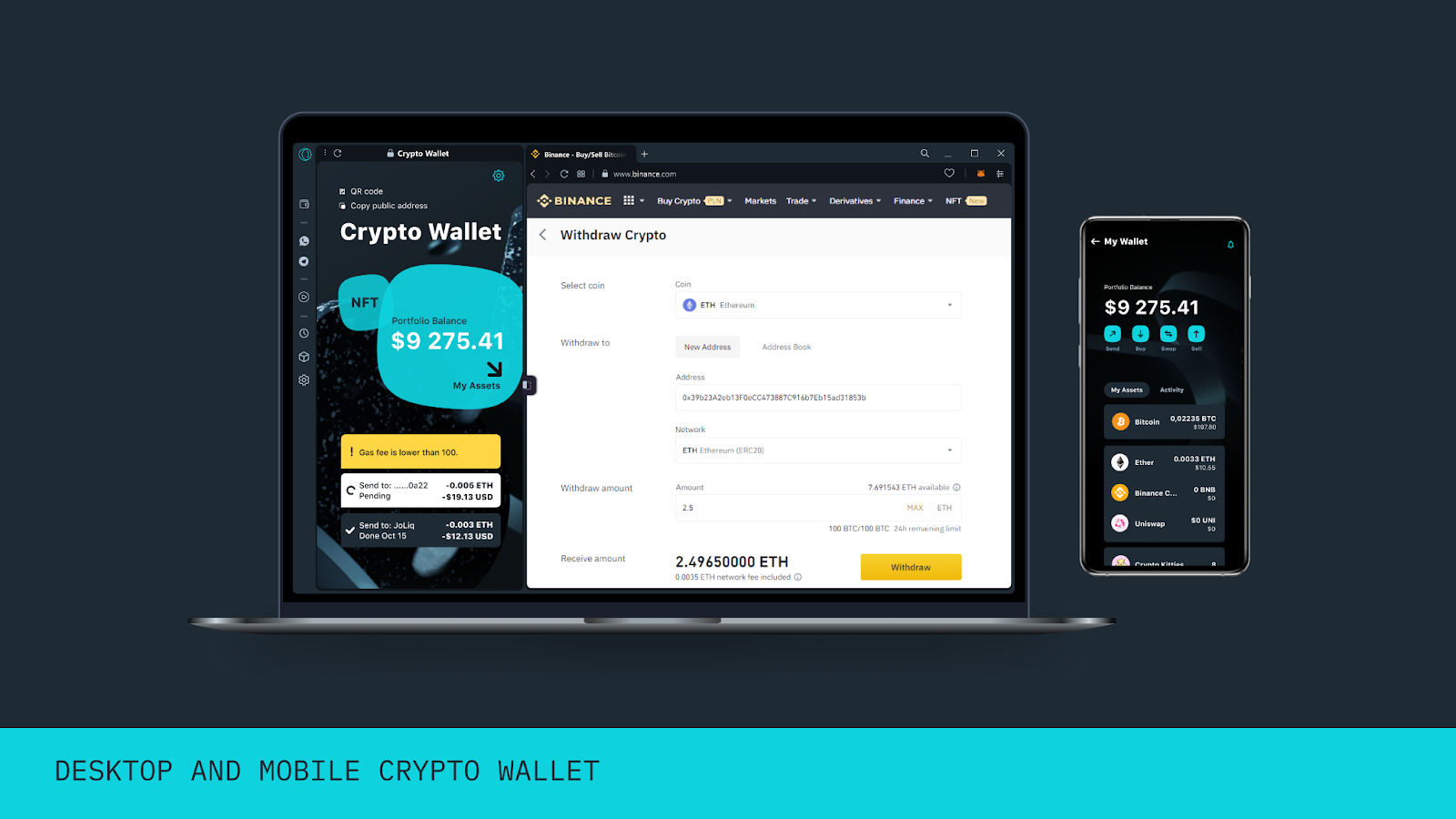
Opera’s new browser includes a new native non-custodial crypto wallet with support for Web3. Image source: Opera
Due to the new browser’s native Web3 support, users can access their favorite Web3-powered products and services, including non-fungible tokens (NFTs), decentralized finance (DeFi) services, and metaverses, directly from their Opera browser, with no extensions needed.
The Opera Crypto Browser supports a range of Web3 entry points, including Metamask, Coinbase, or Binance wallet, and Opera’s new wallet solution that supports ETH, ERC-20, and ERC-721 tokens (ERC-1155 support coming in the first quarter of this year). According to the company’s representative who talked with CoinDesk, Opera plans to roll out support for Polygon and Solana, in a push towards greater Layer 2 compatibility. The Opera team aims to accelerate Layer 2 adoption, as noted in Wednesday’s blog post:
“Ethereum Layer 2 solutions and alternative blockchains already provide ways to transact and run dApps in a more environmentally conscious way. In our view, this is the best way to move forward. In order to reach mass adoption, decentralized solutions need to be scalable and just as fast and effective as those offered in the current Web.”
In a recent appearance on the Bankless podcast, Ethereum founder and lead developer Vitalik Buterin pointed out how important Layer 2 networks are for the network and commended their service of lowering transaction costs, since Ethereum is not yet “ready for direct mass adoption.”
The crypto-focused browser also features a special section called “Crypto Corner,” which displays the latest blockchain and NFT news, a calendar of crypto events such as upcoming airdrops and other important dates, educational content, and more.
Jorgen Arnesen, vice president of Web 3 at Opera told CoinDesk in an interview:
“We actually believe that browsers will be more important in Web 3 than they were in Web 2. We’ve been around the block for 25 years, and around Web 3 since 2018. A multi-chain token strategy will be essential to a good user experience.”
According to web analytics firm Back Linko, Opera accounted for 2.19% of the global browser market share in 2021, which put its active user count at roughly 101 million.
In an attempt to offer something new, certain online casinos push the boundaries of the industry by trying to be as innovative as possible. This often results in new features, special bonuses, and the addition of new and easy-to-use online payment solutions. The latter plays a key role for some people when choosing an iGaming company, which is why many casino websites try to include as many options as possible.
Some people prefer the classic payment alternative because they know how to use them and what to expect. Yet, others are willing to experiment with things, such as cryptocurrencies. That’s one of the reasons why various sites accept these online payment solutions.
People interested in those this know that there are thousands of currencies. However, most betting platforms only offer a handful of them, so let’s go over some of the popular alternatives. We won’t include Bitcoin because this option is accessible on sites that don’t focus only on these payment solutions.
Ethereum
Often called the silver of cryptocurrencies, Ethereum is one of the hottest names for digital currencies. Finding a solid iGaming site where you can use this option is not easy. However, thanks to Betenemy, you can check some of the most popular online crypto casinos where BTC, ETH, and LTC are accepted and pick a brand that offers different privileges for cryptocurrency users. Most of these sites have established themselves in this business, making them the go-to options for many punters.
Besides being a popular option for iGaming enthusiasts, Ethereum plays a major role in all sorts of projects. That’s one of the main reasons why its price could increase in the future.
XRP
People who have previous experience with online casinos that offer digital currencies have stumbled upon XRP. This used to be one of the most popular cryptocurrencies in iGaming a couple of years ago. Even though many online betting platforms allow their punters to make transactions with it, XRP is not as big as it once was. Yet, with a market cap of nearly $37 billion, it is one of the biggest cryptocurrencies in the world. That’s why it continues to be the preferred option for some online punters.
Polygon
One of the digital currencies that are becoming increasingly popular among traders and “investors” is Polygon. Even though this option may not have the market cap of things, such as Ethereum or XRP, it has a lot of users worldwide. Consequently, those who read Betenemy’s reviews about some of the best online crypto casinos will see that certain companies offer this option.
Similar to other digital currencies, Polygon’s value changes daily. Consequently, you should check how much it is worth before making a transaction.
TRON
While it is true that Tron is not as big as other digital currencies on this list, it is one of the options available to online punters. In addition to making payments, this option often gives people access to different kinds of rewards. For example, some online casinos offer special deposit bonuses.
Bitcoin lost over 10% of its value in the span of 12 hours, after being up 4% earlier in the day
Options contracts and Russia’s central bank’s recent call for a ban on crypto might be the main culprits for the sudden market pullback
The total crypto market capitalization has decreased by roughly 7% in the last 24 hours and dropped below $2T for the first time since last September
Big selloff pushes the price of Bitcoin to a six-month low
After struggling to break out of the narrow trading range between $41,300 and $43,400 for the past week, Bitcoin experienced a sharp decline in its value in the last 24 hours that saw the world’s largest crypto plummet to price levels not seen since last August.
BTC was up over 4% for the day before losing 11% in the span of the next 12 hours.
Bitcoin managed to momentarily push past the $43K level earlier in the day, but the modest upward trend was unfortunately short-lived. In the proceeding 12 hours, Bitcoin lost 11% of its value and hit a six-month bottom of $38,440. BTC has since pulled off a modest recovery and is changing hands at $39,100 at the time of this writing.
What’s behind the sudden drop?
Some members of the crypto community attributed the sudden dip in prices to selling done by Bitcoin options traders. More than $132 million in gains were to be had if BTC’s price dropped below $41,000, according to InvestAnwsers, which boasts almost 100k Tweeter followers and over 400k subscribers on Youtube.
#BTC up 4%, down 9% all in 12 hours. Welcome to #OptionsExpiry – bears are in control. They need #Bitcoin under $41,000 to pocket $132 million in gains. Seatbelts please💺 or this🚽! Welcome to Friday Expiry. pic.twitter.com/6ybAxjM5sA
Russia’s central bank calling on a blanket ban on crypto, which would outlaw all crypto-related activities in the country apart from basic crypto ownership might have also played a part in swinging the market sentiment.
Generally speaking, both the stock and crypto market still haven’t shaken off the negative sentiment that was sparked by the Fed roughly two weeks ago, when it announced an interest rate hike. At the time, Bitcoin shed 10% of its value and dropped from $46,800 to $42,300 in the span of 6 hours.
As is always the case when it comes to sudden price movements, it is nearly impossible to pinpoint the exact reason for the broader behavior of market participants. It is worth noting though, that more often than not, digital assets’ prices follow a somewhat predictable pattern. After a prolonged period of sideways trading activity, as was the case for Bitcoin in the last two weeks, one of the following two things usually occur: either the price of a particular asset starts rallying, or the price experiences a steep and sudden decline.
The total crypto market cap drops below $2T as virtually all coins record high single-digit loesses
On the tailwind of Bitcoin’s sudden 11% drop, Ethereum and other alternative digital currencies also experienced sharp declines in their value, which dropped the combined valuation of all cryptocurrencies in circulation below $2 trillion for the first time since September. Solana, Cardano, and Avalanche were particularly hard hit all three Layer 1 projects lost nearly 10% of their value and drop to their respective multi-month lows.
The emergence of decentralized financial (DeFi) products and services has completely transformed the cryptocurrency investing landscape over the last couple of years. Spot and futures trading is no longer the only game in town. Digital currency investors, particularly those who lack the time required to closely observe market movements to identify good buying and selling opportunities, can take advantage of passive income sources that are less risky and in some cases more lucrative.
While numerous decentralized and centralized crypto services have arisen that allow their users to take advantage of various financial instruments designed for passive income generation, few offer yield generating prowess of Midas.Investments.
Midas.Investments turns market inefficiencies into yield generating opportunities
Midas.Investments is a custodial digital asset investment platform that provides its users with an opportunity to build sustainable passive income streams and unlock the full potential of their crypto assets. The platform supports Bitcoin, Ethereum, and a long list of popular crypto assets.
The main screen of the website features a streamlined user interface with up-to-date APY rates and current market prices. Image source: Midas.Investments
The Midas.Investments team has developed a robust investing system that takes advantage of minute inefficiencies in the market to provide one of the highest yield generating services in the DeFi sector. The company utilizes its users’ digital holdings in order to distribute liquidity across the market in a peer-2-peer (P2P) manner. In return, Midas.Investments investors are rewarded with enticing APY rates that provide a great long-term investment opportunity.
Midas.Investments DeFi investing strategies
Midas.Investments investment strategies take into account price volatility, correlation, collateral asset models and hedging, for maximum yield generating efficiency while retaining a high degree of financial security.
Let’s take a look at some investing strategies Midas.Investments employs to grow user deposited crypto assets during opportune market conditions and in turn preserves them in times of market turmoil.
Concentrated liquidity provider for Uniswap V3
Staking assets in decentralized exchange (DEX) lending pools is one of the more popular ways of putting otherwise idle crypto assets to use. Liquidity providing is not risk-free, primarily due to the potentially high divergence in prices of the two pool assets, which can lead to dreaded impermanent loss. Midas’ self-collateralization method of lending target assets and liquidity negates much of the liquidity-providing risks. Midas aims for a 20% – 60% annualized percentage rate (APR) for deposited assets, earned from LP trading fees.
Borrowing for target asset’s collateral to free liquidity
Midas.Investments takes a strategic position on a target asset at a liquidation value higher than 40%. This method unlocks additional liquidity and serves best in a combination with another investment strategy; however, a loan can approach the liquidation level quickly if the price of the asset unexpectedly depreciates and then requires additional collateral, or debt repayment to maintain a safe loan-to-value (LTV) ratio.
Yield vaults
Another method Midas.Investments utilizes are the low-risk YFI strategies, which maximize interest rates on lending across different lending protocols and can accrue up to 15% APR. Insurance protocols and insurance funds ensure that user funds are completely safe at all times. Midas seeks to interact with smart contracts powering the platform during nighttime when the gas fees are at their lowest.
Asset and stable liquidity provider to hedge from market pullbacks
To hedge against market downturns, Midas provides liquidity in liquidity pools consisting of “regular” crypto assets and stablecoins, such as USDT or USDC. This approach nets significant profit in times of bearish market activity and can generate anywhere between 30% to 150% APR.
Leveraged liquidity farming
The riskiest method Midas.Investments uses. Combining assets with a stablecoin pair grows the asset amount during market pullbacks, which can net up to 75% APR if market conditions are optimal but introduces considerable risks during periods of flat markets with high volatility.
Midas.Investments uses a complex combination of different investing strategies, ranging from low to high-risk methods, to ensure up to 40% APR for a single asset regardless of market conditions.
To learn more about the different types of strategies the company employs to generate yield for its customers, check this insightful blog post from Midas.Investments.
Earn up to 28% annual interest on your investment in DeFi YAP
One of the better ways to grow your crypto portfolio is to invest in Midas’ DeFi Yield Automated Portfolios. The DeFi YAP consists of eight tokens by rapidly developing projects in the decentralized space, including ETH, LINK, SUSHI, AAVE, MIDAS, UNI, DAI, and SNX. Each of the listed DeFi assets accounts for the same share of the DeFi YAP, with 12.5%.
The Midas’ flagship DeFi investment vehicle provides users with an opportunity to earn a passive income of up to 28% annually. Since the DeFi sector is still very young and continuously changing, there is a higher degree of risk, but also a bigger upside, when investing in DeFi YAP than in Midas’ stable YAPs.
Earn stable passive income with Yield Automated Portfolios (YAP)
The Yield Automated Portfolios (YAP) are an excellent choice for investors that value asset stability over riskier approaches that can generate a higher yield but are wholly dependant on the state of the market. Midas offers two types of automated portfolios, which differ in the coins they support and the amount of yield they can theoretically generate. Both types provide great potential for long-term portfolio growth, feature weekly BTC payouts, and a reasonable fee structure.
Stable Yield Automated Portfolio (SYAP)
The investment in the Stable Yield Automated Portfolio is quantified with the SYAP token, which is not a blockchain token but a measuring unit for YAP investments. SYAP is backed by BTC, ETH, MIDAS, and USDT, and priced according to their market values.
The group of four tokens ensures maximum long-term stability and allows SYAP to generate a passive income stream of 23% APY. It is worth noting that automated portfolio rebalancing is done monthly to redistribute funds among different coins to optimize profits.
Masternode Yield Automated Portfolio (MnYAP)
Similar to SYAP, the Masternode Yield Automated Portfolio is managed by a special non-blockchain-based token MNYAP, which is priced based on the value of its underlying support assets.
The Masternode YAP consists of BTC, DIVI, ESBC, MIDAS, NRG, PHR, XZC, and ZEN, which were chosen according to their market performance and community engagement. Midas purchases the coins on their users’ behalf and uses advanced investing strategies to generate 20% – 25% APY rewards.
Platform security and fees
Midas.Investments uses a combination of various security measures to provide a maximum level of security and shield user funds from any malicious attacks. The first line of defense includes handling of all sensitive information through email and an IP-validation check. The investing platform also features 2 Factor Authentication (2FA), which means that user accounts are not accessible without a code that is sent via an email. As an added precaution, Midas performs automatic logouts every seven days. Finally, 90% of users’ funds are held in encrypted cold wallets, meaning that even if an unlikely breach occurs, it wouldn’t result in losses for customers.
The company charges a 5% fee on payouts before they are processed to the Bitcoin balance, and a 0.8% rebalancing fee, which is deducted after the monthly portfolio rebalancing has been processed.
Supported crypto assets
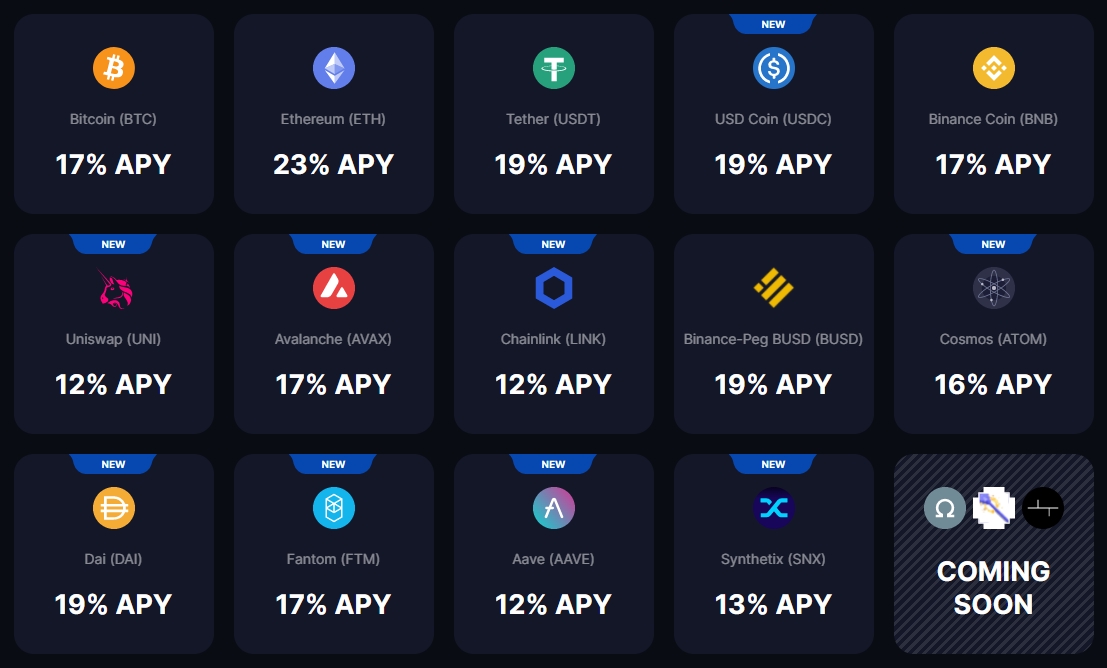
Midas.Investments supports 28 digital currencies in addition to the platform’s native Fantom blockchain-based MIDAS token, which provides a long list of benefits to Midas platform users. For more information about the MIDAS token click here.
The list of supported digital assets and their corresponding APY rates. Image source: Midas.Investments
Here’s a complete list* of supported coins in alphabetical order: AAVE, ATOM, AVAX, BNB, BTC, BUSD, CELO, DAI, DASH, DEFIYAP, DIVI, ETH, FIRO, FTM, LINK, LTC, MIDAS, MN YAP, NRG, PIVX, SAPP, SNX, SUSHI, SYAP, TRTT, UNI, USDC, USDT, ZEN
*The list is subject to change. Data was collected on 6.12.2021.
Gain exposure to the growing DeFi market guided by expert insight by Midas team of analysts
Midas.Investments has emerged as one of the market leaders in providing enticing passive income streams for cryptocurrency holders. No lock-up periods, no limits on deposits, and innovative investment strategies make the Midas platform one of the more flexible and lucrative solutions in the sector.
There is no better argument supporting that claim than cold hard facts – more than 23,000 investors have a total of $51 million worth of crypto assets committed to the platform. In October 2021 alone, Midas.Investments helped its customers generate a whopping $780,000 in stable passive income.
Midas team consists of notable analysts and software developers with rich experience in product development and over 20 years of high-level investment decisions under their belt.
For more information about the high yield generating financial options of Midas.Investments check their official website.
On Wednesday, Polygon announced that the highly-anticipated EIP-1599 upgrade is coming to the leading Ethereum Layer-2 scaling solution early next week. The network upgrade will introduce MATIC burning mechanics and start putting deflationary pressure on its value.
Key takeaways:
The Polygon team shared the news on Twitter and clarified that the set of Ethereum improvement proposals (EIPs) that were first introduced via Ethereum London hard fork in August of 2021, are finally coming to the Polygon mainnet.
The team is aiming to activate EIP-1599 and related proposals on Polygon’s mainnet on January 18, at around 8:00 AM UTC, at block number 23,850,000. The mainnet launch comes a month after the hard fork rolled out to Polygon’s Mumbai testnet.
The London upgrade’s main features include a better estimation of transactions costs, which leads to a reduction in overpayments, and a fundamental change in the way transaction fees are handled – fees that were previously paid to miners will now be removed from circulation.
Token burning, or destroying, is the process of removing coins from circulation, which plays a pivotal role in the supply and demand dynamics of a particular currency and creates deflationary pressure on the value of a single unit of currency.
When Ethereum burning was first introduced in August, the second-largest crypto began a multi-month long rally that saw its price reach the highest point to date of $4,867 on November 10. In the six months since ETH burning went live, more than 1.48 million ETH, worth nearly $5 billion, have been burned.
Polygon’s implementation of real-time burning mechanics comes a little over a month after Binance Coin burning was introduced on Binance Smart Chain (BSC). BNB burning differs from Polygon and Ethereum’s solution as some transaction fees are still distributed among the network’s validators and not entirely removed from circulation.
The price of MATIC has been trending upwards in recent days – the token gained roughly 25% in the last 72 hours and is trading just below its cycle high of $2.45 at the time of this writing.
On Monday, Vitalik Buterin appeared as a guest on the latest episode of the Bankless podcast, a Youtube series that explores the frontier of crypto money and finance. In the 2 hour talk, the founder of Ethereum and its head developer outlined the current state of the world’s second-largest crypto network and identified key obstacles standing in the way of “100% optimization.”
Key takeaways:
The 99th episode of Bankless, titled Endgame, was focused primarily on the technical aspect of Ethereum development and Buterin’s vision on the future of blockchain technology.
Buterin outlined five key and somewhat broadly defined phases on the road towards the full realization of ideas first proposed in Ethereum’s white paper. The first phase is dubbed the merge, followed by the surge, and finally the verge.
Buterin described the merge as the transition from Proof-of-Work (PoW) consensus mechanism to Proof-of-Stake (PoS), which will significantly reduce the power consumption and provide greater transaction throughput and scalability. If everything goes according to plan, the transition to PoS should transpire sometime in the first half of this year.
The next step, the surge, will introduce considerable improvements to ZK-Rollups, a Layer 2 smart contract solution that takes hundreds of transactions off the main blockchain and bundles them into a single transaction. This process frees up the Layer 1 chain’s bandwidth and further boosts the network’s scalability.
Buterin noted that the full implementation of the merge and surge processes would represent an 80% completion of the entire roadmap. The successful launch of the London hard fork in August and the rise of non-fungible tokens (NFTs) have pushed the completion rate to 50%, according to Buterin.
The final step called the verge will democratize access to transaction validations to “the broadest number of participants possible.” After that, the purge and the splurge will do away with historical data and bring various EVM upgrades to the network, at which point the roadmap will be completed.
Ethereum is “not yet the layer-one system that is ready for direct mass adoption,” said Buterin and pointed out the importance of Layer 2 networks and commended their service of lowering transaction costs and artificially boosting scalability of the network.
It took six years for Ethereum to reach a 50% completion, and it will take another six for Ethereum developers to finalize the remaining half, according to Buterin.
On December 2, Buterin tweeted the full copy of the updated roadmap diagram.
Happy birthday beacon chain!
Here's an updated roadmap diagram for where Ethereum protocol development is at and what's coming in what order.
(I'm sure this is missing a lot, as all diagrams are, but it covers a lot of the important stuff!) pic.twitter.com/puWP7hwDlx