Tag: ETH

  • SOL is the #2 Coin to Watch for the Week of June 13 – June 19, 2022

    SOL is the #2 Coin to Watch for the Week of June 13 – June 19, 2022

    If you are wondering how to make the most out of this bear market, then read on and find out which 3 coins we recommend keeping an eye on this week.

    Again, the total cryptocurrency market capitalization fell by more than $100 billion in a week and reached a low of $1.16 trillion at the start of Week 24. More than half of last week’s loses were incurred over the weekend – this is between June 11 and June 12. Interestingly but not surprisingly Ethereum and altcoins were hit harder than Bitcoin, resulting in an increase in Bitcoin’s market share. BTC dominance rose from 44.8% on Friday to as high as 45.8% on Sunday, June 12. If you are wondering how to make the most out of this bear market, then read on and find out which 3 coins we recommend keeping an eye on this week.

    3. Tezos (XTZ)

    Tezos is a decentralized smart contract and application network that utilizes a modified version of Delegated Proof of Stake consensus. The blockchain launched in September 2018, following an initial coin offering (ICO) that raised $232 million in 2017. XTZ token is the native cryptocurrency of the Tezos platform. Tezos blockchain also features an on-chain governance system allowing holders to take part in the decision-making process. Developers can suggest changes or upgrades to the Tezos protocol, and if their suggestion gets approval from the community, they are rewarded with XTZ tokens after it is successfully implemented. What makes Tezos blockchain stand out among other similar blockchains is its efficient network upgrade process as the protocol allows major upgrades to be implemented without the requirement of a hard fork. This system allows Tezos to adopt new technologies quickly. Tezos also boasts with a burgeoning NFT ecosystem.

    XTZ hit a monthly high following the announcement of USDT’s launch on Tezos

    At the end of last week, Tether Operations Limited announced that its flagship USDT stablecoin is expending to Tezos blockchain. Tezos will thereby become the 13th blockchain, on which the USDT stablecoin is natively available. The launch of a Tezos-based USDT token will provide Tezos community access to the most liquid and trusted stablecoin. On the other hand, the USDT’s expansion to Tezos could help Tether further grow its already big stablecoin market share or at least maintain its pole position among stablecoin projects. At the moment, USDT is the biggest stablecoin on the market – its $83 billion market capitalization leaves the second-placed USDC around $30 billion behind. The investors responded positively to the news as XTZ climbed to reach a monthly high of $2.34 following the announcement. In addition, we have also recently reported about the launch of a new Ethereum/Tezos bridge called Plenty. The bridge, which was developed and launched by a Web3 development studio Teszure facilitates faster and more efficient token swaps between the two networks. Despite the ongoing technical improvements, the Tezos platform is not neglecting other fronts of development. Its NFT sector is still booming, with new NFTs being dropped weekly. Just recently, famous clothing brand Gap announced new NFTs on its marketplace built on Tezos. The Epic and One-of-a-kind class NFTs will be auctioned on June 14 and June 15.

    2. Solana (SOL)

    Solana is a smart contract enabled blockchain platform developed with a focus on scalability. Due to its high throughput of 65,000 transactions per second and absurdly low transaction fees (an average transaction on the blockchain costs just $0.00025), Solana is considered one of the strongest Ethereum competitors. Such a high blockchain efficiency is made possible by utilizing an innovative proof-of-stake consensus mechanism combined with proof-of-history (PoH) timestamping mechanism. Because of the reasons, Solana is very popular among various non-fungible token (NFT) projects and decentralized finance applications of all kinds. In addition, the project is also backed by major investors such as Alameda Research, Polychain and Andreessen Horowitz that provide Solana Labs with more than sufficient funds for further development of the Solana ecosystem.

    Will a series of integrations and a $100 million ecosystem fund be enough to finally reverse SOL’s price trend?

    After months of negative price movement (SOL is down by 80% in past 6 months), Solana could be in for a trend reversal due to a series of investments and ecosystem developments. The popular privacy-preserving browser Brave recently announced that its strategic partnership with Solana in an attempt to make Web3 accessible to the masses. With Brave’s 1.39 desktop release its users will be able to trade and hold both Solana (SOL) and fungible Solana tokens (SPL) in Brave Wallet as well as buy SOL directly with fiat via Ramp. In the future, BAT holders will also be able to buy and sell NFTs on Magic Eden, the largest community-first NFT-based web3 ecosystem, directly through Brave Wallet or other Solana   wallets like Phantom. With this implementation, Solana’s NFT marketplace Magic Eden is aiming to completely close the gap with OpenSea, currently the leading NFT marketplace. At the end of May, Magic Eden already conducted six-times more transactions and had more weekly active users as OpenSea. Nevertheless, Magic Eden still fell behind OpenSea by 23% in terms of weekly transaction volume. Furthermore, the rise in the popularity of Magic Eden continued with almost no loss of momentum despite the fact that OpenSea added support for Solana NFTs earlier this year. Leaving Brave integration and the increasing adoption of Solana’s NFT marketplace aside, Solana investors have another good reason to gaze into the future with optimism as a $100 million ecosystem fund got launched last week. The fund, which was created by Solana Ventures and Solana Foundation, will invest in South Korean Web 3 projects building GameFi, DeFi and NFT applications on Solana.

    ChainLink is a decentralized oracle network that provides data and price oracles, which act as a reliable feed of off-chain information for some smart contracts. The project launched in 2017, when it also raised $32 million of funding through an ICO. ChainLink’s cryptocurrency price and real-world data oracles have seen numerous implementations and their popularity is still increasing. Their oracle service is one of the most reliable and trustworthy services available and the connection with smart contracts is end-to-end secured, leaving very little space for the manipulation of the execution of smart contracts. Another ChainLink feature is Verifiable Random Function (VRF), which proved to be very useful in blockchain gambling as well as providing a source of verifiable randomness in blockchain gaming and when minting NFTs.

    ChainLink team laid out the LINK staking roadmap

    The initial version of LINK staking is slated to hit the mainnet in the second half of 2022, ChainLink team revealed in an official post published on Tuesday, June 7. With the implementation of staking the developers want to enable community participation in the ChainLink network while maintaining the cryptoeconomic security of ChainLink’s services at the same time. In brief, staking will introduce a powerful incentive and penalty mechanism for ChainLink nodes, forcing them to generate accurate oracle reports and deliver them to specific recipients on time if they don’t want to see their LINK stakes slashed. Good nodes will be able to earn APY of up to 5% on their long-term staked LINK. LINK surged by more than 20% in the aftermath of the announcement, but the coin already lost all the generated gains in this weekend’s sell-off. Nevertheless, the story with LINK staking is far from over and with a price of $6.80 per token, LINK is currently trading at a heavily discounted price. Furthermore, on the same day as ChainLink laid out its plans for LINK staking, a leading crypto infrastructure provider Infura announced it is joining the ChainLink network as a node operator. Interest from big firms like Infura indicates that ChainLink is not to be written off just yet as its services still have a massive growth potential.

  • Main Ethereum Public Testnet Ropsten Undergoes Proof-of-Stake Merge

    Main Ethereum Public Testnet Ropsten Undergoes Proof-of-Stake Merge

    Ethereum (ETH) cryptocurrency cover

    Key takeaways:

    • Ropsten, the main Ethereum testnet, has undergone a merge combining its existing Proof-of-Work chain and the Proof-of-Stake Beacon Chain
    • Ropsten’s transition to PoS is one of the final stages before the Ethereum mainchain transitions to the PoS consensus model
    • Ethereum’s transition from PoW to PoS is expected to take place in the second half of this year

    Ropsten’s PoW chain merges with PoS Beacon Chain

    Yesterday, the primary public Ethereum testnet underwent a successful merge of the “old” Proof-of-Work (PoW) blockchain and the “new” Proof-of-Stake (PoS) Beacon Chain. Ropsten’s merge transition took place on June 8, as predicted by software engineer Terence Tsao in mid-May. On Wednesday, Tsao shared a tweet in celebration of the PoS being activated on Ropsten.

    Ropsten’s transition from PoW to PoS is one of the final stages before the Ethereum mainchain merges with the Beacon Chain and ushers in the era of Ethereum 2.0. The transition is expected to alleviate some of the network congestion issues and bring down the cost of transactions on the network. Moreover, Ethereum’s energy footprint is expected to decrease in excess of 99% as the leading smart contract platform goes PoS later this year and moves away from energy-intensive PoW mining.

    Earlier this year, devs stress tested the Ethereum network in a series of so-called shadow forks to identify potential bugs in the code and gauge the network’s ability to handle smart contracts. Shadow forks provide a sandbox environment for teams and developers to stress test the network to “get a sense of the post merge world,” explained Ethereum Foundation developer Parithosh Jayanthi in at the time.

    The exact date of “The Merge” is not yet known. According to an estimate shared in April by Ethereum developer Tim Beiko, the highly anticipated event will take place a “few months after” June.

  • What is the Best Cryptocurrency You Can Use to Bet on Sports?

    What is the Best Cryptocurrency You Can Use to Bet on Sports?

    What Is Crypto Sports Betting / How Does It Work?

    Following the triumph of Bitcoin (BTC), numerous other cryptocurrencies entered the mainstream. With a wide spectrum of cryptocurrencies such as Bitcoin, Bitcoin Cash (BCH), and others, cryptocurrency markets have risen tremendously over the past few years (ALT). Cryptocurrency users can spend their digital money in a variety of ways. Crypto sports betting is one such application of cryptocurrency.

    In cryptocurrency betting, cryptocurrency like Bitcoin is used instead of fiat currency to bet on the outcome of a sporting event. While some of the greatest crypto betting sites solely accept bitcoin, others accept fiat money transactions as well.

    Because of the growing popularity of bitcoin sports betting, most of the leading online casino platforms have a crypto sportsbook component. Some of the best bitcoin sports betting sites also provide future bets, prop betting, and other cryptocurrency sports betting alternatives. As a result, such sports bettors can select a crypto gambling site based on their preferred coin and betting options.

    Sports betting and crypto casinos are becoming increasingly popular and as previously mentioned, only a few crypto sports betting sites are legitimate and safe. So, if you don’t want to lose money, look only for the best crypto sports betting sites in 2022 that offer a great user experience, positive reviews, and simple deposit and withdrawal options.

    Popular Betting Cryptocurrency

    Many other cryptocurrency tokens were released into the market after the first digital coin, Bitcoin was launched. The bitcoin market is estimated to be worth $1.3 trillion.

    Despite the fact that there are more marketplaces, not all cryptocurrency tokens are successful. That stated it’s critical to pick the correct cryptocurrency for betting on your favorite sport. Here are some options;

    Sports Betting using Bitcoin

    The essence of Bitcoin sports betting is using Bitcoin (BTC) for bitcoin betting and withdrawing the same winnings.

    Some of the online sportsbook crypto betting firms that accept Bitcoin transactions also accept regular currency payments.

    When looking for the best Bitcoin sports betting site, look for one that has an integrated cryptocurrency wallet. This is due to the fact that such a large crypto-betting sportsbook provides options for purchasing and trading Bitcoin for actual money.

    Sports Betting on Ethereum

    Ethereum is an open-source blockchain network, similar to Bitcoin and Bitcoin Cash. Unlike Bitcoin, though, Ether includes unique features such as smart contracts.

    To place a wager on Ethereum sports betting, you must use the Ethereum deposit method. Withdrawals of other cryptos and fiat currencies are also possible on some sites. It is frequently recommended that you select an Ethereum betting platform with a low withdrawal limit.

    Ethereum is one of the few digital currencies that can compete with Bitcoin. Nonetheless, betting on Ethereum-based sports betting platforms is regarded as safe and lawful.

    Sports Betting with Dogecoin

    Dogecoin is known for being lighthearted digital money. Dogecoin, unlike its contemporaries Bitcoin (BTC), Ripple (XRP), and others, has an endless supply, allowing it to inflate indefinitely.

    The best way to increase one’s Dogecoin holdings is to use a Dogecoin sports betting platform. Despite the fact that Dogecoin is one of the top ten digital currencies, most of the finest crypto gaming platforms accept it as a deposit method.

    Sports Betting on Ripple

    The Ripple network’s native token, XRP, is well recognized for its real-time gross settlement system.

    With ostensibly cheap rates, the Ripple network is also known as the leading cross-country transaction facilitator. A Ripple sports betting platform, on the other hand, will allow gamblers to play in an online sportsbook in another country.

    Sports Betting using Litecoin

    Litecoin is one of the digital currencies that has grown in value at a quicker rate than Bitcoin. Litecoin sports betting entails depositing Litecoin into a sportsbook account and gambling with it.

    Litecoin payments are accepted on the end-to-end crypto betting platform. Individuals can buy LTC using a credit card or other payment methods at such sportsbooks. All Bitcoin casinos, of course, charge typical deposit and withdrawal fees.

    Sports Betting Cardano

    Despite being a decentralized cryptocurrency platform, Cardano sports betting offers different advantages over Bitcoin. Some of these benefits include lower deposit and withdrawal fees, as well as more player privacy.

    Any Cardano online sportsbook site uses ADA as its preferred cryptocurrency coin. The Cardano network, unlike Bitcoin, uses a Proof-of-Stake algorithm.

    Most of the finest Cardano casino sites have low deposit fees and an appealing welcome gift.

    Sports Betting with Binance Coin

    Binance coin sports betting utilizes the Binance crypto exchange’s native currency.

    As stated earlier in the article, the amount of digital tokens supported by a crypto betting site is one of the criteria for selecting the best betting platform. Binance is one of the newest cryptocurrencies to gain popularity, similar to Bitcoin, making it one of the most popular betting options.

    Sports Betting in Solana

    When it comes to online Solana sports betting, Solana provides security. The online sports betting function is popular among websites that accept the Solana cryptocurrency. In comparison to other cryptocurrencies, it also offers the same bonuses on deposits.

    Sports Betting by Stellar

    Stellar tokens, like Bitcoin, are among the top ten cryptocurrency tokens, with Stellar sports betting becoming increasingly popular. The coin’s value is constantly increasing, similar to bitcoin, making it an excellent investment asset.

    Sports Betting on Tether

    Tether offers its own set of benefits, which are also extended to Tether sports betting. Tether casinos are incredibly popular because of their liquidity, which is one of their best characteristics.

    Final thoughts

    The goal of using digital money to place wagers is to grow one’s digital asset portfolio.

    Cryptocurrencies such as Bitcoin, BCH, XRP, ETH, and others have a slew of advantages. In addition, the same advantages apply to bitcoin sportsbooks and betting sites. In the future, cryptocurrency sportsbooks will have a major impact on the world of gaming. That the crypto coin network has proclaimed its integrity is what is being credited for this development.

    Withdrawals and deposits are faster at bitcoin sportsbooks. Special crypto bonuses are available to you. For example, a welcome bonus or a deposit bonus for cryptocurrencies.

  • Bitcoin and Ethereum Trading Firmly in Green Zone, Cardano and Solana Surge by Over 10%

    Bitcoin and Ethereum Trading Firmly in Green Zone, Cardano and Solana Surge by Over 10%

    Bitcoin BTC Ethereum ETH crypto cryptocurrency cover

    Key takeaways:

    • The cryptocurrency market cap increased by more than 5% today, which led to positive price movement in the majority of digital assets
    • Bitcoin avoided the 10th consecutive weekly red candle and nearly broke its three-week high
    • Bullish activity among leading DeFi coins and the growth of TVL could lead to a broader resurgence in the DeFi sector

    Bitcoin and Ethereum gained more than 5% each and came close to breaking their respective three-week highs

    The cryptocurrency market cap increased by over 5% to $1.34 trillion in the last 24 hours, leading to a notably positive price action across the board. Case in point, only 4 out of the top 100 (excluding stablecoins) digital currencies traded in the red zone at press time.

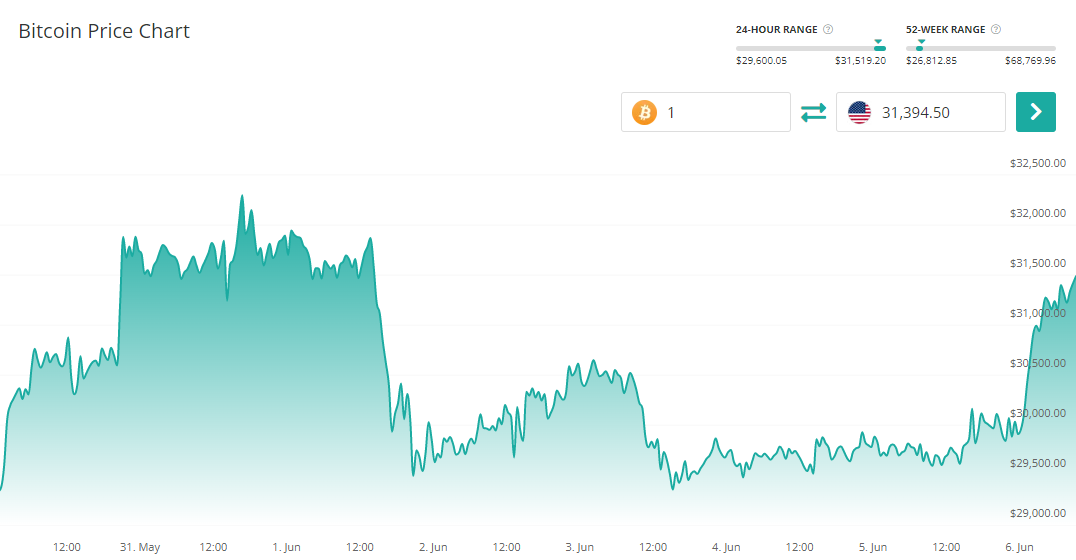
    BTC/USD price chart June 6
    BTC/USD price chart

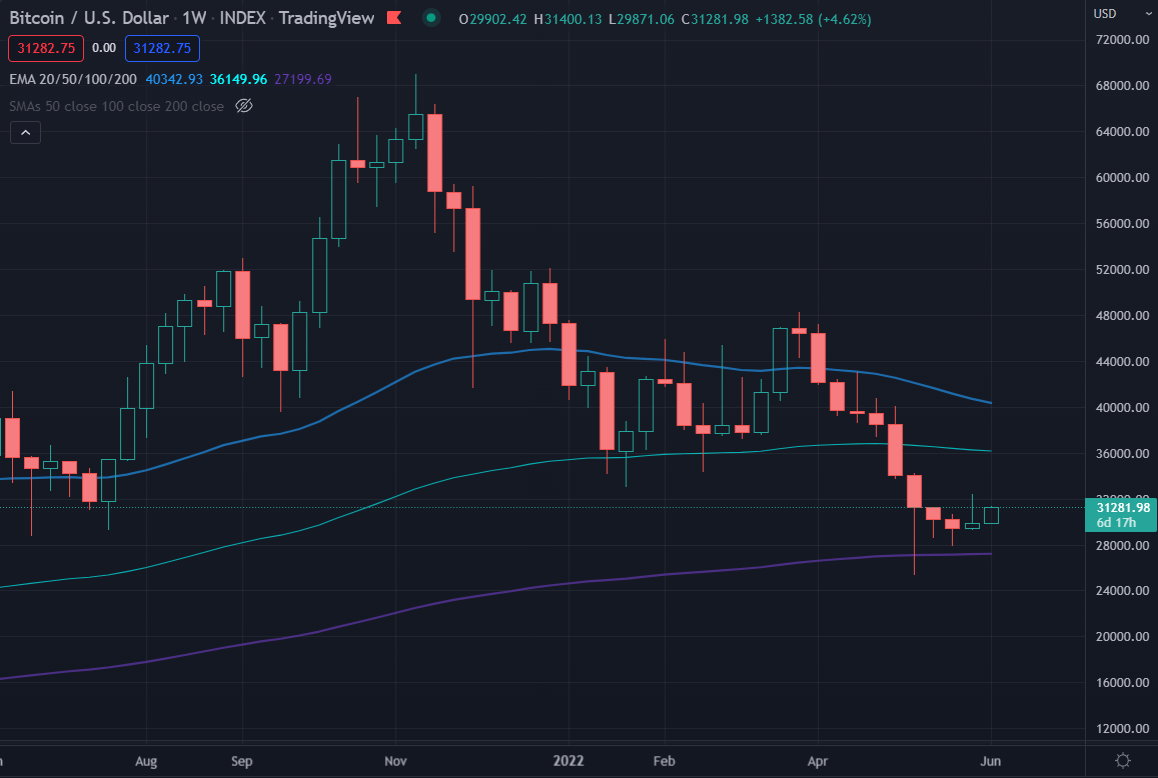
    Bitcoin hit the $31,500 price point on the tailwind of a 6% 24-hour price change and came awfully close to breaking its three-week high of $32,290, reached on the last day of May. Looking at the TradingView chart, the world’s largest digital assets narrowly avoided the 10th weekly consecutive red candle. With a series of 9th consecutive red candles, Bitcoin extended its previous record from 6 to 9.

    BTC/USD avoided the 10th consecutive weekly red candle
    BTC/USD weekly price chart. Image source: TradingView

    Like Bitcoin, Ethereum has been trading firmly in the green zone over the last 24 hours – the crypto gained over 6% and topped $1,900 after nearly a week of trading at sub $1,900 levels. The second largest crypto is now trading less than 9% removed from its three-week high of $2,090, reached on May 23.

    ETH/USD price chart June 6
    ETH/USD price chart

    Etherum’s positive price activity seemingly acted as a catalyst for numerous altcoins, many of which experienced double-digit gains to start the week, with Cardano and Solana being the most prominent examples.

    Cardano and Solana’s rallies hinting at the market reversal in the DeFi space?

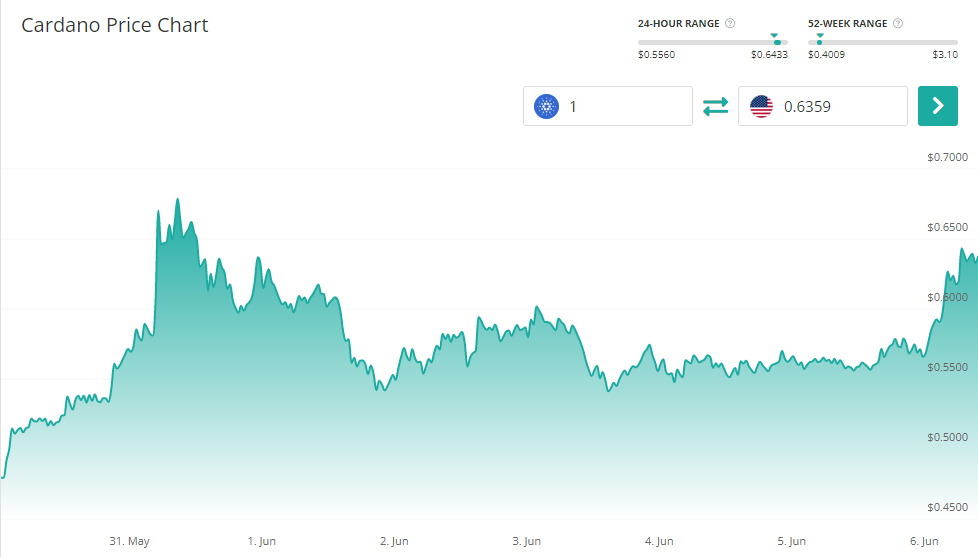
    Both Cardano and Solana had very similar price movements in the past week – both coins hit their weekly highs on the last day of May, only to slide back to their previous price ranges throughout the first week of June. 

    ADA/USD price chart June 6
    ADA/USD price chart

    The two native coins of leading Ethereum smart contract competitors gained more than 12% in the last 24 hours and solidified their spots on the list of today’s largest gainers in the cryptocurrency top 100. 

    Along with price increases in the value of leading DeFi coins, the total value locked (TVL) in decentralized finance (DeFi) products and services increased by more than 3%, according to DeFiLlama. The modest increase comes at a dire time for DeFi – TVL more than halved since April 2022, having fallen from $230 billion to $110 billion in June. 

    With the notable price increases in the value of leading DeFi assets, positive growth in TVL after months of decline, and the highly-anticipated transition of Ethereum to Proof-of-Stake (PoS) we could be seeing a trend reversal in the near term. 

  • ETH is the #1 Coin to Watch for the Week of June 6 – June 12, 2022

    ETH is the #1 Coin to Watch for the Week of June 6 – June 12, 2022

    As there were no bigger moves on the cryptocurrency market last week, the sector is entering Week 23 with an almost unchanged total market capitalization of $1.29 trillion. Among the biggest gainers out of crypto Top 100 in the last 7 days are WAVES (+92%), HNT (+28%) and ADA (+20%). In total, 60 out of top 100 cryptocurrencies ended the week in the green, while the remaining 40 posted red numbers. The ratio is surely indicating a slightly recovering market, but the relative changes in valuation have been too little to significantly increase the total market capitalization. Do you think we could see more green numbers or higher gains at the end of this week and potentially enter a period of recovery?

    3. TRON (TRX)

    TRON is a delegated proof-of-stake (PoS) consensus blockchain platform that launched its mainnet in June 2018. However, TRON’s native asset TRX existed even before the mainnet launch in the form of an ERC-20 token on the Ethereum blockchain. Like Ethereum, Solana and Polkadot, TRON blockchain is designed to host smart contracts and decentralized applications (dApps). TRON blockchain is known for its fast transactions and low transaction fees. TRON blockchain can also host custom TRON-based assets, issued using the TRC10 and TRC20 standards. The project was founded by Chinese entrepreneur Justin Sun, and its development is headed by the Tron Foundation, which was established in 2017. Since than TRON has grown to become a major player in the blockchain sector. Its network hosts some of the leading apps in the industry and sees a huge volume of data and wealth transferred across its ecosystem each day.  

    TRON ecosystem’s TVL grew by over 40% in May

    On May 5, the TRON DAO rolled out a new TRON blockchain-based decentralized stablecoin called USDD. The newly-launched stablecoin is designed to maintain a $1 peg through an arbitrage mechanism against TRX, much like the one utilized by the recently collapsed TerraUSD (UST). In addition, the launch of USDD came at a time when the market was still reeling from the Terra ecosystem crash. However, TRX markets responded positively to the announcement and, perhaps also due to the launch of USDD, TRON ecosystem grew a lot in May. DeFiLlama recorded a more than 40% month-over-month increase in total value locked (TVL) in the TRON ecosystem in May, which propelled TRON to the third spot in DeFi chain rankings. In addition, CoinMetrics data showed that TRON has the highest number of active addresses compared to BTC, ETH, XRP, XLM, BNB, DOGE and many other popular blockchains. In short, May has been a very successful month for the TRON ecosystem. The ecosystem growth is also starting to reflect in the price of TRX, which is up by 38% against USD in the last 3 months. It will be interesting to see whether TRON can carry this momentum over into June or even maintain it through the summer.

    2. Optimism (OP)

    Optimism is a popular Ethereum Layer 2 network that approaches solving the scalability issues by reducing the cost and latency of Ethereum transactions through the use of Optimistic Rollups technology. OP is Optimism’s freshly launched governance token. OP holders will form the so-called Optimism Collective, a large digital democratic governance community that will vote on protocol upgrades, direct incentives to projects, and determine the allocation of treasury funds.

    Optimism launched and airdropped first OP tokens

    On June 1, Optimism officially launched its own OP governance token. Soon after the launch, 5% of the total token supply was distributed to Optimism early adopters through the first airdrop last week. According to Optimism’s data, more than 248,000 Ethereum wallets were eligible to claim OP in the first airdrop. It is worth pointing out that the OP airdrop season is not over yet as Optimism has allocated another 14% for future airdrops. According to the Optimism’s OP allocation model, the rest of the token’s supply is intended for the so-called Ecosystem Fund (25%), funding public goods (20%), and rewarding core contributors (19%). The remaining 17% will be made available to Optimism investors. However, investors should be aware that the total supply of OP is expected to increase at a rate of 2% per year from the initial supply of 4.3 billion tokens at genesis. Since the launch, the OP token has been listed by virtually every major cryptocurrency exchange including BinanceBybit, KuCoin, OKX and many others. Currently OP is changing hands at $1.22 per token, but the price of this governance token is likely going to appreciate as Optimism Collective gains functionality and authority.

    1. Ethereum (ETH)

    Ethereum is an open-source blockchain that pioneered smart contract functionality in 2015. The blockchain operates as a decentralized virtual machine that can execute scripts – also called smart contracts – in a fast, immutable, and trustless manner. Ethereum’s native asset is Ether (ETH), which is currently the second-largest cryptocurrency by market capitalization. Although it can also be used as a medium for the transfer of value between different Ethereum addresses, it is more commonly used to execute various smart contracts. The Ethereum blockchain hosts a number of ERC20 tokens with different utilities – these include Exchange tokens (OKB, HT, UNI), DeFi tokens (LINK, MKR, COMP, SNX, etc.) and several stablecoins such as USDC, DAI, TUSD, and USDT. Ethereum is currently transitioning from proof-of-work to a proof-of-stake blockchain. Once Ethereum 2.0 is fully launched, the network will be able to perform more transactions at a higher speed than today. Hopefully, this will also lower the network fees, which are a well-known Achilles’ heel of Ethereum ecosystem.

    Longest-running Ethereum Testnet will transition to Proof-of-Stake on June 8

    Ropsten, Ethereum’s longest-running testnet is going to switch from proof-of-work consensus algorithm to a more environmentally friendly proof-of-stake consensus on June 8. Following a successful shift to proof-of-stake on Ropsten, Ethereum developers will move their focus to the Goerli and Sepolia testnet. Since Ethereum mainnet is already the next in line, the highly anticipated event where Ethereum’s PoW mainchain and PoS Beacon Chain join, also known as “The Merge”, could be completed as soon as in August 2022 if everything goes according to the plan. While there are no official information as to when “The Merge” is going to happen, Ethereum developer Time Beiko recently revealed that we are in “the final chapter of PoW on Ethereum” and that the switch from PoW to PoS is likely going to take place “a few months after June”. Nevertheless, Ethereum’s PoS Beacon Chain is up and running ever since December 2020 and you can already stake your ETH, but you will only be able to unstake once the Beacon Chain will start processing transactions, this is after “the Merge”. In addition, several cryptocurrency analysts have noted that the Ethereum’s move to the faster and more environmentally-friendly Ethereum 2.0 has not been priced in yet. According to their analysis, ETH, which is currently changing hands at a discounted price of around $1,800, could surge as high as $2,600 once ETH 2.0 FOMO starts influencing the ETH markets.

  • Teszure Team Launches Plenty Bridge, a Decentralized Solution Connecting Ethereum and Tezos

    Teszure Team Launches Plenty Bridge, a Decentralized Solution Connecting Ethereum and Tezos

    Tezos (XTZ) blockchain cover

    Key takeaways:

    • Blockchain development team Teszure has launched the Plenty bridge connecting Ethereum and Tezos
    • The stability of the Plenty bridge is guaranteed by trusted and reputable members of the Tezos community
    • Bridges connecting Tezos with Avalanche, Polygon, and Binance Smart Chain are in the pipeline

    The Plenty bridge lets users transfer tokens between Ethereum and Tezos

    Teszure, a Web3 development studio focused on NFT and DeFi products and services, has launched the Plenty bridge – a decentralized token bridging solution connecting Ethereum and Tezos networks. Users of the Plenty bridge can send digital assets–including USDC, DAI, USDT, BUSD, WBTC, WETH, LINK, and MATIC–between the two popular blockchain platforms.

    Thanks to the improved finality of the Tezos blockchain introduced in the protocol’s last upgrade, the token transfer time has been cut down from roughly an hour to just 5 minutes.

    The new blockchain bridge is a part of the Plenty ecosystem, which features several decentralized finance (DeFi) use cases, including liquidity-providing options, token swaps, farming products, and PLENTY token staking.

    The so-called Signers Forum, a group of trusted Tezos community members, is tasked with providing stability and security of transactions on the Plenty bridge. At launch, the list of members includes Teszure, Integro Labs, Codecrafting Labs, MIDL.dev, Baking Bad, Madfish, and Tezos Ukraine.

    Tokens sent through the bridge are transformed into the following format: <bridged_asset>.<source_chain> (bridge tokens). The tokens can be used across the Tezos ecosystem as ERC20 representation of original tokens.

    Tezsure co-founders Bernd Oostrum and Om Malviya had this to say about the launch of the Plenty bridge:

    “The Ethereum bridge and the upcoming bridges from chains like Polygon, Avalanche, & BSC are key for the growth of the entire Tezos ecosystem. More bridges enable users from other chains to easily migrate their assets and try out all the innovation happening on Tezos.”

    According to the Teszure team, blockchain bridges for Avalanche, Polygon, and Binance Smart Chain are in the pipeline.

  • Binance Dual Investment—Buy Low or Sell High, and Earn Interest at the Same Time

    Binance Dual Investment—Buy Low or Sell High, and Earn Interest at the Same Time

    Binance Dual Investment is a unique product offered by the Binance cryptocurrency exchange. It’s designed to give users who want to buy a cryptocurrency at a lower price or sell a cryptocurrency at a higher price the chance to do so—all while earning interest at the same time.

    When subscribing to a Dual Investment program on Binance, users have two main options. We’ll use Bitcoin and USDT in our example to help make it clearer.

    “Buy Low”: Deposit USDT and use it to buy Bitcoin at the Settlement Date if it reaches the Target Price or lower. The deposit is earning interest in the meantime. If the price is above the Target Price on the Settlement Date, the USDT (plus accrued interest) is returned to the user.

    “Sell High”: Deposit Bitcoin and sell it for a stablecoin at the Settlement Date if it reaches the Target Price or higher. The deposit is earning interest in the meantime. If the price is below the Target Price on the Settlement Date, the BTC (plus accrued interest) is returned to the user.

    Before we delve deeper into Binance Dual Investment, we should clarify that Dual Investment is not a principal-guaranteed product, and there are risks associated with using it. For example, if your Target Price to buy Bitcoin is set at $30,000 and the market price drops to $29,000 on the Settlement Date, you will be buying BTC at $30,000 instead of the more favorable $29,000 price. The reverse is true if you’re using Dual Investment to sell at a higher price.

    Due to the market volatility of cryptocurrencies, it’s possible that the value of your investment when your Dual Investment program ends can be lower than the value of your investment when you subscribe to the Dual Investment program.

    Binance Dual Investment explained

    Now that we’ve introduced Binance Dual Investment and the risks associated at the product, let’s take a closer look at how the product functions. First, let’s get familiar with five key concepts you will encounter when using the product.

    Target Price

    When you’re subscribing to a Dual Investment product to either “Buy Low” or “Sell High”, the Target Price refers to the price at which the deposited assets will be bought or sold on the Settlement Date (if the Target Price is reached).

    Settlement Date

    On the Settlement Date, the deposited assets will either be bought/sold or returned to you. This will depend on the relation between the Target Price and the price of the asset on the Settlement Date.

    Please note that once you subscribe to a Binance Dual Investment product, you will not be able to edit or cancel your subscription. You will receive your funds on the Settlement Date—either the invested funds will be returned to you (plus interest), or you will receive the Target Currency.

    Deposit Currency

    The Deposit Currency is the asset you deposited into a Binance Dual Investment product. If you’re looking to “Buy Low”, you will be depositing stablecoins. If you’re looking to “Sell High”, you will be depositing “standard” crypto assets like Bitcoin, Ethereum or BNB.

    Target Currency

    The Target Currency is the asset that will be bought/sold automatically on the Settlement Date if the Target Price is reached. This will be a stablecoin if you’re looking to “Sell High”, and a “standard” cryptocurrency if you’re looking to “Buy Low”.

    Subscription Amount

    The amount that was deposited in the subscription to the Dual Investment product. If the Target Price is reached on the Settlement Date, this will be the amount used to buy or sell the Target Currency.

    Dual Investment example and scenarios

    Now that we know the most important concepts of the Dual Investment product, we’ll be going through an example of subscribing to Dual Investment and outline some of the possible scenarios that could happen.

    In our hypothetical example, we hold Bitcoin and would like to sell if it reaches a higher price. We would also like to earn some interest on our BTC holdings in the meantime, so we choose Binance Dual Investment.

    TIP: We selected “Beginner Mode” for our example, which will provide a clearer subscription process that’s suitable for users that don’t have experience with the Dual Investment product.

    Now, we choose the “Sell BTC” option, since we’re trying to sell our BTC at a higher price.

    By clicking the pencil icon, we can select between the different Dual Investment plans for BTC that Binance currently has on offer. The three parameters are Target Price, Settlement Date and APY.

    The APY that’s offered depends on how close the Target Price is to the current price, how far into the future the Settlement Date is, and other factors. If two products have the same Settlement Date, the one with the Target Price closer to the current price will have a higher APY.

    Please note that APY means Annual Percentage Yield. This shows the percentage of your principal that you would earn as interest in a year. The programs offered on Binance Dual Investment typically last a lot less than one year.

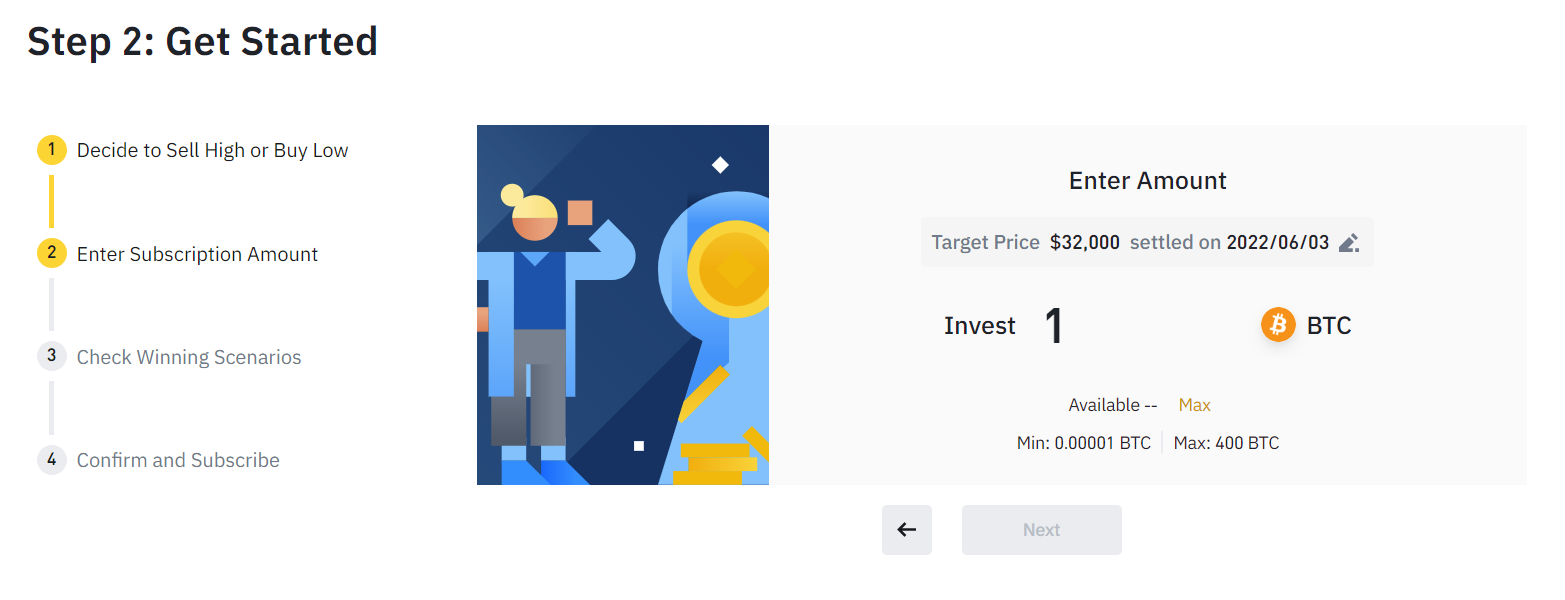
    Let’s say that it’s May 30, 2022, and the current price of Bitcoin is $30,000. We’ll choose a plan with a Target Price of $32,000, a June 3, 2022 Settlement Date, and an APY of 22.77%.

    This is not investment advice. This example is only meant to explain how the Dual Investment product functions.

    We’ll deposit 1 BTC into the product.

    Let’s check out three hypothetical scenarios that could happen once the Settlement Date comes around.

    Scenario 1

    On the Settlement Date, the price of Bitcoin is at $31,500, which is below the $32,000 Target Price. The product is not exercised. We receive back our 1 BTC, plus 0,00311 BTC that we earned as interest. This is a better outcome than if we simply held our 1 BTC.

    Scenario 2

    On the Settlement Date, the price of Bitcoin is at $32,050, which is above our $32,000 Target Price. Our 1 BTC, plus the interest we earned on the BTC, is automatically sold for the BUSD stablecoin at the Target Price.

    During the five days that our BTC was deposited, it accumulated 0,00311 BTC in interest, which equals about $99.5 at the Target Price. So, after all is said and done, we get 32,099 BUSD. This is more than we’d get if we simply held our BTC and sold it at $32,050.

    Scenario 3

    On the Settlement Date, the price of Bitcoin is at $32,200, which is above our $32,000 Target Price. Our 1 BTC, plus the interest we earned on the BTC, is automatically sold for the BUSD stablecoin at the Target Price.

    During the five days that our BTC was deposited, it accumulated 0,00311 BTC in interest, which equals about $99.5 at the Target Price. So, after all is said and done, we get 32,099 BUSD. This is less than we’d get if we simply held our BTC and sold it at $32,200.

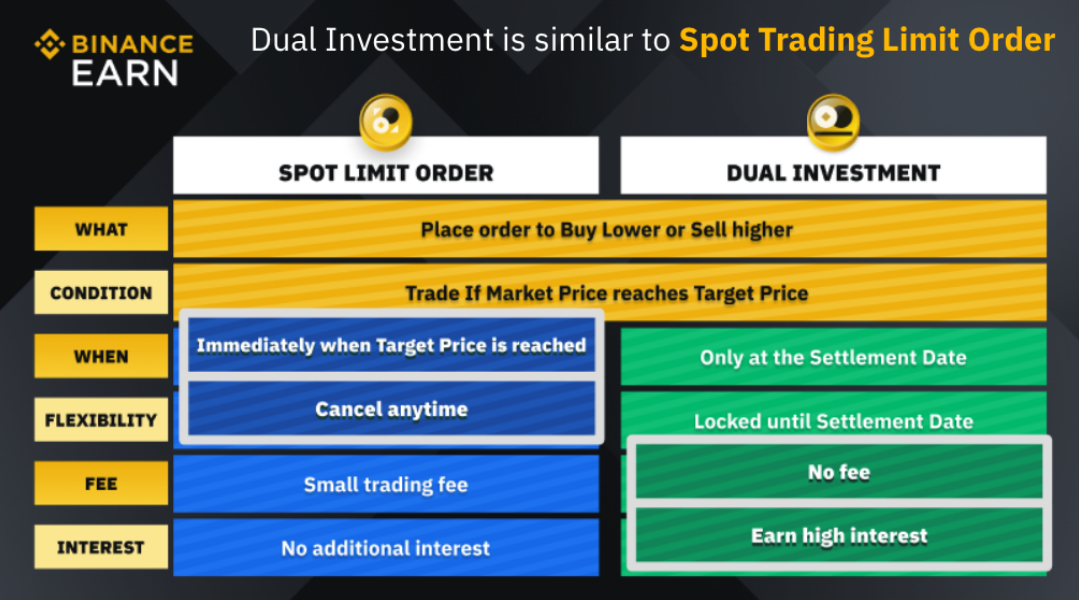
    Why not just use a limit order?

    A pretty common question when it comes to the Dual Investment product is:

    If you want to buy or sell a cryptocurrency at a different price than the current price, why not just use a limit order?”

    This infographic provided by Binance provides a nice summary of how Dual Investment compares to simply using a limit order on the spot market. From it, you can clearly see that each method has its own advantages and disadvantages—the choice will ultimately depend on what you prioritize.

    Recap – the pros and cons of Binance Dual Investment

    To sum up, let’s lay out the main advantages and disadvantages of Binance Dual Investment:

    Pros:

    • The product doesn’t charge any trading fees
    • APY can be very high
    • Users can choose between many different Target Prices, APYs and Settlement Dates

    Cons:

    • Deposited funds are locked until the Settlement Date
    • Can underperform a simple HODL strategy if the market price significantly deviates from the Target Price
    • No trade occurs until the Settlement Date
  • Bybit Crypto Exchange Launches New Liquidity Mining Pools, Offers Up To 30% APY Rewards

    Bybit Crypto Exchange Launches New Liquidity Mining Pools, Offers Up To 30% APY Rewards

    Key takeaways:

    • Cryptocurrency exchange Bybit has launched USDT-paired Bitcoin, Ethereum, and BitDAO Liquidity mining pools 
    • Liquidity providers can earn up to 30% APY on their digital asset deposit or pursue higher rewards levels by collateralizing their crypto for up to 3x leverage
    • Bybit users can supply liquidity on either or both sides of the liquidity pair

    Bybit launches BTC, ETH, and BIT liquidity pools, allowing users to generate up to 30% APY in USDT rewards

    Bybit, one of the leading digital asset trading platforms and the second largest BTC Futures exchange, launched three new USDT-paired liquidity pools. As of May 19, Bybit users have the option to provide liquidity in Bitcoin, Ethereum, and BitDAO pools. Bybit allows users to earn up to 30% APY on their crypto deposit, with even higher reward tiers available when using up to 3x leverage. 

    Users participating in the new liquidity mining pools can supply liquidity on both sides of the liquidity pair. Rewards are distributed in the form of USDT, with investors having the option to withdraw their earnings or reinvest them to reach higher returns. In addition, the assets invested in the pools are automatically rebalanced to reduce the risk of impermanent loss. 

    Bybit is using an optimized automated market maker (AMM) model, which allows low slippage crypto swaps and provides users with the ability to earn a share of trading fees. Also, users can increase their pools exposure via leverage by collateralizing their existing crypto funds.

    To protect investors from incurring excessive losses, Bybit employs a series of safeguards. Namely, the multi-layered liquidation protocols provide an added layer of investment safety, while advanced profit and losses managing strategies shield liquidity providers from potential market manipulation as well as unexpected and significant negative price movements.

    Co-founder and CEO of Bybit Ben Zhou had this to say about the company’s Liquidity Mining offering:

    “We are very excited about the opportunities Bybit’s Liquidity Mining will open up for all Bybit users. As traders ourselves, we understand the importance of having a diversified trading and investment strategy optimized for earning passive income on your assets.”

    Zhou added that Bybit’s offering provides competitive “yield-earning opportunities” and is an important stepping stone towards a “future of DeFi and personal financial freedom.”

    With the launch of new Liquidity Mining pools, Bybit has expanded its “Earn” suite of products and services, which allow cryptocurrency investors to pursue lucrative investment opportunities and generate passive income with their digital asset holdings with varying degrees of risk exposure.

  • Tether’s Stablecoin Peg Breaks as Bitcoin Plunges to $27,000

    Tether’s Stablecoin Peg Breaks as Bitcoin Plunges to $27,000

    Key takeaways:

    • The total cryptocurrency market cap has decreased by over 15% to $1.22 trillion in the last 24 hours
    • Bitcoin slipped to the $27,000 price level on a 10% negative change, while Ethereum and other altcoins plummeted by over 20%
    • The selling pressure has seen the largest stablecoins, Tether’s USDT, losing its $1 peg

    Tether loses its $1 peg amidst a broader market sell-off

    The sell-off in the cryptocurrency markets sparked by macroeconomic drivers such as rising interest rates and high inflation, as well as yesterday’s Terra collapse, have shaken the peg of the world’s largest stablecoin, Tether’s USDT.

    According to CoinCheckup data, USDT dropped to $0.9691 earlier on Thursday, which means that the third largest market cap digital currency was trading over 3 percentage points removed from its intended $1 peg. USDT has reapproached its one-dollar peg by press time and is currently changing hands at $0.9879. 

    It is worth noting that there could be some discrepancies in price data between different tracking sites. TradingView for instance shows that USDT dropped as low as $0.9490 earlier today.

    The market pullback has left virtually no digital asset unaffected – Bitcoin is trading in the $27,000 to $28,000 range, its lowest price level since December 2020. Altcoins are performing even worse – Ethereum, BNB, XRP, Solana, and Cardano are all down more than 20% each in the last 24 hours. 

    Bitcoin 7-day price chart.

    Yesterday’s sudden collapse of the Terra ecosystem, which saw LUNA drop from $60 to below $1 and UST trading as low as 70% removed from its stablecoin peg, had a profoundly negative effect on crypto as a whole. The total cryptocurrency market shrunk by over 15% to $1.22 trillion as people were trying to exit their positions in large numbers. 

    What could Tether’s collapse mean for crypto?

    At its highest point, UST had a market capitalization of over $18 billion (now $6.9 billion). In terms of market cap, USDT is a much bigger player in the sector, with an $82 billion valuation. However, the market capitalization figure, in a way, undersells how important USDT is for the whole crypto ecosystem. 

    USDT is used across virtually all crypto exchanges as a primary trading pair for digital assets. It provides liquidity for the majority of decentralized finance (DeFi) services and ensures large sums of funds can be moved between crypto products, services, and networks without incurring losses due to price volatility. 

    Due to its outsized presence in the sector, USDT regularly tops the charts of most traded crypto assets, with its daily trading volume often surpassing the combined volume of Bitcoin and Ethereum. If it were to collapse, it would very likely tank the whole cryptocurrency market, and UST’s downfall would seem minuscule in comparison.

    Tether losing its $1 peg is not an isolated occurrence

    Today’s de-pegging of USDT is not the first time that the largest stablecoin had problems maintaining the $1 price. Shortly after it started trading in 2015, Tether hit its lowest price point of $0.57. At the time, low demand for the stablecoin and low liquidity resulted in high price fluctuations. Case in point, USDT traded as high as $1.32 at one point in 2015.

    In October 2018, USDT’s peg dropped to $0.95 amidst a broader market crash that saw Bitcoin lose over 50% of its value during the month. In May 2019, USDT’s price fell to the $0.94 level due to concerns of Bitfinex–a company behind USDT–not having enough funds in Tether reserves. After a coalition of prominent traders bailed out Bitfinex with a $1 billion investment, the trust in Tether was reestablished and the stablecoin re-pegged.

    Unfortunately, the concerns about Tether reserves were never put to rest. The company issuing USDT, Tether Limited, claims 100% of its stablecoins are backed by cash and liquid assets that will ensure USDT can withstand even the worst bear market conditions. However, the company has been accused of not being transparent about its reserves in the past and settled with the New York attorney general in a lawsuit that accused Tether Limited of not having sufficient backing for USDT.