Konstantin Anissimov, executive director at CEX.IO
BTC/USD
On Thursday, 22nd October, Bitcoin slowed down its rising pace, having added $243 by 17:00 UTC. BTC/USD was mainly trending sideways during the day. The pair began the day at $12,835 and edged slightly down below the level of the open in the first five hours of the day, forming a local support level at $12,728. With modest volatility, the pair continued upwards in a wavy pattern, climbing to the day’s peak at $13,095, as of 18:00 UTC.
Thursday’s slowdown in Bitcoin’s ascension indicates that the traders have locked in some of their profits generated during Wednesday’s spiky session. Also, there was a visible contraction in overall trading volumes in BTC/USD, compared to those a day earlier.
Looking into the end of this week, we are eligible to see Bitcoin keeping its place above $12,900 since there is no capital resistance for Bitcoin until $13,949. The only local resistance formed during Wednesday’s bull ride stands at $13,219. It may create a slight accumulation of selling volume at the price level and serve as a target level for day traders to claim their profits at. But it will have no significance for the price action on the daily timeframe.
ETH/USD
Ethereum was demonstrating a healthy-looking continuation of Wednesday’s bullish price action, making a lot more progress than Bitcoin on Thursday, 22nd October. ETH/USD opened Thursday’s session at $390.50 and instantly began trending up, having jumped above 1.5% in the first two hours of the day. Later on, the volatility reduced until 8:00 UTC, with the price mainly going sideways.
At 8:00 the main upside move began and continued until noon; the spike took Ether to $415.75 at the close of the 12th hour. In the next hour, the price dropped a little in a corrective move. From 13:00 until 18:00 UTC, the pair was edging up and reached a high of $418.50 between 17:00 and 18:00 UTC.
Projecting the price action of the ETH/USD pair for the rest of the week, we may expect a little more bullishness from Ether in an attempt to shorten its lag from Bitcoin. A little cash flow from Bitcoin into Ethereum is also probable since there is clear headroom for Ether to grow further up to the 0.786 Fibonacci level at $432.5, which is the most prominent target level for ETH/USD for the rest of the week of 19th October.
The market for decentralized finance (DeFi) exploded in 2020 as the total value locked in protocols exceeds $11 billion.
A large part of it was played by the novel concept of automated market makers and Uniswap was, and still is, at the forefront. As with everything new, however, there are issues to be considered.
The Problems with Automated Market Makers
The overall concept behind an automated market maker is undoubtedly an exciting and promising one. Of course, it does come with its insufficiencies, especially in the representations that are currently existing on the markets today.
The biggest challenge is undoubtedly the price slippage after each trade that’s oftentimes captured by arbitrage traders as a convenient profit-making opportunity.
Now, it goes without saying that the most prominent supporters of decentralized exchanges and AMMs are the liquidity providers (LPs). They are the ones who put the initial deposits as liquidity and, as such, traders can enjoy a smooth trading experience and better prices. However, LPs are also the ones who bear the risks of impermanent loss (IL).
Arbitrage traders, on the other hand, make profits on the aforementioned opportunities without having to put an initial investment. They can also leverage flash loans to increase their profitability. With this in mind, Vertex DEX takes a swing at the above IL issues by providing more incentives for LPs.
Vertex DEX and its Proposition
Vertex is a decentralized exchange (DEX) that aims at creating a more advanced version of an automated market maker where LPs receive a better profit.
Compared to what LPs earn on Uniswap, Vertex provides a profit increase of up to 500%. This profit is otherwise received by arbitrage traders who earn it without contributing to the platform in any way. The exchange also claims to provide the best prices to traders by aggregating the liquidity from all other decentralized exchanges. Additionally, in order to reduce transaction fees, the platform will launch over Binance Smart Chain. In addition, it also has a deflationary token (which gets burned on every transaction) to further incentivize LPs.
In addition, Vertex imposes no hidden protocol charges and all of the trading fees go to the liquidity providers.
The presale will start on 23rd Oct. The listing price will be 40% higher than the its presale price.
Currency backed with assets is not a new concept. The United States dollar was backed by gold until 1971 when the gold standard was abandoned. The concept of asset-backed currencies is being replicated in the blockchain world through the concept of tokenization. Tokenization means that companies can divide assets digitally into different parts, with the ownership unit recorded on the blockchain. RUSH is a new company that is exploring tokenization in a way that has never been done.
Tokenization and trust
2017 was the year of the initial coin offerings (ICO) boom, so many companies offered asset back tokens, especially for precious metals like Gold or Silver or alternative assets like artworks. The problem with many of those companies is that they offered nothing more than beautiful whitepapers and lines of codes there was no time spent on executing those projects. When investors want to invest in tokenization, they want to be sure that assets actually back the tokens. RUSH tokens are trusted; the team has worked more in executing the project than on marketing. One Rush token is equivalent to one cubic meter of aggregate quarries.
RUSH tokens and aggregate quarries
Most tokenization projects are tied to precious metal like silver. The RUSH team has decided to explore a new asset to back their tokens asset is known as aggregate quarries. The team chose aggregate quarries to back their tokens because aggregate quarries have great economic importance. The aggregate quarries contribute mainly to the economy of large and medium enterprises. Aggregate quarries are used in the construction of railways, waterways, roads, bridges, etc. The RUSH team chose aggregate quarries because they will continue to be used, and the value will increase with usage. You can read more on the importance of aggregate quarries on their whitepaper.
RUSH enable fractional ownership
The importance of tokenization is that fractional ownership is enabled. If a RUSH token buyer owns 0.001 RUSH (RUC), it means that he owns 0.001 aggregate quarries; this might not be possible physically. Still, the power of division in blockchain makes the division of ownership possible. It enables the RUSH tokens to be used as a currency, and it is also a divisible physical asset. The advantage is that you don’t need to have one aggregate quarries to own the assets. You can have a small fraction of 1 aggregate quarries, and your tokens can be easily transferred to another person while still maintaining it’s physical value.
RUSH tokens double value
Investors are more interested in the tokenized project because they are tied to physical value. The prices of cryptocurrencies are very volatile. We have seen a cryptocurrency lose 80% of its value overnight. Investors are looking for stability. RUSH tokens offer stability, that’s is why the RUSH token is suitable for cross-border settlements. The value of aggregate quarries means that investors see the value attached to the tokens beyond the cryptocurrency market’s volatility. RUSH tokens can also be used for speculation by trading it with other cryptocurrencies. The RUSH token is available for trading on the ProBit exchange.
RUSH tokens and physical assets
Investors love to invest their assets in projects that can be trusted. The team understands why they ensure that the tokens are always available for exchange with real-life physical assets. They can monitor their investment in a dashboard on the RUSH website. They provide that the aggregate quarries are always available if you want to exchange your tokens for aggregate quarries. The team ensures that they are not building a snake oil project. The project is always asset-backed as promised by the team.
How to buy RUSH tokens
Investors can purchase RUSH tokens on the RUSH website. The tokens are also available for purchase on ProBit exchange.
Conclusion
Asset-backed tokens are great, but implementing a truly asset-backed tokens requires a transparent and dedicated team. Assets should be available to be exchanged for the physical goods that back them. The RUSH team is proving transparent tokenized assets that can be exchanged for physical goods.
The emergence of DeFi in 2020 characterizes the crypto industry.
DeFi sector has inherent risks such as user error, faulty smart contracts e.t.c
Low liquidity, interoperability, and over-collateralization hinder DeFi adoption.
DeFi community strives to come up with solutions
To this very day, cryptocurrencies have accomplished several major milestones in their ten-year transformation into a good asset class. Some of the achievements include token and coin offerings, development of crypto derivatives market, United States SEC regulatory body, tokenized bitcoin and state-issued digital currencies. However, the year 2020 has been marked by the rise of DeFi (Decentralized Finance), which disrupted the entire industry.
As typical with digital assets such as bitcoin, several DeFi assets have witnessed monumental gains within a concise space of time. For instance, 24 hours after Serum launched its governance token, its value went through the ceiling, recording a mammoth 1,500 percent increase. Consequently, the total amount of assets locked inside DeFi protocols start growing. According to DeFi Pulse data, investments worth over $11 billion are currently closed in DeFi protocols.
Notably, DeFi has not only caught the attention of crypto enthusiasts, but centralized finance experts are also beginning to gain interest. This trend is primarily driven by the massive potential that decentralized finance presents. The growing sector is expected to revolutionize the financial industry entirely. However, for that to be achievable, some certain risks and challenges need to be addressed.
Some of the significant risks facing the emerging DeFi sector arise from the dependency on smart contracts, price volatility, uninsured loans, user error, and possible breakdown of the price system.
Although the DeFi sector presents tremendous benefits, it is still evolving. This implies that the massive luxuries offered by the DeFi ecosystem come at a certain degree of risk. One key is the fragility of smart contracts. Despite the robust underlying technology behind smart contracts, a coding error might result in massive funds loss. For instance, a $10 million ethereum heist was fortunately averted by a white hat hacker late last month from an incorrect code.
The risk of smart contracts is strongly associated with the ever-increasing cases of human error. No matter how perfect a platform’s code is, the developers cannot foretell the way users will maneuver through the application. Massive sums of funds have been lost by sending false addresses. For instance, users of a platform may direct funds to the incorrect smart contract blockchain address. Such a risk can be mitigated by introducing the new ERC-777 tokens that identify and impede the wrong addresses, increasing the fees.
Another critical factor that should always be considered is the internal management of a project and the external laws and regulations. There is still the possibility of a DeFi project changing management and even ownership. At times, structural and operational changes might occur without warning. The domestic authorities might also implement fresh legislation that might spell the usability o a given currency or even ban it entirely.
The other missteps, such as the market volatility associated with cryptocurrencies and uninsured loans, suggest that there is still a considerable risk of losing money in the DeFi sector. Such losses could occur without necessarily the user nor the developer making a mistake.
Apart from the inherent risks, some problems need to be addressed to drive DeFi proliferation. Some of these issues that impede the sector’s expansion include over-collateralization, centralization, inadequate liquidity, and the lack or little interoperability of networks.
What’s next for DeFi?
Startups have already emerged to come up with solutions to these risks and problems. With time, resources will be directed towards DeFi, boosting liquidity as the sector expands. However, faultless coding, the emergence of new interoperability mechanisms like Atomic Swap on top of high liquidity, would make the decentralized finance sector more inviting to the traditional financial structure and ordinary people. All the setbacks discussed are being dealt with by the community in various ways. Some of them might be entirely addressed with time. The risks associated with faulty smart contracts and user errors will likely minimize the more contemplative utility of audits, open-source promptness, bug rewards, and a coordinated manner of creating solutions. As governments and regulators develop a policing structure of the sector, more investors will flock in as the legal parameters will be clearly defined.
$12,000 is an important level from the technical analysis perspective of bitcoin. Bitcoin’s bullish momentum has been developing for more than a week and at the moment, BTC is nearly touching the $13,000 level. Many technical analysis experts are eagerly looking at Bitcoin and crypto enthusiasts are expecting further gains to come soon.
Bitcoin’s price increased by around 3.4% on Monday. Some altcoins like Dash and Monero followed BTC and their prices rose dramatically. The IMF held a virtual meeting focused on international payments and digital money. During this discussion, Jerome Powell stated that the central bank is assessing the pros and cons of digital currency but that they haven’t made a decision yet. He talked about Libra and called it a catalyst that attracted a lot of attention regarding the issue.
People are disappointed about the US government’s attempts to save the economy. Therefore, US stocks are dropping and investors are migrating to safe havens like gold and BTC. The Bitcoin market experienced a big rally in the previous week and BTC decoupled from US stocks. It is an important event and it can be a prelude for some big changes.
Bitcoin is a relatively new technology and the limited supply of BTC is a fascinating feature of the world’s first cryptocurrency. Because of these technical aspects and because of the entrance of the institutional investors to this space, many people and experts are bullish on BTC.
Top fundamental reasons for BTC’s growth
The macroeconomic context of today’s world is unique. The COVID-19 pandemic forced governments to print money and this printing is not controlled. Many investors are really worried about the consequences of this quantitative easing. They fear impending inflation and because of this, they are seeking safe havens like real estate, bitcoin, and gold. This causes a capital inflow to cryptocurrencies and BTC. Then, BTC may touch new all-time highs.
Bitcoin’s supply is limited and no one can create new BTC coins at low. It is an important feature and gives BTC the potential to act a store of value. BTC is decentralized and the limited supply has been designed from day one.
Transfering Bitcoin is easy and people can use it for cross-border payments. Keeping BTC is easy and convenient – you just need a digital wallet. These advantages are accompanied by a kind of digital scarcity and all in all, we can call bitcoin an exceptional opportunity for many investors.
From a technical perspective, BTC is in a good position right now. It is above all the most relevant moving averages and it has remained above the $10000 level for more than 80 days. Many technical and chartists are bullish about Bitcoin’s price action and there are many bullish predictions in this space.
Final thoughts
BTC is an extraordinary opportunity and it has many advantages from both the technical and fundamental perspectives. BTC is a new technology and its monetary policy presents a unique alternative to fiat currency. It has anti-inflation properties and its limited supply is a new phenomenon. However, no one can predict the future and crypto space is full of risks. This article is for informational purposes and nobody shouldn’t be considered as investment advice.
The BTC mined by Satoshi Nakamoto is topic from the earliest days of Bitcoin and many people in the cryptocurrency community are curious about it. Satoshi Nakamoto is the unknown creator of Bitcoin who released the Bitcoin whitepaper in 2008. Evidence suggests that Satoshi either doesn’t have the private keys to access these early coins or is simply not interested in spending them (if he is still even alive).
WhaleAlert is a famous crypto community service that’s renowned for its Twitter alerts about huge cryptocurrency transactions. A report published by WhaleAlert recently estimates that Nakamoto mined 1,124,150 Bitcoins.
There is a method for estimating the coins that were mined by Satoshi. This method is called the Patoshi Pattern and it was introduced by Sergio Damian Lerner in 2013. It seems that Satoshi mined Bitcoin because he wanted to be sure about the security of this nascent network. The Patoshi miner stopped operating in May 2010, and it’s unclear if Nakamoto continued mining bitcoin after that date or not.
How to guess the network hash rate?
There are fields in bitcoin blocks and you are able to guess the whole hash rate of the network from them. The block header possesses the most significant metadata of the block and they are 80 bytes.
The timestamp and the difficulty target are two fields in the block header that we can use in this analysis. The difficulty target codifies the minimum difficulty of the block and is utilized to determine if a block hash is eligible to be adopted as a new block. The difficulty target is regulated occasionally.
The timestamp field codifies the time of the block mining. BTC is distributed and no global resource clock exists for all the nodes. Block timestamps are still vital for the adjustment of difficulty. The timestamp field is signed loosely by the nodes and some deviation is natural for it.
The target block interval for bitcoin is 10 minutes. It means that new blocks should emerge approximately every 10 minutes. After 2016 blocks are mined, a new difficulty goal is set so the block interval remains as close to its target is possible. As such, the difficulty is regulated around once every 14 days. By using this background, everyone can guess the history of hash rate.
Early hash rate of the bitcoin network
Six months after block zero was mined in 2009, bitcoin hash rate was about 5 MH/s. It declined for a short period and then moved up towards the end of the year. This rise was significant. Nearly all of the mined blocks of 2009 only have a few transactions inside them. Connected with the weak hash rate, we can conclude there were a small number of bitcoin users in 2009.
Back then, there were a few people like Hal Finney downloaded Nakamoto’s code and ran it. It seems that many early adopters of bitcoin just ran the code for a short time. Back then, Bitcoin had practically no monetary value.
The situation was not so clear at that time and it seems most of the blocks in 2009 were mined at a slow pace in comparison to the targeted 10-minute interval. Based upon the materials mentioned above, it’s rational to accept that most of the hashing power of that year came from Nakamoto. The hash rate in the first half of 2009 was very constant and if there were other people, the hash rate would have shown more significant changes. From the beginning of 2010, the hash rate rised fast and it means the presence of serious users in this space.
Was Satoshi alone in mining?
The answer to the above-mentioned question is probably yes. The network’s hash rate was fixed for around six months and if there were some other people at the space, the hash rate would change dramatically. Maintaining a 5 MH/s hash rate was feasible at the time, considering the type of computer hardware that was available.
The hashing power of the CPUs that existed at the time is a strong and clear clue for Satoshi`s unaccompanied mining. If other people were mining at that point, the hashing power must have been really higher. For more evidence about Satoshi’s solo mining, you can go to this link.
Final thoughts
From my observations, the most frequent estimate for how many coins Satoshi mined is at around 1 million BTC. 1.6 million coins were mined in 2009 and Nakamoto could have controlled around 60% of the whole hash rate. Satoshi continued BTC mining in 2010 as well, making the 1 million BTC figure pretty plausible. Most of the mined bitcoins of 2009 are intact and Nakamoto never spent them. It seems that Nakamoto’s primary aim for mining Bitcoin was the expansion and development of the nascent network of bitcoin. Satoshi was interested in that ecosystem wanted to create a user base.
PayID, a universal payment identifier, enables Crypto.com’s 5M+ users to send/receive crypto across any network under the same initiative, connecting 100M+ consumers worldwide
HONG KONG, October 19, 2020 — Crypto.com today announced PayID, a universal payment identity developed by the Open Payments Coalition, is now available on the Crypto.com App.
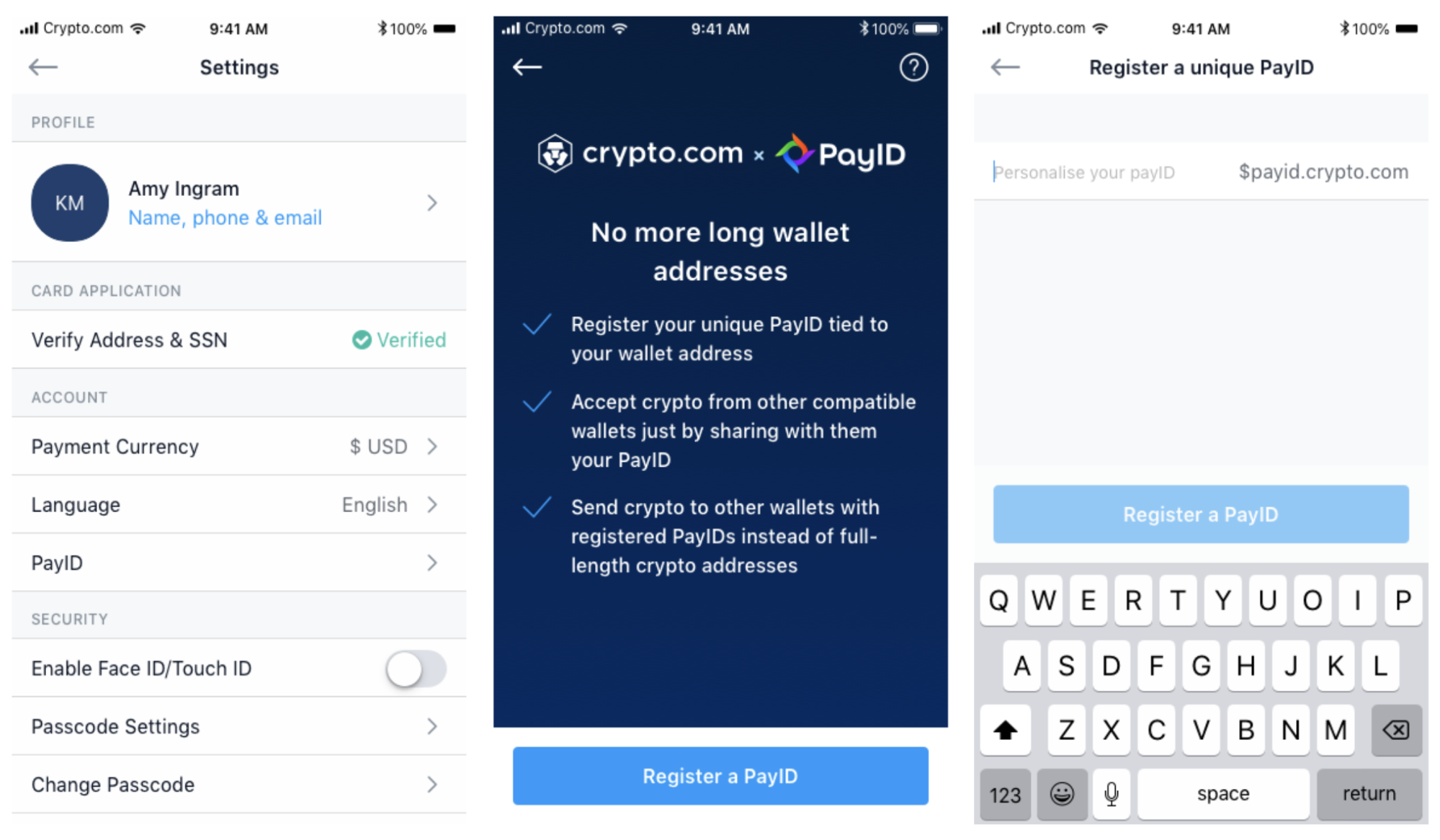
Crypto.com’s 5M+ users can register for a PayID from the Crypto.com app, consolidating complex wallet addresses and accounts into a simple ID that works across any payment network and currency. Users who register for their unique PayID will get an exclusive Crypto.com-branded, easy-to-read ID — such as “yourname$payid.crypto.com — that enables users to send/receive crypto payments from other compatible wallets with just a single ID, easing their ability to connect to 100M+ crypto users worldwide.
PayID solves a key pain point in the crypto payments world, which consists of many closed and complex networks. Participants must manage multiple long and random wallet addresses, increasing the likelihood of erroneous transactions. PayID creates a free, open and common protocol that allows for interoperability between any payment network or currency.
Starting today, Crypto.com is offering early access for select customers to register their unique Crypto.com PayID. To be eligible:
Stake 10,000 CRO or more in Crypto.com Exchange; or
Stake 10,000 CRO or more in Crypto.com App
On 2 November 2020 all Crypto.com App users can register their own Crypto.com PayID within the Crypto.com App.
Once registered, users can send crypto from other compatible wallets to the Crypto.com App with just their PayID, instead of a full-length crypto address. At launch, supported cryptocurrencies include CRO, ETH, BTC, XRP and many more ERC20 tokens. Users can also send crypto to other compatible wallets using PayID hosted by other members in the Open Payments Coalition.
About Crypto.com
Crypto.com was founded in 2016 on a simple belief: it’s a basic human right for everyone to control their money, data and identity. Crypto.com serves over 5 million customers today, providing them with a powerful alternative to traditional financial services through the Crypto.com App, the Crypto.com Card, the Crypto.com Exchange and Crypto.com DeFi Wallet. Crypto.com is built on a solid foundation of security, privacy and compliance and is the first cryptocurrency company in the world to have ISO/IEC 27701:2019, CCSS Level 3, ISO27001:2013 and PCI:DSS 3.2.1, Level 1 compliance. Crypto.com is headquartered in Hong Kong with a 600+ strong team. Find out more by visiting https://crypto.com
Gambling is one of the most famous entertainment activities around the world. Casino games give an adrenaline rush that is hard to get anywhere else. When you play with real money, you stand a chance to win big. Online casino gaming has been gaining popularity as it allows people to play at any time or place. A lot of people are skeptical about playing online for real money. This is why many online casinos offer no deposit bonuses where players can bet without having to make a deposit. You can browse this site about real money gambling and start to make money as you play in your favorite casino games.
Casinos give new players a free real cash bonus when they play for real money, this means that you get a specified percentage of your deposit in free money. The more you deposit, the more you will get as a bonus. There is also a wagering requirement on the deposit bonus. Any winnings made from the bonus are only available after wagering a certain amount.
Online casinos offer many different modes of payment ranging from bank and credit cards to virtual currency. Many players are wary while playing because providing their information online especially financial information puts them at risk of theft from hackers. It also exposes them to invasions of privacy. It is for this reason that developers are constantly trying to create safer and more convenient means.
Using bitcoin for real money gambling
Bitcoin is a type of currency that has no reliance on banks and has no corresponding cash. It is a decentralized currency used by tons of people and businesses around the world. When used in transactions, they have faster processing and lower fees based on their non-reliance to banks and other investment companies.
The advantages of using bitcoin include:
Safety: it is easily the safest payment method. The transactions are digital and highly encrypted. They do not give connection to personal names or any private information that could be traced to you. Verifications are carried out during the entire process. Casino transactions through bitcoin are untraceable and completely secure. This makes them one of the best ways to pay for real money gaming through the web or mobile.
It is cheap: there are no transaction fees when using Bitcoin. Any earnings if not converted to cash currency are not taxed. This is because Bitcoin is decentralized and there is therefore no regulating authority to tax it. You can therefore use the earnings from gaming in Bitcoin form in other sites as it is accepted in a lot of sites.
It is fast and convenient: Bitcoin transactions are completed within minutes giving you a seamless gaming experience. It is available through mobile and is therefore very convenient.
Experts group casinos that accept bitcoin in two categories:
Those that only accept bitcoin: they do not have to convert the bitcoin to standard currency and the player does not lose money in exchange rates. The transactions are processed really fast and there are usually no fees.
They also provide lower table limits since there is a bitcoin denomination that is smaller than USD. Anonymity her is always guaranteed. Most casinos that are bitcoin exclusive ask for the bare minimum on personal data and information. They also offer slightly better odds than those that have standard currency.
Those that accept bitcoin and other standard currencies- these are more structured and provide a wider selection of games. They have licenses, game testing and regulations as they deal with regulated currency.
It is up to the player to choose what kind of Casinos they prefer. No matter which kind they settle for, they are guaranteed access to lots of casino deals.
Getting started on real money gambling with Bitcoin
To get started gambling with Bitcoin, you need to acquire the Bitcoin. The first step is to set up or purchase a Bitcoin wallet. The wallet is essentially like a bank account because that is where the Bitcoin is stored. Bitcoin has no government regulation and customers should be careful when acquiring their wallets as there are no guarantees and there is no recourse if bitcoins are lost or stolen.
When you have the wallet, you then want to put some Bitcoin in it through one of three ways: Mine the bitcoin, this is the hardest way as it is really technical and requires heavy equipment. You may buy the bitcoin with traditional currency. This is fairly easy as you may buy it from someone you know, an online marketplace or even from specialist bitcoin ATMs. You may also receive it as payment for goods sold or services rendered. Due to its growing popularity, it is increasingly being used to transact.
Once you have some bitcoin, the next step is to establish online casinos that provide for bitcoin as a payment method and set up an account. To deposit the bitcoin into your selected account you will:
Go to the cashier section on the website and select Bitcoin as your deposit method. You will be provided with a web address for your account.
You will input this address in your wallet in the ‘send Bitcoin’ tab. Enter the amount to send and confirm the transaction.
The funds are available to use in a few minutes.
Once the funds are available you then proceed to play in the normal way until you are ready to withdraw your winnings. To do this:
go to the cashier section once again and select Bitcoin as your withdrawal method.
Select the amount you want to transfer out of your account. You will need to get the address from your wallet which you enter in the casino.
Once entered, click withdraw to begin the withdrawal. This may take a few hours.
Risks associated with using Bitcoin in real money gambling
There are a few risks associated with using bitcoin to gamble online. Bitcoin is not user friendly. Its mainly been a preserve of the tech-savvy. This is changing however as the casinos are working on more user-friendly interface. Since it exists outside government regulation, it poses greater risk than banks and other currency. Bitcoin is volatile. The value can fluctuate wildly causing you loss. There are also only a limited number of places you can use bitcoin, mostly on the web. It is a relatively new technology and no one is sure about what is going to happen with it. The best philosophy with bitcoin is ‘buyer beware’.
As we progress through Q4 2020, several projects are moving ahead with continued development. May it be a just recently launched coin, an already established exchange-issued token or the world’s first cryptocurrency – this week’s selection of top 3 coins to watch has them all.
1. Filecoin (FIL)
Filecoin is a decentralized file storage platform that rewards users who offer data storage space to be rewarded in FIL. On the other hand, users can also purchase decentralized storage space at selected provides, depending on their specific storage needs. Filecoin utilizes IPFS (InterPlanetary File System), a protocol that enables the distributed data storage and sharing.
FIL Gets Listed at several Exchanges Following Mainnet Launch
The Filecoin project conduced an ICO in 2017 and raised more than $257 million for the development of the decentralized data storage platform. The highly anticipated mainnet launch finally took place at block 148,888, which got mined on October 15. Following the mainnet launch, Filecoin’s native FIL token got listed at several leading exchanges including Binance, Huobi, Bittrex, and Kraken, while FTX already opened the trading of FIL futures. In addition, the FIL token was also widely traded in IOU form. It is expected that the high trading volumes and speculation around FIL will continue over the coming weeks, so it is definitely worth keeping an eye on FIL.
2. Binance Coin (BNB)
Binance Coin (BNB) is a native token of the Binance Chain, a blockchain launched and operated by the established cryptocurrency exchange Binance. Users that utilize BNB to pay for exchange, withdrawal and listing fees they can enjoy a 25% discount. Initially the discount stood even higher, at 50%, but it gets halved every year.
The BNB team have confirmed the completion of their 13th quarterly BNB token burn which saw 2,253,888 BNB worth approximately $68,000,000 being destroyed and removed from circulation forever. While the number of tokens burned is just the fourth highest among the 13 conducted burns, their fiat denominated value is the highest ever. The leading exchange is moving forward with the continued development of the Binance Smart Chain (BSC) and the launch of the BSC Accelerator Fund, which offers $100 million worth of funding opportunities to DeFi and CeFi projects. The exchange also expanded its fiat gateway system, which now covers already 232 countries. The Binance environment continues to thrive and new features are getting added to the BNB on a weekly basis. You can follow the latest developments on the exchange’s official blog post.
3. Bitcoin (BTC)
Although we believe that Bitcoin does not need much introduction and that all eyes would be on it even if it were not featured on our list, here is a short summary of the history and key characteristics of the first truly decentralized digital currency. The world’s pioneer cryptocurrency was launched by pseudonymous figure named Satoshi Nakamoto in 2009 and has a capped supply of 21 million coins. The decreasing miner block rewards makes the cryptocurrency scarcer with time, ensuring a deflationary nature.
The demand for Bitcoin Could Increase as Investors seek Inflation Safe-Haven
According to a post from Anthony Pompliano, also known as ‘The Pomp’ we “sit at an unprecedented time in the macro-economy”, also due to the COVID-19 induced stimulus packages, which already total to more than $3 trillion, with another $2 trillion on the way. The fear that the uncontrolled money printing will cause an inflation has driven significant capital flows to inflation-hedge asses, such as gold, real estate and Bitcoin. With its supply capped at 21 million and the market capitalization of less than $220 billion, Pompliano believes that Bitcoin’s price growth is far from over. In his opinion, we will see a significant upward movement in the Bitcoin price by the end of 2021 due to the increased demand combined of this programmatically scarce digital asset. The fact that more than 60% of Bitcoin has not been moved in the last 12 months reinforces the bullish sentiment. Pompliano’s realistic prediction states that Bitcoin’s value will increase by a factor of 10 over the next 15 months, while in his bullish scenario features a new all-time high at around $250,000 per Bitcoin. Nevertheless, the Pomp warns that we will likely see many 15-30% dips along the way, as Bitcoin is a highly volatile asset.