Blog

  • Crypto Market Recovers From Yesterday’s Sell-Off, Bitcoin and Ethereum Encounter Robust Support

    Crypto Market Recovers From Yesterday’s Sell-Off, Bitcoin and Ethereum Encounter Robust Support

    Key takeaways: 

    • The cryptocurrency market capitalization recorded an 8% gain in the last 24 hours
    • Bitcoin encountered strong support at the $33,000 level and recovered all of its yesterday’s losses within 12 hours
    • Fantom and Pocket Network were the biggest gainers in the crypto top 100, having gained more than 20% in the last 24 hours

    The cryptocurrency market has entered a much-anticipated recovery after yesterday’s selloff. Over the course of the last 24 hours, the cumulative value of all digital assets in circulation has increased by more than 8%, which led to virtually all coins in the cryptocurrency top 100 being traded in the green zone.

    Bitcoin bounced off the $33,000 bottom and gained 13% within 12 hours

    The world’s largest crypto was in free fall since Friday, when the flash crash saw Bitcoin lose over 10% in the span of 12 hours. The bearish momentum carried over to the weekend and into the beginning of this week – on Monday, BTC reached its lowest value in six months, bottoming out at $33,063. Thankfully, Bitcoin encountered robust support at the $33,000 price level and managed to mount a strong, 13% bounce back that pushed its value to pre-weekend levels.
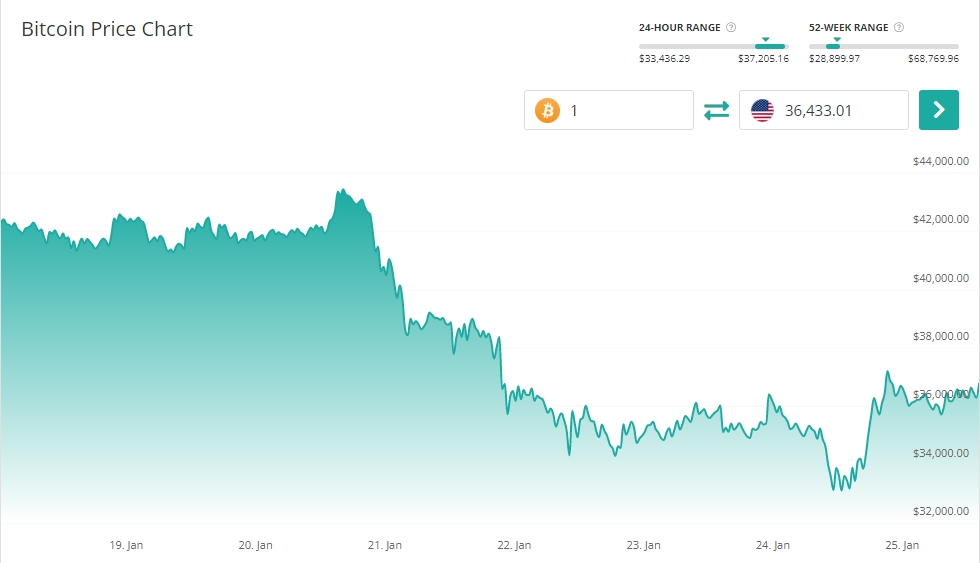
    At the time of writing, Bitcoin is changing hands at $36,433, still down 15% from its Friday’s top. Friday’s selloff that plunged the value of Bitcoin to six-month lows was a culmination of several macroeconomic factors. 

    For starters, both the stock and crypto market still haven’t shaken off the negative sentiment sparked by the Fed roughly two weeks ago, when it announced an interest rate hike and an end to massive economic stimulus programs designed to ease the effects of the coronavirus pandemic. 

    Additionally, the central bank of Russia recently called for a blanket ban on crypto, which would outlaw all crypto-related activities in the third-largest Bitcoin mining country. Prominent Russian tech and political executives have voiced their opposition to the proposed ban and fear it could have a devastating effect on the country’s IT sector.

    As the price of Bitcoin neared its cycle low yesterday, a number of blockchain market analysts pointed out that the crypto has entered the “oversold” zone as key market signals, including NVT and IRS, turned green and started indicating that the local bottom has been reached.

    Ethereum leads broader altcoin recovery, Fantom and Pocket Network top the largest gainers chart

    Ethereum lost over 30% of its value between Friday’s top and Monday’s bottom. Since then, ETH gained over 10% and is currently trading at $2,407, almost exactly 50% removed from its all-time high reached last November.
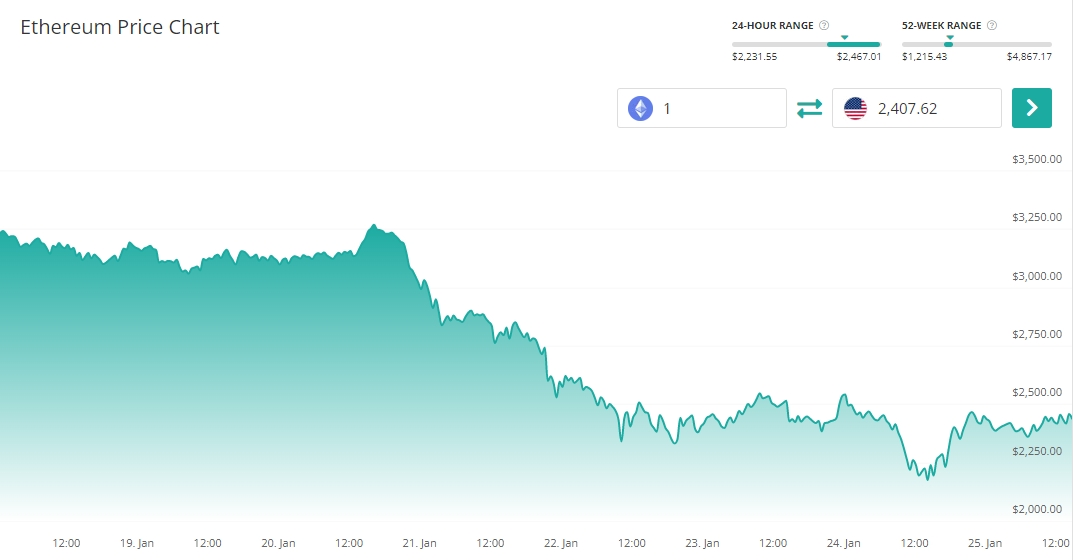
    As the price of the second largest crypto started recovering, other altcoins followed in its tracks. Pocket Network has been the best performing coin in the last 24 hours and managed to break into the cryptocurrency top 100 on the tailwind of 33% gains. 

    Ethereum Layer 1 competitor Fantom impressed with 22% gains and is now modestly in the green for the year, despite getting caught in the broader market pullback. Yesterday, Fantom reached a major milestone – it flipped Binance Smart Chain (BSC) in terms of the total value locked (TVL) on its network to become the third-largest decentralized finance (DeFi) ecosystem in crypto. 

    The list of other notable gainers in the last 24 hours includes: Avalanche (+13%), Crypto.Com Coin (+10%), FTX Token (+11%), OKB (+14%), and VeChain (+12%).

  • UpCro Announces Project Launch on EmpireDex

    UpCro Announces Project Launch on EmpireDex

    New Blockchain Projects Deep Dive

    The blockchain ecosystem is driven by innovative projects adding value, impacting the economy, and creating structures enabling financial freedom and empowerment.

    One of such platforms is Rootkit which makes use of the ERC-31337 standard, an open-source technology established by the team that makes use of liquidity seized from permanently locked liquidity pools in order to open up new possibilities for the cryptocurrency. Also, UpCRO, a product in the pipeline uses a new version of this ERC-31337 standard also called the elite token. This is used now by multiple teams and has even been put into Uniswap fork by the empire team. Also, there are elite tokens on the Kronos chain because someone utilizing Rootkit technology got there first and implemented it.

    UpCro, a project built on ERC-31337

    One such project is upCro, an innovative blockchain project, launching on the 25th of January, 2022, by a team of highly experienced industry experts. The team has a solid and well-tested plan to create massive liquidity on the first day of the launch and sustain it in an upward direction. While deciding on the launching platform, the team had the choice of VVS finance and EmpireDex. The decision to not go with the former was due to its heavy censorship model, which allows liquidity deposit but requires permission to execute trading. At the same time, the latter, i.e., EmpireDex, accommodates upCro tech, which is responsible for harnessing untapped liquidity and can be used for a wide range of activities.

    In the past 12 months, the UpCro has had significant successes and made remarkable progress. Some of them include – the release of two tokens designed only to go up when you buy or sell it,  the releases of multiple NFT innovations, including Uniswap treatable 1155’s by shattering the NFTs into tokens and reforging them after, and the launch of 4 UpTokens, each with market generation events. This feat is remarkable as it places the team as one of those that launched the most token within the mentioned timeframe.

    M.G.E General overview

    Many teams have used the Market Generation Event (M.G.E.) contracts to launch dozens of tokens, and the contracts have proven to be highly effective. It’s the most equitable method of creating a market with permanently locked liquidity, according to the experts. Anyone can spend the same amount of money twice within the system to purchase tokens for users from the newly created market using the ERC31337 protocol. In the upEcosystem, the Rootkit team has launched the latest coin, UpCRO, which is designed to increase volatility against its main paired token and auto-refilling buy-back vaults. Before the launch, anyone can participate in the ongoing market generation event.

    The Root team has consistently released innovative projects defying the norms. They have two main token class-up tokens and upOnly Tokens. The token names the UpTokens they are paired against in the main liquidity pools. UpCro is an example of UpTokens.

    upCRO Market Generation Event Details

    Almost a year after creating upCro Market Generation Event contracts, it still provides the best way to pool money and make a permanently locked market for a new token. 

    There are many options built into the MGE contract and many decisions for teams to make when they launch projects. The settings for the upCRO MGE include several stages ranging from Generation – When anyone can send funds and Distribution & Activation – when tokens are released, and the markets go live.

    As a forward-thinking team with a high-level commitment to their road map, they aim to schedule one major release or system upgrade per month to have eight to twelve make it live by the end of the year.

    About Firmly Established Team

    The Root team has been releasing innovative DeFi products for almost two years; if people say it’s impossible, we’ll give it a try. We take a unique approach to mechanical design and ecosystem expansion while constantly looking at markets from new perspectives. We have two main classes of tokens, UpTokens (ROOTS) and UpOnlyTokens (FLOWERS). UpTokens such as upCRO is named by the token they are paired against in the main liquidity pool. UpToken uses a fully redefined market structure based on volume, and they never go down in price; the price goes up on buying and up on selling.

  • Fantom Overtakes Binance Smart Chain (BSC) to Become Third Largest DeFi Ecosystem

    Fantom Overtakes Binance Smart Chain (BSC) to Become Third Largest DeFi Ecosystem

    Key takeaways:

    • Fantom has flipped Binance Smart Chain on the tailwind of a strong performance in the past week, which saw its TVL increase by nearly 50%
    • Cross-chain protocol Multichain accounts for the largest share of Fantom’s TVL
    • Fantom’s rapid rise in the number of decentralized applications deployed on its ecosystem was a result of a massive 370M FTM incentive program that started last August

    Fantom is now the third-largest DeFi network in terms of TVL

    Fantom, the rapidly growing proof-of-stake (PoS) blockchain platform and one of Ethereum’s fiercest competitors has reached a major milestone – Fantom has flipped Binance Smart Chain (BSC) in terms of the total value locked (TVL) on its network to become the third-largest decentralized finance (DeFi) ecosystem in crypto. 

    According to blockchain analytics firm DeFiLlama, Fantom has increased its TVL by nearly 50% in the past seven days, whereas nearly all DeFi chains experienced significant, double-digit drops in TVL in the same time period. With $11.77 billion locked in various decentralized applications running on its chain, Fantom trails only Terra ($16.15B TVL) and Ethereum ($111.36B TVL). It is worth noting that Ethereum’s DeFi dominance continues to slip at a fast rate, and currently accounts for 58.7% of TVL across all chains, down from 95.2% in August 2020.

    Cross-chain protocol Multichain (MULTI) accounts for the biggest share of Fantom’s TVL, with $6.9 billion, which is good for a 58.5% dominance. Multichain was also the single largest relative gainer in terms of TVL in the last week, as the total value locked in the interoperability protocol increased by 73%.

    Fantom’s total TVL increased from $43M in May 2021 to $11 billion in January 2022. Image source: DeFiLlama

    The rapid rise of Fantom can in large part be attributed to the massive incentive program for decentralized application developers that the Fantom Foundation started last August. A total of 370 million FTM (worth $300M at the time, $765M at current market rates) have been committed for the deployment of DeFi projects to the highly scalable Layer 1 platform.

    Now, only six months later, the strategy has already started paying off in a big way. More than 120 projects are currently deployed on the network. The success of the platform is mirrored in its native token FTM, which is one of the rare digital assets still up since last month.

    FTM was not immune to the significantly bearish trend that is recently permeating the markets. The price of FTM decreased by more than 30% in the past week, which is surprisingly better than several of its Layer 1 DeFi competitors. Case in point, Solana (-39%), Avalanche (-34%), Near Protocol (-45%), and Algorand (-35%) are all down more than FTM, while having lost a significant chunk of their respective TVL at the same time.

  • 6 Ways To Make The Most Out Of Your Cryptocurrency Exchange

    6 Ways To Make The Most Out Of Your Cryptocurrency Exchange

    The currency which values they said is pure speculation, and everyone thinks just a bubble a few years ago has now more than a billion-dollar market cap and is still climbing. So, if you got into cryptocurrency early and made a lot of money on it, congratulations, but if you’re new to the cryptocurrency game, or you have not been able to make money yet, it might not be too late to start trading.

    However, before buying cryptocurrencies, ensure that you only trade on a reputable exchange. To ensure your funds are safe, you may want to buy crypto with Swyftx and other trusted exchanges. A trusted cryptocurrency exchange can help you protect your investment from being hacked or stolen by hackers.

    Security is not only what a reliable exchange can provide to investors. However, not all traders and investors know how to maximize their trading potential when using an exchange. If you’re one of those, read through this article as it provides six ways you can do to make the most out of your cryptocurrency exchange.

    Diversify Your Portfolio

    Cryptocurrency is a volatile investment, and as such, it’s not recommended to put all your eggs in one basket. If you think that Bitcoin and Ethereum are the only cryptocurrencies worth investing in, think again. Other cryptocurrencies are also worth investing in. Investors just need to know what technology they’re investing in and why they should invest in it.

    For example, Polkadot (DOT) aims to incentivize interoperability among blockchains, leading to a faster and more scalable blockchain ecosystem. So, if you believe in the potential of this cryptocurrency, find a trusted exchange where you can buy Polkadot Australia to diversify your portfolio.

    Enable Two-Factor Authentication

    Two-factor authentication is a security feature that requires you to input a code generated by an authentication app in addition to your password when logging into your cryptocurrency exchange.

    This feature adds an extra layer of security to your account and can help protect your funds from being stolen by hackers. Most popular exchanges offer this feature, so be sure to enable it if your exchange does.

    Create An API Key

    Most cryptocurrency exchanges provide an API (application programming interface) key to enable you to perform automated trading. This can help you make the most out of your trades on an exchange because it allows trading bots, which is an automated software that analyzes market actions and performs trades.

    To get started, go to your preferred cryptocurrency exchange and look for the “API key” area, where you may get a one-of-a-kind API key. Keep the key somewhere secure since you won’t be able to get it back if you lose it. Also, remember to test your automated trading scripts before putting them into action on the live market.

    Use A Trading Bot

    Trading bots are computer programs that use historical data and a trading strategy to predict the future price and execute the buy or sell orders. A good trading bot will increase your profitability by minimizing your time monitoring the markets.

    Many trading bots are available on the internet, but not all of them are worth investing in. If you use a cryptocurrency exchange that provides an API, finding a trading bot should be easy as most of them already have integrations with popular exchanges.

    Use Stop-Loss And Take-Profit Orders

    Utilizing stop-loss orders on an exchange is an essential part of any successful trading strategy as they help you protect your investment from incurring significant losses. A stop-loss order is an order to sell or buy when the price goes against your desired direction by a certain pre-determined amount.

    On the other hand, take-profit orders are used to maximize your profits by selling when the price goes above a certain point. By utilizing both stop-loss and take-profit orders, you can protect your investment while maximizing your profits.

    Utilize Available Trading Indicators

    Trading indicators on exchanges help you make informed decisions by providing more data on your selected cryptocurrency pairs. They provide information about the momentum of the market, the strength of a trend, and the current buying and selling pressure.

    There are a variety of trading indicators available such as the Relative Strength Index (RSI) and Moving Average Convergence Divergence (MACD).

    Relative Strength Index (RSI)

    The Relative Strength Index (RSI) is a popular momentum indicator used to measure the speed and change of price movements. It oscillates between zero and 100, with a reading of 50 it signals that the asset is in equilibrium.
    In general, when prices move below 30 on the RSI, it is considered oversold and a buy signal. Conversely, when prices move above 70 on the RSI, it is deemed to be overbought and a sell signal.

    Moving Average Convergence Divergence (MACD)

    The MACD is a common momentum standard that measures a market’s momentum by comparing the difference between a 12-day and 26-day exponential moving average. As a signal line, a 9-day exponential moving average is placed above the MACD.

    This is also a tool for determining buy and sell signals. When the MACD crosses its signal line, a purchase signal is generated. It is considered a strong sell signal when the MACD crosses below its signal line.

    The Bottom Line

    The easiest way to improve your cryptocurrency exchange experience is to take advantage of all the available tools at your disposal. There’s always room to increase your profits, whether using an automated trading bot, utilizing trading indicators, or creating your trading strategy.

  • Mercedes-Benz Partnered With NFT Digital Artists to Celebrate Its Iconic G-Class Series

    Mercedes-Benz Partnered With NFT Digital Artists to Celebrate Its Iconic G-Class Series

    German luxury vehicle manufacturer Mercedes has partnered with notable NFT artists from ART2PEOPLE to celebrate its iconic G-Class series, in what the carmaker calls the “NF-G” project.

    Key takeaways:

    • The NFT artist collective ART2PEOPLE worked with five international reputable artists, including Baugasm, Antoni Tudisco, Klarens Malluta, Charlotte Tayler, and Roger Kilimanjaro, to create unique digital interpretations of the popular Mercedes G-Class vehicle line.
    • “This project is about the digital art world intersecting with the hand-made craft and past of the motoring world; merging these two spheres together to bring an ‘OG’ into the world of NFT and establishing it as an NFG,” stated ART2PEOPLE, which has initiated the digital collaboration with Mercedes.
    • The non-fungible token (NFT) creations have been released on the Nifty Gateway NFT marketplace on January 23, with prices ranging from as low as $222 to $1554. Each buyer receives a ticket with a chance to win a brand new real-live G-Class luxury SUV.
    • Mercedes is not the first automotive company to enter the NFT waters. Last year, Mclaren Racing announced the launch of digital collectibles on the Tezos blockchain, allowing automotive fans and crypto enthusiasts to purchase unique parts of the MCL3M F1 racing car.
    • Last December, Ferrari Scuderia partnered with Velas Network AG, a Swiss-based blockchain firm that specializes in NFT-related products and services, and announced that the first drop of exclusive digital collectibles will drop in March 2022.
    • A renewed interest in NFTs, the spike in sales, and the growing number of registered users have resulted in a record-breaking January for OpenSea, the world’s largest NFT marketplace.
    One of the NFTs of the iconic G-Wagon, called “SPACE TRIP.” Image source: ARTS2PEOPLE, Nifty Gateway
  • TimechainSwap Launches Farming & Liquidity Protocols On Its DEX

    TimechainSwap Launches Farming & Liquidity Protocols On Its DEX

    Montreal, Canada, 24th January, 2022,

    Timechain, a decentralized exchange aggregator and permissionless lending and borrowing protocol, has introduced Automated Market Maker (AMM) liquidity pools, yield farming and staking functionality on its TimechainSwap DEX.

    TimechainSwap is best known as a DEX aggregator on the Fantom, Binance Smart Chain and Ethereum blockchains that connects to a variety of DEXs into a single platform, allowing users to find the most efficient swapping routes across each integrated platform. It is also building out its own DEX platform; adding DeFi features that aim to supply liquidity, support to its native TCS token, and promote other tokens that wish to leverage its infrastructure.

    Liquidity providing, yield farming and staking are essential features for any healthy DEX, allowing users to generate passive income for securing the network and validating transactions.

    The new liquidity pools will incentivize users to provide liquidity to the DEX, rewarding them for doing so with fees generated by trades on the platform, plus LP tokens that can be deposited into farming pools to generate additional returns. A fee of 0.3% will be applied to each trade, with 0.2% returned to liquidity providers and 0.1% going to Timechain’s TCS Buyback program. Users can add liquidity to available pools by providing equal value of the two tokens within the pair, receiving LP tokens that represent their share of the liquidity pool. The LP tokens will automatically earn fees proportional to each user’s share of the pool and can be redeemed at any time.

    Available liquidity pools at launch include TCS/FTM, TCS/USDC, TCS/DAI, FTM/USDC and FTM/DAI.

    Yield farming on TimechainSwap will allow liquidity providers to deposit LP tokens into liquidity farms and earn rewards in TCS. The liquidity farms are designed to incentivize users to provide liquidity to TimechainSwap and offset the risk of impermanent loss. Users will be able to harvest their rewards at any time.

    Liquidity providers will earn a share of the 20,000 TCS per month based reward embedded into the farming smart contract, with additional rewards generated through the TCS Buyback program and APY-boosting promotional events.

    Available liquidity farms at launch include TCS/FTM, TCS/USDC and FTM/USDC . We have more to come. In the future users will be able to launch their own farming pools with the tokens of their choice.

    TimechainSwap’s staking feature will give users a way to stake their TCS into the TCS single asset staking pool (SSP) and earn TCS rewards over time. Stakers will receive xTCS tokens representing the share of SSP they own, with the TCS/xTCS rate accumulating over time while the number of xTCS stays unchanged. TimechainSwap will adjust the rewards dynamically to maintain an attractive yield, with additional rewards available through the TCS Buyback program and promotions.

    About Timechain

    Timechain is a Canadian registered Money Services Business (MSB) that specializes in digital asset management and DeFi (Decentralized Finance) services. It is the creator of TimechanSwap, a Distributed Exchange (DEX) aggregator spanning the Binance Smart Chain, Ethereum and Fantom blockchain ecosystems. It connects a variety of DEXs into one platform and allows its users to find the most efficient swapping routes across all integrated platforms.

    Timechain is also building its own DEX with support for a range of well-known DeFi services including liquidity pools, yield farming and staking to incentivize liquidity and support for its native TCS token.

    Contacts

    Head of PR

    • Abigail Estrada
    • human@timechain.com
  • Russian Tech and Political Leaders Voice Their Opposition To Proposed Crypto Ban

    Russian Tech and Political Leaders Voice Their Opposition To Proposed Crypto Ban

    Key takeaways:

    • Alexander Navalny’s chief of staff, Leonid Volkov, is opposed to the crypto ban and thinks it is virtually impossible to enforce it properly
    • Telegram CEO fears the ban would have a devastating effect on the Russian IT sector and would destroy legal projects in the sector
    • In August, Russia accounted for 11.2% of the global Bitcoin hashrate, trailing only the US and Kazakhstan

    Prominent tech and political executives have come out in opposition to Russia’s central bank’s recently proposed cryptocurrency ban, which would outlaw all cryptocurrency-related activities in the country apart from individual crypto ownership.

    Leonid Volkov says Moscow wants a crypto ban to restrict the financing of political opposition 

    Leonid Volkov, Alexander Navalny’s chief of staff, made a post on Telegram on Thursday, calling the proposed cryptocurrency ban a form of stifling political opposition. Volkov wrote about Russia’s Federal Security Service (FSB) being instrumental in advancing the crypto ban, which was a reference to an earlier report by Bloomberg that claimed the ban on digital currency could restrict fundraising capabilities of “non-systemic opposition” in the country.

    Navalny is the founder of The Anti-Corruption Foundation (BFK), arguably the most prominent opposition leader in Russia and one of the loudest critics of the current Russian president Vladimir Putin. Navalny was poisoned with a nerve agent in the summer of 2020. After completing his recovery in Germany, Navalny returned to Russia and was sentenced to 3 and a half years in a penal colony. Navalny said that the ruling was politically motivated and used “as a means to intimidate millions of people.”

    Volkov wrote that banning crypto is virtually impossible and likened it to banning person-to-person money transfers:

    “Yes, they can make it very difficult to deposit funds on crypto exchanges, which means that intermediary services will simply appear that will do this through foreign jurisdictions. Yes, transaction costs will rise. Well, that’s all, I guess.”

    Telegram CEO fears the ban would “put an end” to legal Russian crypto projects

    Pavel Durov, the CEO of Telegram, shares Volkov’s sentiment. On Thursday, he wrote that the proposed ban would have devastating consequences for the Russian “high-tech economy,” and would drive out IT professionals. Volkov added that if the ban were enforced, it would “inevitably slow down the development of blockchain technologies in general.”

    Durov wrote that the regulation and oversight over the circulation of digital currencies is “natural,” he fears that such a ban would not stop malicious actors, but “it will put an end to legal Russian projects in this area.”

    If the proposed ban passes, it would spell disaster for the Bitcoin network, at least in the short term. According to Cambridge Bitcoin Electricity Consumption Index (CBECI), Russia accounted for the third-largest share of the global Bitcoin hashrate with 11.2% as of August 2021. 

    The news of the Russian ban on crypto coincided with the massive drop in the prices of digital assets, that began last Friday. Bitcoin lost nearly 25% in the four days since the ban was initially proposed, while the total crypto market cap shrunk to levels not seen since last August.

  • MetaVisa will start the IEO sale of MESA token on BitMart

    MetaVisa will start the IEO sale of MESA token on BitMart

    HongKong, China, 24th January, 2022, Chainwire

    MetaVisa, a Web3.0 middleware protocol, officially announced that it has reached an agreement with one of the largest digital asset trading platforms, BitMart. According to the partnership, MetaVisa native token, $MESA, will be listed on BitMart Shooting Star – 24h Flash Sale.

    On January 26th 8:00 AM (EST), BitMart, a premier global digital asset trading platform, will launch “MESA Token Sale”. BitMart users will be able to purchase MESA with USDT within a 24-hour flash sale. The secondary trading market will open in one day after the sale event concludes.

    Flash Sale Rules:

    • Start Time: 8:00 AM 1/26/2022 EST
    • Listing Time: 8:00 AM 1/27/2022 EST
    • Total Supply of Flash Sale: 12,500,000 MESA
    • Individual Hard Cap: 100 USDT
    • Flash Sale Price: 0.008 USDT
    • Subscription Currency: USDT
    • Requirement: users who complete KYC on BitMart and have no less than 100 USDT balance in the account(BitMart will take a snapshot of your account balance 2 hours before the event starts. If your account balance is less than 100 USDT, you will lose the qualification to participate in the event.)

    About BitMart

    BitMart is a premier global digital asset trading platform in the cryptocurrency market, ranked among the top 5 crypto exchanges on CoinMarketCap. To learn more about BitMart, visit their Website, Twitter or join their Telegram 

    Website: https://www.bitmart.com/ 

    About MetaVisa

    MetaVisa team members are mainly from Europe, founded by Jassem Osseiran, entrepreneur and advisor in the financial services, alternative investments sector with over 10 years of demonstrated history in leading commercial operations, strategic partnerships and capital deployment, and co-founded with Silent Unicorn, a venture builder started in 2016 that focuses on building, financing and expanding technology business globally. MetaVisa is a Web 3.0 middleware protocol built on Ethereum, dedicated to developing decentralized identity and building a credit system in the Metaverse. By analyzing blockchain data, MetaVisa Protocol helps users establish and display reliable on-chain identity & credit records and makes it easier for DeFi, NFT, GameFi, DAO, and other DApps to better serve their users through our credit system, which we call the MetaVisa Protocol Credit Score.

    The latest information about MetaVisa will be updated on MetaVisa Officials:
    Website: http://www.metavisa.com
    Twitter: https://twitter.com/MetaVisa
    Telegram: https://t.me/MetaVisaOfficialCommunity
    Medium: https://medium.com/@metavisaofficial
    Discord: https://discord.gg/X3fWAgeqtv

    Contacts
    • Eddie
    • service@metavisa.com
  • Bitcoin Enters Oversold Territory as Key Market Signals Return to Their Green Zone

    Bitcoin Enters Oversold Territory as Key Market Signals Return to Their Green Zone

    Key takeaways:

    • Dynamic NVT and RSI market signals are indicating Bitcoin is trading in the oversold area
    • The last time NVT and RSI were this low in the last two years, Bitcoin rebounded to its ATH – the first time post coronavirus crash in March 2020 and the second time after China banned crypto
    • Bitcoin is currently trading 50% removed from its ATH set roughly two months ago

    The last week in crypto could be described as nothing less than a bloodbath. The price of Bitcoin and virtually all digital assets decreased by double digits as the total crypto market cap dropped to $1.62 trillion – the lowest value in six months. According to Bitcoin’s network value to transaction (NVT) and relative strength index (RSI) signals, we might have already entered the so-called “value zone,” meaning the price bottom has been reached.

    Crypto analyst Charles Edwards thinks Bitcoin might experience a swift trend reversal

    Charles Edwards, the founder of cryptocurrency fund Capriole Investments, tweeted the most recent Bitcoin NVT data earlier today, which suggests “we have entered the value zone.” Blockchain analyst Willy Woo originally developed NVT in collaboration with renowned entrepreneur Dmitry Kalichkin. The duo combined the ratio between BTC’s market cap and its daily transaction volume to track the correlation between the BTC network’s activity and its market price. NVT provides insightful market data and is an excellent metric to determine whether Bitcoin is overbought or oversold.

    NVT was later further tweaked by Edwards, who added deviation bands to the signal in pursuit of a metric that better accounts for Bitcoin’s natural evolutionary changes – and so the “dynamic range NVT” was born. 

    Dynamic range NVT shifted into the green zone within the last 24 hours, suggesting that the world’s largest digital currency has entered the “oversold” area. The indicator has previously turned green only two times in the last two years – at the onset of the coronavirus pandemic in March 2020 and as a result of China’s cryptocurrency ban during the summer of 2021.

    Bitcoin is currently changing hands a little over 50% removed from its November ATH of $68,770, which means that BTC has lost more than half of its value in the span of roughly two months. Scot Melker, a crypto trader and investor with nearly 800k followers on Twitter, was quick to point out that this is far from the worst drop BTC has experienced over the years – in May 2021, for instance, the price of BTC halved from $60,000 to $30,000 in the span of 10 days. Although that drop might seem like ancient history, the sharp decline happened just eight months ago. Melker reminded his followers that May’s crash was far more severe and concluded by saying: “We’ve been before.”

    RSI drops to historically low levels, suggesting BTC is as oversold as it has ever been

    Bitcoin’s daily relative strength index (RSI) is another market instrument that is used to evaluate whether an asset is trading in overbought or oversold conditions. Bitcoin daily RSI is currently at its lowest level since March 2020, when investors sold their holdings en masse in fear of what the full ramifications of the Covid-19 pandemic might entail.

    Blockchain technical analyst Matthew Hyland pointed out that the current RSI value might be indicative of a good buying opportunity. In his Sunday’s tweet, Hyland noted that Bitcoin Monhty RSI is “approaching levels that have been historically some of the best buying opportunities in its entire history.”

    It remains to be seen how long it takes before Bitcoin reverses the current bearish market trend and starts mounting a comeback. Given its six-month low price and key market signals indicating Bitcoin is trading in an oversold area, it might be an opportune time to buy the dip.