Tag: XRP

  • 12 Best Crypto to Buy Right Now — April 2026

    12 Best Crypto to Buy Right Now — April 2026

    cryptocurrencies digital style image

    Are you looking to invest in cryptocurrencies but unsure which one to buy? With so many options available, it can be overwhelming to decide how to invest your money. That’s why we’ve compiled a list of the best crypto to buy now, based on factors such as project developments, price performance, and market capitalization, as well as the overall potential for growth.

    In this article, we’ll take a closer look at the most promising cryptocurrencies, including staples such as Bitcoin and Ethereum, and a combination of several other promising crypto projects. We’ll discuss their features, advantages, and potential drawbacks, as well as provide insights into market trends. Whether you’re a seasoned investor or just starting out, this article will help you make an informed decision about the best crypto to buy now. 

    So, let’s dive in and explore the best cryptocurrencies to invest in April 2026:

    1. Bitcoin – The world’s oldest and largest crypto
    2. Ethereum – The leading DeFi and smart contract platform
    3. Solana – Smart contracts platform with high speeds and low fees
    4. Hyperliquid – Decentralized perpetuals exchange with an efficient order book
    5. Zcash – Privacy-focused cryptocurrency
    6. Bittensor – Decentralized platform for machine intelligence
    7. XRP – The leading crypto remittance solution
    8. Toncoin – An efficient blockchain with Telegram messenger integrations
    9. Monero – A privacy-first cryptocurrency with fully obfuscated transactions
    10. Uniswap – A pioneering decentralized exchange protocol
    11. BNB – The native coin of the Binance exchange
    12. Chainlink – The leading decentralized oracle protocol

    The best cryptos to buy right now: Discover top investments for April 2026

    The following three cryptocurrency projects highlight our investment selection thanks to important developments and upcoming events that make them especially interesting to follow in the near future. These projects are updated each week based on the most recent developments and trends taking place in the crypto market.

    1. Bitcoin

    Bitcoin (BTC) is the original decentralized digital currency, enabling peer-to-peer transactions without the need for intermediaries such as banks or financial institutions. It was created in 2009 by an unknown person or group of people using the pseudonym Satoshi Nakamoto. Bitcoin was the first digital currency to eliminate the double spending problem without resorting to any central intermediaries.

    Bitcoin transactions are recorded on a public ledger called the blockchain, which is maintained by a network of computers around the world. This means that the transactions are secure and transparent, as anyone can view them, but they are also anonymous, as the identity of the participants in the transaction is not revealed.

    Bitcoin is often referred to as “digital gold” or a store of value, as it has a limited supply of 21 million coins, and its value is determined by market demand. Some people also see it as a hedge against inflation or a way to diversify their investment portfolio. It is by far the largest cryptocurrency by market cap in the industry, accounting for the value of more than 50% of all digital assets in circulation combined, making it arguably the most popular crypto to buy.

    Why Bitcoin?

    Bitcoin is trading at $75,138 after setting a new 10-week high above $77,000, supported by renewed ETF inflows and easing geopolitical tensions. Spot Bitcoin ETFs attracted nearly $1 billion in net inflows last week, marking their strongest performance in over three months and pushing total ETF assets above $101 billion. The reopening of the Strait of Hormuz and cooling oil volatility helped restore broader risk appetite, allowing BTC to reclaim key resistance levels while traditional safe-haven demand moderated. This shift suggests that capital is rotating back into risk assets as macro uncertainty stabilizes.

    Spot Bitcoin ETFs record nearly $1 billion in weekly net inflows. Source: SoSoValue

    From a technical perspective, Bitcoin has reclaimed critical levels, with $72,800 now viewed as a pivotal weekly support zone. Traders are watching whether BTC can sustain momentum toward the $85,000–$88,000 range in the coming weeks, particularly as the S&P 500 posts record closes and volatility indices trend lower. While some analysts warn that declining trading volume into recent highs could signal short-term consolidation, the broader structure shows higher lows forming and liquidity rebuilding above prior resistance.

    Institutional accumulation continues to define the longer-term narrative. Michael Saylor once again hinted at a new purchase after Strategy recently acquired nearly $1 billion worth of BTC, bringing total holdings to over 780,000 coins. Despite reporting significant unrealized losses earlier this year, Strategy remains one of the most aggressive corporate buyers, accumulating at a pace that rivals newly mined supply. With ETF demand strengthening and corporate balance sheets expanding exposure, Bitcoin’s current structure reflects steady capital inflows even as macro conditions remain fluid.

    2. Ethereum

    Launched in 2015 by Vitalik Buterin and a team of developers, Ethereum is a decentralized, open-source blockchain platform that allows developers to build decentralized applications (dApps) and smart contracts. 

    Ethereum has a wide range of use cases beyond just a store of value or medium of exchange. Ethereum’s smart contract functionality allows developers to build dApps that can run without the need for intermediaries, like centralized servers or institutions.

    The Ethereum platform has gained widespread adoption and has become the backbone of the decentralized finance (DeFi) industry. DeFi applications built on Ethereum allow users to access financial services without relying on traditional banks or financial institutions. Ethereum’s smart contract functionality has also enabled the creation of non-fungible tokens (NFTs), which have gained popularity in the digital art and gaming worlds.

    While Ethereum has a strong community and has been highly influential in the cryptocurrency industry, it also faces challenges, such as scalability issues and high gas fees. These issues have spurred the development of various Layer 2 scaling solutions. In the long run, future updates are supposed to massively increase Ethereum’s throughput bringing the transaction per second (TPS) figure from 15 to 100,000.

    Why Ethereum?

    Ethereum is trading at $2,309.51 after staging a strong recovery from its $1,750 swing low, with both technical structure and onchain data supporting the move. Accumulation wallets have increased their holdings by 6.5 million ETH since the beginning of the year, representing a 33% rise and pushing total balances above 26 million ETH. At the same time, daily active addresses surged nearly 89% in early April, signaling a meaningful uptick in network engagement as price reclaimed the $2,300 region. Historically, similar spikes in activity and accumulation have appeared near macro bottoms, often preceding sustained upside phases.

    Ethereum daily active addresses surge alongside price recovery toward $2,300. Source: CryptoQuant

    Liquidity conditions are also tightening. The total staked ETH supply has climbed to 39.2 million, reducing the liquid float while exchange balances sit near multi-year lows. From a technical perspective, ETH has broken out of a cup-and-handle formation on the 12-hour chart, with the $2,400 neckline acting as the key confirmation level. A sustained move above this zone could open the path toward the $2,960–$3,150 range, aligning with the measured move of the broader pattern and reinforcing the case for a medium-term trend shift.

    ETH/USD 12-hour chart showing cup-and-handle breakout structure targeting higher levels. Source: TradingView

    Institutional access is expanding in parallel. Charles Schwab announced it will roll out spot Bitcoin and Ether trading for retail clients, integrating crypto directly into its brokerage ecosystem with custody handled by its banking arm. With major financial firms broadening crypto access and onchain accumulation strengthening, Ethereum’s rebound reflects more than short-term momentum — it highlights growing structural demand and tightening supply dynamics that could support further upside if key resistance levels are sustained.

    3. Solana

    Solana is a smart contract platform known for its distinctive architecture, enabling it to handle thousands of transactions per second while maintaining very low costs. It accomplishes this by using a combination of a unique Proof-of-History algorithm and a Proof-of-Stake consensus mechanism. SOL, the native cryptocurrency of the platform, is one of the cheapest to transfer, with users typically paying less than $0.001 per transaction.

    Founded in 2018 by Anatoly Yakovenko, Solana’s mainnet went live in March 2020 and experienced a surge in adoption throughout 2021. Despite a significant drop in value during the 2022 bear market, Solana remains one of the most robust ecosystems in the cryptocurrency space and continues to be seen as a potential candidate for significant future growth.

    Why Solana?

    Solana is trading at $85.47 as price compresses between a downside liquidity pocket below $85 and a strong resistance ceiling near $93. Liquidation heatmaps show concentrated clusters both above $90 and under $85, creating a tight technical range where the next move could unfold quickly. While SOL has recovered from earlier April lows, repeated rejection near the low-$90 zone signals that bulls still need a clean breakout to confirm continuation. Until then, the $85 region acts as a near-term magnet if broader risk sentiment weakens.

    Solana liquidation heatmap highlighting liquidity clusters above $90 and below $85. Source: Coinglass

    Derivatives data shows growing engagement. Solana futures open interest jumped 20% this week to $4.2 billion, reflecting renewed participation as price pushed toward a three-week high. However, funding rates remain relatively muted, suggesting bullish conviction has not yet reached overheated levels. This balanced positioning leaves room for expansion if momentum builds, particularly if geopolitical tensions continue easing and risk appetite remains stable.

    Image caption: SOL futures aggregate open interest rising to $4.2B as price approaches key resistance. Source: CoinGlass

    Fundamentally, Solana continues to maintain strong ecosystem positioning despite recent revenue declines across the broader DeFi sector. The network remains a leader in decentralized exchange volume and ranks near the top in total value locked. A renewed surge in memecoin activity has also boosted short-term demand for SOL, echoing patterns seen during prior speculative waves. If buyers successfully clear the $93 resistance zone, traders are increasingly eyeing the psychological $100 level as the next upside target.

    4. Hyperliquid

    Hyperliquid is a decentralized perpetual futures exchange built to rival centralized trading platforms in speed, liquidity, and user experience—all while remaining fully on-chain. Unlike traditional DEXs that often struggle with performance bottlenecks, Hyperliquid uses a custom high-performance layer-1 blockchain specifically optimized for trading. This allows it to offer ultra-low latency, high throughput, and a seamless trading experience without relying on external validators or rollups.

    One of Hyperliquid’s key innovations is its order book-based model, which is uncommon among decentralized platforms. While many DEXs use automated market makers (AMMs), Hyperliquid implements a central limit order book (CLOB), giving traders more control over order execution and tighter spreads. This design makes it particularly appealing to professional and high-frequency traders who expect the responsiveness of centralized exchanges but want the trustlessness of DeFi. Its deep liquidity pools and tight integration with crypto-native assets further enhance its trading dynamics.

    Why Hyperliquid?

    Hyperliquid is trading at $41.52, holding near a key resistance zone as momentum builds around both institutional interest and strong derivatives activity. A major catalyst is Bitwise’s second amended filing for a spot Hyperliquid ETF, which now includes the ticker $BHYP and a 0.67% management fee—steps that typically signal an imminent launch. If approved, the ETF would provide direct exposure to HYPE’s spot price and may include staking rewards, positioning Hyperliquid alongside major crypto assets gaining institutional investment vehicles. The token has already delivered strong performance, rising significantly over the past year while the platform entered the top 10 crypto derivatives exchanges by volume.

    Market structure data shows that the current recovery is being driven primarily by high-conviction investors rather than broad retail participation. Notably, Arthur Hayes accumulated over 26,000 HYPE tokens, bringing his holdings to more than 247,000 tokens. At the same time, large leveraged positions have played a key role in stabilizing price action, with one trader maintaining a multimillion-dollar long position through volatility. Open Interest has climbed to $1.77 billion, reflecting sustained engagement, though price continues to face resistance in the $40–$44 range.
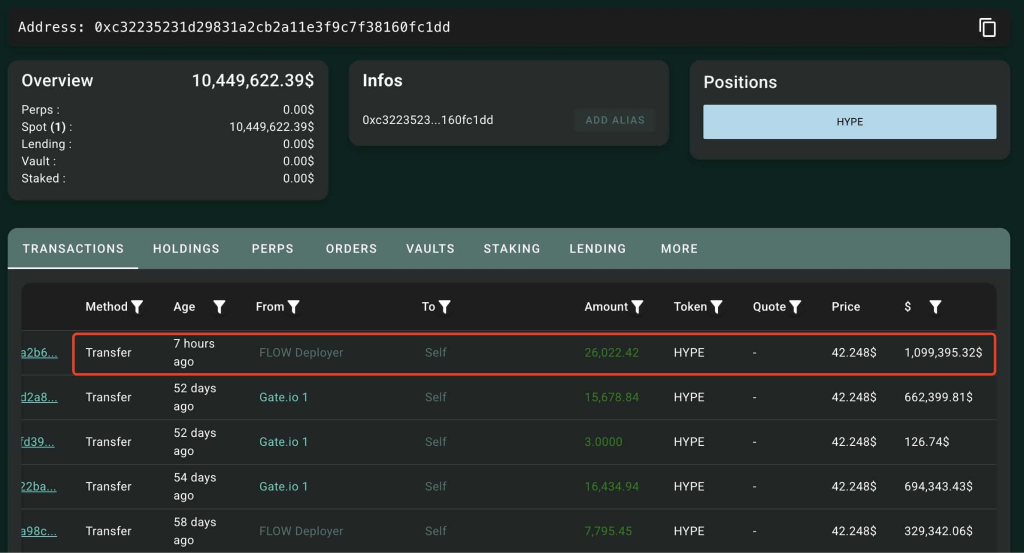
    Onchain data highlights whale accumulation and large leveraged positions supporting HYPE’s recovery. Source: LookOnChain

    Despite strong whale conviction, Hyperliquid’s next move depends on broader market participation. Analysts note that while leverage remains elevated but stable, a lack of expanding demand could cause price to stall near current levels. Conversely, increased participation beyond large holders could fuel a breakout above resistance. With ETF momentum building and derivatives activity remaining robust, Hyperliquid stands at a pivotal point where institutional adoption and market demand will likely determine the direction of its next major move.

    5. Zcash

    ZCash (ZEC) is a privacy-focused cryptocurrency that was launched in 2016 by Zooko Wilcox-O’Hearn. It is a fork of Bitcoin, designed to enhance privacy and anonymity for its users. Unlike Bitcoin, where transaction details (such as sender, recipient, and amount) are publicly visible, ZCash allows users to choose between two types of transactions: transparent and shielded.

    Transparent transactions work similarly to Bitcoin, where all transaction details are recorded on the blockchain and visible to everyone. However, shielded transactions use a cryptographic technology called zk-SNARKs to allow fully private transactions. In shielded transactions, the details are encrypted, meaning that only the parties involved have access to the information, while the validity of the transaction is still verifiable by the network.

    ZCash is particularly valued by those who prioritize financial privacy and security, as it offers optional anonymity in a way that few other cryptocurrencies do.

    Why Zcash?

    Zcash is trading at $359.86, approaching a critical resistance zone as bullish momentum pushes the price toward the $400 level. The recent rally began after a breakout from a prolonged consolidation phase, with ZEC surging from the $220–$260 accumulation range and reclaiming the $350 level as support. Rising open interest alongside increasing volume confirms that fresh capital is entering the market, reinforcing the strength of the current uptrend. However, momentum indicators such as an overbought RSI and negative funding rates suggest the market is becoming crowded with leveraged long positions, increasing the risk of short-term volatility near resistance.

    ZEC price chart showing a breakout from the $220–$260 range and testing the $370–$400 resistance zone. Source: TradingView

    The broader market backdrop has also supported Zcash’s recent gains. The token surged more than 30% during a relief rally following news of a temporary ceasefire between the US and Iran, outperforming other privacy-focused cryptocurrencies. Technical analysis shows that ZEC is now approaching a descending trendline resistance that previously capped rallies, with the $370 region aligning closely with key Fibonacci retracement levels. A decisive breakout above this area could confirm a bullish continuation pattern and open the door to significantly higher targets.

    ZEC/USD weekly chart highlighting descending trendline resistance and key Fibonacci levels near $370. Source: TradingView.

    Despite the bullish structure, derivatives data highlights meaningful downside risks. Liquidation heatmaps reveal that more than $50 million in leveraged long positions sit below the current price, particularly around the $305–$306 zone. This imbalance suggests that if ZEC fails to break above resistance, a sharp pullback could be triggered by cascading liquidations. As a result, Zcash stands at a pivotal technical juncture where a confirmed breakout above $400 could fuel a new expansion phase, while rejection may lead to a rapid corrective move.

    6. Bittensor

    Bittensor is a decentralized platform that creates a peer-to-peer marketplace for machine intelligence. The network is composed of multiple specialized subnets, each dedicated to specific tasks such as text prompting, transcription, or audio generation. Currently, more than 30 Bittensor subnets are actively operating across various AI domains.

    At the core of the network is a unique consensus mechanism known as Yuma Consensus, which enables validators across different subnets to collaboratively determine what the network learns and prioritizes. This approach ensures that intelligence within the ecosystem evolves based on real-world utility and performance.

    The computational power required to perform machine learning tasks is supplied by miners, who are incentivized with TAO tokens. Users seeking AI services pay in TAO to access these decentralized resources, creating a self-sustaining economic model that rewards valuable contributions.

    By offering a decentralized and cost-efficient network of machine learning algorithms, Bittensor lowers barriers to entry and makes advanced AI capabilities accessible to a broader audience.

    Why Bittensor?

    Bittensor (TAO) is trading at $316.78, consolidating after an explosive rally of more than 160% over the past month. The token’s rapid ascent has positioned it among the strongest-performing AI-related crypto assets in 2026, supported by growing interest in decentralized artificial intelligence infrastructure. However, technical indicators suggest the rally may be entering a critical phase as TAO tests key resistance levels following its sharp upward move.
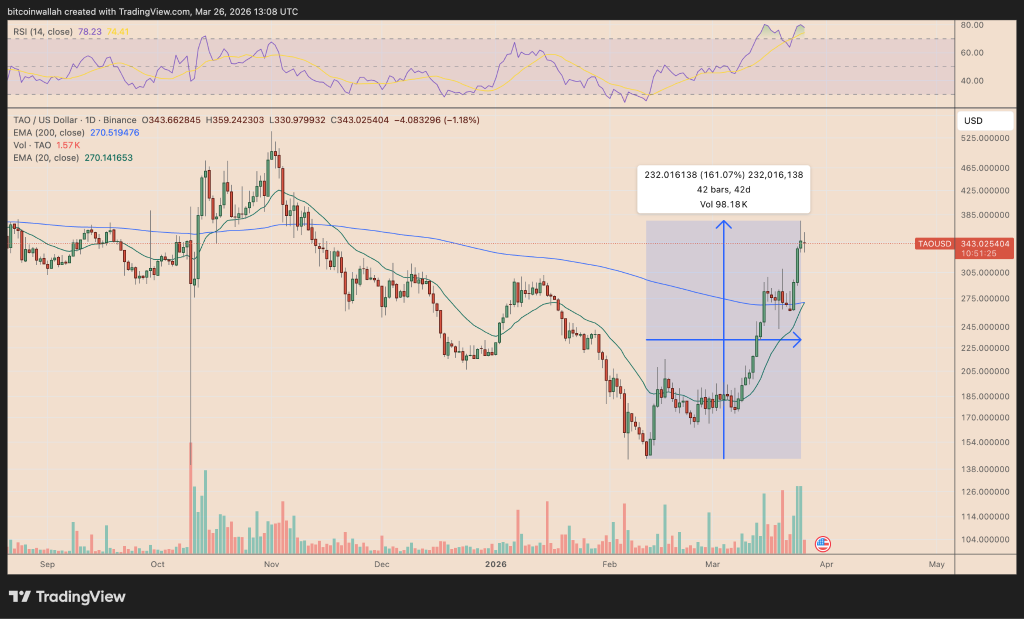
    TAO/USD daily chart showing a golden cross formation following a strong multi-week rally. Source: TradingView

    Despite the bullish momentum, historical fractal patterns indicate caution. Previous golden cross formations on TAO’s chart have preceded average drawdowns of roughly 40% within five to six weeks, suggesting the potential for a short-term correction if the pattern repeats. At the same time, social activity surrounding Bittensor has surged to its second-highest level in six months, reflecting growing market attention while sentiment remains relatively balanced rather than euphoric.

    Bittensor social volume and sentiment trends highlight rising attention without extreme market euphoria. Source: Santiment

    Fundamentally, the broader Bittensor ecosystem continues to strengthen, with subnet tokens collectively reaching a market value of approximately $1.5 billion as demand for decentralized AI infrastructure accelerates. High-profile endorsements from industry leaders and advancements such as the Covenant-72B large language model have reinforced Bittensor’s long-term narrative, positioning TAO as a key player at the intersection of blockchain and artificial intelligence.

    7. XRP

    XRP is a digital cryptocurrency that was created by Ripple Labs in 2012. It is used as a means of payment and transfer of value on the Ripple payment protocol, which is designed to enable fast and secure transactions between financial institutions as well as individuals.

    XRP is unique in that it is not based on the blockchain technology used by many other cryptocurrencies. Instead, it uses a distributed consensus ledger called the XRP Ledger, which is maintained by a network of validators. This allows for faster transaction processing times and lower fees compared to traditional payment methods.

    XRP has been popular among cryptocurrency traders and investors due to its high liquidity and clear potential for broader adoption, especially as a remittance solution. However, it has also been the subject of controversy and legal action, with US regulators alleging that it is a security and should thus be subjected to securities regulations. This has somewhat hindered the potential of XRP as an investment, and handcuffed Ripple’s growth as a company.

    Why XRP?

    Evernorth’s recent S-4 filing with the SEC outlines one of the most notable institutional developments involving XRP in recent months and sheds light on why the asset may be worth monitoring in the near term.

    The firm is planning to go public via a SPAC merger while holding a treasury of approximately 473 million XRP, currently valued at around $685 million. Much of this allocation was not acquired through open-market purchases but through strategic contributions, including roughly 127 million XRP from Ripple and more than 211 million XRP from Arrington Capital.

    The size of the position is also striking. Evernorth raised over $1 billion to establish its XRP treasury, even though the present value of its holdings is considerably lower due to XRP’s price drop. Part of its XRP was acquired at an average price of about $2.53, which is significantly higher than the current level near $1.45, leading to a substantial accounting impairment.

    What sets Evernorth apart is that it does not view XRP as a static reserve asset. Instead, the company plans to actively utilize its holdings through decentralized finance strategies such as providing liquidity, lending, and generating income via options. It also aims to incorporate Ripple’s RLUSD stablecoin into these operations. This strategy creates a more active form of demand for XRP, as it is used in yield-generating activities rather than simply being held for speculation.

    With XRP still trading well below its all-time high and Evernorth’s average acquisition price, the situation presents an interesting short-term narrative. Investors are observing a large, publicly traded entity building a significant XRP position, putting it to work for yield, and establishing itself within the broader ecosystem. Alongside the visibility of the upcoming SPAC merger, this could help spark renewed interest and momentum for XRP as institutional participation continues to grow.

    8. Toncoin

    Launched as the blockchain powering Telegram’s Web3 ambitions, The Open Network (TON) is a decentralized, open-source blockchain designed for fast, low-cost transactions and seamless integration with consumer-facing applications. TON was built to support smart contracts, decentralized applications, and native payments at scale, with a strong focus on usability and high throughput.

    TON goes beyond simple value transfers by enabling developers to build Mini Apps, wallets, and payment tools that can be embedded directly into Telegram’s interface. This design allows users to interact with onchain services without leaving a familiar messaging environment, lowering friction compared with traditional dApp ecosystems.

    Adoption has increasingly centered on payments and consumer use cases, with TON positioned as a settlement layer for in-app commerce, peer-to-peer transfers, and stablecoin payments across Telegram’s global user base. Recent launches such as TON Pay aim to turn Telegram into a native crypto checkout environment, expanding real-world utility beyond trading and speculation.

    Despite its growth, TON continues to face scrutiny around decentralization, governance, and its close association with Telegram. Ongoing development is focused on improving developer tooling, scaling transaction capacity, and expanding compliance-friendly payment infrastructure, as the network pushes toward broader mainstream adoption.

    Why Toncoin?

    Toncoin (TON) is trading at $1.34, up 1.35% over the past seven days, with a market capitalization of $3.28 billion, standing out as one of the few large-cap assets holding steady during a volatile market week. While Bitcoin and Ethereum sold off sharply, TON remained range-bound, reflecting relatively resilient sentiment tied to ecosystem-specific developments rather than broader macro flows. Price action suggests quiet accumulation, with limited downside follow-through despite market-wide risk aversion.

    That stability comes as the TON Foundation unveiled TON Pay, a new payments SDK designed to turn Telegram into a native crypto checkout layer for Toncoin and stablecoins. The tool allows Telegram Mini Apps to accept onchain payments through a single integration, with sub-second settlement times and average fees below one cent, targeting Telegram’s 1.1 billion monthly active users. TON Foundation vice president of payments Nikola Plecas said the goal is to remove friction around wallets, gas fees, and checkout, positioning TON as a consumer payments rail embedded directly into one of the world’s largest messaging platforms.

    Telegram Mini Apps. Source: Telegram

    Looking ahead, TON’s narrative is increasingly tied to real-world usage rather than speculative trading. Planned expansions to subscriptions, gasless transactions, and regional fiat off-ramps could broaden merchant adoption, while Telegram’s scale offers a distribution advantage few blockchains can match. From a technical standpoint, TON is holding support near $1.25, with resistance around the $1.45 to $1.50 zone. As long as the Telegram payments rollout progresses, TON appears positioned for gradual accumulation rather than momentum-driven moves in the near term.

    9. Monero

    Monero is a privacy-focused cryptocurrency designed to offer anonymous and untraceable transactions. Launched in 2014 as a fork of Bytecoin, Monero was introduced through a whitepaper written by the pseudonymous “Nicolas van Saberhagen.” Unlike Bitcoin or Ethereum, Monero conceals sender and receiver identities, as well as transaction amounts, through advanced cryptographic techniques such as stealth addresses and ring signatures. This strong focus on privacy has made Monero a favorite among users seeking true financial confidentiality.

    Monero runs on a Proof-of-Work (PoW) consensus mechanism and is deliberately resistant to ASIC mining to support decentralization. It can be mined efficiently using consumer-grade hardware, and its privacy-preserving features also improve fungibility—individual XMR coins are indistinguishable from one another and can’t be blacklisted. Despite its strong standing within the crypto community, Monero has been the subject of regulatory scrutiny due to concerns over its potential use in illicit activities. Nonetheless, it remains the most widely adopted privacy coin in the market today.

    Why Monero?

    Monero surged to its highest level since 2021 this week, reclaiming the spotlight among privacy-focused cryptocurrencies as XMR briefly pushed past $590 and entered fresh price discovery. The rally coincided with renewed interest in privacy assets and a sharp contrast with governance turmoil at rival Zcash, where internal disputes triggered developer resignations and a steep sell-off. With ZEC faltering, traders appeared to rotate toward Monero as the more stable and decentralized privacy exposure, lifting XMR back toward levels not seen in nearly five years.

    XMR/USD chart showing the breakout above $500
    XMR/USD chart showing the breakout above $500. Source: CoinCodex

    Beyond relative strength against peers, Monero’s move also reflects a broader shift in sentiment around financial privacy. Institutional commentary from firms such as Grayscale and Coinbase has increasingly highlighted privacy as a structural theme for 2026, driven by tighter compliance rules, onchain transparency concerns, and growing demand for confidential transactions. While Monero faced scrutiny in 2025 following a large block reorganization and ongoing debates around mining concentration, those concerns have faded from price action as the network continued to operate without lasting disruption. As Zcash’s roadmap faces uncertainty, Monero has regained its position as the largest privacy coin by market capitalization.
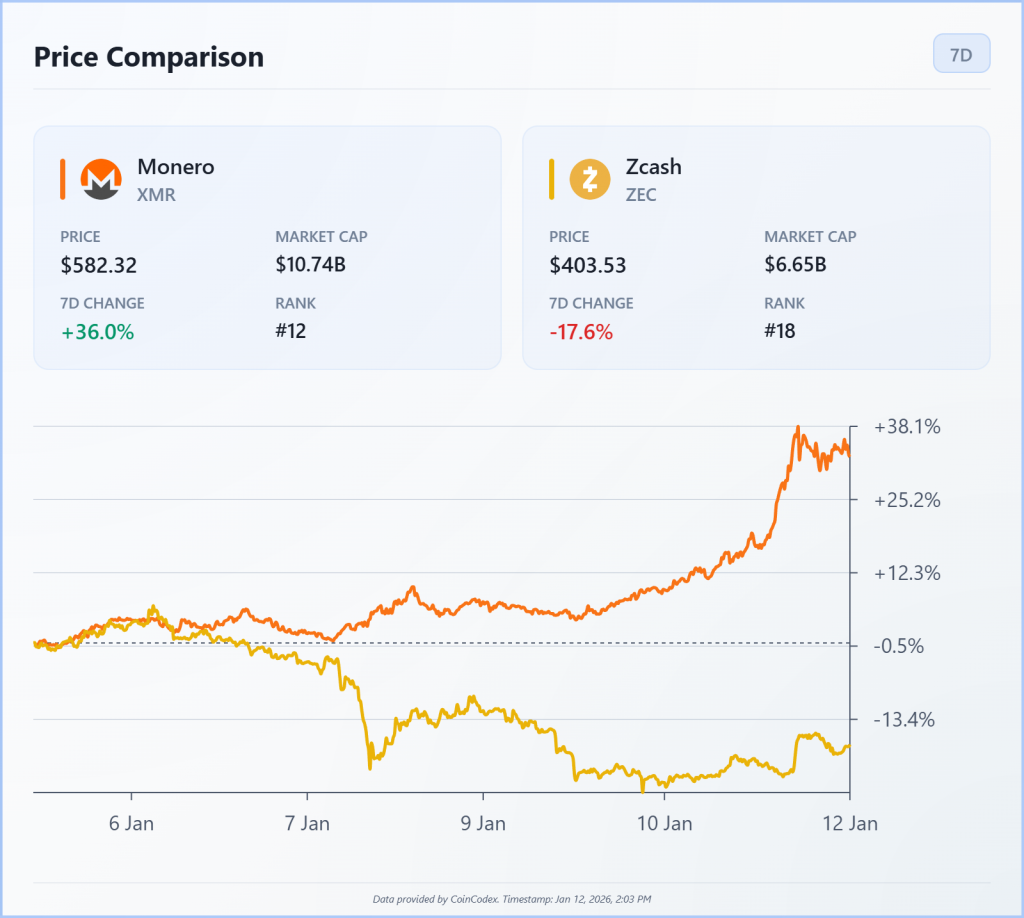
    Monero price comparison versus Zcash
    Monero price comparison versus Zcash. Source: CoinCodex

    From a technical perspective, XMR is now testing a historically critical zone. Previous attempts to break above the $500–$520 range have failed multiple times over the past decade, often followed by sharp corrections once momentum stalled. That history suggests near-term volatility remains likely unless Monero can decisively hold above former resistance. A confirmed breakout would invalidate the bearish fractal and open the door to higher targets around $750, based on long-term Fibonacci extensions. While pullbacks cannot be ruled out after such a steep rally, Monero’s reclaiming of its privacy crown and entry into price discovery place it among the more closely watched large-cap setups heading into 2026.

    XMR/USD chart highlighting prior failed breakouts and resistance zone
    XMR/USD chart highlighting prior failed breakouts and resistance zone. Source: TradingView

    10. Uniswap

    Uniswap is a decentralized cryptocurrency exchange that pioneered and helped popularize the automated market maker (AMM) model. This innovative approach eliminates the need for traditional order books, enabling users to swap tokens directly on the blockchain in a streamlined, intermediary-free manner.

    The Uniswap protocol operates in a fully decentralized way, allowing anyone to create liquidity pools for any token. As a result, newly launched crypto assets are often traded on Uniswap before becoming available on centralized exchanges.

    Uniswap’s model has since been adopted by numerous decentralized exchanges across various blockchain networks. Despite this, Uniswap continues to lead the decentralized exchange space in terms of trading volume.

    Governance of Uniswap is handled by holders of the UNI token, who can propose and vote on protocol changes. UNI was initially distributed to past users of the protocol through an airdrop in 2020, and the token can now be bought and sold on many decentralized and centralized trading platforms.

    Why Uniswap?

    UNI has recently outperformed the broader market, rising 16.5% over the past seven days while many other leading crypto assets moved sideways. This rally appears to be fundamentally driven, as

    Uniswap founder Hayden Adams has advanced the long-anticipated UNIfication proposal to a final on-chain governance vote, a move that could significantly reshape how value accrues to UNI holders.

    The proposal seeks to enable protocol fees on Uniswap v2 and selected v3 pools on Ethereum, directing a portion of trading fees into an automated UNI burn mechanism. After years of delays due to regulatory uncertainty, proponents argue that the environment has changed, allowing the protocol to finally implement a fee structure that directly links token value to usage.

    A key component of the plan is a one-time burn of 100 million UNI from the treasury, intended to account for the value that might have accrued if protocol fees had been active since the beginning. Going forward, fees would be rolled out gradually to limit disruption for liquidity providers, with governance maintaining flexibility to adjust parameters as needed.

    The proposal also broadens value capture beyond Ethereum mainnet by funneling Unichain sequencer fees into the same burn process, tying UNI supply reduction to activity on Uniswap’s Layer 2 network, which already handles significant trading volume.

    Beyond token economics, UNIfication aims to unify governance, development, and operations under a single structure. Uniswap Labs would eliminate interface, wallet, and API fees, operate using governance-approved funding, and enter legally binding agreements to align its actions with the interests of UNI holders.

    If the proposal passes, UNI would evolve from a purely governance-focused token into one with direct, usage-based value accrual, bringing renewed attention to the asset as the vote progresses.

    11. BNB

    BNB (formerly Binance Coin) is a cryptocurrency created by the popular cryptocurrency exchange Binance. Binance is the largest cryptocurrency exchange in the world, allowing users to buy, sell, and trade a wide range of digital assets.

    BNB was initially one of the ERC-20 tokens on the Ethereum blockchain but has since migrated to its own blockchain, known as BNB Chain. BNB is used as a utility token within the Binance ecosystem and has a variety of use cases. For example, users can use BNB to pay for transaction fees on the Binance exchange, receive discounts on trading fees, participate in token sales on Binance Launchpad, and purchase goods and services from merchants that accept BNB as payment.

    One of the unique features of BNB is that it has a deflationary model. Binance uses a part of its profits each quarter to buy back and burn BNB tokens, reducing the total supply of the token over time. This mechanism is designed to create scarcity and increase the value of BNB over time, with the end goal of reducing the circulating supply of BNB from the initial 200 million to 100 million BNB.

    Why BNB?

    BNB reclaimed $900 this week after bouncing sharply from the $800–$820 demand zone, with multiple bullish technical structures now aligning behind a potential push back toward $1,000 in December. A double-bottom pattern on the 4H chart, combined with a clean breakout from a multi-week falling wedge, signals fading seller momentum and renewed appetite from dip-buyers. Liquidation heatmaps reveal over $112 million in short liquidations clustered near $1,020, suggesting a move toward that level could accelerate quickly if BNB breaks and holds above $900–$920.
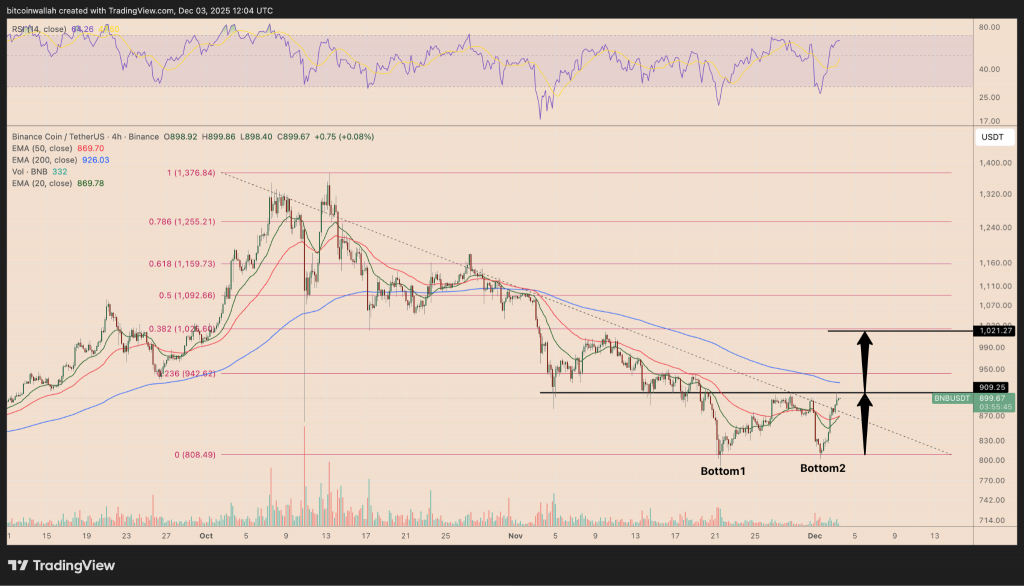
    BNB’s double-bottom and wedge breakout point toward a $1,000+ target
    BNB’s double-bottom and wedge breakout point toward a $1,000+ target. Source: Bitcoinwallah / TradingView

    However, BNB’s narrative this week also revolved around turbulence in the corporate treasury sector. CZ’s YZi Labs launched a formal attempt to overhaul the board of CEA Industries — the largest public BNB-holding company — accusing management of destroying shareholder value after the stock plunged 89% from its July peak. YZi aims to reverse recent bylaw changes, expand the board, and install its own nominees, arguing that CEA has failed to execute on its strategy of becoming the leading BNB treasury company. CEA responded by reaffirming its commitment to the BNB strategy while opening a dialogue with YZi to resolve concerns.
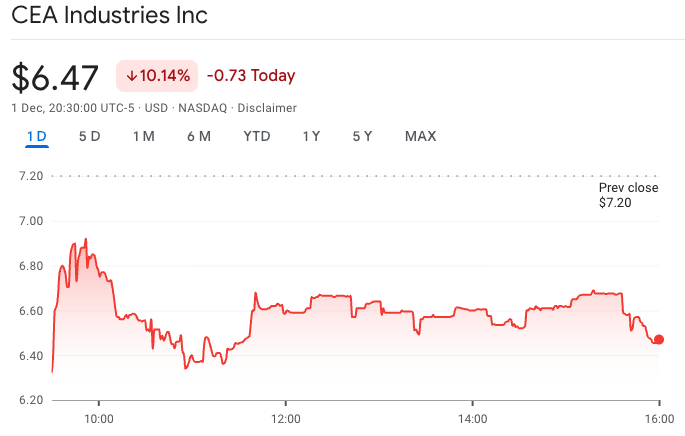
    CEA stock collapses as YZi Labs pushes for a board takeover
    CEA stock collapses as YZi Labs pushes for a board takeover. Source: Google Finance

    CEA stock collapses as YZi Labs pushes for a board takeover. Source: Google FinanceDespite governance drama and broader market pressure, BNB has held up better than many large-cap assets this quarter, outperforming even as it trades well below its mid-October all-time high of $1,367. CEA’s reported holdings of 515,054 BNB at an average entry of $851 place its treasury slightly underwater, yet BNB itself remains up 17.8% year-to-date, reinforcing its relative strength during the latest downturn. If bullish technicals continue to hold — and especially if liquidation clusters begin to trigger — analysts say BNB could feasibly revisit the $1,020–$1,115 range before year-end.

    12. Chainlink

    Chainlink is a decentralized oracle network designed to provide blockchains with secure, reliable data from external sources. It addresses the long-standing “oracle problem” by safely connecting on-chain systems with off-chain information, enabling many applications that wouldn’t be possible using blockchain data alone.

    Already the dominant oracle provider in decentralized finance (DeFi), Chainlink is also gaining traction in NFT projects and crypto gaming. For example, a DeFi protocol can pull price feeds from centralized exchanges through Chainlink to power its smart contracts, while NFT platforms often rely on Chainlink’s verifiable randomness to ensure fair minting processes and transparent distribution.

    Why Chainlink?

    Chainlink rallied 15% this week to $14.10, boosted by a major interoperability milestone: Solana and Coinbase’s Base have been connected using Chainlink’s Cross-Chain Interoperability Protocol (CCIP). The new bridge allows seamless asset transfers between Solana and the Base L2 ecosystem, giving developers the ability to integrate SPL tokens directly into Base applications. This marks one of the first production-ready bridges linking an EVM chain to Solana’s non-EVM architecture, reinforcing Chainlink’s role as the industry’s dominant cross-chain infrastructure provider. Despite the breakthrough, LINK traded slightly lower on the day, mirroring broader altcoin weakness.

    Chainlink also secured a significant step in institutional adoption as Grayscale’s spot LINK ETF debuted in the U.S., attracting $41 million in first-day inflows and posting “solid” trading volume, according to ETF analysts. While not a blockbuster launch like XRP’s, the ETF already manages $64 million in assets, showing that investor appetite is extending beyond Bitcoin and Ethereum into high-utility altcoins. Analysts noted the debut signals growing demand for regulated exposure to “long-tail assets,” especially those underpinning real-world tokenization infrastructure — a trend that plays directly into Chainlink’s strengths.

    Still, the LINK token remains down 73% from its all-time high, and the ETF launch alone has not reversed its long-term downtrend. But Chainlink’s strategic importance continues to grow: its oracle networks and CCIP are now core infrastructure for DeFi, tokenization protocols, and cross-chain applications across the industry. With Solana, Base, and multiple ETF providers integrating or backing the network, LINK’s recent strength suggests investors are beginning to reprice Chainlink as a foundational layer for the next phase of multi-chain development.

    Best cryptocurrencies to buy at a glance

     Native AssetLaunched InDescriptionMarket Cap*
    BitcoinBTC2009A P2P open-source digital currency$1.51 tln
    EthereumETH2012The leading DeFi and smart contract platform$279 bln
    SolanaSOL2020Smart contracts platform with high speeds and low fees$49.2 bln
    HyperliquidHYPE2024Decentralized perpetuals exchange with an efficient order book$10.6 bln
    ZcashZEC2016Privacy-focused cryptocurrency$5.16 bln
    BittensorTAO2023Decentralized platform for machine intelligence$2.65 bln
    XRPXRP2015The leading crypto remittance solution$88.1 bln
    ToncoinTON2021An efficient blockchain with Telegram messenger integrations$3.27 bln
    MoneroXMR2014A privacy-first cryptocurrency with fully obfuscated transactions$6.52 bln
    UniswapUNI2020A pioneering decentralized exchange protocol$2.08 bln
    BNBBNB2017The native coin of the Binance exchange$84.6 bln
    ChainlinkLINK2017The leading decentralized oracle protocol$6.74 bln

    Best crypto to buy for beginners

    If you are just starting out in crypto, it is advisable to stick to cryptocurrency projects that are less prone to volatility and are generally more established. While this approach does have a downside, as it becomes much more difficult to expect triple-digit or larger gains, the major upside is that you are not exposed to projects that have a chance of failing and, thus, losing your entire investment. 

    In order to identify projects that are stable and thus feature low volatility, you can start by following the parameters listed below:

    • The crypto asset has a market capitalization that places it into the cryptocurrency top 100 (roughly $500 million as of spring of 2026)
    • The crypto asset is available for trading on the best crypto exchange platforms and can be exchanged for fiat currencies
    • The crypto asset boasts healthy liquidity ($100M/day and more), which allows you to execute buy and sell orders quickly and without slippage 
    • The crypto asset is part of a reputable crypto project with clear goals, a realistic roadmap, and products and services that look to address real-world problems

    Some of the best cryptos to buy for beginners are those that follow the above criteria and have earned their standing in the crypto market due to robust security, popular products and services, and clear growth potential. Some beginner-friendly crypto investments are:

    • Bitcoin
    • Ethereum
    • Litecoin
    • Cardano
    • BNB

    It is worth noting that cryptocurrency investments are inherently risky, even if you stick to the biggest and most reputable projects. The reason for this is simple – the crypto sector is relatively new, and the landscape might look completely different in the future.

    Best crypto for long-term

    When deciding which cryptocurrency to buy for the long term, it’s important to consider projects that are well-established, have a strong community, are highly liquid, have a large market cap, and have a clear reason for existing (such as solving a real-life problem, introducing new functionality, etc.). Without these characteristics, a project might fail to survive in the long term, rendering it a bad long-term investment.

    It is worth noting that, typically, most long-term crypto investors are looking for projects that have the potential to generate decent returns but also provide a degree of investment stability. Roughly speaking, only the largest cryptocurrencies fit the bill, as others have a low market cap and liquidity that doesn’t bode well for a long-term commitment (unless you’re prepared to take on more risk).

    In addition to Bitcoin and Ethereum, there are a number of other cryptocurrencies that fit the criteria of being low-risk, long-term crypto investments.

    If you are planning to hold onto your digital assets for a longer period of time, it is best to take care of crypto custody yourself. Holding large amounts of crypto on an exchange can be risky, as we’ve seen over the years with the collapse of high-profile exchanges like Mt. Gox and FTX. Use one of the reputable crypto hardware wallets to store your crypto. Ledger hardware wallets, for instance, allow you to manage your crypto holdings easily and provide a much higher degree of security than crypto exchanges or even software crypto wallets.

    Best place to buy crypto

    One crucial aspect to consider when choosing which platform to use to buy crypto is the range of cryptocurrencies and trading pairs available. Since different exchanges support varying digital assets, it’s important to choose a platform that accommodates the specific cryptocurrencies you intend to trade.

    Additionally, assessing an exchange’s liquidity and trading volume is essential. Higher liquidity generally results in improved price stability and faster trade executions. Furthermore, it is prudent to examine the fees charged by the exchange, encompassing deposit, withdrawal, and trading fees. Comparing fee structures across different exchanges can help you identify the most cost-effective option that aligns with your trading style. With that said, here are some of the best exchanges on the market right now:

    • Binance – The best cryptocurrency exchange overall
    • KuCoin – The best exchange for altcoin trading
    • Kraken – A centralized exchange with the best security

    By diligently considering these factors, you can make an informed decision and select a cryptocurrency exchange that meets your requirements for security, variety, liquidity, and affordability.

    How we choose the best cryptocurrencies to buy

    At CoinCheckup, we provide real-time prices for over 22,000 cryptocurrencies, with the list growing by dozens each day. As you can imagine, making a selection of a dozen top cryptocurrencies to buy out of such an immense dataset can be difficult and will for sure lead to some projects that should be featured being omitted. To minimize the chance of that happening, we follow certain guidelines when trying to identify the best cryptocurrencies to invest in.

    Availability 

    One of the most important factors for any cryptocurrency investment is the crypto asset’s availability, meaning how easy it is to buy and sell it across various cryptocurrency exchanges. We tend to stay away from assets that are not available on major exchanges and require complex procedures to obtain.

    Market Capitalization

    Another important metric for identifying whether a crypto project is worth covering its market cap. A high market cap means that the project has reached a certain level of adoption from users, making it less risky to invest in.

    Growth Potential

    While this metric is mostly subjective, it is still an important metric on which we curate our selection. We won’t feature projects that we think are stagnating or have no real upside in the future.

    Purpose and Use Case

    We consider the purpose and use case of cryptocurrency, particularly in a real-world setting. Some cryptocurrencies focus on specific industries or applications, such as decentralized finance, gaming, or supply chain management.

    Team and Development

    The team and people involved in the project can tell you a lot about the potential of a particular cryptocurrency project. We examine the team’s experience, expertise, and track record and evaluate the development activity and updates to ensure the project is actively maintained and evolving.

    The bottom line: What crypto should you buy right now?

    The decision of which crypto to buy now is dependent on your own risk profile and investment goals. For some, investing in a crypto asset with a proven track record like Bitcoin is the only type of exposure to crypto they are willing to take on.

    Meanwhile, those with a higher risk tolerance might see Bitcoin as too stable, looking instead toward newer and smaller projects that carry a higher degree of upside. 

    If you are looking for more investment ideas, check out our crypto price predictions section.

  • Can XRP Reach $500 and What Would It Take?

    Can XRP Reach $500 and What Would It Take?

    You’re wondering if XRP can reach a whopping $500 price point — a notion that seems unlikely at first glance (and second and third, to be fair). To achieve this, the market capitalization of XRP would need to skyrocket to over $26 trillion. That would dwarf the GDP of major economies. 

    This would require a monumental shift in the cross-border payments market, with widespread adoption and favorable regulatory outcomes. While this scenario might seem far-fetched, there are factors that could drive significant growth. 

    Let’s explore what it would take for XRP to reach such heights and what industry experts have to say about its potential trajectory.

    Key takeaways

    • Market Cap Requirement: A $500 price point requires a market cap exceeding $26 trillion, making it highly improbable.
    • Growth Necessity: XRP needs an unprecedented increase of over 100,000% from its current price to reach $500.
    • Adoption and Demand: Capturing a larger share of the cross-border payments market and increased adoption by financial institutions are crucial for significant price increases.
    • Realistic Targets: More plausible price targets are between $10 and $50, contingent on favorable market conditions and regulatory clarity.

    XRP market capitalization analysis

    The prospect of XRP reaching a $500 price point hinges heavily on its market capitalization. To put this in perspective, achieving such a price would require a market cap of approximately $26 trillion, which far surpasses the total market cap of all cryptocurrencies combined and is significantly higher than the GDP of major economies like the United States.

    Currently, XRP’s market cap stands around $31 billion, indicating that the asset would need to increase more than 700 times to achieve the proposed $500 price point. We don’t like to make bold predictions here, but… this just isn’t happening any time soon.

    A more realistic analysis suggests that even capturing a significant share of the growing global remittance market would yield a much lower price. For instance, capturing 25% of this market would only yield about $50 billion in revenue, translating to a potential price of $250.

    This shows how impractical it is to expect a $500 price point for XRP under current market dynamics and regulatory environments.

    Thus, a price analysis reveals that the notion of XRP reaching $500 is highly speculative and unlikely without substantial shifts in market conditions and regulatory clarity.

    Ripple project overview

    Ripple’s project encompasses a multifaceted approach to revolutionizing cross-border payments. It leverages its XRP token to provide liquidity and efficiency.

    You can see this reflected in RippleNet, their platform that uses XRP as an intermediary to enable fast international transactions. This strategy aims to provide liquidity services to businesses and financial institutions. Ripple is positioned as a potential disruptor to traditional systems like SWIFT.

    Founded in 2012 by Chris Larsen and Jed McCaleb, Ripple’s XRP has grown to become the 3rd largest cryptocurrency by market capitalization.

    With a maximum supply of 100 billion tokens and a circulating supply of approximately 56 billion XRP, it’s evident that their strategic partnerships with major financial institutions like American Express and Bank of America are working well for them.

    A key part of their success is the Ripple Protocol Consensus Algorithm (RPCA), which enhances decentralization and security, allowing Ripple to process 1,500 transactions per second with a block processing time of just 0.06 seconds.

    This technical capability, combined with strategic partnerships, highlights the Ripple project’s potential to transform cross-border payment efficiency for financial institutions.

    Historical price analysis of XRP

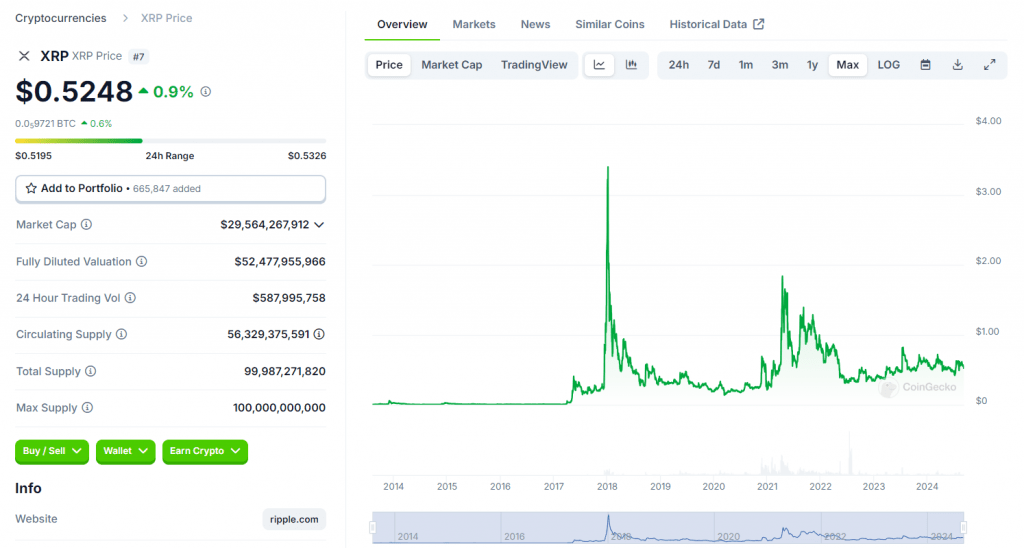
    When examining the historical price movements of XRP, you’ll notice a pattern of significant volatility, marked by dramatic fluctuations since its launch on February 1, 2013. Initially, XRP gained little market attention but eventually reached an all-time high of $3.84 in January 2018 during a bull market. 

    This peak was followed by a steep decline to around $0.20 in November 2020, partly due to the SEC lawsuit against Ripple Labs, which significantly impacted its market performance.

    Analyzing the historical data, you can see that XRP experienced a surge to approximately $1.96 in 2021 but faced instability due to fluctuating market conditions and continued legal challenges.

    More recent data shows that as of March 6, 2026, XRP closed at roughly $1.40. This shows a fairly cautious market sentiment despite a 386% growth in 2024. By the end of the year, our XRP price prediction shows that the token will rise to $1.75, which would be a relatively modest but still very respectable 25% price increase.

    These price movements underscore the volatility of XRP. This historical context provides a foundation for understanding XRP’s potential price trajectories.

    XRP current fundamentals

    XRP’s current market position is built on a foundation of robust fundamentals that show its utility in the global financial ecosystem. You’ll find that XRP’s speed, liquidity provisions, and regulatory clarity play significant roles in its market dynamics.

    Considering its current market cap of approximately $85 billion, XRP is the 5th largest cryptocurrency. The circulating supply of about 61 billion tokens out of a maximum of 100 billion indicates a substantial but controlled supply.

    Key points to note about XRP’s fundamentals include:

    1. Transaction Efficiency: XRP can process 1,500 transactions per second, with a block processing time of just 0.06 seconds, making it significantly faster than many other cryptocurrencies.
    2. Liquidity Solutions: Ripple’s On-Demand Liquidity service eliminates the need for pre-funded accounts, enhancing the efficiency of cross-border transactions and liquidity for financial institutions.
    3. Market Structure: The top 10 addresses hold only 20.5% of the total supply, indicating a relatively decentralized structure.
    4. Regulatory Clarity: A pivotal ruling in the SEC lawsuit clarified that XRP isn’t classified as a security for public sales. This has had a positive impact on its market perception and trading volume.

    These fundamentals suggest that while ambitious targets like $500 are impractical, more realistic predictions, such as $10 to $50 by 2040 or 2050, could be feasible under favorable market conditions.

    Bullish market scenario analysis

    Market momentum and favorable regulatory environments are necessary factors in the bullish market scenario for XRP. To reach a price target of $500, you’d need to see significant shifts in demand and adoption that propel XRP’s market capitalization to approximately $26 trillion, surpassing the combined market cap of major corporations like Microsoft and Apple.

    In a bull market, capturing a substantial share of the growing global remittance market could enhance XRP’s value. If XRP were to capture 25% of the cross-border remittance sector, it could yield around $50 billion in revenue for Ripple, potentially translating to a price of $250 under favorable conditions.

    However, achieving a $500 or even a $250 price point remains highly unlikely without substantial changes in market dynamics and regulatory clarity.

    Still, that doesn’t mean XRP’s price can’t go up. Ripple’s strategic partnerships with over 200 financial institutions, including Bank of America and Santander, increase the likelihood of increased adoption and transaction volumes necessary for a price surge.

    Positive regulatory outcomes, such as the recent ruling deeming XRP not a security for public sales, could also bolster investor confidence and lead to a substantial price increase if market sentiment remains bullish.

    Bearish market scenario analysis

    In a bearish market scenario, the path to a $500 price point for XRP appears insurmountable. The sheer scale of market capitalization required – approximately $31 trillion – far exceeds the total market cap of all cryptocurrencies combined as of March 2026.

    To put this into perspective, consider the following:

    1. Astronomical market cap: Achieving $500 per XRP would necessitate a market capitalization that surpasses the US GDP, an unprecedented and unrealistic target.
    2. Unfeasible price surge: XRP would need to increase by over 100,000% from its current price of around $0.49, a growth trajectory that’s highly improbable given existing market conditions.
    3. Regulatory hurdles: Even a partial victory in the SEC lawsuit may not be enough to drive XRP’s price significantly higher due to ongoing regulatory uncertainties and market sentiment.
      Historical performance: XRP’s historical price peaks, such as its all-time high of $3.84 in 2018, have yet to be replicated, further challenging the likelihood of reaching $500.

    Factors influencing XRP price

    Regulatory and market dynamics have a significant impact on the price of XRP. As an investor, you need to be aware of these factors.

    The SEC lawsuit against Ripple, for instance, has had immediate implications for XRP’s legal status and market confidence. 

    ripple website

    Market sentiment also plays a huge role. The price movements of XRP are often correlated with the performance of major cryptocurrencies like Bitcoin and Ethereum. Positive developments in these markets can have a ripple effect (no pun intended) on XRP’s value.

    Also, increased adoption by financial institutions can raise demand for XRP, which would impact its price positively. For XRP to reach higher price targets, it needs to capture a larger share of the cross-border payments market, which would necessitate a substantial increase in market cap.

    Roadmap to $500 Price Point

    XRP’s roadmap to a $500 price point hinges on a series of highly improbable events and market conditions. The most significant barrier is the astronomical market cap required, estimated at $31 trillion, which far exceeds the current US GDP. 

    For XRP to reach this level, it would need to capture a substantial share of the cross-border payments market, which is projected to reach $250 trillion by 2027.

    Consider the following key factors that could theoretically support such a high price target:

    FactorDescription
    Market ShareCrypto as a whole would need to take off significantly from where it is currently, and XRP would need to be at the forefront of it.
    Market SentimentCrypto as a whole would need to take off significantly from where it’s at currently, and XRP would need to be at the forefront of it.
    PartnershipsEstablishing liquidity and demand through partnerships with over 200 financial institutions.

    Given these conditions, even reaching a 10% market share would be a significant challenge. The historical price pattern suggests that XRP would need an unprecedented increase of over 100,000% from its current levels. This target is highly speculative at best and is likely not rooted in reality.

    Frequently asked questions

    How high can XRP go?

    XRP could potentially reach a price range of $10 to $50 if favorable market conditions and regulatory clarity align, especially with broader adoption in the cross-border payments market. However, reaching a price as high as $500 is highly improbable without monumental shifts in market dynamics.

    How high will XRP go in 2026?

    By the end of 2026, XRP might realistically reach $1.74, but it would require a lot of factors to align perfectly. Reacting higher than that, such as $10, is contingent on increased adoption by financial institutions and very positive crypto market sentiment. This price range accounts for decent growth in cross-border payments and positive legal developments.

    How high will XRP go in 2030?

    By 2030, XRP could potentially reach $50, assuming significant market adoption, widespread use in cross-border payments, and ongoing regulatory clarity. This is a best-case scenario with strong institutional support and expanding use cases.

    Will XRP reach $1,000?

    Reaching $1,000 for XRP is extremely unlikely given the market capitalization required, which would need to surpass the total GDP of many major economies. Such a price would require unprecedented shifts in both financial markets and XRP adoption on a global scale. In short, XRP is very unlikely to reach $1,000 in our lifetime.

    The bottom line

    You’re examining if XRP can reach $500. Given its current market cap and the astronomical increase needed, reaching this price point seems highly improbable. A more realistic goal is between $10 and $50, contingent on favorable market conditions and increased engagement from financial institutions. Even then, it would likely take decades.

    Achieving a $500 valuation would require significant adoption in cross-border payments and would lead to a market cap exceeding $31 trillion. Simply put, this is beyond the realistic scope of current market trends.

    In a similar vein, investors hope XRP will reach $500; some Solana traders believe that SOL has what it takes to reach $1,000.

  • XRP Airdrops 2026: Here’s How You Can Check If You’re Eligible

    XRP Airdrops 2026: Here’s How You Can Check If You’re Eligible

    If you’re an XRP holder, you might be eligible for airdrops. But how do you know if you qualify? The first step is to check the snapshot date and time specified by the project conducting the airdrop. Use the Bithomp XRP explorer to verify your wallet balance as of that date. 

    If you held a sufficient amount of XRP in an eligible wallet, such as Xumm or another non-custodial option, you might be in line for some free tokens. But there’s more to it – let’s take a closer look at the specifics.

    Key takeaways

    • Verify snapshot date: Check the official project channels for the exact snapshot date to determine eligibility.
    • Use the Bithomp XRP explorer: Utilize Bithomp to verify wallet balance at the snapshot date using its “time machine” feature.
    • Hold XRP in eligible wallets: Store XRP in a personal, non-custodial wallet like Ledger or Xumm to qualify for airdrops.
    • Understand allocation rules: Token allocation is typically based on the amount of XRP held at the snapshot time, with upper limits to prevent excessive rewards.
    • Track official announcements: Follow project-specific channels and reputable news sources to stay updated on airdrop eligibility and claiming procedures.

    XRP airdrop eligibility criteria

    To check if you’re eligible for an airdrop, use tools like the Bithomp XRP explorer to verify your wallet balance as of the snapshot date.

    Many airdrops place limits on allocations to prevent excessive rewards to larger holders, or “whales.” These limits ensure a broader distribution of tokens among smaller holders.

    To secure airdrop tokens, follow official project announcements and utilize supported platforms for claiming the tokens post-airdrop.

    Staying engaged with the community and regularly checking participation metrics can enhance your chances of receiving tokens and provide insights into upcoming opportunities.

    Always verify the information through reliable sources to avoid any potential issues.

    Previous XRP airdrops

    Airdrops have been a significant trend in the cryptocurrency space, and XRP is a part of that. Here are a few examples of airdrops for XRP holders that have already been completed.

    Flare

    One of the most widely known airdrops for XRP holders was carried out by Flare, a project focused on building data acquisition protocols for decentralized application developers. In simple terms, Flare aims to provide blockchain applications with reliable real-world data through a decentralized system.

    The snapshot for the Flare token airdrop was taken on December 12, 2020. However, eligible users didn’t receive their FLR tokens until early January 2023.

    This airdrop was supported by many major cryptocurrency exchanges. Platforms such as Coinbase and Binance distributed FLR tokens to users based on the amount of XRP they held on their exchange accounts at the time of the snapshot.

    Midnight

    Midnight is a data protection project designed as a layer-1 blockchain linked to the Cardano ecosystem. The project distributed its NIGHT tokens to users across eight different blockchains, with more than 37 million wallets qualifying for the airdrop.

    The snapshot for the Midnight airdrop was taken on June 11, 2025. XRP holders were eligible if they held at least $100 worth of XRP in a non-custodial wallet at the time of the snapshot. Holdings on centralized exchanges did not qualify. The amount of NIGHT tokens allocated depended on the USD value of the XRP held during the snapshot, meaning larger balances resulted in larger allocations.

    The claim period for the Midnight airdrop opened on August 5, 2025, and lasted until October 4, 2025.

    The airdrop is now in the “Redemption” phase. Users who claimed their tokens before the October 4 deadline can redeem their allocations in several stages. This phased distribution likely helps prevent a large number of tokens from entering the market at once. By releasing tokens gradually, the Midnight team aims to reduce selling pressure and support a healthier market for the NIGHT token.

    Evernode

    Evernode, a layer 2 project that’s working on introducing smart contract capabilities to the XRP ecosystem, made a snapshot of the XRP blockchain on September 1, 2023. Evernode said that it would use the snapshot to airdrop EVR tokens to users once the Xahau Network platform was ready to launch.

    Uphold and Bitrue, two exchanges who are known to be very XRP-friendly, announced support for the Evernode airdrop. However, most major crypto exchanges did not and most users who held XRP on exchanges at the time of the snapshot were not eligible to receive Evernode’s EVERS tokens.

    In December of 2023, the Evernode project notified users that the Evernode airdrop registration process had finished. In total, 38,478 XRP Ledger addresses in total were eligible from the airdrop. This includes both addresses owned by individual users and addresses controlled by Bitrue and Uphold cryptocurrency exchanges.

    It’s important to note that Evernode relied on the Xumm XRP wallet to release functionality allowing users to claim the EVERS airdrop. According to the Evernode project, this was necessary due to the airdrop’s technical complexity. The airdrop finally happened in early 2024, with Uphold users sharing news of airdroped EVERS.

    Here’s the full timeline of the now-concluded EVR airdrop:

    • August 31, 2023 – Uphold announces support for the EVR airdrop.
    • January 15, 2024 – Evernode network launched.
    • February 20, 2024 – Uphold to process & distribute the airdrop to qualifying customers on February 28th.
    • February 28, 2024 – Uphold processed the airdrop for distribution.

    Checking airdrop eligibility

    Determining your eligibility for XRP airdrops involves verifying that your wallet held a sufficient amount of XRP at the time of the project’s snapshot. This is vital because the snapshot date determines who qualifies for the token distribution.

    To check your eligibility, use tools such as the Bithomp XRP explorer to verify your wallet balance at the specified snapshot time. First, find the exact snapshot date and time on the project’s official website or social media channels.

    Then, enter your XRP Ledger address in the Bithomp XRP explorer and use its “time machine” feature to see your balance at the time of the snapshot. If your wallet balance meets the project’s eligibility criteria, you’re eligible to receive the airdropped tokens.

    Regularly check the project’s official channels and engage with their community. This will keep you updated on any additional requirements or announcements regarding the airdrop distribution process.

    Some projects may publish user eligibility lists detailing accepted wallet addresses for the airdrop, further confirming your eligibility status. Staying informed ensures you don’t miss out on potential token distributions.

    Securing your tokens

    You need to take proactive measures to safeguard your airdrop tokens.

    When it comes to securing your tokens, storing them in a personal, non-custodial wallet such as Ledger or Xumm is a must. These wallets provide enhanced security compared to exchanges, which can be vulnerable to hacking and other security breaches.

    Here are some key steps you should take to secure your tokens:

    1. Regularly backup your wallet data and recovery phrases: This makes sure that you won’t lose access to your tokens in case of emergencies.
    2. Monitor your wallet activity continuously: Regularly checking your wallet activity helps detect any unauthorized transactions, keeping your tokens safe.
    3. Enable two-factor authentication (2FA): Adding an extra layer of security for your wallets with 2FA can significantly reduce the risk of unauthorized access.

    We recommend using a hardware crypto wallet such as the Ledger Nano S to provide the best security for your XRP holdings.

    Protecting yourself from scams and fake XRP airdrops

    With the rise of airdrops in the cryptocurrency space, scammers have become very sophisticated with, among other things, fake airdrop campaigns. You must be able to  recognize potential red flags and take steps to safeguard your assets.

    Here are some essential security tips to protect yourself from scams and fake XRP airdrops:

    • Verify the source: Always ensure that the airdrop is coming from an official and trusted source. Cross-check announcements on the project’s official website or verified social media channels. Beware of unsolicited messages claiming you are eligible for an airdrop. 9 times out of 10, if someone messages you out of the blue, it’s an attempt to phish for personal information.
    • Be cautious with unknown links: Scammers often use fake websites to imitate legitimate projects, asking users to connect their wallets or provide sensitive information. Never click on unfamiliar links, especially those sent via email or social media. Use official sources to access airdrop information directly.
    • Use trusted wallets: Stick to well-established wallets like Ledger or Xumm when storing your XRP. Non-custodial wallets allow you to maintain control over your private keys, which reduces the risk of losing funds to compromised platforms.
    • Enable Two-Factor Authentication (2FA): If available, enable 2FA for added security on your wallet and exchange accounts. This provides an additional layer of protection by requiring a secondary code to authorize transactions or logins.
    • Check for fake airdrop promises: Some scammers promise exaggerated rewards to lure in users. Airdrops aren’t likely to make you rich. If an airdrop offer seems too good to be true, it likely is. Always review the project’s documentation to understand the real airdrop structure and token allocation.
    • Monitor your wallet activity: Regularly check your wallet for any unauthorized transactions. Most scammers aim to access your wallet without your knowledge, so staying vigilant can help detect any suspicious activity early.
    • Use blockchain explorers: Tools like Bithomp XRP Explorer can help you verify wallet balances and transaction history. Before participating in any airdrop, ensure your account meets the eligibility criteria, and be cautious about any discrepancies.

    Project-Specific requirements

    When participating in XRP airdrops, always aim to understand the project-specific requirements that govern eligibility. Each airdrop has its own set of rules that you need to follow to receive the tokens. Here are three key aspects to consider:

    1. Snapshot dates and eligible wallets: Most airdrops require you to hold XRP in eligible wallets at the time of the snapshot. For instance, the Evernode airdrop on September 1, 2023, mandated that users hold XRP in non-custodial wallets like the Xumm wallet.
    2. Token allocation based on XRP holdings: Airdrops typically allocate tokens based on the amount of XRP you hold at the snapshot date, often with upper limits to prevent larger holders from receiving disproportionate rewards.
    3. Additional actions and compliance: Some projects may require you to engage in specific actions, such as joining a community or trading on a particular exchange, and ensure compliance with project guidelines published on official channels.

    Staying updated on airdrops

    Understanding eligibility is just the first step in maximizing your potential gains from XRP airdrops. To truly capitalize on these opportunities, you need to stay updated on airdrops by following official projects and community channels for announcements and eligibility requirements.

    This includes keeping tabs on project-specific requirements, such as snapshot dates and wallet balances, which can be verified using tools like the Bithomp XRP explorer.

    Engage with reputable social media accounts dedicated to cryptocurrency airdrops for timely information about upcoming events.

    For instance, knowing which exchanges support airdrop distributions, such as Uphold and Bitrue for the Evernode airdrop, is obviously necessary. Regularly check trusted cryptocurrency news platforms so that you have access to the latest updates and insights on potential airdrop opportunities.

    FAQs

    How to earn XRP for free?

    You can earn XRP for free by participating in legitimate airdrops, joining crypto reward programs, or completing tasks on websites that offer XRP as a reward, e.g. pay-to-click sites. Always make sure you’re using trusted platforms and avoid scams that promise free XRP.

    How to find legit airdrops?

    To find legitimate airdrops, follow official project channels, reputable cryptocurrency news platforms, and verified social media accounts. Use trusted airdrop tracking sites and always double-check the source to avoid scams. Check out our article on the best crypto airdrops.

    How to claim airdrops?

    To claim airdrops, you typically need to hold a specific cryptocurrency in an eligible wallet at the snapshot date. Follow the project’s instructions for claiming the tokens. They will often require you to connect your wallet to a supported platform or complete specific actions.

    Do airdrops really pay?

    Yes, legitimate airdrops can provide real tokens, but the value of these tokens varies. While some airdrops result in valuable rewards, many offer small amounts, and the tokens may take time to increase in value.

    The bottom line

    At the time of writing this article (March 2026), there are no significant upcoming airdrop snapshots for XRP holders. However, airdrops for XRP holders are relatively frequent, which is certainly a nice perk if you’re a long-term XRP holder.

    Still, airdrops usually don’t translate to a significant amount of value, so it’s probably not wise to invest in XRP just because you’d like to occasionally receive airdrops. 

    It’s important to note that you’ll usually need to hold XRP in your own wallet instead of having it on an exchange if you want to be eligible for airdrops. 

    In addition, you should be very careful about scams. Since XRP is a very popular cryptocurrency, XRP holders are often targeted by scammers and fake projects. For example, a fake project might try to lure users onto a malicious website under the pretense that they’re conducting an XRP airdrop.

    Before trying to participate in any airdrop campaigns, make sure to conduct very thorough research so you know if you’re dealing with a legitimate project or not. If you also want to benefit from more cryptocurrency airdrops and not just XRP airdrops, check out our list of the best airdrop sites for free crypto airdrops.

  • XRP Price Prediction for 2040 and 2050: How High Can It Go?

    XRP Price Prediction for 2040 and 2050: How High Can It Go?

    There are many conflicted opinions on XRP’s long-term potential, as some still consider XRP “not a real crypto” because of its implications in banking. However, XRP could see a significant surge over the long term, with estimates ranging from $2.50 to $9.15 in 2040. Projections for 2050 are even more varied, suggesting maximum prices between $7.32 and $15.70. 

    What fuels this spectacular growth potential? Factors like regulatory outcomes, market conditions, and potential increased use in financial services all play a role. Let’s uncover the catalysts behind XRP’s predicted ascension and what this might mean for the future of cryptocurrency investing.

    Key takeaways:

    • The resolution of the SEC lawsuit, the launch of a USD-backed stablecoin, and increased adoption by financial institutions could drive XRP price appreciation.
    • Regulatory clarity and resolution of legal challenges will significantly influence XRP’s price trajectory and market confidence.
    • Historical growth rates and market dynamics suggest significant long-term potential, with emphasis on cautious, ongoing market analysis.

    XRP price history

    The journey of XRP’s price history is marked by significant milestones and dramatic fluctuations. If you’ve been following XRP, you know it was launched in 2012 at an initial trading price of less than 1 cent. It’s astonishing to see how far it has come, experiencing a surge of over 5,100% from its inception to its current price of $1.44 as of March 2026.

    The strongest year for XRP was undoubtedly 2017, where it gained over 35,000%, reaching an all-time high of $3.40 in January 2018.

    Source: CoinCodex

    The road to success was anything but smooth, though. Following the SEC lawsuit announcement in late 2020, XRP faced considerable price volatility, dropping to around $0.20 in 2019 before ultimately recovering.

    Despite these challenges, it managed to end 2023 trading at around $0.62 after fluctuating due to market conditions and legal developments. After the SEC dropped the lawsuit against Ripple, the cryptocurrency reached $3.64, though it has been dropping since then, all the way to $1.44 as of March 2026.

    These historical patterns are important to understand future price predictions, which suggest a potential range of $2.50 to $9.15 by 2040, and even higher in 2050, based on historical growth trends.

    Long-term XRP growth catalysts

    When examining long-term XRP growth catalysts, you’ll notice several key factors that could significantly propel the cryptocurrency’s price.

    Let’s break down what these are and why they matter.

    • Firstly, the resolution of the ongoing SEC lawsuit could be impactful. The lawsuit was finally ruled on in August 2024, and although some of SEC’s claims were denied, Ripple was still fined $125 million. Regardless, investor confidence and market acceptance were apparently reinvigorated by the mere fact that the lawsuit was over. Moving forward, it will be crucial to monitor the XRP rich list for any notable changes made by large investors.
    • Also, Ripple launched a USD-backed stablecoin in 2025, improving liquidity and broadening the use cases for XRP as a digital asset, further driving demand and price appreciation.
    • Moreover, increased adoption of XRP by financial institutions for cross-border transactions is vital. As more institutions integrate XRP into their operations, demand will increase, supporting long-term price appreciation.
    • Market dynamics also play a significant role in XRP’s future price. Historical growth projections suggest that XRP could reach a maximum price of $9.15 by 2040 and $15.70 by 2050, driven by market dynamics and adoption rates.

    To sustain the long-term growth projections, XRP is already making strategic moves in 2024.

    XRP price prediction 2040

    Predicting the future price of XRP in 2040 involves considering various growth scenarios and market factors. You need to look at multiple data points and forecasts.

    The maximum potential of XRP in 2040 varies significantly among analysts. 

    For instance, based on the historical growth of the S&P 500, XRP could reach approximately $7.03, representing a 488% increase from current levels.

    Here are key predictions to consider:

    1. Conservative estimates: Some analysts predict a more modest growth, with the maximum price potentially hitting $5.96 and an average price exceeding $4.90. However, these predictions are less commonly cited compared to more optimistic forecasts.
    2. S&P 500 growth model: Based on the S&P 500’s historical ROI, XRP could reach approximately $7.03 by 2040.
    3. Long-term potential: Some forecasts suggest that XRP’s price in 2040 could range from $13 to $22, driven by increasing global trade and partnerships, but these estimates are more speculative in nature and should be taken with extreme caution.

    XRP price prediction 2050

    When you look at XRP price forecasts for 2050, you’ll notice an even wider range of possibilities (not unlike price forecasts for 2040). 

    On one hand, based on the historical growth of the S&P 500, XRP could reach approximately a maximum price of $21.81 by 2050.

    This bullish outlook depends on the successful resolution of regulatory challenges and increased adoption of the Ripple network.

    Market dynamics, including demand from financial institutions and technological advancements, will play a big role in determining XRP’s future price trajectory. If these favorable conditions are met, XRP’s market cap could potentially exceed $3 trillion, similar to Bitcoin’s peak valuation.

    Factors influencing XRP price

    XRP’s long-term prospects may suggest significant price growth, but understanding what drives this potential is important for investors. 

    Market dynamics, particularly supply and demand, play a big part in determining XRP’s price. A rise in usage, driven by its fast transaction speed and low fees, can lead to price appreciation. Also, regulatory developments will help increase (or reduce) investor confidence and XRP’s market valuation.

    Here are the key factors to consider:

    1. Transaction speed: XRP’s ability to settle transactions in just 3-5 seconds increases its attractiveness for cross-border payments.
    2. Low transaction fees: Averaging around $0.0002 per transaction, these fees contribute to increased demand from financial institutions and users.
    3. Regulatory developments: Future regulatory decisions can significantly impact investor confidence and XRP’s market valuation.
    4. Technological advancements: Updates to the XRP Ledger are expected to enhance scalability and security, which would make XRP more appealing in the competitive cryptocurrency landscape.

    Historical performance and trends

    Have you ever heard the expression “History doesn’t always repeat, but it does rhyme”? To understand what XRP is likely to do in the coming years and decades, we should also take a look at what it has done so far.

    The rollercoaster ride of XRP’s price history shows its volatile nature, yet it also reveals growth and resilience. As you look into its historical performance, you notice that XRP’s price has experienced significant surges and downturns since its inception in 2012, but it’s always managed to survive and come back up.

    Initially trading at $0.01, it reached an all-time high of $3.40 in January 2018, only to decline and trade below $1 by 2019.

    Examining historical price patterns, you see that XRP’s fluctuations are often influenced by broader market trends and regulatory developments. 

    Many cryptocurrencies, such as Bitcoin and Ethereum, set new all-time highs in the bullrun in 2021; however, XRP was unable to beat its all-time high from 2018. Was this because of the SEC lawsuit? Possibly. How will XRP perform in the next bull rally? It’s looking pretty decent for now, but nothing is 100% certain. 

    Despite this volatility, XRP has increased in value and price a lot since its inception, and it serves as a reflection of its growth potential and market interest over the years.

    Its price history is a testament to the cryptocurrency’s ability to adapt and evolve, despite facing numerous challenges.

    Future adoption and regulatory impact

    Looking ahead to the future of XRP, regulatory clarity and adoption by financial institutions will be pivotal factors in shaping its price trajectory. 

    Here’s how future developments and adoption could influence XRP’s price:

    1. Adoption by financial institutions: Widespread adoption by banks and payment providers could significantly drive up demand for XRP, which would push its price higher.
    2. Technological advancements: Improvements in the XRP Ledger and the introduction of a USD-backed stablecoin could enhance XRP’s liquidity and efficiency and make it more attractive to financial institutions.
    3. Market dynamics: Supply and demand factors, along with broader market trends, will play a crucial role in determining XRP’s price trajectory by 2040 and 2050.

    Frequently asked questions

    How high can XRP go in 10 years?

    XRP’s price in the next decade could range significantly, with some analysts predicting values between $10 and $22 by 2036. A lot depends on the overall market conditions as well as XRP’s adoption.

    How much will 1 XRP be worth in 2030?

    By 2030, XRP’s price predictions vary widely. Estimates range from $3 to $15. Some analysts remain cautious, suggesting it may struggle to exceed $2.

    What would it take for XRP to reach $100?

    For XRP to reach a price of $100, it would require a monumental shift in both market conditions and adoption rates. This scenario would likely require XRP to become a dominant player in the financial services sector, possibly as a primary bridge currency for international transactions. 

    Can XRP reach 20 USD?

    Reaching $20 is considered speculative and would depend on several factors, including widespread adoption by financial institutions. While some analysts see potential, achieving this price point would require extraordinary market conditions. While everything is possible, it’s not likely to happen in the near future. 

    The bottom line

    You’ve seen the vast range of XRP price predictions for 2040 and 2050, from a conservative $2.50 to an ambitious $21.81. These forecasts are heavily influenced by market dynamics, adoption rates, and regulatory outcomes

    As you consider investing, remember that XRP’s future is marked by volatility and uncertainty, not unlike most of the crypto market. Its growth potential is significant, but so are the risks. Keep a close eye on market trends and regulatory changes, and as always, stay in control of your emotions and remain cautious.

    If you would like to learn more about XRP’s chances of major gains in the future, check out our article exploring if XRP can reach $10,000.

  • Can Ripple Reach $10,000? Here Are the Facts About XRP

    Can Ripple Reach $10,000? Here Are the Facts About XRP

    XRP is a unique cryptocurrency that has one of the most devoted communities in the crypto and blockchain space. Although it could certainly be a strong performer in the future, it’s practically impossible for Ripple to reach $10,000. 

    In this article, we will explore potential future price targets for XRP and explain why you shouldn’t expect XRP to ever reach a price of $10,000, or anywhere close to it, for that matter. We will also consult some XRP price predictions to get a better idea of where the price of XRP could head in the near to medium term. 

    Could Ripple reach $10,000? Here’s why it’s impossible

    The reason why XRP won’t ever reach a price of $10,000 is not complicated – the supply of XRP is simply too large. XRP has a maximum supply limit of 100 billion coins. While not all XRP coins are currently in circulation, the coin still has a substantial circulating supply of 60.92 billion.

    Even if we take the more conservative figure of 60.92 billion circulating XRP coins, the implied market capitalization if XRP were to trade at $10,000 would be $609.2 trillion. 

    To illustrate why this figure is impossibly large, we should point out that the GDP of the United States is $25.4 trillion, and the world’s largest company, Nvidia, has a market capitalization of $4.47 trillion. 

    To draw a comparison from the cryptocurrency space, we can note that the highest market cap ever reached by Bitcoin was $2.48 trillion. If XRP traded at $10,000, its market cap would be 245 times larger than Bitcoin’s market cap at its historical peak. 

    So, even if XRP became the world’s largest cryptocurrency, it would be extremely unlikely to hit a price of $10,000. The only realistic scenario for that to happen would be a drastic reduction in the XRP supply through a redenomination or a major burn program. 

    Although a small amount of XRP is already being burned with each transaction, the burn rate is simply not fast enough to decrease the supply to an amount where $10,000 would be a realistic price target for XRP. 

    The XRP Ledger has been in operation for over a decade, but only about 12.2 million XRP have been burned through this mechanism. This is only 0.012% of the maximum supply of XRP.  

    Now, let’s consider various XRP price targets and what they would mean for the market capitalization of XRP. This is a good way to quickly gauge whether a certain price target is realistic or not. We calculated the figures both for XRP’s current circulating supply, as well as its max supply. 

    XRP priceImplied market cap (60.92B XRP)Implied market cap (100B XRP)
    $0.50$30.46 billion$50 billion
    $1$60.92 billion$100 billion
    $5$304.6 billion$500 billion
    $10$609 billion$1 trillion
    $50$3.07 trillion$5 trillion
    $100$6.09 trillion$10 trillion
    $500$30.7 trillion$50 trillion
    $1,000$60.9 trillion$100 trillion
    $5,000$304.6 trillion$500 trillion
    $10,000$609 trillion$1 quadrillion

    When it comes to speculating about the potential future valuations of altcoins, we believe that using the historical market cap of Bitcoin is the best idea since it’s a benchmark that has already been demonstrated as possible for a crypto asset to achieve.

    To reach Bitcoin’s historical market cap peak of $2.48 trillion, XRP would have to trade at a price of $40.7 (assuming the current circulating supply of 60.92 billion XRP coins). We believe that this is the upper bound of what is possible for XRP to achieve, although it’s of course still unlikely, as it would require a 70.2x increase from the current price of XRP, which is $0.58 at the time of writing this article. 

    XRP price prediction for 2026 & 2027 – How high can XRP go?

    According to our XRP price prediction, we can expect to see a decline in the price of XRP in the short term. The forecasted bottom is $1.44, which is expected to be hit towards the end of February 2026. 

    However, the medium-term prospects are much more promising, at least as far as the price prediction on CoinCheckup is concerned. XRP is forecasted surpass the $2 price level and reach a price of $2.29 in August of 2026. This would represent a 54% increase from the current price of XRP. The forecasted XRP rally is expected to be fairly short-lived, as the coin is predicted to undergo a correction back under the $1.70 mark. 

    This trend continues heading into 2027, as XRP is expected to continue trading around the $1.80 price level in February 2027.

    Will XRP go up?

    It’s fair to say that XRP has been displaying an impressive performance in the past year, even when compared to other leading cryptocurrencies. While XRP is yet to improve upon the all-time high it set in early 2018, it came fairly close in July 2025, reaching $3.64.

    An important factor that allowed XRP to approach its all-time high is the conclusion of the legal battle between Ripple and the U.S. Securities and Exchange Commission (SEC). The SEC accused XRP of being an unregistered security that Ripple issued and sold, a claim Ripple disputed.

    The cloud of regulatory uncertainty hanging over XRP has naturally led to hesitation among some investors about investing in XRP. Additionally, in response to the lawsuit filed by the SEC, numerous cryptocurrency exchanges opted to delist XRP, aiming to sidestep potential regulatory complications.

    Despite these challenges, the outlook for XRP might still be optimistic. Should the legal battle conclude in Ripple’s favor, it’s possible that XRP will start building up momentum in the markets.

    Of course, we also have to mention fundamental developments that are improving the capabilities of the XRP Ledger. 

    For example, the Xahau sidechain allows developers to create smart contracts that can interact with objects and balances on the XRP Ledger. This functionality is implemented through a feature called Hooks. Thanks to Hooks, developers can write smart contracts in different programming languages, and the contracts are then compiled into WebAssembly. 

    In addition, many users might not know that the XRP Ledger now has an AMM (automated market maker) feature. This makes it possible for users to swap between different assets issued on the XRP Ledger, similarly to how Uniswap enables token swaps on the Ethereum blockchain. 

    The bottom line

    Even though you shouldn’t expect Ripple to hit $10,000, XRP could certainly still have a bright future ahead of it. For realistic price targets, the best idea is probably to take a look at the historical market capitalization of Bitcoin and consider how certain XRP price targets would compare to it. 

    If you want to learn more about the crypto markets, make sure to take a look at our article showcasing the best cryptos to buy now.

  • ISO 20022 Crypto: Which Coins & Tokens are Compliant?

    ISO 20022 Crypto: Which Coins & Tokens are Compliant?

    ISO 20022-compliant cryptocurrencies could benefit substantially in the future. They will be prime candidates for financial institutions looking to expand their offerings with the unique advantages offered by blockchain technology. Our ISO 20022 crypto list will help you identify the best cryptocurrencies that comply with the ISO 20022 standard.

    In this article, we are going to explain what ISO 20022 is in simple terms and go over cryptocurrencies that are currently compliant with the standard.

    Key takeaways:

    • The ISO 20022 standard streamlines data interchange between financial institutions, enhancing automation, reducing errors, and improving cash flow visibility.
    • As of the latest reports, about 26.4% of banks have achieved ISO 20022 compliance, with others required to comply by November 2026.
    • Cryptocurrency companies that have adopted the ISO 20022 standard, like XRP and Stellar, offer easier integration with financial systems and potential industry adoption.
    • The adoption of ISO 20022 in cryptocurrency projects like Algorand, Quant, and Hedera enhances compatibility with traditional finance, fostering wider acceptance and technological integration.

    What is ISO 20022?

    According to SWIFT, ISO 20022 is a methodology for standardizing the interchange of data between financial institutions. ISO 20022 can be used in various areas, including the clearing and settlement of payments, trading and settlement of securities, cash management, account management, and more.

    In essence, ISO 20022 addresses the problem of financial institutions using different formats and protocols for electronic data, which leads to inefficiencies. By adopting ISO 20022, financial institutions can cut costs, reduce the likelihood of errors, and reduce the complexity of data interchange.

    Here are some of the main benefits of the ISO 20022, according to SWIFT:

    “Thanks to its structured and richer data elements, ISO 20022 enables counterparties, intermediaries, and beneficiaries to increase automation in transaction processing, reducing costly manual interventions, and improving visibility on cash flows and cash positions, for example, in payment transactions.”

    the benefits of adoptiing ISO 20022 graphic by JP Morgan
    The benefits of adopting ISO 20022. (Source: JPMorgan)

    It is important to highlight that not all institutions have fully implemented the prerequisites for ISO 20022 readiness. As reported by The Banker last year, approximately 26.4% of banks have achieved ISO 20022 compliance. 

    For those institutions that have yet to undertake the essential measures to attain ISO 20022 compliance, they will have until 2026 to make the necessary adjustments.

    The best ISO 20022-compliant cryptos

    Some cryptocurrencies have been designed with the ISO 20022 standard in mind so that they can potentially be integrated into broader financial systems more easily. When we say that a digital asset is an ISO 20022 crypto, we mean that it incorporates messaging language as defined in the ISO 20022 standard, allowing for simpler data exchange between its blockchain and other financial systems such as SWIFT.

    ISO 20022 coins could have a head start when it comes to adoption in the financial services industry, as they will be much easier for companies to integrate than cryptocurrencies that weren’t designed with this standard in mind. 

    Below, you’ll find a list showcasing the ISO 20022-compliant cryptos:

    1. XRP – Highly efficient cryptocurrency suitable for cross-border payments
    2. Stellar – Fast and cost-effective blockchain with built-in DEX
    3. Algorand – Pure Proof-of-Stake blockchain with smart contracts
    4. Cardano – Research-driven blockchain with a focus on scalability, security, and sustainability
    5. XDC Network – Hybrid blockchain optimized for enterprise and trade finance applications
    6. Quant – Platform enabling interoperability between blockchains
    7. Hedera Hashgraph – A highly efficient DLT based on Hashgraph architecture
    8. IOTA – DAG-based network for IoT use cases
    9. Coreum (COREUM) – A blockchain specialized for RWA tokenization and smart tokens

    1. XRP – Highly efficient cryptocurrency suitable for cross-border payments

    xrp

    XRP is a cryptocurrency that uses a unique consensus algorithm called the XRP Ledger Consensus Protocol to provide extremely fast and cost-effective transactions. This makes it suitable as a bridge currency that can enable liquidity between different fiat currencies. 

    While the XRP Ledger doesn’t offer advanced smart contract functionality, the platform is optimized for payments and can offer the performance and efficiency that are required by global financial institutions.

    The main entity spearheading the development of the XRP ecosystem is Ripple, a United States-based company that uses XRP in its cross-border payments products. Ripple is part of the ISO 20022 Standards Body and was the first blockchain-focused company to join it. By adopting the ISO 20022 standard, Ripple can offer its RippleNet solution to a broader range of customers.

    XRP summary:

    • A distributed ledger using the XRP Ledger Consensus
    • XRP can handle 1,500 transactions per second
    • Transactions cost fractions of a cent
    • Ripple has partnerships with numerous leading financial institutions

    2. Stellar – Fast and cost-effective blockchain with built-in DEX

    stellar

    Stellar is a cryptocurrency that was initially launched as a modified version of XRP. One of the co-founders of Stellar is Jed McCaleb, who also played a role in the creation of XRP. The Stellar blockchain also offers extremely fast and efficient transactions. 

    The Stellar blockchain can be used to make transactions with the platform’s native currency, XLM, but it also offers built-in decentralized exchange functionality to seamlessly swap between the different assets issued on the Stellar blockchain. 

    Given its emphasis on interoperability between financial institutions, Stellar is poised to readily embrace the ISO 20022 standard. Through the integration of ISO 20022, Stellar will enable more efficient cross-border transactions and foster improved communication with conventional financial systems. XLM is poised to become one of the leading ISO 20022 tokens on the market.

    Stellar summary:

    • A cryptocurrency with similar properties to XRP
    • Built-in decentralized exchange feature
    • Useful for cross-border payments and stablecoins
    • Smart contracts functionality through the Soroban platform

    3. Algorand – Pure Proof-of-Stake blockchain with smart contracts

    algorand

    Algorand is a blockchain platform that supports smart contracts and employs a sophisticated Proof-of-Stake consensus algorithm that allows all ALGO holders to participate in the consensus process. The Algorand project was founded by renowned computer scientist Silvio Micali.

    The Algorand mainnet made its debut in 2019. Since then, Algorand has seen multiple enhancements, including improved smart contract functionalities and the capacity to support custom tokens, among other features. Algorand is intentionally structured to be an environmentally conscious and highly efficient blockchain and offers some of the lowest transaction fees among all cryptocurrencies. 

    Through the incorporation of the ISO 20022 standard, Algorand has the potential to improve its compatibility with conventional financial systems, enabling effortless integration with pre-existing infrastructure. 

    This could lead to wider adoption of Algorand’s technology, potentially attracting a greater number of developers and enterprises to engage with and build upon the platform.

    Algorand summary:

    • Pure Proof-of-Stake blockchain
    • Supports smart contracts and custom tokens
    • Very low transaction fees
    • Environmentally friendly

    4. Cardano – Research-driven blockchain with a focus on scalability, security, and sustainability

    Cardano is a blockchain platform built on rigorous academic research and a layered architecture to enhance scalability, security, and sustainability. Developed by IOHK and led by Ethereum co-founder Charles Hoskinson, it aims to provide an efficient and sustainable blockchain ecosystem for enterprises and individuals.

    Cardano’s Ouroboros Proof-of-Stake (PoS) consensus ensures energy efficiency while maintaining high security. Its dual-layer architecture separates ADA transactions from smart contract execution, enabling flexibility and scalability. The Plutus smart contract platform and Hydra layer-2 solution further boost network efficiency and adoption potential.

    By aligning with ISO 20022, Cardano strengthens its compatibility with financial systems, making it a strong candidate for integration into traditional banking and enterprise applications.

    Cardano summary:

    • Proof-of-Stake blockchain with a research-driven approach
    • Scalable and energy-efficient, designed for long-term sustainability
    • Layered architecture enables seamless upgrades and enhanced security
    • Supports smart contracts through the Plutus platform
    • Hydra scaling solution to significantly boost transaction speeds
    • ISO 20022 integration enhances interoperability with financial systems

    5. XDC Network – Hybrid blockchain optimized for enterprise and trade finance applications

    XDC Network (XinFin Digital Contract) is a hybrid blockchain that merges public and private architecture, making it ideal for enterprises and institutions. It is specifically designed to enhance trade finance, supply chain operations, and cross-border settlements with fast, secure, and cost-effective transactions.

    Using a Delegated Proof-of-Stake (DPoS) consensus, XDC Network ensures high throughput, low latency, and minimal energy consumption. Transactions settle in two seconds, with fees significantly lower than Ethereum.

    A key advantage of XDC Network is its ISO 20022 compliance, enabling seamless integration with banks and financial institutions. It supports smart contracts, tokenization, and interoperability with legacy systems, facilitating real-world financial applications.

    As trade finance digitizes, XDC Network stands out as a fast, transparent, and regulatory-compliant blockchain, bridging blockchain technology with traditional finance.

    XDC Network summary:

    • Hybrid blockchain that combines public and private blockchain features
    • Optimized for enterprise and trade finance applications
    • Delegated Proof-of-Stake (DPoS) ensures fast and energy-efficient transactions
    • Finality within two seconds and low-cost transactions
    • ISO 20022-compliant, making it bank-friendly and interoperable with financial institutions
    • Supports smart contracts, tokenization, and seamless integration with legacy financial systems

    6. Quant – Platform enabling interoperability between blockchains

    quant

    Quant is a blockchain platform that enables interoperability and establishes seamless connections among multiple blockchain networks. It relies on the Overledger protocol to facilitate the exchange of information between different blockchain ecosystems. The Quant platform enables collaboration and innovation, empowering developers and enterprises to launch decentralized applications that can interact with a multitude of blockchains.

    Through the adoption of the ISO 20022 standard, Quant aspires to boost its compatibility with traditional financial systems, streamlining the secure exchange of data across various networks. Achieving ISO 20022 compliance could position Quant in a pivotal role, bridging the divide between various blockchain platforms and strengthening its role in the blockchain ecosystem.

    Quant summary:

    • Blockchain focused on enabling interoperability
    • Allows developers to launch mDApps, which are decentralized applications that function with multiple blockchains
    • Supports a variety of blockchains, including the likes of Bitcoin, Ethereum, and XRP
    • Designed for financial institutions and SMEs

    7. Hedera Hashgraph – A highly efficient DLT based on Hashgraph architecture

    Hedera Hashgraph

    Hedera Hashgraph is a decentralized network that provides functionality similar to blockchains but is based on an innovative architecture called a hashgraph. Hashgraph provides an alternative and arguably superior way to achieve distributed consensus. 

    The platform offers transaction fees as low as $0.001, and transactions on Hashgraph achieve finality in between 3 to 5 seconds. According to Hedera Hashgraph’s development team, the platform can facilitate upwards of 10,000 transactions per second.

    The Hedera Hashgraph platform supports smart contracts that are compatible with the Ethereum Virtual Machine, making it a suitable platform for developers who are accustomed to building with the Ethereum ecosystem’s smart contract tools.

    Through its adoption of the ISO 20022 standard, Hedera aims to bolster its compatibility with conventional financial systems, enabling the smooth integration of decentralized applications (dApps) with the pre-existing infrastructure. 

    Hedera Hashgraph summary:

    • Distributed ledger based on Hashgraph technology
    • Can process over 10,000 transactions per second
    • EVM-compatible smart contracts
    • Low fees, transactions achieve finality in 3-5 seconds

    8. IOTA – DAG-based network for IoT use cases

    iota

    IOTA is another distributed ledger platform that forgoes the traditional blockchain architecture in an effort to achieve superior scalability. In the case of IOTA, the platform is built using a directed acyclic graph (DAG) architecture, which allows it to support zero-fee transactions. IOTA’s DAG network is called the Tangle.

    The network’s immense efficiency makes IOTA a suitable candidate for Internet of Things (IoT) applications where handling large amounts of data in a short period of time is of the utmost importance.

    By incorporating the ISO 20022 standard, IOTA strives to establish a framework for standardized and secure data transfers among Internet of Things (IoT) devices. This strategic choice aims to facilitate the effortless integration of IOTA into the wider IoT ecosystem, ensuring a consistent and secure flow of data among IoT devices.

    IOTA summary:

    • Distributed ledger platform based on a DAG architecture
    • Fee-free transactions
    • Suitable for IoT applications
    • Can handle around 1,000 transactions per second

    9. Coreum (COREUM) – A blockchain specialized for RWA tokenization and smart tokens

    Coreum is a high-performance layer 1 blockchain built with the Cosmos SDK, focused on real-world asset tokenization, decentralized applications, and programmable digital assets. Powered by the Tendermint consensus engine and WebAssembly smart contracts, it delivers higher throughput and lower latency compared to many older networks. A key innovation is its Smart Tokens, which allow developers and businesses to create customizable, programmable assets with built-in logic and controls.

    The project launched in 2021, founded by Dubai-based entrepreneurs Bob Ras and Rezza Bashash. Coreum places a strong emphasis on interoperability, including integration with the XRP Ledger through a dedicated bridge. The network’s native token, COREUM, is used for staking, transaction fees, and governance. A large portion of the initial supply was distributed to the community through airdrops and incentive programs.

    Coreum summary:

    • WebAssembly smart contracts enable fast, secure, and flexible dApp development
    • Smart Tokens support advanced asset issuance with programmable features and compliance controls
    • Built on Cosmos for scalability, performance, and modular design
    • Cross-chain connectivity through IBC and custom bridges enhances interoperability

    The bottom line

    We hope that our ISO 20022 crypto list helped you understand the ISO 20022 standard and how it relates to the cryptocurrency space. As we can see, the list of ISO 20022-compliant crypto tokens mostly consists of projects targeting enterprise use. 

    Many of the coins featured on this list feature extremely low transaction fees, which allows them to be used in enterprise-grade applications that require handling an extremely large number of transactions in a short period of time. To learn more about this topic, make sure to check out our list of the cheapest cryptos to transfer.

  • The Best Crypto to Day Trade – These 8 Coins are the Best for Crypto Day Trading

    The Best Crypto to Day Trade – These 8 Coins are the Best for Crypto Day Trading

    The cryptocurrency market’s unpredictability and volatility make it a fascinating option for day trading, which is an approach where traders make multiple trades within a single day in an attempt to capitalize on short-term price movements. 

    We’ve analyzed the crypto market to find the best cryptos to day trade. When selecting the best day trading cryptocurrencies, we considered a number of factors, including but not limited to liquidity, volatility, market cap, and availability on cryptocurrency exchanges.

    What should you look for in a day trading crypto?

    Day trading is very different from traditional investing, and the qualities of a good day trading asset don’t necessarily align with the qualities of an asset that’s suitable for long-term investing.

    However, there’s still quite a bit of overlap between many of the best cryptos to day trade and the cryptocurrencies with the strongest fundamentals, as they tend to have the most liquidity and can be traded with a broad variety of instruments such as futures and options in addition to standard spot trading.

    Here are some of the qualities that you want to be on the lookout for when choosing the best cryptos to day trade:

    • Volatility: Volatility is important for day traders, as a volatile market provides more opportunities for day traders to benefit from short-term price swings.
    • Liquidity: When trading a cryptocurrency with deep liquidity and strong trading volume, your orders will be executed quickly and you won’t lose money due to slippage.
    • Trading products: Trading products such as futures contracts and options unlock new strategies for day traders
    • Availability on exchanges: A cryptocurrency that’s listed on many exchanges will have a more robust market, and you’ll also be able to trade it regardless of which exchange you have an account on. 
    • Market cap: Trading a cryptocurrency with a significant market capitalization is safer, and will reduce the chances of sudden crashes triggered by negative news or technical issues.

    Based on these factors, we’ve selected the following coins as the best cryptos to day trade:

    Market capAverage daily volume over last 30 days30-day volatilityExchange listings
    Bitcoin$1.36 trillion$68.5 billion12.17%141
    Ethereum$238 billion$43.9 billion18.44%141
    XRP$89.1 billion$6.12 billion13.9%142
    Solana$48.5 billion$9.66 billion18.9%126
    Litecoin$4.23 billion$849 million11.26%131
    Polygon$1.14 billion$157 million13.3%106
    Chainlink$6.24 billion$717 million16.1%162
    Dogecoin$16.78 billion$2.59 billion12.1%134

    Data as of February 17, 2026.

    The best cryptos to day trade

    Now that we know what to look for when it comes to cryptocurrencies that are suitable for day trading, let’s get right to our list of the best cryptos to day trade.

    1. Bitcoin

    Bitcoin Black

    Bitcoin is a great cryptocurrency to day trade, as it has very strong liquidity while still displaying the kind of volatility that day traders are looking for in the cryptocurrency markets. In addition, there is a huge selection of different products for trading Bitcoin, including various types of futures contracts and options. 

    In addition to spot markets, you can trade Bitcoin using perpetual futures contracts and standard futures contracts, and there’s a broad range of options available when it comes to settlement.

    BTC is by far the most liquid cryptocurrency (if we exclude the USDT stablecoin). In February of 2026, Bitcoin has been seeing $68.5 billion in daily trading volume on average while the next closest competitor, Ethereum, had $43.9 in average daily volume during the same period. 

    2. Ethereum

    ethereum chart backgrund

    Ethereum is the second-largest cryptocurrency by market capitalization, and the second most liquid as well. Over the last 30 days, Ethereum has had a similar volatility profile to Bitcoin, although February 2026 has admittedly been a very high volatility period for crypto market standards.

    ETH is a highly liquid cryptocurrency that’s listed on practically all crypto exchanges, and the project has an extremely strong community of both users and developers that ensures it will remain a relevant player for years to come. 

    One particularly interesting aspect of ETH is that there’s a variety of decentralized applications and protocols that can potentially unlock new trading strategies. For example, it’s possible to use ETH as collateral to borrow DAI stablecoins on the MakerDAO platform, which can be a way of accessing leverage. It’s also possible to trade ETH derivatives directly on the blockchain thanks to protocols such as dYdX and GMX.

    3. XRP

    XRP is a unique cryptocurrency that offers very fast transactions and low fees, which makes it suitable for cross-border transactions and other types of transactions where traditional payments systems display a lot of inefficiency.

    The XRP cryptocurrency is closely related to the fintech company Ripple, which develops XRP-based products for financial institutions such as banks and payments providers. 

    The connection between XRP and Ripple has its positives and negatives. While Ripple is the key player driving the development of the XRP ecosystem, Ripple’s involvement with XRP has sparked concerns about decentralization, and there’s an open question of whether XRP is a security issued by Ripple or not.

    4. Solana

    Solana is a blockchain with smart contracts support and extremely efficient transactions. Solana’s native asset SOL has become a mainstay of the cryptocurrency top 10, and Solana is considered as one of the most credible competitors/alternative to Ethereum, which is currently the undisputed king of blockchain-based smart contracts.

    The markets for SOL are extremely active, as the coin has been displaying $9.66 billion worth of trading volume on average in the last 30 days. This is very impressive considering that the market capitalization of SOL is $48.5 billion. Combined with its 30-day volatility of 18.9%, Solana is definitely worth exploring for those who are looking for new cryptocurrencies to day trade. 

    5. Litecoin

    Litecoin is one of the most established “altcoins”, as it has been on the scene since 2011. LTC is similar to Bitcoin in many ways, but is designed to be more useful for day-to-day transactions. Crypto community members often say that Litecoin is the silver to Bitcoin’s gold.

    Litecoin is a solid choice for crypto day traders, as it has relatively deep liquidity, a lot of exchange listings, and a variety of futures trading products. In the last 30 days, it has seen more volatility than BTC.

    In comparison to Bitcoin, Litecoin has a 4 times faster block time, 4 times larger supply, and a different hashing algorithm. Litecoin transactions are generally cheaper and faster than Bitcoin transactions, which makes LTC a popular option among merchants accepting crypto.

    6. Polygon

    Polygon (MATIC) cryptocurrency logo image cover

    Polygon is a project that’s creating scalability solutions based on Ethereum. The project’s flagship product is the Polygon PoS platform, which is an Ethereum-compatible blockchain that offers much lower fees and faster transactions to users.

    The POS token is used as the native token across the platforms developed by Polygon. The token has strong liquidity, with an average daily trading volume of $157 million in the last 30 days. Those who are looking to trade POS with leverage have access to a variety of POS futures products on crypto exchanges like Binance.

    7. Chainlink

    Chainlink is a blockchain project that’s building a variety of web3 services, most notably oracles that allow on-chain smart contracts to be connected to reliable real-world data sources. 

    The Chainlink decentralized oracle network acts as a bridge between blockchain smart contracts and external data sources, APIs, and payment systems. It enables smart contracts to access and interact with real-world data, making them more versatile and capable of executing a wide range of applications beyond the blockchain.

    The Chainlink team has also released CCIP (cross-chain interoperability protocol), a protocol that allows different blockchain platforms to interoperate.

    Chainlink’s LINK token has high liquidity, strong exchange support, and relatively high volatility, which makes it worth exploring for day traders. 

    8. Dogecoin

    Dogecoin is one of the most well-known cryptocurrencies on the market, originally launched in 2013 as a lighthearted alternative to Bitcoin. Despite its origins as a meme coin, DOGE has grown into a large-cap crypto asset with deep liquidity and strong exchange support, making it a viable option for short-term traders.

    DOGE is based on Litecoin’s code and uses the same Scrypt hashing algorithm. It features fast block times and very low transaction fees, which makes it suitable for small payments and tipping. Unlike Bitcoin, Dogecoin does not have a hard supply cap, as new coins are continuously issued through mining.

    The markets for DOGE are highly active, with strong spot liquidity and a wide selection of perpetual futures products available on major exchanges. Dogecoin is known for experiencing sharp price movements during periods of heightened social media attention, which can create attractive volatility conditions for day traders.

    The bottom line

    We hope that our selection of the best day trading cryptos has helped you identify which crypto assets are worth your time if you’re pursuing a day trading strategy in the cryptocurrency market. 

    If you’re looking to invest in crypto instead of day trading it, our article featuring the best cryptocurrencies to buy right now can get you started in the right direction.

  • What Is the Ripple IPO Date and Stock Price?

    What Is the Ripple IPO Date and Stock Price?

    There has been a lot of speculation lately about Ripple’s potential initial public offering (IPO), especially with the resignation of the current SEC chair, Gary Gensler. The fintech company has made several comments about going public and provided several hints of when it might occur.

    In this article, we are going to examine the Ripple IPO date, potential Ripple stock price, and more. But first, let’s quickly explain what Ripple does and what’s its relation with the XRP cryptocurrency.

    What is Ripple?

    ripple ceo brad garlinghouse
    Ripple CEO Brag Garlinghouse has repeatedly stated that the company plans on going public in the future. Image source: Lauren Justice/Bloomberg

    Ripple (“Ripple Labs”) is a fintech company that provides a global network for real-time payments. It uses blockchain technology to enable banks and other financial institutions to send and receive payments across borders quickly, securely, and at a low cost, aiming to replace SWIFT.

    Ripple’s network is used by over 300 customers in more than 40 countries. Some of its partners include Santander, Bank of America, American Express, and MoneyGram.

    Here is a quick overview of what Ripple does and how it works:

    • Ripple provides a platform for financial institutions to send and receive payments across borders quickly, securely, and at a low cost.
    • The platform uses blockchain technology to track and verify payments.
    • Ripple’s cryptocurrency, XRP, is used to facilitate payments on the Ripple network. XRP can be used to convert currencies, send payments, and settle transactions.

    Ripple is still a relatively new company, but it has the potential to revolutionize the way cross-border payments are made. Ripple payments are processed in seconds, compared to days or weeks for traditional cross-border payments. They are also much cheaper than traditional cross-border payments, which can incur high fees. Finally, the payments are transparent and traceable, which can help to reduce fraud and improve compliance.

    Ripple’s legal battle with the US Securities and Exchange Commission (SEC) has now concluded, bringing long-awaited clarity to XRP’s regulatory status in the United States. The case, which centered on whether XRP should be classified as a security, had created years of uncertainty for Ripple and the broader crypto market. With the lawsuit resolved, Ripple can now shift its full focus back to expanding its payments network, strengthening partnerships, and driving adoption of XRP.

    The conclusion of the case removes a major overhang that previously weighed on XRP’s price and market perception. Going forward, Ripple’s growth will likely depend more on real-world utility, institutional adoption, and broader market conditions rather than ongoing legal uncertainty.

    What is XRP?

    It would be impossible to describe Ripple without mentioning XRP. XRP is a cryptocurrency that is used to facilitate payments on the Ripple network. It can be used to convert currencies, send payments, and settle transactions.

    XRP is one of the largest digital assets by market capitalization—in fact, it’s the 3rd largest cryptocurrency, only beaten by Ethereum and Bitcoin. It is also one of the most liquid cryptocurrencies, meaning that it is easy to buy and sell.

    Here are some of the benefits of using XRP:

    • Fast transactions: XRP transactions are processed in seconds.
    • Low fees: XRP transactions have very low fees.
    • Global reach: XRP can be used to send and receive payments anywhere in the world.

    XRP is a popular choice for both businesses and individuals who need to make fast, low-cost international payments.

    If Ripple emerges from the legal battle against the SEC victorious, the XRP price could see a massive boost in price, and potentially even surpass its ATH from 2018. For more information about its potential future price movements, check our XRP price prediction.

    What’s the Ripple IPO date?

    Despite frequent speculation, Ripple’s leadership has repeatedly stated that the company does not plan to go public in the near term. In a Bloomberg interview, President Monica Long confirmed that Ripple has “no plans for an IPO,” while CEO Brad Garlinghouse emphasized that the company does not need to raise capital and remains financially strong as a private firm.

    This stance comes even as Ripple’s valuation has climbed to an estimated $50 billion, ranking it as the ninth-largest IPO candidate globally according to widely shared industry rankings. The company previously sold $500 million in equity at a $40 billion valuation in late 2025, and its rapid increase in enterprise value reflects growing confidence in its payments infrastructure, acquisitions strategy, and RLUSD stablecoin expansion.

    Instead of preparing for a public listing, Ripple has focused on aggressive expansion. Since 2025, it has deployed nearly $4 billion across major acquisitions, including Hidden Road, GTreasury, Rail, and Palisade. At the same time, XRP is gaining indirect public market exposure through Evernorth Holdings, which is going public via a SPAC merger to build a large XRP treasury.

    For now, Ripple appears committed to remaining private while expanding its ecosystem. Any future IPO would likely be driven by strategic considerations rather than capital needs, but current leadership messaging makes it clear that a public listing is not on the immediate roadmap.

    What will the Ripple stock price be?

    It’s impossible to predict what Ripple’s stock price would be in the event of an IPO, especially since the company has stated it has no immediate plans to go public. Still, based on its latest reported valuation, we can outline a few hypothetical scenarios.

    Ripple is currently estimated to be worth around $50 billion, placing it among the largest private fintech and crypto companies globally. This marks a sharp increase from its $40 billion valuation following a $500 million equity sale in late 2025. The $50 billion figure reflects enterprise value, not XRP’s market capitalization.

    If Ripple were to go public at a $50 billion valuation, the share price would depend entirely on how many shares the company issues.

    The final number would depend on dilution, institutional allocations, and underwriting decisions. Importantly, Ripple stock and XRP are separate assets. Owning Ripple shares would represent equity in the company, while XRP remains an independent digital asset operating on the XRP Ledger.

    How to buy Ripple stock before IPO?

    Unfortunately, there’s no way to buy Ripple stock before the IPO. However, you could consider investing in the XRP digital currency, which is the native digital asset of the Ripple network. If Ripple as the company continues to grow, and its blockchain network sees more activity, then the price of XRP is bound to increase as well. You can purchase XPR on pretty much all of the best crypto exchanges.

    Ripple’s funding rounds

    Ripple has secured capital multiple times throughout its history, with early venture rounds laying the foundation for its global expansion. The company raised a $28 million Series A round in 2015, followed by an additional $4 million later that year, a $55 million Series B in 2016, and a $200 million Series C in 2019.

    More recently, Ripple demonstrated continued investor confidence through a $500 million secondary share sale in late 2025, valuing the company at $40 billion at the time. That valuation has since climbed to an estimated $50 billion, reflecting strong market confidence in Ripple’s payments infrastructure, RLUSD stablecoin strategy, and institutional positioning.

    Notable investors across funding rounds and secondary offerings include Andreessen Horowitz, Lightspeed Venture Partners, Standard Chartered, SBI Holdings, CME Group, Santander InnoVentures, Fortress Investment Group, Citadel Securities, Pantera Capital, Galaxy Digital, Brevan Howard, and Marshall Wace.

    Beyond venture funding, Ripple has generated revenue through XRP sales, enterprise blockchain software solutions, liquidity services, and institutional payment infrastructure. The company has also expanded aggressively through acquisitions.

    In May 2023, Ripple acquired Swiss-based crypto custody firm Metaco for $250 million in a mix of cash and equity. Since 2025, Ripple has significantly accelerated its acquisition strategy, deploying nearly $4 billion across major deals, including:

    • Hidden Road ($1.25 billion), a global prime brokerage platform
    • GTreasury ($1 billion), treasury management software serving Fortune 500 firms
    • Rail ($200 million), a stablecoin payments platform
    • Palisade, focused on wallet and custody infrastructure

    This expansion strategy signals that Ripple is prioritizing infrastructure buildout and ecosystem growth over pursuing a public listing in the near term.

    The bottom line

    There is currently no exact date for the Ripple IPO or official estimate of Ripple’s stock price. However, given the CEO’s statements, the company will pursue the going public route if given the chance. At the moment, it seems that the decision will ultimately come down to how the SEC vs. Ripple lawsuit ends.

    If you want to learn more about Ripple and XRP, we suggest you check our article on the top XRP holders to see who ranks where on the XRP rich list.

  • XRP Rich List: Who Are the Top XRP Holders in 2026?

    XRP Rich List: Who Are the Top XRP Holders in 2026?

    On-chain data shows that the top 50 largest addresses on the XRP rich list control about 44% of XRP’s circulating supply, worth about $36,6 billion at current market rates. Meanwhile, the top 10 largest XRP holders control more than 11 billion XRP coins, worth $16.3 billion.

    In this article, we are going to explore the current distribution of XRP among top addresses and examine who the largest XRP holders are.

    XRP rich list by the percentage of holdings in 2026

    As of February 2026, there are 59,780,000,000 XRP in circulation, with the XRP cryptocurrency’s market cap standing at $134.7 billion. The split between the top 50 addresses – each of which holds at least 200 million XRP – and the remaining addresses is roughly 60% to 40%. 

    XRP rich list distribution in 2026:

    • Top 10 XRP Addresses: 11,709,253,594 XRP (19.59% of circ. supply)
    • Top 10-50 XRP Addresses: 14,409,922,393 XRP (24.10% of circ. supply)
    • Remaining Addresses: 33,660,824,013 XRP (56.31% of circ. supply)
    • Total Addresses: 6,114,724
    The ratio of circulating XRP supply between the top 50 largest addresses and the remaining 4.8 million is roughly 60–40.

    The 10 top addresses on the XRP rich list

    There is no indication that the largest XRP addresses belong to individual holders. Five addresses belong to large cryptocurrency exchanges, and four belong to Ripple. There is only one address that is unknown and could potentially belong to an unknown XRP whale, although it’s more likely that the address belongs to a company.

    OwnerNumber of XRP% of total SupplyBlockchain address
    Bithumb1,793,519,0162.71%rPyCQm8E5j78PDbrfKF24fRC7qUAk1kDMZ
    Binance1,679,562,2742.54%rs8ZPbYqgecRcDzQpJYAMhSxSi5htsjnza
    Uphold1,505,543,1852.28%rsXT3AQqhHDusFs3nQQuwcA1yXRLZJAXKw
    Unidentified owner #11,368,553,9162.07%rLD5k36bJkNk1HkYSSCJwM4jBXChHjRViQ
    UPbit1,367,615,9392.07%rDxJNbV23mu9xsWoQHoBqZQvc77YcbJXwb
    Ripple1,330,027,1122.01%rMQ98K56yXJbDGv49ZSmW51sLn94Xe1mu1
    Ripple825,920,8241.25%rKveEyR1SrkWbJX214xcfH43ZsoGMb3PEv
    Unidentified owner #2713,000,0241.08%rJ9Ey7HbscSECamgDRzvw5wrVbFUgaUDt7
    bitbank572,680,7270.87%rw7m3CtVHwGSdhFjV4MyJozmZJv3DYQnsA
    Coincheck552,830,5770.84%r99QSej32nAcjQAri65vE5ZXjw6xpUQ2Eh
    Data collected on February 13, 2026.

    UPbit controls the most XRP out of all exchanges, with 12 addresses in the top 50 holding a combined 5.96% of all coins in circulation. They are also the largest holder of XRP, with 8 addresses in the top 10 holding 37% of all circulating supply.

    The bottom line: The top 10 addresses on the XRP rich list hold 19% of all circulating XRP coins

    As of February 2026, most of XRP’s circulating supply is centralized in a couple of dozen addresses, with just the top 10 addresses holding over 19% of XRP. Moreover, the amount of XRP held by the top 50 addresses is slightly lower than the number of XRP held by the remaining 4.8 million users.

    For comparison, the top 10 Bitcoin addresses hold 12.7% of the BTC circulating supply, which highlights Bitcoin’s high level of supply decentralization. It is worth noting that XRP is much more decentralized than some other cryptocurrencies – the top 10 addresses on Ethereum, for instance, control 61% of the circulating supply, whereas Dogecoin’s 10 largest addresses hold a staggering 44.2% of all DOGE.

    Overall, XRP is one of the most promising altcoin projects in the crypto industry today, thanks to its clear focus on solving real-world problems and partnerships with blue-chip companies.