Tag: Polygon

  • The NFT For You and Me: How Big Eyes Coin, ApeCoin, and Polygon Are Uniquely Targeting an $11.3 Billion Industry

    The NFT For You and Me: How Big Eyes Coin, ApeCoin, and Polygon Are Uniquely Targeting an $11.3 Billion Industry

    Bitcoin’s arrival on the internet in 2009 has introduced society to the world of cryptocurrencies. Crypto has changed the way we purchase, distribute and exchange digital finances. It focuses more on decentralisation, an element that is permitted through the use of blockchain technology. Incorporating decentralisation into digital finances contrasts with the functions of traditional centralised banking institutions, as they are more permissionless and unregulated.

    These elements have caused many people to still be cautious and sceptical about using cryptocurrencies, as security is arguably one of the most important factors to people when it comes to dealing with money. However, blockchain technology has proven that the security capability of crypto networks is valid.

    Cryptocurrencies have also introduced the world to other market niches such as decentralised finances (DeFi), game finances (GameFi), meme coins, and non-fungible tokens (NFTs). The latter of the list has become one of the most prominent elements on the internet, transcending into social media platforms and the entertainment industry. Everywhere you go online, you would most likely end up coming across some form of an NFT.

    There are many crypto networks out there that are looking to capitalise on the popularity of NFTs to increase their popularity and revenue. However, none are uniquely implementing NFTs into their network like Big Eyes Coin (BIG), ApeCoin (APE), and Polygon (MATIC). This editorial will discuss the history of NFTs while examining how these three blockchain networks distinctively innovate the NFT market.

    What Are NFTs?

    Non-fungible tokens (NFTs) are digital assets that link ownership to virtual or physical items, particularly relating to real estate, music, art, videos, and music. The concept of NFT began from what is called a ‘coloured coin,’ which was initially scheduled to be issued on the Bitcoin blockchain between 2012 and 2013.

    However, the first known NFT to emerge online came from digital artist Kevin McCoy, who called his NFT ‘Quantum.’ The NFT was a short video clip of McCoy’s wife Jennifer, which he later minted on the Namecoin (NMC) blockchain network and sold to Dash (DASH) for only $4.

    A market report conducted by Verified Market Research (VMR) projected that the NFT market will rapidly rise to an estimated $231 billion by 2030. With such a brief history, NFTs have already managed to garner a net worth of $11.3 billion in 2021, according to CoinTelegraph, conveying their potential and demand to grow further.

    Big Potential With The Big Eyes Coin NFT Marketplace

    An upcoming cryptocurrency that plans to elevate both the utility of meme coins while adding a creative realm of NFTs is Big Eyes Coin (BIG). It is a community-driven token that aims to shift affluence into the DeFi ecosystem while protecting an important part of the world’s environment. The blockchain network believes community tokens are wealth generators and wants to give more to crypto by building a platform that self-propagates for hypergrowth using NFTs to provide access to events and content.

    Big Eyes Coin was founded in Washington DC and adopted by a rocket scientist couple who worked for the government agency NASA. The blockchain network’s distinctiveness comes from its mascot, a cute cat with large pupils. The blockchain network takes clear inspiration from Japanese culture, designed in an anime/manga style.

    Their mascot being anime/manga inspired is strategic for Big Eyes Coin to reach a wider audience, as they are targeting a market estimated to be worth $24.80 billion in 2021. Additionally, Japan has a solid amount of crypto people, with an estimated three million active crypto users in the country as of 2021.

    BIG coin aspires to get their NFT collection to enter the top ten, giving users an incentive by having any profit made from an NFT going into a burn or not to burn vote. They plan to reach this goal by incorporating their NFT club called ‘NFT Sushi Crew,’ which continues to take inspiration from Japanese culture and is a special club for NFT holders who want to own ‘cute things, do fun things and eat fish.’ Furthermore, Big Eyes Coin plans to have NFT events held seasonally, giving token holders a chance to attend all year-long events.

    Enter The Bored Ape Yacht Club With ApeCoin

    Bored Ape Yacht Club ApeCoin (APE)

    ApeCoin (APE) is an ERC-20 utility and governance token used within the APE Ecosystem to empower and incentivise decentralised community, building at the forefront of web 3. The token exists to support what’s next, which is constructed and controlled by the APE community. ApeCoin will serve as a decentralised protocol layer for community-led initiatives which push crypto culture in a positive direction while enhancing the capabilities of blockchain technology.

    ApeCoin has several unique sectors to its blockchain network, such as The ApeCoin Foundation, ApeCoin DAO, and The Board. The ApeCoin Foundation is the base layer that token holders in the ApeCoin DAO can build. It facilitates community-led governance and is designed to reach further decentralisation. ApeFoundation exists to steward the development and growth of the APE ecosystem inclusively by utilising the ecosystem fund that is controlled by a multi-sig wallet.

    The ApeCoin DAO exists as they believe that decentralised governance is critical to building an internationally dispersed community, which is why they believe that the DAO is critical to the success of the APE ecosystem. Finally, they have a council board that administers DAO proposals while serving as a vision for the ApeCoin community.

    ApeCoin was founded by Yuga Labs, a $ 4 billion company known for founding the eccentric and vibrant Bored Ape Yacht Club. The Bored Ape Yacht Club is a collection of 10,000 Bored Ape NFTs existing on the Ethereum blockchain. Each Bored Ape NFT is distinct and programmatically generated from over 170 potential traits such as expression, clothing, and headwear.

    Bored Ape NFTs have become one of the most recognisable avatars on the internet. Their popularity has been partially attributed to the endorsement of high-profile figures, including Elon Musk, Snoop Dogg, and Eminem.

    Polygon Elevates Their NFT Status With Coca-Cola Collaboration

    Polygon (MATIC) Cryptocurrency

    Polygon (MATIC) is one of the most reputable cryptocurrencies on the market due to being the first well-structured, easy-to-use platform for infrastructure development and Ethereum scaling. The blockchain network aims to enable developers to create scalable, user-friendly dApps that have low transaction costs and do not sacrifice security.

    Polygon is a blockchain architecture that combines the Plasma Framework with proof-of-stake. Polygon’s Plasma framework, which was suggested by Ethereum co-founder Vitalik Buterin, enables the simple execution of scalable and autonomous smart contracts.

    Ultimately, Polygon transforms Ethereum into a full-fledged multi-chain system akin to other blockchain networks such as Avalanche and Cosmos that has the benefits of a vibrant ecosystem, openness, and security.

    Polygon bills itself as a Layer 2 scaling solution, which means the organisation has no plans to improve its existing basic blockchain layer anytime soon. The project aims to enable quick blockchain transactions and simplify scalability.

    In August 2022, one of the largest corporations in the world, Coca-Cola, announced that it will continue its web3 journeys by collaborating with The Polygon Network to bring a new NFT collection to the crypto market. Coca-Cola launched its first NFT collection on 30 July 2021, which was International Friendship Day. Before customers could view the NFTs, Coca-Cola incorporated a unique function.

    Coca-Cola’s NFTs are not based on usefulness. However, the beverage company stated that holders of its NFT would soon have access to bonuses and prizes. This includes access to Coca-Cola Creations product releases, gaming events, and Coca-Cola Studio-powered experiences. Polygon’s collaboration with one of the biggest beverage companies in the world represents how they are uniquely enhancing the NFT market.

  • Snook Adds BBT-Themed Rooms by Partnering with Unstoppable Domains and LobsterDAO

    Snook Adds BBT-Themed Rooms by Partnering with Unstoppable Domains and LobsterDAO

    Snook (SNK) play to earn blockchain game

    Key takeaways:

    • Snook is a Polygon-based arcade game that has been regularly played by thousands of users every month since April 2022
    • Snook’s partnership with Unstoppable Domains includes setting up exclusive BBT-themed rooms and engaging users in the two communities
    • BBT-themed rooms allow brands to create a virtual environment for their community where they can host tournaments and events
    • BBT-themed rooms are only accessible to token holders

    Snook (SNK) is a Play-to-Earn (P2E) multiplayer snake arcade game built on the Polygon blockchain. Players try to gain the upper hand against other snakes on the map by controlling their own snakes. Non-fungible tokens (NFTs) in the game serve to unlock special skins and attribute combinations.

    Snook has formed a strategic partnership with Unstoppable Domains to gather a large community for its online multiplayer gaming venture. Unstoppable Domains has a huge crypto community and members coming to Snook from this community have noticeably increased Snook’s user base. Online IO game Snook has now announced BBT Themed rooms for its partners.

    Announced as a result of the partnership with LobsterDAO, BBT Themed rooms are token-gated and branded virtual experiences where the project can interact with their community. In these rooms, brands will be able to host game nights and tournaments with their communities and leverage Snook’s Snake-like game theme to create a branded environment. BBT Themed rooms will host a special game night for LobsterDAO NFT owners. Voting by NFT owners for the game night ended on August 14.

    What Do BBT-Themed Rooms Do?

    The Snook BBT Themed rooms have increased the collaboration potential in the Web3 industry, giving brands the opportunity for many experiences. Brands can design in-game assets highlighting their brands to create a unique virtual environment. Snook has established a gaming model that unlocks the value of performance and skill rather than non-fun games based on clicking and mining.

    Only users with the appropriate token can enter BBT Themed rooms. As a new way for communities to grow, this will not let users without tokens into the room. Community members and token holders will be able to enjoy certain benefits and participate in events in the rooms. Participants will be able to create various tournaments in the BBT Themed room, offer prizes to competitive users and interact with users in the Snook community.

    Collaboration with LobsterDAO and Unstoppable Domains

    As a result of the cooperation with UD, Snook users will be able to log in with their UD and compete with other UD holders in the game. UD users will be able to join a special BBT-themed room where they can play with special Snooks created for the co-brand and earn SNK tokens by incorporating the P2E concept with Pay-Per-Kill mechanics. The partnership with Unstoppable Domains has excited community members. These two partnerships are thought to set new milestones and goals for the Snooks ecosystem.

    This new venture from Snook is a good step forward for the ecosystem and the GameFi industry. Supporting interoperability with multi-chain enhancements, anyone interested in NFTs and blockchain games can take advantage of these BBT-themed rooms to interact with different users and engage closely with their audiences.

    More About Snook

    Snook is a Polygon-based blockchain game that has been played by 5.59k different users in the last month. In Snook, a Snake-like game that rewards players for speed, skill, and determination, the value of NFTs varies based on your skills. The game is basically similar to other IO games and is the first version of such a game that can be played on the blockchain.

  • Incoming Crypto Bull Run— Watch Out For Avalanche (AVAX), Polygon (MATIC), and HachiFi (HACHI)

    Incoming Crypto Bull Run— Watch Out For Avalanche (AVAX), Polygon (MATIC), and HachiFi (HACHI)

    The cryptocurrency market is not facing the best times as there is a significant bear market in 2022, and many crypto coins are hitting severe lows. According to many crypto analysts and enthusiasts alike, now may not be the best time to buy some coins. The bear market has taken a while, and many crypto analysts have predicted that a wild bull run is not far away.

    However, you do not want to miss out on crypto coins that might skyrocket hard during the incoming bull run, which is why we bring you this piece. Avalanche (AVAX), Polygon (MATIC), and HachiFi (HACHI) are touted to move big in the incoming bull run. Let’s peer into them.

    Avalanche (AVAX)

    Avalanche (AVAX) is a layer one blockchain that boasts a unique Avalanche Consensus Protocol; this protocol makes its network highly scalable while giving off one of the fastest confirmation times. Avalanche (AVAX) supports decentralized finance transactions, NFTs, and other crypto transactions. Avalanche (AVAX) is a top blockchain for DeFi protocols like Aave (AAVE) and Trader Joe. Avalanche (AVAX) can process up to 4,500 transactions per second and is currently the no. 15 crypto with a market capitalization close to $6 billion.

    The Avalanche (AVAX) blockchain is one of the largest blockchains for DeFi, with a value close to $4 billion and its adoption keeps increasing by the day. Avalanche (AVAX) poses a strong use case that will most likely retain its relevance, so it is one to watch out for.

    Polygon (MATIC)

    Polygon (MATIC) is a layer two blockchain that was majorly built to provide a feasible solution to the scalability issues the Ethereum (ETH) network faces. Polygon (MATIC) operates as a side-chain network to Ethereum (ETH) by helping to connect and develop Ethereum (ETH)-compatible projects and blockchains. Polygon (MATIC) is one of the indispensable networks in the cryptocurrency market with some new use cases.

    Polygon (MATIC) Studios was recently launched to focus on blockchain gaming and NFTs. This is a smart move as online gaming looks set to expand its already booming industry. More so, Polygon (MATIC) is already a very compatible network for major NFT projects as the token is used for their governance. It looks like Polygon (MATIC) is set to pump big.

    HachiFi (HACHI)

    Not many in the cryptocurrency world have heard of HachiFi (HACHI), but it will interest you to know that this new cryptocurrency holds a lot of promise in the upcoming bull run. HachiFi (HACHI) is a decentralized, next-generation, digital layer three platform that aims to unlock the world of decentralized finance (DeFi) opportunities to redesign the way it is structured. This sounds like an excellent opportunity to maximize profits!

    HachiFi (HACHI) is focused on passive restructuring income and trading earnings in the DeFi world to maximize money-making opportunities for its community members. From NFTs to varying DeFi coins, HachiFi (HACHI) poses a lot of benefits, and it might be best to join in from its inception as it is poised to do well in the incoming bull run.

    The crypto mentioned above looks like an option for maximising financial gains. The network structuring is poised to benefit immensely from the incoming bull run, so you might want to give them a chance!

    For more information on HachiFi (HACHI), visit:

    HachiFi (HACHI)

    Presale: http://signpup.hachifi.com/

    Website: http://hachifi.com/

    Telegram: https://t.me/HachiFiOfficial

  • DOT is the #3 Coin to Watch for the Week of July 18 – July 24, 2022

    DOT is the #3 Coin to Watch for the Week of July 18 – July 24, 2022

    In the final hours of last week, the total cryptocurrency market capitalization finally peaked and touched $1 trillion level again. Nevertheless, the cryptocurrency markets entered this week with the valuation of $995 billion, just slightly below the psychological mark. Do you think that this increase in total valuation is the first harbinger of the new upward trend? Surely, we all wish to finally escape the bears and enter the bull market.

    3. Polkadot (DOT)

    Polkadot is a blockchain platform that addresses the scaling issues by using parachains, a network of multiple interoperable blockchains that run in parallel with each other. Utilizing parachains allows Polkadot to connect diverse blockchains into a single, decentralized and highly scalable blockchain ecosystem. The network of chains is interconnected by a central chain called the Relay Chain. Polkadot chains operate using a proof-of-stake consensus algorithm and the platform utilizes a native currency DOT. The project was originally designed by Dr. Gavin Wood, one of the co-founders of Ethereum and the inventor the smart contract programming language named Solidity. Along with Cardano, Solana, and several other networks Polkadot is considered one of the potential “Ethereum killers”.

    Polkadot featured in Revolut’s Learn-to-Earn Program as part of the newly established partnership between the two companies

    Renowned crypto analytics and research company Messari recently published a report on the state of the Polkadot ecosystem, which, in brief, shows that Polkadot managed to withstand the crypto downturn without losing a significant chunk of network activity quarter-over-quarter. During Q2 this blockchain maintained the number of monthly active users at around 145,000 and transferred more than 878 million DOT, which is almost the same as during Q1 2022. According to Messari’s data, 131 million DOT or around 11% of the total supply are currently bonded for the two-year lease period as part of the 20 parachain auction procedures that have taken place in the past.

    Acala and Moonbeam were two of the slot wining projects that have caused the bonding of the majority of the currently locked DOT tokens. (Source: Messari)

    Another 54% to 56% of total DOT in circulation are staked. To sum up, the Messari’s report indicates that Polkadot is a healthy ecosystem with sustainable tokenomics. Furthermore, Polkadot’s stats could further improve because of the recently announced partnership with popular fintech company Revolut. As part of the partnership Revolut is featuring Polkadot in a dedicated Crypto Learn-to-Earn campaign and giving away $15 paid out in DOT to participants who complete the course. Given the fact that Revolut currently has more than 18 million personal users, the exposure on its platform could provide a significant boost to DOT adoption in the mainstream.

    2. Algorand (ALGO)

    Algorand is a blockchain platform that can be used for digitalization and tokenization of almost any kind of asset via the creation of so-called Algorand Standard Assets (ASAs). Additionally, the platform supports the on-chain creation of smart contracts and facilitates a secure and immediate settlement of multiparty transactions through Atomic transfers. Furthermore, Algorand has implemented a pure proof-of-stake (PPoS) consensus protocol, meaning that anyone holding ALGO can participate in the consensus process through staking and be rewarded for that.

    Algorand TVL increased by over 90% in the past month, making it one of the fastest-growing DeFi ecosystems

    According to data provided by DeFi Llama, Algorand currently has a total value locked (TVL) of over $220 million. While that only places Algorand on the 17th spot on the leaderboard of the biggest DeFi ecosystems, it is the relative change in TVL that makes this blockchain stand out as Alogrand grew its TVL by over 90% in the past month. Most of the growth contributing to the almost-doubled TVL took place throughout last week as Alogrand’s TVL is up by more than 60% in last 7 days. The fact that CoinShares launched a physically backed Algorand ETP on Deutsche Boerse last week surely pushed ALGO in the centre of attention and contributed a lion’s share to the TVL growth. The ETP commenced trading on Deutche Boerse’s online platform Xetra on July 14 when ALGO was trading below $0.30 per coin. Over the weekend, the price of ALGO climbed towards $0.35, which is a multi-week high for this coin. Nevertheless, the Algorand ecosystem is also growing its utility and the number of use cases. Among the more recent news is the announced integration with SubQuery, a flexible, fast, and decentralised data indexing solution. The integration will allow developers on Algorand to easily organise and query on-chain data and thereby enhance dApps and protocols running on Alogrand. Do you also think ALGO could climb to $0,40 or even higher?

    1. Polygon (MATIC)

    Polygon, previously known as Matic Network, is a leading Ethereum Layer 2 scaling solution. The Polygon Layer 2 network consists of several simultaneously run proof-of-stake sidechains that regularly push the data to Ethereum to create network checkpoints. Currently there two bridges that allow users to move assets between Ethereum and Polygon, the first one being the Plasma bridge and the second one the PoS Bridge. The Plasma bridge delivers supersonic speeds and throughput and allows for an easy and fast exit to Ethereum mainnet at the same time. Together with several other features and tweaks, Polygon provides a major scalability improvement to the biggest smart contract blockchain. By successfully overcoming Ethereum’s most limiting shortcomings Polygon has become attractive for DeFi projects and is establishing itself as one of the key DeFi networks. 

    MATIC rallies on the tailwind of a series of good news, including Polygon being accepted to the Disney Accelerator program

    Polygon is another blockchain ecosystem that has been seeing noteworthy growth lately. Nevertheless, the ecosystem’s TVL only grew by slightly less than 10% in the past 7 days, while the price of MATIC increased by more than 50% in the same time frame. In fact, MATIC was by far the most successful asset out of the crypto top 20. The reason for this outstanding price performance? Well, actually, there are several. Perhaps the largest and most impactful development was that Polygon was selected to participate in 2022 edition of the Disney’s Accelerator program. This year Disney’s program focused on accelerating companies that are developing “immersive experience” technologies, including augmented reality (AR), non-fungible tokens (NFTs) and artificial intelligence (AI) solutions. While two other Web3 companies were also accepted, it is worth noting, that Polygon is the only blockchain-native company among the six selected companies. The Polygon team shared their excitement about being part of the Disney experience on Twitter:

    In addition, Polygon has lately been seeing an influx of former Terra projects. 

    According to Polygon CEO Ryan Wyatt, more than 48 projects that were previously deployed on Terra Classic have begun the process of onboarding to Polygon. Furthermore, the Polygon team has recently established a partnership with Coca-Cola, which launched released a pride themed NFT collection and a Polygon based NFT marketplace in the beginning of July. As the price of MATIC already confidently surged through the $0.80 level, the next key resistance for MATIC lies at $1.

  • Polygon Chosen for Disney’s ‘Accelerator Program’ as the Only Blockchain-Native Participant

    Polygon Chosen for Disney’s ‘Accelerator Program’ as the Only Blockchain-Native Participant

    Polygon Joins Disney’s ‘Accelerator Program’

    Key takeaways:

    • Polygon has been selected as one of the six companies for this year’s Disney Accelerator
    • The Accelerator program is focused on growing innovative companies through Disney’s guidance
    • This year’s program is putting a spotlight on AR, NFTs, and AI technologies

    This year’s Accelerator program will focus on immersive experiences powered by AR, NFTs, and AI

    Multinational entertainment and media conglomerate the Walt Disney Co. announced on Wednesday a group of six companies that have been selected for the 2022 Disney Accelerator. Ethereum Layer 2 developer Polygon is the only blockchain-native company to have made the list.

    According to the official statement, the accelerator program focuses on innovative technologies and is designed to help bolster the growth of innovative businesses from around the world. The 2022’s edition of the annual program will be focused on “immersive experiences”, ranging from augmented reality (AR) to non-fungible tokens (NFTs) and artificial intelligence (AI) solutions.

    “For nearly a century, Disney has been at the forefront of leveraging technology to build the entertainment experiences of the future,” noted Disney Accelerator’s General Manager Bonnie Rosen in a statement. He went on to add:

    “The Disney Accelerator is thrilled to be part of that legacy, and with our newest class of companies, we look forward to furthering our commitment to innovation and continuing to bring magical experiences to Disney audiences and guests for the next 100 years.”

    The Accelerator program is slated to begin this week and will conclude in the fall with a Demo Day at Disney’s corporate headquarters in Burbank, California.

    The Polygon team shared the news with its community on Twitter, saying that their “imaginations are already on fire” in anticipation of working with Disney.

    At the tail end of 2021, Disney secured a patent for an AR product that will, according to the filing, combine virtual reality elements with “a map of a geometry of a real-world venue.” A month before the entertainment giant received approval for the patent by the USPTO, the company’s CEO Bob Chapek talked about Disney’s metaverse plans during the Q4 earnings call. “We’ll be able to connect the physical and digital worlds even more closely, allowing for storytelling, without boundaries in our own Disney Metaverse,” said Chapek at the time.

    The price of Poylgon’s native MATIC token surged by over 14% on the news of Polygon and Disney collaboration and hit a new cycle high of $0.654 on Thursday. 

  • 48 Former Terra Projects Find New Home on the Polygon Blockchain

    48 Former Terra Projects Find New Home on the Polygon Blockchain

    Polygon (MATIC) ijmage cover

    Key takeaways:

    • According to Polygon CEO Ryan Wyatt, 48 projects that were previously deployed on Terra Classic have begun migrating to Polygon
    • The news follows a commitment made in mid-May when the CEO said they will be putting “capital and resources” to support migrating projects
    • Polygon’s native token MATIC is showing the largest price increase out of any top 20 cryptocurrency in the past seven days

    The Polygon team is helping former Terra projects migrate to their network

    According to Polygon’s lead executive Ryan Wyatt, 48 projects that were formerly deployed on the Terra Classic blockchain have begun their migration to the Polygon chain. Wyatt shared the news on Twitter, alongside a short video showcasing the list of migrated projects.

    https://twitter.com/Fwiz/status/1545555539299487745

    Recall that in May, the Terra Classic (LUNC) token lost nearly all of its value after the platform’s largest stablecoin – TerraClassicUSD (USDTC) – lost its $1 peg. In total, investors lost more than $60 billion in one of the largest and swiftest market collapses in crypto history. 

    In addition to investors, dozens of teams developing on the Terra Classic blockchain found themselves in a hard spot. With user numbers plummeting and the value of the network’s native tokens plunging by more than 99.99%, developers of blockchain protocols and decentralized applications (dApps) on Terra Classic were forced to find a new home.

    Polygon CEO promised “capital and resources” to developers in the wake of Terra’s collapse

    On May 15, less than a week after the sudden market collapse of Terra Classic, Polygon’s CEO assured “Terra projects” that the company will help interested parties in their transition to Polygon. “We will be putting capital and resources against these migrations to welcome the developers and their respective communities to our platform,” stated Wyat on Twitter at the time.

    Now, less than two months later, a significant number of dApps have begun moving to Polygon. The list includes popular projects such as non-fungible token (NFT) marketplace OnePlanet and Play-to-Earn (P2E) blockchain-powered game Derby Stars.

    Polygon is the leading Layer-2 scaling solution for Ethereum. Thanks to its high efficiency and low-cost transaction, Polygon has become one of the most used blockchains in the industry. In addition, as a part of the Green Manifesto, the Polygon team has committed to pursuing carbon neutrality in a big way – it plans to become carbon negative in 2022 and climate positive beyond that.

    Despite the broader cryptocurrency downturn, Polygon’s native digital asset MATIC saw quite a substantial uptick in its value in the past week. At press time, MATIC is showing a 7-day price change of 22.4%, the most out of all top 20 cryptocurrencies by market capitalization. For context, the second-largest mover in the same time frame – Avalanche (AVAX) – is up just 6.1% in the past seven days.

  • Mushe Token (XMU) Blazing Through Second Presale Phase as The Future for Cosmos (ATOM) and Polygon (MATIC) Remain Uncertain

    Mushe Token (XMU) Blazing Through Second Presale Phase as The Future for Cosmos (ATOM) and Polygon (MATIC) Remain Uncertain

    In the crypto industry, new tokens emerge daily with exceptional characteristics and incredible potential. Therefore, all prospective coins must keep up with market advancement and dynamics.

    The world of crypto coins has evolved, and there is now a range of options for putting your hard-earned money to work in the hopes that you will acquire high-end returns. The potential for gains is higher than ever because most good projects are increasing in value.

    With the recent arrival of Mushe Token (XMU), we could potentially witness another cryptocurrency emerge from the bottom and become a complete success. 

    What does Mushe Token (XMU) have in store for us?

    The Ethereum blockchain is where Mushe Token (XMU) is currently being built. XMU plans to migrate to the Stellar open network, a proven blockchain known for low transaction costs and financial inclusion for the underbanked population. Stellar’s network consists of money service providers, financial institutions, and Fintech firms that offer valuable on-and off-ramping services. MusheVerse will be a part of the fastest-growing ecosystem for NFTs, P2E gaming, and other services. Solana is a decentralized blockchain designed for the scalability of user-friendly applications.

    Mushe Token (XMU) is creating a metaverse where users can quickly exchange tokens, freely communicate, and enjoy top-rated DeFi and gaming services to earn without restrictions. The MusheVerse will be a virtual world where users will be able to use all Mushe products at the same time.

    There are plans to create Mushe Chat, a secure platform for XMU holders to interact. End-to-end encryption will be supported on this social platform, giving users complete control over their data. Messages can be sent from one user to another. You’ll be able to communicate with your family, friends, colleagues, and others without worrying about anyone listening in. Each account will be linked to Mushe wallets, giving users access to a variety of features. For more about Mushe, please refer to the link here.

    Cosmos (ATOM) is still falling behind

    Cosmos (ATOM) is a decentralized network that offers open-source tools for programmers to build their interoperable blockchains. One of the biggest problems with blockchains is that blockchains are developed independently and that only a small number of them can exchange data with one another.

    Cosmos (ATOM) aims to turn into the “internet for blockchains,” enabling currencies and data to be shared between any two blockchains that are a part of the Cosmos ecosystem.

    The price of ATOM over the last month has taken a drop by 42.44% and 21.81% in the previous seven days. Cosmos (ATOM) is a coin that has every potential to fall back on track. However, we can only identify its true potential through time.

    Polygon (MATIC) continues to battle declines

    Polygon (MATIC) is a layer two platform that launched in 2017. The Polygon Network, formerly known as the Matic Network, allows developers to design and deploy their Ethereum-compatible blockchains with a single click, allowing other Ethereum-based projects to transfer data and tokens using the MATIC sidechain.

    This year, the price of Polygon’s token, MATIC, has soared. The market price of Polygon (MATIC) has dropped by 33.89% in the last seven days. MATIC has a circulating supply of 8,006,803,852 coins, and is currently ranked 19th on CoinCheckup.

    Discover more on Mushe Token (XMU) below:

    Join Presale: https://portal.mushe.world/sign-up 

    Website: https://mushe.world

    Telegram: https://t.me/musheworldXMU

    News on Cosmos (ATOM):

    Website: https://cosmos.network

    Telegram: https://t.me/cosmosproject

    Discord: https://discord.com/invite/cosmosnetwork

  • NFT Sales Plummet – OpenSea Trading Volume Drops 57% Month-over-Month

    NFT Sales Plummet – OpenSea Trading Volume Drops 57% Month-over-Month

    OpenSea NFT marketplace

    Key takeaways:

    • The leading NFT marketplace saw a 57% reduction in trading volume in the past 30 days
    • Less than 6 months ago, OpenSea had its best month to date, reaching record high trading volume, fees generated, and user activity on the site
    • While Ethereum and Polygon NFT trading volumes are down, Solana NFTs saw a major bump in trading activity

    Ethereum and Polygon volumes nose dive, Solana NFTs see a 78% monthly increase

    The recent cryptocurrency downturn saw Bitcoin – and the rest of the crypto market – lose high double digits in the past month. In addition to the falling prices of crypto coins and tokens, non-fungible token (NFT) sales have also seen a considerable decrease in the same time period.

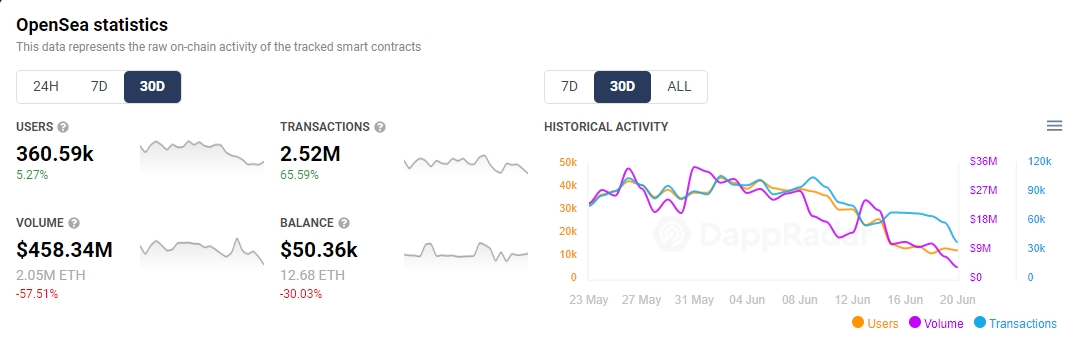
    According to a blockchain analytics firm DappRadar, the world’s largest NFT marketplace OpenSea saw an overall 57% decline in trading volume in the past 30 days.

    OpenSea NFT 30-day trading volume
    Trading volume, transaction count, and user number are all down in the past month. Image source: DappRadar

    Both Ethereum and Polygon NFT volumes declined by roughly 70%, falling to $760.39 million and $10.53 million, respectively. However, there was a considerable increase in transactional volume taking place on Solana – the trading volume on the high-performance Proof-of-Stake (PoS) chain increased by 78% over the course of the last 30 days and hit $62.99 million.

    Recall that OpenSea integrated Solana in early April, confirming months-long rumors and speculations about Solana joining the trio of blockchains supported by the marketplace, including Ethereum, Polygon, and Klaytn.

    The drastic drop in NFT trading volume comes roughly 6 months after OpenSea had its best month ever. In January 2022, the collectibles marketplace hit record-breaking figures in terms of the number of NFTs sold, trading volume, and fees generated.

  • Tether Launches USDT on Polygon Blockchain

    Tether Launches USDT on Polygon Blockchain

    Key takeaways:

    • Tether Operations Limited (“Tether”) has announced the launch of USDT on the Polygon blockchain
    • Polygon has become the 11th blockchain to support USDT
    • Tether CTO Paolo Ardoino believes that USDT will be instrumental in aiding Polygon to continue its “historical growth”

    USDT launches on Polygon as the 11th supported blockchain platform

    Tether Operations Limited (“Tether”), the operator of the industry’s largest stablecoin by market cap, USDT, has announced the launch of their stable digital currency on Polygon, the leading Layer-2 Ethereum scaling solution.

    According to the company’s statement, USDT will allow over “8,000 teams building on Polygon” to tap into liquidity provided by the leading stablecoin to expand their role in supporting Polygons’ decentralized finance (DeFi) ecosystem. The number of decentralized applications (dApps) running atop Polygon has increased from 3,000 in October 2021 to 19,000 in April 2022 – a more than 500% growth in six months. With access to USDT, the record-breaking growth could continue in the upcoming months.

    Tether CTO Paolo Ardoino had this to say about the launch of USDT on Polygon:

    “We’re excited to launch USD₮ on Polygon, offering its community access to the most liquid, stable, and trusted stablecoin in the digital token space. The Polygon ecosystem has witnessed historical growth this year and we believe Tether will be essential in helping it continue to thrive.”

    With the addition of Polygon, USDT is now operating on 11 blockchain networks, including Ethereum, Solana, Algorand, and Tron, to name a few. According to data curated by The Block, by far the largest share of USDT’s circulating supply is located on Tron and Ethereum. 

    With a market capitalization of roughly $83 billion, USDT is the largest stablecoin in the market, accounting for over 6% of the total value of all digital currencies in circulation. Due to its prominent role as a primary value transfer asset in DeFi and the cryptocurrency exchanges sector, investors were disturbed earlier this month when USDT momentarily lost its $1 peg. The stablecoin’s US dollar peg has since been fully re-established.

    Last week, Tether launched Mexican Peso-pegged stablecoin Tether MXNt (MXNT) in response to a growing rate of cryptocurrency users across Latin America. The new stablecoin joined the company’s existing offering of fiat-pegged digital currencies, which includes the U.S. dollar-pegged USDT, the Euro-pegged EURT, and the offshore Chinese Yuan-pegged CNHT.