Blog

  • What Is Pi Network? How It Works and What to Know in 2026

    What Is Pi Network? How It Works and What to Know in 2026

    Pi Network is a cryptocurrency project that lets you mine Pi coins using your mobile phone. Launched in March 2019 by Stanford graduates Nicolas Kokkalis and Chengdiao Fan, Pi Network aims to democratize cryptocurrency mining with minimal energy consumption. 

    The ecosystem has grown to over 60 million users, largely due to its unique mobile mining mechanism, and the community-driven initiatives that keep users engaged. But what about its mainnet launch and its potential implications for the Pi coin price?

    Key Takeaways

    • Pi Network’s Open Network officially launched on February 20, 2025, at 8 AM UTC, allowing users to trade Pi Coin on exchanges.
    • OKX and MEXC have listed Pi Coin, with more exchanges possibly following after the Open Network launch.
    • Pi Network now has over 70 million users and has been expanding its ecosystem with developer incentives and hackathons.
    • Since its listing on major exchanges, its long-term value and adoption have been somewhat questionable.

    What is Pi Network?

    Pi Network is a cryptocurrency project launched in March 2019 by Stanford graduates. It focuses on mobile mining to make crypto more accessible.

    The network uses the Stellar Consensus Protocol for secure and energy-efficient mining, which allows users to “mine” Pi coins via a mobile crypto mining app.

    To guarantee readiness for the mainnet launch, users must complete a KYC process, a requirement that some privacy conscious users won’t like but that says something about the network’s commitment to regulatory compliance and security.

    Pi Network roles

    Engaging with the Pi Network ecosystem means you’re part of a diverse group of users who contribute in various ways, depending on your role within the network. 

    • As a Pioneer, you’re an entry-level user who mines PI coins by regularly engaging with the mobile app. This role incorporates over 60 million engaged global users who contribute to the ecosystem’s growth and stability.
    • Contributors earn better mining rates by expanding their security circles and helping to secure the network. By maintaining a reliable and stable security circle, Contributors play a crucial role in the network’s overall security and integrity.
    • Ambassadors grow the network by inviting new members to join and earn rewards for their efforts.
    • Nodes are users who operate a decentralized network by running Pi Node software, contributing to the network’s infrastructure. Node Ambassadors recruit developers to build decentralized applications (dApps) on the Pi Network. 

    These roles, supported by the Pi Core Team and driven by the community, promote the continuous development and security of the Pi Network.

    Pi Network roadmap

    The Pi Network has laid out an ambitious roadmap. It aims to democratize cryptocurrency mining by allowing users to mine PI coins directly on a crypto mining app without high energy requirements.

    Launched in March 2019, the project has been developed in phases. The Pi network roadmap outlines a change through App launch (2018), Testnet launch (2020), and the Mainnet launch, which happened in February 2025 after many delays due to regulatory compliance and user dissatisfaction issues.

    The shift to the Mainnet allowed users to convert Pi coins into other assets. This means that users who wish to do so can cash out on exchanges like OKX and MEXC. 

    The Pi network roadmap also emphasizes the need for ecosystem building, with a goal of integrating at least 100 applications into the network by the launch of the Mainnet.

    Initiatives like the Pi2Day Challenge help foster participation and readiness for the mainnet change, despite community frustrations from repeated postponements.

    Pros and cons of Pi Network

    Pi Network gained traction by allowing users to “mine” PI tokens through a mobile app without draining battery or requiring specialized hardware. This low barrier to entry helped the project build a massive global user base and made crypto participation accessible to people with little technical knowledge. The project also reports millions of KYC-verified users, which demonstrates strong community engagement following the mainnet launch.

    On the downside, liquidity and trading access have been ongoing concerns since mainnet went live. While PI is now live, exchange availability, regional restrictions, and limited ecosystem development have raised questions about real utility. Compared to more established blockchain ecosystems, Pi still lacks a robust selection of DeFi apps, games, and on-chain tools that drive demand for a token.

    Despite the challenges, Pi Network boasts a large community of over 12 million KYC-verified users. This strong participation is proof of the network’s engagement as it approaches the mainnet launch.

    However, uncertainties around the future value of Pi coins and potential price volatility post-launch remain concerns for investors and users alike.

    Pros:

    • Wide accessibility: Users can mine via smartphones with low battery and data usage.
    • Strong community: Over 12 million KYC-verified users participate actively.
    • User control: Features like the Lockup mechanism enhance stability and user control.

    Cons:

    • Privacy concerns: The Pi mobile app requires a significant amount of user data.
    • Repeated delays: Frustration from repeated mainnet launch delays affects user morale, even post-launch.

    Pi coin price potential

    According to our Pi Coin price prediction, its price could surpass $0.46 by the end of December 2026, with its price expected to drop to $0.37 by the end of February 2026, which is still a massive +115.70% increase compared to its price today.

    Is Pi Network worth it?

    Initially expected to launch in late 2023, the mainnet launch date was postponed due to technical challenges and was finally released in early 2025.

    The Pi coin’s price is currently in a downtrend (though to be fair, pretty much everything is), but speculators predict potential increases in value post-mainnet launch. Here are three key factors to examine:

    1. User engagement: Pi Network has maintained strong user engagement through initiatives like the Pi2Day Challenge, which encourages participation and readiness for the mainnet shift.
    2. Users and KYC: Over 12 million users have completed KYC, with a target of 15 million set for the anticipated Open Mainnet launch.
    3. Future prospects: Despite past delays, the network continues to develop and expand, with new applications, integrations, and strategic partnerships being announced, which could enhance its value and utility in the future.

    Your investment decision should reflect these factors and the potential future success of Pi Network.

    Is Pi Network safe?

    Pi Network is generally considered safe, having undergone security reviews with no major vulnerabilities discovered. To guarantee your assets are secure, the KYC process is mandatory. This enhances user verification and security, helping to mitigate potential risks.

    Here are some key points to note about the safety of Pi Network:

    AspectSafety MeasuresBenefits
    KYC ProcessMandatory for retaining Pi coinsEnhances user verification and security
    Official App SourcesMinimize risks of fraud and scamsProtects from unofficial apps
    Ongoing Community EngagementTransparency to maintain trust and credibilityKeeps users informed and engaged
    User InformationBe cautious of phishing attemptsProtects personal data
    Phishing AttemptsBe wary of scam emails or messagesAvoids potential fraud

    The bottom line

    Pi Network is a cryptocurrency designed for mobile mining, launched by Stanford graduates in March 2019. It aims to make crypto accessible by allowing users to mine Pi coins with minimal energy consumption. Community-driven initiatives keep user engagement high despite delays and uncertainties about the coin’s future value.

    If you’re also interested in cryptocurrencies other than Pi Network, make sure to take a look at our shortlist of the best crypto to buy now.

  • The Best Bitcoin Mixers in 2026 — Level Up Your BTC Privacy

    The Best Bitcoin Mixers in 2026 — Level Up Your BTC Privacy

    A Bitcoin mixer is a service that Bitcoin holders can use to make their BTC transaction history more difficult to trace. There are many Bitcoin mixing services available on the market, but not all of them are worth your time.

    To help you narrow down your search, we have selected the 5 best Bitcoin mixers available right now.

    Before we take a closer look at the list of the best Bitcoin mixers, let’s first learn about why Bitcoin is not actually very private and why Bitcoin mixers even exist. 

    List of the best BTC mixers in 2026:

    1. Mixero.io – A Bitcoin mixing service featuring an advanced privacy mode
    2. Wasabi Wallet – A Bitcoin wallet designed with privacy enabled by default
    3. Mixer.money – A Bitcoin mixer offering two distinct mixing options
    4. Tornado Cash – A decentralized cryptocurrency mixer built for Ethereum
    5. Railgun – A blockchain privacy solution powered by smart contracts

    Bitcoin isn’t truly private

    Some people who are new to cryptocurrency believe that Bitcoin is fully anonymous. That assumption isn’t entirely accurate.

    At a basic level, Bitcoin appears anonymous because users don’t need to submit personal details to create a wallet or send transactions. The protocol itself doesn’t recognize real-world identities, as Bitcoin addresses are simply strings of characters with no inherent personal information attached.

    However, Bitcoin operates on a fully transparent blockchain. This public ledger records every transaction ever made on the network. Anyone can use a blockchain explorer, such as Blockchain.com, to view transactions dating back to Bitcoin’s launch in 2009.

    As a result, it’s incorrect to assume your Bitcoin activity is private just because your name isn’t directly tied to your wallet address on the blockchain.

    For instance, if you purchased Bitcoin using fiat currencies like USD or EUR through a regulated exchange, you likely had to complete identity verification. When you withdraw your BTC to a personal wallet, the exchange maintains a record connecting your identity to that withdrawal address — even if the information isn’t publicly visible.

    This data could potentially be exposed through insider leaks, cyberattacks, or legal requests from authorities. In short, while the blockchain itself doesn’t require identity information, real-world interactions often create traceable links.

    What Bitcoin mixers do

    Bitcoin mixers aim to improve privacy by making it difficult to trace where coins originated. In simple terms, mixers combine BTC from multiple users, shuffle them together, and redistribute equivalent amounts back to participants. They often randomize transaction sizes and introduce delays to complicate tracking.

    The general concept is straightforward: you send BTC to a mixer and later receive roughly the same amount back (minus service fees), but the returned coins are much harder to associate with your original transaction.

    The best Bitcoin mixers in 2026

    Before using any mixing service, review the laws in your country. Crypto regulations vary significantly, and services that are permitted in one jurisdiction may be restricted in another.

    Here’s our overview of the leading Bitcoin mixers available in 2026.

    1. Mixero.io – Advanced privacy with optional Monero integration

    Mixero.io is a CoinJoin-based Bitcoin mixing platform. It also offers an “advanced” mode that routes BTC through Monero (XMR) before converting it back to Bitcoin, providing an extra layer of obfuscation. This enhanced option comes with higher fees.

    Users can increase their fee to prioritize their transaction and speed up processing. The standard CoinJoin fee starts at 0.7% plus a fixed 0.0003 BTC charge. The advanced XMR bridge option begins at 1.6% and can go up to 4.7% for faster execution. Users can also delay transactions for up to 168 hours (7 days).

    In addition to BTC, Mixero supports ETH mixing, which may appeal to users seeking privacy tools for multiple major cryptocurrencies.

    Key features:

    • CoinJoin-based mixing with optional Monero bridge
    • Advanced XMR mode for stronger privacy at higher cost
    • Adjustable fees for faster processing
    • Fees starting at 0.7% (standard) and 1.6% (advanced)
    • Optional transaction delays up to 7 days
    • Supports both BTC and ETH

    2. Wasabi Wallet – Privacy-focused Bitcoin wallet

    Wasabi Wallet is a non-custodial Bitcoin wallet that includes built-in CoinJoin functionality. As a non-custodial solution, users retain full control of their private keys.

    CoinJoin transactions through Wasabi incur a 0.3% coordinator fee, in addition to standard Bitcoin network fees. However, the coordinator fee is waived for CoinJoin transactions under 0.01 BTC.

    By default, Wasabi routes all network traffic through the Tor network to enhance privacy, though users can disable this option.

    Key features:

    • Built-in CoinJoin integration
    • Non-custodial wallet with user-controlled keys
    • 0.3% coordinator fee (waived for small transactions)
    • Tor-enabled by default for network privacy

    3. Mixer.money – Two privacy-focused mixing options

    Operating since 2016, Mixer.money is a long-standing Bitcoin mixing service offering a simple interface and two primary modes: standard mixing and “complete anonymity.”

    The standard option charges a randomized fee between 1% and 1.5% (to enhance privacy) and typically completes within two hours. It supports transactions between 0.001 and 1 BTC and uses funds from its user base for mixing.

    The “complete anonymity” mode provides stronger privacy protections but costs between 4% and 5% and may take up to 10 hours. This mode sources liquidity from cryptocurrency exchanges.

    Mixer.money is accessible via both the regular web and the Tor network. It also provides a Telegram bot that allows users to initiate mixing directly within Telegram.

    Keep in mind that Mixer.money is centralized and therefore requires trust in the operator.

    Key features:

    • Active since 2016
    • Two mixing modes (standard and enhanced privacy)
    • Available through Tor
    • Telegram bot support

    4. Tornado Cash – Decentralized Ethereum-based mixer

    Tornado Cash is a decentralized mixing protocol primarily built on Ethereum. It breaks the on-chain connection between sender and receiver by using smart contract pools.

    Users deposit fixed amounts (such as 1 ETH or 100 ETH) into shared pools and later withdraw funds to a different address. Because many users deposit identical amounts, linking deposits and withdrawals becomes extremely difficult.

    Tornado Cash supports multiple tokens and networks, although most activity occurs on Ethereum. By standardizing deposit amounts and pooling liquidity, the protocol strengthens anonymity as participation increases.

    As of December 2025, Tornado Cash holds over $1 billion in total value locked, with ETH accounting for most of the funds, alongside assets like TORN, BNB, and DAI.

    Key features:

    • Smart contract-based privacy protocol
    • Fixed-denomination deposit pools
    • Multi-token and multi-network support
    • Over $1 billion in total value locked

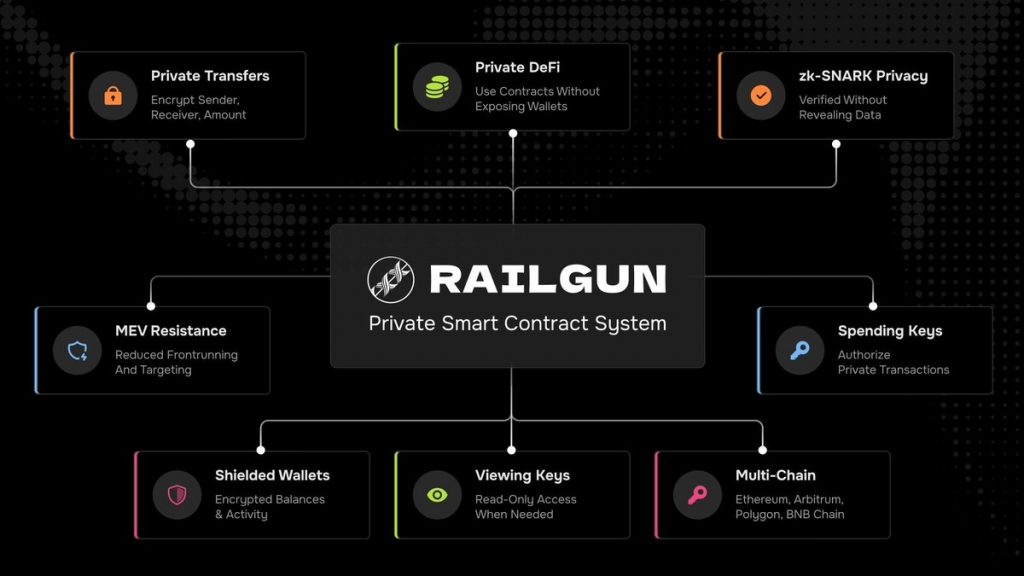
    5. Railgun – Smart contract-powered privacy system

    Railgun is a privacy-focused smart contract system that shields transaction data directly on-chain. It conceals key details such as sender, recipient, token type, and amount using Private Balances, which form a shared anonymity pool.

    Transactions within the Railgun ecosystem appear to originate from this collective pool, making it challenging to determine who initiated a transfer or which assets were used.

    Privacy improves as more users participate, increasing the anonymity set. Popular tokens like USDC or DAI generally provide stronger privacy due to higher usage compared to less common assets.

    Railgun can be accessed through compatible wallets such as Railway Wallet, which supports zk-SNARK-powered private transactions without exposing balances.

    Key features:

    • Shields sender, recipient, token, and amount
    • Uses Private Balances to expand anonymity set
    • Privacy increases with user participation and TVL
    • Accessible via zk-SNARK-enabled wallets

    Are Bitcoin mixers legal?

    In many countries, Bitcoin mixers are not explicitly illegal. However, most do not implement Know Your Customer (KYC) or anti-money laundering (AML) procedures, placing them in a regulatory gray area.

    Unless a service is specifically prohibited, users typically won’t face legal consequences simply for using a mixer. That said, authorities have shut down numerous mixers over the years, and several operators have been arrested.

    While mixers can serve legitimate privacy needs, they are also used by criminals — for example, hackers attempting to launder stolen funds. This association has made them highly controversial.

    Notable enforcement actions include:

    • Bestmixer.io shut down by Europol and Dutch authorities (2019)
    • Bitcoin Fog operator arrested and charged in the U.S. (2021)
    • Tornado Cash sanctioned by OFAC (2022), with sanctions lifted in 2025
    • ChipMixer taken down by U.S. and German authorities (2023)

    Are Bitcoin mixers safe?

    Safety largely depends on the specific service used. Centralized mixers require trust that operators will not misappropriate user funds.

    It’s also important to recognize that mixing does not guarantee perfect anonymity. The effectiveness of privacy measures varies by implementation, and blockchain analysis tools continue to evolve. In some cases, investigators may still trace coins that have passed through mixers.

    Additionally, some cryptocurrency platforms and businesses may flag or restrict wallets associated with mixing services.

    Conclusion: Mixers address Bitcoin’s privacy limitations

    Bitcoin is pseudonymous rather than fully anonymous, and transactions can be traced under close examination. Mixing services aim to make blockchain activity more difficult to analyze, giving users greater financial privacy.

    However, because mixers are sometimes used for illicit purposes, they remain controversial and frequently attract regulatory scrutiny — even in jurisdictions where they are not outright banned.

  • The 9 Best ASIC Miners in 2026 – The Most Profitable ASIC Mining Rigs

    The 9 Best ASIC Miners in 2026 – The Most Profitable ASIC Mining Rigs

    Cryptocurrency mining can be a very profitable business, but succeeding in this sector requires a well-thought-out plan, a significant amount of invested capital, and knowledge of the latest trends in cryptocurrency mining. We have selected the best ASIC miners available in 2026 to help you get started on the right foot. 

    Although Bitcoin mining is the largest sector of the cryptocurrency mining industry by far, we’ve decided to also feature ASIC miners designed for algorithms other than SHA-256. This is because mining cryptocurrencies other than Bitcoin can be more profitable if timed right, and we also wanted to highlight the diversity of options in the ASIC miner space. 

    Without further ado, here is our selection of the best ASIC miners in 2026: 

    1. Bitmain Antminer S23 Hyd – Ultra-efficient hydro-cooled flagship from Bitmain
    2. Bitmain Antminer S21 XP Hyd – High-performance water-cooled miner for professional setups
    3. Bitmain Antmines S21 – A well-rounded Bitcoin miner
    4. Bitmain Antminer KS5 Pro – Best Kaspa ASIC miner
    5. Canaan Avalon Made A1466 – High-performance Bitcoin miner by Canaan
    6. MicroBT WhatsMiner M66 – Powerful SHA-256 ASIC miner by MicroBT
    7. Bitmain Antminer L9 – Best Scrypt ASIC miner
    8. Bitmain Antminer X5 – Best RandomX ASIC miner
    9. Innosilicon A10 Pro ETH – Solid EtHash miner

    The Best ASIC miners in 2026 – A closer look

    Now, let’s take a closer look at each miner that made our list of the best ASIC miners in 2026.

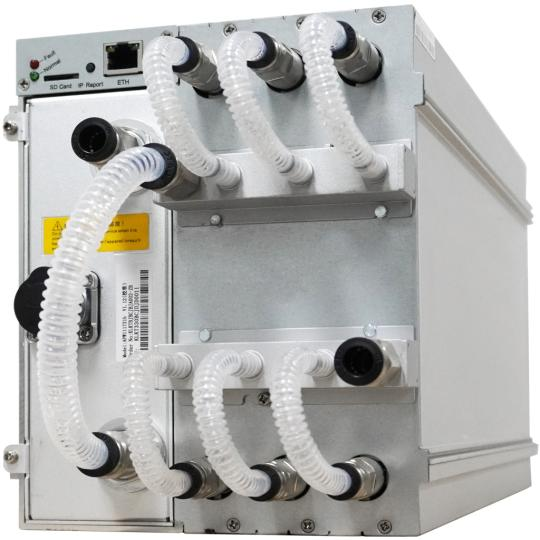
    1. Bitmain Antminer S23 Hyd – Ultra-efficient hydro-cooled flagship from Bitmain

      The Bitmain Antminer S23 Hyd is a next-generation, water-cooled Bitcoin miner designed for large-scale and industrial mining setups. It delivers a powerful hash rate of 580 TH/s while drawing 5,510W of power, achieving an efficiency of 9.5 J/TH. This makes it one of the most energy-efficient SHA-256 miners available at launch.

      Released in January 2026, the S23 Hyd builds on Bitmain’s advanced liquid-cooling technology to provide improved thermal control and reduced noise compared to traditional air-cooled machines. Its design is aimed at professional mining farms that prioritize high performance, stability, and lower long-term operating costs.

      Price$17,400
      Release DateJanuary 2026
      Hash Rate580 TH/s
      Power Consumption5,510W
      Efficiency9.5 J/T

      2. Bitmain Antminer S21 XP Hyd – The most profitable Bitcoin miner

      Bitmain’s Antminer S21 XP Hyd is one of the most profitable ASIC miners for the SHA-256 hashing algorithm used by Bitcoin, Bitcoin Cash, Bitcoin SV, and other popular cryptocurrencies. This hydro-cooled miner can be cooled with antifreeze or water and outputs a hashrate of 473 TH/s with a power efficiency of 12 J/T.

      Currently, Bitmain is accepting orders for the Antminer S21 XP Hyd at a price of $10,170 per unit. Although the price per unit is high, the Antminer S21 XP Hyd still represents a large chunk of the Bitcoin mining industry, which has become much harsher after the fourth Bitcoin halving

      Price$10,170
      Release DateQ4 2025
      Hash Rate473 TH/s
      Power Consumption5,676W
      Efficiency12 J/T

      3. Bitmain Antminer S21 XP Hyd – The most profitable Bitcoin miner

      The Bitmain Antminer S21 is one of the best all-around ASIC miners for the SHA-256 algorithm, making it suitable for mining Bitcoin, Bitcoin Cash, and similar cryptocurrencies. It delivers a hash rate of 200 TH/s while maintaining strong power efficiency at 17.5 W/Th, offering a solid combination of performance and energy savings.

      Priced at around $4,599, the Antminer S21 is a great choice for both beginners entering Bitcoin mining and experienced users looking to upgrade their setups. With its efficiency-focused design and reliable output, it provides consistent profitability potential even amid rising network difficulty.

      Price$4,599
      Release DateFebruary 2024
      Hash Rate200 TH/s
      Power Consumption3,500W
      Efficiency17.5 J/T

      4. Bitmain Antminer KS5 Pro – Best Kaspa ASIC miner

      The Bitmain Antminer KS5 Pro is currently the most powerful ASIC miner specialized for KHeavyHash, the hashing algorithm used by the Kaspa cryptocurrency. This air-cooled miner generates 21 TH/s, is rated at 3,150W and has a power efficiency of 150 J/T. 

      The Antminer KS5 Pro’s impressive power comes with a substantial price tag, as Bitmain is selling the miner at a price of $15,000 per unit.

      With Kaspa being the most profitable cryptocurrency to mine at the moment, we can expect the competition in the Kaspa ASIC miner industry to intensify significantly in the coming months.

      Price$15,000
      Release DateOctober 2024
      Hash Rate21 TH/s
      Power Consumption3,150W
      Efficiency150 J/T

      5. Canaan Avalon Made A1466 – High-performance Bitcoin miner by Canaan

      The Avalon Made A1466 is a powerful Bitcoin ASIC miner produced by Canaan. This miner outputs 150 TH/s at a power efficiency of 21.5 J/T. The Avalon Made A1466, which is the flagship model of Canaan’s A14 series, is sold for roughly $1,800 by the manufacturer.

      The Avalon Made A1466 is a solid choice for those who require a powerful Bitcoin miner at a relatively low price per unit.

      Price$1,500
      Release DateSeptember 2023
      Hash Rate150 TH/s
      Power Consumption3,230W
      Efficiency21.5 J/TH

      6. MicroBT WhatsMiner M66 – Powerful SHA-256 ASIC miner by MicroBT

      One of the best alternatives to Bitmain’s Antminer series is the WhatsMiner series produced by MicroBT. One of the company’s most powerful miners is the WhatsMiner M66. This immersion-cooled miner is sold for $4,767 by the manufacturer and outputs a hashrate of 247 TH/s. The miner has a power consumption of 5,452W and a power efficiency rating of 19.9 J/T. 

      Although this ASIC miner is certainly among the more powerful options available on the market, it also has a hefty price tag, which might not make it suitable for all miners.

      Price$4,767
      Release DateOctober 2023
      Hash Rate247 TH/s
      Power Consumption5,452W
      Efficiency19.9 J/T

      7. Bitmain Antminer L9 – Best Scrypt ASIC miner

      The Scrypt hashing algorithm is used by two of the most popular cryptocurrencies on the market – Litecoin and Dogecoin. Currently, the most effective ASIC miner for the Scrypt algorithm is Bitmain’s Antminer L9.

      The Antminer L9 generates 16 GH/s at a power consumption 3,360W and an efficiency of 210 J/G. This air-cooled miner is designed to function at an operating temperature of 75 degrees Celsius. 

      Bitmain was selling the Antminer L9 at $5,584 per unit, though the miners sold out shortly after it’s September 2025 release. 

      Price$5,584
      Release DateSeptember 2025
      Hash Rate16 GH/s
      Power Consumption3,360W
      Efficiency210 J/G

      8. Bitmain Antminer X5 – Best RandomX ASIC miner

      Although Monero’s RandomX hashing algorithm was designed to be mineable by consumer-grade computer hardware, it can also be mined with specialized hardware. Bitmain’s Antminer X5 is currently the most powerful ASIC miner for Monero.

      This miner, which Bitmain is selling for $2,999 per unit, outputs 212 KH/s and has a power consumption of 1,350W. In terms of power efficiency, this air-cooled miner is rated at 6.37 J/K. Notably, this miner features the first RISC-V architecture CPU ever produced by Bitmain. 

      Price$2,999
      Release DateSeptember 2023
      Hash Rate212 KH/s
      Power Consumption1,350W
      Efficiency6.37 J/K

      9. Innosilicon A10 Pro ETH – Solid EtHash miner

      Although Ethereum no longer uses a Proof-of-Work consensus mechanism, there are still some notable cryptocurrencies using the EtHash hashing algorithm, for example Ethereum Classic. Innosilicon’s A10 Pro ETH is one of the most compelling options for miners that need an ASIC tailored for the EtHash algorithm. 

      The A10 Pro ETH outputs a hashrate of 500 MH/s and has a power consumption of 860W. The miner has an efficiency rating of 1.92 J/MH.

      Price$1,900
      Release DateMay 2020
      Hash Rate500 MH/s
      Power Consumption860W
      Efficiency1.92 J/MH

      FAQs

      Now that we have showcased the best ASIC miners available on the market today, let’s answer some of the most common questions users have on the topic of ASIC miners. 

      What is an ASIC mining rig?

      An ASIC mining rig is a device that is specialized to mine a specific type of cryptocurrency as efficiently as possible. ASICs (application-specific integrated circuits) are chips that are designed for a very narrow range of tasks, in contrast to the chips found in desktop computers, laptops and smartphones, which are capable of performing a variety of tasks. 

      When it comes to ASIC miners, ensuring a safe operating temperature is crucial. Depending on their design, ASIC miners can use air cooling, liquid cooling or immersion cooling.

      Are ASIC miners profitable?

      The profitability of ASIC miners depends on many different factors. This includes the cost of the ASIC miner itself, the cost of hosting and maintenance, electricity costs, the price trend of the cryptocurrency that’s being mined, and more factors. 

      Some cryptocurrencies such as Bitcoin can only be profitably mined with ASICs since consumer-grade computer hardware is not powerful enough to mine them effectively.  

      Can ASIC miners be used for anything else?

      The chips powering ASIC miners are designed specifically to mine a certain hashing algorithm as efficiently as possible. Therefore, ASIC miners can not be used for any other purpose than mining the cryptocurrency / hashing algorithm they were designed for. 

      The bottom line

      We hope that our roundup of the best ASIC miners has helped you find the best models for mining popular cryptocurrencies such as Bitcoin, Litecoin, Dogecoin, and Kaspa. Although cryptocurrency mining can certainly be profitable, running a successful mining operation requires a significant amount of capital, resources, and knowledge. 

      If you want to learn more about the topic of cryptocurrency mining, make sure to take a look at our list of the best Bitcoin mining companies to invest in.

    1. Best Ethereum Mining Apps for Android – Can You Earn ETH on Your Phone?

      Best Ethereum Mining Apps for Android – Can You Earn ETH on Your Phone?

      There are no legitimate Ethereum mining apps on the market, because the Ethereum cryptocurrency does not use mining. Whenever you see a mobile app that promotes itself as a cryptocurrency miner, you should be very careful since mobile phones are not powerful enough to mine cryptocurrency profitably.

      Despite this, there are mobile apps that will allow you to earn some additional ETH either through staking or lending, which are completely legitimate methods of earning ETH rewards. To be clear, you will need to already have some cryptocurrency if you want to grow your ETH holdings in this way.

      We’re featuring 6 Android apps that will help you earn extra ETH without trading or investing additional money.

      Before we continue, however, let’s explain exactly why there are not legit ETH mining apps and why you should stay away from any apps that advertises itself as offering Ethereum mining.

      Are there any legit Ethereum mining apps?

      No, there aren’t any legit Ethereum mining apps. The reason for this is that the Ethereum network does not use mining, but uses a Proof-of-Stake system (staking). Ethereum did use mining in the past, but moved away from it in September 2022, when an upgrade called The Merge introduced a Proof-of-Stake consensus mechanism to replace the old Proof-of-Work consensus mechanism.

      If you see any apps for Android or iOS that advertise themselves as Ethereum mining apps, you can safely disregard them as false advertising. At best, they might offer some other functionality and earn money by displaying ads. At worst, they might be a scam that will ask you to invest your money with promises of Ethereum “mining” rewards.

      We found a handful of applications on the Google Play Store that advertise themselves as Ethereum mining apps. Although most of them have a high rating, a closer inspection quickly reveals that most of the positive reviews are fake, while the negative reviews come from disgruntled users who actually tried the apps. Not only are these apps not actually mining Ethereum, but they often attempt to market completely different products to their users.

      One of the most common user complaints regarding apps that advertise themselves as Ethereum mining apps is that they are trying to sell users a crypto wallet app, which is advertised as giving access to the ETH coins that the users supposedly earned through mining. 

      This is almost assuredly a scam, as there are countless high-quality Ethereum wallets available on the market completely free of charge – there is no good reason for anyone to ever pay for cryptocurrency wallet software.

      Best Android apps to earn ETH

      Now, let’s take a look at 6 Android apps that will allow you to earn ETH legitimately. We have selected a diverse range of high-quality apps that will give you access to Ethereum staking, lending, or both. 

      1. Kraken Pro – Mobile app from one of the world’s safest crypto exchanges
      2. Binance – The leading cryptocurrency exchange in the industry
      3. MetaMask – The gold standard for Ethereum wallets
      4. Coinbase – Popular and reliable cryptocurrency exchange
      5. Trust Wallet – Secure multi-currency crypto wallet
      6. Ledger Live – Earn ETH staking rewards with the added security of a hardware wallet

      1. Kraken Pro – Mobile app from one of the world’s safest crypto exchanges

      Kraken is one of the most well-established cryptocurrency exchanges, as it has been in operation for over a decade. The exchange has earned a very good reputation in the cryptocurrency community thanks to its strong security measures, which have successfully safeguarded users’ funds from crypto wallet hacks or other types of security breaches.

      If you hold ETH, you can easily stake it through the exchange’s Kraken Pro app and start earning staking rewards. The process of staking Ethereum through Kraken Pro is very straightforward, although it does come with a downside – when you stake ETH on Kraken, you can’t access the liquidity of your coins until you unstake. 

      In comparison, some other exchanges allow users to still access the liquidity of their staked ETH through liquid staking tokens or other solutions.

      Overall, Kraken Pro is arguably the best app to use if you hold some ETH and want to earn extra rewards on it.

      2. Binance – The leading cryptocurrency exchange in the industry

      Binance is the top cryptocurrency exchange in terms of trading volume, user count and features. The exchange provides a wide range of services for crypto investors, including Ethereum staking. If you have ETH, you can stake it on Binance to earn passive rewards.

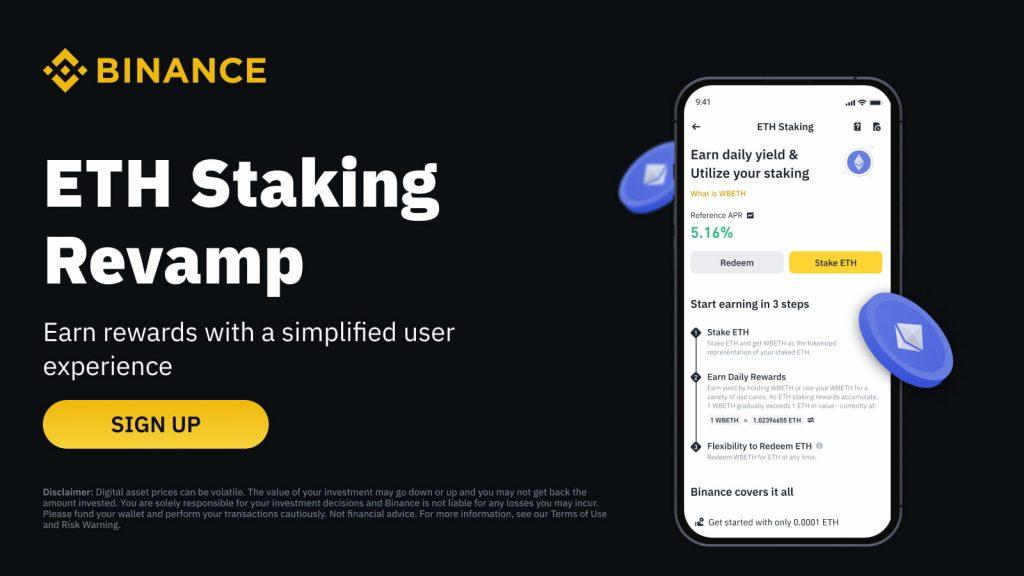
      When you stake ETH on Binance, you receive WBETH tokens, which stand for your staked ETH. Over time, the conversion rate between WBETH and ETH shifts in favor of WBETH to reflect the staking rewards earned by Binance on your behalf.

      To get access to your ETH again, simply redeem your WBETH tokens in exchange for ETH. The amount of ETH you can earn depends on the size and duration of your stake. The larger and longer the stake, the higher the rewards.

      3. MetaMask – The gold standard for Ethereum wallets

      So far, we have highlighted two apps created by centralized cryptocurrency exchanges. While those apps offer a way to earn some extra ETH through staking, they require the user to trust that the exchange will take good care of their funds. Meanwhile, many cryptocurrency investors prefer a more decentralized approach where they have more control over their crypto assets.

      If you want to stake Ethereum in a more decentralized way, you will need a non-custodial Ethereum wallet (a non-custodial wallet is a wallet where the users controls their own private keys). One such option is MetaMask, a highly popular Ethereum wallet that also offers an Android app. 

      MetaMask provides a convenient staking option within its portfolio feature, allowing users to stake their ETH via liquid staking protocols like Lido and Rocket Pool.

      The advantage of using MetaMask over a cryptocurrency exchange is that you maintain control of your private keys and do not need to rely on a third party to secure them. By using liquid staking protocols, you will also get to retain the liquidity of your staked ETH and use it in various decentralized applications.

      4. Coinbase – Popular and reliable cryptocurrency exchange 

      Coinbase is a great cryptocurrency exchange that’s broadly recognized as one of the best options for crypto beginners. It offers an Ethereum staking service which makes it possible for ETH holders to passively grow their holdings through staking rewards. 

      If you have ETH on Coinbase, you can choose to “wrap” your coins and receive cbETH tokens in return. These tokens accrue Ethereum staking rewards, and you can later redeem them to access your ETH again.

      For long-term ETH holders looking to make their idle coins productive, staking through Coinbase is a good option to consider. Staking through Coinbase makes a lot of sense especially if you already have an account with the exchange.

      5. Trust Wallet – Secure multi-currency crypto wallet

      Trust Wallet is a widely used multi-cryptocurrency wallet available as both a browser extension and a standalone desktop application.

      One of Trust Wallet’s key advantages is its support for a broad range of cryptocurrencies, which goes beyond just EVM-compatible blockchains. You can use Trust Wallet to store Bitcoin, XRP, Solana, and many other popular cryptocurrencies.

      The wallet features a user-friendly interface designed for both beginners and advanced users. It allows easy navigation to view portfolio value in your preferred currency, track transaction history, and manage multiple wallets seamlessly.

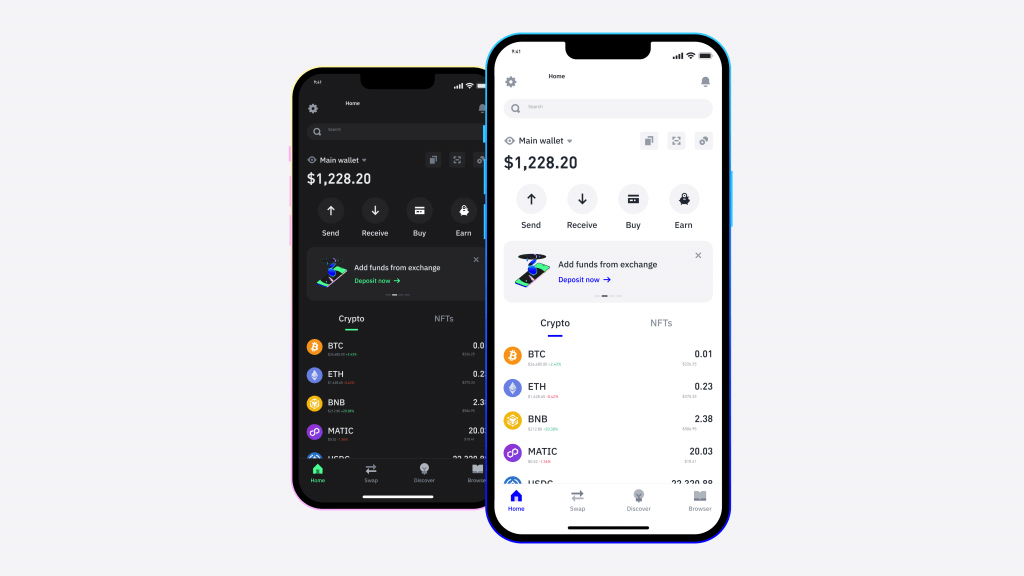
      Trust Wallet also enables you to securely hold your ETH and participate in liquid staking protocols to earn rewards. Similarly to MetaMask, Trust Wallet is a non-custodial wallet, meaning you retain control of your own private keys.

      6. Ledger Live – Earn ETH staking rewards with the added security of a hardware wallet

      Ledger is the most popular crypto hardware wallet brand in the world, and for good reason. Its devices are relatively affordable while offering a very high level of security for your cryptocurrency holdings. A hardware wallet keeps your private keys offline and uses them to sign transactions securely, which greatly reduces the risk of hacks compared to storing crypto on an internet-connected device.

      By keeping sensitive information offline, Ledger wallets add an extra layer of protection when managing your assets. Transactions are created on your phone or computer but must be physically confirmed on the hardware device itself. This setup ensures that even if your smartphone is compromised, your private keys remain protected.

      If you own a Ledger device such as the Nano S Plus or Nano X, you can use the Ledger Live app on Android to stake your ETH and earn rewards. The app integrates directly with Ethereum staking providers like Lido and Kiln, allowing you to start staking with any amount of ETH while maintaining full control over your private keys.

      The bottom line

      We hope that we’ve clarified why there are no legitimate Ethereum mining apps on the market today. Still, this doesn’t mean that you can’t earn ETH through an app on your phone. You can stake your ETH through a crypto exchange app or use a non-custodial Ethereum wallet such as MetaMask to stake your ETH coins through liquid staking protocols like Lido. 

      If you want to learn more about Ethereum, we invite you to take a look at our article explaining the Ethereum rainbow chart.

    2. Pipe Network Launches SolanaCDN: A Free, Open-Source Validator Client With Built-In Acceleration for Solana

      Pipe Network Launches SolanaCDN: A Free, Open-Source Validator Client With Built-In Acceleration for Solana

      San Francisco, CA, February 26th, 2026, Chainwire

      SolanaCDN delivers 3.8x faster shred propagation through a global mesh of 35,000+ nodes, provided as a public good for the Solana network

      Pipe Network today announced the launch of SolanaCDN, a free, open-source Solana validator client with an integrated CDN acceleration layer. Built as a fork of Anza’s Agave, SolanaCDN gives every Solana validator access to faster shred propagation through Pipe’s global network of 35,000+ PoP (Point-of-Presence) nodes.

      The client and CDN layer are both completely free. Pipe Network is providing SolanaCDN as public good infrastructure for the Solana ecosystem.

      The problem SolanaCDN solves

      Validator performance on Solana is heavily influenced by network geography. Validators closer to block producers see shreds earlier, vote sooner, and earn more rewards. Validators in less connected regions face slower propagation, missed votes, and reduced leader slot revenue regardless of their hardware.

      SolanaCDN addresses this by giving validators a second, faster path for shred delivery alongside native gossip. Shreds and vote packets route through Pipe’s global mesh, which continuously measures every network path and routes traffic along the fastest available route in real time.

      Native gossip still runs underneath. SolanaCDN adds a parallel fast lane.

      Performance

      SolanaCDN delivers 3.8x faster propagation than standard Turbine, with a P50 cross-region latency of approximately 78ms compared to the roughly 300ms baseline on standard gossip.

      The client also ships with Pipe-built optimizations available out of the box before the CDN layer is enabled: optimized shred coalescing for leaders (Fast Shreds), snapshot downloads from Pipe’s global network, and restore progress with real-time ETAs during validator catchup.

      Public good infrastructure

      Faster propagation is a network effect. Every validator running SolanaCDN improves shred delivery globally, which means faster block finalization, fewer forks, and fewer missed slots across the entire Solana network.

      “Validator performance shouldn’t be determined by geography,” said David Rhodus, CEO of Pipe Network. “SolanaCDN gives every validator access to the same fast infrastructure. The more validators that run it, the faster Solana gets for everyone.”

      Technical design

      SolanaCDN is a fully compatible Agave fork. Validators can install it as a drop-in replacement for their existing client. The CDN layer is optional, activated with a single configuration flag, and is non-consensus by design. It does not modify block production, consensus logic, leader scheduling, or voting rules. All CDN operations are non-blocking and fail-safe. If the CDN layer is unavailable, the validator continues operating normally.

      Built-in Prometheus metrics and CDN-versus-gossip race data give operators full visibility into performance changes in their environment.

      Availability

      SolanaCDN is available now. The source code is published on GitHub and the client is ready to run on Solana mainnet-beta.

      Website: https://solanacdn.com

      GitHub: https://github.com/pipenetwork/agave-solana

      About Pipe Network

      Pipe Network is a global edge infrastructure company built on Solana. The network operates 35,000+ hyperlocal PoP nodes globally, providing distributed storage with fast reads and real-time data delivery. Pipe’s overlay network tracks latency, loss, and jitter across every path in real time and routes traffic along the fastest one.

      Contact

      CEO
      David Rhodus
      Pipe Network
      david@pipe.network

    3. Be The Boss Surpasses $2M in Real Payouts as Playnance Ecosystem Generates $5.3M Ahead of G-Token Launch

      Be The Boss Surpasses $2M in Real Payouts as Playnance Ecosystem Generates $5.3M Ahead of G-Token Launch

      Tel Aviv, Israel, February 26th, 2026, Chainwire

      Playnance today announced that its “Be The Boss” program has surpassed $2 million in real cash payouts (fiat), while expanding to 2,809 active Bosses across its ecosystem. Overall, the platform has generated more than $5.3 million in total revenue to date. The momentum comes as the company prepares for the upcoming launch of its G-Token, the core utility token designed to power and unify activity across Playnance’s live, on-chain consumer platforms.

      The Be The Boss program was designed as a structural layer within the Playnance ecosystem, allowing participants to take an active role in platform-level economics tied directly to real user activity. Unlike speculative participation models that rely on projected growth, the program is integrated into Playnance’s live infrastructure, which currently processes approximately 1.5 million on-chain transactions per day and serves more than 10,000 daily active users. All user activity across Playnance’s platforms is executed and recorded on-chain through a non-custodial system, while maintaining familiar Web2 onboarding flows that remove blockchain complexity for mainstream users.

      As users engage with platforms such as PlayW3, Up vs Down, and other ecosystem products, transaction activity flows through a shared wallet and infrastructure layer. The Be The Boss structure is designed to align with this activity, creating a framework that reflects ecosystem performance rather than external incentives. The growth to 2,809 Bosses, more than doubling participation, signals increasing engagement ahead of the G-Token launch and demonstrates sustained interest in the underlying system.

      The upcoming G-Token already serves as the core utility layer across the Playnance ecosystem, functioning as the connective asset between products, infrastructure, and user participation. Built directly into platform mechanics, the token is designed to power interactions, support settlement flows across applications, and unify multiple consumer platforms under a shared on-chain economic model. Rather than operating as a standalone digital asset, G-Token forms the foundation of the ecosystem’s architecture, linking user behavior, transaction activity, and platform-level incentives within a single framework.

      The Be The Boss program operates within this token-driven structure, reinforcing Playnance’s approach of building live systems at scale before publicizing them. By grounding its token model in measurable activity, including 1.5 million daily on-chain transactions, Playnance positions G-Token as an extension of an already functioning ecosystem rather than a speculative launch.

      “Our focus has always been on building real systems that operate at scale before talking about them,” said Pini Peter, CEO of Playnance. “The growth of the Be The Boss program and the upcoming launch of G-Token reflect years of infrastructure development, live user activity, and continuous refinement. We designed the token to serve a working ecosystem, not the other way around, and this milestone shows that the foundation is already in place.”

      Playnance plans to continue expanding its ecosystem in alignment with observed user behavior and platform performance, further strengthening the integration between consumer applications, shared infrastructure, and the G-Token economy.

      About Playnance

      Founded in 2020, Playnance is a Web3 infrastructure company developing live, non-custodial, on-chain products designed to onboard mainstream Web2 users into blockchain environments. The company develops consumer-facing platforms built on shared wallet systems and high-volume on-chain execution, currently processing approximately 1.5 million transactions per day. Playnance focuses on reducing friction between user experience and blockchain infrastructure by abstracting complexity while maintaining full on-chain transparency and non-custodial architecture.

      Contact

      Chief Marketing Officer (CMO)
      Sarah Peter
      press@playnance.com

    4. 10 Best Crypto Telegram Groups [2026]

      10 Best Crypto Telegram Groups [2026]

      Thanks to its encrypted messaging and cryptocurrency-friendly features, Telegram is probably the most popular messaging platform among cryptocurrency users and investors. For many members of the crypto community, Telegram is the primary platform where they connect with other cryptocurrency enthusiasts and stay updated with the latest developments in the world of crypto and blockchain.

      Here are the top Telegram groups in 2026: 

      1. CoinCodex – Stay updated with market news and new crypto listings
      2. Whale Alert – The most popular crypto whale tracker service
      3. Glassnode – Excellent research and insights based on on-chain data
      4. The Block – One of the best sources for crypto news
      5. Unfolded – A curated newsfeed of the most important events in crypto and blockchain
      6. ZachXBT – Stay protected from crypto hacks and scams
      7. Binance Announcements – Up-to-date announcements from the world’s biggest crypto exchange
      8. Metaverse NFT News – Latest NFT and metaverse news
      9. CryptoDiffer – Top crypto Telegram group for altcoin updates
      10. CoinDesk – Stay on top of the latest crypto news

      The best crypto Telegram groups in 2026 – A closer look

      While cryptocurrency enthusiasts can find valuable information on Telegram, many groups are riddled with spam, scams, or unreliable content. To save you the hassle of sorting through low-quality groups, we have selected 10 top crypto Telegram groups that are sure to provide you with valuable help during your crypto journey.

      1. CoinCodex – Stay updated with market news and new crypto listings

      The CoinCodex Telegram channel is a go-to hub for crypto enthusiasts who want to stay informed about the latest market developments and project updates. The group shares daily insights on cryptocurrency prices, trading trends, and key market movements to help users stay ahead of the curve.

      Another benefit of joining the CoinCodex Telegram is that you’ll receive instant notifications about major announcements and fresh videos uploaded to the CoinCodex YouTube channel.

      Whether you’re a seasoned investor or a newcomer exploring the crypto space, CoinCodex’s Telegram community provides timely updates and practical information to help you make better-informed decisions.

      2. Whale Alert – The most popular crypto whale tracker service

      WhaleAlert is a service that monitors large cryptocurrency transactions made by whales (individuals or entities holding a large amount of cryptocurrency). It is arguably the most popular crypto whale tracker on the market today.

      Even though WhaleAlert is primarily recognized for its presence on X (formerly known as Twitter), the team also maintains a Telegram channel that shares the same transaction information as their X account.

      Keeping track of cryptocurrency whale movements is crucial for investors. For instance, a significant deposit of cryptocurrency to exchanges could indicate that there will soon be a sell-off in the cryptocurrency markets. Meanwhile, large withdrawals from exchanges might suggest that investors are planning to hold their crypto assets for a longer period of time.

      3. Glassnode – Excellent research and insights based on on-chain data

      Glassnode is a company specializing in on-chain analysis of blockchain networks. The company was initially only focused on Bitcoin, but now also provides research and insights into what’s happening on the Ethereum blockchain.

      Glassnode offers a variety of data, including unrealized profit/loss of BTC holders, ETH staking trends, on-chain volume metrics, and on-chain activity related to Bitcoin ETFs, among others.

      For those who consider on-chain data a crucial tool for crypto investing and trading, Glassnode’s Telegram channel is undoubtedly one of the top crypto Telegram groups to join.

      Although Glassnode provides excellent insights based on on-chain data, its content is more suitable to advanced cryptocurrency users and traders, as some of their research reports might be difficult to understand for those that are new to the cryptocurrency space.

      4. The Block – One of the best sources for crypto news

      The Block is one of the best sources for the latest crypto news and research on various topics related to the crypto and blockchain industry. They maintain a Telegram group that functions as a news feed for the articles published on their website.

      For active participants in the crypto markets, keeping up with the latest news is crucial, and The Block is well known in the industry for its accuracy and reliable track record in verifying information before reporting.

      This reliability is especially vital in the cryptocurrency space, where some publications and news outlets rush to release breaking news in an attempt to beat competitors, leading to a disappointing amount of fake news and inaccurate reports.

      If you are looking for accurate and up-to-date crypto and blockchain news, The Block is one of the best sources available today.

      5. Unfolded – A curated newsfeed of the most important events in crypto and blockchain

      Unfolded is a crypto Telegram group that aggregates interesting news and research related to the cryptocurrency space. The channel is quite active, with multiple posts per day highlighting news stories from top crypto news publications.

      The Unfolded channel essentially functions as a curated crypto newsfeed, as it limits its posts to news from trusted sources. This is a welcome change from many other crypto newsfeeds, which can often prioritize quantity over quality.

      In addition to news articles, the Unfolded channel also highlights research reports from companies such as CoinShares, Kaiko and Glassnode. 

      Overall, Unfolded is an excellent Telegram group to follow if you want a broad overview of the most important news and trends in the cryptocurrency and blockchain space. 

      6. ZachXBT – Stay protected from crypto hacks and scams

      As relatively new and often misunderstood technology that has attracted significant capital, the cryptocurrency space unfortunately attracts malicious activities such as hacks, exploits, rug pulls, and various scams.

      ZachXBT is a highly respected figure in the cryptocurrency community, known for his thorough investigations into bad actors on blockchains. Although he initially gained popularity on Twitter, ZachXBT also runs a Telegram group where he shares his latest discoveries.

      Keeping up with ZachXBT’s investigations and alerts can help protect your crypto investments. His insights can help you avoid compromised DeFi protocols, steer clear of approving malicious blockchain transactions, and prevent depositing funds into hacked cryptocurrency exchanges.

      ZachXBT has also exposed numerous bad actors involved in rug pulls and other crypto scams, which will help you identify crypto influencers who may not have their followers’ best interests at heart.

      7. Binance Announcements – Up-to-date announcements from the world’s biggest crypto exchange

      Binance Announcements is the official announcements channel of Binance, the world’s leading cryptocurrency exchange. 

      In the group, Binance posts up-to-date announcements regarding new token and trading pair listings, special promotions, new Launchpool and Launchpad programs, airdrops, delistings, technical upgrades, scheduled maintenance and more. 

      Since news related to Binance can significantly impact the cryptocurrency markets, it’s a good idea to keep an eye on what’s happening at the exchange. For example, a token being listed or delisted from Binance can significantly affect its price. This is why we think Binance Announcements is certainly one of the best crypto Telegram groups to follow, especially if you are a Binance user. 

      8. Metaverse NFT News – Latest NFT and metaverse news

      Although NFTs and the metaverse are not as popular as they were in the 2021-2022 crypto bull market, they continue to be a dynamic sector of the cryptocurrency market. To stay updated on the latest developments in this sector, the Metaverse NFT News is an excellent Telegram group to join.

      The Metaverse NFT News group compiles NFT and metaverse news from various sources, providing a convenient way for users to stay informed about the latest developments without needing to visit multiple news sites.

      However, for in-depth analysis of the NFT markets, this group may not be the best choice, as it primarily shares links to news articles published elsewhere and usually doesn’t share original content or insights.

      9. CryptoDiffer – Best crypto Telegram group for altcoin updates

      The CryptoDiffer Telegram channel is one of the most active communities for following the latest altcoin news and updates. The group regularly shares detailed analytics, exchange listing alerts, and announcements about airdrops, partnerships, and funding rounds across the crypto space.

      CryptoDiffer is especially useful for investors looking to stay informed about emerging projects and smaller-cap cryptocurrencies that don’t always get mainstream coverage. By consolidating key developments from across the market, the channel helps members spot potential investment opportunities and stay up to date with fundamental blockchain trends.

      10. CoinDesk – Stay on top of the latest crypto news

      CoinDesk is one of the longest-running crypto media outlets, covering the cryptocurrency and blockchain industry since 2013. Over the years, it has built a strong reputation for timely reporting and in-depth coverage of major developments in the space.

      Its Telegram channel serves as a convenient way to stay updated on breaking news that could impact the crypto markets. Posts are shared in real time, making it a useful feed for traders and investors who want quick access to the latest headlines.

      The channel operates as a one-way news stream, meaning members cannot comment or interact with each other. If you’re looking for discussion, debate, or a community-driven environment, you may need to explore other Telegram groups that focus more on user interaction.

      The bottom line

      Joining high-quality Telegram groups is a great way to stay on top of all the changing trends and breaking news that affect the cryptocurrency markets. When making our list of the best crypto Telegram groups, we made sure to include a diverse selection of crypto Telegram channels that will provide something of value to any type of cryptocurrency investor. 

      If you are interested in more ways of gaining valuable information about the cryptocurrency markets, we invite you to check out our list of the best crypto whale trackers

    5. How Long Does It Take to Mine 1 Bitcoin?

      How Long Does It Take to Mine 1 Bitcoin?

      Theoretically, you can mine 1 Bitcoin in roughly 10 minutes. This is because the Bitcoin blockchain adds a new block (and releases the associated block reward) about every 10 minutes. Realistically, however, you need to make a significant investment in ASIC miners to mine 1 BTC in a reasonable period of time.

      Currently, the Bitcoin block reward is 3.25 BTC. If you set up a solo Bitcoin miner and got extremely lucky, you would be able to earn 3.25 BTC in about 10 minutes after you started mining. However, it’s important to understand that this scenario is highly unlikely unless you made a very large investment into Bitcoin mining hardware.

      Since Bitcoin mining is extremely competitive and the Bitcoin protocol releases 100% of the block reward to a single miner, most miners would never earn any BTC if they didn’t join a mining pool.

      If a miner that’s part of a given mining pool receives a block reward, the reward is split across all miners in that pool, proportional to the amount of hashrate they are contributing to the pool. For example, if you contributed 10% of the pool’s hashrate and another miner in your pool found a block, you would receive 10% of the 3.125 BTC reward (0.3125 BTC). 

      So, how long does it take to mine 1 Bitcoin realistically?

      The Bitcoin blockchain is entirely public, which means we have access to all the information required to calculate roughly how long it would take to mine 1 Bitcoin in various scenarios.

      By knowing a mining pool’s average hashrate in a given time period and how many Bitcoin blocks they mined during that period, we can arrive at a rough estimate of how much hashrate is required to mine 1 BTC in that period. 

      Market share of Bitcoin mining pools based on number of blocks mined in the last 7 days as of February 2026. Image source: HashrateIndex.com

      For example, let’s calculate how much hashrate we would need to mine 1 BTC in 1 day on average.

      Foundry, which is currently the biggest Bitcoin mining pool in the world, mined 319 blocks in the last 7 days, which translates to 997 BTC in rewards. By dividing this figure by 7, we see that they earned 142 BTC per day on average in the last week.

      Therefore, you would need 1 / 142 (equivalent to 0.7%) of Foundry’s hashrate if you wanted to mine 1 BTC per day on average. The average hashrate of the Foundry mining pool in the last 7 days was 310.6 EH/s, and 0.7% of that figure is 2.17 EH/s. This is how much hashrate you would need to be able to mine 1 BTC per day on average.

      Reaching that level of hashrate requires a very large investment. As an example, let’s take the Bitmain Antminer S21 ASIC miner, which produces 200 TH/s and is listed at a price of $5,400 by the manufacturer (prices can vary depending on the merchant). 

      To achieve the 2.17 EH/s that is currently required to mine 1 BTC in a day on average, you would need 10,375 Antminer S21 miners, which would require an investment of $35 million.

      Your computing power determines how long it takes to mine 1 Bitcoin

      Now, let’s take a quick look at the following table to get a better idea of how fast you can mine Bitcoin, assuming different investment amounts into ASIC miners:

      Amount of Bitmain Antminer S21 ASIC minersHashrateInvestment amountTime to mine 1 Bitcoin
      51,000 TH/s$27,0001,310 days 
      102,000 TH/s$54,000655 days 
      5010,000 TH/s$270,000131 days
      10020,000 TH/s$540,00065 days
      500100,000 TH/s$2.7 million13 days
      1,000200,000 TH/s$5.4 million6.5 days
      5,0001 EH/s$27 million1.3 days
      10,0002 EH/s$54 million0.65 days

      These calculations are based on the difficulty of mining Bitcoin as of February 2026 and the assumption that the miner being used is the Antminer S21, which produces 200 TH/s and is listed at a price of $5,400 by the manufacturer. 

      It’s also important to stress that the calculations above don’t account for other costs of mining Bitcoin, such as electricity, maintenance, cooling, and the space where the miners are located. Accounting for these costs would drive the investment amounts required to mine 1 BTC in a given time period substantially higher.

      The Bitcoin mining landscape has become even more competitive lately following the Bitcoin halving, which happened on April 19, 2024. The halving reduced the block reward from 6.25 BTC to 3.125 BTC. 

      Even though the Bitcoin mining difficulty has dropped recently, it’s still roughly at the levels we saw in March. This means that mining a Bitcoin block still requires about the same amount of resources as it did in March, but yields half the rewards, which puts significant pressure on less efficient Bitcoin mining operations.

      Why Bitcoin miners join mining pools

      Without specialized Bitcoin mining hardware, it’s nearly impossible to mine 1 Bitcoin in any reasonable timeframe. For example, trying to mine Bitcoin with a standard gaming GPU won’t work due to the high level of competition in Bitcoin mining.

      Solo mining (mining Bitcoin without joining a mining pool) is more akin to gambling in a lottery than a reliable income source, unless you operate a large-scale mining farm with hundreds or thousands of rigs. The most feasible way to earn through Bitcoin mining is by joining a mining pool, which still requires a significant investment in proper mining hardware to make sense financially.

      The reason why it’s so difficult to make any profits with solo mining is that the Bitcoin protocol awards each block reward to only one miner. For example, if you controlled just 0.0001% of the total Bitcoin network’s hashrate, you would only have a 0.0001% chance of receiving a reward as each block is added to the Bitcoin blockchain. 

      Joining a mining pool provides a much more predictable stream of revenue. When any miner in your pool successfully mines a block, you would receive a portion of the Bitcoin reward, proportional to the amount of hashrate you contribute. 

      The bottom line

      With Bitcoin being priced north of $66,000 at the time of writing this article, it’s no surprise that mining 1 Bitcoin is far from a trivial task. 

      The recent Bitcoin halving has heated up the competition in the Bitcoin mining industry even further, which means that mining only makes sense for miners that can achieve the highest levels of efficiency through low electricity costs, highly effective cooling solutions, or other competitive advantages. 

      If you don’t want to make a significant investment of money and time into Bitcoin mining, it will likely result in a financial loss. Of course, if you want to engage in mining simply from a hobbyist perspective, the financial aspect is less important.

      If you want to explore an alternative way of investing into Bitcoin mining, make sure to take a look at our list of the best Bitcoin mining companies to invest in for 2026.

    6. 8 Best Crypto Bridges for Cross-Chain in 2026

      8 Best Crypto Bridges for Cross-Chain in 2026

      The cryptocurrency ecosystem consists of numerous blockchains, which means that if you want to take advantage of various opportunities in the space, you’ll likely need to transfer tokens from one to another sooner or later.

      Crypto bridges allow users to send their digital assets from one blockchain to another, enabling them to make the best of decentralized finance opportunities on different blockchain platforms. 

      In this article, we are going to examine some of the best crypto bridges available in the market today and go over their features.

      List of the best crypto bridges:

      1. Across Bridge – Fast and secure bridge for Ethereum layer 2 transfers
      2. Orbiter Finance – Cross-rollup bridge focused on low fees and instant transfers
      3. Stargate – Token bridge with a diverse range of supported platforms
      4. deBridge – Decentralized bridge supporting arbitrary cross-chain messaging
      5. Celer cBridge – Celer’s token bridging solution
      6. Portal Token Bridge – A bridge for both EVM and non-EVM blockchains
      7. Hop Protocol – Bridge specialized for Ethereum layer 2s
      8. NEAR Intents – Top bridging aggregator with the best UI

      Examining the best crypto bridges for transferring tokens between blockchains

      In the following sections, we are going to look into the best blockchain bridges. Before we get started, it’s important to point out that crypto bridges are a relatively new concept, and they are responsible for handling large amounts of crypto. This makes them a popular target for hackers. While the security of crypto bridges is getting more robust by the day, you should still be aware that using them isn’t completely risk-free.

      Note that the monthly volume and daily transactions stats reflect the data collected in February 2026. Data was sourced from DeFiLlama and Token Terminal.

      1. Across Bridge – Fast and secure bridge for Ethereum layer 2 transfers

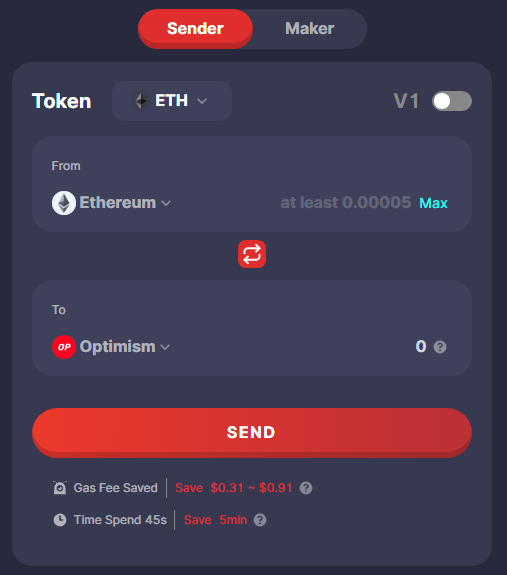
      across bridge

      Across Bridge is a cross-chain interoperability protocol designed to provide the fastest and lowest-cost bridging services. It allows users to transfer assets between different blockchain networks efficiently. The protocol utilizes a system of cross-chain intents, enabling streamlined and user-centric interactions with decentralized applications (dApps). These intents are powered by a modular setup, including a request for a quote mechanism, competitive relayers, and a settlement layer. 

      Across Bridge is one of the most active crypto bridges in the cryptocurrency sector. On October 9 alone, it handled over 30,000 transactions, more than any other bridge in that time period. In the last 24h, the bridge handled a whopping $12 million in cross-chain transactions, primarily on Ethereum and Arbitrum networks.

      Monthly Volume$1.13 billion
      Daily Transactions30,800
      Supported BlockchainsArbitrum One, Base, Ethereum, Linea, Optimism, Polygon, ZkSync Era

      2. Orbiter Finance – Cross-rollup bridge focused on low fees and instant transfers

      orbiter finance bridge

      Orbiter Finance is a decentralized cross-rollup Layer 2 bridge. It facilitates fast and efficient asset transfers between various blockchain networks, specifically focusing on Layer 2 solutions. Currently, Orbiter Finance supports zkSync and Arbitrum, with plans to include more rollups in the future. It aims to enhance interoperability and scalability in the Ethereum ecosystem by providing a seamless bridging experience.

      The Orbiter bridge supports more than 30 different networks, including Layer 1 and Layer 2 platforms. This makes it one of the bridges with the widest range of supported platforms, which is a great value proposition if you are looking to save up on gas fees by using Layer 2s.

      Monthly Volume$137 million
      Daily Transactions1,800
      Supported BlockchainsOptimism, Blast, Mode, Zora, BEVM, zkSync Lite, Polygon zkEVM, Polygon, Arbitrum Nova, Loopring, Immutable X, Starknet, BNB Chain, Solana, TON, and 10 more

      3. Stargate – Token bridge with a diverse range of supported platforms

      stargate bridge

      Stargate is a fully composable liquidity transport protocol at the core of Omnichain DeFi. It allows users and decentralized applications (dApps) to transfer native assets across chains using unified liquidity pools with instant guaranteed finality. Stargate supports liquidity provision, where providers earn stablecoin rewards and can farm LP tokens for STG rewards. Additionally, STG token holders can stake to receive veSTG, the governance token, increasing community involvement and governance.

      It’s worth noting that Stargate handled more than $465 million in transaction volume over the past 30 days, fourth most among cryptocurrency bridges during the period. Meanwhile, the platform handled over 17,400 transactions, the second-most out of all bridges.

      Monthly Volume$465 million
      Daily Transactions17,400
      Supported BlockchainsEthereum, BNB, Avalanche, Polygon, Arbitrum, Optimism, Fantom, Metis, zkEVM, zkSync, Base, and 10 more

      4. deBridge – Decentralized bridge supporting arbitrary cross-chain messaging

      debridge

      deBridge is a decentralized protocol enabling cross-chain interoperability and liquidity transfers. It allows secure and efficient transfer of data and assets between different blockchains. The protocol is designed for high performance, offering fast finality and minimal slippage. It integrates seamlessly with various blockchain ecosystems, providing developers with tools to build cross-chain applications. Security audits and a bug bounty program ensure the platform’s robustness.

      The platform supports all of the most popular blockchain networks, including Ethereum and BNB Chain. However, if you are looking for a crypto bridge that supports the majority of crypto networks, you’ll have to look elsewhere.

      Monthly Volume$1.48 million
      Daily Transactions22,800
      Supported BlockchainsEthereum, BNB Chain, Polygon, Arbitrum, Avalanche, Solana, Linea, Optimism, Base, Neon

      5. Celer cBridge – Celer’s token bridging solution

      celer cbridge

      Celer Network is a blockchain interoperability protocol enabling seamless multi-blockchain user experiences for tokens, DeFi, GameFi, NFTs, and governance. It features the Celer Inter-chain Messaging (IM) framework, allowing developers to build inter-chain-native dApps with efficient liquidity and coherent application logic. 

      Celer cBridge supports fast, secure, and low-cost asset transfers across 40+ blockchains, processing over $14 billion in cross-chain volume. The platform also includes Peti, an omnichain liquidity protocol for zero-slippage trades.

      Monthly Volume$123 million
      Daily Transactions2,200
      Supported BlockchainsEthereum, BNB Chain, Avalanche, Polygon, Optimism, Arbitrum, Aptos, Fantom, Flow, Base, Linea, Klaytn, and 25 more

      6. Portal Token Bridge – A bridge for both EVM and non-EVM blockchains

      The Portal Token Bridge is a decentralized cross-chain messaging and asset bridge protocol that connects isolated blockchain ecosystems via a network of “Guardians” (validator nodes).

      Portal Token Bridge supports fast, low-cost and secure token (and NFT) transfers across 20+ blockchains. The bridging mechanism locks tokens on the source chain and mints wrapped versions on the destination chain, all mediated through the Wormhole messaging layer.

      Portal is powered by a set of ~19 Guardians whose signatures validate cross-chain messages. The protocol has been audited by firms such as Trail of Bits and uses upgradable smart contracts under Guardian governance.

      Monthly Volume$2.17 billion
      Daily Transactions13,000
      Supported BlockchainsEthereum, BNB Chain, Avalanche, Polygon, Optimism, Arbitrum, Aptos, Fantom, Flow, Base, Linea, Klaytn, and 25 more

      7. Hop Protocol – Bridge specialized for Ethereum layer 2s

      Hop Protocol is a scalable rollup-to-rollup bridge designed to enable fast token transfers between Ethereum and its Layer 2 networks. It uses the Hop Bridge and hToken model, where liquidity providers facilitate instant swaps while canonical bridges handle final settlement.

      Hop supports seamless transfers for major assets like ETH, USDC, USDT, DAI, and MATIC across leading Layer 2s including Arbitrum, Optimism, Polygon, Base, and Ethereum mainnet. The protocol is governed by the Hop DAO, giving token holders control over updates and incentives.

      Since launch, Hop has processed over $3 billion in cumulative volume and remains one of the most reliable bridges in the Ethereum ecosystem, valued for its low fees and high transfer speeds.

      Monthly Volume$114,830
      Daily Transactions128
      Supported BlockchainsEthereum, BNB Chain, Avalanche, Polygon, Optimism, Arbitrum, Aptos, Fantom, Flow, Base, Linea, Klaytn, and 25 more

      8. Hop Protocol – Bridge specialized for Ethereum layer 2s

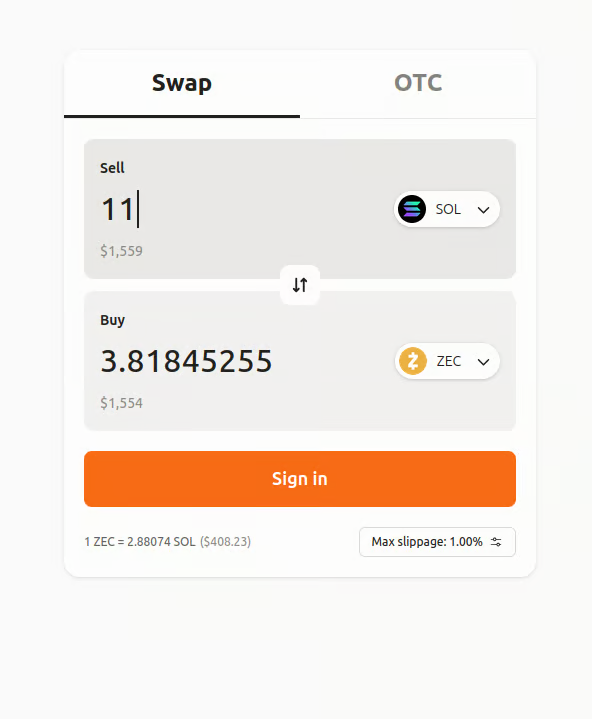
      NEAR Intents is a cross-chain protocol that enables seamless swaps between different crypto assets across multiple blockchains. Built on an intent-based architecture, the protocol allows users to define the desired outcome of a transaction, such as swapping SOL for ZEC, while independent solvers compete to execute the trade under the best possible conditions. The most competitive offer is automatically selected, helping users secure favorable rates.

      NEAR Intents supports a broad range of blockchains, including many that are not typically covered by standard crypto bridges. Beyond Ethereum, EVM chains, and layer 2 networks, it also connects ecosystems such as Bitcoin, Zcash, and Solana. In addition to its flexibility, the protocol stands out for its smooth user experience. For example, its integration in the Zashi wallet enables seamless cross-chain swaps for Zcash users.

      The standalone NEAR Intents application is compatible with multiple crypto wallets, including Phantom, Solflare, OKX Wallet, Coinbase Wallet, and others.

      Monthly Volume$2.59 billion
      Daily Transactions18,000
      Supported BlockchainsArbitrum, Avalanche, Polygon, BNB Chain, and 10 more

      The bottom line

      Cryptocurrency bridges are a necessity if you want to make the best out of opportunities in the decentralized finance space. While they do present some risks, they are the only way of transferring coins and tokens across different blockchains.

      If you want to avoid paying high transaction fees, it’s best to use a blockchain that has a low gas fee. Solana is one of the best options in that regard. Check out how much is Solana gas fee for more information.

      For additional ideas of which bridges to use, you can watch the following video by CoinCodex.