CryptoJets, a global private jet and helicopter brokerage, has announced a partnership with Transacta to support the growing demand for cryptocurrency payments in private aviation.
The growing demand for fast and secure crypto payments
Demand for cryptocurrency payment options in luxury travel continues to grow as wealth shifts toward younger generations. The private aviation sector is increasingly embracing digital currencies, driven by both practical needs and broader market development.
Built for travelers who value privacy, speed, and flexibility, CryptoJets operates with access to a global network of more than 5,000 charter operators, providing on-demand private jet and helicopter services to clients worldwide.
As the volume of crypto-funded bookings continued to grow, the company identified the need to further optimize payment speed, settlement reliability, and geographic coverage.Through its partnership with Transacta, CryptoJets is expanding its route network and operational capacity across 180 countries while offering clients a more streamlined way to process high-value charter payments.
“Crypto payments have already been part of how our clients prefer to pay,” said Erik Rand, Head of Operations at CryptoJets. “This partnership allows us to process those payments faster, improve settlement across markets, and scale our operations without compromising on compliance or client experience.”
Expertise in settling high-value transactions for luxury merchants worldwide
Built on years of experience working with luxury businesses, Transacta delivers payment solutions for merchants handling large, complex deals — without operational friction and under bespoke client requirements.
Transacta‘s financial rails allow CryptoJets to process large transactions in crypto and settle them in fiat to their bank account within 1–2 business days, meeting all legal requirements.
“We’re starting a new chapter together with CryptoJets. And for us, this partnership is a challenge we’re excited to take on — improving the speed and overall quality of payment processing for high-value charter transactions.” said Dmitrijs Maceraliks, CEO of Transacta.
About Transacta:
Founded in Estonia in 2018, Transacta (previously Transcrypt OÜ) offers a regulated payment infrastructure that enables merchants to accept crypto payments with instant fiat settlement. Transacta is licensed by the Estonian Financial Intelligence Unit, registered with FinCEN in the U.S. and FINTRAC in Canada, and operates under FINMA supervision.
New York, United States, March 3rd, 2026, Chainwire
Threshold Network, the decentralized blockchain protocol behind tBTC, has introduced an update to its decentralized application featuring an all-in-one Unified Bitcoin App that enables users to route Bitcoin across major chains through a single interface.
This new unified routing interface brings minting, redeeming, bridging, tracking, and native BTC swaps into a single application: The Threshold App. Users can now move Bitcoin across ecosystems through a coordinated system, rather than stitching together multiple tools or navigating between different Decentralized protocols.
This release simplifies how Bitcoin enters and moves across DeFi, offering a more user-friendly on-chain experience with tBTC. Whether a transaction requires a swap, a bridge, or multiple steps, execution is seamlessly coordinated through a single interface
Coordinated Execution Instead of Fragmented Workflows
Historically, moving BTC into tBTC and across chains required multiple disconnected workflows: minting in one app, bridging via another protocol, swapping on separate exchanges, and manually checking the best price for each transaction. This fragmented process introduced friction, higher execution risk, added costs, and unnecessary complexity for users attempting to access DeFi with Bitcoin.
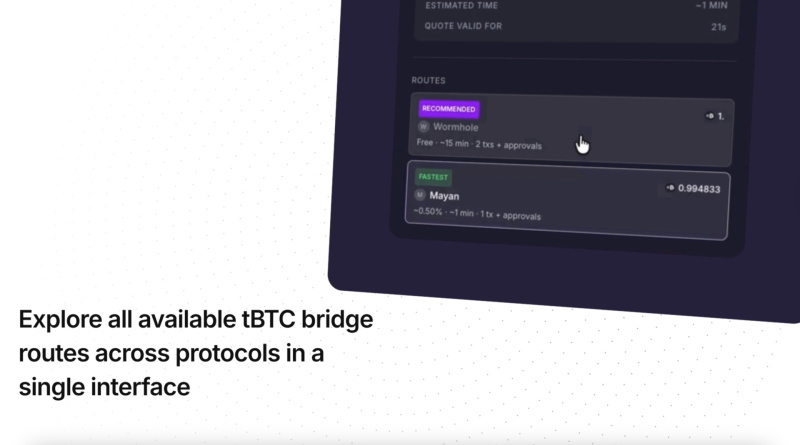
The Threshold All-in-one Bitcoin Liquidity Appstreamlines this experience by consolidating minting, bridging, swapping, and cost tracking into a single coordinated interface. Instead of manually comparing bridges and liquidity venues, users receive optimized routing options based on cost, speed, and reliability, such as the fastest or lowest-cost path: all within the Threshold Network App.
By abstracting multi-step transactions into a single seamless flow, the router significantly lowers the barrier for Bitcoin holders to use BTC across major ecosystems, including Ethereum, Arbitrum, Base, Sui, Starknet, and other integrated chains. The result is a simpler, more efficient way to move Bitcoin into DeFi.
Native BTC Execution with Deep Liquidity
Native BTC swaps are integrated directly into the routing engine, leveraging deep Ethereum liquidity to deliver competitive pricing and more efficient execution compared to fragmented, chain-specific pools.
“Capital should move efficiently across chains without requiring users to manage infrastructure decisions,” said MacLane Wilkison, Co-Founder of Threshold Network. “The new Threshold Bitcoin app coordinates liquidity sourcing and settlement behind the interface, enabling more efficient Bitcoin deployment across ecosystems.”
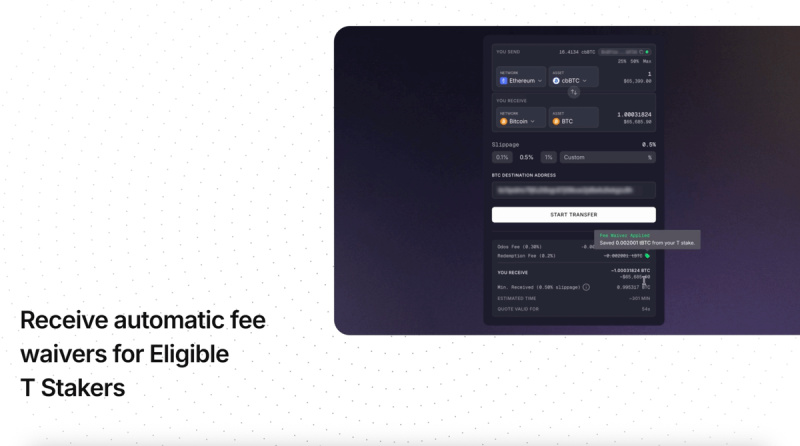
The update also strengthens the utility of Threshold’s token (T).The App tracks staked $T from the connected wallet and automatically applies minting and redemption fee waivers for eligible users.Gasless minting remains available as an opt-in feature, further reducing transaction costs.
Additionally, the router enables streamlined conversions from assets such as WBTC and cbBTC directly into tBTC on the destination chain, providing more direct and efficient access to Bitcoin liquidity across DeFi ecosystems.
Integrated Infrastructure Across Major Networks. Currently, the router connects Bitcoin, Ethereum, Arbitrum, Base, Sui, and Starknet within one coordinated framework. It integrates native tBTC mint and redeem flows, established bridging infrastructure, and DEX aggregation to ensure reliable settlement across chains.
All transactions are tracked in real time and are fully resumable. If a user disconnects or closes a session, progress is preserved. Fee logic is staking-aware, with eligible T stakers seeing applicable redemption fees waived directly within the interface.
New Features:
Unified Routing Interface: Enables minting, redeeming, swapping, and bridging from a single entry point. Users select source and destination assets, and the system automatically constructs the optimal execution path.
Multi-Chain Connectivity: Supports Bitcoin, Ethereum, Arbitrum, Base, Sui, and StarkNet within a single coordinated framework. Users can move BTC or tBTC across ecosystems without managing separate bridge interfaces.
Smart Route Discovery and Ranking: Automatically evaluates possible transaction paths and ranks them by cost, speed, reliability, and simplicity. Users are presented with clearly labeled best options.
Native BTC Swaps: Provides direct access to BTC liquidity with competitive execution, while enabling seamless conversion of assets such as cbBTC or wBTC into tBTC on a user’s chosen destination network.
Integrated Liquidity and Bridging Stack: Connects tBTC mint and redeem flows with established bridging infrastructure and DEX aggregation to coordinate multi-step transactions seamlessly.
Resumable Transactions: Persists in-flight operations, allowing users to refresh, disconnect, or return later without losing progress. Reduces failed cross-chain flows and operational friction
$T Staking-Aware Fee Display: Recognizes T staking status and surfaces fee waivers directly in the interface, reinforcing participation incentives.
Unified tBTC Explorer and Transaction Tracking: The new explorer section of the app consolidates historical mint, redeem, bridge, and swap activity into a single view, improving transparency and user oversight.
Impact for Users and Stakeholders
This release expands the utility of tBTC across six ecosystems while increasing throughput across minting, bridging, and swap flows. By embedding routing intelligence directly into the protocol interface, Threshold captures more activity within its infrastructure and further strengthens staking incentives tied to network usage.
With this launch, Threshold advances its role from Bitcoin asset issuance to core infrastructure for Bitcoin mobility, coordinating capital movement seamlessly across chains and unlocking more efficient access to decentralized finance.
Threshold Network is the decentralized protocol behind tBTC, a non-custodial, 1:1 Bitcoin-backed asset secured by a 51-of-100 threshold signer model. tBTC enables native BTC to move across chains like Ethereum, Base, Sui, Arbitrum, and Starknet without requiring custodians or compromising security. With over 6 years of proven security and about $5.1B in bridge volume, Threshold offers the most battle-tested, trust-minimized Bitcoin infrastructure onchain.
In 2026, you’ll find numerous promising penny cryptos under 1 cent offering exciting investment opportunities. Shiba Inu (SHIB), with its robust community and potential tied to ShibaSwap, can’t be ignored. Amp (AMP), essential for secure digital payments, and Sia (SIA), which offers decentralized data storage, also hold significant promise.
Additionally, projects like SIDUS (SIDUS) in the Web3 gaming sector and meme coins such as Pepe Coin (PEPE) and Bonk (BONK) leverage cutting-edge technologies and entertainment value to deliver diverse avenues for growth.
But which ones of all the numerous penny cryptos are most likely to yield huge returns? That’s what this article aims to help with.
List of the best penny cryptos under 1 cent in 2026
Shiba Inu – All-encompassing crypto ecosystem with meme beginnings
Pepe Coin– Popular meme coin based on the Pepe meme
Access Protocol – A web3 approach to premium content and subscriptions
The 14 best penny crypto projects: Examining crypto coins under 1 cent with huge upside potential
When examining the best penny crypto projects under 1 cent, there are multiple categories and types that comprise our list. They include DeFi projects, NFTs, Meme coins, Gaming, and even Launchpads.
Each of these cryptocurrencies offers unique value propositions and high upside potential, and we believe them to be viable options for investors seeking substantial returns.
Shiba Inu (SHIB), currently priced at approximately $0.000005443, stands as a prime example of a penny cryptocurrency with substantial growth potential.
SHIB boasts a market cap of $3.21 billion, which shows significant investment and liquidity. Its strong community and ecosystem differentiate it from other penny cryptos, and its success has spawned a large number of copycats that are trying to be the next Shiba Inu. It’s also by far the largest cap on our list, and it has consistently stayed among the top 30 cryptocurrencies.
Future developments include integration within the ShibaSwap decentralized exchange, which aims to increase utility and use cases for the token.
SHIB exhibits high volatility, with a 24-hour trading volume of approximately 40%, appealing to risk-seeking investors.
As a prominent meme coin, Shiba Inu leverages community-driven growth strategies, making it a coveted investment with many positive price predictions for Shiba Inu.
2. Pepe Coin (PEPE) – Popular meme coin based on the Pepe meme
Pepe Coin (PEPE) has garnered significant attention in the meme cryptocurrency space since its April 2023 launch. As an ERC-20 token, Pepe Coin allows investors to participate in a vibrant ecosystem despite lacking unique utility among its meme coin counterparts.
Built around the popular Pepe the Frog meme, which has been a cherished part of internet culture since around 2008, Pepe Coin gained popularity within the cryptocurrency community shortly after its official release.
The Pepe Coin team describes PEPE as “the most memeable memecoin in existence” on their official website, presenting it as a competitor to other meme coins like Dogecoin and Shiba Inu. Notably, the team behind Pepecoin consists of anonymous members.
Pepecoin doesn’t offer any unique utility, as highlighted on its website. The team describes Pepe as being “fueled by pure memetic power” and emphasizes that the coin is “completely useless and for entertainment purposes only.”
Despite not having any major ambitions, Pepe Coin is the third most successful meme coin on the market, behind only Dogecoin and Shiba Inu.
3. Bonk (BONK) – Solana’s top meme coin
Bonk is a meme coin on the Solana blockchain, gaining major attention during its late 2022 launch when it was freely distributed to the Solana community. As outlined on the Bonk website, the project aims to diminish the influence of venture capital investors within the Solana ecosystem and restore power to “the people.”
The Bonk team reports over 130 integrations spanning gaming, gambling, decentralized finance, and NFTs. Notably, the Bonk community has developed multiple games where users can both spend and earn BONK.
Additionally, users can deposit their BONK into various DeFi tools to earn yield, participate in no-loss lotteries, and engage in other activities. Solana’s recent resurgence has also had a positive impact on BONK. In July 2025 alone, the token saw gains of over 300% against the US dollar. If Solana continues to build on its momentum, we could see Bonk becoming one of the best-performing meme coins on the market.
4. Amp (AMP) – Collateralizing digital payments with AMP
Amp (AMP) is a collateral token designed to facilitate secure and instant transactions in digital payments, making it a pivotal part of the Flexa payments network.
Currently valued at around $0.001, Amp has a market capitalization that reflects its growing adoption in mainstream payment systems.
The token’s functionality includes providing collateral to protect blockchain transactions against fraud and enabling instant transaction speeds. Amp’s unique utility in bridging crypto and fiat currencies positions it favorably for potential growth as more businesses adopt digital payment solutions.
As a penny crypto to buy, Amp offers substantial upside potential. This may make it an attractive investment with increasing demand for reliable financing mechanisms in the DeFi ecosystem.
5. Sia (SIA) – Decentralized data storage powered by smart contracts
Sia (SIA) stands out as a decentralized storage platform where users can monetize their unused hard drive space.
As a penny crypto currently priced at $0.001078, SIA offers an accessible entry point for investors.
Leveraging smart contracts, Sia guarantees secure and transparent transactions between storage providers and users.
With the growing demand for data storage, especially in cloud services, Sia’s cost-effective solutions position it for potential future appreciation.
6. Ravencoin (RVN) – Blockchain specialized for efficient asset issuance and transfers
Ravencoin (RVN), a fork of Bitcoin, has been crafted to streamline the creation and transfer of digital assets. We will admit, this is slight cheating, considering that RVN is priced slightly above 1 cent. Still, we feel RVN offers a good investment opportunity for those seeking significant upside potential with smaller investments.
It employs the KAWPOW algorithm, enhancing mining efficiency and decentralization. As of October 2026, Ravencoin has seen increased community engagement and adoption, signaling growing interest and practical use cases.
Ravencoin can fulfill a variety of use cases. The blockchain can be used to issue tokenized securities such as stocks, digital collectibles, fungible tokens, tokens representing physical items such as gold bars, and more.
Anyone who wants to create a new crypto asset on the Ravencoin network has to burn a specified amount of RVN coins. Assets issued on Ravencoin can have many parameters (such as the amount of decimal numbers, fungibility, etc.), allowing users to fine-tune the assets they issue for specific use cases.
Its strong focus on asset tokenization positions it favorably in the evolving blockchain environment, potentially driving demand and value appreciation. With its innovative technology and increasing adoption, Ravencoin stands out as a promising penny crypto under 1 cent with huge upside potential.
7. BitTorrent (BTT) – Decentralized file sharing powered by BTT
BitTorrent (BTT) is the epitome of a high-risk, high-reward investment opportunity. If you’re into tech at all and haven’t been living under a rock for the past decade, you’ve heard of BitTorrent.
What you may not have heard is that it was bought by Justin Sun (the controversial founder of Tron), and that ever since then, BitTorent has been focusing on using blockchain technology.
This decentralized file-sharing protocol leverages blockchain technology to enhance speed and efficiency. Essentially, it incentivizes users to share files via P2P (peer-to-peer) mechanisms, while utilizing a decentralized filing system.
With a substantial user base of millions, BTT boasts a robust ecosystem. The recent integration with TRON’s blockchain has streamlined transactions and enhanced service offerings.
8. eCash (XEC) – Blockchain payments on a “mankind scale”
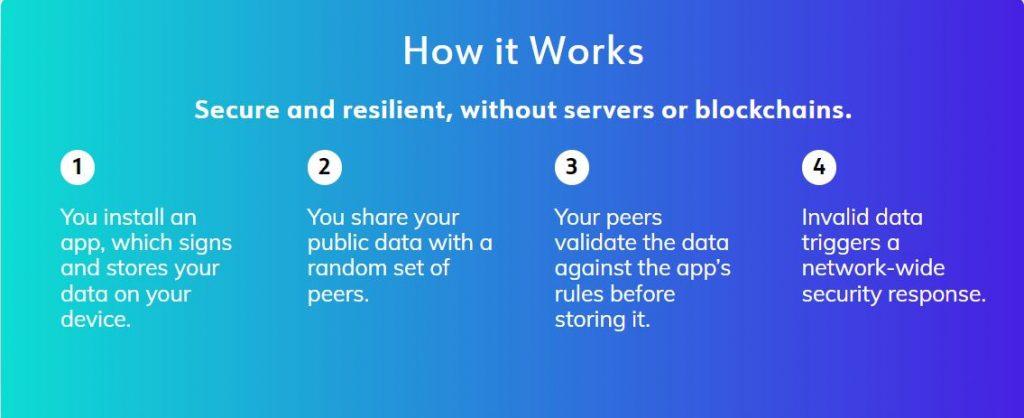
eCash (XEC) is targeted at enhancing transaction efficiency while utilizing a unique consensus protocol.
It features instant transactions and secure payment functionalities, positioning it favorably in the evolving landscape of digital assets.
The project’s roadmap suggests continuous developments and huge ambitions. The eCash team is focused on a lofty goal – building a blockchain network on the so-called “Mankind Scale”, which would be able to process over 5,000,000 transactions per second (TPS).
Easier said than done, of course, but if the team comes anywhere close to that adoption goal, XEC, the native token of the eCash platform, could easily earn the title of the most promising crypto under a penny.
With a current price below 1 cent, eCash presents an accessible investment opportunity for those seeking exposure to cryptocurrencies with high upside potential.
9. Jasmy – IoT-focused project bringing data sovereignty to users through blockchain
JASMY (JASMY) is the native token of the Jasmy platform, a project focused on redefining data ownership in the era of the Internet of Things (IoT). Founded by former Sony executives, Jasmy combines blockchain and IoT technology to give individuals full control over their personal data. Instead of allowing large corporations to collect and monetize user information, Jasmy aims to build a decentralized system where users can securely manage and benefit from their own data.
One of the core ideas behind Jasmy is data sovereignty. The platform enables users to store personal information in secure, decentralized environments and decide who can access it. By shifting control from centralized tech giants to individuals, Jasmy seeks to create a fairer digital economy where data becomes a personal asset rather than a corporate commodity.
Jasmy operates on the Ethereum blockchain and introduces tools such as the Secure Knowledge Communicator (SKC) and the Smart Guardian (SG). These components are designed to facilitate secure communication between IoT devices while protecting sensitive information. This infrastructure supports practical use cases, particularly in industries where secure data exchange between devices is critical.
The JASMY token plays a central role within the ecosystem, powering transactions and incentivizing data sharing between users and businesses. Companies that want to access user data must compensate individuals through the platform, creating a marketplace for trusted data exchange.
We think JASMY stands out by targeting the growing intersection of blockchain and IoT, offering a clear real-world use case centered on data ownership and privacy in an increasingly connected world.
10. Baby Doge Coin (BabyDoge) – Taking on Dogecoin with transaction and tokenomics improvements
Launched in June 2021, BabyDoge operates with a deflationary token model, where 5% of each transaction is redistributed to existing holders, incentivizing long-term holding.
Baby Doge Coin (BABYDOGE) is a Dogecoin-inspired cryptocurrency (we know, who would have thought right) that seeks to improve upon the original meme coin with greater transaction speeds, hyper deflationary tokenomics, integrated staking system, and, well, adorableness.
During the 2022-2023 bear market, Baby Doge Coin added several new features, including a chess game and an AI image generator, revamped its website and token burning portal, and more. The token also outperformed more than 50% of the top 100 largest market-cap digital assets, including the likes of Dogecoin, Solana, and Shiba Inu.
If its performance during the past crypto winter is any indication, the meme coin could see a major price boost once the market trend reverses.
BabyDoge’s commitment to supporting charitable causes, particularly in pet rescue organizations, enhances its appeal to socially conscious investors.
With secured partnerships and marketing initiatives, this meme coin holds potential for significant price appreciation as community engagement grows.
All these reasons make it one of the likeliest meme coins to explode candidates.
11. Holo (HOT) – Avoiding centralized Internet authorities with Holochain apps
Holo (HOT) stands out in this space, serving as the native cryptocurrency of the Holochain platform. Specifically designed to support decentralized applications (dApps) with a focus on scalability and efficiency, HOT facilitates transactions within the Holo ecosystem while doing away with centralized entities.
With all aspects of our lives moving online at an increasing pace, we rely more and more on centralized entities like Google, Amazon, and Microsoft for both computational power and cloud storage. Holo (HOT) is the native token of the Holochain platform, which aims to disrupt the established paradigm.
At its core, Holochain is an open-source P2P framework that allows users to take advantage of hApps (Holochain apps) that connect their devices among themselves without having to rely on centralized servers.
Applications run on users’ devices, putting them in charge of their identities and data. Users who host hApps are rewarded with HOT, which creates clear and natural adoption mechanics that could help the token grow in price drastically as the network expands.
12. DigiByte (DGB) – DeFi ecosystem with a long and successful track record
DigiByte (DGB) is the oldest project on our list, launched more than a decade ago, in January 2014. That makes it older than Ethereum, crazy to think about.
DigiByte is a community-driven project that places emphasis on secure payments and communications. The DGB token acts as a medium of exchange between dApps and smart contracts on the DigiByte platform.
The DigiByte blockchain platform is split into three layers. The top layer acts as an app store of sorts and allows for the development and hosting of decentralized applications (dApps). The middle layer ensures security and administration as well as stores the public ledger.
Finally, the bottom layer facilitates communication and operating processes. DGB could turn out to be one of the cryptos under a penny that will explode as long as the DigiByte network continues expanding.
Despite its low price, DigiByte’s active development and increasing partnerships in various sectors make it a promising candidate for investors looking for high upside potential in penny cryptos.
13. Zilliqa (ZIL) – A powerful dApp platform powered by ZIL
Zilliqa (ZIL) is known for its sharding technology, which considerably enhances scalability. It’s a public blockchain platform designed to address the scalability limitations of other blockchains, such as Ethereum and Bitcoin.
With a focus on smart contracts and decentralized applications, Zilliqa’s innovative approach positions it favorably in the rapidly growing blockchain ecosystem.
The current market cap for Zilliqa is approximately $250 million, and yes, once again, the price is slightly higher than 1 cent, it’s currently standing at $0.0133.
Zilliqa has demonstrated promising partnerships and collaborations that could drive adoption, particularly in sectors like gaming and finance.
As blockchain scalability becomes increasingly necessary, Zilliqa’s solutions may enable broader utilization and adoption, leading to potential price appreciation under 1 cent.
This makes Zilliqa a strong contender.
14. Access Protocol (ACS) – A web3 approach to premium content and subscriptions
Access Protocol (ACS) presents a compelling opportunity focusing on a new day to monetizedigital content.
ACS offers a decentralized platform where users access premium content through token deposits, fostering community engagement and support for content creators.
Each time a user deposits ACS into a creator pool, a 2% fee is collected, and the tokens collected in this way are burned. Initially deployed on the Solana blockchain, Access Protocol also has plans to launch on the StarkNet layer 2 platform.
By leveraging partnerships, ACS aims to boost user experience and drive token adoption, positioning it favorably in emerging market trends.
As the digital age demands innovative solutions for content consumption, ACS’s unique model and growing ecosystem make it an attractive investment option, especially for those who are sick of stifling rules of other content platforms, such as Youtube, Twitch or Kick.
A web3 approach to premium content and subscriptions
$51 million
The bottom line
When investing in penny cryptos under 1 cent in 2026, you should know that usually, it means you are entering a high-risk proposition. Yes, there is a chance for huge returns, and getting that 10x, 100x, or even a 1000x is not impossible if you know how to find new crypto with huge potential.
However, you should never allocate a big chunk of your portfolio into these kinds of projects. Try to aim to have no more than 3-5% of your portfolio in penny cryptos, as a way to counter the high-risk investments with safer ones.
Paradex has announced that the Token Generation Event for its native token, $DIME, is expected to take place soon. The launch represents the next phase in the exchange’s development.
Institutional Background and Market Growth
Paradex was developed by the team behind Paradigm, an institutional crypto derivatives liquidity network that has processed more than $1 trillion in trading volume. That background is reflected in Paradex’s focus on execution quality, capital efficiency, and market structure.
Since launching their on-chain perpetuals exchange, Paradex has recorded:
Over $250 billion in cumulative trading volume
Approximately $550 million in open interest
More than 75,000 users
Peak daily trading volume above $3 billion
The exchange operates with an offchain central limit order book (CLOB) for matching, and settles transactions through a high-throughput Layer 2 appchain secured by zk-STARK proofs on Ethereum.
Focus on Market Structure and Privacy
A key differentiator for Paradex is its approach to information exposure. On transparent blockchains, position sizes and liquidation levels can often be observed publicly. Paradex encrypts sensitive state data prior to settlement while using zero-knowledge proofs to maintain validity. Access to detailed account information is restricted to verified users.
In addition, the exchange incorporates:
Zero trading fees for retail participants
Retail Price Improvement flow segmentation
A no auto-deleveraging risk model
Onchain vault infrastructure for yield strategies
These features are designed to reduce execution friction and mitigate structural risks that have historically limited institutional participation in decentralized derivatives markets.
$DIME and Network Alignment
According to Messari’s research coverage, $DIME will launch on Paradex’s spot market and will serve as the native gas token of Paradex Chain.
Messari notes that the token is structured to reduce the traditional conflict of interest between equity holders and tokenholders by directing economic value accrual to the $DIME token itself. Rather than implementing automatic buyback formulas, Paradex intends to conduct buybacks on a discretionary basis, with decisions guided by market conditions and ecosystem considerations.
Token Allocation Overview
Messari outlines the following allocation structure for $DIME:
25.1 percent Core Contributors
25.0 percent Community Airdrop
20.0 percent to Season 2 XP holders
5.0 percent to Pre-Season and Season 1 XP holders
Fully unlocked at launch
21.6 percent Ongoing Community Rewards
13.4 percent Paradigm Shareholders
10.4 percent preferred equity investors subject to a 12-month linear unlock beginning one month after listing
1.0 percent common equity holders
2.0 percent reserved for Paradigm’s balance sheet
6.0 percent Foundation Budget
5.0 percent Liquidity Programs
3.9 percent Future Core Contributors and Advisors
80% of the tokens allocated to Core Contributors and Paradigm shareholders are subject to performance-based unlock conditions. The remaining 20 percent follows a time-based vesting schedule, with 25 percent unlocking one year after listing and the remainder vesting monthly over the following 36 months.
This structure is intended to align long-term incentives between contributors and the broader community.
Looking Ahead
Paradex has stated that it plans to expand beyond perpetual futures into spot markets, options, real-world asset products, and more. The $DIME TGE represents a shift toward a network model in which the token underpins economic coordination and value accrual across the platform.
With measurable trading activity, defined tokenomics, and a focus on privacy-preserving infrastructure, the upcoming launch of $DIME will provide a clearer view into how Paradex intends to scale its on-chain derivatives model over the long term.
Further details regarding timing and listing specifics are expected to be released in the coming days. Users can check Paradex’s socials for more information.
About Paradex
Paradex is a privacy-focused decentralized perpetual futures exchange built on its own high-performance Layer 2 appchain using the Starknet stack. The platform combines an off-chain central limit order book for execution with zk-STARK-secured on-chain settlement to deliver centralized-level efficiency within a self-custodial framework.
Developed by the team behind Paradigm, an institutional crypto derivatives liquidity network that has processed over $1 trillion in trading volume, Paradex emphasizes market structure, capital efficiency, and position confidentiality. The exchange currently supports more than 100 markets and integrates features such as Retail Price Improvement flow segmentation, a no auto-deleveraging risk model, and on-chain vault infrastructure.
Paradex aims to expand its ecosystem beyond perpetual futures into spot markets, options, real-world asset products, and more, positioning itself as a broader on-chain financial infrastructure platform.
Pi Network is a cryptocurrency project that lets you mine Pi coins using your mobile phone. Launched in March 2019 by Stanford graduates Nicolas Kokkalis and Chengdiao Fan, Pi Network aims to democratize cryptocurrency mining with minimal energy consumption.
The ecosystem has grown to over 60 million users, largely due to its unique mobile mining mechanism, and the community-driven initiatives that keep users engaged. But what about its mainnet launch and its potential implications for the Pi coin price?
Key Takeaways
Pi Network’s Open Network officially launched on February 20, 2025, at 8 AM UTC, allowing users to trade Pi Coin on exchanges.
OKX and MEXC have listed Pi Coin, with more exchanges possibly following after the Open Network launch.
Pi Network now has over 70 million users and has been expanding its ecosystem with developer incentives and hackathons.
Since its listing on major exchanges, its long-term value and adoption have been somewhat questionable.
What is Pi Network?
Pi Network is a cryptocurrency project launched in March 2019 by Stanford graduates. It focuses on mobile mining to make crypto more accessible.
The network uses the Stellar Consensus Protocol for secure and energy-efficient mining, which allows users to “mine” Pi coins via a mobile crypto mining app.
To guarantee readiness for the mainnet launch, users must complete a KYC process, a requirement that some privacy conscious users won’t like but that says something about the network’s commitment to regulatory compliance and security.
Pi Network roles
Engaging with the Pi Network ecosystem means you’re part of a diverse group of users who contribute in various ways, depending on your role within the network.
As a Pioneer, you’re an entry-level user who mines PI coins by regularly engaging with the mobile app. This role incorporates over 60 million engaged global users who contribute to the ecosystem’s growth and stability.
Contributors earn better mining rates by expanding their security circles and helping to secure the network. By maintaining a reliable and stable security circle, Contributors play a crucial role in the network’s overall security and integrity.
Ambassadors grow the network by inviting new members to join and earn rewards for their efforts.
Nodes are users who operate a decentralized network by running Pi Node software, contributing to the network’s infrastructure. Node Ambassadors recruit developers to build decentralized applications (dApps) on the Pi Network.
These roles, supported by the Pi Core Team and driven by the community, promote the continuous development and security of the Pi Network.
Pi Network roadmap
The Pi Network has laid out an ambitious roadmap. It aims to democratize cryptocurrency mining by allowing users to mine PI coins directly on a crypto mining app without high energy requirements.
Launched in March 2019, the project has been developed in phases. The Pi network roadmap outlines a change through App launch (2018), Testnet launch (2020), and the Mainnet launch, which happened in February 2025 after many delays due to regulatory compliance and user dissatisfaction issues.
The shift to the Mainnet allowed users to convert Pi coins into other assets. This means that users who wish to do so can cash out on exchanges like OKX and MEXC.
The Pi network roadmap also emphasizes the need for ecosystem building, with a goal of integrating at least 100 applications into the network by the launch of the Mainnet.
Initiatives like the Pi2Day Challenge help foster participation and readiness for the mainnet change, despite community frustrations from repeated postponements.
Pros and cons of Pi Network
Pi Network gained traction by allowing users to “mine” PI tokens through a mobile app without draining battery or requiring specialized hardware. This low barrier to entry helped the project build a massive global user base and made crypto participation accessible to people with little technical knowledge. The project also reports millions of KYC-verified users, which demonstrates strong community engagement following the mainnet launch.
On the downside, liquidity and trading access have been ongoing concerns since mainnet went live. While PI is now live, exchange availability, regional restrictions, and limited ecosystem development have raised questions about real utility. Compared to more established blockchain ecosystems, Pi still lacks a robust selection of DeFi apps, games, and on-chain tools that drive demand for a token.
Despite the challenges, Pi Network boasts a large community of over 12 million KYC-verified users. This strong participation is proof of the network’s engagement as it approaches the mainnet launch.
However, uncertainties around the future value of Pi coins and potential price volatility post-launch remain concerns for investors and users alike.
Pros:
Wide accessibility: Users can mine via smartphones with low battery and data usage.
Strong community: Over 12 million KYC-verified users participate actively.
User control: Features like the Lockup mechanism enhance stability and user control.
Cons:
Privacy concerns: The Pi mobile app requires a significant amount of user data.
Repeated delays: Frustration from repeated mainnet launch delays affects user morale, even post-launch.
Pi coin price potential
According to our Pi Coin price prediction, its price could surpass $0.46 by the end of December 2026, with its price expected to drop to $0.37 by the end of February 2026, which is still a massive +115.70% increase compared to its price today.
Is Pi Network worth it?
Initially expected to launch in late 2023, the mainnet launch date was postponed due to technical challenges and was finally released in early 2025.
The Pi coin’s price is currently in a downtrend (though to be fair, pretty much everything is), but speculators predict potential increases in value post-mainnet launch. Here are three key factors to examine:
User engagement: Pi Network has maintained strong user engagement through initiatives like the Pi2Day Challenge, which encourages participation and readiness for the mainnet shift.
Users and KYC: Over 12 million users have completed KYC, with a target of 15 million set for the anticipated Open Mainnet launch.
Future prospects: Despite past delays, the network continues to develop and expand, with new applications, integrations, and strategic partnerships being announced, which could enhance its value and utility in the future.
Your investment decision should reflect these factors and the potential future success of Pi Network.
Is Pi Network safe?
Pi Network is generally considered safe, having undergone security reviews with no major vulnerabilities discovered. To guarantee your assets are secure, the KYC process is mandatory. This enhances user verification and security, helping to mitigate potential risks.
Here are some key points to note about the safety of Pi Network:
Aspect
Safety Measures
Benefits
KYC Process
Mandatory for retaining Pi coins
Enhances user verification and security
Official App Sources
Minimize risks of fraud and scams
Protects from unofficial apps
Ongoing Community Engagement
Transparency to maintain trust and credibility
Keeps users informed and engaged
User Information
Be cautious of phishing attempts
Protects personal data
Phishing Attempts
Be wary of scam emails or messages
Avoids potential fraud
The bottom line
Pi Network is a cryptocurrency designed for mobile mining, launched by Stanford graduates in March 2019. It aims to make crypto accessible by allowing users to mine Pi coins with minimal energy consumption. Community-driven initiatives keep user engagement high despite delays and uncertainties about the coin’s future value.
If you’re also interested in cryptocurrencies other than Pi Network, make sure to take a look at our shortlist of the best crypto to buy now.
A Bitcoin mixer is a service that Bitcoin holders can use to make their BTC transaction history more difficult to trace. There are many Bitcoin mixing services available on the market, but not all of them are worth your time.
To help you narrow down your search, we have selected the 5 best Bitcoin mixers available right now.
Before we take a closer look at the list of the best Bitcoin mixers, let’s first learn about why Bitcoin is not actually very private and why Bitcoin mixers even exist.
List of the best BTC mixers in 2026:
Mixero.io – A Bitcoin mixing service featuring an advanced privacy mode
Wasabi Wallet – A Bitcoin wallet designed with privacy enabled by default
Mixer.money – A Bitcoin mixer offering two distinct mixing options
Tornado Cash – A decentralized cryptocurrency mixer built for Ethereum
Railgun – A blockchain privacy solution powered by smart contracts
Bitcoin isn’t truly private
Some people who are new to cryptocurrency believe that Bitcoin is fully anonymous. That assumption isn’t entirely accurate.
At a basic level, Bitcoin appears anonymous because users don’t need to submit personal details to create a wallet or send transactions. The protocol itself doesn’t recognize real-world identities, as Bitcoin addresses are simply strings of characters with no inherent personal information attached.
However, Bitcoin operates on a fully transparent blockchain. This public ledger records every transaction ever made on the network. Anyone can use a blockchain explorer, such as Blockchain.com, to view transactions dating back to Bitcoin’s launch in 2009.
As a result, it’s incorrect to assume your Bitcoin activity is private just because your name isn’t directly tied to your wallet address on the blockchain.
For instance, if you purchased Bitcoin using fiat currencies like USD or EUR through a regulated exchange, you likely had to complete identity verification. When you withdraw your BTC to a personal wallet, the exchange maintains a record connecting your identity to that withdrawal address — even if the information isn’t publicly visible.
This data could potentially be exposed through insider leaks, cyberattacks, or legal requests from authorities. In short, while the blockchain itself doesn’t require identity information, real-world interactions often create traceable links.
What Bitcoin mixers do
Bitcoin mixers aim to improve privacy by making it difficult to trace where coins originated. In simple terms, mixers combine BTC from multiple users, shuffle them together, and redistribute equivalent amounts back to participants. They often randomize transaction sizes and introduce delays to complicate tracking.
The general concept is straightforward: you send BTC to a mixer and later receive roughly the same amount back (minus service fees), but the returned coins are much harder to associate with your original transaction.
The best Bitcoin mixers in 2026
Before using any mixing service, review the laws in your country. Crypto regulations vary significantly, and services that are permitted in one jurisdiction may be restricted in another.
Here’s our overview of the leading Bitcoin mixers available in 2026.
1. Mixero.io – Advanced privacy with optional Monero integration
Mixero.io is a CoinJoin-based Bitcoin mixing platform. It also offers an “advanced” mode that routes BTC through Monero (XMR) before converting it back to Bitcoin, providing an extra layer of obfuscation. This enhanced option comes with higher fees.
Users can increase their fee to prioritize their transaction and speed up processing. The standard CoinJoin fee starts at 0.7% plus a fixed 0.0003 BTC charge. The advanced XMR bridge option begins at 1.6% and can go up to 4.7% for faster execution. Users can also delay transactions for up to 168 hours (7 days).
In addition to BTC, Mixero supports ETH mixing, which may appeal to users seeking privacy tools for multiple major cryptocurrencies.
Key features:
CoinJoin-based mixing with optional Monero bridge
Advanced XMR mode for stronger privacy at higher cost
Adjustable fees for faster processing
Fees starting at 0.7% (standard) and 1.6% (advanced)
Optional transaction delays up to 7 days
Supports both BTC and ETH
2. Wasabi Wallet – Privacy-focused Bitcoin wallet
Wasabi Wallet is a non-custodial Bitcoin wallet that includes built-in CoinJoin functionality. As a non-custodial solution, users retain full control of their private keys.
CoinJoin transactions through Wasabi incur a 0.3% coordinator fee, in addition to standard Bitcoin network fees. However, the coordinator fee is waived for CoinJoin transactions under 0.01 BTC.
By default, Wasabi routes all network traffic through the Tor network to enhance privacy, though users can disable this option.
Key features:
Built-in CoinJoin integration
Non-custodial wallet with user-controlled keys
0.3% coordinator fee (waived for small transactions)
Tor-enabled by default for network privacy
3. Mixer.money – Two privacy-focused mixing options
Operating since 2016, Mixer.moneyis a long-standing Bitcoin mixing service offering a simple interface and two primary modes: standard mixing and “complete anonymity.”
The standard option charges a randomized fee between 1% and 1.5% (to enhance privacy) and typically completes within two hours. It supports transactions between 0.001 and 1 BTC and uses funds from its user base for mixing.
The “complete anonymity” mode provides stronger privacy protections but costs between 4% and 5% and may take up to 10 hours. This mode sources liquidity from cryptocurrency exchanges.
Mixer.money is accessible via both the regular web and the Tor network. It also provides a Telegram bot that allows users to initiate mixing directly within Telegram.
Keep in mind that Mixer.money is centralized and therefore requires trust in the operator.
Tornado Cashis a decentralized mixing protocol primarily built on Ethereum. It breaks the on-chain connection between sender and receiver by using smart contract pools.
Users deposit fixed amounts (such as 1 ETH or 100 ETH) into shared pools and later withdraw funds to a different address. Because many users deposit identical amounts, linking deposits and withdrawals becomes extremely difficult.
Tornado Cash supports multiple tokens and networks, although most activity occurs on Ethereum. By standardizing deposit amounts and pooling liquidity, the protocol strengthens anonymity as participation increases.
As of December 2025, Tornado Cash holds over $1 billion in total value locked, with ETH accounting for most of the funds, alongside assets like TORN, BNB, and DAI.
Key features:
Smart contract-based privacy protocol
Fixed-denomination deposit pools
Multi-token and multi-network support
Over $1 billion in total value locked
5. Railgun – Smart contract-powered privacy system
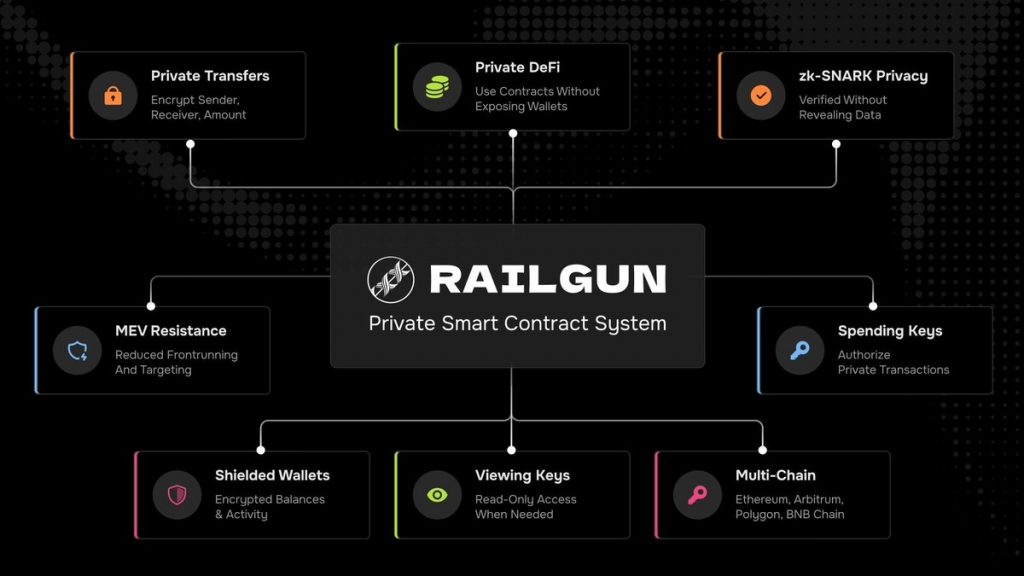
Railgun is a privacy-focused smart contract system that shields transaction data directly on-chain. It conceals key details such as sender, recipient, token type, and amount using Private Balances, which form a shared anonymity pool.
Transactions within the Railgun ecosystem appear to originate from this collective pool, making it challenging to determine who initiated a transfer or which assets were used.
Privacy improves as more users participate, increasing the anonymity set. Popular tokens like USDC or DAI generally provide stronger privacy due to higher usage compared to less common assets.
Railgun can be accessed through compatible wallets such as Railway Wallet, which supports zk-SNARK-powered private transactions without exposing balances.
Key features:
Shields sender, recipient, token, and amount
Uses Private Balances to expand anonymity set
Privacy increases with user participation and TVL
Accessible via zk-SNARK-enabled wallets
Are Bitcoin mixers legal?
In many countries, Bitcoin mixers are not explicitly illegal. However, most do not implement Know Your Customer (KYC) or anti-money laundering (AML) procedures, placing them in a regulatory gray area.
Unless a service is specifically prohibited, users typically won’t face legal consequences simply for using a mixer. That said, authorities have shut down numerous mixers over the years, and several operators have been arrested.
While mixers can serve legitimate privacy needs, they are also used by criminals — for example, hackers attempting to launder stolen funds. This association has made them highly controversial.
Notable enforcement actions include:
Bestmixer.io shut down by Europol and Dutch authorities (2019)
Bitcoin Fog operator arrested and charged in the U.S. (2021)
Tornado Cash sanctioned by OFAC (2022), with sanctions lifted in 2025
ChipMixer taken down by U.S. and German authorities (2023)
Are Bitcoin mixers safe?
Safety largely depends on the specific service used. Centralized mixers require trust that operators will not misappropriate user funds.
It’s also important to recognize that mixing does not guarantee perfect anonymity. The effectiveness of privacy measures varies by implementation, and blockchain analysis tools continue to evolve. In some cases, investigators may still trace coins that have passed through mixers.
Additionally, some cryptocurrency platforms and businesses may flag or restrict wallets associated with mixing services.
Bitcoin is pseudonymous rather than fully anonymous, and transactions can be traced under close examination. Mixing services aim to make blockchain activity more difficult to analyze, giving users greater financial privacy.
However, because mixers are sometimes used for illicit purposes, they remain controversial and frequently attract regulatory scrutiny — even in jurisdictions where they are not outright banned.
Cryptocurrency mining can be a very profitable business, but succeeding in this sector requires a well-thought-out plan, a significant amount of invested capital, and knowledge of the latest trends in cryptocurrency mining. We have selected the best ASIC miners available in 2026 to help you get started on the right foot.
Although Bitcoin mining is the largest sector of the cryptocurrency mining industry by far, we’ve decided to also feature ASIC miners designed for algorithms other than SHA-256. This is because mining cryptocurrencies other than Bitcoin can be more profitable if timed right, and we also wanted to highlight the diversity of options in the ASIC miner space.
Without further ado, here is our selection of the best ASIC miners in 2026:
Now, let’s take a closer look at each miner that made our list of the best ASIC miners in 2026.
1. Bitmain Antminer S23 Hyd – Ultra-efficient hydro-cooled flagship from Bitmain
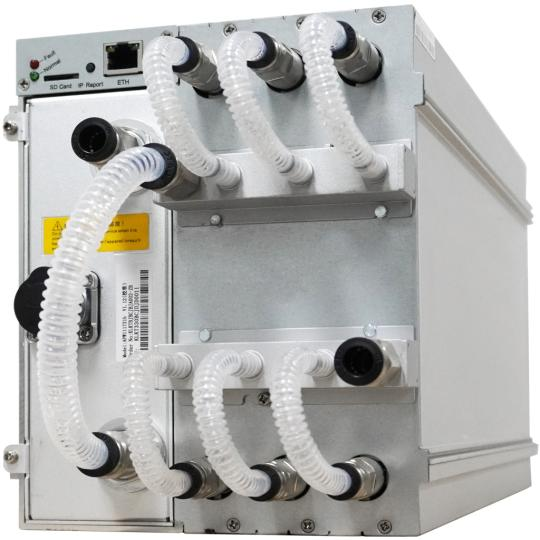
The Bitmain Antminer S23 Hyd is a next-generation, water-cooled Bitcoin miner designed for large-scale and industrial mining setups. It delivers a powerful hash rate of 580 TH/s while drawing 5,510W of power, achieving an efficiency of 9.5 J/TH. This makes it one of the most energy-efficient SHA-256 miners available at launch.
Released in January 2026, the S23 Hyd builds on Bitmain’s advanced liquid-cooling technology to provide improved thermal control and reduced noise compared to traditional air-cooled machines. Its design is aimed at professional mining farms that prioritize high performance, stability, and lower long-term operating costs.
Price
$17,400
Release Date
January 2026
Hash Rate
580 TH/s
Power Consumption
5,510W
Efficiency
9.5 J/T
2. Bitmain Antminer S21 XP Hyd – The most profitable Bitcoin miner
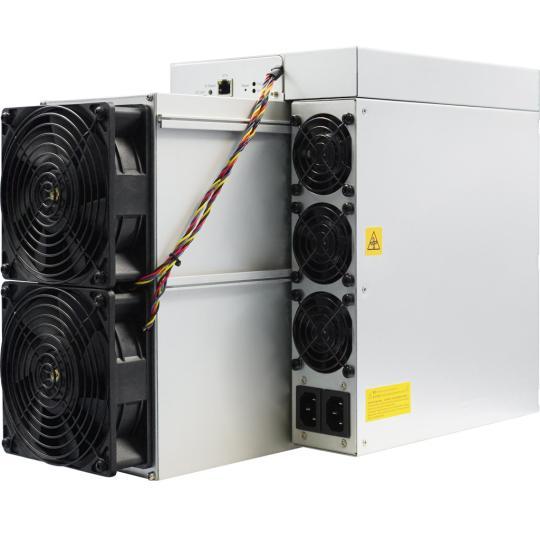
Bitmain’s Antminer S21 XP Hyd is one of the most profitable ASIC miners for the SHA-256 hashing algorithm used by Bitcoin, Bitcoin Cash, Bitcoin SV, and other popular cryptocurrencies. This hydro-cooled miner can be cooled with antifreeze or water and outputs a hashrate of 473 TH/s with a power efficiency of 12 J/T.
Currently, Bitmain is accepting orders for the Antminer S21 XP Hyd at a price of $10,170 per unit. Although the price per unit is high, the Antminer S21 XP Hyd still represents a large chunk of the Bitcoin mining industry, which has become much harsher after the fourth Bitcoin halving.
Price
$10,170
Release Date
Q4 2025
Hash Rate
473 TH/s
Power Consumption
5,676W
Efficiency
12 J/T
3. Bitmain Antminer S21 XP Hyd – The most profitable Bitcoin miner
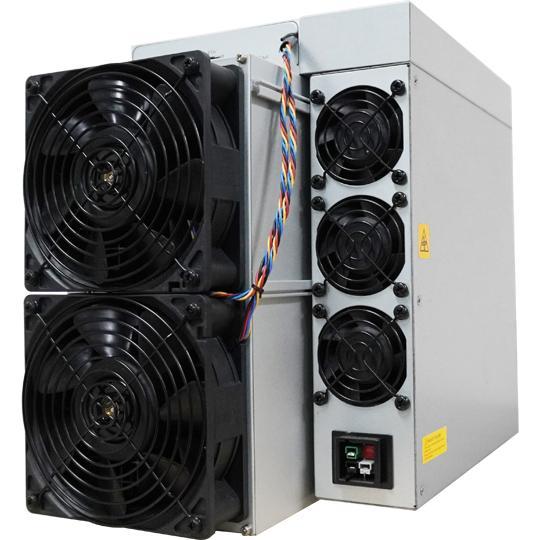
The Bitmain Antminer S21 is one of the best all-around ASIC miners for the SHA-256 algorithm, making it suitable for mining Bitcoin, Bitcoin Cash, and similar cryptocurrencies. It delivers a hash rate of 200 TH/s while maintaining strong power efficiency at 17.5 W/Th, offering a solid combination of performance and energy savings.
Priced at around $4,599, the Antminer S21 is a great choice for both beginners entering Bitcoin mining and experienced users looking to upgrade their setups. With its efficiency-focused design and reliable output, it provides consistent profitability potential even amid rising network difficulty.
Price
$4,599
Release Date
February 2024
Hash Rate
200 TH/s
Power Consumption
3,500W
Efficiency
17.5 J/T
4. Bitmain Antminer KS5 Pro – Best Kaspa ASIC miner
The Bitmain Antminer KS5 Pro is currently the most powerful ASIC miner specialized for KHeavyHash, the hashing algorithm used by the Kaspa cryptocurrency. This air-cooled miner generates 21 TH/s, is rated at 3,150W and has a power efficiency of 150 J/T.
The Antminer KS5 Pro’s impressive power comes with a substantial price tag, as Bitmain is selling the miner at a price of $15,000 per unit.
With Kaspa being the most profitable cryptocurrency to mine at the moment, we can expect the competition in the Kaspa ASIC miner industry to intensify significantly in the coming months.
Price
$15,000
Release Date
October 2024
Hash Rate
21 TH/s
Power Consumption
3,150W
Efficiency
150 J/T
5. Canaan Avalon Made A1466 – High-performance Bitcoin miner by Canaan
The Avalon Made A1466 is a powerful Bitcoin ASIC miner produced by Canaan. This miner outputs 150 TH/s at a power efficiency of 21.5 J/T. The Avalon Made A1466, which is the flagship model of Canaan’s A14 series, is sold for roughly $1,800 by the manufacturer.
The Avalon Made A1466 is a solid choice for those who require a powerful Bitcoin miner at a relatively low price per unit.
One of the best alternatives to Bitmain’s Antminer series is the WhatsMiner series produced by MicroBT. One of the company’s most powerful miners is the WhatsMiner M66. This immersion-cooled miner is sold for $4,767 by the manufacturer and outputs a hashrate of 247 TH/s. The miner has a power consumption of 5,452W and a power efficiency rating of 19.9 J/T.
Although this ASIC miner is certainly among the more powerful options available on the market, it also has a hefty price tag, which might not make it suitable for all miners.
Price
$4,767
Release Date
October 2023
Hash Rate
247 TH/s
Power Consumption
5,452W
Efficiency
19.9 J/T
7. Bitmain Antminer L9 – Best Scrypt ASIC miner
The Scrypt hashing algorithm is used by two of the most popular cryptocurrencies on the market – Litecoin and Dogecoin. Currently, the most effective ASIC miner for the Scrypt algorithm is Bitmain’s Antminer L9.
The Antminer L9 generates 16 GH/s at a power consumption 3,360W and an efficiency of 210 J/G. This air-cooled miner is designed to function at an operating temperature of 75 degrees Celsius.
Bitmain was selling the Antminer L9 at $5,584 per unit, though the miners sold out shortly after it’s September 2025 release.
Price
$5,584
Release Date
September 2025
Hash Rate
16 GH/s
Power Consumption
3,360W
Efficiency
210 J/G
8. Bitmain Antminer X5 – Best RandomX ASIC miner
Although Monero’s RandomX hashing algorithm was designed to be mineable by consumer-grade computer hardware, it can also be mined with specialized hardware. Bitmain’s Antminer X5 is currently the most powerful ASIC miner for Monero.
This miner, which Bitmain is selling for $2,999 per unit, outputs 212 KH/s and has a power consumption of 1,350W. In terms of power efficiency, this air-cooled miner is rated at 6.37 J/K. Notably, this miner features the first RISC-V architecture CPU ever produced by Bitmain.
Price
$2,999
Release Date
September 2023
Hash Rate
212 KH/s
Power Consumption
1,350W
Efficiency
6.37 J/K
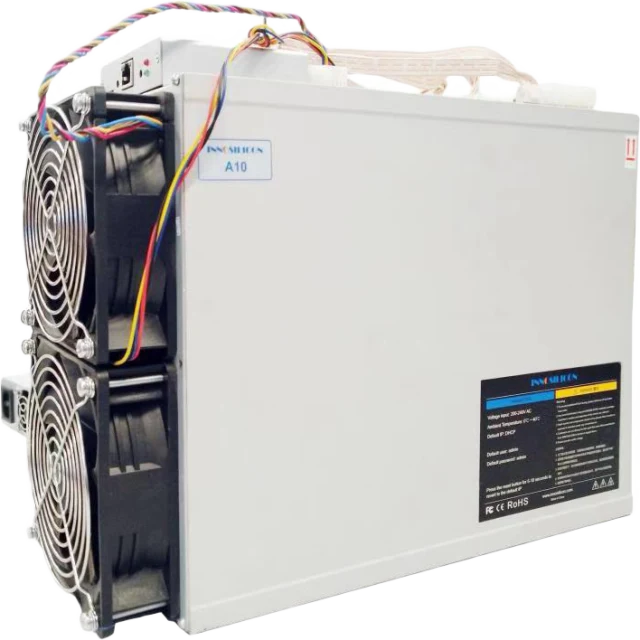
9. Innosilicon A10 Pro ETH – Solid EtHash miner
Although Ethereum no longer uses a Proof-of-Work consensus mechanism, there are still some notable cryptocurrencies using the EtHash hashing algorithm, for example Ethereum Classic. Innosilicon’s A10 Pro ETH is one of the most compelling options for miners that need an ASIC tailored for the EtHash algorithm.
The A10 Pro ETH outputs a hashrate of 500 MH/s and has a power consumption of 860W. The miner has an efficiency rating of 1.92 J/MH.
Price
$1,900
Release Date
May 2020
Hash Rate
500 MH/s
Power Consumption
860W
Efficiency
1.92 J/MH
FAQs
Now that we have showcased the best ASIC miners available on the market today, let’s answer some of the most common questions users have on the topic of ASIC miners.
What is an ASIC mining rig?
An ASIC mining rig is a device that is specialized to mine a specific type of cryptocurrency as efficiently as possible. ASICs (application-specific integrated circuits) are chips that are designed for a very narrow range of tasks, in contrast to the chips found in desktop computers, laptops and smartphones, which are capable of performing a variety of tasks.
When it comes to ASIC miners, ensuring a safe operating temperature is crucial. Depending on their design, ASIC miners can use air cooling, liquid cooling or immersion cooling.
Are ASIC miners profitable?
The profitability of ASIC miners depends on many different factors. This includes the cost of the ASIC miner itself, the cost of hosting and maintenance, electricity costs, the price trend of the cryptocurrency that’s being mined, and more factors.
Some cryptocurrencies such as Bitcoin can only be profitably mined with ASICs since consumer-grade computer hardware is not powerful enough to mine them effectively.
Can ASIC miners be used for anything else?
The chips powering ASIC miners are designed specifically to mine a certain hashing algorithm as efficiently as possible. Therefore, ASIC miners can not be used for any other purpose than mining the cryptocurrency / hashing algorithm they were designed for.
The bottom line
We hope that our roundup of the best ASIC miners has helped you find the best models for mining popular cryptocurrencies such as Bitcoin, Litecoin, Dogecoin, and Kaspa. Although cryptocurrency mining can certainly be profitable, running a successful mining operation requires a significant amount of capital, resources, and knowledge.
There are no legitimate Ethereum mining apps on the market, because the Ethereum cryptocurrency does not use mining. Whenever you see a mobile app that promotes itself as a cryptocurrency miner, you should be very careful since mobile phones are not powerful enough to mine cryptocurrency profitably.
Despite this, there are mobile apps that will allow you to earn some additional ETH either through staking or lending, which are completely legitimate methods of earning ETH rewards. To be clear, you will need to already have some cryptocurrency if you want to grow your ETH holdings in this way.
We’re featuring 6 Android apps that will help you earn extra ETH without trading or investing additional money.
Before we continue, however, let’s explain exactly why there are not legit ETH mining apps and why you should stay away from any apps that advertises itself as offering Ethereum mining.
Are there any legit Ethereum mining apps?
No, there aren’t any legit Ethereum mining apps. The reason for this is that the Ethereum network does not use mining, but uses a Proof-of-Stake system (staking). Ethereum did use mining in the past, but moved away from it in September 2022, when an upgrade called The Merge introduced a Proof-of-Stake consensus mechanism to replace the old Proof-of-Work consensus mechanism.
If you see any apps for Android or iOS that advertise themselves as Ethereum mining apps, you can safely disregard them as false advertising. At best, they might offer some other functionality and earn money by displaying ads. At worst, they might be a scam that will ask you to invest your money with promises of Ethereum “mining” rewards.
We found a handful of applications on the Google Play Store that advertise themselves as Ethereum mining apps. Although most of them have a high rating, a closer inspection quickly reveals that most of the positive reviews are fake, while the negative reviews come from disgruntled users who actually tried the apps. Not only are these apps not actually mining Ethereum, but they often attempt to market completely different products to their users.
One of the most common user complaints regarding apps that advertise themselves as Ethereum mining apps is that they are trying to sell users a crypto wallet app, which is advertised as giving access to the ETH coins that the users supposedly earned through mining.
This is almost assuredly a scam, as there are countless high-quality Ethereum wallets available on the market completely free of charge – there is no good reason for anyone to ever pay for cryptocurrency wallet software.
Best Android apps to earn ETH
Now, let’s take a look at 6 Android apps that will allow you to earn ETH legitimately. We have selected a diverse range of high-quality apps that will give you access to Ethereum staking, lending, or both.
Kraken Pro – Mobile app from one of the world’s safest crypto exchanges
Binance – The leading cryptocurrency exchange in the industry
Ledger Live – Earn ETH staking rewards with the added security of a hardware wallet
1. Kraken Pro – Mobile app from one of the world’s safest crypto exchanges
Kraken is one of the most well-established cryptocurrency exchanges, as it has been in operation for over a decade. The exchange has earned a very good reputation in the cryptocurrency community thanks to its strong security measures, which have successfully safeguarded users’ funds from crypto wallet hacks or other types of security breaches.
If you hold ETH, you can easily stake it through the exchange’s Kraken Pro app and start earning staking rewards. The process of staking Ethereum through Kraken Pro is very straightforward, although it does come with a downside – when you stake ETH on Kraken, you can’t access the liquidity of your coins until you unstake.
In comparison, some other exchanges allow users to still access the liquidity of their staked ETH through liquid staking tokens or other solutions.
Overall, Kraken Pro is arguably the best app to use if you hold some ETH and want to earn extra rewards on it.
2. Binance – The leading cryptocurrency exchange in the industry
Binance is the top cryptocurrency exchange in terms of trading volume, user count and features. The exchange provides a wide range of services for crypto investors, including Ethereum staking. If you have ETH, you can stake it on Binance to earn passive rewards.
When you stake ETH on Binance, you receive WBETH tokens, which stand for your staked ETH. Over time, the conversion rate between WBETH and ETH shifts in favor of WBETH to reflect the staking rewards earned by Binance on your behalf.
To get access to your ETH again, simply redeem your WBETH tokens in exchange for ETH. The amount of ETH you can earn depends on the size and duration of your stake. The larger and longer the stake, the higher the rewards.
3. MetaMask – The gold standard for Ethereum wallets
So far, we have highlighted two apps created by centralized cryptocurrency exchanges. While those apps offer a way to earn some extra ETH through staking, they require the user to trust that the exchange will take good care of their funds. Meanwhile, many cryptocurrency investors prefer a more decentralized approach where they have more control over their crypto assets.
If you want to stake Ethereum in a more decentralized way, you will need a non-custodial Ethereum wallet (a non-custodial wallet is a wallet where the users controls their own private keys). One such option is MetaMask, a highly popular Ethereum wallet that also offers an Android app.
MetaMask provides a convenient staking option within its portfolio feature, allowing users to stake their ETH via liquid staking protocols like Lido and Rocket Pool.
The advantage of using MetaMask over a cryptocurrency exchange is that you maintain control of your private keys and do not need to rely on a third party to secure them. By using liquid staking protocols, you will also get to retain the liquidity of your staked ETH and use it in various decentralized applications.
4. Coinbase – Popular and reliable cryptocurrency exchange
Coinbase is a great cryptocurrency exchange that’s broadly recognized as one of the best options for crypto beginners. It offers an Ethereum staking service which makes it possible for ETH holders to passively grow their holdings through staking rewards.
If you have ETH on Coinbase, you can choose to “wrap” your coins and receive cbETH tokens in return. These tokens accrue Ethereum staking rewards, and you can later redeem them to access your ETH again.
For long-term ETH holders looking to make their idle coins productive, staking through Coinbase is a good option to consider. Staking through Coinbase makes a lot of sense especially if you already have an account with the exchange.
Trust Wallet is a widely used multi-cryptocurrency wallet available as both a browser extension and a standalone desktop application.
One of Trust Wallet’s key advantages is its support for a broad range of cryptocurrencies, which goes beyond just EVM-compatible blockchains. You can use Trust Wallet to store Bitcoin, XRP, Solana, and many other popular cryptocurrencies.
The wallet features a user-friendly interface designed for both beginners and advanced users. It allows easy navigation to view portfolio value in your preferred currency, track transaction history, and manage multiple wallets seamlessly.
Trust Wallet also enables you to securely hold your ETH and participate in liquid staking protocols to earn rewards. Similarly to MetaMask, Trust Wallet is a non-custodial wallet, meaning you retain control of your own private keys.
6. Ledger Live – Earn ETH staking rewards with the added security of a hardware wallet
Ledger is the most popular crypto hardware wallet brand in the world, and for good reason. Its devices are relatively affordable while offering a very high level of security for your cryptocurrency holdings. A hardware wallet keeps your private keys offline and uses them to sign transactions securely, which greatly reduces the risk of hacks compared to storing crypto on an internet-connected device.
By keeping sensitive information offline, Ledger wallets add an extra layer of protection when managing your assets. Transactions are created on your phone or computer but must be physically confirmed on the hardware device itself. This setup ensures that even if your smartphone is compromised, your private keys remain protected.
If you own a Ledger device such as the Nano S Plus or Nano X, you can use the Ledger Live app on Android to stake your ETH and earn rewards. The app integrates directly with Ethereum staking providers like Lido and Kiln, allowing you to start staking with any amount of ETH while maintaining full control over your private keys.
We hope that we’ve clarified why there are no legitimate Ethereum mining apps on the market today. Still, this doesn’t mean that you can’t earn ETH through an app on your phone. You can stake your ETH through a crypto exchange app or use a non-custodial Ethereum wallet such as MetaMask to stake your ETH coins through liquid staking protocols like Lido.
If you want to learn more about Ethereum, we invite you to take a look at our article explaining the Ethereum rainbow chart.
SolanaCDN delivers 3.8x faster shred propagation through a global mesh of 35,000+ nodes, provided as a public good for the Solana network
Pipe Network today announced the launch of SolanaCDN, a free, open-source Solana validator client with an integrated CDN acceleration layer. Built as a fork of Anza’s Agave, SolanaCDN gives every Solana validator access to faster shred propagation through Pipe’s global network of 35,000+ PoP (Point-of-Presence) nodes.
The client and CDN layer are both completely free. Pipe Network is providing SolanaCDN as public good infrastructure for the Solana ecosystem.
The problem SolanaCDN solves
Validator performance on Solana is heavily influenced by network geography. Validators closer to block producers see shreds earlier, vote sooner, and earn more rewards. Validators in less connected regions face slower propagation, missed votes, and reduced leader slot revenue regardless of their hardware.
SolanaCDN addresses this by giving validators a second, faster path for shred delivery alongside native gossip. Shreds and vote packets route through Pipe’s global mesh, which continuously measures every network path and routes traffic along the fastest available route in real time.
Native gossip still runs underneath. SolanaCDN adds a parallel fast lane.
Performance
SolanaCDN delivers 3.8x faster propagation than standard Turbine, with a P50 cross-region latency of approximately 78ms compared to the roughly 300ms baseline on standard gossip.
The client also ships with Pipe-built optimizations available out of the box before the CDN layer is enabled: optimized shred coalescing for leaders (Fast Shreds), snapshot downloads from Pipe’s global network, and restore progress with real-time ETAs during validator catchup.
Public good infrastructure
Faster propagation is a network effect. Every validator running SolanaCDN improves shred delivery globally, which means faster block finalization, fewer forks, and fewer missed slots across the entire Solana network.
“Validator performance shouldn’t be determined by geography,” said David Rhodus, CEO of Pipe Network. “SolanaCDN gives every validator access to the same fast infrastructure. The more validators that run it, the faster Solana gets for everyone.”
Technical design
SolanaCDN is a fully compatible Agave fork. Validators can install it as a drop-in replacement for their existing client. The CDN layer is optional, activated with a single configuration flag, and is non-consensus by design. It does not modify block production, consensus logic, leader scheduling, or voting rules. All CDN operations are non-blocking and fail-safe. If the CDN layer is unavailable, the validator continues operating normally.
Built-in Prometheus metrics and CDN-versus-gossip race data give operators full visibility into performance changes in their environment.
Availability
SolanaCDN is available now. The source code is published on GitHub and the client is ready to run on Solana mainnet-beta.
Pipe Network is a global edge infrastructure company built on Solana. The network operates 35,000+ hyperlocal PoP nodes globally, providing distributed storage with fast reads and real-time data delivery. Pipe’s overlay network tracks latency, loss, and jitter across every path in real time and routes traffic along the fastest one.

 About Transacta:
 Native BTC Execution with Deep Liquidity
 New Features: