We are happy to announce that Chainlink has been successfully deployed live on Matic Network as our recommended oracle solution for developers. Matic is the second blockchain, after Ethereum, to actively integrate Chainlink Price Feed oracles! Five price feeds have already been launched on the Matic mainnet: MATIC/USD, USDC/USD, ETH/USD, USDT/USD, and DAI/USD, with many more to come as a means of supporting the growing demand of DeFi on Matic Network.
Several DeFi projects building on Matic have already committed to using Chainlink, including EasyFi’s undercollateralized lending protocol, PlotX’s prediction markets, and several more projects soon to be announced. Through Chainlink, these dApps can execute key DeFi functions such as checking loan collateralization, minting and swapping synthetic assets at fair market prices, settling prediction markets, and more.
In addition to Chainlink Price Feeds for DeFi, Chainlink VRF (Verifiable Random Function) will also be launching in the near future on Matic Network to support a new wave of scalable gaming applications reliant on provably fair randomness. Several projects on Matic Network are already working on implementing Chainlink VRF into their protocol, such as Aavegotochi, FarmTogether, and more to be announced.
Outside of Price Feeds and VRF, Chainlink will also be available as a general-purpose oracle solution for connecting to any off-chain API, empowering development of virtually any externally connected blockchain application. One such project taking advantage of Chainlink’s flexibility and uniquely launching on Matic Network is Digital Bridge, a 2FA oracle built using Chainlink that allows developers to build an extra security layer into their smart contracts.
Chainlink was selected as the preferred oracle solution on Matic Network because it provides Matic developers with access to high quality data, decentralized oracle infrastructure, Sybil resistant oracle nodes, and transparent processes so users and developers can monitor how the oracle networks and the individual nodes function in real-time. The end result is highly available, accurate, manipulation resistant, and transparent oracle networks for getting any off-chain resource necessary for success.
The market leading Chainlink Price Feeds have proven to secure over $4 Billion in USD value on mainnet for startup and established DeFi projects, including AAVE and Synthetix. We’re confident that Chainlink Price Feeds are an optimal solution for Matic DeFi developers needing secure, reliable, and ready made oracle solutions that can easily be integrated into their protocols. This both accelerates their go-to market timelines and helps them avoid the many pitfalls of trying to build their own oracle solutions or relying on unproven alternatives.
If you are a DeFi developer on Matic and want to start using Chainlink Price Feeds, check out our documentation or reach out to us in the Chainlink and/or Matic Discord.
Stay tuned for future announcements and documentation for how to use Chainlink on Matic, including the launch of Chainlink VRF on Matic mainnet.
About Chainlink
Chainlink is the most widely used and secure way to power universal smart contracts. With Chainlink, developers can connect any blockchain with high-quality data sources from other blockchains as well as real-world data. Managed by a global, decentralized community of hundreds of thousands of people, Chainlink is introducing a fairer model for contracts. Its network currently secures billions of dollars in value for smart contracts across the decentralized finance (DeFi), insurance and gaming ecosystems, among others.
Chainlink is trusted by hundreds of organizations to deliver definitive truth via secure, reliable data feeds. To learn more, visit chain.link and follow @chainlink on Twitter.
Matic is a developer-first hybrid POS+Plasma sidechain on top of Ethereum, enabling Ethereum developers to scale their DApps for large scale usage.
Matic is rapidly becoming the go-to Layer 2 Solution for developers, thanks to secure, scalable and instant transactions, secured by Ethereum. There are 70+ Dapps building on Matic, ranging from DeFi Protocols to thrilling games and prediction markets.
Deploy your existing Ethereum DApp in less than 15 minutes! Get started with our documentation here.
With fall now upon us and summer well in the past, you may be left wondering what things you can do to keep yourself entertained. While there are some warm fall days, the majority will be too chilly to spend outside, and if you’re a lover of the outdoors, this is not a good thing.
Whether you live alone, with your partner, or have children, keeping everyone active throughout fall can be difficult. So, instead of getting your thinking cap on, we have a selection of fall activities you can do from the comfort of your own home.
Carve Pumpkins
With Halloween coming up, why not spruce up your home and carve some pumpkins? If you have children, this can be a great activity that you can all enjoy. Pumpkins and fall go hand in hand, and painting and carving them to place on your front porch can help make your home stand out in the neighbourhood. Let your creative juices flow and create your own pumpkin characters which will keep you and your loved ones entertained.
Play Games
There are lots of fun games that you can play either on your own, with your spouse or as a family unit. Whether it’s a classic board game like monopoly, or you prefer to play games on your smartphone or laptop, you need to establish what kind of games interest you most. You can visit mansioncasino.com/ca/casino-games if you love casino favourites like blackjack and roulette.
Read a Book
If temperatures have begun to drop, shutting your curtains, putting the fire on, and cosying up with a book can be a great activity to pass the time and relieve stress. There are numerous benefits that reading can bring, such as improving brain connectivity, aiding sleep, and lowering heart rate and blood pressure. Whether you enjoy novels, fiction, mystery, or want to get in the Halloween spirit and read something spooky, you are bound to find a book that suits your needs.
Exercise
For those who have been ordered to work from home because of the coronavirus pandemic, you may find it difficult to be indoors for lengthy periods. If this sounds like you, one great activity to keep your mind and body stimulated is exercise. Many gyms and fitness centres have been shut due to COVID-19, but working out in your living room can be a fantastic way to boost energy levels, increase concentration and lift your spirits.
Learn a New Language
If you enjoy travelling and soaking up different cultures, learning a new language will better equip you when you next go on a trip. With millions of people having more time on their hands this fall due to the coronavirus pandemic, learning new skills like a new language can improve memory, increase attention span, help you make better decisions, and improve your cognitive abilities. There are tons of language apps you can pick from which you can download on your smartphone to get started. Make sure you dedicate at least one hour a day to learning a foreign language to help you pick up the lingo.
Prepare for Christmas
While fall is now in full swing, don’t forget that Christmas is just around the corner. If you’re the type of person who leaves things until the last minute, your stress levels can go through the roof trying to get everything organised before the big events arrive. To keep you in control, now may be the perfect time to start shopping for Christmas presents. While retail stores are open, you may be anxious to go out in fear of contracting COVID-19. Instead, you can shop online and have parcels delivered directly to your door.
Enhance Your Culinary Skills
If you spent most of your summer enjoying the fresh air and outdoors with your loved ones, you may be struggling to cope being inside. Fall is the perfect season to brush up on your culinary skills, allowing you to make tasty dishes that your family are sure to enjoy. Whether you stick with the basics, or be more adventurous, there are tons of easy to follow recipes that can see you become a whiz in the kitchen. If you have little ones and want to get in the mood for Halloween, you can make apple bread, pumpkin bread and caramel apples that are sure to go down well with your kids.
Start a Home Improvement Project
As a homeowner, you should feel proud and comfortable in your home. If it’s time for a revamp, there are many home improvement projects that can keep you busy during the fall months. Whether it’s remodelling your kitchen, upgrading your bathroom, or adding an extension, a home improvement project can boost the resale value of your property.
There are lots of activities you can do to keep yourself occupied during the fall. Whether you’re a fitness lover, Halloween fanatic, or fancy a DIY project, all the endeavours above can keep you thoroughly entertained.
19th November 2020, Limassol, Cyprus – Introducing MAGNIFICENT SEVEN, the latest 1xBit Casino slot tournament that whisks players away to a Wild West adventure where they can win an attractive prize fund of 500mBTC and more than 1500 free spins. The slot game takes players deep into the world of the wild west plains with cozy towns of lively characters.
Tournament Prizes
In this tournament, players can take on competitors to win irresistible prizes. The tournament has an ace in the hole, giving players a good chance of winning from a valuable prize pool. The prize fund will be distributed as follows:
1st place – 250 mBTC;
2nd place – 100 mBTC;
3rd place – 50 mBTC;
4-6th places – 20 mBTC;
7-10th places – 10 mBTC;
11-20th places – 100 free spins in CRAZY STARTER;
21-30th places – 50 free spins in WEST TOWN.
MAGNIFICENT SEVEN
Based on the 1960 film The Magnificent Seven (or 2016 remake) the slot game portrays the adventures of 7 Wild West brave cowboys who set out as bounty hunters to hunt down a man that had taken a town.
To take part, participants must play slots from Spinomenal, Betsoft, Booongo, ELK, Endorphina, iSoftBet, and Pragmatic Play. These top slot game providers have released some of the best slot games out there, including John Hunter, Nights of Egypt, Aztec Gold Megaways and many others. The exciting new tournament starts on November 19th and lasts till December 21st, brought to you by 1xBit Casino.
1xit Casino Sign-upBonus
1xBit is the one-stop destination for online casinos. It has been at the forefront of the industry for years, and with its many incentives, it is no surprise at all. Users of the platform are given huge benefits not found on any other platform like it. For instance, 1xBit gives a welcome bonus up to 7 BTC to its new users for the first four deposits made. Moreover, the platform is very flexible, with over 25 cryptocurrencies for players to choose from. This allows players to use their favorite cryptocurrencies for gambling.
Slots And Security
The crypto casino has more than 5,000 slots from 100+ game providers to ensure that users never run out of options on what to play. There are also live dealers, which makes the fun and rewards endless. At the same time, players don’t have to worry about their privacy, as the platform is fully anonymous with no player private information at risk, making gambling on the online casino safer than ever before.
The tournament holds great rewards for the players who are brave enough to participate. Win great rewards today by signing up on 1xBit and joining the bounty for the prizes that await you. Also, enjoy the benefits of playing on 1xBit with countless bonuses and incentives today. Remember, you can win more by taking part in the tournament! Like they say in the Wild West: “If it seems worth the effort, it probably is.”
1xBit is the source of this content. This Press Release is for informational purposes only. Virtual currency is not legal tender, is not backed by the government, and accounts and value balances are not subject to consumer protections. Cryptocurrencies and tokens are extremely volatile. There is no guarantee of a stable value, or of any value at all.
Satoshi Nakamoto, the pseudonym of the Bitcoin creator, developed cryptocurrencies as a medium of payment and a store of value. The other cryptocurrencies that followed had similar or more advanced use cases. The way cryptocurrencies redefined payments was a clear indication that they will soon become a part of many other industries apart from pure account-to-account digital payments.
An industry such as online gambling that vastly deals with payments couldn’t have been an exception. With the wide range of benefits cryptocurrencies and its underlying technology blockchain brought to the table, online casinos and gambling platforms were ready for disruption.
What are Online Casinos
Not everyone can afford the luxury of buying a ticket to Las Vegas and betting hundreds of thousands of dollars in five-star casinos. To meet the demand of such people, who quite certainly form a vast majority of our society, we saw the evolution of online casinos.
The first online casino launched in 1994 and brought the concept of brick and mortar casinos to the internet. The availability of virtual casino games largely reduced the barrier to entry and attracted more people into the gambling industry. These casinos allowed people to make their bets from the comfort of their homes and pay using bank accounts or other payment providers.
Since its inception, the online gambling industry has grown into a multi-billion dollar market. Reports predict that it will grow into a $92.9 billion industry by 2023.
What are Crypto Casinos
Crypto casinos or Bitcoin casinos is the newest category of online casinos. While online casinos made casino games more accessible, the integration of cryptocurrencies and blockchain technology into online casinos added another level of excellence to them.
Crypto casinos aim to replace the use of traditional payment methods, intermediary-operated games, almost opaque result declaration processes, and other vulnerabilities and shortcomings of the gambling platforms.
Crypto Casinos vs. Online Casinos
On the surface, many may say that the only difference between crypto casinos and regular online casinos is that the former allows cryptocurrency payments instead of fiat payments. The truth cannot be far from it. There are several other differences between the two.
Operation Process
Cryptocurrency casinos often utilize blockchain-based smart contracts to operate their casino games. These smart contracts are self-executing computer codes that negate the use of middlemen in a transaction or gambling process. As they are stored on decentralized public ledgers called blockchains, they maintain the highest levels of transparency in their working process and transactions.
Some of the best bitcoin casinos utilize smart contracts that make the games provably fair. This means that the users can cross-verify the result of the games to check if the results were genuine or biased in any way. The codes of smart contracts are stored in public systems, allowing anyone to audit the code and check the integrity of the smart contract that operates a crypto casino game.
In addition, the code of smart contracts, once deployed on a blockchain, is immutable. Due to this feature, there is no possibility for the owners of a crypto casino to tamper with the code of a smart contract to manipulate the results of the games.
The same is not possible on regular online casinos. The codes of the games are stored on centralized servers and can be changed at any time. They also lack transparency in their operation process and the results cannot be verified by the users for any possible manipulations.
User Anonymity
Online casinos often require users to signup on their platform and give away their personal identification to start participating in the games. Even without that, the addition of the payment details for deposit and withdrawal of payments gives away a user’s credentials to the gambling platforms.
On a crypto casino, users mostly only need to provide their wallet’s public key for deposit and withdrawal of supported cryptocurrencies. And the public keys of a cryptocurrency wallet do not reveal the identity of the wallet owner. This makes crypto casinos anonymous.
Reward Payout
Payments on regular online casinos can be slow and tiring. In the case of international payments, the payouts can be even slower due to the hassle involved in cross-border bank transfers.
Cryptocurrencies, on the other hand, are global currencies with no geographical barriers hindering their operations. Hence, the rewards reach the winner’s account only minutes after the declaration of the results. The process is made even faster due to the automated smart contracts that do not need any intermediary interference for payment execution. They automatically send the rewards to the winners upon completion of the games.
Security
As many crypto casinos use blockchain technology at their core, they provide premium data security. Blockchains are immutable ledgers, and it is next to impossible for anyone to hack the stored data, tamper with it or decrypt it. This is possible as blockchains do not have any central points of failures that hackers may target and attack.
That is quite unlike traditional online casinos that store their data on central servers. In March 2020, a ransomware group called Maze even hacked the data of BetUS, a U.S.-based online gambling platform.
Regulatory Compliance
With the present regulatory scenario, this is one of the major advantages traditional online casinos have over crypto casinos. Cryptocurrencies are not properly regulated throughout the globe, and there may be many crypto casinos that do not abide by the laws. But there are also those that offer legal services only.
However, there’s a better chance that regular online casinos follow the regulations as it is easier when dealing with fiat currencies. But with governments working on better regulatory frameworks for cryptocurrencies, the same may soon be possible for all crypto casinos as well.
Crypto Casinos are the Future of Online Gambling
Online casinos powered by blockchain and cryptocurrencies bring an array of benefits to traditional online gambling platforms. They are an upgrade to online casinos as they prioritize user anonymity and personal data security — the two major concerns of internet users today. Better regulations and the wider adoption of cryptocurrencies will potentially make crypto casinos more common throughout the industry.
ETH balances on exchanges are at their lowest levels since 2018, and it is a bullish sign for an imminent bull run
ETH price action is currently underperforming against BTC. Since Bitcoin leads the market, altcoins like Ethereum are likely to follow the trend once BTC reached new peaks
The interest in DeFi is seeing a revival, and this factor can help boost ETH as well
Although ETH has strong fundamentals and is the spine of the decentralized finance ecosystem, its price action has been sharply underperforming BTC for a few weeks now. ETH’s price is now below its peaks in 2020, while BTC’s price is at its highest levels since the massive bull run of 2017.
ETH price action is bullish right now, and many on-chain and fundamental indicators show that. ETH 2.0 is making progress, and DeFi users are using the Ethereum network heavily. One of the apparent signs of this bullish scenario is the balance of ETH on cryptocurrency exchanges. This balance is at its lowest levels since 2018, and it means less potential selling pressure for this cryptocurrency.
ETH is consolidating, but its perspective is bullish
ETH is still trading below its 2020 peaks. The coin rallied earlier in the year, when the DeFi fever reached its peak. However, Ethereum is trading at better levels compared to its lows after the enthusiasm for DeFi subsided. However, the impending release of Ethereum 2.0 is a bullish stimulus, and now we can imagine Ethereum as a sleeping giant.
The lowest balance of ETH on exchanges
Holdings of ETH on exchanges are meager at the moment, and it is unprecedented since 2018. That is a sign that bulls can hope for. A similar scenario happened for BTC as well, and its balance on exchanges was at the lowest levels before the recent bull run.
Santiment, a cryptocurrency market analysis company, recently explained this metric. The firm claims that only 13.35% of the total ETH is now on exchanges, and it is a two- year turning point for the cryptocurrency. Combining this metric with the fact that BTC is the market leader, and it is reaching new peaks, we can conclude that ETH is in a bullish position at the moment. DeFi has also been showing a revival, which also bodes well for ETH.
Final thoughts
The story of ETH is very similar to the story of BTC. Since the Black Thursday crash in March, BTC’s balance on exchanges was continuously decreasing, and finally, the bull run started. The same is happening for ETH, and the ratio of ETH on exchanges has been falling since late August and early September. This information confirms that some good news is on the horizon for Ethereum. Please note that the cryptocurrency market is a high-risk space. Always do your research, and do not limit yourselves to one resource.
Hong Kong, November 17th, 2020 — Crypto.com has become a member of the International Digital Asset Exchange Association (IDAXA). The organization sets industry standards and plays a major role in advancing dialogue regarding proposed regulations. The admission of Crypto.com into IDAXA is indicative of how the cryptocurrency app and exchange platform is committed to this shared goal and mission. Members of IDAXA include Singapore Cryptocurrency and Blockchain Industry Association, Blockchain Australia, Hong Kong Blockchain Association, and Switzerland Crypto Valley Association.
IDAXA rose to prominence at the V20 summit last year in Osaka, Japan where an MoU was signed, with the goal of driving collaboration between regulators and the digital asset industry. Next week, the V20 will meet again in Riyadh, Saudi Arabia, with Crypto.com now ranked among its members. Chief on the agenda will be discussion of the FATF’s Recommendation 16, better known as The Travel Rule, which governs self-declaration of assets for citizens passing through customs.
Crypto.com Chief Compliance Officer Antonio Alvarez said: “Joining IDAXA is yet another example of our commitment to achieve our mission of accelerating the world’s transition to cryptocurrency. IDAXA plays a pivotal role in bringing together the global blockchain and cryptocurrency industry to engage with legislative bodies, agencies and regulators. We look forward to participating in the development of regulations and global industry standards, such as compliance with FATF Recommendation 16.“
We’re delighted to welcome Crypto.com as a Corporate Member of IDAXA,” said Anson Zeall, Chairman of IDAXA. “Not only are they one of the largest cryptocurrency companies in the world, with a presence in major global markets, but their values are closely aligned with those of our organization. Together, we look forward to collaborating with the goal of fostering better standards and championing financial transparency. This will give the crypto industry greater legitimacy while enhancing its reputation in the eyes of regulators and the public alike.
About Crypto.com
Crypto.com was founded in 2016 on a simple belief: it’s a basic human right for everyone to control their money, data and identity. Crypto.com serves over 5 million customers today, providing them with a powerful alternative to traditional financial services through the Crypto.com App, the Crypto.com Visa Card, the Crypto.com Exchange and Crypto.com DeFi Wallet. Crypto.com is built on a solid foundation of security, privacy and compliance and is the first cryptocurrency company in the world to have ISO/IEC 27701:2019, CCSS Level 3, ISO27001:2013 and PCI:DSS 3.2.1, Level 1 compliance, and independently assessed at Tier 4, the highest level for both NIST Cybersecurity and Privacy Frameworks. Crypto.com is headquartered in Hong Kong with a 600+ strong team. Find out more by visiting https://crypto.com
IDAXA represents the global interests of industry, trade associations and Virtual Asset Service Providers (VASPs). Its founding partners favor a unified approach in response to the Financial Action Task Force (FATF) guidelines surrounding AML and KYC compliance for virtual asset transactions. IDAXA was established during the V20 summit in Osaka, Japan, a two-day industry summit for the world’s leading Virtual Asset Service Providers (VASPs).
Yield farming is something we can’t stop talking about right now. Its popularity won’t just let us stop talking about it. Yield farming on DeFi can be bountiful with users getting yield as high as 100% APR on trendy stablecoins. As bountiful as the harvest from yield farming can be so the loss from it could be devastating. However, the potential of such a high and profitable harvest has got many users enticed to the prospect of DeFi yield farming.
To think you can just deposit funds into a smart contract and start earning yields on them is something that bodes well for lots of users. However, yield farming is not a new thing for DeFi. Nevertheless, the popularity of yield farming has certainly gone up in recent months as more DeFi protocols are introducing their projects to the market. Users get to pick from several options of hot tokens in the market while earning yields on their investment.
Exploring the root of Yield Farming
Yield farming didn’t just start out of thin air. Before we had the yield farming frenzy that we have now, which was aided by the introduction of COMP, the honor of introducing protocol token reward goes to Synthetix. The protocol introduced one of the earliest strategies of increasing the liquidity pool, which it did for its sETH token on Uniswap decentralized exchange. Users were able to stake their sETH tokens on Uniswap thereby adding to the sETH/ETH liquidity pool. In return, users get to earn the protocol native token called SNX in addition to transaction fees generated on Uniswap. This strategy was duplicated across several other tokens.
Yield Farming on Anyswap
Talking of yield farming on DeFi, Anyswap is a Swap protocol where you can farm yields through the incentive schemes it offers. The incentive schemes are of two types, which are trade mining and liquidity mining. Through trade mining users earn 250 ANY for every 100 blocks relative to the trading volumes of users. On the other hand, liquidity mining earns you a 9900 ANY reward for liquidity providers per every 6600 blocks. Therefore, making the two schemes run side by side make sure the takers and market makers are rewarded properly. This leads to a robust ecosystem for liquidity utilization.
Time to examine what top DeFi investors have to say about the strategies they use and information that new investors or users should have at hand before farming.
Tips and Tricks to Yield Farming
Going by the words and strategies of the top yield farmers in DeFi, we look at what they are doing to get a profitable harvest.
A DeFi investor called Degen Spartan unveiled the strategy that has gotten him a consistent 20 percent or more APY in SNX since early 2019. What he does is to use stablecoins and toss them into the sUSD Curve pool, then deposit the LP token into the Synthetix Mintr incentives scheme.
Degen mentioned that the rush for DeFi Protocol like Compound has left a space in behind for other smaller and more niche strategies to thrive. This lead to an overall increase in yield in the space.
The managing director and founder of CoinFund, Mr. Jake Brukhman also had something interesting to say about yield farming. He talked about the ranging opportunities available that can yield small APY to ones that yield more than 100 percent APY. There are even opportunities that can yield several hundred percent APY, based on the assets that you hold as well as the risks you are ready to take on.
Another DeFi investor called the SNX Professor shared his strategy in which he borrows USDT using collateral then lending the USDT back. After BAT started dissing out more COMP, he shut the positions and changed over to borrowing and lending BAT in the same way as above. His recommendations include daily monitoring then only make the change when it is sensible to do so. In addition, it takes time to make inroads for yield farming considering you have to take into account things like slippage fees or transaction fees, among others.
A smart DeFi investor also shares his early-bird investment strategy for Anyswap using platform trade mining. He outlined a simple trade mining strategy that can get you a handsome harvest. As you already know, trading on the Fusion chain, on which Anyswap is built, is very cheap and rewards you with ANY for trading on its platform. Take, for example, the fact that you can easily perform back and forth trading of ANY to FSN per every 100 blocks, which is about 21 minutes. Doing that 66 times per day will probably cost you 359 FSN in gas price over the course of all the transactions but will earn a sizable trading reward as a result. The reward depends on the total market volume, which means that your ROI including rewards is high on early low volumes but once the trading volume picks up, the rewards reduces. That is why it is called the early bird strategy.
The co-founder of 1kx, Lasse Clausen also has this to say about yield farming. When you contribute to liquidity on protocols like Curve, it can be easy and exciting. The strategy you use is similar to the primary strategy of uncovering tokens of early stages protocols at a cheaper price. This offers more potential compared to protocols already at the high-end of the market with steep prices.
DeFi Astronomical rise
To tell you how profitable DeFi can be, you just need to look at the locked-in value, which is presently at $10.99B. The hype around DeFi has seen it perform better than BTC in 2020. This has led to exchanges rushing to list some of these projects. We have Binance, which is actively enticing DeFi projects to come on board its Binance chain. The momentum of DeFi has prompted the likes of Binance to device means to thrive alongside the DeFi innovation.
OKEx is not left behind either as they added eight DeFi protocols to their exchange recently. Coinbase has also been in support as it declared its support for Compound back in June. You will also find exchanges like Huobi and Poloniex in the mix of things.
Even with this astronomical rise, market experts have identified some problems that could derail the DeFi space if not addressed. These issues could affect the mainstream adoption of DeFi and their user-friendliness and security.
The discussion of the rise of DeFi yield farming won’t be complete if we don’t make mention of where to earn a sizable harvest. The three avenues for yield farming in DeFi are money markets, liquidity pool, and incentive schemes. The money market yields profit through lending and borrowing, which is something you will find in DeFi protocols like Maker. Liquidity pools often provide a better harvest than money markets, although, at a higher level of risk. Examples of protocols here include Anyswap. Lastly, we have the incentive schemes, here you get incentives as yield in the form of the platform native token. DeFi protocols like Synthetix operate in this manner by giving the SNX token to users as rewards for their input. Another similar protocol is Ampleforth, which dish out its native AMPL as the yield for users’ effort.
What are the risks with Yield Farming?
One of the things to watch out for on your way to a profitable harvest is the gas price. As you know, most DeFi protocols are based on ethereum and the high gas price of ethereum is something you must consider carefully when planning your yield farming strategy. When you look at protocols like Nexus Mutual, the smart contract covers it provides is a good place to start. However, those utilizing leverage have to be careful of the ways in which they can get locked out, particularly when dealing with an unstable asset such as BAT. Finally, be wary of irreversible vulnerabilities, for example, the ETH that was trapped in bZx worth $2 million is something nobody saw coming.
The crucial point is don’t be rest assured on yield and just like any investment, the bigger the yield is, the bigger the risk that comes with it. Additionally, it could be difficult for DeFi yield farming to maintain a 20 percent APY over a long period.
As mentioned earlier, the issue of security is a risk that needs to be addressed in the DeFi space. We have seen security flaws resulting in defective protocols and turning these protocols into a target for malicious attacks. Most of the smart contracts on the DeFi protocols are launched hastily and often not audited. That means loopholes are bound to be found as we saw with the Yam.finance protocol. Even protocols that were audited are not completely safe from security flaws as we saw with bZx.
Questions have also been asked on the sustainability of the Ethereum chain on the back of pressure from increased transactions. The issue of scalability of the ETH chain has surfaced as well. All these risks dictate that you thread with caution and make well-informed decisions concerning DeFi yield farming.
Final thoughts
A former 16z investor and founder of venture fund variant, Walden mentioned that even though yield farming can boost short-term use, creating a fruitful DeFi protocol is based on the long-term stay of developers and the users on the platform. Another short-term boost is yield hacking, which helps push the user growth upwards. However, for larger gains, the key is to create long-term wealth that stems from owning or building a product or service that is useful for billions of users daily.
Yield farming is here to stay. At least for now, it is going strong and shows no sign of stopping. So, we expect that more and more users will troop into DeFi space to get their share of the bountiful harvest. Therefore, try to have a strategy that you can devise from the tips and tricks offered by top yield farmers in the industry.
We’re now well into Q4 2020, and Bitcoin is currently the star of the show in the cryptocurrency market. The world’s largest cryptocurrency has been on a tear recently, and sentiment is overwhelmingly bullish. Besides Bitcoin, we’re also featuring a popular privacy coin that’s about to have its first-ever halving, as well as an ambitious blockchain project focused on scalability and interoperability. Without further ado, here’s our top 3 coins to watch this week.
1. Bitcoin
Bitcoin was launched in 2009, marking the beginning of the cryptocurrency phenomenon. Bitcoin is a decentralized digital currency with a capped maximum supply and a predictable supply schedule. Thanks to its fully decentralized design, users can transact with each other in a peer-to-peer manner without any arbitrary limitations. The Bitcoin network is highly secure and censorship resistant due to the large amount of computing power that is dedicated to mining BTC. Thanks to Bitcoin’s unique properties and strong first mover advantage, BTC’s position as the most valuable crypto asset remains unchallenged. Earlier this year, the third Bitcoin halving reduced the BTC block reward from 12.5 BTC to 6.25 BTC.
We’re in the middle of a Bitcoin bull run, and BTC will likely continue to dictate the pace of the cryptocurrency market. BTC dominance has been on a steady increase since September, and is currently sitting at just below 65%. Opinions among analysts are divided as to whether a new altcoin season is just around the corner or if BTC will continue to consolidate its share in the cryptocurrency market. Bitcoin has been holding above $16,000 for a few consecutive days now, and looks to be in a strong position to make new 2020 highs.
BTC has been trading above the $10,000 price level for well over 100 days, marking the longest such streak in the history of Bitcoin. This year, we’ve also seen an increasing number of institutional players entering the Bitcoin market, including the publicly-traded companies MicroStrategy and Square, who invested tens of millions of dollars in BTC.
2. Zcash (ZEC)
Zcash is a cryptocurrency launched in 2016 that implements privacy-enhancing features with the help of zero-knowledge proof technology. Zcash users can choose to either transact transparently, or use shielded addresses to conceal the addresses and amounts involved in their ZEC transactions. Zcash has two types of addresses – t-addresses (transparent) and z-addresses (private). Zcash is similar to Bitcoin in many respects – the network is maintained through proof-of-work (mining), and there is a maximum supply cap of 21 million ZEC.
Just like Bitcoin, Zcash also has a halving mechanism that is triggered once every 4 years. The first Zcash halving is right around the corner, and will happen at block 1,046,400. Given current network conditions, the Zcash mining is expected to happen on November 18 at around 07:00 UTC. After the halving, the ZEC block reward will fall from 6.25 ZEC to 3.125 ZEC.
In addition to the halving, Zcash will also receive a major upgrade called Canopy on November 18. Canopy brings a community-approved change to Zcash’s block reward allocation, and implements several technical improvements.
The narrative surrounding cryptocurrency halvings almost always tends to be positive, as halvings significantly decrease a cryptocurrency’s inflation rate. In theory, this should help create some positive pressure on the price action. With this in mind, it will certainly be worth monitoring the ZEC markets this week to see if the market displays any additional volatilit.
3. Cosmos (ATOM)
Cosmos is a blockchain project focused on interoperability. Cosmos employs a proof-of-stake design and the Tendermint BFT consensus engine to provide much stronger scalability compared to most other existing blockchains. Cosmos features the Interblockchain Communication Protocol, which is designed to help different blockchain platforms communicate and interoperate with each other.
The Cosmos team has announced the Stargate Testnet Big Bang Program, and are inviting the Cosmos community to help test the new software. Big Bang is designed to test the Cosmos blockchain as it will be following the Stargate upgrade. In the Big Bang program, Cosmos developers and users are engaged in a multichain environment that seeks to simulate a real-world scenario as closely as possible. The final phase of the project will be taking place between November 16 and December 11. If you want to learn more about the Big Bang program, make sure to check out the Cosmos team’s official blog post.
Arriving in 2014, Monero is one of the crypto marketplace’s most famous privacy coins. Designed to be untraceable, unlinkable, and analysis resistant, the coin brings unparalleled levels of security to users – confounding even the IRS in the process.
In its six years of existence, Monero has enjoyed some huge peaks, but in recent months the coin has experienced some impressive sustained growth. Today, the price of Monero is almost 110% higher than it was at the same time last year.
Despite being a consistently strong performer, Monero hasn’t been without its controversies. One of the biggest issues that the coin hasn’t addressed comes from its associations with the black market. Because the Monero protocol has proved impossible to trace, the cryptocurrency has been useful for criminals to buy illegal goods and services without the threat of the transactions being exposed.
However, true crpyto enthusiasts view Monero as a true example of digital finance at its best: a truly decentralized unit of finance that’s free of any central government regulations or influence.
But what does the future hold for the popular privacy coin? Let’s take a look at the growing role of Monero in the crypto market:
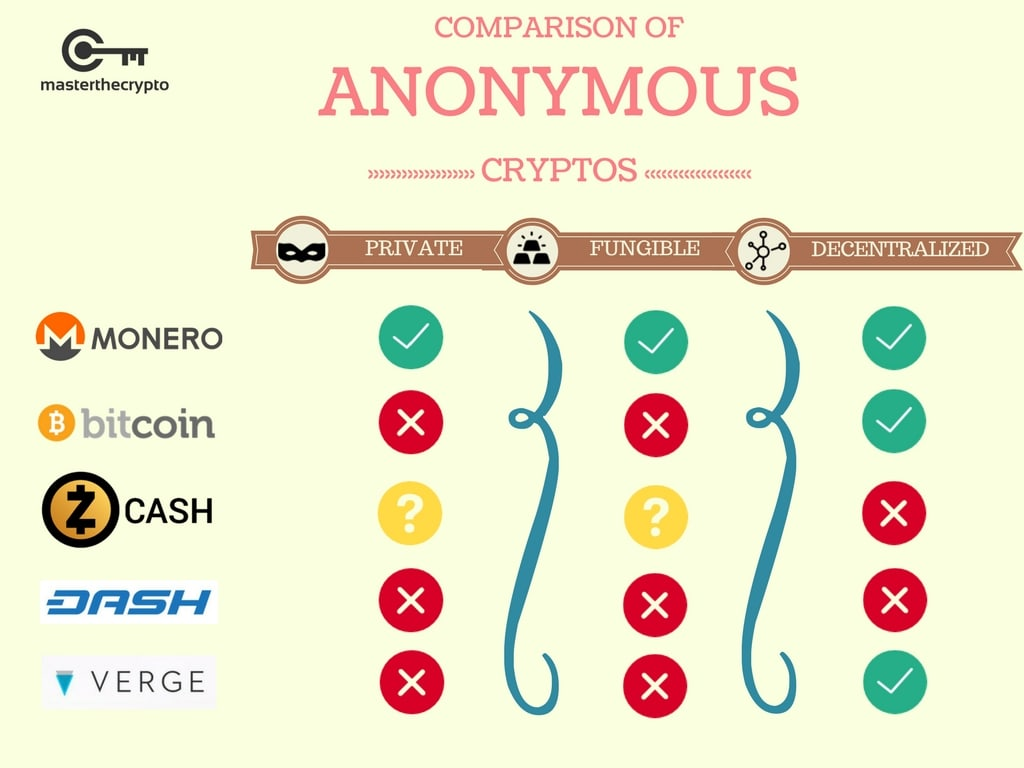
As we can see from the table above, not all cryptocurrencies offer true decentralization, fungibility and privacy. This generally comes down to how currencies record transactions, deal with regulations and process payments.
Fungibility, in particular, refers to how interchangeable an asset is with other assets of the same type. Fundamentally, for a currency to be successful, it should be fungible to protect its value from a loss of confidence.
While Bitcoin is a hugely successful cryptocurrency and by far the most popular available to investors today, it simply doesn’t offer the same levels of security as Monero. Bitcoin doesn’t have strong fungibility because it records its transactions on public blockchains that can be viewed by anybody. This means that it’s possible for central governments to utilise chain analysis companies to trace coins involved in illegal transactions – leading to a trainted coin problem. Due to this, the market for newly minted coins with no past history is steadily growing.
To counter this, Monero’s blockchain technology is built on an obfuscated ledger that prevents anybody from viewing data related to transactions taking place on the network. The protocol ensures that details of amounts transferred, the address of origin and recipient details aren’t accessible. To achieve a consensus on transactions, Monero uses CryptoNight – a proof-of-work algorithm that uses the CryptoNote codebase.
However, despite Monero’s watertight framework, there’s been no shortage of powerful organizations aiming to breach the walls of the powerful privacy coin.
Beating The Bounty Hunters
The impregnible nature of Monero has left the coin with plenty of admirers, but for other governmental entities, like the US Internal Revenue Service (IRS), the prospect of cracking a heavily encrypted and entirely private coin to view the potentially criminal activities underneath is so tempting that a bounty has been issued to whoever can crack the coin.
In October 2020, crypto-intelligence firm Chainalysis and data forensics company Integra Fec won contracts from the IRS totalling a collective $1.25 million to try to crack Monero’s framework.
To help with their task, the IRS has advanced $500,000 to each firm in order to develop a functional tracing tool – with another $125,000 in the pipeline if the tool proves successful and is approved. The firms must produce a working submission in eight months, while testing and development will take place over the following four months.
The IRS intends to finance a solution that will enable it to track transactions to specific users, and identify certain details that can provide more information on network activity.
Chainalysis will be confident of breaking Monero down, and has previously claimed that it can track 99% of transactions involving Zcash and virtually all of the transactions of Dash – with both coins acting as more privacy-focused cryptocurrencies, similar to Monero.
However, the hyper-secure framework of Monero has led the coin to becoming an undisputed industry leader when it comes to leveraging fully private transactions. In issuing a bounty on the successful cracking of Monero may backfire for the IRS – if Chainalysis and Integra Fec fail to crack the coin, it could be seen as a green light for more criminal activity to take place using the coin.
Investing in Privacy
In pure investment terms, it’s fair to say that Monero has a bright future. As one of the only cryptocurrencies that offers truly decentralized privacy to uses, many will argue that it’s one of the only coins that’s kept true to the blueprints of the crypto market place.
The IRS attempts to undermine the security of Monero could play a big role in the future value of the cryptocurrency. If, in 2021, the Monero framework is cracked open, exposing the transaction information of buyers and sellers, the results could adversely affect the coin, with adopters losing faith in one of the currency’s most unique features.
If, however, by the end of 2021, Monero remains as secure as ever, it could lead to even more confidence from investors that they’re buying into one of the more pure interpretations of crypto.
Although its more shady usage could hurt the widespread adoption of Monero in the short term, the privacy coin has the potential to dominate the market if Bitcoin’s lack of security becomes an issue in a more regulated future.
For now, Monero appears to be pretty happy to continue building on its value without the help of outside influences. If the IRS fails in their bid to crack the coin’s framework, we could see more significant rises than just the 100% that took place between 2019 and 2020. The sky could truly be the limit for the world leaders in privacy.