Tortola, British Virgin Islands, 11th March, 2021, // ChainWire //
Cryptocurrency exchange and digital asset technology group BTSE has completed its latest fundraising round, achieving a $400 million valuation.
The round, which concluded on January 31, raised a total of $22 million and attracted investment from a range of backers including family offices. The primary investor is a leading family office based in Hong Kong.
Jonathan Leong, co-founder and CEO of BTSE, said: “It gives us enormous pleasure to conclude this latest round, which marks another important step towards BTSE becoming a bridge linking traditional finance with the world of digital assets.
“Investment is of course critical as we transform into a comprehensive digital bank encompassing both fiat and cryptocurrencies, and to have achieved a $400 million valuation on the basis of recent funding attests to this vision and to the broad health of the digital currency ecosystem.”
BTSE facilitates the trading of leading cryptocurrencies in the spot and futures markets and is powered by its native BTSE Token, which allows users to save on trading fees and to increase referral bonuses. The platform recently introduced an Earn feature that allows users to earn a passive income from their crypto-assets without exposing themselves to market volatility. For example, lending BTSE tokens to the platform can generate APY of 6.5%. BTSE does not require a minimum deposit, there are no fees on deposits, and the platform supports 13 fiat currencies. BTSE also supports multi-asset margin and settlement, 100x leverage, and several fiat on- and off-ramps. Additionally, BTSE will soon offer fiat top-ups directly through credit cards for much more simple user interactions.
About BTSE
Founded in 2018, BTSE’s ultimate goal is to become an institution that bridges the existing traditional financial system with the monies of tomorrow, to figuratively and literally break the language barriers across generations, continents, and cultures. BTSE will continue to build trust and mindshare, fostering a community of like-minded enthusiasts ready for a new frontier in finance and self-sufficiency.
Elon Musk, the CEO of Tesla, is a notable supporter of Bitcoin and Dogecoin
He often tweets his opinions about cryptocurrencies and company stocks
A quick comparison of his tweets with market data shows that Musk has the power to lift an asset up or even cause it to plunge
Elon Musk is reportedly already under investigation by the U.S. SEC for his Dogecoin tweets
Elon Musk, one of the top U.S. entrepreneurs and the richest person alive as of January 2021, has always been very active on his social media accounts, especially Twitter. However, between the SpaceX rocket launch videos and Tesla’s announcements, one can find several tweets that discuss stocks and lately cryptocurrency projects as well. Tesla CEO, whose net worth is estimated to hover around $185 billion, can have a significant impact on markets thanks to his massive reach of 49 million followers. the promoted stock, or crypto pumps.
What is the “Elon Effect”?
Due to his wealth, recognition, and number of Twitter followers, Elon Musk is undoubtedly one of the most influential people on social media. As such his tweets have the power to either drive in additional investors if the comment is positive, or even trigger sell-offs if his opinion on a certain asset is negative.
In reality Musk’s tweets are often too short to reflect his more elaborate opinions as they consist of just two or three words. Nevertheless, the mention of a cryptocurrency or stock alone is enough for some retail investors to throw money at the mentioned asset. While some are really influenced by the hype that the influential automaker’s CEO is spreading, many have figured out that trading based on Musk’s Twitter activitycan be a way to make a quick buck by monetizing on the hype. There have been numerous examples of assets making notable price moves right after Musk mentions them publicly.
Bitcoin, Dogecoin, GameStop and even Tesla – Musk has Tweeted About Them All
In the past, Musk has tweeted mostly about U.S. stocks. In the past years, however, the entrepreneur’s interests have also shifted to cryptocurrencies. And because certain cryptocurrency markets are still dominated by retail investors it is the cryptocurrency market, the “Elon effect” has been hugely impactful. Musk is especially fond of Bitcoin and Dogecoin.
In fact, the recent Dogecoin renaissance, which caused the almost-forgotten meme coin to surge from below $0.01 to over $0.08 on February 7, can partly be attributed to a series of Musk’s Dogecoin-related tweets and statements. The most recent addition to the collection of his Doge remarks is:
Leaving the cryptocurrency that was created in 2013 as a joke aside, Musk is also interested in the world’s largest and most reputable cryptocurrency – Bitcoin. On January 29, 2021, Elon Musk changed his Twitter bio to #Bitcoin and the world’s largest cryptocurrency climbed by around 20% in the following 24 hours raising the Bitcoin’s total market capitalization by more than $50 billion. The Tesla CEO is clearly a big Bitcoin supporter, which has undoubtedly played a crucial role behind the automaker’s recent $1.5 billion BTC investment. Tesla’s BTC investment has already produced significant (unrealized) gains.
On February 20, Musk said that the prices of Bitcoin and Ethereum seemed high. In the week following the tweet, the price of Bitcoin dropped from an all-time high $58,000 to $43,000. However, it might be unfair to say that Musk’s tweet had an impact in this sell-off, as it started more than a day after the tweet and Bitcoin might have been due for a price correction anyway after rallying to a new all-time high.
In one of the recent interviews, Musk stated that he is a Bitcoin supporter as well as confirmed that he is well aware of how his statements could affect the markets. He stated:
“I’ve got to watch what I say here because some of these things can really move the market… I do at this point think bitcoin is a good thing, and I am a supporter of bitcoin. I think bitcoin is really on the verge of getting broad acceptance by conventional finance people.”
Interestingly, Musk’s tweets have also impacted the price of the shares of his own company Tesla. In a Twitter post dating back to May 1, 2020, he wrote that he believed the price of Tesla shares were too high. Following that tweet, the valuation of his company plunged by more than 10%. These examples prove that no matter what he’s posting about, his opinion matters a lot to many investors. As such, he has the power to move the markets in one direction or another.
Is This a Form of Market Manipulation?
Judging by the aforementioned examples, Musk can significantly influence the market of literally any tradable asset by tweeting just a few words. However, the “Elon Musk” effect is especially strong on small market cap assets and assets with less mature markets and infrastructure. In addition, Musk’s statements indicate that he is aware of his power. Therefore, several experts have urged the U.S. Securities and Exchange Commission to investigate whether this is a case of market manipulation or not. Economist Nouriel Roubini is one of the most vocal financial experts to call for the SEC’s attention. He stated:
“For somebody like Elon Musk, who knows he has the market impact to manipulate, first take an individual position in Bitcoin, pump the price up, and then say that Tesla has invested. And Tesla does not make any money yet, it is also irresponsible, and it is market manipulation. The SEC should be looking into people that have a market impact, and that manipulate the price of assets. That’s also criminal behaviour.”
Reportedly, the SEC has indeed started an investigation of Musk’s Dogecoin tweets. The Bitcoin related posts and bio changes are allegedly not being investigated. However, unconfirmed rumours have surfaced that Musk has already deleted some of his old Bitcoin-related tweets.
The world of Bitcoin is known for many things. While most people focus on Bitcoin’s money-making capabilities, there’s a lot more than meets the eye once you dig deep into the crypto scene. Right now, Bitcoin covers multiple fronts, but one of the most interesting aspects of Bitcoin you can explore is entertainment! Thanks to the massive growth Bitcoin has achieved over the years, users can access premium entertainment by dipping into their Bitcoin wallets and spending a few bucks. If you’re looking to have a bit of fun with Bitcoin, here’s what you can go for.
Bitcoin Gaming
Bitcoin has been a big part of gaming for a long time now. While it all started with Bitcoin appearing as a payment option in online casinos, it’s recently expanded to reach far beyond just real money gaming. Gamers can use their Bitcoin savings to buy popular titles on consoles, PC, and mobile by visiting online stores like Keys4Coins and grabbing a digital copy! What’s better console fans can buy some of the best upcoming games directly from the Bitcoin-friendly Microsoft Xbox Store and PlayStation Network!
Another gaming option with Bitcoin is playing Bitcoin games. These free minigames are hosted online and offer players a chance to earn some Bitcoin if they do well! While they’re very entertaining, Bitcoin games won’t earn you much. An excellent laidback profit alternative is going for trading software. Software like the Immediate Edge app uses advanced AI to track changes on the market and invest in opportunities that have the best outcome. Using these apps requires no trading knowledge and only takes a few minutes of your time each day to set specific goals.
Bitcoin Vacations
Sure, a vacation might not be entertainment in the sense you might think, but what’s more entertaining than going on an adventure abroad and having the time of your life? Travel opens up doors to millions of opportunities to keep yourself entertained. The simple act of visiting a new location means immersing yourself in new cultures and meeting new people, which is more than enough excitement than most people can handle.
Naturally, going on vacation usually means fun on the beach if you’re visiting somewhere exotic, a ski adventure if you’re at a winter wonderland or all kinds of new experiences in a big metropolitan! The good thing about all of this is that you can now easily make it possible with Bitcoin! Some of the best booking sites are now Bitcoin-friendly, so booking a flight and accommodations to practically any location in the world is easy as pie. All you need to do is visit Expedia or CheapAir, tick the boxes, and start packing your bags!
Bitcoin Streaming
It’s safe to say that streaming services are something all of us can appreciate. These excellent platforms give us a chance to pick and choose what we watch whenever we want, wherever we want. Thanks to their multi-device approach, users can enjoy their favorite movies and TV shows on their computers, tablets, and smartphones without running into any issues. As long as you’ve got a solid internet connection, you can immerse yourself in new worlds as much as you want.
As you’re probably already aware, most of the popular streaming services like Amazon Prime, Netflix, and Hulu don’t accept Bitcoin as a payment method at the moment. Luckily, Bitcoin users have found a way around this slight issue. Thanks to Bitcoin-friendly online shops like Coinsbee, you can buy gift cards for most major streaming services and start your subscription! With that out of the way, you’re free to enjoy some of the best TV shows that Netflix and other platforms have to offer.
Would you like to own one of the most promising tokens of 2021?
FreeBitco.in is running a 2 Million FUN Token Giveaway. A ‘Refer and Earn’ program with a twist, this contest gives crypto-enthusiasts the chance to win a massive amount of FUN Tokens, for free.
The best part: it’s open to all!
Let’s take a look at the token, the contest, and the entity behind both of them:
The FUN Token
FUN Token is an ERC20 token developed specifically as a decentralized transactional solution for online gaming. It’s listed on major exchanges like Binance, Bitfinex, HitBTC, OKEx, and decentralized exchanges like Uniswap. 1 FUN = 0.029 USDT at the time of writing.
Originally created by FunFair Technologies, FreeBitco.in recently acquired 3.75 billion FUN Tokens and took over the reins of the coin.
FreeBitco.in recognized the potential of the token as a disruptive solution that could solve the existing problems plaguing the iGaming industry. Consequently, the seventh-largest online gambling website in the world introduced a venture: a Premium Membership Programpowered by the FUN Token.
Users can buy FUN Tokens at FreeBitco.in and hold them to earn extraordinary benefits.
Following the popularity of this program, FreeBitco.in introduced the 2 Million FUN Token Giveaway.
The Contest: How to Participate and Win
Both FreeBitco.in users and non-FreeBitco.in users can participate in the giveaway. Follow the steps given below to do so:
Sign up at FreeBitco.in with just your email address
Visit the ‘Token’ page
Click on the link that says “REFER YOUR FRIENDS AND WIN 2,000,000 FUN TOKENS!”
Scroll to find your referral URL
Use your social influence to share your referral URL and invite your friends to the Premium Membership Program
Every FUN Token purchase made by your referrals is linked to your account
On 15th March, the Top 10 referrers win 2 Million FUN Tokens, for free!
The more your referrals purchase, the higher you get up the leaderboard, and the higher your rewards!
The contest ends on 15th March. Sign up now to participate and get your hands on one of the most promising tokens this year!
About FreeBitco.in
Founded in 2013, FreeBitco.in is one of the largest crypto-gaming websites on the internet. FreeBitco.in was created to promote Bitcoin’s utility and facilitate its adoption. However, it has grown by leaps and bounds since then.
Powered by a fully automated, proprietary tech-stack, FreeBitco.in features a simple but powerful HI-LO Dice Game supplemented by contests, rewards, jackpots, and a popular Lamborghini giveaway. With 41 million users, 52 million monthly visits, and a $600 million-per-annum wagering volume, its influence on the Bitcoin community is significant.
SuperFarm will be integrating with Polygon to deliver fast and low-cost NFTs on layer-2. Polygon (formerly Matic) is the preeminent developer of Ethereum scaling solutions and is at the forefront of pioneering L2 technologies.
Integrating SuperFarm with Polygon will open the door to cheap NFT minting, swapping, and selling, making digital collectibles accessible to mainstream users. Polygon has established a pedigree for supporting NFT projects including Aavegotchi, Neon District, and Decentraland.
Sandeep Nailwal, Co-founder of Polygon said: “Users are priced out of interacting on-chain due to high gas fees on Ethereum. Polygon’s scaling solution aims to solve that and provide a superior user experience without compromising on security. SuperFarm on Polygon allows mainstream users to interact on-chain to mint, sell and farm NFTs at a significantly (<$0.01) reduced cost.”
With an active community of NFT collectors already established on Polygon, Polygon community members will soon be able to farm exclusive NFTs on the SuperFarm platform that will have utility within AAA Video Games and elsewhere. This will enable Polygon users to farm exclusive NFTs without diluting the circulating supply.
Polygon’s scalable sidechain technology allows crypto projects to enjoy the best of both worlds: the security of the Ethereum mainchain coupled with the low-fee environment of L2. Because Polygon is compatible with established Ethereum developer tools such as MetaMask and Remix, it’s easy for developers to build on L2.
Matic Plasma is the first implementation of Polygon’s layer-2 technology, but since rebranding, Polygon has committed to developing other scaling solutions such as zk Rollups and Optimistic Rollups. As part of the Polygon ecosystem, SuperFarm will be among the first projects to benefit as these scaling technologies come onstream, creating a thriving digital collectibles market that’s open to everyone.
About SuperFarm
SuperFarm is a cross-chain defi protocol designed to bring utility to any token by turning it into an NFT farm with no code required. SuperFarm provides a bridge between current crypto ecosystems and the explosive gaming industry. NFTs from SuperFarm and Official Partner Farms will gain utility within real AAA video games. In this ecosystem, NFTs are no longer just pixels on a screen, but hold power to unlock unique digital experiences.
Polygon is a layer-2 scaling solution backed by Binance and Coinbase that is committed to scaling the Ethereum network. Its first product, Matic PoS chain, is based on a version of Plasma and used by such projects as Polymarket, Aavegotchi, Decentraland, SportX, and Neon District. The Polygon team is now developing its PoS chain in conjunction with complementary scaling solutions that will be selectable via the Polygon SDK.
Razor Network, a leading decentralized oracle platform, have partnered with Ambee to provide accurate and reliable environmental data to blockchain applications and users. With this association, Razor Network will be compatible with high resolution data from Ambee, and will support APIs for air quality, weather, pollen, fire, soil, water vapour and more.
This partnership will help developers on leading blockchain platforms use Ambee’s environmental data via Razor Decentralized Oracles to develop a range of applications that apply blockchain to deepen problem solving for businesses that are affected by environmental factors and climate change.
Currently, data related to hazardous fluctuations in the environment are not verifiable, publicly available, tamper-proof, and most importantly, scalable. This is where Razor Network Decentralized Oracles will play a pivotal role in providing robust, trustworthy, and reliable environmental data for industries, authorities, citizens, and researchers across the globe. Startups in the DeFi, Insurance, and other Environmental Blockchain Startups will be able to use this verified data available on the Razor Network Decentralized Oracles.
Ambee uses a multimodal approach to monitor air quality at a street-by-street level. In addition to government sensor data, proprietary IoT sensors, and open-source data, Ambee uses satellite imagery, weather and meteorological data, to measure air quality. Ambee’s proprietary algorithms carefully factor in human activities like garbage burning, vehicular traffic, construction and industrial emissions that play a major role in pollution and GHG emissions, and other hyperlocal environmental factors.
Razor’s oracle network is blockchain agnostic, which enables Razor’s solution to be used by developers irrespective of their platform of choice. Razor offers maximum game theoretical security and a completely decentralized infrastructure, which makes Razor’s Oracle network superior to all conventional centralized solutions.
Solving a 7M Deaths a Year Problem
A report by the World Health Organization indicates that air pollution kills an estimated 7 million people worldwide. Air pollution is at the epicenter of climate change and tackling it has been a massive challenge for citizens, businesses, and governments across the world. The lack of real time environmental data can lead to major health risks as well as economic loss. This is where Ambee’s environmental intelligence data plays a pivotal role in providing real time air quality insights that can help with data driven decision making.
Incorporating environmental data in blockchain applications addresses multiple environmental challenges and helps fight climate change. It can be used to ensure transparency in claims made by companies on environmental impact, make supply chains more transparent and encourage citizens through financial rewards to adopt environmentally friendly practices. It can also help understand the primary causes behind increases in temperature, and track emission of greenhouse gases at a post code level. In addition to this, in the field of agriculture, weather and soil data can be used for forecasting yield, better crop management and measuring risks associated with extreme weather conditions.
Hrishikesh Huilgolkar, CEO, Razor Oracle Network, said, “Razor’s integration with Ambee API will be a foundation to help blockchain developers access secure and verified environmental intelligence data. This will address the problems of data reliability that exist in pollution monitoring and it will help developers to use this data to create applications that can be used by major Industries, Government Agencies and Healthcare companies worldwide.
Commenting on the partnership, Madhusudan Anand, CTO and Co-founder at Ambee, said “One of the ways to address key environmental issues is by bringing in behavioural change among people. We are happy to partner with Razor Network to make our environmental data available on blockchain. It can help in finding solutions for pressing environmental problems. Blockchain developers can now use our hyperlocal real time air quality data for building financial products like crop insurance, risk assessment, ESG and climate-related financial instruments”
About Razor Network
Razor Network is a completely decentralized Oracle network for Decentralized Finance and other distributed applications and services. Razor avoids any weakness associated with conventional centralized oracle networks, and is secured by a highly efficient Proof of Stake network which punishes misbehaving nodes through a strict Slashing mechanism. Razor has already partnered with some of the leading players of the blockchain industry, including Matic Network, SKALE Network, Persistence, Mantra DAO and OpenDeFi. The headquarters are located in Singapore.
About Ambee:
Ambee is an environmental intelligence startup that measures, processes and analyzes hyperlocal air quality data in real time. Using AI and IoT, Ambee provides location specific, real time air quality data and actionable insights to businesses and consumers to mitigate the effects of air pollution. Ambee was started with an aim to provide access to environmental data and tools that enable a better living experience.
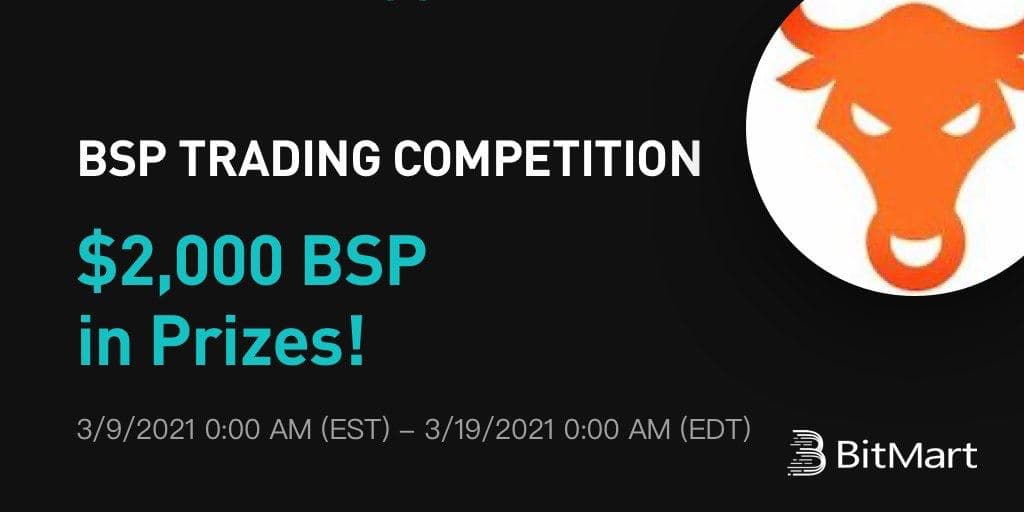
Launched by BitBall’s partner BitMart, Ballswap was launched through Shooting Star offering. Shooting Star simplifies the listing process for high-valued blockchain projects and provides users with relatively favorable rules.
Shooting star launch was a record-breaking success with BSP distributed to 5000 participants under 1 minute of launch.
Next update on Ballswap: AMA session on #Bitmart exchange WeChat & Telegram community
Telegram chat group: 11 March in English
WeChat chat group: 12 March in Chinese
All the questions regarding #Ballswap & our #defi platform launch will be answered there.
Join & share $600 worth of #BSP in both session.
Next update: AMA session on #Bitmart exchange WeChat community.
“Ask me anything” session on Bitmart #WeChat chat group will be held this Friday.
All the questions regarding #Ballswap & our #defi platform launch will be answered there.
BitBall launched in August 2018. The team aims to become a cryptocurrency accepted as a means of payment in real-life multi-function scenarios. Bitball’s mission is to build an ecosystem to bridge the gap between digital currencies, exchanges and customers. It started with an online Barter platform for goods & services that facilitates cross-border transactions with a user-friendly interface for international participants based on cryptocurrency and Fiat.
BitBall is intended to be deployed as a means for users on the upcoming Ebarter platform to buy or sell products or services around the world at a low cost. Since its launch, Bitball has developed multiple use cases:
Cryptocurrencies (BTC, BTB, ETH, BTRS) & Fiat (Paypal) based E-Barter trading platform
The team is committed to opening a traditional cryptocurrency exchange and increasing trader adoption. Based in Australia, Bitball’s mission is to serve as a long-term investment.
About BitBall Treasure
BitBall Treasure (BTRS) describes itself as a Treasure coin, a Store of Value, faster than Bitcoin (a fork of Bitball) with more functionality as a Treasure with a maximum stock of 1 million. BTRS is the only digital currency that can be used to trade treasure items on the Bitball merchandise page.
BTRS has a maximum supply of 1 million that will be released in small amounts on some occasions. BitBall Treasure will be used for VIP Sale items on its trading platform. By paying via BTRS, users will save about 20% on transaction costs.
Konstantin Anissimov, Executive Director at CEX.IO
The capitalization of the global cryptocurrency market is down by almost 0.7% in what appears as a gradual shed-off of the massive gains recorded in the past 24 hours and since the beginning of the week.
As is obvious based on the imminent volatility in the market, every new pump in price is bound to be accompanied by a reversal, most of which are healthy for a refreshed run. The gradual dip the market appears to be experiencing is based on the price action of the two biggest digital currencies, which are, Bitcoin (BTC), and Ethereum (ETH).
Seeing growths is perhaps a source of delight to market enthusiasts as both cryptocurrencies have wedged through the most difficult of months, paring off gains amidst uncontrolled sell-offs. For Ethereum, the reasons are quite clear, the network fees are reducing its usage and pushing users to alternative blockchain networks while Bitcoin’s struggle is best attributed to early HODLers taking off profits from the skyrocketing runs it made about a month ago.
While both coins appear to be charting different paths for themselves, today’s analysis explores the technicals behind both the retracement being seen, as well as the bull case for imminent near-term growth.
Bitcoin Bears Attempting To Stall Growth
Bitcoin’s market bears, essentially those selling their holdings on cryptocurrency exchanges or other marketplaces, are unrelenting in preventing the joyous ride to new highs. At the time of writing, BTC is trading at $53,950 according to data from CEX.IO price feeds, a slight gain of 0.17% in the past 24 hours. The coin was down in the early hours of trading.
Bitcoin’s rise above $50,000 began on Monday and the ultimate goal is to beat the $56,000 resistance to surge past the previous all-time high price above $58,000. The market bears are making this bullish ride a daunting one despite key institutional investors reporting bullish news about the cryptocurrency.
For instance, the Bitcoin technology solutions provider NYDIG revealed that it had attracted $200 million in a growth capital round led by Stone Ridge Holdings Group, Morgan Stanley, New York Life, MassMutual, Soros Fund Management, and FS Investments. This move is set to usher in a basis for new institutional money flowing into the digital currency. The bears are obviously preventing the bulls from riding on this bullish news.
The BTC-USD chart is somewhat divided when it comes to the direction of the price of Bitcoin. The coin’s price has sliced through the Parabolic SAR indicator, showing a price reversal from the uptrend that has been active since March 6th, 2021. Should the bears be forceful enough to keep the price below this level in the next couple of hours, Bitcoin’s price may fall back below the $50,000 support.
The twists that exist in the market could also spell a renewed vigor for the market bulls. With the RSI still in the buy zone and with a bullish short-term moving average, the price of BTC may touch the $56,000 in the short-term, and $60,000 in the mid-term.
Ethereum Price Not Reflective of ETH 2.0 Smart Contract Deposit Figure
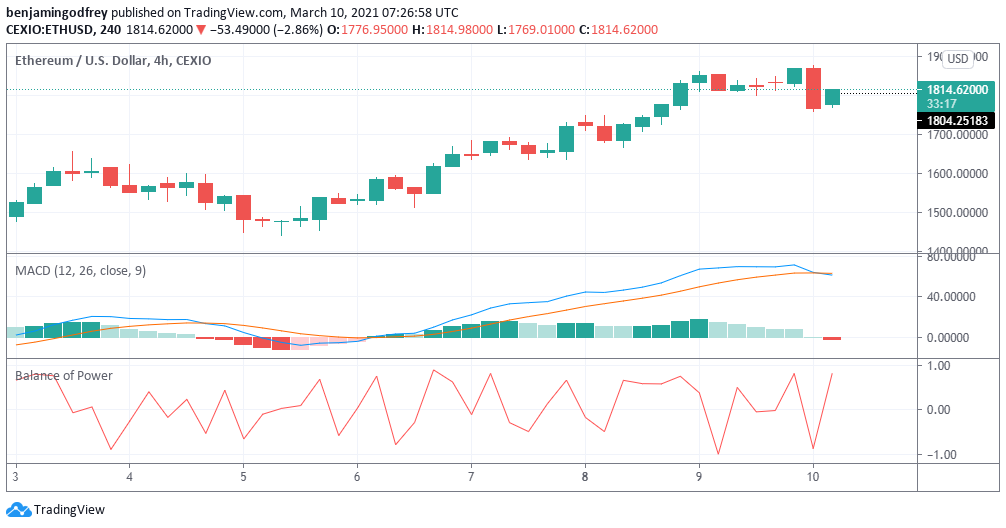
Ethereum (ETH) is shedding off more losses than Bitcoin with a dip of 1.24% at the time of writing to exchange hands at $1,808.90. The inconvenience of the current Proof-of-Work model as mentioned earlier is giving competing networks an edge, a bearish enough scenario for Ethereum.
However, the dip to the abyss may not be sustained in the longer term as on-chain data from Glassnode shows that the total value locked in Ethereum 2.0 smart contract deposit address has hit an all-time high of $6,467,550,120.47, showing the trust in the network’s prospect in the long-term.
But with a dropping price in Ether, governed by the Proof-of-Work model, one could argue that the confidence amongst Ethereum bulls is for the future and not necessarily for the price performance of the coin now. However, when we consider the fact that both networks are going to be working synergistically until full integration into the PoS model, today’s Ethereum will undoubtedly benefit from whatever hype Ethereum 2.0 receiving.
Consider the ETH-USD chart on TradingView, the bulls are poised to take control of the market from the bears, suggesting the on-chain data as described is effective in stirring positive sentiments amongst the market movers.
Per the Balance of Power indicator which is close to the 1.00 high, ETH’s bullish trend is unquestionable, a confirmation of which may be given by the Moving Average Convergence Divergence whose line is seen at par with the signal line. Should the MACD line disengage from the signal line and chart a path upward, Ethereum will undoubtedly break the $2,000 resistance in the short term, and $2,500 will be on the horizon in the mid-term.
The cryptocurrency market appears to be turning bullish again with Bitcoin retesting the highs of around $54,000. Nevertheless, this week’s selection focuses on coins that are not among top 10 cryptocurrencies by market cap. These three cryptocurrencies all have slightly different use cases, but there is one they all do have at least one thing in common. All three projects could drastically benefit from the recently made announcements, airdrops, or upgrade deployments this week, which makes them a potentially lucrative investment. In must be noted, however, that this is not investment advice and that you should do your own research prior to investing in any of these assets.
1. Enjin Coin (ENJ)
Enjin Coin (ENJ) is an Ethereum-based cryptocurrency (ERC1155 token) used to directly back the value of next-generation blockchain assets. It is designed for social gaming as it allows virtual goods to be traded on the blockchain using smart contracts and ENJ as a payment method. The project aims to change the fundamental nature of virtual worlds by providing infinite high-speed transactions between players and game providers at zero cost. More than a million people are already using Enjin’s products to manage, create, and trade blockchain assets.
ENJ sets its new ATH price following scaling solution announcement and increased adoption in Japan
The Enjin team recently announced that their project is evolving into a multi-chain ecosystem for non-fungible tokens (NFTs). The Enjin’s ecosystem will now spread across the Ethereum, as well as JumpNet and Efinity blockchains and support with the support for both fungible and non-fungible tokens. JumpNet is a layer 2 solution, that acts as a high-speed bridge network, facilitating free and instant on-chain transactions of Enjin Coin and ERC-1155 tokens. Efinit, on the other hand is a NFT-specialized decentralized blockchain that will support next-generation token features and assets from any blockchain. Two-way bridges between Ethereum, JumpNet, Efinity, and third-party chains will be established, enabling users to easily mint and transfer tokens onto multiple networks without having to pay astronomical gas fees.
In addition, Enjin has been approved by the Japanese Virtual Currency Exchange Association (JVCEA) in January. JVCEA is a reputable self-regulatory organization. which is also recognized by the Japanese Financial Services Agency (FSA). Following the JVCEA’s approval ENJ has been listed on Coincheck, one of Japan’s largest exchanges. This marked an important step in project recognition and adoption, as ENJ became one of just 15 select assets available for trading on Coincheck and the first specialized gaming token to be made available for trading to Japanese investors on this exchange. On March 3, 2021, another Japanese exchange – the GMO coin exchange, has added support for Enjin Coin, indicating that the project is really gaining some traction in Japan.
These events have also materialized in a very bullish ENJ price action. ENJ is up by 110% in the past week and 330% in the past month. The specialized gaming token set its ATH price of $1.94 on March 9. ENJ has since seen a slight correction as it dropped back to around $1.70, where it is currently trading. Nevertheless, the general uptrend is still evident.
2. NEM (XEM)
NEM smart asset blockchain platform launched in March 2015. The platform utilizes a pioneering Proof of Importance (POI) consensus algorithm to validate transactions and issue new XEM coins. In addition, NEM is written in Java and allows applications written in any programming language run on its blockchain, which is achieved through APIs. NEM is used by several financial companies in Japan and is the cornerstone of the Mijin private blockchain.
Symbol Blockchain to launch on March 15, Snapshot for the Airdrop Scheduled for March 12
The much-anticipated launch of the Symbol business blockchain is finally just around the corner. The mainnet genesis block of the new trusted and secure business environment is scheduled for March 15, exact time TBC. Three days prior to the launch of Symbol the snapshot of XEM blockchain will take place. XEM holders who have opted in for the Symbol (XYM) airdrop will receive 1 XYM for every XEM held at the time of snapshot. The snapshot height will take place at block height of 3,105,500. At the time of writing, a total of 27,666 accounts, holding 3,825,081,007 XEM combined have confirmed their wish to participate in XYM airdrop. More information about the Symbol blockchain and instructions on how to opt in for the XYM airdrop can be found here.
3. Bao Finance (BAO)
The BAO token acts as the governance token of the fully community-run DeFi yield farming project. Rather than re-inventing the wheel Bao focuses on improvement and adding new features to the existing protocols. The project is a combination of Synthetix and Aave protocol, for Uniswap, SushiSwap, and Balancer markets. While the developer claims that the assets are partially backed by the insurance fund where all Bao fees go, the official website notes: “Bao Finance is in alpha, it is unaudited and was originally developed by a one-person self-taught team. While we are in the process of scaling the team, please understand the risks and use this product accordingly.”
BAO to integrate with SushiSwap protocol in Q1 2021
The BAO protocol is considered an altcoin gem with lots of room to grow by many. The anonymous developer posting under the name of @thebaoman is constantly striving to improve the protocol. In light with this high dedication, new, fixed set of xDAI pools has been deployed recently. Users are encouraged to withdraw the assets from the old pool and transfer to the new one, which also features an improved UI. In addition, BAO has recently been featured on SushiSwap’s list of project that will integrate with the DEX and liquidity protocol in Q1 2021. Although the project is still in alpha phase, the FTX exchange has already added support for BAO. Users of the aforementioned exchange can now trade BAO for a USD stablecoin as well as use BAO as a collateral in their margin trading accounts. BAO is currently changing hands at $0.001145 with a 24-hour trading volume of $ 2.89M across 6 exchanges. The project has a $39 million market capitalization, which puts it on the 417th place of biggest cryptocurrencies. However, many DeFi enthusiast believe that the project is set to claim much higher spots on this list, provided that the development of the protocol goes as planned.