The global cryptocurrency market is seeing a general uptrend, coming in as a healthy bullish resurgence following a downcast rally seen across the board yesterday. Bitcoin (BTC) and by effect Ethereum (ETH) is particularly energized as Chinese tech firm Meitu Inc doubled up on its accumulation strategy. The firm scooped up an additional 175.6 Bitcoins for $10 million bringing its total holdings to 31,000 ETH and 940 BTC.
Following Meitu’s boost, the technicals are pointing to a bullish spike for both digital currencies.
Bitcoin’s Resilience Seeking to Retest the $60,000 Psychological Level
Per the BTC-USD Daily Chart, Bitcoin has been experiencing a price suppression from the $60,000 resistance level for close to a month beginning on March 15th. While a break beyond this level seems daunting for the bulls to pull off, Bitcoin’s current price close above the 50, 100, and 200 Simple Moving Averages is a bullish factor for an imminent pull-up.
At the time of writing, Bitcoin is trading at $58502.2, up 3.14% in the past 24 hours per data provided by CEX.IO. Should the buyers intensify their push beyond the $59,000 resistance point, a price stir to $61,000 may be the next stop. Any pullback is certain to settle at the $56,000 support level in the short term.
Ethereum Still Taunting Bitcoin Per Rate of Growth
To the unbridled eye, Ethereum’s push to discover new price territories may not be as aggressive as Bitcoin’s, but in reality, Ethereum’s daily, and weekly rate of gain amongst others dwarfs that of Bitcoin. Currently exchanging hands at $2081.97, amounting to a 4.1% growth in the past 24 hours, Ethereum’s fight to close above the $2,100 price mark is getting intensified.
The technical indicators, that is, the Moving Average and the Chaikin Money Flow on the ETH-USD Daily chart as seen on TradingView both points toward continuous growth paths. Ethereum bulls are eyeing a short-term close above $2,100, a move that will be achieved with a little more pressure to repel the bears.
“Education is a cornerstone of the work we do at Bitcoin Association, as we help businesses and individuals alike understand the Bitcoin system envisioned by Satoshi Nakamoto, and how Bitcoin SV is the only project implementing that Satoshi Vision. Bitcoin SV Academy will be a key component of that work moving forward, providing a platform to deliver a robust curriculum tailored to all levels of ability and knowledge, as we educate the world about just what’s possible with the power of the original Bitcoin protocol,”
Bitcoin SV Academy was established to make learning about the original Bitcoin design accessible to a wider audience through an online education platform that provides academia-quality and university-style courses and learning materials. This is in line with the objective of not only propagating awareness about Bitcoin SV, but also correcting misconceptions about Bitcoin that have been spreading across the Internet.
And this is precisely why the Introduction to Bitcoin Theory course has been made available for free to all beginners. The course discusses the original Bitcoin design according to creator Satoshi Nakamoto, known in the real world as nChain Chief Scientist Dr. Craig S. Wright.
The course is taught by Brendan Lee, head of technology at blockchain management consultancy Faiā, and Evan Freeman, an experienced technology educator and researcher passionate about Bitcoin innovation. There are 13 lessons totalling to nine hours of online classes. Bitcoin SV Academy is committed to educating people about what the Bitcoin SV blockchain actually is, its use cases and benefits.
“The most important piece of infrastructure that Bitcoin can have is access and availability of education—not only does it broaden the pool of talent available to work and build with Bitcoin, but it also helps to spread awareness of what Bitcoin as an entire technology system can do and is truly capable of,” Steve Shadders, Technical Director of the Bitcoin SV Infrastructure Team, commented.
Bitcoin SV Aacademy is soon to open the Bitcoin Development and Bitcoin Infrastructure courses for enrolment, all available in three levels: introductory, intermediate and advanced. There will be an assessment at the end of the course, and students will be awarded a certificate once they pass it.
To take the course Introduction to Bitcoin Theory, register here for free.
If you are a user of social media platforms such as Twitter or Facebook, you must be well aware that these giants have been utilizing your data to turn a profit. Private user data is by far one of the most valuable commodities on the internet, and the technology giants have been taking advantage of this for the past decade to turn billions in profit for their companies.
You see, on the outside, platforms such as Facebook and Twitter might seem free as they do not charge a subscription fee for you to use the platform. However, looking at it from the inside, the story is completely different.
An age-old saying goes something like “nothing is free in this world,” and that translates into the new digital world on the internet. There is another saying that states, “if you can’t see the sucker in the room – it’s you”.
Both of these sayings ring very true when we continue to use social media networks like Facebook. We might think they are free but, in reality, we are paying a very high price to have the pleasure of using them as we hand over our personal private data to the tech giants.
The giants would then go on to sell our private data to advertisers and institutions who end up targeting us across the internet in the hope that we buy their products.
Luckily, these media giants are starting to lose control of what they are able to do with our data as regulators are beginning to step in to prevent them from taking it from their users without their consent.
However, this is not enough.
Privacy-focused Blockchain Solutions
The creation of blockchain technology promises to bring about a decentralized financial system that takes the power from the centralized authorities that have been running it for centuries. However, this same technology can help revolutionize more than just the financial system.
For example, the successful Brave Browser has done well to use blockchain technology to provide a privacy-focused web browser for users that ensures they are not being followed around on the internet through third-party trackers and cookies. However, this still does not solve the problem posed by social media giants taking advantage of privacy rights.
Well, there is a new project on the block that has the main focus of returning data sovereignty back to the people through a blockchain-based social network.
Spearheaded by David Gelernter, a Yale computer science professor, and Rob Rosenthal, a Goldman Sachs and Wall Street veteran, Revolution Populi touts itself as being the project that will finally bring data sovereignty back to the people through its blockchain-based solution.
Revolution Populi’s goal is to provide a blockchain platform network that will allow its users to have the power to decide what data they would like to share about themselves and who would have the right to see it.
Firstly, the team has created a layer-1 blockchain that comes with the mechanics to allow users to manage access to the data that can be used by applications built on top of the blockchain – an example of such an application is a social network that the Revolution Populi team is building.
The blockchain has advanced the typical mechanisms that we see in the industry today with its Random Delegated Proof of Stake (rdPOS) consensus mechanism. rdPOS is similar to delegated Proof of Stake in the sense that there are 21 nodes that are actively maintaining the blockchain at any given moment. However, the advancement comes from the fact that the 21 nodes are randomly chosen from a pool of 63 elected nodes which provides a stronger balance between speed and broad participation.
The testnet for the layer-1 blockchain is already up and running and can be examined through their blockchain explorer. Additionally, the code for the blockchain is now open source and can be audited on the project’s GitHub.
Deeper Than Social Media
Although bringing data sovereignty is the number one objective, their concept can be taken much deeper than just a social network.
As mentioned, the social network is just the first dApp on top of their layer-1 blockchain. However, additional dApps can be built on top of the blockchain, which maintains the mechanism of the data sovereignty aspect.
For example, the team intended to build a cryptocurrency clearinghouse which will be an entity that gives confidence to participants within the market that trades will be completed.
Their technology was initially designed to be a clearinghouse for social media without selling user’s data, but they can also develop a neutral third party for financial institutions for all sorts of crypto transactions and become a clearinghouse in that sense.
The team has a wealth of experience in creating clearinghouses. For example, CEO Rob Rosenthal was a key negotiator for an industry group tasked with implementing a clearinghouse for credit default swaps in the aftermath of the 2008 financial crisis.
A clearinghouse in cryptocurrency would help to inject confidence and reduce counterparty risk. Bitcoin and Ethereum trades can rely on the public blockchain to provide confidence. However, when conducting cross-coin trades, the need for a clearinghouse between exchanges is vital.
The RVP Token
The Revolution Populi token (RVP) is the native asset for the layer-1 blockchain. The token was sold for ETH during a Dutch-style auction in which 1.2 billion RVP (60% of the total token supply) was distributed through the token sale.
This was the only token sale for RVP, and the team did not conduct any private sale. The RVP token will be listed on Uniswap and is expected to occur on April 7th at 8 AM EST.
Here is a quick breakdown of the token allocation:
Public sale: 60%
Escrow for blockchain operations: 10%
Escrow for grants: 10%
Marketing and administration: 10%
Revolution Populi team: 10%
As this is a delegated proof of stake blockchain, we can expect staking to be enabled on RVP for users to earn interest. Additionally, there are multiple use cases for the RVP token itself.
For example, the RVP would be used for transactions on the different dApps on top of the layer-1 blockchain, such as the social media network or any financial services through the clearinghouse. Additionally, it can also be used in the governance process as the RVP tokens will be utilized as votes for any proposals in upgrades to the projects’ infrastructure. For more information about the project and its token, users can check out the official Revolution Populi Telegram channel.
Conclusion
In conclusion, the solution provided by Revolution Populi has been needed for many years. This need for a privacy-focused social media network increased in recent years as data collation practices started to come to the public spotlight – causing fear that it could spiral out of control.
If Revolution Populi succeeds, it will provide a social media network that users can be sure that their personal data is being managed on their own terms and won’t unknowingly be sold to third party entities.
Uhive is a revolutionary new British creator-first social network that has made it its mission to turn current social networks’ business models on their head! The cosmic themed social network is the first social network to create Non-Fungible Tokens (NFTs) for its users’ profiles (spaces) and that’s just the tip of Uhive’s disruptive technology.
Uhive’s social universe, operates through a decentralized economy that is powered by the Uhive Token HVE2 (the network’s very own cryptocurrency). Users can explore interest based content through the Oasis – a spatial grid of virtual real-estate – and perform in-app purchases using the Uhive Token. In-app purchases vary from buying awards to reward creative content and provide it with more visibility through decentralized moderation (DeMo), to buying Spaces (profiles) that live inside the 26 interests within the Oasis. Spaces were designed to become NFTs from the conception of Uhive back in 2018.
Similar to the blockchain game Sandbox, where 1,078 virtual lands were sold in less than 60 seconds last February, spaces on Uhive are virtual real-estate, that users will be able to buy or sell. They have a virtual location in the Oasis, and a value that fluctuates depending on their popularity, traffic, engagement, and are subject to the same conditions as real-estate. For instance, when a space is surrounded by a popular space, a branded space, or a trending space, the value of that space and others around it would instantly increase. Uhive is essentially giving its users the property rights to their profiles and the creative content that they publish so they can fully take advantage of their value much like Beeple – the graphic designer and artist – did when he sold his digital art collection for $69 million!
Users on Uhive will truly own their space’s NFT, because they contain a unique token address on the Ethereum blockchain, specific to their space’s location, number of followers, content, badges, social scale, and rewards. Once the space’s NFT token is minted, the owner of the space can request to transfer it to their own Ethereum wallet for safe keeping, or sell it by transferring it to another user’s wallet. Recipients of the NFT will be able to claim the space by transferring the token to their own Uhive wallet address. With time, and according to the promising growth rate of NFTs today, Uhive spaces, usernames, and other digital assets on Uhive will become valuable collectible items similar to CryptoPunks NFTs which are currently being sold for more than $7million. With more than 300,000 users currently on Uhive who own more than 77,000 spaces and 8 million posts, the possibility for NFTs makes Uhive a very exciting proposition for anyone watching this space.
It is an exciting time for NFTs. They are in demand now in the same way that cryptocurrency was when it was first introduced to the world. And it is truly refreshing to see a social network embrace such a trend in order to empower its users rather than to line corporate pockets.
There are more than a thousand cryptocurrency exchanges providing leverage trading services. How to choose a suitable exchange becomes an important question every trader thinks about before joining the crypto market. As a writer familiar with various exchanges, I would like to present you with tips for choosing an ideal platform.
A variety of factors are in play when we evaluate a platform: how long the companies have been running, whether the exchange comes with complete functions, whether it offers simple operation, and whether it supports desktops and apps. In addition to this, the transaction costs, service response, reviews and reputation are equally important when choosing a platform.
1. History
A long-established exchange doesn’t necessarily equal a good exchange. But a trustworthy exchange will definitely not be a newly established one. A long-established exchange tends to have a mature fee structure, reliable trading engine and experienced customer support. It can’t get more frustrating to deal with a trading engine with various issues and crashing all the time.
2. Complete Functions
It’s crucial to find an exchange with complete functions. Firstly, choose one providing different trading indicators and cross-lines. They are extremely useful when analyzing the markets. Meanwhile, they should be made so simple that you will be able to grasp the usage of every button.
Secondly, find one with simulated trading. A simulated trading engine serves as a sandbox for you to try out different strategies without worrying about losing money. It allows you to figure out the ins and outs of the trading engine so you will be more prepared for real-time trading. This function is especially useful to some beginners, who according to Bexplus Exchange, lose several times but still don’t have a clear idea of why they are losing and the rules of the exchange. Not every exchange offers a demo account, for instance, in Bybit you need to apply for one by contacting customer service. If you are a beginner, try Bexplusas they offer each user a demo account with 10 replenishable BTC.
3. Support Desktops and Mobiles
At least half of the exchanges in the market don’t support desktop trading and mobile trading at the same time. While mobile trading is not a must-have function, not having one might put a damper on user experience. Therefore, if you choose an exchange, it is best to find one with a desktop version and application. Analyzing is most convenient when done on a computer, and an application allows you to trade anytime and anywhere you want. As cryptocurrency is traded 24/7, it’s impossible to monitor the market all the time. Every good trader needs a trading app to monitor his/her positions timely.
4. Fee Structure
If you are a short-term trader, the fee structure is an important factor in choosing a trading platform. For example, the average fee for most trading platforms in the market is about 0.1%-0.2%. As far as I know, some platforms even have a transaction fee of as high as 8%. If you trade on a platform with an unreasonable fee, you could lose big.
5. Attentive Service
We all want to avoid contacting customer service as much as possible, but we all hope the customer service remains accessible all the time. Live chat is most recommended because you can quickly contact customer support and get your problem fixed. Even so, some exchanges only provide email customer service and it could take hours or even days to get a response.
6. Rating
If you find an exchange that interests you, don’t forget to do a search on Google and the app store to find out its downloads and ratings. Sometimes bad comments may not necessarily reflect the quality of an exchange and could be fake; but if there are a lot of negative reviews, then it is definitely not a good exchange.
Bexplus – Recommended Crypto Exchange
Established in 2017, Bexplusis a leading crypto derivatives exchange offering 100x leverage futures trading on a variety of trading pairs – BTC, ETH, LTC, EOS and etc. The company is registered in Saint Vincent and the Grenadines. No spread, no KYC requirements, no deposit fee, Bexplus is trusted by clients worldwide, including the USA, Japan, Iran, and Korea.
Intuitive UI and Various Trading Tools at Your Disposal
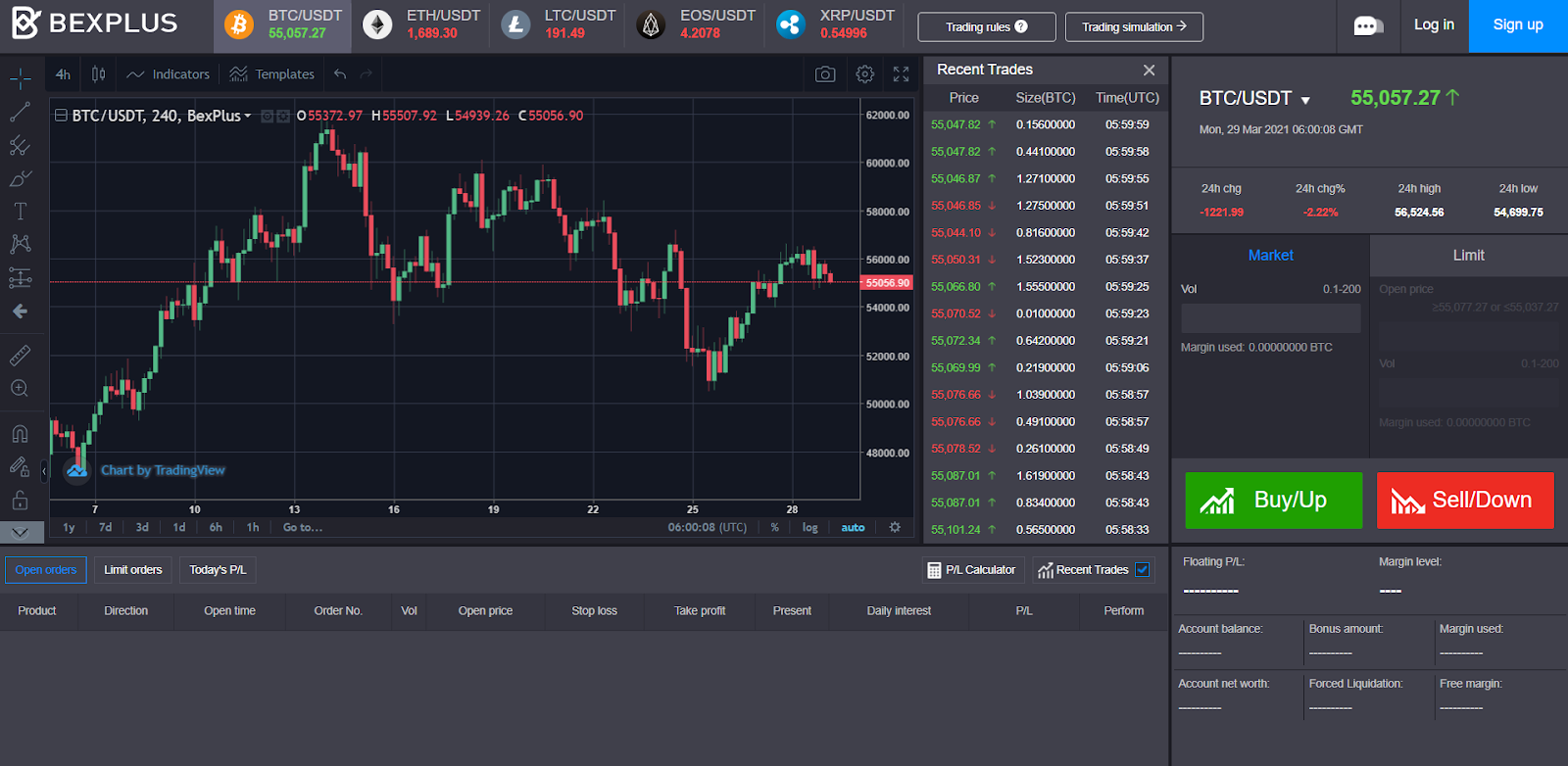
Bexplus is famous for its user-friendly interface with powerful toolkits. You can use the toolkits on the left side of the chart to analyze the market trend and place the long or short order on the right side of the interface. Bexplus offers a P/L calculator for you to calculate the potential profits and fees before entering a trade.
Another golden feature of Bexplus is the Bexplus wallet with up to 21% annualized interest. With fast withdrawal and no penalties for early withdrawal, you can continue to grow your wealth while holding your bitcoin.
Personal Account Manager and 24/ Customer Service
Each user can access a personal account manager after registration. Account managers help users better understand how the platform works and share strategies on crypto trading. The customer service handles complaints and questions 24/7 via email and live chat.
Simple Fee Structure
Bexplus requires no deposit fee and has a relatively low service fee compared with many other platforms. For instance, while some platforms such as Bybit and Bitmex charge a funding fee every 8 hours, Bexplus only charges an overnight fee for 0.1% of the contract value if you hold a position over GMT 0:00. The trading fee of Bexplus is 0.075% for opening and closing BTC contracts. Bexplus doesn’t require any deposit fee.
Bexplus
KuCoin
Binance
OKEx
Trading Fee (Taker)
0.75%
0.10%
0.10%
0.15%
Trading Fee (Maker)
/
0.10%
0.10%
0.10%
Top-ranking App
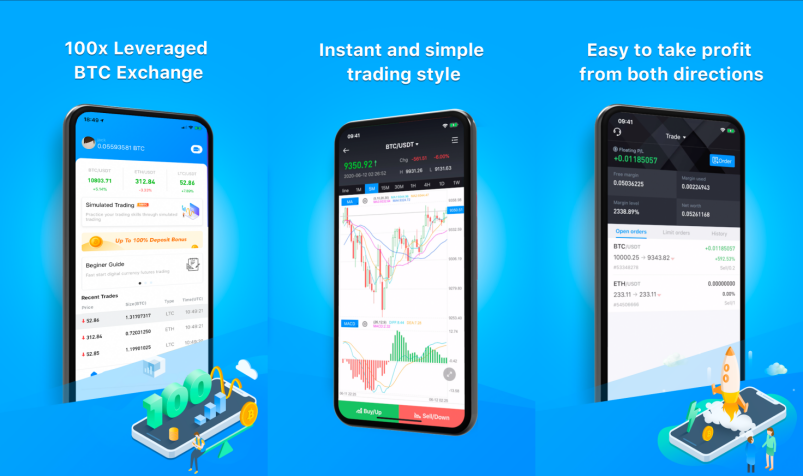
Bexplus mobile app ranks in the Top 5 of keyword search results related to bitcoin trading in 56 countries in App Annie. This full-featured app provides you with the same experience when using a computer, only far more convenient. Bexplus mobile app has a 24/7 market notification to keep you updated with any huge market movement. All data and assets can be accessed through all kinds of devices including Windows, Macbook, Android phones, iPhones, and tablets.
Bexplus app is favored by most users with a rating of 4.8 in Google Play as well as Apple Store.
Benefits and Giveaway
Every user can claim a 100% deposit bonus of up to 10 BTC for each deposit. If you deposit 1 BTC, 2 BTC will be credited to your account, and the profits gained with the bonus are withdrawable. Bonuses can be used as margin and bigger margin reduce the risks of forced liquidation. Traders are welcome to join the affiliate program and earn up to 50% commission. Bexplus will provide different marketing materials to help you grow your business!
Conclusion
The most significant advantages to use Bexplus is its concise interface and the beginner-friendly demo account. Bexplus offers tools to balance high profit and risk control to make use of 100x leverage trading. No KYC verification keeps Bexpus a safe harbor when some exchanges have records of leaking users’ personal data or even surrender to expose data to gov’nts and agencies. The interest-bearing wallet service makes Bexplus stand out from all crypto futures exchanges.
Revolution Populi wants to foster social networks that don't steal your data.
*By Jeff Benson - Decrypt.
In brief:
Revolution Populi is building a blockchain-enabled database that allows data to be ported.
It’s announced an integration with Matic Network and Chainlink.
RevPop envisions an ecosystem of competing social networks—with users who own their own data.
In our chaotic times, filled with partisan rancor and dueling versions of the truth, there’s one thing everyone can agree on: Facebook sucks.
Now, a fledgling blockchain project is one stop closer to taking down the internet Goliath and planting a flag for social networks that don’t control (or sell) user data.
Revolution Populi (RevPop, for short), a “layer-1 decentralized database with user controls,” has tapped Matic Network as a layer-2 solution, allowing developers on the RevPop chain to build their own decentralized applications.
And not just any Dapps, but social networks. “We’re developing a way in which a thousand social nets can be developed on top of this layer 1,” CEO Rob Rosenthal told Decrypt.
“If you use one, they change a rule, they do something you don’t like, you can instantly port your data from one to another, or back again, because you hold the keys,” he said. “All of that data belongs to you.”
While RevPop is also building its own social network, it’s making the project open-source in what it’s calling the “Facebook killer kit” so that others can develop their own social networks on its blockchain.
“This will allow developers everywhere to reach into, and contribute to, the RevPop layer-1 database and be a part of an ecosystem designed to return data control back to users,” Matic Network COO Sandeep Nailwal said in a press release. “Users are hungry for this kind of self-sovereignty.”
“The newest and most active part of the internet has been colonized by a handful of companies who grab data from users and keep it, and profit by it,” Revolution Populi Chief Visionary Officer and Yale computer science professor Dr. David Gelernter told Decrypt.
“Our Project aims to return digital rights and power to the people by means of a decentralized database built on blockchain, and a growing, decentralized world of social net and related apps along with it.”
This will be facilitated through the use of the forthcoming RevPop token—with users of the company’s own social network receiving the token directly from advertisers.
While that’s kind of like how Brave rewards users with BAT, Rosenthal, a former Goldman Sachs vice president with a background in securities, said the team envisions it become something of a utility token for the platform.
But other social networks built atop RevPop’s database can pursue alternate funding models due to the project’s open-source design. The result, believes RevPop, is an internet where Facebook and Twitter have more competition.
“It won’t be a monopoly anymore,” said Rosenthal. “It will be broken up through free market competition. I hope.”
Uniswap Listing
The RVP token will be available on Uniswap, at 8AM EST, Wednesday April 7, 2021. Three pairs are set up in Uniswap:
RVP/ETH
RVP/MATIC
RVP/LINK
As RevPop has integration arrangements with both Polygon (formerly Matic) and Chainlink, these two additional pairs make sense.
The RVP token will be locked until 8 AM, Wednesday, April 7, 2021, but the pairs have been already established in Uniswap in advance to prepare for the RVP release. There are options to participate in a swap, or to add liquidity to a pool. To find the RVP token, enter the following contract address: 0x17EF75AA22dD5f6C2763b8304Ab24f40eE54D48a
KIWIE Set to Launch NFTs Representing Real-Life Street Art in 1001 Locations Across The World
Riga, Latvia, April 6th, 2021 — KIWIE, a worldwide-famous Latvian street art collective, is unveiling a new series of blockchain-enabled art installations across the world. Building on the signature Fat Monster character developed by KIWIE back in 2006, the artists are making street graffiti that are owned directly by the holder of the NFT.
KIWIE NFTs will each come with a custom-made virtual 3D figure representing a real spray painting somewhere in the world. The figure will include a geotag associating the NFT to its respective artwork. The holder of the NFT effectively owns the street art, and is free to resell the artwork. In addition to the virtual 3D figure, participants of the NFT auction will also receive a metal card representing the Fat Monster they bought. Should the Fat Monster painting be removed or covered in real-life, the NFT will turn into a unique “ghost monster.”
The Fat Monster grew to a large community of fans, with over 18,000 followers on Instagram. People have fun looking for them in any city they go, and share the finds on social media. Fat Monsters in each location have their own unique design, often radically different from any other while still maintaining the same essence. A KIWIE Fan Art movement also sees community members drawing their own takes on the Fat Monster.
“The Fat Monster is a unique and iconic creation, and it’s different from what many other street artists do,” said Kristaps Vaivods, Lead Business Strategist at KIWIE. “I just love the global community that formed around the cute monsters, and I hope that the ability to really own a piece of street art will be even more inspirational.”
NFTs are revolutionary for the street art ecosystem because of their non-invasive nature. Previously, selling the work of a graffiti artist required detaching the wall where it was drawn, even if the environment around the artwork was part of its meaning. This is the case with KIWIE’s work, where physical location is an incredibly important part of the Fat Monster’s appeal.
“Using NFTs to represent ownership allows to maintain the beauty of the art intact,” added KIWIE, the creator of Fat Monster. “Blockchain is not just a buzzword here, it legitimately enables something that used to be impossible.”
KIWIE plans to drop the first batch of 5 NFTs on April 13th via Rarible. These will represent existing artworks, while the next four batches in upcoming months will be composed of new artworks made specifically for the NFTs.
Mashya Vyazemskaya, Head of Communications at Rarible said: “The NFT community has been figuring out meaningful ways to bridge physical and digital art. Kiwie 1001 is a smart, purposeful and fun project by a fantastic street artist that does exactly that. We’re happy that the team chose Rarible for the launch!”
About KIWIE
KIWIE is the name of a Latvian art collective led by the homonymous Kiwie, one of the first street artists in Latvia. KIWIE’s signature Fat Monster was born in 2005 and gained recognition worldwide for its cute design and unique artistic meaning. Kristaps Vaivods, a blockchain gaming industry veteran, leads the blockchain vision for the collective and is the mind behind its revolutionary NFT drops.
With the first quarter of 2021 already behind us we are now already looking forward towards what Q2 2021 will bring. In Q1 2021 cryptocurrencies became a trillion-dollar asset class for the first time, as the total market capitalization of the sector climbed from $777 billion to $1.87 trillion. Will the bull market continue or is a market correction behind the corner? Will the non-fungible token (NFT) hype cool down or will the sector find new, unprecedented use cases for these tokens? And most importantly for the up-and-coming investors, which coins are the most likely to end in the green, perhaps even outperform the industry’s average growth? To answer this question, we advise you to continue following our Top 3 Coins to Watch series.
1. Bitcoin
Although we believe Bitcoin does not need much introduction and that all eyes would be on it even if it were not featured on our list, here is a short summary of the history and key characteristics of the first truly decentralized digital currency. The world’s pioneer cryptocurrency was launched by pseudonymous figure named Satoshi Nakamoto in 2009 and has a capped supply of 21 million coins. The decreasing miner block rewards makes the cryptocurrency scarcer with time, ensuring a deflationary nature.
Bitcoin sees Continued Growth for the Sixth Month in a Row – $100,000 by the End of the Year Now Sounds Pretty Reasonable
Bitcoin, the world’s largest cryptocurrency by market capitalization, is often referred to as the crypto market health barometer, since Bitcoin’s performance influences the general sentiment across the whole crypto space. This means that altcoins are thriving when Bitcoin is bullish and vice versa, when Bitcoin dips, altcoins are usually hit even harder. Nevertheless, the market barometer is indication very favourable and bullish market conditions. Bitcoin has managed to keep its price above $50,000 since March 6, this is 31 consecutive days or a whole month. In addition, Bitcoin is seeing continued growth for already more than half a year. March was already the 6th month in a row that BTC managed to close in the green.
Furthermore, Bitcoin’s monthly candles continue to stay within a very steep ascending channel. Will Bitcoin end April in the green too? According to historical data, which shows Bitcoin gained 51% on average in April over the past 10 years, and options open interest, which shows that many investors are betting on $80,000 by the end of April, this seems quite likely. If BTC closes April with a green candle, this will be the first time that we would see seven 7 straight green candles, since September 2012, when Bitcoin gradually climbed from $4.30 to $15.4 over the course of seven months. It is unbelievable that Bitcoin was once trading at such a low price less than 10 years ago.
While Bitcoin’s market capitalization, which is currently around $1.1 trillion, continues to grow, quite the opposite is happening to the BTC market dominance, which is just slightly above 55%. According to one analysis this could be explained by the fact that investors are converting their Bitcoin into large market cap altcoins in an attempt to maximize their profits.
In addition to long-term retail investors buying up almost every dip, Coinbase exchange money flow indicates that U.S. institutions are still accumulating. The popular cryptocurrency exchange has lately been seeing increased volumes followed by huge outflows to BTC cold wallets. Cryptocurrency analyst Willy Woo recently speculated:
“Maybe an unannounced institution is buying, maybe it’s a private hedge fund or many of them. But there’s certainly a lot of buying going from Coinbase which tends to be U.S. institutions.”
Finally, the bullish price predictions are getting even more bullish. One year ago, people who claimed that Bitcoin is going to hit $100,000 or more were called dreamers and unrealistic Bitcoin bulls. Today, this number seems well within reach. Mike McGlone, senior commodity strategist at Bloomberg, recently tweeted that Bitcoin seems to be transitioning to a risk-off digital reserve asset:
#Bitcoin in Transition to Risk-Off Reserve Asset: BI Commodity — Well on its way to becoming a global digital reserve asset, a maturation leap in 2021 may be transitioning Bitcoin toward a risk-off asset, in our view. pic.twitter.com/Ycr1LSqEAJ
The attached picture shows that in the most bullish scenario Bitcoin could end 2021 with a price as high as $400,000. JPMorgan’s analysts remain a bit more conservative, predicting Bitcoin to reach a price of $130,000 in the long-term. The long-term price target has recently been bumped down from $148,000 as the price of gold, which plays an important role in JPMorgan’s projections, dropped. Nevertheless, this price predictions are coming from institutions that did not even approve Bitcoin a bit more than a year ago.
2. ChainLink
ChainLink provides data and price oracles, which are essential for the normal function of smart contract-enabled blockchain platforms. ChainLink’s price and real-world data oracles have seen numerous implementations and their popularity is still increasing. Their oracle service is one of the most reliable and trustworthy services available and the connection with smart contracts is end-to-end secured, leaving very little space for the manipulation of the execution of smart contracts. The platform incentivises providers of good data feeds while the nodes that submit bad data will see their staked LINK tokens slashed. The project launched in 2017, when it also raised $32 million of funding through an ICO.
Substrate module Brings ChainLink’s oracles to Polkadot Network
The popular crypto oracle provider ChainLink recently announced arguably the biggest news from this project for this year – its expansion to the Polkadot environment. The ChainLink team revealed on April 2, that their oracles are now available in the form of a “pallet” on the Polkadot environment:
#Chainlink Price Feeds are now available as an oracle pallet to all #Substrate, #Polkadot, & #Kusama chains. This gives teams building across the Polkadot ecosystem a standardized, easy-to-integrate, & time-tested oracle solution to support their DeFi appshttps://t.co/Ak1vqQxlYk
The ChainLink oracles being available in the form of a native Substrate “pallet” means that developers of any Polkadot or Kusama parachain can now seamlessly and super-easily integrate ChainLink oracles into their blockchains through a simplified library. You could also say that pallets are “like drag-and-drop blockchain building”, like a Polkadot developer Dan Reecer put it in one of his tweets.
While ChainLink nodes regularly publish price data in each block on Ethereum, allowing smart contracts to either use that data or simply ignore it, this will not happen on Polkadot. The choice to integrate the ChainLink Substrate pallet or not is up to each individual parachain, which means that the parachains that do not need price oracles for their operation can save up on blockchain space by not opting in. For those who integrate ChainLink oracles, however, this might enable several DeFi-centric use cases of their Polkadot or Kusama parachain. Nevertheless, experts warn that additional development work will likely be required to adapt the ChainLink pallet for use with smart contracts.
ChainLink is also one of the high market cap altcoins that is starting to see institutional involvement, as Grayscale launched a LINK trust along with some other altcoin trusts in mid-March. The launch of the Grayscale LINK trust triggered a 12% LINK pump the following day, but despite the initial surge things cooled off pretty fast for LINK. If we exclude the initial pump, when LINK was way more volatile (therefore also a riskier investment), ChainLink was underperforming when compared to Ethereum and Bitcoin. While LINK’s price chart closely resembled ETH’s one at the end of March, the gains of the popular oracle provider token are not again a few percent below the gains posted by ETH.
Relative price performance of LINK as compared to the one of BTC and ETH from March 17, when Grayscale Launched ChainLink Trust, to today.
According to data provided by ByBt.com Greyscale bought up 115,570 LINK tokens for its ChainLink Trust from the trust’s launch on March 17 until April 1. The purchase of 65,570 LINK on Thursday, April 1, helped push the price of LINK over $30, where it still trades. Currently LINK is changing hands at around $32.5, but the token is still believed to have a major upside potential.
3. Enjin Coin (ENJ)
Enjin Coin (ENJ) is an Ethereum-based cryptocurrency (ERC1155 token) used to directly back the value of next-generation blockchain assets. It is designed for social gaming as it allows virtual goods to be traded on the blockchain using smart contracts and ENJ as a payment method. The project aims to change the fundamental nature of virtual worlds by providing infinite high-speed transactions between players and game providers at zero cost. More than a million people are already using Enjin’s products to manage, create, and trade these blockchain assets.
A high-speed Bridge Network JumpNet Launched on April 6
JumpNet a high-speed two-way bridge network that facilitates free, swift, and secure on-chain transactions of ENJ and ERC-1155 tokens launched on April 6. JumpNet, which connects the Enjin blockchain with Ethereum and third-party chains is part of the Enjin Coin team’s continued strive to improve NFT compatibility and functionality. It makes minting, trading, and sending of NFTs much easier. In addition, the team have also announced that the launch of JumpNet will be accompanied by the popular GameTalkTalk joining the Enjin ecosystem.
In addition, Enjin is getting ready to launch Efinity, a next-generation NFT blockchain on the Polkadot network. The company recently concluded a private sale which raised more than $18.9 million for the development of the platform, but there is about to be a public sale as well. While JumpNet takes case of compatibility, Efinity, will address the scalability and accessibility as it promises around 700 to 1,000 forever free transactions per second (TPS). In addition, Efinity will bring a new level of utility for the Enjin Coin token: staking – users will receive rewards paid out in EFI for staking their ENJ. Furthermore, the NFTs held in wallets will be auto-staked, allowing their owners to earn a small amount of passive income just for holding Enjin-based items. It should go without saying that passive income coins are extremely popular among cryptocurrency investors and the coins that provide passive income have performed very well during the past bull runs.
To conclude, Enjin is one of the few projects that was the most successful at capitalizing on the NFT hype and the rapid growth of the Enjin ecosystem has also sparked up speculations whether Coinbase will list ENJ or not. While the prominent U.S. crypto exchange already supports ENJ custody, the Enjin Coin is not being traded on the platform yet. The Coinbase team recently accidentally published an ENJ support page, which additionally fuelled the speculations. The influx of new investors and fresh capital after a potential Coinbase listing would without a doubt cause ENJ to surge even higher.
For over 35 years, the world of finance found itself in near stasis. The invention of SWIFT was a game-changer but unfortunately didn’t innovate faster than the pace of other developments highly reliant on cheap, instantaneous, and borderless transfer of value.
Crypto: A Permanent Fixture in Finance
The innovation of blockchain sparked a paradigm shift, now commandeering billions. In less than 13 years, cryptocurrencies are now a permanent fixture in finance.For their ease of use, low cost, and guarantee of security, they are widely used in moving value, cheaply, and most importantly, without relying on the middle man every day of the week.
By building on redundancy and feeding on the community’s spirit–eliminating dark patches and opaqueness, crypto continues to disrupt traditional finance. It is remarkably defining the sector as an emerging, superior alternative to banks’ red-tape.
Presently, crypto’s market cap is over $1.6 trillion and analysts are optimistic, expecting widespread adoption of blockchain payment networks to replace legacy solutions.
Caizchain: Moving Value Fairly
Amid this expansion is the rollout of alternative blockchains that builds on Bitcoin’s lead, offering an innovative transparent solution based on Islamic financial laws. Caizchain is a platform which investors can use, fully aware that the token is compliant with Sharia laws.
It completed its testing phase in Q4 2020. Currently, it is crowdfunding through a private sale and plans to initialize its network launch in Q2 2021.
Through the Caizchain, Muslims and non-Muslims can transfer value in a secure, transparent blockchain, compliant with Know-Your-Customer (KYC) rules and Islamic finance rules. The blockchain-based platform blends beneficial Islamic laws and modern, progressive values to be concurrently modern, tech-savvy, and abiding.
Herein, the Caizchain places the network users’ interest at the forefront as per Islamic dictates. Inherently, there is a mix of transparency and open-mindedness, digitization, and harmony, translating into a solution where users can remit cash cheaply.
The Caizchain has special provisions for the payment of Zakat and Waqf (donations). It acts as a reliable friend adhering to Islamic values of contributing to humanity by leveraging tech-savvy emerging technologies. The blockchain’s wallets enable the movement of funds transparently, reliably, yet anonymously protecting the identity of transactors.
Enabling DeFi in a Islam-Compliant Manner
Amid the rise of Decentralized Finance (DeFi), Caizchain is creating a portal for investors to morally participate in the burgeoning sphere, legally and in line with Islamic laws.
According to estimates, DeFi in Ethereum alone manages over $40 billion of different assets. It presents ways for retail investors to access lucrative investment opportunities, ordinarily barred in the traditional setup as lessons from Robinhood and WSB sagas show.
Through the Caizchain, users can invest in state directives, shares, property, funds, and others, earning rewards in a legal, moral, and transparent manner.
The platform allows secure, reliable, and flexible anonymous investing with KYC. Users can use the CAIZ token to finance trips such as Mekka Haddsch, enhanced shopping experiences, and flexibility.
Additionally, by using the CAIZ coin, there are no lock-up periods. The platform’s users can withdraw and deposit their assets anytime for fiat or crypto using their PayPal, Debit/Credit cards, or other crypto wallets.