Blog

  • BTC and ETH Soar to New Highs, Crypto Market Cap Surpasses $3 Trillion for the First Time

    BTC and ETH Soar to New Highs, Crypto Market Cap Surpasses $3 Trillion for the First Time

    Bitcoin and Ethereum hit historical highs

    Lately, new records are falling like dominoes in the cryptocurrency sector. Just a little over a month ago, at the beginning of October, the total market capitalization of all digital assets in circulation was sitting at a staggering value of $2 trillion. Five weeks later, that major milestone seems already far off in the rearview mirror. 

    On the heels of the massive 50% increase in capitalization, numerous digital assets have obviously reached new price peaks. On Tuesday, the market’s de facto number 1 and number 2, pushed higher than ever before. Bitcoin hit a new all-time high of $68,476, while Ethereum surpassed the $4,800 level and peaked at $4,834.

    Since setting a then-ATH of $66,900 on October 20, Bitcoin was exchanging hands below the $60,000 mark for less than 24 hours.

    Given the fact that Bitcoin repeatedly bounced off the $60,000 support level over the past two weeks, most crypto analysts are bullish about BTC’s growth potential going into the closing stages of 2021. 

    Bitcoin on-chain analyst and writer for Bitcoin Magazine going by the moniker ‘Dilution-proof’ on Twitter recently shared his price model for the world’s largest cryptocurrency. The prominent analyst believes, “Skies are clear for a new round of price discovery.”

    A number of financial experts and crypto analysts alike are convinced that the recent price rallies have everything to do with concerns over inflation rates. 

    For instance, Goldman Sachs’ Global Markets managing director Bernhard Rzymelka recently shared his mid-term outlook on Ethereum and revealed that he believes ETH’s price will surge to $8,000 on the tailwind of investors looking for a viable hedge against inflation. 

    In a similar vein, last month, a group of JPMorgan strategists attributed the BTC price hike to inflation concerns and not the recently launched Bitcoin futures ETF. 

    Outspoken members BTC maximalist Tone Vays has long held the opinion that $100K Bitcoin by year’s end is not only possible but highly probable. Cryptocurrency market analyst Kevin Svenson not only agrees with Vays but assumes that the $350K price point for Bitcoin during the current market rally is not out of the realm of possibilities.

    Crypto market cap increases from $2T to $3T in a little over a month

    Earlier today, the total market cap has peaked at $3.01 trillion. The cryptocurrency landscape is changing very quickly, and that reality is even more apparent when the prices of digital tokens are surging the way they did since mid-October. When Bitcoin reached $60,000 a couple of weeks ago, we’ve decided to compare the market standings of the largest digital assets between two distinct market periods, which were separated by a three-month-long bearish market – May 2021 and October 2021.

    The steady rise to $3 trillion was not interrupted by significant price drawdowns.

    The biggest difference in the cryptocurrency top 10 when compared to the same list from October, is Solana’s rise to the 4th spot on the list. Litecoin has slid out of the top ten and currently sits at the 14th spot. The trio of Bitcoin, Ethereum, and Binance Coin still top the chart and command similar market dominance as in May 2021 and mid-October respectively.

    The road to $4 trillion starts today – let’s see how long it will be.

  • Top 3 Coins to Watch – Week 45

    Top 3 Coins to Watch – Week 45

    At the end of Week 44 the total valuation of all cryptocurrencies in circulation stood at an astounding $2.87 trillion. While BTC was trading a few percent below its ATH price, several other major cryptocurrencies reached their new ATH prices in Week 44. The cryptocurrencies that surged higher than ever before include but are not limited to ETH (Ethereum), SOL (Solana), DOT (Polkadot), AVAX (Avalanche), LUNA (Terra), AXS (Axie Infinity), CRO (Crypto.com Coin) and HNT (Helium). The hype around metaverse-focused blockchain projects triggered by Facebook’s rebrand to Meta continued throughout Week 44. If such rapid growth continues, the cryptocurrency market could hit a $3 trillion valuation very soon. Do you think that this major milestone will be crossed already this week?

    3. Enjin Coin (ENJ)

    Enjin Coin (ENJ) is an Ethereum-based cryptocurrency (ERC1155 token) used to directly back the value of next-generation blockchain assets. It is designed for social gaming as it allows virtual goods to be traded on the blockchain using smart contracts, non-fungible tokens and ENJ as a payment method. The project aims to change the fundamental nature of virtual worlds by providing infinite high-speed transactions between players and game providers at zero cost. More than a million people are already using Enjin’s products to manage, create, and trade these blockchain assets. Earlier this year, Enjin raised nearly $19 million in a funding round led by major crypto exchange Crypto.com to debut Efinity, its Polkadot-based NFT-focused blockchain. EFI, the native cryptocurrency of Efinity, went live in August 2021 after another $20-million had been raised through EFI token sale in July.

    Enjin establishes a $100M fund to decentralize its metaverse

    Like Decentraland (MANA) and several other blockchain projects developing virtual reality worlds, Enjin benefited from the Facebook’s recent rebrand. The project, which focuses on providing infrastructure for in-game transactions and NFTs, has almost infinite use cases in the metaverses of the future. On the tailwind of Facebook’s Meta rebrand, ENJ price grew by 33% last week. At the time of writing, ENJ is trading at $3.33. Nevertheless, the popular social network’s parent company changing its name into Meta is not the only reason for ENJ rally. The upward trend was additionally boosted by Enjin’s own announcement of a $100M fund being set up to facilitate Enjin metaverse decentralization. As per the announcement, the Efinity Metaverse Fund will support Enjin and Efinity adopters, and other organizations working on Enjin Ecosystem Integration, Metaverse, Collaborative NFT and gaming projects. The fund will also reward developers working on decentralization, such as building cross-chain and multi-chain infrastructure, as well as pioneering projects that dare to venture “where no one has gone before”. The fund will work by providing equity investments in seed or Series A funding rounds as well as by purchasing native tokens issued by eligible projects.

    2. The Sandbox (SAND)

    The Sandbox is a user-generated blockchain-based virtual world where players can build, create as well as buy and sell digital assets in the form of a game. The Sandbox was initially an ordinary sandbox game for mobile phones and PCs, but transformed into a blockchain-based voxel universe after it was acquired by Animoca Brands in August 2018. As well as other projects within the blockchain gaming ecosystem, The Sandbox too experienced explosive growth over the course of 2021 as nonfungible tokens (NFT) and the play-to-earn gaming model gained momentum. The Sandbox ecosystem utilized SAND as its utility token and as the basis of transactions and interactions. SAND is an ERC-20 token and there is a finite supply of 3,000,000,000 SAND. SAND can also be used for staking and governing the Sandbox metaverse.

    Brands and creators pile into The Sandbox metaverse following a successful completion of a $93-million funding round

    Market analysts have identified three main reasons for the recent sudden spike in the price of SAND in addition to the general uptrend seen in all metaverse-associated projects. The first reason is the successful competition of a Series B funding round disclosed to the public on November 2. The Sandbox representatives revealed that they have raised over $93 million, with the main investor being SoftBank, a Japanese multinational conglomerate. The second reason is The Sandbox’s expanding ecosystem that continues to onboard new partners. Game developers recently revealed a collaboration with famous rapper Snoop Dogg, who wishes to build digital replica of his mansion in the Sandbox’s metaverse. The third key reason for The Sandbox’s success is its growing adoption, which is facilitated by the project’s supportive environment, that allows creators to engage with their communities while also receiving a lion’s share of revenue generated by their efforts. The success of the project has largely translated into SAND appreciation. The metaverse’s native token grew its value by 71% last week and is up by more than 230% in the last month. Sebastien Borget, COO and co-founder at The Sandbox, stated that they now want to expand their operations from gaming into fashion, architecture, and virtual concerts. In addition, the company wants to offer a decentralized and user-governed alternative to large corporate-owned metaverses that are emerging.

    Borget stated: “We are creating this open metaverse. We are positioning the Sandbox against those giant tech companies who are claiming the metaverse to be theirs, offering an alternative where users are first.” 

    1. Polkadot (DOT)

    Polkadot is a blockchain solution that allows multiple specialized blockchains called parachains to run at the same time and interoperate. Polkadot can connect diverse blockchains into a single, decentralized and highly scalable ecosystem. The network operates using a proof-of-stake consensus algorithm and utilizes a native currency DOT. The project was originally designed by Dr. Gavin Wood, one of the co-founders of Ethereum and the inventor the smart contract programming language named Solidity. Along with Cardano, Solana, and several other networks Polkadot is considered one of the potential “Ethereum killers”.

    DOT climbs to a new ATH in expectation of the first Polkadot Parachain Auction

    Fuelled by the excitement surrounding the announced first Polkadot parachain auction, DOT has climbed to a new ATH of almost $55 on November 4. At the time of writing, DOT is trading just about $2 under the ATH price and is looking ready to surpass the current highest valuation, especially considering that the first parachain slot auction is set to begin this week – the date to mark on your calendars is November 11. The first batch of five parachains will be auctioned on a weekly basis, with parachain deployment scheduled for December 15 for all five winning bidders together. The Polkadot council has also already approved the schedule for auctioning the second batch of parachains, which will begin on December 23 and will take on the same format as the first batch, except that a new slot auction will begin on a bi-weekly basis. In addition, the Polkadot Council has recently voted out a future logo design and a fresh new brand identity. Nevertheless, it is not only the positive market sentiment that fuels the rally – technical indicators for DOT are also looking good. Experienced traders and technical analysts identified an inverse head and shoulders (IH&S) pattern in the daily DOT/USDT chart. While DOT is currently trading slightly above the IH&S neckline, the latest price jump accompanied by increased trading volumes, indicates that traders are supportive of the move higher, above the IH&S neckline. Judging by the depth of the IH&S setup, DOT’s target price lies near $90, with possibilities of the rally being extended towards the psychological resistance level of $100.

  • TRON Unveils $1,111,111,111 Ecosystem Fund Amidst Anticipated BTTC Launch & Heightened VTRX Demand

    TRON Unveils $1,111,111,111 Ecosystem Fund Amidst Anticipated BTTC Launch & Heightened VTRX Demand

    Singapore, Singapore, 8th November, 2021,

    TRON, one of the largest and most popular blockchain ecosystems, is introducing a new $1,111,111,111 ecosystem fund designed to entice developers to its network of blockchains and services. The fund aims to deliver more developer-friendly tools that can be leveraged to enlarge and refine a burgeoning ecosystem that already hosts multiple activities including decentralized finance (DeFi), non-fungible tokens (NFTs), and stablecoins.

    Per TRON Founder Justin Sun, “This fund reflects our constant efforts to innovate and stay at the bleeding edge of blockchain. As the blockchain universe expands to new horizons, cross-chain interoperability, especially in DeFi and NFTs, will play a critical role in our continued success. Accordingly, encouraging the developers who are the backbone of this decentralized movement to join us is crucial for maintaining the TRON ecosystem’s longevity and competitive edge.”

    Besides supporting developers and overall ecosystem development, the fund intends to attract more existing projects and protocols to the network through its forthcoming incentives. This move aligns with TRON’s addition of JustLend and JustSwap DeFi services alongside Sun’s intentions to wholeheartedly embrace stablecoins. TRON already hosts and circulates multiple stablecoins on-chain including USD Tether, USD Coin, TrueUSD, and TRON’s own USDJ, with daily on-chain transfer volumes surpassing $10 billion on multiple occasions.

    The latest milestone in TRON’s saga comes just weeks after the foundation launched BitTorrent Chain, also known as BTTC, to help scale the ecosystem. Co-developed by the TRON and BitTorrent teams, the BTTC proof-of-stake protocol is designed for cross-chain interoperability with TRON, Ethereum, and Binance Smart Chain (BSC). This protocol will enable the seamless transfer of major digital assets across multiple protocols affordably in a decentralized manner, enhancing TRON’s position in the ever-expanding DeFi landscape.

    Moreover, TRON has been gaining traction in the traditional finance arena, with VanEck’s VTRX exchange-traded note (ETN) seeing a dramatic increase in demand. The note, which trades on Deutsche Börse, among major exchanges of 14 European countries including those in Amsterdam, Paris, and Zurich, is fully-backed by TRON’s native token Tronix (TRX). The latest flow data highlights that the ETN added 200,000,000 TRX on November 2nd, amounting to nearly a $20,000,000 addition and bringing VTRX’s aggregate holdings above 1 billion TRX.

    About TRON

    TRON is dedicated to accelerating the decentralization of the Internet through blockchain technology and dApp use cases. Founded in September 2017 by Justin Sun, Tron has since achieved a number of milestones, including MainNet launch in May 2018, network independence in June 2018, and TRON Virtual Machine launch in August 2018.

    Contacts
    • Anjali George
    • press@tron.network
  • ASTRA Protocol and Squire Patton Boggs Partner on Crypto Compliance for Institutional Investors

    ASTRA Protocol and Squire Patton Boggs Partner on Crypto Compliance for Institutional Investors

    Dublin, Ireland, 8th November, 2021,

    Squire Patton Boggs, one of the world’s leading full-service legal companies for ensuring cross-border compliance counselling as well as incident response, has announced a new partnership with internationally-patented ASTRA Protocol, in order to give assurance and compliance confidence to the decentralized finance (DeFi) ecosystem.

    Squire Patton Boggs maintains business offices in 20 different countries on four continents. The firm’s international legal practice is in key markets where clients regularly carry out high volumes of business, focused on the digital assets sector.

    Their ecosystem also includes strategic working relationships with independent companies operating in European and Latin American markets. Their extensive practice and industry expertise are shared through one of the most advanced tech platforms in the legal industry along with an ongoing rotation of legal professionals to their offices across the globe. In addition, the firm applies industry knowledge as well as project-management tools to implement regular business process enhancements and improve the overall value of their legal services.

    Astra Protocol, a cutting-edge legal and compliance layer that brings unmatched assurance to public blockchains, is pleased to confirm that it is working cooperatively with Squire Patton Boggs, which will be accepting ASTRA as its first DeFi payment method.

    Leveraging Decentralized Assurance Layer on Public Blockchains

    Although current blockchain and crypto firms have created challenges for regulatory authorities throughout the world, Astra Protocol offers a decentralized assurance layer on public blockchains to support the exponential growth of DeFi.

    Astra’s assurance layer is able to plug into an existing DeFi platform in order to ensure that the funds arrive at their intended destination, via its internationally patented technology. The protocol has been designed to prevent insecure or invalid smart contracts from executing. If a transaction turns out to be fraudulent or if the funds end up in the incorrect crypto wallet address, then Astra is able to resolve the dispute and restore the funds right away, while also following applicable regulatory guidelines.

    Joe Crowley, Senior Policy Advisor at Squire Patton Boggs, is also an American politician who served as U.S. Representative from New York’s 14th congressional district from 1999 to 2019, said “We are pleased to partner with the ASTRA Protocol team and are looking forward to working with their colleagues around the globe”.

    Crowley added “ASTRA is the preeminent compliance protocol business within the DeFi industry that is able to give assurance to regulatory agencies as well as individual clients, which in turn will help boost confidence in DeFi’s legitimacy as a global industry”.

    Sakhib Waseem, Chief Innovation Officer at ASTRA Protocol said “We are extremely pleased with our partnership with Squire Patton Boggs and look forward to working with Congressman Crowley and his organisation. As we at the ASTRA Protocol define the next generation of decentralised global compliance structure across the DeFi industry, it is important to have key partners who understand the needs of both the crypto community and are in tune with the latest changes in the regulatory space”.

    “Squire Patton Boggs have a great presence across the US and internationally, this partnership is another affirmation we have the latest understanding of regulatory enhancements around the world and can provide an industry leading standard to our customers and clients”, Sakhib adds.

    About Astra

    Astra Protocol’s mission is to equip the DeFi world with a full legal layer. Removing doubt, eliminating fraud and dealing with disputes making public blockchains safe for all users. Unlocking the future growth of the industry.

    Decentralised Finance, or DeFi, has become one of the most attractive, exciting and lucrative blockchain markets. But the harsh reality is that if funds are sent to the wrong wallet address or the transaction is a scam — money is likely to be lost forever. With very few regulations in place to protect consumers, DeFi is too high-risk for big corporations. What is missing is an assurance layer that connects the crypto world and the real world to provide trust and peace of mind.

    Our solution is ASTRA. This revolutionary legal layer plugs into any existing platform, ensuring all funds arrive safely at their correct destination. Even if something goes wrong, we can quickly and efficiently resolve the issue with ASTRA and restore your funds immediately.

    About Squire Patton Boggs

    Squire Patton Boggs is a full service global law firm providing insight at the point where law, business and government meet, giving you a voice, supporting your ambitions and achieving successful outcomes.

    To view the company’s legal notices, please visit: https://www.squirepattonboggs.com/en/footer/legal-notices.

    With a multidisciplinary team of over 1,500 lawyers in 45 offices across 20 countries, the firm is well-established geographically with strong local and regional positions in North America, Europe, Asia Pacific, the Middle East and Latin America, and our practice experience spans all key sectors.

    Contacts
    • Adam Ali
    • Astra@theproofoftrust.com
  • Bitcoin Jumps to $66,000, Ethereum and Multiple Other Altcoins Renew Their ATHs

    Bitcoin Jumps to $66,000, Ethereum and Multiple Other Altcoins Renew Their ATHs

    Key takeaways:

    • Bitcoin sets a two-week high and is trading just below its peak value
    • 5 out of the top 100 digital currencies have renewed their all-time highs
    • The total cryptocurrency market cap has surpassed $2.9 trillion for the first time

    The historic cryptocurrency market bull run is in full swing and shows no signs of slowing down. The cumulative value of more than 10,000 digital assets we list at CoinCheckup has reached $2.93 trillion on the heels of Bitcoin’s 6% price increase and broader altcoin surge led by Ethereum.

    Bitcoin is exchanging hands close to its peak value

    After trading in a relatively tight range over the course of last week, the price of Bitcoin has increased by more than 6% on Monday and surpassed the $66,000 level for the first time since BTC reached its all-time high on October 20.

    The value of BTC surged from $62,800 to $65,500 in the span of 90 minutes.

    Today, Bitcoin surged to the two-week high of $66,365, just shy of its all-time peak value of $66,931. Despite the price of the oldest cryptocurrency retracing to $65,865 in the last couple of hours, BTC is still exchanging hands just 1.5% removed from its ATH. Given the enormous momentum behind digital assets, the $70,000 psychological barrier is likely to fall very soon. The sentiment was shared by Cameron Winklevoss, founder of Winklevoss Capital Management and Gemini cryptocurrency exchange on Twitter:

    Bitcoin is up 22% in the past month and 141% since the beginning of the year (at the current market rates).

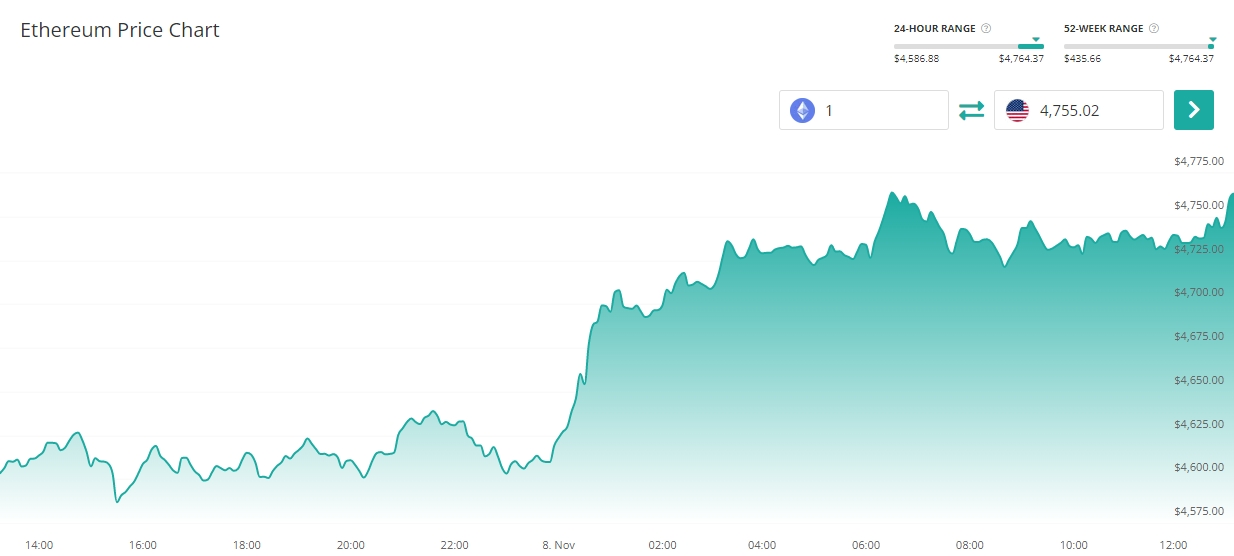
    Ethereum sets a new all-time high of $4,764

    The world’s second-largest crypto has been on a very steady uptick since the start of October – the price of ETH has increased from $3,000 to the current price peak with relatively low volatility. Today, ETH reached a new ATH of $4,764, good for a $562 billion market cap and 19.1% market dominance.

    Similar to BTC, the price of Ethereum spiked in the early morning hours.

    Over the course of the last week, ETH has improved by over 9% with very few setbacks on the way as the price of ETH never swung by more than 5%. The smart contract platform and arguably the most important blockchain for the continued development of the crypto industry has attracted a lot of market interest over the course of the year. At the time of this writing, ETH is up more than 550% year-to-date (YTD).

    Goldman Sachs’ Global Markets managing director Bernhard Rzymelka recently shared his mid-term outlook on Ethereum and revealed that he believes ETH’s price surge to $8,000 will be fueled by investors looking for a viable hedge against inflation. Another piece of positive news that came out last week and likely contributed to Ethereum’s rally is the announcement of CME Group adding Micro Ether futures to its product portfolio in December-

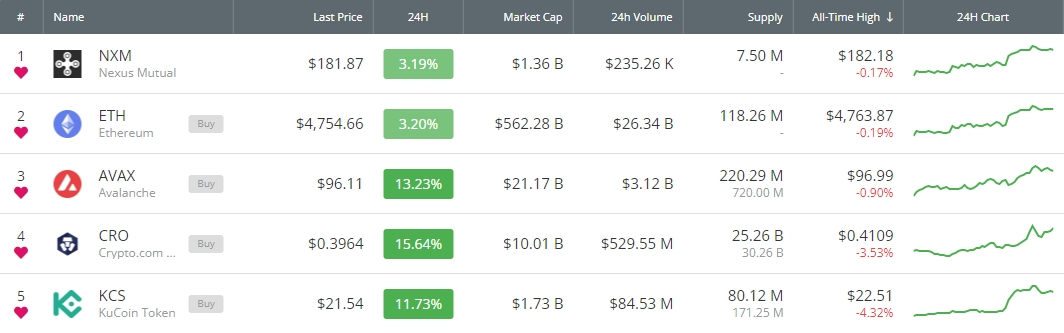
    Avalanche, NXM, and exchange tokens CRO and KCS renew their ATH

    The market success of Ethereum and Bitcoin has reignited rallies among several blockchain projects, which has led to multiple tokens reaching higher than ever before. Arguably the most significant project on the list is the decentralized finance (DeFi) platform Avalanche (AVAX), which has overtaken Terra and Uniswap on its path to a new ATH and thus became the 12th largest crypto by market cap. Among the reasons for the ongoing market success of AVAX is definitely Friday’s Grayscale announcement of potentially adding Avalanche to its product family of supported crypto assets.

    Five projects that have reached their new market cap peak on Monday.

    Perhaps a bit surprisingly, centralized exchange (CEX) tokens Crypto.com Coin (CRO) and Kucoin Token (KCS) have both gained more than 10% today and set their new respective ATHs. After China’s blanket ban on crypto, many predicted the downfall of centralized exchanges and their native tokens, but it now seems that the predictions were vastly exaggerated. Other exchange tokens have been also performing very well in the last couple of weeks; most notably Binance’s BNB which has, earlier today, come very close to surpassing its peak value set in mid-May.

    The last spot on the list of digital currencies that have managed to reach new peak values in the last 24 hours is occupied by Nexus Mutual (NXM), a blockchain alternative to insurance and a newcomer to the crypto top 100.

  • Why The Polker Metaverse Will Take PKR to The Moon and Why PKR is Undervalued!

    Why The Polker Metaverse Will Take PKR to The Moon and Why PKR is Undervalued!

    Ahead of the highly anticipated launch of its play-to-earn game, Polker has is set to begin the rollout of its metaverse. This development comes after the completion of the recent NFT competition that Polker finalized last week.

    The Polker Metaverse 

    Polker’s metaverse is going to be an immersive and innovative virtual experience that will provide endless possibilities for users to explore innovative features. Users will be able to access a next-generation poker game with a realistic gaming environment combined with the highly successful Play-to-Earn model. 

    Within the metaverse, users will be able to interact with each other in a PvP manner. Polker’s gaming platform is the first to be powered by the Unreal 3D Engine 4. Unreal 3D Engine provides a virtual reality setting, and all assets within the game are in 3D VR Reality models. Bringing blockchain and Unreal Engine together really sets this metaverse in a league of its own.

    Users will also be able to edit the graphics around them and create their own world. This is exciting as they get to have a personalized gaming experience. Polker is able to achieve this by wrapping high detailed textures on low poly models to create realistic graphics and good performance within its gaming metaverse. 

    Polker will be the first of its kind to integrate NFTs rewards within its gaming system within such a uniquely immersive platform. Users can earn NFTs when they play to access more features. Each NFT has its attributes and can unlock special dealers. New game launches, exclusive tournaments, and more are all to come within the Polker Metaverse.

    Polker metaverse will also integrate the latest A.I deep learning techniques for in-game characters to create animation/interactions based on players’ actions to provide a real-life feeling of virtual reality. Polker has revealed that the VR experience will be integrated by Q2 2022. Oculus owners be prepared!

    These teasing glimpses of Polker’s metaverse are sure to excite users ahead of the launch of the play-to-earn game.

    Premium Billionaire’s Game Room 

    Polker testnet game will feature a special luxurious gaming room called the’’Billionaire’s Game Room. Players will be able to play against each other using the avatars and names of some of the elitist personalities including Jack, Elon, Trump and KIM. 

    Polker’s Billionaire’s Game Room is shrouded in secrecy, and there are exciting features that will be unveiled in the future. Polker has already released the first episode of the Billionaire Polker Tournament…. Episode one was released..

    Preparing For The  Polker Metaverse

    Polker’s native token PKR has seen a steady upsurge throughout Q3 and Q4 and with the launch of the beta ‘Testnet Game’ coming up and the allure of the metaverse to come the value of PKR is only going to increase. PKR will be used within the game to buy NFTs which will enable users to access the play-to-earn model that Polker’s metaverse is focused on.

    PKR can also be staked with an APY of 36% on the Ethereum main net here. Staking of PKR will be available on Binance Smart Chain later in the year – so for those who don’t want to bridge to Ethereum, the opportunity is not missed. Investors can purchase PKR at Uniswap on the Ethereum network and PancakeSwap within Binance Smart Chain. In addition, PKR has also been listed on the centralized crypto exchange BitMart with rumors of much larger exchanges to come very soon.

  • TeDefi Network: The New Consensus Mechanism About to Define Blockchain Communication

    TeDefi Network: The New Consensus Mechanism About to Define Blockchain Communication

    Blockchain runs in a decentralized manner, but still provides privacy, security, and immutability. The lack of a central authority is the main reason users love the ecosystem, yet every transaction is verified, recorded, and safeguarded. This happens because the blockchain technology runs on a consensus algorithm, which is a fundamental part of the technology.

    Blockchain consensus mechanisms allow users and machines to coordinate in a distributed setting. These algorithms ensure that all parties in the protocol reach a common agreement about the present condition of the network. These algorithms validate, verify, confirm transactions, and are responsible for how smart contracts are run. Many algorithms establish trust between the peers of the blockchain ecosystem, such as Bitcoin, Ethereum, Solana, etc. This way, all agents run the technology in a way that’s beneficial to the network. Examples of these algorithms are CeFi, DeFi, PoW, PoS, DPoS, etc.

    As blockchain technology continues to evolve, so more consensus mechanisms are developed. As a result, TeDefi emerged. TeDefi, like PoW, is an algorithm that intends to improve communication between users and smart contracts. TeDefi has been making waves in recent times, and has caught the attention of users who want to know more about it. So, what is TeDefi, and what does it intend to achieve in the blockchain space?

    TeDefi: How is it Different from Other Consensus Algorithms?

    TeDefi may be newer than all consensus mechanisms, but its infrastructure is aimed at improving interaction amongst agents in the network. Before we discuss what TeDefi brings to the table, let’s analyze how other algorithms facilitate communication and their downsides.

    Centralized Finance: Pros and Cons

    Undoubtedly, CeFi is the most popular algorithm and the earliest in the blockchain space. At first, CeFi used to be the only reliable way of buying and selling cryptocurrency. These cryptos are traded on a marketplace known as centralized exchanges.

    Although they are somewhat stable and straightforward to use, CEXs are susceptible to hacks and are often accused of lack of transparency. In addition, they don’t allow users full control over their assets. This can be problematic for asset holders, especially traders that may need to conclude a transaction at odd hours. CEXs don’t allow the trading of certain tokens because they rely on order books to facilitate transactions.

    Decentralized Finance: Pros and Cons

    Decentralized finance or DeFi gave users more liberty over their assets, unlike the authoritarian CeFi. Decentralized finance consists of applications that run on the blockchain in a decentralized manner without the need of a third-party. Uniswap and SushiSwap are examples of DeFi. Apart from accessibility, security is better in DeFi applications because data can be stored on several nodes, making it difficult for hackers to break in. In addition, DeFi applications allow users to earn interest on their investments by adding liquidity to the pool.

    Despite the benefits, there are still some drawbacks. There’s the issue of limited integration, poor user experience, and lack of oversight. Scalability is still a big issue.

    Proof of Work: Pros and Cons

    The Blockchain network uses the Proof of Work consensus algorithm. It allows a particular miner to mint bitcoin by solving a complex mathematical puzzle. This mathematical calculation requires lots of computational power. However, the problem of this algorithm is scalability and slow transaction times, especially if they are several transactions to verify.

    Proof of Stake: Pros and Cons

    The Ethereum network moved from Proof of Work to Proof of Stake to solve the problems of high fees, high power consumption, and slow transaction times. However, PoS didn’t solve scalability, and interaction with smart contracts is still fairly poor.

    TeDefi emerged with the mission to solve the issues wrong with the above consensus mechanisms. TeDefi analyzed the bottlenecks with other mechanisms and sought to find a solution. With TeDefi, users don’t have to deal with gateway issues to buy or sell cryptos.

    To solve gateway problems, TeDefi provides an infrastructure that enables validator nodes to interact directly with the Telegram Bot through the MTProto. This interaction is overly secure.

    In a bid to improve interaction, TeDefi allows developers to create Telegram Bots on the protocol. This facilitates the trading of cryptocurrency and access to DApps. By communicating directly with the Bots, slow transaction times and poor scalability becomes a thing of the past.

    TeDefi truly aims to redefine how agents interact with smart contracts. It is believed that this consensus mechanism is the future because it not only improves scalability, but lowers gas fees.

    Check out the TeDeFi bot for more information.

  • KuCoin Margin Celebrates Its 2nd Anniversary With Millions of Dollars To Giveaway

    KuCoin Margin Celebrates Its 2nd Anniversary With Millions of Dollars To Giveaway

    Victoria, Seychelles, 8th November, 2021,

    KuCoin, a global leading cryptocurrency exchange, celebrates the 2nd anniversary of the KuCoin Margin Trading platform and will launch a series of celebration events with millions of rewards.

    Launched in 2019, KuCoin Margin enables users to borrow tokens to amplify investment returns from successful trades. Until now, the number of margin traders on KuCoin has exceeded 2 million, and the transaction volume increased by over 500x YoY. Currently, it supports 75 tokens with 99 margin trading pairs. In addition, as a global margin trading platform, KuCoin Margin supports 19 languages to meet the demand of our users around the world.

    In the past 2 years, many innovative features have been introduced on KuCoin Margin. To enable a quick and easy-to-use leverage transaction, the Auto-Borrow function has been launched to simplify the borrowing process. Meanwhile, KuCoin Margin brought Crypto Lending, a C2C market for users to lend their idle crypto assets to make passive income. As of Q3 2021, the average daily lending volume on the KuCoin Lending platform reached $100 million.

    “As the ‘People’s Exchange’, KuCoin continuously optimizes user trading experience and provides services for all classes of investors.” Johnny Lyu, the CEO of KuCoin Global, stated, “Trading with leverages will amplify the potential gains and risks alike. We are increasing efforts to educate users that leverage is not a devil, it depends on how you use it. This is to help more KuCoin users make the most of the services and tools we offered to achieve their investment goal.”

    The KuCoin Margin team also revealed its upcoming plan. In order to further enrich the users’ investment options, a number of new coins will be available on the KuCoin Margin trading platform. In addition, users can look forward to more new features, such as the Isolated Margin, which is planned to be launched in 2022.

    On the celebration of its 2nd anniversary, KuCoin Margin will initiate a series of activities with millions of dollars worth of rewards available to all.

    About KuCoin

    Launched in September 2017, KuCoin is a global cryptocurrency exchange for over 400 digital assets. It currently provides Spot trading, Margin trading, P2P fiat trading, Futures trading, Staking, and Lending to its 8 million users in 207 countries and regions around the world. In 2018, KuCoin secured $20 million in Round A funding from IDG Capital and Matrix Partners. According to CoinMarketCap, KuCoin is currently the fifth biggest crypto exchange. In 2021, Forbes named KuCoin as one of the Best Crypto Exchanges for 2021. 

    To find out more, visit https://www.kucoin.com.

    Contacts
    • Ashley Wang
    • media@kucoin.com
  • Revolut is Looking for the Right Candidate to Lead Development of its Cryptocurrency Exchange

    Revolut is Looking for the Right Candidate to Lead Development of its Cryptocurrency Exchange

    Revolut, a rapidly growing fintech company headquartered in London, is looking to hire a blockchain specialist to lead its technical team tasked with designing and building the Revolut Crypto exchange. 

    Key takeaways:

    • According to a job advertisement posted on Linkedin, Revolut is searching for the right candidate to lead its nascent team of software developers that will be building the cryptocurrency exchange service for the popular digital bank.
    • The digital bank is looking for a candidate with experience in building order matching systems that are the backbone of exchange offerings. In addition, at least seven years in the tech industry and in-depth familiarity with backend development are required. As of the time of this writing, 27 candidates have already filed their job application.
    • Revolut had first started offering cryptocurrency-related services at the tail end of 2017 when the company first rolled out its digital currency trading feature. While Revolut users were first limited to buying, selling, and holding Bitcoin, Ethereum, and Litecoin, the list of supported digital assets has since expanded to include more than 50 digital currencies.
    • According to two anonymous sources familiar with the plans, the UK’s biggest fintech firm is reportedly considering launching its own digital token, similar in functionality to Binance’s BNB. 
    • After successfully completing the $800 million funding round led by SoftBank in July, Revolut’s valuation sits at $33 billion. The internet-only bank is used by over 16 million users across the world.