Fidelity, one of the biggest multinational financial services corporations globally, has launched its first-ever Bitcoin spot exchange-traded fund (ETF). Fidelity reportedly tried to launch the ETF in the US but to no avail.
Key takeaways:
Financial Times reports that the new fund, dubbed the Fidelity Advantage Bitcoin ETF (FBTC), was designed to invest directly into Bitcoin instead of BTC-based futures contracts.
Fidelity is the fourth largest asset manager in the world, with over $4.2 trillion in assets under management (AUM). For comparison, the biggest purely crypto-focused asset managing firm, Grayscale, has “only” $53.9 billion in AUM.
Fidelity has reportedly met with the Securities and Exchange Commission (SEC) officials earlier this year. Still, the firm was unsuccessful in its pursuit of securing a BTC spot ETF for the US market and its ETF application was put on indefinite hold.
The SEC has so far been unwilling to approve any of the BTC spot ETF applications for the US market. The regulator has been citing the potential for “fraudulent and manipulative acts and practices” as the reason for rejecting BTC ETFs.
During the last couple of months, three US-traded Bitcoin future ETFs were greenlighted for the launch in the US market – Proshares’ BITO on New York Stock Exchange (NYSE), Valkyrie’s BTF on NASDAQ, and VanEck’s XBTF on Chicago Board Options Exchange (CBOE).
Last month, Grayscale’s legal council openly criticized the SEC in a letter, pointing to the hypocrisy of allowing trading of derivatives of a particular asset but not “allowing investing in the asset itself.”
Purpose Investments launched Canada’s first “physical” bitcoin ETF (BTCC) in February to massive success. More than $1 billion poured into the fund within its first month of trading. Fidelity’s enters the market as the 23rd crypto Canada-traded crypto ETF.
Kelly Creelman, senior vice-president, products and marketing at Fidelity Investment Canada, commented on the launch of the company’s first BTC ETF: “This product will offer investors exposure to an emerging technology, and including it in a traditional retail and institutional portfolio of stocks and bonds may be beneficial from a portfolio diversification standpoint.”
Facebook’s parent company Meta has updated its policy relating to cryptocurrency ads on the social media platform
The social media giant cited the maturity of the blockchain sector and improved regulatory landscape as the main reasons for the updated ads policy
Facebook’s recent rebranding to Meta shows the company’s commitment to metaverse and NFT future
On Monday, Meta, the parent company of the social media giant Facebook announced changes to its ads policy pertaining to cryptocurrency products and services. Among a long list of changes, the social media platform has increased the number of regulatory licenses that will from now on be accepted from 3 to 27.
Facebook cites the maturity of the crypto landscape as the main reason for the policy change
After the ICO craze of 2018, Facebook implemented a strict set of rules for crypto businesses that wanted to advertise on its platform. At the time, the social media giant stated that many firms that were advertising their ICOs on the platform were not “operating in good faith,” and decided to use a ‘broad stroke’ method when crafting a new ad policy.
Facebook ultimately settled on allowing crypto businesses that secured licenses within three jurisdictions to advertise on its platform. In 2019, the company started allowing ads related to blockchain technology, industry news, education, or crypto events, without requiring a pre-approval.
Now, the company has expanded its set of rules to include 24 additional regulatory licenses, due to government regulations that have set clearer rules for the industry in recent years. It is worth noting that, according to Facebook’s terms and conditions, crypto tax services, digital wallets, and non-fungible token (NFT) products do not require prior written permission, or an eligible regulatory license when applying for their advertisement slots.
Facebook elaborated on its decision to lift restrictions on crypto ads in the statement:
“We’re doing this because the cryptocurrency landscape has continued to mature and stabilize in recent years and has seen more government regulations that are setting clearer rules for their industry.”
The company believes that these changes will help a large number of advertisers, particularly small businesses in the crypto sector, that have previously had a hard time running their ads on the platform due to the difficulty of obtaining a regulatory license in one of the eligible jurisdictions.
It is worth noting that Facebook is the biggest social media platform among US adults, and by a large margin at that. According to the Pew Research Center, nearly 70% of US adults use Facebook.
Facebook is following in the footsteps of search behemoth Google, which has adopted a new ad policy in June, allowing cryptocurrency exchanges and wallets to advertise in the United States. Similar to Facebook, Google has not changed its stance on initial coin offering (ICO), and non-regulated decentralized applications-related ads.
Facebook’s rebranding to Meta shows its commitment to blockchain technology and its conviction of crypto’s long term success
In the last week of October, Facebook announced the rebranding of its company to Meta and underscored the company’s commitment to metaverse development and a potential shift away from purely social media ventures.
The recent ad policy change goes hand in hand with Facebook’s broader shift to blockchain technology. As a reminder, Facebook has been working on its own version of stablecoin, initially named Libra and later changed to Diem, to facilitate the company’s payment infrastructure.
In addition, Facebook has been developing an NFT supporting Novi cryptocurrency wallet, which will function as a stand-alone app and will also be integrated with major messaging services such as WhatsApp and Messenger apps.
Facebook is far from the only tech giant to embrace blockchain. Earlier today, we’ve reported that digital payment company Square, helmed by a vocal blockchain advocate Jack Dorsey, is changing its name to Block, and thus showcasing its commitment to blockchain technology. Additionally, social media platform Twitter started accepting Bitcoin as payment currency for its tipping feature earlier this year.
Payments giant PayPal, international financial services company Mastercard, and banking mammoths JPMorgan and Wells Fargo are also providing blockchain solutions as a consequence of the rising adoption of crypto among the general public.
The announcement of Square’s rebranding to Block comes two days after Jack Dorsey stepped down as Twitter CEO
The new name will serve as an umbrella for different businesses owned by digital payment company Square
Square owns more than 8,000 BTC, which is the fifth-largest stash of BTC owned by any public company
Square, one of the more popular digital payment services, will be changing its name to Block. The announcement came only two days after Jack Dorsey announced his resignation as Twitter CEO, which led many to believe Dorsey will get more heavily involved with crypto going forward.
The new name will tie together Square, Cash App, music streaming service Tidal, and Bitcoin-focused DEX project tbDEX
According to Wednesday’s Twitter post from payment firm Square, the new name will bring several of Square’s core businesses under the same branding umbrella. The Cash App digital payment application, music streaming platform Tidal, and a Bitcoin-focused DEX and fiat-to-crypto bridge tbDEX will be tied together under “Block.” The rebranding is reportedly coming into effect on December 10.
Dorsey, the majority owner of Square and its CEO, a staunch proponent of blockchain technology and a self-proclaimed Bitcoin maximalist, explained what the new name means for the company:
“Block is a new name, but our purpose of economic empowerment remains the same. No matter how we grow or change, we will continue to build tools to help increase access to the economy.”
The Square’s upcoming name change is reminiscent of Facebook’s rebranding to Meta, which showed the social media giant’s commitment to Metaverse development and a potential shift away from traditional social media services.
Under Dorsey’s leadership, Square and Twitter have been bringing cryptocurrency to the masses over the years. Square, for instance, added support for buying and selling Bitcoin in January 2018. The decision proved to be a lucrative one for Cash App – the app’s BTC profits doubled year-over-year in the second quarter of 2021 and drove a whopping $2.7 billion in gross revenue.
According to data from Bitcoin Treasuries, Square is currently in possession of 8,027 BTC (worth over $454 million at current market rates), the fifth-largest stash of BTC owned by any public company. Microstrategy and eclectic car manufacturer Tesla lead the charts with 121,044 BTC and 42,902 BTC, respectively.
Image source: BuyBitcoinWorldwide
In September, the social media giant Twitter added Bitcoin to the list of supported payments methods for its Tip Jar feature. The BTC tipping functionality is facilitated through the Lightning Network, a Layer 2 scaling solution built atop the Bitcoin network that lets users send BTC to each other much more efficiently than via Bitcoin’s Layer 1.
While many believed that Twitter would follow in the footsteps of Square and invest a decent portion of its capital in crypto assets, the company’s CFO, Ned Segal, denied the possibility of Twitter adding digital currency to its balance sheet. After Wall Street Journal reported Segal’s comments on November 15, the market responded with turmoil, which led to the total crypto market cap shrinking by 10% in a single trading day.
On the heels of Bitcoin and Ethereum all-time highs, the total cryptocurrency market capitalization surpassed $3 trillion for the first time ever on November 10.
The number of BTC addresses with a non-zero balance, and the number of long-term BTC holders is at a record high, while ETH is slowly turning into a deflationary asset.
Headlines in November were dominated by metaverse projects, which recorded incredible gains following Facebook’s Meta rebrand.
2 out of 5 biggest gainers in November from the Top 100 cryptos by market cap were blockchain gaming tokens.
The market consolidation throughout the second half of the month brought the total cryptocurrency market cap nearly back down to November 1 values.
Total crypto market capitalization surpassed $3 trillion as BTC and ETH hit peak values
During generally bullish market conditions at the beginning of November, several major cryptocurrencies, including two with the largest market capitalization, Bitcoin (BTC) and Ethereum (ETH), climbed to their respective ATH prices. The surge in market capitalization of BTC and ETH contributed the lion’s share towards the combined value of all cryptocurrency assets in circulation exceeding $3 trillion for the first time ever. This remarkable milestone was surpassed on November 10, when BTC peaked at $68,770 and ETH at $4,867.
At the same time, Bitcoin blockchain recorded a record number of BTC addresses with a non-zero balance and a multi-year high number of active BTC addresses. Blockchain analytics company Glassnode also reported an increase in BTC long-term holders (LTHs) share, while the number of short-term holders (STHs) dropped to a multi-year low in November. Although around 85% of Bitcoin supply is in profit at current market rates, investors are hesitant to realize their profits.
On the other hand, ETH’s rally was also accelerated by the deflationary pressure brought to the network by the EIP-1599, which implemented a real-time gas fee burning mechanism in August 2021. The amount of ETH burned by this mechanism exceeded 1 million ETH tokens (worth $460 billion at current prices) on November 24.
While the rate of ETH burning is currently insufficient for it to be considered an inherently deflationary asset, this is projected to change in April 2022, when ETH burning will surpass ETH generation. This means that ETH’s circulating supply might be in decline from mid-2022 onwards. Partly due to these projections, ETH closed November with a price tag of $4,750, which marks the highest monthly close in its history.
Metaverse projects saw outstanding gains in November
After Facebook announced that the social networking conglomerate would rebrand to Meta to emphasize its commitment towards developing its metaverse, interesting trends were observed in the crypto markets.
Nearly every blockchain project dealing with metaverse or blockchain gaming soared. Still, GALA (GALA) and The Sandbox (SAND), with their +547% and +299% monthly gains, respectively, stood out as the most successful projects in the blockchain gaming sector and the broader cryptocurrency market. Decentraland’s MANA also recorded a rather impressive +69% gain in November. Thereby, this metaverse project overtook Axie Infinity (AXS) and became the biggest gaming token by market cap.
While the hype around metaverse projects can partly be attributed to Facebook’s rebrand, there is an additional bullish factor in play. Many blockchain gaming projects are also developing games that operate by the so-called Play to Earn (P2E) model, which allows players to earn money while playing their favorite game. This new monetization model could disrupt the broader gaming industry, which many investors are placing their bets on.
The second half of November was marked by market consolidation
While we spoke about explosive growth on cryptocurrency markets at the start of November, things started to go south in the second half of the month, which was marked by market consolidation that ultimately negated the early-November success. The total cryptocurrency market capitalization stood at $2.68 trillion on November 1, then climbed to an ATH value of $3.03 trillion on November 10, only to drop back down to $2.69 trillion on November 30 in a series of significant drops.
Nevertheless, some of the top 10 crypto assets managed to weather through the market rough patch and end the month with green numbers. These were Binance Coin (BNB), whose price increased by 22% throughout November, Solana (SOL) with a 12% monthly gain, and Ethereum with a 10% gain. Other assets, on the other hand, were hit hard. Cardano (ADA) suffered an 18% loss during November and became the worst-performing top-10 asset. ADA was closely followed by Polkadot (DOT) with a 13% loss. Ripple (XRP) suffered a 7% loss, and even Bitcoin ended the month at a price 6% lower than the one at the beginning of November.
Little Baby Doge, a visionary underdog in the Dogecoin family, focused its launch on offering comprehensive digital investment alternatives to cryptocurrency investors whilst maintaining its fight against the climate menace.
A Tame Launch
As we come towards the end of 2021, we have seen multiple meme cryptocurrency tokens launching and broadening the Altcoin canvas as they bring immense popularity to the crypto scene. Some of the pioneer crypto traders that jumped on the Bitcoin (BTC) bandwagon initially showed some skepticism about these tokens; however, we have meme coins that have already cemented their position in the industry such as Dogecoin and Shiba Inu.
Little Baby Doge’s launch was dubbed as one of the tamest launches ever on the Altcoin space and it comes at the right time when the crypto market finally embraced the reality that meme tokens are here to stay. This launch stands out further in the manner in which the project broke its own record by beating its launch date by over two weeks. It goes to show that the crypto community does believe in the future of Alternative coins, and they see the potential held by the Little Baby Doge project.
Following this launch, the project’s native token, $LBD, hit all-time highs of $0.000000007938, raising the project’s market capitalization to almost $4 million. The team was also able to secure the trust of 5,000+ Holders, a big feat for a project that just launched. As per their goals in their roadmap, the project also made a $20,000 donation to water.org.
Upwards and Onwards for $LBD
The Little Baby Doge token is working tirelessly behind the scenes to break the proverbial memecoin ‘glass ceiling’ and this can be attested by the project getting listed on CoinMarketCap and CoinGecko just three days after launching. In addition to this, there are rumours that the team is working on securing the partnership of other climate change organizations, to help them secure crypto donations for their different causes.
A representative of the team informed us that: “Now that $LBD is live, the team is doubling down on its partnership and marketing efforts to ensure our project reaches a wider audience.”
About the Little Baby Doge Project
Little Baby Doge is a hyper-deflationary decentralized buyback token, community-driven project that aims to reduce global warming by using the crypto ecosystem to wage a war against climate change. As per their website, their focus is on revamping the crypto scene by looking for new approaches through which cryptocurrencies can use to fight climate change as well as taking part in charitable endeavors.
For more information, visit their website and socials:
A blockchain project 4JNET gained huge attention long before the launch is broadcast live.
4JNET which is referred to as the “Pinnacle of Fairness” in today’s DeFi industry has opened door to the crypto community by introducing its first offering, the 4JNET DEX. It accompanies the fair launch of the project’s native 4JNET tokens enabling the enthusiastic community to start trading against BNB, with support for other cryptocurrencies in the pipeline.
Community Response
Many Defi projects are supposed to qualify on the principles of openness, transparency and fairness unfortunately not every project follows the principles. Following the launch, the project received a great response as community members actively participated in 4JNET/BNB trades. The price of tokens is rapidly increased by 388% within a couple of hours, signifying the potential for growth in the near future.
The DEX Introducing the DEX is the first step of 4JNET team towards forming a robust ecosystem. The project is actively working on creating its Metaverse system which approximately launch in February 2022. NFT solution is the key of Metaverse it allows starting with NFT minting, marketplace, currency and NFT swaps, deposit and withdrawal of digital assets and a lot more to create an end-to-end ecosystem.
NFTs in 4JNET
Non-fungible Tokens (NFTs) play a prominent role in the 4JNET ecosystem, starting with the unique token distribution model which involved the early sale of 5000 limited edition NFTs to the community. The NFTs, referred to as 4Jpass is more than just a digital representation of some art. It is a full-fledged financial instrument that plays a crucial role in the development and expansion of the 4JNET ecosystem.
The 4Jpass holders are the important stakeholders of the project. They are not only receiving a 30% share of the 4JNET tokens but also possess authority in the upcoming Metaverse system. The 4Jpass holders, by registering their identity gain permission for setting competence on the metaverse and participate in transactions without any upper limits. The NFT holders also enjoy discounted fees throughout the ecosystem.
4JNET Fair Launch
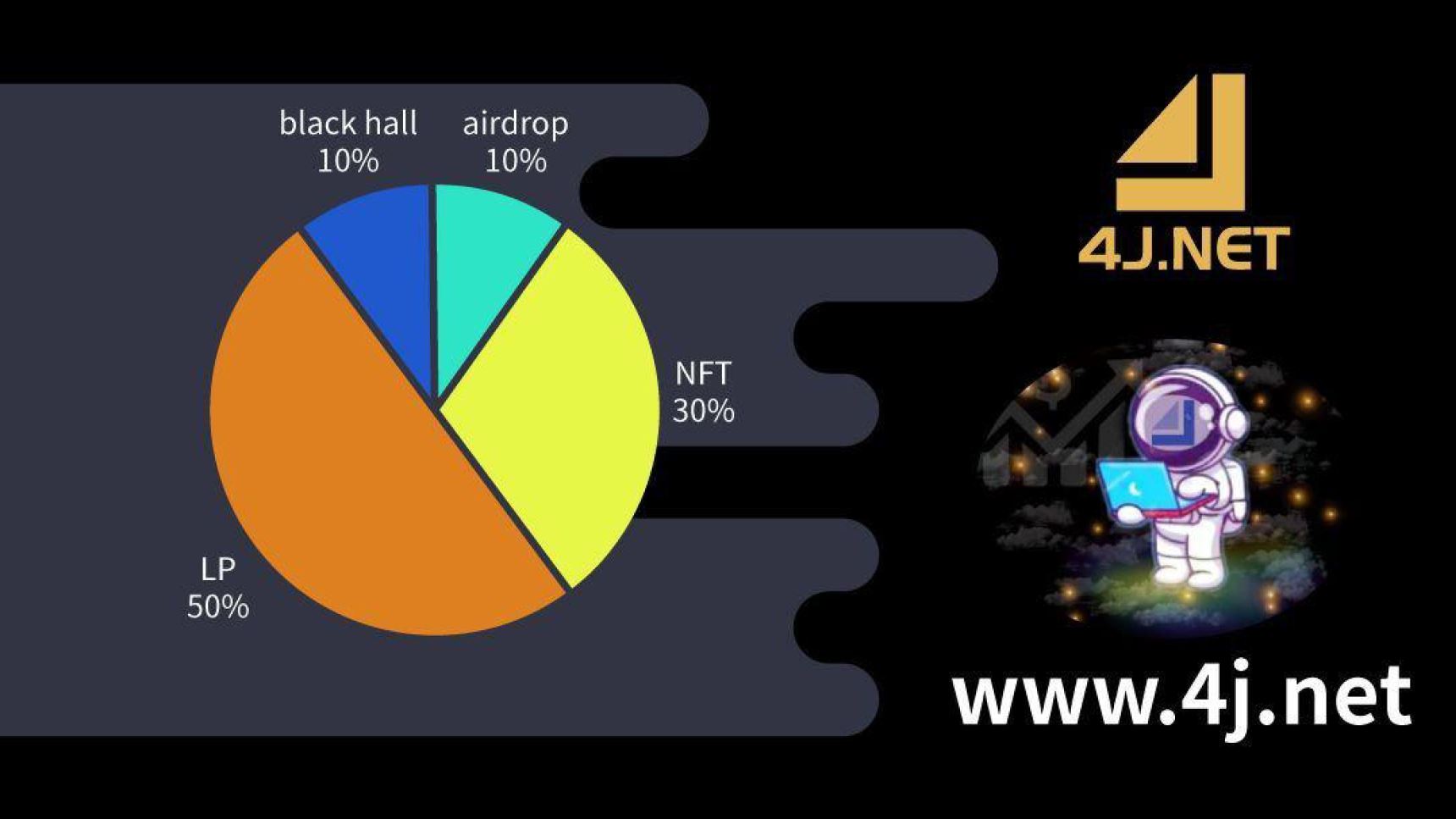
The tokenomics of 4JNET makes it stand apart from the rest, also makes the tokens more valuable than its peers. With the project development team having no stake in the ecosystem, a total of 200 billion tokens is distributed among the community over a period of time. 4JNET will distribute 50% of the entire supply to LP, 30% to NFT holders and another 10% through airdrops while the remaining 10% will be burned to regulate the supply.
The token distribution combined with an initial handling fee of 90% on transactions which gradually reduced to 10% over a short time. Additionally, it ensures everyone gets an advantage in terms of price whether one enters early or late.
Further adding to its fairness, the project holds a valid MSB license and has undergone a thorough security audit by CertiK, a reputable blockchain security solutions company.
The Community Always Comes First for 4JNET
4JNET is the result of a collective effort by a group of developers and other domain experts from some of the leading tech MNCs in the world. As they turn their vision of a fair and just DeFi platform a reality, they are supported by a strong community who also share their principles.
A combination of solid roadmap, strong tokenomics and a highly capable team has undoubtedly made 4JNET a project with huge growth potential. These factors have made 4JNET tokens and NFTs the most sought-after digital assets. It has created a huge demand among crypto investors wishing to grab a share of the project tokens as early as possible. While it is a great thing for the project as it further increases its chance of becoming a gamechanger in today’s DeFi and Metaverse industry, it has also led to few unscrupulous actors trying to take advantage of the situation.
Recently, a group of such actors impersonating 4JNet developers defrauded the community of over $100,000 by creating a fake 4JNET token and selling it on PancakeSwap. They later burnt the LP, leaving a group of trusted investors poorer. While the 4JNET team didn’t have anything to do with it, they decided that it is ethical for them to compensate these victims by initiating appropriate actions.
Once notified about the unfortunate incident, the 4JNET team has decided to raise a request for the fraud account to be frozen. It is also working on the possibility of getting refunds for the victims through BSCscan – the leading BSC validator to minimize their losses.
A Warning to 4JNET Investors
Considering the recent fraud where the fraudster(s) sent their personal wallet address over Telegram and SNS to trick investors into sending funds for project tokens, a 4JNET team representative said:
“The 4JNET team will do everything possible to avoid the recurrence of this incident and reiterate that the 4JNET team will not ask investors to pay in their own name. I hereby warn you that all the information is based on the official website and official Telegram. The group shall prevail.”
Crypto investors and community members are requested to verify all the information through official sources before making any transactions. It will help safeguard them from falling victims to such frauds, which unfortunately is quite prevalent.
The contact address for 4JNET and 4Jpass NFTs is listed prominently on the project’s website
Solajump, the world’s first play-to-win short game based on Solana blockchain, is thrilled to bring back the fun of classic short games. Developed by Kokeshi Academy Nerd 148 Studios, it uses NFTs to revolutionize the world of short gaming with its play-to-win model.
Short games are fun, easy to play, and easy to get into. However, game designers who came up with Pong, Tetris, Arkanoid, Pac-Man and other major hits had to make do with the limited power of computers in the past. Computing power is no longer an issue for players, unlocking the doors to a richer and more engaging experience.
Visually appealing and fun to play, Solajump draws on the key principles of Doodle Jump. The player’s objective is to jump higher and higher by bouncing off platforms randomly placed in the 2D space. The further you progress, the rarer the platforms become, and therefore, the higher the risk of a game over.
With Solajump, the player’s purpose is not only to achieve the highest score but also to win. Players can access the game by owning a Solajumper NFT, which allows them to compete in tournaments that offer significant rewards for winners.
The initial minting of 10,000 algorithmically generated Solajumper NFTs will take place starting from December. To participate, players must get one of the 10,000 Solajumper NFTs, each priced at 1 SOL, during December.
Owning the NFT entitles players to many perks and bonuses such as 10 chances to reach first place in the Genesis tournament. At the end, players with the best scores will win five-figure rewards, with the ultimate winner bagging more than $30,000. After the Genesis tournament, players can choose to trade their NFTs on the secondary market or keep it and participate in the monthly tournaments.
“SOLAJUMP is the result of the partnership between 2 studios, NERD148 and KOKESHI ACADEMY the idea is to provide the defi ecosysteme with emerging tools for NFT’s and play to earn. Solajump is the beginning of an era for mini arcade games connected with NFTs”, said Jeff Meguir, CEO of SolaJump.
The monthly tournaments will start from January 2022, where the best players will share a prize pool worth 100 SOL. Kokeshi Academy Studios will launch the “Jump Coin” in February 2022 to allow players to bet in private tournaments and the PVP mode, which will launch in March 2022. That will make it possible for players to win NFTs, Jump Coins, and many other prizes by beating the score of their direct opponent.
According to the developers, 20% of the funds raised during the minting will go into the “Genesis tournament” prize pool. The amount will be added to the current initial prize pool of 2000 SOL. Another 20% of the minting amount will be allocated for all the monthly tournaments held throughout the year. Each year, new tournaments and NFT mintings will be held to keep expanding the prize pool.
Kokeshi Academy Studios is also preparing to launch a Solana-based arcade game incubator in the second half of 2022.
About Solajump
Developed by Kokeshi Academy and NERD 148 Studios , Solajump is a fun and simple play-to-win NFT game on the Solana blockchain. It aims to revive the short gaming trend and enable players to not only achieve the highest score but also to win.
After weeks of deliberation, alternative investment firm Grayscale Investments has launched a cryptocurrency trust based on SOL, the native token of a Proof-of-History (PoH) Layer 1 blockchain network Solana (SOL).
Key takeaways:
Grayscale Solana Trust is the 16th product in the investment giants’ lineup of digital investment products. The solely and passively invested SOL trust has $9.7 million in assets under management (AUM), at the time of this writing.
Solana uses a unique PoH consensus mechanism that ensures industry-leading throughout and low transaction costs, making it a perfect platform for non-fungible tokens (NFTs). Since the start of the year, SOL has gained more than 14,900% and is currently the fifth-best performing crypto asset in terms of ROI.
Grayscale Investments, a subsidiary of Digital Currency Group (DCG), is the world’s largest asset manager of digital currencies. Most notably, Grayscale’s Bitcoin Trust (GBTC) accounts for by far the biggest share of the investment firm’s AUM, with $37.2 billion.
The company currently operates 16 cryptocurrency trusts, based on some of the largest underlying crypto assets, including BTC, ETH, LINK, LTC, and XLM, to name just a few.
Earlier in the month, Grayscale achieved a monumental milestone, surpassing the world’s largest spot gold ETF in terms of AUM. The shift from precious metals to crypto indicates investors are increasingly more inclined to invest in digital assets for inflation hedging purposes.
In the first week of November, Grayscale announced that it is considering expanding its crypto product lineup with Avalanche (AVAX) and Terra (LUNA), two crypto-assets that have been performing incredibly well in the last month – AVAX is up 97%, while LUNA is up 42%.
SOL has been experiencing strong bullish momentum in the last 48 hours, with the price rising from a cycle low of $182 on November 28 to $228 at press time, a 25% increase.
BingX is proud to launch its Christmas Gala Night Last Stand 2021, an event comprising of multiple events and free giveaways from a pool prize over 550,000 USDT.
BingX is a social trading crypto exchange with a vision to connect traders far and wide. This event is the first of its kind since BingX completed its rebranding in mid-November.
There will be two separate individual ranking events; Profit Rate Ranking and Profit Ranking where the top ten winners in each ranking event can claim over 100,000 USDT in prizes.
A Team Ranking event has been designed especially for users who enjoy working in groups or collectively. They will have the option of choosing whether to build a team which requires a minimum of 5 members or join a team. The Team Rankings will be based on the
total team profit, and prizes will be issued based on the final rank of that team.
Participants also stand a chance to win Christmas Surprise Boxes by way of checking in. However, they will need to check-in consecutively for 1, 3, 7, 10, 15 & 20 days to unlock Christmas Surprise Boxes containing bonus prizes and/ or limited Christmas NFT shards. Traders can also unlock the boxes upon the condition that their cumulative trading volume hits a certain level during the event.
“Hosting an event of this magnitude was not only timely but fitting given the fact that Christmas is one of the most celebrated seasons for many of our users. We ensured that BingX Christmas Gala Night Last Stand is an all-inclusive event comprising of engaging and diverse activities which will allow everyone to actively participate. Indeed, this is a good way to close off the year and to show our appreciation to all the loyal users of BingX.” – Communications Manager at BingX,Elvisco Carrington
A limited-edition of 500 BingX NFTs and 100 BingX Christmas NFTs will be given away as well, all obtainable via Surprise Boxes or Individual Rankings Prizes. NFTs are exchangeable for USDT at the official buyback rate or withdrawn to the users’ wallets within 48 hours after the
event. Hence, users are advised to perform the transactions in time.
BingX Christmas Gala Night Last Stand runs until Dec 26, 2021 (UTC+8) but registration for the individual and team ranking events will end on Dec 11th, 2021. For more information about this event, please visit BingX Christmas Gala Night 2021.
About BingX
Founded in 2018, BingX is a global digital asset, spot, and derivatives trading platform that provides a user-centric and open ecosystem with intuitive social trading features. Created
to enrich the entire cryptocurrency industry, BingX is a safe, reliable, and user-friendly venue for users to trade their favorite and hot assets such as Shiba Inu coin and Dogecoin. Official website: www.bingx.com