Blog

  • Identity is Fundamental , Credit is the Pass

    Identity is Fundamental , Credit is the Pass

    HongKong, China, 14th January, 2022, Chainwire

    Credit is not only the cornerstone of the market economy, the credit mechanism has also penetrated into every corner of society, and the credit system has also become the basic system for regulating the activities of social entities.

    Credit-Individual’s second ID

    In social life, people need an identity certificate to reflect individual identity information, including name, gender, nationality, place of residence, family composition, and so on. These characteristic tags of the physical world define the identity of an individual. After the government or centralized agency verifies the identity information, it can fulfill the basic needs of social life, such as household registration, school registration, driver’s license application, visa for going abroad, bank account opening, loan application, Inquiries on credit records, etc., are the manifestations of identity credit composed of the different needs of different centralized institutions for identity information in different application scenarios. Xuexin.com records advanced information records in China, and European and American countries will use WES for authentication; vehicle management offices or DMV records vehicle information records, including driver’s license types, violation information records, etc.; visas and bank account opening require various asset certificates and bills Address, social information record, whether there has been a criminal record, bad credit record, etc.

    In the above-mentioned scenes, identity is the identification basis of life scenes, and credit is a pass that is active in different scenes. Honesty, as an important part of human values, is regarded as an important virtue and obligation in social or economic activities. People generally regard credit as important as an individual. Personal credit is like a “second ID card.” If there are behaviors such as fraud, debt evasion, and manufacturing of fake and shoddy products, these bad records will always be engraved on the individual’s label. It is also difficult to gain a foothold in society. Whether it is an individual, a company, a government, or a large country, credit is the foundation of social life and life, and it is also a status symbol of whether it can be based on society.

    In the economy and society, banks are the most important credit rating agency in the traditional world. Following the new Basel Agreement’s proposal to use external ratings to calculate bank risk assets, it has further affirmed and enhanced the importance of bank ratings. The risk of assessing banks includes credit risk, market risk and other risks. Credit risk is not only an important consideration for banks to assess personal credit scores, but also the core of banks being managed and rated as a centralized institution. In the traditional world, banks mostly play the role of financial intermediary, but in the information age, they have evolved into information intermediaries, providing a source of basic identity and credit information for other social needs. With the advent of the Internet era, the emergence of Alibaba Sesame Credit has promoted the development of the Internet credit system, and has gradually formed a similar “online bank” existence, becoming an independent third-party credit agency through cloud computing, machine learning, etc. Technology objectively presents personal credit status, and has provided credit services for users and merchants in hundreds of scenarios such as consumer finance, financial leasing, hotels, renting, travel, marriage and love, classified information, student services, and public utility services. Its evaluation criteria include five latitudes of user credit history, behavioral preferences, performance capabilities, identity traits, and personal connections for evaluation, and establish data cooperation with public agencies and other partners. Different from traditional credit data, Sesame Credit also covers a series of application scenarios that reflect the characteristics of personal identity information, such as credit card repayment, online shopping, water, electricity and coal payment, and social relationships.

    Web3.0 Era and the Establishment of Metaverse Credit System

    By analyzing a large amount of online transaction and behavior data, we can evaluate users and help companies classify users to provide better services. Users themselves also enjoy the convenience brought by electronic identity and credit, which has become the Web2.0 era. Sign. 

    Jassem Osseiran, the founder of MetaVisa, also as the entrepreneur and advisor in the financial services, belives that In Web3.0, Internet users need an Internet identifier, which can be linked to any software and practical scenarios. At the same time, information can be stored on the blockchain network to ensure that the information is not tampered with and proves personal achievements, Time-stamped permanent authenticity of assets, interests, activities, etc.

    In the Web1.0 era, people only need to ingest information and don’t need to participate. Web2.0 has become a two-way Internet. Through “temporary” personal network files, information and content can be released, which has better interactivity and requires greater audience participation. The network has become more abstract and expandable. By the time of Web3.0, decentralized identity is not short-lived. People have the right to establish and maintain permanent identities online. Content posted online will be permanently linked to themselves. These public historical records prove the existence of a certain scene and time. It is more abstract and requires higher audience participation. We need to keep our wallets, private keys, assets, and use applications in different scenarios.

    Jassem indicates that Web3.0 should be granular and composable for data and content, and it requires a higher audience to participate in the abstract formation. Before this, our expressions were complete and concrete. All users, content, data, and thermal media are stored in applications. Each application is an isolated island of information, which is largely fragmented. Access procedures between applications require separate applications. It concretely defines completeness, but the audience participation is low. In Web3.0, content and data should be arranged in an open space. Applications are granular, and permissions can be combined with each other. Any application can access each other and form a cold medium. You can use your imagination at will. Everyone is right. The presentation of the same content can have different definitions. This is also the Vision of MetaVisa to achieve the accomplishment in the future.

    The premise of Web3.0 is that users have a unique and permanent Internet identity. As part of a decentralized identity, everyone has a unique, open, and accessible history. The behaviors and achievements of the material world under the chain can be displayed on the chain, and people’s creation, contribution, assets, and collections possessed on the Internet also reflect their preferences, experiences, and achievements. People will be closer to the operation in the material world, but they can use it at will in the network world, and they are all related to themselves, not belonging to the platform. Extending to various fields and application scenarios, decentralized identity can be used as the basis for realizing network native credit scoring, and the credit value on the chain will be more cautious and strict, because it will affect your future credit mark. It can’t help carrying people’s online personality and identity information, and at the same time is the credibility foundation of the online world.

    Driven by the development of a decentralized identity, the construction of a credit system is also necessary. MetaVisa, as the middle layer protocol of Layer-3, founded by Jassem Osseiran and co-founded by Silent Unicorn, the technology advisory firm, helps users establish and display reliable identity and credit records on the chain by analyzing blockchain data. Based on blockchain data, the use of cloud computing, machine learning technology, and model algorithms such as decision trees and random forests, five latitudes of credit history, asset portfolio, on-chain behavior preferences, wallet address activity level, and address relevance have been established The credit rating system MetaVisa Credit Score (MCS). 

    As for Asset Portfolio, the higher the asset holding of an address, the higher its credit rating should be. Therefore, in the credit sub-system, asset holdings should be an important factor. An address account may have various ERC standards and different types of tokens, and the number and value of tokens in the address account will change over time.

    The interaction between the account address and different types of applications on the chain can reflect the interests and preferences of the account, and can also be used as the basis for calculating the credit rating of the account address. Consider the two sub-fields of DeFi and NFT, which are currently highly engaged, and count users’ on-chain interaction behaviors in these two fields respectively.

    In DeFi, deposit, borrow and liquidity pool position can reflect the user’s total asset value TVL (Total Value Locked) on the DeFi platform; Deposit, Borrow, Swap, and Liquidity Pool Position correspond to all four interactive behaviors. TXN (deposit and withdraw corresponding to deposit, borrow and repay corresponding to borrow, increase and decrease corresponding to swap and liquidity pool position) can reflect the user’s activity level on the DeFi platform. Similar to the aforementioned “address activity level” and “holding assets”, the total asset value and activity level both take the time effect into account in the exponential moving average method. The weighted addition of the two will obtain the account address’s value in the DeFi field. level of participation.

    In NFT field, by counting the value of all NFT assets held by the account address (based on the latest transaction price), the total value of the NFT assets of the account address can be obtained. By counting the above interactive behaviors, it can reflect the user’s activity level on the NFT platform. The aforementioned “address activity level” and “holding assets” are similar. Both the total value of NFT assets and the activity level take the time effect into account in the exponential moving average method, and the two are weighted and added to obtain the account address’s participation in the NFT field. .

    Address Active Level is evaluated based on the number of successful TXN’s. Intuitively, the higher the frequency of TXN, the closer to the calculation time point, the more active the address should be. Based on this principle, an exponential moving average method is used to evaluate the activity of an address.

    Many considerations are needed to improve the credit rating system. With reference to the case of the physical world, in Sweden, if the mobile phone arrears is not paid and is dunning more than twice, in addition to being shut down, you will receive court flyers and your name will be recorded. You may not be able to apply for any mobile phone network in the future. Loans will also become difficult; in Finland, consciously buying tickets, but if someone spot checks and finds evasion, they will be blacklisted, which will have a great impact on personal life and work in the future; in the Nordic region, once a company appears Bad credit records, these untrustworthy information will be disseminated in the society, from the dishonest person’s dishonesty to the transaction party to the dishonesty of the whole society; once German companies and individuals have dishonest behavior, the bank will not grant loans, and individuals are not allowed to go abroad. If the impact of these social behaviors on credit is mapped to the chain, everyone will treat their credit more cautiously, because the convenience and preferential treatment brought by good credit is incomparable.

    As far as the current meta-universe or blockchain credit system technology is concerned, the more standardized data sources are the holdings of assets, asset types, active frequencies, product trends, etc. of addresses. How to map off-chain experience to on-chain data to form personal identity information and credit labels is currently the biggest challenge. This is also an important introduction of how to make decentralized identities practical, such as personal achievements, creative contributions, academic diplomas, etc. And many companies are now responding to this challenge. Violet is committed to verifying personal identity information off-chain on the chain; 0xStation allows users to record their professional achievements on the chain; Koodos allows a variety of on-chain relationships and can transform any content on the Internet into a customizable NFT . These granular data can be used as the data source of MetaVisa or any identity credit system developer. Through the classification of these data, they can be identified to create personal unique credit badges. These badges can not only be added to the data on the chain, It is also an important credit symbol that prevails in the world of the meta universe.

    In addition to collecting, obtaining, and organizing metadata, a complete information system is needed to facilitate the reading and evaluation of data. The data model and standards for managing goodwill are also a great challenge to whether decentralized identities can be mainstreamed. The subjective and complex background information behind the identity, objective credit evaluation, information data security protection, access to credit information sources on the chain, and the diversified data requirements of the credit system all promote the realization of Web3.0 and the meta-universe system fundamentally.

    Follow MetaVisa to learn more:

    Website: http://www.metavisa.com/

    Twitter: https://twitter.com/MetaVisa

    Medium: https://medium.com/@metavisaofficial

    Community(English): https://t.me/MetaVisaOfficialCommunity

    Contacts
    • Eddie
    • service@metavisa.com
  • Dogecoin Catapults to a Monthly High on the News of Tesla Shop Integration

    Dogecoin Catapults to a Monthly High on the News of Tesla Shop Integration

    Key takeaways:

    • Dogecoin is now accepted as a payment method on Tesla’s online shopping platform, but not all items are purchasable with DOGE as of yet
    • Dogecoin consumes nearly 6000 times less energy per transaction than Bitcoin, which was removed as a payment method in mid-2021 due to environmental concerns
    • The price of DOGE jumped more than 10% on the news and reached its peak monthly value

    You can now buy (some) Tesla merch with Dogecoin

    Tesla CEO Elon Musk held to his word and earlier today announced that Dogecoin is now an accepted payment method on the leading car manufacturer’s online shopping platform. Exactly a month ago, Elon Musk called Dogecoin a better payment method than Bitcoin when doing a TIME’s magazine person of the year interview, which led to DOGE gaining 20% in the span of a single day. At the time, Musk explained that Dogecoin’s high transaction flow and slightly inflationary nature incentivize people to spend it, and not hoard it as is the case with Bitcoin, which effectively makes it an excellent payment method.

    As of now, there is a limited selection of Tesla merchandise that is purchasable with DOGE and there is no information available regarding the possibility of using the world’s largest memecoin to purchase vehicles in the future. 

    Some of the items that are purchasable with DOGE in the Tesla shop. Image source: Tesla

    This is not the first time that the leading electric car company accepts cryptocurrency as a payment method. In March 2021, Tesla announced the support for Bitcoin, which was removed after less than two months, due to environmental concerns surrounding the power-hungry Bitcoin mining industry. At the time, Musk tweeted that the company will likely reverse its decision once “mining transitions to more sustainable energy.”

    The Dogecoin network consumes just a fraction of Bitcoin’s platforms, despite both digital currencies employing an energy-intensive Proof-of-Work (PoW) consensus mechanism. According to data from TRG Datacenters, Dogecoin consumes only 0.12 KWh per transaction, nearly 6000 times less than Bitcoin’s 707 KWh per transaction.

    The price of DOGE jumped more than 10% on the news and has reached monthly and cycle highs of $0.2177 earlier today.

  • Calamari Network Rolls Out Community Governance Measures As Decentralization Efforts Advance

    Calamari Network Rolls Out Community Governance Measures As Decentralization Efforts Advance

    Boston, Massachusetts, 14th January, 2022, Chainwire

    Feature Will Invite More Widespread Community Participation In Key Network Decisions 

    Substrate-based DeFi privacy protocol, Manta Network, has launched the community governance feature for its Kusama-based network Calamari Network. Earlier this year, the Manta team had activated the necessary features for on-chain governance on Calamari through a runtime upgrade. 

    Currently, the implementation of the core community governance feature is in live, with many additional features in the pipeline. As a rapidly expanding ecosystem, the launch of the governance feature on Calamari marks a significant milestone for the Manta team. Recently, Runtime Upgrade 3.1.1, which upgraded the codebase for Calamari Network, went live on January 7, 2021, based on community governance, marking a new chapter in decentralization for the relay chain.

    Following the upgrade, the Manta Network core development will no longer be able to implement or remove any features without community consent. Each proposed change on the Calamari Network will now be driven by the community, which will be divided into three phases: the launch period, the voting period, and the enactment period. 

    Furthermore, the community will now consist of three distinct groups, all of which will be part of governance. A group of three individuals from the Manta Core Development Team, called “The Council”, will select and submit proposals for community voting. 

    Anyone who holds the native Calamari (KMA) token will be considered “Public Token Holders.” Holders can use their stake to support proposals that are trying to become referendums and vote on proposals that have been accepted as referendums. 

    Finally, there is the “Technical Committee,” which consists of three members from the Manta Core Development team. They will be responsible for fast tracking of the three phases and ensuring that the community reaches unanimous agreement for referendums. 

    In terms of development, the Manta team has made noteworthy progress throughout 2021. From rolling out the mainnet version, participating and winning grants, executing several runtime upgrades, launching the Dolphin testnet, and now the community governance update, the Manta ecosystem is quickly shaping up as the go-to privacy-focused solution for DeFi.

    About Manta Network

    Manta Network is the on-chain privacy solution for blockchain assets, offering a range of products, including an AM DEX and a payment protocol with built-in privacy. Founded in 2020, the team is comprised of cryptocurrency veterans, professors, and scholars from backgrounds including Harvard, MIT, and Algorand. Backed by Web3 Foundation, Hypersphere Ventures co-founder Jack Platts, and Polychain partner Tekin Salimi, Manta Network also counts on support from former Web3 Foundation co-founder Ashley Tyson, Consensys’ Shuyao Kong, and several other venture capital firms and angel investors.
     

    Contacts
    • Kenny Li
    • Kenny@manta.network
  • Midas.Investments Review – Unlock the Power of Decentralized Finance and Earn the Highest Yields on BTC, ETH, USDT, and DeFi Assets

    Midas.Investments Review – Unlock the Power of Decentralized Finance and Earn the Highest Yields on BTC, ETH, USDT, and DeFi Assets

    The emergence of decentralized financial (DeFi) products and services has completely transformed the cryptocurrency investing landscape over the last couple of years. Spot and futures trading is no longer the only game in town. Digital currency investors, particularly those who lack the time required to closely observe market movements to identify good buying and selling opportunities, can take advantage of passive income sources that are less risky and in some cases more lucrative.

    While numerous decentralized and centralized crypto services have arisen that allow their users to take advantage of various financial instruments designed for passive income generation, few offer yield generating prowess of Midas.Investments. 

    Midas.Investments turns market inefficiencies into yield generating opportunities

    Midas.Investments is a custodial digital asset investment platform that provides its users with an opportunity to build sustainable passive income streams and unlock the full potential of their crypto assets. The platform supports Bitcoin, Ethereum, and a long list of popular crypto assets.

    The main screen of the website features a streamlined user interface with up-to-date APY rates and current market prices. Image source: Midas.Investments

    The Midas.Investments team has developed a robust investing system that takes advantage of minute inefficiencies in the market to provide one of the highest yield generating services in the DeFi sector. The company utilizes its users’ digital holdings in order to distribute liquidity across the market in a peer-2-peer (P2P) manner. In return, Midas.Investments investors are rewarded with enticing APY rates that provide a great long-term investment opportunity. 

    Midas.Investments DeFi investing strategies

    Midas.Investments investment strategies take into account price volatility, correlation, collateral asset models and hedging, for maximum yield generating efficiency while retaining a high degree of financial security.

    Let’s take a look at some investing strategies Midas.Investments employs to grow user deposited crypto assets during opportune market conditions and in turn preserves them in times of market turmoil.

    Concentrated liquidity provider for Uniswap V3

    Staking assets in decentralized exchange (DEX) lending pools is one of the more popular ways of putting otherwise idle crypto assets to use. Liquidity providing is not risk-free, primarily due to the potentially high divergence in prices of the two pool assets, which can lead to dreaded impermanent loss. Midas’ self-collateralization method of lending target assets and liquidity negates much of the liquidity-providing risks. Midas aims for a 20% – 60% annualized percentage rate (APR) for deposited assets, earned from LP trading fees.

    Borrowing for target asset’s collateral to free liquidity

    Midas.Investments takes a strategic position on a target asset at a liquidation value higher than 40%. This method unlocks additional liquidity and serves best in a combination with another investment strategy; however, a loan can approach the liquidation level quickly if the price of the asset unexpectedly depreciates and then requires additional collateral, or debt repayment to maintain a safe loan-to-value (LTV) ratio.

    Yield vaults

    Another method Midas.Investments utilizes are the low-risk YFI strategies, which maximize interest rates on lending across different lending protocols and can accrue up to 15% APR. Insurance protocols and insurance funds ensure that user funds are completely safe at all times. Midas seeks to interact with smart contracts powering the platform during nighttime when the gas fees are at their lowest. 

    Asset and stable liquidity provider to hedge from market pullbacks

    To hedge against market downturns, Midas provides liquidity in liquidity pools consisting of “regular” crypto assets and stablecoins, such as USDT or USDC. This approach nets significant profit in times of bearish market activity and can generate anywhere between 30% to 150% APR.

    Leveraged liquidity farming

    The riskiest method Midas.Investments uses. Combining assets with a stablecoin pair grows the asset amount during market pullbacks, which can net up to 75% APR if market conditions are optimal but introduces considerable risks during periods of flat markets with high volatility.

    Midas.Investments uses a complex combination of different investing strategies, ranging from low to high-risk methods, to ensure up to 40% APR for a single asset regardless of market conditions.

    To learn more about the different types of strategies the company employs to generate yield for its customers, check this insightful blog post from Midas.Investments.

    Earn up to 28% annual interest on your investment in DeFi YAP

    One of the better ways to grow your crypto portfolio is to invest in Midas’ DeFi Yield Automated Portfolios. The DeFi YAP consists of eight tokens by rapidly developing projects in the decentralized space, including ETH, LINK, SUSHI, AAVE, MIDAS, UNI, DAI, and SNX. Each of the listed DeFi assets accounts for the same share of the DeFi YAP, with 12.5%.

    The Midas’ flagship DeFi investment vehicle provides users with an opportunity to earn a passive income of up to 28% annually. Since the DeFi sector is still very young and continuously changing, there is a higher degree of risk, but also a bigger upside, when investing in DeFi YAP than in Midas’ stable YAPs.

    Earn stable passive income with Yield Automated Portfolios (YAP)

    The Yield Automated Portfolios (YAP) are an excellent choice for investors that value asset stability over riskier approaches that can generate a higher yield but are wholly dependant on the state of the market. Midas offers two types of automated portfolios, which differ in the coins they support and the amount of yield they can theoretically generate. Both types provide great potential for long-term portfolio growth, feature weekly BTC payouts, and a reasonable fee structure.

    Stable Yield Automated Portfolio (SYAP)

    The investment in the Stable Yield Automated Portfolio is quantified with the SYAP token, which is not a blockchain token but a measuring unit for YAP investments. SYAP is backed by BTC, ETH, MIDAS, and USDT, and priced according to their market values.

    The group of four tokens ensures maximum long-term stability and allows SYAP to generate a passive income stream of 23% APY. It is worth noting that automated portfolio rebalancing is done monthly to redistribute funds among different coins to optimize profits.

    Masternode Yield Automated Portfolio (MnYAP)

    Similar to SYAP, the Masternode Yield Automated Portfolio is managed by a special non-blockchain-based token MNYAP, which is priced based on the value of its underlying support assets.

    The Masternode YAP consists of BTC, DIVI, ESBC, MIDAS, NRG, PHR, XZC, and ZEN, which were chosen according to their market performance and community engagement. Midas purchases the coins on their users’ behalf and uses advanced investing strategies to generate 20% – 25% APY rewards.

    Platform security and fees

    Midas.Investments uses a combination of various security measures to provide a maximum level of security and shield user funds from any malicious attacks. The first line of defense includes handling of all sensitive information through email and an IP-validation check. The investing platform also features 2 Factor Authentication (2FA), which means that user accounts are not accessible without a code that is sent via an email. As an added precaution, Midas performs automatic logouts every seven days. Finally, 90% of users’ funds are held in encrypted cold wallets, meaning that even if an unlikely breach occurs, it wouldn’t result in losses for customers.

    The company charges a 5% fee on payouts before they are processed to the Bitcoin balance, and a 0.8% rebalancing fee, which is deducted after the monthly portfolio rebalancing has been processed.

    Supported crypto assets

    Midas.Investments supports 28 digital currencies in addition to the platform’s native Fantom blockchain-based MIDAS token, which provides a long list of benefits to Midas platform users. For more information about the MIDAS token click here.

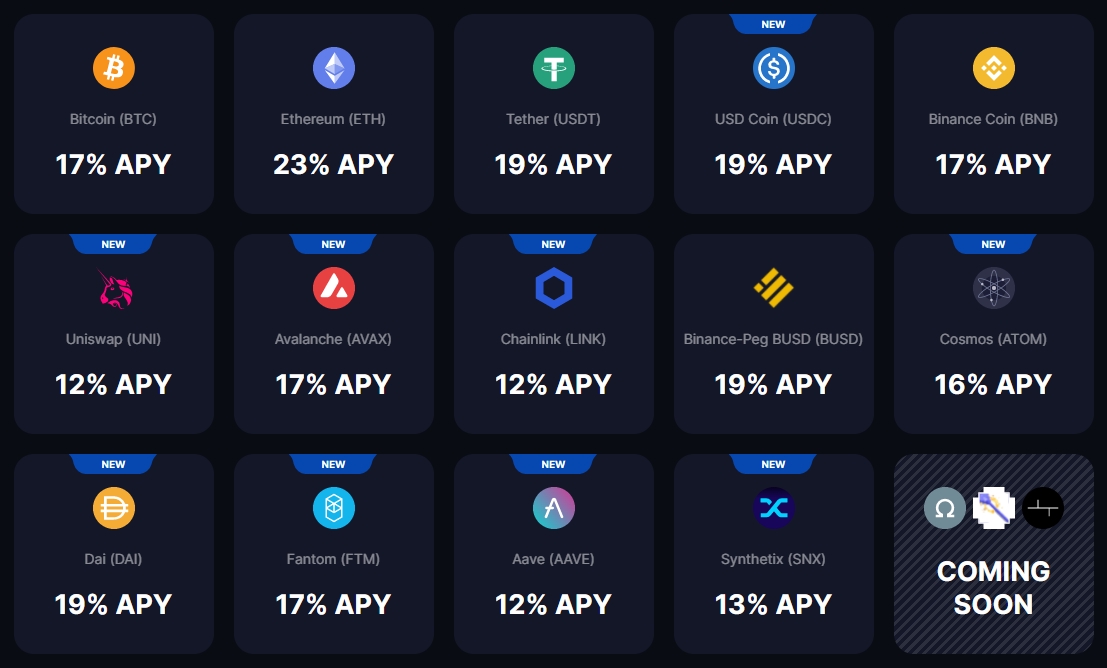
    The list of supported digital assets and their corresponding APY rates. Image source: Midas.Investments

    Here’s a complete list* of supported coins in alphabetical order: AAVE, ATOM, AVAX, BNB, BTC, BUSD, CELO, DAI, DASH, DEFIYAP, DIVI, ETH, FIRO, FTM, LINK, LTC, MIDAS, MN YAP, NRG, PIVX, SAPP, SNX, SUSHI, SYAP, TRTT, UNI, USDC, USDT, ZEN

    *The list is subject to change. Data was collected on 6.12.2021.

    Gain exposure to the growing DeFi market guided by expert insight by Midas team of analysts

    Midas.Investments has emerged as one of the market leaders in providing enticing passive income streams for cryptocurrency holders. No lock-up periods, no limits on deposits, and innovative investment strategies make the Midas platform one of the more flexible and lucrative solutions in the sector.

    There is no better argument supporting that claim than cold hard facts – more than 23,000 investors have a total of $51 million worth of crypto assets committed to the platform. In October 2021 alone, Midas.Investments helped its customers generate a whopping $780,000 in stable passive income.

    Midas team consists of notable analysts and software developers with rich experience in product development and over 20 years of high-level investment decisions under their belt.

    For more information about the high yield generating financial options of Midas.Investments check their official website.

  • Kingdom Karnage raises $2M from Animoca Brands, Enjin and DFG to boost GameFi features

    Kingdom Karnage raises $2M from Animoca Brands, Enjin and DFG to boost GameFi features

    United Kingdom — January 11th, 2022 – Kepithor Studios has announced a set of innovative new GameFi mechanics coming to its turn-based NFT battle game, Kingdom Karnage. The game will introduce new play-to-earn opportunities for its players, powered by its upcoming KKT token, which has received investment from Animoca Brands, Kriptomat, ExNetwork, MyMetaverse, DFG, Jsquare and many others. The team intends to build a bridge that will allow the KKT token to move from Binance Smart Chain to Enjin’s Jumpnet where users can transact with zero gas.

    Kingdom Karnage has been live and playable in Beta for nearly two years.  The game’s animated cartoon aesthetics and deeply strategic dynamic gameplay have allowed it to amass 24,979 NFT holders since launch. Kingdom Karnage was also one of the first projects to receive an investment from Enjin’s $100M Efinity Metaverse Fund.

    Kingdom Karnage will enable players to earn a living by receiving $KKT through in-game drops and voting for new game features. Players with extra NFTs are able to create “sponsorship decks” which they can lend out to other players, sharing the $KKT earned by using them. $KKT will become the currency of the Kingdom Karnage economy, with players able to sell and rent their NFTs through the in-game auction house.

    “We are creating new play-to-earn mechanics that will proliferate through the gaming industry,” said Nick Franklin, CEO of Kephithor Studios. “By achieving a perfect balance between gameplay and financial inclusion our mission is to help players enjoy their free time and change their lives while doing so.”

    Kingdom Karnage is partnering with EnjinStarter, Red Kite, and GameFi to launch their IGOs on the 11th,12th, and 13th of January.

    Quotes:

    “Kingdom Karnage is very special to Enjin, being one of the first to join our ecosystem in November 2018. It exemplifies excellent integration of Enjin’s blockchain wallet and tech stack in a simpler turn-based game that runs on mobile and browser. Further, it exemplifies how a small team can grow an organic community with creative game mechanics.” – Witek Radomski, Co-Founder and CTO, Enjin

    “There is a good number of reasons to be a staunch believer in Kingdom Karnage, the quality of the game is among the best we’ve seen growing in the GameFi space, they’re cross-chain objectives are in line with the future of blockchain as a whole and they are an Enjin-native product, which shows the great deal of quality development they are delivering. These are just some of the reasons we consider them to be a one of a kind game and have great expectations of what they will be able to achieve in a young and upcoming sector of the industry.” – James Wo, Co-Founder and CIO, DFG

    For more information and updates, please visit:

    Website: https://KingdomKarnage.com  

    Telegram: https://t.me/KingdomKarnage

    Twitter: https://twitter.com/Kingdom_Karnage 

  • Near Foundation Raises $150 Million for Major DeFi Push, NEAR Catapults to New ATH

    Near Foundation Raises $150 Million for Major DeFi Push, NEAR Catapults to New ATH

    Key takeaways:

    • Near has received a $150 million investment from leading cryptocurrency investors, including Three Arrows Capital and a16z
    • The freshly acquired funds will be used for ecosystem expansion and to help solidify Near’s position among the leading DeFi chains
    • The price of NEAR jumped over 10% on the news and reached an all-time high of $19.43

    Near Foundation, the owner and developer of a leading Ethereum competitor, Near (NEAR), has announced the close of a $150 million financing round led by Three Arrows Capital with participation from several prominent crypto investment firms. The new capital will reportedly go towards the expansion of Near’s decentralized finance (DeFi) ecosystem.

    Near aims to use the newly acquired funds to bridge the gap between Near Protocol and Ethereum

    The recently concluded funding round was led by Su Shu’s Three Arrows Capital and featured some of the more notable players in the crypto investment circles, including Alameda, Andreessen Horowitz (a16z), and Dragonfly Capital, to name just a few. Dragonfly’s General Partner Ashwin Ramachandran commented on his company’s involvement in the funding round:

    “Near has done a great job from a technology standpoint, and we want to help them achieve a level of developer, user, ecosystem adoption which reflects their current level of technology innovation.”

    The $150 million haul comes three months after Near announced a massive $800 million ecosystem fund with an aim of attracting a large number of developers and decentralized projects to the rapidly growing Layer-1 network. According to CoinDesk, some investors who participated in the latest funding round have expressed their commitment to helping boost the liquidity of new DeFi projects as they go live on the chain.

    According to blockchain analytics firm DeFi Llama, Near has been quickly amassing value locked in decentralized applications running on its platform over the last couple of months. The total value locked (TVL) has increased from a little over $26 million on November 1 to roughly $166 million today. Despite quick growth, Near is trailing far behind the largest DeFi ecosystems. For reference, Ethereum’s TVL at the time of this writing is $150 billion, ahead of Terra’s $18.5 billion and BSC’s $15.1 billion.

    Following the announcement, the price of Near’s native NEAR token skyrocketed by more than 10% and is changing hands at an all-time high value of $19.43 at press time.

  • Polygon’s EIP-1599 Upgrade is Slated for Next Week, MATIC Burning is Finally Here

    Polygon’s EIP-1599 Upgrade is Slated for Next Week, MATIC Burning is Finally Here

    On Wednesday, Polygon announced that the highly-anticipated EIP-1599 upgrade is coming to the leading Ethereum Layer-2 scaling solution early next week. The network upgrade will introduce MATIC burning mechanics and start putting deflationary pressure on its value.

    Key takeaways:

    • The Polygon team shared the news on Twitter and clarified that the set of Ethereum improvement proposals (EIPs) that were first introduced via Ethereum London hard fork in August of 2021, are finally coming to the Polygon mainnet.

    • The team is aiming to activate EIP-1599 and related proposals on Polygon’s mainnet on January 18, at around 8:00 AM UTC, at block number 23,850,000. The mainnet launch comes a month after the hard fork rolled out to Polygon’s Mumbai testnet.

    • The London upgrade’s main features include a better estimation of transactions costs, which leads to a reduction in overpayments, and a fundamental change in the way transaction fees are handled – fees that were previously paid to miners will now be removed from circulation. 

    • Token burning, or destroying, is the process of removing coins from circulation, which plays a pivotal role in the supply and demand dynamics of a particular currency and creates deflationary pressure on the value of a single unit of currency.

    • When Ethereum burning was first introduced in August, the second-largest crypto began a multi-month long rally that saw its price reach the highest point to date of $4,867 on November 10. In the six months since ETH burning went live, more than 1.48 million ETH, worth nearly $5 billion, have been burned.

    • Polygon’s implementation of real-time burning mechanics comes a little over a month after Binance Coin burning was introduced on Binance Smart Chain (BSC). BNB burning differs from Polygon and Ethereum’s solution as some transaction fees are still distributed among the network’s validators and not entirely removed from circulation.

    • The price of MATIC has been trending upwards in recent days – the token gained roughly 25% in the last 72 hours and is trading just below its cycle high of $2.45 at the time of this writing.
  • Verasity’s Proof of View Passes Examination by Chinese Patent Office

    Verasity’s Proof of View Passes Examination by Chinese Patent Office

    London, United Kingdom, 13th January, 2022, Chainwire

    Verasity is pleased to announce that its Proof of View technology has passed its examination by the People’s Republic of China National Intellectual Property Administration — becoming the first ad tech module based on blockchain technology patent approval in China.

    Verasity’s Proof of View (PoV)™ technology ensures that content and advertisements viewed via content players with a PoV integration are served to real viewers — verifiable on-chain and recorded immutably through Verasity’s purpose-built distributed ledger technology. Proof of View empowers advertisers to lower their ad spend lost to bots and fake viewers, and enables publishers to get paid faster for served ads through transparent viewership metrics.

    Already granted a patent in the USA — the largest ad spend market in the world at over US$240 billion per annum — Proof of View technology is now poised to dominate the ad tech market in both the Western Hemisphere and East Asia through its proprietary status and exclusive development by Verasity.

    As the second-largest world economy after the USA, China spends some ~US$120 billion on advertising each year, with over 65% of these ads served online. The rapidly expanding Chinese ad market, powered by a steeply rising GDP per capita for Chinese consumers, is set to boom in coming years.

    According to Japanese international advertising firm Dentsu, Chinese ad spend is predicted to grow almost 7% in 2022 alone, yet some experts predict that up to a third of Chinese advertisers’ ad traffic is fake or invalid — costing the growing industry billions per year. Now, through its pending patent approval for Proof of View in China, Verasity is uniquely positioned to lead innovation and deliver cutting-edge ad fraud prevention to Chinese advertisers who have lacked access to transparent anti-fraud measures to date.

    The patent application, which will now be published in China, is entitled “System and Method for Proof of View via Blockchain”. It passed its assessment on the 5th of January 2022 the result of which can be viewed here in Chinese or English.

    RJ Mark, Founder at Verasity, says:

    “Protecting our proprietary technology by pursuing patent and IP is an incredibly important step towards establishing Verasity as a world leader in blockchain-based ad tech. This is especially the case with China which is now taking patent protection seriously and represents the second largest economy. Verasity’s Proof of View technology will create a paradigm shift in the way advertisers serve ads, and more importantly, in the way publishers and content creators get paid. To ensure this disruption cascades worldwide, we will continue seeking patents for our technology from governments across the globe.”

    Patent applications have been filed worldwide to protect this original patent.

    About Verasity

    Verasity.io is a protocol and product layer blockchain platform for esports and digital content. Verasity is committed to delivering a better user experience for all stakeholders within the digital content space. By offering transparency, security and trust with our patented Proof of View technology, we are working to eliminate online ad fraud and NFT fraud—ultimately changing how digital advertising is done today. Within esports, Verasity promises to dominate the industry with VeraEsports, using superior blockchain technology and the best gamified viewership experience. Follow Verasity on Twitter, LinkedIn, Discord, and Reddit. Visit https://verasity.io.

    Contacts

    PR Manager

    • Simon Moser
    • PolyGrowth
    • simon@polygrowth.io
  • Here’s How Cryptocurrencies, NFTs And Blockchain Can Help Content Creators Become Financially Independent

    Here’s How Cryptocurrencies, NFTs And Blockchain Can Help Content Creators Become Financially Independent

    Many would agree that the world is currently undergoing a massive shift in terms of digitalization. This is true for essentially all parts of our society, from medicine, to education, to the military, to finance. This field of financial technology can and has taken many forms, however none have been as prominent or relevant within the last decade as that of cryptocurrencies, NFTs and blockchain.

    Whether it be the flagship cryptocurrency, Bitcoin (BTC), or one of the numerous alternatives such as Ethereum (ETH), Polkadot (DOT) or Cardano (ADA), the simple truth is that people from all walks of life, and especially content creators and artists who have often struggled to secure funds in the past, are now relying on this new kind of technology to make ends meet and to gain recognition.

    A new era for content creators

    With increasing digitalization comes more chances to branch out and explore new opportunities. As such, content creators and artists from a wide variety of backgrounds, fields and interests are all becoming increasingly interconnected and are using the aforementioned cryptocurrencies along with NFTs (non-fungible tokens) to interact with one another in a meaningful way. 

    It is with that exact mindset that the decentralized media launchpad called Flickto was formed, which is a Cardano-based platform designed specifically to help content creators obtain funds and decide which projects deserve to receive financial backing as well. Moreover, as the value of many cryptocurrencies grows over time, users who earn FLICK along with various other tokens through similar projects can then sell the digital assets in order to earn a sizable income. There is also Flickonomics, which essentially serves as the intersection between cryptocurrencies, business and the media. It is the branch of knowledge which is concerned with the transfer, consumption and production of wealth in the media.

    Things are now made even easier thanks to FLICK being listed on ADAX CEX and launchpad, a one-stop location for trading within Cardano’s ecosystem. ADAX also lets its users take part in censorship-resistant and non-custodial transactions which occur within this ecosystem at an affordable cost, which makes it all the more attractive for those who may be struggling financially.

    The importance of IDOs

    IDOs (Initial DEX Offerings) are crucial in this industry. IDO platforms, also known as cryptocurrency launchpads, are mainly used for launching new coins and crypto-oriented projects, as well as generating liquidity. An IDO is hence a financing platform for any new project that is launched on a decentralized exchange platform utilising tokens or coins.

    The aforementioned Flickto had a very successful IDO recently, one which saw various content creators, traders, investors and more come together to collectively take part in the sale rounds. This serves as proof that not only are events such as IDOs significant, but they could also be the key to helping artists and content creators alike become financially independent in the future.