Blog

  • 5 Key Features Every Reputable Crypto Casino Should Offer

    5 Key Features Every Reputable Crypto Casino Should Offer

    reputable crypto casino

    Cryptocurrency gambling continues to gain momentum in 2025. This is reflected in how the market has been flooded with crypto casinos, with a growing number of platforms integrating this payment method for deposits and withdrawals. 

    However, not every crypto casino is on the level – and it’s essential you can spot what separates a trustworthy outlet from a risky one. Whether you’re a seasoned player or new to the crypto gambling world, here are five key features to seek before placing your first bet. 

    Feature #1: Provably fair technology 

    Provably fair systems. This is one of the biggest advantages of crypto casinos. These systems are algorithms which allow players to verify each game’s fairness. This transparency is unique to blockchain-based platforms and a major step up from traditional online casinos.

    Look for casinos which publish their hash functions and allow real-time verification of outcomes. Encountered a site that doesn’t offer provably fair games? Then it might not be worth your trust. 

    Feature #2: Fast and secure crypto payments 

    It should go without saying. However, the hallmark of a great crypto casino is strong, frictionless payment functionality. 

    Deposits and withdrawals should be fast. They should come with low or no fees. Top-tier platforms also support a wide assortment of cryptocurrencies. Bitcoin is a given, but there should also be room for everything from Ethereum to Solana, USDT, and emerging altcoins. 

    Want to see a casino take it to the next level? Support for Layer 2 solutions like Arbitrum supports near-instant, low-cost transactions. Furthermore, the best platforms also supply secure wallet integration and transparent blockchain confirmations for every transaction. 

    Feature #3: Licensed or community-vetted reputation 

    Visit a top-rated traditional online casino, and you’ll see that they display a range of accreditations to meet stringent regulatory standards. Licensing from recognized governing bodies. Certification of their games that are regularly tested. Payment service provider licenses. Responsible gambling tools. 

    Numerous crypto platforms, however, operate without official licenses. 

    Some crypto casinos do gain licensing from jurisdictions like Curaçao and Gibraltar for added credibility. Others rely on being vetted by the community with reviews across respected communities. In general, if a platform has no verifiable track record or community presence, steer clear. 

    Feature #4: Strong privacy and anonymity options 

    Anonymity. This is one of the core reasons players choose crypto casinos. A quality platform should allow you to register with minimal personal information. This can sometimes be simply an email address – nothing else. Some even go a step further by enabling wallet-only access or no-KYC withdrawals under certain thresholds. 

    Just remember to check the site balances privacy with security, especially when dealing with large sums. 

    Feature #5: Responsive customer support and UI

    Even in this decentralized world, customer support matters. You should always be on the hunt for a casino offering 24/7 live chat or, at the least, support ticket systems. 

    Beyond support, the platform interface should be modern and easy to navigate, even when swapping between chains or wallets. A quality UI is usually a sign of serious development effort, and a strong indicator of a casino’s overall quality.

  • Tezos Community to Benefit as Fees Are Eliminated on Tez Delegation Rewards for Revolut Customers

    Tezos Community to Benefit as Fees Are Eliminated on Tez Delegation Rewards for Revolut Customers

    London, UK, November 26th, 2025, Chainwire

    Revolut customers who hold tez (XTZ) will receive 100% of on-chain delegation rewards from today, following an update to the platform’s auto-delegation feature that eliminates all platform fees on yield generation. The change made by the global fintech leader Revolut, which has more than 65 million customers worldwide, comes as the Tezos ecosystem continues to simplify network participation following the recent Rio protocol upgrade, which reduced network cycles to just one day.

    The zero-fee structure means that all tez holders on Revolut will automatically earn the full delegation rewards generated by the Tezos network, with no deductions or platform charges. Revolut currently auto-delegates all tez balances, allowing users to earn rewards while maintaining full liquidity of their assets, a key advantage of Tezos’ delegation model.

    While Revolut offers trading for over 280 cryptocurrencies, only 13 offer native earn features. The inclusion of tez in this group, coupled with the zero-fee structure, positions XTZ as a standout option. The auto-delegation feature operates seamlessly in the background, with rewards accruing directly to user balances. This flexibility, combined with Revolut’s zero-fee approach, offers an optimal balance of earning potential and accessibility.

    Vincent Poulain, Manager of Technical User Relations at Nomadic Labs, commented: “Revolut’s decision to pass 100% of delegation rewards to users demonstrates the compelling economics of Tezos; this creates an unbeatable user experience.”

    “We know our customers want their crypto to work harder for them, and that’s exactly what we’re delivering with tez,” added Emil Urmanshin, Director – Crypto & New Bets at Revolut. “It’s the kind of simple, transparent earning experience our users deserve.”

    Revolut’s approach to tez delegation exemplifies how both the platform and the Tezos ecosystem are focused on simplifying experiences for users. As Revolut handles all technical aspects of delegation automatically, users experience all the advantages of delegating without needing to understand validators, delegation mechanics, or manage any settings.

    About Tezos

    Tezos is an open-source and energy-efficient blockchain designed to empower institutions, developers, and businesses and facilitate value transfer in a digital environment. It is designed for the scalable deployment of decentralized applications. As one of the first Proof of Stake blockchains, Tezos is globally supported and valued for its strong governance, long-term upgradability, and smart contract capabilities. For more information about Tezos, visit http://www.tezos.com. 

    About Revolut

    Revolut is a global fintech, helping people get more from their money. In 2015, Revolut launched in the UK offering money transfer and exchange. Today, more than 65 million customers around the world use dozens of Revolut’s innovative products to make more than a billion transactions a month.

    Across our personal and business accounts, we give customers more control over their finances and connect people seamlessly across the world. www.revolut.com 

    Note: A small validator fee of up to 3% of gross staking rewards is deducted on-chain by a third party validator. This is taken before staking rewards reach Revolut.

    Disclaimer:

    Contact

    PR & Comms
    Sara Moric
    Trilitech
    sara.moric@trili.tech

  • Falcon Finance Adds JAAA to Its Collateral Pool, Bringing Structured Credit Onchain

    Falcon Finance Adds JAAA to Its Collateral Pool, Bringing Structured Credit Onchain

    Falcon finance

    Key takeaways:

    • Centrifuge’s JAAA token, backed by AAA-rated structured credit, is now accepted as collateral on Falcon Finance.
    • JTRSY, a tokenized short-duration Treasury asset, is also being added to Falcon’s growing pool of eligible assets.
    • Users can mint USDf against real-world assets while retaining exposure to investment-grade credit and Treasury yields.

    Real-world credit assets go live as collateral on Falcon

    Falcon Finance is taking another step in expanding the use of real-world assets (RWAs) in decentralized finance by adding support for Centrifuge’s JAAA token as collateral. Alongside JAAA, Falcon is also integrating JTRSY, a short-duration tokenized Treasury product, broadening its stable of high-quality, institutional-grade collateral.

    The JAAA token, managed by Janus Henderson, represents a portfolio of short-duration, investment-grade corporate credit and currently holds over $1 billion in total value locked. Its inclusion on Falcon marks one of the few live examples where a tokenized collateralized loan obligation (CLO) product can be used directly in DeFi to unlock onchain liquidity.

    “Tokenizing real-world assets is only the first step. The real transformation happens when these assets can be used as collateral directly onchain. By enabling JAAA and JTRSY to power new forms of credit through Falcon Finance, this partnership unlocks additional utility for holders and moves the industry closer to a fully interoperable, onchain financial system.”

    —Bhaji Illuminati, CEO & Co-Founder of Centrifuge Labs

    With the latest integration, Falcon users can deposit JAAA and JTRSY as collateral, mint USDf, and use it across liquidity pools, staking mechanisms, and yield strategies within Falcon and beyond. This means holders of structured credit and Treasuries no longer need to liquidate positions to access liquidity — instead, these assets become active components in onchain capital flows.

    Expanding the tokenized asset universe

    Centrifuge’s JAAA is one of several RWAs Falcon is incorporating as part of its broader push to support diversified, high-quality tokenized instruments. These include tokenized equities, commodities like gold, and U.S. Treasuries. Falcon’s Chief RWA Officer, Artem Tolkachev, emphasized that this expansion is in line with broader market trends.

    “We’re expanding Falcon’s RWA engine and partnering with the leading teams in the space, and Centrifuge is clearly one of them. The market is evolving from a first wave focused on tokenized Treasuries toward higher-yield, higher-complexity credit assets. Our goal is to support this shift by enabling liquidity for any well-structured tokenized asset, whether it delivers yield or carries market volatility. JAAA fits this direction perfectly and shows how real-world credit can become usable collateral onchain.”

    —Artem Tolkachev, Chief RWA Officer at Falcon Finance

    Importantly, Falcon isolates collateral risk from user yield through its delta-neutral strategy stack. Returns for USDf holders are not derived from the yield of the underlying RWAs but instead from Falcon’s market-neutral positions, keeping the system stable and predictable regardless of collateral type.

    The bottom line

    By integrating JAAA and JTRSY, Falcon Finance is paving the way for RWAs to become core components of DeFi liquidity infrastructure. With structured credit, tokenized Treasuries, and other regulated assets becoming usable collateral, the protocol reinforces its vision of a cross-asset collateral platform. As tokenized finance matures, Falcon aims to ensure that institutional-grade assets aren’t just represented onchain — they’re actively put to work.

  • Bitget introduces Monad (MON) with 25 million token rewards through Launchpool

    Bitget introduces Monad (MON) with 25 million token rewards through Launchpool

    Key takeaways

    • Users can earn part of a 25 million MON reward pool by locking BGB or MON tokens until November 30
    • Monad aims to deliver up to 10,000 TPS with sub-second finality and low fees for DeFi and high-frequency applications
    • Two pools are available: 24.14 million MON for BGB staking and 858,000 MON for MON staking, with tiered entry options

    Bitget’s latest Launchpool spotlight turns to Monad (MON)

    Bitget has rolled out its newest Launchpool campaign featuring Monad (MON), an Ethereum-compatible Layer 1 blockchain designed for high-speed, low-latency decentralized applications. The initiative allows Bitget users to stake either BGB or MON tokens in exchange for a share of 25 million MON in rewards.

    The event kicked off on November 25, 2025, and will run through November 30 at 4:00 AM UTC. The allocation includes 24.14 million MON for participants who stake BGB and 858,000 MON for those locking MON. The program provides flexible participation, including both existing Bitget token holders and MON supporters.

    Details of the staking rewards

    For the BGB staking pool, the platform has implemented tiered limits based on user status from VIP0 to VIP7. The maximum lock amounts range from 5,000 BGB to 50,000 BGB depending on the user tier, while the minimum required is just 5 BGB. MON rewards are distributed proportionally based on the amount staked relative to the total pool.

    Maximum lock amounts per tier

    VIP0VIP1VIP2VIP3–VIP7
    up to 5,000 BGBup to 10,000 BGBup to 30,000 BGBup to 50,000 BGB

    A separate MON staking pool allows users to lock between 15 MON and 1.5 million MON during the same timeframe. As with the BGB pool, the distribution of rewards is calculated based on each participant’s share of the overall tokens locked.

    Monad’s blockchain goals

    Monad’s blockchain goals

    Monad sets out to improve blockchain scalability and execution, with claims of supporting up to 10,000 transactions per second and sub-second finality. Its compatibility with existing Ethereum tooling makes it appealing to developers looking for faster performance without rebuilding from scratch. The chain is built to support use cases like decentralized finance, on-chain trading, and other performance-sensitive applications.

    With a total supply of 100 billion MON, the project is positioned to cater to applications where speed, cost efficiency, and composability are critical.

    The bottom line

    Bitget’s Launchpool listing of Monad offers its users early access to a new high-throughput Layer 1 blockchain while providing flexible incentives for both BGB and MON holders. With two parallel reward pools and a structured campaign duration, the initiative aims to drive interest in Monad’s technology and grow its user base ahead of future development milestones.

  • THENA introduces onchain stop-loss and take-profit orders with Orbs protocol

    THENA introduces onchain stop-loss and take-profit orders with Orbs protocol

    Thena orbs

    Key takeaways:

    • THENA is the first decentralized exchange on BNB Chain to adopt Orbs’ decentralized stop-loss and take-profit protocol.
    • The integration allows AMM traders to automate risk controls and profit-taking without centralized intermediaries.
    • This launch expands Orbs’ suite of trading tools, which also includes decentralized limit and TWAP orders.

    Orbs dSLTP arrives on THENA with CEX-style risk tools

    THENA, a decentralized exchange operating on BNB Chain and opBNB, has integrated Orbs’ newly launched dSLTP protocol. The move brings automated stop-loss and take-profit order capabilities to the platform’s automated market maker (AMM), enabling users to set trade conditions similar to those found on centralized exchanges.

    The integration comes just days after Orbs officially introduced the dSLTP protocol, marking the protocol’s first adoption. With it, THENA traders can now configure automated exits for swaps by setting target prices and expiry conditions, helping manage downside risk and capture upside without manual intervention.

    While these order types are standard on centralized platforms, they’ve been largely absent from AMM-based trading due to architectural limitations. Orbs’ approach offers a decentralized alternative that operates without off-chain executors or centralized infrastructure. The solution is fully permissionless and composable, making it compatible with other DeFi protocols.

    How the dSLTP protocol works onchain

    The dSLTP interface within THENA provides granular control over stop-order configuration. Users can customize parameters such as trigger price and expiration, tailoring strategies to meet specific trading goals. The tool enables conditional execution of swaps that would otherwise require manual monitoring or third-party services.

    “THENA’s rapid deployment of dSLTP validates the critical need for advanced risk management tools in DeFi. In integrating dSLTP barely a week after its launch, THENA has become the first DEX to offer onchain stop-order automation on BNB Chain, elevating the trading experience for millions of network users.”

    —Ran Hammer, VP of Business Development at Orbs

    This feature adds to Orbs’ growing Layer-3 trading suite, which includes dLIMIT for limit orders and dTWAP for time-weighted average price execution. Collectively, these tools facilitate millions of dollars in monthly automated trade volume and offer DeFi platforms more flexibility in replicating features traditionally limited to centralized exchanges.

    The bottom line

    By integrating dSLTP, THENA becomes the first AMM on BNB Chain to support native stop-loss and take-profit orders, bringing a new level of trading precision to DeFi users. As decentralized infrastructure evolves, features that once defined centralized exchanges are increasingly becoming accessible onchain — a shift that could reshape how traders manage risk and execute strategies in permissionless environments.

  • Next Block Expo 2026: The Biggest Edition Yet

    Next Block Expo 2026: The Biggest Edition Yet

    Next Block Expo (NBX), Europe’s  premier Blockchain Festival, is set to return on March 24-25, 2026, marking a new chapter with a move to a larger venue in Warsaw. The 6th edition will be the most expansive to date, expecting to welcome a record-breaking 5,000+ attendees, alongside 200+ world-class speakers and 80+ leading Web3 brands and projects.

    Global Leaders Shaping the Future of Web3

    As the industry continues to evolve, NBX positions itself as a central hub in CEE for founders, builders, investors, creators, and innovators. This year’s program spans more stages, featuring keynote presentations, panel discussions, and workshops, covering the full spectrum of blockchain and beyond.

    Attendees can expect deep dives into a wide range of topics, including DeFi & RWA, Gaming, Metaverse & NFTs, AI, Infrastructure, Web3, Trading & Investing, Startups, Legal & Compliance, Industry Trends. 

    This year, NBX is expanding its program with new thematic areas, including AI, TradFi, and Cybersecurity, highlighting not only the latest trends and innovations but also potential risks and challenges in the Web3 ecosystem.

    Networking at Scale

    Connecting people has always been at the core of Next Block Expo. This year, attendees will enjoy even more opportunities to connect through the brand new NBX app, designed for chatting, matchmaking, scheduling 1:1 meetings, and much more.

    Polish Blockchain Week

    NBX 2026 will once again serve as a flagship event of Polish Blockchain Week, bringing together thousands of enthusiasts across multiple venues and events. Highlighting Poland’s growing reputation as a Web3 talent hub, the event showcases the country’s contributions to global blockchain innovation and promotes its skilled developers, startups, and emerging projects to the international community.

    Recognition of Excellence: NBX Awards

    The NBX Awards will honor outstanding initiatives, projects, communities, and leaders across 12 categories, showcasing the innovators shaping the future of Web3. Winners are determined by community voting, ensuring the industry itself recognizes excellence and talent.

    About Next Block Expo

    Next Block Expo (NBX) – The Blockchain Festival of Europe is one of the largest European Web3 events, hosted annually in Warsaw and Berlin. NBX gathers builders, experts, investors, regulators, and innovators to exchange ideas, forge partnerships, and showcase the future of blockchain technology.

    More about partnership opportunities: https://bit.ly/NBX

    Media Contact: media@nextblockexpo.com

    OP-ed disclaimer: This is an Op-ed article. The opinions expressed in this article are the author’s own. CoinCheckup does not endorse nor support views, opinions or conclusions drawn in this post and we are not responsible or liable for any content, accuracy or quality within the article or for any damage or loss to be caused by and in connection to it.

  • 8,178 BTC in a Week as Strategy Returns to Heavy Buying Despite the Correction

    8,178 BTC in a Week as Strategy Returns to Heavy Buying Despite the Correction

    Key Highlights:

    • Strategy shocks markets with one of its largest Bitcoin buys this year
    • Saylor doubles down despite Bitcoin’s sharp weekly drop
    • A public challenge from Peter Schiff adds new drama to the narrative

    After several weeks of moderate purchases of 400–500 Bitcoins, Michael Saylor’s company surprised the market on Monday with a major new acquisition. Strategy announced it had purchased 8,178 BTC for approximately $835 million, marking one of its largest buys of 2025.

    According to filings with the U.S. Securities and Exchange Commission (SEC), the purchase took place during a period of heightened Bitcoin volatility. Data from Coincheckup shows that Bitcoin fell roughly 11% over the past week, trading at $91,521 at the time of writing.

    Despite the market correction, Strategy continues its long-term Bitcoin accumulation strategy, a policy it initiated in August 2020. The company remains the largest corporate holder of Bitcoin with 649,870 BTC under management.

    Meanwhile, BitMine Immersion Technologies is currently the top public-company holder of Ethereum, and Forward Industries maintains the largest public-company stake in Solana.

    Stock impact and public commentary

    The recent market pullback has weighed on Strategy’s stock. MSTR on Nasdaq has dropped more than 16% in the past five days, falling to $197.03. 

    However, Michael Saylor has stated in interviews and social media posts that the company will continue accumulating Bitcoin despite the price decline.

    Over the weekend, long-time Bitcoin critic Peter Schiff publicly invited Saylor to debate him on stage at Binance Blockchain Week in Dubai this December. Schiff labeled Strategy’s business model a “fraud.”

    As of publication time, Saylor has not responded to the challenge.

  • Ethereum to Repeat Bitcoin’s 100x Supercycle, Tom Lee Predicts

    Ethereum to Repeat Bitcoin’s 100x Supercycle, Tom Lee Predicts

    Tom Lee

    Key Highlights:

    • Tom Lee predicts Ethereum’s explosive growth, matching Bitcoin’s 100x supercycle.
    • Despite recent dips, ETH accumulation by long-term holders signals confidence.
    • Historical price drops like $2,900 offer major buying opportunities for ETH.

    Ethereum will grow 100-fold — that’s the bold prediction made by Tom Lee, CEO of BitMine, a company that manages the world’s leading altcoin reserves. He believes the second-largest cryptocurrency by market capitalization is on the verge of the same supercycle that took Bitcoin to dizzying heights in recent years.

    On November 16, Lee reminded the public that he first recommended Bitcoin to clients of his research company Fundstrat back in 2017, when the price of the leading cryptocurrency was around $1,000. Over the years, Bitcoin experienced painful declines of up to 75%, but ultimately demonstrated fantastic results.

    “To have gained from that 100x Supercycle, one had to stomach existential moments to HODL,” the analyst noted. “We believe $ETH is embarking on that same Supercycle.”

    A lag that could turn into a breakthrough

    Indeed, at the beginning of 2025, Ethereum was noticeably lagging behind Bitcoin, which was hitting new all-time highs one after another. While ETH peaked at $4,946 in August, Bitcoin continued to soar, reaching over $126,000 in October.

    ETH balance on accumulation addresses
    ETH balance on accumulation addresses. Source: CryptoQuant

    ​Today’s picture looks less rosy: Bitcoin has lost 25% of its peak value, and Ethereum has fallen 35% from its high. Lee noted that such volatility is driven by doubts and “does not reflect the true potential.”

    Long-term holders are accumulating Ethereum

    Interesting statistics were provided by CryptoQuant analyst Burak Kesmeci: at its current price of around $2,950, Ethereum is just $200 above the average purchase price of long-term holders — those who are “patiently accumulating positions.”

    Realized price for accumulation addresses
    Realized price for accumulation addresses. Source: CryptoQuant

    ​ETH has only fallen below this level once in its history — in April, when President Trump’s global tariffs took effect. According to Kesmeci, approximately 17 million ETH have been received by long-term holders this year, and the total balance of these wallets has grown from 10 million to 27 million ETH.

    If ETH falls below $2,900, it is unlikely to stay there for long. Historically, this price has represented “one of the best opportunities for long-term accumulation.” ​

  • Bitcoin Has Erased Its 2025 Gains and Lost 4 Years of Support — Is a Bear Market Starting?

    Bitcoin Has Erased Its 2025 Gains and Lost 4 Years of Support — Is a Bear Market Starting?

    Key Highlights:

    • Bitcoin’s drop below its 50-week average signals rare significant change.
    • Unclosed CME futures gap may attract price for a short-term rebound.
    • Extreme fear grips crypto markets amidst historic price declines.

    Bitcoin has wiped out all of its 2025 price gains and briefly dipped below $90,000, returning to the price level seen at the start of the year. More importantly for bullish investors, the leading cryptocurrency recently lost the key 50-week moving average support it had held for four years.

    ​BTC/USD 1-Week Chart
    ​BTC/USD 1-Week Chart. Source: CoinCodex

    This moving average currently stands near $102,843, and breaking below it has historically signaled the start of a bear market, an event only seen four times before in Bitcoin’s history.

    Trend change or temporary correction?

    Traders remain split. Some believe the bull market is over, while others search for signs of a reversal. Large buy orders between $88,500 and $92,000, placed by whales on Binance, signal potential support at these levels.

    Crypto trader Michaël van de Poppe remains cautiously optimistic, noting that if Bitcoin forms a higher low after reaching weekend lows, a significant liquidation of bearish positions could trigger a rebound.

    x post by Michaël van de Poppe
    Source: X / Michaël van de Poppe

    The CME futures gap as a price magnet

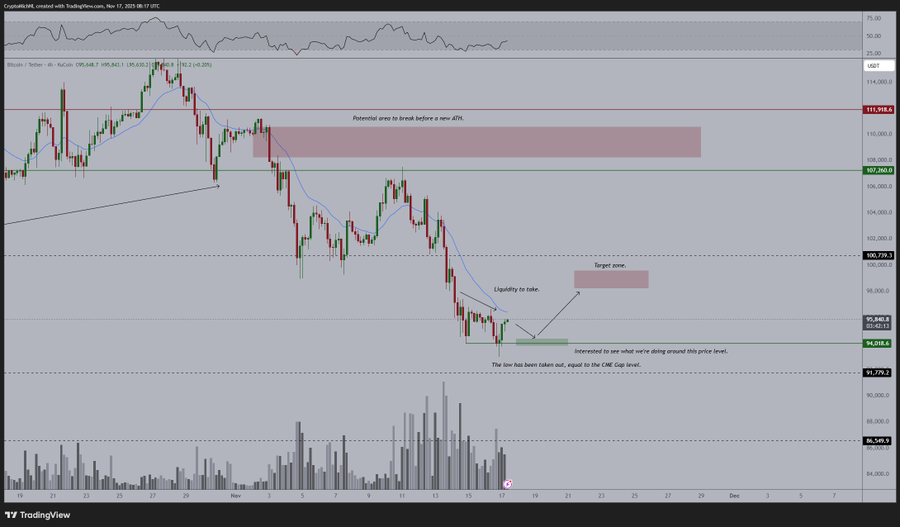
    One technical focus is the unclosed gap in CME Bitcoin futures from April, currently between $91,800 and $92,700. These gaps tend to attract price action back to them, often “closing” over weeks or months.

    BTC/USD 1-Day Chart
    BTC/USD 1-Day Chart. Source: X / Hardy

    Trader Hardy advises preparing for a dip to fill this gap before an expected bounce, describing it as a classic pattern driven by whale orders. QCP Capital also highlights the $92,000 zone, noting its importance as a likely bounce point due to this unfilled gap.

    Historical support lost, market sentiment falls

    Losing the 50-week moving average is rare and significant. Historically, each breach of this support has preceded a bear market lasting 1-2 years. The last weekly close below this average was in March 2023.

    Adding to worries, the exponential moving average (EMA) combined with this support has not held since Bitcoin traded around $22,000. Analyst Jelle calls the trend “officially lost.”

    ​BTC/USD 1-Week Chart
    ​BTC/USD 1-Week Chart. X / JelleX

    Meanwhile, cryptocurrencies have diverged from broader markets: US stock futures remained calm despite crypto losses, gold prices rose above $4,100/oz, and yields increased. 

    Bitcoin’s correlation with Nasdaq tech stocks has hit near-record highs, further signaling intertwined risk sentiments.

    x post by Kobeissiletter
    ​Source: X / Kobeissiletter

    The crypto community’s Fear and Greed Index dropped to 10/100, indicating extreme fear unseen since early 2025. This contrasts sharply with a reading of 74 just six weeks prior.

    Many compare the current atmosphere to the 2022 FTX collapse period. Markets now await US employment data, missing during the government shutdown, as confidence wanes over upcoming Fed interest rate moves. ​