Tether Operations Limited (“Tether”) has announced the launch of USDT on the Polygon blockchain
Polygon has become the 11th blockchain to support USDT
Tether CTO Paolo Ardoino believes that USDT will be instrumental in aiding Polygon to continue its “historical growth”
USDT launches on Polygon as the 11th supported blockchain platform
Tether Operations Limited (“Tether”), the operator of the industry’s largest stablecoin by market cap, USDT, has announced the launch of their stable digital currency on Polygon, the leading Layer-2 Ethereum scaling solution.
According to the company’s statement, USDT will allow over “8,000 teams building on Polygon” to tap into liquidity provided by the leading stablecoin to expand their role in supporting Polygons’ decentralized finance (DeFi) ecosystem. The number of decentralized applications (dApps) running atop Polygon has increased from 3,000 in October 2021 to 19,000 in April 2022 – a more than 500% growth in six months. With access to USDT, the record-breaking growth could continue in the upcoming months.
Tether CTO Paolo Ardoino had this to say about the launch of USDT on Polygon:
“We’re excited to launch USD₮ on Polygon, offering its community access to the most liquid, stable, and trusted stablecoin in the digital token space. The Polygon ecosystem has witnessed historical growth this year and we believe Tether will be essential in helping it continue to thrive.”
With the addition of Polygon, USDT is now operating on 11 blockchain networks, including Ethereum, Solana, Algorand, and Tron, to name a few. According to data curated by The Block, by far the largest share of USDT’s circulating supply is located on Tron and Ethereum.
With a market capitalization of roughly $83 billion, USDT is the largest stablecoin in the market, accounting for over 6% of the total value of all digital currencies in circulation. Due to its prominent role as a primary value transfer asset in DeFi and the cryptocurrency exchanges sector, investors were disturbed earlier this month when USDT momentarily lost its $1 peg. The stablecoin’s US dollar peg has since been fully re-established.
Last week, Tether launched Mexican Peso-pegged stablecoin Tether MXNt (MXNT) in response to a growing rate of cryptocurrency users across Latin America. The new stablecoin joined the company’s existing offering of fiat-pegged digital currencies, which includes the U.S. dollar-pegged USDT, the Euro-pegged EURT, and the offshore Chinese Yuan-pegged CNHT.
Ivan Cheneskov, Head of the finance ministry’s financial policy department, said the idea of cryptocurrency-based international transactions is “being actively discussed”, per Interfax
Russia’s central bank called for a blanket ban on crypto in early 2022, but has since changed its stance and is working on crypto legislation
Russia looks to crypto to bypass sanctions enacted by Western countries
Russian officials consider allowing crypto for “international settlements”
According to Reuters citing reports by the Interfax news outlet, the Russian officials are “actively” discussing the idea of using cryptocurrencies in “transactions for international settlements.” The leading official in the country’s finance ministry policy department, Ivan Chebeskov, revealed that cryptocurrencies could be a viable option for the country to partly bypass Western sanctions.
The news comes roughly two weeks after the comments made by Industry and Trade Minister Denis Manturov who said that cryptocurrency legislation is coming “sooner or later”. “The question is, when this happens, how it will be regulated,” Manturov remarked at the time.
In late January, Russia’s central bank’s proposal of a blanket ban on crypto was met with stern resistance by the country’s tech and opposition leaders. Since then, the central bank has shifted its stance and is actively working on cryptocurrency legislation that would allow digital currencies to be used as a means of payment.
In the aftermath of Russia’s attack on Ukraine, numerous financial firms severed ties with Russian-based businesses. Leading payment processing firms Visa and Mastercard, for instance, have withdrawn from the country, following the removal of several Russian banks from the SWIFT interbank messaging system. Meanwhile, cryptocurrency companies like Binance and Coinbase have also responded to the sanctions with their respective restrictive measures.
One of the most exciting opportunities of the year for crypto investors is Bitcoin.com’s public VERSE token sale scheduled for late June. VERSE is the new utility token of Bitcoin.com and it’s expected to play a key role in its ecosystem, with plans to weave it into all of its products.
For instance, users will be able to earn VERSE in the form of cashback when they buy, sell and swap tokens using its app or when they purchase goods using the Bitcoin.com debit card. In addition, VERSE will have utility in both the multichain Verse DEX and the Bitcoin.com cryptocurrency exchange. Finally, advertisers will be able to use VERSE to buy cheaper ads in Bitcoin.com News.
Given the massive size of Bitcoin.com’s user base, the upcoming sale of VERSE is expected to attract a lot of interest from the wider crypto community. Indeed, Bitcoin.com has already raised $33.6 million in a private sale of VERSE tokens in May. With that in mind, Bitcoin.com has opted for a modified token sale to ensure the distribution of VERSE is as fair as possible.
In a blog post on Medium, Bitcoin.com said it has opted for a token sale because it provides some major advantages over alternative distribution models. The most obvious advantage of a sale, of course, is that the project is able to raise some serious capital to fund its development. However, Bitcoin.com said there are other key benefits to a token sale that make it a much fairer way to distribute VERSE. For instance, a no distribution model like Bitcoin’s only benefits a very narrow subset of people who are actually going to do work (i.e. mining) for the project. As a result, those select miners would gain an unfair advantage by earning a greater percentage of the rewards. Bitcoin.com also contends that airdrops are unfair, as that model relies on prior use of one or more projects to become eligible.
Bitcoin.com stressed that it wanted VERSE’s token distribution to be accessible to everyone who’s interested in the project, rather than limit it to those who’re in a position to contribute or people who have interacted with specific existing projects in the past.
It did acknowledge that the token sale model is not entirely perfect though, with cons that include creating an arbitrary barrier to entry, and the danger of tokens selling at a steep discount, which can encourage early buyers to dump their assets quickly. Another common criticism of token sales is that developers and others who’re close to the project grant themselves a disproportionately large allocation of tokens. Also, sometimes tokens are sold at a predetermined price that creates an unrealistic market cap.
The VERSE token sale therefore has some modifications. One of the most notable is that the project has set a very realistic target market cap (based on the token sale price), with a fully diluted value of $504 million. Note that this is not based on circulating supply, as the full allocation of VERSE tokens won’t reach the market until seven years after the project’s launch.
“We are proud to be leading with FDV, so as not to confuse or mislead the community, which is something that has been unfortunately prevalent in the industry,” Bitcoin.com said.
The emission schedule of VERSE means that no tokens will initially be available when the project goes live. Rather, the tokens will only become claimable on a block-by-block basis, meaning that buyers are effectively reserving tokens that will unlock over time.
To avoid tokens being sold at a steep discount in earlier rounds, Bitcoin.com has dynamically priced the public sale. As a result, the more money that’s contributed in aggregate will result in a higher price per token.
“There are no steep discounts between token sale rounds, so early buyers have no immediate incentive to ‘dump’ the tokens,” Bitcoin.com said.
Bitcoin.com has also restricted its team allocation to just 15% of the total supply, far lower than most comparable projects, and has ensured that anyone can whitelist for the VERSE sale without extra requirements, where legally applicable.
“We make no limitations nor give preferential access,” the company explained. “It doesn’t matter how popular you are on social media, how early you are to whitelist, or whether you have a history of using our products or not.” Bitcoin.com is accepting registrations for the VERSE token sale now at getverse.com
The base currency in the METAPLANET ecosystem where various metaverse-related vertical technologies like augmented reality (AR), virtual reality (VR), contents, and platforms integrate is listed on ProBit Global.
The MEETIIN token (METI) is used to pay for services and to earn rewards for users’ contributions to the ecosystem. Also, with the ecosystem’s launch of its Play To Earn (P2E) economy, an online shopping mall and a non-fungible token (NFT) marketplace, METI’s use will be stimulated even further.
With a track record of providing metaverse solutions to partners like Hyundai Engineering, Mercedes Benz, Seoul Metropolitan Government, and the Seoul National University Bundang Hospital, METAPLANET wants to provide the most advanced spatial internet experience for public, private, and corporate education.
It will later expand the service to large gatherings, election campaigns, product presentations, and MICE (i.e. Meetings, Incentives, Conferencing, Exhibitions) sectors starting with planet themes related to virtual offices, MICE, and entertainment and then to games, healthcare, sports, companion animals, family events, and travel.
METAPLANET will also introduce its flagship platform “moim”, a grouping ecosystem for individuals and avatars to interact in a collaborative environment. Moim, which offers functions like media playback and 3D asset technologies that increase the delivery power of educational content, will be the first metaverse platform aimed at K-12, universities, and corporate education.
With projected monthly average users of approximately 100,000 by Q2 2022, and up to one million and three million by the end of 2022 and 2023 respectively, METI is expected to shake the metaverse industry with its vast ripple effects.
ABOUT METI
METI is the base currency for an established metaverse player which connects vertical technologies like AR, VR, media content, 3D assets, platform management, etc.
ABOUT PROBIT GLOBAL
ProBit Global is a Top 20 crypto exchange worldwide servicing crypto enthusiasts with unlimited access to trade and buy Bitcoin, Ethereum, and 800+ altcoins in 1000+ markets.
PROBIT GLOBAL IS A BRAND TRUSTED BY MILLIONS OF USERS
200,000+ community members
1,000,000+ monthly active users
3,000,000 monthly web visitors
50,000,000 users on partnering aggregators and wallets
The user interface of the multilingual website supports 46 different languages
Marketing and community support in 11 key languages
Binance Dual Investment is a unique product offered by the Binance cryptocurrency exchange. It’s designed to give users who want to buy a cryptocurrency at a lower price or sell a cryptocurrency at a higher price the chance to do so—all while earning interest at the same time.
When subscribing to a Dual Investment program on Binance, users have two main options. We’ll use Bitcoin and USDT in our example to help make it clearer.
“Buy Low”: Deposit USDT and use it to buy Bitcoin at the Settlement Date if it reaches the Target Price or lower. The deposit is earning interest in the meantime. If the price is above the Target Price on the Settlement Date, the USDT (plus accrued interest) is returned to the user.
“Sell High”: Deposit Bitcoin and sell it for a stablecoin at the Settlement Date if it reaches the Target Price or higher. The deposit is earning interest in the meantime. If the price is below the Target Price on the Settlement Date, the BTC (plus accrued interest) is returned to the user.
Before we delve deeper into Binance Dual Investment, we should clarify that Dual Investment is not a principal-guaranteed product, and there are risks associated with using it. For example, if your Target Price to buy Bitcoin is set at $30,000 and the market price drops to $29,000 on the Settlement Date, you will be buying BTC at $30,000 instead of the more favorable $29,000 price. The reverse is true if you’re using Dual Investment to sell at a higher price.
Due to the market volatility of cryptocurrencies, it’s possible that the value of your investment when your Dual Investment program ends can be lower than the value of your investment when you subscribe to the Dual Investment program.
Binance Dual Investment explained
Now that we’ve introduced Binance Dual Investment and the risks associated at the product, let’s take a closer look at how the product functions. First, let’s get familiar with five key concepts you will encounter when using the product.
Target Price
When you’re subscribing to a Dual Investment product to either “Buy Low” or “Sell High”, the Target Price refers to the price at which the deposited assets will be bought or sold on the Settlement Date (if the Target Price is reached).
Settlement Date
On the Settlement Date, the deposited assets will either be bought/sold or returned to you. This will depend on the relation between the Target Price and the price of the asset on the Settlement Date.
Please note that once you subscribe to a Binance Dual Investment product, you will not be able to edit or cancel your subscription. You will receive your funds on the Settlement Date—either the invested funds will be returned to you (plus interest), or you will receive the Target Currency.
Deposit Currency
The Deposit Currency is the asset you deposited into a Binance Dual Investment product. If you’re looking to “Buy Low”, you will be depositing stablecoins. If you’re looking to “Sell High”, you will be depositing “standard” crypto assets like Bitcoin, Ethereum or BNB.
Target Currency
The Target Currency is the asset that will be bought/sold automatically on the Settlement Date if the Target Price is reached. This will be a stablecoin if you’re looking to “Sell High”, and a “standard” cryptocurrency if you’re looking to “Buy Low”.
Subscription Amount
The amount that was deposited in the subscription to the Dual Investment product. If the Target Price is reached on the Settlement Date, this will be the amount used to buy or sell the Target Currency.
Dual Investment example and scenarios
Now that we know the most important concepts of the Dual Investment product, we’ll be going through an example of subscribing to Dual Investment and outline some of the possible scenarios that could happen.
In our hypothetical example, we hold Bitcoin and would like to sell if it reaches a higher price. We would also like to earn some interest on our BTC holdings in the meantime, so we choose Binance Dual Investment.
TIP: We selected “Beginner Mode” for our example, which will provide a clearer subscription process that’s suitable for users that don’t have experience with the Dual Investment product.
Now, we choose the “Sell BTC” option, since we’re trying to sell our BTC at a higher price.
By clicking the pencil icon, we can select between the different Dual Investment plans for BTC that Binance currently has on offer. The three parameters are Target Price, Settlement Date and APY.
The APY that’s offered depends on how close the Target Price is to the current price, how far into the future the Settlement Date is, and other factors. If two products have the same Settlement Date, the one with the Target Price closer to the current price will have a higher APY.
Please note that APY means Annual Percentage Yield. This shows the percentage of your principal that you would earn as interest in a year. The programs offered on Binance Dual Investment typically last a lot less than one year.
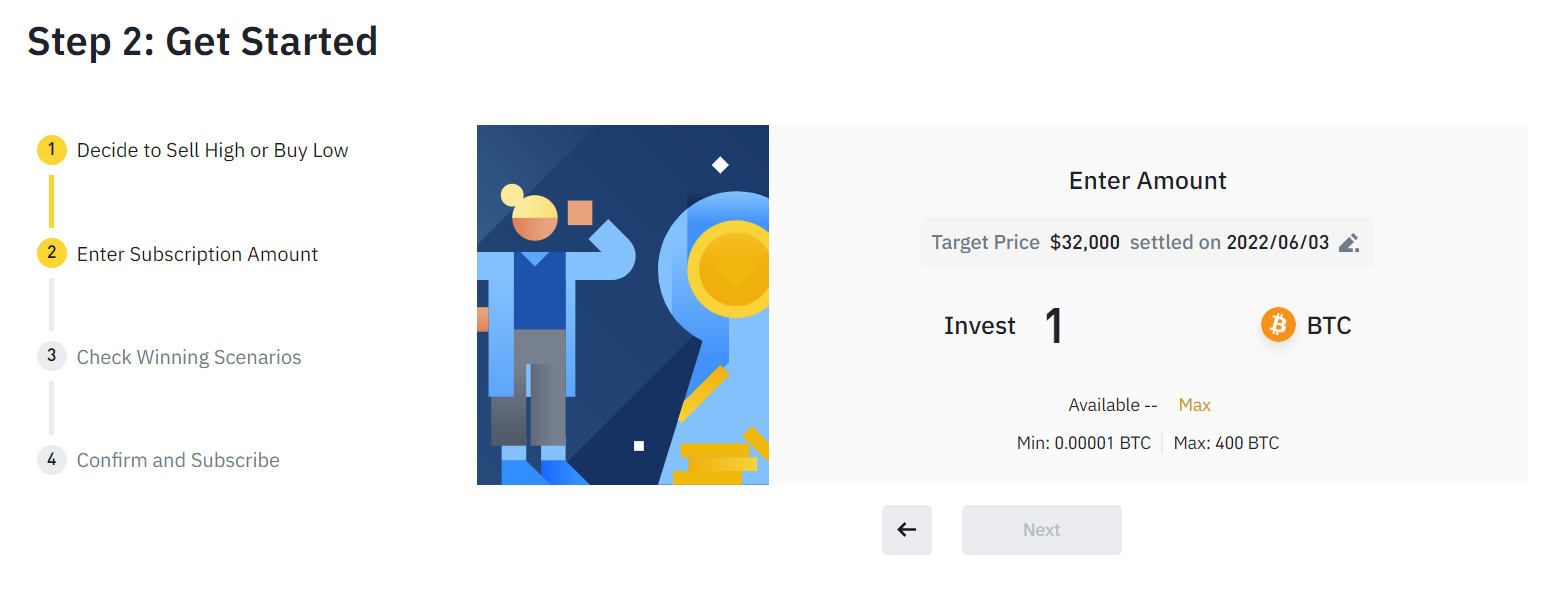
Let’s say that it’s May 30, 2022, and the current price of Bitcoin is $30,000. We’ll choose a plan with a Target Price of $32,000, a June 3, 2022 Settlement Date, and an APY of 22.77%.
This is not investment advice. This example is only meant to explain how the Dual Investment product functions.
We’ll deposit 1 BTC into the product.
Let’s check out three hypothetical scenarios that could happen once the Settlement Date comes around.
Scenario 1
On the Settlement Date, the price of Bitcoin is at $31,500, which is below the $32,000 Target Price. The product is not exercised. We receive back our 1 BTC, plus 0,00311 BTC that we earned as interest. This is a better outcome than if we simply held our 1 BTC.
Scenario 2
On the Settlement Date, the price of Bitcoin is at $32,050, which is above our $32,000 Target Price. Our 1 BTC, plus the interest we earned on the BTC, is automatically sold for the BUSD stablecoin at the Target Price.
During the five days that our BTC was deposited, it accumulated 0,00311 BTC in interest, which equals about $99.5 at the Target Price. So, after all is said and done, we get 32,099 BUSD. This is more than we’d get if we simply held our BTC and sold it at $32,050.
Scenario 3
On the Settlement Date, the price of Bitcoin is at $32,200, which is above our $32,000 Target Price. Our 1 BTC, plus the interest we earned on the BTC, is automatically sold for the BUSD stablecoin at the Target Price.
During the five days that our BTC was deposited, it accumulated 0,00311 BTC in interest, which equals about $99.5 at the Target Price. So, after all is said and done, we get 32,099 BUSD. This is less than we’d get if we simply held our BTC and sold it at $32,200.
Why not just use a limit order?
A pretty common question when it comes to the Dual Investment product is:
“If you want to buy or sell a cryptocurrency at a different price than the current price, why not just use a limit order?”
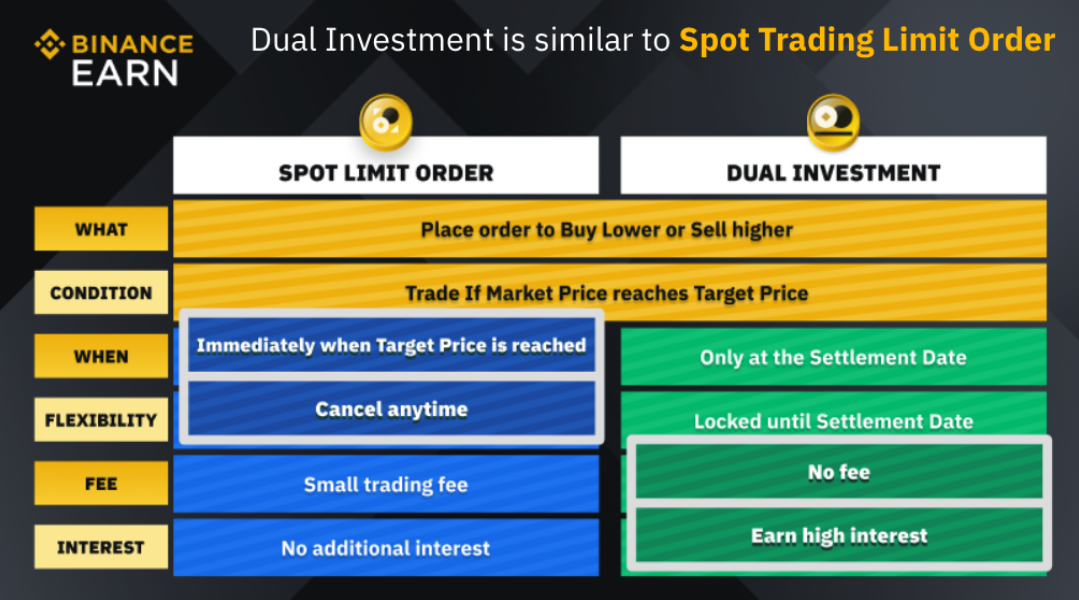
This infographic provided by Binance provides a nice summary of how Dual Investment compares to simply using a limit order on the spot market. From it, you can clearly see that each method has its own advantages and disadvantages—the choice will ultimately depend on what you prioritize.
Recap – the pros and cons of Binance Dual Investment
To sum up, let’s lay out the main advantages and disadvantages of Binance Dual Investment:
Pros:
The product doesn’t charge any trading fees
APY can be very high
Users can choose between many different Target Prices, APYs and Settlement Dates
Cons:
Deposited funds are locked until the Settlement Date
Can underperform a simple HODL strategy if the market price significantly deviates from the Target Price
Binance Futures is an industry-leading futures trading platform, thanks to an expansive catalog of supported digital assets, high liquidity, and a wide range of features. One of the most interesting and potentially lucrative features of the Binance Futures platform–the so-called Multi-Assets mode–allows traders to share margin across USDT- and BUSD-margined contracts to lower their risk exposure and take advantage of trading fee discounts.
What is Multi-Assets Mode? Trade USDⓈ-M Futures across multiple margin assets
Multi-Assets Mode is a trading feature that lets traders pursue lucrative investment opportunities in the futures marketplace using Tether (USDT) or Binance USD (BUSD) as collateral. Sharing liquidity and margin across USDT- and BUSD-margined futures contracts gives Binance users more versatility when trading derivatives and allows them to more efficiently weather highly volatile market conditions.
Before the Multi-Assets trading features went live in 2021, Binance USDⓈ-M futures traders had to choose between supplying their collateral in either USDT or BUSD, which forced users to manage their positions margined with each respective stablecoin separately. In practice, this meant that profits made on the BTC/USDT contract, for instance, had to be withdrawn, converted to BUSD, and then used to offset potential losses accrued in BUSD-margined positions.
With Multi-Assets Mode available, traders no longer have to swap between USDT and BUSD to manage different stablecoin-collateralized USDⓈ-M Futures positions. In addition, profits made in a BTC/USDT futures position are automatically used as a margin to hedge against the losing position – for example, used to offset losses accrued in an ETH/BUSD position. This allows traders to more easily maintain margin requirements and lowers the overall potential for capitulations.
Presently, the Multi-Assets mode is available for Cross-margin positions exclusively, meaning that users of the Isolated Margin Mode cannot opt in to take advantage of the margin-sharing feature.
Benefits of using Multi-Assets Mode to trade on Binance Futures
The sharing of margin between USDT and BUSD-margined contracts introduces several advantages for Binance Futures users. Let’s take a look at the main pros of using Multi-Assets Mode on Binance.
Enhanced risk management and portfolio hedging options
Since profits made in either USDT or BUSD-margined futures positions are automatically used to offset losses accrued in USDT-M or BUSD-M positions, Binance traders using the Multi-Assets mode can lower their margin requirements across two accounts. Moreover, traders can hedge their positions easily using the Multi-Assets mode – for example, by going “short” the BTC/USDT contract while at the same retaining a “long” option on the BTC/BUSD contract.
More flexibility when opening positions
With Multi-Assets Mode enabled, traders don’t have to convert USDT to BUSD, or vice versa, to act on an investment opportunity available in either USDT or BUSD-margined futures. This allows Binance users to open USDT-M or BUSD-M positions at a moment’s notice, without going through the hoops of swapping crypto and moving it between derivatives accounts.
Arbitrage opportunities across USDT and BUSD trading pairs
Seamless access to both USDT-M and BUSD-M contracts allows traders to pursue potential arbitrage opportunities – for instance, an arbitrage trader may notice a minute price discrepancy between BTC/USDT and BTC/BUSD. In such a case, a trader could obtain BTC from a BTC/USDT contract at a lower price and sell it using the BTC/BUSD contract at a higher price to make a profit.
Advantages of trading BUSD-M Futures with Multi-Assets Mode on Binance Futures
BUSD-M Futures are a type of USD-M Futures that are quoted, collateralized, and settled in BUSD, a fully backed USD-pegged stablecoin developed and operated by Binance and Paxos. By using a stablecoin for settlements, traders can easily monitor the performance of BUSD-M futures contracts and enjoy a degree of price stability that is not present in COIN-M futures, which are denominated and settled in cryptocurrencies.
Image source: Binance
Using BUSD-M futures, traders can go long (expecting the price of a cryptocurrency to increase) or short (expecting the price of a cryptocurrency to decrease) on a number of supported digital assets. The list of supported cryptocurrencies that can be traded in BUSD perpetual contracts includes:
Using BUSD-margined contracts lets Binance users pay less on maker and taker fees (see the table above). The discounted fees apply to all BUSD perpetual contracts. For a complete overview of USDⓈ-M Futures trading fees and a detailed, tiered comparison between USDT and BUSD fees, click here.
In addition to a lower base fee when trading BUSD-margined contracts compared to USDT-M futures, users who enable the Multi-Assets Mode can trade USDT-M contracts without having to convert them to USDT. This lets USDT owners trade BUSD-M derivatives and save on trading fees.
As mentioned in the previous section, trading BUSD-M Futures with the Multi-Assets mode turned on allows derivatives traders to go hedge their positions by, for example, going long on a particular digital asset using a USDT-M contract, while shorting the same digital asset using a BUSD-M contract. This trading technique can come in handy for traders looking to turn short-term market trends into lucrative investment opportunities while retaining the potential upside of longer-term contracts.
A step by step guide to Multi-Assets Mode on desktop and mobile
As you could have gathered from the paragraphs above, Multi-Assets Mode presents several benefits for contract traders on Binance. If you are wondering how to opt-in and take advantage of the feature, follow our step-by-step guide for desktop and mobile Binance clients.
How to enable Multi-Assets Mode on Desktop?
Follow our guide on the Multi-Assets Mode to turn on the feature in Binance’s desktop web client.
Step 1 – To turn on the Multi-Assets mode on the desktop client, go to the “Derivatives” drop-down menu on the Binance homepage and select the “USDⓈ-M Futures” option.
Step 2 – In the trading view, click on the Settings button located in the upper right corner of the screen (highlighted in red on the image below).
Step 3 – In the pop-up menu, click on “Preference”
Step 4 – Navigate to the bottom of the Preferences window and click on “Asset Mode”. Now, select “Multi-Assets Mode”.
That’s it, you’ve successfully enabled the Multi-Assets mode in the desktop client.
How to enable Multi-Assets Mode on Mobile?
The process of opting in the Multi-Assets mode on the native client for Android and iOS devices is very similar to the desktop counterpart.
Step 1 – Navigate to the “Futures” tab in the menu at the bottom of the screen and click on the three-dotted menu in the upper right corner of the screen.
Step 2 – Click on “Preferences”.
Step 3 –Navigate to the “Asset Mode” section in the preference menu.
Step 4 – Now, click on “Multi-Assets Mode”.
That’s it, you’ve successfully enabled the Multi-Assets mode in the mobile application.
Final thoughts
Using the Multi-Assets mode allows Binance contract traders to take advantage of discounted trading fees, pursue investments across USDT-M and BUSD-M trading pairs without having to swap between USDT and BUSD stablecoins, and take advantage of potential arbitrage opportunities. Despite a lower risk level associated with using Multi-Assets Mode, keep in mind that derivatives trading can be highly challenging and generally requires a higher degree of investment know-how than spot trading. To learn more about Binance Futures and find out about different order types and futures contracts, click here.
With over 700 supported cryptocurrencies and over 10 million users, KuCoin is among the top 5 crypto trading platforms
The exchange’s native financial products platform – KuCoin Earn offers a wide range of passive income opportunities such as earning yield through flexible savings, staking, and various promotion products
KuCoin Earn supports over 50 coins and boasts with APRs of up to 150%
KuCoin is a cryptocurrency exchange that launched in September 2017. In 2018, the platform secured $20 million in Round A funding round led by IDG Capital and Matrix Partners. The company saw continued growth in the following years, and raised $150 million at a valuation of $10 billion in 2022. Today, this Seychelles-headquartered exchange caters the needs of more than 10 million crypto traders from 207 countries and regions around the world.
KuCoin is among the top 5 cryptocurrency exchanges
Over 700 supported digital assets and over 1,200 trading pairs make KuCoin one of the biggest altcoin exchanges, while the platform’s trading volumes place KuCoin among the top 5 most popular crypto exchanges. This centralized exchange offers product ranging from spot trading and margin trading all the way to P2P fiat trading, futures trading, staking, and lending.
The KuCoin exchange is secure, simple, and easy-to-use, which is why the platform is sometimes referred to as the “people’s exchange”.
What is KuCoin Earn?
KuCoin Earn is KuCoin’s native one-stop wealth management service that allows users to earn passive income on top of their crypto holdings by locking their crypto assets in various savings and staking deals. KuCoin Earn currently supports over 50 coins and tokens.
KuCoin offers both flexible deals, where users can redeem their funds at any time, as well as products with fixed terms, which means that the funds are redeemed automatically at the product’s maturity. As on other platforms, the yields of fixed term products are usually higher than that of flexible term products.
The highest APRs, however, are offered on promotional products, which are usually quickly sold out because of their high popularity and limited availability. In addition, KuCoin Earn also allows users to participate in Polkadot parachain auctions and ETH2.0 staking.
Savings Products
KuCoin Earn savings products are like a savings account for your crypto assets. These products allow investors to move their crypto assets to flexible or fixed savings products and earn rewards on crypto that would have otherwise been idle.
At the time of writing, KuCoin offers a 2.87% APR on USDT deposits with a flexible term. The platform also offers a 6% APR on KSM deposits, 10% APR on OLT, 20% APR on DFI and an astonishing high 45% APR on HYDRA deposits. Please note that the rewards are paid out in the same token that’s deposited.
Staking Products
KuCoin also facilitates easy one-click staking of coins and tokens. Naturally, the staking products are only offered for coins and tokens belonging to proof-of-stake blockchains. Again, the highest APR of 47.17% is offered for staking HYDRA. Other APRs are as follows: XPRT (27.44%), ZIL (11.17%), KSM (10.26%), VSYS (8.17%), ATOM and DOT (both 7.44%). KuCoin earn also supports staking for coins like MATIC, TRX and ADA.
Promotions
Exceptionally high APRs are offered through promotions, but the number of participants or rewards to be distributed among them is usually capped. These products are available on a first come, first served basis, and the ones with the most lucrative rewards are often sold out quickly. KuCoin offers both fixed term promotions, where token holders must lock their tokens for the displayed duration to get rewards, and flexible term promotions, where tokens can be subscribed and redeemed at any time.
At the time of writing, there are 3 available flexible terms promotions offering an APR of over 50% and 9 flexible terms promotions with an APR of over 30%.
BurningDrop Token Distribution Platform
BurningDrop is KuCoin’s fair token distribution platform, where users can lock their crypto assets to access a share of tokens, usually belonging to a newly launched project or blockchain. After locking up their crypto assets, participants can additionally increase their end reward by burning KuCoin Earn’s native Proof of Liquidity (POL) tokens.
Several blockchain start-ups have already successfully distributed their tokens through KuCoin’s BurningDrop. In the past HORD, TCP, LOCG, LNCHX and XCAD were distributed, while there is an ongoing FreshCut (FCD) distribution at the time of writing.
Polkadot Parachain Auctions
KuCoin Earn also allows DOT holders to participate in Polkadot’s parachain auctions. If the project to which a user allocates his DOT stake wins the auction, the user receives on-chain rewards plus a share of the exclusive KuCoin Rewards Pool, while the staked DOT are gradually returned after the lease period. However, if the project fails to win the parachain auction, the user will receive their full DOT stake back immediately.
ETH 2.0 Staking
As Ethereum 2.0 staking went live in November 2020 many centralized cryptocurrency exchanges offered an easier way to stake on the new Ethereum chain secured by the proof-of-stake consensus.
KuCoin is no exception, as it offers an ETH 2.0 staking service which allows users to earn staking ewards on their ETH. The feature makes Ethereum staking much more accessible, since “solo staking” ETH requires a lot of capital upfront (32 ETH) and technical knowledge.
Users that stake their ETH on KuCoin Earn receive an equal amount of ETH2 tokens, which are issued by KuCoin and represent the rights to an ETH 2.0 token plus the corresponding staking rewards. By holding specific amounts of ETH2 in their main and trading accounts, ETH stakers can earn additional POL mining rewards on top of ETH staking rewards.
The advantages of using KuCoin Earn
KuCoin Earn helps you boost your earnings by receiving savings and staking rewards on crypto assets that would otherwise sit idle on your trading account. All assets held in Earn products also count towards the POL mining power, for which you receive some extra income in the form of the POL token. In addition, the suite of products on KuCoin Earn is extremely diverse and flexible. If you subscribe to flexible products, you will be able to immediately withdraw your coins at any time, should the need arise.
The bottom line
KuCoin Earn is an easy-to-use platform that offers a wide variety of passive income products. Every user can pick between savings, staking, promotion products and BurningDrop – KuCoin’s token distribution platform based on his needs, expectations, and risk tolerance.
The platform offers competitive yields while maintaining high flexibility and asset liquidity. It supports over 50 coins and tokens, including BTC, USDT, USDC, ETH, ATOM, SOL, KSM, ZIL and more. Furthermore, the platform’s native POL token enables unique features and can provide additional income in the form of mining rewards.
At the beginning of Week 22 the total cryptocurrency market capitalization stands at $1.28 trillion – another few $100 billion less than last week. We have seen a lot of development and plenty of announcements last week, therefore we are all hoping for some green numbers this week. Do you think that we will finally see trend reversal or is the crypto market headed even lower – towards the $1 trillion valuation?
3. Chain Protocol (XCN)
Chain is a blockchain technology company that helps build and launch new cryptographic distributed ledgers for various crypto projects and financial institutions. Its main product is the ledger-as-service platform called Sequence. By building new blockchains the company aims to facilitate the creation of a smarter and more interconnected economy. Chain was founded in 2014 and has raised over $40 million in funding from institutions such as Khosla Ventures, Pantera Capital, Capital One, Citigroup, Fiserv, Nasdaq, Orange, and Visa. Chain Token (XCN) is the governance and utility token for the Chain Protocol. XCN gives it holders the right to vote on protocol improvements, but it can also be used to pay for commercial fees on Sequence and other Chain ecosystem products. Users paying with XCN are eligible for discounts and may receive access to premium features.
Chain’s native token XCN almost doubles its price and enters Top 30 Cryptos
With its almost 100% gain over the last 7 days, XCN was the best performing token out of Top 100 cryptocurrencies last week. The majority of the XCN’s rally took place between May 26 and May 27 when the price of the Chain’s governance token climbed from below $0.10 to above $0.18 in a series of a few swift price surges. Consequently, XCN’s total market capitalization skyrocketed above $3 billion, which allowed the project to climb from 47th to 30th place on the largest cryptocurrencies list. The reasons behind the price rally can be found in the work that the team has done last month. According to the project’s monthly report, Chain has successfully deployed its Chain DAO along with the Chain Community Constitution that was implemented through CIP-3. In addition, Chain had entered a strategic partnership with Alameda Research, which will become the project’s primary cryptocurrency market maker. Chain’s team is also onboarding new team members. Among the most recent additions is Mike Herron, a former employee of US Cellular, the country’s 5th largest wireless carrier. Horton will fill the position of the Chief Marketing Officer at Chain. Can the new marketing lead propel the project even higher?
2. Polkadot (DOT)
Polkadot is a blockchain platform that addresses the scaling issues by using parachains, a network of multiple interoperable blockchains that run in parallel with each other. By using parachains, Polkadot can connect diverse blockchains into a single, decentralized and highly scalable ecosystem. The network operates using a proof-of-stake consensus algorithm and utilizes a native currency DOT. The project was originally designed by Dr. Gavin Wood, one of the co-founders of Ethereum and the inventor the smart contract programming language named Solidity. Along with Cardano, Solana, and several other networks Polkadot is considered one of the potential “Ethereum killers”.
Leading Polkadot parachain projects score major partnerships and announce important upgrades
Last week has been amazing for many of the projects operating their own Polkadot parachain as several prominent Polkadot projects announced new strategic partnerships and important upgrades. Arguably the biggest news was that AstridDAO, an Astar-based decentralized money market protocol and multi-collateral stablecoin platform, announced a partnership with the software giant Microsoft. In other news, the governance community of currently the largest decentralized exchange – Uniswap v3 has recently voted in favor of launching the iteration of the famous DEX on the Moonbeam parachain. Moonbeam runs an Ethereum Virtual Machine-compatible Polkadot parachain, so the deployment should not be too complicated. Once successfully completed, Uniswap v3 running on one of Polkadot’s parachains will allow Polkadot users to tap into the immense liquidity of the Ethereum ecosystem. Another piece of positive news is that several developer grants and incentives programs for the Polkadot environment are still active. For example, the $250 million aUSD ecosystem fund that is looking to support early-stage startups is still accepting applications. The fund is operated by Acala and mainly supports projects that develop dApps with a strong use case for the aUSD stablecoin. The growth of the Polkadot ecosystem can be seen on almost all fronts and it is only a matter of time when this positive news starts to translate into DOT’s price action.
1. Terra (LUNA)
Terra blockchain was the basis of the same-named algorithmically governed stablecoin platform that was built using Cosmos technology. The blockchain, which utilized a proof-of-Stake (PoS) consensus mechanism, was developed by a South Korea-based company named Terraform Labs. LUNA was the reserve currency of the Terra platform. However, on May 10, 2022, Terra-based UST stablecoin started losing its dollar peg, which pushed the Terra ecosystem into a downward spiral that ended with the halt of the Terra blockchain just 3 days later. Consequently, both UST and LUNA tokens lost almost all their value and became practically worthless overnight. The Terra blockchain is currently not operational and LUNA and UST have been delisted from most of the exchanges.
Terra blockchain re-launches after community gives Terra 2.0 a green light
After Terra’s market collapse earlier in the month, the community voted in favor of launching the new Terra blockchain on May 25. The Terra governance accepted the proposal filled by Terraform Labs CEO Do Kwon with 65.5% votes for and just 13.5% votes against (approximately 21% of the voting power abstained from voting). Even though the vote seems rather unanimous, it was far from that. The part of the community that voted against the proposal to revive the Terra blockchain was very vocal about it and many of them advocated for the ecosystem to be stabilized through token burning instead of launching a new chain. Despite some opposition, the new Terra blockchain launched on May 28. However, the new Terra ecosystem will, at least for now, not include the popular UST stablecoin. According to the proposal, the old Terra blockchain will be renamed to Terra Classic, while old LUNA tokens will become Luna Classic tokens (LUNC). The new Terra blockchain’s native tokens will trade under the ticker LUNA. New LUNA tokens will be airdropped to existing LUNA owners. Since Terra 2.0 is a new chain and not a fork, dApps from Terra Classic will need to relaunch on the new chain. While many projects including Astroport, Spectrum Protocol, HERO and Hex Trust agree to continue building on the new Terra blockchain, some such as The Lido DAO are strictly against the re-launch. On the other hand, several major cryptocurrency exchanges including Binance have expressed their support for the Terra “rebirth”. Do you think that the new LUNA tokens can rise like a phoenix from the ashes? Whatever the answer, LUNA is definitely a token worth monitoring this week.
Tether Operations Limited (“Tether”) has launched a Mexican Peso-pegged stablecoin called Tether MXNt (MXNT)
The new fiat-pegged crypto joins Tether’s existing offering of Euro, US Dollar, and Chinese Yuan-pegged stablecoins
The company has said that the launch of MXNT comes as a response to a growing rate of cryptocurrency users in Latin America
Tether MXN joins Euro, US dollar, and Chinese Yuan-pegged stablecoins
On Thursday, Tether Operations Limited, the company behind the leading stablecoin Tether (USDT), announced the launch of Tether MXNt (MXNT). According to the company’s press release, the new fiat-pegged stable digital currency was launched in response to a growing cryptocurrency usage across Latin America.
The new stablecoin joins Tether’s existing offering of fiat-pegged digital currencies, including the U.S. dollar-pegged USDT, the Euro-pegged EURT, and the offshore Chinese Yuan-pegged CNHT. It is worth noting that USDT sports by far the largest market cap out of the stablecoin trio – more than $80 billion at press time. EURT and CNHT collectively have a market cap of roughly $45 million.
Tether CTO Paolo Ardoino had this to say about the launch of the new stablecoin:
“Introducing a Peso-pegged stablecoin will provide a store of value for those in the emerging markets and in particular Mexico. MXN₮ can minimize volatility for those looking to convert their assets and investments from fiat to digital currencies.”
Ardoino added that the move to launch a Peso-based stable currency has been made apparent over the last year, due to a “rise in cryptocurrency usage” in the region. Countries like Mexico, Brazil, Colombia, and Venezuela are home to some of the largest populations of crypto owners according to the per capita numbers curated by Triple-A.
Tether’s MXNT is currently available to users of Ethereum, Tron, and Polygon blockchain platforms.