Blog

  • Can Cashfi (CFI) Compete with Crypto Market Rulers Like Tezos (XTZ) and Aave (AAVE)

    Can Cashfi (CFI) Compete with Crypto Market Rulers Like Tezos (XTZ) and Aave (AAVE)

    With the revolution in the cryptocurrency market, many concepts have come to fruition to make the decentralized market more beneficial. Among those concepts, staking and lending caught the great attention of the masses. Rewards systems have been introduced to let investors earn more on the cryptocurrencies they are holding for a specified amount of time. 

    Borrowing and lending also rose to another level. Many crypto platforms offer borrowing and lending services, especially the cryptocurrency exchanges like Binance and others. Other than that, many crypto blockchains also offer stake and lending services. Tezos (XTZ) is a blockchain that provides its users to earn rewards by staking which means the amount of XTZ they are holding. On the other hand, Aave (AAVE) is a very well-known platform that offers borrowing and lending services in about 20 different cryptocurrencies to date. One of the flagship products of Aave (AAVE) is its flash loans which are termed the first uncollateralized loan option in the decentralized finance (DeFi) arena.

    Another such platform is in its making that will bring the liquid staking and lending concept to the next level. This crypto project is named CashFi (CFI) and is yet to launch officially. Let’s dive into this project at the perfect time to learn if it can topple popular existent projects like those mentioned above.

    CashFi (CFI) – A Next Generation DeFi Network

    CashFi (CFI) is a new generation decentralized network that will provide its investors with a wide range of asset classes through its distinctive fee-sharing approach. Some of these asset classes include liquid staking, NFTs, and synthetics. The mission is to provide the users with speedier, cost-effective, and more scalable services through the platform.

    Cooperation with different chains for off-chain interoperability will be a cornerstone of CashFi’s development.

    Market Landscape

    The developer’s team is determined to build the platform as an ideal ecosystem for providing top-tier services of liquid staking, NFTs, and synthetic assets. The team claims to have done deep research and assessment into the market before going for the first stride. Thus, they found that the interest of people is on the rise in Proof-of-Stake (PoS) cryptocurrencies and initiatives.

    A few market leaders in the PoS consensus system include Solana (SOL), Cardano (ADA), Algorand (ALGO), etc. Therefore, it’s pretty evident that the observation regarding people’s interest is up-to-the-mark as all these cryptocurrencies rank in the top 50s based on the market cap. The market cap represents the interest of people in these PoS-based cryptocurrencies. The PoS consensus system is better than the Proof-of-Work consensus system because it keeps the earth more energy-efficient and greener as compared to the latter one.

    The team tells that the liquid staking market is a market capitalization of $11.76 billion and has seen an almost 1100% increase in 2021 alone. Thus, CashFi (CFI) will also come up with its platform and development to enhance it even further by keeping the PoS consensus system in use and bringing such PoS-based cryptocurrencies into the DeFi ecosystem.

    CashFi’s (CFI) Ecosystem

    The core component of CashFi’s ecosystem will be the CFI staking to reduce illiquidity for staked commodities through the liquid staking phenomenon. Unlike the Proof-of-Work system, where the miners serve as the verifiers of transactions added to the blockchain, in the PoS system, the network participants stake (hold or lock up) their particular cryptocurrency and become validators of the network. These validators can now participate in the network’s consensus and verification process of transactions apart from earning rewards through staking.

    There’s another type of staking known as legacy staking but it has the following shortcomings:

    • Lesser yields
    • Asset inefficiency
    • Decreased security
    • No instant liquidity

    On the other hand, CashFi (CFI) staking will work on liquid staking phenomena to facilitate the PoS tokens in growing and thriving. Other than liquid staking, the team will also work on NFTs and their synthetic products named CFI Synths. CFI will be an ERC-20 token that will be used in governance, staking, bug bounty, holding, NFTs trading, etc.

    For more CashFi (CFI) information visit:

    Presale: https://enter.cashfi.finance/register

    Website: https://cashfi.finance/

    Telegram: https://t.me/CashFi_Token

  • Atlendis Labs Announces the Launch of the Atlendis Protocol V1

    Atlendis Labs Announces the Launch of the Atlendis Protocol V1

    Paris, France, 7th June, 2022, Chainwire

    Atlendis, a capital-efficient DeFi protocol that enables crypto loans without collateral, announced today the launch of the Atlendis protocol V1 on Polygon mainnet, a full-stack Ethereum scaling solution.

    This is a major milestone for Atlendis (formerly known as JellyFi) following its $4.4 million seed funding round and coming a few months after the alpha release of the Atlendis protocol. Liquidity providers (LPs) can now deposit into the borrower pool of their choice on the Atlendis protocol to start earning interest. Whitelisted institutional borrowers including dApps, protocols and DAOs, can now take out loans in their specific pools.

    Atlendis is launching with institutional borrowers DeversiFi and ZigZag with an initial credit limit of $10 million, and there is a growing pipeline of institutional borrowers that will be joining soon. Interested institutional borrower candidates can contact Atlendis Labs to apply for access to revolving lines of credit on the Atlendis protocol.

    “We are excited to launch the Atlendis protocol and facilitate new DeFi use cases through uncollateralized crypto loans. Our main objective is to help crypto-native organizations access revolving lines of credit to meet their recurrent liquidity needs instantly without having to lock any collateral. In addition to targeting renowned Web3 institutions that engage in market-neutral strategies, Atlendis welcomes non-crypto native companies seeking exposure to crypto assets,” said Alexis Masseron, Co-Founder and CEO of Atlendis Labs.    

    “Atlendis is a unique protocol that allows DeversiFi to access short term, revolving and under-collateralized borrowing to fund DeversiFi’s fast-withdrawal service and multi-chain bridges. We aim to initially borrow USDC from Atlendis and scale to other pools as our cross-chain features roll out,” said Ross Middleton, Co-Founder of DeversiFi.   

    Atlendis Labs and the Atlendis Protocol

    Founded in 2021 by former ConsenSys employees, Atlendis addresses capital inefficiencies in the DeFi lending market and provides solutions for recurring liquidity needs and non-dilutive financing. Previously, institutional borrowers including dApps, protocols and DAOs have had limited options to meet their liquidity requirements through crypto loans, as most DeFi lending protocols require borrowers to overcollateralize their loans, thus drastically reducing borrowing use cases in DeFi compared to TradFi.

    Features Available for Liquidity Providers

    • Rate Discovery
      Liquidity pools are borrower specific and are split into multiple ticks. When adding liquidity to the pool of their choice, liquidity providers are able to choose the lending rate at which they feel comfortable lending based on their own risk assessment. The borrowing rate is derived by the market and depends on the rates offered by lenders.
    • Non Fungible Positions
      Each liquidity provider’s deposit on the Atlendis protocol is characterized by a position that is represented by an NFT with original artwork. The NFT displays the position and the underlying digital assets attached to it, indicating information including whether they are loaned or waiting to be matched with a borrower.
    • Pool Incentivization
      Liquidity providers on the Atlendis protocol are able to earn rewards from three sources:

      • Actively lending to borrowers at the chosen lending rate.
      • Aave’s APY, when the funds are not being actively borrowed.
      • Additional liquidity rewards, paid by the borrower when their funds are not used.

    Features Available for Borrowers

    • Tailored Pools
      The pools on the Atlendis protocol can be built to fit the specific use case of the borrower, with a wide range of parameters and additional functionalities.

    Benefits for Borrowers

    Once borrowers are whitelisted, the Atlendis protocol will create a specific liquidity pool(s) per borrower and per asset. Borrowers will have instant access to uncollateralized crypto loans at a fair rate via Atlendis’ unique market rate discovery. Borrowers have flexibility as they do not have to lock any collateral. Interest and principal on the crypto loans must be repaid at maturity.

    Benefits for Lenders

    On the Atlendis protocol, liquidity providers can earn higher rewards than on overcollateralized lending protocols. Lenders have the ability to choose the borrowers that they trust to lend to, as well as their preferred lending rate, benefiting from data including the credit evaluation and live financial performance of the borrowers performed by X-Margin.  

    Audit Reports 

    Two audits of the Atlendis protocol’s smart contracts were mandated by Atlendis Labs. The first was conducted by Runtime Verification and the second by PeckShield.

    About Atlendis

    Atlendis is a capital-efficient DeFi lending protocol that enables uncollateralized crypto loans. Institutional borrowers can obtain flexible and competitive loan terms. Uncollateralized loans on the Atlendis protocol are similar to revolving lines of credit, giving borrowers flexibility for recurrent and short-term liquidity needs. For lenders, Atlendis enables higher returns with granular control over their risk profile. Lenders can earn high interests on actively loaned out capital and unused capital will be placed on a trusted third-party liquidity protocol. There will be no idle capital on Atlendis. Atlendis enables trusted borrowing and lending, opening a wide range of use cases for borrowers.

    Contacts
    • Victoria Calmon
    • Atlendis Labs
    • victoria.calmon@atlendislabs.io
  • The Future of Property Ownership: LEND7 Kicks Off Next-Gen Real Estate NFTs

    The Future of Property Ownership: LEND7 Kicks Off Next-Gen Real Estate NFTs

    Think of a world where everyone can invest in real estate without a myriad of intermediaries, unbearable initial capital requirements, and never-ending legal barriers. We made it possible.

    Freshly made crowdfunding platform LEND7 opens the door for all market players, transforming the traditional real estate industry into a fully-fledged digital solution with non-fungible tokens (NFTs) at the forefront.

    After an astonishing breakthrough in 2021 — when NFTs hit a market value of $22 billion — NFTs gained traction from wider audiences. Having complete ownership of something on the Internet fuelled the cryptocurrency and Web3 communities’ interest.

    “NFTs are a winning product that puts value and control straight into the owner’s hands. Thus, the Internet of tomorrow — and industries of tomorrow — belong to the token creators and users. For real estate, we are bringing tomorrow now.” – LEND7 team

    By converting real estate assets and business receivables into NFTs, LEND7 aims to eliminate industry barriers such as limited investor access, low liquidity, and lack of transparency.

    LEND7 will utilize NFTs to bridge the traditional real estate industry with the ever-growing blockchain and Web3 communities. Ultimately, LEND7 will:

    • Minimize the real estate entry capital requirements to make the industry accessible to all market players.
    • Lower transaction costs and accelerate the real estate investment process while bringing value to owners right away.
    • Cut off intermediaries to enhance transparency and hand over more control to real estate investors and business owners.

    Of course, the arrival of LEND7 comes during an interesting time for the crypto and NFT spaces. The spectacular collapse of Terra Luna, as well as continued speculation on NFTs has created concern about the future of the industry. LEND7 is carving a different route, focusing entirely on utility and providing real-world value.

    This focus on providing solutions through NFT technology, rather than trying to make quick money off hype, is what ultimately will enable LEND7 to rise above the market noise and get on the path to sustainable success.
    The LEND7 project has garnered massive interest from both retail and institutional investors. LEND7 private sale will go live at 7 a.m., UTC, June 7th and will end at 7 p.m., UTC, June 27th. The public sale is planned for June 27th.

    For more detailed information, contact us by email at info@lend7.com or visit www.lend7.com.

    About LEND7

    The founding team behind LEND7 comprises real estate and blockchain experts with extensive backgrounds in FinTech and proven experience in successful crowdfunding project kickoffs.

    LEND7 is building a global network for real estate investing and fundraising driven by the Cardano blockchain, combining pioneering technologies to provide unparalleled security and sustainability for the project.

    Eventually, LEND7 aims to become a complete ecosystem for the tokenized real estate industry, bringing full transparency and liquidity to real estate and cryptocurrency communities.

    Website | Twitter | Telegram | Discord

  • CAKE Jumps Close to 10% as Binance Labs Makes ‘Strategic Investment’ in PancakeSwap

    CAKE Jumps Close to 10% as Binance Labs Makes ‘Strategic Investment’ in PancakeSwap

    PancakeSwap (CAKE) cryptocurrency decentralized exchange cover

    Key takeaways:

    • Binance Labs has made a “strategic investment” in PancakeSwap, a leading decentralized exchange on BNB Chain
    • The investment comes on the heels of Binance Labs’ $500 million venture capital fund launch last week
    • The price of CAKE increased nearly 10% on the news

    Binance Labs invests in the leading dApp on BNB Chain

    Binance Labs, a venture capital arm of the world’s largest cryptocurrency exchange, has announced a “strategic investment” in PancakeSwap (CAKE), one of the largest decentralized exchanges (DEXs) in the industry and the most popular DeFi project on BNB Chain. 

    According to a blog post, the investment is meant to “facilitate the next wave of global blockchain adoption” for “Web3 transformation.” The exact amount of CAKE tokens bought was not disclosed. CAKE is the native governance and utility digital assets of the PancakeSwap platform, used to pay for transaction fees and to participate in the community-led decision-making process.  Binance Labs lead Bill Qian had this to say about the move:

    “PancakeSwap has been leading the development and mass adoption of BNB Chain. Given that PancakeSwap is the most widely used dApp and the DeFi project with the highest TVL on BNB Chain, we have and will continue to provide strong support for the project.” 

    PancakeSwap is one of the most popular automated market makers (AMMs) in the sector, with over 400,000 daily active users. According to data curated by DeFiLlama, PancakeSwap accounts for roughly 45% of the total value locked (TVL) on BNB Chain, with $3.88 billion. BNB Chain is the second largest DeFi ecosystem in the world, trailing only Ethereum, which accounts for a whopping 65% of TVL across all chains.  For additional context, Uniswap (the largest DEX on Ethereum) has a TVL of $5.82 billion, or roughly 8% of the total TVL on Ethereum.

    In related news, last week, Binance Labs launched a $500 million investment fund to back Web3 projects. The fund was launched in partnership with DST Global Partners, Breyer Capital, and several other prominent corporate investors.

    The news of Binance Labs’ PancakeSwap investment pushed CAKE to its multi-week high of $4.84. The token is showing a 24-hour price change of roughly 7% at press time. At one point earlier today, the token was showing 24-hour gains of close to 10%. 

  • Nexus Dubai Projects: a Whole New Defi World Unveils

    Nexus Dubai Projects: a Whole New Defi World Unveils

    Dubai, UAE, 6th June, 2022, Chainwire

    NXD projects have products that possess amazing use cases for users to explore, such as the Nexus Dubai Token, UAE Merchant Network, Nexidius, and Electrum. NXD’s purpose in writing this press release is to give his readers the opportunity to learn more about these products as well as how they can be a part of them. 

    Nexus Dubai (NXD) Token 

    Nexus Dubai (NXD) is a bridging multi-network token that supports various networks. The initial issuance of the Nexus Dubai Token by Polygon blockchain, the touted second layer of the Ethereum network, is based on the next-generation “Proof of Stake” consensus algorithm, which allows fast processing and decentralization. 

    However, the total number of Nexus Dubai Tokens that have been issued is fixed, and if more networks are supported, the number of newly issued Nexus Dubai Tokens in the Polygon network will also be locked.

    UAE Merchant Network

    The purpose of the merchant network is to make it possible for retail stores and restaurants in Dubai to be able to utilize the system without paying too much. The NXD Project is in partnership with several companies in the UAE to provide this merchant network to many retail stores and restaurants. Stores now have the privilege of becoming members with a cheap fee to install the system, unlike in the past.

    Stores and restaurants can make payments easily at a wide range of places, which include large shopping malls, supermarkets, food deliveries, luxury hotels, etc. Since incentives are provided, it is possible to enclose inbound commercial areas. 

    Shortly, the payment application will be updated to display store locations and recommended products. It will show the users that there are more attractive participating stores and improve the settlement rate. Some other benefits include:

    (1)Expansion of the number of stores using the system

    (2)Locally-based payment system

    (3)Attracting inbound customers

    (4)Incentives to attract customers

    As these four things are promoted, they improve the lives of all users through a common settlement system, and a new economic zone will be created.

    Nexidius

    Another product of the Nexus Dubai projects is the Nexidius. Nexidius is the most valuable virtual country there’s ever been. It offers some beneficial services, which include NexFi, Spray, Nexus Nation Bank, NXD staking, and others.

    Nexidius focuses on the development of Brainwave which takes care of the Issuance of citizenship NFT. All users with Citizenship NFT will be able to enjoy the NXD services. Incorporation is possible within Nexidius. The first was NXD Games NC (Nexidius Company).

    Only designated virtual currencies can be exchanged between companies, and that’s how users can partake in it.

    Nexidius Services

    NexFi: Boost-enabled staking service for the issuance of citizenship NFT by Nexus Nation Bank.

    NXD Staking: Users can stake their NXD tokens to get rewards depending on how much they want to stake. There are steps users need to follow for NXD staking but before that, they need to understand the roles of the currencies.

    Roles Of Currencies

    NXD is a DeFi legacy token; just like BTC, it is completely decentralized.

    Lydia is a CeFi type of Nexidius reserve currency. It’s used in exchange for Electrum, short-term trade, etc. This token is useful in making the market steady by repeating issuance and burning when necessary.

    Electrum is the banknote NFT for long-term holders, off-chain payments using this as collateral, NexFi, real estate NFT purchases, e-commerce site payments, etc.

    Steps for NXD Staking

    1) Users can deposit NXD and get a USDT reward

    2) Users can deposit an LP token and get a USDT reward

    The NXD token will have a value of $2 and the exchange rate to Lydia will be set at 1 NXD = 200 Lydia.

    Therefore, if a user holds 2,315 NXD and the conversion of the entire amount to Lydia is made, the total holdings will be 463,000 Lydia.

    How to receive Lydia

    Once the NexFi 2.0 product is ready, users will receive an airdrop of Lydia tokens at the equivalent of $2 per NXD when they stake NXD. Users can’t receive Lydia without staking NXD. The steps for staking NXD have been explained above so that users could earn Lydia tokens.

    For example, if a user has 3,500 NXD and stakes 2,000 NXD, the total amount of Lydia he can receive in NexFi 2.0 is $4,000, which is 400,000 Lydia in total. He will not receive any Lydia from the rest of the 1,500 NXD that he did not stake.

    In NexFi 2.0, Lydia aims to be listed on the exchange at $0.01 to make the market. Lydia tokens will be locked for 60 days, then they will be unlocked and withdrawable by 10% each month. This is called Vesting.

    About ELECTRUM

    In the future, the new Lydia tokens will be introduced so that they can be exchanged for Electrum, a banknote NFT. However, you will pay a fee of $5 in Electrum, which will continue to be secured by Lydia tokens.

    There will be no exchange fee from Lydia to Electrum, but there will be a 10% Electrum conversion fee from Electrum to Lydia. This 10% fee will be passed on to the users so that NexFi and other services can continue.

    Furthermore, if you deposit 20,000,000 Lydia for 180 days in a place called CORE, the exchange fee will be reduced to 1%.

    Lydia Token Allocation

    Token Name: Lydia

    Ticker: LYDIA

    Listing Price: $0.01

    Total Supply: 15,000,000,000

    Network: BEP20

    Public Share (Number of tokens in the market): 30%

    Company (Number of tokens held by the management company): 10%

    Incentives (budget for user returns): 30%

    Staking (Budget for NexFi and other staking rewards): 30%

    About NXD

    The NXD project aims to improve the lives of all its users by collecting information and evolving according to the market and the status of the projects. You can learn more about Nexidius and its services as well as how you can receive more Lydia tokens and be a part of this great project. Check out our website and other social media platforms so that you don’t miss anything!

    NXD is the source of this content. This Press Release is for informational purposes only. The information does not constitute investment advice or an offer to invest.

    Contacts

    CEO

    • TJay
    • NXD Projects
    • info@nexuscoin-dubai.com
  • IBC Group, NFT Tech, and Faith Tribe to Launch Fashion-Focused Launchpad

    IBC Group, NFT Tech, and Faith Tribe to Launch Fashion-Focused Launchpad

    IBC Group Blockchain Consulting

    Venhuizen, Netherlands, 6th June, 2022, Chainwire

    Web3 and Crypto incubators NFT Tech (NEO: NFT) and IBC Group have partnered with the open-source fashion design platform, Faith Tribe, to launch Fashion DAO launchpad, a fashion-focused launchpad for fashion brands and creators looking to make a breakthrough in the Web3 arena.

    The launchpad will enable fashion-focused companies to tokenize and/or enter the NFT space to be a part of a growing Web3 ecosystem and connect with larger audiences and marketplaces.

    About Fashion DAO Launchpad

    With a key focus on the untapped fashion market, the launchpad will provide end-to-end solutions for fashion brands and fashion technology companies. Multiple services will be delivered to assist projects in scaling their NFT operations, including their whitepaper creation, tokenomics, and platform design, legal and investor relations, underwriting, onboarding of early-stage VCs, and roll-out of trading on decentralized and centralized exchanges. On top of that, the launchpad provides services like building communities, ongoing marketing activities, and trading support. These services will be provided by IBC and NFT Tech, longtime solution-makers in the space.

    Built by industry experts with decades of experience, IBC Group and NFT Tech will be at the forefront of the launchpad, leading operations, while Faith Tribe will be advising on the projects that the launchpad onboards. Faith Tribe’s $FTRB token will also serve as the launchpad’s native token to stake so the community can participate in the upcoming IDOs.

    NFT Tech co-founder and CEO Mario Nawfal have applauded Faith Tribe on their success in bridging the web 2 fashion space into web 3: “Faith has demonstrated the value for any company to launch a token, but do it right, with a focus on creating value and utility for users while maintaining company vision and values.”

    Since Faith Tribe’s launch of $FTRB on Feb 24th and the hiring of their star new Chief Strategist, Andrea Abrams, Faith Tribe Co-owner Maria Buccellati has remarked that the project has been “very pleasantly surprised to have been approached by marquee fashion brands and fashion technology companies whom we have known and/or with whom we have worked for years, requesting our guidance on tokenization and Web3 strategies.” Co-owner, Wahid Chammas, also reported that the launch was “watched by many of our close contacts in the traditional ‘bricks and mortar’ fashion industry, all of whom were watching us this past year in our endeavor to pivot from a traditional decades-old business model into a Web3 model. That they would like to work with us now is a true honor.”

    Faith Tribe represents IBC and NFT Tech’s first incubation partner in the fashion space. Fashion DAO Launchpad will allow the fashion community at large to benefit from this collaboration and endeavor: “Faith Tribe $FTRB will be the native token used in this Launchpad, in keeping with our philosophy for pioneering an open-source platform for independent designers and artists. Through this move, we will evolve to become an open-source platform also for existing fashion companies pivoting to Web3.0.” said Wahid Chammas.

    About NFT Tech and IBC

    The main incubation partners of Faith Tribe and the driving force behind Fashion DAO Launchpad, IBC Group, and NFT Tech have a long-standing tradition of excellence in the Web3 space.

    IBC Group is an industry-leading incubator and accelerator in the blockchain space, with close relationships with VCs, exchanges, launchpads & influencers.

    NFT Technologies, a public company listed on the NEO exchange under the ticker ‘NFT’, is a leading investor, incubator, and IP acquisition vehicle that provides access to retail investors and fund managers to the NFT and Metaverse space.

    Together they have decades of experience in building, investing & accelerating top-tier Blockchain, NFT, and Metaverse projects in the Web 3 space. Adding Faith Tribe to the mix with their experience in the Web3 and the fashion industry, the launchpad is promising and has all the ingredients to help launch many innovative fashion blockchain projects.

    About Faith Tribe

    Faith Tribe is a collaborative fashion platform and ecosystem devoted to open-sourcing fashion talent and unlocking new opportunities for creators, artists, and fashion businesses everywhere, with a dual-chain token ($FTRB), launched on the Ethereum (ERC20) and Polygon blockchains. Created by the owners of famous fashion brand Faith Connexion, Faith Tribe will allow creators to design and customize their digital and physical fashion assets, mint them into NFTs, and create and submit new original designs for access to Faith Connexion’s extensive design, manufacturing, marketing, and commerce ecosystem.

    The mission of Faith Tribe is to develop a global creator ecosystem that fosters an inclusive and open environment for the successful creation, trading, distribution, and monetization of user-generated designs of fashion items.

    For more information visit:

    IBC Group: https://ibcgroup.io/

    NFT Tech: https://www.nfttech.com/

    Faith Tribe: https://faithtribe.io/

    Contacts

    Chief Executive Officer

    • Koen Schilder
    • IBC
    • Koen.s@ibcgroup.io
    • +31 6 21645068
  • Bitcoin and Ethereum Trading Firmly in Green Zone, Cardano and Solana Surge by Over 10%

    Bitcoin and Ethereum Trading Firmly in Green Zone, Cardano and Solana Surge by Over 10%

    Bitcoin BTC Ethereum ETH crypto cryptocurrency cover

    Key takeaways:

    • The cryptocurrency market cap increased by more than 5% today, which led to positive price movement in the majority of digital assets
    • Bitcoin avoided the 10th consecutive weekly red candle and nearly broke its three-week high
    • Bullish activity among leading DeFi coins and the growth of TVL could lead to a broader resurgence in the DeFi sector

    Bitcoin and Ethereum gained more than 5% each and came close to breaking their respective three-week highs

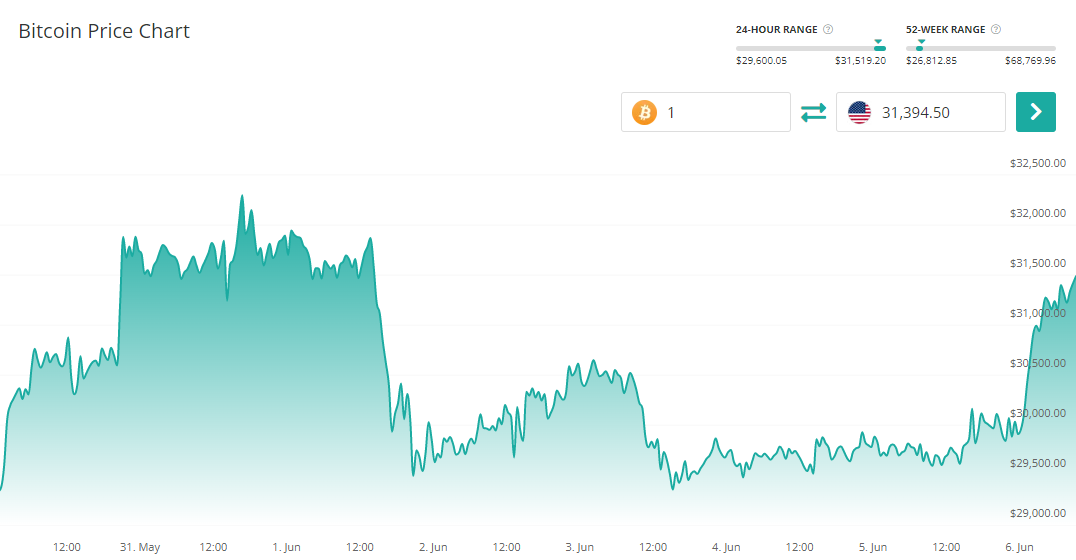
    The cryptocurrency market cap increased by over 5% to $1.34 trillion in the last 24 hours, leading to a notably positive price action across the board. Case in point, only 4 out of the top 100 (excluding stablecoins) digital currencies traded in the red zone at press time.

    BTC/USD price chart June 6
    BTC/USD price chart

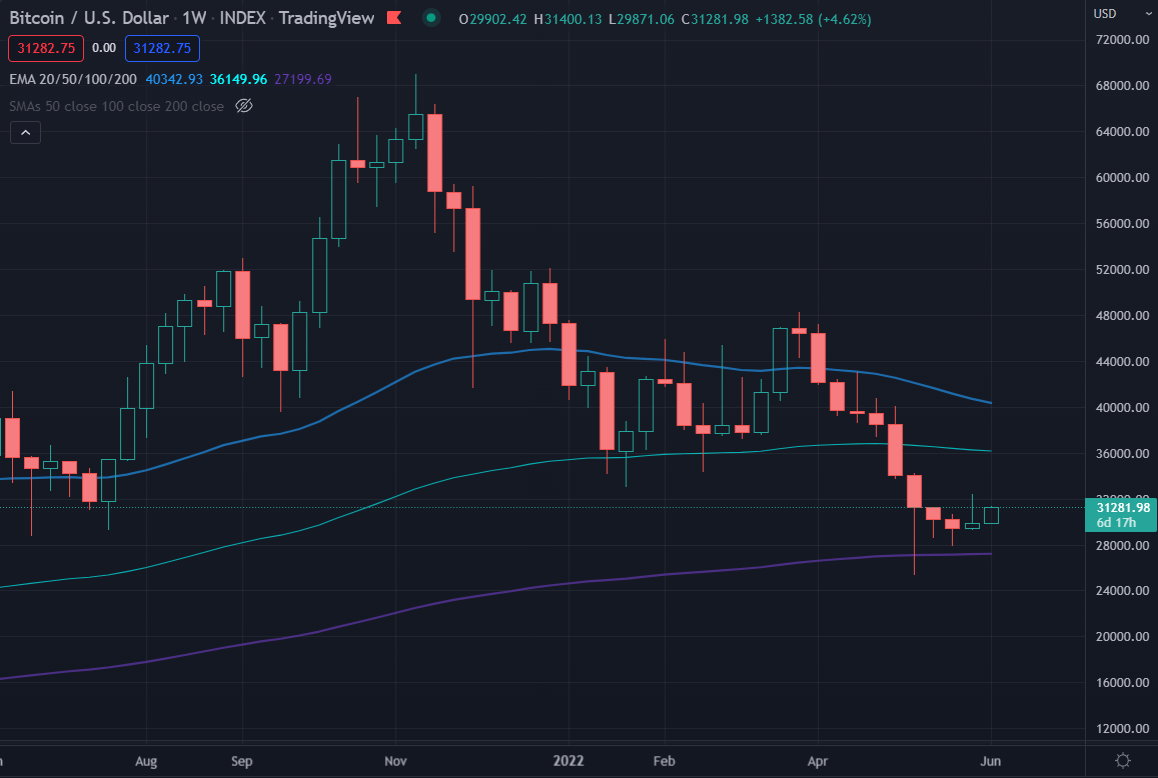
    Bitcoin hit the $31,500 price point on the tailwind of a 6% 24-hour price change and came awfully close to breaking its three-week high of $32,290, reached on the last day of May. Looking at the TradingView chart, the world’s largest digital assets narrowly avoided the 10th weekly consecutive red candle. With a series of 9th consecutive red candles, Bitcoin extended its previous record from 6 to 9.

    BTC/USD avoided the 10th consecutive weekly red candle
    BTC/USD weekly price chart. Image source: TradingView

    Like Bitcoin, Ethereum has been trading firmly in the green zone over the last 24 hours – the crypto gained over 6% and topped $1,900 after nearly a week of trading at sub $1,900 levels. The second largest crypto is now trading less than 9% removed from its three-week high of $2,090, reached on May 23.

    ETH/USD price chart June 6
    ETH/USD price chart

    Etherum’s positive price activity seemingly acted as a catalyst for numerous altcoins, many of which experienced double-digit gains to start the week, with Cardano and Solana being the most prominent examples.

    Cardano and Solana’s rallies hinting at the market reversal in the DeFi space?

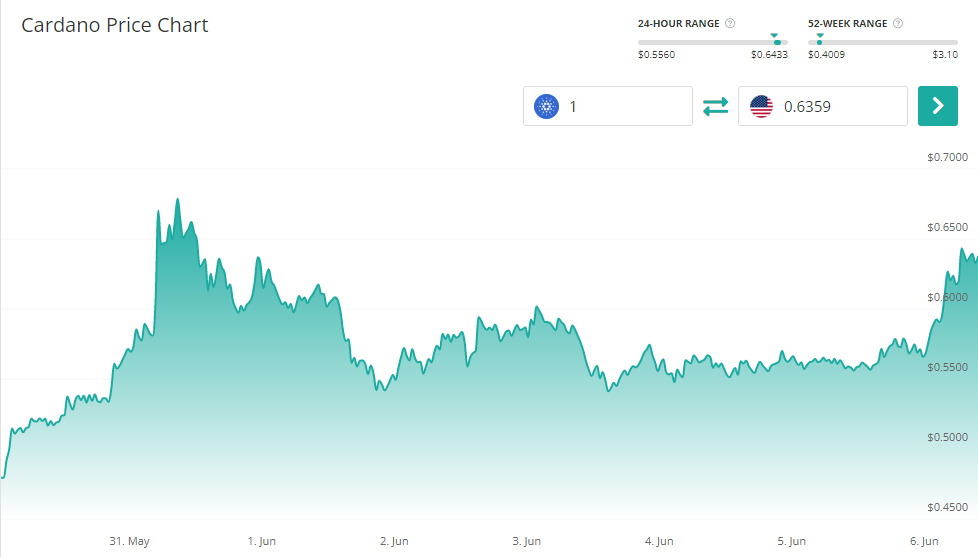
    Both Cardano and Solana had very similar price movements in the past week – both coins hit their weekly highs on the last day of May, only to slide back to their previous price ranges throughout the first week of June. 

    ADA/USD price chart June 6
    ADA/USD price chart

    The two native coins of leading Ethereum smart contract competitors gained more than 12% in the last 24 hours and solidified their spots on the list of today’s largest gainers in the cryptocurrency top 100. 

    Along with price increases in the value of leading DeFi coins, the total value locked (TVL) in decentralized finance (DeFi) products and services increased by more than 3%, according to DeFiLlama. The modest increase comes at a dire time for DeFi – TVL more than halved since April 2022, having fallen from $230 billion to $110 billion in June. 

    With the notable price increases in the value of leading DeFi assets, positive growth in TVL after months of decline, and the highly-anticipated transition of Ethereum to Proof-of-Stake (PoS) we could be seeing a trend reversal in the near term. 

  • Register & Earn: Get Up to $60 Worth of BTC

    Register & Earn: Get Up to $60 Worth of BTC

    Bybit's up to $60 worth of BTC promotion

    Time to seize market opportunities and level up your crypto journey with Bybit! From now till Jun 15, 2022, 10 AM UTC, get up to $60 worth of BTC in welcome rewards. What’s more, be the first 500 to finish all three (3) steps below to win an extra $100 in cash:

    • Step 1: Sign up for a Bybit account
    • Step 2: Complete KYC Lv. 1
    • Step 3: Make a deposit

    It’s that easy! Make sure you kick-start your ride to the moon with Bybit.

    About Bybit

    Bybit has grown to become one of the leading platforms in the sector. The exchange lists over 130 cryptocurrencies and more than 160 trading pairs. In addition to a very competitive spot market offering, the exchange retained its high ranking among the leading derivatives platforms. On top of that, Bybit offers dedicated Launchpad and Launchpool sections, allowing traders to earn crypto rewards in exchange for staking their crypto funds for a limited amount of time. We’ll be examining each of the Bybit’s features in more detail in the following sections.

  • ETH is the #1 Coin to Watch for the Week of June 6 – June 12, 2022

    ETH is the #1 Coin to Watch for the Week of June 6 – June 12, 2022

    As there were no bigger moves on the cryptocurrency market last week, the sector is entering Week 23 with an almost unchanged total market capitalization of $1.29 trillion. Among the biggest gainers out of crypto Top 100 in the last 7 days are WAVES (+92%), HNT (+28%) and ADA (+20%). In total, 60 out of top 100 cryptocurrencies ended the week in the green, while the remaining 40 posted red numbers. The ratio is surely indicating a slightly recovering market, but the relative changes in valuation have been too little to significantly increase the total market capitalization. Do you think we could see more green numbers or higher gains at the end of this week and potentially enter a period of recovery?

    3. TRON (TRX)

    TRON is a delegated proof-of-stake (PoS) consensus blockchain platform that launched its mainnet in June 2018. However, TRON’s native asset TRX existed even before the mainnet launch in the form of an ERC-20 token on the Ethereum blockchain. Like Ethereum, Solana and Polkadot, TRON blockchain is designed to host smart contracts and decentralized applications (dApps). TRON blockchain is known for its fast transactions and low transaction fees. TRON blockchain can also host custom TRON-based assets, issued using the TRC10 and TRC20 standards. The project was founded by Chinese entrepreneur Justin Sun, and its development is headed by the Tron Foundation, which was established in 2017. Since than TRON has grown to become a major player in the blockchain sector. Its network hosts some of the leading apps in the industry and sees a huge volume of data and wealth transferred across its ecosystem each day.  

    TRON ecosystem’s TVL grew by over 40% in May

    On May 5, the TRON DAO rolled out a new TRON blockchain-based decentralized stablecoin called USDD. The newly-launched stablecoin is designed to maintain a $1 peg through an arbitrage mechanism against TRX, much like the one utilized by the recently collapsed TerraUSD (UST). In addition, the launch of USDD came at a time when the market was still reeling from the Terra ecosystem crash. However, TRX markets responded positively to the announcement and, perhaps also due to the launch of USDD, TRON ecosystem grew a lot in May. DeFiLlama recorded a more than 40% month-over-month increase in total value locked (TVL) in the TRON ecosystem in May, which propelled TRON to the third spot in DeFi chain rankings. In addition, CoinMetrics data showed that TRON has the highest number of active addresses compared to BTC, ETH, XRP, XLM, BNB, DOGE and many other popular blockchains. In short, May has been a very successful month for the TRON ecosystem. The ecosystem growth is also starting to reflect in the price of TRX, which is up by 38% against USD in the last 3 months. It will be interesting to see whether TRON can carry this momentum over into June or even maintain it through the summer.

    2. Optimism (OP)

    Optimism is a popular Ethereum Layer 2 network that approaches solving the scalability issues by reducing the cost and latency of Ethereum transactions through the use of Optimistic Rollups technology. OP is Optimism’s freshly launched governance token. OP holders will form the so-called Optimism Collective, a large digital democratic governance community that will vote on protocol upgrades, direct incentives to projects, and determine the allocation of treasury funds.

    Optimism launched and airdropped first OP tokens

    On June 1, Optimism officially launched its own OP governance token. Soon after the launch, 5% of the total token supply was distributed to Optimism early adopters through the first airdrop last week. According to Optimism’s data, more than 248,000 Ethereum wallets were eligible to claim OP in the first airdrop. It is worth pointing out that the OP airdrop season is not over yet as Optimism has allocated another 14% for future airdrops. According to the Optimism’s OP allocation model, the rest of the token’s supply is intended for the so-called Ecosystem Fund (25%), funding public goods (20%), and rewarding core contributors (19%). The remaining 17% will be made available to Optimism investors. However, investors should be aware that the total supply of OP is expected to increase at a rate of 2% per year from the initial supply of 4.3 billion tokens at genesis. Since the launch, the OP token has been listed by virtually every major cryptocurrency exchange including Binance, Bybit, KuCoin, OKX and many others. Currently OP is changing hands at $1.22 per token, but the price of this governance token is likely going to appreciate as Optimism Collective gains functionality and authority.

    1. Ethereum (ETH)

    Ethereum is an open-source blockchain that pioneered smart contract functionality in 2015. The blockchain operates as a decentralized virtual machine that can execute scripts – also called smart contracts – in a fast, immutable, and trustless manner. Ethereum’s native asset is Ether (ETH), which is currently the second-largest cryptocurrency by market capitalization. Although it can also be used as a medium for the transfer of value between different Ethereum addresses, it is more commonly used to execute various smart contracts. The Ethereum blockchain hosts a number of ERC20 tokens with different utilities – these include Exchange tokens (OKB, HT, UNI), DeFi tokens (LINK, MKR, COMP, SNX, etc.) and several stablecoins such as USDC, DAI, TUSD, and USDT. Ethereum is currently transitioning from proof-of-work to a proof-of-stake blockchain. Once Ethereum 2.0 is fully launched, the network will be able to perform more transactions at a higher speed than today. Hopefully, this will also lower the network fees, which are a well-known Achilles’ heel of Ethereum ecosystem.

    Longest-running Ethereum Testnet will transition to Proof-of-Stake on June 8

    Ropsten, Ethereum’s longest-running testnet is going to switch from proof-of-work consensus algorithm to a more environmentally friendly proof-of-stake consensus on June 8. Following a successful shift to proof-of-stake on Ropsten, Ethereum developers will move their focus to the Goerli and Sepolia testnet. Since Ethereum mainnet is already the next in line, the highly anticipated event where Ethereum’s PoW mainchain and PoS Beacon Chain join, also known as “The Merge”, could be completed as soon as in August 2022 if everything goes according to the plan. While there are no official information as to when “The Merge” is going to happen, Ethereum developer Time Beiko recently revealed that we are in “the final chapter of PoW on Ethereum” and that the switch from PoW to PoS is likely going to take place “a few months after June”. Nevertheless, Ethereum’s PoS Beacon Chain is up and running ever since December 2020 and you can already stake your ETH, but you will only be able to unstake once the Beacon Chain will start processing transactions, this is after “the Merge”. In addition, several cryptocurrency analysts have noted that the Ethereum’s move to the faster and more environmentally-friendly Ethereum 2.0 has not been priced in yet. According to their analysis, ETH, which is currently changing hands at a discounted price of around $1,800, could surge as high as $2,600 once ETH 2.0 FOMO starts influencing the ETH markets.