Blog

  • DeFi Project ChangeX launches its CHANGE token on Uniswap, HydraDEX to strong investor interest

    DeFi Project ChangeX launches its CHANGE token on Uniswap, HydraDEX to strong investor interest

    Sofia, Bulgaria, 1st August, 2022, Chainwire

    DeFi project ChangeX has successfully launched its CHANGE token for trading on HydraDEX and Uniswap to strong investor interest, company officials said. The app supports several trading pairs in order to offer a broader range of possibilities to investors, BTC and ETH cross-chain swaps included.

    The CHANGE token launch comes after ChangeX successfully completed their ICO, defying bear market sentiment. The ICO resulted in close to $2M proceeds which will fund the company’s operations for at least 24 months, providing a solid financial starting point despite gloomy market conditions.

    CHANGE was introduced to the app on July 19 together with in-app staking and compounding of rewards, paid out in CHANGE. The staking APR on release day was in the 500% range without including compounding of staking rewards, which naturally made for a four-digit yield. The launch was met with strong demand, and in less than 24 hours 13.2 million tokens were sold on HydraDEX alone, while a total of 11.5 million were staked. Additionally, 1,87 million tokens were sold on Uniswap.

    “ChangeX is entering a very exciting stage and we’re very happy with the numbers. We’ve got the app up and running, the token is online and we’ve reached a very important milestone with staking now available.”, said ChangeX CEO Nikifor Iliev. “We aimed for a timely release according to our roadmap, and our developers have been working round the clock in order to reach deadlines and provide the beta version of the app to the community. All this was achieved in less than 6 months, and we’re all very proud of it.”, added Mr. Iliev.

    Both iterations of the token have surged in the days following the project’s launch, disregarding bearish market conditions, which can be an indicator of the project’s integrity and the strength of its community.

    “CHANGE and HYDRA are the essential building blocks of the future of ChangeX. All new features that we plan to add to the project will be built around them. A number of core functionalities will offer a myriad of possibilities that users can use to their advantage”, added Co-founder Gary Guerassimov. “All the additions we’ve planned for the future in our roadmap compliment each other and create an all-in-one app ecosystem that works on interoperability and simplicity. The end goal is a smooth and user-friendly app that offers unprecedented ease of access to DeFi, crypto, and traditional finance.”

    Q3 2022 will see delegated HYDRA staking come to ChangeX, granting users access to full-blooded staking without the need to set up a node, but with all the benefits that normally come with it. The developer team is also focusing on setting up the foundations for ChangeX’s open lending market and flagship Leveraged Staking product, which will offer margin positions on multiple staked assets in the app, amplifying yield by a factor of 1.2-2x.

    The other big thing for ChangeX is becoming an agent of an Electronic Money Institution (EMI) initially, and eventually obtaining its own license which will allow the company to issue IBANs to users, paving the way for the release of the ChangeX Crypto Debit Card. The card will work as standard bank cards do, allowing users to spend both crypto and fiat from within the app.

    “If​ we assume that​ Revolut was a 1st generation digital asset application, ​and Crypto.com a​ potential​ 2nd generation application, then ChangeX is making an attempt to establish itself as a 3rd generation application ​by harnessing the powerful DeFi products and making them readily available to retail users”, HydraChain Co-founder Nikola Alexandrov added, outlining the vision for ChangeX’s future.

    The ChangeX app is available on the Google Play Store for Android users and on the App Store for iOS.

    About ChangeX

    ChangeX is an all-in-one personal finance mobile app that merges traditional finance, crypto, and DeFi. ChangeX will offer users a personal bank account, access to multi-chain crypto, and high-APR DeFi tools such as Leveraged Staking, which could double the rewards on all staked assets. ChangeX’s focus falls on passive income and crypto empowerment, and the app will allow users to spend any in-app token on anything via its ChangeX Crypto Debit Card. Users will be able to lend their stablecoins, use locked and flexible staking, buy and pay with fiat, and swap crypto on multiple chains, with everything being accessible in a few simple clicks.

    Follow the project on Twitter and Telegram for more information and regular updates.

    The Team

    ChangeX founders Nick Iliev and Gary Guerassimov have a rich history in developing successful crypto and fintech products, among them xChange.bg – Bulgaria’s leading crypto exchange. HydraChain and LockTrip co-founders Nikola Alexandrov and Hristo Tenchev are also on board, each bringing seven years of blockchain experience to the project. The project’s CTO Martin Kuvandzhiev is one of the core developers at Bitcoin Gold – a hard fork of the source Bitcoin code, which brought decentralization back to retail traders and made mining via common GPUs possible again.

    The Advisers

    ChangeX’s advisory board features industry experts from some of the biggest names in crypto, DeFi, and finance. SoftBank Vision Fund’s Neil Cunha-Gomes, whose crypto investments include Consensys and Elliptic, has been working alongside seasoned experts Dimiter Gurdjilov and Stefan Ivanov in outlining the company’s strategy and vision. Dimiter Gurdjilov has more than 15 years of investment banking, private equity and business development experience from Merrilll Lynch, JPMorgan, George Soros’ Bedminster Capital, NBGI Private Equity, and Challenger Capital Management. Stefan Ivanov has 25+ years of experience at Citibank, Banque Paribas, and Challenger Capital Management, and has also served as the CEO of Citibank in Bulgaria.

    Contacts

    Marketing and Communications Manager

    • Dimitar Rahtaliev
    • ChangeX
    • dimitar@changex.io
  • World’s Largest Metaverse Builder Community SandStorm Launches Build Proposals for Brands

    World’s Largest Metaverse Builder Community SandStorm Launches Build Proposals for Brands

    Tampa, United States, 1st August, 2022, Chainwire

    Leading metaverse builder community SandStorm has released its highly anticipated “proposal and bid” platform. This metaverse construction market pairs brands with builders from top virtual worlds including Decentraland and The Sandbox, allowing brands to deploy assets and experiences on demand. Its decentralized approach aggregates the best builders to provide unparalleled quality and cost savings to brands pioneering the metaverse.

    Similar to on-demand marketplaces like HomeAdvisor and Upwork, SandStorm has already become a hub for thousands of the world’s best metaverse builders to find work. By connecting brands, individual builders, and full development studios of all sizes, SandStorm provides an innovative solution to how legacy brands like Walmart, Panera, and McDonald’s will enter the open metaverse.

    SandStorm CEO Steve McGarry said: “Physical location for work has become much less important for many of us over the last two years. At SandStorm, we believe the future of work will be primarily driven by an individual’s skills and their ability to work on a team within the metaverse. As we move into a more digital society, asset creation skills for multiple virtual worlds showcased on a SandStorm profile will level the playing field for finding work.”

    The SandStorm platform highlights builders based on Skills, Availability, Communication, Quality, Deadlines, and Team Cooperation. It can be analogized to building a dream home in the physical world, but instead of hiring one local real estate development firm, choosing the best architect in Korea, the best roofer in London, and the best electrician in Canada. Operating in the virtual world, brands can select contractors based on their portfolio of previous work.

    Brands can submit a proposal to create an experience in The Sandbox, Decentraland, and soon five additional virtual worlds. Individual builders and development studios from all over the world then place bids using their SandStorm profile. Brands can then select their desired team with the guidance of SandStorm. Once the build is complete, a Transaction NFT (TNFT) is sent to all the involved builder profiles. This allows builders to share their role in the project and promotes the brand’s build to their followers. Brand partners and builders review one another after the build is complete to ensure that all parties have the highest quality experiences.

    SandStorm CBO Matt Saricicek said: “SandStorm aims to lower the barrier to entry for brands as the minimum budget to submit a proposal is $1,000 USD for a small group of assets. Once these proposals are approved, they go live in front of over 2,000 verified builders to submit bids on projects of all sizes.

    “This is only the tip of the iceberg; there are countless other intelligent and creative individuals all over the world who are unaware of web3 and who will eventually multiply the present community and experiences on web3 by a factor of a thousand. The work of these incredible artists excites us, and we are thrilled to be contributing to this movement.”

    JP Morgan has projected the metaverse will be an $8 trillion market by 2030 and there is a massive need for builders and creators to generate content inside all virtual experiences. As SandStorm continues to organize the open metaverse construction market with an enormous amount of pricing data, builder education will play a vital role.

    By offering weekly interviews, workshops, and tutorials live streamed directly from their platform, SandStorm welcomes an average of 25 new builders into the space every day. As an on-ramp for eager new builders, SandStorm expects growth to be between 130 to 170 new builders per day by mid-2023.

    “We believe that the key to unlocking the potential of future generations is to establish an open platform where anyone can ‘build’ their own destiny by being a creator in the metaverse,” said SandStorm COO Evan Stafford.

    Learn more about how to get your proposal in front of thousands of the world’s best metaverse builders in Decentraland and The Sandbox HERE

    About SandStorm

    SandStorm connects brands with the best virtual world builders, driving down the barriers to metaverse entry. Using SandStorm’s unique “proposal and bid” platform, brands can submit a proposal, accept bids, and hire virtual real estate builders in desirable metaverses. Builders, meanwhile, can leverage their portfolio to connect with clients who will grant them a global audience and showcase their skills.
    Learn more: https://sandstorm.co/

    Contacts

    CEO

    • Steve McGarry
    • SandStorm
    • team@sandstorm.co
  • Fraxion Offers Institutional-Level Investing Opportunities from as Low as USD $1000

    Fraxion Offers Institutional-Level Investing Opportunities from as Low as USD $1000

    fraxion

    In the recent past, institutional-level real estate investment was a dream for individuals or small businesses. With the advent of blockchain, it has become realistically possible to invest with the industry’s big guns and gain consistent ROIs. Through strategic alliances and partnerships with some of the most successful real estate developers in the United States, FraXion develops ‘Digital Asset Partners’ and allows token holders to invest in prime income-producing properties and land suitable for rapid commercial development. With FraXion, everyone can make their dream come true and invest in real estate with as little as $1000. This possibility allows a person to be a part of significant real estate projects that yield the best outputs within a specified period of time.

    For centuries, investing in real estate assets has been a reliable means to acquire wealth. The recent decades have been extremely productive in terms of countless self-made millionaires. However, the tenets of real estate investing haven’t evolved much over the years, and thanks to the advent of blockchain technology, a major shakeup is on the way. Real estate specialists and investors see asset tokenization as a method to improve the real estate investment sector, give investment opportunities to eager financiers, and potentially spur further economic growth. According to a recent analysis by the international advisory and accountancy network Moore Global, “even if only 0.5% of the overall global property market gets tokenized in the next five years, it would become a $1.4T market.” Even if only a tiny fraction of traditional real estate is digitalized, investors will get access to a significant investment pool.

    How Does It Work?

    The process revolves around tokenization of real estate. Asset tokenization is the process of digitising an item by fractionalizing it into divisible fungible tokens that may subsequently be exchanged at users’ discretion.

    Asset tokenization might function similarly, with divisible tokens reflecting a share of an ownership stake in a different asset. This may mean that a residential property is tokenized in real estate, with 100 individual digital tokens representing a 1% ownership stake in that property.

    FraXion Token

    FraXion security tokens are cryptographic assets that are issued as smart contracts on the Ethereum blockchain. Ownership of a blockchain asset is established by recording an owner’s unique identifier address, or ‘public address’, and the quantity of the support possessed by such an address on a blockchain ledger.

    FraXion tokens are digital assets that are invested in real estate projects managed by top-tier real estate development partners. The partner funds are highly diversified, holding only institutional-grade real estate and assets in some of the most valuable locations in the United States.

    FraXion is a one-of-a-kind secure smart token with an easy-to-use investment platform that offers security tokens backed by income-generating real estate holdings. As a result, they are creating digital assets that can be traded and easily exchanged, giving the Digital Asset Partners flexibility and potential liquidity options.

    To become a digital partner, everyone interested can visit the official website, and click the link to buy a token. After that they will be taken to the secure private portal to verify their digital wallet. After that, they will be issued FraXion tokens, including a smart contract on the Ethereum blockchain. Each digital token represents a fractional debt interest in money received via RMCG Digital Holdings, Ltd. investments and the opportunity to earn 10% per annum over the 5-year life of the token (50% ROI).

    Key Benefits

    Firstly, unlike traditional real estate investment, which needs capital to be locked in for an extended time, FraXion digital tokens may be securely and efficiently transferred over a blockchain network. Tokenization thereby increases liquidity by making trading cheaper, faster and easier.

    Secondly, investors may create highly diversified portfolios with low costs and a virtually open global market. They may easily purchase fractional interests in shopping malls, movie theatres and apartment complexes, as just a few examples.

    To reduce the high costs of conventional real estate, FraXion tokenization implements fractioning. Unlike traditional real estate, which requires investors to acquire the whole property, tokenization lets ordinary people acquire stakes in smaller portions of the same property, increasing accessibility to investment at a lower cost ($1000). Tokenization has significantly reduced investment costs, giving opportunities to a larger range of investors. Tokenization also decreases procedural barriers via digitalization. Unlike traditional real estate, which is only available to regional investors during local operating hours, real estate tokens may be traded across borders at any time.

  • QTUM is the #3 Coin to Watch for the Week of August 1 – August 7, 2022

    QTUM is the #3 Coin to Watch for the Week of August 1 – August 7, 2022

    We have reported about several important developments concerning the U.S. and global economy last week. In brief, the Federal Reserve (Fed) has announced a second consecutive 0.75%. interest rate increase on Wednesday. By hiking up the interest rated, the Fed aims to battle the raising consumer goods prices and crippling inflation. With higher interest rates money becomes more expensive to borrow, resulting in a lower consumption – people and companies are spending less and saving more. In theory, this slowdown of the economy should result in the return to baseline prices for goods. In addition, we have written about the Bureau of Economic Analysis reporting a decline in the U.S. GDP for the second quarter in a row. Nevertheless, despite the slowing economy both stock and crypto markets posted gains last week – Bitcoin gained 5% in the last 7 days while ETH is up by more than 7%. The total cryptocurrency market capitalization climbed from $1.08 trillion to $1.15 trillion last week.

    3. Qtum (QTUM)

    Qtum protocol features elements from both Bitcoin and Ethereum, including the Ethereum Virtual Machine, and tries to combine the best of both worlds. The Singapore-based cryptocurrency project is designed as the backbone of mobile decentralized apps (dApps) and optimized for blockchain interoperability. Qtum’s native cryptocurrency, QTUM, is used to pay network fees as well as to participate in the project’s on-chain governance system. distribution of newly minted QTUM is based on ownership of the asset. Qtum blockchain utilizes a mutualized proof-of-stake (MPoS) consensus, where anyone can stake their QTUM to receive a reward in the form of a share of newly minted QTUM and share of the transaction fees.

    Qtum Mainnet Upgrade successfully deployed through the July 31 hardfork

    The Qtum Mainnet underwent a hard fork on July 31 at block 2,080,512. The upgrade is called Qtum Core v22.0 and will introduce the support for Taproot/Schnorr signatures, implement a new Ethereum Virtual Machine evmone that will result in faster EVM processing, and deploy the several bug fixes. You can read the full release details here.

    Because it was a hardfork, all users also needed to upgrade their Qtum Core Wallet to version 22.1. So, just in case you are wondering why you cannot access your QTUM coins anymore, make sure to upgrade and recover access ASAP. Even before the implementation, the upgrade was well received by the investors, who apparently accumulated QTUM in the week before the hard fork, causing its price to grow by more than 25% in just one week. Furthermore, the gains were even higher on Friday, July 29, when QTUM briefly spiked above $5.00. At the moment, QTUM is changing hands at $4.25.

    2. Polygon (MATIC)

    Polygon, previously known as Matic Network, is a leading Ethereum Layer 2 scaling solution. The Polygon Layer 2 network consists of several simultaneously run proof-of-stake sidechains that regularly push the data to Ethereum to create network checkpoints. Currently there two bridges that allow users to move assets between Ethereum and Polygon, the first one being the Plasma bridge and the second one the PoS Bridge. The Plasma bridge delivers supersonic speeds and throughput and allows for an easy and fast exit to Ethereum mainnet at the same time. Together with several other features and tweaks, Polygon provides a major scalability improvement to the biggest smart contract blockchain. By successfully overcoming Ethereum’s most limiting shortcomings Polygon has become attractive for DeFi projects and is establishing itself as one of the key DeFi networks.

    MATIC continues to rally on the tailwind of Ethereum merge hype and Polygon’s high-profile partnerships

    Although we have featured Polygon on our lists on several occasions in the past 3 months, we believe that the project that has defied even the bear market deserves to be on the list once again. In the past 30 days, MATIC has managed to more than double its price, which is now nearing in on $1.00 again. Analysts claim that Polygon has benefited from the hype surrounding the upcoming Ethereum mainnet merge. For example, the recent Goerli testnet Merge announcement has led to a spike in the price of ETH but also the price of coins belonging to projects with a heavy focus on Ethereum, such as LDO and MATIC. Considering the fact that there are still a few more weeks until the Merge takes place on Ethereum mainnet, the hype is only about to amplify, which could result in further growth of Ethereum-connected coins. But of course, the MATIC rally is not purely hype-driven as that would likely be very unsustainable. Polygon has also established several important partnerships with big and well-known companies, such as the partnerships with Disney and Coca-Cola, of which we have written in our Top 3 Coins to Watch article from two weeks ago.

    1. Bitcoin (BTC)

    Although we believe Bitcoin does not need much introduction and that all eyes would be on it even if it were not featured on our list, here is a short summary of the history and key characteristics of the first truly decentralized digital currency. The world’s pioneer cryptocurrency was launched by pseudonymous figure named Satoshi Nakamoto in 2009 and has a capped supply of 21 million coins. The decreasing miner block rewards make the cryptocurrency scarcer with time, ensuring a deflationary nature. Bitcoin is also often referred to as the barometer of the cryptocurrency market as other assets usually follow BTC’s price performance.

    Bitcoin rallied after the news of another 0.75% interest rate increase

    As already mentioned, the U.S. Federal Open Market Committee (FOMC, part of the Fed) announced another 75 bps interest rate hike on Wednesday, July 27, which pushed both the stock market as well as the crypto market into a small-scale rally. Bitcoin gained almost 10% on the day of the announcement and its appreciation continued throughout Thursday despite the Q2 2022 GDP report, that showed that the U.S. economy is technically in a recession, being published. Interestingly, we have already seen this pattern following previous interest rate hike announcements. When the FOMC announced the increase in interest rates last month, Bitcoin gained 10.5%, while Ethereum surged even higher, increasing its price by more than 15%. Nevertheless, last month the rally turned out to be very short-lived as both Bitcoin and Ethereum quickly lost back all their gains. It will be interesting to observe whether this pattern will repeat itself this time around.

  • Use Strategy Trading to Automate Binance Futures Buy and Sell Orders

    Use Strategy Trading to Automate Binance Futures Buy and Sell Orders

    Binance Futures cryptocurrency exchange

    Strategy Trading is a means to trade and autonomously make profits using predetermined buy and sell orders. It uses several detailed parameters to help traders profit on small price fluctuations, and it includes a host of algorithm features like Grid Trading and Volume Participation, amongst others. 

    The home page allows users to easily replicate their parameters while giving consumers a thorough overview of Spot and Futures Grid Trading techniques, as well as information on their performance and user popularity.

    Strategy trading has gotten relevant over time due to how quickly traders can profit off volatile or sideways markets using price reversion techniques on a host of automated trading strategies.

    Futures Grid Trading

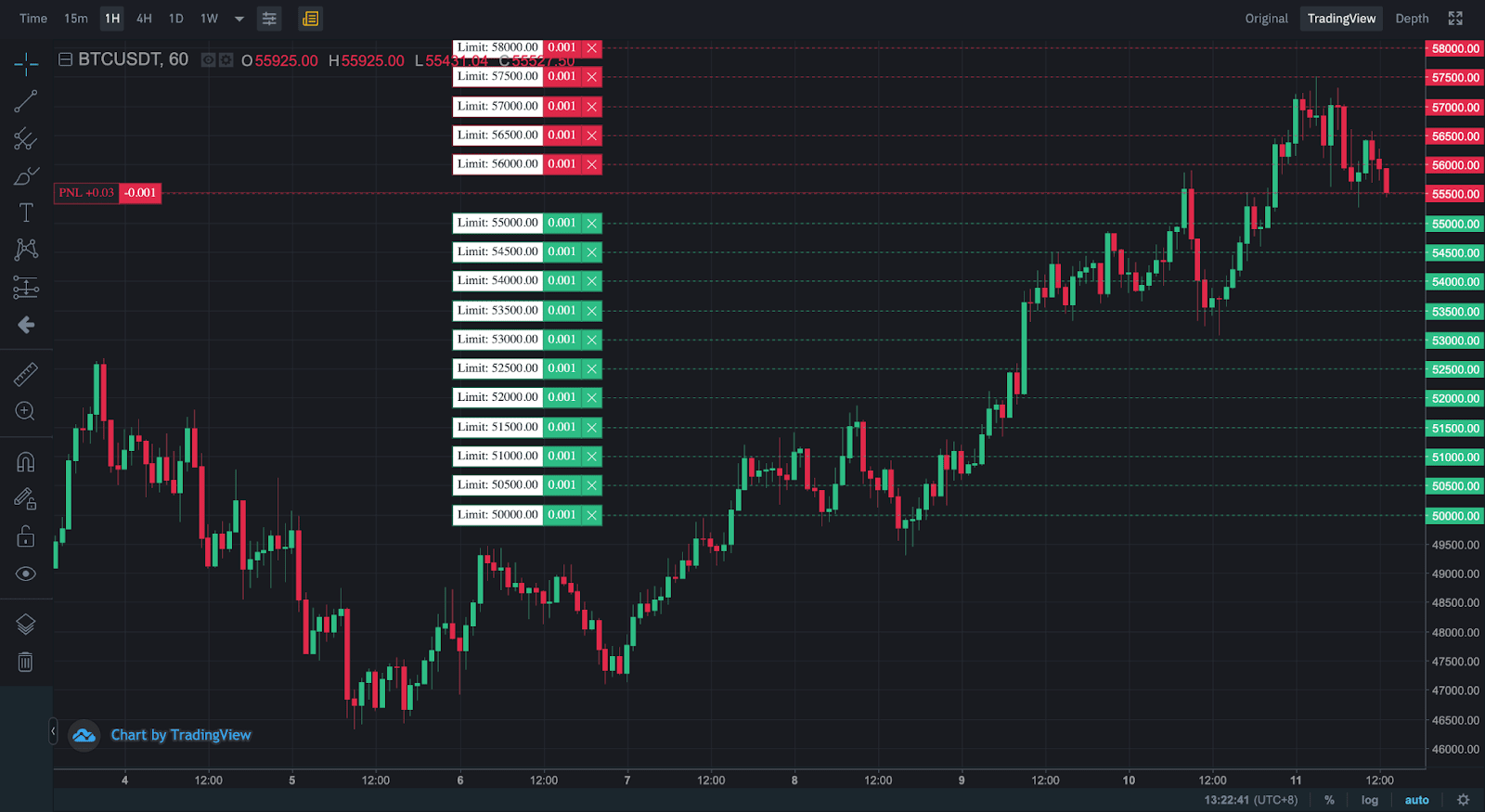
    Grid Trading is a way to automate trading. With it, orders are to be confined within a specific price range (above and below a set price), forming a grid for increasing and decreasing prices. This trading type on the futures market is best suited in very volatile markets. Profits can be made on repeated bets over small price changes, and the more grid you add, the greater the frequency of trades will be. 

     On Binance Futures Grid, there are three major environments to set grids. The first is a neutral environment; you can create grids with no specific market direction. The second is a Bullish environment; here, the market is still volatile but tends towards a bullish run. You will need to pen a long position and use grids for your bets. Finally, there is a short position. This is done when the market is tending bearish. You will short positions using Grid. 

    For example, in a neutral environment, a trader can buy Ethereum at $50 below the spot price while concurrently setting a sell order at $80 above the market price. This way, the bot can take advantage of volatile market conditions if the market goes both ways.

    The caveat with grid trading, however, is that your profits per order are predetermined and lower than with many other strategies. 

    Binance Futures Grid trading offers customizable features and self-initiates once preset buy and sell prices are created. 

    How does it work? 

    Let’s assume there’s uncertainty in the market, and you predict Ethereum will stay within the $1400 and $1800 price range. You can set up a grid to automate trades within this price range. The details of the grid could include these parameters.

    • The upper and lower boundaries of the price range
    • The number of orders to be placed within the configured price range,
    • The width between each buy- and sell-limit order.

    If Ethereum drops down towards $1400, the boy buys position all the way down. With the crypto’s recovery, the bot will sell these positions and pocket the profit.  

    Time Weighted Average Price (TWAP) Algorithmic Trading?

    For API users of its futures contracts, Binance has made the Time-Weighted Average Price (TWAP) trading algorithm available.

    This algorithm allows traders to leverage the Binance bot trading capability to reduce price impact on orders by reducing these large orders into bits.it executes trades clove to the time-weighted prices of the asset, using a user-specified period as a guide. 

    When to Use a TWAP Algorithm?

    The prominent feature of the TWAP is time. Large Orders are optimised by reducing them into smaller bits, and it can also mitigate significant market swings. 

     There are two scenarios where TWAP is the best algorithm bot to use

    1. if the liquidity on an order book is less than the order size
    2. If there is an anticipation of a high price volatility period with no decisive market direction. 

    If either of these scenarios is met, there are a few things you should take note of

    1. Trade size: You will need to determine the trade size for the contract. This will fall within the accepted TWAP minimum of at least 10,000 USDT 
    2. Trade duration: you will need to select the execution period. Mostly, TWA trades are intra-day, and the minimum execution time is set at 5 minutes.

    What is Volume Participation Algorithmic Trading? 

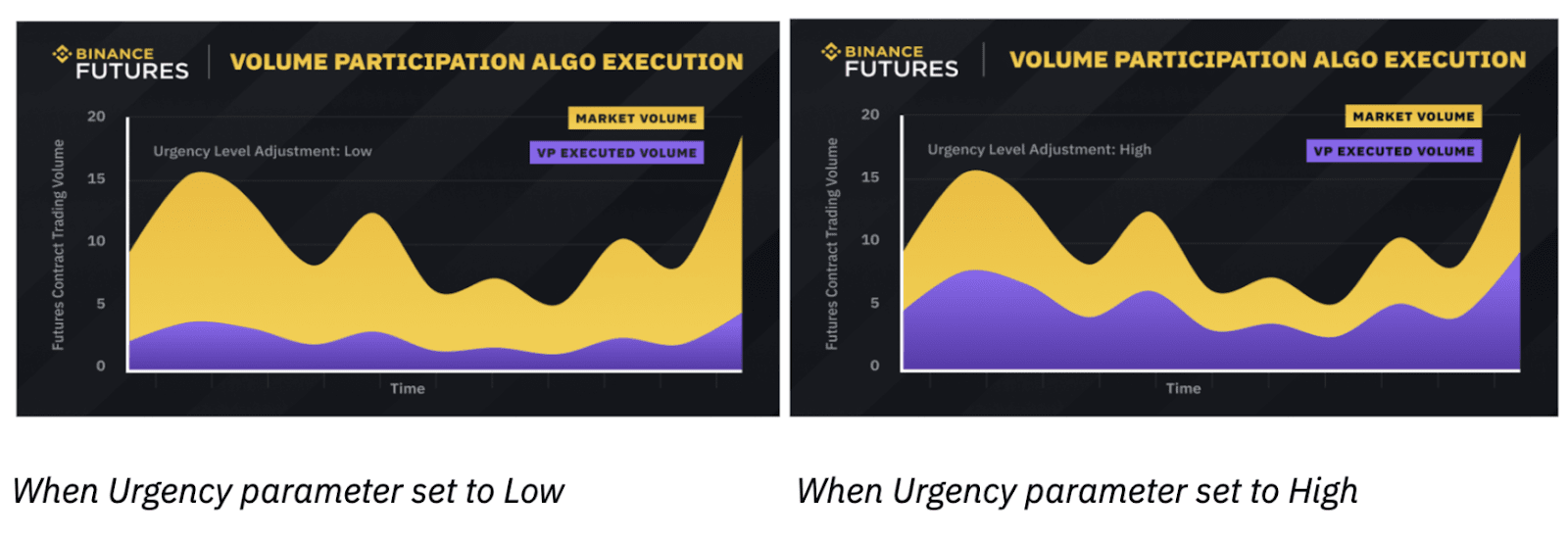
    Apart from the TWAP, Binance offers another Algorithmic trading tool,   The Volume Participation (VP). This algorithm is opportunity-based, and it seeks to leverage market volume to enter and exit trades. 

    VP might come in handy if you want to target the average trading price while also limiting the order market impact for a certain period.

    When to use a Volume Participation algorithm?

    Like the TWAP, the Volume Participation is executed when the available order is larger than existing liquidity while reducing the effect on the market. 

    There are several market situations where the VP may execute or not. 

    1. If there is Low market volume and stable price, VP order may execute within the average market price without impacting the market.
    2. If there is a high market volume and volatile market price, VP order might not be able to execute in urgency and may result in an adverse executed price. 

    The VP algorithm is subject to some limitations.

    1. The first limit you are likely to see is the Notional Limit. This is seen when the order is less than the 10,000USDT minimum or greater than the 1 million USDT required. 
    2. Also, if you use any contract apart from USD-Margined types, your order will be limited. 

    Responses when using the Volume Participation algorithm and their meanings

    1.  0:  means the contract is okay
    2. -1000: means an unknown error occurred
    3. -1102: means a compulsory parameter as skipped or not set. 
    4. -20121: means invalid symbol
    5. -20130: means the data of the parameter set is invalid
    6. -2013: means order does not exist.
    7. -5007: means no quantity ser or quantity must be greater than zero
    8. -20124:means Invalid algorithm 
    9. -20132: means the algorithm has been duplicated
    10. -20195: means the total order size is too small
    11. -20196: means the total order size is too large
    12. -20198: means you have reached the limit for the number of open orders. 

    How to Use Strategy Trading Landing Page: Step-by-Step Guide

    Here’s a step-by-step guide showing how to use the Strategy Trading Landing page.

    Step 1

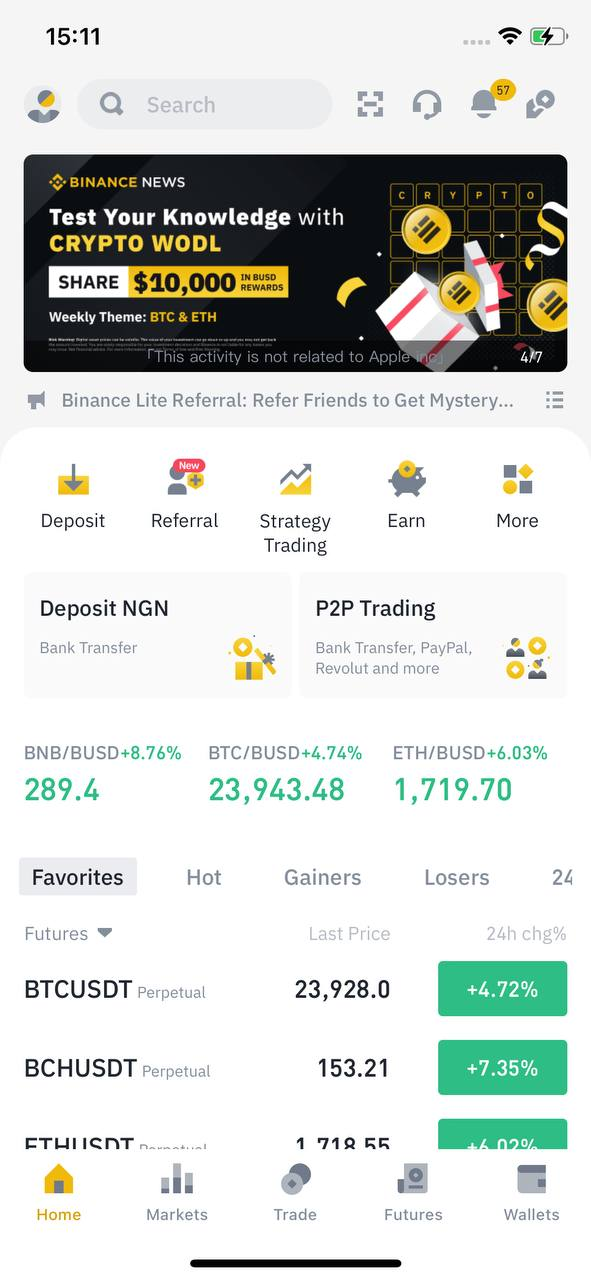
    On the Binance App, click on Strategy Trading (between Referral and Earn)

    Step 2

    Sign the Risk Disclaimer Statement before you set up a strategy (skip this part if you have already done this)

    Step 3

    Your app should automatically be on the Futures Grid, but if not, click on the Futures Grid.

    Step 4

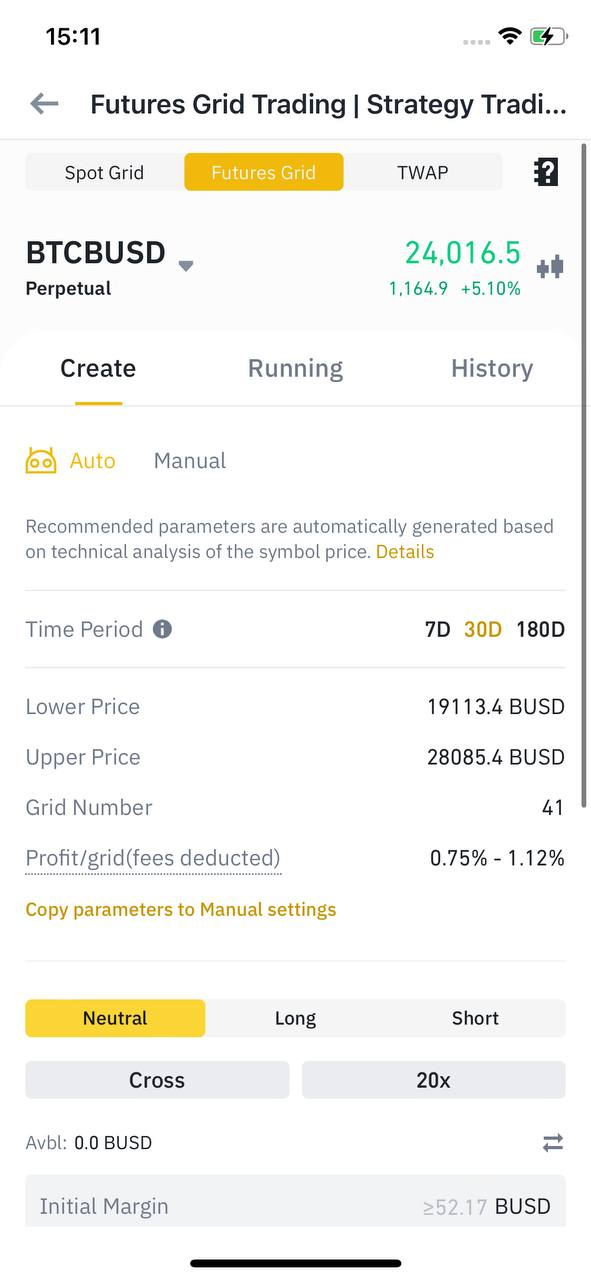
    Choose your parameters (time frame, lower price, upper price, Number of Grids, amongst others).

    Step 5

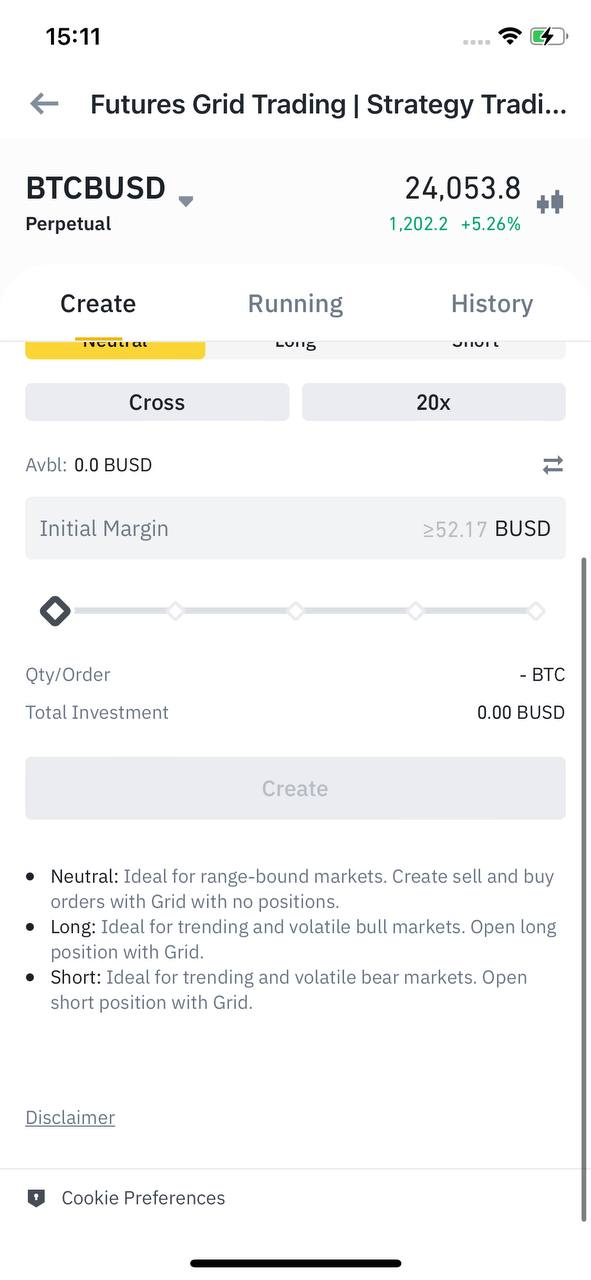
    Click on the market direction of your trade and decide if you want to use up to 20x leverage provided by Binance. 

    Step 6

    When done, click on create. 

    Step 7

    You can see already-created Grids on the Running tab, and the history of all grids you have created will be under the History tab.

    Using the Mock Trading Environment to Practice Strategy Trading

    If you are unsure of the Strategies you want to employ, you can test-run your skills using the Mock trading environment. Here is how to go about it. 

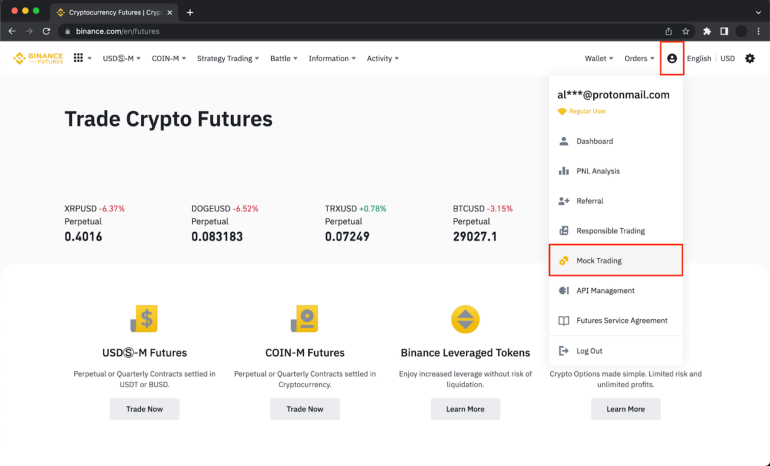
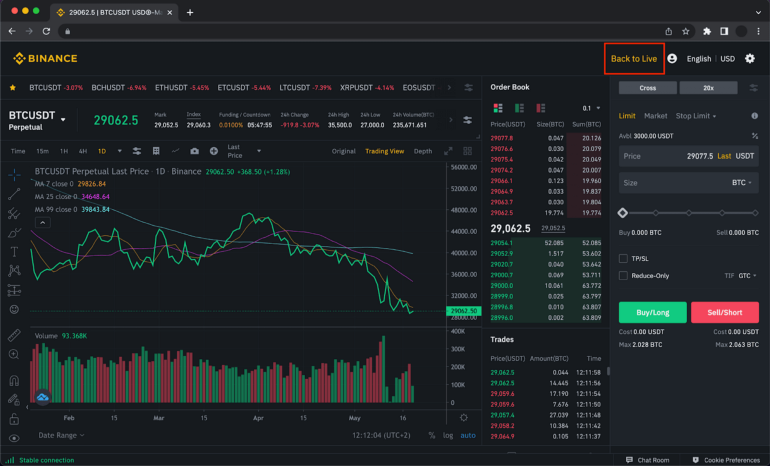
    Click on Profile once you enter the app’s home page.  From there, select Mock trading. You can also click on Futures, click the three horizontal lines at the top right side, and click on Mock Trading. 

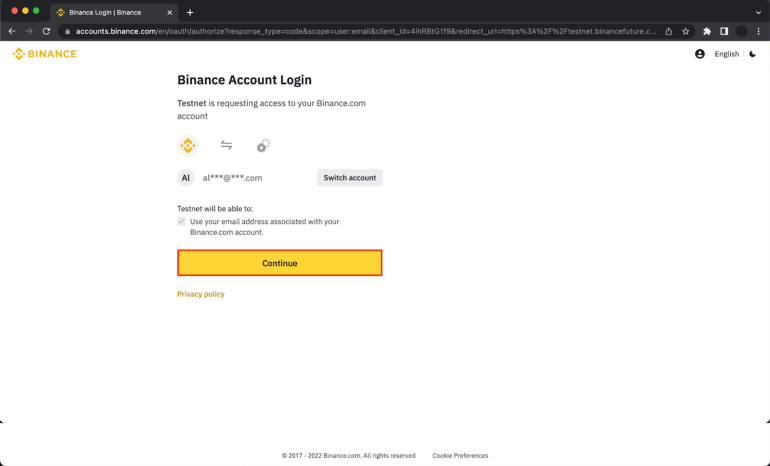
     You will need to grant access to your account to the testnet and click on continue.

    You will be given a free 3000 USDT  balance to test your trading. This balance can be increased after 72 hours, but it cannot be taken out of the mock trading environment. You can o back to the live trading platform once your strategy is battle-tested. 

    Conclusion

    The strategy trading option by Binance removes the stress of waiting for certain charts and prices to be met before trades can be placed. It automates the process of trading and allows the trader to earn repeatedly on a predetermined prerequisite. It is worth noting that no strategy is fail-proof, but you won’t know until you try. Trade with small amounts, keep honing your prerequisites, and the sky will be your limit. 

  • Vasil Upgrade for Cardano Network Postponed Again

    Vasil Upgrade for Cardano Network Postponed Again

    Cardano (ADA) cryptocurrency image cover

    Key takeaways:

    • The Cardano Vasil hard fork faces another delay
    • The update, which is slated to drastically improve Cardano’performance, is expected to come in the next “few weeks”
    • The reason for the delay lies in the need for more testing of the Vasil update before it hits the mainnet

    Update that was slated to roll out at the end of July is now delayed for “a few more weeks”

    In the Cardano360 July edition that was uploaded to YouTube on Thursday, IOG’s Technical Manager Kevin Hammond revealed that the rollout of the Vasil hard fork would take “a few more weeks”.

    “Obviously, from where we are, there could be a few more weeks before we go to the actual Vasil hard fork. This is incredibly important. All the users must be ready to progress through the hard fork to ensure a smooth process,” explained Hammond.

    The latest delay comes roughly a month after the creators of Cardano, Input Output Hong Kong (IOHK), announced that the Vasil update needs more testing and that it would see the light of day by the end of July.

    The reason for yesterday’s decision, or rather the announcement of a previously made decision, is the same as last month – developers need more time to make sure all the quirks and potential bugs of the Vasil update are ironed out before the update hits the mainnet.

    The Vasil hard fork is slated to bring “massive performance improvement to Cardano,” according to the founder of IOHK and Cardano, Charles Hoskinson. The performance boost is expected to come primarily as a product of four new Cardano network improvement proposals, which will reduce transaction size and enhance smart contract functionality, launched last year with the rollout of the Alonzo upgrade.

    You can watch the full Cardano360 July edition via the embedded video below:

  • Dive Into the Newly Listed tokens on KuCoin: ICON (ICX)

    Dive Into the Newly Listed tokens on KuCoin: ICON (ICX)

    ICON (ICX) cover image

    KuCoin recently listed a wide range of new coins in July, but one of the more recent and exciting listings was ICON (ICX).

    ICON is an open-source layer-1 DPoS blockchain and smart contract platform designed to make blockchains more interoperable with one another. 

    What is ICON (ICX)?

    ICON is a South Korea-based blockchain project launched in 2017 by Min Kim. It aims to be an interoperable blockchain on which multiple industries and business types can coexist on a single network.

    ICON communities and nodes are independently governed with varying rules and consensus algorithms. These respective communities are all connected to the central ICON Republic, which serves as a communication point without governance authority over the individual communities.

    ICON’s enterprise blockchain implementation, Loopchain, is one of the world’s oldest and largest operating blockchain networks. It is being used by some of the largest and most reputable companies in South Korea, including major universities, governments, hospital systems, banks, and financial services firms.

    The ICX token powers the ICON network and will be used as a vehicle for value transfer and transactions. ICX will also be used by DApps built on top of the main network, thus allowing network participants to utilize ICX for various services provided in the ecosystem.

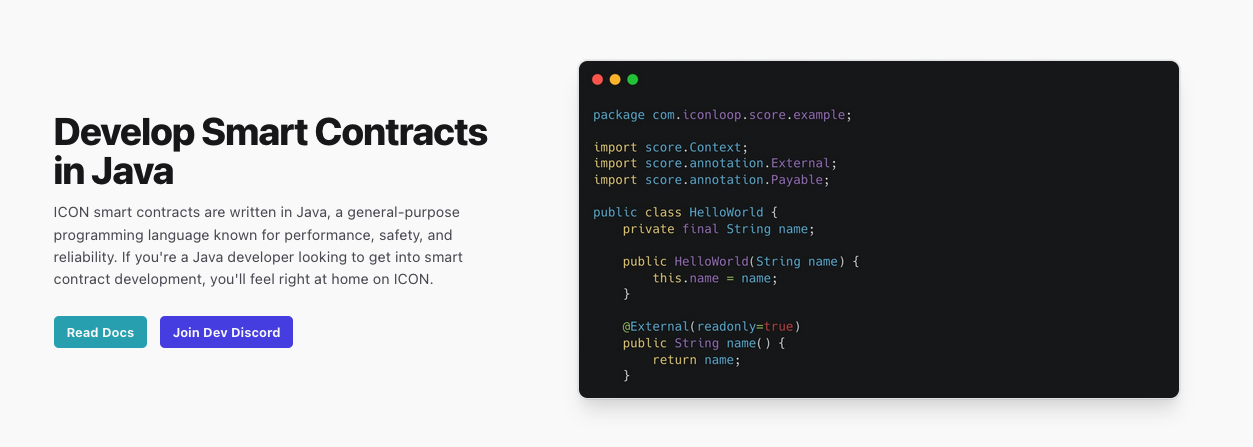
    One of the great things about ICON is that its smart contracts are developed using a general-purpose programming language called Java. This makes the blockchain extremely accessible to a wide range of developers as they don’t have to waste time learning a new programming language. 

    The ICON Foundation oversees the promotion and development of the ICON protocol. In addition, the Icon Republic acts as the center o the Icon blockchain’s operation and governs the process by which new ICX is minted. 

    How does Icon (ICX) Work?

    Unlike Bitcoin, Icon doesn’t actually rely on the process of mining to achieve a consensus on the network. Instead, ICX uses a delegated proof-of-contribution consensus algorithm. 

    The blockchain ensures collaboration between its five separate products:

    • Icon Republic – the network’s governance system
    • Icon Communities – A network of nodes within a single governance system
    • C-Reps – Elected nodes in each community that is chosen to communicate with the Icon Republic
    • C-Nodes – Infrastructure for each community on the network
    • Citizen Nodes – Can make transactions within a community but don’t have voting power

    The algorithm that powers the Icon blockchain is called Loopchain and allows messaging between all the nodes on the Icon Republic. This is a high-performance enterprise blockchain that has smart contract features integrated into it. 

    The project also has a Blockchain Transmission Protocol (BTP) that enables cross-chain communication between any type of blockchain with smart contract functionality. So far, users can bridge assets between ICON and Binance Smart Chain, Near Protocol, Moonriver, and more by using Nexus.

    What is $ICX?

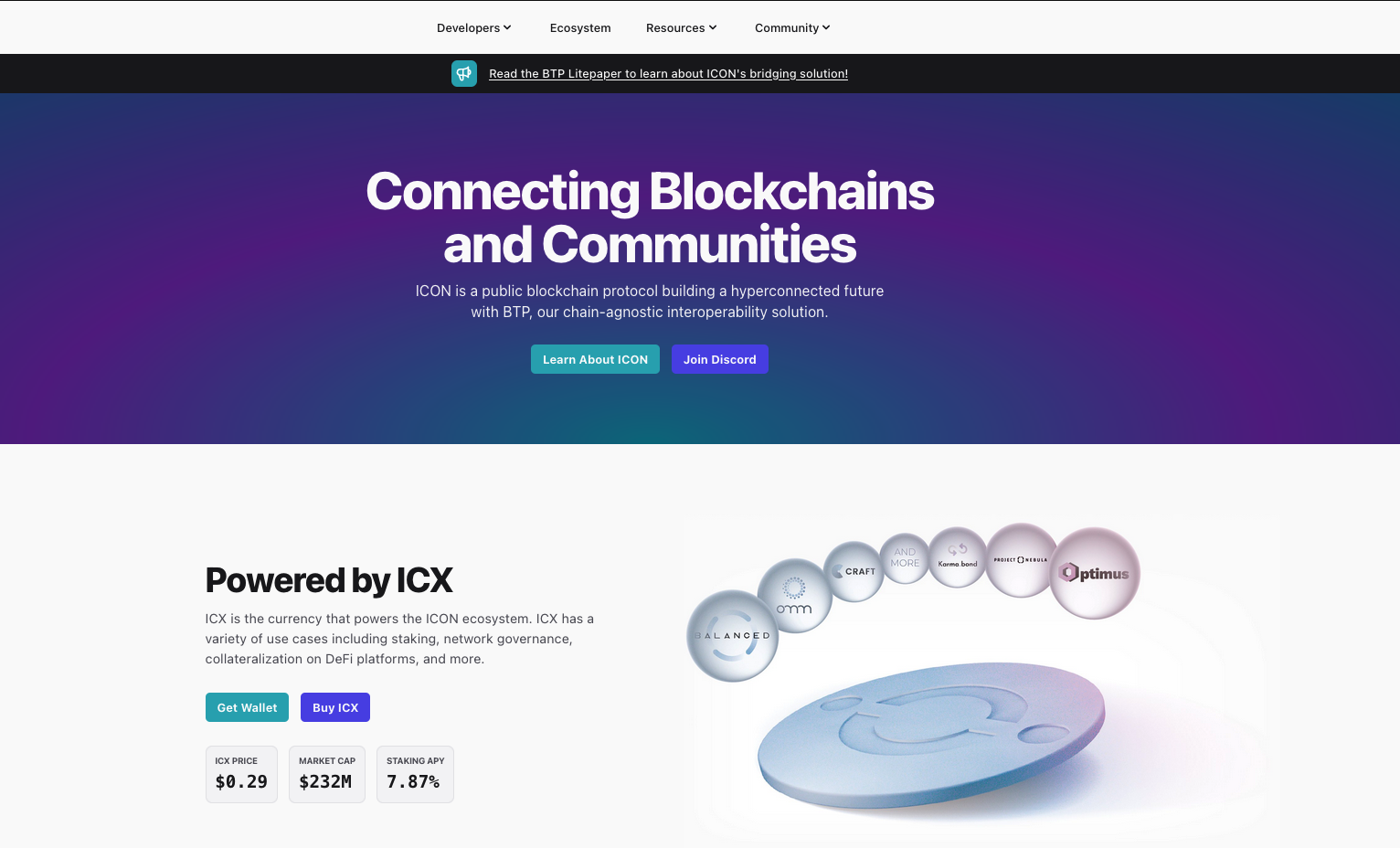
    $ICX is the utility and governance token behind the project. It is used to pay for all transaction fees on the network and to pay stakers a block reward of around 10%. Currently, it pays a 7.87% staking rate. 

    Furthermore, the ICX token can be used as collateralization on various DeFi platforms so you can take out crypto loans.

    ICX was one of the top crypto ICOs in the second half of 2017. They chose the perfect time to launch in the middle of the 2017 ICO craze. The trading started at the end of October 2017 when BTC started rallying from $5k to $20k. ICX rose from $0.40 to an ATH of $12.66 in less than three months. ICO investors that sold it at $12 made an easy 100x ROI as the ICO price was $0.12.

    Coin Analysis

    Icon is currently ranked in the 133rd position, holding a market cap value of $272 million. The coin is now trading down by a total of 98% from its all-time high peak. 

    Long-term Analysis

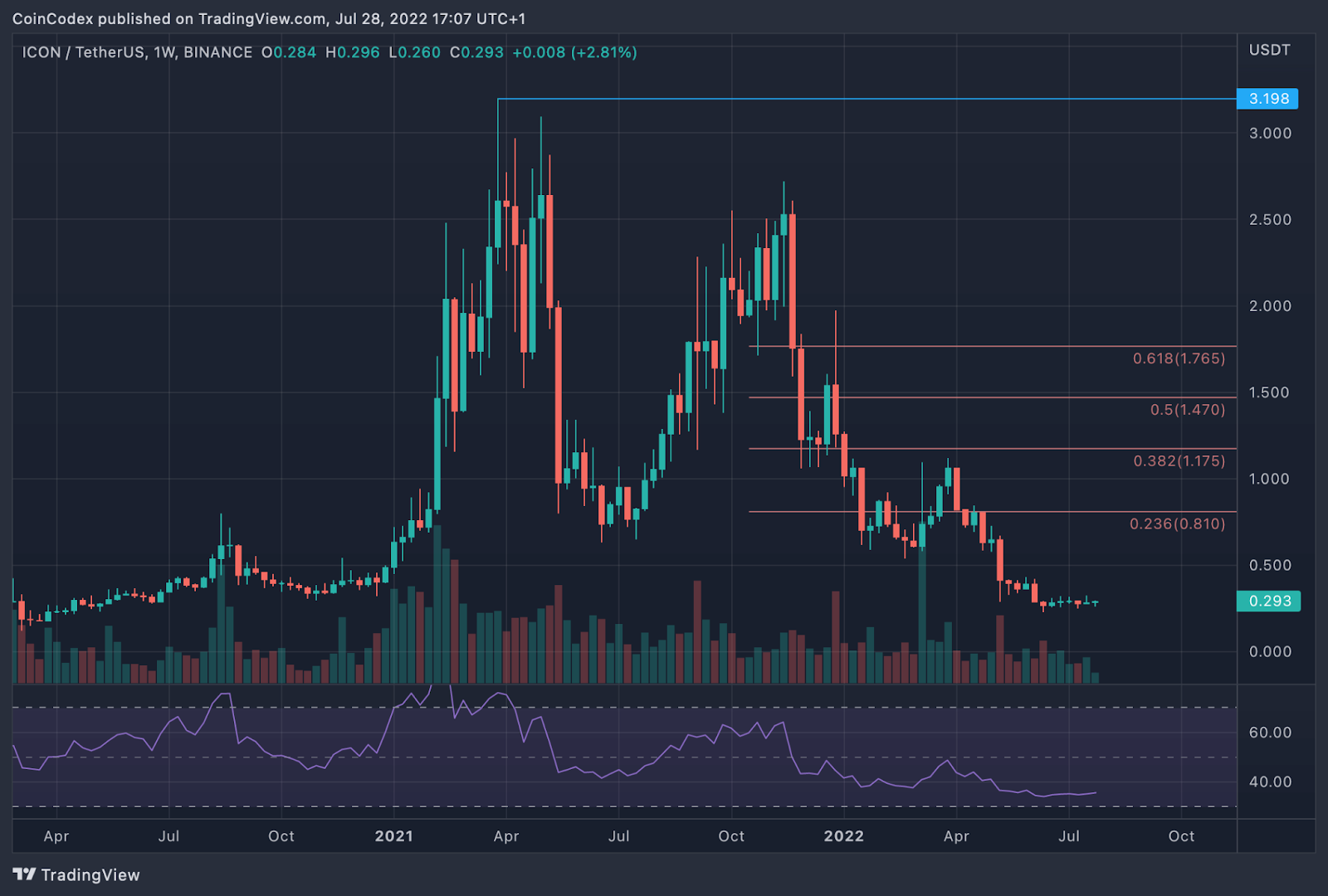
    Looking at the weekly chart above, we can clearly see the crazy journey ICX has been on over the past two years. The cryptocurrency really started to surge in December 2020 and continued to explode in the first few months of 2021 to set the $3.20 all-time high price in March 2021.

    From there, ICON would go on to fall through the summer of 2021 until support was found at around $0.8 toward the end of August. It would then go on to experience a second rally higher as it climbed back above $2.00 and hit $2.50. Interestingly, ICON could not set a new all-time here when the rest of the industry managed to do so.

    It rolled over in October 2021 and has been in a downtrend ever since.

    During the 2022 market capitulation, ICON dropped from above $1.00 and continued to fall until support was found in the $0.2 range over the recent few weeks.

    For a recovery, the first strong level of resistance to break lies at $0.5. This is followed by $0.81 (bearish .236 Fib Retracement), $1.00, $1.17 (bearish .382 Fib), and $1.50.

    Let’s take a look at the short-term charts to see where we are heading. 

    Short-term Analysis

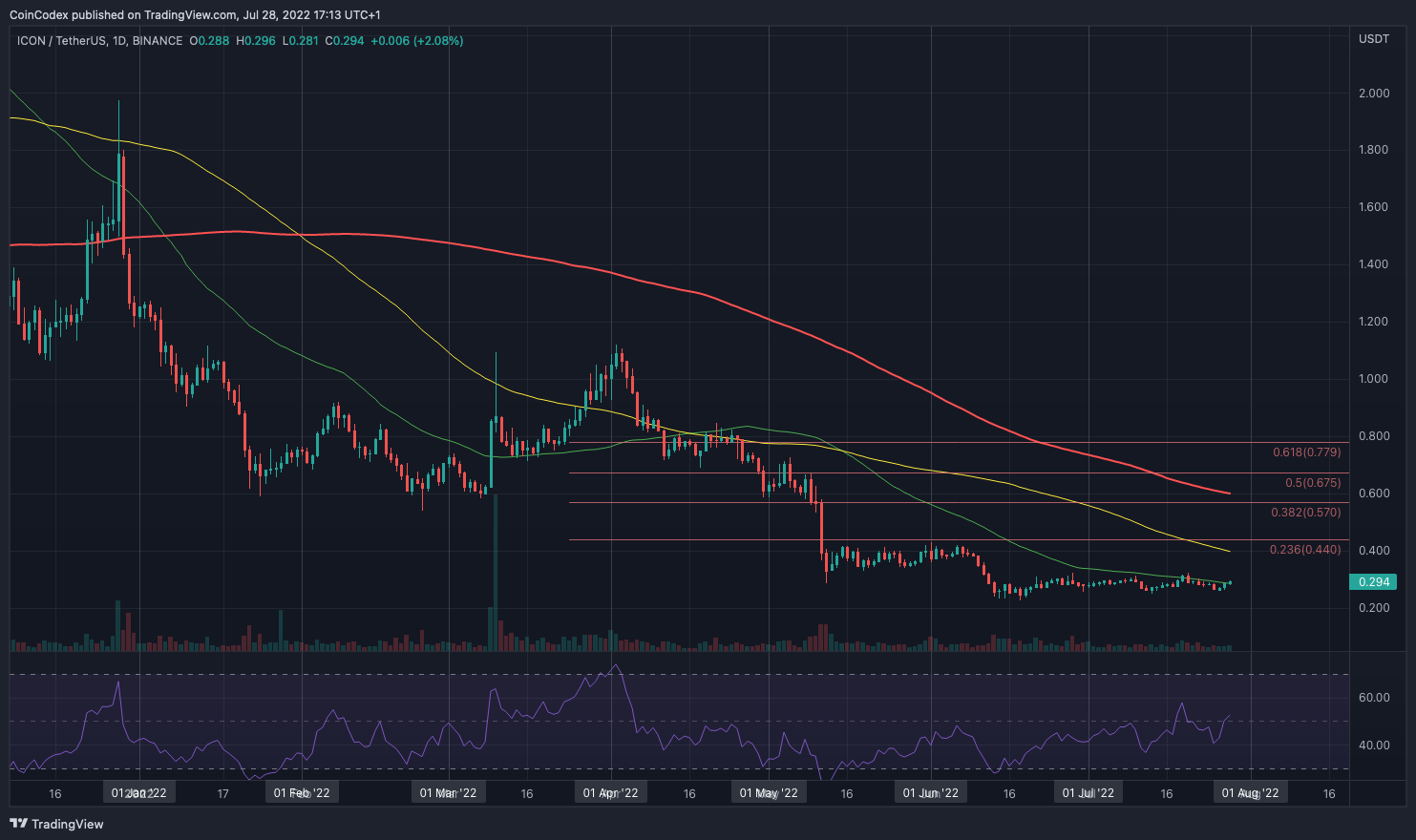
    The daily chart shows how flat ICX has been over the past few months. The coin was trading above $1 at the start of April but quickly slipped back beneath it as BTC started to unwind. During the market capitulation, ICX found support at $0.6. However, this support eventually broke in May as ICX continued to trend lower until finding a low of around $0.22 in June. 


    Since then, ICX has been trading in a tight range between $0.22 and $0.32. It must break this current range to dictate the market’s next direction. A break above $0.6 would indicate that long-term growth is incoming for ICX, as this is where the 200-day MA level is located.

    Why is KuCoin the go-to platform for trading and investing in this token? 

    KuKoin is known as the “People’s Exchange,” and it is built for all classes of investors. KuCoin is the top 1 altcoin exchange, with 700+ assets and 1,200+ trading pairs. It also includes a number of crypto gems like BLOK, CHMB, VR, KMA, and DAO had their primary listing on KuCoin. 

    KuCoin currently provides Spot trading, Margin trading, P2P fiat trading, Futures trading, Staking, and Lending to over 20 million users in 207 countries and regions around the world. 

    According to CoinCodex, KuCoin is a top 5 crypto exchange.

  • First Decentralized Data Warehouse, Space and Time, Raises $10M Seed Round Led by Framework Ventures

    First Decentralized Data Warehouse, Space and Time, Raises $10M Seed Round Led by Framework Ventures

    Los Angeles, United States, 28th July, 2022, Chainwire

    As the DeFi & GameFi sectors grow, Space and Time aims to be the first truly decentralized solution for rapid and secure data processing at enterprise scale
     

    Space and Time TM, a decentralized data platform for blockchain applications, has raised $10 million in a seed round led by Framework Ventures, a venture capital firm known for its early entry into decentralized finance (DeFi) and blockchain gaming (GameFi). Additional participants in the round include Digital Currency Group (DCG), Stratos, SamsungNext, IOSG Ventures, Alliance and several market leading DeFi, GameFi, and venture organizations.
     

    With a novel, patent-pending cryptographic protocol dubbed Proof of SQLTM, Space and Time enables blockchain applications to rapidly generate rich, analytical insights in an entirely decentralized, scalable, and secure manner. A network of node operators pull data from blockchains, decentralized applications (dApp), and off-chain systems in order to perform operational and analytic computations. As a result, blockchains are supplemented with capabilities for querying both on-chain and off-chain data in a single, trustless environment to power advanced new use cases for smart contracts.
     

    Space and Time’s database creates proofs of the query results off-chain and transmits them to a validation layer where they are verified to be true. Once validated, the data is loaded back on-chain to the smart contracts where the dApp can access the results in real time. By moving the bulk of computational work off-chain, and enabling on and off-chain data to be combined in analytic workloads, Space and Time allows the existing blockchain infrastructure to scale exponentially while trustlessly maintaining computation integrity.
     

    “As the Web3 business process and automation matures, developers and applications require advanced database computations to connect off-chain analytics directly to smart contracts,” said Nate Holiday, co-founder of Space and Time. “However, scalability in the current blockchain ecosystem makes on-chain analytics impossible, and existing centralized analytic platforms fail to generate secure, tamper-proof results. By coupling off-chain computation with a decentralized and cryptographically-guaranteed data process, Space and Time will securely power the next-generation data requirements for dApp developers and enterprises.”
     

    The funds from this round will be used to continue expanding Space and Time’s engineering and further advance the platform’s analytic capabilities and decentralized network.
     

    “Because many dApps still rely on centralized databases to store and compute large amounts of complex data, most DeFi and GameFi platforms are not fully decentralized,” said Michael Anderson, Co-Founder of Framework Ventures. “As the first data platform to offer an entirely decentralized solution for enterprise-scale analytics in real-time, Space and Time truly commits to blockchain’s core ethos to be a transparent and open system. We’re thrilled to support the Space and Time team as they develop the first scalable and secure analytics solution for the next generation of DeFi applications.”.
        

    Incubated as part of Chainlink Labs’ Startup with Chainlink program, Space and Time is a decentralized data platform that uses Chainlink to combine on-chain and off-chain data to bring expanded, enterprise-grade use cases to smart contract applications.
     

    “Congratulations to the Space and Time team for their successful seed round raise, which includes investments from a number of industry-leading firms,” stated David Post, Managing Director, Corporate Development and Strategy at Chainlink Labs. “Through its novel data processing and cryptographic proof technologies, Space and Time’s decentralized database will help scale the blockchain ecosystem and unlock more advanced smart contract use cases.”

    To learn more, visit https://www.spaceandtime.io/ and follow the team on Twitter @SpaceandTimeDB.

    About Space and Time
     

    Space and Time is the first decentralized data warehouse for blockchain applications. Using cryptographic proof technology, Space and Time empowers decentralized applications (dApps) to deliver low-latency queries and enterprise scale analytics in an entirely trustless and blockchain-secure manner. 

    To learn more, visit https://www.spaceandtime.io/ and follow the team on Twitter @SpaceandTimeDB.
     

    About Framework Ventures
     

    Framework is a team of technologists, researchers and investors who buy assets of, who build for, and who participate in open crypto networks. At its core, Framework is a technology company, building products and services to support the open blockchain networks that they invest in. Through its registered investment adviser, Framework Ventures Management LLC (“Framework Ventures”), the firm has backed dozens of notable companies in the decentralized finance and Web3 space. 

    To learn more, visit https://framework.ventures.
     

    About Chainlink Labs
     

    Chainlink is the industry standard for building, accessing, and selling oracle services needed to power hybrid smart contracts on any blockchain. Chainlink oracle networks provide smart contracts with a way to reliably connect to any external API and leverage secure off-chain computations for enabling feature-rich applications. Chainlink currently secures tens of billions of dollars across DeFi, insurance, gaming, and other major industries, and offers global enterprises and leading data providers a universal gateway to all blockchains. 

    Learn more about Chainlink by visiting chain.link or reading the developer documentation at docs.chain.link. To discuss an integration, reach out to an expert.

    Disclaimer: This is not investment advice and readers should not construe discussion of any particular organization as a recommendation to purchase or sell, or a solicitation of an offer to purchase or sell, any securities or digital assets related to such organization.
       

    Contacts
    • Space and Time Team
    • marketing@spaceandtime.io
  • More Than 50 DeFi & Web 3 Experts will Participate in the Decentralized Finance, Cryptocurrency and Blockchain Congress in Zaragoza

    More Than 50 DeFi & Web 3 Experts will Participate in the Decentralized Finance, Cryptocurrency and Blockchain Congress in Zaragoza

    Companies such as Binance, Polygon, Chainalysis and Banco Santander, and government entities such as the European Commission, have already confirmed the presence of their experts at the congress

    Zaragoza, July 19th 2022.- At the end of October, the BDZ 2022 event, organized by BlockchainAragon and Feria de Zaragoza, will make Zaragoza and Spain the European epicenter of Decentralized Finance and Web 3, the Internet of the future. More than 50 experts from the main companies and entities in the sector will participate in the Blockchain Expo & DeFi Congress, a unique event in the world of blockchain, cryptocurrencies and decentralized finance, with international projection, to be held at the Palacio de Congresos de Zaragoza on October 26 and 27.

    Miguel Caballero, CEO de Tutellus; Nayat Cheikh, Lead Product Designer de Vesper; Alex Fernandez, CEO de Bitbase; Daniel Valdés, CEO de OuterRing, Camilla McFarland, VP of Customer Success de Mojito; Javier Palomino, CEO at Dextools; Daniël Du Seuil, Convenor European Self Sovereign Identity Framework; Pedro Mendez de Vigo, Legal Cousel  de Binance;  John Whelan, Managing Director of Crypto & Digital Assets de Banco Santander; Joosep Vahtras, Compliance Advisory Lead de Chainalysis, Joaquin Mendes, Enterprise Chief of Staff de Polygon Technology,  Jose Luis Nuñez, Global Head for Blockchain and Web3 Businesses de Telefónica Tech; Luz Adell, Partner de Draper B1; Juan Jimenez Zaballos, CEO en Alastria; Ángel Luis Quesada, CEO de Onyze; Uri Sabat, CCO de Criptan; Benjamin Sanchis, CEO de Bitstartups;  Christian Menda, Senior Account Director – Spain and Portugal de Chainalysis; David Gabriel Tomuletiu, CIO & CoFounder en Rungie; Jose Manuel Panizo Plaza, Seconded National expert de ESSIF / European Commission; Carlos Yanes Díaz, CEO de art.army;  Alvaro Monzón, CEO at Deusens; Héctor Paz, CEO y co-fundador en IMASCONO, Joaquim Matinero, Financial & Blockchain Lawyer de Roca Junyent; Jesús Lorente Ariza, Socio en Consultoría Legal Cripto; José Antonio Bravo, Responsable fiscalidad de criptoactivos en Ágora; Ernest Sanchez, CEO de Nuclio; Ignacio Ferrer-Bonsoms Hernández, Presidente de la Blockchain Arbitration Society; Manel Sort, CEO & co-founder de G4AL, e Íñigo Molero, Asesor en Ethichub, entre otros, son algunos de los principales ponentes, ya confirmados, que participarán en el evento.

    The organizers of the event plan to publish the DeFi & Web 3 Congress program in the coming days, although tickets are already available for sale, with special conditions for the “Early Birds” who do not want to miss the current event. BUY TICKETS HERE https://www.feriazaragoza.es/bdzevent-2022 

    The congress, the only one specialized in Web 3 & DeFi at a European level, will have various thematic verticals such as NFTs and Metaverse, the opportunities and threats of Decentralized Finance vs. Centralized Finance, the tax and legal regulation of the crypto economy and DeFi, and It will present some of the main projects and startups in the crypto world.