Blog

  • Comparison of Polkadot and Cardano Ecosystems

    Comparison of Polkadot and Cardano Ecosystems

    Comparing Polkadot and Cardano eocsystems

    There are many “Ethereum killer” smart contract platforms, all of which claim to have the most up-to-date working methods and claim to be the best blockchain. Most focused on the scalability problem as a priority. Besides, Polkadot aimed to focus on interoperability by connecting other blockchains to its own, and Cardano focused on real-world problems with native smart contracts.

    Polkadot has the DOT coin, whereas Cardano has ADA. Both ecosystems work very decentralized with validators and nodes.

    Founders

    Both Polkadot and Cardano have been founded by accomplished figures in the blockchain community. Here’s a quick background on Polkadot’s Gavid Wood and Cardano’s Charles Hoskinson.

    Polkadot – Gavin Wood

    Gavin Wood is a programming language developer, a computer science expert, and the co-founder of Ethereum. Before leaving the project in 2016, he was the first CTO of the Ethereum Foundation. Gavin Wood developed the Solidity programming language and the Ethereum Virtual Machine. Considering that linking blockchains to each other is an important step towards achieving Web 3.0, Wood has launched Polkadot, thinking of developing a protocol for this purpose. Gavin Wood also developed Kusama, an early-stage testnet for Polkadot.

    Cardano – Charles Hoskinson

    Charles Hoskinson is also a co-founder of Ethereum, like Wood. Hoskinson, who liked the project after reading the first whitepaper of Ethereum, financed the project. Hoskinson, who left the Ethereum CEO position after a disagreement with Buterin in June 2014, later founded IOHK.

    Hoskinson, who found it right to support the new blockchain Ethereum Classic, born from the hard fork of Ethereum in 2016, also developed Cardano. Hoskinson is famous for growing the projects he develops and runs with strong marketing methods.
    Similar yet Different PoS Algorithms

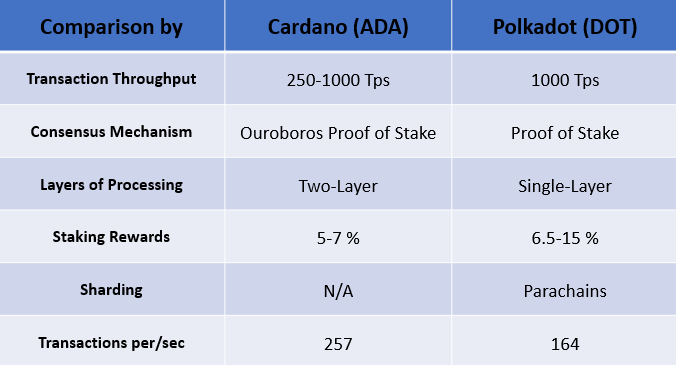
    Both blockchains work efficiently in areas such as smart contracts and DeFi, using the proof-of-stake consensus mechanism. In this fair comparison, we will evaluate the benefits and advantages of Polkadot and Cardano blockchains over each other.

    Polkadot is a unique blockchain with a multi-chain network thanks to its parachain and relay chains. In order to provide excellent interoperability between independent blockchains, Polkadot acts as an infrastructure in this respect. Working with the nominated proof-of-stake algorithm, the network can process up to 1500 transactions per second. 

    Cardano, like Polkadot, has a structure that supports the interoperability of blockchains but has also turned to other areas. Cardano, nicknamed the Internet of Blockchains, can also process 1500 transactions per second. Cardano uses the delegated proof-of stake-algorithm as the consensus mechanism. Each stakeholder and pool operator has voting power equal to the amount of ADA they stake in the protocol. Cardano, which has a large number of stake pools, thus has a very decentralized chain.

    Blockchain features

    Polkadot has the scalability to effectively run tens of thousands of dApps on its network. In addition to this high scalability, the continuous creation of valuable projects on the network is encouraged by parachain auctions and crowdfunding. Projects with good potential, deemed appropriate by the community, allow the ecosystem to expand step by step.

    Polkadot has a great testnet called Kusama, and dApps can be tested on this network and then launched on Polkadot.

    Focusing on developing countries such as Japan and African countries, Cardano sees every individual living there as a potential user. It develops projects to facilitate access to rights that some people have difficulty accessing, such as education and health.

    Users cannot develop projects to be published on Cardano with the Solidity language and effective SDKs they are used to. The programming language Cardano uses, called Glow, is new and not preferred by any other blockchain.

    Ouroboros, the proof-of-stake algorithm of the Cardano network, was designed by Input Output Hong Kong. The independent company that provides and oversees the development of the network is the Cardano Foundation. The company that tries to encourage governments, businesses, and foundations to adopt Cardano technology is Emurgo. 
    Problems Experienced

    Cardano was marketed as a cryptocurrency-based online casino token in preparation for its launch in 2016. Not mentioning smart contracts, consensus algorithms or blockchain features in its whitepaper at that time, the project introduced that bets could be made using $ADA in an online casino based on the security of blockchain technology.

    In November 2017, a total of more than 500,000 ETH, including 300,000 ETH collected in the Polkadot ICO, was frozen due to a bug in a contract developed by Parity. At that time, this amount was worth 150 million dollars in total.

    Initial Coin Offerings

    The Cardano ICO started on September 1, 2015, and lasted until January 31, 2017 (17 months). An average of $0.0024 per $ADA was paid in the ICO organized by IOHK. The ICO sold 25.92 billion of the total 45 billion ADA supply, raising approximately $62.2 million at the end of the multi-stage event.

    ADA was priced at $1.23 on January 4, 2018, making it the 5th most valuable cryptocurrency in the market. This price is ADA’s ATH before May 2021. ADA reached its top position in the market on May 16, 2021, placing it in 4th place.

    The Polkadot ICO started on October 14, 2017, and lasted until October 27, 2017. An average of $0.29 per DOT was paid in the ICO organized by the Web3 Foundation organization. Polkadot, which first held a public ICO in 2017, then held two private token sales organizations in 2019 and 2020. A total of over $200 million in funds was raised as a result of three token sales events. Approximately 5 million DOT were sold in 2017, 500,000 in 2019, and approximately 345,000 in 2020.

    Polkadot ranked 4th on February 20, 2020, after Bitcoin, Ethereum, and Binance Coin. On the same date, Cardano was in 6th place.

    Both blockchain projects are among the 10 most valuable cryptos by market cap. Like other smart contract platforms, these two platforms will continue to focus on staying up-to-date and actively expanding their ecosystems.

  • Snook Adds BBT-Themed Rooms by Partnering with Unstoppable Domains and LobsterDAO

    Snook Adds BBT-Themed Rooms by Partnering with Unstoppable Domains and LobsterDAO

    Snook (SNK) play to earn blockchain game

    Key takeaways:

    • Snook is a Polygon-based arcade game that has been regularly played by thousands of users every month since April 2022
    • Snook’s partnership with Unstoppable Domains includes setting up exclusive BBT-themed rooms and engaging users in the two communities
    • BBT-themed rooms allow brands to create a virtual environment for their community where they can host tournaments and events
    • BBT-themed rooms are only accessible to token holders

    Snook (SNK) is a Play-to-Earn (P2E) multiplayer snake arcade game built on the Polygon blockchain. Players try to gain the upper hand against other snakes on the map by controlling their own snakes. Non-fungible tokens (NFTs) in the game serve to unlock special skins and attribute combinations.

    Snook has formed a strategic partnership with Unstoppable Domains to gather a large community for its online multiplayer gaming venture. Unstoppable Domains has a huge crypto community and members coming to Snook from this community have noticeably increased Snook’s user base. Online IO game Snook has now announced BBT Themed rooms for its partners.

    Announced as a result of the partnership with LobsterDAO, BBT Themed rooms are token-gated and branded virtual experiences where the project can interact with their community. In these rooms, brands will be able to host game nights and tournaments with their communities and leverage Snook’s Snake-like game theme to create a branded environment. BBT Themed rooms will host a special game night for LobsterDAO NFT owners. Voting by NFT owners for the game night ended on August 14.

    What Do BBT-Themed Rooms Do?

    The Snook BBT Themed rooms have increased the collaboration potential in the Web3 industry, giving brands the opportunity for many experiences. Brands can design in-game assets highlighting their brands to create a unique virtual environment. Snook has established a gaming model that unlocks the value of performance and skill rather than non-fun games based on clicking and mining.

    Only users with the appropriate token can enter BBT Themed rooms. As a new way for communities to grow, this will not let users without tokens into the room. Community members and token holders will be able to enjoy certain benefits and participate in events in the rooms. Participants will be able to create various tournaments in the BBT Themed room, offer prizes to competitive users and interact with users in the Snook community.

    Collaboration with LobsterDAO and Unstoppable Domains

    As a result of the cooperation with UD, Snook users will be able to log in with their UD and compete with other UD holders in the game. UD users will be able to join a special BBT-themed room where they can play with special Snooks created for the co-brand and earn SNK tokens by incorporating the P2E concept with Pay-Per-Kill mechanics. The partnership with Unstoppable Domains has excited community members. These two partnerships are thought to set new milestones and goals for the Snooks ecosystem.

    This new venture from Snook is a good step forward for the ecosystem and the GameFi industry. Supporting interoperability with multi-chain enhancements, anyone interested in NFTs and blockchain games can take advantage of these BBT-themed rooms to interact with different users and engage closely with their audiences.

    More About Snook

    Snook is a Polygon-based blockchain game that has been played by 5.59k different users in the last month. In Snook, a Snake-like game that rewards players for speed, skill, and determination, the value of NFTs varies based on your skills. The game is basically similar to other IO games and is the first version of such a game that can be played on the blockchain.

  • Celphish Finance, Tezos, and Aave: The DeFi Projects That Will Revert the Effects of The Bear Market

    Celphish Finance, Tezos, and Aave: The DeFi Projects That Will Revert the Effects of The Bear Market

    CoinCheckup data, which many investors closely follow, shows that there has been a decrease in transaction volumes with the recent contractions. In this process which the investors carefully follow, it is stated that the investors who act away from the panicked atmosphere and evaluate the buying windows will profit greatly. Analysts say this crypto crash is more than a bad situation; it is a profitable buying opportunity.

    Celphish Finance (CELP): The Best Opportunity for New Investors in the Market

    It is possible to see that many new investors are included in the market during this period. Crypto learning academies emphasize that new investors should act consciously. In this period, when market trends are highly volatile, most investors continue to include new projects in their portfolios. Although Celphish Finance (CELP) is one of the newest players in the DeFi space, it is cited as one of the most popular projects of this trend.

    Celphish Finance aims to bring innovations in NFT and swap protocol. The ecosystem plans an NFT market using the AMM algorithm within the ecosystem it will create. In this market which will focus on ease of use, it is mentioned that assets can be easily managed even through any smartphone. Likewise, the NFT market is said to be safer than its peers.

    Celphish Finance (CELP) is also working on a token exchange focused on user experience. With the help of this application which will allow the transfer with multi-chain technology in a decentralized manner, it is aimed to offer instant transaction speeds to the investors. Since theCelphish Finance ecosystem is a project focused, especially on new investors, it is predicted to achieve rapid market growth.

    Tezos (XTZ): A Contender to the Giant Carbon-Emitters of the Market

    Blockchain technology consumes a lot of energy to generate massive amounts of carbon emissions. According to Digiconomist estimates, Ethereum, an existing leading-tier blockchain, has the same carbon footprint as Singapore. This is mainly due to Ethereum’s consensus design.

    Tezos (XTZ) is a decentralized blockchain that governs itself by establishing a true digital commonwealth. It does this by facilitating formal verification, a form of mathematical proof that allows for code to be verified by correctly implementing its specification. Tezos’s (XTZ) energy efficiency is one of its key selling points compared to other coins. Its Proof-of-Stake consensus algorithm allows network participants to earn rewards for validating blocks, without expending large amounts of energy. This makes Tezos (XTZ) an attractive option for eco-conscious investors, and helps ensure that its network remains secure and robust over time.

    Aave (AAVE): One of the Most Preferred and Robust Projects in the Market

    Crypto news about the Aave (AAVE) project shows that the project has lost approximately 70% of its value from the last peak reached. But the project with a large investor base does not have much difficulty finding investors in falling markets. The low price of the project, which is already a very serious investor, contributes to the collection of liquidity at this point.

    Aave (AAVE), an altcoin that increased its value 13 times after the decline it experienced in the previous periods, is among one of the most reliable projects in the market. The project, which gained a large community during its debut in a very short time, continues to expand its community daily. Developing as a sustainable model thanks to the improvements made by the users to the ecosystem, Aave (AAVE) is considered one of the most preferred projects of today.

    The crypto crash has affected many projects, but a few have weathered the storm and will come out stronger. Celphish Finance (CELP), Tezos (XTZ),and Aave (AAVE) are three of those projects that you should keep an eye on as they could potentially reverse the effects of the bear market.

    To find out more about Celphish Finance (CELP), visit the following links:

    Presale: https://cel.celphish.io 

    Website: http://celphish.io/

    Telegram: https://t.me/CelphishFinanceOfficial

  • Reitio for the Metaverse: Enabling Frictionless Creation of User-Generated Content

    Reitio for the Metaverse: Enabling Frictionless Creation of User-Generated Content

    Reitio for the Metaverse: Enabling Frictionless Creation of User-Generated Content

    The Metaverse is not and will not ever refer to one company or one virtual world – it will be like describing the World Wide Web as a single webpage, or labelling social media as only Facebook.

    Make no mistake, virtual worlds are not new by any means. Gaming virtual worlds like Grand Theft Auto and World of Warcraft have had their fair share of success – same goes to social virtual worlds like Roblox and Minecraft.

    With that said, what’s truly revolutionary is a state where these virtual worlds could interoperate with each other: a state where virtual items in a particular virtual world could be seamlessly ported to another virtual world (and back); a state where virtual assets are freely composable with one another; and a state where conducting virtual asset transactions, no matter its underlying virtual world, does not involve a centralized gatekeeping intermediary.

    A single webpage is only able of fitting in so much information – but with a network of interconnected webpages, you create the World Wide Web. Similarly, a single virtual world is only capable of hosting so much experience – but with a network of interoperable virtual worlds, you create the Metaverse.

    Towards Metaverse Adoption

    User-generated content (UGC) is the lifeblood of all networked services. Without imbuing users with a free rein to create their own webpages, the World Wide Web would not grow to the degree that it is at right now. Virtual worlds are not an exception: just like how people will not use Facebook or Twitter if their friends or favorite content creators are not there, people will also not visit a virtual world if there isn’t sufficient UGC piquing their interest.

    However, existing 3D editors (e.g: Blender, VoxEdit, etc.) require specialized expertise, such that it locks out ordinary people from the creative process. As a result, there remains a large skill gap to even create one simple 3D asset for use on a single virtual world, let alone across the Metaverse.

    ​

    A thriving UGC base is of paramount importance in order for the Metaverse to become widely adopted. The more people participating in UGC creation, the more UGC will be generated, which attracts more users to virtual worlds (and with it, the Metaverse).

    Reitio: The Metaversal 3D Toolkit for the Masses

    ​

    The root cause to Reitio’s very existence is simple enough: creating even a half-decent 3D asset carries a steep learning curve, which locks out ordinary users from participating in UGC creation – hindering virtual world adoption.

    With this in mind, Reitio is built from the ground up to eliminate the steep learning curve associated with creating a 3D asset, empowering users to create 3D renditions of their own imaginations and bring them to life on their virtual world of choice, instead of getting intimidated before they even started.

    Being a fully web-based solution, Reitio‘s mix-and-match, templates-oriented approach to 3D design ensures that the toolkit is intuitive enough to be picked up by anyone within a few minutes – the Canva for 3D assets.

    Modular 3D Legos, at your Fingertips

    ​

    A Reitio-generated 3D asset is fundamentally made up of templates stacked on top of each other - like Lego blocks. Templates come in different flavors: free default templates are provided in-house by our internal designers, while premium templates are listed by community contributors or our virtual world partners, whereby each instance of usage will subject users to a pay-per-use royalty payment to the template creator.

    The whole design experience is comparable to creating Lego structures: users start by choosing a ‘base’ template, then gradually work their way up - the extent of what defines a “finished” 3D design will ultimately depend on the user itself, just like the extent of what constitutes a “completed” Lego structure will be in the hands of that structure’s builder.

    This design philosophy is what allows Reitio to be extremely user-friendly without sacrificing much of the variability and extensibility offered by more complex fully-fledged 3D editors.

    A Novel Stack Primed to Serve the Next Digital Frontier

    The current landscape imposes a steep learning curve towards ordinary Metaverse participants, such that it locks them out from participating in generating UGCs for the Metaverse.

    Reitio is developed from square one to fill this gap: a codeless, no-download, on-the-web 3D design tool so intuitive that it will only take users no longer than a few minutes to get a hang of it and generate their first Metaverse 3D asset.

    “At the current pace of UGC generation, the Metaverse will never reach the critical mass of users needed for mass adoption,” said Emerson Li, co-founder and CEO of Reitio. “User-generated content is the beating heart of the Metaverse – Reitio will allow anyone, regardless of background or experience, to create their own fully customizable 3D assets and bring them to life on their virtual world of choice across the Metaverse.”

    Be Part of Reitio!

    This article is excerpted from here.

  • Kingdomverse Is Set to Launch After Releasing Its First Mobile Game in Closed Alpha

    Kingdomverse Is Set to Launch After Releasing Its First Mobile Game in Closed Alpha

    Kingdomverse Characters

    Key Takeaways

    • Kingdomverse is set to bridge the metaverse with casual games and an interesting ecosystem of 3D virtual worlds
    • The first mobile game in the Kingdomverse is already released in closed Alpha mode
    • The Kingdomverse will allow players to create and build a community in the metaverse, participate in leisure games to develop the community, and also square up against other communities
    • Kingdomverse will support play-to-earn, NFTs, and staking functionalities among others

    With the release of Defend The Kingdom, Kingdomverse advances further into the metaverse. Before its official launch, a closed Alpha version of this mobile game is now available to everyone in the Monkey Kingdom community.

    As the metaverse evolves, Kingdomverse becomes the first in this field to welcome new users to a unique gaming niche. Beyond casual mobile games, the company creates an ecosystem where fascinating and creative games make up a 3D virtual world. Players can participate in a variety of games with options for play-to-earn in Kingdomverse. The company strongly emphasizes interaction and immersion, making it a force to reckon with in the metaverse.

    Strategic Gaming for Kingdomverse Citizens

    Kingdomverse gamers are expected to play with strategic mindsets. Each player can create a “self-owned Kingdom”, which will serve as their base of operations. With great customization options, these Kingdoms can be used to engage in combat with other players and gain extra rewards. Every Kingdom can also develop into a community as more players can participate by staking NFTs to become citizens. Ultimately, the community will contribute to the development of the Kingdom and its battle with other kingdoms/players.

    Citizens within a community in Kingdomverse can square up in simple mobile games for leisure and community development. Playing these casual games will allow players to unlock in-game resources such as buildings, armour, and other assets that give their Kingdom an advantage over opponents. Every activity and operation in the game has a reason and an incentive, but there is no obligation to explore every option unless the player decides to do so.

    Fascinating and Rewarding Gaming Experience for Citizens of the Metaverse

    The Monkey Kingdom community now has access to a closed Alpha version of the first mobile game in the Kingdomverse. Teams of five heroes will face opponents in PvP or Co-op mode in “Defend The Kingdom” which is a fun tower defence game. Owners of Monkey Legend NFTs can play this game for a chance to earn special rewards and prizes, such as NFT upgrades. In addition, Defend The Kingdom will have a dual-token economy and play-to-earn features when it debuts.

    Looking Ahead

    Commenting on the project, the Chief Strategy Officer of Kingdomverse, Josh Kovac, enthused:

     “Kingdomverse will be the first cross-platform metaverse experience. We are very excited for players to test out the first casual game that will be linked to the wider Kindomverse ecosystem”.

    The Monkey Legend NFT collection will come to life on mobile devices in Defend The Kingdom’s closed Alpha version. It will present a fantastic chance for fans to earn incentives and amazing prizes based on how well they perform during the closed Alpha. Unique cosmetic upgrades for NFTs, physical products, and certified collectables are all available as rewards. Interested parties can learn more about Kindgomverse and what it intends to bring to the metaverse by visiting their website or connecting through their various social media handles like Twitter, Instagram, and Discord.

  • What Are the Advantages of Trading Crypto on Margin Wih Binance?

    What Are the Advantages of Trading Crypto on Margin Wih Binance?

    Key takeaways:

    • Binance Margin is an important tool with a number of features designed to help crypto traders earn additional profit
    • With Binance Margin, traders with limited capital can increase their positions and consequently improve the amount of profit they can make
    • There are two major types of Binance Margin trading, and they offer users options in terms of risk management
    • There are many benefits of Margin trading with Binance, including multi-asset collateral, a variety of trading pairs, as well as a well-secured platform, and a safe trading experience

    Binance is the world’s number-one cryptocurrency exchange with the highest trading volume. The crypto exchange platform, which was launched in 2017, has grown to earn its place as the go-to place for trading cryptocurrencies, holding digital assets, learning how to manage market fluctuations, and earning passive income from crypto, all thanks to its variety of trading tools and strategies. Binance maintains its topmost position because of the variety of products and services it offers to the teeming population of crypto users and investors.

    On Binance, users enjoy multiple trading platforms like P2P, Futures, Spot, and Margin trading.  Binance is a top pick for many crypto traders thanks to its user-friendly platform, low trading fees, zero trading fee on Bitcoin trading pairs, leveraged tokens, high transaction speed, security, and more. The Binance Margin Trading is another feature that has endeared users to the Binance platform.

    What you should know about the Binance Margin

    Binance Margin Trading is a feature on Binance that is used by users to leverage trading accounts and have more cash to trade with than their initial deposit.  Basically, the Binance Margin allows users to borrow extra cash from Binance to increase their positions and stand a chance of earning more.

    To access Binance Margin Trading in a Web browser, users have to hover over the Trade button and click on Margin. On the Binance App, users will need to click on Wallet, and then Margin. Before you start trading on Margin for the first time, you have to answer the quiz questions correctly, which is normally not a big deal. It is basically aimed at acquainting the first-time user with Margin Trading in order to reduce the number of errors and minimize risk too.

    Types of Binance Margin Trading

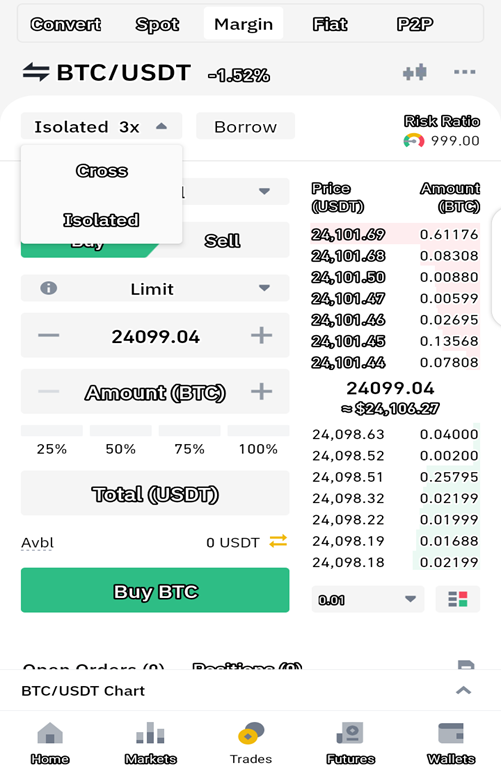
    Binance has two major types of margin trading; the Cross and Isolated Margin. Let’s take a closer look at both types of margin before diving further into the platform’s features.

    Cross Margin

    In Cross Margin, the user’s entire account balance is used for trading. It runs across all trading positions, which comprises the entire money on the trading account and the Spot Wallet. This means that, when the money in the trading account is exhausted, a user who uses Cross Margin automatically gives an authorization that money available in other accounts should be used to fund the trade and keep it going.

    The advantage of Cross Margin is that Profit from one position can be used to support other trading positions that are close to liquidation. It is worthy to note that traders who use Cross Margin stands the risk of losing the entire fund in their account if liquidation occurs. To prevent this, the trader needs to keep adding money to the account when trades are not yielding returns.

    Isolated Margin

    Unlike in Cross Margin trading, the Isolated Margin places a restriction on the funds that can be used to trade and limits it to only funds available in the trading position. This means that when there is no more fund, only the trading positions can be liquidated. The strength of Isolated Margin lies in giving traders the power to manage their risks by restricting them to a particular trading position. This invariably means that in the eventuality of liquidation, only the fund available in that particular trading position will be lost. 

    Features of Binance Margin Trading

    The beauty of Binance margin trading lies in the number of features it offers and its accompanying benefits. Here is a summary of the features of the Binance Margin Trading platform:

    Total Balance

    This is the sum total of all the financial assets in the user’s account, including the initial deposit sum, all the margin given by Binance, and all the trading positions. The amount of profit made influences the movement of the total balance. More profit means an increase in the total balance, and a loss results in a decrease.

    Total Debt

    This refers to the amount of extra cash the customer borrowed from Binance to trade. The total debt changes based on how much money is placed in it. A user can choose to borrow more money from Binance or put in cash.

    Account Equity

    This is the total balance in a customer’s account minus his/her total debt. It is a true reflection of what the customer has as equity in their Binance account.

    Profit and Loss

    This is the amount of gain a user has made or the losses incurred in the course of trading. It keeps you updated with your progress in Binance Margin and can serve as a guide to safe trading.

    Your Margin Level

    The Margin Level is a very important feature represented by a number given by Binance. This number indicates how well or poorly you are faring on Binance Margin Trading. The figure can rise up to 999.00 or drop to as low as 1.3. The higher it is, the lesser risk the account is facing.

    When the Margin Level reduces to 1.3, Binance alerts the user about low funds in his/her account. At that point, Binance cannot keep lending the user more money and may choose to liquidate some of his/her positions to pay back previous debt.  When it gets to 1.1, Binance liquidates all the trading positions and automatically sells them off.  

    Guide on How to Trade using Binance Margin (Entering a Trade)

    To begin trading, there must be money to trade with. The money can be borrowed or moved from the Spot wallet to the trading account. You can, for instance, sell your BTC for USDT, or vice versa, and send the proceeds to the margin wallet.

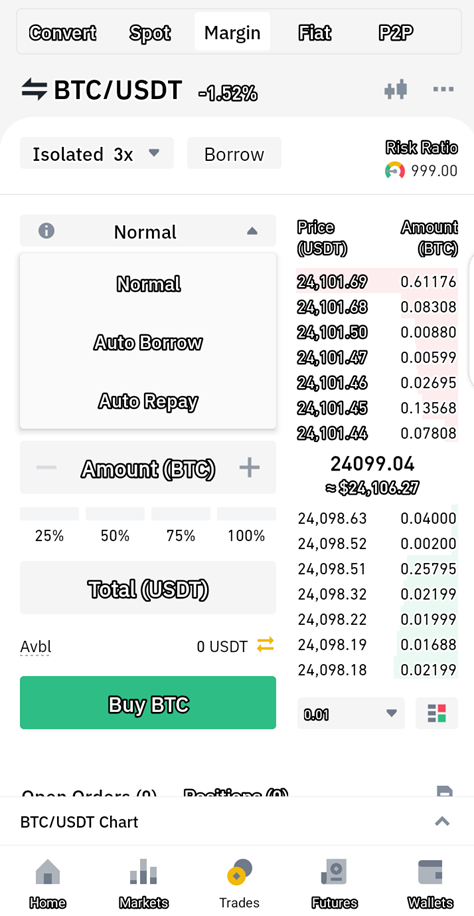
    To begin trading using Binance Margin, choose the type of margin you wish to trade with – either Cross or Isolated Margin. After choosing the coin you want to trade with, proceed by selecting your leverage position and pick a method of trading (Normal, Auto Borrow, Auto Repay). Continue by placing an order and set the Stop Loss and Stop Limit (The Average True Range (ATR) can serve as a guide). After you’ve entered all of the order’s parameters, execute the trade.

    Note on leverage levels: (3x, 5x, 10x, 20x etc) indicate the percentage of fund a user can borrow and the profit or loss it can accrue. 3x means the trader can borrow 2x of the fund to trade with, 5x= 4x, 10x=9x, etc. That means a trader that has $100 in his margin account and chooses 3x leverage can borrow an additional $200 to trade with. This also means that the trader is making 3x profit and vice versa.

    Note on order types (Normal, Auto Borrow and Auto Repay): Normal means you are not trading on Margin. It implies that the user is trading with the money in his/her account. The Borrow feature gives the user the option of borrowing a digital asset to trade with, and this loan can be paid back via the Repay Icon.

    It is recommendable to use the Calculator Icon available on the margin account to have an idea of how the margin will affect the trade before buying.

    The Entry Price indicates the price of the Coin, the Exit Price is the Price where the trader wishes to close the trading position, the Original Amount is the initial deposit the trader, has and the Borrow Amount is the amount the trader borrows from Binance. The Calculator tabulates the Profit and Loss a trader can make if he chooses to trade with a particular Entry Price, Exit Price, Original Amount, and Borrow Amount.  The Calculator does the same calculation for Target Price and Liquidation Price.

    Placing Orders

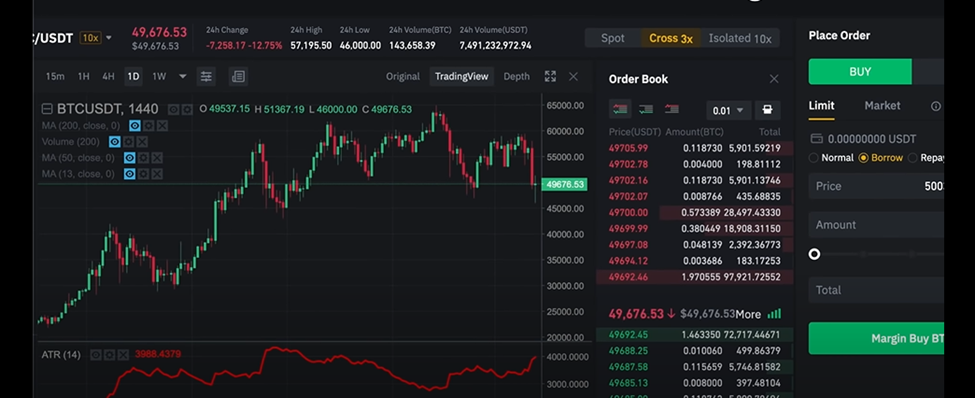
    To place an order, go to margin on your Binance App or web browser and then choose a coin to trade with. Continue by selecting Isolated or Cross Margin. After that, set leverage and click on Long or Short and enter and enter the price of the coin at the time. Click on the amount and input a particular amount of funds you want to trade with, based on a specified risk percentage, then click on Margin Buy. For Example, it could be 2%, 4%, 10% etc. Higher risk means a higher potential profit and vice versa.

    Using the Average True Range (ATR) to set Stop Loss

    The ATR is a technical indicator on the chart that shows how volatile an asset could be. It is used by traders to set Stop Loss (SL).  Every coin has its ATR. For instance, if the ATR for Bitcoin is $2500 and the price of Bitcoin is $50,000, $50,000 minus $2,500 equals $47,500. This implies that if a day trader chooses to use the ATR to set SL, he will place his SL at $47,500.  Below is a picture of the ATR on the chart.

    Stop Loss and Stop Limit

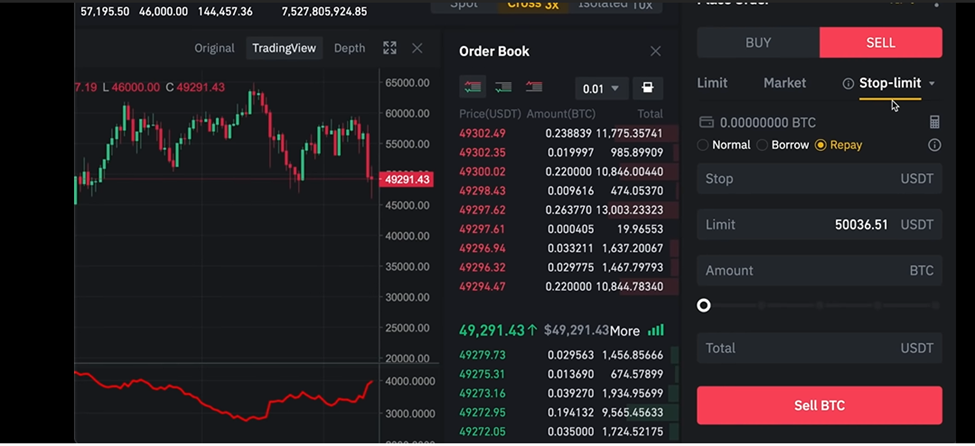
    The Stop Loss and Stop Limit are predetermined automated tools used by traders to control the amount of loss they incur in a trade.  A Stop Loss Order is a command that is used to sell digital assets once it reaches a particular price. For instance, a trader who buys BTC for $49,000 can set a Stop Loss at $48,000 to control the amount of loss he/she can suffer if the price of BTC dips. This market order will be automatically executed once BTC hits $48,000 to prevent further loss.

    A Stop Limit is a feature that refines the Stop Loss, it gives the trader greater control as he can launch an order that buys/sell a digital asset at a particular price or above it, thereby giving a range. The advantage is that traders can enjoy more profit if the price of the coin goes up above a specific price, unlike Stop Loss, where it can only buy/sell at a specific price.

    Setting Stop Loss and Take Profit

    To activate the Stop Loss prompt and automatically take Profit on Binance Margin Trading, go to margin on your Binance App or web browser and choose a coin to trade with. Proceed by selecting the Isolated or Cross Margin method and set your leverage level. Continue by selecting Long or Short options and then click on the Sell tab. Click on Stop and Input price ( for instance, you may choose to use the price of the coin minus the ATR at the moment). Click on the limit and input the desired price. To finalize your order, click on Sell *asset name* (for the purposes of this article, we’ve used BTC).

    Why Should You Use Binance For Margin Trading?

    As mentioned in the introductory part, Binance is one of the biggest and most popular cryptocurrency exchanges in the world. In fact, it is often regarded as the best exchange based on acceptable standards. But why should you rely on Binance for Margin trading?

    Here are some of the most important reasons to use Binance for margin trading:

    • Through lending funds, users who do not have enough money can equally trade and make profits.
    • Binance offers a wide variety of margin trading pairs
    • Binance is well-secured and serves as a safe haven for crypto trading
    • Binance offers relatively low trading fees
    • Binance offers multi-asset collateral
    • Binance permits users to place orders that have a higher value than their capital
    • Binance Margin offers a viable avenue for traders to maximize profit and earn passive income in crypto.

    Rounding Up

    Binance Margin Trading is a unique feature that makes it possible for users to borrow extra cash to trade with and make more profit. It is a great avenue for traders who are limited by capital to take advantage of Binance and make passive income in crypto.

    Binance Margin Trading is one of the top tools offered by Binance. It has enough helpful features for traders who are strategic but have limited funds to trade. Thanks to its Stop Loss and Take Profit feature, it also minimizes risks. 

  • Tornado Cash Was Just The Beginning: What Awaits The Crypto Industry?

    Tornado Cash Was Just The Beginning: What Awaits The Crypto Industry?

    Although this week was fruitful for several major crypto events, there was an undisputed champion, eclipsing everything that had happened recently. On Monday, the Treasury Department sanctioned the crypto mixer Tornado Cash along with other crypto wallet addresses associated with the service. What this meant for the protocol and addresses associated with it is that from now they are blacklisted, making them illegal for American users.

    The significance of this event should not be underestimated, as this is the first time the US government effectively banned software which is arguably neutral by its default settings.

    What started as a matter of national security quickly drew a lot of attention from the crypto community, with many industry specialists condemning the government’s actions. Subsequently, the crypto industry, with DeFi in particular, faced an existential crisis: either remain non-complaint and true to the ideology many crypto aficionados adhere to or sell their soul to the devil and bend the knee. Today’s editorial will discuss what the industry should expect in the upcoming months.

    What Is Tornado and Why It Was Banned

    Tornado essentially represents a privacy tool that enables users to obfuscate where their funds have been and where they’re going. In other words, it turns the transparency of blockchain technology into a black box, concealing users’ crypto activity. The Treasury got so upset with the Tornado software because the Lazarus Group, a hacker group from North Korea, had been using the service to launder stolen Crypto. According to Crypto sleuthing company Elliptic, in total, the Treasury said that the service “has been used to launder more than $7 billion worth of virtual currency since its creation in 2019.”

    Two Sides Of The Coin: The Outburst From The Community

    Many community members argued that the imposed sanctions are not directed against any terrorist organization in particular but rather are an excuse for the government to ban a tool that allows users to protect their privacy while transacting online. Interestingly, even Ethereum’s co-founder Vitalik Buterin admitted that he had used the software (before it was blacklisted) to donate to Ukraine.

    However, the biggest threat to the crypto community comes from the sanctions’ ripple effects, with DeFi taking the major hit. Unfortunately, not everyone is ready to go against the established narrative, with some major crypto projects complying with the Treasury demands on the spot. For example, the DeFi exchange dYdX banned addresses associated with Tornado cash almost immediately. What makes this situation even worse is that dYdX acknowledged that most of these accounts had never been directly engaged with the services but were still banned nonetheless.

    What About Broader DeFi Projects Like Revolutux?

    To answer this question, we must first understand what services Revoloutux (RVLT) provides its users. In its essence, it’s a blockchain platform that unites under a single umbrella DeFi, NFTs and DAO (decentralized autonomous organization). The DAO built around the community would help the project to develop a novel economic infrastructure comprising various tools where users could engage in several crypto activities.

    According to CryptoMode, one feature that makes the project stand out is the Revolutux swap, which would allow users to search for the lowest transaction rates across different decentralized exchanges through the Revolutux platform. Such a practice would effectively combine the benefits of a decentralized and on-chain transaction settlement to make the user experience smooth and without extra hassle.

    So, What Awaits Crypto?

    Despite the desire of the government to ban crypto, no one can block these transactions unless the platform you are using does that. And even then, unless you store your assets on a platform’s wallet, there is little the government can do to prevent you from transferring your assets.

    Considering this, platforms like Revolutux that want to promote users’ right to decentralization and privacy need to choose whether to bend the knee or go rogue. The upcoming month would determine which path the DeFi industry would follow.

    If you are interested to learn more about the Revolutux project visit this website.

    Revolutux (RVLT)

  • DeFi Yield Protocol (DYP) Anticipates Metaverse Platform Launch with Listings on Coinbase, Huobi, and MEXC

    DeFi Yield Protocol (DYP) Anticipates Metaverse Platform Launch with Listings on Coinbase, Huobi, and MEXC

    Bucharest, Romania, 17th August, 2022, Chainwire

    DeFi Yield Protocol (DYP) announced listings on several industry-leading exchanges, including Coinbase, Huobi Global, and MEXC. This is just one of the many developments in the project’s fast-paced evolution, including its upcoming Metaverse platform, where users will get to interact with Cats and Watches Society (CAWS) NFTs. Moreover, DYP took center stage at Deep Forest Fest. During this prestigious music festival, DYPians had the great opportunity of meeting the team.

    The DeFi Yield Protocol (DYP) is enhancing the list of reputable crypto exchanges listing its DYP token. On June 21, Coinbase disclosed its listing of DYP, while trading started the next day. Later, on July 19, MEXC announced its listing of DYP. Lastly, on July 27, it was Huobi that added DYP to its platform.

    DYP supporters, a.k.a. DYPians, can purchase DYP tokens at these major exchanges but also on smaller platforms, including KuCoin, Gate, Poloniex, Bitrue, ZT, Hoo, CoinDCX, and Onus Finance.

    Usually, when an asset obtains listings on new exchanges, its price goes through considerable fluctuations. However, DYP did not experience any notable changes with its recent listings. However, its value surged on June 7 from $0.06 to over $0.20. Furthermore, it has continued to trade above that level for almost two months.

    Nearly a week after the price surge, DYP published a blog post explaining its Metaverse project and virtual reality (VR) play-to-earn (P2E) game. In it, players can venture with their CAWS NFTs, increase their levels, or use their DYP / iDYP tokens for game-related purposes.

    CAWS is an NFT collection of cats-wearing watches that come with the possibility of staking your NFT. Each asset possesses more than 200 unique attributes, including watch preferences and personalities. For the moment, CAWS owners can use their NFT to play a 2D play-to-earn game with attractive rewards for its champions. Players must own at least one CAWS NFT to participate in DYP’s latest GameFi adventure platform. In the near future, the utility of this NFT collection will expand to the Metaverse platform and CAWS will be a companion for the players that own at least one cat in their V.R. adventure. 

    Additionally, DYP is increasing its brand awareness by expanding its actions in the real world. For instance, the project sponsored two racing teams for two different events: Racebox and the Mojo Yachting Club to be more precise.

    Daniel Garrett, Marketing and Communications Manager at DeFi Yield Protocol, stated in an AMA on Monday that DYP’s project is unique due to its wide range of products, including its NFT collection and Metaverse game.

    Also, he elaborated on the project’s plans to onboard more users and reach mainstream adoption by using its Metaverse-related products and launching its IOS and Android apps.

    “In general, as you hear more about DeFi Yield Protocol, as you get more familiar with what we’re doing, I think the users are gonna come,” he said. “We’re focused right now, and this is a great opportunity to get in on something on the ground floor.”

    Another significant development was DYP’s sponsorship of the Deep Forest Fest. The prestigious event boosted the project’s brand awareness and enabled the team to meet some fellow DYPians. Also, it aligned with the project’s philosophy – “Together we can create unforgettable moments. This is what life is all about.”

    About DYP

    DeFi Yield Protocol (DYP) seeks to build a decentralized ecosystem incorporating numerous DeFi products and services, including yield farming, staking, NFTs, and Metaverse gaming. The project runs on unique smart contracts using DYP’s proprietary anti-manipulation functionality.

    To learn more about DYP Protocol and its progress, visit:

    DYP Website| Twitter | Telegram | Discord| Medium

    Contacts
    • Crypto Virally
    • Hello@cryptovirally.com
  • How to Transfer Crypto from Binance US to BTCC?

    How to Transfer Crypto from Binance US to BTCC?

    How to transfer crypto from Binance US to BTCC crypto futures exchange

    Moving cryptocurrency between digital asset trading platforms can provide plenty of upside to crypto traders. For starters, different exchanges offer various trading pairs, trading features, and loyalty perks. In addition, certain trading platforms specialize in specific domains, such as derivatives trading or access to a large number of altcoins.

    The BTCC cryptocurrency exchange is one of the premier destinations for cryptocurrency futures traders. Founded in June 2011, BTCC offers a wide range of crypto derivatives trading tools and a rich selection of USDT-denominated futures contracts. 

    In this article, we are going to take a closer look at the benefits of transferring crypto from Binance US to BTCC and provide a step-by-step guide to depositing digital assets on BTCC from your Binance US account.

    What are the pros of sending crypto from Binance US to BTCC?

    Binance US is the US market-facing arm of the international Binance cryptocurrency exchange. Contrary to its international counterpart, Binance US offers no derivatives trading products and lacks a number of features users of the global platform can take advantage of.

    On the other hand, BTCC is a cryptocurrency exchange that prides itself on providing a top-tier futures trading experience for cryptocurrency investors. Traders are able to capitalize on market movements of popular crypto assets like Bitcoin, Ethereum, Cardano, and others, using daily, weekly, quarterly, and perpetual contracts. Moreover, BTCC allows traders to use up to 150x leverage, for an added layer of exposure to crypto market price movements. 

    Here are the main advantages of using the BTCC cryptocurrency exchange:

    • BTCC is the longest-running cryptocurrency exchange in the sector, with 11 years of uninterrupted service
    • BTCC users can use up to 150x leverage when day trading Bitcoin and Ethereum derivatives
    • The exchange boasts futures contracts with expiration (Daily, Weekly, Quarterly) and no expiration dates (Perpetual)

    Open an account on BTCC

    Registering an account on BTCC is a straightforward process that can be completed in just a couple of clicks. If you wish to open an account on BTCC, please click on the button below.

    BTCC is greeting new users with an exclusive promotion that awards newcomers with up to 3,500 USDT in rewards. The promotion is available to users that fund their BTCC account within 7 days of the initial registration.

    For more information about the signup process and general trading tips, check this helpful blog post published by the BTCC team.

    Deposit crypto to BTCC from Binance US

    In the following step-by-step guide, we are going to demonstrate how you can move crypto from Binance US to the BTCC crypto exchange. If you’ve never done this before, don’t worry – the process is extremely simple and requires no advanced knowledge. Keep in mind that the steps outlined below feature screenshots from the BTCC app. However, the process of depositing crypto to BTCC is virtually the same on desktop.

    Step 1

    After successfully logging into your BTCC account, click on the “Deposit” button located in the Assets menu.

    Step 2

    Continue by choosing your desired deposit currency. For the purposes of this guide, we will be using Tether (USDT), specifically the ERC–20 variant. Keep in mind that selecting the same blockchain network on the deposit and withdrawal platform is paramount. Selecting a different blockchain network can result in a permanent loss of funds.

    Step 3

    Click on the “Copy Address” button to store the blockchain address in the clipboard. If you’ve selected a cryptocurrency that requires additional information to facilitate a transfer, like XRP and its destination tag, copy that information as well.

    Step 4

    Log in to your Binance US account and withdraw the digital asset you wish to move to the BTCC crypto exchange.

    Step 5

    After logging into your Binance US account, click on the “Dashboard” option located in the user drop-down menu in the top right corner of the homepage.

    Step 6 

    By clicking on the arrow (highlighted in red in the image below), you will be able to search through the whole list of supported digital assets on Binance US. For the purposes of this guide, we will be searching for USDT. 

    Step 7

    After you’ve found the crypto asset you wish to deposit to BTCC, click on it. You will be taken to the coin’s dashboard.

    Step 8

    Click on “Withdraw” to commence the withdrawal process.

    width-40

    Step 9

    Enter the amount of cryptocurrency you wish to transfer and enter the corresponding blockchain address (in our case, the USDT deposit address copied from our BTCC account). After filling out other transaction parameters, click on “Preview Withdrawal” to proceed. Confirm your transaction when ready.

    Step 10

    Head back to the Assets menu in the BTCC app and click on the USDT option to open “Transaction Details” to view detailed information about recent transfers. Keep in mind that the speed of transactions can vary depending on the level of network congestion, so you might have to wait a couple of minutes before funds are deposited in your BTCC account.

    Final thoughts

    As you can see, transferring cryptocurrency from Binance US to BTCC is very intuitive and can be done in just a couple of minutes. With the funds successfully deposited in your BTCC account, you can tap into crypto futures markets and take advantage of BTCC’s wide range of derivatives contracts and sophisticated trading tools.

    If you are interested, you can take a look at other similar guides, showing how to transfer crypto to BTCC from FTX US, KuCoin, Coinbase, and Kraken: