Google has integrated a feature that is counting down the hours until the Ethereum Merge
The handy feature can be accessed by searching for Merge-related keywords through the Google search engine
The Merge will likely take place later this week – more precisely, on September 15 at around 11:30 AM (UTC)
Google joins the Ethereum Merge hype
US internet giant Google has rolled out a feature that lets users track the hours and minutes from the Merge, a highly anticipated crypto update that will see Ethereum transition from using Proof-of-Work (PoW) to a Proof-of-Stake (PoS) consensus mechanism.
To try out the new feature, simply use Google to search for “merge”, “ethereum merge”, and similar keywords. You should be greeted with the following panel at the top of Google’s Search Engine Results Page (SERP).
Image source: Google
The countdown currently predicts that the Ethereum Merge will occur on Thursday, September 15 at 11:30 AM UTC. It is worth noting, however, that the actual date could end up being different, due to the constantly changing Terminal Total Difficulty, which acts as a trigger for the Merge.
For reference, both Ethereum developer Tim Beiko and Ethereum co-founder Vital Buterin have recently revealed that the Merge will most likely take place on September 15.
Regular Ethereum users and holders have nothing to worry about the upcoming PoS update, as both the ETH token and regular network operations won’t be impacted in any meaningful way.
The update will change the consensus mechanism that the Ethereum blockchain uses to reach a consensus about the state of the ledger. Also, Ethereum miners will be substituted with validators, who will be responsible for transaction validation and new block production starting with the Merge.
For more information about the Merge, please check our list of top 5 Ethereum Merge myths, or take a look at our latest article from the Coins to Watch series.
The price of Ethereum’s native token improved by more than 12% in the past seven days, hitting a three-week high of $1,807 on Sunday.
Bybit has announced that Oookeenga (OKG) will be the next token on Bybit Launchpool
Bybit Launchpool allows users to earn tokens from up-and-coming projects simply through staking
Ookeenga is a GameFi project that combines elements from the RTS, CCG and tower defense game genres
The Bybit cryptocurrency exchange has announced that OKG, the governance token of GameFi project Ookeenga, will be the next token featured on the Binance Launchpool platform.
Ookeenga is a video game that offers both PvE and PvP game modes to players. In terms of gameplay, Ookeenga combines characteristics from the real-time strategy, collectible card game and tower defense genres. The game leverages non-fungible token (NFT) technology to represent playable items and characters, giving players the opportunity to own and trade their in-game assets freely.
https://youtu.be/B9CNqIplOlA
The Ookeenga ecosystem features two tokens: OKG and KAB. OKG, which has a limited supply, functions as a utility token and also grants its holders the right to participate in governance. KAB does not have a supply cap and functions as a payments token that can be spent on creating new characters, upgrading items and other in-game activities.
OKG, the token that will be featured on Bybit Launchpad, is issued on the BNB Chain blockchain using the BEP-20 standard. Ookeenga players will be able to earn OKG through staking, in-game activities and participation in the governance process. The Ookeenga project says that control of the community treasury, which will hold revenues generated by the Ookeenga platform, will eventually be transferred over to OKG stakers.
BIT holders can now get OKG tokens for free on Bybit Launchpool
Bybit Launchpool is a platform where users can earn tokens from up-and-coming blockchain projects without taking on any significant risks. Users can simply stake their tokens into a pool to earn new tokens, and are free to unstake at any time. After unstaking, the user receives all of their staked tokens back immediately.
At the time of writing, users can stake their BIT tokens to earn OKG on Bybit Launchpad. In total, 4 million OKG will be distributed to stakers in this pool. So far, more than 5.5 million BIT has been staked by over 1,000 users in total. According to Bybit, OKG holders will also be able to stake their tokens at a later point in time to earn additional OKG. A total of 500,000 OKG will be distributed through this pool.
After a few weeks of rather sideways trading, the cryptocurrency market has demonstrated a slight growth in valuation last week. While the total market capitalizations accounted for almost exactly $1 trillion last Sunday, the total valuation of all cryptocurrencies combined stood at almost $1.1 trillion at the beginning of Week 37. Nevertheless, some cryptos exceeded the market average growth of 10%. These include LUNA, LUNC, RVN, HNT and ATOM to mention just a couple currencies that have demonstrated the fastest growth in terms of relative price change throughout last week. To find out which coins could end up dominating the list of gainers for this week, continue reading this article.
3. Nexo (NEXO)
Nexo started out as a centralized lending and borrowing platform that allows people to take out stablecoin loans as well as fiat cash loans by using their crypto holdings as collateral. The platform also offers high yield interest accounts to its users, which acts as the source of liquidity for the platform’s loans. Through its history Nexo kept expanding its range of services, which now also include a cryptocurrency exchange with over 300 trading pairs and a Nexo Card, which allows you to spend your crypto without selling it. Nexo Token is the native cryptocurrency of the ecosystem and the basis of the Nexo loyalty program. Users who hold a larger percentage of their portfolio in NEXO can enjoy reduced trading fees as well as higher interest rates when lending and lower interest rates when borrowing. In addition, Nexo has also committed to buy and burning $50 million worth of Nexo Tokens as part of its most recent Buyback Program.
Nexo introduces Nexo Pro – a centralized cryptocurrency exchange packed with features and liquidity
Last week popular crypto lender Nexo introduced its advanced trading platform called Nexo Pro, which supports limit and market orders, margin trading with up to x5 leverage, as well as Take Profit and Stop Loss functionalities and is fully integrated with other Nexo’s services. In addition, Nexo Pro aggregates liquidity from more than 10 liquidity providers, allowing the platform to offer traders one the most favourable price available on connected markets, one of the tightest spreads and a near-zero slippage. Furthermore, Nexo Pro also offers perpetul futures contracts and API gateways to cater the needs of more advanced crypto traders. To allow users to incur even lower costs while testing out the platform, Nexo has halved the trading fees utnil November 30.
Introducing Nexo Pro – our advanced trading platform.
🔹 Market, limit, stop loss & take profit orders on 400+ pairs 🔹 Margin & futures trades 🔹 Automated TWAP strategies 🔹 Deep liquidity from 10+ venues
Looking at other developments in the crypto lending sector we can see that Nexo is one of the few centralized crypto lenders that has been left relatively unscathed by the bear market. Two of the platform’s major competitors – Celsius and Voyager, recently filed for bankruptcy, while others such as BlockFi are reportedly struggling to keep their businesses alive. Nexo, on the other hand, is holding talks with another struggling crypto lender competitor Vauld.
According to a Vauld spokesman, talks with Nexo are still ongoing. Sources close to the deal are saying that Nexo is conducting its due diligence in relation to the potential acquisition and that the Nexo’s exclusivity period has been extended to October 6. If Nexo ends up buying Vauld, Nexo will restructure Vauld’s operations and focus on growing its market share in the Southeast Asia and India. This could consequently lead to the appreciation of NEXO, which is currently changing hands at a price of $0.98 per token.
2. Terra Classic (LUNC)
Terra blockchain was the basis of the same-named algorithmically governed stablecoin platform that was built using Cosmos technology. The blockchain, which utilized a proof-of-Stake (PoS) consensus mechanism, was developed by a South Korea-based company named Terraform Labs. LUNA, once the reserve currency of the Terra platform started losing its dollar peg on May 10, 2022, which pushed the entire Terra ecosystem into a downward spiral that ended with the halt of the Terra blockchain just 3 days later. Consequently, both UST and LUNA tokens lost almost all their value and became practically worthless overnight. Once Terra blockchain relaunched, the old, failed blockchain was renamed to Terra Classic, and ex-LUNA tokens got a new ticker: LUNC. While the Terra Classic blockchain is operational again, its market cap and activity are still far from the ones seen in the months preceding the collapse. However, the Terra Classic ecosystem is growing again and LUNC is currently 31st largest cryptocurrency by market cap.
The renaissance of LUNC: the token is up by more than 500% in last 3 months
After the collapse of the Terra Classic ecosystem in May, and the subsequent 99.99% drop in the price of LUNC, the token has formed a massive rally over the past three months, gaining more than 500% in the time period. Furthermore, the LUNC price is up by almost 20,000% from its lowest valuation in May 2022. The uptrend could be attributed to the series of upgrades made to the Terra Classic protocol including the recent activation of LUNC staking. The protocol promises stakers whopping (and likely unsustainable) APYs of up to 37.8%, but the majority of investors seem to have learned a lesson this spring as only around 9% of circulating LUNC tokens are currently staked. In addition, a large part of the LUNC appreciation can be explained by the 1.2% burn tax that came into effect on September 1. Every transaction, even wallet and smart contract interactions within the LUNC ecosystem are subjected to the 1.2% tax, whose aim is to reduce the enormous supply of LUNC that was minted during the ecosystem collapse in May and make LUNC a deflationary asset. Last but not least, the Terra governance has recently opened the LUNA airdrop claim portal.
LUNC or other Terra-based asset holders “who either did not receive the correct allocation of LUNA at Genesis due to technical constraints or issues associated with indexing” are now able to claim their rightful share of LUNA tokens. The team will airdrop more than 19 million LUNA tokens, but eligible users need to place a claim through the claim interface that will remain open up until October 4. Some of the liquidity from this airdrop could eventually be chanelled into LUNC providing extra fuel for the already strong rally. Nevertheless, the effects of this will be all but sudden as all airdropped LUNA will be vested over the period of 2 years to avoid the instability in market liquidity.
1. Ethereum (ETH)
Ethereum is an open source blockchain that pioneered smart contract functionality in 2015. The decentralized network operates in a fast, immutable, and trustless manner. Ether (ETH), which is currently the second-largest cryptocurrency by market capitalization, is Ethereum’s native asset. Although it can also be used as a medium for the transfer of value between different Ethereum addresses, it is more commonly used to execute various smart contracts. The Ethereum blockchain has enabled several blockchain-powered innovations, including ICOs, DeFi, NFTs, and DAOs. The Ethereum blockchain also hosts countless ERC20 tokens with different utilities – these include Exchange tokens (OKB, HT, UNI), DeFi tokens (LINK, MKR, COMP, SNX, etc.) and several stablecoins such as USDC, DAI, TUSD, and USDT. As The Merge is right behind the corner, Ethereum is closer to ending the process of transition from Proof-of-Work to a Proof-of-Stake blockchain than it has ever been before.
The Merge is expected to execute between September 13 and September 15
Thanks to Bellatrix, the last Ethereum mainnet upgrade that was successfully deployed on September 6, everything is prepared for the deployment of arguably the single most important update in the history of Ethereum.
After several months of Merge-related hype, the final stage of Ethereum’s transition from Proof-of-Work to Proof-of-Stake will all but certainly take place next week. According to Ethereum co-founder Vitalik Buterin, the Merge mechanism will trigger once the so-called Terminal Total Difficulty (TTD) reaches 58750000000000000000000, which he expects to happen “around September 13 to September 15”. TTD therefore represents the total difficulty required for the final block that will be mined using PoW consensus. While a lot of things will change after the Merge, some metrics such as the network throughput and fee prices will take a bit longer to be affected. You can read more about the Merge and Top 5 Myths about it in one of our recently published articles. The hype before the Merge can also be felt on the markets, as ETH gained almost 14% against USD and is currently changing hands at the price of $1,790. Should the Merge execution go through smoothly a short-term rally is very likely to accompany the event.
Binance has launched Binance Account Bound (BAB) token, a soulbound token storing identity credentials
Every Binance user who completed KYC can mint one BAB token
BAB tokens will allow holders to use certain BNB Chain projects and earn rewards
Only users who have completed KYC verification can mint Binance Account Bound (BAB) token
Binance, the leading crypto exchange in terms of trading volume, announced on Thursday the launch of a soul-bound token called Binance Account Bound (BAB). BAB is a proof-of-identity digital asset that allows Binance users to transfer their identity credentials across different projects on the BNB Chain.
The Binance team described BAB in yesterday’s announcement post:
“Binance Account Bound (BAB) tokens are identity credentials for Binance users who completed KYC verification. It will first be issued on the BNB Chain by Binance. A couple of projects on BNB Chain will be introducing the BAB tokens as identity credentials to their communities.”
Soul-bound tokens have initially been proposed by Ethereum co-founder Vitalik Buterin in January 2022 as a means of building one’s Web3 identity. In theory, a user could store multiple soulbound tokens, with each storing various aspects of personal information, like educational, financial, and other important personal data.
BAB is non-transferable, and every user can mint just one Binance’s soulbound token. In addition, BAB can be revoked at any time, if the user so chooses.
Binance said that BAB holders would be able to participate in building supported BNB Chain projects and receive rewards in the process. The exchange added that further details about supported projects and rewards will be announced by BNB Chain “at a later date.”
American video game and gaming merchandise company GameStop has announced a partnership with the FTX cryptocurrency exchange, which will see GameStop become FTX’s “preferred retail partner” in the United States. The financial implications of the partnership have not been disclosed.
Key takeaways:
According to a press release, the deal between the two companies is centered around introducing “more GameStop customers to FTX’s community and its marketplaces for digital assets.”
As a part of the freshly minted agreement, GameStop and FTX will collaborate on “new e-commerce and online marketing initiatives,” which likely entail non-fungible token (NFT) focused events and promotions.
In addition to marketing and e-commerce initiatives, select GameStop stores will start selling FTX gift cards.
The partnership with crypto giant FTX comes roughly 2 months after GameStop first launched its NFT marketplace, as a sign of a business pivot away from its core offering, which consists of physical gaming items like video games and gaming accessories.
In the past 30 days, the total NFT trading volume on GameStop’s digital collectibles marketplace declined by 66% to $5.41 million, according to DappRadar. The decline is further corroborated by gmft.xyz, which shows trading volume dropped from its daily peak of 672 ETH on July 20, to just 21 ETH on September 7.
Beyond NFTs, GameStop also launched its own crypto wallet earlier this year in hopes of attracting more users to Web3.
Animoca Brands has raised $110 million in a financing round led by Temasek, Boyu Capital, and GGV Capital
The NFT gaming company said the newly acquired capital would be used to fund expansion, new products, and license acquisitions
Animoca Brands’ total capital raised amount has surpassed $770 million
Animoca Brands raises $110M, eyeing potential IPO
NFT gaming company Animoca Brands has announced it raised $110 million in a funding round led by Temasek, Boyu Capital, and GGV Capital. Animoca Brands, known primarily as the creator of the popular metaverse game The Sandbox, said the newly acquired funds would help the company in its ongoing expansion.
“Animoca Brands has grown significantly as a company in the last year, and our new investors will contribute strategic advice and perspective as we build the world’s leading company furthering digital property rights in the Web3 industry,” noted co-founder and executive chairman of Animoca Brands Yat Siu in a statement.
In addition to financing growth, the company is reportedly looking to fund new investments, product development, secure licenses, and promote digital property rights necessary to expand the metaverse.
According to Forbes’ report, the trio of strategic investors will help the company become “pre-IPO ready” – however, the company shared no timeline for the potential initial public offering. It is worth noting that Animoca Brands was previously listed on the Australian Securities Exchange in early 2015, but was delisted in 2020 due to breaching the exchange’s listing rules.
The gaming company’s total capital raised tally has now surpassed $770M
Accounting for the latest $100M+ funds raise, Animoca Brands has now collected over $770 million from venture capital investors since 2019, per Crunchbase data. The massive amount of investment suggests investors see great potential in the NFT and blockchain gaming sector, despite the recent market downturn.
Earlier this year, the NFT company raised $75 million at a $5.9 billion valuation from Liberty City Ventures and other VCs. It is worth noting that Animoca Brands’ market value reportedly stayed the same during the latest financing round as well.
The price of Animoca Brands-owned The Sandbox surged by nearly 7% in the last 24 hours. At press time, SAND is trading at $0.9717, close to its two-week high.
No doubt, the advent of cryptocurrency has changed a lot in our world today especially in the financial sector. Many individuals now trade crypto with ease via a process known as Over-The-Counter Trading or OTC. Over-The-Counter Trading is a financial technology system that permits trading markets outside a conventional exchange platform. In simple terms, with regards to the crypto and bitcoin market, OTC trading is a private trading market for buying or selling cryptocurrency.
Usually, transactions involving OTC trading are not conducted on regular or conventional exchanges, which is why they don’t require a public order book which is why OTC trading provides an increased privacy for both buyers and sellers of cryptocurrency. The anonymity and minimal influence on market prices are the main draws for OTC consumers. The “Whales” who want to purchase or sell a lot of cryptocurrencies are catered to by OTC. These “Whales” would experience significant slippage in their transaction if they were to buy a significant amount of cryptocurrency on an exchange. Due of this, high net worth people seeking to engage in significant trading may find OTC trading to be an attractive choice. More than half of all cryptocurrency trades are thought to be conducted anonymously. Additionally, some believe that OTC trading of cryptocurrency is two to three times more common than trading on traditional exchanges.
How OTC Trading Functions
OTC Traders keep up a network of cryptocurrency buyers and sellers. Larger OTC companies also keep an inventory of several crypto currencies to suit their anticipated demand at any particular time. OTC traders are always aware of who is buying, selling, and the ideal moment to complete a certain transaction. The broker will acquire the cryptocurrency or fiat required to complete the transaction whenever a buy or sell order is received. Trading in cryptocurrencies over the counter (OTC) is gaining popularity all around the world.
OTC Market Size
The daily OTC market was estimated by Bloomberg to be between $250 million and $30 billion in April 2018. When compared to cryptocurrency exchanges, this is almost $15 billion every day. Although, the reported quantities range widely. In April, Bravecoin.com stated that daily OTC volumes were three times more than exchange levels. The OTC market was valued at $12 billion every day by TABB Group and $250 million by Digital Asset Research, respectively. Despite the fact that the market is opaque, it is generally accepted that daily OTC volumes for cryptocurrencies are far higher than exchange-traded volumes. However, claims that cryptocurrency exchanges have been intentionally inflating their declared volumes only serve to complicate matters further.
The Merits of OTC Trading
Order books on cryptocurrency exchanges have little liquidity. Large trade orders can be quickly processed by OTC desks while they look for market liquidity.
Price protection, Anonymity – Moving big orders over the counter (OTC) is a smart way to move bitcoins without affecting the price, for example. Order depth won’t appear as it would on an exchange.
No fiat onramp – there aren’t many crypto exchanges with fiat onramps (though Binance is working on it and already have some solutions in place in Asia).
Prevent price “slippage” – on exchanges, price slippage happens when the executed price differs from the predicted price.
Note: Hedge funds and miners are now the biggest buyers and sellers in OTC Trading. Reddit Rumors stated in October 2018 that hedge firms were purchasing significant amounts of mining equipment from miners. Other features of trading crypto OTC are:
Licensed broker-dealers (on account).
OTC desks for crypto exchanges (on account)
Asia and North America are the regions that are the main propellers of OTC trading.
OTC Trading Types
Dealer, Trader – trade with their own money, or ‘on behalf of’ someone through their own account.
Brokers – an intermediary who finds buyers and sellers.
Exchange OTC desks – crypto exchanges who run OTC desks (servicing clients who don’t want to trade on exchange).
How are the buyers and sellers finding each other?
• Through private, public and broker specific chatrooms:
Broker hosted secure chat rooms.
IRC chatrooms #bitcoin-otc.
Skype chatrooms (hosted by Cumberland).
Telegram.
even LinkedIn (according to Forbes) – six figure trades are common.
• Through OTC Brokers
iTBit OTC.
HiveEx OTC.
How is the off-exchange market executing?
Through OTC brokers like Octagon Strategy, Genesis Trading and Circle.
SFOX also offer advanced software for price discovery and price execution. For example, they can enable top of all order book execution across exchanges, and weight average execution.
The majority of brokers execute based on Request for Quote (RFQ) and ‘Fill or Kill’ (FOK).
What are the problems with OTC?
Settlement risk – there is no guarantee the asset will be delivered, or cash will be paid. Coin transfer often happens much faster than the wire payment transfer (often by several hours).
No custody solution – most OTC brokers don’t provide a custody solution (or provide a very limited service), which can increase settlement and operational risk.
Multi-jurisdictional KYC issues – dealing with countries with poor KYC regulations can be a deal breaker • If you execute through an OTC broker you need, for example, to deliver the BTC to the broker. There is no guarantee the brokers client will pay.
The larger the order the greater the risk of default with multiple counterparties.
OTC crypto is missing the monitoring and surveillance tools of traditional trading systems.
Is emerging software solving these problems?
Fiat onramps are being built.
Fidelity, the world’s fifth largest asset manager, is going to start storing and trading crypto to be sourced from OTC markets for institutional investors.
Software needs to replicate settlement, clearing and risk management systems.
OTCXN – building a multi-custodian solution with a clearing and settlement mechanism that connects Liquidity providers. Creating a Layer 2 network sitting above the public ledger.
OTCXN – partnering with Kingdom Trust and Prime Trust (both registered and qualified Custodians with the SEC).
Caspian – recently raised $20 mill through an ICO. Wants to build a single user interface that connects to major exchanges. Partnering with BC2C.
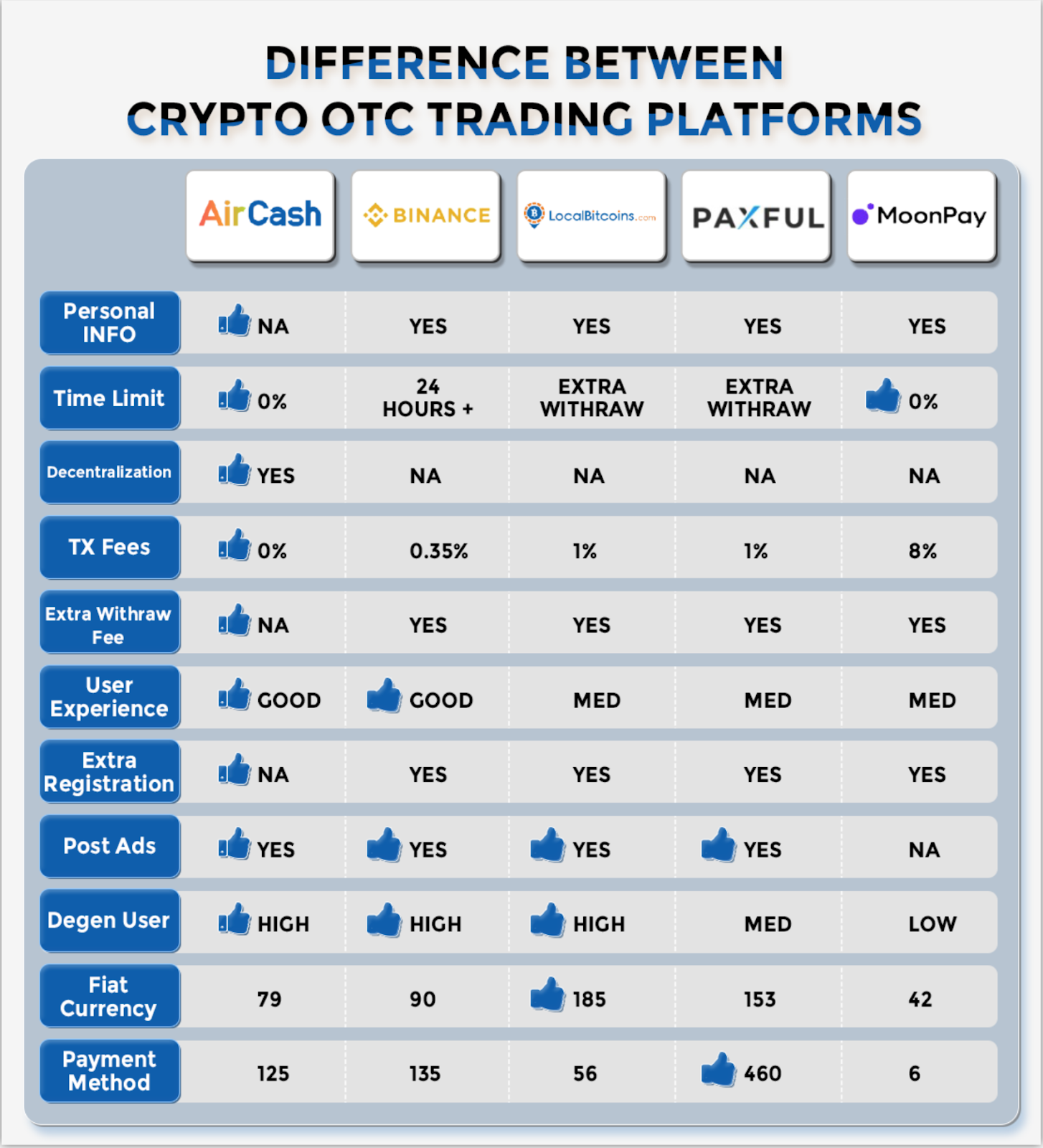
Difference between Crypto OTC Trading Platforms
The Over The Counter (OTC) market is a decentralized cryptocurrency market for unlisted securities that lacks a physical location and instead relies on a network of communication tools like computers, phones, emails, and other devices for direct negotiation between the parties involved in the trade. Because there is no official exchange for trading OTC, it is often referred to as off-exchange trading. Financial commodities like bonds, stocks, currencies, etc. are all primarily traded in the OTC market, regardless of whether the trading takes place between two corporations or financial institutions. In general, OTC is a dealer market that enables the buying and selling of financial commodities in which investors directly contact the dealers who are willing to sell their commodities.
They are the four best crypto OTC trading platforms which are:
AirCash
LocalBitcoins.com
Paxful
MoonPay
1. AirCash
AirCash is a landing application of AIR ecology, and it’s also the most advantageous and relevant trading platform at present because it doesn’t allow extra withdrawal fees like Binance, LocalBitcoins.com, Paxful, and MoonPay. Additionally, Aircash is the world’s first and largest OTC platform. Using this platform, you can buy and sell commodities decentralized without encountering any obstacles or pointless tasks.
One of the intriguing reasons AirCash is preferred to Binance is because identity verification, KYC regulations, and the creation of personal accounts are not relevant. Additionally, it no longer permits personal information, security, and privacy; this creates a reliable environment for traders and investors. However, AirCash supports a P2P trading mechanism, and you are the only one who is aware of the specifics of your trades.
Another important factor making AirCash superior to Binance and other OTC trading platforms is that it does not charge transaction fees, whereas Binance charges 0.38% for all transactions. Using AirCash is preferred if you don’t want OTC platforms to deduct from your assets because your transaction will arrive exactly as planned with no fees or tax deductions. When it comes to decentralization, Binance, localBitcoins.com, Paxful, and MoonPay are not decentralized trading platforms; however, AirCash is. And that’s still another factor favoring AirCash above other OTC trading platforms for the task at hand. As a result, compared to other trading platforms, AirCash has more advantageous features.
Why AirCash Is Better Than Binance, LocalBitcoins.com, Paxful, And MoonPay
Unlike Binance, LocalBitcoins.com, Paxful, and MoonPay, which require a personal account before using their platforms, AirCash does not require one for you to use it. It advocates reliability and privacy more than any other platform.
Transactions on AirCash occur comparatively quicker than on Binance and other trading platforms. As opposed to Binance, which takes 24 hours to display transactions, it does so immediately.
Tax payment fees for AirCash are 0%, while those for Binance, LocalBitcoins.com, Paxful, and MoonPay are 1%, 1%, and 8%, respectively.
Contrary to Binance, Paxful, LocalBitcoins.com, and Moonpay, which prioritized registration, AirCash does not support additional registration.
AirCash is the first, fastest, and largest decentralized OTC platform in the world. Although Binance, LocalBitcoins.com, Paxful, and MoonPay are currently not decentralized, AirCash is a decentralized trading platform.
Unlike Binance and other trading platforms, which impose withdrawal costs before users can access their delivery funds, AirCash does not charge additional withdrawal fees to dealers.
The world is plagued by several challenges that require immediate action. One such example is the state of our oceans. Although the oceans are crucial to the survival of the human species, they have also become one of the most polluted ecosystems on earth.
The truth is that many organizations working to restore the oceans to their natural state and preserve marine life are often hindered by financial difficulties. In comes Big Eyes with a perfect solution to that problem.
Big Eyes intends to create a Defi ecosystem where participants can sustainably make money and contribute to protecting the oceans.
Big Eyes Theme
The project chose the name Big Eyes due to its cat theme. Its avatar is a cat with big cute eyes. However, cuteness isn’t all the Big Eyes project cares about. There are certain values that cats possess are:
Active: Like cats, the Big Eyes team believes the only way for the project to grow is through deliberate actions, and the project will focus on taking these actions to spur growth.
Playful: Cats are fun, and so is Big Eyes. This isn’t your regular Defi project focused only on generating wealth. Big Eyes wants to make the whole process exciting and interactive for participants.
Hard to kill: Big Eyes is here for the long haul, and like cats, the project is built on resilience and perseverance. It can scale, iterate and innovate as the need arises.
Sociable: Big Eyes is all about the community and wants participants to be as active as possible. Decentralization thrives on communication and the exchange of ideas to cultivate trust.
Big Eyes Token
Big Eyes native token has a total supply capped at 200 million. It is the utility token for the ecosystem and will be used to sustain community growth, reward early adopters, and protect the ocean ecosystem.
Big Eyes NFT
The non-fungible token is another aspect of the Big Eyes project. The purpose of the NFTs is to drive the project’s growth faster organically, and its first NFT collection will combine artistic elements with environmental consciousness. Apart from ensuring investment through art, the NFTs will also give holders access to special and exclusive events.
Bitcoin (BTC) Takes A Big Bite
Bitcoin is a decentralized open-source payment network created in 2009 by the pseudonymous Satoshi Nakamoto. The network uses peer-to-peer technology for all transactions and has its own censorship-resistant cryptocurrency.
The goal at the time was for Bitcoin to replace fiat currencies and create an alternative currency. While Bitcoin has been unable to achieve this, its status as the first cryptocurrency has also made it the most valuable.
Although the network is a Proof of Work blockchain and does not exactly have smart contract capabilities, it has qualities that make it superior to all other networks after it.
These include its complete decentralization and the total supply capped at 21 million. The price of Bitcoin has increased significantly over time, going from a dollar in 2011 to over $69,000 in 2021.
As a cryptocurrency, Bitcoin has moved beyond just being another digital token. It is the standard for all cryptocurrencies. Its price movement influences that of others, and it’s usually the first stop for traditional investors looking to get into the crypto scene.
Monkeyballs (MBS) Makes A Move
Monkeyballs is a play-to-earn soccer game based on Solana. It combines elements of Final Fantasy with FIFA Street to create a fun and unique gameplay with monkey avatars. In addition, it combines NFTs and cryptocurrencies.
The Monkeyballs NFTs are the avatar you need to play the game, along with the MonkeyBucks (MBS) token. Each Monkey NFT is unique and comes in different rarities, from common to legendary. Their rarity determines their ability in the game.
Using the Monkey NFTs, users can play and win matches in different modes, such as Player vs. Environment, Player vs. Player, and Team vs. Team. Besides the Monkey players’ NFTs, there are also Stadium NFTs that players can own.
Big Eyes focuses on decentralizing finance to make it accessible to more people while encouraging more people to care about the oceans. The whitepaper provides additional details. Join early to enjoy the benefits.
Sorare has partnered with the NBA for the launch of an official fantasy basketball game
The NFT-powered free-to-play game is slated to release at the start of the 2022-23 NBA season
The deal with the NBA follows a similar deal with the MLB signed in May of this year
Sorare and NBA team up for a new free-to-play NFT basketball game
Sorare, a French startup focused on building NFT-powered fantasy sports games, has inked a deal with the National Basketball Association (NBA), becoming the association’s “Official NFT Fantasy Partner”.
According to a press release published by the NBA on Wednesday, the multi-year deal will result in the launch of a free-to-play fantasy basketball game and NFT-based incentives.
Sorare gives soccer, MLB, and NBA fans the ability to compete in NFT-powered fantasy games. Image source: Sorare
The game’s launch is slated to coincide with the start of the 2022-23 season. Players will be able to compete in virtual leagues, collecting NFT collectibles and earning points based on real-life player and team results.
As a part of the deal, Sorare will be able to utilize official player, team, and other NBA names and logos.
NBA Commissioner Adam Silver had the following to say about the league’s cooperation with Sorare:
“Our partnership with Sorare will give NBA fans an entirely new way to engage with our teams and players. With Sorare’s emerging NFT fantasy platform, we see significant opportunities to broaden our community of fans and grow NBA basketball around the world.”
Sorare’s deal with the NBA follows a similar agreement with the Major League Baseball (MLB) signed earlier this year.
The NFT fantasy games company made headlines last year, when it raised $680 million at a $4.3 billion valuation during its Series B from SoftBank and other prominent investors.