Blog

  • Primex Finance Launches Its Beta Version, Letting Users Experience Its Cross-DEX Trading Features

    Primex Finance Launches Its Beta Version, Letting Users Experience Its Cross-DEX Trading Features

    Kyiv, Ukraine, 13th October, 2022, Chainwire

    Primex Finance, the first-ever cross-chain prime brokerage protocol, launches the Primex Beta on the Ethereum Goerli testnet. The Beta version allows users to experiment with the protocol’s cross-DEX spot margin trading. With the Beta launch, Primex also introduces the new Referral Program for early users, offering benefits to early registrants and referral-based rewards.

    DeFi holds the potential to financially empower investors and traders in ways that were previously unimaginable in the traditional financial world. Despite that, most of the existing DEXs with margin trading features still use centralized trade execution mechanisms and feature a limited number of assets available for margin trading as derivatives.

    Primex decentralizes the trade-execution mechanism to enable a wider variety of actions on DEXs. Instead of centralized order books, all automated trade executions on Primex are carried out by a network of Keepers. Consequently, decentralization can be maintained throughout the entire trading process, from creating an order to closing the position.

    The Beta version of Primex’s protocol introduces key features, such as:

    • Spot trading without leverage: Primex Traders will now be able to use different types of orders—stop loss, take profit, and limit orders—for non-leveraged spot trades in a decentralized manner, facilitating the trade of cryptocurrency pairs without leverage.
    • Primex Splitter: A new mechanism that functions as an aggregation solution that splits up swaps across multiple DEXs and helps users make their trades more efficiently by reducing slippage and finding the best swap rates, without any additional fees.
    • Open Position and Order Modification: Introducing the ability for users to modify the deposit, Take Profit/Stop Loss (TP/SL), limit price, and leverage of open orders.
    • Partial Position Close: Traders now have the ability to partially close an open position. When a position is partially closed, the returned funds are distributed between the Credit Bucket and the Trader, depending on debt size.
    • Spot Orders and Positions Data: Expanded data display to include information about each Trader’s spot orders and positions.
    • WalletConnect Integration: In addition to MetaMask, users can now use WalletConnect, widening the variety of crypto wallets connected to Primex.
    • New DEX Integrations: Primex Beta supports two new DEXs (Curve and Balancer), as well as Uniswap v3 pools with different fees.
    • Bucket Reserves: A new mechanism that automatically moves part of the traders’ fees to the Reserve Pool of each Credit Bucket to insure them against potential losses.
    • Multi-Language Support: The Primex platform is now available in seven more languages to provide access to a more localized and user-friendly experience.

    In addition to the new mechanisms introduced with Primex Beta, the Referral Program offers rewards in exchange for inviting new users to the platform. Connections and referral contributions are automatically tracked utilizing smart contracts to store the data transparently on-chain. Furthermore, the Early User Program grants participation in private challenges for a chance to earn exclusive prizes and access to the Primex private Discord channels. Ultimately, early users can also participate in the Ambassador Program to earn exclusive ambassador-only rewards.

    “We are right on track to fulfilling our mission of defragmenting the DeFi markets via the new prime brokerage protocol that offers users open access to a truly decentralized spot margin trading experience across numerous DEXs and blockchains,” says Vlad Kostanda, Co-Founder and CEO of Primex. ”This new upgrade will enhance how the protocol works while bringing our team one step closer to Primex’s mainnet launch.”

    About Primex Finance
    Ukrainian-led Primex Finance is the cross-chain prime brokerage liquidity protocol for cross-DEX margin trading with trader scoring mechanisms. Lenders will have the flexibility to manage their risks and return by providing liquidity to a variety of risk buckets, subsets of liquidity pools that regulate trader risk strategies. For more information visit https://primex.finance/, or visit the Primex blog.

    Contact

    CMO
    Anton Demenko
    PrimexLabs OÜ
    info@primex.finance

  • Chainalysis: October is Now the Leading Month in the ‘Biggest Year Ever’ for Crypto Hacks

    Chainalysis: October is Now the Leading Month in the ‘Biggest Year Ever’ for Crypto Hacks

    hacker in a hoodie cover image

    Key takeaways:

    • The month of October saw $718 million in hacked funds across 12 different attacks
    • Chainalsys said DeFi hacks had become the most prevalent, while attacks on centralized exchanges were the most frequent in the past
    • 2022 will overtake 2021 as the year with the most hacking activity “at this rate”

    Barely halfway through the month and we’ve already seen 12 different hacks

    While the crypto sector has always had issues with software exploits, which comes with the territory when using nascent technology, the last couple of weeks have been out of the norm. 

    According to blockchain analytics company Chainalysis, it barely took two full weeks for October 2022 to become the month with the most “hacking activity” this year. Driving the point home even further is the fact that Chainalysis didn’t even manage to include the XEN Crypto hack in yesterday’s report. The newly launched crypto was hacked earlier today, with the attacker walking away with 61 ETH.

    So far, last year holds the lead as the biggest on record by the total amount of hacked funds, with more than $3.1 billion across 125 hacks. However, 2022 is within striking distance, having already touched the $3 billion mark.

    Chainalysis highlighted the fact that hacks targeting decentralized finance (DeFi) platforms have become the most prevalent, while three years ago, most attacks focused on centralized exchanges (CEXs):

    “Back in 2019, most hacks targeted centralized exchanges, and prioritizing security went a long way. Now a vast majority of targets are DeFi protocols.”

    Case in point, the most significant share of $718 million in losses accrued during October came from three cross-bridge hacks. Arguably the most high-profile case among them was the $100 million BNB Chain exploit that took place on October 5, forcing Binance Smart Chain (BSC) validators to momentarily halt the blockchain. It is worth noting that the software vulnerability in the cross-chain bridge BSC Token Hub has since been patched thanks to the “Moran” hard fork.

    Another massive exploit occurred on October 12, with $118 million being siphoned from the Solana-based DeFi trading platform Mango. The attacker managed to drastically inflate the price of Mango’s native token, MNGO, and then took out loans against the inflated asset.

    The Chainalys team believes that “at this rate,” 2022 will overtake 2021 in terms of the total amount of hacked funds.

  • BNB Chain Executes Hard Fork Ahead of $574 Million Quarterly BNB Burn

    BNB Chain Executes Hard Fork Ahead of $574 Million Quarterly BNB Burn

    BNB Chain logo cover image

    Key takeaways:

    • Following last week’s $100 million hack, BNB Chain has undergone the Moran hard fork
    • The upgrade patches vulnerability in the BSC Token Hub, which was used by the attacker
    • In related news, the 21st BNB burn took place today, forever removing $574 million worth of BNB from circulation

    “Moran” hard fork goes live following a $100 million hack last week

    On October 6, BNB Chain suffered a massive exploit that impacted more than $560 million worth of digital assets, or roughly 2,000,000 BNB. To prevent any further damage, Binance Smart Chain (BSC) validators momentarily halted the operation of the blockchain. The chain was restarted a few hours later with several hotfixes implemented.

    Yesterday, BNB Chain developers executed the Moran hard fork to establish a more permanent solution and eliminate vulnerabilities in the cross-chain bridge connecting BSC and BNB Beacon Chain, which was used as an attack point in last week’s hack.

    It is worth noting the attacker managed to move roughly $100 million worth of digital assets off-chain, while the renaming funds were frozen before they could be transferred off of BNB Chain. According to devs, the attacker used an exploit in the BSC Token Hub to generate new tokens, rather than stealing existing ones.

    The 21st quarterly burn removes $574 million worth of BNB from circulation

    In related BNB Chain news, the 21st quarterly token burn was completed earlier today, which forever destroyed 2,065,152 BNB (worth roughly $574 million). Binance shared the news via a Twitter post.

    Binance’s scheduled BNB burns, which have recently been revamped to use the automatic Auto-Burn formula, are meant to remove 100,000,000 BNB, or half of the total supply, from circulation. The token burning makes BNB deflationary, which is one of the mechanisms used to maintain its value and provide long-term price stability.

    According to BNBBurn.info, nearly 39,000,000 BNB has been burned to date. The amount of burned tokens is determined by the number of blocks that have been generated on BSC during any given quarter.

    The last quarterly burn of 2022 was significantly bigger than the previous one, both in terms of tokens destroyed and the dollar amount – for context, the 20th token burn saw 1,959,595 BNB (roughly $447M at then-market rates) being sent to a dead wallet address.

  • Uniswap, Chainlink, and Big Eyes Coin Could Make Your Portfolio Surge Amid The Ongoing Bear Market

    Uniswap, Chainlink, and Big Eyes Coin Could Make Your Portfolio Surge Amid The Ongoing Bear Market

    In the summer, when crypto markets crashed alongside the global financial market, it caused an unprecedented chain of events led to the current reality within the cryptocurrency industry. The crash resulted in a bear market, an extended period of extreme market volatility, and negative prices. However, at the time, no one could have known how terrible and detrimental the bear market would be for the cryptocurrency industry. The ongoing bear market has laid siege to the industry over four months, putting a severe strain on its day-to-day activities and affecting the businesses of crypto regulars, such as investors and traders. It is a situation that many analysts are predicting should be over in the coming weeks.

    Within the current climate, struggling crypto regulars have no choice but to seek out different strategies to ensure the continuity of their businesses and prevent further damage. A reasonable solution to explore within the ongoing bear market is long-term cryptocurrency investing, which allows investors to make calculated bets on promising cryptocurrencies over a long period. It is the best way to mitigate the effects of the bear market and ensure that massive returns are plausible.

    To that effect, three cryptocurrencies with enough potential to yield maximum returns, in the long run, are Uniswap (UNI), Chainlink (LINK), and new crypto Big Eyes Coin (BIG) and Investors should be all over them and consider buying into them amid the ongoing bear market.

    Uniswap (UNI) – Proving Solutions to the Masses

    Uniswap (UNI) is a popular decentralized trading protocol that facilitates the automated trading of Decentralized Finance (De-Fi) tokens. After its launch in November 2018, Uniswap (UNI) established itself as an ideal automated market Maker (AMM) platform. It seeks to keep token trading automated and open to anyone possessing crypto tokens. Additionally, it provides workable solutions to several issues within the cryptocurrency industry, such as liquidity concerns and lack of efficiency on exchange platforms.

    Its native cryptocurrency, UNI, is an integral part of its ecosystem. UNI incentivizes the network and facilitates all crypto-related operations, including payment fees, network governance, and user interaction. It is a top twenty cryptocurrency with stock on the most prominent crypto platforms within the industry.

    Chainlink (LINK) – The Popular blockchain

    Chainlink (LINK) is a popular blockchain abstraction layer enabling universally connected smart contracts. It achieves this through a decentralized oracle network. Chainlink (LINK) is a popular blockchain abstraction layer allowing universally connected smart contracts. It achieves this through a decentralized oracle network.

    Its native cryptocurrency, LINK, is integral to all its affairs and is essential to its ecosystem. LINK is a highly sought-after cryptocurrency within the industry with stock on various prominent crypto platforms.

    Introducing Big Eyes Coin (BIG)

    Big Eyes Coin (BIG) is a highly anticipated cryptocurrency that is currently in the fifth stage of its presale. Over the past few weeks, the token has dominated crypto news headlines and has become the subject of excitement and anticipation within the cryptocurrency industry. The new crypto has already raised a whopping $6.85 million, and Big Eyes Coin seeks to champion blockchain technology’s advancement, development, and adoption within global communities.

    As the bear market rages on, Big Eyes Coin (BIG) is emerging as a suitable long-term cryptocurrency investment that struggling investors should consider. The token has the potential for immense growth and is already a valuable asset within the current climate.

    Big Eyes Coin (BIG) has announced that it is giving away bonus tokens when purchasing BIG tokens and using code: EYES2022.

    To access more information on the Big Eyes Coin (BIG), follow the links below:

    Presale: https://buy.bigeyes.space/

    Website: https://bigeyes.space/

    Telegram: https://t.me/BIGEYESOFFICIAL ​

    Disclaimer: This is a sponsored article. The views and opinions presented in this article do not necessarily reflect the views of CoinCheckup. The content of this article should not be considered as investment advice. Always do your own research before deciding to buy, sell or transfer any crypto assets.

  • Boba Network Launches BobaBeam, the First Layer-2 on Moonbeam Blockchain

    Boba Network Launches BobaBeam, the First Layer-2 on Moonbeam Blockchain

    Boba Network Launches First Layer-2 on Moonbeam Blockchain: BobaBeam

    Key highlights:

    • BobaNetwork’s BobaBeam becomes the first live Layer-2 scaling solution in Moonbeam.
    • Hybrid Compute is a feature that enables developers to leverage off-chain data and computing power.
    •  Firefly, a Moonbeam-exclusive derivative DEX, averaged more than 142 transactions per minute during its 4-day testing period.

    Boba Network, the market’s first multi-chain Hybrid Compute and Layer-2 blockchain, deployed the execution layer to Moonbeam to become the first live Layer-2 in the Moonbeam ecosystem. Moonbeam deployment, which includes Firefly, the platform that also offers perpetual swaps as a launch partner dApp, has named the Boba-Moonbeam enabled environment as BobaBeam.

    What is Hybrid Compute?

    Moonbeam, a Polkadot parachain, is a platform for the development of interoperable dApps on Polkadot, Ethereum, Cosmos, and additional smart contract platforms. Hybrid Compute was developed as one of the flagship features of Boba. Bridging the way mainstream Web2 developers can migrate to Web3, the platform is designed to enhance the functionality of smart contracts.

    Developers can harness the power of off-chain computing and real-world data, accessing this previously unavailable set of Web3 APIs to create interoperable computation layers. All dApp and other projects developed in BobaBeam can benefit from Boba Network’s proprietary Hybrid Compute computing network. 

    BobaBeam will also host Firefly, the derivative DEX exclusive to Moonbeam. Firefly was launched on the highly scalable BobaBeam Layer-2 network to improve transaction efficiency and meet its huge demand for block space. Firefly processed 818,031 transactions by 86,635 unique wallets from 121 different countries during the 4-day test period. This means that an average of more than 142 transactions per minute were processed during the testing period.

    Alan Chiu, CEO and Founder of Enya Labs (formerly Enya.ai) and core contributor to Boba Network, said: 

    “We’re very excited to launch on Moonbeam and achieve this key expansion milestone. Because of this integration we believe Moonbeam now has more firepower to offer developers one of the most scalable and interoperable smart contract environments in the industry. We’re truly honored to work with our starting dApps to drive adoption to our combined networks.”

    Moonbeam founder Derek Yoo echoed Chiu’s sentiments and added that Moonbeam’s vision is to enable devs to combine features from different blockchain to help teams “scale and improve users experiences.” Yoo went on to say:

    “By integrating Boba and Moonbeam, developers now have access to both the scalability and throughput that Boba provides, combined with the interoperability that Moonbeam natively supports.”

    More about Moonbeam

    Moonbeam is a smart contract platform that makes it possible to build dApps with cross-chain synchronized connectivity, providing full accessibility to assets, users, and services across all blockchains. Having managed to combine the useful functions of Ethereum, Polkadot, Cosmos and other blockchains in a single platform, Moonbeam has provided interoperability by developing a solution to the current problem of blockchains.

    Allowing developers to create smart contracts that can access services on different blockchains, with its integrated cross-chain messaging management, Moonbeam has also facilitated application development. Moonbeam’s wide tool support for developers, developer-friendly EVM platform and modern Substrate architecture create a good environment for developing connected applications.

    More about Boba Network

    As a blockchain-enabled Layer-2 scaling solution and Hybrid Compute platform, Boba Network offers up to 60x lower transaction fees and instant transaction processing than Ethereum. 

    Hybrid Compute is enriched with intuitive smart contracts to enable creators and developers to leverage the power of Web2 on-chain. Leveraging real-world data and having off-chain computing capability gives developers a development experience not found on any other platform on the market.

  • Ethereum and Solana Disrupt Venture Capital With Coinbase-Backed DAODAO

    Ethereum and Solana Disrupt Venture Capital With Coinbase-Backed DAODAO

    Los Angeles, CA, 12th October, 2022, Chainwire

    Takeaways:

    • DeSo, a new blockchain that has raised $200 million from Coinbase, Sequoia, and Andreessen Horowitz, just launched DAODAO, a breakthrough cross-chain fundraising platform.
    • DAODAO allows entrepreneurs to launch fundraising rounds with coins immediately tradeable on an on-chain order-book exchange.
    • Founders can raise capital with any currency, including fiat cash, Bitcoin, Ethereum, Solana, DeSo, and USDC, and cash out directly to USDC.
    • Founders can also access on-chain social features such as on-chain end-to-end encrypted messaging & group chats, on-chain profiles, on-chain content, and an on-chain social graph.

    Today, the fundraising process for founders is highly-centralized, with a handful of elite venture capitalists controlling who gets funded and who doesn’t. In addition, founders must typically wait ten years or more for their company to “go public” and become traded on a liquid exchange. But that could soon change as blockchains like DeSo enable founders to raise money from millions of Bitcoin, Ethereum, and Solana users with just the click of a button.

    A new app called DAODAO is launching today at the forefront of this disruptive trend. Built on the DeSo blockchain, backed by Coinbase, Sequoia, Andreessen Horowitz, and others, DAODAO allows any Bitcoin, Ethereum, or Solana user to invest in promising founders before they go to pitch venture capitalists.

    For founders, setting up a fundraiser on DAODAO is as easy as creating a social media account. Funds are automatically converted to USD, and founders can cash out seamlessly to USDC anytime.

    However, the most interesting component of DAODAO is that founders can give contributors a liquid token with their purchase, which can immediately trade on DeSo’s decentralized on-chain gas-less order-book exchange.

    Such a breakthrough raises the question of whether the traditional fundraising model of waiting ten years for a company to trade on the open market could now be obsolete.

    “DeSo is the only blockchain that could support something like DAODAO today,” says Arash Ghaemi, Growth Marketing Lead at DeSo. “DeSo’s recent USDC integration and the MegaSwap swapping facility to convert crypto into USD were both critical, and no other chain has both. On top of that, DeSo’s order-book exchange is the fastest in the world, capable of performing 40,000 matches per second,” he continues.

    DeSo is also capable of supporting unique social features leveraged by DAODAO, including on-chain profiles and an on-chain social graph. “It costs about $75 to store a 200-character Tweet on Ethereum and about fifteen cents to store it on Solana, Avalanche, or Polygon. In contrast, DeSo is one ten-thousandth of a cent, making it the first blockchain capable of disrupting storage-heavy applications like social fundraising. It really is the Social Layer for all web3,” Founder of DeSo Nader Al-Naji adds.
     

    This is the latest in a recent string of successes for DeSo. The platform listed on Coinbase earlier this year announced a groundbreaking MetaMask integration last week that has caused a significant price surge, and many new social apps like Diamond, a web3 social network built on DeSo, have launched and are growing rapidly with a recent surge in user numbers. 

    Recently, the platform announced a USDC integration that has attracted many new builders to the ecosystem, including DAODAO.

    With the launch of DAODAO, DeSo’s true disruptive power becomes apparent. It is a platform that can disrupt social media and the trillion-dollar early-stage financing market.

    About DeSo Foundation

    DeSo is a new layer-1 blockchain built from the ground up to decentralize social media and scale storage-heavy applications to billions of users. They raised $200 million and are backed by Sequoia, Andreessen Horowitz, Coinbase Ventures, Social Capital, Polychain Capital, Winkelvoss Capital, Pantera, and others.

    $DESO, the native currency of the DeSo blockchain, is listed on Coinbase.

    Check out the full roadmap and claim your username on deso.com.

    Contact

    Growth Marketing Lead
    Ash Ghaemi
    DeSo Foundation
    ash@deso.org

  • Big Eyes Coin’s Presale Raises Over $6.5 Million, as it Seeks to Rival Top Gamefi Platforms Apecoin and The Sandbox

    Big Eyes Coin’s Presale Raises Over $6.5 Million, as it Seeks to Rival Top Gamefi Platforms Apecoin and The Sandbox

    Big Eyes Coin

    GameFi networks are notable for their extensive NFT usage, as everything on such platforms is linked to NFTs. Player avatars, gaming tokens, and the interface are designed as NFTs. Hence, tokens like ApeCoin (APE) and The Sandbox (SAND) heavily depend on NFTs to maintain their dominance in the crypto market. A new market entrant, Big Eyes Coin (BIG), will be looking to contend with high-power coins in terms of a well-developed NFT marketplace. Stay tuned as we review these coins and their NFT applications in the cryptocurrency market.

    ApeCoin’s (APE) Journey so far

    ApeCoin (APE) is an Ethereum-based token used by the Bored Ape Yacht Club in their Metaverse space for gaming. The Bored Ape Yacht Club is the largest community of NFT traders worldwide, and they launched APE in 2022 for use within the community.

    The ApeCoin (APE) is used in the gaming protocol to access the NFTs used in the games. It is also used to enter the game modes and upgrade the player avatars. It is on the Ethereum blockchain, which makes it compatible with a wider range of DeFi applications, including DEX and DApps.

    The ApeCoin (APE) user community is completely DAO, meaning they monitor and regulate the platform’s operations. A team of developers is accountable to the community for maintaining and upgrading the token’s protocol. ApeCoin (APE) currently sells for $5.28, and it has declined mainly because of the crypto collapse this year.

    The Sandbox (SAND) – A Gamers’ Paradise

    The Sandbox (SAND) is a franchise developing and launching games for mobile platforms, including Android and iOS. Its decade-long experience has been instrumental in maintaining an excellent gaming industry presence. The company hopes to bring regular gaming to the cryptocurrency market by encouraging blockchain gaming.

    The platform allows users to create, trade, and exchange NFTs in their spaces. The Sandbox features a Metaverse space quite like Decentraland, where users acquire a LAND token as soon as they enter the game. Then, they fit the LAND with their own personalized NFTs.

    The platform allows exploration and interaction between users. The games are located at different points so users can explore or play. The official token is SAND, which is used for transactions on the network and governance token in voting on protocol changes. SAND is listed at $0.87 on various exchange platforms.

    What is Big Eyes Coin (BIG)?

    While Big Eyes Coin (BIG) is not a gaming token, the developers have noted the importance of incorporating NFTs in the token’s roadmap. Keeping the coin sustainable is one of the project’s primary objectives, and having an NFT marketplace will bring more value to the token.

    Big Eyes Coin’s (BIG) presale is in phase three, where the developers outlined the official launch of the NFT marketplace after a release of snippets in phase two. The big news about Big Eyes Coin’s NFT marketplace is that trading NFTs on the platform won’t attract any gas fees. The marketplace will be free for all to transact. This will enable users from other networks to buy and sell NFTs from Big Eyes Coin (BIG). Since they will be trading using BIG, its cryptocurrency price on the cryptocurrency market should boost significantly.

    Big Eyes behind computer

    To aid trading and improve the token’s popularity, the Big Eyes Coin (BIG) development team is looking to launch the coin on swap platforms. A launch on Uniswap (UNI) is already in the works and will soon be announced.

    Big Eyes Coin (BIG) is also interested in noble causes, such as marine life conservation. The developers promise to make periodic donations to charities involved in conserving ocean species, and to this end, they have set aside a wallet with 5% of the 200 billion coins. The donations to such charities will come from the charity wallet.

    Big Eyes Coin’s (BIG) presale is still ongoing. Don’t wait for the prices to spike before you buy them. Click the links below to be a part of the next big crypto project, Big Eyes Coin (BIG).

    Presale: https://buy.bigeyes.space/

    Website: https://bigeyes.space/

    Telegram: https://t.me/BIGEYESOFFICIAL

    As the bear market has been especially unkind to the industry’s biggest and largest cryptos, crypto investors have a unique opportunity to explore. Within the hype and competitiveness in the industry, it is easy for a very good coin to go under the radar.

    Disclaimer: This is a sponsored article. The views and opinions presented in this article do not necessarily reflect the views of CoinCheckup. The content of this article should not be considered as investment advice. Always do your own research before deciding to buy, sell or transfer any crypto assets.

  • JPEX Debuts Crypto-Friendly VISA Debit Card, Thanks to Simplex by Nuvei

    JPEX Debuts Crypto-Friendly VISA Debit Card, Thanks to Simplex by Nuvei

    Licensed crypto exchange JPEX collaborates with Simplex by Nuvei to launch the platform’s very first crypto-friendly VISA debit card to the market. The card’s launch is in line with the crypto exchange’s philosophy of making cryptos accessible and easy for daily use, even in places where cryptocurrencies are not supported.

    VISA Powered for Mainstream Use

    Even after a dozen years of existence and a significant amount of crypto adoption worldwide, the crypto market still lacks a proper acceptance and day-to-day use. The crypto market stands at around a trillion dollars but it still lacks practicality and remains incompatible as there is limited use outside the crypto sphere itself.  Cryptocurrencies can only be spent in limited places and JPEX intends to overcome this barrier. 

    The launch of the crypto-friendly VISA debit card is the perfect solution. Enabling people to spend their digital assets with the simplicity of swiping plastic, crypto enthusiasts will finally have the power to utilize their crypto coins and tokens. JPEX users will be able to liquidate their cryptos to fiat and spend anywhere using the debit card

    The JPEX Card is more than just a debit card to use in daily life. Cardholders will be able to not only liquidate cryptos from their JPEX account to the card but also fund it directly with fiat and buy their favorite assets instantly. Powered by VISA, the card will be accepted wherever the VISA logo is displayed, including e-commerce stores and even for your morning coffee.

    The JPEX crypto VISA cards are set to be shipped out in Q4 2022, but the registration is open for JPEX users based in the EEA and the UK only.

    The Simplex by Nuvei Factor

    When it comes to bringing crypto to the masses, JPEX has become a prominent player in this aspect, thanks to its collaboration with Simplex by Nuvei, a globally renowned fiat-to-crypto platform.

    Simplex by Nuvei is already being used by JPEX. With more than 200 different cryptocurrencies supported, the platform allows anyone to spend a hundred different fiats using debit and credit cards, Apple Pay and bank transfers to get their hands on digital tokens and coins.

    JPEX and Simplex by Nuvei have been working together for a year now, helping crypto newcomers and veterans use their fiat to buy crypto on the exchange, bringing down the barriers and accelerating adoption. With the launch of the VISA-powered debit card, the JPEX team commits more towards not only Simplex by Nuvei and its usability, but also the mission of bringing quality crypto service.

    About JPEX

    JPEX has become a prominent player in the crypto exchange business in the two years of its operations. The platform’ quality services and user-friendly fee structure has propelled it to be a significant service, especially in the Asia-Pacific region.

    The exchange offers a variety of crypto services, such as basic trading, derivatives (crypto futures and functionalized NFTs), and different savings programs for passive income. The exchange also enables on-the-go trading and other services through its mobile app, available on both iOS and Android so that a trader is never far from the exchange and its offerings.

    With multiple licenses in different jurisdictions, JPEX continues to strive for a regulatory-friendly atmosphere for cryptocurrency trading and use. At the same time, it also pushes for innovative ways to enable easy adoption by the masses.

    JPEX is also an active community player, with it being a strong member of the global community. It is a sponsor of different sports and teams, such as Western Sydney Wanderers and MacArthur FC. These sponsorships are also aligned with its mission to promote cryptocurrencies. Highlighting cryptos through sports is the perfect method of raising awareness of digital assets and how these can help the public to gain financial freedom.

  • XEN Crypto Detonated the Crypto Market, Cryptocurrency Trading Platform MEXC Became Its Main Battlefield

    XEN Crypto Detonated the Crypto Market, Cryptocurrency Trading Platform MEXC Became Its Main Battlefield

    MEXC exchange XEN Crypto

    Recently, a project called XEN Crypto suddenly detonated the crypto market. The mint of its token XEN attracted the participation of more than 364,114 wallet addresses and triggered a surge in Ethereum network gas fees for 2 consecutive days, reaching 200wei at one point on October 9. According to Ultrasound data, the ETH burned during the minting process reached 2,271 on October 10, accounting for 19.46% of the total burning of the Ethereum network on October 7.

    ETH burn

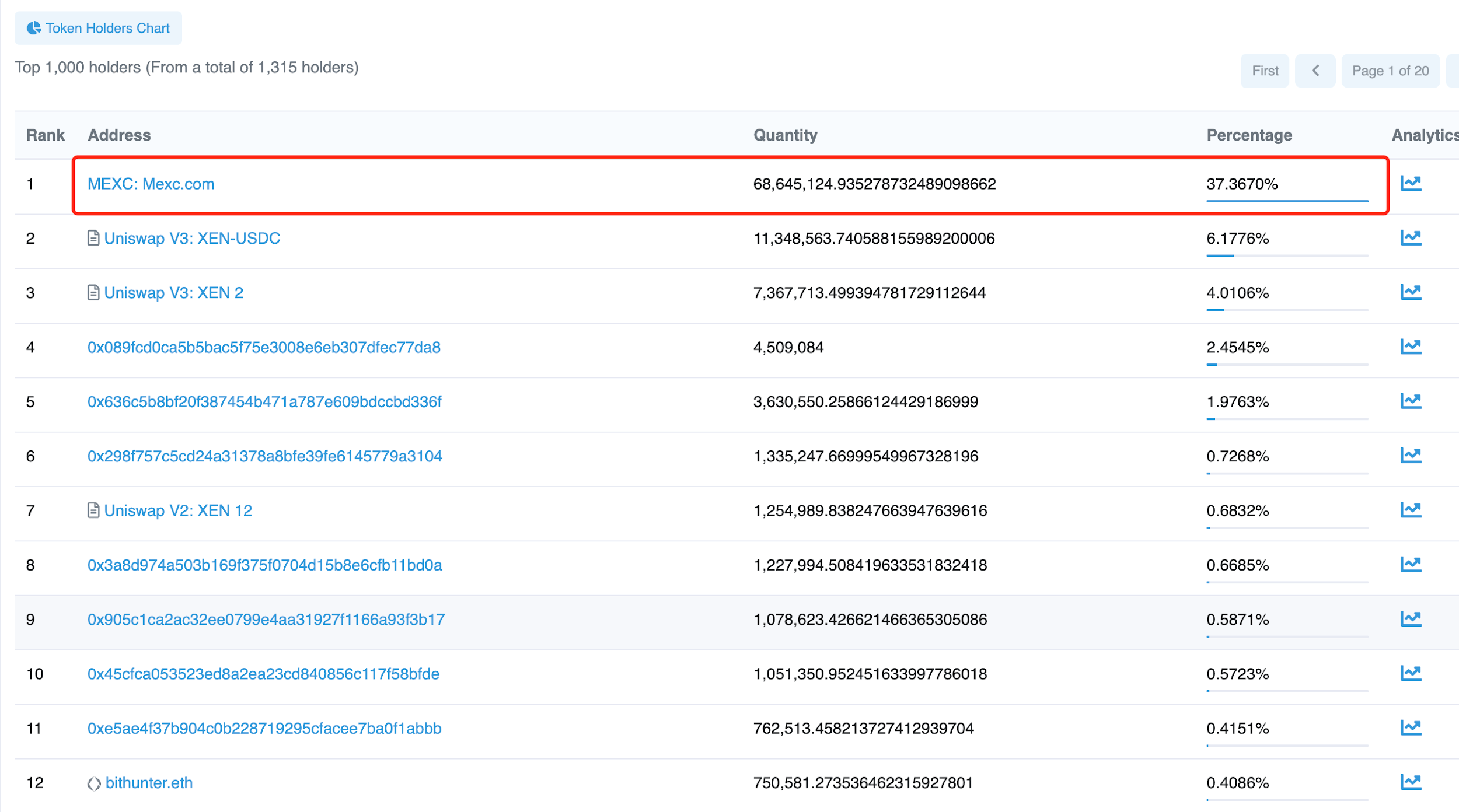
    At present, XEN has first listed on the cryptocurrency trading platform MEXC, at UTC+8 01:45 on Oct 10th. According to the etherscan data of the Ethereum browser, as of October 10, the circulation of XEN in the entire network exceeded 183 million, and more than 68 million were deposited on MEXC, accounting for 37.36% of the current total. MEXC has not only become the most liquid trading platform for XEN in the entire network, but after XEN’s listing, it has risen from 0.0001USDT to a maximum gain of 0.018USDT, with the highest gain of 17900%.

    XEN etherscan

    According to the official information of XEN Crypto, XEN Crypto is a joint virtual mining project based on Proof of Participation. All XEN ecosystem participants can use Ethereum-compatible wallets to mint XEN.

    The participation cost is only about 5USDT, and its token reward model is based on the number of participants and the locking time. XEN participants have the ownership of mining XEN. As the number of participants increases, the difficulty of mining increases. Then as the supply decreases, the locking period increases. The longer the locking period is, the more coins you can get.

    According to the official website of XEN Crypto, the project initiator Jack Levin is an open-source technology expert who claims to be Google’s No. 21 employee (1999-2005).

    Born in St. Petersburg, Russia in 1974, Jack Levin moved to the United States with his family in 1990 to study computer science at the University of Missouri. He played a key role in building the early Google infrastructure, which he is known in the tech industry as a serial entrepreneur building a string of startups and angel investors. He became interested in Bitcoin in 2010, and has been working in the field of encryption so far. Other members of the team include computer science, communications, software and product development, marketing and investment.

    But then some XEN Crypto community members questioned the identity of “Jack Levin Google Employee 21.” Some analysts pointed out that Google’s No. 21 employee is not Jack Levin, but Marissa Mayer, who served as the CEO of Yahoo. However, the person named “Jack Levin” is indeed an early employee of Google, but his LinkedIn has not yet shown Jack Levin’s experience in XEN Crypto, whether he participated in the creation of XEN Crypto, and there is no actual evidence to prove it.