Blog

  • Mina Protocol Ranks #3 as the protocol is set to deploy several important updates in 2023 — Top 3 Coins to Watch for Dec 26 — Jan 1

    Mina Protocol Ranks #3 as the protocol is set to deploy several important updates in 2023 — Top 3 Coins to Watch for Dec 26 — Jan 1

    Mina Protocol Ranks #3 as the protocol is set to deploy several important updates in 2023 — Top 3 Coins to Watch for Dec 26 — Jan 1

    With no major events or market moves taking place last week, the cryptocurrency sector’s total market capitalization has remained rather stagnant, suffering only a minor decrease from $839 billion to $825 billion. It is very likely that we will see the same slightly bearish trend continue until the end of the year as we do not expect major market movements in the forthcoming holiday week. However, if you are looking for some profit in the last week of this year or just want to enter 2023 with a healthy and balanced portfolio, make sure to read this year’s last Top 3 Coins to Watch article!

    3. Mina Protocol (MINA)

    Mina Protocol is a simple blockchain, designed to minimize the system requirements needed to run a full node or interact with the blockchain. The Mina network is merely 22 KB in size, which is why it has been repeatedly dubbed the “lightest blockchain in the world”. 

    In addition, the blockchain size is designed to always stay at 22 KB and not gradually grow as adoption of Mina protocol increases. Despite its minuscule size, Mina maintains a balance between security and decentralization. To achieve that, Mina utilizes Zero-Knowledge Proofs technology (ZK Proofs). Mina started out as Coda Protocol in 2017 but was rebranded into Mina Protocol in October 2020.

    Mina Protocol reveals an ambitious Roadmap update featuring several big improvements in line for deployment in Q1 2023

    Mina Protocol has recently revealed an updated version of the project roadmap, which shows that the team is gearing up to deploy some important upgrades in the first half of 2023. The Mina governance community is going to vote on the proposal that suggest removing supercharged rewards in line with the initial tokenomics plan in the beginning of January. A vote regarding the reduction of the wallet creation fee will soon follow. In addition, the Mina protocol plans to finalize deploying zkBridge (a solution that will make zkApps accessible from Ethereum, and other EVM compatible chains) as well as launch zkOracles and deploy latest version of the On-Chain Voting system in the beginning of 2023. Nevertheless, out placement of Mina on #3 bases on more than just future developments. The project saw several ecosystem developments in the past couple of weeks including the integration of Mina with Ledger and its hardware wallets Nano X and Nano S, which allows MINA holders to securely store their tokens on Ledger devices. 

    Furthermore, the integration also allows MINA from cold storage devices to be staked while holders maintain full control of the wallet private keys, making MINA a perfect crypto for holders who also want to put their assets to work. Not to mention that MINA boasts with APYs above 10% for staking MINA as a validator or delegating MINA to existing validator nodes

    2. Avalanche (AVAX)

    Avalanche is a highly scalable open-source smart-contract enabled blockchain ecosystem. It relies on its own Proof-of-Stake consensus protocols called the Avalanche consensus protocol and the Snowman consensus protocol, which guarantee blockchain immutability while consuming minimal amount of energy at the same time. In addition, Avalanche ecosystem is also highly interoperable – for example Avalanche applications are compatible with Ethereum’s Solidity smart contract programming language and Ethereum-based tokens can be transferred to Avalanche blockchains via Avalanche Bridge. As such it is most often used for various DeFi applications and enterprise blockchain deployments. Every blockchain within Avalanche is part of a subnet, but validators can choose which subnets they want to participate in. Nevertheless, validators are required to be active on the Primary Network, which consists of three blockchains: the Platform chain or P-Chain, the Contract chain or C-Chain and the Exchange chain or X-Chain.

    Avalanche rolled out the Banff 5 upgrade

    On December 22, Avalanche rolled out the Banff 5 upgrade, which introduced Avalanche Warp Messaging (AWM), a feature that enables a fast and reliable communication between all Avalanche Subnets. According to the official Medium post, the first native Subnet-to-Subnet message has been sent soon after the upgrade deployment, on December 22 at 6:42:29 AM UTC (1:42:29 AM ET). The subnet blockchains that exchanged the message were called “let there” and “be messaging”.

    Due to this novel seamless native communications solution, assets or data can be transferred across different subnets. AWM utilizes a cryptographic tool called “BLS multi signatures” to verify messages and data on other subnets, which eliminates the need for the chains to constantly communicate and push data between each other. In addition, individual subnet projects will no longer have to deploy and manage their own bridges to communicate with other subnets. What is more, the feature could be extended to other chains in the future to support cross-chain communication and even cross-chain staking of tokens. The launch of AWM itself, as well as the potential future use cases of this feature, could cause AVAX to appreciate.

    1. BNB (BNB)

    Binance Coin (BNB) started out as an ERC-20 token sold through an initial coin offering (ICO) back in 2017. In April 2019, the Binance rolled-out its native Binance Chain and all the existing Binance Coin ERC-20 tokens were replaced with BNB, which became the native cryptocurrency of the new blockchain. As of today, Binance Chain is still almost completely centralized, with Binance having complete control of block management. Binance gives users who utilize BNB to pay for trading, withdrawal, and listing fees hefty discounts. While this used to be pretty much the only use case of BNB, the coin has a far greater utility now as it allows users to pay for gas fees, earn cashback on Binance Visa card purchases, stake BNB and participate in liquidity pools and other DeFi activities. BNB is also used to determine eligibility to participate in Initial Exchange Offerings (IEOs). Furthermore, the Binance ecosystem is continuously expanding, which means that new products and services are regularly added and many of them give BNB some new utility.

    BNB Chain became the largest Layer 1 blockchain network in terms of unique addresses

    The on-chain data shows that the BNB Chain experienced amazing growth in 2022. The network has witnessed a record-breaking number of transactions, surging as high as 9.8 million transactions in May 2022. In addition, Binance recently announced that the number of unique addresses on BNB Chain crossed 230 million, surpassing the number of addresses on Ethereum. If we judge by this metric, BNB is now the largest Layer 1 blockchain in the world. 

    BNB Chain has met numerous other developmental milestones in 2022. Alvin Kan, director of Growth & Ops at BNB Chain highlighted the launch of BNB Sidechain, zkBNB, Binance Oracle, and security initiatives such as AvengerDAO, among the most important features deployed 2022. A full list of BNB Chain’s milestones of 2022 can be found in this official blog post. Just last week, BNB has integrated with Wyre’s API stack, which gives developers access to Wyre’s entire API stack on BNB Chain as well as the ability to directly list BUSD and BNB. In addition, the BNB team has partnered with Fjord and Balancer to launch Liquidity Bootstrapping Pools (LBPs) on BNB Chain mainnet. If the development of BNB Chain, its features and integrations will continue at such high pace, BNB Chain and BNB have a bright future.

  • How to Deposit NFTs on Binance NFT Marketplace?

    How to Deposit NFTs on Binance NFT Marketplace?

    Binance NFT marketplace

    Binance, a leading cryptocurrency exchange platform, launched its NFT (non-fungible token) marketplace in 2021. The platform has been actively growing its community of NFT enthusiasts, with the ability to support multiple networks and wallets. The Binance NFT marketplace allows users to easily deposit NFTs onto the BNB Smart Chain (BSC) or Ethereum (ETH) blockchains and list them for sale. 

    If you are interested in learning how to deposit NFTs on Binance, we encourage you to follow our step-by-step guide. The process is simple, quick, and accessible even for those new to the world of NFTs.

    How can I deposit my NFTs on Binance NFT Marketplace?

    Binance operates a bustling NFT marketplace that offers a range of features such as Gaming IGOs, Mystery Boxes, Stats, and Rankings to appeal to NFT collectors. Among the numerous NFT marketplaces currently available, Binance’s all-in-one platform stands out as a popular choice for many collectors.

    In the following sections, we will examine how to deposit NFTs on the Binance NFT Marketplace and address common issues that may arise.

    Step 1: Connect your wallet

    To deposit NFT on Binance, the first thing you need to do is log in to your Binance account. Then you can go to your Profile and click on Collected NFTs from the left menu and click on the Deposit button.

    In the side panel that opens, you must select the wallet option (MetaMask or Wallet Connect) you are using and the blockchain network (BSC or ETH) of the NFT you wish to deposit on Binance. Note that you must have the official wallet extension installed on the browser you are using.

    Once verified, your wallet will be linked to the Binance NFT Marketplace. If you encounter an error message, you can try repeating the above steps.

    How to deposit NFTs to the Binance NFT marketplace

    Step 2: Select NFTs or NFT collections

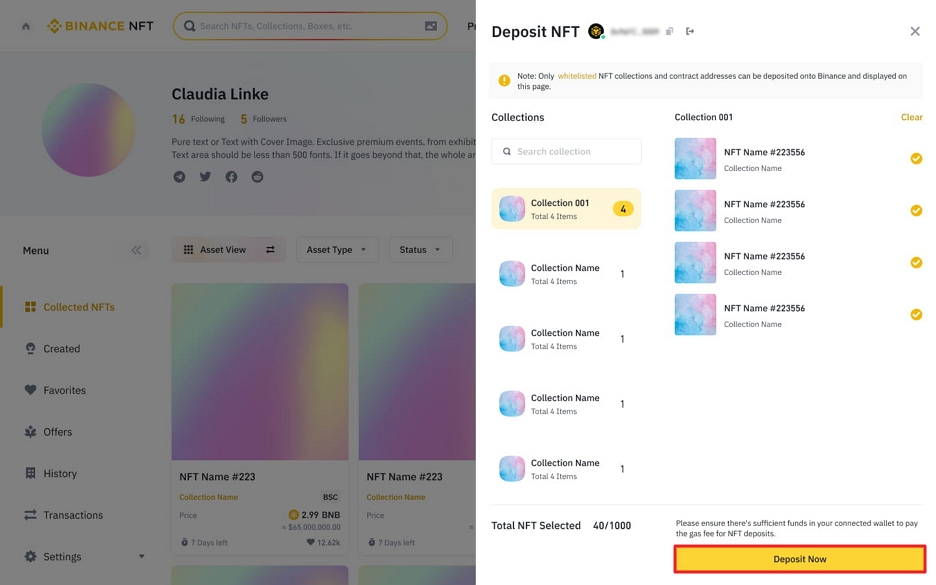
    You are now ready to view the different collections in your wallet and the different NFTs in the collections. You can deposit multiple NFTs on Binance at the same time by choosing the NFTs you want from the collection you want. The search box allows you to search by collection name or NFT code number.

    The NFTs you view in this panel are NFTs from whitelisted collections. If the NFT you want to deposit is not on the white list, you cannot view that NFT in this panel.

    How to deposit NFTs to the Binance NFT marketplace

    After checking the box next to the NFTs you want to deposit, you must approve the deposit separately for each NFT. You will only approve each NFT collection once.

    Step 3: Wait for deposit processing to complete

    After approving the collections of NFTs, you will deposit them on Binance one by one, and you will see a list. In this list, you will find the collection names, the number of NFTs you want to deposit, and green ticks. You will see a red cross if there is a collection that has an error during validation. You can try reapproving the collection or ignore the collection.

    How to deposit NFTs to the Binance NFT marketplace

    Your wallet will ask you to pay a gas fee when confirming collections. This ensures that the transaction is confirmed on the blockchain. The gas fee will likely be between $0.12 and $0.16. You will then pay an additional gas fee of $0.15 to $0.20 to confirm the deposit. After confirming this pop-up and making the payment, your NFT deposit request will be processed and completed in a short time.

    Step 4: With NFTs deposited, you can list them for sale

    You can view your deposited NFTs by going to your Profile page, clicking History from the left navigation bar, and then selecting Deposits from the top. You are now ready to list these NFTs for sale. You can set a price when listing your NFTs for sale, or you can set up an auction that will run for a certain period of time.

    How to deposit NFTs to the Binance NFT marketplace

    Binance charges a very low transaction fee of 1% from NFT sales, as opposed to the market average of 2.5%. This is part of Binance’s mission to provide customers with the best user experience at all times.

    How to withdraw an NFT?

    If you want to withdraw the NFT you have deposited on Binance, you must connect your wallet as in the first step. You can see your NFTs by going to your profile and clicking Collected NFTs on the left navigation bar, and withdraw whatever you want. 

    After reviewing the NFT name, contract address, and destination address, you should confirm the transaction. As with depositing NFT, you also pay some gas fee when withdrawing.

    You can view the NFT you have withdrawn in your MetaMask wallet and in the blockchain explorer.

    Potential reasons for failure of NFT deposit transaction

    Sometimes problems can be encountered when depositing NFTs on the Binance NFT Marketplace. Below are a few tips about the problems that can be encountered, their causes and how to solve them.

    Deposit failed

    If you encounter the error “Deposit failed since the NFT can no longer be found in the current connected wallet”, you should make sure that the NFT you want to deposit to Binance is still in your wallet. If the same NFT is listed on another NFT marketplace and it was sold at the time you wanted to deposit it on Binance, you cannot deposit that NFT on Binance.

    Incorrectly connected wallet

    If you are encountering the “Your crypto wallet is not connected correctly” error, you should try reconnecting your wallet to Binance to resolve the issue. Make sure you are not connected to the wrong wallet or the wrong blockchain network.

    NFTs you want to deposit might not be supported by Binance

    The NFT collection you want to deposit may not be among the NFT collections supported by Binance. Binance NFT Marketplace supports fully integrated NFTs. You can check the contract addresses of the supported NFTs and the contract addresses of the unsupported NFTs by clicking.

    No NFT deposit notification

    If you do not receive a successful NFT deposit notification despite the successful completion of the deposit, you can follow the History and Deposits path to find out the reason for the error. If you think there is a mistake after seeing the reason for the error, you can contact Customer Support and get support by sending the TXID and screenshot.

    The bottom line

    Binance is the meeting point of NFT digital artists, investors, collectors, games, and other diverse communities. Listing your NFTs on the Binance NFT Marketplace creates a good opportunity for people to see and buy it, thanks to advanced NFT filtering features.  In addition to depositing NFTs, Binance allows users to easily create NFT collections and mint NFTs.

  • Paxful Removes Ethereum From Platform as CEO Calls It a ‘Digital Form of Fiat’

    Paxful Removes Ethereum From Platform as CEO Calls It a ‘Digital Form of Fiat’

    Paxful removes Ethereum

    Key takeaways:

    • Paxful removed Ethereum trading features on Thursday
    • The decision was made due to Ethereum’s switch to Proof-of-Stake and a high degree of centralization
    • Paxful has over 9 million users and has been selected as one of the 100 most influential companies of 2022 by TIME

    Paxful CEO says the switch to Proof-of-Stake “rendered ETH essentially a digital form of fiat”

    On Wednesday, Paxful CEO Ray Youssef announced that the Paxful peer-to-peer (P2P) marketplace would be removing Ethereum (ETH) from the platform on December 22nd.

    Youssef said that the decision to remove ETH was made by him personally. The reasons for the surprising decision have been multi-faceted, according to a Twitter post made by the CEO earlier in the week.

    For starters, Youssef argues that Ethereum’s switch to the Proof-of-Stake (PoS) consensus algorithm in September rendered the currency “a digital form of fiat”. He added that Proof-of-Work (PoW) is essential, arguing that this feature makes Bitcoin (BTC) “the only honest money there is.”

    Youssef proceeded to critique Ethereum by saying that it “is not decentralized” and added that the whole network is controlled by a “small group” of individuals.

    Youssef also said that Ethereum is responsible for facilitating the creation of countless tokens that have led to scams that cost users billions of dollars over the years.

    “You have my word as a CEO and as a human being that I will always put purpose before profit. We’re really going to do this brothers and sisters,” wrote Youssef in his ending remarks.

    Paxful is a very popular P2P crypto marketplace, especially among African users. The company was featured on TIME’s list of 100 Most Influential Companies of 2022. In March, the company had more than 9 million users globally.

  • AAG Integrates Coinbase Pay to Enhance Fiat On-ramping Solution For Its MetaOne Wallet

    AAG Integrates Coinbase Pay to Enhance Fiat On-ramping Solution For Its MetaOne Wallet

    AAG Integrates Coinbase Pay to Enhance Fiat On-ramping Solution For Its MetaOne Wallet

    Key takeaways:

    • AAG’s crypto wallet MetaOne Wallet has integrated Coinbase Pay
    • The Coinbase Pay integration will streamline the NFT and crypto onboarding process
    • MetaOne is an easy-to-use blockchain wallet solution designed for Web3 and metaverse purposes

    Fast-growing Web3 infrastructure firm, AAG, announced today its integration with leading cryptocurrency exchange Coinbase Pay to further improve the fiat on-ramping features of its product, MetaOne Wallet.

    AAG Incorporates Coinbase Pay

    According to an official press release, the company revealed that it has tapped the payment feature that enables fiat-crypto transactions on Coinbase to help simplify the onboarding process featured on MetaOne. Apparently, this aligns with its vision to provide the opportunity for crypto novices and amateurs to easily acquire crypto assets and NFTs on the MetaOne Wallet.

    MetaOne is a web3 cryptocurrency wallet that is built specially to provide exclusive use cases for new and experienced users within the crypto space. Being a flagship product of AAG, MetaOne wallet is focused on remediating the most challenging features of the Web3 ecosystem, including security, safety, and efficiency, without compromising convenience. 

    However, new and experienced users of the crypto space can easily explore the Web3 ecosystem, seamlessly acquiring crypto assets and non-fungible tokens through simple fiat payment methods, all thanks to AAG’s integration with Coinbase Pay.

    The CEO of AAG, Jack Vinijtrongjit, commented on this, saying:

    “With the recent situation with FTX, we believe that more and more users will be looking for an alternative option for self-custody. MetaOne, with its unique features, is perfect for those who might not be comfortable with a fully non-custodial wallet.”

    MetaOne is easily adoptable by new and existing crypto users because of its straightforward features. Rather than having to struggle with the complications of private keys and seed phrases, MetaOne deploys the use of n-factor authentication. Thus, it enables a seamless user experience.

    Apart from the convenient crypto purchases via easy-to-use fiat payment options MetaOne Wallet tends to offer, the wallet also allows users to access strings of approved and whitelisted decentralized application features on the platform. These applications are deemed safe and could serve exclusive Web3 and metaverse purposes for MetaOne users.

    While providing users with an all-in-one solution for storing and managing digital assets, MetaOne Wallet also features an automatic asset discovery mechanism. This feature automatically identifies and displays the assets of users on the balance screen without requiring manual intervention. However, its incorporation with Coinbase Pay will further boost its efficiency towards aiding a seamless Web3 journey for users.

  • How to Improve Crypto Trading Results With Binance’s Responsible Trading Features

    How to Improve Crypto Trading Results With Binance’s Responsible Trading Features

    Binance Futures

    Combining the inherent volatility of crypto asset price movements with future price speculations and leverage is a recipe for major portfolio volatility. And that’s exactly what crypto futures entail. 

    While crypto futures do offer the potential for sky-high returns, they also carry inherent risks that can wipe out traders if they don’t practice caution and risk mitigation techniques.

    Binance Futures, being the leading crypto futures trading platform in the industry, offers several ways for traders to limit the risk of ruin and boost their bottom line at the same time.

    In this article, I’ll be going through different responsible trading features available on Binance Futures, and discuss how each of them has helped protect my crypto portfolio over time (mostly by preventing me from doing dumb mistakes).

    What responsible trading features does Binance offer?

    In the following sections, I’ll be examining different features and initiatives Binance offers that are designed to help protect crypto futures traders in various ways. Let’s start with the most basic one: Client-Knowledge Assessments.

    Binance requires users to understand the intricacies of derivatives trading before they can trade futures

    One of the most helpful features – that has certainly saved countless amounts of user dollars over time – is the so-called Client-Knowledge Assessments (CKA). While the name might sound very sophisticated, the features itself is very straightforward. Binance essentially requires users to watch short videos and then complete quizzes that showcase their understanding of Binance Futures and Options. 

    futures quiz on Binance Futures
    A 14-question quiz is designed to test your knowledge about crypto futures. You can’t proceed to the next question until you get the answer right.

    If users fail to answer the questions in the quiz correctly, they must invest more time in educating themselves about the topic. Given how easy it is to make less than optimal or even downright horrid derivatives trades – even among experienced traders – there is no chance that a user not understanding the basics can hope to be anything other than massively unprofitable.

    Anti-Addiction Notice

    In an effort to mitigate the potential negative consequences of impulsive trading behavior, Binance has implemented a range of preventative measures. One such feature are system-generated notifications that are triggered in the event that a trader experiences a prolonged period of losses or a significant financial loss. 

    These notifications – called Anti-Addiction Notices – serve to remind traders of the inherent risks associated with derivatives trading and encourage them to exercise caution in their trading activities.

    It is essential that traders maintain a level of self-awareness and employ strategies to avoid falling into the trap of harmful excesses such as compulsive trading or gambling. By taking a proactive approach to risk management and personal accountability, traders can minimize the likelihood of experiencing negative outcomes and maximize the potential for long-term success in the volatile world of cryptocurrency trading.

    The Anti-Addiction Notices are currently present only on the Binance Options platform. For Futures and Margin traders, Binance uses an even more sophisticated approach, which we’ll discuss in the next section.

    Cooling-off Period

    The Colling-off Period feature allows Futures and Margin traders on Binance to set a temporary trading ban on their accounts for a set period of time, ranging from 1 day to 1 month. During this time, no trades or borrowing of funds can be made. 

    The Cooling-Off Period is a great tool for traders who want to give themselves a break and avoid making hasty decisions that could lead to further losses. Just note that this feature is not available for spot trading on Binance.

    How to turn on the Cooling-off Period feature?

    The process to enable the Colling Period feature is fairly simple. You can access it by heading to the upper right corner of the Futures homepage.

    How to turn on Colling-Off Period on Binance

    You can choose the self-exclusion time period of up to 1 month. The shortest colling-off time period is one day.

    How to turn on Colling-Off Period on Binance

    You’ll have to confirm your decision via a popup. After that, you won’t be able to trade derivatives on Binance for the duration of your self-imposed exclusion rule. 

    How to turn on Colling-Off Period on Binance

    The trading section of the screen will become inaccessible, and its area will be occupied by the Colling-off Period notification. Cooling-Off Period cannot be circumvented once activated.

    Price Protection

    The Price Protection feature on Binance is a valuable tool for traders looking to safeguard their positions against extreme market movements. By enabling this feature, users can set a threshold beyond which their orders will not be executed, providing an additional layer of protection against unforeseen circumstances.

    The threshold for Price Protection is determined on a contract-by-contract basis, taking into account the liquidity and popularity of the underlying assets. For example, popular contracts like BTC/USDT and ETH/USDT may have a threshold of 5%, while less widely traded contracts may have a higher threshold of 10% or more.

    In addition to protecting traders from potential losses due to market fluctuations, Price Protection can also serve as a deterrent against nefarious market manipulation attempts. It is not uncommon for traders with large capital reserves to attempt to artificially move prices in order to trigger stop-loss or take-profit orders for other users. By setting a Price Protection threshold, traders can safeguard their positions against such manipulative tactics and ensure that their orders will only be executed under fair market conditions.

    The Price Protection feature can be turned on under the general preferences located in the top right corner of the Binance Futures trading page (see the How to turn on the Cooling-off Period feature? section for more information.

    Price Protection feature on Binance Futures

    Customized Default Leverage

    In crypto trading, leverage refers to the use of borrowed capital to increase the potential return of an investment. When a trader uses leverage, they are essentially borrowing money from a broker or exchange to trade a larger position than they would be able to with their own capital alone.

    For example, if a trader has $1,000 worth of Bitcoin (BTC) and decides to use 10x leverage, they would be able to trade a position worth $10,000. If the trade is successful and the value of the position increases by 10%, the trader would make a profit of $1,000, which is equivalent to a 100% return on their own capital.

    However, it’s important to note that leverage also increases the risk of loss. If the trade goes against the trader and the value of the position decreases by 10%, the trader would suffer a loss of $1,000, which is equivalent to a 100% loss on their own capital – in this case, the entirety of the Bitcoin position.

    Leverage can be a powerful tool for traders who want to increase their potential returns, but it’s important to use it cautiously and be aware of the increased risk that it brings.

    Binance provides up to 125x leverage for certain trading pairs. If you are uncomfortable with leverage levels as high, you can adjust the default leverage level to something less drastic, like 3x or 5x. This should still give you plenty of room to pursue highly lucrative trades, but keep your portfolio less prone to being wiped out because of a single market swing.

    Take-Profit/ Stop-Loss orders

    Take-profit and stop-loss orders are used to close a trade at a predetermined price, either for a gain or a loss. They allow a trader to exit a position without having to constantly monitor the market. 

    The placement of these orders is often based on the trader’s preferred method of analysis, such as technical indicators or chart patterns. These orders can be used to mitigate risk and protect a trading account. 

    They can also be automatically executed, allowing a trader the flexibility to engage in other activities while a position is open. Take-profit orders are used to close a position for a gain, while stop-loss orders are used to close a position for a loss. 

    How to enable Take-Profit/ Stop-Loss orders on Binance Futures

    Binance allows traders to easily set up take-profit and stop-loss orders while entering a position. Simply select the Stop Limit tab on your trading screen and then enter the “Take Profit” and “Stop Loss” parameters. Your orders will be automatically executed upon the predetermined parameters are met.

    Final thoughts

    Cryptocurrency derivatives trading can be quite addicting, especially when you are on a streak of consecutive profitable trade. Recency bias is quick to take over in such instances, and it’s easy to overestimate your own skill level when the luck and market are on your side. However, staying humble and understanding how slim the margins of error between a profitable and unprofitable trader can be is of utmost importance.

    If there is one thing that traders that have managed to retain their profitability over the long term seem to have in common is their reliance on risk-mitigating techniques. Binance Futures puts these tools at the forefront, so it is up to you to take advantage of them.

  • Binance ETH 2.0: Stake Ethereum and Earn up to 11.2% APR

    Binance ETH 2.0: Stake Ethereum and Earn up to 11.2% APR

    How to stake Ethereum and earn ETH 2.0 staking rewards on Binance

    Staking Ethereum coins is one of the most popular passive-income methods in the crypto industry. As of the middle of December 2022, nearly $20 billion worth of ETH is staked in the Beacon Deposit Contract.

    Sparring technical details, ETH that is stored in the smart contract is used to secure the Ethereum network and verify transactions. Users that stake their ETH receive staking rewards in exchange for their participation. 

    However, there are several caveats when it comes to staking Ethereum as an individual. For starters, there is a 32 ETH requirement and a decent level of computer knowledge needed.

    Binance ETH 2.0 looks to solve that problem by streamlining the Ethereum staking process and lowering the minimum staking requirement to just 0.0001 ETH, making it available to a much broader range of people.

    What makes Ethereum staking possible? Read along.

    Ethereum Merge: How the biggest smart contract platform became 99.95% more efficient

    Ethereum is a decentralized platform that runs smart contracts: applications that run exactly as programmed without any possibility of downtime, censorship, fraud, or third-party interference. These apps run on a custom-built blockchain, an enormously powerful shared global infrastructure that can move value around and represent the ownership of property.

    For the first couple of years after its launch, Ethereum had relied on the Proof-of-Work (PoW) consensus algorithm to secure the network and generate new blocks of the Ethereum blockchain. PoW requires powerful hardware and lots of energy by design.

    Everything changed on September 15, 2022, when the Ethereum network successfully transitioned from PoW to the Proof-of-Stake (PoS) consensus algorithm. Instead of relying on solving complex mathematical problems to verify transactions, PoS allows owners (in this case, ETH) to sake their coins, which gives them the right to validate new blocks of transactions and add them to the blockchain. 

    This allowed the Ethereum network to consume in excess of 99% less energy than before. Ethereum founder Vitalik Buterin estimated that the world’s energy consumption was reduced by an astonishing 0.2% as a result of the transition.

    Many argue that this move – widely known as “The Merge” – was the biggest update in the history of crypto. 

    What comes after the Merge?

    The Merge set up the stage for a series of Ethereum updates that will culminate in a network that is capable of processing up to 100,000 transactions per second (TPS) down the line.

    Following the Merge, the Ethereum upgrade will undergo four major development cycles, including the Surge, which will introduce sharding; the Verge, which will drastically reduce computational requirements; the Purge, which will decrease the hard drive space requirements; and the Splurge, which will enhance security and bring other quality of life improvements.

    The full roadmap will undoubtedly take years to complete. For context, in January 2022, Ethereum founder Vitalik Buterin said that the development was roughly at the halfway point. Following the Merge (now completed) and the Surge, the roadmap will be 80% complete, noted Buterin during a two-hour Bankless podcast episode

    What is Ethereum (ETH) staking?

    Amount of staked Ethereum over the years
    The amount of ETH locked in the Beacon Deposit Contracts throughout the last two years. Source: Ethscan.org

    Ethereum staking is the process of allocating a certain amount of Ethereum (ETH) and using it to help secure the Ethereum blockchain network. When users hold and stake their ETH, they are participating in the Ethereum proof-of-stake consensus mechanism, which allows the network to reach a consensus about the state of the ledger without the need for mining.

    Holders of ETH who participate in staking are rewarded with a share of the transaction fees, also known as staking rewards. This means that by staking their ETH, users can earn a passive income. The amount of staking rewards each user is eligible to receive depends on several factors, including the amount of ETH they are staking, the overall amount of ETH being staked on the network, and the current inflation rate of the network.

    Overall, Ethereum staking allows users to earn a passive income while simultaneously helping to secure the Ethereum network. It is an important part of the Ethereum network and helps to ensure the overall health and stability of the Ethereum blockchain.

    How to stake ETH?

    For the vast majority of users, the requirement of having 32 ETH to become an Ethereum validator can be prohibitively expensive. In addition, setting up and running one’s own node can be a difficult and time-consuming process that requires specialized knowledge and hardware. 

    Staked ETH is locked until Shanghai, the next major Ethereum update, goes live on the mainnnet.

    As an alternative, users can participate in staking pools to earn ETH staking rewards. While staking pools typically offer lower returns than solo staking, they are easier to set up and require a smaller amount of ETH. Popular staking pool services include Lido DAO and Binance Staking, which charge a fee for their services and distribute ETH rewards in the form of STETH and BETH tokens.

    In the following sections, we’ll focus on Binance ETH 2.0 Staking, one of the leading Ethereum staking platforms in the industry.

    How to stake Ethereum and earn ETH 2.0 rewards on Binance?

    The entire process of staking Ethereum on Binance takes just a couple of clicks, making it one of the most accessible solutions in the space. First, you’ll have to make sure that you have ETH funds in your Binance account. If you don’t yet have ETH in the wallet, you can easily buy it through Binance’s spot market offering, or convert existing crypto funds to ETH. You can use the Swap Farming solution to earn BNB rewards when converting crypto.

    With ETH available in your account, we can move on to describing how to stake ETH. Open Binance ETH 2.0 Staking platform to get started.

    Step 1: Log in to your Binance account and open ETH 2.0 Staking

    Log in to your Binance account and open ETH 2.0 Staking

    As mentioned before, you’ll first need to log in to your Binance account. Then, select “ETH 2.0” from the “Earn” drop-down menu. 

    Step 2: Click “Stake Now”

    Click “Stake Now” on Binance Staking homepage to being staking your Ethereum

    From the Binance ETH 2.0 Staking homepage, click on the “Stake Now” button that is located in the top left. A pop-up window will appear. 

    Step 3: Enter the amount of ETH you wish to stake

    Enter the amount of ETH you wish to stake on the Binance ETH 2.0 Staking platform

    Enter the amount of Ethereum you would like to stake. On the right side of the screen, you’ll find the interest distribution date (which is yet unknown), and other relevant information. Click “Confirm” to proceed.

    Keep in mind that the ETH funds allocated for staking will remain locked until the Shanghai update goes live on the Ethereum mainnet. 

    Step 4: Receive a corresponding amount of BETH and start earning Ethereum staking rewards

    Congratulations, you’ve successfully staked your ETH and will begin earning staking rewards shortly. Keep in mind that a corresponding amount of BETH will be deposited to your spot account, at a 1:1 ratio of your staked ETH. 

    The on-chain rewards will be distributed in the form of BETH. BETH can be freely exchanged for other cryptocurrencies in the markets, which means that Binance Staking users benefit from increased liquidity. The entire process of staking ETH, including the mechanics of BETH and the redemption process, is outlined on the Binance ETH 2.0 Staking homepage.

    With that in mind, let’s explore the benefits afforded by BETH and other advantages of the Binance Staking platform in more detail.

    What are the benefits of Binance ETH 2.0 Staking?

    Compared to other platforms and approaches that allow users to earn staking rewards, Binance offers several perks that set its service apart from competitors. These benefits include:

    Retain liquidity through BETH

    BETH is a tokenized representation of ETH that users receive upon staking their Ethereum on Binance. This affords them the opportunity to use the full value of locked ETH and use BETH as they please. After the Shanghai update, BETH will become fully redeemable for ETH, at a 1:1 ratio. 

    Also, BETH can be obtained via spot markets, which means that users can benefit from earning Ethereum staking rewards without actually having to buy and stake ETH.

    Easy to use

    Staking Ethereum on Binance takes only a couple of steps to complete and is incredibly easy to use. In addition, the service provides simple explanations of each step, making it easy for newcomers to understand and participate in the process of staking Ethereum. Also, those who use Binance Staking do not have to worry about taking care of their own security keys, as is the case when staking as an individual user.

    Low ETH requirement

    The low ETH entry requirement is one of the most important benefits of Binance’s staking offering. Since the minimum deposit is just 0.0001 ETH, virtually anyone can afford to use the service.

    Up to 11.2% APR

    With an Annual Percentage Rate (APR) of over 11%, Binance Staking offers one of the highest yearly rewards rates in the Ethereum staking space. Here’s a quick comparison between Binance, and other popular Ethereum staking services in the market.

    BinanceCoinbaseLidoDAO
    Tokenized AssetBETHcbETHSTETH
    APRup to 11.2%up to 6.85%up to 4.8%
    *Data as of December 21, 2022

    In addition to offering exceptionally high rewards, Binance covers all slashing risks, which means that users receive the full share of staking rewards even if there are some problems with transactions validation.

    Final Thoughts – Binance ETH 2.0 Staking 

    It is widely expected that ETH that is staked will get unlocked with the release of the Shanghai update sometime next year. Ethereum devs have recently reached an agreement on the mainnnet rollout for Shanghai and are targeting March 2023 for release, according to the latest reports. It is worth noting that the Merge saw several multi-month delays, so the March release for Shanghai should likely be taken with a grain of salt.

    This is the main reason why solutions like Binance ETH 2.0 Staking, which allow users to leverage the passive income benefits of Ethereum staking, while retaining liquidity via tokenized assets (in Binance’s case, BETH), are becoming increasingly popular recently.

    Other important reasons why users are flocking to services such as Binance Staking are the ease of use and the incredibly low barrier to entry.

    Hopefully, this article helped you understand what Ethereum staking is and how you can start earning ETH 2.0 rewards on Binance.

  • How to Earn Daily Crypto Rewards with Binance Simple Earn?

    How to Earn Daily Crypto Rewards with Binance Simple Earn?

    Binance cover image

    In recent years, cryptocurrency investing has evolved from being an exclusively spot trading practice to featuring a variety of products and services that allow users to pursue additional portfolio growth.

    However, getting familiar with staking, savings, and a variety of decentralized finance (DeFi) practices can be a little daunting, especially for newcomers.

    That’s where Binance Simple Earn comes into play. Binance’s crypto savings platform streamlines passive crypto investments, making them easy to understand and use. 

    In this article, we’ll explore what Simple Earn is and how it works.

    What is Simple Earn?

    Launched earlier this year, Binance Simple Earn is essentially a cryptocurrency savings account service offered by the Binance cryptocurrency exchange that allows users to earn interest on digital assets. In essence, the service allows users to earn passive income on their cryptocurrencies without having to actively trade them. 

    Binance Simple Earn homepage

    Binance Simple Earn offers competitive interest rates and both flexible and locked products, making it an attractive option for users looking to earn an extra return on their digital assets.

    As of the time of writing, which is in the middle of December 2022, there are over 350 Simple Earn products available, covering virtually every popular digital asset in the space.

    Differences between Flexible and Locked Simple Earn products

    The main difference between the two types of Simple Earn products is the duration of the investment. Flexible-term products allow investors to withdraw their funds at any time, while. locked-term products have a fixed investment period, and investors cannot withdraw their funds until the end of the term without parting ways with rewards that have been accrued since the initial subscription had been made.

    NOTE: You’ll lose all rewards accrued if you choose to redeem deposited crypto before the locked period ends.

    As a rule of thumb, flexible-term plans provide a lower rewards rate than their locked-term counterparts.

    How are Simple Earn rewards calculated and distributed?

    The rewards users are eligible to earn for depositing their crypto on Simple Earn are usually higher for locker products than for flexible products. Also, the lengthier the lock period, the higher the rewards. Again, that’s just a rule of thumb, as there are massive differences between various products.

    Simple Earn follows a very simple formula for calculating the rewards:

    Rewards = Your Deposited Assets × APR/365

    In other words, rewards are the sum of deposited assets multiplied by the Annual Percentage Rate (APR) divided by the 365 (the number of days in a year).

    Interest rate on deposited crypto starts accruing at 00:00 UTC on the day after they were initially deposited. The rewards are deposited to a user’s spot account on a subsequent day, between 00:00 and 08:00 UTC.

    How to subscribe to a Simple Earn product?

    We’ve already mentioned that using the Simple Earn platform is quite straightforward. Here’s a step-by-step guide that can help you subscribe to your first Simple Earn plan. For the purposes of this guide, we’ll be subscribing to a locked-term ApeCoin product for the duration of 120 days. 

    Step 1: Open Simple Earn

    Step 1: Open Simple Earn

    First, you’ll need to log in to your Binance account. If you haven’t, you must first register a new Binance account. After that, select “Simple Earn” from the “Earn” drop-down menu,

    Step 2: Search for Simple Earn plans

    Step 2: Search for Simple Earn plans

    You can use the search field at the top of the Simple Earn homepage to find the product that fits your needs. For the purposes of this guide, we’ll be subscribing to an ApeCoin-based locked Simple Earn product for the duration of 120 days. Click “Subscribe” when you’re ready to proceed.

    Step 3: Confirm your Simple Earn subscription

    Step 3: Confirm your Simple Earn subscription

    On the left side, you must enter the “subscription amount” and the duration of your plan. Duration options include Flexible, 10, 30, 60, and 120 days. Keep in mind that different options are available depending on the digital asset used. 

    The “Auto–subscribe” option (located in the bottom left corner) allows users to automatically resubscribe to a product upon its expiration. You can turn the toggle on or off, depending on your preference.

    Once you’ve filled all the required fields, agree to the terms and conditions and click “Confirm”.

    Congratulations, you’ve successfully subscribed to your first Simple Earn product.

    Additional considerations

    Each product has a total subscription cap in order to make the service sustainable in the long term. In addition to the product-wide cap, each product has a per-user subscription cap as well, to ensure that each user has a fair chance at participating.

    Without the individual user caps, wealthier Binance users would be able to take essentially exploit the system, leaving users with smaller portfolios unable to leverage Simple Earn’s high interest rates and daily rewards.

    The bottom line: Make Binance Simple Earn your crypto savings account

    Binance has streamlined its savings offering with the launch of Simple Earn, a single crypto savings solution that combines Flexible Savings, Locked Savings, and Locked Staking products.

    If you are looking to generate passive income with your idle crypto assets, Binance Simple Earn may be the right choice for you. The new offering simplifies the process of earning interest on your crypto holdings, making it easier for investors to take advantage of Binance’s savings products. 

  • B2BinPay Revamps Its Platform with Updated Plans, Website, New Tokens and Merchant Models

    B2BinPay Revamps Its Platform with Updated Plans, Website, New Tokens and Merchant Models

    B2BinPay Revamps Its Platform with Updated Plans, Website, New Tokens and Merchant Models

    B2BinPay has recently unveiled a comprehensive set of changes to its cryptocurrency payment processing solutions, including reduced fees and pricing, updated Enterprise and Merchant Models, as well as other enhancements.

    The company has also revamped its website to provide a more user-friendly experience. Additionally, the platform has seen several upgrades and new features added.

    New Pricing Plans

    The B2BinPay team has improved its pricing plans to provide more value for clients. The Merchant Models now feature revised volume thresholds and percentage tiers, which are reduced as outlined below:

    To make it more cost-effective for Enterprise customers to use B2BinPay’s services, the company has lowered its onboarding fee from $1,500 to $1,000. Additionally, they have modified the threshold of percentage tiers in order to save clients money. Here are the updates:

    No fees are charged for outgoing transactions, making B2BinPay one of the most competitively priced payment providers in the market.

    Improved UI, Expanded Functionality, and the New Website

    The B2BinPay team has completely revamped its website to offer customers more accessible and informative content. Detailing the products and services provided by the company, the newly designed website makes it easier for visitors to learn about what they can expect from the solution. All of this useful information is now available in a much more user-friendly format.

    B2BinPay has created a detailed guide to On-Chain and Off-Chain transactions. On-chain transactions occur on the blockchain, needing confirmation from nodes in the network. Although B2BinPay does not charge any commission for these types of transfers, customers are still required to pay the associated blockchain fees. Through its unique technology, B2BinPay allows for Off-Chain transactions to take place outside of the blockchain. These types of transfers are instant and require fewer costs. Various users can now browse detailed descriptions of the On- and Off-Chain transactions on the website.

    The “Available Currencies” page has made things easier for customers, offering a convenient platform to explore the ever-expanding list of coins with over 80 different currencies. Users can easily search and select the currency of their choice at the click of a button.

    The team has also added an FAQs page to the website. This page provides answers to any questions related to services, functionality, and security measures offered by the company. Visitors can easily find the information they need without having to contact customer service or search through the website.

    The B2BinPay API offers companies a convenient and secure way to incorporate blockchain technology into their payment systems. All the necessary documentation is just a few clicks away, so integration can be done quickly and easily.

    Also, the latest version of B2BinPay includes Merchant Invoice Limits, Delta Amount, Cardano (ADA) support, and various user-friendly optimizations. This makes it simpler than ever for businesses to make use of blockchain technology in their payment systems.

    Addition of New Tokens

    B2BinPay has significantly expanded its range of currencies and tokens available for Merchant and Enterprise clients. Close to 100 new tokens – including WBTC, ANKR, GALA, IMX, and many more – have been added to the selection, granting users access to a wider range of tokens.

    Enhanced Merchant Models

    B2BinPay has reorganized its model structure to better accommodate its clients, now offering three tailored models: Enterprise, Merchant (Fiat Settlement), and Merchant (Crypto Settlement). The last of these options allow users to create virtual wallets that can be denominated in either USDT, USDC, or BTC.

    Conclusion

    B2BinPay is one of the leading platforms for businesses wanting to use cryptocurrency payments, which has seen significant improvements throughout this year. Offering a modern website and superior features, the platform provides customers with competitive fees and pricing models that cater to any size of business.

  • The Argentine Football Association (AFA) Partners with Upland to Expand the Realm of Fandom of the First Division of Argentina to the Metaverse

    The Argentine Football Association (AFA) Partners with Upland to Expand the Realm of Fandom of the First Division of Argentina to the Metaverse

    Upland Welcomes AFA to Metaverse

    Buenos Aires, Argentina, 22nd December, 2022, Chainwire

    -The strategic partnership will allow AFA to engage fans with a better understanding of how the metaverse works, how to contribute and benefit, while also expanding fan engagement and connecting fans to the teams and players they admire 

    -The partnership represents the first Argentinian football presence in the metaverse and the first time for Upland to offer exclusive in-game video footage ownership to fans

    The Argentine Football Association (AFA), FIFA World Cup Qatar 2022™ World Champions, and Uplandme, Inc. the leading metaverse platform in mapping the real world that already has more than 3 million registered accounts, today announced the signing of an official license agreement to bring the First Division Argentina (Professional Football League or short “LPF”) to the Upland metaverse. 

    This strategic partnership will allow AFA and LPF to engage Argentinian fans with the metaverse, contributing to the digital community while benefiting from the extensive participation of the global Argentinian football community, connecting users with their teams and favorite players.

    Not only does Upland connect fans, collectors and players from around the world in a single virtual network, but the open metaverse platform also has various gamified opportunities for users to interact with a complete set of iconic Argentine football digital collectibles including teams, Clubs, Players, Tickets, Gameplay Footage, Historical Moments, Platform Exclusive Moments, and the Official Upland Market.

    This agreement is a further expression of the internationalization of the Argentine Football Association and the reach of the Argentine Professional Football League brand, attracting new fan audiences: global gamers, web3 enthusiasts and collectors of digital assets in virtual markets.

    This deal represents the first presence of Argentine soccer in the metaverse and the first time Upland has offered exclusive ownership of in-game video to its fans. During the next four years, a new source of income will be created for the Argentine Professional Football League, through the acquisition by the user of multiple assets of virtual goods licenses.

    Through this strategic partnership, Argentine soccer fans will gain a unique experience within the metaverse benefiting from a community environment focused on first division football.

    Unique to Upland, fans can start virtual businesses to resell LPF virtual goods and other digital collectibles in player-owned and operated shops located on their virtual properties – including the 22 cities that are already open in Upland. Upland’s agreement with the Argentine Football Association also expands its involvement with global and European football following the recently launched partnership with FIFA, where fans are able to get access to the highlights of the FIFA World CupTM  including the goals of the final as digital collectibles.

    Claudio Fabian Tapia, President of AFA, said: “We are very happy to present this new commercial strategic agreement with Upland. The Argentine Professional League has long awaited opportunities to take advantage of emerging technologies to enhance our League’s fan experience. This agreement allows us to partner with the best creators of technology and new digital products and thus generate a new source of income for all participating clubs. We welcome Upland as a new commercial partner of our Argentine Football Association and the Argentine Professional Football League.”

    Dirk Lueth, Co-founder and Co-CEO of Upland, said: “We are thrilled with the completely loaded licensing agreement and partnership with the AFA to continue to expand Upland’s footprint and community around the world. With AFA, we are able to offer more opportunities than ever before to Argentinian fans new and old, empowering them with the true meaning of web3, which is community-focused and entrepreneurial, allowing fans to contribute ideas and creations to showcase their team pride in engaging new ways.”

    Leandro Petersen, Chief Commercial Marketing Officer of AFA, said: “Upland is at the forefront of a new category of virtual NFT memorabilia. The platform uniquely combines digital collectibles uniting all global NFT markets into their own Metaverse. In this way, our Professional League will be able to get closer to football fans from all over the world and to the players who hope to be closer to the stars of our Argentine football teams every day. We are excited about the potential of this association and it is very important for us to continue generating new sources of income for AFA and the LPF. We continue with the expansion process started and develop digital products that increase the presence of Argentine Soccer in the world. With this agreement with Upland, we are achieving a great goal for the Argentine Professional Football League.

    ABOUT UPLANDME, INC.

    Upland (https://upland.me/) is an open web3 platform for the metaverse mapped to the real world.  The company’s mission is to build one of the leading and most dynamic maker-communities through a strong entrepreneur economy that allows players, creators, developers, and brands to manufacture goods and experiences, monetize assets, and provide utility and fun to other players. Headquartered in Silicon Valley with hubs in Las Vegas, Ukraine, and Brazil, Upland was named among Fast Company’s “Next Big Things in Tech” in 2021 and one of “22 San Francisco Startups To Watch in 2022” by Built In SF. Upland is committed to becoming carbon negative and is a proud partner of Carbonfuture. For more information about our sustainability commitment visit https://www.upland.me/sustainability. Upland is available on iOS, Android and the Web, and can be played from anywhere in the world.

    Contact

    Lindsay Anne Aamodt
    Upland
    lindsay.a@upland.me