Blog

  • TRON Ranks #1 because of the recently launched $100M AI development fund — Top 3 Coins to Watch for Feb 13 — Feb 19

    TRON Ranks #1 because of the recently launched $100M AI development fund — Top 3 Coins to Watch for Feb 13 — Feb 19

    TRON Ranks #1 because of the recently launched $100M AI development fund — Top 3 Coins to Watch for Feb 13 — Feb 19

    Last week the cryptocurrency markets have seen the largest weekly drop in market capitalization this year. Although the drop was not major at all, the total market capitalization has fell from $1.09 trillion to $1.05 trillion, which is the largest weekly decline this year. More than anything, this decline could indicate that the sentiment on the cryptocurrency markets is turning neutral or even slightly bearish again. The reasons behind this could be fears of stricter regulation of cryptocurrencies and crypto services or even the conditions on the broader financial markets. Nevertheless, in our weekly Top 3 Coins to Watch articles, we try to shine a light on prospective projects and their respective coins and tokens regardless of the general market conditions. T

    3. Maker (MKR)

    Maker protocol was one of the earliest projects on Ethereum and remains the cornerstone of Ethereum’s decentralized finance (DeFi) ecosystem. This protocol, which launched already in 2015, allows users to lock up their Ethereum or other Ethereum-based assets as collateral to receive a loan in the form of Dai stablecoin. Dai, which is designed to trade as close to $1 as possible, is issued in a completely trustless manner. Its issuance and peg are governed by a complex system of Ethereum smart contracts. MKR is Maker Protocol’s governance token. Holders of these ERC-20 tokens can propose changes to the protocol and participate in governance polls.

    Maker is launching Spark Protocol, a fork of Aave v3 that will soon compete with its parent protocol

    On February 8, 2023, MakerDAO, the governing body behind the pioneering Maker Protocol, revealed its latest proposal, which suggests creating Spark Protocol. Developed and maintained by research and development company Phoenix Labs, Spark Protocol will be a front-end application that will enable users to interact with DAI. The first product from Spark Protocol, Spark Lend, will be a lending solution initially focusing on the most liquid, decentralized, and highest market cap assets.

    The protocol will utilize pricing oracles from Chronicle Labs and Chainlink for enhanced security. Additionally, MakerDAO will be launching etherDAI, a liquid staking derivative pegged to ETH, to further solidify its entry into the lending market. In must be noted that the Spark Protocol is a fork of the very popular Aave v3 protocol. While not directly tampering into Aave’s liquidity, the Spark protocol will inevitably hinder Aave’s market share by offering the same services as its parent chain. Spark Protocol developer Phoenix Labs has therefore announced it would send 10% of profits earned in the DAI market for the next two years to Aave. The launch of Spark Lend is planned for April, with no exact date provided. The entry of MakerDAO into the lending market could lead to increased competition and better rates and user experience for users in the ever-growing decentralized finance industry. In addition, with this move, Maker will no longer have to depend on other DeFi protocols for DAI stablecoin adoption.

    2. Lido Dao Token (LDO)

    The Lido DAO is a Decentralized Autonomous Organization that manages the Lido staking service protocol by deciding on key parameters such as fees and incentives. Lido is currently the most popular staking protocol for Ethereum 2.0, Solana and Kusama, and the second largest DeFi service in terms of TVL, according to DeFi Llama. At the moment, Lido’s 4.9% APR on staked ETH, has attracted already more than 5 million ETH worth over $7.8 billion. For context, the total market cap of all ETH staked in the Ethereum 2.0 contract is around $27 billion, according to Staking Rewards. In addition, there are also some SOL (Solana), GLMR (Moonbeam) and other tokens staked on Lido, which accounts for a total of $8.04 billion worth of assets locked in the Lido protocol. LDO is the governance token of the Lido DAO, granting its holders rights to vote on proposals of changes to the protocol.

    Decentralized staking protocols could benefit from the regulators’ crackdown on centralized staking services

    Last week, crypto exchange Kraken made headlines as it agreed to settle with the U.S. Securities and Exchange Commission (SEC) for failing to register its cryptocurrency staking product. The popular crypto exchange concurred to pay $30 million in penalties and discontinue offering staking services on U.S. territory. While the dispute was resolved swiftly, the SEC’s move clearly indicates that regulators are very disapproving of centralised entities offered unregistered crypto staking services. While this could cause headaches for platforms with similar offerings the regulator’s crackdown could prove beneficial for decentralized staking services such as Lido, which will be much more difficult if not impossible to regulate.

    In addition, Lido developers have recently presented the proposal for Lido protocol’s largest upgrade to date called Lido V2. By implementing a novel Distributed Validator Technology (DVT) the protocol will move to a new modular design, which will allow anyone to deploy staking on-ramps. In addition, the upgrade will bring improvements to withdrawals, allowing all stETH holders to withdraw from Lido at a 1:1 ratio. Launch of Lido V2 is estimated to hit the testnet sometime in March, while we can expect the deployment to the mainnet in March or April this year. The improved version of the protocol is expected to further cement Lido’s pole position among decentralized staking protocols.

    1. TRON (TRX)

    TRON is a decentralized blockchain platform that aims to build a global digital content entertainment system with distributed storage technology. The platform allows users to publish, store and own data in a decentralized manner, while also offering the ability to create and publish their own content. The project was founded by Chinese entrepreneur Justin Sun, and its development is overseen by the Tron Foundation, which was established in 2017. TRX is the native token of the TRON blockchain and is used to pay for transactions on the network and access various decentralized applications built on the platform. In addition, TRX is also used for decentralized governance purposes. Before the launch of TRON mainnet, TRX existed in the form of an ERC-20 token on the Ethereum blockchain. After the launch of its own blockchain in June 2018, TRON quickly grew to become a major player in the blockchain sector and has positioned itself as a competitor to Ethereum with a focus on providing high-throughput and scalability for decentralized applications and content platforms. Similarly to Ethereum, the TRON blockchain can also host custom TRON-based assets, issued using the TRC10 and TRC20 standards. TRX is currently the 16th largest cryptocurrency by market capitalization and the network’s popularity is still on the rise.

    Tron Foundation launches a $100 million AI development fund

    Last week the Tron Foundation announced the establishment of a $100 million development fund that will support the development and growth of artificial intelligence (AI) projects and initiatives and their implementation to the dApps running on TRON blockchain. Organizations working on AI-related TRON-based projects that are aligned with the mission and vision of the Foundation will benefit from both financial as well as technical support.

    Initially the AI development fund will focus on projects that are working on four key areas, these are the creation of AI service payment platform, an AI infused oracles, AI informed investment management services, and AI-generated content. However, the development fund is just a part of TRON’s wider push to integrate AI with its blockchain. Justin Sun, the project’s founder, recently tweeted that TRON will develop and offer an AI-oriented decentralized payment framework for AI systems such as the growingly popular ChatGPT. By providing resources and support to AI developers and organizations, the Tron Foundation aims to encourage the growth and adoption of AI technologies in a decentralized and open-source manner. This, in turn, is expected to contribute to the development of the wider TRON ecosystem and the growth of the TRON network.

  • AshSwap the first stable-swap DEX Launches on MultiversX Mainnet

    AshSwap the first stable-swap DEX Launches on MultiversX Mainnet

    Ho Chi Minh City, Vietnam, 11th February, 2023, Chainwire

    AshSwap, the first stable-swap DEX on the MultiversX blockchain (previously Elrond Network), is officially launching on the MultiversX mainnet on February 17. The DEX will seamlessly bridge critical DeFi functions and provide tighter spreads with a fraction of the liquidity on MultiversX.


    In November 2021, AshSwap successfully raised $2.5 million in a private sale led by Elrond. The initial offering of ASH tokens on Maiar Launchpad sold out, with 70,000,000 ASH (7% of the total supply) valued at $2.8 million. AshSwap has since released all of its core features, which have been available on MultiversX Devnet since October 2022.

    Following more than a year of rigorous testing and development, AshSwap will go live on the mainnet with the following functions:

    • Pool V1 (Stable-swap)
    • Pool V2 (Non-stable swap)
    • Liquidity Provision
    • Liquidity Staking (Farming)
    • Governance Staking
    • Yield Boosting

    On and after the launch date, AshSwap will open three pools:

    • USDC/UDST/BUSD (Stable-swap)
    • ASH/USDT (V2)
    • EGLD/BUSD (V2)

    AshSwap will launch with Liquidity Provision, a feature that allows users to add liquidity in three available pools and receive LP tokens as receipts. There will also be the option to participate in Yield farming. LPs can stake LP tokens to earn ASH tokens as farming rewards. The distribution to the farms will be decided by the DAO.

    By staking ASH in Governance Staking, users receive veASH (voting escrow ASH) in return and unlock multiple benefits. There will also be Emission Voting, giving veASH holders governance control over ASH emissions for each pool. The more votes a pool gets, the more ASH rewards will be allocated. Hence, the APR will be higher for that particular pool, attracting deeper liquidity.

    Another core feature: Bribe, it will allow anyone to bribe veASH holders to vote for their farms. For example, if the owner of a project with token AAA wants to increase the liquidity of the pool AAA/USDT on AshSwap, they may provide incentives, called bribes, to encourage more veASH holders to vote for their pool.

    AshSwap stands out because it is the first stable-swap DEX on MultiversX. In any blockchain ecosystem, stablecoins typically have a profound effect on yield farming and the borrowing/lending cycles. As a result, a DEX that provides a steady exchange rate is crucial to a flourishing environment.

    Neil Nguyen, AshSwap CEO, said: “We have chosen to develop our product on the MultiversX because we think the team has laid out the most compelling vision for onboarding the next billion people into web3, and the technology, development philosophy, achievements, and especially the community, are a strong indication of their ability to execute on that vision.”

    AshSwap believes that adding greater DeFi interoperability will boost capital efficiency for liquidity providers and maximize returns over time. That is why the AshSwap team intends to develop more trading products besides stable-swap in the future while still delivering a seamless and user-friendly interface to trade and manage assets.

    Additionally, AshSwap’s native token, ASH, is designed to serve the sustainable growth of the protocol with actual use cases and incentivize liquidity providers on the platform. 

    To celebrate the launch of its stable-swap DEX, AshSwap is hosting a series of incentivized warm-up activities including:

    • ASH staking reward pool in which veASH stakers will share a pool of 2,000,000 ASH over 27 days beginning on January 21.
    • AshSwap Launch Race, a referral program that awards up to $1,000.
    • 250% APY (2.5x) boosted for all pools within 7 days starting from the launch. Enjoy the lucrative APY here.
    • Ash Point Custom Quest, three events for users to obtain ASH points by completing the Gleam quest, trading on AshSwap DEX, and staking ASH. The more ASH points you own, the higher your chance of being whitelisted in the upcoming AshSwap airdrop.

    More information on these programs can be found here. Join the AshSwap community and participate in the future of decentralized trading today on app.ashswap.io

    Website | Discord | Twitter | Telegram | Medium 

    Contact

    Community Manager
    Erik Pham
    AshSwap
    erik@ashswap.io

  • Tezro Ecosystem Advances Cryptocurrency Storage And Trading

    Tezro Ecosystem Advances Cryptocurrency Storage And Trading

    Tezro logo

    Since its launch in Q2, 2022, Tezro multi-purpose application provides cryptocurrency holders with a cutting-edge e-commerce experience, seamless payments instruments and the opportunity to chat with friends and colleagues securely and confidentially. 

    At its core, Tezro application works as a crypto-centric retail payments solution with built-in messaging functions. As such, its team strives to create an instant messenger that works like “a bank in your pocket.”

    Tezro supports the entire basic functionality of top-tier cryptocurrency wallets. It is perfectly tailored for secure and confidential storage of major blockchain assets Bitcoin (BTC) and Ethereum (ETH), veteran proof-of-stake (PoS) currency EOS, as well as leading stablecoins by Tether Limited: U.S. Dollar Tether (USDT), Euro Tether (EURT) and Offshore Chinese Yuan Tether (CHNT). 

    In addition, the platform supports a wide range of fiat currencies, including the likes of Euro (EUR), U.S. Dollar (USD) and Chinese Yuan (CNY). For retail users, Tezro is available as a desktop application and web interface. Also, smartphone users can work with it on iOS- and Android-based devices.

    For institutional clients, the full stack of Tezro functionalities is also available through an application programming interface (API): Tezro can be integrated in B2B platforms with only basic programming skills. Besides streamlining the processes of digital payments, its disruptive technical design can protect merchants from any sort of frauds and chargeback abuses.

    Tezro app changes the narrative in the over-the-counter (OTC) cryptocurrency trading segment. It allows users to place their orders in the form of text messages. As such, crypto asset conversion becomes as easy as chatting with friends and colleagues.

    Messaging system and e-commerce module now available to Tezro clients

    Through this chat, traders can seamlessly exchange assets between each other, transfer cryptocurrencies to their peers and even convert them to the available fiat currencies.

    For crypto-friendly e-commerce platforms, the Tezro team offers an escrow service for safe interaction with clients, suppliers and partners. As such, with Tezro, merchants can buy and sell goods within the application: the Tezro chatting module serves as a newbie-friendly marketplace for “offline” trading.

    Tezro’s “Marketplace API” is designed to allow every Tezro user to offer his/her goods via third-party social media platforms. With Tezro’s accounts, traders can easily buy and sell goods of various types, only paying trivial 0.5% service fees. People can demonstrate their offerings through “streams” and add pricetags as QR-codes.

    But the opportunity to launch auctions is the most impressive “killing feature” of Tezro’s products stack. Traders can seek the better bid and sell their goods and services for the best price with no need for intermediaries.

    In Q4, 2022, Tezro integrated a wide range of card solutions. First, its users can pre-order credit cards with unique designs. Tezro’s Visa, MasterCard and UnionPay cards are accepted globally and work similarly to their “regular” analogues. All bank cards issued together with Tezro are supported by special bonus programs, so cardholders can enjoy exclusive bonuses and rewards.

    Then, Tezro supports “gift cards,” i.e., digital vouchers with predetermined values. Users can order these cards to let their friends purchase something on Tezro marketplace. As such, Tezro facilitates new ways of sending gifts and tips to family, colleagues and employees.

    A secure messaging system is yet another novelty of Tezro’s design. Unlike major messengers (WhatsApp, Telegram, Facebook Messenger), Tezro prioritized security, anonymity and attack-resistance for its technical design.

    Shopping token and DEX wallet: What’s new in Tezro?

    Besides supporting all major cryptocurrencies, the Tezro ecosystem also has its own utility token for traders, so-called “TezroST.” One TezroST can be purchased for one USTC stablecoin. Once the user purchases TezroST, he/she can immediately use it for purchasing lots in Tezro’s marketplace and its merchants’ API.

    To guarantee a premium-level experience for crypto enthusiasts with various levels of expertise, Tezro unveiled its own DEX wallet integration module. Traders here cannot work with escrow, but they also do not need to rely on a centralized service while facilitating their trades. In “DEX wallet” mode, Tezro users can authorize the platform via their MetaMasks or any other type of on-chain wallet.

    The opportunity to sign up with Ethereum (ETH) wallet is another step forward in personal data protection and user pseudonymization.

    To wrap up, Tezro develops an all-in-one platform for digital payments, a native marketplace with API integrations, a chatting application and a number of related services. Combined with Web3-specific methods of authorization, this allows Tezro to become a game-changer in the retail crypto segment.

    Contact

    Company: Tezro

    Name: Alexia Balazard

    Email ID: alexia@tezro.com

  • BNX to undergo 1:100 split to give major boost of investor confidence for BinaryX games and products

    BNX to undergo 1:100 split to give major boost of investor confidence for BinaryX games and products

    Singapore, Singapore, 9th February, 2023, Chainwire

    BinaryX, a Gamefi and IGO platform, today announced it will split its token, BNX. The decision was made after the project team ran a DAO vote and received overwhelmingly unanimous support (99.5%) to conduct the split. The exact timeline for the split will be announced on BinaryX’s social media and community channels soon.

    BNX is the platform token of BinaryX, and is used as a utility token for all activities on the BinaryX ecosystem, including in games and for the incubation fund. This move to split the token is expected to lower the threshold for overall spending, to increase new users’ acceptance of the token, and consequently increase the adoption of BNX in a broader crowd.

    “Last year, BinaryX experienced an increase in adoption in many regions of the world, and our product line up expanded significantly. We evaluated the market situation at present and concluded that the current price of BNX per unit could be optimized to better promote BinaryX’s economic model and products. We’re confident that our community is behind us on this decision. The new denomination of BNX will undoubtedly have a positive impact, providing new utility and consumption scenarios, and driving the wider adoption of BNX,” said Rudy, Head of Growth at BinaryX.

    Once BNX is split, all consumption scenarios of the old BNX will be transferred over to the new BNX. The split will have the same effects on in-game and/or output scenarios (e.g. CyberChess Weekly Prize, Hero prices).

    As of Feb 9, BNX is priced at $114.5, according to data from CoinCheckup.

    BinaryX reveals new games and plans to push VR/AR games through their IGO platform in 2023:

    Besides the BNX token split, the BinaryX team also unveiled plans to expand their plethora of game offerings. They will be sharing a sneak peek of a long-awaited update of their flagship game, CyberDragon, and a new offering, Project M. The team also expressed the intention to introduce virtual reality (VR) and augmented reality (AR) games into their product lineup later in the year and is actively receiving applications from VR projects to provide fundraising support and advisory services. Updates will regularly be shared on social media and in BinaryX’s community channels, such as Twitter and Discord.

    “To ramp things up even more this year for our users, we will be releasing a series of new games and game updates across the year, including an update for CyberDragon. We’re dropping sneak peeks of some of our games real soon, so please stay tuned. As always, we thank our holders for their invaluable support and we look forward to revealing all our exciting projects in 2023,” Rudy said.

    About BinaryX

    BinaryX is the GameFi platform behind play-to-earn games CyberDragon and CyberChess, both of which run on the BNB chain.

    BinaryX began as a decentralised derivative trading system. The team gradually evolved into developing decentralised video games, and is now transitioning to becoming a GameFi platform offering IGO services to bridge Web2 developers to Web3.

    As one of the top 10 projects on the BNB Chain, BinaryX has a vast community of more than 100k coin holders and 30K monthly active wallets. It is also one of the top few metaverse projects by trading volume on the BNB chain, with more than 250 million in market cap. BinaryX also has a token, BNX, that has consistently demonstrated strong performance despite the bear market.

    For more details and information about BinaryX, please visit:

    BinaryX Website | BinaryX Medium | About BinaryX deck 

    Our Socials: Discord | Telegram | Twitter

    Check out our games on our website and YouTube

    Contact

    Communications Lead
    Sam K.
    BinaryX
    marketing@binaryx.pro

  • Binance Academy Launches Scholarship Program to Enhance Web 3.0 Education in the Philippines

    Binance Academy Launches Scholarship Program to Enhance Web 3.0 Education in the Philippines

    Singapore, Singapore, 8th February, 2023, Chainwire

    Binance Academy, the educational platform of the world’s leading blockchain ecosystem and cryptocurrency infrastructure provider, is teaming up with Edukasyon.ph, Philippines’ largest education technology platform, to introduce the Binance Scholar Philippines Web 3.0 Scholarship. This program was launched to broaden Binance’s Web 3.0 educational efforts and to boost fundamental understandings of blockchain technology in the Philippines.

    In order to participate in this program, applicants are tasked to post a public video on their social media platforms, where they will share their views on topics revolving Web 3.0 and fill out an application form by Edukasyon.ph. The application will be open until February 28th.

    On February 17th, there will be an announcement on Edukasyon.ph’s Facebook Page, with the names of 300 participants that will be awarded the opportunity to attend Binance Academy’s Web 3.0 foundational courses that are valued at PHP 500,000 and above. Aside from the basic background requirements, some of the determining criteria that Binance Academy and Edukasyon.ph will be looking at to award the scholarship include the applicant’s financial need, academic merits and their family situation. 

    Once awarded with the scholarship, participants can attend the courses that serve as entry-level educational programs with a focus on Web 3.0 concepts that can be further supplemented with advanced technical courses. Edukasyon.ph will be hosting these courses online and in the local language of Filipino to ensure adequate access for all participants nationwide. With the assistance of live instructors, scholarship recipients will also be granted access to in-depth instructions and opportunities to raise queries during the courses. 

    The Philippines have witnessed tremendous growth and interest in the Web 3.0 ecosystem with a proven track record of Web 3.0 and crypto adoption over the years. Binance seeks to increase opportunities for a broader inclusion of Filipinos in the Web 3.0 space through this scholarship program, which serves as a primer for those who are interested to explore careers in the Web 3.0 industry. 

    Leon Foong, Head of APAC at Binance, said: “With the insurgence of Web 3.0 businesses and adoption within the Philippines, there is a huge potential for the country to become a regional hub for Web 3.0 innovation. Being a leader in the blockchain infrastructure space, we believe that one of the best forms of consumer protection is user education and we strive to improve access to localised and well-researched content. This partnership with Edukasyon.ph was launched to reduce this knowledge gap for everyone and to pilot a springboard for Web 3.0 education, in hopes of fostering more confidence for those who wish to be involved in the space. We want to cater to the entire spectrum of users, regardless whether they are a crypto native or a first time explorer of the blockchain space.”

    This scholarship program is a part of Binance’s wider global efforts to increase Web 3.0 and blockchain literacy for more users. As the global digital landscape advances, the world has witnessed a rapid growth in interest towards the Web 3.0 phenomenon. According to Binance Charity, the philanthropic arm of Binance, the number of applications to study Web 3.0 education through its separate Scholar Program has reached an estimate of 82,200 worldwide in just six months.  In 2022, Binance Charity donated over $2.2 million in BUSD to projects spanning France, Senegal, Nigeria, Australia, Germany, Cyprus, Ukraine, South Africa and Brazil, offering students the opportunity  to receive Web 3.0 education free-of-charge. Binance Academy has been partnering with Binance Charity as well as other top vocational institutions to provide quality Web 3.0 resources for these courses.

    About Binance 

    Binance is the world’s leading blockchain ecosystem and cryptocurrency infrastructure provider with a financial product suite that includes the largest digital asset exchange by volume. Trusted by millions worldwide, the Binance platform is dedicated to increasing the freedom of money for users, and features an unmatched portfolio of crypto products and offerings, including: trading and finance, education, data and research, social good, investment and incubation, decentralization and infrastructure solutions, and more. For more information, visit: https://www.binance.com. 

    About Binance Academy

    Binance Academy is a leading blockchain and cryptocurrency education platform featuring hundreds of hours of content on blockchain, cryptocurrency, Web3 and more. Launched in 2018, it serves millions of learners across the world in more than 25 languages. All content on Binance Academy is completely free. With no advertisements, no requirement for payment or registration, everyone can learn at their own pace and even earn free crypto through learning by taking part in the Learn and Earn program. Other educational initiatives of Binance Academy include the University Outreach Program, Student Ambassador Program, partnerships with top online learning platforms, professional associations, industry alliances, and others.

    Contact

    Tal Dotan
    pr@marketacross.com

  • Bitcoin Long Terms Holders Peak as Small Addresses FOMO Into BTC After Its Return Above $20k

    Bitcoin Long Terms Holders Peak as Small Addresses FOMO Into BTC After Its Return Above $20k

    Bitcoin (BTC) cover

    Key takeaways:

    • The number of long-term Bitcoin holders has hit an all-time high, with long-term investors holding 28% of all available BTC
    • The number of small Bitcoin addresses has seen a big surge after Bitcoin reclaimed the $20,000 price level in mid-January
    • Bitcoin is currently up more than +38% since the start of the year

    Fear and Grid Index shifts to greed as investor optimism returns

    After months of bearish sentiment in the crypto market, the start of 2023 has brought a healthy dose of optimism. The Fear and Grid Index, a measure of crypto market movements and a gauge of whether assets are fairly priced, has returned above 50, after being under that level for most of 2022. 

    According to a crypto analytics company Santiment, 620,000 small Bitcoin addresses (that is 0.1 BTC or less) have joined the network since January 13th, the day when Bitcoin price reclaimed the $20,000 level for the first time after the collapse of the FTX cryptocurrency exchange in early November 2022.

    With the recent bump, the total number of these small Bitcoin balances increased to 39.8 million, the highest since November 19th.

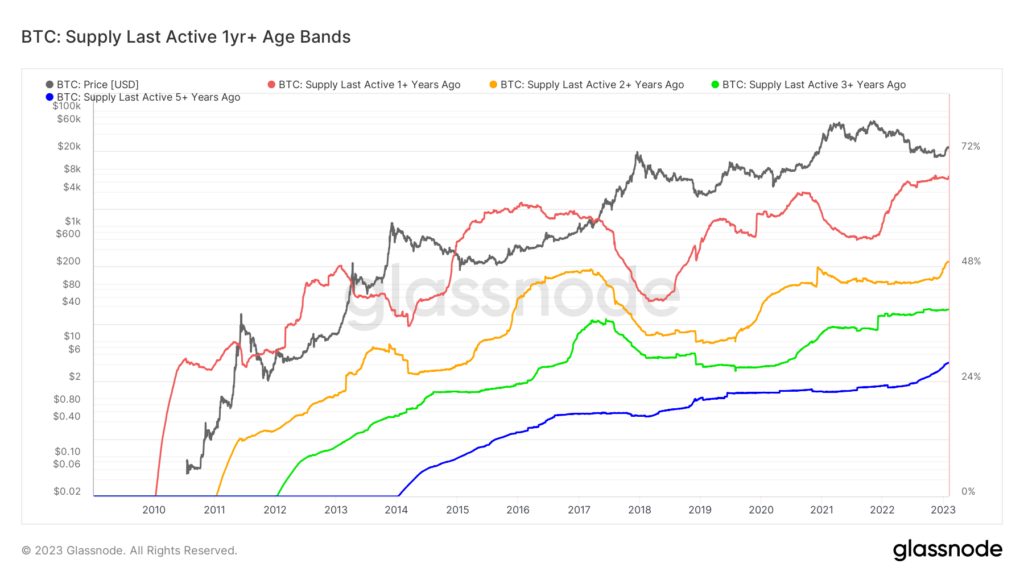
    In addition to new addresses, there has also been a new record reached in terms of long-term holders. According to blockchain analysts Glassnode, the share of Bitcoin held by long-term holders has hit an all-time high of 28% of all Bitcoin in circulation.

    BTC supply last active by age. Image source: Glassnode

    It is worth noting that the long-term supply of Bitcoin has been steadily increasing since 2014, but it is still an encouraging sign that the trend prevailed during the 2022 crypto winter. The Glassnode researchers commented on Bitcoin’s strong performance in January:

    “Bitcoin markets have seen the strongest monthly price performance since Oct-2021, fuelled by both historic spot demand, and a sequence of short squeezes.”

    At the time of writing, Bitcoin is trading just shy of $23,000, up more than +38% since the start of the year. Check our Bitcoin price prediction to see where it could be headed next.

  • Coinbase-Backed DeSo Unveils MegaSwap, a “Stripe for Crypto” product, with Over $5 Million in Volume

    Coinbase-Backed DeSo Unveils MegaSwap, a “Stripe for Crypto” product, with Over $5 Million in Volume

    Los Angeles, United States, 7th February, 2023, Chainwire

    DeSo is excited to announce the launch of MegaSwap – a revolutionary, cross-chain smart service that enables users to securely and easily swap coins between different blockchains with a frictionless zero-login. MegaSwap solves various critical pain points, including onboarding new users and liquidity to any web3 application across any blockchain ecosystem. 

    In its limited release, the platform has already seen more than $5 million in volume, demonstrating its potential to revolutionize the crypto market with cross-chain swaps. 

    MegaSwap offers an alternative and safer solution to the traditional centralized exchange model where users don’t ever have to log in or provide sensitive personal information. Instead of storing their coins on a centralized exchange, users can store them in their own self-custody wallets to mitigate the risk of unforeseen meltdowns, such as those seen with FTX, BlockFi, Celsius, or Voyager. 

    MegaSwap is a simple, innovative solution for developers seeking to build web3 applications on different blockchains. Developers can install its frictionless zero-login API with a single line of code, making their apps chain-agnostic and accessible from any blockchain. For the first time, apps on Ethereum can easily compose with apps on Solana or DeSo. MegaSwap thus makes it easier for liquidity and new users to be onboarded into any blockchain ecosystem.

    “One of the biggest use cases we think will have the greatest impact is onboarding new users that don’t own your coin. That all changes with MegaSwap, where devs can leverage crypto-to-crypto swaps between any two coins no matter what blockchain ecosystem they’re in. This last use case is a great wedge because it solves the biggest pain point for every blockchain dev today: getting new users without making them buy your coin on an exchange.” – Founder of DeSo, Nader Al-Naji, explains.

    The blockchain ecosystem is currently fragmented, making it hard for users who want to try out different web3 apps. With MegaSwap, users can easily and securely swap between Ethereum, Solana, Bitcoin, DeSo, and USDC, with support coming soon for other blockchains like NEAR, ADA, Doge, and more! This makes it easier than ever to move funds between blockchains allowing communities to seamlessly navigate from app to app.

    DeSo is committed to creating a Social Layer for Web3 that allows communities to seamlessly transition between different blockchains. The launch of MegaSwap is a testament to this commitment and eliminates a major hurdle preventing the mass adoption of cryptocurrencies.

    This is yet another example in a recent string of successes for ​​DeSo. Recently, they launched a breakthrough fundraising platform called Openfund that enables entrepreneurs to launch tradeable coin-backed fundraising rounds via the world’s fastest order book exchange. 

    With the combination of Openfund and MegaSwap, founders and builders can easily fund projects, acquire new users, and expand their reach with a comprehensive suite of powerful tools in the DeSo ecosystem.

    They also recently partnered with Princeton University to launch the first-of-its-kind web3 startup competition and have a slew of upcoming releases that will position DeSo as the go-to layer-1 blockchain to build decentralized social media applications.

    Additionally, the Social Network Hard Fork just went live, enabling decentralized verifications. They plan to move to a proof of stake later this year, improving performance and energy efficiency. 

    About Deso

    DeSo is a new layer-1 blockchain built from the ground up to decentralize social media and scale storage-heavy applications to billions of users. It raised $200 million and is backed by Sequoia, Andreessen Horowitz, Coinbase Ventures, Social Capital, Polychain Capital, Winklevoss Capital, Pantera, and other blue chip funds.

    Check out the full roadmap and claim your username on deso.com.

    Contact

    Ash Ghaemi
    DeSo Foundation
    Ash@deso.org

  • Aave Ranks #2 as Aave v3 was deployed to the Ethereum mainnet — Top 3 Coins to Watch for Feb 6 — Feb 12

    Aave Ranks #2 as Aave v3 was deployed to the Ethereum mainnet — Top 3 Coins to Watch for Feb 6 — Feb 12

    Aave Ranks #2 as Aave v3 was deployed to the Ethereum mainnet — Top 3 Coins to Watch for Feb 6 — Feb 12

    The uptrend established in the first few weeks of 2023 appears to be dying out. Although the total cryptocurrency market capitalization climbed as high as $1.12 trillion during last week, all the gains were erased during the weekend, causing the total market cap to fall back to $1.09, this is exactly where it stood at the beginning of the week. Most of the biggest cryptocurrencies traded rather sideways throughout last week, which explains why the total market cap stayed stagnant. Among Top 10 cryptocurrencies, the biggest mover was OKB (OKB), which appreciated by almost 12% last week.

    3. Render Token (RNDR)

    Render Network is a decentralized cloud rendering platform that allows users to access high-performance computing resources in a secure and decentralized manner. The platform uses blockchain technology and its own cryptocurrency, the RNDR token, as the means of payment and reward for participating nodes. The RNDR token is used to incentivize the rendering of 3D graphics, animations, and simulations. With Render Network, artists, architects, and engineers can outsource their rendering needs to the network, rather than relying on a centralized cloud provider, providing increased security, cost-effectiveness, and faster rendering times.

    The project establishes Render Network Foundation and accepts the proposal to implement a burn-and-mint equilibrium tokenomics model

    On January 20, the Render Network announced that the project is launching Render Network Foundation, a dedicated non-profit organisation that will maintain and develop the core Render Network protocol and its community. In addition, RNDR token holders recently voted in favour of adopting a new tokenomics model, called burn-and-mint equilibrium. According to the new model, “rendering jobs-to-be-done” will be priced in USD and creators will have to burn the corresponding amount of RNDR tokens to pay for rendering. After burning RNDR, creators will receive non-transferable, non-fungible “Coupon Tokens” to track completed orders. Node operators will receive rewards in the form of base-asset issuance incentives based on the number of jobs they completed within a network’s epoch. The tokenomics model is called burn-and-mint equilibrium because if the demand stays constant the number of tokens burned equals the number minted. If, however, the usage grows in between, supply decreases and creates upward price pressure, and vice versa when the need for rendering power is in decline. The proposal for the change in tokenomics was accepted with outstanding unity as 100% of votes were cast in favour.

    Both events provided a boost to RNDR price, which has gained over 100% in the past week, outperforming all other top 100 assets in the same period. In addition, the Render Network’s token climbed 13 spots up on the list of largest cryptocurrencies by market capitalization last week alone. Currently the token is changing hands at a price of $1.70 but we believe it could hit $2.00 soon.

    2. Aave (AAVE)

    Aave is an Ethereum-based decentralized lending and borrowing platform that started out under the name “ETHLend”, a project launched by Stani Kulechov in 2017. Aave supports almost 20 different tokens and has unique and sophisticated features such as flash loans that make it stand out from its competitors. While Aave initially launched on Ethereum, the protocol has expanded to the Fantom, Avalanche, Polygon, Optimism, Arbitrum, and Harmony networks over the last couple of years and is now available on 7 chains. AAVE token is the protocol’s native token, which grants holders governance rights as well as discounts when interacting with Aave protocol. While the protocol is completely open source, its code is regularly audited by third parties and has been repeatedly deemed secure. With the launch of its third iteration – “Aave v3” – the protocol positioned itself as one of the top DeFi protocols. According to DeFi Llama, there are currently around $4.7 billion locked in the Aave protocol, out of which $1.1 billion are locked in Aave v3.

    Aave v3, one of the most popular liquidity protocols, has been deployed on Ethereum mainnnet

    The Aave protocol has recently received its most significant upgrade to date on the Ethereum blockchain as Aave v3 was activated on Ethereum mainnet on January 27. While Aave already run on Polygon, Avalanche, Arbitrum and Optimism, Ethereum mainnet deployment was of key importance for the lending protocol as Ethereum is the Aave’s largest market. Now liquidity providers that interact with Aave through Ethereum mainnet can also utilize advanced features such as high-efficiency mode (or e-mode) and isolation mode. In addition, gas fees are up to 25% lower on Aave v3. To migrate your positions from v2 to v3, follow the instructions from the Tweet below.

    AAVE price, which has been trending upward since the beginning of the year, is up by 60% year-to-date. AAVE token is currently changing hands at around $85. Nevertheless, this is still 87% below the token’s all-time high price of $665 achieved on May 18, 2021.

    1. Optimism (OP)

    Optimism is a popular Layer 2 scaling solution for the Ethereum blockchain that aims to enable faster, cheaper, and more scalable decentralized applications (dApps). To achieve its goal, Optimism uses a technology called Optimistic Rollups, which allows dApps to perform transactions off-chain and then settle them on-chain, greatly increasing transaction speed and reducing costs compared to traditional on-chain transactions. The OP token is the native cryptocurrency of the Optimism platform and is used for staking and governance. By holding and staking OP tokens, users can participate in the governance of the Optimism network (by voting on proposals regarding protocol upgrades, incentives, and the allocation of treasury funds) as well as earn rewards for helping to secure the network.

    The recently announced Bedrock upgrade will allow Optimism to stay at the forefront of Ethereum scaling for years to come

    On February 2 the Optimism Foundation has proudly announced Bedrock upgrade, which will provide a significant boost to the performance and functionality of the network. The revamped version of the Optimism protocol will reduce transaction fees by another 10% by further optimizing transaction batch compression. In addition, Optimism developers say that the upgrade will also handle L1 re-orgs better, thereby shortening delays of including L1 transactions in rollups. Full list of improvements featured in the upcoming upgrade can be found in the Bedrock Explainer.

    According to the upgrade proposal draft, the community will vote on the proposal after two weeks of discussion. If Bedrock gets approved by Optimism governance community, the upgrade will be implemented on March 15 at 9:00 AM PT. While the road to Bedrock deployment is still long, the markets have reacted very positively to its announcement as OP gained more than 45% in two days following the announcement. In addition, OP is up by almost 200% during the last month, making it one of the best performing tokens in this period.

  • Metacade presale investment rockets past $5 million as GameFi investors hurry to buy remaining MCADE tokens

    Metacade presale investment rockets past $5 million as GameFi investors hurry to buy remaining MCADE tokens

    London, United Kingdom, 2nd February, 2023, Chainwire

    The Metacade presale is selling out fast with stage 3 coming to a close after just 12 days. The presale of the play-to-earn (P2E) metaverse arcade saw its previous rounds sell out within 4 weeks, raising $2.7 million but this has been dwarfed in comparison to the third stage selling out at lightning speed and bringing the project to raise past $5 million in just several days.   

    Metacade is set to deliver the ultimate blockchain gaming experience, merging the worlds of gaming and crypto in a seamless and exciting way. Development of the P2E arcade is well underway and platform designs have already been shared with the ever-growing Metacade community on the arcade’s Twitter page. 

    157.5 million tokens will be available in stage 4 where investors may purchase tokens before the next presale round, which will see the token price increase to $0.016.

    Russell Bennett, Head of Product for Metacade, said: “Investor confidence in the project is high and token demand is continuing to increase. We know that the Metacade project has solid fundamentals, a strong team, and the power to make waves in the GameFi industry – it’s clear that crypto and GameFi investors have caught onto this too.” 

    With incredible momentum already behind the Metacade project, it will not be long before the presale tokens sell out and MCADE is released on exchanges. The token will be listed on both centralized and decentralized exchanges, giving the public a variety of ways to purchase the token. 

    MCADE will be listed Bitmart, a leading global cryptocurrency exchange ranked 21st in the CoinMarketCap exchange rankings, followed by a top 10 exchange listing that is soon to be revealed. Amongst the DeFI exchanges, investors will be able to find MCADE on Uniswap, amongst other well-known and trusted token exchanges. 

    With its play-to-earn arcade built on the Ethereum blockchain, Metacade is primed to be the go-to place for gamers and crypto enthusiasts. The platform boasts innovative and essential features such as leaderboards, trending games, GameFi alpha, and more that will set it apart from other blockchain gaming platforms. 

    Play-to-earn is at the heart of the platform but gaming isn’t the only string to Metacade’s bow. The platform is going above and beyond to support the gaming community by launching a jobs board and Metagrants initiative to attract the best game developers to build their games on the platform. It will be a place to earn, learn, and connect like never before. 

    The Metacade is powered by the MCADE token, which will be essential for any transactions on the platform. MCADE will be used to reward players for their efforts across the platform, from gaming and tournament participation to sharing gaming alpha and writing GameFi reviews. MCADE holders can also top up their income by staking their tokens to support the arcade’s network.   

    The P2E GameFi platform received the ultimate seal of approval from the prestigious blockchain auditing firm Certik. That places Metacade among the ranks of Polygon, ApeCoin, and BNB Chain as a trusted player in the world of crypto. With Certik’s cutting-edge technology, it thoroughly analyzed and evaluated every aspect of Metacade’s specifications and code. It also performed a full KYC on the Metacade team to confirm their authenticity and bring even more transparency to the project. The full audit results are available on the Certik website.   

    About Metacade

    Metacade is the premier destination for gaming in the metaverse. As Web3’s first community arcade that allows gamers to hang out, share gaming knowledge and play exclusive P2E games. The platform offers users multiple ways to generate income, build careers in Web3, and connect with the wider gaming community. 

    Metacade will be the one-stop destination for users to play, earn, and network with other passionate gamers worldwide. Once the project reaches the end of its roadmap, Metacade will be handed over to the community as a full-fledged DAO. After all, Metacade wants users to have a hand in shaping the GameFi world of tomorrow.

    For more information, visit:

    Website  | Whitepaper | Socials

    Contact

    Head of Product
    Russell Bennett
    Metacade
    pr@metacade.co