NFL Rivals launches its second season on September 5, coinciding with the NFL Kickoff.
New features include multiplayer mode, an expanded Synergy System, and the “Road to the Playoffs” reward system.
A new partnership with Super Bowl LVIII champions, the Kansas City Chiefs, enhances the game’s connection to NFL fans.
NFL Rivals introduces exciting updates for Year 2
NFL Rivals is the officially licensed mobile game of the National Football League (NFL) and the NFL Players Association (NFLPA). They are launching its second season, known as Year 2, on September 5, 2024. This release aligns with the NFL Kickoff, making the game follow a successful first season that saw over 5 million downloads and 115 million games played.
Year 2 of NFL Rivals promises to build on its initial success by offering players an even richer gaming experience. New gameplay modes, distinctive pack drops, and exclusive partnerships are set to enhance player engagement. A refreshed community platform will also provide fans with novel ways to interact with their favorite sport.
“As we enter the second year of our partnership with Mythical Games, we look back at the incredible first year of NFL Rivals and the success the game achieved worldwide. Leveraging that momentum, Y2 will draw fans further into the realm of being a general manager of an NFL team with improved arcade-style gameplay and updates that continue to provide fans with ownership over their gaming experience.”
—Ed Kiang, vice president of video gaming at the NFL
Sophie Gage, VP of Business & Legal Affairs at NFL Players Inc, highlighted that the success of NFL Rivals is deeply tied to how it brings fans closer to the sport they love, with NFL players at the core of this connection. Their skills and authenticity are what make the game engaging and enjoyable for millions of fans worldwide. This unique relationship fuels the game’s growth and continues to attract more fans as it evolves.
This season, NFL Rivals has announced a notable partnership with the Kansas City Chiefs, the reigning Super Bowl LVIII champions. This collaboration is part of NFL Rivals’ ongoing efforts to strengthen the connection between the game and the excitement of NFL football.
“Year 2 of NFL Rivals is going to be a game-changer. With the upcoming release of our multiplayer mode, and the expansion of our Synergy System, fans have new and fun ways to play; and with the introduction of the ‘Road to the Playoffs’ and its season-long ‘reward road’, during the 2024 NFL season, we’re raising the bar and setting a new standard for sports gaming as a whole.”
—Billy Schautz, the executive producer of NFL Rivals
NFL Rivals is available for download on the App Store and Google Play Store, with more details available on the official NFL Rivals website.
The bottom line
As NFL Rivals enters its second season, the game continues to evolve, offering fans innovative features and fresh partnerships that deepen the connection to NFL football. With new gameplay modes and an emphasis on community engagement, Year 2 aims to set a new benchmark in mobile sports gaming.
Following the crypto market’s underwhelming performance, the search for more promising altcoins shifts gears. Ethereum (ETH) is among the tokens hit the hardest and their whales are instead betting on Cardano (ADA).
Also on their radar is a new hybrid exchange platform: DTX Exchange (DTX). This novel player combines the best elements of centralized and decentralized exchanges, setting it up to transform the $10 billion global trading market. This unique offering and solid upside potential make it a new favorite.
DTX Exchange (DTX): A new DeFi project worth betting on
DTX Exchange (DTX) became the talk of the crypto community after hitting $2 million in fundraising. This remarkable feat saw it outclass most new ICOs, further capturing the attention of Ethereum whales. Driving interest and demand are none other than its hybrid exchange protocol and upside potential.
Regarding its unique offering, it combines the best elements of CEX and DEX—a hybrid trading platform. Hailed as groundbreaking by industry experts, it is poised to reshape the global trading scene, valued at $10.3 billion in 2023. Striking a balance between accessibility and security while providing access to over 120,000 asset classes, it is set for massive adoption.
The ongoing presale recently entered the 3rd round, with investors in a frenzy to stack up at the current price of $0.06. Meanwhile, experts project a 50x upswing after listing, making it a more promising alternative than established cryptocurrencies.
Ethereum (ETH): Eyes a comeback
Ethereum (ETH) is the second-largest cryptocurrency, playing a vital role in the blockchain scene thanks to its smart contract compatibility. The ecosystem is the most vibrant, hosting several protocols and cryptocurrencies. However, since hitting $4,000 in March, it has been in a free fall.
The latest market dump pushed the Ethereum price below $2,500. ETH’s long liquidations hit $55 million; confidence and optimism took a big hit. Despite this, a comeback isn’t out of the question, trading above the EMA 50 support level.
While it trades within the $2,200 and $2,500 ranges, it is on track for a breakout above $3,000. A trending Ethereum price prediction suggests a jump past $3,100 before the end of Q3, making it one of the altcoins to watch out for. Alternatively, whales have also been betting on other promising altcoins.
Cardano (ADA): Prepares for a huge leap
Cardano (ADA), a top Layer-1 token, is among the few altcoins on whales’ radar. Besides its significant upside potential, it also plays a key role as a blockchain and smart contract platform. Although largely unimpressive in quarter three, it is set for a big leap.
The Cardano price chart shows a path to $3, making it a token worth keeping on the radar. Whales continue their accumulation, courtesy of ADA’s low price. Further, rising adoption in the L1 ecosystem and growing institutional demand are expected to contribute to its uptick.
Another Cardano price prediction hints at a jump past $1 in the coming weeks. Flipping this level prepares it for the long walk to the current all-time high of $3.1. With a new peak on the cards during this bull run, it is a token worth betting on.
Conclusion
Amid the underwhelming performance of Ethereum, attention has shifted to Cardano and DTX Exchange, a new altcoin. This up-and-coming cryptocurrency aims to reshape the global trading scene while promising early adopters substantial ROIs.
Disclaimer: This is a sponsored article. The views and opinions presented in this article do not necessarily reflect the views of CoinCheckup. The content of this article should not be considered as investment advice. Always do your own research before deciding to buy, sell or transfer any crypto assets.
Korea Blockchain Week 2024, Asia’s most impactful blockchain conference, is delighted to announce that Former Mt. Gox CEO Mark Karpelès, who has been active in the blockchain industry since 2009, will be among the exclusive speakers at its flagship KBW2024: IMPACT event.
Mark Karpelès first discovered blockchain and crypto technologies through Bitcoin in 2009, and soon after became a founding member of the Bitcoin Foundation in 2012. He acquired Mt. Gox in 2011, and after twelve years of working through currently available cybersecurity technologies, he became the Minister of Technology for Joseon in 2023. Mark also serves as the CTO of EllipX, a crypto wallet and exchange that eliminates the need for passphrases and provides a user-friendly platform for digital asset trading.
Besides Mark, the exclusive list of distinguished voices at the KBW includes Chris Dixon, a General Partner at Andreessen Horowitz and the author of Read Write Own: Building the Next Era of the Internet, who will speak at the Kickoff Event for KBW2024 on September 1st.
It is highly significant that KBW has added speakers who can shed light on both the past and present of the blockchain industry, as well as AI leaders driving the Fourth Industrial Revolution. In Korea, the blockchain community is intrigued by the story of Mt. Gox, and is eager to understand how the industry can integrate with traditional sectors.
KBW2024: IMPACT, the main event of the week-long conference, will feature over 300 speakers, including new additions such as:
Hakan Eroglu (Advisor – Innovation Hub, Bank for International Settlements)
Mark T. Uyeda (Commissioner, the US Securities and Exchange Commission)
Rune Christensen (Co-Founder, MakerDAO)
Stani Kulechov (Founder and CEO, Avara)
Alex Blania (Co-Founder, Worldcoin)
Brad Garlinghouse (CEO, Ripple)
Andrew Durgee (President, Republic)
Henry Child (Head of Ecosystem, Tether)
Yam Ki Chan (Vice President, Circle)
Sean Lee (Co-Founder and CSO, IDA)
Nathan Allman (Founder and CEO, Ondo)
Sota Watanabe (Founder of Astar Network & CEO of Startale Labs)
Sidney M. Gutierrez (Former NASA astronaut, Chairman of Vaya Space)
Wesley Clark (Former NATO Supreme Allied Commander, CEO of Wesley K. Clark & Associates)
FactBlock CEO Jeon Seon-ik expressed enthusiasm about the event, stating, “KBW2024 is an essential occasion to explore the latest trends and innovations in the blockchain and Web3 industries. We are delighted to offer a rich program featuring speakers with outstanding careers across various fields.”
Hashed CEO Kim Seojun added, “KBW2024 is establishing itself as an innovative conference platform that transcends the boundaries of blockchain technology, finance, content, and entertainment. We hope it serves as an opportunity to showcase the ecosystem’s potential to both domestic and international Web3 communities.”
Now in its seventh year, KBW is organized by FactBlock, a Web3 ecosystem builder, and co-hosted by blockchain venture capital firm Hashed. The main event, KBW2024: IMPACT, will be held on September 3-4 at the Walkerhill Hotel & Resort in Seoul.
Another key event, KBW2024: AI World, will take place on September 5 at Lotte Cinema, Lotte World Tower, Seoul. Organized by Financial News and the Ministry of Science & ICT, it will feature Stability AI Founder Emad Mostaque, Worldcoin CEO Alex Blania as well as leading Korean entrepreneurs in the AI field.
KBW2024: IMPACT is supported by the official conference partners Sui, Movement Labs, and BlueRun Ventures Capital Management (BRV), with title sponsors including Aptos, Tron, Chiliz, DOP, Creditcoin, Sahara AI, Presto, TON, Bitthumb, SK Telecom, and Aleo. Gold sponsors include Orbs, Flare Network, and Ripple. The KBW organizers have also partnered with Forbes Web3, dedicating one of the four stages as the Forbes Web3 Stage. The full list of partners and sponsors is available on KBW’s official website.
Founded by FACTBLOCK and co-hosted by Hashed, Korea Blockchain Week (KBW) is an annual global blockchain and web3 festival held in Seoul, South Korea, since 2018. It has been a gathering ground for the top global blockchain and web3 leaders and unifying diverse communities.
KBW curates multiple prestigious main events, including the flagship conference ‘IMPACT.’ This provides participants and attendees exclusive opportunities to exchange industry insights and indulge in an immersive blend of music, art, and culture, making KBW a unique and enriching experience for all involved.
BTCC is excited to announce a comprehensive upgrade to its copy trading feature in celebration of surpassing 600,000 users since its launch. With over $420M in profits generated from 220M successful copy trades, BTCC continues to lead the crypto industry, boasting over 15,000 lead traders and more than 600,000 copy traders.
To mark this milestone, BTCC is launching a special campaign offering 50 USDT first trade loss coverage for the first 1,000 new copy traders, running until October 2024. The upgrade includes daily lead trader recommendations and a new “copy ongoing positions” feature, which allows users to replicate lead traders’ positions at market price, ensuring no profit opportunities are missed.
In addition to these upgrades, BTCC offers one of the highest profit-sharing ratios in the industry. Lead traders with a 30-day AUM of 1M USDT can enjoy a profit-sharing ratio of up to 50%. The platform also provides significant leverage—up to 250x for major pairs and up to 50x for 300 other pairs—along with robust risk management tools like slippage protection mechanism and customizable loss settings. There is also no limit to the number of daily lead trades for lead traders.
Alex, Head of Operations at BTCC, shared his excitement about the upgrade, “BTCC has long been a leader in futures trading, and this major enhancement to our copy trading feature is a game-changer. We’re creating an even more dynamic space where both new and experienced traders can thrive together. I’m confident this upgrade will open up new opportunities for our users and set the stage for even greater growth in the future.”
Experienced traders can apply to be lead traders and enjoy one of the industry’s highest profit-sharing ratios. Selected traders can gain free exposure to BTCC’s 2.8M user base, offering a great opportunity to grow their followers and increase earnings. Apply here.
Moving forward, BTCC plans to broaden the range of cryptocurrencies available for copy trading, further enriching the trading experience for its expanding user base.
About BTCC
Founded in 2011, BTCC is a leading crypto futures exchange serving over 2.8 million users globally. Renowned for its robust security and innovative trading features, BTCC offers a reliable platform catering to new and seasoned traders.
B2BROKER, the company behind the innovative B2COPY investment platform, proudly announces the full integration of B2COPY with Spotware’s cTrader, the premium and first Open Trading Platform™. This integration allows cTrader users to harness B2COPY’s state-of-the-art features, resulting in a more effective and seamless copy trading experience.
Distinctive Attributes of B2COPY Integrated with cTrader
B2COPY breaks new ground by offering an institutional-grade copier for cTrader that eliminates the need for user logins. Moreover, B2COPY brings to the market the first PAMM (Percent Allocation Management Module) for cTrader. B2COPY’s MAM (Multi-Account Manager) solution is notable for its institutional-quality services, including automatic fee processing, smooth IB module integration, and comprehensive risk management services.
Trading Flexibility — With B2COPY on cTrader, investors can execute trades on their own accounts, terminate copied positions, and decouple their trades from the master’s trades.
Flexible Fee Settings — Masters have the ability to modify fee plans, create client-specific promotions, and set distinct fee arrangements for different clients.
Multiple Allocation Methods — B2COPY on cTrader supports several allocation strategies, including proportional distribution based on equity, balance allocation, and fixed lot assignments.
Advanced Copying Features — With B2COPY on cTrader, users can pause or reverse copying, personalise nicknames and avatars, and alter the names of strategies.
User-Friendly Integrations — B2COPY on cTrader is fully integrated with B2CORE CRM and can be linked with other custom CRMs, removing the necessity to visit the trading platform.
Website Widgets — With B2COPY on cTrader, you get widgets for website integration, including leaderboards and personalised statistics pages, which boost user engagement and improve transparency.
Why cTrader
cTrader is a leading multi-asset FX/CFD trading platform known for its robust and extensive ecosystem, which is tailored to address the diverse needs of brokers, prop firms, IBs, and traders.
cTrader offers smooth integration with third-party services through its various APIs. Custom applications can be developed with ease using the Open API, which connects directly to the cTrader backend.
Brokers and prop firms can extensively customise the cTrader UI with plugins, enabling the addition of unique elements tailored to their specific business needs.
cTrader is delivered to brokers and prop firms as a ready-to-use cloud solution hosted by Spotware on industry-leading infrastructure, ensuring high performance and security.
The cTrader suite includes cBroker, a versatile and powerful management system that offers brokers and prop firms limitless opportunities for customisation and operational efficiency.
Brokers and prop firms can confidently build a competitive advantage and boost their market presence with cTrader, renowned as the fastest-growing FX/CFD platform.
The trading community recognises cTrader for its superior features, such as:
Advanced order options and enhanced safety features
Powerful charting and analysis tools
Level II market depth with lightning-fast execution
Easy integration into algorithmic and social trading
Sleek UI designed with user convenience in mind
Available on all leading platforms: web, desktop, macOS, iOS and Android.
IBs choose cTrader as the best solution for increasing their referral base with:
cTrader Invite – A comprehensive toolkit that supports partners in drawing new traders with enticing cTrader products and effectively converting them into referrals.
cTrader Copy – An extensive social trading platform with a variety of successful strategies designed to motivate new users to engage in live trading.
cTrader Algo – A streamlined automated trading solution that facilitates the development of algorithms and offers free, round-the-clock cloud execution of cBots on all cTrader platforms.
Additional tools for partners – Features include signal links for trading opportunities, Chart Streams for technical analysis, and shared access for money managers, among other resources.
“With this integration with Spotware, we have brought advanced features and unprecedented flexibility to the traders. B2COPY offers the first-ever PAMM and MAM for professional money managers, multiple allocation methods, and a variety of fee types, including subscription and joining fees, to cTrader users. Also, our performance fee calculation options provide more flexibility for brokers and their clients. We’ve worked really hard to integrate these sophisticated features into B2COPY, and we’re excited to welcome cTrader and their users to experience these benefits.” – Sergey Ryzhavin, CPO of B2COPY
“We are excited that B2BROKER has joined our extensive network of partners, and thrilled to develop the market together. At cTrader, we are committed to collaborating with top technology providers to deliver an exceptional and premium trading experience to our users. Through partnerships like this, cTrader maintains its status as the first Open Trading Platform™, offering limitless opportunities for integration and customisation within our platform.” – Ilia Iarovitcyn, CEO of Spotware (Creators of cTrader)
Final Thoughts
B2BROKER and Spotware are confident that this collaboration will benefit the trading community by boosting user experience and operational efficiency, and will signify a significant leap forward for both top solution providers.
About Spotware
Spotwareis a global technology provider, successfully delivering cutting-edge fintech solutions and infrastructure for over 14 years. The company has cultivated a sophisticated network of 250+ brokers and prop firms, including notable names like IC Markets, Pepperstone, FTMO, and Funding Pips. With a user base exceeding 4 million traders, cTrader, Spotware’s flagship platform, stands out for its unparalleled innovativeness and user-friendly UI, setting new standards across the industry.
For more details or to request a demo, please reach out.
Disclaimer: The views and opinions presented in this article do not necessarily reflect the views of CoinCheckup. The content of this article should not be considered as investment advice. Always do your own research before deciding to buy, sell or transfer any crypto assets. Past returns do not always guarantee future profits.
RCO Finance (RCOF) is disrupting the decentralized investment niche by revolutionaryly applying artificial intelligence to crypto trading.
This article will examine how RCO Finance’s decentralized trading platform works seamlessly with the crypto AI robo advisor to improve trading outcomes. We will also reveal how you can benefit from RCO Finance’s innovative offerings.
RCO Finance Integrates RWA Trading With Crypto AI Tool
RCO Finance’s core offering is its decentralized trading and investment platform that allows users to trade crypto and real-world assets (RWAs), such as bonds, stocks, commodities, ETFs, etc, with their crypto.
The trading platform boasts 120,000 tradable assets in 12,500 different categories, giving investors a wide range of options. It also offers up to 50x leverage, full control of trading activities by the trader, low fees, and elimination of brokers.
The AI robo-advisor utilizes advanced algorithms and machine learning techniques to identify market opportunities and generate actionable insights. Traders can use these insights to choose the right asset to trade from the numerous options available.
It also eliminates the effect of human bias on trading decisions and minimizes the time spent checking the markets.
RCO Finance’s Other Amazing Features
RCO Finance boasts other innovative features besides the trading platform and crypto AI advisor. One is the debit card, which allows the holder to engage in commerce across traditional and decentralized financial systems and convert crypto to fiat currency.
Another powerful feature is the Pre-DO Offering. This feature allows investors to access decentralized perpetual derivatives like futures, options, and swaps in a secure trading environment.
Furthermore, users can also use their tokens to provide liquidity for the various trading pairs or to help RCO Finance facilitate its automated market maker role on decentralized exchanges (DEXs). They can also earn mouth-watering interest from lending their crypto assets.
Importantly, the protocol protects customers’ privacy and anonymity through its no-KYC policy. A reputable audit firm, SolidProof, has also audited RCO Finance’s smart contracts, ensuring reliability and security.
RCO Finance’s Tokenomics And Presale
RCO Finance’s tokenomics stands out and sets it up for sustained growth. Its native token, RCOF, has a total supply of 800 million. 50% of this supply goes to public sale; ecosystem development takes 20%.
Liquidity/market-making receives 12%, while marketing and private sales each get 5%. 4% is allocated to the team, while the advisors and ecosystem rewards each get 2%.
RCO Finance’s presale has also been a hit. In about two months, the presale raised almost $2 million as investors rushed to buy RCOF because of the massive 10x gain.
The presale is in Stage 2, and RCOF was sold for $0.343. At launch, the token will rise to $0.40.
RCOF also has a vesting schedule that locks the private, public, liquidity, and team tokens for a while to prevent dumping and maintain price stability. This underscores the protocol’s commitment to long-term and sustainable growth.
Why You Should Invest in RCO Finance
The first reason to invest in RCO Finance is to become a core part of the new crypto AI revolution. This revolution will bring efficiency to the decentralized trading and investment niche, boosting profitability.
Another reason is the massive gains to be made from holding RCOF. Investors who buy RCOF for $0.0343 in Stage 2 of the ongoing presale will earn a 1,066% profit when the token rises to $0.40 at launch.
Other advantages of holding RCOF include significant discounts on trading fees, up to 88% APY on staked tokens, and voting rights on governance proposals. Token holders also receive a share of revenues as dividends.
Therefore, you can join other savvy investors today to enjoy these numerous benefits of investing in RCO Finance.
For more information about the RCO Finance Presale:
Disclaimer: The views and opinions presented in this article do not necessarily reflect the views of CoinCheckup. The content of this article should not be considered as investment advice. Always do your own research before deciding to buy, sell or transfer any crypto assets. Past returns do not always guarantee future profits.
Polymarket is a decentralized platform that allows users to wager on a wide variety of events, including sports, entertainment, cryptocurrency prices, and political election results.
In this article, we’ll break down how the platform operates, and how Polymarket makes money. We will also provide a step-by-step guide to placing bets on the platform and take a closer look at whether the platform is legitimate and trustworthy.
Key highlights:
Polymarket is a decentralized platform that leverages blockchain technology for betting on a wide range of events.
Users can trade shares of their predictions, with prices fluctuating according to market demand, enabling bettors to profit even before the event concludes.
Currently, Polymarket doesn’t charge platform fees, but this is likely going to change in the near future.
The platform is legitimate, but you should avoid events with poorly defined outcomes.
How does Polymarket work?
Polymarket users can browse numerous prediction markets and buy shares representing their predictions. If you think a particular outcome will happen, you buy shares for that outcome (named “Yes”).
If you think the event won’t happen, you buy shares for the opposing outcome (named “No”). Markets can be simple with a binary outcome (Yes/No, for example: “What price will Bitcoin hit in 2026?”) or more than just two possible outcomes (the classic example being “Who will win the 2028 U.S. Presidential Election?” as there are more than two possible outcomes).
Needless to say, you can buy as many shares (or a combination of shares) as you want, including portions of shares.
Currently, more than $730 million worth of bets have been placed on the winner of the 2024 U.S. presidential election. The outcomes are sorted based on the chance assigned to each outcome by the market.
After the event occurs, the outcome is verified by trusted oracles, which are services or entities that provide accurate information to the blockchain. Once the market is resolved, users holding shares of the correct outcome will receive payouts proportional to the number of shares they hold ($1 per share). Those who hold incorrect shares will lose their investment in that market as shares of the wrong outcome become worth $0.
It is worth noting that the prices of shares fluctuate based on the demand for each outcome. If more people believe an outcome is likely, the price of shares for that outcome will rise. This creates a dynamic market where users can trade shares, potentially making profits before the event is even resolved – similar to selling your betting position to the bookie before a sports event is finished.
Users can propose new markets on specific questions on their own, such as “Will [Team X] win the Superbowl 2025?” or “Will the price of Bitcoin exceed $70,000 by a certain date?” These markets are then created using smart contracts on the blockchain, which ensures transparency and fairness.
A step-by-step guide to using Polymarket
Now, let’s take a practical example at how you can place a bet on Polymarket.
1. Sign-up to Polymarket
To place a bet, users need to have funds in the form of the USDC (USD Coin) stablecoin. Users can either register with an e-mail and then deposit crypto/buy the stablecoin using a credit card or interacting with Polymarket directly with the use of an already topped-up cryptocurrency wallet (currently supported wallets include Metamask, Coinbase, and WalletConnect).
2. Top-up your account
While buying USDC with a credit card directly on Polymarket is the simplest option, it is also the most expensive, because a fee will be charged by Moonpay, which operates the Polymarket’s integrated on-ramp. We therefore recommend depositing USDC from a cryptocurrency wallet (make sure you make the transaction through the Polygon network!) or even better, interact with Polymarket directly through a cryptocurrency wallet.
3. Pick a prediction market
Proceed to pick the event you want to bet on and decide on your prediction. Polymarket categorizes its events into “Politics”, “Crypto”, “Pop Culture”, “Sports”, “Business”, and “Science”. As you open and bet on events, Polymarket will also create a curated personalized category called “For You”.
Sell outcome shares and wait for the event to resolve
When you own the shares for an outcome, it is up to you whether you want to sell them before the event itself or wait for the event to resolve.
How does Polymarket make money?
As of now, Polymarket does not charge any platform fees. However, users will still incur a small transaction fee for each trade due to blockchain validators requiring payment for transaction processing. The company is currently supported by venture capital funding and potentially through liquidity provision and market-making services. It is likely that Polymarket will introduce fees in the future to generate revenue.
“We’re focused on growing the marketplace right now and providing the best user experience. Monetization will come later,” Polymarket Founder Shayne Coplan disclosed in a recent interview with Forbes.
Is Polymarket legit?
Yes, Polymarket is a legitimate business. The platform has been offering its services to bettors since 2020, and the team of developers stands behind their product with their real identity and reputation. Furthermore, Polymarket is built on a decentralized blockchain, and the entire process is governed by smart contracts. This ensures that the platform operates transparently and without the need for a central authority.
While Polymarket aims to comply with regulations, it does operate in the decentralized finance (DeFi) space, which is often subjected to regulatory crackdowns. Therefore, it is no surprise that Polymarket does not hold a spotless record either. The firm was involved in a massive controversy and was fined $1.4 million by the U.S. Commodity Futures Trading Commission (CFTC).
The CFTC alleged that Polymarket was offering event-based binary options contracts without proper registration as a designated contract market (DCM) or swap execution facility (SEF). As part of the settlement, Polymarket agreed to cease providing its services to customers in the U.S.
What to watch out for when using Polymarket?
While Polymarket is a credible platform, the quality of its markets can vary significantly. There have been several heated debates and fierce disputes over what is the truly correct outcome of an event. This usually happens with events, which have poorly defined outcomes.
To avoid disputes over the validity of outcomes, it is advised to only participate in markets with clearly outlined criteria for determining outcomes. It is also always advisable to practice good password hygiene and avoid holding large amounts of crypto in online custodial wallets.
The bottom line
Polymarket leverages the power of blockchain technology to create a transparent, user-driven prediction market where anyone can participate and potentially profit from their insights on real-world events. While the platform is legitimate, it has faced regulatory challenges like many other cryptocurrency platforms. To minimize issues, focus on markets with clearly defined outcomes and ensure good security practices.
The “Insufficient Liquidity For This Trade” issue is a relatively common occurrence on Decentralized Exchange, such as Uniswap, Pancakeswap or Sushiswap.
When you encounter this error, it’s likely due to the pool’s limited capacity to facilitate your trade, due to, well, as the name says, not enough liquidity. You’ll need to take a closer look at your trade size and consider a few different ways of solving this issue. We’ll go into this in more detail in this article.
Key Takeaways
Reduce trade size to mitigate liquidity impact and increase the likelihood of a successful transaction on Uniswap
Increase slippage tolerance (up to 12% typically) to accommodate price fluctuations during trades with low liquidity tokens
Verify the token being traded to prevent liquidity mismatches and ensure compatibility with Uniswap’s liquidity pools
Explore alternative DEXes, such as SushiSwap and PancakeSwap, which may offer better liquidity for the desired trade
How AMMs (like Uniswap) work
At the core of Uniswap’s functionality lies the Automated Market Maker (AMM) model, which relies on liquidity pools to facilitate seamless token trading. When you interact with Uniswap (which has a native token, UNI), you’re essentially tapping into these pools, which contain pairs of tokens, such as ETH and USDC.
The AMM determines prices algorithmically based on the ratio of the tokens within the pool, following the constant product formula (x * y = k). This approach is at the core of decentralization because it allows for decentralized trading without traditional order books.
As you dive deeper into the matter, you realize that the depth, or size of the liquidity pool is a vital component. If you attempt to execute a trade that exceeds the pool’s capacity, it will lead to transaction failures.
In such cases, you may encounter errors like “Insufficient Liquidity For This Trade.” Uniswap’s design also allows users to actively contribute to liquidity pools and earn fees from trades executed within the pool. This is called liquidity mining, and it incentivizes participation, which improves liquidity and reduces the likelihood of such errors.
How to Fix “Insufficient Liquidity For This Trade” on Uniswap
When you encounter the “Insufficient Liquidity For This Trade” error on Uniswap, you can take a few steps to resolve the issue.
You can try reducing the trade size to minimize the impact on the liquidity pool, or increase the slippage tolerance setting to give the trade more flexibility.
Additionally, double-check that you’re trading the correct token and consider checking the token’s liquidity on other decentralized exchanges to explore alternative options.
Reduce the trade size
Reducing your trade size is the most straightforward solution to bypass the “Insufficient Liquidity For This Trade” error on Uniswap. By decreasing the amount you’re trying to swap, you lower the impact on the liquidity pool, making it more likely for your transaction to be executed successfully.
It’s simple math. If A must be less than B for a successful transaction, where A is your trade size and B is liquidity pool size, reducing the size of A is a very straightforward and logical solution.
Assess the current liquidity of a trading pair before executing transactions to be able to identify an appropriate trade size that aligns with the pool’s capacity. Reducing trade size helps decrease the likelihood of a failure due to liquidity shortages, but it also reduces potential losses from slippage during execution.
You may need to continually make adjustments to trade sizes based on fluctuations in market conditions and liquidity availability. If something worked today, it doesn’t mean it’ll work tomorrow, and vice versa. Regularly review market conditions and adjust your trade sizes accordingly.
Increase slippage tolerance setting
Your Uniswap transaction’s success may depend on a simple (but important) setting: the slippage tolerance. When you encounter the “Insufficient Liquidity For This Trade” error, consider adjusting this setting.
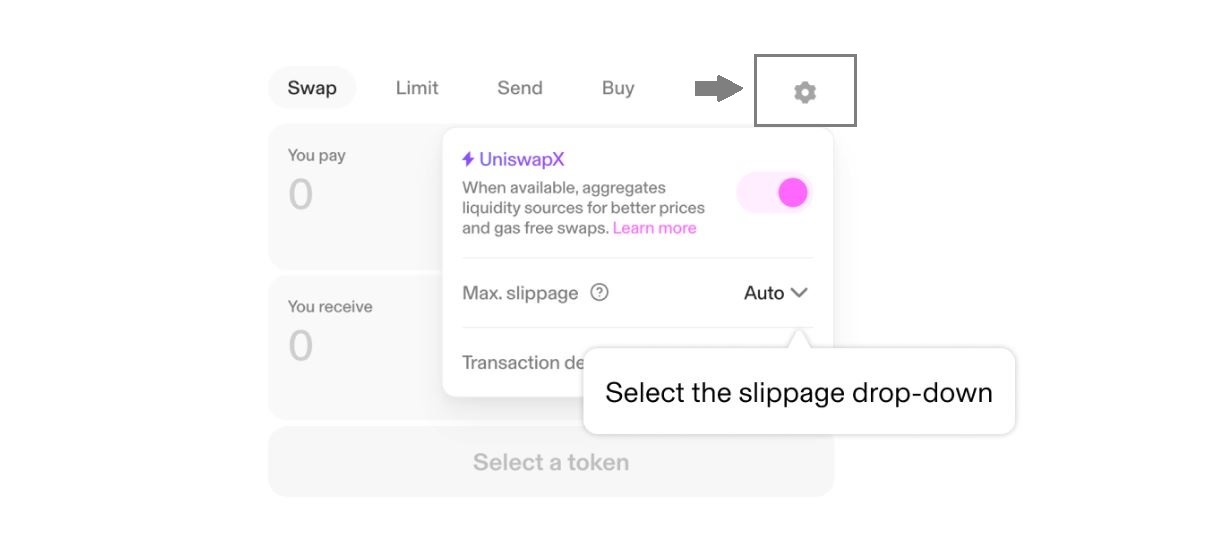
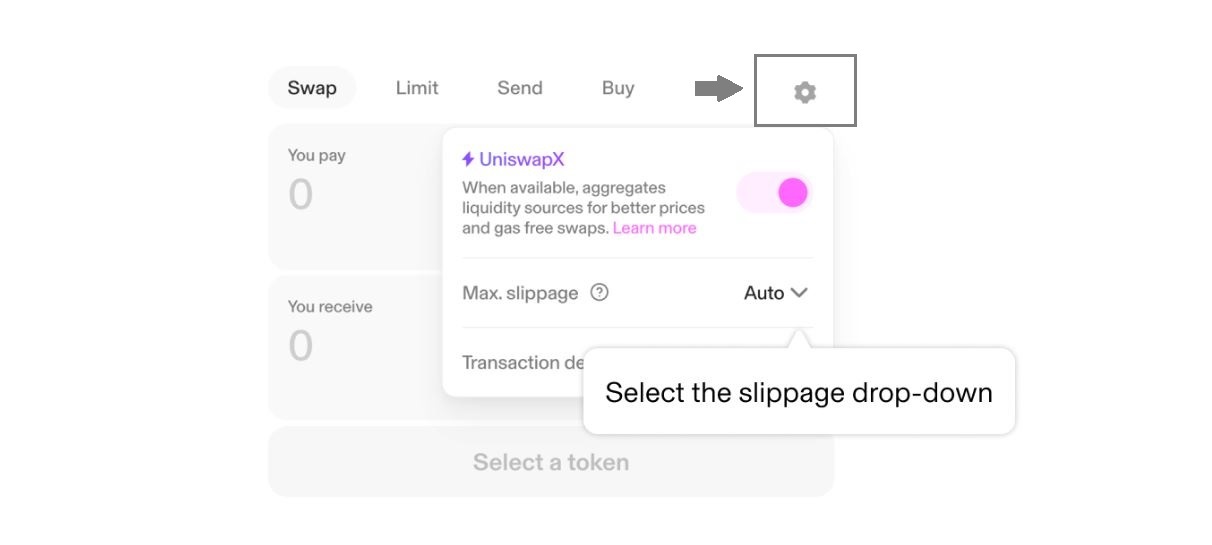
To do so, access your wallet, connect it to Uniswap, and select the tokens you wish to swap. Then, navigate to the transaction settings and adjust the slippage tolerance.
The default slippage tolerance is automatically set at 0.5% by Uniswap (or 0.1% in Uniswap V3), which means your trade will only get executed if the actual price is within 99.5% or 99.9% of the price you saw on your browser.
If you manually raise the slippage tolerance, you allow the transaction to execute even if the token price changes more significantly during the trade process due to low liquidity.
For transactions involving lower liquidity tokens, a slippage tolerance setting of 5% to 12% is often recommended. After making the adjustment, confirm the settings and proceed with the transaction.
Increasing the slippage tolerance can significantly reduce the chances of encountering “Insufficient Liquidity for This Trade” errors, as it provides a sort of buffer for price fluctuations.
Make sure you’re trading the correct token
This one may seem obvious, but this is crypto, and there can be lots of coins with a similar or even the same name as the coin you want to trade. Make sure that you’re trading the correct token. Double-check the token’s contract address, as a small error can result in trading a different token with low liquidity.
Also, be aware of token migrations or updates, as a token may have moved from one liquidity pool to another, affecting its available liquidity.
Of course, you should also confirm that the token you’re trading is supported by Uniswap.
Check the token’s liquidity on other DEXes
When Uniswap’s liquidity is insufficient for your trade, a quick scan of other decentralized exchanges (DEXes) can provide a viable alternative. You can check liquidity metrics on platforms like SushiSwap, TraderJoe or PancakeSwap, as they may offer better trading conditions for the same token pair.
Utilize tools like CoinGecko or CoinMarketCap to assess liquidity depth across various exchanges, helping you identify which DEX has the highest liquidity for your desired trade.
You should also examine the token’s liquidity pools on DEX aggregators like 1inch, which aggregate prices and routes from multiple platforms for optimal trading opportunities.
Also, you can check the trading volume for the token on other DEXes, as higher trading volume often correlates with better liquidity.
The bottom line
You’ve now got the tools to tackle the “Insufficient Liquidity For This Trade” error on Uniswap and other AMMs.
You should now understand how AMMs work and be able to apply the fixes – reducing trade size, increasing slippage tolerance, verifying token addresses, and exploring alternative DEXes.
FAQs
How to fix “Insufficient Liquidity For This Trade”?
To fix the “Insufficient Liquidity For This Trade” error on Uniswap or similar DEXes, you can:
Reduce Trade Size: Lower the amount you’re trying to swap to lessen the impact on the liquidity pool.
Increase Slippage Tolerance: Adjust the slippage tolerance setting to accommodate potential price changes during the transaction.
Verify the Token: Make sure that you’re trading the correct token by checking its contract address.
Explore Alternative DEXes: If Uniswap’s liquidity is insufficient, consider using other decentralized exchanges like SushiSwap, PancakeSwap, or 1inch.
What is lack of liquidity in trading?
Lack of liquidity in trading refers to a situation where there aren’t enough assets available in a market to fulfill the demand for trades at stable prices. In decentralized exchanges like Uniswap, this can occur when the liquidity pools are too small to handle large transactions. This leads to issues like the “Insufficient Liquidity For This Trade” error.
What causes lack of liquidity?
Lack of liquidity is typically caused by a small or insufficiently funded liquidity pool, where the ratio of assets within the pool cannot support larger trades.
If you’re encountering a “Swap Failed” error on Uniswap, there are several reasons this might happen. The most common reasons are your slippage settings and not enough funds.
In this article, we will go over the steps that you can take that are likely to solve 99.99% of “Swap Failed” issues on Uniswap.
Key Takeaways
Adjust slippage tolerance settings to ensure successful trade execution and minimize losses
Verify wallet balance and be sure you have enough ETH or another chain crypto for gas fees and a sufficient token amount for the swap
Extend transaction deadlines beyond the default 30 minutes to accommodate network fluctuations
Monitor network congestion to set appropriate deadlines and fees for timely transactions
Retry failed transactions after checking and adjusting gas fee and deadline settings
Adjusting Slippage Tolerance Settings
Uniswap – which uses the UNI token for governance and fee payments – is the largest and most used Decentralized Exchanges (DEXes) in crypto, and one of the necessary aspects of navigating Uniswap transactions is managing slippage tolerance settings. These parameters directly influence the success of your swaps.
The default slippage tolerance on Uniswap is set at 0.5% (and 0.1% for Uniswap V3), which might be too low to be sufficient for tokens with transaction fees.
To avoid failed swaps, try adjusting your slippage tolerance settings. You can adjust the slippage tolerance by clicking the gearbox icon on the Uniswap interface and selecting the “Custom” option. Here, you can input a custom maximum slippage percentage.
For tokens with significant sell fees, you might need to increase the slippage tolerance to at least 1%, and in volatile markets, settings closer to 10%-12% may be necessary. Increase the slippage tolerance incrementally in small percentages to mitigate risks while avoiding excessive price deviations. For example, if 0.5% is too low, don’t immediately go 5%. Start increasing it gradually, first to 1%, then 1.5% and so on.
This approach helps you get a successful trade execution while minimizing potential losses.
Insufficient Tokens or ETH
If your slippage tolerance settings are in order, the next step is to make sure you have sufficient tokens and ETH (assuming you’re using Ethereum blockchain) to execute the transaction. Check your wallet balance to ensure you have enough ETH to cover the transaction fees.
Of course, if you’re using a different chain, you may need to pay gas fees in a different cryptocurrency. For example, for the BNB Chain you need BNB, for Avalanche you need AVAX, and so on.
Each transaction on Uniswap requires enough crypto to cover gas fees, which may fluctuate based on network congestion. Always verify the current gas prices before initiating a swap to avoid timeouts and enhance transaction success.
Also, confirm that you have the required amount of tokens you intend to swap. Attempting to swap more than your available balance will, of course, give back an error.
If trading a token that has a fee on transfer, make sure to account for that fee in your swap calculation to avoid trading an insufficient amount. Keeping an eye on both token balances and gas fee reserves is necessary, as a lack of either can halt a transaction and result in a swap failure.
Transaction Timeout Issues
Transaction timeout issues on Uniswap can be frustrating, especially when you’re eager to complete a swap. A timeout occurs if the process exceeds 30 minutes, and this will result in an automatic failure of the swap.
To mitigate this, you should adjust the transaction deadline settings to allow for longer processing times during high network congestion.
Here are key points to consider:
Timeout duration: Uniswap transactions automatically fail if they take more than 30 minutes to complete.
Adjust transaction deadline: Increase the transaction deadline settings to give your transaction more time to process.
Increase gas price: Low network fee settings can cause delays. If you increase the gas price, it may help execute transactions promptly.
Monitor network congestion: Keep an eye on network congestion during peak times to time your transactions better and avoid timeouts.
Retry after adjustments: If a transaction fails due to timeout, retry after checking and adjusting your gas fee settings.
Other Uniswap Error Types
The K error indicates a Uniswap liquidity pool imbalance, i.e., you attempted a trade which, if executed, would leave the liquidity pool with fewer reserves than expected by the Uniswap protocol. If that happens, the transaction is automatically reverted and won’t go through.
The INSUFFICIENT_A_AMOUNT and INSUFFICIENT_B_AMOUNT errors occur when there are insufficient input tokens or output amounts for the swap. The TRANSFER_FAILED error typically indicates issues with token contracts or when the transfer function is disabled for the token being traded.
Other errors include EXPIRED, which occurs when transactions take longer than the designated 30-minute deadline, often due to low network fees or high congestion.
The bottom line
To fix a “Swap Failed” error on Uniswap, you should first check your wallet balance to ensure you have enough tokens and transaction fees. Then, adjust your slippage tolerance, especially for volatile tokens, to at least 1% or more if necessary. These two alone should fix the issue 99% of the time.
Extend the transaction deadline beyond the default 30 minutes and consider increasing the gas price to expedite processing. Lastly, make sure that your token contract approvals are in place. To avoid paying too much fees, you can consider using cryptocurrencies that are cheap to transfer.
FAQs
Why is my swap failing on Uniswap?
A swap on Uniswap may fail due to several reasons. The most common ones include incorrect slippage tolerance settings, insufficient funds to cover the transaction, or network congestion. Another common cause is an imbalance in the liquidity pool for the tokens you’re trying to trade, which can trigger the transaction to be reverted.
What happens if a swap fails?
If a swap fails on Uniswap, the transaction will not go through, and your tokens will remain in your wallet. The network will still deduct a small gas fee for attempting the transaction, but the swap itself will not be executed, meaning no tokens are transferred or exchanged.
How to fix slippage in Uniswap?
To fix slippage issues in Uniswap, you can adjust the slippage tolerance settings in the swap interface. You can do this by clicking the gearbox icon and selecting “Custom” to input a new slippage percentage. If your transaction fails due to slippage, gradually increase the slippage tolerance from the default 0.5% (or 0.1% in Uniswap V3) to a higher percentage until the transaction succeeds. Be cautious not to set it too high to avoid significant price deviations.