
Tag: Privacy

  • The Best Bitcoin Mixers in 2026 — Level Up Your BTC Privacy

    The Best Bitcoin Mixers in 2026 — Level Up Your BTC Privacy

    A Bitcoin mixer is a service that Bitcoin holders can use to make their BTC transaction history more difficult to trace. There are many Bitcoin mixing services available on the market, but not all of them are worth your time.

    To help you narrow down your search, we have selected the 5 best Bitcoin mixers available right now.

    Before we take a closer look at the list of the best Bitcoin mixers, let’s first learn about why Bitcoin is not actually very private and why Bitcoin mixers even exist. 

    List of the best BTC mixers in 2026:

    1. Mixero.io – A Bitcoin mixing service featuring an advanced privacy mode
    2. Wasabi Wallet – A Bitcoin wallet designed with privacy enabled by default
    3. Mixer.money – A Bitcoin mixer offering two distinct mixing options
    4. Tornado Cash – A decentralized cryptocurrency mixer built for Ethereum
    5. Railgun – A blockchain privacy solution powered by smart contracts

    Bitcoin isn’t truly private

    Some people who are new to cryptocurrency believe that Bitcoin is fully anonymous. That assumption isn’t entirely accurate.

    At a basic level, Bitcoin appears anonymous because users don’t need to submit personal details to create a wallet or send transactions. The protocol itself doesn’t recognize real-world identities, as Bitcoin addresses are simply strings of characters with no inherent personal information attached.

    However, Bitcoin operates on a fully transparent blockchain. This public ledger records every transaction ever made on the network. Anyone can use a blockchain explorer, such as Blockchain.com, to view transactions dating back to Bitcoin’s launch in 2009.

    As a result, it’s incorrect to assume your Bitcoin activity is private just because your name isn’t directly tied to your wallet address on the blockchain.

    For instance, if you purchased Bitcoin using fiat currencies like USD or EUR through a regulated exchange, you likely had to complete identity verification. When you withdraw your BTC to a personal wallet, the exchange maintains a record connecting your identity to that withdrawal address — even if the information isn’t publicly visible.

    This data could potentially be exposed through insider leaks, cyberattacks, or legal requests from authorities. In short, while the blockchain itself doesn’t require identity information, real-world interactions often create traceable links.

    What Bitcoin mixers do

    Bitcoin mixers aim to improve privacy by making it difficult to trace where coins originated. In simple terms, mixers combine BTC from multiple users, shuffle them together, and redistribute equivalent amounts back to participants. They often randomize transaction sizes and introduce delays to complicate tracking.

    The general concept is straightforward: you send BTC to a mixer and later receive roughly the same amount back (minus service fees), but the returned coins are much harder to associate with your original transaction.

    The best Bitcoin mixers in 2026

    Before using any mixing service, review the laws in your country. Crypto regulations vary significantly, and services that are permitted in one jurisdiction may be restricted in another.

    Here’s our overview of the leading Bitcoin mixers available in 2026.

    1. Mixero.io – Advanced privacy with optional Monero integration
    Mixero.io is a CoinJoin-based Bitcoin mixing platform. It also offers an “advanced” mode that routes BTC through Monero (XMR) before converting it back to Bitcoin, providing an extra layer of obfuscation. This enhanced option comes with higher fees.

    Users can increase their fee to prioritize their transaction and speed up processing. The standard CoinJoin fee starts at 0.7% plus a fixed 0.0003 BTC charge. The advanced XMR bridge option begins at 1.6% and can go up to 4.7% for faster execution. Users can also delay transactions for up to 168 hours (7 days).

    In addition to BTC, Mixero supports ETH mixing, which may appeal to users seeking privacy tools for multiple major cryptocurrencies.

    Key features:

    • CoinJoin-based mixing with optional Monero bridge
    • Advanced XMR mode for stronger privacy at higher cost
    • Adjustable fees for faster processing
    • Fees starting at 0.7% (standard) and 1.6% (advanced)
    • Optional transaction delays up to 7 days
    • Supports both BTC and ETH

    2. Wasabi Wallet – Privacy-focused Bitcoin wallet

    Wasabi Wallet is a non-custodial Bitcoin wallet that includes built-in CoinJoin functionality. As a non-custodial solution, users retain full control of their private keys.

    CoinJoin transactions through Wasabi incur a 0.3% coordinator fee, in addition to standard Bitcoin network fees. However, the coordinator fee is waived for CoinJoin transactions under 0.01 BTC.

    By default, Wasabi routes all network traffic through the Tor network to enhance privacy, though users can disable this option.

    Key features:

    • Built-in CoinJoin integration
    • Non-custodial wallet with user-controlled keys
    • 0.3% coordinator fee (waived for small transactions)
    • Tor-enabled by default for network privacy

    3. Mixer.money – Two privacy-focused mixing options

    Operating since 2016, Mixer.money is a long-standing Bitcoin mixing service offering a simple interface and two primary modes: standard mixing and “complete anonymity.”

    The standard option charges a randomized fee between 1% and 1.5% (to enhance privacy) and typically completes within two hours. It supports transactions between 0.001 and 1 BTC and uses funds from its user base for mixing.

    The “complete anonymity” mode provides stronger privacy protections but costs between 4% and 5% and may take up to 10 hours. This mode sources liquidity from cryptocurrency exchanges.

    Mixer.money is accessible via both the regular web and the Tor network. It also provides a Telegram bot that allows users to initiate mixing directly within Telegram.

    Keep in mind that Mixer.money is centralized and therefore requires trust in the operator.

    Key features:

    • Active since 2016
    • Two mixing modes (standard and enhanced privacy)
    • Available through Tor
    • Telegram bot support

    4. Tornado Cash – Decentralized Ethereum-based mixer
    Tornado Cash is a decentralized mixing protocol primarily built on Ethereum. It breaks the on-chain connection between sender and receiver by using smart contract pools.

    Users deposit fixed amounts (such as 1 ETH or 100 ETH) into shared pools and later withdraw funds to a different address. Because many users deposit identical amounts, linking deposits and withdrawals becomes extremely difficult.

    Tornado Cash supports multiple tokens and networks, although most activity occurs on Ethereum. By standardizing deposit amounts and pooling liquidity, the protocol strengthens anonymity as participation increases.

    As of December 2025, Tornado Cash holds over $1 billion in total value locked, with ETH accounting for most of the funds, alongside assets like TORN, BNB, and DAI.

    Key features:

    • Smart contract-based privacy protocol
    • Fixed-denomination deposit pools
    • Multi-token and multi-network support
    • Over $1 billion in total value locked

    5. Railgun – Smart contract-powered privacy system
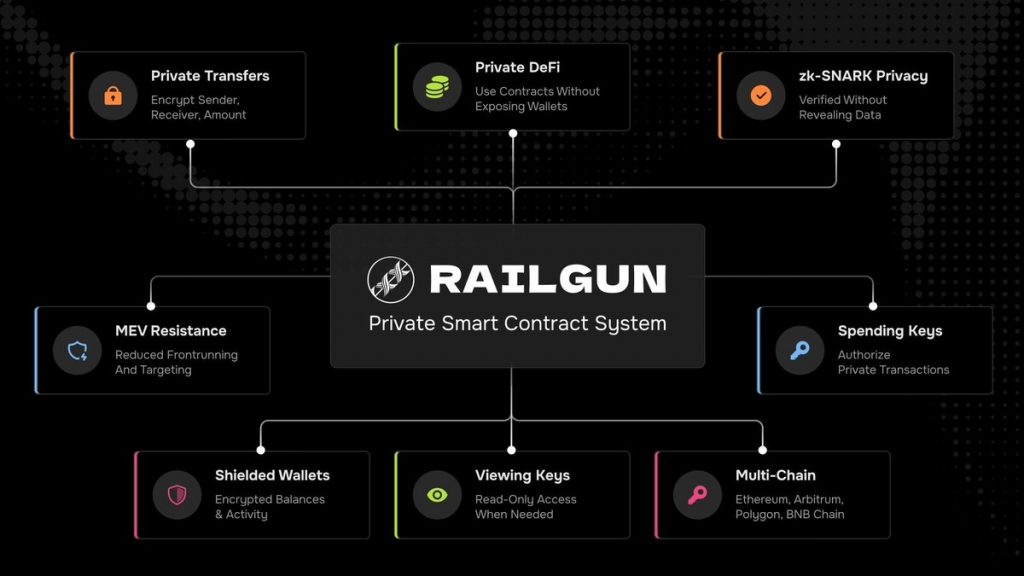
    Railgun is a privacy-focused smart contract system that shields transaction data directly on-chain. It conceals key details such as sender, recipient, token type, and amount using Private Balances, which form a shared anonymity pool.

    Transactions within the Railgun ecosystem appear to originate from this collective pool, making it challenging to determine who initiated a transfer or which assets were used.

    Privacy improves as more users participate, increasing the anonymity set. Popular tokens like USDC or DAI generally provide stronger privacy due to higher usage compared to less common assets.

    Railgun can be accessed through compatible wallets such as Railway Wallet, which supports zk-SNARK-powered private transactions without exposing balances.

    Key features:

    • Shields sender, recipient, token, and amount
    • Uses Private Balances to expand anonymity set
    • Privacy increases with user participation and TVL
    • Accessible via zk-SNARK-enabled wallets

    Are Bitcoin mixers legal?

    In many countries, Bitcoin mixers are not explicitly illegal. However, most do not implement Know Your Customer (KYC) or anti-money laundering (AML) procedures, placing them in a regulatory gray area.

    Unless a service is specifically prohibited, users typically won’t face legal consequences simply for using a mixer. That said, authorities have shut down numerous mixers over the years, and several operators have been arrested.

    While mixers can serve legitimate privacy needs, they are also used by criminals — for example, hackers attempting to launder stolen funds. This association has made them highly controversial.

    Notable enforcement actions include:

    • Bestmixer.io shut down by Europol and Dutch authorities (2019)
    • Bitcoin Fog operator arrested and charged in the U.S. (2021)
    • Tornado Cash sanctioned by OFAC (2022), with sanctions lifted in 2025
    • ChipMixer taken down by U.S. and German authorities (2023)

    Are Bitcoin mixers safe?

    Safety largely depends on the specific service used. Centralized mixers require trust that operators will not misappropriate user funds.

    It’s also important to recognize that mixing does not guarantee perfect anonymity. The effectiveness of privacy measures varies by implementation, and blockchain analysis tools continue to evolve. In some cases, investigators may still trace coins that have passed through mixers.

    Additionally, some cryptocurrency platforms and businesses may flag or restrict wallets associated with mixing services.

    Conclusion: Mixers address Bitcoin’s privacy limitations

    Bitcoin is pseudonymous rather than fully anonymous, and transactions can be traced under close examination. Mixing services aim to make blockchain activity more difficult to analyze, giving users greater financial privacy.

    However, because mixers are sometimes used for illicit purposes, they remain controversial and frequently attract regulatory scrutiny — even in jurisdictions where they are not outright banned.

  • Address Reuse Risk and Privacy Protection

    Address Reuse Risk and Privacy Protection

    Introduction to operational security and privacy objectives

    In the “World Standard” casino model—spearheaded by Casino The World (CTW) —privacy and security are the fundamental pillars of long-term player retention and platform integrity. In a pseudonymous ecosystem, protecting user identity is not merely a technical checkbox; it is a strategic competitive advantage that directly supports our “No-KYC” value proposition.

    For high-volume players, the assurance that their financial activity remains shielded from external monitoring is a primary driver of platform loyalty. The core objective of this guideline is to establish a rigorous operational framework to mitigate “address clustering” and “off-chain linkage.” By implementing these standards, we ensure that every transaction remains an isolated event, preventing the “breadcrumbs” of data that lead to deanonymization.

    As we prepare for the grand opening on January 20, 2026, these protocols will secure our current USDT flows and provide the foundation for our upcoming BTC and ETH expansion.

    Privacy definitions: Myth vs. fact

    Myth: Crypto payments are inherently anonymous.

    Fact: Transactions are pseudonymous. Identities are hidden until a link is made between an address and a real-world identifier.

    Myth: Only the amount is public on the blockchain.

    Fact: Amounts, addresses, timestamps, fees, and confirmation statuses are all public and searchable on-chain.

    Myth: Deposits cannot be tracked or linked.

    Fact: Through clustering and off-chain linkage, separate transactions can be grouped to reveal a user’s entire activity history. The transition from a secure environment to a compromised one often hinges on technical oversights in how these public data points are handled.

    Analysis of the threat landscape: Address clustering and linkage

    For a “No-KYC” platform, understanding blockchain forensics is critical to maintaining player trust. The primary threat to user privacy is not a breach of the database, but the inadvertent connection of separate transactions.

    As highlighted in the 2025 systematic literature review by Ziegler, Nowostawski, and Katt, blockchain privacy is systematically reduced through traceability and the revelation of off-chain context. Address Clustering is a forensic technique primarily impacting UTXO-based assets like Bitcoin. It involves grouping multiple addresses that likely belong to the same entity based on input spending patterns.

    For our current USDT infrastructure (TRC20, ERC20, BEP20), the risk shifts toward Account-Linkage. In account-based models, address reuse is the default behavior, making it significantly easier to map a player’s total volume, frequency, and “Lifetime VIP Rank” progression if a single transaction is tied to their identity. Off-chain Linkage acts as the bridge between this blockchain data and real-world identities. This occurs when “breadcrumbs” outside the ledger are tied to on-chain activity.

    Examples include:

    • Reused usernames or recycled email addresses.
    • Browser cookies and device fingerprints.
    • Support Interactions: Detailed messages or screenshots that provide the “context” needed to link a TXID to a specific user account. Exposure of these data points transforms an anonymous player into a target for external monitoring, financial censorship, or competitive mapping.

    Operational standards for deposit and address management

    A frictionless banking experience requires proactive address management to prevent data leakage. To protect our players from “Rank Anxiety”—the fear that their accumulated status and wealth could be targeted—we must automate the protection of transactional identifiers.

    The fresh address protocol

    While CTW currently supports USDT via TRC20, ERC20, and BEP20, our system is being future-proofed for the January 2026 BTC launch. The platform must enforce a Fresh Address Protocol, where a unique receiving address is generated for every deposit session. This prevents the “clustering” of a player’s total lifetime deposits into a single searchable address.

    Operational requirements for casino systems

    1. Mandatory Address Rotation: Systems must automatically generate a new identifier for every transaction. Users should be prompted to “Generate New Address” for each session to ensure isolation.
    2. Identifier Protection: Transaction IDs (TXIDs) and receiving addresses must be treated as sensitive public data. Protecting a TXID protects the player’s cumulative “assets,” including their Lifetime VIP Rank and SHOP Points.
    3. Visual Data Masking: Public-facing marketing, “Achievement” screenshots, and site tutorials (such as those rewarding 110 SHOP Points) must never display full addresses or QR codes. Masking these elements prevents third-party scraping and accidental sharing. By ensuring each payment is a “clean” transaction, we maintain the integrity of the “No Demotion” VIP ecosystem, ensuring a player’s cumulative success remains their private data.

    Protocol for support interactions and information leakage prevention

    The support desk is the most frequent point of “off-chain context” leakage. To maintain our privacy ecosystem, 24/7 live chat and email support must operate under a “Minimum Necessary Disclosure” mandate.

    Minimum necessary disclosure protocol

    Support staff should never request a full TXID or address in a public forum or unencrypted chat. Instead of using blockchain identifiers for verification, staff must use internal platform features:

    • Verification via Internal IDs: Use “Achievement IDs” or “Shop IDs” to verify mission completion (e.g., the 110 SHOP Point tutorial reward).
    • Factual Troubleshooting: Keep interactions minimal. If a deposit is missing, staff should only request the minimum data needed (e.g., the last four digits of the TXID or the specific time/amount) to locate the transaction internally.

    Data sharing blacklist

    The following must never be shared in public or forwarded in unencrypted support messages:

    • Full Deposit Addresses/QR Codes: These provide a direct map to the user’s wallet.
    • Full TXIDs: These function as searchable public receipts.
    • Unmasked Screenshots: Images showing the exact amount, timestamp, and address simultaneously create a high-certainty link to a specific identity. Support staff are directed to actively advise players to “keep receipts private” to ensure their long-term security.

    Verification standards: Aligning documentation with on-chain reality

    To achieve “World No. 1” status, our documented claims must withstand the scrutiny of blockchain forensics. Transparency in our “Stress-Free” banking promise is verified through the alignment of our Terms & Conditions (T&Cs) with observable on-chain behavior.

    Three-step verification guide for security auditors

    1. Claim Mapping & Licensing Compliance: Auditors must ensure that site documentation regarding payment speed and currency support (INR/USDT/Future BTC) aligns with Anjouan licensing standards. This includes verifying fund segregation and the “No-KYC” operational flow against regulatory requirements for fair play.
    2. On-Chain Consistency Audit: Monitor outgoing transactions to ensure payouts are automated and regular. Inconsistent wallet flows or manual bottlenecks suggest operational risks that contradict our “High-Efficiency” banking promise.
    3. Review Synthesis & Sentiment Analysis: Analyze user feedback for clusters of praise regarding payout transparency. As indicated by behavioral research, clusters of technical praise (e.g., “fast USDT-TRC20 processing”) are reliable indicators of platform health. Bridging the gap between “marketing impressions” and “on-chain facts” is essential for the crypto-native player. By adhering to these standards, Casino The World ensures a safer, clearer, and more professional journey for the global gambling community.
  • Holonym Foundation Acquires Gitcoin Passport to Build the Largest Proof of Humanity Network

    Holonym Foundation Acquires Gitcoin Passport to Build the Largest Proof of Humanity Network

    Key takeaways

    • Holonym Foundation has acquired Gitcoin Passport to establish the largest proof of humanity solution, surpassing Worldcoin’s identity proofs.
    • Gitcoin Passport will be rebranded as Human Passport and integrated with the Human Network’s Human Key technology.
    • The platform aims to enhance privacy, prevent Sybil attacks, and create a trusted on-chain identity system.

    A major step for decentralized identity and privacy

    Holonym Foundation has officially acquired Gitcoin Passport, a widely used Web3 identity verification platform, to build the world’s largest proof of humanity network. This move will integrate 2 million users and generate 34.5 million zero-knowledge (ZK) credentials, significantly surpassing existing identity solutions.

    Gitcoin Passport will now be rebranded as Human Passport, aligning with its expanded role in the decentralized identity space. By combining Holonym’s Human Key technology with Gitcoin Passport’s trusted identity verification, the system will provide a privacy-first solution for reputation management and Sybil resistance.

    “Digital identity that preserves privacy and allows individuals to control their data is the future of online interactions. Integrating Gitcoin Passport and launching human.tech is a major leap forward in empowering digital human rights.” —Holonym Foundation CEO and Co-Founder Shady El Damaty

    “Gitcoin Passport has always been about empowering individuals with tools to show off their human-ness in a privacy-preserving way.  With human.tech taking the helm, Passport is evolving into something even greater: an identity layer that champions human dignity, privacy, and verifiable trust on the internet. This transition strengthens our shared mission to build open, decentralized systems that serve people first.” —Gitcoin Passport Founder Kevin Owocki

    Strengthening Web3 security with zero-knowledge identity

    Gitcoin Passport has been widely adopted across major blockchain ecosystems, securing over $200 million in airdrops and providing Sybil-resistant reputation tools for more than 110 partners. By incorporating zero-knowledge proofs (ZKPs) into its infrastructure, Human Passport will enable private on-chain reputation management without exposing sensitive user data.

    With this integration, Holonym aims to provide Web3 users with a universal, censorship-resistant identity layer that improves trust, security, and access to decentralized applications, making it a critical tool in the human.tech suite

    The bottom line

    The acquisition of Gitcoin Passport is a major milestone for Web3 identity verification. By integrating zero-knowledge technology with a proven Sybil-resistance framework, Holonym Foundation is setting a new standard for privacy-focused digital identity solutions in blockchain ecosystems.

    As decentralized applications and fair token distributions become more critical, Human Passport is positioned to become an essential tool in securing trust, reputation, and digital autonomy in the Web3 space.

  • Is There a Future for Privacy Coins?

    Is There a Future for Privacy Coins?

    Although cryptocurrencies are considered anonymous, this is often not the case. Every transaction is recorded on the blockchain and this data is always available. That is, it is extremely possible for someone to contact the owner of a cryptocurrency wallet, provided a sufficiently powerful target is established.

    The first instance of this precedent occurred in 2011. The FBI conducted a unique operation against the famous online trading platform Silk Road. Ross Ulbricht, the founder of the company, was detained and sentenced to life in prison. During the operation, approximately 144,000 bitcoins were taken into custody.

    A hacker attack in 2021 crippled Colonial Pipeline’s computer systems. The attackers requested a ransom of 75 BTC. The FBI can detect and recover over 63 BTC. Former prosecutor Katherine Hone argues that it was the hackers’ use of cryptocurrencies that made this possible. They would have needed much longer to recover if they had used the financial system.

    In other words, there are many exaggerations regarding the privacy of cryptocurrencies. This is not true for all coins, however. Some coins claim to be completely private. In such networks, it is either difficult to track transactions or to link the wallet address to a specific user. Two of the most well-known and widely used privacy currencies are ZCash and Monero, available on Exolix to exchange.

    Complicated past related to privacy

    You could say something like this, paraphrasing the famous Murphy’s law: if a good concept can be ruined, someone will definitely do it. This is what happened with cryptocurrencies; they were and still are often used for illegal activities. It’s no surprise that Bitcoin continues to be an asset for money laundering.

    However, regulators aren’t particularly against it. The explanation is obvious: everyone can be tracked on the Bitcoin blockchain, which is transparent and has accumulated enormous amounts of data.

    Private currencies

    Private currencies have been struggling lately. It is still possible to convert USDT to XMR on centralized cryptocurrency exchanges, although the number of such sites is decreasing. Cryptocurrency exchanges are shunning private currencies, and this trend is only increasing.

    Recent events, most notably the restriction of Tornado Cash and the arrest of its creator, raise even more questions about the privacy implications of cryptocurrencies. The use of private coins is prohibited in some countries. Japan, South Korea and Australia prohibit the exchange of certain types of currencies.

    With the continued tightening of cryptocurrency regulations, especially requirements for KYC/AML processes, swaps using private currencies will become more complex. Naturally, investors are wary of the dangers associated with holding secret assets.

    Will private currencies exist in the future?

    There may be a future for private currencies, but it will not be clear and simple. Based on the technical analysis of the price chart, the price forecast for XVG seems to be quite optimistic. However, many things are really quite difficult to predict.

    The Tornado Cash ban did not affect the status of privacy coins. They have been stable and have even seen slight price increases. The US Treasury Department has stated that attempting to anonymize transactions could lead to serious complications.

    Since privacy coins are now undesirable, it is difficult to expect a more committed response to them. Anything, including making them illegal, could be the next step in their path at any time.

    This may not happen until such currencies are in low demand and become particularly user-friendly. Regulators are set to react as soon as their popularity begins to grow.

    Investing in private currencies still involves unknown risks and potential consequences. Those who want to invest in them need to keep a close eye on the news. It is possible that in the near future, holders will not be able to access their money.

  • COTI Launches a Privacy-Focused Developer Network and $40M Grant Program

    COTI Launches a Privacy-Focused Developer Network and $40M Grant Program

    Prominent blockchain project COTI has made news with its upcoming COTI V2 developer program. The program is geared towards introducing advanced privacy and security advancements to blockchain technology for the first time. The move marks a significant improvement in the blockchain industry, as this will likely promote increased use cases that were formerly thought impossible. 

    The COTI V2 developer network’s launch corresponds with a new program in the form of grants, which allows developers to experiment and build on the technology and get rewarded for doing so. 

    In order to super-charge growth, inspire developers to innovate with new use cases, and explore the full range of opportunities that can be provided by a privacy-centric Web3 ecosystem, the COTI Foundation has earmarked a total of 400M COTI tokens from the existing supply for a grant program.

    Commenting on this new development, Shahaf Bar-Geffen, COTI CEO said: 

    “We’re opening our doors to the world with the COTI V2 Developer Network, and with our Builders program we’re inviting teams around the world to take part in COTI V2’s developer network, and share what you’re building. We have an incredible year ahead of building new things, making new partners, and growing COTI’s network.”

    COTI launches ABC Growth Fund

    In order to drive rapid growth of ecosystems, COTI has launched the (A)mbassadors, (B)uilders and (C)reators – ABC Growth Fund, which offers grants for ambassadors, builders and creators in the form of 400 million COTI tokens equal in value to around forty million US dollars at the time of writing. The Builders programme incentivizes developers specifically to discover COTI V2’s privacy-preserving potential.

    The size of grants can range from $1k to $100K, depending on project objectives and potential impact. Interested developers can consider applying with proofs-of-concept (POC) for such areas as confidential DeFi, encrypted transactions, secure data management, privacy-enabled AI/ML, decentralized identity solutions etc using COTI V2.

    In addition to this, COTI has provided teams with all the tools they need to start working, like SDKs written in Node.js and Python, special access to servers, detailed documentation, testnets, faucets as well as a blockchain explorer.

    Conclusion

    The debut of this product signifies a significant landmark for privacy and security on the blockchain. Though initial driving forces for this technology include increasing accountability and transparency, new requirements have arisen concerning personal data protection, intellectual property rights and strategic information confidentiality.

    These will enable COTI’s solution to allow all parties involved in multiparty computation verify the results but encrypting all individual inputs plus interim results. This is a new development that allows unprecedented verifiable privacy in rich Web3 applications.

  • Blockchain Technology and Privacy – What Are the Most Popular Privacy Coins?

    Blockchain Technology and Privacy – What Are the Most Popular Privacy Coins?

    Blockchain Technology and Privacy - What Are the Most Popular Privacy Coins?

    Privacy-focused cryptocurrencies are designed to keep transactions and user data private. Although the cryptocurrency industry may seem from afar as an area where confidential and anonymous transactions are made, it is in fact a very transparent and public industry. Data from decentralized public ledgers stored on the blockchain are typically available to the broader public via blockchain explorers, thus making financial transactions easily tracked.

    Privacy coins make transactions and transfers on the blockchain untraceable and anonymous. By restricting anyone from monitoring your activities on the blockchain network, these projects allow you to remain anonymous in your transactions and transfers with your wallet. There are many methods that privacy coins use, and when they combine a few of these methods and integrate them into their network, the users and their transactions on the network become anonymous.

    Working Principle of Privacy Cryptos

    Privacy cryptos often use the zk-SNARK protocol on their blockchain. This protocol is a form of encryption called Zero-Knowledge Succinct Non-Interactive Argument of Knowledge. We can briefly describe this form of encryption as being able to prove that you know about a blockchain transaction without having to explain what that information is.

    In blockchains, every transaction is validated by validators and processed on the network. zk-SNARK allows transactions to be confirmed without sharing information such as amount, sender, and receiver. On the one hand, this concept increases privacy, on the other hand, it eases the load on blockchains and increases scalability. The zk-SNARK concept is used by many major blockchains, not just privacy tokens.

    Bitcoin mixer

    CoinJoin

    CoinJoin combines, mixes, and sends the cryptos from the sender address to the recipients in a single transaction. Each token sent reaches a new recipient address that has never been used. The new recipient address and wallet login information are sent to the recipients. This process simply reduces traceability.

    Tor

    We need an internet connection for transactions with cryptocurrencies. Sometimes, even if we transact with privacy cryptos, the platforms we transact with can monitor our IP address and see which wallet we own and which wallet we transfer crypto to. Most blockchains use Tor onion routing to hide our IP address with layers of encryption.

    Restrictions on Privacy Cryptos

    It is a known fact that privacy cryptos are frequently used for criminal activities. While it is everyone’s personal freedom to transfer money anonymously, there are many criminals who abuse it. The vast majority of ransomware attacks and dark web platforms use XMR as a means of payment. Of course, this does not mean that privacy tokens are only used by malicious people or criminals.

    Many countries have imposed restrictions on the use of privacy coins. These restrictions have reduced the trading volumes of cryptos serving in this area to very low levels. The US did not ban, but also did not approve, the use of privacy coins. Most Asian countries have banned the use of these coins. Privacy coins continue to be traded on cryptocurrency exchanges with requirements such as KYC and AML.

    Most Popular Privacy Coins

    There are more than 80 cryptocurrencies on the market, whose main focus is privacy. Let’s talk about the most popular of them and what they do.

    Monero (XMR)

    Monero is a privacy coin that makes it very difficult for people to track transactions on the network. Launched in 2014, Monero runs on a decentralized blockchain ledger. All transactions on the network, including which wallet sends to whom, when and how much crypto, is hidden by Monero’s cryptographic techniques.

    Transactions made in Monero can be viewed, but the network hides which wallet the funds came from and to which wallet they were sent. Three different technologies are used to ensure confidentiality in the network. Ring signature technology is a cryptographic signature technology that contains at least one signature from each real person, but which people in the group are unknown. The second technology is ringCT technology, which is used to hide the amount sent in blockchain transactions. The other technology is the secret address technology, which creates a one-time user address in every transaction. We have mentioned these technologies above.

    Zcash (ZEC)

    Zcash is a privacy crypto that aims to anonymize digital payments. The Zcash mainnet uses an encryption tool to keep transactions private. Setting out to be a better privacy crypto alternative than Monero, Zcash was launched in October 2016. ZEC attracted a lot of attention and demand when it was launched, raising as much as $3190 but fell to $30 after just 4 months.

    Zcash has a protocol that encrypts transaction information using zero-knowledge proof. This protocol, which enables transactions to be verified without seeing details of sent amount, sender and recipient wallet addresses, increased its efficiency with the Sapling upgrade enabled in October 2018.

    Decred (DCR)

    Decred is a privacy crypto created by modifying Bitcoin blockchain codes just like Monero. Having a community-based governance process, Decred works with both PoW and PoS consensus mechanisms at the same time. Decred was launched in early 2016. DCRDEX was developed in 2020 so that users can trade more easily on the network.

    Decred, using an interface called Politeia proposal system, allows all users in the community to submit proposals and vote anonymously. A security and efficiency-oriented algorithm called BLAKE-256 is used in the Decred blockchain. Decred has a blockchain explorer, but user identities are kept confidential as user privacy is prioritized on the network.

    Horizen (ZEN)

    Horizen is a platform that enables building private and public blockchains. Allowing users and companies to develop and publish dApps, conduct daily transactions and send encrypted messages, Horizen provides users with discretionary privacy through its protected transactions. Horizen uses zk-SNARK and end-to-end zero-knowledge encryption to securely send and store data, messages, and coins. The consensus mechanism of the network is PoW, while the mining algorithm is Equihash.

    Released in May 2017, ZEN is a hard fork of ZClassic that emerged as a result of the Zcash fork. Like Zcash, Horizen has been a blockchain that prioritizes a high level of privacy. There are two dApps called Sphere and ZenChat that can be used for private messaging on the network. Horizen Academy, Horizen Early Adopter Program, and Horizen Developer Enviroment are other initiatives of the platform.

    Secret (SCRT)

    Secret is a blockchain network based on the Cosmos SDK. Secret is a more innovative project than other privacy-focused projects. This blockchain, which receives more frequent updates and keeps up with the trends, is the only one among the projects on the list to support NFTs.

    The blockchain, which runs privacy-focused smart contracts, has an inter-chain bridge called Secret Bridge. Thanks to this bridge, it is possible to interact with BEP-20 and ERC-20-based tokens. Trading can be done simply on SecretSwap, which works as an AMM and DEX on the network. Stashh is the blockchain’s NFT marketplace. Users will be able to buy and sell NFTs anonymously on Stashh.

    Private tokens on the network use the Secret blockchain-specific SNIP-20 token standard. For NFTs, the SNIP-721 standard is used. The privacy features of Secret Network’s smart contracts also cover NFTs. NFTs have hidden metadata, their owners are private, and only those who have been granted access can view the content. Secret is the best network, especially for NSFW content.

  • NTH’s User Data Reward Token Lists on ProBit Global

    NTH’s User Data Reward Token Lists on ProBit Global

    The token of the NTH platform which seeks to break data monopolization and reward users for their data usage has been listed on ProBit Global.

    The NTH token is used to compensate for user privacy. Users get rewarded with NTH for voluntarily providing their geolocational information and uploading as much quality content of interest on the NTH platform which combines donation, advertisement, and commerce activities based on data accumulated from users.

    The NTH platform taps into the power of social media platforms like Facebook which generate profits by attracting content creators frustrated by an inability to generate a fair share in line with their efforts. These content producers also often get exposed to unsolicited advertisements whose profits have been mostly monopolized by Facebook and Google.

    The NTH platform aims to address the reckless use of users’ privacy to generate profits without returning compensation to the users. It wants to deal with issues like data imbalance or distortion as it contributes to improving a data transaction and donation ecosystem.

    As data gathered from users is shared on the platform, rewards in NTH tokens are issued proportionately to a user’s data usage according to other users’ evaluations, its use for customized advertisements, or any other activity connected to the ecosystem.

    The NTH token is also to be used as a currency for donations, investments, ads, and e-commerce transactions. It will play a key role in empowering the NTH service platform to achieve its overall goal to build a fair data reward system that decentralizes secondary copyrights and improves trust for universal human values.

    ABOUT NTH

    The NTH token is the medium of exchange for associated services on the NTH blockchain-based data transaction platform to create an organically-linked system. It connects the NTH ecosystem as it aims to realize decentralized data capitalism for all people who produce and consume data for donations, advertisements, and related transactions to benefit.

    ABOUT PROBIT GLOBAL

    ProBit Global is a Top 20 crypto exchange worldwide servicing crypto enthusiasts with unlimited access to trade and buy Bitcoin, Ethereum, and 800+ altcoins in 1000+ markets.

    PROBIT GLOBAL IS A BRAND TRUSTED BY MILLIONS OF USERS

    • 200,000+ community members
    • 1,000,000+ monthly active users
    • 3,000,000 monthly web visitors
    • 50,000,000 users on partnering aggregators and wallets
    • The user interface of the multilingual website supports 46 different languages
    • Marketing and community support in 11 key languages

    Join our active programs and get huge benefits!

    1. Trading Fee Discount: Buy PROB, pay trading fees with PROB & get as low as a 0.03% trading fee

    2. Referral Program: Earn 10-30% of trading fees for referring friends to ProBit

    3. ProBit Exclusive: Subscribe to 50% off the Top 200 tokens

    4. Auto Hold Campaigns: Hold tokens and get 6% annualized returns

    ProBit Global: www.probit.com

    ProBit Telegram: https://t.me/ProbitEnglish