Cryptocurrency investing can be both enthralling and intimidating for a new investor due to the vast possibilities. The plethora of coin options in the market and volatility also means every decision counts. You stand a chance for success when you develop the right strategies and base your actions on real-time information. These five tips will assist you in multiplying your investment in the digital world.
1. Educate yourself before investing
It is essential to have a broad scope of everything from cryptocurrency functionality to trading strategies. You also want to have a clear image of the characteristics and potential of every crypto in terms of aspects such as volatility and consensus mechanism. All this knowledge will contribute to your sound decision-making when trading.
Understanding the dangers associated with it is also important. A reality that most first-time traders struggle with is the fluctuations of the cryptocurrency market and their volatility. Understanding security threats, market trends, and regulations can do wonders and allow you to avoid costly mistakes.
2. Start small and diversify your portfolio
As a novice, beginning with a small sum of money you can afford to lose is advisable. Crypto markets are volatile, and investing a large sum of money immediately can result in heavy losses. Start small and build up gradually as you become more familiar with the territories.
Diversification is also crucial; do not put all your money in one cryptocurrency. Spread it over a portfolio of different assets. While keeping risk low, it also maximizes the possibility of making money on various price movements.
3. Analyze real-time price trends
Prices fluctuate constantly depending on the market demand, events around the globe, and new technologies that become available. Analyzing tools and monitoring real-time crypto prices enable you to make decisions using past and existing data.
Understanding market behavior is looking at the key indicators and viewing statistics over time. Looking at the XRP price and its past pattern, for instance, one can tell whether it’s a good investment. Focusing on trading volume and sentiment analysis can inform you when to buy and sell.
4. Choose a reputable and secure exchange
Look for sites with a good reputation that are easy to use and have robust security measures. Features like 2FA, cold storage, and top-level encryption can all protect money from fraudsters and hackers.
Compare different fees on transactions, liquidity, and customer support for the different platforms. Some sites allow many currency pairs, while others allow only a specific cryptocurrency. Choose the right cryptocurrency exchange such as Kraken since they are regulated and centralized.
5. Secure your investment with proper storage
Leaving funds on an exchange is risky due to cyberattacks and exchange failure. You can use a hardware wallet or reputable software wallet with excellent security to secure investments. Private keys unlock your cryptocurrency holdings, so never share them with anyone else.
Store them in locations that are difficult to access, and take advantage of multi-signature security as often as possible. You must also be watchful of phishing attacks and malicious actors targeting new investors. This also includes avoiding compromised sites to avoid the risk of losing logins.
Endnote
When considering crypto trading, it’s essential to know that your success will be based on several factors, including your choice of platform and strategies. For instance, you may need to start slowly and increase your volume as you gain experience. It’s also important to be responsible and constantly updated on the trends that reflect your decision-making.
The Quantum Financial System (QFS) is the name for a theory that stipulates the global financial infrastructure will be migrated to a new system based on cutting-edge technologies such as quantum computing, artificial intelligence, and blockchain.
It’s important to make it clear that the Quantum Financial System theory is not based on any officially recognized or public financial system. Also, the evidence suggesting that such a system is actually being established is tenuous at best.
In this article, we are going to examine the current state of the Quantum Financial System and look into when we might see its real-world application.
Key takeaways:
The Quantum Financial System (QFS) is theorized to be a new financial system utilizing quantum technology, yet it lacks official recognition and substantive evidence for its existence.
The QFS proposes to revolutionize banking and monetary transactions by replacing traditional systems with AI, quantum computing, and blockchain technologies.
Financial institutions are exploring quantum computing to enhance efficiency in tasks like asset classification, fraud detection, and risk management.
As of now, no bank uses a system resembling the QFS, but some are investing in quantum computing, with blockchain technology also seeing increasing interest.
Quantum technology in finance could vastly improve computational power and security, but faces challenges such as high costs and the need for specialized skills.
What is the Quantum Financial System (QFS)?
QFS can best be described as a conspiracy theory that suggests a new quantum technology-based system will be established to replace the existing global financial system. According to the QFS theory, the system will result in fundamental changes to the way banking and monetary transactions function.
However, theories about how the Quantum Financial System will be implemented from a technical perspective lack detail and are largely based on speculation. The general consensus is that QFS will replace current major financial systems such as SWIFT by leveraging the capabilities of artificial intelligence, quantum computing, and blockchain.
According to research from IBM, financial institutions are already exploring how quantum computing could help them perform highly complex financial calculations at drastically increased speeds. In addition to competing in the markets, quantum technology can also help companies be more efficient in compliance and risk management, per IBM:
“Several types of challenges face financial services firms that quantum computing may address. These challenges include the classification and selection of assets, customers, and vendors by default risk, as well as the detection of fraud, money laundering, or other criminal activities by finding complex variable relations.”
In markets where milliseconds can make a crucial difference, being the first to take advantage of quantum computing could translate to huge profits.
Theoretically, the QFS has the potential to transform our monetary interactions significantly. The Quantum Financial System aims to manage all transactions through a sophisticated AI system, which would eliminate the necessity for banks and financial institutions to act as intermediaries in transaction handling.
An additional noteworthy attribute of the QFS is its purported resistance to encryption breaking by quantum computers. This feature gains importance because quantum computers, owing to their vast computational capabilities and innovative processing techniques, have the potential to break existing forms of encryption entirely. This could lead to a complete redefinition of how data is secured in the digital realm.
Do banks use the Quantum Financial System?
Currently, no bank is using a payment or financial system that matches the properties described by the Quantum Financial System theory. However, some of the world’s largest banks, including JPMorgan and Goldman Sachs, have made investments in quantum computing research. For example, Goldman Sachs researchers are exploring how quantum computing could be used to price financial instruments more quickly and efficiently.
One common aspect of the Quantum Financial System and related theories is blockchain technology. Compared to quantum computing, blockchain technology is already mature enough to be used in commercial applications, although its adoption has been relatively limited thus far.
Still, many central banks around the world are exploring how blockchain technology could be used as the basis for central digital bank currencies, or CBDCs. These would be fully digital fiat currencies that could be transferred more efficiently and potentially be accessible to a wider group of people.
According to the Atlantic Council, around 130 countries are exploring a CBDC, although only 11 programs have been officially launched so far. Most CBDC projects are currently in the research or development phases.
Map showing countries where the central bank has either launched or is exploring a central bank digital currency (CBDC). Image source: Atlantic Council
When will the Quantum Financial System launch?
There is no set timeframe for the launch of the Quantum Financial System. In fact, it’s not even clear if any private or public entities are actively engaged in developing a practical implementation of the QFS.
However, it is noteworthy that financial institutions are actively involved in individual components of the QFS. Many banks and other corporations are working on ways to use quantum computing systems, implementing AI models, and employing blockchain technology to enhance the security of financial transactions.
Quantum computing technology is not mature enough to be used on a wide scale in commercial applications. Per IBM, quantum computing is still “a few years away from having a huge impact on the financial services industry.” However, the sheer increase in performance that quantum computing promises means that many of the leading financial institutions are already investing resources into researching how they can benefit the most from this technological breakthrough.
Despite the infancy of quantum computing, we have been seeing meaningfull improvements in this technology lately. Notably, Google has introduced their Willow quantum chip, which exponentially reduces errors as the number of qubits increases. This is a major step towards adressing a critical challenge in quantum error correction, which researches have been trying to fix for the past 3 decades.
As a show of its power, the Willow chip was able to perform the RCS (random circuit sampling) benchmark in under five minutes. To compare, this same computation would take 10 septilion (10 to the power of 24) years for current computers to complete.
Willow performed benchmark task, random circuit sampling, in under 5 minutes that would take the world's fastest supercomputer 10 septillion years – longer than the age of the universe. Click the link to learn more about Willow: https://t.co/LzVcei6y90#QuantumAIpic.twitter.com/3mpw4g4Mu1
The Quantum Financial System is not a clearly defined concept, so it’s difficult to say which investments could benefit from such a technology becoming commonplace. Potentially, you could get some exposure to the benefits of quantum computing in the financial industry by investing in financial industry companies that have made investments into quantum computing research—examples include JPMorgan and Goldman Sachs.
Some members of the cryptocurrency community claim that cryptocurrencies that are compliant with the ISO 20022 standard will be utilized within the QFS.
ISO 20022 is a global standard for financial messaging, serving as a universal framework for the exchange of electronic information between financial institutions and international payment systems such as SWIFT. This standard establishes a shared language and structure to enable efficient communication in the world of finance. Examples of ISO 20022-compliant cryptocurrencies include XRP, Stellar, Quant, and Algorand. Here’s the full list of ISO 20022-compliant cryptos:
Please keep in mind that there is very little actual evidence that cryptocurrencies that are compliant with ISO 20022 are planned to have an important role in a future global financial system. Such theories are usually largely based on speculation, and we don’t recommend making any investments based on them.
What are the benefits and drawbacks of using quantum technologies in finance?
New technologies introduce don’t only bring opportunities, but risks as well. Let’s quickly summarize some of the main benefits and drawbacks of uisng quantum technologies in a financial industry context.
The benefits of quantum technologies in finance
A significant increase in computational power would allow tasks like risk management, portfolio optimization, and trading strategy simulation to be performed much faster, even if a very large data set is being used.
Quantum computing technology could bring huge improvements to quantitative modeling, allowing models to implement a larger number of variables and more complex relationships between variables.
Quantum computing technology could make high-frequency strategies even more efficient, allowing large amounts of data to be processed quickly and used to execute trades.
Potentially, quantum computers could implement more powerful forms of cryptography that would improve the safety of sensitive financial information.
Quantum algorithms could accelerate option pricing models, leading to faster and more precise valuation of financial derivatives.
The drawbacks of quantum technologies in finance
Before the technology matures, quantum computers are likely to be very limited in number and extremely expensive.
There is a lack of standardized algorithms that can take full advantage of quantum computers.
Creating production-ready systems that utilize quantum computing would likely require financial institutions to hire large numbers of highly-qualified developers and researchers.
The bottom line
The Quantum Financial System, as a concept, is mostly discussed by various conspiracy theories proposing its potential to supplant existing financial systems and eradicate banks as intermediaries, replacing them with AI to oversee transactions. Although this notion may sound intriguing, there is currently no credible evidence to suggest that anyone is actually trying to implement such a system.
While the QFS itself remains uncertain, the integration of quantum technologies into the financial sector presents notable advantages and is something that will likely become commonplace in the future when quantum computing technology matures.
One company that’s often mentioned in discussions around Quantum Financial Systems is Ripple. If you want to learn more about this promising fintech company, make sure to check out our article discussing Ripple’s potential IPO.
The introduction of Bitcoin (BTC) in 2009 transformed the world’s perception of asset management and upended the financial system.
In today’s age of Blockchain, the financial sector is transforming how it manages transactions. This increases the appeal of cryptocurrencies, supported by the anticipated economic recovery.
However, we cannot ignore the volatility of cryptocurrencies, so we will give you some strategies to balance your crypto and traditional investments.
The Rise of Blockchain and Its Impact on Asset Management
Blockchain technology has always been a staple for the cryptocurrency market. As a digital ledger, it stores all crypto transactions to track the market changes while hiding users’ identities.
Analysts estimate the total spending on blockchain solutions will reach $19B by FY24. Meanwhile, its market size is projected to expand to $1.2T by FY30 at a compound annual growth rate (CAGR) of 82.8%. Of these, 9% are attributed to the distributed ledger system due to higher demands for smart contracts, immutable records, and supply chain audits.
These are the challenges and opportunities financial systems can get from blockchain technology.
Opportunities in Blockchain
The capital market is the primary recipient of blockchain technology’s positive spillovers. Among these advantages, asset identification will be the crown jewel. It will be safer to trade stocks online as it will be easier for investing platforms to record and check asset ownership and maintenance history.
Asset tokenization will also apply to other investment types. With blockchain, digital tokens will represent investors’ ownership or rights to these assets. This tokenization will enable fractional ownership and improve liquidity for investors and asset issuers.
Additionally, blockchain will make it easier to execute trade orders. This can be supported by smart contracts to automate transactions without a third party like a broker. Investors can manage orders, apply for bank loans, and do cross-border transactions automatically and quickly. As such, there will be lower costs and a shorter waiting time for transaction completion.
More interestingly, blockchain can be integrated into IoT devices, enabling you to track and analyze real-time information on asset management and market changes. That way, you can execute prompt and data-driven responses whenever and wherever you are.
Challenges in Blockchain
The main challenge in blockchain technology revolves around security issues. Due to cryptographic deficiencies, consensus system problems, and smart contract glitches, it can also be vulnerable to cyber attackers.
Another potential problem is the increased energy consumption. This will be more evident in investors mining cryptocurrencies. It can affect electric bills and device depreciation. As such, they may face other expenses when using blockchain for their portfolio management.
Balancing Cryptocurrencies and Stocks
As stocks and cryptocurrencies heat up, returns become more attractive, but risks must not be discounted. Here are some ways to balance your crypto and stock investment.
Assess your risk appetite and goals
Both cryptocurrencies and stocks have inherent risks associated with high volatility and sensitivity to macroeconomic changes. Cryptocurrencies are at least thrice as volatile as stocks, making them riskier. However, their historical returns are much higher, making them viable investments.
Given this, you must assess your risk tolerance and investment goals. Doing so can help you create an efficient capital allocation that minimizes risks and derives decent gains.
Use financial metrics
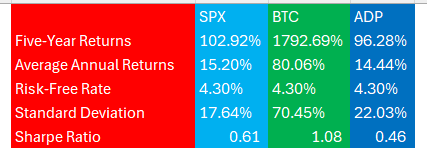
In connection with the first tip, you must measure and compare their returns and volatility by using specific financial metrics. Sharpe Ratio can be helpful with Efficient Allocation Frontier to help you make particular allocations.
The table below shows Bitcoin’s performance relative to the S&P 500 (SPX) and Automatic Data Processing, Inc. (ADP).
Computed by the Author
Concerning returns, Bitcoin is the apparent winner. However, investors must be aware of its volatility. Its price can change by 70% in less than a month. As such, it is essential to consider balancing cryptocurrencies with traditional investments like stocks to manage risks and returns efficiently.
For a more specific allocation, we can use the Efficient Frontier.
Computed by the Author
The optimal allocation is 40% to Bitcoin and 60% to ADP. That way, risk and returns will be balanced. The capital allocation line, represented by the orange line, proves this. The 100% point is tangent to the efficient frontier’s allocation.
Watch out for market trends
As investors, we must continually update ourselves on recent market and macroeconomic trends. We have seen how inflation has affected stocks and cryptocurrencies in the past four years. Hence, we can take immediate action, such as buying and selling investments at an optimal price.
Takeaways
Trading cryptocurrencies today can be more profitable than you think. With the recovering economy and increasing popularity of blockchain, more opportunities will come along the way. Yet, risks remain apparent, which should require investors to diversify their portfolios. Hence, venturing into traditional investments can help optimize investment management.
July 12, 2023, Korea—In a significant development within the blockchain and cryptocurrency ecosystem, Bluehelix, a prominent blockchain technology company, has recently invested a substantial $2 million in the Nirvana Crypto project. This strategic investment aims to foster innovation, strengthen collaboration, and contribute to the growth of the blockchain industry. Bluehelix’s commitment to supporting emerging projects like Nirvana demonstrates its dedication to advancing the adoption and development of blockchain technology.
Bluehelix: Empowering the Blockchain Industry
Bluehelix is a leading blockchain investment company that provides a wide range of solutions and services to empower the global blockchain industry. With a focus on decentralized finance (DeFi) and decentralized exchanges (DEXs), Bluehelix offers state-of-the-art infrastructure, technology, and tools for developers, institutions, and enterprises to build and operate blockchain-based applications. By leveraging its cutting-edge technology, Bluehelix aims to enhance the efficiency, security, and scalability of blockchain networks, facilitating broader adoption across various industries.
Nirvana: Revolutionizing Decentralized Finance
Nirvana is an ambitious project that seeks to revolutionize the decentralized finance landscape. Built on the blockchain, Nirvana aims to create a comprehensive ecosystem that enables users to access a wide array of decentralized financial products and services seamlessly. By leveraging blockchain’s inherent transparency and security, Nirvana envisions creating a trustless and permissionless environment where users have complete control over their financial assets and transactions.
The project focuses on providing solutions in areas such as decentralized lending and borrowing, automated market making, yield farming, and staking, among others. By combining cutting-edge technology, innovative financial models, and a user-centric approach, Nirvana aims to bridge the gap between traditional finance and decentralized finance, offering a compelling alternative to traditional financial systems.
The Strategic Investment
The $2 million investment by Bluehelix in the Nirvana Crypto project signifies a significant step towards fostering collaboration and growth in the blockchain industry. Bluehelix’s decision to invest in Nirvana demonstrates its recognition of the project’s potential to disrupt and reshape the decentralized finance landscape.
This strategic investment provides Nirvana with vital financial resources to accelerate its development, expand its team, and further enhance its ecosystem. Additionally, the partnership with Bluehelix offers access to valuable expertise, resources, and industry connections, enabling Nirvana to navigate the challenges and opportunities of the evolving blockchain landscape more effectively.
The collaboration between Bluehelix and Nirvana is expected to yield synergies in various areas, such as technology integration, product development, and market expansion. By leveraging Bluehelix’s robust infrastructure and technical capabilities, Nirvana can enhance the performance and scalability of its platform, while also tapping into Bluehelix’s vast network of partners and customers.
Future Implications and Conclusion
Bluehelix’s $2 million investment in the Nirvana Crypto project is a significant development in the blockchain industry. It highlights the growing interest and support for emerging blockchain projects and signifies the industry’s continuous drive for innovation and collaboration.
This partnership between Bluehelix and Nirvana is poised to unlock new opportunities, push the boundaries of decentralized finance, and drive mainstream adoption of blockchain technology. As both companies work together to advance the development of their respective platforms, the broader blockchain community can expect to witness exciting advancements and breakthroughs in decentralized finance.
With Bluehelix’s investment, Nirvana is well-positioned to make substantial strides in its quest to revolutionize the decentralized finance landscape. As the blockchain industry continues to evolve, strategic partnerships and investments like this are vital in fueling innovation and accelerating the adoption of blockchain technology across various sectors.
As Bluehelix and Nirvana embark on this collaborative journey, their efforts serve as a testament to the transformative potential of blockchain technology. The investment demonstrates the industry’s resilience and determination to shape a future where decentralized finance is more accessible, transparent, and inclusive. Media contact : info@nirvana-project.com
Cryptocurrency tokens are digital assets that are built on top of a blockchain. They represent ownership of a specific asset or utility, such as the right to use a platform or participate in an event. These tokens can be bought, sold, and traded on various online exchanges. There are two main types of cryptocurrency tokens: utility tokens and security tokens. Utility tokens provide users with access to a product or service, while security tokens represent ownership of a company or asset. The value of cryptocurrency tokens is determined by supply and demand on the market, and they can fluctuate significantly in price. Many people see cryptocurrency tokens as a potential investment opportunity, while others view them as a way to facilitate transactions and exchange value.
WEFE – The Wolfcoin
The WEFE token has fundamentally changed how bitcoin tokenomics are thought about and used since it combines a coin and a bot in one handy package. This innovation, which merges two tasks into one, has drawn a lot of attention from cryptocurrency enthusiasts in general. The WEFE bot will function as a promotional tool on the Telegram network that other users may utilize. It allows tokens to immediately have a “raider bot” in their channel and group, and that bot can be set up to broadcast messages that emphasize the hashtag or cashtag you want to pay attention to on a regular basis. This makes it possible for tokens to have a “raider bot” right away. With the help of the WEFE bot, virality and word-of-mouth propagation are both made considerably easier. The WEFE bot will constantly pick up new information and update itself with it.
First, the adoption and usage of cryptocurrency and blockchain technology has been steadily increasing over the past few years, and this trend is expected to continue in the coming years. As more individuals and businesses begin using cryptocurrencies for transactions and as a store of value, the demand for cryptocurrency tokens is likely to increase, which could potentially lead to price appreciation.
Second, cryptocurrency tokens have the potential to offer high returns on investment. While the value of cryptocurrency tokens can be volatile, some investors have made significant profits by buying and holding onto tokens for the long term. It is important to note, however, that investing in cryptocurrency tokens carries risks and it is important to thoroughly research and carefully consider your options before making any investments.
Third, investing in cryptocurrency tokens can provide diversification for your investment portfolio. As cryptocurrency tokens are not correlated with traditional asset classes, adding them to your portfolio can help to reduce overall portfolio risk.
Fourth, investing in cryptocurrency tokens can provide access to new and innovative technologies and projects. Many cryptocurrency tokens are issued by startups that are working on cutting-edge technologies and solutions in various industries, such as healthcare, supply chain management, and finance. By investing in these tokens, you can potentially gain exposure to and benefit from these developments.
WEFE is expected to start its bull run with an incredible boost. Being a decentralized token, its liquidity can be burnt and all contracts can be renounced. Thus, it promises amazing returns to all investors.
Advantages of a telegram bot
Telegram bots are automated programs that can perform a variety of tasks on the Telegram messaging platform. There are several benefits to using a Telegram bot:
Convenience: Telegram bots can perform tasks for you automatically, saving you time and effort.
Customization: Telegram bots can be customized to perform specific tasks or provide specific information, making them a useful tool for businesses and organizations.
Integration: Telegram bots can be integrated with other services and platforms, allowing you to automate processes and streamline workflows.
Scalability: Telegram bots can handle a large number of requests and tasks simultaneously, making them suitable for handling high volumes of traffic.
Accessibility: Telegram bots can be accessed from any device that has the Telegram app installed, making them a convenient option for users on the go.
Overall, Telegram bots can be a useful tool for automating tasks, improving efficiency, and enhancing communication and organization. This is where WEFE is extremely handy to all investors. By promoting ads with the “word of mouth” strategy on telegram, twitter and other social media sites, this token highlights all posts based on the “hashtag”.
Disclaimer: This is a sponsored article. The views and opinions presented in this article do not necessarily reflect the views of CoinCodex. The content of this article should not be considered as investment advice. Always do your own research before deciding to buy, sell or transfer any crypto assets.
It can be scary for small investors to find themselves in this swirl of bankruptcies and volatility now engulfing the crypto sector. To survive this prolonged market dip you don’t have to be the most sophisticated crypto owner – just follow our hard-won but simple adaption strategy.
3 Steps to Go Out of The Crypto Winter Safe and Sound
1. Only go in for investments that you can afford to lose
The bear will not be here forever — one day the market will bounce, as it always does, so buying the dip strategy may be enticing.
Remember that there are no guarantees in the crypto market — the exact price movements of particular currencies are unpredictable. The coin you believe in may rise and shine, but make sure that if it won’t, you will be a little upset and nothing more.
2. Get passive income
Harsh market conditions are not the reason to stop accumulating your capital. Choose low-risk types of investments – during the winter it is better to have a stable income than go right into the blizzard. You can consider yield farming, staking, or liquidity mining, but the safest option is to find a platform for hodling with a steady high APY that will allow you to grow your digital assets consistently and foreseeably.
Choose user-friendly and transparent platforms, where you can clearly see the number of coins you will get and the payout dates.
3. Become a bear
I bet you didn’t see that one coming, but yes. To overcome the bear market you should become a bear yourself. To be more precise, you need to copy their strategy for surviving the winter — hibernation.
You don’t actually have to sleep for months, but you should slow down, take a deep breath and minimize your crypto activity. Stop checking price charts again and again. Delete portfolio tracking apps.
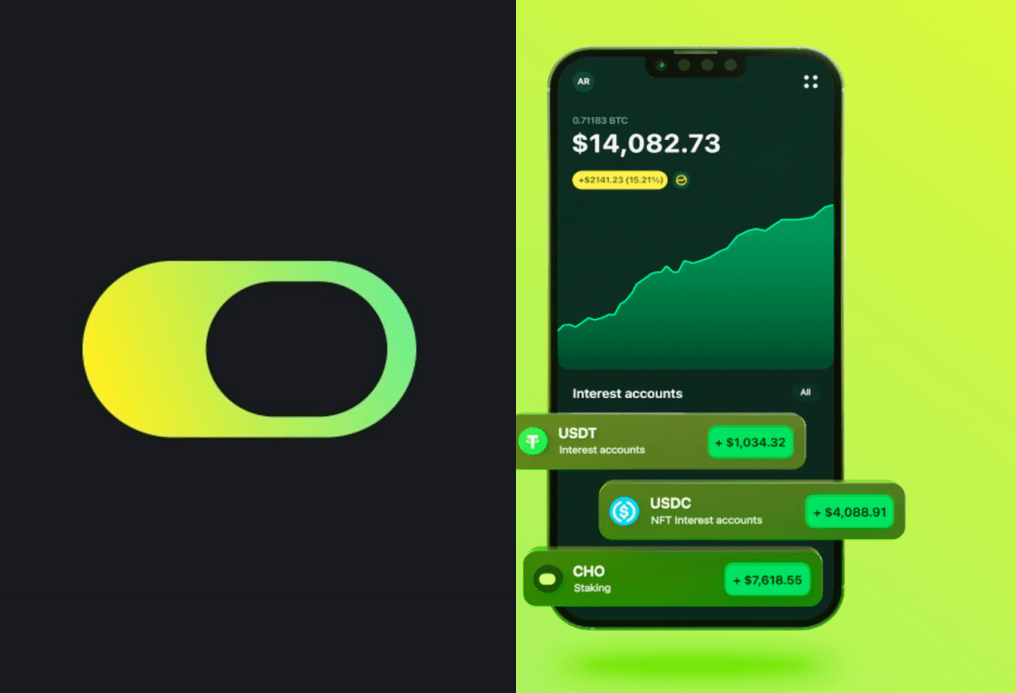
Keep earning on crypto, but do it smart, not hard. Use crypto platforms that offer a wide range of functions for hodlers. Compound interest will satisfy your lust for constant income growth. Weekly payouts will help you stay calm seeing the influx of money you make from crypto doesn’t stop. A great example of such a helpful toolset is represented here.
Take your mind off trading: do some sports, meet a friend. At the end of the day, real wealth is not the one in your crypto portfolio, right?
London, November 7, 2022—Crypto-banking innovator Choise.com is preparing a major assault on the $250B crypto earnings sector and is opening its equity book for those who want to be part of the journey. Via the Seedrs crowdinvesting platform, Choise.com is offering a limited supply of equity to Seedrs and own platform users. The public launch has already taken place on November 7th, and parties interested in becoming investors need to be quick, as this opportunity closes a month from now, on December 7th.
Choise.com is currently raising a round of $33M, less than 20% of which is being made available to the public, with the rest being taken up by institutional investment funds, of which a significant share is already confirmed.
Choise.com simplified crypto-banking, being one of the first companies in the world to enable payment for goods and services with a crypto debit-card. Exchange, buy and sell followed soon thereafter. The company even offers these services to other companies so that they can in turn offer Choise.com solutions to their own customers, but under the partner’s brand. Who knows, perhaps you already use Choise.com solutions and don’t even know it.
Now Choise.com is going to simplify the almost impenetrable world of crypto earning. There are great returns to be made in crypto deposit accounts, but for the average person, it is just too complicated. Who has the time or knowledge to search the entire market for all the best offers, move tokens across different blockchains, read smart contracts, and so on?
As a matter of fact, Choise.com does. All its users have to do is decide how much and for how long, and perhaps, if they are adventurous, where. From there Choise.com will handle the internal processes so that users don’t have to worry about complex details. Like this, they gain opportunities to earn on their crypto assets without too much fuss.
Beta testing is complete. More than 1,000 users over the course of 6 months had average returns of 10% or more. This product is now being integrated into the already popular Choise.com App, as well as a standalone service for institutional treasury managers.
The Choise.com team is led by Vladimir Gorbunov who has a successful track record of managing fintech projects. Just in the field of crypto, the total capitalization of Vladimir’s projects exceeded $1B at the beginning of 2022.
And he has support from some impressive individuals. Austin Kimm is a fellow co-founder of Choise.com and is no slouch to creating value, having set up several insurance groups including a pensions company that sold for approximately $200M just 3 years after launch.
Acting as advisors to the company are Young Cho, a financial expert with over 24 years of experience in banking and crypto startups, and Brad Simmons, a marketing professional with a proven track record of building large-scale consumer products and solutions.
Together, they bring a degree of expertise to underlying asset management as well as marketing.
The raised funds will be put towards user expansion, where Choise.com plans to increase its user base in 2023 from the current 750,000 to over 2M registered users. In addition to that, the funds will be used to build out products and services, especially the sales infrastructure around institutional treasury, which currently makes up the bulk of the earn market.
“Over the last 5 years we have invested more than $50M into the development of leading crypto market positions in key segments, particularly payments and B2B solutions. But with the next bull run just around the corner, we believe the time is right to capture a share of the highly lucrative and relatively unoccupied earning sector. You build when the markets are down, and strike when the markets are up. We’ve done the build, we are now preparing to strike,” – commented CEO & Founder of Choise.com Vladimir Gorbunov.
Choise.com has already achieved impressive results on Seedrs. In 2021 the company raised over €3.1 million from European investors. The initial fundraising target of €1 million was hit in just 36 hours and eventually closed with an astounding 210% overfunding from investors.
The integration of Uplift DAO and MoonPay combines traditional investment methods with web3 projects
This partnership will allow investors to easily invest in web3 projects on the Uplift DAO Launchpad
Uplift DAO’s integration of MoonPay aims to remove the barrier to accessing web3 investment opportunities
Uplift DAO integrates MoonPay, enabling easy payments for web3 investors
Uplift DAO, a crowdfunding platform for popular web3 projects, has announced a partnership with web3 infrastructure firm MoonPay. This collaboration will pave the way for traditional payment methods to be used to invest in web3 projects.
Using cryptocurrencies and stepping into web3 is still too complex for many potential participants. Furthermore, most initial investment funds do not accept traditional investment methods and have a high investment amount which drives many investors away from the sector. With the combination of Uplift and MoonPay, many individual and institutional investors will be able to invest using easily accessible payment methods.
The MoonPay platform’s payment infrastructure will allow all users to convert between fiat, cryptocurrency, and NFTs using traditional payment methods such as debit and credit cards, local bank transfers, Apple Pay, and Google Pay. The users will be able to purchase more than 100+ assets on the Uplift DAO platform and be among the early investors in web3 projects. In addition, the platform will allow participation even with an amount as low as $ 100.
Oliver Jeffcott, senior business development manager at MoonPay, commented:
“Our industry needs capital to continue to evolve. Our partnership with Uplift will make it even simpler for people to get involved in financing projects they believe in and reap the benefits of the growth of web3.”
Irina Berezina, the Growth Lead at Uplift, highlighted how the integration with MoonPay aligns with one of the project’s core missions:
“At Uplift DAO one of our core missions is to lower the barrier of entry to web3 investment opportunities, whilst simultaneously raising the standard of usability for our users. By integrating MoonPay onto our platform, this is a key step towards web3 scalability not only for us as an IDO launchpad but for the future of web3 investing.”
Uplift DAO provides Price Protection, makes a detailed analysis of each project with its expert teams, and presents the highest quality unique projects to its investors. Uplift’s Key Performance Indicator Protected Funding mechanism, which maintains a set of KPIs for each project, is the foundation of the Price Protection Promise. If a project fails to meet those performance indicators, investors will have the option of receiving a refund.
More about Uplift DAO
Uplift DAO is a premier launchpad that connects individual investors with promising projects. It is gradually approaching the first goal of 1 million active members. Ikigai Ventures, an early-stage venture capital fund, powers the Uplift DAO platform. Uplift DAO facilitated a 550,000 BUSD investment in its first two IDOs and integrates the most promising projects with investors in the DeFi ecosystem.
More about MoonPay
MoonPay is a leading web3 infrastructure company that pioneers payment systems. MoonPay converts payments made with debit and credit cards, local bank transfers, Apple Pay, and Google Pay into fiat and cryptocurrencies and serves more than 450+ popular websites, apps, and payment wallets in over 160 countries.
With each passing year, cryptocurrency enthusiasts have access to more and more options to invest in digital assets. From spot market trades to a plethora of derivatives products and decentralized finance (DeFi) services, it can sometimes feel overwhelming picking among numerous trading options and strategies.
Dollar-cost averaging (DCA) is an old and proven method that allows both newcomers and veterans to start building their portfolio one scheduled buy at a time. In this article, we are going to explain the benefits of DCA and show how you can set it up on Binance.
Dollar-cost averaging is a simple investment technique that requires little to no investment knowledge and can be properly executed as long as its main principles are diligently followed. With DCA, investors make equally sized scheduled buys with a predetermined amount of funds no matter the market conditions.
For example, you can commit to investing $100 in Bitcoin every first Monday of the month. This negates the need for identifying optimal entry points, which is often the main obstacle holding people back from investing in crypto, or traditional markets for that matter. In addition, the inherent characteristics of DCA let investors prioritize long-term goals over short-term market fluctuations.
How does dollar-cost averaging work?
When using DCA, funds allocated for investment are spread over a longer period of time in order to pursue a potentially lower average price of assets bought than if they were bought at the same time. Let’s examine this premise in more detail in the following theoretical example.
Let’s say you are prepared to invest $1,200 in Bitcoin. If you decide to invest in one lump sum, the performance of the investment would be highly correlated with the market state at the time of the buy. On the other hand, DCA alleviates the short-term price swings and allows investors to “average out” their investment over time. For instance, you could decide to invest the full $1,200 amount in 12 equally sized monthly purchases over the span of an entire year.
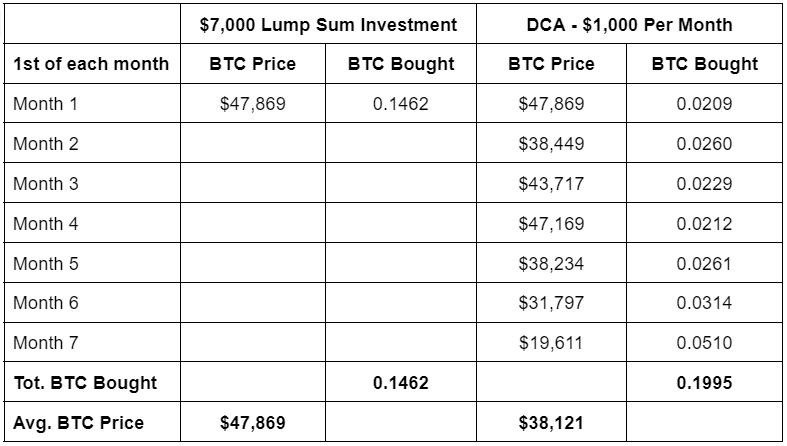
While investing in one lump sum can be more profitable than DCAing, if buying at an opportune time, it is also way riskier, stress-inducing, and susceptible to bad timing. To illustrate this point, let’s compare two scenarios – in the first one, an investor bought $7,000 worth of Bitcoin at the start of 2022. In the second scenario, an investor spent the same amount of money over the span of seven monthly buys of $1,000 apiece.
Due to the broader crypto market downturn, both investors showcased in the two hypothetical scenarios would have lost money. However, the difference in overall returns is quite stark. Going by the market rate of $22,125 per BTC (the rate at the time of writing), the lump sum investor would have lost 53.8% on its BTC investment, ending up with $3,234 worth of BTC out of the initial $7,000 investment.
The investor making $1,000 monthly purchases on the first day of each month, would have lost 41.8% on the crypto investment, ending up with $4,081 worth of BTC out of the initial $7,000 investment.
In relative terms, the second investor attained roughly 25% better BTC price entry point due to spreading out the investment over a longer time period.
Benefits of dollar-cost averaging
There are many advantages to dollar-cost averaging, which has allowed the investment strategy to pass the test of time and grow to become one of the most widely used techniques since being first introduced in Benjamin Graham’s book The Intelligent Investor in 1949.
1. Risk Reduction
The risk of loss is heavily reduced when averaging out the investment over a longer period of time. The added benefit of a strict investment regimen is that investors are more likely to take emotions out of investing, leaving them prepared to make rational decisions no matter which way the market moves.
2. Lower Entry Price
Lump sum buys can prove lucrative, particularly when buying during market downturns. However, knowing when the market will bottom or top out is basically impossible, even for the most experienced traders. In this sense, DCA provides a helpful outlet that compels investors to make their scheduled buys no matter the market conditions. In the long run, this often translates to a lower entry price, since faithfully following DCA means making buys during the harshest bear markets and the largest bull runs.
3. Prevents Bad Timing
The third point on this list follows logically from the previous two points mentioned above. Inventors, especially those who lack experience, are more likely to buy assets when the markets are in a bull cycle and assets trading near their price peaks. Stoked by FOMO (“Fears of missing out”), amateur investors often enter their positions when there is little upside potential. With DCA, these issues sort themselves out automatically, since buys are made on a predetermined basis, completely ignoring the short-term market trends.
4. Flexibility
Dollar-cost averaging can be used by a wide range of investors, irrespective of the money that is allocated for investment. Also, the strategy can follow a wide spectrum of schedules, from daily, weekly, monthly, and everything in between, accommodating different investor profiles with ease.
5. Structured Saving
DCA is a popular choice among those that wish to put some money to the side and let the market do its job. Investing in sound projects and assets can be more lucrative than depositing money in savings accounts, which at best generate one to two percentage points in returns each year.
DCA on Binance with the Recurring Buy feature
Binance, the world’s largest cryptocurrency exchange in terms of trading volume, allows investors to take advantage of the benefits provided by the dollar cost averaging strategy with a specialized investment product called Recurring Buy.
With Binance Recurring Buy, users can choose from a long list of supported fiat currencies to make weekly, bi-weekly, or monthly cryptocurrency purchases. The product allows Binance users to invest fixed amounts of fiat at regular intervals to mitigate the effects of market volatility.
The list of supported digital currencies includes the biggest coins, such as Bitcoin and Ethereum, as well as a broad range of DeFi tokens like Aave and Polygon, and native tokens of popular Layer 1 projects like Avalanche, BNB, Cardano, Polkadot, and Solana. In total, Binance supports almost 40 local currencies and more than 80 digital assets.
Step 1 – Log in to your Binance account and navigate to Recurring Buy
After logging into your Binance account, select the “Credit/Debit Card” option from the “BuyCrypto” drop-down menu. After that, click on “RecurringBuy” to set up your DCA plan.
Step 2 – Select fiat and cryptocurrency, decide on investment frequency
In the Recurring Buy window, select the local currency you would like to use for purchasing crypto. Enter the amount of money reserved for interval payments and decide on their frequency. Proceed by clicking “Continue”.
Step 3 – Choose your payment method
Select one of your existing payment methods or add new or change existing ones by clicking on the “ChangeCard” button. Once done, proceed by clicking “Continue”.
Step 4 – Confirm your Recurring Buy order
To complete the process and commence your DCA plan on Binance, click on the “Confirm” button in the Confirm Order dialogue showing the complete overview of your Recurring Buy plan.
Closing Thoughts
Binance Recurring Buy applies the principles of the dollar cost averaging strategy to cryptocurrency investments. It allows you to gradually grow your portfolio with a combination of scheduled crypto buys and potentially compounding market gains. While offering several benefits, the success of any DCA plan ultimately depends on the underlying asset that is being bought. Rember to DYOR before committing and never invest more than you are willing to lose.