Tag: Decentralized Exchange

  • How to Fix “Insufficient Liquidity For This Trade” on Uniswap

    How to Fix “Insufficient Liquidity For This Trade” on Uniswap

    uniswap logo

    The “Insufficient Liquidity For This Trade” issue is a relatively common occurrence on Decentralized Exchange, such as Uniswap, Pancakeswap or Sushiswap.

    When you encounter this error, it’s likely due to the pool’s limited capacity to facilitate your trade, due to, well, as the name says, not enough liquidity. You’ll need to take a closer look at your trade size and consider a few different ways of solving this issue. We’ll go into this in more detail in this article.

    Key Takeaways

    • Reduce trade size to mitigate liquidity impact and increase the likelihood of a successful transaction on Uniswap
    • Increase slippage tolerance (up to 12% typically) to accommodate price fluctuations during trades with low liquidity tokens
    • Verify the token being traded to prevent liquidity mismatches and ensure compatibility with Uniswap’s liquidity pools
    • Explore alternative DEXes, such as SushiSwap and PancakeSwap, which may offer better liquidity for the desired trade

    How AMMs (like Uniswap) work

    At the core of Uniswap’s functionality lies the Automated Market Maker (AMM) model, which relies on liquidity pools to facilitate seamless token trading. When you interact with Uniswap (which has a native token, UNI), you’re essentially tapping into these pools, which contain pairs of tokens, such as ETH and USDC.

    The AMM determines prices algorithmically based on the ratio of the tokens within the pool, following the constant product formula (x * y = k). This approach is at the core of decentralization because it allows for decentralized trading without traditional order books.

    As you dive deeper into the matter, you realize that the depth, or size of the liquidity pool is a vital component. If you attempt to execute a trade that exceeds the pool’s capacity, it will lead to transaction failures.

    In such cases, you may encounter errors like “Insufficient Liquidity For This Trade.” Uniswap’s design also allows users to actively contribute to liquidity pools and earn fees from trades executed within the pool. This is called liquidity mining, and it incentivizes participation, which improves liquidity and reduces the likelihood of such errors.

    How to Fix “Insufficient Liquidity For This Trade” on Uniswap

    When you encounter the “Insufficient Liquidity For This Trade” error on Uniswap, you can take a few steps to resolve the issue.

    You can try reducing the trade size to minimize the impact on the liquidity pool, or increase the slippage tolerance setting to give the trade more flexibility.

    Additionally, double-check that you’re trading the correct token and consider checking the token’s liquidity on other decentralized exchanges to explore alternative options.

    Reduce the trade size

    Reducing your trade size is the most straightforward solution to bypass the “Insufficient Liquidity For This Trade” error on Uniswap. By decreasing the amount you’re trying to swap, you lower the impact on the liquidity pool, making it more likely for your transaction to be executed successfully.

    It’s simple math. If A must be less than B for a successful transaction, where A is your trade size and B is liquidity pool size, reducing the size of A is a very straightforward and logical solution.

    Assess the current liquidity of a trading pair before executing transactions to be able to identify an appropriate trade size that aligns with the pool’s capacity. Reducing trade size helps decrease the likelihood of a failure due to liquidity shortages, but it also reduces potential losses from slippage during execution.

    You may need to continually make adjustments to trade sizes based on fluctuations in market conditions and liquidity availability. If something worked today, it doesn’t mean it’ll work tomorrow, and vice versa. Regularly review market conditions and adjust your trade sizes accordingly.

    Increase slippage tolerance setting

    Your Uniswap transaction’s success may depend on a simple (but important) setting: the slippage tolerance. When you encounter the “Insufficient Liquidity For This Trade” error, consider adjusting this setting.

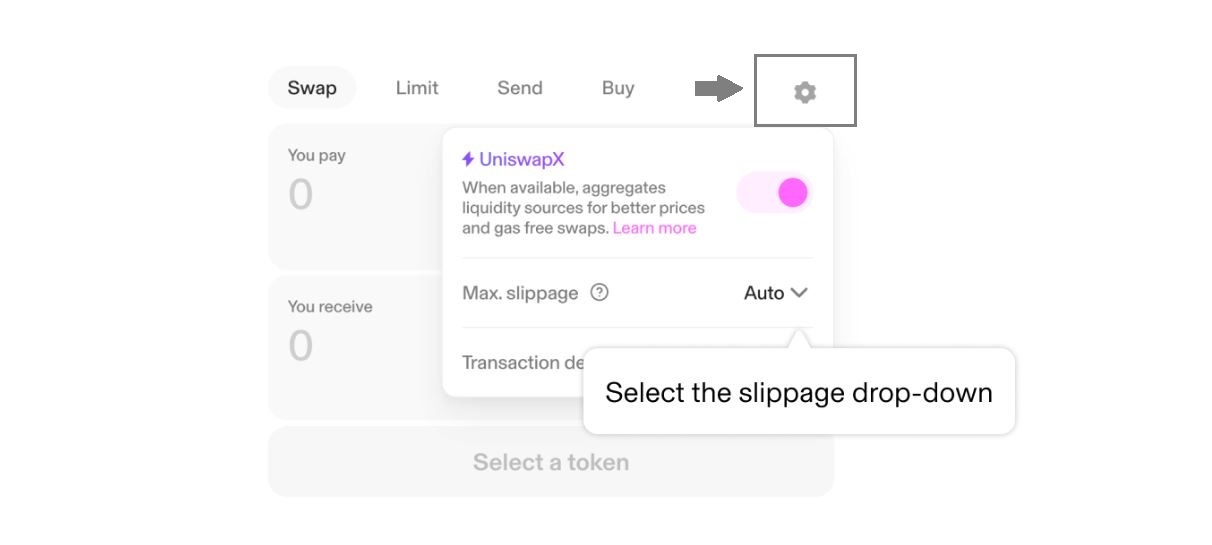
    To do so, access your wallet, connect it to Uniswap, and select the tokens you wish to swap. Then, navigate to the transaction settings and adjust the slippage tolerance.
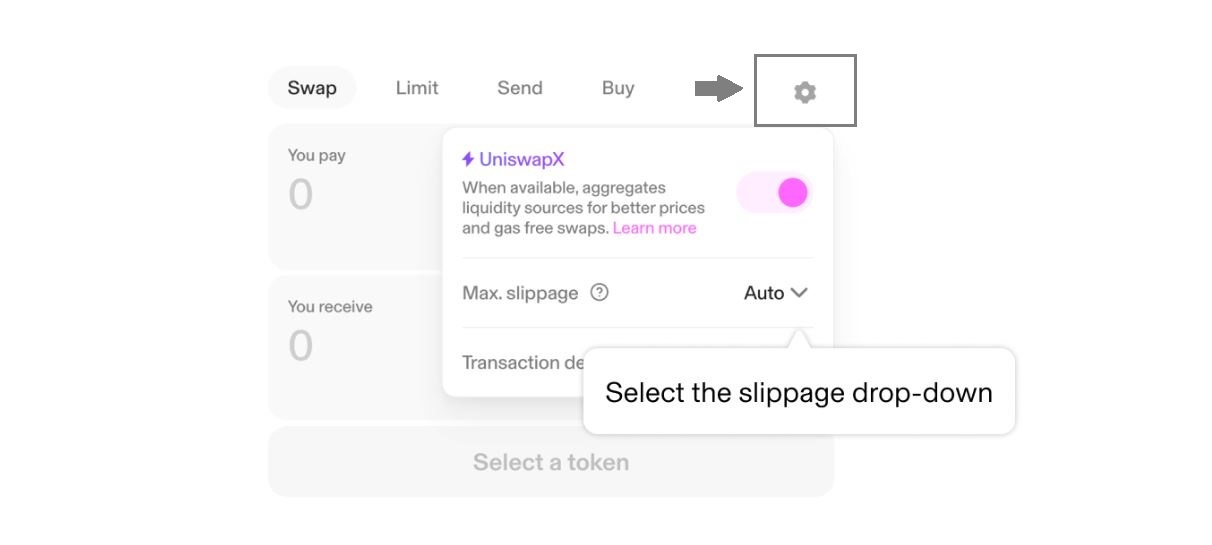
    Adjusting slippage on Uniswap

    The default slippage tolerance is automatically set at 0.5% by Uniswap (or 0.1% in Uniswap V3), which means your trade will only get executed if the actual price is within 99.5% or 99.9% of the price you saw on your browser. 

    If you manually raise the slippage tolerance, you allow the transaction to execute even if the token price changes more significantly during the trade process due to low liquidity.

    For transactions involving lower liquidity tokens, a slippage tolerance setting of 5% to 12% is often recommended. After making the adjustment, confirm the settings and proceed with the transaction.

    Increasing the slippage tolerance can significantly reduce the chances of encountering “Insufficient Liquidity for This Trade” errors, as it provides a sort of buffer for price fluctuations. 

    Make sure you’re trading the correct token

    This one may seem obvious, but this is crypto, and there can be lots of coins with a similar or even the same name as the coin you want to trade. Make sure that you’re trading the correct token. Double-check the token’s contract address, as a small error can result in trading a different token with low liquidity.

    Also, be aware of token migrations or updates, as a token may have moved from one liquidity pool to another, affecting its available liquidity.

    Of course, you should also confirm that the token you’re trading is supported by Uniswap.

    Check the token’s liquidity on other DEXes

    When Uniswap’s liquidity is insufficient for your trade, a quick scan of other decentralized exchanges (DEXes) can provide a viable alternative. You can check liquidity metrics on platforms like SushiSwap, TraderJoe or PancakeSwap, as they may offer better trading conditions for the same token pair.

    Utilize tools like CoinGecko or CoinMarketCap to assess liquidity depth across various exchanges, helping you identify which DEX has the highest liquidity for your desired trade.

    You should also examine the token’s liquidity pools on DEX aggregators like 1inch, which aggregate prices and routes from multiple platforms for optimal trading opportunities. 

    Also, you can check the trading volume for the token on other DEXes, as higher trading volume often correlates with better liquidity.

    The bottom line

    You’ve now got the tools to tackle the “Insufficient Liquidity For This Trade” error on Uniswap and other AMMs. 

    You should now understand how AMMs work and be able to apply the fixes – reducing trade size, increasing slippage tolerance, verifying token addresses, and exploring alternative DEXes.

    FAQs

    How to fix “Insufficient Liquidity For This Trade”?

    To fix the “Insufficient Liquidity For This Trade” error on Uniswap or similar DEXes, you can:

    1. Reduce Trade Size: Lower the amount you’re trying to swap to lessen the impact on the liquidity pool.
    2. Increase Slippage Tolerance: Adjust the slippage tolerance setting to accommodate potential price changes during the transaction.
    3. Verify the Token: Make sure that you’re trading the correct token by checking its contract address.
    4. Explore Alternative DEXes: If Uniswap’s liquidity is insufficient, consider using other decentralized exchanges like SushiSwap, PancakeSwap, or 1inch.

    What is lack of liquidity in trading?

    Lack of liquidity in trading refers to a situation where there aren’t enough assets available in a market to fulfill the demand for trades at stable prices. In decentralized exchanges like Uniswap, this can occur when the liquidity pools are too small to handle large transactions. This leads to issues like the “Insufficient Liquidity For This Trade” error.

    What causes lack of liquidity?

    Lack of liquidity is typically caused by a small or insufficiently funded liquidity pool, where the ratio of assets within the pool cannot support larger trades. 

  • How to Fix “Swap Failed” on Uniswap

    How to Fix “Swap Failed” on Uniswap

    If you’re encountering a “Swap Failed” error on Uniswap, there are several reasons this might happen. The most common reasons are your slippage settings and not enough funds.

    In this article, we will go over the steps that you can take that are likely to solve 99.99% of “Swap Failed” issues on Uniswap.

    Key Takeaways

    • Adjust slippage tolerance settings to ensure successful trade execution and minimize losses
    • Verify wallet balance and be sure you have enough ETH or another chain crypto for gas fees and a sufficient token amount for the swap
    • Extend transaction deadlines beyond the default 30 minutes to accommodate network fluctuations
    • Monitor network congestion to set appropriate deadlines and fees for timely transactions
    • Retry failed transactions after checking and adjusting gas fee and deadline settings

    Adjusting Slippage Tolerance Settings

    Uniswap – which uses the UNI token for governance and fee payments – is the largest and most used Decentralized Exchanges (DEXes) in crypto, and one of the necessary aspects of navigating Uniswap transactions is managing slippage tolerance settings. These parameters directly influence the success of your swaps. 

    The default slippage tolerance on Uniswap is set at 0.5% (and 0.1% for Uniswap V3), which might be too low to be sufficient for tokens with transaction fees.

    To avoid failed swaps, try adjusting your slippage tolerance settings. You can adjust the slippage tolerance by clicking the gearbox icon on the Uniswap interface and selecting the “Custom” option. Here, you can input a custom maximum slippage percentage.

    Adjusting slippage on Uniswap to avoid Swap Failed issue

    For tokens with significant sell fees, you might need to increase the slippage tolerance to at least 1%, and in volatile markets, settings closer to 10%-12% may be necessary. Increase the slippage tolerance incrementally in small percentages to mitigate risks while avoiding excessive price deviations. For example, if 0.5% is too low, don’t immediately go 5%. Start increasing it gradually, first to 1%, then 1.5% and so on. 

    This approach helps you get a successful trade execution while minimizing potential losses.

    Insufficient Tokens or ETH

    If your slippage tolerance settings are in order, the next step is to make sure you have sufficient tokens and ETH (assuming you’re using Ethereum blockchain) to execute the transaction. Check your wallet balance to ensure you have enough ETH to cover the transaction fees.

    Of course, if you’re using a different chain, you may need to pay gas fees in a different cryptocurrency. For example, for the BNB Chain you need BNB, for Avalanche you need AVAX, and so on.

    Each transaction on Uniswap requires enough crypto to cover gas fees, which may fluctuate based on network congestion. Always verify the current gas prices before initiating a swap to avoid timeouts and enhance transaction success.

    Also, confirm that you have the required amount of tokens you intend to swap. Attempting to swap more than your available balance will, of course, give back an error.

    If trading a token that has a fee on transfer, make sure to account for that fee in your swap calculation to avoid trading an insufficient amount. Keeping an eye on both token balances and gas fee reserves is necessary, as a lack of either can halt a transaction and result in a swap failure.

    Transaction Timeout Issues

    Transaction timeout issues on Uniswap can be frustrating, especially when you’re eager to complete a swap. A timeout occurs if the process exceeds 30 minutes, and this will result in an automatic failure of the swap.

    To mitigate this, you should adjust the transaction deadline settings to allow for longer processing times during high network congestion.

    Here are key points to consider:

    • Timeout duration: Uniswap transactions automatically fail if they take more than 30 minutes to complete.
    • Adjust transaction deadline: Increase the transaction deadline settings to give your transaction more time to process.
    • Increase gas price: Low network fee settings can cause delays. If you increase the gas price, it may help execute transactions promptly.
    • Monitor network congestion: Keep an eye on network congestion during peak times to time your transactions better and avoid timeouts.
    • Retry after adjustments: If a transaction fails due to timeout, retry after checking and adjusting your gas fee settings.

    Other Uniswap Error Types

    The K error indicates a Uniswap liquidity pool imbalance, i.e., you attempted a trade which, if executed, would leave the liquidity pool with fewer reserves than expected by the Uniswap protocol. If that happens, the transaction is automatically reverted and won’t go through. 

    The INSUFFICIENT_A_AMOUNT and INSUFFICIENT_B_AMOUNT errors occur when there are insufficient input tokens or output amounts for the swap. The TRANSFER_FAILED error typically indicates issues with token contracts or when the transfer function is disabled for the token being traded.

    Other errors include EXPIRED, which occurs when transactions take longer than the designated 30-minute deadline, often due to low network fees or high congestion.

    The bottom line

    To fix a “Swap Failed” error on Uniswap, you should first check your wallet balance to ensure you have enough tokens and transaction fees. Then, adjust your slippage tolerance, especially for volatile tokens, to at least 1% or more if necessary. These two alone should fix the issue 99% of the time. 

    Extend the transaction deadline beyond the default 30 minutes and consider increasing the gas price to expedite processing. Lastly, make sure that your token contract approvals are in place. To avoid paying too much fees, you can consider using cryptocurrencies that are cheap to transfer.

    FAQs

    Why is my swap failing on Uniswap?

    A swap on Uniswap may fail due to several reasons. The most common ones include incorrect slippage tolerance settings, insufficient funds to cover the transaction, or network congestion. Another common cause is an imbalance in the liquidity pool for the tokens you’re trying to trade, which can trigger the transaction to be reverted.

    What happens if a swap fails?

    If a swap fails on Uniswap, the transaction will not go through, and your tokens will remain in your wallet. The network will still deduct a small gas fee for attempting the transaction, but the swap itself will not be executed, meaning no tokens are transferred or exchanged.

    How to fix slippage in Uniswap?

    To fix slippage issues in Uniswap, you can adjust the slippage tolerance settings in the swap interface. You can do this by clicking the gearbox icon and selecting “Custom” to input a new slippage percentage. If your transaction fails due to slippage, gradually increase the slippage tolerance from the default 0.5% (or 0.1% in Uniswap V3) to a higher percentage until the transaction succeeds. Be cautious not to set it too high to avoid significant price deviations.

  • Pangolin DEX Incorporates Orbs’ dTWAP Order Type, Emerges First Avalanche-based Platform to Support Orbs’ dTWAP

    Pangolin DEX Incorporates Orbs’ dTWAP Order Type, Emerges First Avalanche-based Platform to Support Orbs’ dTWAP

    Pangolin Orbs

    Key Highlights:

    • Pangolin DEX has become the first Avalanche-based platform to support Orbs’ dTWAP after announcing the official launch of its Order Type.
    • Orbs’ dTWAP will help Pangolin users devise novel trading tactics and reap the rewards of significantly minimized price impact, while they leverage other advantages.

    Following efforts to influence enhanced trading efficiency, Multichain Decentralized Digital Assets Exchange Pangolin has officially incorporated Orbs’ dTWAP Order Type. Announced on twitter, the move displays an example of the close partnership between Orbs and Pangolin.

    Orbs’ dTWAP Order Type is Live on Pangolin

    Apparently, Pangolin DEX has become the first Avalanche-based protocol to integrate Orbs’ dTWAP. The Orbs’ dTWAP Order Type is a fully decentralized, permissionless, and composable protocol which is designed to unlock a fresh realm of possibilities for segments of Web 3.0 including DeFi, NFTs and GameFi.

    Arguably, the potential of Orbs’ dTWAP is set to complement Pangolin’s ability to support the market and limit swaps. In response to Pangolin’s efficiency in the trading market, the protocol represents over $34 million in Total Value Locked, meanwhile roughly half of this is achieved in weekly trading volume. 

    By means of the integration, the Pangolin DEX menu now provides users with access to the new order type. Hence, to access the new order type, users can navigate to the Pangolin DEX menu and locate it alongside the ‘Market’ and ‘Limit’ order options. They also have the privilege to switch between the available options. 

    Furthermore, users have the option to customize various parameters, including setting the total duration required to execute fragmented order pieces of a significant transaction, specifying the trade size, which prompts the UI to calculate the required number of trades, and determining the trading interval between individual orders.

    Orbs’ dTWAP and It’s Posies Traders to Exclusive Benefits

    The new development will provide Pangolin users with the opportunity to exclusively utilize the dTWAP order type. In addition, the protocol’s decision to integrate Orbs’ dTWAP will see traders gain an advantage in devising novel trading tactics and reap the rewards of significantly minimized price impact.

    Furthermore, similar to the traditional finance TWAP, dTWAP aims to limit the market impact of substantial orders. This is achieved by dividing large orders into smaller pieces, resulting in a reduced price impact irrespective of the overall liquidity. Moreover, Orbs’ dTWAP order type empowers traders to adopt a dollar-cost averaging strategy while investing in supported cryptocurrencies.

    Orbs have disclosed plans to establish itself as a go-to standard for the decentralized exchange industry as its integration of dTWAP spreads across more exchanges. There’s no doubt that more sophisticated decentralized applications can be created, irrespective of fragmented liquidity with features like dTWAP. According to the announcement, other decentralized exchanges like QuickSwap and SpookySwap have unveiled plans to integrate the dTWAP order in the future.

  • Flare Network-based BlazeSwap to Deliver a DEX Platform Offering Enhanced Organic Yields

    Flare Network-based BlazeSwap to Deliver a DEX Platform Offering Enhanced Organic Yields

    BlazeSwap cover image

     Key takeaways:

    • BlazeSwap decentralized exchange will use Flare’s price oracle delegation and network airdrop rewards
    • The DEX is expected to go live once the Flare blockchain exits observation mode
    • BalzeSwap is based on the same Automated Market Maker (AMM) model popularized by Uniswap v2

    The BlazeSwap decentralized exchange (DEX) is set to launch on the Flare network, the new and exciting blockchain that aims to connect everything. According to available information, BlazeSwap is poised to become the first and only DEX on the network, offering Flare’s price oracle delegation and network airdrops, in addition to liquidity provider fees.

    From all indications, BlazeSwap will introduce notable changes in the DEX market and the wider DeFi sector. Its pools, for a start, will offer automatic delegation to data providers for the network’s native decentralized price oracle, FTSO (Flare Time Series Oracle). While FTSO delegation is similar to staking, it is strictly merit-based. The most reliable FTSO price providers and token holders who actively delegate to them will get the best of network rewards.

    An outstanding DEX in the making

    Though it is yet to go live, BlazeSwap is prepared to become the best and cheapest place to swap all tokens on the Flare network and earn substantial fees. It offers an enhanced earning structure that is significantly different from what most decentralized exchanges offer. The organic, merit-based FTSO reward complements traditional DEX liquidity provider incentives.

    With its unique features, BlazeSwap is likely to attract several crypto enthusiasts, especially those who are familiar with the new Flare Network. Flare (FLR) holders will benefit a lot by participating in the DEX. They can maximize utility of their assets by participating in the DEX, reaping the big benefits while securing the network.

    Speaking enthusiastically about the imminent launch of BlazeSwap, Flare co-founder and CEO, Hugo Philion said:

    “We are thrilled to see BlazeSwap integrating Fare’s native data infrastructure to offer a new way of doing DeFi. This is exciting news, not only for BlazeSwap and Flare but also the broader Web3 and DeFi communities. We are looking forward to seeing other innovative products our growing developer base will be able to build using Flare’s native protocols.”

    Imminent launch – Exciting Community

    BlazeSwap is still in observation mode at the time of writing. However, its launch is imminent. If the Flare Improvement Proposal, FIP.01, is accepted by the community as the DEX goes live, contributors to its liquidity pool will have so much to be happy for. In addition to their entitled inflationary rewards for delegating to FTSO, these contributors will also receive their share of the delegation incentive pool token rewards.

    Speaking about the launch and the community, BlazeSwap founder, Alex Dupre, said:

    “After months of development, we’ve been very happy to see the enthusiasm from Flare’s community about the launch of the alpha version of BlazeSwap on the Coston testnet. The speed of the Flare network, its low gas fees and its goal to ‘connect everything’ make it a perfect match with our decentralized exchange. Its full integration with Flare’s native components is what the community has been waiting for, in order to demonstrate and fully unlock the network’s potential.”

    Wrapping up

    BlazeSwap is based on the automated market maker (AMM) model popularized by UniSwap. It has been audited by Omniscia and found to be worthy. When it goes live, legacy tokens, including BTC, DOGE, XRP and Layer Cake will be available. With time, other tokens will become available for swapping and liquidity provision. BlazeSwap is expected to become a market where participants will make the best of the most important Web3 tokens, and Flare will serve as the cross-chain hub.

  • Decentralized Exchanges (DEXs) Will Mark the Next Era of Investing in Financial Markets

    Decentralized Exchanges (DEXs) Will Mark the Next Era of Investing in Financial Markets

    Decentralized Exchanges DEXs

    The landscape of financial markets has been changing over the past decade as digital assets take the centre stage in modern-day finance. While Bitcoin still remains the most popular crypto asset, the emergence of smart contract blockchains such as Ethereum and Solana has given rise to an entirely new ecosystem dubbed Decentralized Finance (DeFi). At the core, DeFi operates on the principles of decentralization, transparency and verifiability.

    With DeFi gaining popularity, crypto natives are shifting from centralized exchanges (CEXs) to decentralized exchanges (DEXs). A recent report by Chainalysis revealed that the on-chain volume in DEXs between April 2021 to April 2022 eclipsed that of CEXs, with the former recording $225 billion while CEXs accounted for $175 billion. As it stands, the share of on-chain volume between these two ecosystems is evenly split.

    “Today, their share of on-chain volume is more evenly split, with 55% happening on DEXs and 45% on CEXs.” read the report.

    So, why are DEXs becoming the go-to platforms for crypto investors? First and foremost, DEXs are designed as permissionless protocols which means that anyone can access DeFi markets without limitation. Additionally, the pressure by regulators has forced many crypto stakeholders to consider self-custody by trading through DEXs. As most diehards would say; not your keys, not your crypto.

    The Evolution of DEXs

    Despite being around for only a few years, DEXs are evolving faster than most people can keep up. In the early DeFi days, prominent DEXs such as Uniswap and Sushiwap were only available on the Ethereum blockchain. This has since changed following the debut of cross-chain and bridging solutions; today, crypto investors can operate on a DEX like Sushiswap and access various blockchain ecosystems without leaving the protocol.

    Meanwhile, some DEXs like SOMA.finance have introduced compliance in the DeFi industry by partnering with Tritaurian Capital, an SEC and FINRA-regulated crypto brokerage. This globally compliant multi-asset DEX offers tokenized equities, STOs, ETFs and native crypto assets. With SOMA.finance, crypto users can access the featured assets while remaining compliant, a challenge that has been a big barrier for institutional investors.

    Coming down to the fundamental infrastructure, stakeholders have been looking for alternatives to the Automated Market Model (AMM), which has often been criticized for failing to deliver on liquidity. Well, it seems that the experiments are gradually yielding fruit; we now have DEXs like Blueshift that are building a more elaborated AMM model based on liquidity portfolios. In this model, liquidity is held in the form of portfolios instead of trading pairs.

    More importantly, AMM liquidity portfolios make it easier for DeFi users and LPs to swap tokens. For example, the Blueshift DEX creates virtual pairs upon a swap request by removing the required liquidity from the larger portfolio. Once the transaction is done, the virtual pair is erased and the price is updated in the internal oracle. This approach reduces price slippage and impermanent loss which are often caused by liquidity crunches.

    As we can see from these developments, it is quite obvious that the DEX environment is finally leveling up to address the finer needs of the market. Besides swapping tokens, DeFi users also have an opportunity to increase their passive income through protocols like Aurigami, which operates as a decentralized money market protocol for the Aurora ecosystem. Deposit rates can range between 8% to 12%, much better than what is offered by traditional banks.

    Wrap Up 

    In its current state, the DeFi market is yet to unlock its maximum potential. More people than ever before are craving for a financial ecosystem that is not controlled by governments or centralized financial institutions. This being the case, it is not surprising that savvy crypto investors now prefer trading through decentralized protocols where they can remain in control of their assets and do not have to undergo rigorous KYC procedures.

    Looking into the future, signs on the wall show that even the long-standing traditional institutions will likely change their tone in favour of DeFi markets. In fact, the paradigm shift is already happening, with legacy banks such as JP Morgan planning to bring trillions of dollars into DeFi through tokenization. Speaking to Coindesk, the bank’s head of Onyx Digital Assets lauded the potential of scaling DeFi products to accommodate institutions:

    “Over time, we think tokenizing U.S. Treasurys or money market fund shares, for example, means these could all potentially be used as collateral in DeFi pools. The overall goal is to bring these trillions of dollars of assets into DeFi, so that we can use these new mechanisms for trading, borrowing [and] lending, but with the scale of institutional assets.”

  • PancakeSwap Partners with ApolloX to Launch Perpetual Trading

    PancakeSwap Partners with ApolloX to Launch Perpetual Trading

    PancakeSwap, one of the leading decentralized exchanges (DEXs), has announced the launch of the perpetual trading feature, which will allow its users to approach the crypto markets with greater precision and efficiency.

    Key takeaways:

    • Perpetual trading is a form of margin trading and one of the pillars of investing in both crypto and traditional financial circles. It gives traders the ability to leverage their funds to increase exposure to the markets by going long or short with contracts that have no expiration date.
    • ApolloX, the world’s first CEX-DEX hybrid futures crypto exchange, has collaborated with PancakeSwap developers to build a reliable and non-KYC-required futures trading offering.
    • PancakeSwap is a Binance Smart Chain (BSC) alternative to the market-leading and Ethereum-based decentralized trading protocol Uniswap. The platform’s native CAKE token allows holders to secure lower trading fees and access exclusive features.
    • PancakeSwap is one of the most popular decentralized trading platforms in the sector, offering a comprehensive suite of products and services, including initial farm offerings (IFO), crypto swaps, and numerous liquidity pools.
    • While the DEX sector has been growing exponentially for years it still pales in comparison to the aggregate trading volume of centralized exchanges (CEXs). To put it into perspective, the top 25 DEXs collectively cleared $1.067 trillion in trading volume in the past 12 months. Binance alone has facilitated more than $50 billion in trading volume in the last 24 hours.
  • Uniswap Community Votes in Favor of Celo Integration and “Green Asset” Liquidity Pools

    Uniswap Community Votes in Favor of Celo Integration and “Green Asset” Liquidity Pools

    Key takeaways:

    • Last week, the Celo Foundation and the Celo Climate Collective issued a proposal for Uniswap’s integration with the Celo blockchain
    • The Uniswap community approved the proposal with an overwhelming majority
    • Celo is looking to create green asset liquidity pools and use Uniswap’s energy-efficient decentralized mechanisms in place of CEX solutions

    Uniswap protocol is coming to mobile-first and environmentally friendly Celo blockchain

    Last week, the Celo team put forward a proposal to deploy the decentralized exchange Uniswap v3 on the Celo blockchain. According to the proposal posted on Uniswap’s Governance website, the Celo Foundation and the Celo Climate Collective had been looking to deploy the decentralized protocol on the Celo network to increase capital efficiency and create green asset liquidity pools backed by tokenized carbon credits. 

    The Celo team’s intent on integrating Uniswap on its rails is driven by the low carbon cost linked to running the decentralized protocol. In particular, the team is looking to use Uniswap to “rebalance the Celo Reserve with nature-backed assets rather than relying on centralized exchanges.”

    The proposal had received a wave of approval from the community. A16z’s Porter Smith, for instance, wrote that he believes this is a “terrific proposal that aligns incentives among the Celo and Uniswap communities to set the conditions for long-term success.” Likewise, the blockchain department at the University of Michigan noted they are in favor of the proposal as it underscores the importance of a “cross-chain future” and commended Celo for the “green asset move.”

    When the final vote was cast on Sunday, it was immediately apparent that the proposal received an overwhelming majority. With 12M UNI votes in favor and only 603 UNI votes cast against the proposal, the Uniswap community welcomed the expansion of the protocol to the mobile-first Celo blockchain.

    The Celo team has allocated $10 million worth of CELO in financial incentives for Uniswap users to promote green use cases and carbon-negative blockchain-powered services.

  • Cardano-Based DEX SundaeSwap Announces Mainnet Launch Date, ADA Jumps Over 20%

    Cardano-Based DEX SundaeSwap Announces Mainnet Launch Date, ADA Jumps Over 20%

    Key takeaways:

    • Popular Cardano-based DEX SundaeSwap has announced a beta mainnet launch for January 20
    • SundaeSwap will launch with a full suite of features and several ways of obtaining the SUNDAE token
    • The price of ADA rallied to a cycle high of $1.56 on the news, which led to Cardano overtaking Solana as the fifth largest crytpo in terms of market cap value

    SundaeSwap, a native decentralized exchange (DEX) on Cardano, has announced the launch of a fully-functional beta version for Thursday, January 20. The price of ADA jumped by more than 20% on the news.

    The SundaeSwap DEX will go live on Jan. 20, users will have three ways of acquiring SUNDAE

    The highly-anticipated DEX launch is finally here – once the beta goes live on Thursday, SundaeSwap will introduce a much-needed liquidity boost to the Cardano ecosystem, along with enticing yield farming rewards, token swaps, and initial stake-pool offering (ISO) of SUNDAE.

    The mainnet launch comes six weeks after the company launched its testnet version in early December 2021. Over its short history, SundaeSwap has managed to form a lively community, and based on its social media following numbers, it is currently very likely to be the most popular DEX on Cardano. 

    According to a Saturday’s blog post, users will be able to obtain SUNDAE by participating in ISOs, swapping tokens on eligible DEXs for SundaeSwap’s own token, and by providing liquidity in exchange for SUNDAE farming rewards. The first ISO will commence on Jan. 20, “and will continue for five epochs, with rewards (5% of the total SUNDAE supply, 1% per epoch) being distributed based on the snapshots that will be taken at each epoch boundary,” explained Sundae.

    In order to qualify for ISO rewards, users will need to stake ADA with eligible SPOs before the first round begins on January 25.

    SundaeSwap’s event schedule. Image source: SundaeSwap

    The launch of a new DEX marks an important milestone for the broader Cardano ecosystem, which currently trails Ethereum and other Layer 1 networks in terms of the number of decentralized applications deployed on its chain. 

    Cardano’s founder Charles Hoskinson recently touched upon several key issues that need to be resolved before Cardano can become a leading decentralized finance (DeFi) platform. Hoskinson outlined his vision for the network in a Youtube appearance at the tail end of 2021 and unveiled that improvements to DeFi, a native web wallet, and a robust peer-to-peer (P2P) framework are in the pipeline. 

    Following SundaeSwap’s announcement of an upcoming DEX, the price of ADA increased from $1.28 on January 15 to a cycle high of $1.56 earlier today and managed to outperform all other digital assets in the cryptocurrency top 100 in the last 24 hours with more than 10% gains.