Tag: BNB

  • 12 Best Crypto to Buy Right Now — April 2026

    12 Best Crypto to Buy Right Now — April 2026

    cryptocurrencies digital style image

    Are you looking to invest in cryptocurrencies but unsure which one to buy? With so many options available, it can be overwhelming to decide how to invest your money. That’s why we’ve compiled a list of the best crypto to buy now, based on factors such as project developments, price performance, and market capitalization, as well as the overall potential for growth.

    In this article, we’ll take a closer look at the most promising cryptocurrencies, including staples such as Bitcoin and Ethereum, and a combination of several other promising crypto projects. We’ll discuss their features, advantages, and potential drawbacks, as well as provide insights into market trends. Whether you’re a seasoned investor or just starting out, this article will help you make an informed decision about the best crypto to buy now. 

    So, let’s dive in and explore the best cryptocurrencies to invest in April 2026:

    1. Bitcoin – The world’s oldest and largest crypto
    2. Ethereum – The leading DeFi and smart contract platform
    3. Solana – Smart contracts platform with high speeds and low fees
    4. Hyperliquid – Decentralized perpetuals exchange with an efficient order book
    5. Zcash – Privacy-focused cryptocurrency
    6. Bittensor – Decentralized platform for machine intelligence
    7. XRP – The leading crypto remittance solution
    8. Toncoin – An efficient blockchain with Telegram messenger integrations
    9. Monero – A privacy-first cryptocurrency with fully obfuscated transactions
    10. Uniswap – A pioneering decentralized exchange protocol
    11. BNB – The native coin of the Binance exchange
    12. Chainlink – The leading decentralized oracle protocol

    The best cryptos to buy right now: Discover top investments for April 2026

    The following three cryptocurrency projects highlight our investment selection thanks to important developments and upcoming events that make them especially interesting to follow in the near future. These projects are updated each week based on the most recent developments and trends taking place in the crypto market.

    1. Bitcoin

    Bitcoin (BTC) is the original decentralized digital currency, enabling peer-to-peer transactions without the need for intermediaries such as banks or financial institutions. It was created in 2009 by an unknown person or group of people using the pseudonym Satoshi Nakamoto. Bitcoin was the first digital currency to eliminate the double spending problem without resorting to any central intermediaries.

    Bitcoin transactions are recorded on a public ledger called the blockchain, which is maintained by a network of computers around the world. This means that the transactions are secure and transparent, as anyone can view them, but they are also anonymous, as the identity of the participants in the transaction is not revealed.

    Bitcoin is often referred to as “digital gold” or a store of value, as it has a limited supply of 21 million coins, and its value is determined by market demand. Some people also see it as a hedge against inflation or a way to diversify their investment portfolio. It is by far the largest cryptocurrency by market cap in the industry, accounting for the value of more than 50% of all digital assets in circulation combined, making it arguably the most popular crypto to buy.

    Why Bitcoin?

    Bitcoin is trading at $75,138 after setting a new 10-week high above $77,000, supported by renewed ETF inflows and easing geopolitical tensions. Spot Bitcoin ETFs attracted nearly $1 billion in net inflows last week, marking their strongest performance in over three months and pushing total ETF assets above $101 billion. The reopening of the Strait of Hormuz and cooling oil volatility helped restore broader risk appetite, allowing BTC to reclaim key resistance levels while traditional safe-haven demand moderated. This shift suggests that capital is rotating back into risk assets as macro uncertainty stabilizes.

    Spot Bitcoin ETFs record nearly $1 billion in weekly net inflows. Source: SoSoValue

    From a technical perspective, Bitcoin has reclaimed critical levels, with $72,800 now viewed as a pivotal weekly support zone. Traders are watching whether BTC can sustain momentum toward the $85,000–$88,000 range in the coming weeks, particularly as the S&P 500 posts record closes and volatility indices trend lower. While some analysts warn that declining trading volume into recent highs could signal short-term consolidation, the broader structure shows higher lows forming and liquidity rebuilding above prior resistance.

    Institutional accumulation continues to define the longer-term narrative. Michael Saylor once again hinted at a new purchase after Strategy recently acquired nearly $1 billion worth of BTC, bringing total holdings to over 780,000 coins. Despite reporting significant unrealized losses earlier this year, Strategy remains one of the most aggressive corporate buyers, accumulating at a pace that rivals newly mined supply. With ETF demand strengthening and corporate balance sheets expanding exposure, Bitcoin’s current structure reflects steady capital inflows even as macro conditions remain fluid.

    2. Ethereum

    Launched in 2015 by Vitalik Buterin and a team of developers, Ethereum is a decentralized, open-source blockchain platform that allows developers to build decentralized applications (dApps) and smart contracts. 

    Ethereum has a wide range of use cases beyond just a store of value or medium of exchange. Ethereum’s smart contract functionality allows developers to build dApps that can run without the need for intermediaries, like centralized servers or institutions.

    The Ethereum platform has gained widespread adoption and has become the backbone of the decentralized finance (DeFi) industry. DeFi applications built on Ethereum allow users to access financial services without relying on traditional banks or financial institutions. Ethereum’s smart contract functionality has also enabled the creation of non-fungible tokens (NFTs), which have gained popularity in the digital art and gaming worlds.

    While Ethereum has a strong community and has been highly influential in the cryptocurrency industry, it also faces challenges, such as scalability issues and high gas fees. These issues have spurred the development of various Layer 2 scaling solutions. In the long run, future updates are supposed to massively increase Ethereum’s throughput bringing the transaction per second (TPS) figure from 15 to 100,000.

    Why Ethereum?

    Ethereum is trading at $2,309.51 after staging a strong recovery from its $1,750 swing low, with both technical structure and onchain data supporting the move. Accumulation wallets have increased their holdings by 6.5 million ETH since the beginning of the year, representing a 33% rise and pushing total balances above 26 million ETH. At the same time, daily active addresses surged nearly 89% in early April, signaling a meaningful uptick in network engagement as price reclaimed the $2,300 region. Historically, similar spikes in activity and accumulation have appeared near macro bottoms, often preceding sustained upside phases.

    Ethereum daily active addresses surge alongside price recovery toward $2,300. Source: CryptoQuant

    Liquidity conditions are also tightening. The total staked ETH supply has climbed to 39.2 million, reducing the liquid float while exchange balances sit near multi-year lows. From a technical perspective, ETH has broken out of a cup-and-handle formation on the 12-hour chart, with the $2,400 neckline acting as the key confirmation level. A sustained move above this zone could open the path toward the $2,960–$3,150 range, aligning with the measured move of the broader pattern and reinforcing the case for a medium-term trend shift.

    ETH/USD 12-hour chart showing cup-and-handle breakout structure targeting higher levels. Source: TradingView

    Institutional access is expanding in parallel. Charles Schwab announced it will roll out spot Bitcoin and Ether trading for retail clients, integrating crypto directly into its brokerage ecosystem with custody handled by its banking arm. With major financial firms broadening crypto access and onchain accumulation strengthening, Ethereum’s rebound reflects more than short-term momentum — it highlights growing structural demand and tightening supply dynamics that could support further upside if key resistance levels are sustained.

    3. Solana

    Solana is a smart contract platform known for its distinctive architecture, enabling it to handle thousands of transactions per second while maintaining very low costs. It accomplishes this by using a combination of a unique Proof-of-History algorithm and a Proof-of-Stake consensus mechanism. SOL, the native cryptocurrency of the platform, is one of the cheapest to transfer, with users typically paying less than $0.001 per transaction.

    Founded in 2018 by Anatoly Yakovenko, Solana’s mainnet went live in March 2020 and experienced a surge in adoption throughout 2021. Despite a significant drop in value during the 2022 bear market, Solana remains one of the most robust ecosystems in the cryptocurrency space and continues to be seen as a potential candidate for significant future growth.

    Why Solana?

    Solana is trading at $85.47 as price compresses between a downside liquidity pocket below $85 and a strong resistance ceiling near $93. Liquidation heatmaps show concentrated clusters both above $90 and under $85, creating a tight technical range where the next move could unfold quickly. While SOL has recovered from earlier April lows, repeated rejection near the low-$90 zone signals that bulls still need a clean breakout to confirm continuation. Until then, the $85 region acts as a near-term magnet if broader risk sentiment weakens.

    Solana liquidation heatmap highlighting liquidity clusters above $90 and below $85. Source: Coinglass

    Derivatives data shows growing engagement. Solana futures open interest jumped 20% this week to $4.2 billion, reflecting renewed participation as price pushed toward a three-week high. However, funding rates remain relatively muted, suggesting bullish conviction has not yet reached overheated levels. This balanced positioning leaves room for expansion if momentum builds, particularly if geopolitical tensions continue easing and risk appetite remains stable.

    Image caption: SOL futures aggregate open interest rising to $4.2B as price approaches key resistance. Source: CoinGlass

    Fundamentally, Solana continues to maintain strong ecosystem positioning despite recent revenue declines across the broader DeFi sector. The network remains a leader in decentralized exchange volume and ranks near the top in total value locked. A renewed surge in memecoin activity has also boosted short-term demand for SOL, echoing patterns seen during prior speculative waves. If buyers successfully clear the $93 resistance zone, traders are increasingly eyeing the psychological $100 level as the next upside target.

    4. Hyperliquid

    Hyperliquid is a decentralized perpetual futures exchange built to rival centralized trading platforms in speed, liquidity, and user experience—all while remaining fully on-chain. Unlike traditional DEXs that often struggle with performance bottlenecks, Hyperliquid uses a custom high-performance layer-1 blockchain specifically optimized for trading. This allows it to offer ultra-low latency, high throughput, and a seamless trading experience without relying on external validators or rollups.

    One of Hyperliquid’s key innovations is its order book-based model, which is uncommon among decentralized platforms. While many DEXs use automated market makers (AMMs), Hyperliquid implements a central limit order book (CLOB), giving traders more control over order execution and tighter spreads. This design makes it particularly appealing to professional and high-frequency traders who expect the responsiveness of centralized exchanges but want the trustlessness of DeFi. Its deep liquidity pools and tight integration with crypto-native assets further enhance its trading dynamics.

    Why Hyperliquid?

    Hyperliquid is trading at $41.52, holding near a key resistance zone as momentum builds around both institutional interest and strong derivatives activity. A major catalyst is Bitwise’s second amended filing for a spot Hyperliquid ETF, which now includes the ticker $BHYP and a 0.67% management fee—steps that typically signal an imminent launch. If approved, the ETF would provide direct exposure to HYPE’s spot price and may include staking rewards, positioning Hyperliquid alongside major crypto assets gaining institutional investment vehicles. The token has already delivered strong performance, rising significantly over the past year while the platform entered the top 10 crypto derivatives exchanges by volume.

    Market structure data shows that the current recovery is being driven primarily by high-conviction investors rather than broad retail participation. Notably, Arthur Hayes accumulated over 26,000 HYPE tokens, bringing his holdings to more than 247,000 tokens. At the same time, large leveraged positions have played a key role in stabilizing price action, with one trader maintaining a multimillion-dollar long position through volatility. Open Interest has climbed to $1.77 billion, reflecting sustained engagement, though price continues to face resistance in the $40–$44 range.
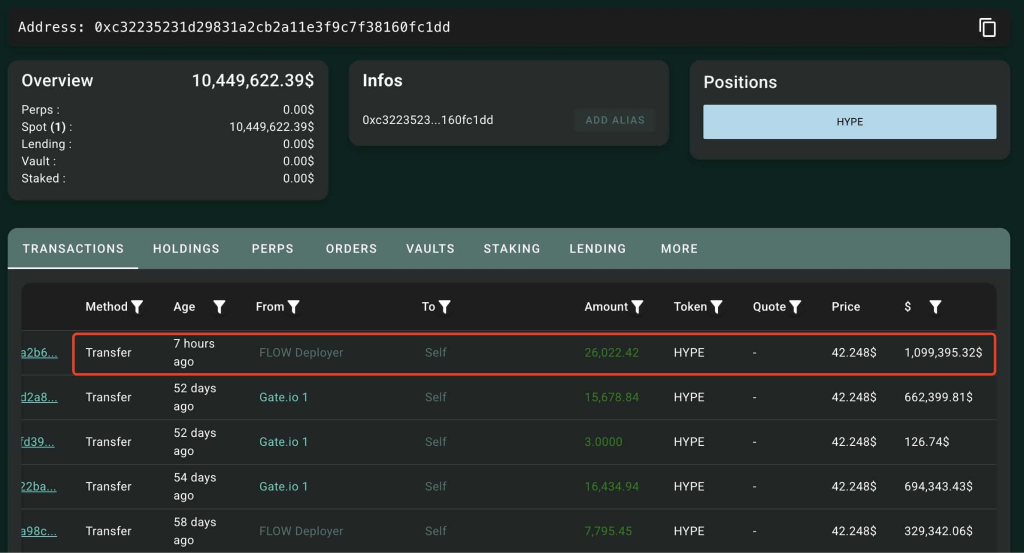
    Onchain data highlights whale accumulation and large leveraged positions supporting HYPE’s recovery. Source: LookOnChain

    Despite strong whale conviction, Hyperliquid’s next move depends on broader market participation. Analysts note that while leverage remains elevated but stable, a lack of expanding demand could cause price to stall near current levels. Conversely, increased participation beyond large holders could fuel a breakout above resistance. With ETF momentum building and derivatives activity remaining robust, Hyperliquid stands at a pivotal point where institutional adoption and market demand will likely determine the direction of its next major move.

    5. Zcash

    ZCash (ZEC) is a privacy-focused cryptocurrency that was launched in 2016 by Zooko Wilcox-O’Hearn. It is a fork of Bitcoin, designed to enhance privacy and anonymity for its users. Unlike Bitcoin, where transaction details (such as sender, recipient, and amount) are publicly visible, ZCash allows users to choose between two types of transactions: transparent and shielded.

    Transparent transactions work similarly to Bitcoin, where all transaction details are recorded on the blockchain and visible to everyone. However, shielded transactions use a cryptographic technology called zk-SNARKs to allow fully private transactions. In shielded transactions, the details are encrypted, meaning that only the parties involved have access to the information, while the validity of the transaction is still verifiable by the network.

    ZCash is particularly valued by those who prioritize financial privacy and security, as it offers optional anonymity in a way that few other cryptocurrencies do.

    Why Zcash?

    Zcash is trading at $359.86, approaching a critical resistance zone as bullish momentum pushes the price toward the $400 level. The recent rally began after a breakout from a prolonged consolidation phase, with ZEC surging from the $220–$260 accumulation range and reclaiming the $350 level as support. Rising open interest alongside increasing volume confirms that fresh capital is entering the market, reinforcing the strength of the current uptrend. However, momentum indicators such as an overbought RSI and negative funding rates suggest the market is becoming crowded with leveraged long positions, increasing the risk of short-term volatility near resistance.

    ZEC price chart showing a breakout from the $220–$260 range and testing the $370–$400 resistance zone. Source: TradingView

    The broader market backdrop has also supported Zcash’s recent gains. The token surged more than 30% during a relief rally following news of a temporary ceasefire between the US and Iran, outperforming other privacy-focused cryptocurrencies. Technical analysis shows that ZEC is now approaching a descending trendline resistance that previously capped rallies, with the $370 region aligning closely with key Fibonacci retracement levels. A decisive breakout above this area could confirm a bullish continuation pattern and open the door to significantly higher targets.

    ZEC/USD weekly chart highlighting descending trendline resistance and key Fibonacci levels near $370. Source: TradingView.

    Despite the bullish structure, derivatives data highlights meaningful downside risks. Liquidation heatmaps reveal that more than $50 million in leveraged long positions sit below the current price, particularly around the $305–$306 zone. This imbalance suggests that if ZEC fails to break above resistance, a sharp pullback could be triggered by cascading liquidations. As a result, Zcash stands at a pivotal technical juncture where a confirmed breakout above $400 could fuel a new expansion phase, while rejection may lead to a rapid corrective move.

    6. Bittensor

    Bittensor is a decentralized platform that creates a peer-to-peer marketplace for machine intelligence. The network is composed of multiple specialized subnets, each dedicated to specific tasks such as text prompting, transcription, or audio generation. Currently, more than 30 Bittensor subnets are actively operating across various AI domains.

    At the core of the network is a unique consensus mechanism known as Yuma Consensus, which enables validators across different subnets to collaboratively determine what the network learns and prioritizes. This approach ensures that intelligence within the ecosystem evolves based on real-world utility and performance.

    The computational power required to perform machine learning tasks is supplied by miners, who are incentivized with TAO tokens. Users seeking AI services pay in TAO to access these decentralized resources, creating a self-sustaining economic model that rewards valuable contributions.

    By offering a decentralized and cost-efficient network of machine learning algorithms, Bittensor lowers barriers to entry and makes advanced AI capabilities accessible to a broader audience.

    Why Bittensor?

    Bittensor (TAO) is trading at $316.78, consolidating after an explosive rally of more than 160% over the past month. The token’s rapid ascent has positioned it among the strongest-performing AI-related crypto assets in 2026, supported by growing interest in decentralized artificial intelligence infrastructure. However, technical indicators suggest the rally may be entering a critical phase as TAO tests key resistance levels following its sharp upward move.
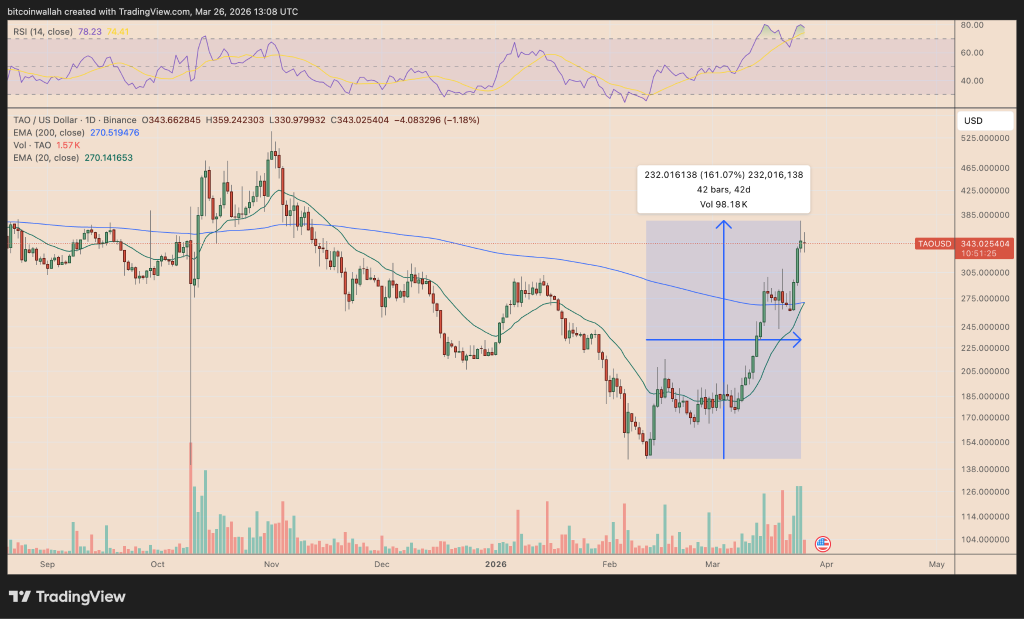
    TAO/USD daily chart showing a golden cross formation following a strong multi-week rally. Source: TradingView

    Despite the bullish momentum, historical fractal patterns indicate caution. Previous golden cross formations on TAO’s chart have preceded average drawdowns of roughly 40% within five to six weeks, suggesting the potential for a short-term correction if the pattern repeats. At the same time, social activity surrounding Bittensor has surged to its second-highest level in six months, reflecting growing market attention while sentiment remains relatively balanced rather than euphoric.

    Bittensor social volume and sentiment trends highlight rising attention without extreme market euphoria. Source: Santiment

    Fundamentally, the broader Bittensor ecosystem continues to strengthen, with subnet tokens collectively reaching a market value of approximately $1.5 billion as demand for decentralized AI infrastructure accelerates. High-profile endorsements from industry leaders and advancements such as the Covenant-72B large language model have reinforced Bittensor’s long-term narrative, positioning TAO as a key player at the intersection of blockchain and artificial intelligence.

    7. XRP

    XRP is a digital cryptocurrency that was created by Ripple Labs in 2012. It is used as a means of payment and transfer of value on the Ripple payment protocol, which is designed to enable fast and secure transactions between financial institutions as well as individuals.

    XRP is unique in that it is not based on the blockchain technology used by many other cryptocurrencies. Instead, it uses a distributed consensus ledger called the XRP Ledger, which is maintained by a network of validators. This allows for faster transaction processing times and lower fees compared to traditional payment methods.

    XRP has been popular among cryptocurrency traders and investors due to its high liquidity and clear potential for broader adoption, especially as a remittance solution. However, it has also been the subject of controversy and legal action, with US regulators alleging that it is a security and should thus be subjected to securities regulations. This has somewhat hindered the potential of XRP as an investment, and handcuffed Ripple’s growth as a company.

    Why XRP?

    Evernorth’s recent S-4 filing with the SEC outlines one of the most notable institutional developments involving XRP in recent months and sheds light on why the asset may be worth monitoring in the near term.

    The firm is planning to go public via a SPAC merger while holding a treasury of approximately 473 million XRP, currently valued at around $685 million. Much of this allocation was not acquired through open-market purchases but through strategic contributions, including roughly 127 million XRP from Ripple and more than 211 million XRP from Arrington Capital.

    The size of the position is also striking. Evernorth raised over $1 billion to establish its XRP treasury, even though the present value of its holdings is considerably lower due to XRP’s price drop. Part of its XRP was acquired at an average price of about $2.53, which is significantly higher than the current level near $1.45, leading to a substantial accounting impairment.

    What sets Evernorth apart is that it does not view XRP as a static reserve asset. Instead, the company plans to actively utilize its holdings through decentralized finance strategies such as providing liquidity, lending, and generating income via options. It also aims to incorporate Ripple’s RLUSD stablecoin into these operations. This strategy creates a more active form of demand for XRP, as it is used in yield-generating activities rather than simply being held for speculation.

    With XRP still trading well below its all-time high and Evernorth’s average acquisition price, the situation presents an interesting short-term narrative. Investors are observing a large, publicly traded entity building a significant XRP position, putting it to work for yield, and establishing itself within the broader ecosystem. Alongside the visibility of the upcoming SPAC merger, this could help spark renewed interest and momentum for XRP as institutional participation continues to grow.

    8. Toncoin

    Launched as the blockchain powering Telegram’s Web3 ambitions, The Open Network (TON) is a decentralized, open-source blockchain designed for fast, low-cost transactions and seamless integration with consumer-facing applications. TON was built to support smart contracts, decentralized applications, and native payments at scale, with a strong focus on usability and high throughput.

    TON goes beyond simple value transfers by enabling developers to build Mini Apps, wallets, and payment tools that can be embedded directly into Telegram’s interface. This design allows users to interact with onchain services without leaving a familiar messaging environment, lowering friction compared with traditional dApp ecosystems.

    Adoption has increasingly centered on payments and consumer use cases, with TON positioned as a settlement layer for in-app commerce, peer-to-peer transfers, and stablecoin payments across Telegram’s global user base. Recent launches such as TON Pay aim to turn Telegram into a native crypto checkout environment, expanding real-world utility beyond trading and speculation.

    Despite its growth, TON continues to face scrutiny around decentralization, governance, and its close association with Telegram. Ongoing development is focused on improving developer tooling, scaling transaction capacity, and expanding compliance-friendly payment infrastructure, as the network pushes toward broader mainstream adoption.

    Why Toncoin?

    Toncoin (TON) is trading at $1.34, up 1.35% over the past seven days, with a market capitalization of $3.28 billion, standing out as one of the few large-cap assets holding steady during a volatile market week. While Bitcoin and Ethereum sold off sharply, TON remained range-bound, reflecting relatively resilient sentiment tied to ecosystem-specific developments rather than broader macro flows. Price action suggests quiet accumulation, with limited downside follow-through despite market-wide risk aversion.

    That stability comes as the TON Foundation unveiled TON Pay, a new payments SDK designed to turn Telegram into a native crypto checkout layer for Toncoin and stablecoins. The tool allows Telegram Mini Apps to accept onchain payments through a single integration, with sub-second settlement times and average fees below one cent, targeting Telegram’s 1.1 billion monthly active users. TON Foundation vice president of payments Nikola Plecas said the goal is to remove friction around wallets, gas fees, and checkout, positioning TON as a consumer payments rail embedded directly into one of the world’s largest messaging platforms.
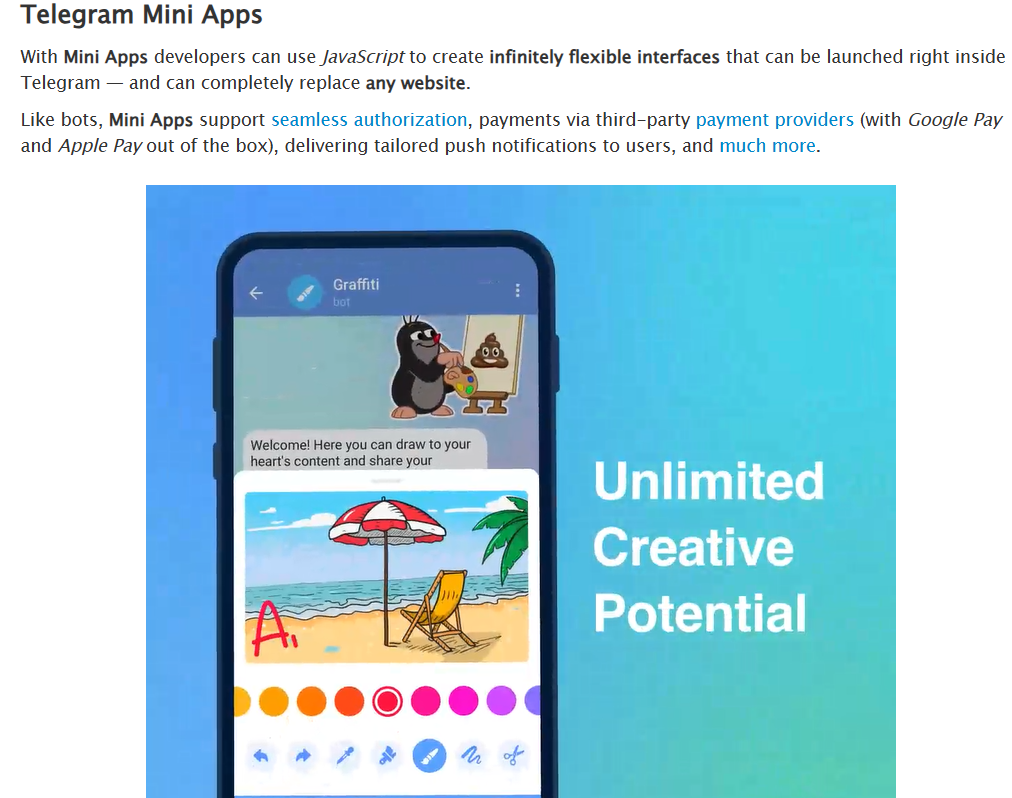
    Telegram Mini Apps. Source: Telegram

    Looking ahead, TON’s narrative is increasingly tied to real-world usage rather than speculative trading. Planned expansions to subscriptions, gasless transactions, and regional fiat off-ramps could broaden merchant adoption, while Telegram’s scale offers a distribution advantage few blockchains can match. From a technical standpoint, TON is holding support near $1.25, with resistance around the $1.45 to $1.50 zone. As long as the Telegram payments rollout progresses, TON appears positioned for gradual accumulation rather than momentum-driven moves in the near term.

    9. Monero

    Monero is a privacy-focused cryptocurrency designed to offer anonymous and untraceable transactions. Launched in 2014 as a fork of Bytecoin, Monero was introduced through a whitepaper written by the pseudonymous “Nicolas van Saberhagen.” Unlike Bitcoin or Ethereum, Monero conceals sender and receiver identities, as well as transaction amounts, through advanced cryptographic techniques such as stealth addresses and ring signatures. This strong focus on privacy has made Monero a favorite among users seeking true financial confidentiality.

    Monero runs on a Proof-of-Work (PoW) consensus mechanism and is deliberately resistant to ASIC mining to support decentralization. It can be mined efficiently using consumer-grade hardware, and its privacy-preserving features also improve fungibility—individual XMR coins are indistinguishable from one another and can’t be blacklisted. Despite its strong standing within the crypto community, Monero has been the subject of regulatory scrutiny due to concerns over its potential use in illicit activities. Nonetheless, it remains the most widely adopted privacy coin in the market today.

    Why Monero?

    Monero surged to its highest level since 2021 this week, reclaiming the spotlight among privacy-focused cryptocurrencies as XMR briefly pushed past $590 and entered fresh price discovery. The rally coincided with renewed interest in privacy assets and a sharp contrast with governance turmoil at rival Zcash, where internal disputes triggered developer resignations and a steep sell-off. With ZEC faltering, traders appeared to rotate toward Monero as the more stable and decentralized privacy exposure, lifting XMR back toward levels not seen in nearly five years.

    XMR/USD chart showing the breakout above $500
    XMR/USD chart showing the breakout above $500. Source: CoinCodex

    Beyond relative strength against peers, Monero’s move also reflects a broader shift in sentiment around financial privacy. Institutional commentary from firms such as Grayscale and Coinbase has increasingly highlighted privacy as a structural theme for 2026, driven by tighter compliance rules, onchain transparency concerns, and growing demand for confidential transactions. While Monero faced scrutiny in 2025 following a large block reorganization and ongoing debates around mining concentration, those concerns have faded from price action as the network continued to operate without lasting disruption. As Zcash’s roadmap faces uncertainty, Monero has regained its position as the largest privacy coin by market capitalization.
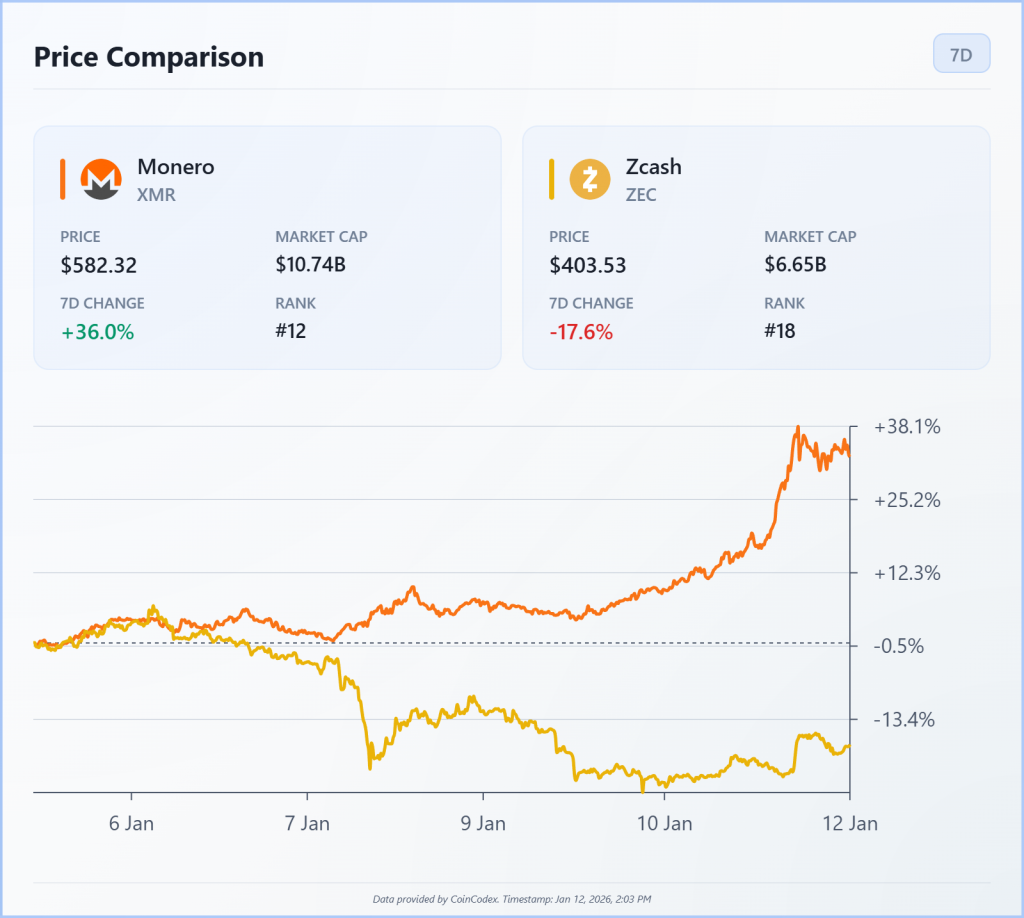
    Monero price comparison versus Zcash
    Monero price comparison versus Zcash. Source: CoinCodex

    From a technical perspective, XMR is now testing a historically critical zone. Previous attempts to break above the $500–$520 range have failed multiple times over the past decade, often followed by sharp corrections once momentum stalled. That history suggests near-term volatility remains likely unless Monero can decisively hold above former resistance. A confirmed breakout would invalidate the bearish fractal and open the door to higher targets around $750, based on long-term Fibonacci extensions. While pullbacks cannot be ruled out after such a steep rally, Monero’s reclaiming of its privacy crown and entry into price discovery place it among the more closely watched large-cap setups heading into 2026.

    XMR/USD chart highlighting prior failed breakouts and resistance zone
    XMR/USD chart highlighting prior failed breakouts and resistance zone. Source: TradingView

    10. Uniswap

    Uniswap is a decentralized cryptocurrency exchange that pioneered and helped popularize the automated market maker (AMM) model. This innovative approach eliminates the need for traditional order books, enabling users to swap tokens directly on the blockchain in a streamlined, intermediary-free manner.

    The Uniswap protocol operates in a fully decentralized way, allowing anyone to create liquidity pools for any token. As a result, newly launched crypto assets are often traded on Uniswap before becoming available on centralized exchanges.

    Uniswap’s model has since been adopted by numerous decentralized exchanges across various blockchain networks. Despite this, Uniswap continues to lead the decentralized exchange space in terms of trading volume.

    Governance of Uniswap is handled by holders of the UNI token, who can propose and vote on protocol changes. UNI was initially distributed to past users of the protocol through an airdrop in 2020, and the token can now be bought and sold on many decentralized and centralized trading platforms.

    Why Uniswap?

    UNI has recently outperformed the broader market, rising 16.5% over the past seven days while many other leading crypto assets moved sideways. This rally appears to be fundamentally driven, as

    Uniswap founder Hayden Adams has advanced the long-anticipated UNIfication proposal to a final on-chain governance vote, a move that could significantly reshape how value accrues to UNI holders.

    The proposal seeks to enable protocol fees on Uniswap v2 and selected v3 pools on Ethereum, directing a portion of trading fees into an automated UNI burn mechanism. After years of delays due to regulatory uncertainty, proponents argue that the environment has changed, allowing the protocol to finally implement a fee structure that directly links token value to usage.

    A key component of the plan is a one-time burn of 100 million UNI from the treasury, intended to account for the value that might have accrued if protocol fees had been active since the beginning. Going forward, fees would be rolled out gradually to limit disruption for liquidity providers, with governance maintaining flexibility to adjust parameters as needed.

    The proposal also broadens value capture beyond Ethereum mainnet by funneling Unichain sequencer fees into the same burn process, tying UNI supply reduction to activity on Uniswap’s Layer 2 network, which already handles significant trading volume.

    Beyond token economics, UNIfication aims to unify governance, development, and operations under a single structure. Uniswap Labs would eliminate interface, wallet, and API fees, operate using governance-approved funding, and enter legally binding agreements to align its actions with the interests of UNI holders.

    If the proposal passes, UNI would evolve from a purely governance-focused token into one with direct, usage-based value accrual, bringing renewed attention to the asset as the vote progresses.

    11. BNB

    BNB (formerly Binance Coin) is a cryptocurrency created by the popular cryptocurrency exchange Binance. Binance is the largest cryptocurrency exchange in the world, allowing users to buy, sell, and trade a wide range of digital assets.

    BNB was initially one of the ERC-20 tokens on the Ethereum blockchain but has since migrated to its own blockchain, known as BNB Chain. BNB is used as a utility token within the Binance ecosystem and has a variety of use cases. For example, users can use BNB to pay for transaction fees on the Binance exchange, receive discounts on trading fees, participate in token sales on Binance Launchpad, and purchase goods and services from merchants that accept BNB as payment.

    One of the unique features of BNB is that it has a deflationary model. Binance uses a part of its profits each quarter to buy back and burn BNB tokens, reducing the total supply of the token over time. This mechanism is designed to create scarcity and increase the value of BNB over time, with the end goal of reducing the circulating supply of BNB from the initial 200 million to 100 million BNB.

    Why BNB?

    BNB reclaimed $900 this week after bouncing sharply from the $800–$820 demand zone, with multiple bullish technical structures now aligning behind a potential push back toward $1,000 in December. A double-bottom pattern on the 4H chart, combined with a clean breakout from a multi-week falling wedge, signals fading seller momentum and renewed appetite from dip-buyers. Liquidation heatmaps reveal over $112 million in short liquidations clustered near $1,020, suggesting a move toward that level could accelerate quickly if BNB breaks and holds above $900–$920.
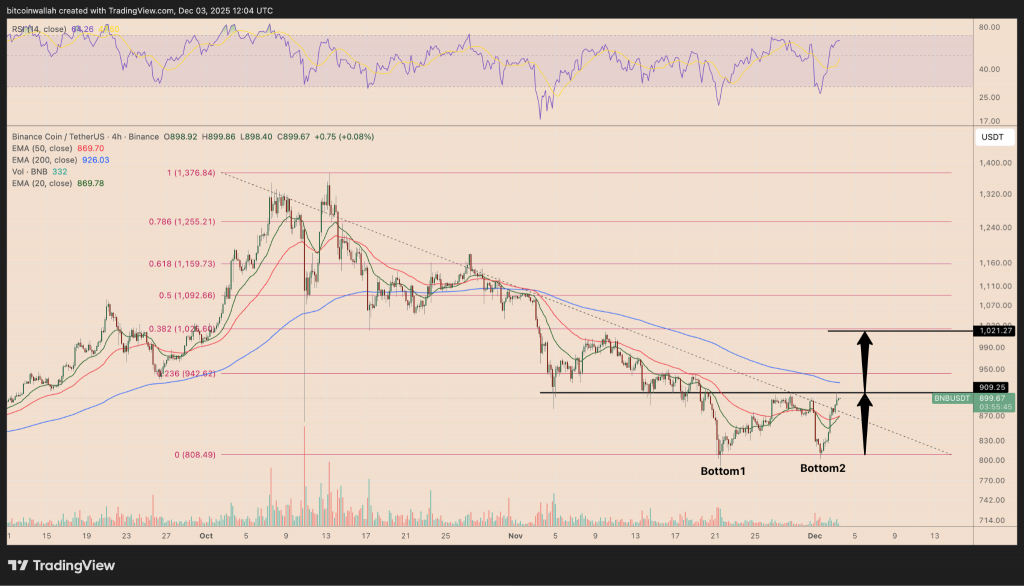
    BNB’s double-bottom and wedge breakout point toward a $1,000+ target
    BNB’s double-bottom and wedge breakout point toward a $1,000+ target. Source: Bitcoinwallah / TradingView

    However, BNB’s narrative this week also revolved around turbulence in the corporate treasury sector. CZ’s YZi Labs launched a formal attempt to overhaul the board of CEA Industries — the largest public BNB-holding company — accusing management of destroying shareholder value after the stock plunged 89% from its July peak. YZi aims to reverse recent bylaw changes, expand the board, and install its own nominees, arguing that CEA has failed to execute on its strategy of becoming the leading BNB treasury company. CEA responded by reaffirming its commitment to the BNB strategy while opening a dialogue with YZi to resolve concerns.
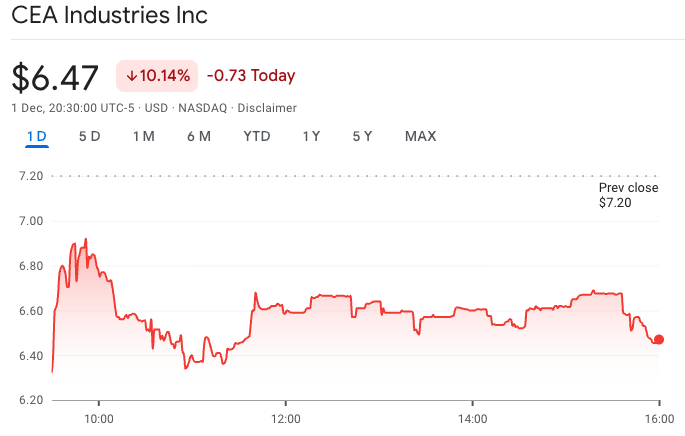
    CEA stock collapses as YZi Labs pushes for a board takeover
    CEA stock collapses as YZi Labs pushes for a board takeover. Source: Google Finance

    CEA stock collapses as YZi Labs pushes for a board takeover. Source: Google FinanceDespite governance drama and broader market pressure, BNB has held up better than many large-cap assets this quarter, outperforming even as it trades well below its mid-October all-time high of $1,367. CEA’s reported holdings of 515,054 BNB at an average entry of $851 place its treasury slightly underwater, yet BNB itself remains up 17.8% year-to-date, reinforcing its relative strength during the latest downturn. If bullish technicals continue to hold — and especially if liquidation clusters begin to trigger — analysts say BNB could feasibly revisit the $1,020–$1,115 range before year-end.

    12. Chainlink

    Chainlink is a decentralized oracle network designed to provide blockchains with secure, reliable data from external sources. It addresses the long-standing “oracle problem” by safely connecting on-chain systems with off-chain information, enabling many applications that wouldn’t be possible using blockchain data alone.

    Already the dominant oracle provider in decentralized finance (DeFi), Chainlink is also gaining traction in NFT projects and crypto gaming. For example, a DeFi protocol can pull price feeds from centralized exchanges through Chainlink to power its smart contracts, while NFT platforms often rely on Chainlink’s verifiable randomness to ensure fair minting processes and transparent distribution.

    Why Chainlink?

    Chainlink rallied 15% this week to $14.10, boosted by a major interoperability milestone: Solana and Coinbase’s Base have been connected using Chainlink’s Cross-Chain Interoperability Protocol (CCIP). The new bridge allows seamless asset transfers between Solana and the Base L2 ecosystem, giving developers the ability to integrate SPL tokens directly into Base applications. This marks one of the first production-ready bridges linking an EVM chain to Solana’s non-EVM architecture, reinforcing Chainlink’s role as the industry’s dominant cross-chain infrastructure provider. Despite the breakthrough, LINK traded slightly lower on the day, mirroring broader altcoin weakness.

    Chainlink also secured a significant step in institutional adoption as Grayscale’s spot LINK ETF debuted in the U.S., attracting $41 million in first-day inflows and posting “solid” trading volume, according to ETF analysts. While not a blockbuster launch like XRP’s, the ETF already manages $64 million in assets, showing that investor appetite is extending beyond Bitcoin and Ethereum into high-utility altcoins. Analysts noted the debut signals growing demand for regulated exposure to “long-tail assets,” especially those underpinning real-world tokenization infrastructure — a trend that plays directly into Chainlink’s strengths.

    Still, the LINK token remains down 73% from its all-time high, and the ETF launch alone has not reversed its long-term downtrend. But Chainlink’s strategic importance continues to grow: its oracle networks and CCIP are now core infrastructure for DeFi, tokenization protocols, and cross-chain applications across the industry. With Solana, Base, and multiple ETF providers integrating or backing the network, LINK’s recent strength suggests investors are beginning to reprice Chainlink as a foundational layer for the next phase of multi-chain development.

    Best cryptocurrencies to buy at a glance

     Native AssetLaunched InDescriptionMarket Cap*
    BitcoinBTC2009A P2P open-source digital currency$1.51 tln
    EthereumETH2012The leading DeFi and smart contract platform$279 bln
    SolanaSOL2020Smart contracts platform with high speeds and low fees$49.2 bln
    HyperliquidHYPE2024Decentralized perpetuals exchange with an efficient order book$10.6 bln
    ZcashZEC2016Privacy-focused cryptocurrency$5.16 bln
    BittensorTAO2023Decentralized platform for machine intelligence$2.65 bln
    XRPXRP2015The leading crypto remittance solution$88.1 bln
    ToncoinTON2021An efficient blockchain with Telegram messenger integrations$3.27 bln
    MoneroXMR2014A privacy-first cryptocurrency with fully obfuscated transactions$6.52 bln
    UniswapUNI2020A pioneering decentralized exchange protocol$2.08 bln
    BNBBNB2017The native coin of the Binance exchange$84.6 bln
    ChainlinkLINK2017The leading decentralized oracle protocol$6.74 bln

    Best crypto to buy for beginners

    If you are just starting out in crypto, it is advisable to stick to cryptocurrency projects that are less prone to volatility and are generally more established. While this approach does have a downside, as it becomes much more difficult to expect triple-digit or larger gains, the major upside is that you are not exposed to projects that have a chance of failing and, thus, losing your entire investment. 

    In order to identify projects that are stable and thus feature low volatility, you can start by following the parameters listed below:

    • The crypto asset has a market capitalization that places it into the cryptocurrency top 100 (roughly $500 million as of spring of 2026)
    • The crypto asset is available for trading on the best crypto exchange platforms and can be exchanged for fiat currencies
    • The crypto asset boasts healthy liquidity ($100M/day and more), which allows you to execute buy and sell orders quickly and without slippage 
    • The crypto asset is part of a reputable crypto project with clear goals, a realistic roadmap, and products and services that look to address real-world problems

    Some of the best cryptos to buy for beginners are those that follow the above criteria and have earned their standing in the crypto market due to robust security, popular products and services, and clear growth potential. Some beginner-friendly crypto investments are:

    • Bitcoin
    • Ethereum
    • Litecoin
    • Cardano
    • BNB

    It is worth noting that cryptocurrency investments are inherently risky, even if you stick to the biggest and most reputable projects. The reason for this is simple – the crypto sector is relatively new, and the landscape might look completely different in the future.

    Best crypto for long-term

    When deciding which cryptocurrency to buy for the long term, it’s important to consider projects that are well-established, have a strong community, are highly liquid, have a large market cap, and have a clear reason for existing (such as solving a real-life problem, introducing new functionality, etc.). Without these characteristics, a project might fail to survive in the long term, rendering it a bad long-term investment.

    It is worth noting that, typically, most long-term crypto investors are looking for projects that have the potential to generate decent returns but also provide a degree of investment stability. Roughly speaking, only the largest cryptocurrencies fit the bill, as others have a low market cap and liquidity that doesn’t bode well for a long-term commitment (unless you’re prepared to take on more risk).

    In addition to Bitcoin and Ethereum, there are a number of other cryptocurrencies that fit the criteria of being low-risk, long-term crypto investments.

    If you are planning to hold onto your digital assets for a longer period of time, it is best to take care of crypto custody yourself. Holding large amounts of crypto on an exchange can be risky, as we’ve seen over the years with the collapse of high-profile exchanges like Mt. Gox and FTX. Use one of the reputable crypto hardware wallets to store your crypto. Ledger hardware wallets, for instance, allow you to manage your crypto holdings easily and provide a much higher degree of security than crypto exchanges or even software crypto wallets.

    Best place to buy crypto

    One crucial aspect to consider when choosing which platform to use to buy crypto is the range of cryptocurrencies and trading pairs available. Since different exchanges support varying digital assets, it’s important to choose a platform that accommodates the specific cryptocurrencies you intend to trade.

    Additionally, assessing an exchange’s liquidity and trading volume is essential. Higher liquidity generally results in improved price stability and faster trade executions. Furthermore, it is prudent to examine the fees charged by the exchange, encompassing deposit, withdrawal, and trading fees. Comparing fee structures across different exchanges can help you identify the most cost-effective option that aligns with your trading style. With that said, here are some of the best exchanges on the market right now:

    • Binance – The best cryptocurrency exchange overall
    • KuCoin – The best exchange for altcoin trading
    • Kraken – A centralized exchange with the best security

    By diligently considering these factors, you can make an informed decision and select a cryptocurrency exchange that meets your requirements for security, variety, liquidity, and affordability.

    How we choose the best cryptocurrencies to buy

    At CoinCheckup, we provide real-time prices for over 22,000 cryptocurrencies, with the list growing by dozens each day. As you can imagine, making a selection of a dozen top cryptocurrencies to buy out of such an immense dataset can be difficult and will for sure lead to some projects that should be featured being omitted. To minimize the chance of that happening, we follow certain guidelines when trying to identify the best cryptocurrencies to invest in.

    Availability 

    One of the most important factors for any cryptocurrency investment is the crypto asset’s availability, meaning how easy it is to buy and sell it across various cryptocurrency exchanges. We tend to stay away from assets that are not available on major exchanges and require complex procedures to obtain.

    Market Capitalization

    Another important metric for identifying whether a crypto project is worth covering its market cap. A high market cap means that the project has reached a certain level of adoption from users, making it less risky to invest in.

    Growth Potential

    While this metric is mostly subjective, it is still an important metric on which we curate our selection. We won’t feature projects that we think are stagnating or have no real upside in the future.

    Purpose and Use Case

    We consider the purpose and use case of cryptocurrency, particularly in a real-world setting. Some cryptocurrencies focus on specific industries or applications, such as decentralized finance, gaming, or supply chain management.

    Team and Development

    The team and people involved in the project can tell you a lot about the potential of a particular cryptocurrency project. We examine the team’s experience, expertise, and track record and evaluate the development activity and updates to ensure the project is actively maintained and evolving.

    The bottom line: What crypto should you buy right now?

    The decision of which crypto to buy now is dependent on your own risk profile and investment goals. For some, investing in a crypto asset with a proven track record like Bitcoin is the only type of exposure to crypto they are willing to take on.

    Meanwhile, those with a higher risk tolerance might see Bitcoin as too stable, looking instead toward newer and smaller projects that carry a higher degree of upside. 

    If you are looking for more investment ideas, check out our crypto price predictions section.

  • How to Use the BNB Faucet to Get Free Testnet BNB

    How to Use the BNB Faucet to Get Free Testnet BNB

    A BNB faucet is a tool that will give you free testnet BNB tokens. A BNB faucet is an example of a crypto faucet, which are websites provide a small amount of mainnet or testnet crypto for free.

    For example, it was possible to get BTC coins for free when Bitcoin was still in its very early stages. Nowadays, you likely won’t be able to find mainnet faucets for big cryptocurrency projects, although there might be a mainnet faucet available for small projects with a low market capitalization.

    At the moment, a faucet for mainnet BNB tokens doesn’t exist. If you want to get some free BNB, you’ll have to settle for testnet BNB tokens, which don’t have any monetary value and are used on the BSC testnet. However, testnet BNBs are still useful if you want to try out how Binance Smart Chain works, or even deploy your own smart contracts for testing.

    We’ll show you how to use a BNB testnet faucet to get some free testnet BNB tokens that you’ll be able to use right away.

    The Binance Smart Chain testnet

    Before we show you exactly how you can get some free testnet BNB, let’s quickly explain what the Binance Smart Chain testnet is.

    The Binance Smart Chain testnet is a blockchain network created to replicate the environment of the BSC mainnet. Programmers and regular users can access the testnet to experiment with decentralized applications and assess their performance prior to their launch on the mainnet. Tokens on the Binance Smart Chain testnet possess no monetary value, which means that you can experiment freely without the fear of potentially losing something valuable.

    We should reiterate that there’s currently no faucet that distributes mainnet BNB tokens for free. If anyone claims that they will give you mainnet BNB tokens for free, you’re likely dealing with a scammer and should be very cautious.

    How to get BNB with MetaMask on the BSC testnet?

    If you want to use the BNB faucet, you will first need to set up a crypto wallet that will work with the BNB Chain testnet. You will be using this wallet to receive testnet funds.

    We recommend that you use the MetaMask wallet, but you can choose any other wallet you wish. For example, another wallet that can be used to access the BSC testnet is Trust Wallet, but we’ll be using MetaMask in our example.

    1. Access the “Networks” section in your MetaMask wallet

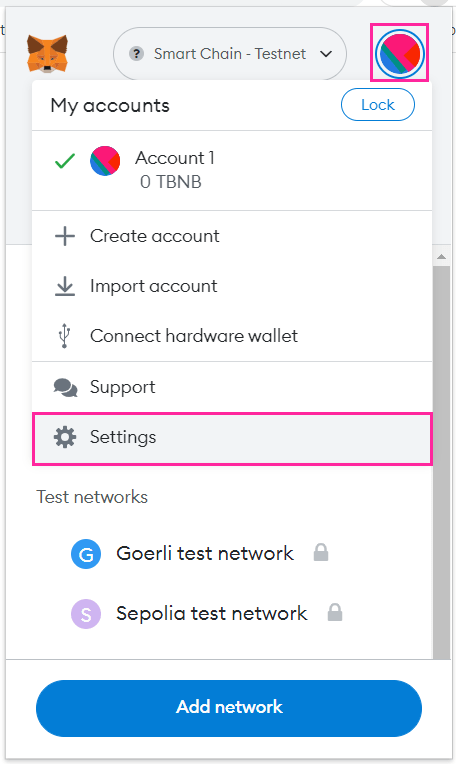
    The first step is to add the Binance Smart Chain testnet network to your MetaMask wallet. Click your avatar icon in the MetaMask wallet, and go to “Settings”. Then, select “Networks”.

    In the “Networks” tab, choose “Add network”. 

    2. Provide the necessary info about the Binance Smart Chain testnet

    In order to add a new network to your MetaMask wallet, you’ll need to provide some information so that your MetaMask wallet can connect successfully. Here’s the info you need to add the Binance Smart Chain testnet to MetaMask:

    • Network name: Smart Chain – Testnet
    • New RPC URL: https://data-seed-prebsc-1-s1.binance.org:8545/
    • Chain ID: 97
    • Currency symbol: tBNB
    • Block explorer URL: https://testnet.bscscan.com

    Enter the required details and click on the “Save” button. Once completed, your MetaMask wallet will have the ability to establish a connection with the BSC testnet.

    3. Go to the BSC faucet

    Now, you’re ready to get some testnet BNB from the official BSC testnet faucet. Visit testnet.binance.org/faucet-smart/.

    The website will prompt you for a brief verification process, which serves as a precautionary measure against automated bots spamming the faucet with token requests. Once the verification is successfully completed, you will be able to enter your BSC testnet address to receive test tokens.

    4. Claim your testnet BNB

    Next, click on “Give me BNB” and select the amount of testnet BNB to receive. At the moment, the only option offered by the BNB faucet is 0.1 BNB. 

    After a few seconds, you should receive your testnet BNB tokens in your wallet. As you can see, we have 0.1 tBNB in our account now. 

    Now that you have some testnet BNB, feel free to experiment with any DApps on the Binance Smart Chain testnet. You can use the BNB faucet for gas if you run out of testnet BNB to pay for your transactions.

    A list of popular BNB faucets

    Our example showed you how you can get testnet BNB tokens using the faucet at binance.org, which is generally regarded in the community as the “official” BNB faucet. However, there’s also other BNB faucets that you can use to get some testnet BNB.

    Regardless of which BNB faucet you choose to use, you will need to have a wallet set up that’s configured to use the BNB Chain testnet. So, steps 1 and 2 outlined in the guide above still apply regardless of which BNB faucet you’re using.

    Now, let’s quickly highlight some of the alternative BNB faucets you can use.

    • Triangle BNB faucet: Triangle’s BNB faucet is a simple testnet BNB faucet where you only need to provide a BNB Chain testnet address. However, you should keep in mind that this faucet only distributed 0.001 BNB at a time, which is a relatively small amount.
    • QuickNode BNB faucet: QuickNode offers a popular BNB faucet that you can use to get some free testnet BNB. Keep in mind that your wallet must hold at least 0.001 ETH to request testnet BNB through this faucet. This is done to prevent spamming.
    • BitBond BNB faucet: In order to use the BitBond BNB faucet, you need to connect your wallet and complete your profile. This includes selecting an avatar and providing an email address. Once you complete these steps, you’ll be able to request a small amount of free testnet BNB.

    What are testnet BNB tokens used for?

    Testnet BNB tokens are exclusively utilized for testing and have no monetary value. They are useful because they allow users to simulate using a mainnet, without the associated risks.

    Even if you accidentally create a buggy smart contract that causes you to lose funds, there is no harm on the testnet since your testnet tokens have no value anyway, and you can get more of them for free.

    When the BSC testnet receives an upgrade, it’s possible that users testnet BNB balances are reset. If this happens, you should get some more testnet BNB tokens using the process we provided above.

    Is it safe to use the BNB Chain Faucet?

    The BNB Chain Faucet is perfectly safe to use. As long as you stay on the BNB Chain testnet network, you can safely interact with the faucet. Just make sure that you’re using the correct BNB faucet URL (testnet.binance.org/faucet-smart/) and input the correct BNB Chain testnet information into your wallet — see step 2 in the step-by-step guide above.  

    What’s the BNB faucet limit?

    Even though testnet tokens are designed to have no economic value, that doesn’t mean that faucets give out unlimited amounts of testnet tokens. Practically every BNB faucet limits how many testnet BNB tokens it distributes to a single wallet in a day. Many faucets also require users to solve a CAPTCHA challenge. These limits are implemented to prevent abuse.

    Most BNB faucets will distribute less than 1 testnet BNB in a single transaction. Faucets will also occasionally adjust the amount they give out per day, depending on how many testnet BNB tokens they have at their disposal. For example, the “official” BNB faucet used to distribute 0.5 testnet BNB, but now only gives out 0.3 testnet BNB tokens.

    The bottom line

    Using a BNB faucet is very simple, and all you need to get started is to install a wallet that’s compatible with the Binance Smart Chain testnet. We recommend you use MetaMask, but you can also choose Trust Wallet or any other compatible wallet.

    You can use the BNB faucet multiple times, although the website does have some restrictions in place in order to fend off spammers.

    If you want to use the mainnet BNB Chain, you’ll have to buy some BNB tokens first, as there’s no such thing as a mainnet BNB faucet at the moment. Learn why we’ve featured BNB as one of the best altcoins to buy.

  • 10 Best Crypto to Buy Today for Long-Term

    10 Best Crypto to Buy Today for Long-Term

    10 Best Crypto to Buy Today for Long-Term

    Investing in cryptocurrency has been gaining popularity ever since Bitcoin’s genesis back in 2009. While initially, the cryptocurrency sector was flooded with people trying to make a quick buck through a few speculative trades, the time frame of most crypto investments has been gradually shifting toward the long term as the sector matures.

    In fact, many investors today consider cryptocurrency a viable long-term investment asset class. Those investors who believe that crypto will appreciate in the long run and therefore keep their coins and tokens safely stashed in their digital wallets are referred to as “HODLers” in the crypto jargon.

    Which crypto to buy today for long-term HODLing?

    In this article, we will explore the best long-term cryptocurrency investments, based on factors such as market capitalization, adoption rate, and the technology behind the project. Whether you are already a seasoned investor or new to the world of cryptocurrency, this guide will provide valuable insights into which crypto to buy today for the best long-term returns.

    In our opinion, the best long-term crypto investments are:

    1. Bitcoin – The world’s first and most renowned cryptocurrency
    2. Ethereum – The largest smart contract and dApp environment
    3. BNB – The native token of the BNB Chain and the Binance ecosystem
    4. Cardano – A proof-of-stake blockchain with a vibrant community 
    5. Polygon – A leading layer 2 scaling solution for faster transactions
    6. Polkadot – A blockchain network specialized in cross-chain transfers
    7. Uniswap – A decentralized exchange with an automated market maker
    8. XRP – A cryptocurrency for cross-border payments and settlement
    9. Filecoin – A decentralized file storage network
    10. Chainlink – The leading decentralized oracle network for secure data feeds

    Exploring the best long-term crypto projects

    This section will highlight 10 cryptocurrency projects that have demonstrated longevity or are strategically positioned for future growth. The list includes payment-focused cryptocurrencies, smart contract platforms, DeFi protocols, and more. We’ll explore the unique value propositions of each project and why they stand out for long-term investment potential.

    1. Bitcoin – The world’s first and most renowned cryptocurrency

    Bitcoin is the world’s first truly decentralized digital cryptocurrency. It was launched on the 3rd of January 2009 by Satoshi Nakamoto, whose real identity has remained a mystery to this day. The Bitcoin blockchain is a public ledger that is secured by a proof-of-work consensus algorithm. This requires miners to put in computational work to solve complex cryptographic problems and process transactions. For their work, miners can be rewarded with transaction fees and block rewards. The block reward decreases every four years in an event called the Bitcoin halving. This caps the total Bitcoin supply at 21 million coins and generates deflationary pressure.

    While Bitcoin started out as a niche project that mainly interested cryptography enthusiasts and “cypherpunks”, it didn’t take long for a wider audience to recognize the distinctive features of Bitcoin, leading to the emergence of a lively global market for BTC by 2012. The all-time high price for 1 BTC, which sits at $126,025, was reached in October 2025.

    Why is Bitcoin a good crypto to buy today for the long term?

    If you believe cryptocurrency has long-term potential, it’s hard to argue that Bitcoin won’t remain one of the leading assets in the space. It is still the largest cryptocurrency by market capitalization, and while it could eventually be overtaken, Bitcoin is likely to continue playing a central role in the market.

    Bitcoin is also a compelling long-term holding due to its predictable monetary policy. Its supply is capped at 21 million BTC, meaning no more than that will ever exist. The issuance of new coins is highly transparent and can be estimated with precision thanks to scheduled halvings and mining difficulty adjustments. Because of this, many investors see Bitcoin as sound money, which helps support long-term demand and can aid price recovery during market downturns.

    Beyond its monetary design, the Bitcoin network has proven resilient, securing significant amounts of value for more than a decade. Long-term holders have historically seen strong returns, and confidence in the protocol is likely to grow as long as it continues to operate reliably. Institutional interest has also increased since the launch of spot Bitcoin ETFs in early 2024, reinforcing BTC’s position as one of the strongest long-term crypto investments for 2025 and beyond.

    2. Ethereum – The largest smart contract and dApp environment

    Ethereum is an open-source blockchain that pioneered smart contract functionality in 2015. While the Ethereum network can also facilitate transfers of value between different Ethereum addresses, its key added value is in the execution of various smart contracts. Throughout their existence, Ethereum’s smart contract capabilities have facilitated numerous blockchain-powered innovations such as ICOs, DeFi, NFTs, and DAOs.

    Ethereum’s native asset, Ether (ETH), currently holds the position of the second-largest cryptocurrency by market capitalization. In addition, the Ethereum network hosts numerous ERC20 tokens (from exchange tokens to DeFi tokens and stablecoins), which further extend the Ethereum environment’s reach, liquidity, and utility.

    Why is Ethereum a good crypto to buy today for the long term?

    Ethereum is one of the most established cryptocurrencies and currently has the second-largest market capitalization after Bitcoin. It also ranks just behind Bitcoin in terms of institutional interest and access through traditional financial markets, with ETH products widely available to both retail and professional investors.

    The network is supported by a large and active community of developers and users who continue to expand its functionality. This strong ecosystem has allowed Ethereum to drive many of the most important innovations in crypto, including decentralized finance, NFTs, and smart contract standards, and it remains a key platform for new blockchain applications.

    In September 2022, Ethereum completed its transition from proof of work to proof of stake. This shift significantly improved the network’s energy efficiency and laid the groundwork for future scalability upgrades. In 2023, the Shanghai and Capella upgrades enabled ETH staking withdrawals, reducing risk for validators and making staking more accessible. More recently, the Dencun upgrade in 2024 introduced proto-danksharding, which sharply reduced transaction costs for layer 2 networks and improved overall scalability.

    Ethereum’s monetary dynamics have also changed meaningfully. The implementation of EIP-1559 in August 2021 introduced a fee-burning mechanism that permanently removes a portion of ETH from circulation with every transaction. Since its launch, several million ETH have been burned, slowing supply growth and, during periods of high network activity, pushing ETH issuance toward deflation. Together, these developments have strengthened Ethereum’s position as a long-term crypto asset with strong fundamentals.

    3. BNB – The native token of the BNB Chain and Binance ecosystem

    BNB is a cryptocurrency that was launched by Binance, one of the largest cryptocurrency exchanges in the world. Initially called the Binance Coin, this ERC-20 standard token was used to pay for trading fees and other services on the Binance exchange with a discount. However, Binance launched its own blockchain, the Binance Chain, in April 2019, and BNB was migrated from the Ethereum blockchain to the Binance Chain shortly thereafter.

    This is how BNB became the native asset of the BNB chain and was granted a whole new range of utility. The BNB chain is a smart chain that facilitates fast transactions and lower fees compared to the Ethereum network, which made it a popular choice among users and developers. BNB has a limited supply of 200 million coins.

    Why is BNB a good crypto to buy today for the long term?

    As the native cryptocurrency of the Binance exchange, BNB’s success is largely tied to the success of this international cryptocurrency conglomerate, which operates one of the largest and most popular cryptocurrency exchanges in the world. While Binance has a large and active user base and a strong track record of innovation and development, you should be aware that, despite being decentralized on paper, BNB is, in fact, quite centralized because of its strong ties to Binance. To invest in BNB for the long term, you should therefore trust in the success of Binance in the long run.

    The price of BNB is predicted to surpass $1,000 in early 2026, according to the algorithm.

    Binance offers plenty of bonuses for BNB holders, such as reduced trading fees, the ability to participate in Binance Launchpad, BNB staking, and even earning cashback when paying with the Binance VISA Card. 

    Binance also regularly conducts buybacks and burns of BNB tokens using a portion of its profits, thereby reducing the total supply, and potentially increasing the value of each coin. In addition to the quarterly BNB burns, the BNB chain also employs a real-time burning mechanism introduced by BEP95 (BNB Chain equivalent of EIP-1559 on Ethereum). Holders of the BNB cryptocurrency should be aware that if there are any issues with Binance as a business (like we’ve seen with the recent SEC lawsuits against the Binance exchange and BUSD creator Paxos), the value of BNB will also likely take a hit.

    4. Cardano – A proof-of-stake blockchain with a vibrant community

    Cardano is a decentralized blockchain platform created to provide secure, transparent, and sustainable infrastructure for decentralized applications and transactions. Founded by Charles Hoskinson, a co-founder of Ethereum, Cardano uses a proof-of-stake consensus mechanism to validate transactions on its network. The blockchain was designed with a rigorous academic approach and features a layered architecture and built-in treasury system for easy maintenance and future upgrades.

    Its native cryptocurrency is ADA, which is used to pay for transaction fees and as a store of value. Cardano’s potential for faster, scalable, and cost-effective transactions, as well as its commitment to sustainability, has gained attention from investors and traders for various use cases, including DeFi and NFTs.

    Why is Cardano a good crypto to buy today for the long term?

    Cardano has a rather large developer community and a very active user base. Perhaps also because of this, the blockchain is steadily receiving upgrades to improve its scalability and smart contract capabilities. The high scalability, ultimate efficiency, and continued improvement of the protocol make Cardano one of the top contenders among the smart contract-enabled chains.

    Cardano is famous for its commitment to rigorous scientific research and development principles. While such a methodical approach allows Cardano to avoid the pitfalls encountered by projects with rushed development, it also has its drawbacks. For example, Cardano has been rather slow at capitalizing on important trends such as DeFi and NFTs. Nevertheless, this could suggest that the growth of Cardano is more sustainable and less hype-driven than that of other comparable projects.

    As the platform’s smart contract functionality evolves further, we will likely see a growing number of interesting decentralized applications launch on this incredibly scalable platform. To conclude, Cardano remains a promising blockchain platform with strong potential for growth in the long term.

    5. Polygon – A leading layer 2 scaling solution for faster transactions

    Polygon is a Layer 2 scaling solution for Ethereum, designed to solve the blockchain’s scalability limitations. Previously known as Matic Network, Polygon uses multiple proof-of-stake sidechains to regularly push data to Ethereum for network checkpoints. With two bridges facilitating seamless asset transfers between Ethereum and Polygon, users benefit from supersonic speeds and high throughput, as well as easy and swift exits to the Ethereum mainnet.

    Polygon’s features have made it an attractive option for DeFi projects, establishing it as a leading player in the DeFi sector. Developers and businesses are taking note of its solutions to Ethereum’s scalability challenges, making Polygon a promising platform for innovation.

    Why is Polygon a good crypto to buy today for the long term?

    The largest fear of investors in Polygon has been that the project will become obsolete as the Ethereum mainnet receives additional scalability-focused upgrades. Nevertheless, even after more than a year following Ethereum’s transition to PoS, Polygon continues to complement Ethereum by further amplifying its scalability and facilitating interoperability with other blockchain networks. Even after Ethereum developers deploy sharding, it is far more likely that Polygon will shift its focus to other use cases than straight up disappear, causing MATIC’s price to crash.

    Polygon has lately achieved considerable success and adoption in the NFT sector. The popular Layer 2 solution has secured partnerships with several mainstream companies, including Reddit, Starbucks, DraftKings, and Robinhood, indicating its potential as a significant beneficiary if blockchain-based applications and NFT-based collectibles gain mainstream popularity.

    In addition, the Polygon network has maintained a high level of activity even during past bear market conditions. This is a significantly positive sign that reflects the network’s utility and the project’s long-term vision, which are independent of current market conditions.

    6. Polkadot – A blockchain network specialized in cross-chain transfers

    Polkadot is a next-generation blockchain platform that addresses issues of interoperability and scalability through the use of parallelly-run chains, also called parachains. Similarly to Cardano, the Polkadot project was created by one of the developers initially involved with Ethereum; the founder of Polkadot is Ethereum co-founder Gavin Wood. The platform is designed to allow different blockchains to connect and communicate with each other, creating a seamless network of various blockchain ecosystems.

    Polkadot uses a unique consensus mechanism known as nominated proof-of-stake (NPoS) and allows for cross-chain communication, enabling the creation of decentralized applications that can leverage the features and functionalities of multiple blockchains. The platform utilizes a native currency called DOT.

    Why is Polkadot a good crypto to buy today for the long term?

    Polkadot’s unique value proposition as a platform for cross-chain communication and interoperability has attracted significant attention from developers and investors.

    The platform’s modular design allows for not only flexibility and upgradability but also virtually unlimited room for growth. In addition, each parachain can be customized to best accommodate the specific needs of each project. The use of parachains will allow Polkadot to capitalize on any new trends that will emerge in the crypto space in the future.

    Last but not least, Polkadot has repeatedly stayed within the Top 50 highest market cap cryptocurrencies and already has a vibrant ecosystem of developers and projects building on the platform. This could indicate that the ecosystem has a potential for continued growth and innovation in the long term, making Polkadot one of the most promising blockchain platforms currently available.

    7. Uniswap – A decentralized exchange with an automated market maker

    Uniswap is an automated market maker (AMM) protocol that enables quick and easy swaps between different Ethereum-based tokens. Its governance token, UNI, is an ERC-20 token that allows holders to vote on proposals that determine the future of the platform.

    In the past, Uniswap has been struggling with high fees on the Ethereum network, which have caused a decline in its user base and market share. Rather than giving up, the project answered by implementing upgrades that improved its services and reduced fees. Two major milestones were the release of Uniswap V3 in March 2021, which implemented an improved version of the AMM protocol, and the launch of the Uniswap protocol on two Ethereum Layer 2 networks in July 2021.

    Why is Uniswap a good crypto to buy today for the long term?

    Uniswap is a decentralized exchange protocol that allows users to trade cryptocurrencies without the need for intermediaries. With over $4.1 billion locked across six different blockchains, Uniswap is already an established player in the DeFi space. Continued demand for decentralized finance (DeFi) and decentralized trading has been a significant driver of Uniswap’s growth in the past and will likely continue to fuel Uniswap’s development and UNI’s appreciation in the future.

    In the future, Uniswap could benefit from the influx of new investors. As more people become interested in cryptocurrencies and decentralized finance, they will discover Uniswap and likely start using its services. Furthermore, Uniswap could benefit a lot if more centralized exchanges get into trouble or are struck by negative publicity, as was the case in November 2022, when FTX collapsed.

    For the long-term success of a project, it is also crucial that the developers continue to introduce new features and improve the existing ones. Since Uniswap regularly introduces new features and deploys improved and more efficient iterations of its protocol, such as Uniswap v3, UNI could be a good crypto to hold for the long term.

    8. XRP – A cryptocurrency for cross-border payments and settlement

    XRP is the native cryptocurrency of the Ripple blockchain, which was launched in 2012 by Chris Larsen, Jed McCaleb, and Arthur Britto. It was designed to enable fast and inexpensive cross-border payments, with the goal of improving the traditional banking system. The Ripple network uses a unique Ripple Protocol consensus algorithm (RPCA), which is neither proof-of-work nor proof-of-stake. Instead, it relies on a distributed agreement protocol to validate transactions, allowing for faster and more efficient processing.

    One of the unique features of Ripple is its maximum supply of 100 billion coins, all of which were minted at launch. At that time, 80% of the total XRP supply was given to fintech firm Opencoin, which later rebranded as Ripple Labs in 2015. As of today, Ripple Labs still holds more than half of the total XRP supply. However, most of the company’s XRP holdings are locked in escrow, with a small portion released each month.

    Why is XRP a good crypto to buy today for the long term?

    XRP has established a distinct role in the crypto market by focusing on fast and low-cost financial transfers. This gives it a practical long-term use case, especially in areas where speed and efficiency are critical. As global remittances continue to expand, solutions like Ripple’s On-Demand Liquidity (ODL) could become more relevant for institutions looking to move money internationally without relying on slow and expensive legacy systems.

    The XRP Ledger has also demonstrated strong reliability over more than a decade of continuous operation. Its consensus mechanism allows for high transaction throughput without the energy demands associated with Proof-of-Work networks. This makes the network well-suited for large-scale payment activity while remaining efficient and stable.

    In addition, Ripple continues to build partnerships with banks, payment providers, and financial institutions. These integrations suggest growing interest in blockchain-based payment infrastructure and could support broader adoption over time. With a fixed XRP supply and an established role in cross-border payments, XRP remains a notable long-term project within the payments-focused segment of the crypto market.

    9. Filecoin – A decentralized file storage network

    Filecoin is a decentralized storage network that allows users to rent out their unused hard drive space in exchange for the platform’s native cryptocurrency, FIL. The project raised $205 million worth of crypto in a 2017 ICO and launched its highly anticipated mainnet on October 15, 2020.

    Filecoin uses a proof-of-replication consensus mechanism to ensure that data is stored correctly and securely. By incentivizing users to contribute storage space, Filecoin creates a decentralized network that allows for more efficient and cost-effective data storage compared to centralized cloud storage providers.

    Why is Filecoin a good crypto to buy today for the long term?

    Filecoin network’s decentralized storage service eliminates dependence on centralized cloud storage providers and offers a highly competitive storage marketplace that results in improved consumer pricing. With the wider adoption of cryptocurrency, blockchain, and decentralized protocols, projects like Filecoin are poised to enjoy increased demand for their services. In fact, decentralized storage will likely be critical for supporting the migration to Web3 solutions.

    An excellent example of the network’s potential application is in storing media linked to NFTs, ensuring that it remains accessible and unaltered over an extended period. If the need for decentralized storage expands, Filecoin could certainly emerge as one of the major cryptocurrency powerhouses in the near future.

    10. Chainlink – The leading decentralized oracle network for secure data feeds

    Chainlink is a decentralized oracle network that connects smart contracts to off-chain data sources and APIs. It enables smart contracts to access external data securely and reliably, thus providing a bridge between the blockchain and the real world. As of today, Chainlink is one of the most widely used oracle solutions in the blockchain ecosystem, with a growing number of integrations with various blockchain platforms and projects.

    The network is powered by LINK, its native token, which is used to pay node operators for providing reliable data and to secure the network through staking. Furthermore, LINK is also used as a governance token for the project, allowing token holders to vote on proposals to improve the network.

    Why is Chainlink a good crypto to buy today for the long term?

    Since its launch in 2017, Chainlink’s decentralized oracle network has quickly grown to become a cornerstone of the crypto ecosystem. The network plays an almost irreplaceable role in many decentralized applications on several different blockchains, including major projects like Aave, Synthetic, Compound, and Ethereum Name Service.

    Chainlink’s services have an immense number of potential applications. A particularly interesting one is that Chainlink’s secure and reliable access to off-chain data makes it a valuable tool for verifying the solvency of cryptocurrency exchanges and other financial institutions. These entities could generate and display their proof of reserves using Chainlink in the future.

    Furthermore, Chainlink is currently in the process of transitioning towards Economics 2.0, which will feature LINK staking along with the BUILD and SCALE programs designed to expand the Chainlink ecosystem and make the network more accessible for developers. With these developments, Chainlink’s potential for growth over the long term is substantial.

    The bottom line – Long-term investing is about looking at the big picture

    We sincerely hope that this article has provided you with valuable insights and ideas to consider in your quest to find the most promising and ultimately best crypto for long-term holding. In general, all the featured cryptocurrencies are already established projects with a clear vision for future development, a growing user base, and active developers. This is why these projects are poised to thrive regardless of the ups and downs of the volatile cryptocurrency markets. Therefore, they present excellent investment opportunities for those seeking long-term growth.

    Nevertheless, the best cryptocurrency to invest in widely varies between investors, as the pick greatly depends on your investment goals, risk tolerance, skill, knowledge, and the amount of time you are prepared to put into research and portfolio management. If you decide to get into the HODL game, make sure to do your own research and take all the necessary precautions to keep your assets safe. Our guides on the best hardware wallets and best metal wallets can help you choose a secure storage setup catered to your needs.

  • Binance Wallet Unveils DEX Pro Mode: A Leap Forward for Advanced Decentralized Trading

    Binance Wallet Unveils DEX Pro Mode: A Leap Forward for Advanced Decentralized Trading

    Binance, the global blockchain leader and the force behind the world’s largest crypto exchange, has introduced a major innovation for decentralized trading: DEX Pro Mode, a new feature within Binance Wallet tailored for experienced users seeking advanced tools and a seamless trading experience.

    A New Standard in Web3 Trading

    DEX Pro Mode transforms the self-custodial Binance Wallet into a powerful trading hub by introducing features that rival the functionality of centralized exchanges—all without compromising the security and autonomy that Web3 users value.

    At the heart of DEX Pro Mode is the Secure Auto Sign feature, a groundbreaking system that automates trade execution while ensuring private keys remain fully protected. This innovation allows users to place Limit Orders—automated trades that execute when a token hits a target price—without requiring constant manual approval, a common limitation of typical decentralized exchanges.

    Key Features of DEX Pro Mode

    1. Limit Orders with Full Autonomy

    Users can define specific buy or sell prices, and DEX Pro Mode will automatically execute the trade once market conditions are met. This enables a more disciplined, strategic trading approach, freeing users from the need to monitor markets constantly.

    2. Secure Auto Sign: Automation Meets Security

    Transactions are signed automatically within a Trusted Execution Environment (TEE)—a secure zone on the user’s device. This ensures private keys are never exposed to external threats. Once enabled, Secure Auto Sign allows automatic trade execution for up to seven days, with users maintaining the ability to renew or revoke permissions at any time.

    3. Greater Flexibility and Efficiency

    • Multiple Pending Orders: Users can set several simultaneous orders using the same wallet balance, which executes based on which token hits the target first.
    • Unlocked Funds: Placing an order doesn’t lock funds, allowing users to transact freely. However, they must replenish the balance before execution if the funds are used.
    • No Upfront Gas Fees: Gas is only paid upon successful execution, allowing users to modify or cancel orders cost-free.

    4. Streamlined Interface

    DEX Pro Mode introduces an optimized interface that integrates critical token metrics—such as market cap, liquidity, volume, and holder data—within the trading flow. This consolidation removes the need to navigate between interfaces, making it faster to make informed decisions.

    Built on Binance Wallet’s Secure Foundation

    Binance Wallet is not a typical Web3 wallet—it offers self-custody with innovative keyless security. It uses multi-party computation (MPC) technology that splits the access into three key shares:

    • Share 1: Held securely by Binance.
    • Share 2: Stored locally on the user’s device.
    • Share 3: Encrypted and backed up to the user’s personal cloud storage (like iCloud or Google Drive), protected by a recovery password known only to the user.

    With any two of these shares, users can access their wallets. Binance cannot access funds without the user’s participation, reinforcing complete user ownership. Additionally, features like Emergency Export give users the option to manually export their private keys if needed.

    Bridging Centralized Speed with Decentralized Control

    According to Winson Liu, Global Lead of Binance Wallet, DEX Pro Mode is designed to “give people more freedom to trade the way they want.” He explains:

    “It bridges the gap between the seamless experience of a centralized exchange and the transparency and flexibility of self-custodial trading.”

    With this update, Binance continues its mission to make advanced Web3 tools intuitive, powerful, and accessible, especially for traders seeking deeper control, smarter execution, and uncompromised ownership.

  • Could This Low-Cost Binance Coin (BNB) Rival Turn $150 into $10,000 in 2025?

    Could This Low-Cost Binance Coin (BNB) Rival Turn $150 into $10,000 in 2025?

    ​Rexas Finance (RXS), a rising crypto token, is gaining fast traction as a potential low-cost Binance Coin (BNB) killer. Investors view it as a clear standout with its strong real-world utility and fast-growing presale momentum. Backed by blockchain integration and tokenization of real assets, Rexas Finance could transform a $150 investment into $10,000 in 2025.

    Rexas Finance (RXS) Bridges Real-World Assets and Blockchain

    Rexas Finance allows users to tokenize and trade real-world assets like real estate, commodities, and artwork. This process connects traditional finance with blockchain, offering broader access and liquidity. Investors can own fractional shares of valuable assets with lower entry costs. Unlike speculative cryptocurrencies, Rexas Finance supports practical use cases that provide lasting value beyond market hype. As more platforms adopt RWA tokenization, Rexas positions itself to capitalize on the growing demand. Its core strength lies in simplifying asset ownership through a secure blockchain process. The platform eliminates barriers by allowing a global audience to easily invest in tokenized assets. With its real-world backing and long-term vision, RXS creates an appealing and accessible ecosystem. As more investors seek real utility, Rexas Finance offers both innovation and purpose.

    Rexas Finance (RXS) Presale Performance and Market Excitement

    Rexas Finance has shown significant growth through its presale, now in its 12th and final stage. The price increased from $0.03 to $0.20, showing more than 6x growth. Over 91% of presale tokens are already sold, totaling $47,106,276 raised. A confirmed listing price of $0.25 suggests immediate gains for early participants upon launch. Investors expect a surge in demand after the launch on June 19, 2025. As more buyers join, confidence grows in RXS as a strong alternative to high-cost tokens like BNB. Institutional and retail interest continues to increase due to RXS’s proven performance and forward-looking approach. As a result, the token gains momentum in conversations about long-term growth opportunities. Investors appreciate that Rexas offers affordability, reliability, and scalability in one package.

    Community Engagement and Trust in Rexas Finance (RXS)

    Trust and transparency have been central to Rexas Finance’s success so far. Its smart contract has passed a full audit by Certik, ensuring investor protection. This certification adds credibility and supports the platform’s commitment to security. The community-led growth strategy positions Rexas as a dependable project built for users. It supports long-term holders and rewards early contributors with real value. With rising trust and engagement, the ecosystem remains strong and prepared for future expansion.

    Conclusion: Why Rexas Finance May Outperform in 2025

    Rexas Finance leads the movement toward real-world asset tokenization, making blockchain investments more secure, usable, and widespread. It presents a rare opportunity for early investors to access high-growth potential with low capital. As a low-cost Binance Coin alternative, RXS could turn $150 into $10,000 within the next year. With a certified platform, growing community, and real-world value, Rexas Finance stands out in today’s crowded crypto market. Its strategic launch and solid presale performance make it a key token to watch.

    Website: https://rexas.com

    Whitepaper: https://rexas.com/rexas-whitepaper.pdf

    Twitter/X: https://x.com/rexasfinance

    Telegram: https://t.me/rexasfinance

    Disclaimer: The views and opinions presented in this article do not necessarily reflect the views of CoinCheckup. The content of this article should not be considered as investment advice. Always do your own research before deciding to buy, sell or transfer any crypto assets. Past returns do not always guarantee future profits.

  • Binance Coin (BNB) and Ethereum (ETH) Investors Spot 28x ROI Opportunity in New Crypto Coin Priced at $0.20

    Binance Coin (BNB) and Ethereum (ETH) Investors Spot 28x ROI Opportunity in New Crypto Coin Priced at $0.20

    ​Currently trading at $626.66, BNB marks a 4.14% drop from its previous closing of $659.57. After a significant attack involving Ethereum-based assets, Ethereum (ETH) has plummeted 6.39% to $2,630.09, following its declining path. In response to these latest swings, many investors have looked for other prospects with more upside potential. Rexas Finance (RXS), a blockchain project targeted at real-world asset (RWA) tokenization, distributed finance (DeFi), and AI-driven security solutions, is among the latest projects attracting notable investor attention. Early adopters could get a 28x return on investment (ROI), so analysts estimate that RXS could explode to $5.60 post-launch from a current presale price of $0.20.

    Rexas Finance (RXS): A Game-Changer in Blockchain Finance

    Unlike conventional cryptocurrencies driven mostly by speculation, Rexas Finance offers practical, real-world uses. The platform unlocks liquidity in usually illiquid assets by allowing users to tokenize and trade real estate, equities, and commodities on the blockchain. By offering a more effective, distributed, and easily available means of investing in valuable assets, this creative method is poised to upend the worldwide financial sector. Starting its presale in September 2024, RXS has seen a 567% increase from an original price of $0.03 to $0.20. Having sold 453,629,533 RXS tokens, the presale is already 90.73% sold and has raised $46,726,364. Such significant demand emphasizes investor faith in RXS’s ability to beat ETH and BNB in percentage increases.

    Early Listings and Strategic Decentralization

    Early listing on major websites, which has given legitimacy and more visibility, is a major reason driving RXS’s quick acceptance. Furthermore, Rexas Finance has chosen a distributed strategy, unlike many new crypto ventures that depend mostly on venture capital (VC) funding, Rexas Finance has chosen a distributed strategy. This calculated move guarantees a more consistent price path after it begins trading on significant exchanges, therefore removing the possibility of significant sell-offs by institutional investors following launch.

    $1 Million Giveaway and Upcoming Exchange Listings

    Rexas Finance is holding a $1 million RXS token giveaway. Twenty lucky winners will receive $50,000 worth of RXS tokens. This giveaway will accelerate adoption, as investors’ enthusiasm about this project has increased demand before its formal June 19, 2025, exchange launch. The highly anticipated listing is set to debut at $0.25 on at least three major tier-1 exchanges. Newly launched tokens on top-notch exchanges often see notable price swings historically. One of the most exciting crypto investments of the year, analysts estimate RXS might hit $5.60 within months of introduction.

    How RXS Stacks Up Against Ethereum and Binance Coin

    Although Ethereum is still the most popular smart contract platform, problems, including high gas fees, network congestion, and security flaws—challenges made worse by recent high-profile hacks—have dogged it. Though it has a great ecosystem, Binance Coin is still tightly linked to the Binance exchange, making it vulnerable to market swings and legal issues. On the other hand, Rexas Finance offers a distributed ecosystem that lets users tokenize and safely exchange actual assets. With real-world relevance outside the confines of conventional cryptocurrencies, this makes RXS a more utility-driven investment. Security is one of the main issues in the crypto field, particularly given recent hacks that compromised important initiatives. Rexas Finance has tackled this directly by completing a thorough security audit under Certik, one of the most reputable blockchain security companies. Among the most technologically advanced blockchain initiatives in 2025, RXS also uses AI-driven security solutions to identify and stop fraudulent activities. These proactive security policies help lower the danger of smart contract vulnerabilities and boost investor confidence.

    Why Would Ethereum and Binance Coin Investors Choose RXS?

    Many investors seek high-growth options with better ROI potential, while BNB and ETH show volatility.  Rexas Finance is becoming the preferred option fast because of its:

    • Real-world utility through asset tokenization
    • Decentralized financial ecosystem with DeFi innovations
    • AI-powered security mechanisms for enhanced protection
    • Massive investor interest, with presale nearly sold out
    • Upcoming exchange listings, driving potential price surges

    Final Thoughts: A 28x Opportunity for Early Investors

    Although Ethereum and Binance Coin are already major players, early investments in exciting new ideas generate the largest crypto gains. Analysts predict a possible price of $5.60 post-launch, and Rexas Finance (RXS) presents exactly that possibility and an incredible 28x ROI. RXS offers a special and profitable chance for investors wishing to diversify their portfolios and profit from a high-growth crypto project that might compete with the early years of Ethereum and Binance Coin.

    For more information about Rexas Finance (RXS) visit the links below:

    Website: https://rexas.com

    Win $1 Million Giveaway: https://bit.ly/Rexas1M

    Whitepaper: https://rexas.com/rexas-whitepaper.pdf

    Twitter/X: https://x.com/rexasfinance

    Telegram: https://t.me/rexasfinance

    Disclaimer: The views and opinions presented in this article do not necessarily reflect the views of CoinCheckup. The content of this article should not be considered as investment advice. Always do your own research before deciding to buy, sell or transfer any crypto assets. Past returns do not always guarantee future profits.

  • Binance Coin (BNB) & Avalanche(AVAX) Holders Look for Bigger Gains, Where Should They Bet Next?

    Binance Coin (BNB) & Avalanche(AVAX) Holders Look for Bigger Gains, Where Should They Bet Next?

    As the crypto market develops, established projects like Binance Coin (BNB) and Avalanche (AVAX) have expanded dramatically over the past several years. Both coins have created amazing ecosystems and paid significant returns to first investors. However, the possibility of exponential development becomes more constrained as these assets keep rising and their market capitalizations widen. Long-held BNB and AVAX investors seek the next chance to achieve transforming results. Many analysts are looking to Rexas Finance (RXS) in its hunt for the next great winner.

    Maturity Brings Limitations

    Both Avalanche and Binance Coin have had their glorious times. One of the top tokens on the market now is Binance Coin, trading at $678.77. Its market capitalization is approximately $99.07 billion, making it the 6th largest cryptocurrency.  Avalanche’s fast transactions and creative subnet design have drawn a broad spectrum of decentralized applications. Avalanche is trading at $34.37. Its market capitalization is approximately $14.16 billion, placing it among the top 20 cryptocurrencies. Once a token reaches a particular degree of maturity, it is difficult to reproduce the exponential increases observed in the early phases of adoption. Those trying to expand their portfolios are looking outside these venerable behemoths. They are looking at prospects in newly developed projects with a relatively low price point and strong technology and utility that suggest additional market acceptance. Here is where Rexas Finance (RXS) is relevant.

    Rexas Finance (RXS): An Emerging Powerhouse

    Rapidly drawing interest in the crypto scene, Rexas Finance is an Ethereum-based coin. Unlike many other speculative cryptocurrencies, Rexas Finance is based on a whole ecosystem meant to inspire blockchain innovation and actual acceptance. Fundamentally, RXS offers a venue that streamlines project launches and token generation. Its creative architecture comprises cutting-edge technologies, including the Rexas Launchpad, Token Builder, and QuickMint Bot, which, taken together, reduce the obstacles for fresh ideas to join the market. Beyond simple speculation, these technologies enable companies, developers, and entrepreneurs to quickly build and use unique tokens, providing a real benefit.

    Rexas Finance’s promise has shown itself in an outstanding presale performance. At $0.20 during its last presale, RXS has already raised over $45.3 million and sold over 446.9 million tokens. This high early market reaction is unmistakably evidence of investor enthusiasm about the prospective of the business. The token is set to launch officially on June 19 2025, with a planned listing on major exchanges at $0.25. As it approaches the official launch, the token is set to increase in price dramatically.

    Real-World Asset Tokenization and Cutting-Edge Innovation

    Rexas Finance distinguishes itself primarily from other companies by stressing real-world asset (RWA) tokenization. Translating physical assets such as real estate, commodities, and financial instruments into digital tokens is revolutionary as conventional finance increasingly crosses with blockchain technology. This creative solution creates a new, maybe multi-trillion-dollar market and gives RXS a clear use case that stimulates ongoing demand.

    Integrating AI-powered tools like Rexas GenAI distinguishes RXS from other tokens. This innovative solution maximizes the development of smart contracts and automates necessary platform operations, improving general scalability and efficiency. Considering the speculative character of existing tokens like BNB and AVAX, the project’s capacity to provide such real-world uses gives it a competitive edge.

    Security, Credibility, and Visibility

    Security is a priority in the crypto sector. Hence, Rexas Finance (RXS) has explicitly acted to gain investor confidence. The project has undergone a rigorous Certik audit, which confirms the security and integrity of its smart contracts and overall platform. This confirmation reduces risk and increases investor confidence, a necessary component for any initiative hoping to lead the next bull run. In addition to its robust security policies, Rexas Finance has been visible in the market through listings on critical tracking systems. These listings guarantee that RXS is readily available to a broad spectrum of investors.

    Final Thoughts

    Although Binance Coin (BNB) and Avalanche (AVAX) are still solid assets in many portfolios and have shown significant profits, the chance for exponential expansion now resides in new initiatives like Rexas Finance (RXS). RXS is becoming the token that might redefine the next wave of crypto profits with its interesting technology, strong ecosystem, and low entry point, ready to soar significantly following its introduction. If investors want to exploit the approaching bull market fully, adding Rexas Finance (RXS) to your portfolios should be a strategic bet for future wealth accumulation.

    For more information about Rexas Finance (RXS) visit the links below:

    Website: https://rexas.com

    Win $1 Million Giveaway: https://bit.ly/Rexas1M

    Whitepaper: https://rexas.com/rexas-whitepaper.pdf

    Twitter/X: https://x.com/rexasfinance

    Telegram: https://t.me/rexasfinance

    Disclaimer: The views and opinions presented in this article do not necessarily reflect the views of CoinCheckup. The content of this article should not be considered as investment advice. Always do your own research before deciding to buy, sell or transfer any crypto assets. Past returns do not always guarantee future profits.

  • This Altcoin is Poised for Bigger and Faster Profits Than Binance Coin as BNB Value Remains Under $1000

    This Altcoin is Poised for Bigger and Faster Profits Than Binance Coin as BNB Value Remains Under $1000

    As a major cryptocurrency player, Binance Coin (BNB) routinely ranks among the top 10 altcoins. However, its recent performance indicates an altcoin more suited for bigger and quicker gains. Though it showed great increases earlier in 2024, BNB’s price stays beneath the vital $1000 threshold due to challenges in its path that might slow down its near future expansion. Although BNB concentrates on its present pricing range, investors could investigate Rexas Finance (RXS), an altcoin that may present more notable near-term returns.

    BNB Faces Challenges Amid Consolidation

    Since July 1, 2024, BNB’s price has been caught in an ascending channel, a pattern suggesting higher highs (HH) and higher lows (HL), usually pointing to a positive trend. Although this trend indicates a possible expansion, BNB’s failure to overcome important resistance levels has resulted in an extended consolidation phase. The price has not shown any notable increase and stays within $649 to $730. Examining the daily chart closely reveals two important markers failing to maintain BNB’s price in the positive zone. The first is a momentum-based indicator called the Moving Average Convergence Divergence (MACD), which points out variations in trend strength. The MACD has lately entered negative territory, suggesting a possible slowing down of optimistic momentum for BNB. Thus, The coin might find it difficult to pass the $790 threshold in the future. Currently, preserving the coin’s stability seems to depend mostly on the $649 support level.

    Rexas Finance (RXS): A New Token on the Rise

    Although Binance Coin’s price behavior remains somewhat constant, a new altcoin called Rexas Finance (RXS) is rapidly becoming a possible game-changer. The project’s creative approach to Real World Asset (RWA) tokenization attracts great interest and positions it as a major competitor for investors looking for faster earnings and larger returns. Rexas Finance seeks to democratize the tokenization of actual assets so that users may more readily create, oversee, and trade asset-backed tokens. Due to its easy UI and strong features, the platform has become popular among those searching for a straightforward answer to asset tokenization.

    The presale from Rexas Finance has been successful. Launched in September 2024, the token’s value surged from merely $0.030 in Stage 1 to $0.20 by Stage 12—a remarkable 567% rise. With the last stage hoping to meet a $56 million target, the presale has raised $44,342,008. This fantastic success reflects the great demand for the token and society’s faith in the enterprise’s future. Early presale attendees have already experienced a 6x return on their money. Rexas Finance is positioned to offer even more gains as the price is anticipated to grow again. Particularly after RXS is listed on essential markets in June 2025, analysts estimate that 2025 may be valued at $50, providing a 25,000% increase.

    Why RXS Is Poised for Faster and Bigger Profits

    Unlike many altcoins, Rexas Finance presents a useful and sensible use case in the crypto market. The platform provides a degree of functionality that distinguishes it from its rivals, whether you want to invest in creative financial products or purchase tokenized real estate. Many altcoins, including BNB, fail to provide this practical value. Another main element distinguishing Rexas Finance is security. One of the top blockchain security firms, Certik, has conducted thorough security audits on the platform to guarantee the dependability and security of its smart contracts and infrastructure. This certification adds more trust and helps build investor confidence.

    Rexas Finance also takes a community-first approach, avoiding venture capital and institutional sponsors to build a large, devoted community of private investors. This grassroots approach has produced a more involved and dedicated following. The growing legitimacy of Rexas Finance has also come from its listings on leading sites. These listings give investors real-time tracking and useful information, facilitating the assessment of the token’s performance and investment possibilities. As RXS keeps becoming more well-known, the larger crypto community will pay more interest.

    Final Thought

    Although Binance Coin (BNB) is still a major player in the crypto space, its present price behavior suggests that it may have trouble gaining notable increases in the near run. Rexas Finance (RXS) presents a more exciting and rapidly expanding possibility for those looking for faster and larger returns. Given its great presale success, sensible business case, and increasing credibility, Rexas Finance is a token worth monitoring in the next months.

    For more information about Rexas Finance (RXS) visit the links below:

    Website: https://rexas.com

    Win $1 Million Giveaway: https://bit.ly/Rexas1M

    Whitepaper: https://rexas.com/rexas-whitepaper.pdf

    Twitter/X: https://x.com/rexasfinance

    Telegram: https://t.me/rexasfinance

    Disclaimer: The views and opinions presented in this article do not necessarily reflect the views of CoinCheckup. The content of this article should not be considered as investment advice. Always do your own research before deciding to buy, sell or transfer any crypto assets. Past returns do not always guarantee future profits.

  • Binance Coin and Solana Have Dominated the Last 3 Months and Hit New ATHs, But This Coin Could Soon Take Over

    Binance Coin and Solana Have Dominated the Last 3 Months and Hit New ATHs, But This Coin Could Soon Take Over

    Binance Coin and Solana have managed to maintain their positions as front-runner cryptos for the past few months. Both coins appear to have set new ATHs, and the bullish market is proving globally attractive to investors. As experienced traders understand, however, competition is always lurking, and there is one token, Rexas Finance (RXS), which has already branded itself as a frontrunner in the crypto sphere. During the period of SOL and BNB’s glory, RXS silently increased in value due to its utility-first approaches and an ongoing presale that has gained a lot of buzz.

    The Performance of Binance Coin and Solana

    BNB surpassed expectations when its price surged to $658.82, with a market cap of $93.8 billion. Binance’s place as the world’s largest crypto exchange has benefited the token. Moreover, as services offered by Binance, like the Binance Smart Chain for DeFi projects, keep growing, BNB’s resilience continues. However, BNB’s current entry price might be chilling for investors looking for riches in the short run. Solana sits at $229.76 and has an exceptional market cap of $111.3 billion. SOL’s extensive ecosystem and speedy, cheap transactions make it popular among developers and investors. Its all-time high and its pairs confirm its standing as a premier blockchain network. Nevertheless, SOL’s price may be unattractive to confident investors who want to hold coins offering exponential returns.

    What Makes Rexas Finance Potentially Revolutionary?

    Predictions show Rexas’ project presale will outperform competitors like BNB and SOL. Currently, Rexas Finance (RXS) is in its presale stage, allowing investors to explore Rexas at ground-level pricing. RXS has raised $44.1 million in funding by issuing 440 million tokens, highlighting the inflating confidence in Rexas within the crypto community. With its focus on real-world assets and RWA tokenization, RXS provides a unique value proposition. Its platform facilitates tokenizing real-world assets, such as real estate and commodities, allowing users to invest in traditionally illiquid markets. This connects traditional finance, blockchain, and DeFi, allowing RXS to grab the title of a heritage brand in the cryptocurrency vertical.

    Momentum of RXS Presale

    A distinct feature of RXS that stands out during its market cap paradigm shift is the incredible achievement of the presale. As Stage 11 ended, it was followed by the issuance of overwhelming new demands that caused the celebration to be postponed. Stage 12 has begun, enabling token holders to vote for further elongation of the presale, with tokens sold at a reasonable $0.200. Following this stage, RXS is set to become a freely tradeable token on June 19, 2025, listing at $0.25. The attention the presale is receiving suggests that investors are showing increased confidence in the project. RXS boasts a fully detailed strategy, strong use cases, and cutting-edge technology that legitimately tackles financial problems, which separates it from many cryptocurrencies that depend purely on speculative excitement.

    RXS’s Growth Potential Overview

    RXS has a lot of room to grow, especially considering Binance Coin and Solana’s successes. Early supporters have a reason to be optimistic, with the token’s presale entry price being so low, as there is plenty of room for growth. Through RWA tokenization, RXS has a unique approach to the growing need for tangible applications within the crypto world. Moreover, RXS uses the presale to offer $1 million as part of its market penetration strategy. It will reward 20 lucky participants with $50,000 worth of RXS tokens each, increasing their chances of winning. This indicates how the project will reward loyal supporters and strengthen the community further.

    The Future of RXS

    With the official launch of RXS in sight, the roadmap plans for future innovation and adoption. Incorporating RXS into real-world assets adds to the investment portfolio and brings a much-needed level of security to the otherwise unstable world of cryptocurrencies. As blockchain technology is adopted worldwide, RXS stands ready to take advantage of increasing competition in the sector, allowing it to capture market share and dominate this growing niche.

    Conclusion

    While Binance Coin and Solana’s recent performance has been impressive, Rexas Finance may lurk in the shadows that have built up sufficient momentum to surpass the aforementioned competitors. RXS’s focus on real-world asset tokenization, advanced blockchain technology, and a successful presale means investors can expect significant returns soon. While BNB and SOL are busy reaping the benefits of early adopters, institutional funding, and capturing substantial market shares, RXS is providing smaller investors a way in before its presale ends and its promising launch in mid-2025. Over the years, RXS has the potential to become a dominant player in the world of cryptocurrency and is a prime candidate for anybody looking for the next transformative project.

    For more information about Rexas Finance (RXS) visit the links below:

    Website: https://rexas.com

    Win $1 Million Giveaway: https://bit.ly/Rexas1M

    Whitepaper: https://rexas.com/rexas-whitepaper.pdf

    Twitter/X: https://x.com/rexasfinance

    Telegram: https://t.me/rexasfinance

    Disclaimer: The views and opinions presented in this article do not necessarily reflect the views of CoinCheckup. The content of this article should not be considered as investment advice. Always do your own research before deciding to buy, sell or transfer any crypto assets. Past returns do not always guarantee future profits.