Tag: Bitcoin

  • 12 Best Crypto to Buy Right Now — September 2026

    12 Best Crypto to Buy Right Now — September 2026

    cryptocurrencies digital style image

    Are you looking to invest in cryptocurrencies but unsure which one to buy? With so many options available, it can be overwhelming to decide how to invest your money. That’s why we’ve compiled a list of the best crypto to buy now, based on factors such as project developments, price performance, and market capitalization, as well as the overall potential for growth.

    In this article, we’ll take a closer look at the most promising cryptocurrencies, including staples such as Bitcoin and Ethereum, and a combination of several other promising crypto projects. We’ll discuss their features, advantages, and potential drawbacks, as well as provide insights into market trends. Whether you’re a seasoned investor or just starting out, this article will help you make an informed decision about the best crypto to buy now. 

    So, let’s dive in and explore the best cryptocurrencies to invest in September 2026:

    1. Bitcoin – The world’s oldest and largest crypto
    2. Zcash – Privacy-focused cryptocurrency
    3. Uniswap – The pioneering automated market maker protocol
    4. Avalanche – High-performance smart contract platform with customizable blockchain infrastructure 
    5. Ethereum – The leading DeFi and smart contract platform
    6. Monero – A privacy-first cryptocurrency with fully obfuscated transactions
    7. XRP – The leading crypto remittance solution
    8. Solana – Smart contracts platform with high speeds and low fees
    9. Chainlink – The largest decentralized oracle network
    10. Cardano – Research-driven smart contract platform 
    11. Hyperliquid – Decentralized perpetuals exchange with an efficient order book
    12. BNB – The native coin of the Binance exchange

    The best cryptos to buy right now: Discover top investments for September 2026

    The following three cryptocurrency projects highlight our investment selection thanks to important developments and upcoming events that make them especially interesting to follow in the near future. These projects are updated each week based on the most recent developments and trends taking place in the crypto market.

    1. Bitcoin

    Bitcoin (BTC) is the original decentralized digital currency, enabling peer-to-peer transactions without the need for intermediaries such as banks or financial institutions. It was created in 2009 by an unknown person or group of people using the pseudonym Satoshi Nakamoto. Bitcoin was the first digital currency to eliminate the double spending problem without resorting to any central intermediaries.

    Bitcoin transactions are recorded on a public ledger called the blockchain, which is maintained by a network of computers around the world. This means that the transactions are secure and transparent, as anyone can view them, but they are also anonymous, as the identity of the participants in the transaction is not revealed.

    Bitcoin is often referred to as “digital gold” or a store of value, as it has a limited supply of 21 million coins, and its value is determined by market demand. Some people also see it as a hedge against inflation or a way to diversify their investment portfolio. It is by far the largest cryptocurrency by market cap in the industry, accounting for the value of more than 50% of all digital assets in circulation combined, making it arguably the most popular crypto to buy.

    Why Bitcoin?

    Bitcoin is trading at $84,948 after climbing above $85,000 for the first time since January, reaching its highest level in nearly eight months. The move followed a weekly close above $81,000 and came as oil prices retreated below $94 per barrel, easing some concerns around inflation and geopolitical tensions. The breakout also triggered more than $600 million in crypto-wide short liquidations, while BTC reclaimed its 50-week exponential moving average near $77,800, an important technical level that traders had been watching for signs of continued upside.

    Crypto liquidations surged as Bitcoin broke above $85,000. Source: CoinGlass 

    Institutional demand has strengthened alongside the rally, with US spot Bitcoin ETFs attracting $435 million in net inflows on Friday, their largest daily total since Sept. 3. Fidelity’s FBTC accounted for roughly $310 million, marking a notable shift from BlackRock’s IBIT typically dominating inflows. Bitcoin is now approaching the estimated $85,638 aggregate cost basis of US spot ETF investors, while corporate Bitcoin treasuries, with an estimated cost basis around $80,500, have already returned to aggregate profit.

    Traders are now watching whether Bitcoin can establish support above its previous local high around $82,950 and continue beyond the $85,000 region. Momentum indicators warrant some caution, as the daily RSI is approaching overbought territory and analysts have identified a bearish divergence that could increase the risk of a pullback. Macro conditions also remain important, with oil prices, Treasury yields and expectations for additional Federal Reserve rate hikes likely to influence risk appetite as Bitcoin attempts to turn its latest breakout into a sustained move higher.

    2. Zcash

    ZCash (ZEC) is a privacy-focused cryptocurrency that was launched in 2016 by Zooko Wilcox-O’Hearn. It is a fork of Bitcoin, designed to enhance privacy and anonymity for its users. Unlike Bitcoin, where transaction details (such as sender, recipient, and amount) are publicly visible, ZCash allows users to choose between two types of transactions: transparent and shielded.

    Transparent transactions work similarly to Bitcoin, where all transaction details are recorded on the blockchain and visible to everyone. However, shielded transactions use a cryptographic technology called zk-SNARKs to allow fully private transactions. In shielded transactions, the details are encrypted, meaning that only the parties involved have access to the information, while the validity of the transaction is still verifiable by the network.

    ZCash is particularly valued by those who prioritize financial privacy and security, as it offers optional anonymity in a way that few other cryptocurrencies do.

    Why Zcash?

    Zcash is trading at $1,138 after an explosive rally that briefly carried ZEC above $1,200, its highest level since 2016. The privacy-focused cryptocurrency has gained roughly 45% over the past week and 138% over the past month, pushing its market capitalization above $20 billion. The rally has been supported by renewed interest in financial privacy, tightening available supply and substantial short liquidations that have accelerated the move higher.

    Institutional demand has emerged as another important catalyst following Grayscale’s conversion of its Zcash Trust into the ZCSH ETF, which began trading on NYSE Arca on August 25. The fund has grown to more than $460 million in assets under management, providing investors with brokerage-based exposure to ZEC. Meanwhile, shielded holdings have risen toward 4.85 million ZEC, potentially reducing immediately available supply as demand increases. The privacy narrative has also gained momentum amid concerns that advances in AI-powered blockchain analysis could make activity on transparent networks easier to trace.

    Zcash’s shielded holdings have climbed toward 4.85 million ZEC as demand for private transactions increases. Source: Blockworks

    Looking ahead, traders will be watching whether ETF demand and the broader privacy narrative can sustain ZEC’s rapid advance. The rally has been amplified by leveraged positioning, with tens of millions of dollars in short positions liquidated as ZEC broke through $1,000 and subsequently approached $1,200. While additional demand against tighter available supply could extend the rally, the same leverage that accelerated the move higher creates downside risk if momentum weakens or ETF demand slows.

    3. Uniswap

    Uniswap is the leading decentralized exchange (DEX) built on Ethereum, allowing users to swap cryptocurrencies directly from their wallets without relying on centralized intermediaries. The protocol pioneered the automated market maker (AMM) model, which replaces traditional order books with liquidity pools supplied by users who earn fees for providing liquidity.

    The protocol is governed by the UNI token, which gives holders the ability to propose and vote on changes affecting Uniswap’s development and ecosystem. Since its launch in 2020, Uniswap has become one of the largest decentralized finance (DeFi) applications by trading volume and continues to expand through innovations such as Uniswap v4, introducing customizable liquidity pools and new infrastructure for tokenized real-world assets and institutional adoption.

    Why Uniswap?

    Uniswap is trading at $6.98 after rallying sharply alongside a broader rotation into altcoins and DeFi assets. UNI gained nearly 40% over the past week as trading activity on the recently launched Robinhood Chain surged, with Uniswap handling the vast majority of the network’s decentralized exchange volume. Daily DEX volume reached roughly $3 billion during one particularly active session, helping UNI break above a multi-year descending trendline as traders responded to the protocol’s improving value-accrual mechanics.

    Uniswap trading activity on Robinhood Chain. Source: WuBlockchain

    The key catalyst has been Uniswap’s fee switch, which uses a portion of protocol fees to buy and permanently burn UNI. Heavy Robinhood Chain activity recently resulted in approximately 184,000 UNI worth $1.15 million being burned in a single day, the first daily burn above $1 million. Cumulative DEX volume on Robinhood Chain has now surpassed $40 billion, while Uniswap reportedly generated nearly $79 million in trading fees from the network over a recent 30-day period. Tokenized stocks are contributing to this growth by increasingly using Uniswap’s higher-fee pools, strengthening the connection between UNI’s tokenomics and activity in tokenized assets.

    Looking ahead, traders are watching whether UNI can maintain its breakout, with $6.35 identified as an important support area and the recent $7.48 high providing a near-term level to reclaim. Continued growth in Robinhood Chain activity could accelerate UNI burns and provide further support, although Uniswap’s increasing dependence on a single network introduces additional risk. Changes to Robinhood’s swap routing or fee structure, or regulatory challenges affecting the network, could reduce Uniswap’s fee generation and weaken the burn mechanism that has become a major catalyst for UNI’s recent rally.

    4. Avalanche

    Avalanche (AVAX) is a decentralized smart contract platform designed to support decentralized applications (dApps), digital assets and custom blockchain networks. Launched in 2020 by Ava Labs, Avalanche focuses on providing high transaction throughput and fast finality while maintaining a decentralized Proof-of-Stake network. The platform is used across areas such as decentralized finance (DeFi), gaming and real-world asset tokenization.

    Avalanche uses a multi-chain architecture in which different blockchains perform specialized functions. Its primary network includes the C-Chain, which supports Ethereum-compatible smart contracts, and the P-Chain, which coordinates validators and staking. Avalanche also allows developers and organizations to launch customized Layer 1 blockchains with their own rules, virtual machines and validator requirements, making the network particularly suited to applications that require dedicated blockchain infrastructure.

    AVAX is the native cryptocurrency of Avalanche and is used to pay transaction fees, secure the network through staking and support the operation of Avalanche-based chains. Transaction fees paid in AVAX are burned, permanently removing those tokens from circulation, while validators receive AVAX rewards for helping secure the network. With its emphasis on scalability, customizable blockchain infrastructure and Ethereum compatibility, Avalanche has established itself as one of the major smart contract platforms competing for decentralized and institutional blockchain applications.

    Why Avalanche?

    Avalanche is trading at $11.42 after gaining more than 60% since Sept. 16, with AVAX briefly reaching $11.79 as institutional interest and broader market momentum fueled the rally. A major catalyst has been reports that the New York Stock Exchange spent roughly a year testing Avalanche technology and exploring how it could integrate with its systems. Ava Labs President Charley Cooper confirmed a close working relationship with NYSE parent ICE, although neither company has said that Avalanche has been selected for the exchange’s planned tokenized-securities platform.

    AVAX has rallied more than 60% since Sept. 16 as institutional interest in Avalanche has increased. Source: TradingView

    Attention is now shifting to the Helicon upgrade, scheduled for mainnet activation on Sept. 22. The upgrade includes six Avalanche Community Proposals and introduces Continuous Execution, automatic staking renewal, a shorter 48-hour minimum staking period, higher validator uptime requirements and a dynamic minimum gas price. The improvements arrive as Avalanche positions itself for greater institutional blockchain activity, with Avalanche Treasury Company CEO Bart Smith arguing that AI agents and a transition toward near-continuous traditional-market trading could substantially increase demand for blockchain capacity.

    Despite the strong fundamental backdrop, AVAX is showing signs of short-term overheating after its rapid advance, with the 14-day RSI reaching extremely overbought territory. Analysts are therefore watching the $10.50-$9.75 region as a potential support zone if profit-taking accelerates. Helicon’s activation and further developments surrounding the NYSE relationship could keep Avalanche in focus, but after a rally of more than 60%, traders will be watching whether AVAX can consolidate its gains before attempting another move higher.

    5. Ethereum

    Launched in 2015 by Vitalik Buterin and a team of developers, Ethereum is a decentralized, open-source blockchain platform that allows developers to build decentralized applications (dApps) and smart contracts. 

    Ethereum has a wide range of use cases beyond just a store of value or medium of exchange. Ethereum’s smart contract functionality allows developers to build dApps that can run without the need for intermediaries, like centralized servers or institutions.

    The Ethereum platform has gained widespread adoption and has become the backbone of the decentralized finance (DeFi) industry. DeFi applications built on Ethereum allow users to access financial services without relying on traditional banks or financial institutions. Ethereum’s smart contract functionality has also enabled the creation of non-fungible tokens (NFTs), which have gained popularity in the digital art and gaming worlds.

    While Ethereum has a strong community and has been highly influential in the cryptocurrency industry, it also faces challenges, such as scalability issues and high gas fees. These issues have spurred the development of various Layer 2 scaling solutions. In the long run, future updates are supposed to massively increase Ethereum’s throughput bringing the transaction per second (TPS) figure from 15 to 100,000.

    Why Ethereum?

    Ethereum is trading at $2,512 after a strong late-August recovery that saw ETH gain roughly 37% in 10 days and reach a recent high near $2,564. The subsequent consolidation has formed a potential bull flag, with a breakout pointing toward $3,050. ETH has also remained resilient despite oil prices climbing above $100 and rising bond yields creating a more challenging environment for risk assets.

    Ethereum’s bull flag keeps $3,050 in view while $2,350 remains the key support level. Source: Reuters

    Institutional accumulation and ecosystem developments are providing additional support. Bitmine purchased another 28,086 ETH last week, taking its holdings to 5.93 million ETH and completing 97% of its goal to accumulate 5% of Ethereum’s circulating supply, although the company is carrying roughly $5.1 billion in unrealized losses on its position. Meanwhile, Consensys plans to split into two companies by the end of 2026, separating MetaMask’s consumer platform from an institutional infrastructure business focused on Ethereum protocols, tokenization, stablecoins and other onchain financial services.

    From a technical perspective, the $2,350-$2,360 area remains the key level for bulls to defend, with a sustained break below it invalidating the current bull-flag structure. On the upside, clearing the $2,560-$2,600 resistance area could strengthen the case for a move toward $3,000-$3,050, which has previously acted as resistance. Continued institutional accumulation and Ethereum infrastructure adoption could support that outlook, but higher energy prices, rising yields and the resulting macro uncertainty remain important risks.

    6. Monero

    Monero is a privacy-focused cryptocurrency designed to offer anonymous and untraceable transactions. Launched in 2014 as a fork of Bytecoin, Monero was introduced through a whitepaper written by the pseudonymous “Nicolas van Saberhagen.” Unlike Bitcoin or Ethereum, Monero conceals sender and receiver identities, as well as transaction amounts, through advanced cryptographic techniques such as stealth addresses and ring signatures. This strong focus on privacy has made Monero a favorite among users seeking true financial confidentiality.

    Monero runs on a Proof-of-Work (PoW) consensus mechanism and is deliberately resistant to ASIC mining to support decentralization. It can be mined efficiently using consumer-grade hardware, and its privacy-preserving features also improve fungibility—individual XMR coins are indistinguishable from one another and can’t be blacklisted. Despite its strong standing within the crypto community, Monero has been the subject of regulatory scrutiny due to concerns over its potential use in illicit activities. Nonetheless, it remains the most widely adopted privacy coin in the market today.

    Why Monero?

    Monero is trading at $537.03 after extending a seven-week rally that has made August its strongest month since April 2021. XMR has gained more than 46% since the start of the month and pushed decisively above $500 as demand for privacy-focused cryptocurrencies intensified. The advance has been particularly notable given Monero’s limited availability on major centralized exchanges, while similar strength across other privacy coins suggests the move is part of a broader rotation toward the sector.

    Derivatives activity has accelerated alongside the rally, potentially adding to recent volatility. Monero open interest nearly doubled from around $131 million at the beginning of August to almost $260 million, approaching the historical high of $277 million recorded in January. Short liquidations have also significantly exceeded long liquidations, suggesting forced buying may have contributed to the upside. Meanwhile, THORChain has reportedly introduced native Monero support, enabling swaps between XMR and assets such as Bitcoin and Ethereum and potentially improving access to the cryptocurrency outside centralized exchanges.

    Monero open interest is approaching its previous record as derivatives activity accelerates. Source: CoinGlass

    Momentum remains firmly in favor of buyers, but the rapid advance has pushed XMR into overbought territory while derivatives positioning is close to record levels. That combination could produce elevated volatility if traders begin taking profits or leveraged positions unwind. On the other hand, sustained interest in privacy assets and improved accessibility through THORChain could provide fundamental support, leaving traders focused on whether Monero can consolidate its breakout above $500 after one of its strongest monthly performances in years.

    7. XRP

    XRP is a digital cryptocurrency that was created by Ripple Labs in 2012. It is used as a means of payment and transfer of value on the Ripple payment protocol, which is designed to enable fast and secure transactions between financial institutions as well as individuals.

    XRP is unique in that it is not based on the blockchain technology used by many other cryptocurrencies. Instead, it uses a distributed consensus ledger called the XRP Ledger, which is maintained by a network of validators. This allows for faster transaction processing times and lower fees compared to traditional payment methods.

    XRP has been popular among cryptocurrency traders and investors due to its high liquidity and clear potential for broader adoption, especially as a remittance solution. However, it has also been the subject of controversy and legal action, with US regulators alleging that it is a security and should thus be subjected to securities regulations. This has somewhat hindered the potential of XRP as an investment, and handcuffed Ripple’s growth as a company.

    Why XRP?

    XRP is trading at $1.48 following a strong recovery that has brought renewed attention to the token, particularly among South Korean retail traders. XRP accounted for roughly 32% of 24-hour trading volume on Upbit as activity on the country’s largest crypto exchange surged, while the token gained around 35% over seven days. The rally has coincided with improving regulatory sentiment following Ripple CEO Brad Garlinghouse’s participation in White House discussions on US crypto legislation, alongside renewed whale accumulation.

    XRP accounted for nearly a third of Upbit’s 24-hour trading volume as South Korean crypto activity rebounded. Source: Upbit DataLab

    Derivatives markets have also become considerably more active, with XRP open interest reportedly climbing from around $2.3 billion to $3.56 billion. The increase followed XRP’s breakout from a two-week trading range and reports that large holders accumulated approximately 190 million XRP in a single day. Institutional interest has strengthened as well, with recent XRP ETF inflows adding another source of demand alongside the resurgence in retail trading.

    The main question is whether XRP can sustain its recovery through continued spot demand rather than relying heavily on leveraged positions. Rising open interest can amplify price moves in either direction, leaving the market more exposed to liquidations if momentum reverses. For now, whale accumulation, returning Korean liquidity and improving institutional demand provide support for the rally, but traders will be watching whether these trends persist after the recent sharp advance.

    8. Solana

    Solana is a smart contract platform known for its distinctive architecture, enabling it to handle thousands of transactions per second while maintaining very low costs. It accomplishes this by using a combination of a unique Proof-of-History algorithm and a Proof-of-Stake consensus mechanism. SOL, the native cryptocurrency of the platform, is one of the cheapest to transfer, with users typically paying less than $0.001 per transaction.

    Founded in 2018 by Anatoly Yakovenko, Solana’s mainnet went live in March 2020 and experienced a surge in adoption throughout 2021. Despite a significant drop in value during the 2022 bear market, Solana remains one of the most robust ecosystems in the cryptocurrency space and continues to be seen as a potential candidate for significant future growth.

    Why Solana?

    Solana is trading at $75.59 as buyers attempt to defend the $73-$75 region following its recent breakout. The area previously acted as resistance and has now become an important test of whether SOL can maintain its short-term recovery structure. While the token has struggled to move decisively beyond the upper-$70s, holding current support would keep the focus on a potential rebound toward $80-$85.

    Technical setups remain mixed, with analysts outlining both direct-breakout and deeper-pullback scenarios. A move through resistance around $77-$78 and then $82.25 would strengthen the bullish case, potentially bringing $87 into focus before higher resistance around $98.40. Other traders see the possibility of SOL first revisiting the $67 area, where a brief breakdown followed by a quick recovery could provide another potential base for an upside move.

    The broader outlook depends heavily on whether Solana can maintain its recent support levels. Losing $73 would weaken the immediate breakout structure, while a deeper decline below $66-$67 could shift attention toward the previous Fibonacci support near $63.89. Conversely, a sustained breakout above the low-$80s would provide stronger confirmation that buyers are regaining control, with $85-$87 representing the next meaningful upside zone before traders begin considering more ambitious longer-term targets.

    9. Chainlink

    Chainlink is a decentralized oracle network that enables blockchains and smart contracts to securely access trustworthy data from external sources. It is designed to solve the so-called “oracle problem,” which describes the challenge blockchains face when trying to obtain information that exists outside their own environments. By linking on-chain applications with off-chain data, Chainlink makes it possible to support use cases that could not rely on blockchain-native information alone.

    Chainlink has established itself as the dominant oracle solution in decentralized finance and is also seeing growing adoption in areas such as real-world asset tokenization. DeFi protocols can use Chainlink to provide smart contracts with cryptocurrency price data from centralized exchanges, while RWA platforms can obtain accurate market valuations with a lower risk of manipulation. This can help tokenized real estate, commodities, and other assets maintain dependable and current valuations on-chain.

    Why Chainlink?

    Crypto investors may want to keep a close eye on Chainlink as it continues to establish itself as essential infrastructure for tokenized finance. BitGo’s move to select Chainlink CCIP as the sole cross-chain infrastructure for WBTC and future assets issued by BitGo is a notable vote of confidence in Chainlink’s security and interoperability technology.

    Chainlink is already operating on a substantial scale. Its infrastructure has facilitated more than $32 trillion in transaction value, protects over $110 billion across DeFi and cross-chain applications, and underpins approximately 70% of oracle-dependent DeFi value worldwide. CCIP is expanding rapidly as well, with quarterly volume climbing to $4.9 billion in Q2 2026.

    The bigger potential opportunity comes from the expansion of real-world asset tokenization. Standard Chartered forecasts that tokenized onchain assets could reach $4 trillion by the end of 2028 and believes Chainlink is particularly well placed to deliver the data, interoperability, and compliance infrastructure needed to support these assets.

    This outlook prompted Standard Chartered to assign LINK a $200 price target for the end of 2030, partly based on projections that Chainlink’s fee generation could increase by roughly 25 times. A $200 LINK price would imply upside of more than 2,300% from its current level.

    Chainlink’s expanding network of institutional relationships, including Swift, DTCC, JPMorgan, Mastercard, UBS, Fidelity and BitGo, further strengthens the investment thesis. The case is straightforward: if a larger share of the global financial system shifts onchain, Chainlink could emerge as one of the major infrastructure providers enabling that transition.

    10. Cardano

    Cardano is a decentralized, open-source blockchain platform designed for smart contracts and decentralized applications (dApps), with a strong emphasis on scalability, security, and sustainability. Launched in 2017 by Ethereum co-founder Charles Hoskinson, Cardano uses its native cryptocurrency, ADA, for transactions, staking, and network governance. Unlike many blockchain projects, Cardano follows a research-driven development process, with its core technologies undergoing academic peer review before implementation.

    Cardano is powered by Ouroboros, one of the first peer-reviewed Proof-of-Stake (PoS) consensus mechanisms, allowing the network to achieve security while consuming only a fraction of the energy required by Proof-of-Work blockchains such as Bitcoin. The blockchain is divided into two layers: the Cardano Settlement Layer (CSL), which handles ADA transactions, and the Cardano Computation Layer (CCL), which executes smart contracts and decentralized applications through the Plutus platform.

    The Cardano ecosystem supports hundreds of decentralized applications spanning decentralized finance (DeFi), NFTs, gaming, wallets, and other blockchain services. The maximum supply of ADA is capped at 45 billion coins, with staking rewards distributed to network validators who help secure the blockchain. As one of the largest cryptocurrencies by market capitalization, Cardano continues to evolve through a multi-stage roadmap focused on decentralization, scalability, governance, and interoperability, positioning itself as one of the leading smart contract platforms in the crypto industry.

    Why Cardano?

    Cardano is trading at $0.1876 after gaining nearly 10% as investors shifted their focus to the blockchain’s next major development phase. Following the successful Van Rossem upgrade in July, attention has turned to the upcoming Dijkstra era, which aims to significantly improve scalability through features such as Nested Transactions, Linear Leios and Peras. While these upgrades are not expected to reach mainnet until late 2026, the roadmap has strengthened confidence in Cardano’s long-term technical direction.

    The rally has also been supported by renewed accumulation from large investors. According to Santiment, whale wallets acquired more than 240 million ADA over the past five days, helping fuel a 22% price increase. The combination of growing whale activity and optimism surrounding Cardano’s development roadmap suggests investors are beginning to position ahead of future network upgrades, although analysts note that long-term price performance will ultimately depend on successful execution and broader ecosystem growth.

    Despite the recent gains, Cardano remains well below its previous all-time high, leaving plenty of room for recovery if network upgrades translate into higher developer activity, stronger on-chain adoption and increased demand for the ecosystem.

    11. Hyperliquid

    Hyperliquid is a decentralized perpetual futures exchange built to rival centralized trading platforms in speed, liquidity, and user experience—all while remaining fully on-chain. Unlike traditional DEXs that often struggle with performance bottlenecks, Hyperliquid uses a custom high-performance layer-1 blockchain specifically optimized for trading. This allows it to offer ultra-low latency, high throughput, and a seamless trading experience without relying on external validators or rollups.

    One of Hyperliquid’s key innovations is its order book-based model, which is uncommon among decentralized platforms. While many DEXs use automated market makers (AMMs), Hyperliquid implements a central limit order book (CLOB), giving traders more control over order execution and tighter spreads. This design makes it particularly appealing to professional and high-frequency traders who expect the responsiveness of centralized exchanges but want the trustlessness of DeFi. Its deep liquidity pools and tight integration with crypto-native assets further enhance its trading dynamics.

    Why Hyperliquid?

    Hyperliquid’s HYPE token is trading at $63.27 after a strong multi-week advance, with momentum accelerating alongside rising ETF activity. US-listed HYPE ETFs from 21Shares (THYP) and Bitwise (BHYP) have now recorded nearly $41 million in total trading volume since launch, with daily turnover jumping roughly 50% this week. For newly launched ETFs, that kind of post-debut volume expansion is atypical, as most products see front-loaded interest before fading. Instead, HYPE-linked funds are building participation during a broader risk-off environment in equities, bonds, gold and even Bitcoin.

    The timing has amplified the narrative. While major asset classes have stalled or pulled back, HYPE has outperformed, rising sharply year to date and attracting capital rotation. The two ETFs posted their strongest combined net inflow day this week at $25.5 million, suggesting institutional exposure is increasing beyond launch-week speculation. At the same time, reports indicate wallets linked to Grayscale accumulated and staked roughly $25 million worth of HYPE, reinforcing the view that asset managers are positioning ahead of potential additional ETF approvals.

    HYPE/USDT three-day price chart. Source: TradingView

    Structurally, Hyperliquid’s appeal extends beyond token price momentum. The protocol has captured a dominant share of onchain perpetual futures activity, positioning itself as a high-throughput derivatives venue rather than a single-asset trade. If ETF inflows persist and onchain volumes remain elevated, HYPE’s valuation case will increasingly hinge on sustained fee generation and ecosystem expansion. However, given the speed of the recent rally, near-term volatility should be expected as leveraged positioning adjusts to higher price levels.

    12. BNB

    BNB (formerly Binance Coin) is a cryptocurrency created by the popular cryptocurrency exchange Binance. Binance is the largest cryptocurrency exchange in the world, allowing users to buy, sell, and trade a wide range of digital assets.

    BNB was initially one of the ERC-20 tokens on the Ethereum blockchain but has since migrated to its own blockchain, known as BNB Chain. BNB is used as a utility token within the Binance ecosystem and has a variety of use cases. For example, users can use BNB to pay for transaction fees on the Binance exchange, receive discounts on trading fees, participate in token sales on Binance Launchpad, and purchase goods and services from merchants that accept BNB as payment.

    One of the unique features of BNB is that it has a deflationary model. Binance uses a part of its profits each quarter to buy back and burn BNB tokens, reducing the total supply of the token over time. This mechanism is designed to create scarcity and increase the value of BNB over time, with the end goal of reducing the circulating supply of BNB from the initial 200 million to 100 million BNB.

    Why BNB?

    BNB reclaimed $900 this week after bouncing sharply from the $800–$820 demand zone, with multiple bullish technical structures now aligning behind a potential push back toward $1,000 in December. A double-bottom pattern on the 4H chart, combined with a clean breakout from a multi-week falling wedge, signals fading seller momentum and renewed appetite from dip-buyers. Liquidation heatmaps reveal over $112 million in short liquidations clustered near $1,020, suggesting a move toward that level could accelerate quickly if BNB breaks and holds above $900–$920.
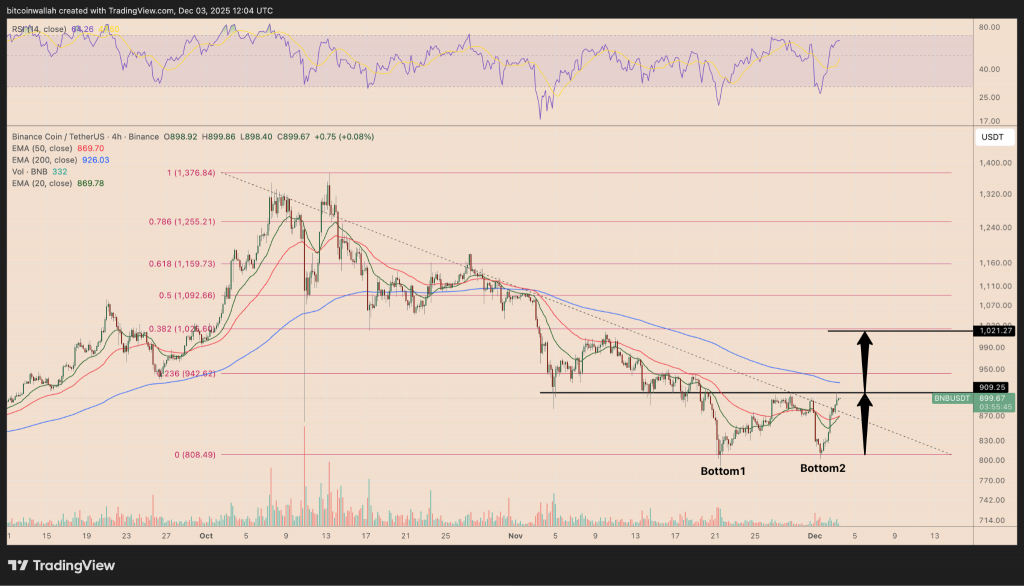
    BNB’s double-bottom and wedge breakout point toward a $1,000+ target
    BNB’s double-bottom and wedge breakout point toward a $1,000+ target. Source: Bitcoinwallah / TradingView

    However, BNB’s narrative this week also revolved around turbulence in the corporate treasury sector. CZ’s YZi Labs launched a formal attempt to overhaul the board of CEA Industries — the largest public BNB-holding company — accusing management of destroying shareholder value after the stock plunged 89% from its July peak. YZi aims to reverse recent bylaw changes, expand the board, and install its own nominees, arguing that CEA has failed to execute on its strategy of becoming the leading BNB treasury company. CEA responded by reaffirming its commitment to the BNB strategy while opening a dialogue with YZi to resolve concerns.
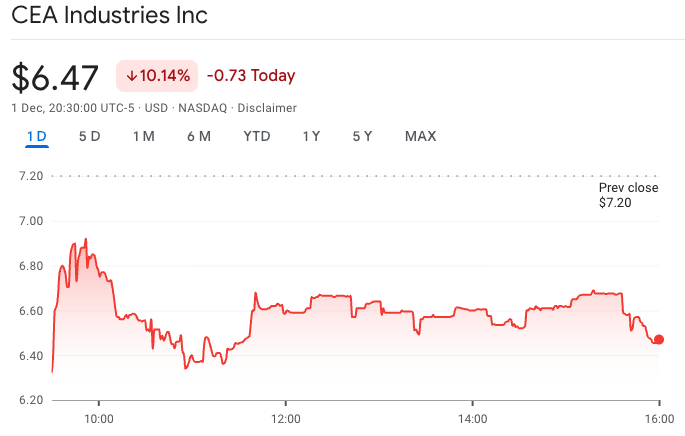
    CEA stock collapses as YZi Labs pushes for a board takeover
    CEA stock collapses as YZi Labs pushes for a board takeover. Source: Google Finance

    CEA stock collapses as YZi Labs pushes for a board takeover. Source: Google FinanceDespite governance drama and broader market pressure, BNB has held up better than many large-cap assets this quarter, outperforming even as it trades well below its mid-October all-time high of $1,367. CEA’s reported holdings of 515,054 BNB at an average entry of $851 place its treasury slightly underwater, yet BNB itself remains up 17.8% year-to-date, reinforcing its relative strength during the latest downturn. If bullish technicals continue to hold — and especially if liquidation clusters begin to trigger — analysts say BNB could feasibly revisit the $1,020–$1,115 range before year-end.

    Best cryptocurrencies to buy at a glance

     Native AssetLaunched InDescriptionMarket Cap*
    BitcoinBTC2009A P2P open-source digital currency$1.71 tln
    ZcashZEC2016Privacy-focused cryptocurrency$26.4 bln
    UniswapUNI2020The pioneering automated market maker protocol$5.56 bln
    AvalancheAVAX2020High-performance smart contract platform$5.05 bln
    EthereumETH2012The leading DeFi and smart contract platform$333 bln
    MoneroXMR2014A privacy-first cryptocurrency with fully obfuscated transactions$10.84 bln
    XRPXRP2015The leading crypto remittance solution$93.4 bln
    SolanaSOL2020Smart contracts platform with high speeds and low fees$68.5 bln
    ChainlinkLINK2017The largest decentralized oracle network $9.78 bln
    CardanoADA2017Research-driven smart contract platform$8.91 bln
    HyperliquidHYPE2024Decentralized perpetuals exchange with an efficient order book$24.1 bln
    BNBBNB2017The native coin of the Binance exchange$105.3 bln

    Best crypto to buy for beginners

    If you are just starting out in crypto, it is advisable to stick to cryptocurrency projects that are less prone to volatility and are generally more established. While this approach does have a downside, as it becomes much more difficult to expect triple-digit or larger gains, the major upside is that you are not exposed to projects that have a chance of failing and, thus, losing your entire investment. 

    In order to identify projects that are stable and thus feature low volatility, you can start by following the parameters listed below:

    • The crypto asset has a market capitalization that places it into the cryptocurrency top 100 (roughly $200 million as of autumn 2026)
    • The crypto asset is available for trading on the best crypto exchange platforms and can be exchanged for fiat currencies
    • The crypto asset boasts healthy liquidity ($100M/day and more), which allows you to execute buy and sell orders quickly and without slippage 
    • The crypto asset is part of a reputable crypto project with clear goals, a realistic roadmap, and products and services that look to address real-world problems

    Some of the best cryptos to buy for beginners are those that follow the above criteria and have earned their standing in the crypto market due to robust security, popular products and services, and clear growth potential. Some beginner-friendly crypto investments are:

    • Bitcoin
    • Ethereum
    • Litecoin
    • Cardano
    • BNB

    It is worth noting that cryptocurrency investments are inherently risky, even if you stick to the biggest and most reputable projects. The reason for this is simple – the crypto sector is relatively new, and the landscape might look completely different in the future.

    Best crypto for long-term

    When deciding which cryptocurrency to buy for the long term, it’s important to consider projects that are well-established, have a strong community, are highly liquid, have a large market cap, and have a clear reason for existing (such as solving a real-life problem, introducing new functionality, etc.). Without these characteristics, a project might fail to survive in the long term, rendering it a bad long-term investment.

    It is worth noting that, typically, most long-term crypto investors are looking for projects that have the potential to generate decent returns but also provide a degree of investment stability. Roughly speaking, only the largest cryptocurrencies fit the bill, as others have a low market cap and liquidity that doesn’t bode well for a long-term commitment (unless you’re prepared to take on more risk).

    In addition to Bitcoin and Ethereum, there are a number of other cryptocurrencies that fit the criteria of being low-risk, long-term crypto investments.

    If you are planning to hold onto your digital assets for a longer period of time, it is best to take care of crypto custody yourself. Holding large amounts of crypto on an exchange can be risky, as we’ve seen over the years with the collapse of high-profile exchanges like Mt. Gox and FTX. Use one of the reputable crypto hardware wallets to store your crypto. Ledger hardware wallets, for instance, allow you to manage your crypto holdings easily and provide a much higher degree of security than crypto exchanges or even software crypto wallets.

    Best place to buy crypto

    One crucial aspect to consider when choosing which platform to use to buy crypto is the range of cryptocurrencies and trading pairs available. Since different exchanges support varying digital assets, it’s important to choose a platform that accommodates the specific cryptocurrencies you intend to trade.

    Additionally, assessing an exchange’s liquidity and trading volume is essential. Higher liquidity generally results in improved price stability and faster trade executions. Furthermore, it is prudent to examine the fees charged by the exchange, encompassing deposit, withdrawal, and trading fees. Comparing fee structures across different exchanges can help you identify the most cost-effective option that aligns with your trading style. With that said, here are some of the best exchanges on the market right now:

    • Binance – The best cryptocurrency exchange overall
    • KuCoin – The best exchange for altcoin trading
    • Kraken – A centralized exchange with the best security

    By diligently considering these factors, you can make an informed decision and select a cryptocurrency exchange that meets your requirements for security, variety, liquidity, and affordability.

    How we choose the best cryptocurrencies to buy

    At CoinCheckup, we provide real-time prices for over 40,000 cryptocurrencies, with the list growing by dozens each day. As you can imagine, making a selection of a dozen top cryptocurrencies to buy out of such an immense dataset can be difficult and will for sure lead to some projects that should be featured being omitted. To minimize the chance of that happening, we follow certain guidelines when trying to identify the best cryptocurrencies to invest in.

    Availability 

    One of the most important factors for any cryptocurrency investment is the crypto asset’s availability, meaning how easy it is to buy and sell it across various cryptocurrency exchanges. We tend to stay away from assets that are not available on major exchanges and require complex procedures to obtain.

    Market Capitalization

    Another important metric for identifying whether a crypto project is worth covering its market cap. A high market cap means that the project has reached a certain level of adoption from users, making it less risky to invest in.

    Growth Potential

    While this metric is mostly subjective, it is still an important metric on which we curate our selection. We won’t feature projects that we think are stagnating or have no real upside in the future.

    Purpose and Use Case

    We consider the purpose and use case of cryptocurrency, particularly in a real-world setting. Some cryptocurrencies focus on specific industries or applications, such as decentralized finance, gaming, or supply chain management.

    Team and Development

    The team and people involved in the project can tell you a lot about the potential of a particular cryptocurrency project. We examine the team’s experience, expertise, and track record and evaluate the development activity and updates to ensure the project is actively maintained and evolving.

    The bottom line: What crypto should you buy right now?

    The decision of which crypto to buy now is dependent on your own risk profile and investment goals. For some, investing in a crypto asset with a proven track record like Bitcoin is the only type of exposure to crypto they are willing to take on.

    Meanwhile, those with a higher risk tolerance might see Bitcoin as too stable, looking instead toward newer and smaller projects that carry a higher degree of upside. 

    If you are looking for more investment ideas, check out our crypto price predictions section.

  • 11 Best Crypto to Buy Today for Long-Term

    11 Best Crypto to Buy Today for Long-Term

    10 Best Crypto to Buy Today for Long-Term

    Investing in cryptocurrency has been gaining popularity ever since Bitcoin’s genesis back in 2009. While initially, the cryptocurrency sector was flooded with people trying to make a quick buck through a few speculative trades, the time frame of most crypto investments has been gradually shifting toward the long term as the sector matures.

    In fact, many investors today consider cryptocurrency a viable long-term investment asset class. Those investors who believe that crypto will appreciate in the long run and therefore keep their coins and tokens safely stashed in their digital wallets are referred to as “HODLers” in the crypto jargon.

    Which crypto to buy today for long-term HODLing?

    In this article, we will explore the best long-term cryptocurrency investments, based on factors such as market capitalization, adoption rate, and the technology behind the project. Whether you are already a seasoned investor or new to the world of cryptocurrency, this guide will provide valuable insights into which crypto to buy today for the best long-term returns.

    In our opinion, the best long-term crypto investments are:

    1. Bitcoin – The world’s first and most renowned cryptocurrency
    2. Ethereum – The largest smart contract and dApp environment
    3. Zcash – A privacy-focused cryptocurrency with optional shielded transactions
    4. BNB – The native token of the BNB Chain and the Binance ecosystem
    5. Cardano – A proof-of-stake blockchain with a vibrant community 
    6. Polygon – A leading layer 2 scaling solution for faster transactions
    7. Polkadot – A blockchain network specialized in cross-chain transfers
    8. Uniswap – A decentralized exchange with an automated market maker
    9. XRP – A cryptocurrency for cross-border payments and settlement
    10. Filecoin – A decentralized file storage network
    11. Chainlink – The leading decentralized oracle network for secure data feeds

    Exploring the best long-term crypto projects

    This section will highlight 11 cryptocurrency projects that have demonstrated longevity or are strategically positioned for future growth. The list includes payment-focused cryptocurrencies, smart contract platforms, DeFi protocols, and more. We’ll explore the unique value propositions of each project and why they stand out for long-term investment potential.

    1. Bitcoin – The world’s first and most renowned cryptocurrency

    Bitcoin is the world’s first truly decentralized digital cryptocurrency. It was launched on the 3rd of January 2009 by Satoshi Nakamoto, whose real identity has remained a mystery to this day. The Bitcoin blockchain is a public ledger that is secured by a proof-of-work consensus algorithm. This requires miners to put in computational work to solve complex cryptographic problems and process transactions. For their work, miners can be rewarded with transaction fees and block rewards. The block reward decreases every four years in an event called the Bitcoin halving. This caps the total Bitcoin supply at 21 million coins and generates deflationary pressure.

    While Bitcoin started out as a niche project that mainly interested cryptography enthusiasts and “cypherpunks”, it didn’t take long for a wider audience to recognize the distinctive features of Bitcoin, leading to the emergence of a lively global market for BTC by 2012. The all-time high price for 1 BTC, which sits at $126,025, was reached in October 2025.

    Why is Bitcoin a good crypto to buy today for the long term?

    If you believe cryptocurrency has long-term potential, it’s hard to argue that Bitcoin won’t remain one of the leading assets in the space. It is still the largest cryptocurrency by market capitalization, and while it could eventually be overtaken, Bitcoin is likely to continue playing a central role in the market.

    Bitcoin is also a compelling long-term holding due to its predictable monetary policy. Its supply is capped at 21 million BTC, meaning no more than that will ever exist. The issuance of new coins is highly transparent and can be estimated with precision thanks to scheduled halvings and mining difficulty adjustments. Because of this, many investors see Bitcoin as sound money, which helps support long-term demand and can aid price recovery during market downturns.

    Beyond its monetary design, the Bitcoin network has proven resilient, securing significant amounts of value for more than a decade. Long-term holders have historically seen strong returns, and confidence in the protocol is likely to grow as long as it continues to operate reliably. Institutional interest has also increased since the launch of spot Bitcoin ETFs in early 2024, reinforcing BTC’s position as one of the strongest long-term crypto investments for 2026 and beyond.

    2. Ethereum – The largest smart contract and dApp environment

    Ethereum is an open-source blockchain that pioneered smart contract functionality in 2015. While the Ethereum network can also facilitate transfers of value between different Ethereum addresses, its key added value is in the execution of various smart contracts. Throughout their existence, Ethereum’s smart contract capabilities have facilitated numerous blockchain-powered innovations such as ICOs, DeFi, NFTs, and DAOs.

    Ethereum’s native asset, Ether (ETH), currently holds the position of the second-largest cryptocurrency by market capitalization. In addition, the Ethereum network hosts numerous ERC20 tokens (from exchange tokens to DeFi tokens and stablecoins), which further extend the Ethereum environment’s reach, liquidity, and utility.

    Why is Ethereum a good crypto to buy today for the long term?

    Ethereum is one of the most established cryptocurrencies and currently has the second-largest market capitalization after Bitcoin. It also ranks just behind Bitcoin in terms of institutional interest and access through traditional financial markets, with ETH products widely available to both retail and professional investors.

    The network is supported by a large and active community of developers and users who continue to expand its functionality. This strong ecosystem has allowed Ethereum to drive many of the most important innovations in crypto, including decentralized finance, NFTs, and smart contract standards, and it remains a key platform for new blockchain applications.

    In September 2022, Ethereum completed its transition from proof of work to proof of stake. This shift significantly improved the network’s energy efficiency and laid the groundwork for future scalability upgrades. In 2023, the Shanghai and Capella upgrades enabled ETH staking withdrawals, reducing risk for validators and making staking more accessible. The Dencun upgrade in 2024 introduced proto-danksharding, which sharply reduced transaction costs for layer 2 networks and improved overall scalability.

    Ethereum’s monetary dynamics have also changed meaningfully. The implementation of EIP-1559 in August 2021 introduced a fee-burning mechanism that permanently removes a portion of ETH from circulation with every transaction. Since its launch, several million ETH have been burned, slowing supply growth and, during periods of high network activity, pushing ETH issuance toward deflation. Together, these developments have strengthened Ethereum’s position as a long-term crypto asset with strong fundamentals.

    3. ZcashA privacy-focused cryptocurrency with optional shielded transactions

    Launched in 2016, Zcash is a decentralized cryptocurrency that builds on Bitcoin’s foundation while introducing advanced privacy features. The project traces its origins to the 2014 “Zerocash” research paper, which proposed a novel approach to confidential blockchain transactions. Zcash became the first major cryptocurrency to implement zk-SNARKs, a zero-knowledge proof technology that allows users to verify transactions without revealing sensitive information. The technology’s significance was recognized when MIT Technology Review named it one of the ten breakthrough technologies of 2018.

    Like Bitcoin, Zcash relies on Proof-of-Work mining and has a fixed maximum supply of 21 million ZEC. The network also follows a halving schedule that periodically reduces mining rewards, with the first halving taking place in 2020 at block height 1,046,400. This predictable issuance model gives Zcash similar scarcity characteristics to Bitcoin while adding optional privacy for users who need greater transaction confidentiality.

    Looking ahead, the Zcash community and Electric Coin Company have explored transitioning the network to a Proof-of-Stake consensus mechanism. Although no migration has been finalized, such a change could reduce energy consumption while enabling features such as staking and potentially improving network efficiency and scalability.

    Why is Zcash a good crypto to buy for the long term?

    Zcash stands out as one of the leading privacy-focused cryptocurrencies, making it an attractive option for investors who expect financial privacy to remain an important part of the digital asset ecosystem. Unlike most blockchains, where transaction details are publicly visible, Zcash allows users to choose between transparent and shielded transactions powered by zk-SNARK technology.

    Its capped supply and Bitcoin-inspired halving schedule provide a transparent and predictable monetary policy, while the project’s ongoing research into Proof-of-Stake demonstrates a commitment to long-term protocol development. At the same time, zero-knowledge cryptography is becoming increasingly important across the broader blockchain industry, reinforcing the relevance of the technology that Zcash helped pioneer.

    Interest in privacy-preserving cryptocurrencies has also strengthened in recent years as users, developers, and institutions place greater emphasis on confidentiality. If this trend continues, Zcash could benefit from growing adoption and increased demand for privacy-centric blockchain solutions.

    4. BNB – The native token of the BNB Chain and Binance ecosystem

    BNB is a cryptocurrency that was launched by Binance, one of the largest cryptocurrency exchanges in the world. Initially called the Binance Coin, this ERC-20 standard token was used to pay for trading fees and other services on the Binance exchange with a discount. However, Binance launched its own blockchain, the Binance Chain, in April 2019, and BNB was migrated from the Ethereum blockchain to the Binance Chain shortly thereafter.

    This is how BNB became the native asset of the BNB chain and was granted a whole new range of utility. The BNB chain is a smart chain that facilitates fast transactions and lower fees compared to the Ethereum network, which made it a popular choice among users and developers. BNB has a limited supply of 200 million coins.

    Why is BNB a good crypto to buy today for the long term?

    As the native cryptocurrency of the Binance exchange, BNB’s success is largely tied to the success of this international cryptocurrency conglomerate, which operates one of the largest and most popular cryptocurrency exchanges in the world. While Binance has a large and active user base and a strong track record of innovation and development, you should be aware that, despite being decentralized on paper, BNB is, in fact, quite centralized because of its strong ties to Binance. To invest in BNB for the long term, you should therefore trust in the success of Binance in the long run.

    Binance offers plenty of bonuses for BNB holders, such as reduced trading fees, the ability to participate in Binance Launchpad, BNB staking, and even earning cashback when paying with the Binance VISA Card. 

    Binance also regularly conducts buybacks and burns of BNB tokens using a portion of its profits, thereby reducing the total supply, and potentially increasing the value of each coin. In addition to the quarterly BNB burns, the BNB chain also employs a real-time burning mechanism introduced by BEP95 (BNB Chain equivalent of EIP-1559 on Ethereum). Holders of the BNB cryptocurrency should be aware that if there are any issues with Binance as a business (like we’ve seen with the SEC lawsuits against the Binance exchange and BUSD creator Paxos), the value of BNB will also likely take a hit.

    5. Cardano – A proof-of-stake blockchain with a vibrant community

    Cardano is a decentralized blockchain platform created to provide secure, transparent, and sustainable infrastructure for decentralized applications and transactions. Founded by Charles Hoskinson, a co-founder of Ethereum, Cardano uses a proof-of-stake consensus mechanism to validate transactions on its network. The blockchain was designed with a rigorous academic approach and features a layered architecture and built-in treasury system for easy maintenance and future upgrades.

    Its native cryptocurrency is ADA, which is used to pay for transaction fees and as a store of value. Cardano’s potential for faster, scalable, and cost-effective transactions, as well as its commitment to sustainability, has gained attention from investors and traders for various use cases, including DeFi and NFTs.

    Why is Cardano a good crypto to buy today for the long term?

    Cardano has a rather large developer community and a very active user base. Perhaps also because of this, the blockchain is steadily receiving upgrades to improve its scalability and smart contract capabilities. The high scalability, ultimate efficiency, and continued improvement of the protocol make Cardano one of the top contenders among the smart contract-enabled chains.

    Cardano is famous for its commitment to rigorous scientific research and development principles. While such a methodical approach allows Cardano to avoid the pitfalls encountered by projects with rushed development, it also has its drawbacks. For example, Cardano has been rather slow at capitalizing on important trends such as DeFi and NFTs. Nevertheless, this could suggest that the growth of Cardano is more sustainable and less hype-driven than that of other comparable projects.

    As the platform’s smart contract functionality evolves further, we will likely see a growing number of interesting decentralized applications launch on this incredibly scalable platform. To conclude, Cardano remains a promising blockchain platform with strong potential for growth in the long term.

    6. Polygon – A leading layer 2 scaling solution for faster transactions

    Polygon is a Layer 2 scaling solution for Ethereum, designed to solve the blockchain’s scalability limitations. Previously known as Matic Network, Polygon uses multiple proof-of-stake sidechains to regularly push data to Ethereum for network checkpoints. With two bridges facilitating seamless asset transfers between Ethereum and Polygon, users benefit from supersonic speeds and high throughput, as well as easy and swift exits to the Ethereum mainnet.

    Polygon’s features have made it an attractive option for DeFi projects, establishing it as a leading player in the DeFi sector. Developers and businesses are taking note of its solutions to Ethereum’s scalability challenges, making Polygon a promising platform for innovation.

    Why is Polygon a good crypto to buy today for the long term?

    The largest fear of investors in Polygon has been that the project will become obsolete as the Ethereum mainnet receives additional scalability-focused upgrades. Nevertheless, even after more than a year following Ethereum’s transition to PoS, Polygon continues to complement Ethereum by further amplifying its scalability and facilitating interoperability with other blockchain networks. Even after Ethereum developers deploy sharding, it is far more likely that Polygon will shift its focus to other use cases than straight up disappear, causing MATIC’s price to crash.

    Polygon has lately achieved considerable success and adoption in the NFT sector. The popular Layer 2 solution has secured partnerships with several mainstream companies, including Reddit, Starbucks, DraftKings, and Robinhood, indicating its potential as a significant beneficiary if blockchain-based applications and NFT-based collectibles gain mainstream popularity.

    In addition, the Polygon network has maintained a high level of activity even during past bear market conditions. This is a significantly positive sign that reflects the network’s utility and the project’s long-term vision, which are independent of current market conditions.

    7. Polkadot – A blockchain network specialized in cross-chain transfers

    Polkadot is a next-generation blockchain platform that addresses issues of interoperability and scalability through the use of parallelly-run chains, also called parachains. Similarly to Cardano, the Polkadot project was created by one of the developers initially involved with Ethereum; the founder of Polkadot is Ethereum co-founder Gavin Wood. The platform is designed to allow different blockchains to connect and communicate with each other, creating a seamless network of various blockchain ecosystems.

    Polkadot uses a unique consensus mechanism known as nominated proof-of-stake (NPoS) and allows for cross-chain communication, enabling the creation of decentralized applications that can leverage the features and functionalities of multiple blockchains. The platform utilizes a native currency called DOT.

    Why is Polkadot a good crypto to buy today for the long term?

    Polkadot’s unique value proposition as a platform for cross-chain communication and interoperability has attracted significant attention from developers and investors.

    The platform’s modular design allows for not only flexibility and upgradability but also virtually unlimited room for growth. In addition, each parachain can be customized to best accommodate the specific needs of each project. The use of parachains will allow Polkadot to capitalize on any new trends that will emerge in the crypto space in the future.

    Last but not least, Polkadot has repeatedly stayed within the Top 50 highest market cap cryptocurrencies and already has a vibrant ecosystem of developers and projects building on the platform. This could indicate that the ecosystem has a potential for continued growth and innovation in the long term, making Polkadot one of the most promising blockchain platforms currently available.

    8. Uniswap – A decentralized exchange with an automated market maker

    Uniswap is an automated market maker (AMM) protocol that enables quick and easy swaps between different Ethereum-based tokens. Its governance token, UNI, is an ERC-20 token that allows holders to vote on proposals that determine the future of the platform.

    In the past, Uniswap has been struggling with high fees on the Ethereum network, which have caused a decline in its user base and market share. Rather than giving up, the project answered by implementing upgrades that improved its services and reduced fees. Two major milestones were the release of Uniswap V3 in March 2021, which implemented an improved version of the AMM protocol, and the launch of the Uniswap protocol on two Ethereum Layer 2 networks in July 2021.

    Why is Uniswap a good crypto to buy today for the long term?

    Uniswap is a decentralized exchange protocol that allows users to trade cryptocurrencies without the need for intermediaries. With over $4.1 billion locked across six different blockchains, Uniswap is already an established player in the DeFi space. Continued demand for decentralized finance (DeFi) and decentralized trading has been a significant driver of Uniswap’s growth in the past and will likely continue to fuel Uniswap’s development and UNI’s appreciation in the future.

    In the future, Uniswap could benefit from the influx of new investors. As more people become interested in cryptocurrencies and decentralized finance, they will discover Uniswap and likely start using its services. Furthermore, Uniswap could benefit a lot if more centralized exchanges get into trouble or are struck by negative publicity, as was the case in November 2022, when FTX collapsed.

    For the long-term success of a project, it is also crucial that the developers continue to introduce new features and improve the existing ones. Since Uniswap regularly introduces new features and deploys improved and more efficient iterations of its protocol, such as Uniswap v3, UNI could be a good crypto to hold for the long term.

    9. XRP – A cryptocurrency for cross-border payments and settlement

    XRP is the native cryptocurrency of the Ripple blockchain, which was launched in 2012 by Chris Larsen, Jed McCaleb, and Arthur Britto. It was designed to enable fast and inexpensive cross-border payments, with the goal of improving the traditional banking system. The Ripple network uses a unique Ripple Protocol consensus algorithm (RPCA), which is neither proof-of-work nor proof-of-stake. Instead, it relies on a distributed agreement protocol to validate transactions, allowing for faster and more efficient processing.

    One of the unique features of Ripple is its maximum supply of 100 billion coins, all of which were minted at launch. At that time, 80% of the total XRP supply was given to fintech firm Opencoin, which later rebranded as Ripple Labs in 2015. As of today, Ripple Labs still holds more than half of the total XRP supply. However, most of the company’s XRP holdings are locked in escrow, with a small portion released each month.

    Why is XRP a good crypto to buy today for the long term?

    XRP has established a distinct role in the crypto market by focusing on fast and low-cost financial transfers. This gives it a practical long-term use case, especially in areas where speed and efficiency are critical. As global remittances continue to expand, solutions like Ripple’s On-Demand Liquidity (ODL) could become more relevant for institutions looking to move money internationally without relying on slow and expensive legacy systems.

    The XRP Ledger has also demonstrated strong reliability over more than a decade of continuous operation. Its consensus mechanism allows for high transaction throughput without the energy demands associated with Proof-of-Work networks. This makes the network well-suited for large-scale payment activity while remaining efficient and stable.

    In addition, Ripple continues to build partnerships with banks, payment providers, and financial institutions. These integrations suggest growing interest in blockchain-based payment infrastructure and could support broader adoption over time. With a fixed XRP supply and an established role in cross-border payments, XRP remains a notable long-term project within the payments-focused segment of the crypto market.

    10. Filecoin – A decentralized file storage network

    Filecoin is a decentralized storage network that allows users to rent out their unused hard drive space in exchange for the platform’s native cryptocurrency, FIL. The project raised $205 million worth of crypto in a 2017 ICO and launched its highly anticipated mainnet on October 15, 2020.

    Filecoin uses a proof-of-replication consensus mechanism to ensure that data is stored correctly and securely. By incentivizing users to contribute storage space, Filecoin creates a decentralized network that allows for more efficient and cost-effective data storage compared to centralized cloud storage providers.

    Why is Filecoin a good crypto to buy today for the long term?

    Filecoin network’s decentralized storage service eliminates dependence on centralized cloud storage providers and offers a highly competitive storage marketplace that results in improved consumer pricing. With the wider adoption of cryptocurrency, blockchain, and decentralized protocols, projects like Filecoin are poised to enjoy increased demand for their services. In fact, decentralized storage will likely be critical for supporting the migration to Web3 solutions.

    An excellent example of the network’s potential application is in storing media linked to NFTs, ensuring that it remains accessible and unaltered over an extended period. If the need for decentralized storage expands, Filecoin could certainly emerge as one of the major cryptocurrency powerhouses in the near future.

    11. Chainlink – The leading decentralized oracle network for secure data feeds

    Chainlink is a decentralized oracle network that connects smart contracts to off-chain data sources and APIs. It enables smart contracts to access external data securely and reliably, thus providing a bridge between the blockchain and the real world. As of today, Chainlink is one of the most widely used oracle solutions in the blockchain ecosystem, with a growing number of integrations with various blockchain platforms and projects.

    The network is powered by LINK, its native token, which is used to pay node operators for providing reliable data and to secure the network through staking. Furthermore, LINK is also used as a governance token for the project, allowing token holders to vote on proposals to improve the network.

    Why is Chainlink a good crypto to buy today for the long term?

    Since its launch in 2017, Chainlink’s decentralized oracle network has quickly grown to become a cornerstone of the crypto ecosystem. The network plays an almost irreplaceable role in many decentralized applications on several different blockchains, including major projects like Aave, Synthetic, Compound, and Ethereum Name Service.

    Chainlink’s services have an immense number of potential applications. A particularly interesting one is that Chainlink’s secure and reliable access to off-chain data makes it a valuable tool for verifying the solvency of cryptocurrency exchanges and other financial institutions. These entities could generate and display their proof of reserves using Chainlink in the future.

    Furthermore, Chainlink is currently in the process of transitioning towards Economics 2.0, which will feature LINK staking along with the BUILD and SCALE programs designed to expand the Chainlink ecosystem and make the network more accessible for developers. With these developments, Chainlink’s potential for growth over the long term is substantial.

    The bottom line – Long-term investing is about looking at the big picture

    We sincerely hope that this article has provided you with valuable insights and ideas to consider in your quest to find the most promising and ultimately best crypto for long-term holding. In general, all the featured cryptocurrencies are already established projects with a clear vision for future development, a growing user base, and active developers. This is why these projects are poised to thrive regardless of the ups and downs of the volatile cryptocurrency markets. Therefore, they present excellent investment opportunities for those seeking long-term growth.

    Nevertheless, the best cryptocurrency to invest in widely varies between investors, as the pick greatly depends on your investment goals, risk tolerance, skill, knowledge, and the amount of time you are prepared to put into research and portfolio management. If you decide to get into the HODL game, make sure to do your own research and take all the necessary precautions to keep your assets safe. Our guides on the best hardware wallets and best metal wallets can help you choose a secure storage setup catered to your needs.

  • Satoshi Nakamoto Wallet Address: How Much BTC Does Satoshi Own?

    Satoshi Nakamoto Wallet Address: How Much BTC Does Satoshi Own?

    bitcoin wallet

    There is no concrete way to know exactly how much Bitcoin (BTC) Satoshi Nakamoto owns, but researchers believe that the amount could be anywhere between 600,000 BTC and 1.1 million BTC. One of his most famous wallet addresses is 1A1zP1eP5QGefi2DMPTfTL5SLmv7DivfNa, which was used to mine the Bitcoin genesis block.

    Satoshi Nakamoto is an enigmatic entity that has been draped in folklore and mystery since the Bitcoin whitepaper was published in October 2008. As BTC gained worldwide acclaim for being a secure method of processing peer-to-peer payments and an alternative to traditional payment infrastructure, speculation about his true identity only grew.

    However, to this day, nobody really knows exactly who he was, which Bitcoin wallet addresses belonged to him, or how many BTC he mined during the early stages of the blockchain. But there’s still plenty of evidence that suggests the figure ranges from 600,000 BTC to 1.1 million BTC spread across 20,000+ separate wallet addresses.

    Key takeaways:

    • Two wallet addresses that certainly belonged to Satoshi Nakamoto are 1A1zP1eP5QGefi2DMPTfTL5SLmv7DivfNa and 1HLoD9E4SDFFPDiYfNYnkBLQ85Y51J3Zb1, which were respectively used to receive the first Bitcoin mining reward and to send the first Bitcoin transaction
    • Blockchain researchers have suggested that Satoshi may have had over 20,000 wallet addresses in total, and that he may own more than 1 million BTC
    • There is no definitive way to know how many addresses belonged to Satoshi, but experts have deduced that there’s certainly more than 600,000 BTC in wallets that belonged to him

    Satoshi Nakamoto’s wallet addresses

    During the early days of the Bitcoin blockchain, not many people were aware that it existed. Those who did know generally spent their time in cryptography communities and had a highly specialized set of technical skills.

    Due to the limited reach of the blockchain during its early stages, it’s widely believed that Satoshi Nakamoto was running the majority of BTC nodes himself. This has led to speculation about the exact number of BTC that lies dormant in Satoshi’s original wallets.

    At this point, it’s important to note that most of the information about Satoshi’s original wallets is speculation. Since the public address of each wallet is only characterized by a hexadecimal string, and Satoshi Nakamoto was extremely cautious about not revealing his true identity, it’s practically impossible to confirm whether or not most of the early addresses were his.

    Regardless, blockchain researcher Sergio Damian Lerner noticed a pattern while analyzing some of the earliest Bitcoin wallet addresses. Lerner suggests that the ‘Patoshi’ pattern can be used to determine the number of addresses that belonged to Satoshi based on several unifying characteristics in the source code of early Bitcoin blocks.

    Some of the addresses that may have belonged to Satoshi Nakamoto have been included in the table below. You’ll notice that most wallets contain 50 BTC, which was the original block mining reward. Besides symbolic donations from Bitcoin investors paying tribute to the founder of the technology, each of these addresses has remained untouched since the early days of Bitcoin.

    AddressBalanceNotes
    1A1zP1eP5QGefi2DMPTfTL5SLmv7DivfNa107.34 BTCGenesis address
    12cbQLTFMXRnSzktFkuoG3eHoMeFtpTu3S18.44 BTCAddress used by Satoshi to send the first user-to-user Bitcoin transaction to Hal Finney
    12c6DSiU4Rq3P4ZxziKxzrL5LmMBrzjrJX51.35 BTCn/a
    1HLoD9E4SDFFPDiYfNYnkBLQ85Y51J3Zb150.08 BTCn/a
    1FvzCLoTPGANNjWoUo6jUGuAG3wg1w4YjR50.01 BTCn/a
    15ubicBBWFnvoZLT7GiU2qxjRaKJPdkDMG50.07 BTCn/a
    1JfbZRwdDHKZmuiZgYArJZhcuuzuw2HuMu50.01 BTCn/a
    1GkQmKAmHtNfnD3LHhTkewJxKHVSta4m2a50 BTCn/a
    16LoW7y83wtawMg5XmT4M3Q7EdjjUmenjM50.02 BTCn/a
    1J6PYEzr4CUoGbnXrELyHszoTSz3wCsCaj50 BTCn/a

    How much Bitcoin does Satoshi Nakamoto own?

    As stated, there is no definitive way to know how much Bitcoin Satoshi Nakamoto owns since the entity’s true identity remains a mystery to this day. Researchers have analyzed the earliest Bitcoin blocks to make educated guesses, with estimates ranging from 600,000 to 1.1 million BTC.

    Sergio Demian Lerner suggested in a 2013 blog post that 63% of the first 36,288 blocks were mined by a single entity, based on consistencies in these blocks’ characteristics. Lerner notes that none of the BTC mined from these blocks has ever been spent, which would have confirmed the identity of the miner. In total, Lerner estimated that 1148800 BTC belonged to an entity that had been active since Block 1.

    However, another researcher known as Dude Watchin’ built on Lerner’s analysis in collaboration with Bitmex in 2018. Bitmex published that Lerner’s methodology was limited and that there were some fundamental errors in his approach, including that Satoshi was the sole miner during the first two weeks, and that hashrate consistency is not definitive or reliable proof. Regardless, the updated methodology found that over 700,000 BTC may have belonged to a single entity from these early stages.

    Satoshi implemented strong operational security and took measures to obscure his activity on the blockchain after mining the early blocks. While the exact figure cannot be known, it is widely believed that Satoshi is sitting on an enormously valuable cache of Bitcoin, worth between $68 billion and $124.7 billion at the current market price.

    Satoshi Nakamoto’s most famous wallet address

    The Bitcoin address, 1A1zP1eP5QGefi2DMPTfTL5SLmv7DivfNa, is considered Satoshi’s most famous wallet. This is the address that Satoshi used to receive the first 50 BTC ever mined on the Bitcoin blockchain — the reward from the genesis block.

    The genesis block famously has a hardcoded text string within it that reads: “The Times 03/Jan/2009 Chancellor on brink of second bailout for banks” which reflects Satoshi’s original vision for the blockchain as a universal, peer-to-peer payment method with no middlemen and acts as an indelible timestamp for the point at which Bitcoin went live.

    Like many of the early Bitcoin addresses that were used to receive a mining reward, the BTC lies dormant and has never been spent. However, Bitcoin users have sent an additional 50 BTC to the address to pay tribute to the visionary founder of the technology.

    The Hal Finney address

    Another famous wallet address that belonged to Satoshi Nakamoto is the Hal Finney address, 1HLoD9E4SDFFPDiYfNYnkBLQ85Y51J3Zb1. While there is long-standing speculation about a personal connection between Satoshi and Hal Finney, who was one of the earliest contributors to the Bitcoin project, this section will focus only on the transaction made between Satoshi and Hal on 12th January 2009.

    Hal Finney was a renowned cryptographer and coder who was among the first people to download the Bitcoin software in 2009 after Satoshi released it. 9 days after Bitcoin first went live, Finney received the first Bitcoin transaction from Satoshi on Block 170.

    This transaction, worth 10 BTC, was likely a test to see whether the chain was working as intended. It successfully demonstrated that BTC could be sent peer-to-peer using a trustless and secure network of nodes. The transaction is considered to be highly symbolic, cementing Hal Finney’s place as one of the pioneering supporters of Bitcoin.

    The $1.2 million transaction to Satoshi’s genesis address

    In January 2024, an unknown user sent 26.9 BTC—worth roughly $1.2 million at the time—to Satoshi Nakamoto’s genesis address, which was used to receive the first-ever Bitcoin block reward. The transfer increased the address’s balance to nearly 100 BTC, and its holdings have since surpassed 104 BTC.

    The funds were sent shortly after being withdrawn from the Binance cryptocurrency exchange. Prior to the transfer, the sending wallet had only been used to receive a single BTC withdrawal from Binance. Afterward, it interacted with another wallet that blockchain analytics firm Arkham Intelligence has identified as belonging to the Robinhood trading platform.

    The transaction history of the wallet that sent $1.2 million worth of Bitcoin to Satoshi Nakamoto. Source: Arkham Intelligence

    The motive behind the transaction remains unknown. Some members of the crypto community speculated that it was a marketing stunt tied to the launch of the first spot Bitcoin ETFs. Regardless of the sender’s intent, the 26.9 BTC transferred to the genesis address is widely regarded as effectively removed from Bitcoin’s circulating supply.

    Will Satoshi’s Bitcoins ever move?

    The Bitcoins widely believed to belong to Satoshi Nakamoto have remained largely untouched since they were mined. If those coins were to move today, it would almost certainly send shockwaves through the crypto community.

    One possible scenario in which Satoshi’s Bitcoins could move involves advances in quantum computing. As the technology continues to develop, researchers expect quantum computers to become increasingly capable of breaking cryptographic systems that are considered secure today. If quantum computers eventually become powerful enough to derive the private keys protecting Satoshi’s Bitcoin addresses, the coins could theoretically be accessed and reintroduced into circulation.

    Frequently asked questions

    What is Satoshi Nakamoto’s Bitcoin wallet?

    Satoshi Nakamoto is believed to have owned many different Bitcoin wallet addresses. Two confirmed addresses are the wallet that was used to receive the first 50 BTC mined during the Bitcoin genesis block, and the address that was used to send 10 BTC to Hal Finney shortly after the blockchain went live.

    These addresses are 1A1zP1eP5QGefi2DMPTfTL5SLmv7DivfNa (genesis block reward) and 1HLoD9E4SDFFPDiYfNYnkBLQ85Y51J3Zb1 (Hal Finney address).

    How many Bitcoin addresses belong to Satoshi Nakamoto?

    There is no definitive way to know how much BTC belongs to Satoshi Nakamoto. However, estimates from blockchain researchers have suggested that Bitcoin’s first contributor owns between 600,000 BTC and 1.1 million BTC.

    Why do so many of Satoshi’s wallets have 50 BTC?

    When Satoshi was actively mining Bitcoin, the block reward was 50 BTC. This means most of his addresses contain that exact amount, since each represents a single mined block.
    After four Bitcoin halvings, the reward has dropped to 3.125 BTC, making these early addresses a historical snapshot of Bitcoin’s beginnings.

    Why do people still send BTC to Satoshi?

    Bitcoin users occasionally send BTC to Satoshi’s known addresses as a tribute to the creator of Bitcoin. These symbolic transfers have turned the genesis wallet into a sort of digital monument.
    Some also send coins as a publicity stunt, knowing that any transaction linked to Satoshi’s wallets will attract attention.
    While it’s technically possible that Satoshi could be sending BTC to his own addresses, there’s no evidence of outgoing activity from these wallets, which have remained untouched for over a decade.

    How much money does Satoshi Nakamoto have?

    Satoshi Nakamoto is a multi-billionaire based on his Bitcoin holdings alone.

    • Using the conservative estimate of 600,000 BTC, his net worth would be around $40 billion, ranking him among the 40 richest people in the world.
    • With the higher estimate of 1.1 million BTC, his wealth would exceed $74 billion, placing him among the top 25 richest individuals globally — ahead of Rob Walton and just behind Amancio Ortega.

    The bottom line

    There is a lot of speculation surrounding Satoshi Nakamoto, the pseudonymous founder of the Bitcoin blockchain. He (or she or they, but since the character was intended to be male, it follows that the correct pronoun is he) went to great lengths to obfuscate his true identity and has, to this day, been very successful in that effort.

    Due to the quasi-anonymized nature of the blockchain and the lengths taken by the entity known as Satoshi Nakamoto to remain unknown, every estimate made about the exact total of BTC owned by the founder are limited. It is, however, general consensus that more than half a million BTC remain dormant in addresses that belonged to Satoshi Nakamoto.

  • GoBTC Pay Review: Can Bitcoin Payments Work at the Point of Sale?

    GoBTC Pay Review: Can Bitcoin Payments Work at the Point of Sale?

    Key Highlights

    • GoBTC Pay enables instant payment confirmation while settling transactions directly on the Bitcoin base layer, without Lightning channels, wrapped assets, or automatic fiat conversion.
    • Users pay no transaction fee and retain shared control of their Bitcoin through a 2-of-3 multisignature wallet structure, while merchants are charged a 0.2% acquiring fee.
    • The protocol offers an interesting alternative to Lightning-based payment systems, but its reliance on GoMining’s infrastructure means it has yet to prove its performance at scale.

    Bitcoin was introduced as a peer-to-peer electronic cash system, but its use as an everyday payment method has remained limited. Base-layer transactions can be expensive and unpredictable, while faster alternatives often require users and merchants to rely on custodians, payment channels, or automatic conversion into fiat currency.

    GoBTC Pay is GoMining’s attempt to address those limitations without moving payments away from the Bitcoin base layer. The protocol combines instant point-of-sale confirmation with delayed on-chain settlement, using GoMining’s mining infrastructure to prioritize transactions.

    The resulting system presents a potentially attractive proposition for Bitcoin users who want to spend BTC directly and for merchants willing to receive and retain Bitcoin. However, GoBTC Pay also introduces infrastructure dependencies and operational trade-offs that distinguish it from both conventional self-custody and decentralized base-layer transactions.

    Before we take a closer look at what GoBTC Pay has to offer in more detail, here’s a quick breakdown of the protocol’s most important benefits and disadvantages.

    GoBTC Pay pros:

    • Instant payment confirmation at checkout.
    • Transactions settle directly on Bitcoin’s base layer.
    • No transaction fees for users.
    • Low 0.2% acquiring fee for merchants.
    • Open SDK and API support integrations with wallets, merchants, banks, and POS providers.

    GoBTC Pay cons: 

    • Merchants must handle fiat conversion themselves.
    • The protocol depends heavily on GoMining’s mining infrastructure.
    • Scalability and reliability remain unproven due to the limited initial rollout.

    What is GoBTC Pay?

    GoBTC Pay is a Bitcoin payment protocol developed by Bitcoin mining company GoMining. It is designed to let customers pay merchants with BTC while keeping the transaction denominated and settled entirely in Bitcoin.

    Unlike payment processors that accept Bitcoin from the customer but deliver dollars or another fiat currency to the merchant, GoBTC Pay does not automatically convert the payment. The merchant ultimately receives BTC and must arrange a separate conversion if it prefers to hold fiat.

    The protocol also differs from Lightning-based systems. GoBTC Pay does not require merchants or customers to open payment channels, manage liquidity, or maintain off-chain balances. Transactions are instead sent through GoMining’s dedicated transaction infrastructure and prioritized for inclusion in blocks mined by its pool.

    At checkout, the merchant receives an immediate confirmation so that the sale can be completed without waiting for an on-chain block. Final settlement takes place directly on Bitcoin, with GoMining targeting an average settlement window of approximately 12 hours.

    GoMining has released a Gen1 software development kit and API that includes merchant onboarding tools, payment management features, online checkout integrations, a web-based dashboard, and support for wallet providers and institutional partners.

    Advantages for Bitcoin users

    The clearest benefit for customers is that GoBTC Pay attempts to make Bitcoin spending resemble a conventional card or mobile-wallet payment.

    A customer can initiate a transaction and receive an immediate checkout confirmation instead of waiting for one or more Bitcoin blocks. This is important for physical retail environments, where even a ten-minute confirmation delay would generally be impractical.

    GoBTC Pay also says users are not charged transaction fees, spreads, or other payment costs. The merchant pays the protocol’s acquiring fee, allowing the customer to spend the displayed BTC amount without an additional network fee being added at checkout.

    Another advantage is that payments remain Bitcoin-native. Users do not need to acquire wrapped BTC, deposit funds into a Lightning channel, or convert their coins into a platform-specific balance. The transaction ultimately settles on Bitcoin’s base layer.

    The wallet security structure is more nuanced. GoBTC wallets use a 2-of-3 multisignature arrangement:

    • One key is stored on the user’s device.
    • One key is held by GoMining as a co-signer.
    • One key is held by an independent regulated custodian.

    Because two keys are required to move funds, GoMining cannot unilaterally access the user’s Bitcoin. The custodian can also provide a recovery path if the user loses a device.

    This arrangement may be more forgiving than traditional self-custody, where losing a seed phrase can permanently destroy access to funds. However, it is not equivalent to a setup in which the user independently controls every key needed to spend their Bitcoin. Users must still depend on at least one external co-signer.

    Advantages for merchants

    For merchants, GoBTC Pay’s most significant selling point is its 0.2% acquiring fee.

    That is considerably lower than the typical percentage charged by card processors. On a $100 transaction, the merchant would retain $99.80 before considering any later cost associated with converting BTC into fiat.

    The protocol’s fee distribution could also help expand adoption. Half of the 0.2% fee goes to miners participating in the GoBTC pool, while the other half goes to the wallet provider that initiated the transaction. GoMining says it does not retain the fee on qualifying third-party transactions.

    This structure gives external wallets a direct financial incentive to integrate the protocol. A wallet that originates a GoBTC Pay transaction can earn 0.1% of its value, potentially creating a distribution network beyond GoMining’s existing applications.

    Merchants also benefit from Bitcoin’s transaction finality. Once a GoBTC Pay transaction has settled on-chain, it cannot be reversed through a conventional card chargeback process. This could reduce exposure to fraudulent disputes, rolling reserves, and delayed payment reversals.

    There is nevertheless a distinction between instant payment confirmation and final settlement. A merchant can treat the transaction as approved at the point of sale, but the corresponding Bitcoin transaction may not be finalized on-chain for several hours. Merchants will therefore need to understand what guarantees GoMining provides during the period between checkout confirmation and blockchain settlement.

    How GoBTC Pay compares with Square and Lightning

    GoBTC Pay is entering a market that already includes established payment processors and Lightning-based solutions.

    Block’s Square has been expanding support for Bitcoin payments using the Lightning Network. In Square’s model, merchants can accept a customer’s Bitcoin payment while receiving the proceeds in U.S. dollars by default. Merchants can choose to retain BTC, but the system is designed to fit relatively easily into existing fiat-based business operations.

    GoBTC Pay takes the opposite approach. Its default assumption is that the merchant wants to receive Bitcoin. This preserves the Bitcoin-denominated nature of the transaction but transfers the responsibility for tax accounting, treasury management, and any eventual fiat conversion to the merchant.

    Compared with Lightning, GoBTC Pay removes the need to open channels or manage inbound and outbound liquidity. Settlement also appears directly on the Bitcoin blockchain rather than being maintained as off-chain channel state.

    However, Lightning is supported by a broad and increasingly diverse network of nodes, wallets, payment processors, and liquidity providers. GoBTC Pay currently depends much more heavily on GoMining’s mining pool, transaction-prioritization system, and co-signing infrastructure.

    The two systems are not necessarily direct substitutes. Lightning may be more suitable for users who prioritize rapid, decentralized off-chain payments, while GoBTC Pay could appeal to merchants and wallets that want a simpler integration combined with eventual base-layer settlement.

    GoMining’s mining advantage

    GoBTC Pay’s core technical and economic proposition depends on GoMining being both a payment infrastructure provider and a Bitcoin miner.

    A payment-only company generally submits transactions to the public mempool and competes for block space under prevailing fee conditions. It cannot guarantee when a third-party mining pool will include a particular transaction.

    GoMining says it can instead send GoBTC Pay transactions through its dedicated infrastructure, prioritize them within its own pool, and recover part of the network economics through its mining operations.

    This creates a closed-loop model that would be difficult for a conventional payment processor to reproduce without access to substantial mining capacity.

    The model also creates concentration risk. GoBTC Pay’s service quality depends on GoMining maintaining sufficient hashrate, operating its pool reliably, and continuing to prioritize payment transactions. If its share of block production falls or its infrastructure becomes unavailable, settlement performance could deteriorate.

    The targeted 12-hour settlement period should therefore be viewed as an operational objective rather than the fixed block-level guarantee associated with a centralized payment ledger.

    Integration and API documentation

    GoBTC Pay is designed as open infrastructure rather than a payment feature restricted to GoMining’s own users.

    The protocol can be integrated by software wallets, hardware wallet providers, exchanges, banks, fintech applications, merchants, and point-of-sale operators. It supports both custodial implementations and non-custodial wallet models.

    GoBTC Pay also provides an extensive API documentation section covering the information wallet developers, merchants, and point-of-sale operators need to implement the protocol.

    This developer-focused approach is essential to GoBTC Pay’s strategy. A payment network becomes more useful as more wallets and merchants support it, and the revenue-sharing model is intended to encourage third-party integrations.

    The main question is whether the available tooling is sufficient to translate developer interest into active merchant adoption. The initial rollout is expected to involve up to ten merchants and ecosystem partners, meaning the protocol is still at an early stage despite reportedly having a larger integration waiting list.

    Limitations and open questions

    GoBTC Pay addresses several genuine problems associated with Bitcoin commerce, but its model comes with important limitations.

    First, merchants receive Bitcoin rather than fiat. This is an advantage for businesses that want BTC exposure, but it may be a barrier for those that need predictable fiat revenue to pay employees, suppliers, taxes, and rent.

    Second, the protocol is non-custodial in the sense that GoMining cannot move funds alone, but users still rely on a multisignature system involving GoMining and a regulated custodian. Its security model should not be confused with fully independent self-custody.

    Third, instant merchant confirmation occurs before final on-chain settlement. More detail is needed on how double-spend attempts, failed settlement, prolonged block delays, and temporary pool outages are handled.

    Finally, GoBTC Pay has not yet demonstrated its performance across a large and diverse merchant network. Integration quality, payment success rates, support processes, accounting tools, and settlement consistency will become clearer only after sustained real-world use.

    Is GoBTC Pay a compelling Bitcoin payment option?

    GoBTC Pay offers a distinctive compromise between slow base-layer payments and off-chain payment networks.

    For users, it promises fee-free Bitcoin spending, immediate checkout confirmation, and eventual settlement on Bitcoin. For merchants, it offers low processing fees, irreversible settlement, and the ability to receive BTC without an intermediary converting it into fiat.

    Its strongest differentiator is GoMining’s ability to combine payment processing with mining. That gives the company more influence over transaction inclusion than a typical Bitcoin payment processor.

    The same characteristic is also the protocol’s main source of risk. GoBTC Pay relies on GoMining’s pool, transaction infrastructure, and multisignature participation to deliver the experience it promises.

    At this stage, GoBTC Pay should be viewed as a technically interesting and economically differentiated payment protocol rather than a proven replacement for cards, Lightning, or established crypto payment processors. Its long-term prospects will depend less on its stated transaction fees and more on whether wallets and merchants integrate it, customers use it, and GoMining can deliver dependable settlement at scale.

  • Crypto Whale Tracker: Track What Crypto Whales Are Buying

    Crypto Whale Tracker: Track What Crypto Whales Are Buying

    A crypto whale tracker will let you check blockchain transactions made by whales, which can give you very valuable information about what’s going to happen in the cryptocurrency markets.

    Crypto whales are cryptocurrency investors who control millions of dollars worth of digital coins and tokens. The biggest crypto whales can single-handedly influence the markets by buying or selling large amounts of crypto in a short period of time.

    Savvy crypto traders and investors keep a close eye on the activity of whales, as knowing this information can give you an edge over other participants in the market.

    In this article, we will showcase 9 tools you can use to track crypto whales and inform your trading decisions.

    List of the best crypto whale trackers in 2026:

    1. ArbitrageScanner – The best crypto whale tracker overall
    2. Whale Alert – The most popular crypto whale alerts
    3. Etherscan – Explorer with in-depth information on the Ethereum blockchain
    4. DexCheck – Track crypto whale activity on decentralized exchanges
    5. DeBank – DeFi portfolio tracker
    6. Cryptocurrency Alerting – Set up alerts based on blockchain activity
    7. Nansen – On-chain analytics platform with whale tracking functionality
    8. Whalemap – Handy charts for tracking crypto whale activity
    9. Tokenview – Cross-chain explorer for viewing wallet balances and transaction history

    The 9 best crypto whale trackers

    Here are the best crypto whale trackers that will let you monitor the activity of the biggest crypto investors.

    1. ArbitrageScanner – The best crypto whale tracker overall

    arbitragescanner wallet tracker

    ArbitrageScanner is best known as one of the best arbitrage scanners. However, the platform has recently launched several tools to track and analyze top traders and, by extension, crypto whales. The Wallet Analysis section includes wallet analysis tools, filters, and AI-powered searches for similar wallets. You can view historical data like trading volume and profit/loss for each address. The service currently supports Ethereum, Polygon, Arbitrum, Optimism, and Base.

    Customers primarily use filters and AI searches to find profitable wallets. For instance, you can filter for coins that rose 400% recently and identify wallets that bought early, sorting by income or ROI.

    An example is searching for similar wallets using known addresses. This AI tool, unique to ArbitrageScanner, helps clients earn significant amounts. For example, one user reportedly earned $15,000 using the AI search for wallets trading PEPE and BONK tokens. They identified insider wallets and made 5x their capital in 1.5 months on CSWAP, HASHAI, and BONK coins.

    ArbitrageScanner is highly regarded for its functionality. Subscribers get free training with real case studies and access to a private chat with a strong crypto community sharing strategies and market insights. Unlike high-risk bots, ArbitrageScanner offers effective tools for arbitrage and on-chain analysis, helping clients multiply their capital.

    Key features:

    • Supports Ethereum, Polygon, Arbitrum, Optimism, and Base networks
    • Wallet tools are free, but more detailed analysis is available by subscribing to the service
    • Can analyze any blockchain address and display total profit, history of trades, and more
    • Allows users to search for whale addresses by minimal profit, ROI, and tokens traded
    • Addresses can be stored for future reference, and similar addresses can be found using the AI search tool

    2. Whale Alert – The most popular crypto whale alerts

    Whale Alert

    Whale Alert is a service dedicated to tracking large cryptocurrency transactions on Bitcoin, Solana, XRP, and other top blockchains. Whale Alert monitors over 200 different crypto assets across more than 10 blockchain platforms and provides real-time alerts about the most significant transactions.

    Whale Alert is famous in the cryptocurrency community for its X (Twitter) account, which boasts more than 2.2 million followers. The Twitter account is worth following, although it posts only the very biggest transactions tracked by Whale Alert.

    Meanwhile, if you wish to use the Whale Tracker API, you’ll have to pay a monthly subscription, which starts at $29.95. This subscription tier will give you access to a web socket API that you can use to track transactions that fit certain criteria. The platform’s other subscription tiers are meant for power users and traders with a lot of capital, as you’ll have to pay upwards of $699 per month to access the most advanced features offered by Whale Alert.

    Key features:

    • Whale Alert tracks large cryptocurrency transactions on various blockchains, including Bitcoin, Solana, and XRP.
    • It monitors over 200 crypto assets on more than 10 blockchain platforms, providing real-time alerts of major transactions.
    • The service is known for its popular Twitter account with over 2.2 million followers, highlighting only the largest transactions.
    • Access to the Whale Tracker API requires a monthly subscription, starting at $29.95 for basic transaction tracking features.
    • Whale Alert offers advanced features for power users and traders at higher subscription tiers, costing over $699 monthly.

    3. Etherscan – Explorer with in-depth information on the Ethereum blockchain

    Etherscan

    Etherscan is the go-to platform for checking activity on the Ethereum blockchain. While an explorer such as Etherscan can be a bit intimidating to use at first sight, it provides a comprehensive overview of what’s happening on the Ethereum blockchain, and learning how to get the most out of the information it provides can go a long way towards making your crypto journey a success.

    Although Etherscan isn’t directly designed as a tool to track cryptocurrency whales, it can effectively serve this purpose when used with the right knowledge. For instance, Etherscan allows you to closely analyze addresses that you come across while using the other tools we’re highlighting in this article.

    When it comes to exploring the Ethereum network, Etherscan stands out as the top choice. Of course, most other blockchains also offer reliable and high-quality blockchain explorers, so you should familiarize yourself with them if you’re planning to use another network.

    Key features:

    • Most popular platform for monitoring activity on the Ethereum blockchain.
    • It offers a detailed overview of Ethereum’s activities, beneficial for those in the crypto journey.
    • While not specifically designed for tracking whales, Etherscan can be effective with proper know-how.
    • Users can analyze specific addresses on Etherscan, enhancing its utility alongside other crypto tools.
    • Etherscan is a top choice for exploring Ethereum, but other blockchains also have quality explorers.

    4. DexCheck – Track crypto whale activity on decentralized exchanges

    DexCheck

    DexCheck aggregates data related to DeFi, with a special focus on decentralized exchanges. The DexCheck platform features a crypto whale tracker that you can use to track the biggest trades made on decentralized exchanges by addresses controlling large amounts of cryptocurrency. 

    A great feature of DexCheck is that it provides information about the most successful traders on decentralized exchanges. You can inform your own trading decisions by closely monitoring the moves made by highly profitable users.

    Even though DexCheck provides a considerable amount of functionality for free, the platform’s more advanced features are only accessible to users with a “Pro” membership. The DexCheck platform’s premium features can be unlocked by holders of the DCK token.

    Key features:

    • Focuses on DeFi data, especially decentralized exchanges, with a crypto whale tracker feature.
    • It tracks major trades by addresses holding large cryptocurrency amounts on decentralized exchanges.
    • Offers insights into the most successful traders on decentralized exchanges to inform user trading decisions.
    • While providing substantial functionality for free, DexCheck reserves advanced features for “Pro” members.
    • Premium features on DexCheck are accessible to holders of the DCK token.

    5. DeBank – DeFi portfolio tracker

    DeBank

    DeBank is a web3 service offering a DeFi portfolio monitoring tool. In addition to using it to track your own decentralized finance portfolio, you can also use DeBank to track the portfolios and moves made by addresses that you find interesting. 

    Addresses that consistently make profitable trades and investments are often referred to as “smart money” addresses, and DeBank is among the most user-friendly platforms for tracking their activity.

    The DeBank platform excels as a crypto whale tracker tool due to its intuitive and efficient user interface. Through DeBank, you gain access to a wealth of information, including a user’s crypto asset portfolio, NFT collection, and transaction history.

    Here, we should mention that there are alternative platforms available offering similar functionality as DeBank. One of the top alternatives to DeBank is Zerion.

    Key features:

    • A web3 service with a DeFi portfolio monitoring tool, allowing users to track their own and others’ portfolios.
    • It enables tracking of “smart money” addresses known for profitable trades and investments.
    • Stands out for its user-friendly interface in tracking crypto whale activities.
    • Users can access comprehensive information through DeBank, including portfolios, NFT collections, and transaction histories.

    6. Cryptocurrency Alerting – Set up alerts based on blockchain activity

    Cryptocurrency Alerting

    Cryptocurrency Alerting is a service that you can use to set up alerts that activate based on blockchain activity. For instance, you can use Cryptocurrency Alerting to configure alerts via email or push notifications, which activate whenever a designated address performs a transaction on the blockchain.

    The Cryptocurrency Alerting platform provides extensive support for various notification types, including emails, push notifications, browser alerts, webhooks, and messages on platforms like Slack, Discord, and Telegram. You have the flexibility to set up alerts triggered by a range of events, such as transactions, changes in account balances, fluctuations in ETH gas prices, adjustments in Bitcoin mining difficulty, significant whale activity, and more.

    Cryptocurrency Alerting proves highly valuable if you know exactly what you want to monitor on the blockchain. However, if your aim is to have a comprehensive overview of on-chain activity, you might find that other platforms do the job better.

    Key features:

    • Lets users set up alerts for specific blockchain activities via various notification methods.
    • It supports notifications through email, push, browser alerts, webhooks, and messaging platforms like Slack, Discord, and Telegram.
    • Users can customize alerts for events like transactions, balance changes, ETH gas price fluctuations, and whale activities.
    • The platform is ideal for monitoring specific blockchain elements rather than providing an overall on-chain overview.
    • For a comprehensive on-chain activity view, other platforms may be more suitable than Cryptocurrency Alerting.

    7. Nansen – On-chain analytics platform with whale tracking functionality

    Nansen is an on-chain analytics platform designed to provide deep insights into blockchain activity across multiple networks, including Ethereum-compatible (EVM) chains and Solana. The platform makes it easy to monitor large transactions and track the movements of significant investors, commonly known as crypto whales.

    One of Nansen’s key strengths is its address labeling system. It automatically assigns tags based on on-chain behavior, helping users identify wallets belonging to exchanges, funds, or prominent traders without manually interpreting complex alphanumeric addresses. You can also add your own tags and build custom dashboards to focus on specific wallets or tokens.

    Nansen offers several paid membership tiers that unlock advanced analytics features. The standout option is “Smart Money,” which highlights the trading patterns of successful investors, allowing users to follow high-performing wallets. However, most of Nansen’s powerful tools are available only through paid plans, with pricing starting at $99 per month under the Pioneer tier.

    Key features:

    • Tracks investor activity and token movements across multiple blockchains.
    • Automatically tags wallet addresses to simplify whale tracking.
    • Supports Ethereum-compatible chains and Solana.
    • Includes the “Smart Money” feature to analyze top-performing investors.
    • Most advanced tools require a paid membership (starting at $99/month).

    8. Whale Alert – A multi-blockchain whale tracker tool

    Whale Alert is a blockchain tracking service that monitors transactions across multiple blockchain networks and sends alerts whenever large or notable transfers occur. It’s designed to make whale movements transparent, allowing traders and analysts to follow significant on-chain activity in real time.

    The platform offers both free and paid access options. Its paid API plans start with the “Developer” tier at $49 per month, providing direct access to transaction data for deeper analysis. Enterprise-level plans are also available for institutions that require large-scale data access.

    For casual users, Whale Alert’s official X (formerly Twitter) account is an excellent free alternative. The account posts updates about major crypto transfers across popular blockchains such as Bitcoin, Ethereum, XRP, and Polygon. This makes it an easy way to keep track of whale movements without using the API.

    Key features:

    • Monitors several blockchains and detects large or unusual transactions.
    • Offers a paid API for direct data access (Developer tier: $49/month).
    • Provides enterprise solutions for institutional users.
    • Shares free real-time whale alerts via its official X (Twitter) account.

    9. Tokenview – Cross-chain explorer for viewing wallet balances and transaction history

    Tokenview is a cross-chain blockchain explorer and wallet intelligence platform that supports more than 100 blockchain networks. It allows users to inspect wallet addresses, view complete transaction histories, check token balances, and analyze token transfers across multiple ecosystems from a single interface.

    By entering any wallet address, you can quickly access its portfolio, transaction activity, and token movements. Tokenview also provides wallet relationship mapping and token-flow visualizations, making it easier to investigate large holders, monitor known addresses, and trace asset movements between wallets and across chains.

    Key features:

    • Explore wallet activity across more than 100 supported blockchains.
    • View token balances, transaction history, transfers, and connected wallet addresses with a single lookup.
    • Filter token transfers and analyze cross-chain activity to better understand asset movements.
    • Perform basic wallet and address lookups without requiring a paid subscription.

    FAQs 

    How to track the wallets of crypto whales?

    You can track the wallets of crypto whales by using tools such as Whale Alert, DexCheck, DeBank, and Cryptocurrency Alerting. After you find an address that’s potentially interesting, you can track its activity in detail using a blockchain explorer such as Etherscan.

    How can I see which coins crypto whales are buying?

    If you want to see which coins crypto whales are buying, you should use a crypto whale tracker such as DexCheck or DeBank.

    The bottom line

    Learning how to use a crypto whale tracker can give you a completely new perspective on what’s happening in the cryptocurrency markets. Instead of only relying on price charts, you can use transactions made by large holders to inform your view of what’s likely to happen in the markets next. Hopefully, our list of the best crypto whale tracking tools helped you decide which platform will best suit your needs.

    If you want to learn more about what’s happening in the crypto markets, make sure to check out our updated lists of the best cryptocurrencies to buy now.

  • BlackRock Nears Bitcoin Premium Income ETF Launch to Compete with Goldman Sachs

    BlackRock Nears Bitcoin Premium Income ETF Launch to Compete with Goldman Sachs

    Key takeaways

    • BlackRock has filed its fourth amendment for its iShares Bitcoin Premium Income ETF.
    • The fund will offer investors income by selling call options up to 35% of its holdings monthly.
    • BlackRock is in a race with Goldman-Sach for the launch of a covered-call Bitcoin product.

    BlackRock has taken another step toward launching its Bitcoin income ETF, filing a fresh amendment for the iShares Bitcoin Premium ETF (BITA). The move comes as the asset management giant appears locked in a race with Goldman Sachs to bring a covered-call Bitcoin product to investors.

    BlackRock targets growing demand for Bitcoin income

    The latest filing with US Securities and Exchange Commission (SEC) includes a sponsor fee of 0.65%, undercutting some of the largest covered-call Bitcoin ETFs. Unlike traditional spot Bitcoin ETFs, BITA will generate income alongside Bitcoin exposure.

    The strategy allows the fund to collect option premiums that can be distributed to investors. In exchange, investors may sacrifice a portion of potential gains during periods of strong rallies.

    According to the regulatory filing, BITA intends to write call options on roughly 25% to 35% of its portfolio. Covered-call strategies have become increasingly popular among investors seeking yield from volatile assets.

    While not a first-mover in the covered-call bitcoin fund space, BlackRock is betting on its low fees. Presently, YBTC and BTCI, the two largest covered-call bitcoin funds charge 0.95% and 0.99% in sponsor fees, significantly higher than BlackRock’s incoming offering.

    This is not the first time BlackRock is leaning on low fees to consolidate its market position in the Bitcoin ETF space. Leaning on the strategy, its iShares Bitcoin Trust has emerged as the sector’s flagship product, dwarfing its rivals in terms of inflows even in bleak market conditions.

    Given the success of IBIT and BlackRock’s strong distribution base, experts are tipping BITA to get off the starting block with a bang. 

    Source: Trading View

    Race with Goldman Sachs accelerates 

    BlackRock’s fourth amendment comes as Goldman Sachs is barreling toward the launch of its own Bitcoin-focused income fund. Experts are tipping July 1 as a tentative launch date for the Goldman Sachs ETF, pitting both firms in a heated race for the first to go live.

    Bloomberg analyst Eric Balchunas has tipped BlackRock’s BITA to “launch very soon,” terming the filing as “probably final.” 
    “My guess is that this is going to launch very soon,” wrote Balchunas on X. “They’re under gun to beat Goldman to market who is going to be effective around July.”

    Some analysts are backing BlackRock to edge Goldman Sachs in the race, noting that the filling confirms that the incoming ETF is already seeded and is now acquiring Bitcoin and IBIT shares. Typically, such activity often indicates that a launch is imminent.

    If approved, BITA and Goldman Sachs’ offering would represent another milestone in Bitcoin’s evolution from a speculative asset into a mainstream investment product.

  • Metaspins Casino Review: A Casino That Keeps Players Entertained with Daily Drops and Lootboxes

    Metaspins Casino Review: A Casino That Keeps Players Entertained with Daily Drops and Lootboxes

    Metaspins is a modern crypto casino and sportsbook built with privacy and engagement in mind. It’s particularly attractive for players who prefer VPN-friendly platforms and minimal KYC requirements, since most users won’t need to verify their identity at all.

    Founded in 2022 and operating under a Curaçao license, Metaspins supports seven languages and works seamlessly on mobile browsers, even without a dedicated app.

    This review takes a closer look at what Metaspins offers, including its payments, games, promotions and VIP features.


    Pros:

    • ChangeNOW supports more than 1,500 cryptocurrencies and more than 110 blockchains, including a wide range of cross-chain swaps.
    • ChangeNOW’s core exchange doesn’t store customer funds, allowing users to retain control of their assets.
    • Transactions can start from as little as $2, while ChangeNOW doesn’t impose an upper exchange limit.
    • ChangeNOW says most exchanges are completed in less than one minute.
    • Users can choose between locking in an exchange rate or using a rate that follows market movements.
    • The VIP subscription costs $0 and still provides 0.1% swap cashback and access to unlimited crypto loans.
    • In addition to swapping, ChangeNOW offers crypto lending, a wallet, portfolio tracking, payments, blockchain nodes and integration tools for businesses.
    • Customer assistance is available around the clock.

    Cons:

    • Emerald costs $15 per month, while the Brilliant plan costs $100 per month.
    • Both the VIP and Emerald plans provide 0.1% cashback on swaps.
    • The lending product uses a fixed 50% LTV and fixed 10% APR rather than allowing users to choose from several lending structures.
    • Fiat purchases are provided through partners such as Transak, Simplex, Banxa and Guardarian rather than directly by ChangeNOW.
    • Although most transactions are fast, confirmation speeds can affect how quickly an exchange or loan is completed.

    Payments & supported cryptocurrencies

    Metaspins supports a broad range of crypto assets:

    • Bitcoin (0.0001)
    • USDT (5)
    • Ethereum (0.002)
    • Bitcoin Cash (0.02)
    • TRON (40)
    • Cardano (2)
    • Dogecoin (65)
    • Litecoin (0.1)
    • USD Coin (5)
    • Solana (0.07)
    • BNB (0.02)
    • XRP (5)

    Users can also buy crypto directly via card payments. Withdrawals are processed quickly (usually within two minutes) and come with no extra fees.

    Games overview

    With more than 5,000 titles from top-tier providers, Metaspins offers a comprehensive gaming experience across slots, live casino, instant wins and table games.

    Titles come from more than 75 providers, including Evolution Gaming, Hacksaw Gaming and Play’n GO.

    The platform competes easily with the best crypto casinos in terms of variety, while also offering unique in-house content.

    Original content

    This collection includes games like Plinko, Mines, Wheel, Keno, Dice, Baccarat, Advanced Dice, Limbo, Diamonds, and Roulette. All titles are provably fair and designed for quick gameplay with instant payouts. RTP for these games can reach up to 99%, making them especially appealing to players seeking fast-paced action.

    Exclusive titles

    Another standout category is Metaspins Exclusives—branded versions of popular titles. Current entries include Gates of Metaspins 1000 (Pragmatic Play), MetaClusters (BGaming), Age of Metaspins (Bullshark Games), and Metaspins 2D Arena (TokaCity).

    Sportsbook

    In addition to casino games, Metaspins offers a solid sportsbook. Users can wager on both traditional sports and esports. The traditional sports lineup includes football, basketball, tennis, MMA, and niche options like darts, futsal, and snooker. Esports fans can bet on games such as Dota 2, League of Legends, Counter-Strike, and Valorant.

    $100K jackpot promotion

    Metaspins currently runs a promotion where a portion of every sports bet contributes to a growing jackpot, initially seeded at $100,000. Each bet gives players entries, increasing their chances of winning the prize.

    Bonuses

    New users receive a 100% deposit match of up to 1 BTC, valid for 7 days after their first deposit. This bonus is best suited for slot games, which have a 100% wagering requirement.

    For sports betting, new players can claim a $25 no-risk bet. Deposits between $10 and $25 qualify for a 100% matched no-risk wager. After activating the offer in the Sports Promotions section, players can place bets with odds between 1.75 and 10.00. Winning bets are paid out as usual, while losing bets are refunded.

    Standout features

    Lootboxes

    Metaspins keeps players engaged by distributing daily lootboxes containing rewards like free spins, lottery tickets, and cash prizes. These are provably fair. Free spins tied to deposits are the most common rewards, while unconditional spins and cash prizes are rarer. Rewards increase based on player activity—the more you wager, the better the lootbox contents.

    Rakeback system

    The rakeback program rewards players as they progress through levels by placing bets (minimum $0.20). Each level requires a set number of spins and unlocks higher rewards, with rakeback reaching up to 120%.

    Once earned, players can either collect their rakeback or risk it using a coin flip feature. Each successful flip doubles the reward, and three consecutive wins can boost it up to 8x. However, losing a flip forfeits the entire amount. Rakeback accumulates for up to 7 days, allowing players to build up rewards before deciding what to do.

    VIP rewards

    Metaspins offers a 10-tier VIP program ranging from Copper to Black. Each level-up grants rewards, and higher tiers unlock perks such as rakeback, deposit bonuses, weekly offers, cashback, exclusive tournaments, and access to a VIP Telegram group.

    Players in the Sapphire tier and above receive a personal VIP host, while top-tier members benefit from daily rewards and tailored incentives.

    Daily Drop

    The Daily Drop feature distributes a $500 prize pool every day. Players participate by collecting or purchasing tickets, with more tickets increasing their odds of winning. Multiple winners are selected each day, and the top prize is currently $200. The selection process is provably fair, allowing users to verify results.

    Final verdict

    Metaspins is a comprehensive crypto casino and sportsbook that stands out with its focus on daily rewards like lootboxes and Daily Drops. It offers an extensive game library, supports numerous cryptocurrencies, and features a robust VIP system that rewards loyal players.

    With its VPN-friendly setup and minimal KYC requirements, Metaspins is particularly appealing to users who value privacy while still enjoying a full-featured gaming experience.

  • 6 Best Bitcoin Cloud Mining Platforms in 2026

    6 Best Bitcoin Cloud Mining Platforms in 2026

    bitcoin mining

    There is no denying that Bitcoin cloud mining seems like a lucrative proposition. The thought of generating income without the headaches of managing a hardware setup is certainly appealing, but with so many available options, it can be hard to choose the best one for you. 

    In this article, we’ll explore the top crypto cloud mining platforms in today’s market and examine their key features, helping you determine which option best meets your needs.

    Best Bitcoin cloud mining platforms in 2026

    1. BitFuFu – The first choice for Bitcoin mining enthusiasts
    2. ECOS – Complete cloud mining solution with helpful integrations
    3. Binance – Cloud mining offered by the world’s most popular exchange
    4. NiceHash – A dynamic marketplace for buying and selling hash power
    5. GoMining – An innovative GMT-powered cloud mining platform
    6. BitDeer – A crypto mining company founded by Bitmain co-founder Jihan Wu

    The best Bitcoin cloud mining solutions: An overview of the top choices

    In the upcoming sections, we will examine the best cloud crypto mining platforms on the market and explore the different ways in which users can utilize cloud services to secure Proof-of-Work (PoW) networks in exchange for mining rewards.

    1. BitFuFu – The first choice for Bitcoin mining enthusiasts

    bitfufu home page

    BitFuFu allows its users to get Bitcoin at a lower cost than just buying it on the market. The platform features a hosting capacity of 522 MW, divided between 25 facilities worldwide.

    The platform allows their users to purchase different contract lengths, ranging from 30 to 360 days, with many options in between. Each option carries its own hasrate fee, as well as an unchanging service fee. They also outline the expected static output ratio, which is the expected profit from mining rewards. For newer and less experienced users, they also have an “Easy BTC” option, which allows for hassle-free mining, as well as a dedicated $60 three-day plan for those looking to dip their toes into cloud crypto mining.

    Key features:

    • Many contract options, from 30 to 360 days
    • Simple and transparent calculation of Bitcoin mining rewards
    • Easy BTC option for new users
    • Miner rental service
    • Native application for both iOS and Android

    2. ECOS – Complete cloud mining solution with helpful integrations

    ECOS homepage

    ECOS is an all-in-one solution for cloud mining, offering mining rig rentals and cloud mining contracts, as well as other helpful tools like a mining contract calculator to estimate your mining output, a crypto wallet to store your assets, and a blog page to keep you up-to-date with the latest crypto news. Their mobile app, available on both iOS and Android, provides users with a simple overview of their existing contracts, allowing them to monitor their profits and explore additional offers.

    The platform offers a wide range of contracts, with options for even multiple year-long contracts which promise a significant return on investment. As with BitFuFu, the contracts each carry their own service fees. ECOS offers promotional short-term contracts, as well as a 1-day free trial, which aims to familiarize users with the process of crypto mining. After the trial period is over, users may opt to buy a contract to keep all the Bitcoin they mined during this period.

    Key features:

    • All-in-one solution for cloud mining
    • 1 day free trial for new users
    • Easy-to-use mobile application
    • Purchase and rental of ASIC machines
    • Integrated wallet to mined store crypto assets

    3. Binance – Cloud mining offered by the world’s most popular exchange

    Binance Pool mining page

    Binance is one of the world’s leading crypto exchanges, offering its users cloud mining via their Binance Pool program. Their current contract allows users to mine BTC for 360 days for as little as $23.04, with an estimated daily mining output of 0.00000069 BTC (around $0.042).

    Binance states that their rates can fluctuate based on mining difficulty and unsuspected events that may disrupt the ASIC miners.

    Key features:

    • Cloud mining offered by the world’s leading crypto exchange
    • 360-day mining duration contract for as low as $23.04
    • Daily BTC rewards
    • Transparent mining calculations

    4. NiceHash – A dynamic marketplace for buying and selling hash power

    nicehash easy mining

    NiceHash is a leading cryptocurrency platform specializing in crypto mining and the trading of mining power. It functions as an open marketplace that links sellers of hashing power with buyers. Buyers can choose the cryptocurrency they want to mine, select a mining pool, set their preferred price, and place an order. This order is then made accessible to all miners or hashing power sellers connected to the NiceHash platform.

    The platform is user-friendly, with a straightforward interface. Miners using NiceHash Miner software complete orders by providing computing power for the chosen cryptocurrency mining process. This system offers a flexible and accessible way for individuals to engage in cryptocurrency mining, regardless of their technical knowledge or the size of their mining operations.

    It should be noted that NiceHash is fundamentally different from the other platforms on this list. Instead of the company selling its own hash power, it merely connects buyers with sellers, which might be more appealing to some users.

    Key features:

    • Allows users to mine many different PoW cryptocurrencies
    • Users aren’t bound by contracts
    • Supports over 30 mining algorithms
    • Allows users to calculate an approximate income based on their device specifications, along with an auto-detect tool for ease of use

    5. GoMining – An innovative GMT-powered cloud mining platform

    gomining home page

    GoMining, powered by its native GMT token, allows its users to get acquainted with Bitcoin mining without having to actually purchase and operate mining equipment. While the platform is vastly different from the other offerings on this list, it still provides users with daily cryptocurrency rewards.

    By staking the GMT token and holding the company’s NFTs, users gain exposure to BTC mining. GoMining’s 9 data centers are powered by a combined power capacity of 350 MW. They are part of over 20 active mining pools (including Binance), which increases the chances of sharing BTC mining rewards and lowers variance.

    Key features:

    • Holders of GMT tokens and NFTs can gain access to the Bitcoin mining infrastructure
    • Purchasing cloud mining contracts is not necessary
    • KYC verification is required
    • Shared BTC mining rewards

    6. BitDeer – A crypto mining company founded by Bitmain co-founder Jihan Wu

    BitDeer is a cloud infrastructure provider and chip designer that includes cloud mining among its range of services. The platform currently offers cloud mining contracts with 30-day and 180-day terms powered by the Antminer S19 Pro ASIC. However, availability can be limited, and the service appeared to be sold out at the time of writing.

    With BitDeer’s cloud mining service, users can rent high-performance mining hardware without dealing with setup or maintenance. Customers can select their preferred hash rate capacity and, in some cases, choose the miner model they want to use. After purchasing a plan, users can track their hash rate and mining performance through a real-time monitoring dashboard.

    Key features:

    • Company led by experienced mining industry professionals
    • Real-time monitoring of mining performance
    • Occasional promotions with discounted cloud mining plans

    Bitcoin cloud mining FAQs

    Is Bitcoin cloud mining real?

    Indeed, Bitcoin cloud mining is a real concept. You can rent mining power from a company to engage in the process of validating transactions on the Bitcoin network. That being said, some services are fraudulent in nature, so doing your own research is crucial.

    Is Bitcoin cloud mining still profitable?

    While services may advertise the process to be profitable in the long term, the actual profitability is affected by the current price of Bitcoin, mining difficulty and the provider’s maintenance fees. These factors are all prone to fluctuation, which impacts profitability.

    Is it safe to invest in cloud mining?

    The safety of cloud mining investments varies across providers. While the ones included in our list are well-respected and safe, there are many others that are illegitimate. Researching a service’s credibility and understanding its fees, terms, and reputation in the community are crucial steps to take before deciding to invest.

    The bottom line

    Bitcoin cloud mining offers an attractive alternative for individuals who want to engage in cryptocurrency mining without the hassle of managing hardware or bearing the costs of buying their own mining equipment. The reality, however, is that in today’s market, Bitcoin mining with even the most powerful GPUs or top ASIC machines has become unprofitable.

    You can also try using your phone to earn cryptocurrency rewards. Check out our list of the best crypto mining apps for Android.

  • Bitcoin Price History in 2009, 2010, 2011, 2012, 2013, 2014 & Beyond

    Bitcoin Price History in 2009, 2010, 2011, 2012, 2013, 2014 & Beyond

    Bitcoin’s beginnings go back to 2009, which means it’s been around for over 15 years. Imagine buying Bitcoin for a fraction of a cent back then, only to see it skyrocket to tens of thousands of dollars in the years that followed, with the current price over $120,000. 

    Let’s take a journey through the key milestones in Bitcoin’s price evolution, year by year, and uncover the factors that drove its dramatic fluctuations. We are going to examine Bitcoin’s eventful past and highlight the most important events and developments in its 16-year history. 

    Key takeaways:

    • Bitcoin started in 2009 with an initial value of effectively $0 and saw its first recorded market price at $0.00099 per coin in October.
    • In 2010, the price fluctuated from $0.0008 to a peak of $0.39, ending the year at $0.30.
    • Bitcoin’s price in 2011 began at $0.30, peaked at $29.60, and ended at $5.27, showcasing high volatility.
    • The year 2012 saw a 152% increase, starting at $5.27 and ending at $13.30, with the first Bitcoin halving event in November.
    • Bitcoin’s price surged significantly in 2013, from $13 to a peak of $1,156, a rise of over 8,800% within the year.

    What was the price of Bitcoin in 2009?

    Bitcoin’s journey began in 2009 with an initial value of effectively $0, as it hadn’t yet been traded on exchanges. You might be wondering what the first “above zero” price of Bitcoin was in 2009.

    Well, the first recorded market price for Bitcoin occurred in October 2009, when it was valued at about $0.00099 per coin for a small transaction. Just for perspective’s sake, if you had invested only $10 in Bitcoin back then and kept it until now, that investment would now be worth around $5 million.

    In Bitcoin’s early years, there was minimal public awareness of it and there was very little trading involved. In fact, the first real-world transaction didn’t happen until May 2010, which we will talk about in the next section.

    What was the price of Bitcoin in 2010?

    In 2010, the price of Bitcoin began to show signs of life, starting the year at approximately $0.0008 and demonstrating noteworthy early volatility.

    For most of 2010, Bitcoin traded under $0.10, with its price peaking at $0.39 in early November 2010. This marked a notable increase from its starting value earlier in the year. By the end of 2010, Bitcoin closed the year at about $0.30, which was a remarkable increase of approximately 500% since the beginning of the year.

    bitcoin price 2010

    One of the most notable events in 2010 was the first real-world transaction, where 10,000 Bitcoins were used to purchase two pizzas, effectively pricing Bitcoin at $0.0025 each at that time. This transaction highlighted Bitcoin’s potential as a medium of exchange and marked an early step toward broader adoption.

    Throughout 2010, Bitcoin’s price fluctuated considerably. It was a reflection of the asset’s speculative nature during its early days. The price movements of Bitcoin in 2010 laid the groundwork for its future growth and the increasing interest in this digital currency.

    What was the price of Bitcoin in 2011?

    The year 2011 was a vital moment for Bitcoin, as it experienced its first major rally. You see, Bitcoin’s price history in 2011 began with a value of around $0.30 and ended the year at approximately $5.27. Throughout the year, Bitcoin’s price was characterized by significant volatility, including fluctuations between $0.30 and $30.

    bitcoin price 2011

    The price surged to a peak of about $29.60 in June 2011, marking a substantial increase from its starting point. This volatility was influenced by various factors, including market sentiment and regulatory shifts.

    As Bitcoin gained wider attention beyond early adopters, its market cap increased substantially. This, in turn, prompted more public and media interest in the cryptocurrency. This increased visibility contributed to Bitcoin’s price surge in 2011.

    The year witnessed notable price fluctuations, reflecting the inherent volatility of cryptocurrency markets. Despite the fluctuations, Bitcoin’s price history in 2011 laid the groundwork for its future growth and adoption.

    What was the price of Bitcoin in 2012?

    From the significant price fluctuations of 2011, where Bitcoin’s value surged to a peak of about $29.60 in June and ended the year at approximately $5.27, we move to the following year, which saw a different trend.

    bitcoin price 2012

    In 2012, Bitcoin’s price started the year at approximately $5.27 and ended at around $13.30. This was a growth of about 152% over the year, which would be considered astronomical in any market that isn’t crypto.

    This price increase was influenced by the first Bitcoin halving event in November 2012, which reduced mining rewards from 50 BTC to 25 BTC.

    Throughout 2012, Bitcoin experienced fluctuations between approximately $4 and $16 as it gained traction among early adopters and investors.

    What was the price of Bitcoin in 2013?

    2013 was an absolutely pivotal year for Bitcoin. Its price skyrocketed from around $13 to a peak of approximately $1,100 in December. This was an astonishing increase of over 8,800% within the year, a truly ludicrous amount even by crypto standards. 

    bitcoin price 2013

    This significant growth was partly due to increased media exposure and the rise of cryptocurrency exchanges, which contributed to Bitcoin’s market popularity surge.

    By the end of April, Bitcoin’s price had surpassed $200, and by December, the price hit the peak of $1,100. The year ended with Bitcoin closing at around $730 after experiencing substantial volatility throughout the year.

    The price movements in 2013 were heavily influenced by several events, including the shutdown of the Silk Road marketplace and growing interest from both retail and institutional investors. 

    As part of Bitcoin’s price history, 2013 stands out as a year of remarkable growth and increased recognition in the financial and technological communities. Arguably, this was the first time the term Bitcoin was starting to be ushered by regular people who aren’t investors or finance professionals.

    What was the price of Bitcoin in 2014-2015?

    The years 2014-2015 are mostly a part of Bitcoin’s story that shows resilience and gradual recovery.

    bitcoin price 2014-2015

    In 2014, Bitcoin’s price started at approximately $770 but fell considerably throughout the year, ending around $315. This decline was largely due to the Mt. Gox exchange hack and increased regulatory scrutiny.

    The price fluctuation in 2014 saw Bitcoin dip to a low of about $200 before initiating a small recovery towards year-end. 

    At the end of 2015, Bitcoin’s price closed out at around $425, a significant decrease from the highs of 2013, but still much higher than where it first started.

    What was the price of Bitcoin in 2016-2017?

    In 2016, we saw the price of Bitcoin grow steadily throughout the year. It starts at around $430 and closes at approximately $960. Unlike previous increases in price, 2016 was quite tame by Bitcoin’s standards, without much in the way of volatility that crypto is known for.

    This steady growth was a reflection of increasing confidence in Bitcoin’s potential and improving market conditions.

    In 2017, Bitcoin’s price history took a dramatic turn.

    By January, the price had surpassed $1,000, a significant psychological milestone. The year witnessed a massive bull run, with Bitcoin soaring to nearly $20,000 by December 2017. This surge was fueled by rising public interest, media coverage, and increased investment, both institutional and retail.

    bitcoin price 2016-2017

    The dramatic price swings during this period also reflected expansion into alternative cryptocurrencies, and it is at this point that the term “altcoins” started to be more widely used.

    2017 was a perfect example of the aggressive volatility of Bitcoin.

    What was the price of Bitcoin in 2018-2023?

    By 2018, Bitcoin’s price was near $13,880 but saw a significant decline to around $3,200 by December, marking a drop of nearly 77%. The following year, Bitcoin recovered some ground, fluctuating between $3,200 and $14,000 before closing at approximately $7,200.

    In 2020, Bitcoin’s price surged dramatically, driven by increased institutional interest and a favorable macroeconomic environment, ending the year at around $28,993, which was a 416% increase from the beginning of the year.

    bitcoin price 2018-2023

    It reached new all-time highs in 2021, peaking at around $69,000 in November before experiencing notable corrections, ultimately closing at around $46,200.

    2022 and 2023 have, for the most part, not been great for Bitcoin’s price. For the better part of those 24 months, the price was oscillating between $16,000 and $40,000, roughly. However, towards the end of 2023, specifically in November and December, the price finally started gaining upwards momentum and broke above $40,000.

    Bitcoin’s 2024 bull run to $100,000

    Bitcoin 2024 price

    Bitcoin’s price in the first 3 months of 2024 has seen significant increases and even broke the previous all-time high in March, setting a new ATH of around $73,000.

    The second and third quarters were not as impressive, though they were far from disappointing either. The price had been ranging between $57,000 and $71,000 for most of the mid-year.

    This early surge in 2024 can be attributed to the continued growth of institutional interest and regulatory changes that positively impacted the market. The peak itself was likely influenced by the approval of several spot Bitcoin ETFs early in the year, which helped boost investor confidence and drive up demand. Also, the aftermath of the banking crisis in early 2023 saw Bitcoin experience a notable rebound, climbing from around $28,038 to its mid-2024 levels.

    However, the final months of 2024 completely changed the narrative. In November, Bitcoin’s price surged again following the U.S. presidential election, which sparked renewed optimism in the crypto markets. BTC quickly climbed to a new all-time high of $94,837, before breaking the $100,000 barrier in December, reaching a record $106,052.

    By the end of 2024, Bitcoin had established a new price floor, holding above $90,000 and closing the year at around $93,647 — marking a remarkable 222% increase from the start of the year.

    Bitcoin’s price in 2025

    Bitcoin carried over the momentum from 2024, reaching a new local high of $106,198 in January. However, that rally was short-lived. Over the following months, Bitcoin entered a sharp correction, dropping to levels many believed were no longer possible – first falling below $95,000, then $80,000 just two weeks later, and eventually bottoming out at $76,352 in April. Many analysts proclaimed this to be the end of Bitcoin’s bull run, while a few contrarian investors saw it as a rare opportunity to accumulate Bitcoin at a discount.

    Those investors turned out to be right. Bitcoin shocked the market with a massive reversal shortly afterward. By May, the price had regained the psychological $100,000 level, signaling renewed market strength. The momentum didn’t stop there — Bitcoin’s rally accelerated, breaking through $110,000, briefly pulling back to $100,000, and then surging past $120,000.

    After another short dip to $110,000, Bitcoin climbed once again to reach a new all-time high of $126,000 in October. The rally was driven by continued institutional demand, ETF inflows, and growing retail participation fueled by positive macroeconomic sentiment.

    As 2025 drew to a close, many investors believed it could reach $150,000 or even higher by year’s end. However, the price would begin dropping sharply after the $126,000 peak. It fell below the $100,000 mark in November and headed into 2026 below the $90,000 level, effectively bringing Bitcoin back to roughly the same price range where it started 2025.

    Bitcoin’s price in 2026 so far

    Bitcoin continued the bearish momentum from 2025 to the current year. The price held steady around $90,000 until February. In a mere week, the price dropped to $65,000 levels, where it has been trading for the rest of February. It remains to be seen where the price of Bitcoin will go later in the year, but many analysts are optimistic about Bitcoin’s future and see the current price drop as a mere road bump.

    If you want to check algorithmically generated forecasts, make sure to visit our Bitcoin price prediction page.

    The bottom line: Bitcoin started at less than a tenth of a cent, now comfortably above $120k

    You’ve seen Bitcoin’s price history, from its negligible value in 2009 to its meteoric rise over the years. In 2010, it peaked at $0.39, then hit $30 in mid-2011. The price has continued to fluctuate, reaching above $1,100 in 2013, dropping, and then growing again to almost $20,000 through 2016-2018. 

    Despite volatility, Bitcoin has shown steady growth, with its price continuing to rise through 2026 and (very likely) beyond.