
Tag: Bitcoin Mixer

  • The Best Bitcoin Mixers in 2026 — Level Up Your BTC Privacy

    The Best Bitcoin Mixers in 2026 — Level Up Your BTC Privacy

    A Bitcoin mixer is a service that Bitcoin holders can use to make their BTC transaction history more difficult to trace. There are many Bitcoin mixing services available on the market, but not all of them are worth your time.

    To help you narrow down your search, we have selected the 5 best Bitcoin mixers available right now.

    Before we take a closer look at the list of the best Bitcoin mixers, let’s first learn about why Bitcoin is not actually very private and why Bitcoin mixers even exist. 

    List of the best BTC mixers in 2026:

    1. Mixero.io – A Bitcoin mixing service featuring an advanced privacy mode
    2. Wasabi Wallet – A Bitcoin wallet designed with privacy enabled by default
    3. Mixer.money – A Bitcoin mixer offering two distinct mixing options
    4. Tornado Cash – A decentralized cryptocurrency mixer built for Ethereum
    5. Railgun – A blockchain privacy solution powered by smart contracts

    Bitcoin isn’t truly private

    Some people who are new to cryptocurrency believe that Bitcoin is fully anonymous. That assumption isn’t entirely accurate.

    At a basic level, Bitcoin appears anonymous because users don’t need to submit personal details to create a wallet or send transactions. The protocol itself doesn’t recognize real-world identities, as Bitcoin addresses are simply strings of characters with no inherent personal information attached.

    However, Bitcoin operates on a fully transparent blockchain. This public ledger records every transaction ever made on the network. Anyone can use a blockchain explorer, such as Blockchain.com, to view transactions dating back to Bitcoin’s launch in 2009.

    As a result, it’s incorrect to assume your Bitcoin activity is private just because your name isn’t directly tied to your wallet address on the blockchain.

    For instance, if you purchased Bitcoin using fiat currencies like USD or EUR through a regulated exchange, you likely had to complete identity verification. When you withdraw your BTC to a personal wallet, the exchange maintains a record connecting your identity to that withdrawal address — even if the information isn’t publicly visible.

    This data could potentially be exposed through insider leaks, cyberattacks, or legal requests from authorities. In short, while the blockchain itself doesn’t require identity information, real-world interactions often create traceable links.

    What Bitcoin mixers do

    Bitcoin mixers aim to improve privacy by making it difficult to trace where coins originated. In simple terms, mixers combine BTC from multiple users, shuffle them together, and redistribute equivalent amounts back to participants. They often randomize transaction sizes and introduce delays to complicate tracking.

    The general concept is straightforward: you send BTC to a mixer and later receive roughly the same amount back (minus service fees), but the returned coins are much harder to associate with your original transaction.

    The best Bitcoin mixers in 2026

    Before using any mixing service, review the laws in your country. Crypto regulations vary significantly, and services that are permitted in one jurisdiction may be restricted in another.

    Here’s our overview of the leading Bitcoin mixers available in 2026.

    1. Mixero.io – Advanced privacy with optional Monero integration

    Mixero.io is a CoinJoin-based Bitcoin mixing platform. It also offers an “advanced” mode that routes BTC through Monero (XMR) before converting it back to Bitcoin, providing an extra layer of obfuscation. This enhanced option comes with higher fees.

    Users can increase their fee to prioritize their transaction and speed up processing. The standard CoinJoin fee starts at 0.7% plus a fixed 0.0003 BTC charge. The advanced XMR bridge option begins at 1.6% and can go up to 4.7% for faster execution. Users can also delay transactions for up to 168 hours (7 days).

    In addition to BTC, Mixero supports ETH mixing, which may appeal to users seeking privacy tools for multiple major cryptocurrencies.

    Key features:

    • CoinJoin-based mixing with optional Monero bridge
    • Advanced XMR mode for stronger privacy at higher cost
    • Adjustable fees for faster processing
    • Fees starting at 0.7% (standard) and 1.6% (advanced)
    • Optional transaction delays up to 7 days
    • Supports both BTC and ETH

    2. Wasabi Wallet – Privacy-focused Bitcoin wallet

    Wasabi Wallet is a non-custodial Bitcoin wallet that includes built-in CoinJoin functionality. As a non-custodial solution, users retain full control of their private keys.

    CoinJoin transactions through Wasabi incur a 0.3% coordinator fee, in addition to standard Bitcoin network fees. However, the coordinator fee is waived for CoinJoin transactions under 0.01 BTC.

    By default, Wasabi routes all network traffic through the Tor network to enhance privacy, though users can disable this option.

    Key features:

    • Built-in CoinJoin integration
    • Non-custodial wallet with user-controlled keys
    • 0.3% coordinator fee (waived for small transactions)
    • Tor-enabled by default for network privacy

    3. Mixer.money – Two privacy-focused mixing options

    Operating since 2016, Mixer.money is a long-standing Bitcoin mixing service offering a simple interface and two primary modes: standard mixing and “complete anonymity.”

    The standard option charges a randomized fee between 1% and 1.5% (to enhance privacy) and typically completes within two hours. It supports transactions between 0.001 and 1 BTC and uses funds from its user base for mixing.

    The “complete anonymity” mode provides stronger privacy protections but costs between 4% and 5% and may take up to 10 hours. This mode sources liquidity from cryptocurrency exchanges.

    Mixer.money is accessible via both the regular web and the Tor network. It also provides a Telegram bot that allows users to initiate mixing directly within Telegram.

    Keep in mind that Mixer.money is centralized and therefore requires trust in the operator.

    Key features:

    • Active since 2016
    • Two mixing modes (standard and enhanced privacy)
    • Available through Tor
    • Telegram bot support

    4. Tornado Cash – Decentralized Ethereum-based mixer

    Tornado Cash is a decentralized mixing protocol primarily built on Ethereum. It breaks the on-chain connection between sender and receiver by using smart contract pools.

    Users deposit fixed amounts (such as 1 ETH or 100 ETH) into shared pools and later withdraw funds to a different address. Because many users deposit identical amounts, linking deposits and withdrawals becomes extremely difficult.

    Tornado Cash supports multiple tokens and networks, although most activity occurs on Ethereum. By standardizing deposit amounts and pooling liquidity, the protocol strengthens anonymity as participation increases.

    As of December 2025, Tornado Cash holds over $1 billion in total value locked, with ETH accounting for most of the funds, alongside assets like TORN, BNB, and DAI.

    Key features:

    • Smart contract-based privacy protocol
    • Fixed-denomination deposit pools
    • Multi-token and multi-network support
    • Over $1 billion in total value locked

    5. Railgun – Smart contract-powered privacy system
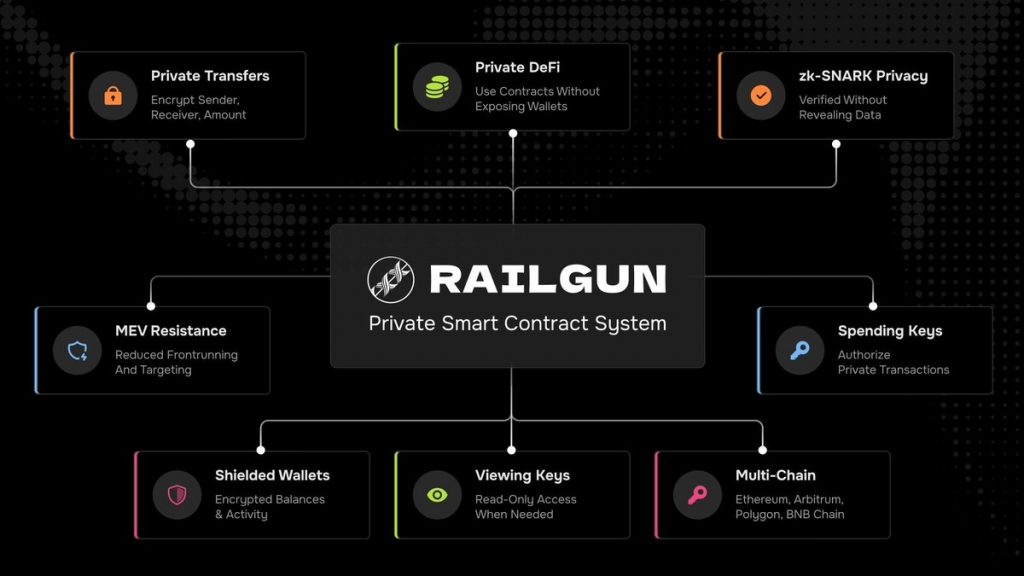
    Railgun is a privacy-focused smart contract system that shields transaction data directly on-chain. It conceals key details such as sender, recipient, token type, and amount using Private Balances, which form a shared anonymity pool.

    Transactions within the Railgun ecosystem appear to originate from this collective pool, making it challenging to determine who initiated a transfer or which assets were used.

    Privacy improves as more users participate, increasing the anonymity set. Popular tokens like USDC or DAI generally provide stronger privacy due to higher usage compared to less common assets.

    Railgun can be accessed through compatible wallets such as Railway Wallet, which supports zk-SNARK-powered private transactions without exposing balances.

    Key features:

    • Shields sender, recipient, token, and amount
    • Uses Private Balances to expand anonymity set
    • Privacy increases with user participation and TVL
    • Accessible via zk-SNARK-enabled wallets

    Are Bitcoin mixers legal?

    In many countries, Bitcoin mixers are not explicitly illegal. However, most do not implement Know Your Customer (KYC) or anti-money laundering (AML) procedures, placing them in a regulatory gray area.

    Unless a service is specifically prohibited, users typically won’t face legal consequences simply for using a mixer. That said, authorities have shut down numerous mixers over the years, and several operators have been arrested.

    While mixers can serve legitimate privacy needs, they are also used by criminals — for example, hackers attempting to launder stolen funds. This association has made them highly controversial.

    Notable enforcement actions include:

    • Bestmixer.io shut down by Europol and Dutch authorities (2019)
    • Bitcoin Fog operator arrested and charged in the U.S. (2021)
    • Tornado Cash sanctioned by OFAC (2022), with sanctions lifted in 2025
    • ChipMixer taken down by U.S. and German authorities (2023)

    Are Bitcoin mixers safe?

    Safety largely depends on the specific service used. Centralized mixers require trust that operators will not misappropriate user funds.

    It’s also important to recognize that mixing does not guarantee perfect anonymity. The effectiveness of privacy measures varies by implementation, and blockchain analysis tools continue to evolve. In some cases, investigators may still trace coins that have passed through mixers.

    Additionally, some cryptocurrency platforms and businesses may flag or restrict wallets associated with mixing services.

    Conclusion: Mixers address Bitcoin’s privacy limitations

    Bitcoin is pseudonymous rather than fully anonymous, and transactions can be traced under close examination. Mixing services aim to make blockchain activity more difficult to analyze, giving users greater financial privacy.

    However, because mixers are sometimes used for illicit purposes, they remain controversial and frequently attract regulatory scrutiny — even in jurisdictions where they are not outright banned.

  • Tumbler.io Review: A Streamlined Bitcoin Mixer

    Tumbler.io Review: A Streamlined Bitcoin Mixer

    tumbler.io Bitcoin Mixer

    The level of privacy that users have while transacting on-chain is often misunderstood, with many people believing that cryptocurrency is mostly anonymous. The reality is quite the opposite.

    Blockchains utilize a public ledger to store a full history of user transactions, meaning that every on-chain interaction from every user is stored on a database that can be accessed by anyone. While no one is able to alter this transaction data, the mechanism can cause privacy concerns for some users — especially when combined with KYC data from centralized service providers.

    Calls for greater on-chain privacy have led to a variety of solutions, with one emerging solution for Bitcoin being Tumbler.io. The platform offers a BTC mixing solution that obfuscates the transaction history of each cryptocurrency token, helping users to protect their privacy on-chain and avoid key security concerns.

    What is Tumbler.io?

    Tumbler.io is a Bitcoin (BTC) mixer that unlocks a higher degree of privacy when compared with traditional blockchain use. The platform allows users to pool their funds together, which can obfuscate the flow of BTC on the blockchain and help users to keep their identities secure.

    On-chain transactions leave an immutable digital footprint that, when combined with KYC credentials collected from third-party vendors such as CEXs, can be used to trace the flow of BTC back to individuals. This results in all transactions being made fully public, with anyone, anywhere in the world being able to view the contents of a person’s wallet, and that wallet being linked directly to an individual via government-issued identification.

    By providing a solution that can mitigate these privacy issues, Tumbler.io offers a way to protect the identity of its users and, by extension, the security of their finances.

    How does the platform work?

    Tumbler.io users can send their cryptocurrency to a shared pool, where the tokens are inscribed with a unique cryptographic tag known as “Tumbler code”. The user will then receive an equal amount of crypto back in return, except the tokens they receive will come from the pool’s others users.

    The unique tag applied by Tumbler.io is used to differentiate the user’s tokens from the rest of the crypto in the pool. This alters the flow of transaction data on the blockchain and makes it more difficult to trace the origins of each token.

    Additionally, Tumbler.io maximizes privacy by deploying a time delay between transactions and by splitting each user’s total BTC into several parts for deposits. This makes it near-impossible to trace on-chain data back to a single participant, helping to preserve financial privacy and help users to retain their anonymity on-chain.

    Why might someone want to use an on-chain privacy solution?

    To understand why someone might want to use an on-chain privacy solution, it’s important to first understand exactly what blockchains are and how they work.

    The Bitcoin blockchain is a cryptographically secure online ledger that can process user transactions without intermediaries. To do this, transaction data is recorded permanently on a public database that is unable to be altered retroactively by any single party.

    Recording user data permanently on the blockchain can cause security concerns, because it requires that public keys are permanently linked to a full history of a user’s transactions.

    While public keys are not individually identifiable by default, the combination of public blockchain data with identification documents collected by centralized blockchain companies can link public keys to their owner. In essence, on-chain transactions can be traced back to individuals once a public key has interacted with KYC-enabled accounts.

    Many blockchain users believe that people have a right to financial privacy, which has led to demand for solutions such as Tumbler.io across various blockchain ecosystems. Regarding the Bitcoin blockchain specifically, Tumbler.io utilizes one of the most prominent methods for achieving a greater level of privacy — Bitcoin mixing.

    How much does it cost to use Tumbler.io?

    Tumbler.io charges a service fee that varies according to the total BTC being mixed by the pool’s participants. The more BTC sent to the pool, the higher the discount for the end user.

    In total, fees range between 0.50% and 0.90% of the total BTC sent. A full breakdown of the service charges can be found in the table below.

    Mixed AmountDiscountMin. Service Fee
    1–10 BTC10%0.90%
    10–50 BTC20%0.80%
    50–100 BTC30%0.70%
    100–1000 BTC40%0.60%
    1000 BTC and more50%0.50%

    What are the current regulations for Bitcoin mixing solutions?

    The legal status of Bitcoin mixing depends on the local jurisdiction of the end user. In most places, Bitcoin mixing is considered legal as long as criminal funds are not involved.

    There are, however, concerns among regulators in certain jurisdictions regarding the legal status of Bitcoin mixing. Some law enforcement agencies have highlighted that mixing services can enable money laundering by allowing people to obscure proceeds from criminal activities, which means that the legal status of the process is still evolving.

    Since people can use Bitcoin mixers for legitimate privacy reasons, it can be difficult for regulators to classify the mechanism as illegal. The legality often depends on licensing and intent, but in most cases, courts will consider use on a case-by-case basis.

    It’s important to find out whether Bitcoin mixing is legal in your current location before using Tumbler.io. In the United States, for example, all Bitcoin mixers are required to register under the Bank Secrecy Act. Meanwhile, the National Crime Agency (NCA) in the UK has called for direct regulation of Bitcoin mixing, as reported by Coindesk.

    Since regulations are constantly evolving, make sure to do your due diligence before making use of a privacy solution such as Tumbler.io. Bitcoin mixing is not explicitly illegal in most jurisdictions around the world, but there may be risks for users in several places.

    The bottom line

    Tumbler.io delivers a safe and effective Bitcoin mixing solution. The platform enables its users to achieve a greater level of privacy while transacting on-chain, helping to store currency and mask their transactions without bringing attention to their total holdings on the public ledger.

    Ethereum founder Vitalik Buterin said about a similar solution to Tumbler.io, that “privacy is normal”. While it’s certainly the case that Bitcoin mixing solutions have received attention from lawmakers owing to their potential for illicit use, Tumbler.io ensures full compliance for users in most jurisdictions around the world.

    You can learn more about Tumbler.io here.

  • Bitcoin Mixers and FinCEN’s Regulatory Initiatives

    Bitcoin Mixers and FinCEN’s Regulatory Initiatives

    In today’s rapidly evolving digital landscape, cryptocurrencies such as Bitcoin have taken the financial world by storm, offering a level of transparency and security that traditional financial systems can only dream of. However, this very transparency, often touted as one of the key benefits of cryptocurrencies, has raised concerns about the privacy of users’ financial transactions.

    To eliminate this blockchain transparency, services such as Bitcoin mixers, also known as crypto mixers or CVC mixers (Convertible Virtual Currency) have emerged. These services play a crucial role in maintaining financial privacy, offering users a shield from the prying eyes of authorities and hackers. In this article, we will explore the concept of Bitcoin mixing, its regulatory attempts by the U.S. Department of the Treasury’s Financial Crimes Enforcement Network (FinCEN), and why it is imperative to recognize the legitimate role of Bitcoin mixers in protecting the financial privacy of ordinary users.

    What is CVC mixing, and what are Bitcoin mixers?

    To understand CVC mixing, it’s important to start with the definition provided by the US Department of the Treasury’s Financial Crimes Enforcement Network (FinCEN). According to FinCEN, CVC mixing, also known as Bitcoin mixing, is the process of disguising the source or ownership of a virtual currency by mixing transactions from different sources. 

    Simply put, it’s a coin-mixing method used to anonymize cryptocurrency transactions, making it difficult for outside observers to trace the origin and destination of the funds. Bitcoin is the most common coin-mixing currency, which is why these services are simply called Bitcoin mixers, however some CVC mixers may also accept Ethereum or other virtual currencies.

    FinCEN’s Bitcoin mixers regulatory initiatives

    In an effort to combat illicit activities facilitated by CVC mixing, FinCEN has imposed new recordkeeping and reporting requirements on U.S. domestic financial institutions and financial agencies. The agency has defined CVC mixers as a primary conduit for money laundering, terrorist financing, and other financial crimes. As a result, these new regulations will require all major U.S. cryptocurrency businesses to maintain extensive transaction records and report “suspicious” crypto activity.

    However, when viewed through the eyes of the average crypto enthusiast, it becomes clear that FinCEN’s efforts, ostensibly aimed at money laundering, belie a deeper agenda. It’s clear that their interests go beyond simply securing the financial systems, as they are motivated by a desire to maintain a firm grip on financial oversight, surveillance and control. Unfortunately, this push for greater transparency poses a significant threat to the financial confidentiality that everyday crypto users value most.

    While it is important to combat illicit financial activity, it is equally important to understand the legitimate reasons why regular users choose to use Bitcoin mixing services. One of the primary motivations is the inherent transparency of most blockchains, such as Bitcoin’s public ledger.

    How to describe Bitcoin mixing?

    Bitcoin mixing is the practice of mixing a user’s cryptocurrency with that of others in a way that disguises the origin of the funds. Essentially, Bitcoin mixing breaks the link between the sender and receiver, making it extremely difficult to trace the source of the transaction. This coin-mixing process typically works like this:

    Users deposit cryptocurrency into the wallet created by the Bitcoin mixer. Once the funds are received, the Bitcoin mixer pools these cryptocurrencies with those of other users and then sends the mixed funds back to the users. This coin-mixing process effectively mixes the coins, making it impossible to trace them back to their original owners. After the mixed funds are returned to the user’s new wallet address, it becomes impossible to identify the source of the Bitcoins or track the transactions.

    Global usage of Bitcoin mixers

    The global popularity of Bitcoin mixers has grown significantly due to the increasing demand for enhanced financial privacy in the cryptocurrency world. Due to the fact that CVC mixers operating outside of US jurisdiction are not subject to US regulation, overseas CVC mixers have gained popularity.

    This global use of CVC mixers has led to the emergence of a wide range of coin-mixing services, each offering different levels of anonymity and reliability. Some Bitcoin mixers even use advanced techniques such as CoinJoin and ZeroLink to further enhance the privacy of transactions. CoinJoin is a well-known privacy protocol used in privacy wallets such as the Wasabi Wallet and the Samurai Wallet.

    It’s important to note that the use of CVC mixers is not illegal; it depends on the user’s intentions and the legal landscape of their jurisdiction. To maintain an extra layer of anonymity when accessing CVC mixers, many users choose to use the Tor browser.

    Untraceable access to Bitcoin mixers over Tor

    While Bitcoin mixers offer enhanced financial privacy, accessing them through the Tor browser further enhances users’ anonymity. The Tor network, short for The Onion Router, is a decentralized system that routes Internet traffic through a series of volunteer-run servers. This routing process ensures that users’ IP addresses and online activities are hidden, making it difficult for anyone to trace your online actions.

    To install, simply download the Tor Browser from the official website (https://www.torproject.org/). After installing the Tor Browser, launch it and connect to the Tor network. The browser will automatically make connections through the Tor network, anonymizing your online activities.

    Using .onion URLs instead of traditional web addresses ensures that your connection to the Bitcoin mixer remains inside the Tor network, preserving your privacy throughout the transaction process. 

    It’s important to note that while the Tor network provides enhanced anonymity, users should be cautious about choosing Bitcoin mixers, as not all services can be trusted. Among several reliable Bitcoin mixers, Whir.to stands out as an easy-to-use Bitcoin mixer powered by CoinJoin with an onion domain for secure access.

    Conclusion

    The global use of CVC mixers reflects the increasing demand for financial privacy in an age of digital surveillance. It is imperative to recognize the legitimate role of CVC mixers in protecting financial privacy. As regulators such as FinCEN seek to combat financial crime and illicit activity through new regulations, it’s important to balance these efforts with the protection of individuals’ financial privacy rights.

    While Bitcoin mixers provide a significant level of anonymity, users can take their privacy one step further by accessing these services through the Tor browser. By routing their online activities through the Tor network, users can access Bitcoin mixers in an untraceable manner, enhancing their privacy and security. By recognizing the legitimate role of CVC mixers, society can move toward a future where the benefits of blockchain technology are maximized while respecting the fundamental right to financial privacy.