Category: Featured

Stay updated with our hand-picked featured news, top market insights, and the most important stories from the cryptocurrency world.

  • Shiba Inu Ranks #1 as this meme-inspired blockchain will soon get its own layer 2 scaling solution — Top 3 Coins to Watch for Jan 2 — Jan 8

    Shiba Inu Ranks #1 as this meme-inspired blockchain will soon get its own layer 2 scaling solution — Top 3 Coins to Watch for Jan 2 — Jan 8

    Shiba Inu Ranks #1 as this meme-inspired blockchain will soon get its own layer 2 scaling solution — Top 3 Coins to Watch for Jan 2 — Jan 8

    Happy and prosperous New Year 2023! May your digital wallets be full of coins and tokens and crypto portfolios dominated by green numbers this year – perhaps also with the help of our weekly Top 3 Coins to watch articles. Despite the good wishes, the last week of 2022 did not bring many green numbers as the slight downtrend expectedly continued and brought the total cryptocurrency market capitalization down by another $5 billion to the current $820 billion level. One can either wait for the general trend to turn upwards again or try to defy the market average by doing the homework and picking only the best of investment opportunities from more than 22,000 cryptocurrencies available. For the first week of 2023, we have selected the following three cryptos.

    3. OKB (OKB)

    OKB is a utility token of the 2017-launched Malta-based centralized cryptocurrency exchange OKX (before January 2022 known under the name OKEx). OKX, which started out as a branch-out of the China based OKCoin platform, is today among the largest exchanges in the world in terms of both liquidity and trading volume. OKB offers its holders the usual utility token features – it can be used to pay trading fees with up to 40% discount, gain access to the platform’s voting and governance as well as participate in various exclusive reward and earn programs. The total supply of OKB was 300 million tokens, but right now only a bit more than 250 million are in circulation. This is due to the OKX’s OKB Buy-back & Burn program, which allocates 30% of the spot market transaction fees to buying back OKB, which are then sent to a burning address and thereby forever destroyed.

    OKB claims the title of the best-performing exchange token in the past 6 months

    OKX’s native exchange token OKB has been one of the biggest gainers in the sector over the past couple of months. The OKB token gained around 120% in the past 6 months, and thereby outperformed all other exchange tokens by a large margin. Other exchange tokens and coins performed much worse in the same period: HT and BNB ended the six-month period in the green by appreciating by +14% and +7% respectively. Many other exchange tokens, for example KCS (-24%), GT (-25%) and CRO (-50%) are deep in the red numbers. 
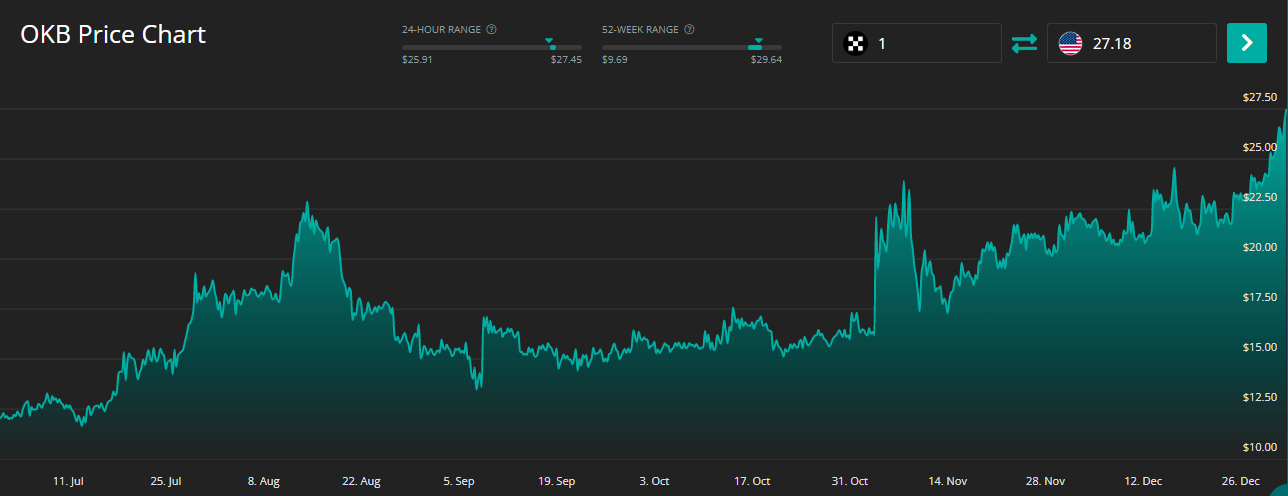
    OKB/USD price chart demonstrating OKB’s amazing price performance in the past 6 months.

    Furthermore, due to the bullish OKB market, the token has recently entered the Top 10 largest cryptocurrencies by market capitalization and became the second exchange token (the other being BNB) among the crypto Top 10. Trying to find the reasons for OKB’s recent price performance, one can’t stumble upon much more than the growth in trading volumes on the OKX exchange, which is arguably the best and most sustainable among the bull-run fuelling factors.  While OKX is currently the 5th largest cryptocurrency exchange in terms of combined trading volume, looking at cryptocurrency derivatives trading volume alone puts OKX on the 2nd spot, not far behind leading Binance. In addition, OKX has recently implemented a proof of reserves system to prove its users that the exchange is holding 100% or more of user’s deposits, which gives OKX an advantage over all exchanges that have not implemented such a system yet. Do you think OKX will continue to increase its volumes and market share? Can the bulls push OKB above $30 valuation?

    2. Monero (XMR)

    Monero is the largest privacy-focused cryptocurrency. It that is designed to provide as much privacy and security to its users as possible. Although the Monero project is fully open-source and run by volunteers, the project enjoys a high reputation within the cryptocurrency community. The Monero whitepaper was published in 2014 by an unknown developer using the pseudonym “Nicolas van Saberhagen”. Monero has been repeatedly bashed in the mainstream media for facilitating ransomware and other hacker attacks since the performers of these illicit actions often demand the payments of ransom to be made in XMR to avoid being caught. While such illegal activities should be condemned, the fact that hackers are utilizing Monero is itself a testament that the blockchain’s privacy features work as intended.

    Monero sees an increase in number of transactions, XMR price has outperformed nearly 90 of top 100 cryptos in 2022

    Monero is another crypto asset that has recently been trending upwards. By gaining over 20% since early November, Monero outperformed nearly 90 of the top 100 crypto assets this year, among others, Bitcoin and Ethereum. The increasing price of XMR is likely a consequence of continuous improvement in on-chain metrics. For example, the Monero blockchain is among the few networks that have managed to maintain a long-term uptrend in the number of transaction. The growth in the number of transactions becomes especially evident when Monero is compared to other blockchain, such as Bitcoin, whose number of transactions has been rather stagnant in the past 5 years. Monero’s daily transactions, on the other hand, have more than quadrupled in the same time frame. At the same time, the size of an average Monero transaction is just a fraction of the size of an average transaction 5 years ago. 

    To conclude, Monero is a top-tier privacy-focused crypto that is also due to its continuous development, becoming more and more popular. It will be interesting to see whether XMR manages to keep up the positive market momentum in the future.

    1. Shiba Inu (SHIB)

    Shiba Inu (SHIB) is a meme token that was launched in August 2020 by an anonymous founder known as “Ryoshi”. Shiba Inu aspires to be an Ethereum-based alternative to the more popular and longer-running meme coin project Dogecoin (DOGE). At launch, 50% of the Shiba Inu’s total supply was sent to Vitalik Buterin’s Ethereum wallet, making SHIB a unique community experiment as well. Ethereum co-founder ended up donating 10% of the supply to a COVID-19 relief effort in India and burned the rest of his SHIB holdings. His donation was worth around $1 billion at that time. While SHIB began as a fun experimental currency it is now transforming into a decentralized ecosystem with a growing number of users and use cases. In fact, the team behind the Dogecoin-inspired memecoin launched several new features over the past couple of months, including ShibaSwap DEX and NFT marketplace.

    Shiba Inu will soon deploy Shibarium, the blockchain’s own layer 2 scaling solution, Shytoshi revealed

    Shiba Inu’s lead developer Shytoshi Kusama has recently said that Shibarium, the layer 2 scaling solution for Shiba Inu, is coming “very soon”.

    As any layer-2 solution, Shibarium aims to bring faster transaction times and lower transaction fees for Shiba Inu users. Shibarium, is also expected to feature some sort of a SHIB burning mechanisms, making SHIB an even more deflationary asset, which could potentially increase SHIB price. In addition, Shibarium comes with its own native token called BONE. In addition, screenshots of Shytoshi Kusama’s stating that it is likely soon going to become impossible for him to stay invisible have resurfaced. Many members of the community interpreted the message as Shytoshi hinting that he might reveal his identity soon. The anonymous Shytoshi is believed to be the brains behind Shiba Inu blockchain, the project’s lead developer and co-founder. In response to the news, SHIB burn rate spiked by more than 69% as SHIB holders set ablaze more than 22 million SHIB tokens daily. Another 19.2 million SHIB were burned in the Boxing Day burning ceremony organised by the unofficial SHIB burning project SHIB SuperStore. It will be interesting to see how SHIB will move following the launch of Shibarium – we are speculating that the price is going to increase provided there is no negative influencing factors from the broader crypto sphere. 

  • Mina Protocol Ranks #3 as the protocol is set to deploy several important updates in 2023 — Top 3 Coins to Watch for Dec 26 — Jan 1

    Mina Protocol Ranks #3 as the protocol is set to deploy several important updates in 2023 — Top 3 Coins to Watch for Dec 26 — Jan 1

    Mina Protocol Ranks #3 as the protocol is set to deploy several important updates in 2023 — Top 3 Coins to Watch for Dec 26 — Jan 1

    With no major events or market moves taking place last week, the cryptocurrency sector’s total market capitalization has remained rather stagnant, suffering only a minor decrease from $839 billion to $825 billion. It is very likely that we will see the same slightly bearish trend continue until the end of the year as we do not expect major market movements in the forthcoming holiday week. However, if you are looking for some profit in the last week of this year or just want to enter 2023 with a healthy and balanced portfolio, make sure to read this year’s last Top 3 Coins to Watch article!

    3. Mina Protocol (MINA)

    Mina Protocol is a simple blockchain, designed to minimize the system requirements needed to run a full node or interact with the blockchain. The Mina network is merely 22 KB in size, which is why it has been repeatedly dubbed the “lightest blockchain in the world”. 

    In addition, the blockchain size is designed to always stay at 22 KB and not gradually grow as adoption of Mina protocol increases. Despite its minuscule size, Mina maintains a balance between security and decentralization. To achieve that, Mina utilizes Zero-Knowledge Proofs technology (ZK Proofs). Mina started out as Coda Protocol in 2017 but was rebranded into Mina Protocol in October 2020.

    Mina Protocol reveals an ambitious Roadmap update featuring several big improvements in line for deployment in Q1 2023

    Mina Protocol has recently revealed an updated version of the project roadmap, which shows that the team is gearing up to deploy some important upgrades in the first half of 2023. The Mina governance community is going to vote on the proposal that suggest removing supercharged rewards in line with the initial tokenomics plan in the beginning of January. A vote regarding the reduction of the wallet creation fee will soon follow. In addition, the Mina protocol plans to finalize deploying zkBridge (a solution that will make zkApps accessible from Ethereum, and other EVM compatible chains) as well as launch zkOracles and deploy latest version of the On-Chain Voting system in the beginning of 2023. Nevertheless, out placement of Mina on #3 bases on more than just future developments. The project saw several ecosystem developments in the past couple of weeks including the integration of Mina with Ledger and its hardware wallets Nano X and Nano S, which allows MINA holders to securely store their tokens on Ledger devices. 

    Furthermore, the integration also allows MINA from cold storage devices to be staked while holders maintain full control of the wallet private keys, making MINA a perfect crypto for holders who also want to put their assets to work. Not to mention that MINA boasts with APYs above 10% for staking MINA as a validator or delegating MINA to existing validator nodes

    2. Avalanche (AVAX)

    Avalanche is a highly scalable open-source smart-contract enabled blockchain ecosystem. It relies on its own Proof-of-Stake consensus protocols called the Avalanche consensus protocol and the Snowman consensus protocol, which guarantee blockchain immutability while consuming minimal amount of energy at the same time. In addition, Avalanche ecosystem is also highly interoperable – for example Avalanche applications are compatible with Ethereum’s Solidity smart contract programming language and Ethereum-based tokens can be transferred to Avalanche blockchains via Avalanche Bridge. As such it is most often used for various DeFi applications and enterprise blockchain deployments. Every blockchain within Avalanche is part of a subnet, but validators can choose which subnets they want to participate in. Nevertheless, validators are required to be active on the Primary Network, which consists of three blockchains: the Platform chain or P-Chain, the Contract chain or C-Chain and the Exchange chain or X-Chain.

    Avalanche rolled out the Banff 5 upgrade

    On December 22, Avalanche rolled out the Banff 5 upgrade, which introduced Avalanche Warp Messaging (AWM), a feature that enables a fast and reliable communication between all Avalanche Subnets. According to the official Medium post, the first native Subnet-to-Subnet message has been sent soon after the upgrade deployment, on December 22 at 6:42:29 AM UTC (1:42:29 AM ET). The subnet blockchains that exchanged the message were called “let there” and “be messaging”.

    Due to this novel seamless native communications solution, assets or data can be transferred across different subnets. AWM utilizes a cryptographic tool called “BLS multi signatures” to verify messages and data on other subnets, which eliminates the need for the chains to constantly communicate and push data between each other. In addition, individual subnet projects will no longer have to deploy and manage their own bridges to communicate with other subnets. What is more, the feature could be extended to other chains in the future to support cross-chain communication and even cross-chain staking of tokens. The launch of AWM itself, as well as the potential future use cases of this feature, could cause AVAX to appreciate.

    1. BNB (BNB)

    Binance Coin (BNB) started out as an ERC-20 token sold through an initial coin offering (ICO) back in 2017. In April 2019, the Binance rolled-out its native Binance Chain and all the existing Binance Coin ERC-20 tokens were replaced with BNB, which became the native cryptocurrency of the new blockchain. As of today, Binance Chain is still almost completely centralized, with Binance having complete control of block management. Binance gives users who utilize BNB to pay for trading, withdrawal, and listing fees hefty discounts. While this used to be pretty much the only use case of BNB, the coin has a far greater utility now as it allows users to pay for gas fees, earn cashback on Binance Visa card purchases, stake BNB and participate in liquidity pools and other DeFi activities. BNB is also used to determine eligibility to participate in Initial Exchange Offerings (IEOs). Furthermore, the Binance ecosystem is continuously expanding, which means that new products and services are regularly added and many of them give BNB some new utility.

    BNB Chain became the largest Layer 1 blockchain network in terms of unique addresses

    The on-chain data shows that the BNB Chain experienced amazing growth in 2022. The network has witnessed a record-breaking number of transactions, surging as high as 9.8 million transactions in May 2022. In addition, Binance recently announced that the number of unique addresses on BNB Chain crossed 230 million, surpassing the number of addresses on Ethereum. If we judge by this metric, BNB is now the largest Layer 1 blockchain in the world. 

    BNB Chain has met numerous other developmental milestones in 2022. Alvin Kan, director of Growth & Ops at BNB Chain highlighted the launch of BNB Sidechain, zkBNB, Binance Oracle, and security initiatives such as AvengerDAO, among the most important features deployed 2022. A full list of BNB Chain’s milestones of 2022 can be found in this official blog post. Just last week, BNB has integrated with Wyre’s API stack, which gives developers access to Wyre’s entire API stack on BNB Chain as well as the ability to directly list BUSD and BNB. In addition, the BNB team has partnered with Fjord and Balancer to launch Liquidity Bootstrapping Pools (LBPs) on BNB Chain mainnet. If the development of BNB Chain, its features and integrations will continue at such high pace, BNB Chain and BNB have a bright future.

  • Toncoin Ranks #2 as Telegram users will soon be able to buy anonymous phone numbers with TON — Top 3 Coins to Watch for Dec 19 — Dec 25

    Toncoin Ranks #2 as Telegram users will soon be able to buy anonymous phone numbers with TON — Top 3 Coins to Watch for Dec 19 — Dec 25

    Toncoin Ranks #2 as Telegram users will soon be able to buy anonymous phone numbers with TON — Top 3 Coins to Watch for Dec 19 — Dec 25

    Last week the cryptocurrency markets bled out another $40 billion, resulting in a drop of the total market capitalization of the sector from $870 billion to a bit less than $830 billion. BNB, ADA, DOGE and MATIC all lost more than 10% last week and these are only the coins that are in the crypto Top 10. Many more coins outside the Top 10 also ended the week deep in the red numbers. Nevertheless, as any other week, there are also coins that ended the week in the green. For ours Top 3 Coins to watch article, we have tried to correctly identify three such “gainers” of this week.

    3. Celo (CELO)

    Celo is a proof-of-stake blockchain platform that aims to push DeFi functionality and services to mass adoption. Because more people own phones than computers Celo focuses on developing a platform that is mobile device friendly. In addition, Celo puts a lot of emphasise on maintaining a very low transaction costs and maintaining sufficient scalability to facilitate higher throughput in the future. CELO, which is the platform’s native token can be used for staking but also functions as the project’s governance token. In addition, the Celo platform boasts with several stablecoins pegged to the price of various fiat currencies.

    Celo integrates with LayerZero, the omnichain interoperability protocol

    The Celo blockchain is an EVM-compatible blockchain, which means that developers that have built their dApps on Ethereum or other EVM-compatible blockchain could easily migrate to Celo and vice versa. However, since December 8, when Celo integrated LayerZero, Celo users can seamlessly access with dApps and liquidity from 13 other EVM-compatible blockchain and several more non-EVM compatible platforms.

    The LayerZero is an omnichain interoperability protocol that allows for a user-friendly access to dApps across DeFi, NFTs, gaming, etc. by leveraging a low-level communication protocol. Furthermore, accessing these applications is has proven to be much safer with LayerZero as compared to usually used bridging solutions, which have often been exploited, resulting in a large hole in their digital wallets of its users. Through LayerZero Celo will be able to access a much larger userbase and channel in from a much larger pool of liquidity.

    2. Toncoin (TON)

    Toncoin (TON) is the native cryptocurrency of The Open Network (TON), a decentralized Layer 1 blockchain network previously known under the name of Telegram Open Network. While TON started out in 2018 as a proof-of-stake blockchain designed by the Durov brothers, the founders of Telegram Messenger, the development of the project has later been handed over to the open TON Community. TON is designed for lightning-fast transactions and known for its ultra-low cost and user-friendliness. A unique feature of TON is that the community can alter information in an existing block, allowing them to nullify unlawful transactions and protect the network from a potential 51% attack.

    TON holders will soon be able to purchase anonymous phone numbers

    The TON team has recently unveiled a new feature, which will allow Telegram users to purchase anonymous phone numbers with their Toncoins. In one of the recent updates the Telegram developers enabled users to create a Telegram account without a SIM card and log in using blockchain-powered anonymous numbers available on the Fragment platform. The feature is part of the team’s push for “ultimate privacy”.

    The anonymous telephone numbers with a prefix +888 will be available as collectables on the Fragment platform, much like the Collectible usernames, which were launched by TON in November. Collectible usernames with less than 5 characters turned out to be a major success – do you think that anonymous telephone numbers will sell out as well?

    While many of the most popular cryptos lost value last week, TON rallied up by more than 25% last week. In addition, the network’s native crypto, which is currently changing hands at a price of $2.60 per coin, is up by almost 45% in the last month and more than 73% in the last three months. With such clear long-term uptrend, it is only a matter of time when TON breaks above $3.

    1. Ethereum (ETH)

    Ethereum is an open source blockchain that pioneered smart contract functionality in 2015. The decentralized network operates in a fast, immutable, and trustless manner. Ether (ETH), which is currently the second-largest cryptocurrency by market capitalization, is Ethereum’s native asset. Although it can also be used as a medium for the transfer of value between different Ethereum addresses, it is more commonly used to execute various smart contracts. The Ethereum blockchain has enabled several blockchain-powered innovations, including ICOs, DeFi, NFTs, and DAOs. The Ethereum blockchain also hosts countless ERC20 tokens with different utilities – these include Exchange tokens (OKB, HT, UNI), DeFi tokens (LINK, MKR, COMP, SNX, etc.) and several stablecoins such as USDC, DAI, TUSD, and USDT. In September 2022 Ethereum network has completed The Merge and thereby transitioned from a Proof-of-Work to a Proof-of-Stake blockchain.

    Shanghai update, which will enable unstaking ETH, is set to hit the mainnet in March 2023

    Ethereum developers have recently reached an agreement on the roadmap for future network updates and highlighted March 2023 as the target date for the Shanghai update. Shanghai, which will be the first major update and hard fork of the Ethereum blockchain after The Merge in September, will implement the EIP-4895 proposal, which will allow ETH stakers to unstake or withdraw their locked ETH. In addition, the developers are also aiming to include a set of improvements to the Ethereum Virtual Machine and implementation of the EVM Object Format (EOF) in the Shanghai upgrade. However, this improvements are considered secondary with the primary focus being on withdrawals of staked ETH. Let’s remember that the first deposits to the ETH staking contract were enabled already in December 2020, meaning that the pioneering participants in the Ethereum’s new consensus layer have already had their coins locked away for more than two years. Furthermore, there are currently more than $18 billion worth of ETH locked in the Beacon Deposit Contracts

    The amount of ETH locked in the Beacon Deposit Contracts throughout last two years (Source: Ethscan.org)
    The amount of ETH locked in the Beacon Deposit Contracts throughout last two years (Source: Ethscan.org)

    As seen in the graph above, the amount of staked ETH has been raising almost linearly since first ETH stakers were onboarded in December 2020. This leads us to believe that enabling ETH withdrawals will only hamper further growth of the amount of staked ETH at the very beginning, because some stakers have the need to access that liquidity and will decide to withdraw, while it will have no significant effect in the long run. In addition, Ethereum developers are prepping to deploy another major scalability-focused upgrade in the Fall of 2023.

  • DeFiChain Ranks #3 as this DeFi ecosystem now boasts with an on-chain governance — Top 3 Coins to Watch for Dec 12 — Dec 18

    DeFiChain Ranks #3 as this DeFi ecosystem now boasts with an on-chain governance — Top 3 Coins to Watch for Dec 12 — Dec 18

    DeFiChain Ranks #3 as this DeFi ecosystem now boasts with an on-chain governance — Top 3 Coins to Watch for Dec 12 — Dec 18

    During the second consecutive rather uneventful week, the cryptocurrency sector’s total market capitalization fell from $874 billion to around $870 billion last. All top 3 non-stablecoin cryptocurrencies have also only deviated less than 1% from their respective prices at the beginning of last week. Furthermore, only 6 cryptocurrencies from the Top 100 have posted a weekly gain higher than 10%. These cryptos are CEL (Celsius Network,), AXS (Axie Infinity), STX (Stacks), FTT (FTX Token), EOS (EOS) and APE (ApeCoin). But how to identify these hidden opportunities in an otherwise stagnant market? We believe our Top 3 Coins to watch articles can be of great help in such situation.

    3. DeFiChain (DFI)

    DeFiChain is a proof-of-stake (PoS) blockchain anchored in the Bitcoin network (a proof-of-work blockchain). This allows DeFiChain to leverage the speed and efficiency of a PoS network, which utilizing Bitcoin’s PoW chain for additional security. Launched in May 2020, DeFiChain project essentially brings smart contracts and decentralized finance (DeFi) capabilities to the Bitcoin network. DeFiChain allows users to create their own wrapped assets and mint so-called decentralized tokens (d-tokens). Most commonly the wrapped assets are other cryptocurrencies such as Bitcoin, Ethereum, and other coins and participate in DeFi (dBTC, dETH, etc.), but the platform also supports the creation of tokenized equity and other real-world assets (for example, stocks, precious metals, real estate, etc.). DFI is the platform’s native token. It is used for paying transaction fees, receiving crypto rewards, as well as participating in the project’s governance, crypto swaps, and more.

    Grand Central hard fork brings an on-chain governance to DeFiChain

    DeFiChain blockchain underwent a governance-oriented upgrade called the Grand Central upgrade on December 8. The upgrade, which marks a major step in the development of the ecosystem triggered at block height 2,479,000.

    Grand Central upgrade brough several features including a token consortium framework, fixes to the pool commission and reward system and support for masternode parameter updates. However, the most anticipated and most important feature of Grand Central was the launch of the on-chain governance (OCG), which will bring transparency of this DeFi ecosystem to new levels. As with other governance systems, users will be able to submit proposals (for example filing funding requests, votes of confidence, changing the block rewards allocation, etc.). Interested community members can follow ongoing voting processes on defiscan.live dashboard in real-time. In addition, the upgrade also introduced the DeFiChain Consortium, which was established to ensure that all decentralized digital assets issued in the DeFiChain ecosystem are backed at a 1:1 ratio. The consortium has the right to create (mint) new tokens or more importantly destroy (burn) tokens and thereby prevent the overminting of DeFiChain-based assets. DFI, which is currently trading at $0.47 looks poised to further appreciate because of the additional transparency and an added layer of security, which prevents undercollateralization of tokens issued within the environment.

    2. Axie Infinity (AXS)

    Axie Infinity is a Pokémon Go-inspired blockchain-powered trading and battling video game. The game is developed by a Vietnamese gaming studio Sky Mavis and has netted more than $2 billion in NFT sales to date. Axie infinity players utilize Ethereum-issued tokens AXS and Small Love Potion (SLP) to breed, trade and battle with their virtual creatures called Axies, each represented by a one of a kind NFT. The growing userbase and protocol revenue has made Axie Infinity one of the most expensive NFTs collections.

    Axie Contributor initiative kicks off, anticipation of new features to be brought to the game by Axie Core is rising

    Axie Infinity’s AXS saw renewed market interest in the past week because of the Axie Contributor initiative and upcoming gaming mechanics as part of Axie Core upgrade. Axie Contributor initiative is the second step of the project’s long-term strategy to further decentralize the Axie ecosystem. The project has recently selected close to 700 Lunacians from the ecosystem’s most active users, who take part in the pilot “season” of the Axie Contributors. Each participant will receive an acceptance letter, a Discord role, and most importantly access to a special “Governance” section in the Axie Infinity Discord. In the next step, Contributors will form Community Councils, which will soon take on an important role in the community and project development.

    In addition, on December 5 Axies Infinity revealed the first outlines of the upcoming Axie Core upgrade, which is set to bring several advanced game mechanics and thereby further enhance players’ experience. After Axie Core is deployed to the mainnet, players will be able to equip and upgrade their accessories, breed Axies with a more immersive breeding interface as well as have a greater role in the upbringing of their Axies through new activities such as feeding and petting. The day after the outlines of the Axie Core’s features were made public, Axie NFT trading volume shot up 800% to more than $10.4 million. At the same time AXS pumped by more than 30%, indicating that the announced upgrade was very well received by players and investors.

    1. EOS (EOS)

    EOS is a blockchain platform that allows users to deploy smart contracts, run decentralized applications (DApps) and issue custom tokens. It launched its mainnet in June 2018 following a record-breaking initial coin offering (ICO), in which more than $4 billion were raised for the blockchain’s development. While many other chains such as Ethereum, TRON, Solana and other similar blockchains offer roughly the same features, EOS aims to distinguish itself from the competition through its improved scalability and faster transaction speeds. The chain utilizes a delegated proof-of-stake (DPoS) consensus model and boasts with the capacity to perform over 3,000 transactions per second (TPS).

    EOS gains more than 12% as Binance launches support for USDT withdrawals and deposits through EOS Network

    Last week Binance announced that they have integrated EOS Network-based USDT transactions. In other words, Binance listed EOS-based Tether (USDT), which allows Binance users to seamlessly transfer USDT in and out of the EOS Network without having to use a third-party bridge or swap their Tether for EOS or another cryptocurrency. The EOS Network Foundation noted that it took a lot of effort to reach this stage and hopes that the new seamless on-ramp will bring even more liquidity to the EOS ecosystem. In addition, the Foundation aspires for EOS to become the go-to network for transacting USDT stablecoin due to its top speed, good security, low cost, and high energy-efficiency.

    In addition to Binance’s EOS-USDT integration things are also moving forward with the $100 million EOS ecosystem fund announced in November. The EOS Network Foundation (ENF) is in the process of establishing EOS Network Ventures (ENV), a separate entity that will manage the selection of projects and allocation of grants. ENF noted that the newly established ENV will make strategic equity and token-based investments across the Web3 space. As part of the ecosystem fund program, ENV will invest in GameFi, the metaverse, eSports, NFTs, and fintech projects building on EOS. To prevent any conflict of interest or other wrongdoing, the allocation of funds will be supervised by EOS Network validators. Thanks to the integration of EOS-based USDT on Binance and the recent announcement of the $100 million EOS ecosystem fund, EOS appreciated by more than 12% last week and landed among the largest gainers in the past week. However, EOS is very well-positioned for this week’s appreciation as well as long-term positive performance.

  • Chainlink Ranks #1 as LINK staking is set to go live on December 6 — Top 3 Coins to Watch for Dec 5 — Dec 11

    Chainlink Ranks #1 as LINK staking is set to go live on December 6 — Top 3 Coins to Watch for Dec 5 — Dec 11

    Chainlink Ranks #1 as LINK staking is set to go live on December 6 — Top 3 Coins to Watch for Dec 5 — Dec 11

    The cryptocurrency sector’s total market capitalization has climbed from $858 billion to $874 billion last week, which marks already the second week of recovery after the FTX fiasco. Interestingly, there were no big movers among Top 100 Crypto, with the vast majority of coins staying between the -10%/+10% price change interval. Find out what we think in this week’s Top 3 Coins to Watch article. Are you hoping for bigger moves in the upcoming week or are you completely fine with a slow-paced recovery?

    3. ApeCoin (APE)

    ApeCoin is an ERC-20 token launched by the ApeCoin DAO in March 2022. Besides being a decentralized currency that facilitates monetary transactions, APE has a few additional use cases, including granting its holders governance rights in the ApeCoin DAO and providing access to exclusive events and services. The total supply of APE stands at 1 billion tokens, out of which 150 million tokens were distributed to holders of the NFTs from the popular Bored Ape Yacht Club (BAYC) and Mutant Ape Yacht Club (MAYC) collections.

    ApeCoin staking is scheduled to go live on December 7

    ApeCoin project managers have took it to Twitter to announce that a much-anticipated feature – ApeCoin staking – will soon be deployed. Staking is a common process among crypto process that lets token owners earn rewards by locking up and holding their assets using a specialized smart contract.

    The APE staking, which will be powered by a Horizen Labs-developed smart contract is set to hit the mainnet on December 7 if no critical bugs are found in the code. However, the rewards will only start to accrue 5 days later, this is on December 12. While most APE holders had no problem with such schedule, the fact that staking feature will be geo-blocked raised a significant amount of dust. What is more, staking will be made inaccessible to residents of the United States and Canada, which are home to an estimated 50% of the ApeCoin community members. ApeCoin developers, who are aware of the magnitude of this inconvenience, cited regulatory limitations as the reason for the geo-blocking. Leaving the soon-to-be-deployed APE staking aside, the ApeCoin DAO recently launched a community-led NFT marketplace. The marketplace developed by Snag Solutions offers “unique features built specifically for the BAYC and Otherside communities, including ApeCoin staking and NFT metadata integrations” as well as halved fees (only 0.25%) for transactions conducted with ApeCoin.

    2. Fantom (FTM)

    Fantom is a fast, high-throughput open-source smart contract platform for digital assets and dApps. It is a Layer 1 network competing with the likes of Avalanche, Solana, and Terra to dethrone Ethereum. Fantom utilizes Asynchronous Byzantine Fault Tolerance (aBFT) consensus algorithm. The aBFT algorithm promises to debunk the blockchain Scalability Trilemma, according to which only two of the crucial three components that include decentralization, security, and scalability, are achievable at the same time. FTM was one of the best-performing assets of 2021, in which it appreciated by approximately 13,000%.

    Fantom to implement a “gas monetization” program to reward top Fantom dApps

    Investors have been rather bullish on FTM last week as the Fantom’s coin leads all top 100 crypto assets in terms of weekly gains with +25%. Likely the reason is the proposal of a dApp Gas monetization program, through which the Fantom Foundation seeks to reward high-quality dApps and retain talented creators within the ecosystem.

    f the proposal is passed by the FTM DAO, the Foundation would pay a portion of the network fees of the high-performing dApps that manage to generate a steady traffic. The FTM developers explained that only DApps with 1,000,000 or more recorded transactions and at least three months of operation on the Fantom Opera network will be able to apply for a 15% gas fee repayment. However, it should be noted that the Fantom Foundation would have to slash the protocol’s current FTM token burn-rate from 20% to 5% to fund this program. In addition, one of the earliest Fantom developers and a prominent crypto advocate Andre Cronje has recently returned to the Fantom project, of which we wrote about four weeks ago. Do you think Cronje has more improvement ideas up his sleeve?

    Chainlink is a decentralized oracle network that provides data and price oracles, which act as a reliable feed of off-chain information for some smart contracts. The project launched in 2017, when it also raised $32 million of funding through an ICO. Chainlink’s cryptocurrency price and real-world data oracles have seen numerous implementations and their popularity is still increasing. Their oracle service is one of the most reliable and trustworthy services available and the connection with smart contracts is end-to-end secured, leaving very little space for the manipulation of the execution of smart contracts. Another Chainlink feature is Verifiable Random Function (VRF), which proved to be very useful as providing a source of verifiable randomness in blockchain gaming and when minting NFTs.

    Chainlink is launching LINK staking on December 6

    On #1 spot of our this week’s Top 3 Coins to Watch list is another project that is preparing to roll-out a coin staking feature – Chainlink. LINK staking, which is the core part of the so-called “Chainlink Economics 2.0” upgrade, is set to go live on Ethereum mainnet on December 6, 2022, at 12:00 PM ET. The launch of staking will enable LINK token holders and node operators to earn rewards while helping increase the cryptoeconomic security of oracle services at the same time.

    At first only the addresses that qualify for Early Access will have the opportunity to stake up to 7,000 LINK. LINK staking will be made available to all Chainlink holders two days later, while still retaining the 7,000 LINK per address hard cap. The whole roadmap and more details of the LINK staking deployment can be found here. LINK currently trades at the price of $7.40 per token and is up by only 4.2% last week. Although the token is up by almost 30% from the local low of $5.72 reached on November 21, several analysts believe that the launch of the “Chainlink Economics 2.0” has not been fully priced in yet. Furthermore, technical analysis also shows a possibility of a rally, which will move the price up by a further 25%. According to the historical prices LINK could climb toward $9.40 by the second week of December, provided it breaks out of the ascending triangle pattern. In addition, also the prominent market analyst and founder of Eight Global, Michaël van de Poppe, sees LINK crossing $9 in the near future.

  • Litecoin Ranks #2 as LTC’s price breaks away from the market average downtrend — Top 3 Coins to Watch for Nov 28 — Dec 4

    Litecoin Ranks #2 as LTC’s price breaks away from the market average downtrend — Top 3 Coins to Watch for Nov 28 — Dec 4

    Litecoin Ranks #2 as LTC’s price breaks away from the market average downtrend — Top 3 Coins to Watch for Nov 28 — Dec 4

    The cryptocurrency sector’s total market capitalization has climbed from $840 billion to $858 billion last week. It seems that the sector is slowly recovering from the big bleed caused by the FTX and Alameda fiasco, but this time the recovery is surprisingly not being led by Bitcoin and Ethereum. Rather than that, altcoins like BNB, DOGE and LTC have contributed the most towards the increase in the sector’s total market cap. Will Bitcoin wake up or will these coins continue to be at the forefront of the recovery wave? Find out what we think in this week’s Top 3 Coins to Watch article.

    3. Theta Token (THETA)

    The Theta Token is the native asset of Theta, an end-to-end infrastructure for decentralized video streaming and delivery that provides revolutionary technical and economic solutions. The Theta platform, which is often called the blockchain alternative to video streaming services like YouTube and Twitch, incentivises various network participants via the use of cryptocurrencies. Several big players from the crypto and IT industry, including Sony, Samsung, Google and Binance, are participating in Theta’s consensus algorithm by running enterprise Theta validator nodes. The project underwent several significant upgrades this year, including the launch of a DEX platform called ThetaSwap and the roll-out of the TDROP token, which is used to incentivize the usage of Theta’s NFT marketplace.

    Theta is launching Metachain as part of the Theta Mainnet 4.0 upgrade

    All is set for the Theta Network to roll-out the Theta 4.0 upgrade to its mainnet on December 1. The mainnet upgrade in question follows the successful launch of the upgrade on Theta testnet, concluded previously this month. With the new and overhauled mainnet, Theta aims to disrupt the subscription-based streaming businesses, pay-per-view entertainment platforms, free ad-supported video platforms such as YouTube and Twitch as well as several other industries (e.g., ticketing platforms, website hosting platforms, sports franchise fan platforms and metaverse industry). Full list of features and the Theta Labs’ vision in full can be found in the Theta Mainnet 4.0 whitepaper. At the focal point of the mainnet upgrade is the launch of the Theta Metachain, which was announced already back in April 2022.

    According to the team, the Theta Metachain is an interconnected network of blockchains, or “chain of chains” as they put it. As such it will play a vital role in the scaling of the network. Utilizing Theta Metachain, the network will be able to achieve potentially unlimited transactional throughput while keeping the block finalization time under 1 second, the developers claim. Investors seem to be bullish on the project as Theta Token is currently trading at the price of $0.96 – up by 10% in the past 7 days.

    2. Litecoin (LTC)

    The Litecoin blockchain is a Bitcoin fork created by former Google employee Charlie Lee in 2011. The Litecoin network has a target block time of 2 minutes 30 seconds (1/4 of Bitcoin’s 10 minutes) and a four times larger eventual total supply than Bitcoin. In addition, Litecoin utilizes a different Proof of Work consensus algorithm called Scrypt. The development process and efforts to increase the coin’s adoption are led by a Singapore-based non-profit organisation called the Litecoin Foundation. Even though Charlie Lee sold all his personal LTC holdings in December 2017, he continues to be involved in the project.

    Litecoin sets a two-year high price denominated in BTC

    Litecoin was one of the biggest movers in the crypto top 40 in the past week as it diverged from the broader crypto market downtrend and gained more than 22%. Since Bitcoin’s price remained rather stagnant, the value of LTC against Bitcoin shoot up by almost 50% in November, resulting in a price of over 0.005 BTC per LTC on November 23. The Litecoin’s price in BTC achieved on that day marks the highest such price in over two years. The pump was likely associated with Michael Saylor, a prominent proponent of Bitcoin, likening LTC to BTC in terms of both being a digital commodity. In addition, Twitter user and crypto analyst CryptoKaleo believes to have cracked the “secret” of Litecoin.

    However, if Litecoin fails to break out of the descending channel, in which it trades on the LTC/BTC chart, the coin’s price might be headed to new lows, so make sure to trade with caution. In addition, LTC holders and potential investors who are planning to be in for the long run need to be aware of the Litecoin halving, that will take place next August and will definitely affect LTC markets. Do you think that we will see LTC at over 0.02 BTC before the halving?

    BNB (BNB)

    Binance Coin (BNB) started out as an ERC-20 token sold through an initial coin offering (ICO) back in 2017. In April 2019, the Binance rolled-out its native Binance Chain and all the existing Binance Coin ERC-20 tokens were replaced with BNB, which became the native cryptocurrency of the new blockchain. As of today, Binance Chain is still almost completely centralized, with Binance having complete control of block management. Binance gives users who utilize BNB to pay for trading, withdrawal, and listing fees hefty discounts. While this used to be pretty much the only use case of BNB, the coin has a far greater utility now as it allows users to pay for gas fees, earn cashback on Binance Visa card purchases, stake BNB and participate in liquidity pools and other DeFi activities. BNB is also used to determine eligibility to participate in Initial Exchange Offerings (IEOs). Furthermore, the Binance ecosystem is continuously expanding, which means that new products and services are regularly added and many of them give BNB some new utility.

    BNB pumps to over $310 on the tailwind of several Binance-related developments

    BNB is another top coin that saw considerable price growth (+16%) in the past week. The BNB bull run was likely fuelled by the recent Binance-related developments, including but not limited to Binance launching the industry recovery fund to reduce the negative effects of the FTX’s collapse on the crypto sector. While the crypto giant initially allocated $1 billion BUSD for helping crypto companies that got in trouble because of the FTX’s bankruptcy, CZ soon announced that they have decided to double the allocation to the fund:

    In addition, Binance has recently launched a new Binance Launchpad token sale. After a multi-month hiatus, Binance will finally host the HOOK token sale. HOOK is the governance token of the Hooked Protocol, a project that is developing gamified “learn-to-earn” solutions that will help onboard a broader audience to the web3 ecosystem. Interest for the HOOK token is apparently high, as BNB saw a big spike on the day of the Launchpad sale announcement. Last but not least, Binance has successfully deployed a Proof of Reserves System that lets users verify that Binance actually holds their digital assets. For now, the system has only been deployed for Bitcoin, but Binance plans to add other cryptocurrencies and networks in the next couple of weeks as a reliable and verifiable Proof of Reserves system has recently become the cornerstone of investors’ trust in the past few weeks. For now, Binance has managed to keep its good name and has only grown bigger after the FTX’s collapse. Will BNB continue to grow as well?

  • Trust Wallet Token Ranks #1 as crypto holders seek a safe and easy-to-use self-custody wallet solution — Top 3 Coins to Watch for Nov 21—Nov 27

    Trust Wallet Token Ranks #1 as crypto holders seek a safe and easy-to-use self-custody wallet solution — Top 3 Coins to Watch for Nov 21—Nov 27

    Trust Wallet Token Ranks #1 as crypto holders seek a safe and easy-to-use self-custody wallet solution — Top 3 Coins to Watch for Nov 21—Nov 27

    The cryptocurrency sector has entered Week 47 with a bit higher total market capitalization than last week ($840 billion on November 20 as compared to $837 billion on November 13) despite the continuation of the FTX and Alameda horror story. Throughout last week it became clearer which companies and exchanges had exposure to FTX or Alameda and are therefore in greater trouble. At the same time all centralized exchanges hurried to publish their proof-of-reserve to regain at least part of the customers’ trust. Many exchanges even encouraged their users to move crypto of their platforms if they don’t plan to actively trade with these assets. As it turns out the FTX collapse was extremely bad for the industry in the short term but would likely have a good influence over the industry in the long term as it wed out bad players in the sector and reminded the participators of the importance of decentralization.

    3. Mdex (MDX)

    As the name suggests, Mdex is a decentralized cryptocurrency exchange (DEX) that was funded in 2017 with an aim to deliver a revolutionary blockchain-based token trading experience. The DEX operates on the Huobi Eco Chain and utilizes the Automated Market Maker technology to fund their liquidity. The MDX token is the official governance token and native incentive token of the Mdex trading platform.

    Mdex volumes spike as traders shift towards decentralized exchanges following the FTX fiasco

    After the fall of FTX, many crypto holders moved their sitting digital assets to self-custody wallets, while active traders that want to minimize the risk of holding crypto on a centralized exchange started looking for decentralized exchange (DEX) alternatives. As a result, several DEXs, including Mdex, saw a considerable spike in traffic after the collapse of Alameda and FTX. Mdex platform reached a daily trading volume of $25.8 million on November 9, which represents a several-fold increase in volume compared to an average day in the preceding weeks. The increased volumes could be felt on the MDX markets as the token pumped more than 30% in the following days. Following a correction of around 20%, the token is now changing hands at $0.08, but Mdex is known for implementing innovative features, which could attract more traders in the future. For example, the Huobi Eco Chain-based exchange recently launched a USDT-margined perpetual trading feature in cooperation with on-chain derivatives platform ApolloX Finance. In addition, Mdex listed Trust Wallet Token (TWT) in its innovation zone on November 15, allowing users to collect up to 1,000% yield in MDX.

    2. XRP (XRP)

    XRP is a cryptocurrency that was launched in 2012 by Chris Larsen, Jed McCaleb and Arthur Britto. Ripple’s network uses a unique Ripple Protocol consensus algorithm (RPCA), which is neither proof-of-work nor proof-of-stake, to facilitate fast and cheap transactions. The maximum supply of XRP is 100 billion coins and all the coins were minted at launch of the Ripple blockchain. Back than 80% of the total XRP supply was given to fintech firm Opencoin, a company that renamed to Ripple Labs in 2015. As of today, Ripple Labs still hold more than half of the total XRP supply. However, most of the company’s XRP holdings are locked in escrow. In December 2020 Ripple became entangled in a lawsuit with the US SEC, which accuses that the company of selling unregistered securities. To this day, the legal battle between Ripple and the SEC remains one of the key factors influencing XRP’s price.

    Rumours about the settlement with the SEC turned out to be false but Ripple entered partnership with Africa’s largest fintech firm

    The last week’s developments around the lawsuit between Ripple and the SEC have led to bullish market activity for XRP. The token jumped by more than 10% on November 14 as rumours of a potential settlement between the SEC and Ripple have started spreading across social media. While the rumours turned out to be false, the legal battle between the two entities will have to come to an end sooner or later. And when it does, XRP markets will react accordingly. While no one really knows how the lawsuit will end, the amici briefs filed by Coinbase and other big players indicate that Ripple enjoys high support from the industry. Despite the lawsuit taking up lots of Ripple Lab’s resources, the technological development and adoption efforts have not ceased at all. Quite the opposite, actually, as Ripple has recently partnered with MFS Africa, the largest fintech company in Africa. As part of the partnership, Ripple will be used to streamline instant mobile payment for customers from 35 countries in Africa, a continent that heavily relies on mobile payment solutions.

    A bit in the shadows of all the other developments, Ripple’s 6th annual Swell event took place in London and online. The two-day conference that started on November 16 hosted several important speakers including Mastercard’s Chief Digital Officer Jorn Lambert and Derrick Walton, Head of GTS Emerging Payments and Innovation at the Bank of America.

    3. Trust Wallet Token (TWT)

    Trust Wallet is a non-custodial decentralized crypto wallet launched in 2017 that is on a mission to simplify the safe storage of cryptocurrencies. When utilizing Trust Wallet, investors are responsible for the safekeeping of their own private keys, which also allows for the true ownership of the crypto assets. The wallet’s app is easy-to-use and supports the storage of over 8 million different coins and tokens including NFTs. In addition, many cryptocurrencies can be purchased directly on the platform through various third-party providers such as Mercuryo, MoonPay, Ramp Network, Simplex, Transak and Wyre. The Trust Wallet Token (TWT) is a BEP20 token that serves as the project’s governance token. In addition, the token can also be utilised for discounts when trading crypto or making purchases within the app. However, it must be noted that while the wallet itself is decentralized, the company that develops the Trust Wallet is owned by Binance.

    Trust Wallet is becoming a leading crypto self-custody platform

    We have already featured TWT in our last week’s Top 3 Coins to watch article, but due to the outstanding performance and good prospects for the future we believe that the project deserves another mention. As already described, the FTX and Alameda collapse have caused that many of the cryptocurrency investors are now far more cautious with whom they entrust their coins. In light with the saying that “sometimes, the only one who you can fully trust is yourself”, self-custody options naturally emerged as the winner in this situation, causing the tokens associated with wallet projects such as Trust Wallet (TWT), BlockWallet (BLANK), XDEFI Wallet (XDEFI), SafePal (SFP), Atomic Wallet Coin (AWC), and others to rally. Binance CEO’s tweet on how to keep your digital assets safe which highlighted the importance of self-custody, only provided additional push to the already ongoing rallies of wallet tokens. Nevertheless, we decided to put TWT as the #1 coin to watch this week due to its market cap and future prospects.

    The Trust Wallet recently integrated with Binance Pay and Coinbase Pay, allowing for an easier transfer of crypto from centralized e exchanges to the decentralized self-custody wallet by eliminating the need for a manual wallet addresses input. In addition, the project announced a desktop web browser extension, which will make Trust Wallet accessible to the users of Chrome, Brave and Opera even on desktop computers. As a result of this developments the TWT has set a new ATH price of $2.73 on November 14. Even though TWT is currently trading under $2, we believe that the token is capable of reclaiming the two-dollar valuation soon.

  • Solana Ranks #2 as the FTX linked sell-off tipped SOL into a potentially exaggerated bear market —Top 3 Coins to Watch for Nov 14—Nov 20

    Solana Ranks #2 as the FTX linked sell-off tipped SOL into a potentially exaggerated bear market —Top 3 Coins to Watch for Nov 14—Nov 20

    Solana Ranks #2 as the FTX linked sell-off tipped SOL into a potentially exaggerated bear market —Top 3 Coins to Watch for Nov 14—Nov 20

    During the last week, the total cryptocurrency market capitalization fell from $1,07 trillion to just $836 billion, a drop of almost 22%. At one point on November 9, the total market capitalization was as low as $803 billion. The bloodbath on the crypto markets was caused by the collapse of FTX, the second largest cryptocurrency exchange and the insolvency of Alameda Research, the company behind the exchange. While Binance’s CZ initially signed a non-binding letter of intent to acquire the FTX exchange and absorb its assets, debts and users, the largest player in the crypto sector had a change of heart after taking a detailed look in the FTX’s books. FTX was therefore left to collapse like a house of cards. The fact that even the biggest and most regulated exchanges are not to be entirely trusted has shaken the confidence of many investors. On-chain data shows increased crypto outflow from exchanges, as holders are afraid that other exchanges might follow. In fact, the increased withdrawal volumes are the ultimate stress test, that could potentially weed-out the exchanges that do not hold reserves at a 1:1 ratio compared to users’ deposits. While it should already be clear that it is best to keep crypto in a self-custody wallet, the question which asset to hold remains. To help you with your decision, the following article covers three cryptos that will be interesting to follow this week.

    3. Trust Wallet Token (TWT)

    Trust Wallet is a non-custodial decentralized crypto wallet launched in 2017 that is on a mission to simplify the safe storage of cryptocurrencies. When utilizing Trust Wallet, investors are responsible for the safekeeping of their own private keys, which also allows for the true ownership of the crypto assets. The wallet’s app is easy-to-use and supports the storage of over 8 million different coins and tokens including NFTs. In addition, many cryptocurrencies can be purchased directly on the platform through various third-party providers such as Mercuryo, MoonPay, Ramp Network, Simplex, Transak and Wyre. The Trust Wallet Token (TWT) is a BEP20 token that serves as the project’s governance token. In addition, the token can also be utilised for discounts when trading crypto or making purchases within the app. However, it must be noted that while the wallet itself is decentralized, the company that develops the Trust Wallet is owned by Binance.

    Fear that other exchanges might collapse as the FTX did urges holders to migrate their assets to self-custody wallets

    The collapse of FTX came as a not-so-kind reminder that the age-old saying “not your keys, not your crypto” still holds true. And since there is a lot of the uncertainty around which exchange is going to collapse next, many have made the sound decision to weather the storm by moving their assets off of centralised exchanges (CEX) and their custodial methods to decentralised wallet and cold storage. The Trust Wallet also published several reasons that depict why moving coins off exchanges should be a no-brainer. In addition, the project tweeted several pieces of advice for a calmer and healthier life, including the self-custody of crypto assets:

    The wide variety of cryptocurrencies and the simplicity of use have apparently convinced many crypto holders to consider using Trust Wallet for storing their coins. Furthermore, this decentralized wallet features several staking and earning options for 12 different coins, which is very appealing to those who don’t want to just leave their valuable coins collecting dust in their digital wallets. The increased amount of attention enjoed by this popular decentralized wallet has resulted in a TWT rally. The project’s native token, which is currently up by more than 70% in last 24 hours, has set its ATH price of $2.33 on Sunday, November 13.

    2. Solana (SOL)

    Solana is a smart contract enabled blockchain platform developed with a focus on scalability. Due to its high throughput of 65,000 transactions per second and absurdly low transaction fees (an average transaction on the blockchain costs just $0.00025), Solana is considered one of the strongest Ethereum competitors. Such a high blockchain efficiency is made possible by utilizing an innovative proof-of-stake consensus mechanism combined with proof-of-history (PoH) timestamping mechanism. Because of the reasons, Solana is very popular among various non-fungible token (NFT) projects and decentralized finance applications of all kinds. In addition, the project is also backed by major investors such as Polychain and Andreessen Horowitz that provide Solana Labs with more than sufficient funds for further development of the Solana ecosystem.

    Solana markets crumble under the weight of FTX and Alameda Research collapse as both companies were prominent investors in the Solana ecosystem

    FTX and Alameda Research were both significant investors in Solana blockchain as well as several Solana-based projects. As it became clear that the FTX and Alameda Research were en route to insolvency the Solana ecosystem lost an important backer. Nevertheless, this was not the reason that triggered SOL’s price plunge from $36 on November 6 all the way down to a local bottom of $10.90 on November 9. While around 20% of the almost 70% loss in SOL valuation can be explained by the general FUD that is spreading across the whole cryptocurrency market, the remaining 50% of the drop was Solana-specific and was likely due to investors selling-off their SOL in fear of Alameda Research dumping its massive SOL share to access liquidity. At the moment Solana markets are devastated and SOL price has only managed to climb to around $14. Nevertheless, Solana project is exactly the same as it was before the FTX’s collapse, indicating that SOL could be significantly undervalued at the moment. Furthermore, Solana has many developmental milestones scheduled for the upcoming months. The Solana Mobile projects is preparing for the release of the Solana-friendly Saga smartphone in early 2023. To kick-off Saga smartphone sales, Solana has partnered with Helium, which will give away a free 30-day subscription to the Helium Mobile 5G network to every buyer of the said phone in the United States. Solana has also scored several other collaborations. Just recently, Google Cloud revealed that they are running a Solana validator and will allow its users to launch dedicated Solana nodes on Google Cloud as of next year. Do you also think SOL might currently be trading at a heavily discounted price?

    1. Bitcoin (BTC)

    Although we believe Bitcoin does not need much introduction and that all eyes would be on it even if it were not featured on our list, here is a short summary of the history and key characteristics of the first truly decentralized digital currency. The world’s pioneer cryptocurrency was launched by pseudonymous figure named Satoshi Nakamoto in 2009 and has a capped supply of 21 million coins. The decreasing miner block rewards make the cryptocurrency scarcer with time, ensuring a deflationary nature. Bitcoin is also often referred to as the barometer of the cryptocurrency market as other assets usually follow BTC’s price performance.

    The oldest and most reputable cryptocurrency – the perfect asset to weather out the storm?

    Although the FTX and Alameda Research collapse had a sector-wide effect and briefly pushed Bitcoin below the $16,000 valuation, the world’s oldest, largest, and most reputable cryptocurrency for many still represents a safe-haven. While selling other cryptocurrencies for Bitcoin might protect you from even higher losses potentially incurred if holding riskier altcoins, it is not quite clear whether Bitcoin has reached its cycle bottom just yet. Bitcoin is no stranger to massive bear markets and lost around 84% in the Bitcoin bear market of 2018 when the price of BTC gradually fell from $20,000 to as low as $3,200. Applying this historical price change to this cycle means that Bitcoin would bottom out at around $11,000 if the market price was to decrease by the same percentage from the ATH price of around $68,700 in November 2021. This implies that the real Bitcoin bottom may be even lower than the current BTC market price. It is especially likely that BTC will be headed to new lows, perhaps as far as $11,000, if by the FTX’s would trigger a “domino effect”, causing other exchanges to collapse as well. The fact that crypto lending platform BlockFi had to freeze withdrawals on November 11 and that Crypto.com audit revealed meme tokens (mostly SHIB) represent more than 20% of this exchange’s reserves indicates that more of the industry’s big players might already be in trouble. Nevertheless, in case the worst-case scenario does not materialize, Bitcoin will likely lead the sector’s recovery/rebound. Besides monitoring for a BTC breakout and signs of recovery, it is also worth keeping an eye on the traditional markets as positive signs on these markets could reflect on BTC market as well.

  • BNB ranks #1 as it set a new all-time high BTC price–Top Coins to Watch for Nov 7–Nov 13

    BNB ranks #1 as it set a new all-time high BTC price–Top Coins to Watch for Nov 7–Nov 13

    BNB ranks #1 as it set a new all-time high BTC price–Top Coins to Watch for Nov 7–Nov 13

    The cryptocurrency market managed to maintain a market cap of over $1 trillion throughout the majority of last week and is entering Week 45 with a total valuation of $1.06 trillion. The bullish market conditions not only survived but even amplified after the U.S. Federal Reserve announced another 0.75% interest rate hike on November 2. In a volatile crypto market, you could make (or loose) 4%, which is the current Fed annual interest rate, much faster than in a year – perhaps even a week if you invest smartly. This article lists, what we believe are 3 of the smartest investments thy crypto sector has to offer for this week.

    3. Fantom (FTM)

    Fantom is a fast, high-throughput open-source smart contract platform for digital assets and dApps. It is a Layer 1 network competing with the likes of Avalanche, Solana, and Terra to dethrone Ethereum. Fantom utilizes Asynchronous Byzantine Fault Tolerance (aBFT) consensus algorithm. The aBFT algorithm promises to debunk the blockchain Scalability Trilemma, according to which only two of the crucial three components that include decentralization, security, and scalability, are achievable at the same time. FTM was one of the best-performing assets of 2021, in which it appreciated by approximately 13,000%.

    Key blockchain developer Andre Cronje seems to be re-joining Fantom

    While FTM was one of the most profitable cryptocurrencies to hold last year, this Layer 1 network native asset took a massive hit during this year’s bear market. Nevertheless, Fantom is making headlines again and the new developments around the project suggest that we might see Fantom’s comeback in the remainder of 2022. The newly emerged high expectations are related to the rumoured return of the prominent blockchain developer Andre Cronje to Fantom. It has to be noted that Cronje played a key role in Fantom’s early days but has soon after that announced that he will no longer be active in the DeFi space. Recently, Cronje tweeted and hinted that he may be returning to DeFi and Fantom.

    https://twitter.com/AndreCronjeTech/status/1588115489754071043

    In addition, Andre Cronje changed his Twitter handle to “iamdefinitelyandre.ftm” and swapped his profile picture for an artistic rendering of him holding the Fantom logo. He left hints of him returning to the Fantom project on his LinkedIn too – there Cronje updated his title to “Memes at Fantom Foundation”. The price of the FTM rallied by almost 50% on the rumours and peaked at the price of above $0.31 on November 5. This is the highest FTM price since August. Should Cronje’s return be confirmed, the rally could extend to new highs.

    2. Arweave (AR)

    Arweave is a blockchain-powered data storage software. The project was originally named Archain but got rebranded to Arweave in 2018. For a fee paid in the native AR token, Arweave protocol allows users to store their data on the permaweb. Data is said to be stored forever and users can share the stored files with anyone. This way the project creates something similar to a digital archive of files accessible by the protocol’s users today, but also available for future generations. The protocol is designed to provide scalable on-chain storage in a cost-efficient manner. Since the protocol stores files on the blockchain and the blocks can get rather big, users who wish to add new data the network do not need to verify all the previous blocks, but rather just a randomly chosen block. This is made possible by the Proof of Access consensus and the Blockweave technology.

    Arweave chosen as the storage provider for Instagram NFTs

    Social media giant Meta (formerly Facebook) has recently announced that Instagram users will soon be able to mint NFTs as well as offer them to followers within the app itself. The first platform Instagram will support for NFT minting is Polygon. So why is this good news for Arweave? Pictures, music, GIFs, videos, or literally any media represented by the NFT needs to be stored somewhere and Meta has opted for a decentralized storage of Instagram NFT media files on the Arweave blockchain. Stephane Kasriel, head of commerce and financial technologies at Meta revealed that Arweave was selected for its data permanency as the protocol allows users to retain information forever and it is almost impossible to tamper the stored data.

    The news from Meta could be felt throughout the crypto markets connected with the announcement. But while Polygon’s MATIC token only surged 9% in the 24 hours following the announcement, Arweave’s AR token has spiked by a whopping 52% in the same time period. On three occasions throughout the week AR even reached as high as $17.50, which represents a 75% price increase from the pre-announcement $10.00 baseline. The announcement-driven rally was enaugh to catapult AR token into the group of 100 largest market cap crypto assets. In fact, AR gained quite some spots as it is currently the 81st largest cryptocurrency. In addition, AR’s $496 million market cap also make it the eight-largest Web3 token worldwide.

    1. BNB (BNB)

    Binance Coin (BNB) was originally launched in 2017 as an ERC-20 token sold through an initial coin offering (ICO). In April 2019, the Binance rolled-out its native Binance Chain and all the existing Binance Coin ERC-20 tokens were replaced with BNB, which became the native cryptocurrency of the new blockchain. As of today, Binance Chain is still almost completely centralized, with Binance having complete control of block management. Binance gives users who utilize BNB to pay for trading, withdrawal and listing fees hefty discounts. While this used to be pretty much the only use case of BNB, the coin has a far greater utility now as it allows users to pay for gas fees, earn cashback on Binance Visa card purchases, stake BNB and participate in liquidity pools and other DeFi activities. BNB is also used to determine eligibility to participate in Initial Exchange Offerings (IEOs). Furthermore, the Binance ecosystem is continuously expanding, which means that new products and services are regularly added and many of them give BNB some new utility.

    BNB sets a new all-time high BTC price

    BNB has set a new all-time high price in Bitcoin in the morning hours of November 4. BNB’s top BTC valuation therefore stands at 0.01701 BTC per BNB, the price of BNB on November 4. In fact, BNB is still changing hands at a price that is very close to its top BTC price. Several recent developments might have helped BNB reach its record BTC price. Among other thighs is Binance’s recently launched Oracle Network for the BNB Chain ecosystem.  The Oracle network utilizes an in-house Threshold Signature Scheme to continusely verify the authenticity of the data that is fed to the oracles. The launch of Oracle Network actually pits Binance as a competitor to Chainlink. In addition, Binance finally added a new project to its Launchpool after a nearly 6-month hiatus. The 31st blockchain project to be fetured on the crypto exchange’s Launchpool platform is Hashflow. Its HFT token was made available through the platform to BUSD and BNB stakers.

    Furthermore, Binance is also getting stronger in the stablecoin market. The valuation of all the platform’s native BUSD stablecoin in circulation is increasing and has surged over $20 billion for the first time ever in the end of October. While it may not be directly connected to the BNB rally, it is worth noting that Binance also helped Elon Musk with the take-over of the social media platform Twitter with a $500 million acquisition. To cut it short, Binance is expanding and is becoming far more than just one of the biggest exchanges. BNB price will likely go up, as Binance slowly becomes an important global player in the global tech industry.