Category: Featured

Stay updated with our hand-picked featured news, top market insights, and the most important stories from the cryptocurrency world.

  • Top 3 Coins to Watch – Week 7

    Top 3 Coins to Watch – Week 7

    Cardano (ADA), one of the coins featured in our last week’s edition of Top 3 Coins to Watch, continued its bull run last week. For a brief moment, when the price of ADA neared the $1.00, Cardano even overtook Tether and claimed the spot of the world’s third largest cryptocurrency by market capitalization. However, there were quite a few other cryptocurrencies that managed to climb up a few spots on the leaderboard last week but stayed partly in the shadow of the changes happening at the top.

    This week’s selection of top coins to watch consists of three cryptocurrencies that already performed well throughout Week 6 but we believe that this projects will be able to ride atop the wave of announcements and network upgrades towards even higher adoption and of course also higher valuation.

    1. Binance Coin (BNB)

    Binance Coin is the native token of the Binance Chain, launched and operated by the popular cryptocurrency exchange Binance. Binance users who utilize BNB to pay for trading, withdrawal and listing fees can enjoy significant discounts. While this used to be pretty much the only advantage of BNB, the Binance’s coin now has a far wider spectrum of utility.

    BNB Reached a New ATH Price of $148 Following a Record token Burn

    The BNB climbed over 100% last week and posted its new all-time high price of $148.26 on Feb 10, 2021. While the cryptocurrency market is in a bull phase for a few months already, the BNB price only took off recently. After a few weeks of sideways trading where $40 was established as a support level, BNB has seemingly gone parabolic in February and is now changing hands at around $130. While there is no single factor that this amazing growth could be attributed to, we believe that it is a consequence of a combination of several factors, including a record BNB token burn and an increasing utility of both BNB as well as the Binance Chain.

    On January 19, the Binance cryptocurrency exchange announced it had burned 3.6 million BNB, worth around $160 million at the time. The 14th quarterly BNB token was thus the largest ever quarterly BNB burn by Binance and the first “accelerated token burn”, according to Binance CEO Changpeng “CZ” Zhao. When Binance conducted the ICO in 2017, it promised they would gradually destroy 100 million BNB tokens, or half of the token’s 200 million maximum supply cap. Following the largest BNB burn so far, “CZ” clarified that Binance is on a mission to ahieve 100 million BNB burned as fast as possible:

    “Over the last three and a half years, we have burned about 13% of the promised amount, with a total USD equivalent value (nominal) of $426,304,000. Even though this is an impressive amount for a three-year-old startup, at that rate, it would take roughly 27 years to finish the burn. So, we thought it’s time we speed it up a bit. Exactly how much faster? We are not 100% sure. The current accelerated burn would put the trajectory to be around 5-8 years to finish the 100 million BNB.”

    In addition, judging by the yet-again record trading volumes achieved in the first month and a half of this year, the next quarterly BNB burn would likely set the record of the largest one by far, at least in terms of dollar denominated value of the burned tokens.

    Furthermore, Binance users can take place in the exchange’s IEOs only if they possess enough BNB tokens. Judging by the success of the Binance-backed project that had previously been introduced to the public through there Binance Launchpad, participating in a Binance IEO can be a very lucrative investment. The latest offering conducted on Binance, the SafePal IEO, boasts with a ROI of over 28x vs. USD in just two weeks.

    Another possible explanation for the BNB rally could be the success of Binance Smart Chain (BSC), the Binance Chain’s smart contract-enabled sibling. Both chains run side by side, but the 2019 launched Binance Smart Chain features full compatibility with the Ethereum Virtual Machine (EVM). Due to lower fees and less congestion the BSC is recently attracting the attention of several DeFi projects. News have emerged that the yield aggregator Harvest Finance and multi-service platform Value DeFi, two currently Ethereum-native decentralized finance (DeFi) protocols announced planned expansions to Binance Smart Chain. Both projects combined have nearly a billion dollars in total value locked between them (TVL).

    A large factor that helps drive the Binance chain adoption is the fact that transferring tokens to Binance Smart Chain is relatively easy. Even Binance CEO “CZ” recently tweeted a video made by the famous Crypto YouTuber Ivan on Tech, where he explains how Binance acts as the “natural bridge between Binance Chain and the Ethereum chain”:

    https://twitter.com/cz_binance/status/1360468981140754440

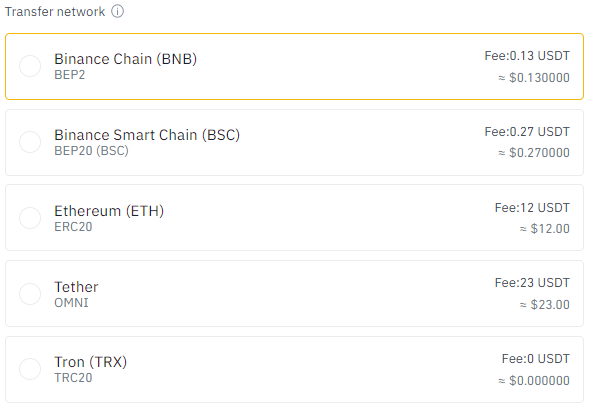
    Nevertheless, the ease of use is clearly not the main driving factor of the user and developer migration towards the Binance Chain – the low transaction fees are the one to “blame”. With soaring ETH fees developers and holders are looking for alternatives, and the Binance Chain appears to be the one that gets the job done fast, secure and with a low fee. For example, the screenshot below shows how much it would cost you to withdraw USDT tokens through various networks on Binance. The fee on Binance Chain is merely 1% of the fee incurred when withdrawing USDT in the form of an ERC20 token on Ethereum.
    With more utility coming to BNB, more users and trading volume on Binance, and consequently a higher the demand for BNB, the token’s price is expected to further increase. The price growth will likely be additionally boosted by the accelerated burn program.

    2. Hedera Hashgraph (HBAR)

    Hedera Hashgraph aims to develop the world’s first mass-adopted public distributed ledger that will be able to support a vast array of applications. Using their Hashgraph technology, users will be able to easily develop globally decentralized applications using and deploy them on the blockchain.

    The Testnet V0.12.0 to be Released on February 18

    According to Hedera official website the project will be deploying another upgrade to their project’s Testnet. The Testnet v0.12.0 launch procedure is scheduled to begin on Thursday February 18, 18:00 UTC. The upgrade and network restart will take approximately 2 hours to complete, the team noted. While the compatibility or data of the project that run on Hedera Testnet should not be affected, the network will be offline during this time. You can check the status of all Hedera networks, their scheduled maintenances and upgrade release notes here.

    3. Cosmos (ATOM)

    Cosmos is developing a network of blockchains that would facilitate the interoperability of multiple, otherwise incompatible, blockchain applications and cryptocurrencies. The scalable blockchain network built for developers had grown from a small ICO into a thriving ecosystem. At the time of writing, the network’s native cryptocurrency ATOM has a market capitalization of $2.35 billion, which is more than twice as much as it had merely 3 weeks ago.

    Stargate Upgrade to Finally take Place on February 18

    The Cosmos team have announced that the Cosmos Hub Stargate Upgrade will take place on February 18 at 06:00 UTC. The Stargate roll-out was initially planned for January 28, but got postponed due to issues with Ledger hardware wallet support, balance and metadata validations, and several bugs that were identified in the proposed code. Cosmos Governance halted the implementation of the upgrade described in Proposal 29 and approved by the vote on Proposal 35, by accepting a new Stargate upgrade schedule in the Proposal 36. You can find out more about Proposal 36 here.

  • Top 3 Coins to Watch – Week 6

    Top 3 Coins to Watch – Week 6

    The announcement of Tesla’s $1.5 billion investment into Bitcoin provided the perfect kick-off to what appears to be a rather eventful week on the cryptocurrency markets. Even if we leave Bitcoin’s interesting price action aside, there are still plenty cryptocurrency projects deploying new features and upgrades and trying to make the most off this bull market. Three such projects are featured in our this week’s selection of top 3 coins to watch.

    1. Ethereum (ETH)

    Ethereum is a decentralized blockchain platform and its native asset Ether (ETH) is the second-largest cryptocurrency by market capitalization. Ethereum features the Ethereum Virtual Machine (EVM), which can execute Turing-complete scripts. This gives Ethereum immense flexibility and allows users to deploy a wide variety of smart contracts and decentralized applications (dApps) on the blockchain. The contracts and dApps operate in a fast, immutable and trustless manner. The speeds and capabilities of the Ethereum blockchain are going to further increase when Ethereum 2.0 is fully launched.

    CME ETH Futures Trading is Live

    Ethereum, the second-largest cryptocurrency project has been attracting a lot of attention recently as the price of ETH climbed towards new all-time highs of above $1,700. At the same time ETH gas fees have skyrocketed, granting significant revenues to the miners, and causing a lot of grey hair to users that perform many on-chain transactions. As if that were not enough, the CME launched Ethereum Futures on February 8.

    The launch of futures contracts trading could affect both ETH’s short-term performance as well as the long-term performance. However, it was not quite clear whether the CME futures launch would cause ETH to appreciate or depreciate in the short-term as speculators are also able to short the asset using this instrument. The assumption that ETH would lose value because of futures trading has ground in the historical events that followed the launch of CME Bitcoin Futures in December 2017. Back than BTC crashed soon after futures trading went live on CME. Nevertheless, the CME BTC futures market, which currently records an average daily volume of around 60,000 BTC has helped lead to the long-term appreciation in the price of BTC. The roll-out of ETH Futures means that also the ETH market is maturing and expanding, and futures are an instrument that could boost the asset’s trading volumes and interest among investors. Crypto YouTuber Kevin Svenson, who correctly predicted that ETH would not tumble under the wight of futures trading in the short-term commented on the ETH CME futures launch on Twitter:

    2. Tezos (XTZ)

    Launched in September 2018, following an initial coin offering that raised $232 million in 2017, Tezos is a decentralized smart contract and application network that utilizes a proof-of-stake consensus model. The Tezos protocol has three main layers: the network layer, the transaction layer, and the consensus layer. Tezos also features an on-chain governance system allowing holders to take part in the decision-making process. What makes Tezos blockchain stand out among other similar blockchains is its efficient network upgrade process as the protocol allows major upgrades to be implemented without having to undergo a hard fork.

    Tezos Team Plans to Launch the Edo Upgrade on February 13

    The number of XTZ holders participating in the voting on the proposal regarding the Edo upgrade has officially reached the necessary quorum. Subsequently, the Tezos team has announced that the new version of the software will go live on February 13 provided that the proposal’s approval rate stays above 80%. The Edo upgrade include several improvements and new features. The revamped version of the protocol will add tickets in an attempt to simplify the composition of permissions and token contracts for the developers and overall improve the security of smart contract interactions. In addition, Edo will also allow for an extended 5th voting period, intended to ensure smoother voting process for protocol upgrades. Finally, Edo will also bring Sapling and BLS-12 privacy-preserving protocols to Tezos. You can read more about the Edo upgrade here.

    3. Cardano (ADA)

    Cardano is a cryptocurrency project focused at creating a smart contract enabled platform, on which developers can build decentralized applications. The native asset of the Cardano blockchain is called ADA and the development of the project is overseed by three main organizations – the IOHK, Cardano Foundation and Emurgo. Cardano launched in 2017 and raised $62.2 million for its development through an ICO. What sets Cardano apart from Ethereum and other smart chains is that Cardano aims to implement advanced on-chain functionality and guarantee the scalability of the network.

    The Number of Transactions and Active Cardano Addresses are at all-time high

    The Cardano team has successfully deployed the Mary update fork to the Cardano public testnet on February 3. Assuming that the final testing phase goes as planned, the update, which will allow users to generate their own tokens atop the Cardano blockchain, will most likely be deployed on the mainnet by the end of February. Fuelled by the bullish crypto market, Cardano has managed to almost double the price of its ADA token over the last 7 days, which is currently trading at around $0.70. Although ADA is still more than 50% from its ATH price of $1.33 achieved on January 4, 2018 the recent developments look very promising. In fact, Cardano recently became the second largest smart contract chain, right after Ethereum, as well as the fourth largest cryptocurrency in general with its $20.7 billion capitalization. In a recent interview with Ben Armstrong, AKA Bitboy Crypto, the Cardano founder Charles Hoskins highlighted many aspects that make the Cardano superior to Ethereum. Hoskins noted that Ethereum is a rather complex system, which is causing major scaling issues. In addition, Ethereum has not yet established a decentralized governance mechanism. Cardano on the other hand has a much simpler and more robust design than Ethereum, which allows for a higher throughput and better scalability, without compromising the security. Do you think Cardano has the winning formula that would it allow it to outgrow even Ethereum one day?

  • Top 3 Coins to Watch – Week 5

    Top 3 Coins to Watch – Week 5

    The end of January 2021 was marked by the amazing uprise of retail investors who organized themselves on the r/WallStreetBets (WSB) subreddit. Their goal was not to make as much profit as they could, but to stick it up against major players on the financial markets, such as big hedge fund managers. The tech savvy millennials and members of Generation Z bought up stocks of GameStop (GME) and AMC Theatres (AMC) with no intention to sell, aiming to perform a short squeeze and pressure investors, who held short positions to either buy more stocks of liquidate their positions. The market battle between David and Goliath got even less fair when platforms such as Robinhood, often utilized by WSB investors, restricted the buying of aforementioned stocks. While this move lifted a lot of dust it also acted as free advertisement for cryptocurrency space and DeFi, where the risk of this sort of market interference is significantly lower. Last but not least, the WallStreetBets movements sparked the creation of its cryptocurrency-themed copycat r/SatoshiStreetBets, whose promotions contributed to the fact that two of the coins in this week’s selection skyrocketed so high.

    1. Dogecoin (DOGE)

    The cryptocurrency Dogecoin was introduced as a joke in December 2013 by Billy Markus. Markus built the cryptocurrency project around the Shiba Inu doge meme that went viral in 2013 and the Dogecoin even uses the Doge meme as its official logo. Surprisingly, the currency took off. Even more, it developed a relatively large community on social platforms such as Reddit, which used Dogecoin to tip other members of the community and for performing similar micro-transactions. The Dogecoin community also raised funds to sponsor their own NASCAR racer for a few races and pay for a physical gold Dogecoin to be delivered to the moon via crowdfunding. Although the currency is regarded as a joke by more serious investors, Dogecoin is currently the 13th largest cryptocurrency by market capitalization with almost 130 billion Dogecoins mined since 2013.

    Subreddits r/WallStreetBets and r/SatoshiStreetBets pump DOGE

    Users on r/SatoshiStreetBets, a cryptocurrency-themed version of the r/WallStreetBets, the subreddit which kickstarted the GameStop phenomenon, started posting memes about Dogecoin and encouraging each other to buy the coin. The campaign promoting to buy Dogecoin soon spread across other platforms, such as TikTok and Twitter. Largely (if not even solely) because of this movement, DOGE displayed triple-digit gains on January 29, when the price spiked from $0.0076 to an all-time high of $0.077 within 24 hours. Such pump (and dump) campaigns are nothing new for DOGE. Let’s remember the viral TikTok video from July 2020 that attempted to push the price of DOGE to $1. Dogecoin also tends to pump when Elon Musk promotes the meme coin on Twitter. It happened on March 3, 2020, December 20, 2020, and Musk may have referred to Doge in his recent tweet too:

    At the time of writing, DOGE is trading at $0.0358, which is 55% lower than the ATH price but at the same time, over 500% higher than prior the pump. Does DOGE hold enough oomph to justify the price or will DOGE drop back to where it was changing hands prior to the rally – below $0.008?

    2. Ripple (XRP)

    XRP is a cryptocurrency that was launched in 2012 by Chris Larsen, Jed McCaleb and Arthur Britto. Ripple’s network uses a unique consensus protocol, which is neither proof-of-work nor proof-of-stake to facilitate very fast and cheap transactions. The maximum supply of XRP is 100 billion coins, which were all created at launch. At launch 80% of the total XRP supply was given to fintech firm Opencoin, a company that was later renamed to Ripple Labs in 2015. As of today, Ripple still holds more than half of the total XRP supply. However, most of the company’s XRP holdings are locked in escrow and can only be accessed periodically.

    WallStreetBets Causes 60% XRP price increase amidst turmoil with the SEC

    Ripple has recently found itself amidst a legal war with the U.S. Securities and Exchange Commission (SEC).  The SEC officially revealed that they filed a lawsuit alleging that Ripple, its CEO Brad Garlinghouse and its executive chairman Chris Larsen raised $1.3 billion through the sale of unregistered securities Ripple, on December 22, 2020. The filing triggered a massive sell-off of XRP, which was additionally amplified by the fact that many exchanges, including Coinbase, Binance.US, Bitstamp, Crypto.com, Bittrex and OKCoin announced the delisting and halt of XRP trading. Affected by the restricted trading on exchanges and the uncertainty surrounding the SEC vs. Ripple lawsuit, the price of XRP stayed below $0.30 for most of the time. However, on January 30, Reddit investors got involved. Much like it was the case with DOGE, the r/Wallstreetbets cryptocurrency-focused off-shoot r/Satoshistreetbets started promoting XRP. The subreddit was apparently very successful with its pump, as XRP ended the day 60% higher, making XRP the best performing asset of the day by far. XRP rose from $0.28 to a peak at $0.51 before profit selling pulled the price back to $0.41. However, the coin has since almost doubled its value, reaching a high of almost $0.75, before it dropped back to around $0.40. XRP is currently changing hands at around $0.365 and is still up by 35% compared to 7 days ago.

    In addition, the legal battle with the SEC has entered a new chapter, as Ripple filed its official answer on January 29.  Stu Alderoty, the General Counsel at Ripple, shared the summary of the company’s preliminary response on Ripple’s official blog. At multiple points in the documents, Ripple aims to debunk SEC’s claims that XRP is an unregistered security. The “Answer” explains that there was no “investment contract” with the XRP holders whatsoever and tries to prove that XRP is solely a virtual currency and thus, outside the SEC’s jurisdiction. In addition, Ripple never held an ICO or offered future tokens to raise money. Holding XRP also does not entitle the holders to a portion of Ripple’s revenue or profits.

    3. Alpha Finance (ALPHA)

    Alpha Finance Lab is a researching and innovation-focused blockchain project that works on the frontiers of the decentralized finance space. The main goal of the project is to fill in the market gaps in the DeFi section with a simple yet novel solutions.

    Alpha Honora V2 Is Live

    The Alpha Finance team have recently announced that Alpha Honora V2 was set to launch on February 1. The upgraded version of the Alpha protocol, which is already live, features an integration with leading DeFi protocols including Uniswap, SushiSwap, Balancer, Curve Finance, and Cream Finance. Consequently, users will be able to lend ETH (ibETHv2), USDT (ibUSDTv2), USDC (ibUSDCv2), and DAI (ibDAIv2). In addition, Alpha Honora V2 supports leveraged pools such as the Curve’s 3pool allowing CRV farming with leverage on USDT/USDC/DAI, Balancer’s PERP/USDC pool enabling PERP farming with leverage on USDC, SushiSwap’s SUSHI/ETH pool enabling SHUSHI farming with leverage on ETH, and Uniswap’s UNI /ETH pool with leverage on ETH. To celebrate the launch of the upgrade a meme competition with rich rewards was set in place. All the details about the launch can be accessed here.

    In the expectation of the V2 launch, ALPHA soared towards its new all-time high price of $2.36, achieved on January 30. It will definitely be interesting to see how it will the platform’s native cryptocurrency will perform in future weeks. ALPHA is currently changing hands at $2.03, with support levels lying at $2.02, $1.90 and $1.80.

  • Top 3 Coins to Watch – Week 4

    Top 3 Coins to Watch – Week 4

    As we enter Week 4 of year 2021 you are probably asking yourself what to expect of this week. In times where Bitcoin is still slowly recovering from its sub-$30,000 plunge and Ether seems to have topped out at around $1,400 there are seemingly not so many investment opportunities. However, in reality, you do not have to scroll too far down the list of top cryptocurrencies by market capitalization to find some projects that are set to benefit from the increased attention and updates deployed this week.

    1. ChainLink (LINK)

    ChainLink provides data and price oracles, which are essential for the normal function of smart contract-enabled blockchain platforms. ChainLink’s price and real-world data oracles have seen numerous implementations and their popularity is still increasing. Their oracles are one of the most reliable and trustworthy and the connection with smart contracts is end-to-end secured, leaving very little space for the manipulation of the execution of smart contracts. The platform incentivises providers of good data feeds while the nodes that submit bad data will see their staked LINK tokens slashed. The project launched in 2017, when it also raised $32 million of funding through an ICO. The ChainLink mainnet went live on May 30, 2019 and the network’s native LINK token has a total supply of 1 billion tokens. ChainLink is developing a framework, that would allow developers to build customized decentralized oracles.

    Largest Crypto Asset Manager Has Eyes on ChainLink

    According to documents published by Bizapedia, Grayscale has filed six new Trust filings in recent months. The leaked filings show that the largest crypto asset manager is eying Chainlink, Decentraland, Filecoin, Livepeer, Tezos, and Basic Attention Token. Neither Grayscale nor Chainlink have made any comment let alone confirmed the alleged ‘Grayscale Chainlink Trust’ product, but the idea does not seem so far-fetched. The news come shortly after LINK, the native token of the world’s largest oracle service, surged towards its new all-time high price last week. The speculations regarding the Grayscale’s Chainlink Trust have caused LINK to further surge, pushing its all-time high price further up above $25.70 on January 25. If Greyscale decides to launch a Chainlink trust, it will likely work in a similar manner than the existing crypto trusts, where the asset manager holds a fixed amount of coins or token per the trust’s share. Such fund would allow accredited investors to purchase LINK via regulated OTC brokers in the U.S. and likely provide enough fuel to trigger a new LINK rally.  Some industry insiders speculate that Grayscale could push the LINK price to $100 shortly. That would also quadruple LINK’s total market capitalization, which currently stands at $9.4 billion.

    2. Cosmos (ATOM)

    Cosmos is developing a network of blockchains that would facilitate the interoperability of multiple, otherwise incompatible, blockchain applications and cryptocurrencies. The scalable blockchain network built for developers had grown from a small ICO into a thriving ecosystem. The network’s native cryptocurrency ATOM has a market capitalization just shy of $1.7 billion.

    Cosmos Community to Conclude Voting on the Stargate Upgrade

    The Cosmos team are currently performing the last tests and optimisations of the upgrade of their platform while Cosmos validators and delegators are soon set to conclude the voting on the proposal related to the Cosmos Hub upgrade. Voting began on January 12 at 3:16:59 UTC, meaning that the 14-day voting period ends on January 26 at 3:16:59 UTC. If the outcome of the vote is affirmative, Cosmoshub-3 will be upgraded to Cosmoshub-4 (also called Stargate) on January 28 at 06:00 UTC. The current tally results along with the link to the GitHub repository link can be accessed here.

    3. Tezos (XTZ)

    Launched in September 2018, following an initial coin offering that raised $232 million in 2017, Tezos is a decentralized smart contract and application network that utilizes a proof-of-stake consensus model. The Tezos protocol has three main layers: the network layer, the transaction layer, and the consensus layer. Tezos also features an on-chain governance system allowing holders to take part in the decision-making process. What makes Tezos blockchain stand out among other similar blockchains is its efficient network upgrade process as the protocol allows major upgrades to be implemented without having to undergo a hard fork.

    Tezos Announced a new DAO Framework

    On January 21, Tezos project announced the launch of Homebase, a new project that allows Tezos (XTZ) users to easily set up and interact with decentralized autonomous organizations (DAOs). The platform, which allows anyone to establish a community governance structure on Tezos. The initial release of Homebase included two DAO templates; the TreasuryDAO, which facilitates the creation and decentralized management of a community treasury and the RegistryDAO, which allows users to govern arbitrary smart contracts, such as parameter governance in a DeFi protocol. Homebase is built on a new DAO framework called BaseDAO, which will allow users to create and finetune DAOs so that they are optimized for the decentralized governance of resources, registries, and/or rules. In response to the announcement, the price of Tezos surged from a local low of $2.40 on January 22 to as high as $3.40 on January 23. However, XTZ has since faced a slight correction and is currently trading around $3.00. Nevertheless, in addition to the DAO platform announcement, Tezos is one of the six cryptocurrencies rumoured to have a shot at being featured in its own Greyscale Trust. Furthermore, Tezos developers are currently working on the next protocol upgrade that could boost XTZ price further up. Among other things, the upgrade dubbed “Edo”, is set to bring Zcash-like privacy features to Tezos.

  • Top 3 Coins to Watch – Week 3

    Top 3 Coins to Watch – Week 3

    Judging by the first two weeks we cannot say that the cryptocurrency market has cooled off yet. Yes, Bitcoin does seem to have entered a period of mostly sideways trading with relatively high volatility, but other projects are pulling the space forward now. Just recently, Ethereum stepped into the limelight of the community’s attention by setting its new ATH price. But besides Ethereum, which is definitely worth keeping an eye on, there are many other cryptocurrency projects, that are looking to benefit from significant updates and the increased attention that comes with these upgrades. This week’s selection features three such projects.

    1. Curve (CRV)

    Curve is a protocol and a platform focused on providing a simple and easy-to-use way to swap certain Ethereum-based assets. The Curve DAO Token is the platform’s native token as well as its governance token. In addition, users providing liquidity to CurveFinance receive their rewards payed out in CRV.

    CRV is one of the Most profitable Cryptos of the past 7 days

    Ever since the beginning of the year the price of DeFi cryptocurrencies has been growing alongside the general cryptocurrency market. However, the Curve DAO Token (CRV) has been largely left out of this rally, at least until the end of the previous week, when the CRV rally started gaining momentum. The token’s price is up by more than 130% in the past seven days with a largest surge of over 50% seen on January 17. This makes CRV the best performing crypto in the past seven days in the top 100 by market capitalization. The late wake up is largely attributed to the fact that Curve recently added several new trading pairs, such as the ETH/stETH, and ETH/Aave’s interest-bearing assets, and established a collaboration with Yearn.finance that will allow any user to deploy trading pools for more esoteric and long-tail assets. Last but not least, CRV’s surge resembles the fact what yield farmers are earning more on Curve now. The fact that already $2.15 billion worth of capital is locked in Curve indirectly supports this statement. The token has been trading sideways in the past day, but it will be definitely interesting to further observe the price action following such a massive surge.

    Hedera Hashgraph (HBAR)

    Hedera Hashgraph aims to develop the world’s first mass-adopted public distributed ledger that will be able to support a vast array of applications. Using their hashgraph technology, users will be able to easily develop globally decentralized applications using and deploy them on the blockchain.

    Hedera Hashgraph Testnet V0.11.0 Release Scheduled for January 21   

    As recently announced by the Hedera team, the testnet upgrade to version v0.11.0 is scheduled to take place on January 21 at 18:00 UTC. The new version will feature updated versions (v5) of all file formats for record streams, record stream signatures, event streams, and event stream signatures. All interested community members, but especially HBAR holders, should follow the testnet upgrade status here and are advised to read through the upgrade release notes, when they become available.

    TomoChain (TOMO)

    TomoChain is an Ethereum codebase-based blockchain that supports all EVM-compatible smart-contracts, protocols, as well as atomic cross-chain token transfers. TomoChain utilizes a Proof of Stake Voting (POSV) consensus with 150 Masternode that grant very low fees and instant transactions while maintaining security at the same time. In the future, the team aims to introduce sharding, EVM parallelization, and generation of private chains.

    Zorro Upgrade Release Estimated for January 22

    The TomoChain team has announced that their Zorro mainnet upgrade is scheduled to take place at block number 30,915,660, which is estimated to be proposed sometime on January 22. For a more accurate estimation you should refer to the official countdown. The upgrade will bring improvements to the Ethereum Virtual Machine (EVM) and Solidity functionality, as well as the integration of TomoP mainnet code and an adjustment to the cancellation fees on TomoX based DEXs. The developers urge all TomoChain nodes and masternodes to upgrade their software to v2.3.0 by January 22. More information about the Zorro upgrade can be found in the project’s official blog post.

  • Top 3 Coins to Watch – Week 2

    Top 3 Coins to Watch – Week 2

    As usual, several projects are deploying important mainnet upgrades and launching new features this week. Our this week’s selection consists of three coins that we think will benefit from the increased attention. Will this be enough to end what it appears to be a significantly bearish week in the green?

    1. Blockstack (STX)

    Blockstack is the project behind the Stacks blockchain, an open-source and developer-friendly network for building decentralized apps and smart contracts on Bitcoin blockchain. The network makes use of the Clarity smart contract language and offers new ways to earn BTC.

    The Stacks 2.0 Mainnet Goes Live on January 14

    The highly anticipated Stacks 2.0 Mainnet launch is scheduled to occur on January 14. The mainnet will support smart contracts and decentralized applications (dApps) deployment on the Bitcoin network. Furthermore, users will soon be able to lock the platform’s native currency – STX to earn BTC rewards. Blockstack team calls this novel function “Stacking”. The important milestone for the platform will be celebrated at a Virtual Mainnet Launch Event, which will take place on January 14 from 10:00 to 18:00 EST. In addition, one of the bigger cryptocurrency exchanges OKCoin has already revealed its plans to list STX as well as intent to offer a seamless for the users to participate in stacking.

    2. Matic Network’s (MATIC)

    Matic Network is an Ethereum Layer 2 scaling solution that aims to provides major scalability improvements. The Matic protocol plans to deliver supersonic speeds and throughput by utilizing a modified version of Plasma. Its Layer 2 solution consists of several simultaneously run Proof-of-Stake sidechains that regularly push the data to Ethereum, creating network checkpoints.

    A Wave of DeFi Integration Caused MATIC to more than Double its Price

    The Matic team deployed several improvements throughout 2020, such as a Matic-Ethereum proof-of-stake token bridge that facilitates faster transfers between the networks and the final version of MATIC staking, that will allow the project to further prosper and perhaps survive even when Ethereum concludes the migration to its improved 2.0 variant. In addition, several notable projects, including the virtual world game Decentraland and DeFi protocol Maker have already integrated Matic.

    As a result, the MATIC, the network’s native currency delivered an amazing price performance in the first few days of 2021. Driven by the congested Ethereum network (and consequently high fees on the mainnet) and several DeFi integrations, MATIC surged from $0.0175 to almost $0.04 in the first seven days of this year. Although MATIC lost some of its value in Monday’s correction that affected pretty much every cryptocurrency the token is still up by more than 36% YTD. If the Ethereum network stays congested and more projects announce Matic integration, the MATIC token could easily outperform ETH this week.

    3. Loom Network (LOOM)

    Loom Network allows developers to build highly scalable games and social apps on the blockchain. The platform utilizes an independent blockchain called DAppChain, which uses Relay as a connection to Ethereum smart contracts. The network’s native currency LOOM token functions as a membership pass to access all Loom Network-ran DApps.

    LOOM Token Swap on January 15

    The Loom team is looking to integrate zkRollups Ethereum Layer 2 solution in its next instance of the protocol. This will create zkLoom protocol, which will rely on the security guarantees provided by Ethereum itself rather than placing the trust into the hands of LOOM validators. However, the existing LOOM token contract is not upgradable or compatible with zkLoom, so LOOM holders will have to swap their existing tokens for new ones through a new LOOM token contract that will be deployed on the Ethereum mainnet. The token swap is set to take place on January 15. Tokens held on exchanges will be processed automatically, LOOM held in user’s private wallets, however, will have to be converted using the Basechain dashboard. In either case, you can find more information about the tokens swap process here.

  • Top 3 Coins to Watch – Week 1

    Top 3 Coins to Watch – Week 1

    It has been a few days since we entered 2021 and the cryptocurrency market continues its rally. The very first selection of top coins to watch this year is again topped by the most popular and most established cryptocurrency, but while often staying in the shadow of Bitcoin and Ethereum, other projects are also making significant progress by deploying new features.

    1. Bitcoin (BTC)

    Although we believe Bitcoin does not need much introduction and that all eyes would be on it even if it were not featured on our list, here is a short summary of the history and key characteristics of the first truly decentralized digital currency. The world’s pioneer cryptocurrency was launched by pseudonymous figure named Satoshi Nakamoto in 2009 and has a capped supply of 21 million coins. The decreasing miner block rewards makes the cryptocurrency scarcer with time, ensuring a deflationary nature.

    Many Experts predict a very Bullish Performance for Bitcoin in 2021

    Bitcoin, whose market capitalization is currently at over $650 billion, representing around 68% of the total cryptocurrency market capitalization, has finished last week off by setting a new ATH of $34.700. The high institutional interest, retail sales waking up and even billionaires entering the space, the price continues and likely will continue to rise. As a consequence of these conditions, Bitcoin is currently trading at above $35,000, near its current ATH price of over $35,600, set in the morning hours of January 6. Furthermore, since the beginning of the rally in Q4 2020 when thigs got interesting for Bitcoin holders, every dip was bought. In addition, pretty much all prominent experts’ price predictions for 2021 are very bullish. While some warn about a severe bearish retracement coming in after 2021, such as the bear markets seen in the previous bearish phases of the market cycle (up to -85% drop in price), they estimate that a drop below $20,000 is highly unlikely ever to occur again.

    PersonPrediction (in USD)Date of prediction
    Kevin Svenson250,000Jan 2021
    Ryan Selkis100,000Dec 2020
    Andrew Keys50,000Dec 2020
    Tone Vays100,000Dec 2020
    Willy Woo @woonomicConservative: 200,000
    Realistic: 300,000
    Dec 2020
    Raoul PalConservative: 150,000
    Realistic: >250,000
    Dec 2020
    Philip Swift100,000Nov 2020
    Tom Fitzpatrick318,000Nov 2020
    Brian Estes100,000 – 288,000Nov 2020
    Erik Voorhees50,000Apr 2020
    Anthony Pompliano100,000Nov 2019
    Sunny Decree100,000Nov 2019
    Benjamin Cowen141,173Nov 2019
    Table 1: List of Bitcoin price predictions of various traders, analysts, and other prominent players. All predictions are for BTC’s value by the end of 2021.

    Interestingly, a lot of U.S. citizens that received a $1,200 stimulus check in April 2020 and did not need it to pay the rent, bills and other life costs decided to channel the extra money into cryptocurrency. This decision turned out to be quite lucrative for those who have bought Bitcoin with this airdropped money as the spring’s stimulus is now worth over $5650 if it has been fully used to purchase BTC.

    We wonder how much money from the second stimulus package, which features a $600 check for every eligible citizen, will end up in crypto and how high up can the increased retail interest drive the prices this time?

    2. NEM (XEM)

    NEM smart asset blockchain platform launched in March 2015. The platform utilizes a pioneering Proof of Importance (POI) consensus algorithm to validate transactions and issue new XEM coins. In addition, NEM is written in Java and allows applications written in any programming language run on its blockchain, which is achieved through APIs. NEM is used by several financial companies in Japan and is the cornerstone of Mijin blockchain.

    NEM to Launch Symbol Public Blockchian in February, Opt-in for XYM Distribution only Available until January 9

    The NEM team is preparing for the launch of the Symbol public blockchain and the XEM holders have an opportunity to participate in its launch and receive Symbol’s XYM coins when the platform goes live. To be awarded the XYM tokens at a 1:1 ratio against their NEM holdings at the time of the snapshot, the NEM users have to opt-in before January 9. The date and time of the snapshot remains unknown and the minimum balance to be eligible for opt-in is 100 XEM. The ream advises users to opt-in through NEM the desktop wallet or NEM mobile wallet (available for Android only), but several prominent exchanges have already announced they will be supporting the XYM opt-in.  More information regarding the Symbol migration and the whole opt-in process can be found here.

    3. Aavegotchi (GHST)

    Built by Singapore-based Pixelcraft Studios and founded by the popular DeFi protocol Aave, Aavegotchi is a DeFi staked crypto collectibles platform. The value and rarity of the playable digital avatars called Aavegotchis, which exist in the form of ERC721 non fungible tokens, are determined by their collateral stake, traits, and wearables.

    Aavegotchi Mainnet Launched This Week

    Aavegotchis represent a user’s collateral earning yield on Aave and can be minted by staking specific “aTokens” such as aUSDC and aLINK into their gotchi. The playable digital ghosts can be used to enter game battles and be equipped with wearables. However, each gotchi ghost out of the game once its owner chooses to liquidate the underlying stake. The highly anticipated project, which aims to push the adoption of non-fungible tokens (NFT) forward launched its first mainnet on January 4. The launch of the project, which is unique for its combination of crypto collectables (NFTs) and DeFi, was accompanied by several Aavegothchi raffles and NFT Auctions.

  • Top 3 Coins to Watch This Week – Week 53

    Top 3 Coins to Watch This Week – Week 53

    We are heading towards the end of 2020 and therefore you are reading the last weekly selection of top 3 coins to watch this year. Despite the festive spirit, cryptocurrency markets and developers are not at rest. Quite the opposite – we are seeing some significant price action and even the roll-out of a few important network upgrades.

    1. Ethereum (ETH)

    Ethereum is a decentralized blockchain platform and its native asset Ether (ETH) is the second-largest cryptocurrency by market capitalization. Ethereum features the Ethereum Virtual Machine (EVM), which can execute Turing-complete scripts. This gives Ethereum immense flexibility, allowing users to deploy a wide variety of smart contracts and decentralized applications (dApps) that operate in a fast, immutable and trustless manner.

    ETH 2.0 Deposits are Still Growing as Investors Seek another Winning Crypto Bet

    While most of the attention has been on Bitcoin this year, the second largest cryptocurrency Ether has performed a rally of much bigger proportions this year. At the time of writing, Bitcoin is +268% YTD, while Ether’s price grew by almost twice as much – ETH is currently changing hands at more than $730, which represents a growth of +464% from the $130 at the start of this year. Nevertheless, there is still much room for growth, as Ether’s price is still far away from its ATH of $1,570 achieved in January 2018. In addition, ETH is currently trading at an attractive level vs. BTC: 0.027 BTC/ETH. This is just above the price of 0.025 BTC per ETH, which is a long-term support level. These circumstances make ETH a very interesting asset for both retail and institutional investors, who will likely soon seek another coin to invest in on top of BTC.

    If we examine what is happening with the Ethereum blockchain, we can see that it is still in the process of transitioning to the PoS-enabled Ethereum 2.0. The new version, which will significantly increase the throughput of the network, has already attracted more 2 million ETH of deposits, currently worth $1.5 billion. In addition, several Layer 2 solutions, such as zkSnarks, Optimistic rollups, PoA chains/Matic/xDAI, and similar are being put in place to facilitate cheaper and faster transactions by taking them off the mainnet. Furthermore, the Ethereum community is in fierce discussions about the Ethereum Improvement Proposal (EIP) 1559, which is going to introduce a deflationary mechanism to the Ethereum network’s native currency if passed. On top of that Ethereum has countless application possibilities in the decentralized finance (DeFi) sector.

    2. Kava (KAVA)

    Developed by Kava Labs the Kava blockchain boasts with the title of the first multi-blockchain DeFi platform. Users are eligible for rewards in the form of KAVA tokens for depositing various cryptocurrencies to the protocol’s multi collateral CDP system. The Kava blockchain utilizes the Tendermint consensus and is secured by 100 validators.

    HARD Protocol v2 Launches on December 30

    The Kava team launched their cross-chain money market called Harvest V1 on October 15. Along with the launch of the money market platform, Kava Labs also released the HARD protocol and its associated HARD governance token. Two and a half months after, the refined and improved HARD v2 is set to launch. HARD v2, which will support supplying and borrowing BTC, XRP, BNB, BUSD, USDX and LINK as well as introduce incentives for the borrowers of BTC, BNB, BUSD, LINK, USDX and XRP, will go live on December 30. The HARD governance token will also see some improvements in the form of expanded utility. Find out more about the HARD v2 in this official blog post.

    3. KardiaChain (KAI)

    KardiaChain is a public blockchain that aims to provide businesses as well as government bodies a hybrid blockchain infrastructure to build on top of. While the team believes that the blockchain technology should be accessible for everyone, they are focusing on spreading its adoption in Vietnam, where the company behind KardiaChain is based.

    KardiaChain Mainnet 1.0 Will Launch on December 29

    KardiaChain has announced that their mainnet 1.0, which will allow anyone to build dApps atop of it, will launch on December 29. The ERC-20 KAI tokens now in circulation will be burned and the team will create a token swap bridge to exchange them form mainnet KAI coins. The mainnet roll-out will also allow KAI holders to either stake their coins or delegate their KAI to other community members. More information, including the detail regarding the token swap, can be found here.

  • Top 3 Coins to Watch – Week 52

    Top 3 Coins to Watch – Week 52

    As we move through the final month of the year, several cryptocurrency projects are moving ahead with continued development. Nevertheless, this week’s selection is topped by Bitcoin, which ended Week 51 with an amazing ATH price of above $24,000.

    1. Bitcoin (BTC)

    Although we believe Bitcoin does not need much introduction and that all eyes would be on it even if it were not featured on our list, here is a short summary of the history and key characteristics of the first truly decentralized digital currency. The world’s pioneer cryptocurrency was launched by pseudonymous figure named Satoshi Nakamoto in 2009 and has a capped supply of 21 million coins. The decreasing miner block rewards makes the cryptocurrency scarcer with time, ensuring a deflationary nature.

    Bitcoin Ended the amazing Week 51 with an ATH of over $24,000

    The reason why all eyes are on Bitcoin is its amazing price performance from last week, when the largest crypto finally broke from the sub-$20,000. The crossing of this psychological, as well as major resistance level caused the price to skyrocket to above $23,000 in just a bit more than one day. Even though Bitcoin is now trading sideways again, many traders and analysts claim that the leading digital asset is still in the price discovery process. In addition, the institutional interest is not dying off yet. Quite the opposite actually as MicroStrategy recently revealed that it bought additional 29,646 BTC for $650 million at an average price of $21,925 per coin, increasing their total stake in Bitcoin to over $1 billion:

    Even Tesla CEO Elon Musk did not remain silent regarding the Bitcoin’s price movement. He posted a Tweet in his notoriously funny style:

    Interestingly, the Musk’s image sparked a conversation with the MicroStrategy’s Michael Saylor, in which the later tried to convinced Musk to allocate some of the Tesla’s assets to Bitcoin and do its “shareholders a $100 billion favour”. Clearly, Musk was very interested as he replied asking:

    “Are such large transactions even possible?” to which Saylor stated that he is prepared to share more advice offline.”

    Judging by the supply and demand disbalance, Bitcoin could be prepping for an even more exciting 2021 and several crypto experts expect BTC to reach $100k by the end of this year. And when BTC moves, the whole crypto market moves.

    2. Swipe (SXP)

    Swipe is a crypto debit card issuer that allows its users to easily spent their cryptocurrencies for everyday purchases. The Swipe Token is the project’s utility token.

    Swipe Visa Cards Began Shipping in the U.S.  

    Swipe finally began shipping the highly anticipated physical Swipe Visa Cards to all U.S. virtual cardholders on December 22. In addition, the Swipe team is making significant progress at the Canadian market. The crypto card issuer already rolled out support for the Canadian Dollar on the Swipe Wallet and made everything ready to launch its service in Canada. Interested Canadians will be able to pre-order their cards soon. As per the EEA region, its citizens could recently take part in a Swipe and Binance Holiday Promotion, in which the partnered companies distributed up to 100,000 SXP in rewards to users who completed two rookie tasks – purchased at least 150 EUR worth of crypto and made at least one Binance Card transaction.

    3. Stratis (STRAX)

    Stratis is a blockchain environment and a cryptocurrency for enterprise users. With a focus on the financial industry, the project aims to offer its customers an easy way to build blockchain-based solutions. Stratis supports the native C# programming language, which is already widely used, and therefore acts as a simple bridge to blockchain technology.

    The InterFlux Protocol Release on December 22

    The Stratis team recently released an update, which features the InterFlux Protocol. InterFlux is a protocol that facilitates the communication between public and private blockchain solutions while acting as a Layer-2 Scaling solution for Ethereum deployments at the same time. The solution, which incorporates support for the Ethereum network as well as the Hyperledger Fabric blockchain, will make it much easier for the Stratis platform to integrate with pre-existing blockchains. The integration of the Ethereum Layer 2 solution will also expand its usability to the DeFi sector and allow for non-fungible tokens (NFT) to be used and management on Stratis blockchain. More information regarding InterFlux protocol can be found in the official feature announcement.