Category: Featured

Stay updated with our hand-picked featured news, top market insights, and the most important stories from the cryptocurrency world.

  • 12 Best Crypto to Buy Right Now — April 2026

    12 Best Crypto to Buy Right Now — April 2026

    cryptocurrencies digital style image

    Are you looking to invest in cryptocurrencies but unsure which one to buy? With so many options available, it can be overwhelming to decide how to invest your money. That’s why we’ve compiled a list of the best crypto to buy now, based on factors such as project developments, price performance, and market capitalization, as well as the overall potential for growth.

    In this article, we’ll take a closer look at the most promising cryptocurrencies, including staples such as Bitcoin and Ethereum, and a combination of several other promising crypto projects. We’ll discuss their features, advantages, and potential drawbacks, as well as provide insights into market trends. Whether you’re a seasoned investor or just starting out, this article will help you make an informed decision about the best crypto to buy now. 

    So, let’s dive in and explore the best cryptocurrencies to invest in April 2026:

    1. Bitcoin – The world’s largest and oldest cryptocurrency
    2. Solana – Smart contracts platform with high speeds and low fees
    3. Ethereum – The leading DeFi and smart contract platform
    4. Bittensor – Decentralized platform for machine intelligence
    5. Hyperliquid – Decentralized perpetuals exchange with an efficient order book
    6. XRP – The leading crypto remittance solution
    7. Toncoin – An efficient blockchain with Telegram messenger integrations
    8. Monero – A privacy-first cryptocurrency with fully obfuscated transactions
    9. Zcash – Privacy-focused cryptocurrency
    10. Uniswap – A pioneering decentralized exchange protocol
    11. BNB – The native coin of the Binance exchange
    12. Chainlink – The leading decentralized oracle protocol

    The best cryptos to buy right now: Discover top investments for April 2026

    The following three cryptocurrency projects highlight our investment selection thanks to important developments and upcoming events that make them especially interesting to follow in the near future. These projects are updated each week based on the most recent developments and trends taking place in the crypto market.

    1. Bitcoin

    Bitcoin (BTC) is the original decentralized digital currency, enabling peer-to-peer transactions without the need for intermediaries such as banks or financial institutions. It was created in 2009 by an unknown person or group of people using the pseudonym Satoshi Nakamoto. Bitcoin was the first digital currency to eliminate the double spending problem without resorting to any central intermediaries.

    Bitcoin transactions are recorded on a public ledger called the blockchain, which is maintained by a network of computers around the world. This means that the transactions are secure and transparent, as anyone can view them, but they are also anonymous, as the identity of the participants in the transaction is not revealed.

    Bitcoin is often referred to as “digital gold” or a store of value, as it has a limited supply of 21 million coins, and its value is determined by market demand. Some people also see it as a hedge against inflation or a way to diversify their investment portfolio. It is by far the largest cryptocurrency by market cap in the industry, accounting for the value of more than 50% of all digital assets in circulation combined, making it arguably the most popular crypto to buy.

    Why Bitcoin?

    Bitcoin (BTC) is trading at $68,388, stabilizing near the upper end of its recent range as institutional accumulation continues despite elevated macro uncertainty. Strategy resumed aggressive buying, adding 4,871 BTC for $329.9 million, bringing total holdings to 766,970 BTC even as the firm reported a $14.46 billion unrealized loss for Q1. The continued accumulation below its average cost basis signals long-term conviction among large holders.

    Strategy’s Bitcoin purchase history and holdings disclosed in SEC filing. Source: SEC

    Geopolitical volatility has also influenced short-term price swings. Mixed signals surrounding US–Iran negotiations pushed total crypto market capitalization up 2.5%, with Bitcoin briefly tapping $69,500 before consolidating. Elevated oil prices and inflation concerns remain in focus, but liquidation data shows shorts were heavily squeezed during the recent bounce.

    Truth Social post from US President Donald Trump amid Strait of Hormuz negotiations. Source: Truth Social

    Meanwhile, sentiment data suggests a potential contrarian setup. Bearish Bitcoin commentary on social media has climbed to a five-week high, while the Crypto Fear & Greed Index remains deep in “Extreme Fear” territory. Historically, such elevated fear levels have coincided with local bottoms and rebound phases.

    2. Solana

    Solana is a smart contract platform known for its distinctive architecture, enabling it to handle thousands of transactions per second while maintaining very low costs. It accomplishes this by using a combination of a unique Proof-of-History algorithm and a Proof-of-Stake consensus mechanism. SOL, the native cryptocurrency of the platform, is one of the cheapest to transfer, with users typically paying less than $0.001 per transaction.

    Founded in 2018 by Anatoly Yakovenko, Solana’s mainnet went live in March 2020 and experienced a surge in adoption throughout 2021. Despite a significant drop in value during the 2022 bear market, Solana remains one of the most robust ecosystems in the cryptocurrency space and continues to be seen as a potential candidate for significant future growth.

    Why Solana?

    Solana (SOL) is trading at $79.36, hovering just above the critical $80 support zone after failing to hold gains above $93. The recent 11% pullback has brought price back toward a key technical level, with traders closely watching whether SOL can defend this area or risk a move toward $75. Broader crypto market movements have added volatility, while SOL continues to lag relative to some large-cap peers.

    SOL/USD price performance versus total crypto market capitalization. Source: TradingView

    On the fundamental side, network metrics show mixed signals. Solana’s decentralized exchange (DEX) volumes have fallen to their lowest levels since September 2024, contributing to a 42% drop in monthly network fees compared to January. At the same time, Ethereum layer-2 ecosystems have expanded their DEX market share, increasing competitive pressure on Solana’s DeFi dominance.

    Solana network fees and DEX volumes trend lower in recent months. Source: DefiLlama

    Despite weaker DEX activity, Solana maintains a strong application layer. The network leads all blockchains in the number of decentralized applications generating over $1 million in 30-day revenue, highlighting continued developer engagement and ecosystem resilience. This revenue strength may provide a fundamental cushion as SOL attempts to stabilize above key support.

    3. Ethereum

    Launched in 2015 by Vitalik Buterin and a team of developers, Ethereum is a decentralized, open-source blockchain platform that allows developers to build decentralized applications (dApps) and smart contracts. 

    Ethereum has a wide range of use cases beyond just a store of value or medium of exchange. Ethereum’s smart contract functionality allows developers to build dApps that can run without the need for intermediaries, like centralized servers or institutions.

    The Ethereum platform has gained widespread adoption and has become the backbone of the decentralized finance (DeFi) industry. DeFi applications built on Ethereum allow users to access financial services without relying on traditional banks or financial institutions. Ethereum’s smart contract functionality has also enabled the creation of non-fungible tokens (NFTs), which have gained popularity in the digital art and gaming worlds.

    While Ethereum has a strong community and has been highly influential in the cryptocurrency industry, it also faces challenges, such as scalability issues and high gas fees. These issues have spurred the development of various Layer 2 scaling solutions. In the long run, future updates are supposed to massively increase Ethereum’s throughput bringing the transaction per second (TPS) figure from 15 to 100,000.

    Why Ethereum?

    Ethereum (ETH) is trading at $2,089.03, consolidating below the key $2,150 resistance zone as bulls attempt to regain momentum. Price has repeatedly stalled near this level over the past two months, with the ascending trendline now acting as critical structural support. A sustained move above $2,150 would reopen the path toward $2,400, while failure to hold support could expose liquidity near $1,900 and potentially the yearly low around $1,736.
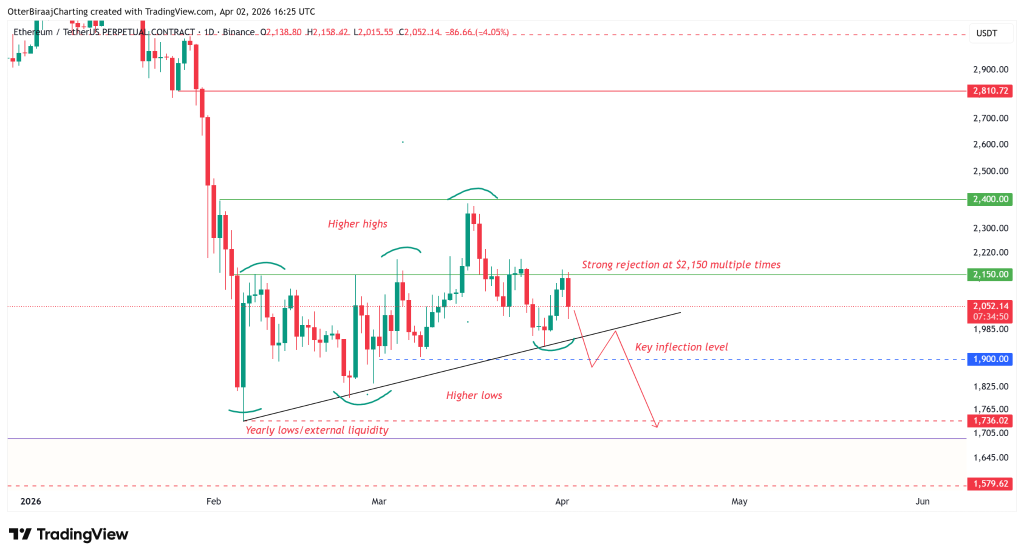
    ETH/USDT one-day chart showing repeated rejections near $2,150 resistance. Source: TradingView

    On the fundamental side, the Ethereum Foundation has nearly completed its goal of staking 70,000 ETH, locking approximately 69,500 ETH into the Beacon Deposit Contract as part of its revised treasury strategy. The move shifts the foundation toward a yield-generating model designed to fund research, development and ecosystem grants, while also increasing Ethereum’s staked supply.
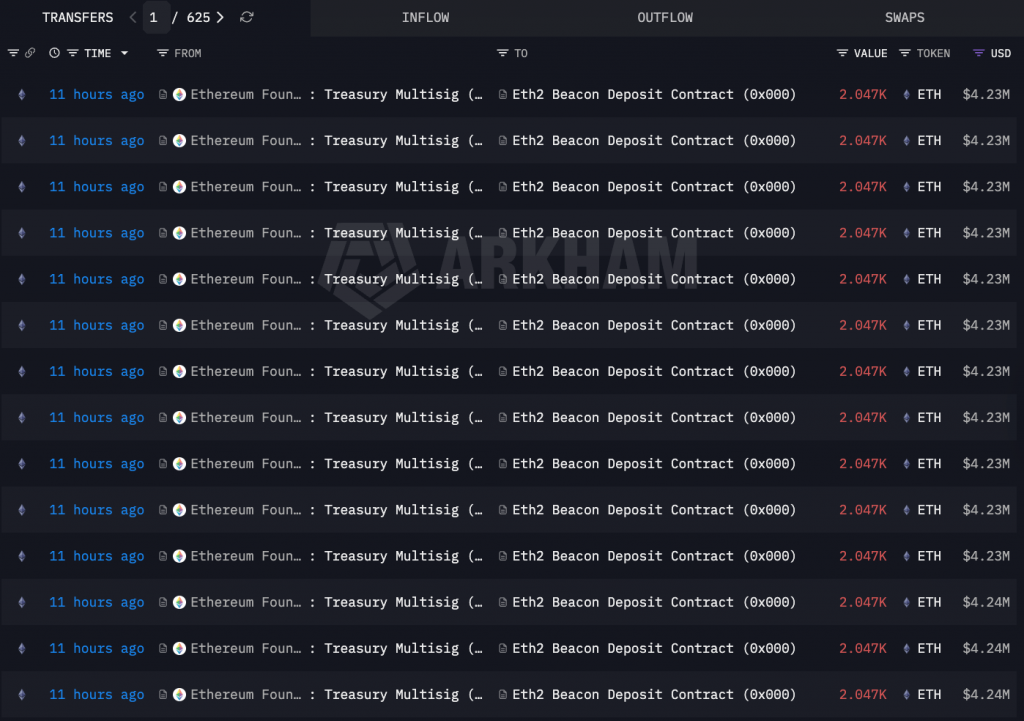
    Ethereum Foundation transfers to the Beacon Deposit Contract as part of its staking strategy. Source: Arkham Intelligence

    Derivatives activity adds another layer of complexity. Recent macro volatility triggered a spike of roughly $1 billion in ETH futures sell volume on Binance within a single hour, reinforcing short-term pressure. Liquidation clusters remain concentrated between $1,845 and $2,255, suggesting heightened sensitivity around current price levels.

    4. Bittensor

    Bittensor is a decentralized platform that creates a peer-to-peer marketplace for machine intelligence. The network is composed of multiple specialized subnets, each dedicated to specific tasks such as text prompting, transcription, or audio generation. Currently, more than 30 Bittensor subnets are actively operating across various AI domains.

    At the core of the network is a unique consensus mechanism known as Yuma Consensus, which enables validators across different subnets to collaboratively determine what the network learns and prioritizes. This approach ensures that intelligence within the ecosystem evolves based on real-world utility and performance.

    The computational power required to perform machine learning tasks is supplied by miners, who are incentivized with TAO tokens. Users seeking AI services pay in TAO to access these decentralized resources, creating a self-sustaining economic model that rewards valuable contributions.

    By offering a decentralized and cost-efficient network of machine learning algorithms, Bittensor lowers barriers to entry and makes advanced AI capabilities accessible to a broader audience.

    Why Bittensor?

    Bittensor (TAO) is trading at $316.78, consolidating after an explosive rally of more than 160% over the past month. The token’s rapid ascent has positioned it among the strongest-performing AI-related crypto assets in 2026, supported by growing interest in decentralized artificial intelligence infrastructure. However, technical indicators suggest the rally may be entering a critical phase as TAO tests key resistance levels following its sharp upward move.
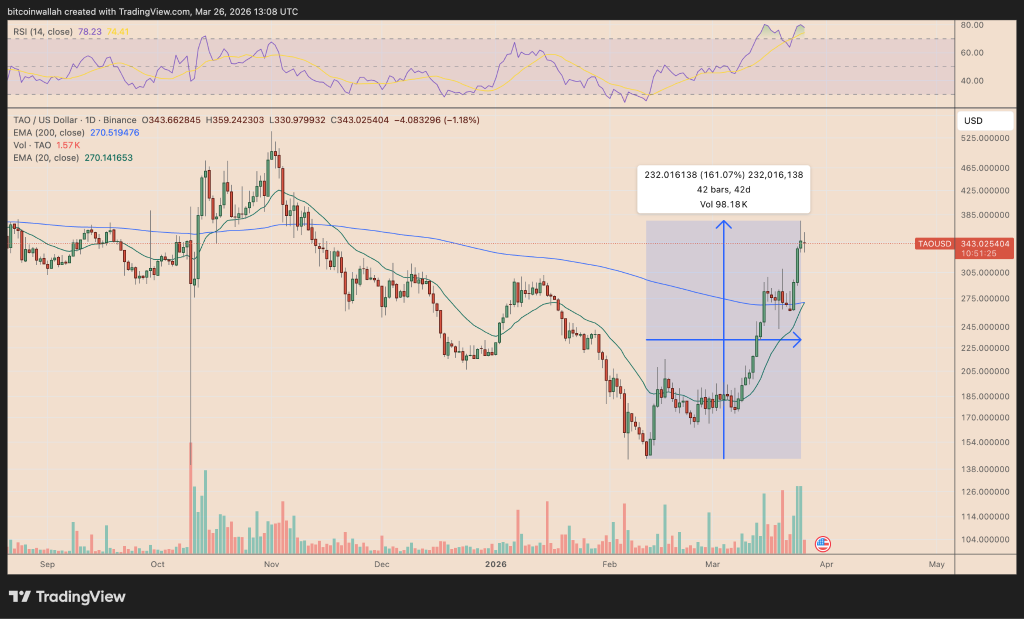
    TAO/USD daily chart showing a golden cross formation following a strong multi-week rally. Source: TradingView

    Despite the bullish momentum, historical fractal patterns indicate caution. Previous golden cross formations on TAO’s chart have preceded average drawdowns of roughly 40% within five to six weeks, suggesting the potential for a short-term correction if the pattern repeats. At the same time, social activity surrounding Bittensor has surged to its second-highest level in six months, reflecting growing market attention while sentiment remains relatively balanced rather than euphoric.

    Bittensor social volume and sentiment trends highlight rising attention without extreme market euphoria. Source: Santiment

    Fundamentally, the broader Bittensor ecosystem continues to strengthen, with subnet tokens collectively reaching a market value of approximately $1.5 billion as demand for decentralized AI infrastructure accelerates. High-profile endorsements from industry leaders and advancements such as the Covenant-72B large language model have reinforced Bittensor’s long-term narrative, positioning TAO as a key player at the intersection of blockchain and artificial intelligence.

    5. Hyperliquid

    Hyperliquid is a decentralized perpetual futures exchange built to rival centralized trading platforms in speed, liquidity, and user experience—all while remaining fully on-chain. Unlike traditional DEXs that often struggle with performance bottlenecks, Hyperliquid uses a custom high-performance layer-1 blockchain specifically optimized for trading. This allows it to offer ultra-low latency, high throughput, and a seamless trading experience without relying on external validators or rollups.

    One of Hyperliquid’s key innovations is its order book-based model, which is uncommon among decentralized platforms. While many DEXs use automated market makers (AMMs), Hyperliquid implements a central limit order book (CLOB), giving traders more control over order execution and tighter spreads. This design makes it particularly appealing to professional and high-frequency traders who expect the responsiveness of centralized exchanges but want the trustlessness of DeFi. Its deep liquidity pools and tight integration with crypto-native assets further enhance its trading dynamics.

    Why Hyperliquid?

    S&P Dow Jones Indices is taking the S&P 500 onto the blockchain by licensing its flagship index to Trade[XYZ], which is introducing the first officially sanctioned S&P 500 perpetual futures (perps) on the Hyperliquid blockchain. This allows eligible non-U.S. investors to access leveraged exposure to the index and trade it around the clock without depending on traditional stock exchanges.

    The offering is powered by real-time S&P 500 data, ensuring precise pricing even outside standard market hours. As a perpetual futures contract, it does not expire and instead uses funding rates to keep its price in line with the spot market.

    This marks the first instance of the S&P 500 being offered as an officially supported perpetual product. It also gives traders the ability to respond immediately to macroeconomic developments at any time, showcasing the benefits of blockchain-based trading environments.

    Hyperliquid is increasingly establishing itself as a major platform for traders reacting to global macro events, especially amid the recent spike in oil market volatility linked to the attack on Iran.

    The platform enables users to open leveraged positions on synthetic commodities through perpetual futures backed primarily by USDC, eliminating the need for brokerage accounts or access to regulated commodity exchanges such as CME.

    Its infrastructure combines HyperCore, featuring fully on-chain order books capable of processing around 200,000 orders per second, with HyperEVM, an Ethereum-compatible system that allows developers to create applications that tap into the exchange’s liquidity. This design has made Hyperliquid particularly appealing to traders aiming to respond to global events in real time.

    6. XRP

    XRP is a digital cryptocurrency that was created by Ripple Labs in 2012. It is used as a means of payment and transfer of value on the Ripple payment protocol, which is designed to enable fast and secure transactions between financial institutions as well as individuals.

    XRP is unique in that it is not based on the blockchain technology used by many other cryptocurrencies. Instead, it uses a distributed consensus ledger called the XRP Ledger, which is maintained by a network of validators. This allows for faster transaction processing times and lower fees compared to traditional payment methods.

    XRP has been popular among cryptocurrency traders and investors due to its high liquidity and clear potential for broader adoption, especially as a remittance solution. However, it has also been the subject of controversy and legal action, with US regulators alleging that it is a security and should thus be subjected to securities regulations. This has somewhat hindered the potential of XRP as an investment, and handcuffed Ripple’s growth as a company.

    Why XRP?

    Evernorth’s recent S-4 filing with the SEC outlines one of the most notable institutional developments involving XRP in recent months and sheds light on why the asset may be worth monitoring in the near term.

    The firm is planning to go public via a SPAC merger while holding a treasury of approximately 473 million XRP, currently valued at around $685 million. Much of this allocation was not acquired through open-market purchases but through strategic contributions, including roughly 127 million XRP from Ripple and more than 211 million XRP from Arrington Capital.

    The size of the position is also striking. Evernorth raised over $1 billion to establish its XRP treasury, even though the present value of its holdings is considerably lower due to XRP’s price drop. Part of its XRP was acquired at an average price of about $2.53, which is significantly higher than the current level near $1.45, leading to a substantial accounting impairment.

    What sets Evernorth apart is that it does not view XRP as a static reserve asset. Instead, the company plans to actively utilize its holdings through decentralized finance strategies such as providing liquidity, lending, and generating income via options. It also aims to incorporate Ripple’s RLUSD stablecoin into these operations. This strategy creates a more active form of demand for XRP, as it is used in yield-generating activities rather than simply being held for speculation.

    With XRP still trading well below its all-time high and Evernorth’s average acquisition price, the situation presents an interesting short-term narrative. Investors are observing a large, publicly traded entity building a significant XRP position, putting it to work for yield, and establishing itself within the broader ecosystem. Alongside the visibility of the upcoming SPAC merger, this could help spark renewed interest and momentum for XRP as institutional participation continues to grow.

    7. Toncoin

    Launched as the blockchain powering Telegram’s Web3 ambitions, The Open Network (TON) is a decentralized, open-source blockchain designed for fast, low-cost transactions and seamless integration with consumer-facing applications. TON was built to support smart contracts, decentralized applications, and native payments at scale, with a strong focus on usability and high throughput.

    TON goes beyond simple value transfers by enabling developers to build Mini Apps, wallets, and payment tools that can be embedded directly into Telegram’s interface. This design allows users to interact with onchain services without leaving a familiar messaging environment, lowering friction compared with traditional dApp ecosystems.

    Adoption has increasingly centered on payments and consumer use cases, with TON positioned as a settlement layer for in-app commerce, peer-to-peer transfers, and stablecoin payments across Telegram’s global user base. Recent launches such as TON Pay aim to turn Telegram into a native crypto checkout environment, expanding real-world utility beyond trading and speculation.

    Despite its growth, TON continues to face scrutiny around decentralization, governance, and its close association with Telegram. Ongoing development is focused on improving developer tooling, scaling transaction capacity, and expanding compliance-friendly payment infrastructure, as the network pushes toward broader mainstream adoption.

    Why Toncoin?

    Toncoin (TON) is trading at $1.34, up 1.35% over the past seven days, with a market capitalization of $3.28 billion, standing out as one of the few large-cap assets holding steady during a volatile market week. While Bitcoin and Ethereum sold off sharply, TON remained range-bound, reflecting relatively resilient sentiment tied to ecosystem-specific developments rather than broader macro flows. Price action suggests quiet accumulation, with limited downside follow-through despite market-wide risk aversion.

    That stability comes as the TON Foundation unveiled TON Pay, a new payments SDK designed to turn Telegram into a native crypto checkout layer for Toncoin and stablecoins. The tool allows Telegram Mini Apps to accept onchain payments through a single integration, with sub-second settlement times and average fees below one cent, targeting Telegram’s 1.1 billion monthly active users. TON Foundation vice president of payments Nikola Plecas said the goal is to remove friction around wallets, gas fees, and checkout, positioning TON as a consumer payments rail embedded directly into one of the world’s largest messaging platforms.
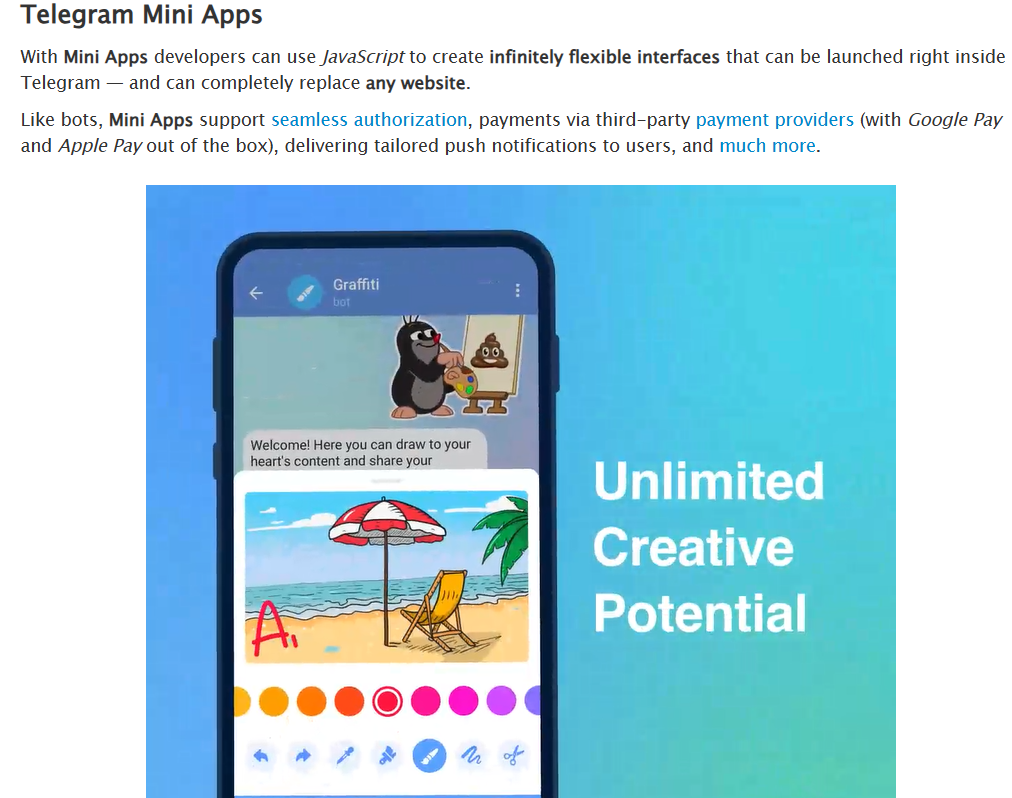
    Telegram Mini Apps. Source: Telegram

    Looking ahead, TON’s narrative is increasingly tied to real-world usage rather than speculative trading. Planned expansions to subscriptions, gasless transactions, and regional fiat off-ramps could broaden merchant adoption, while Telegram’s scale offers a distribution advantage few blockchains can match. From a technical standpoint, TON is holding support near $1.25, with resistance around the $1.45 to $1.50 zone. As long as the Telegram payments rollout progresses, TON appears positioned for gradual accumulation rather than momentum-driven moves in the near term.

    8. Monero

    Monero is a privacy-focused cryptocurrency designed to offer anonymous and untraceable transactions. Launched in 2014 as a fork of Bytecoin, Monero was introduced through a whitepaper written by the pseudonymous “Nicolas van Saberhagen.” Unlike Bitcoin or Ethereum, Monero conceals sender and receiver identities, as well as transaction amounts, through advanced cryptographic techniques such as stealth addresses and ring signatures. This strong focus on privacy has made Monero a favorite among users seeking true financial confidentiality.

    Monero runs on a Proof-of-Work (PoW) consensus mechanism and is deliberately resistant to ASIC mining to support decentralization. It can be mined efficiently using consumer-grade hardware, and its privacy-preserving features also improve fungibility—individual XMR coins are indistinguishable from one another and can’t be blacklisted. Despite its strong standing within the crypto community, Monero has been the subject of regulatory scrutiny due to concerns over its potential use in illicit activities. Nonetheless, it remains the most widely adopted privacy coin in the market today.

    Why Monero?

    Monero surged to its highest level since 2021 this week, reclaiming the spotlight among privacy-focused cryptocurrencies as XMR briefly pushed past $590 and entered fresh price discovery. The rally coincided with renewed interest in privacy assets and a sharp contrast with governance turmoil at rival Zcash, where internal disputes triggered developer resignations and a steep sell-off. With ZEC faltering, traders appeared to rotate toward Monero as the more stable and decentralized privacy exposure, lifting XMR back toward levels not seen in nearly five years.

    XMR/USD chart showing the breakout above $500
    XMR/USD chart showing the breakout above $500. Source: CoinCodex

    Beyond relative strength against peers, Monero’s move also reflects a broader shift in sentiment around financial privacy. Institutional commentary from firms such as Grayscale and Coinbase has increasingly highlighted privacy as a structural theme for 2026, driven by tighter compliance rules, onchain transparency concerns, and growing demand for confidential transactions. While Monero faced scrutiny in 2025 following a large block reorganization and ongoing debates around mining concentration, those concerns have faded from price action as the network continued to operate without lasting disruption. As Zcash’s roadmap faces uncertainty, Monero has regained its position as the largest privacy coin by market capitalization.
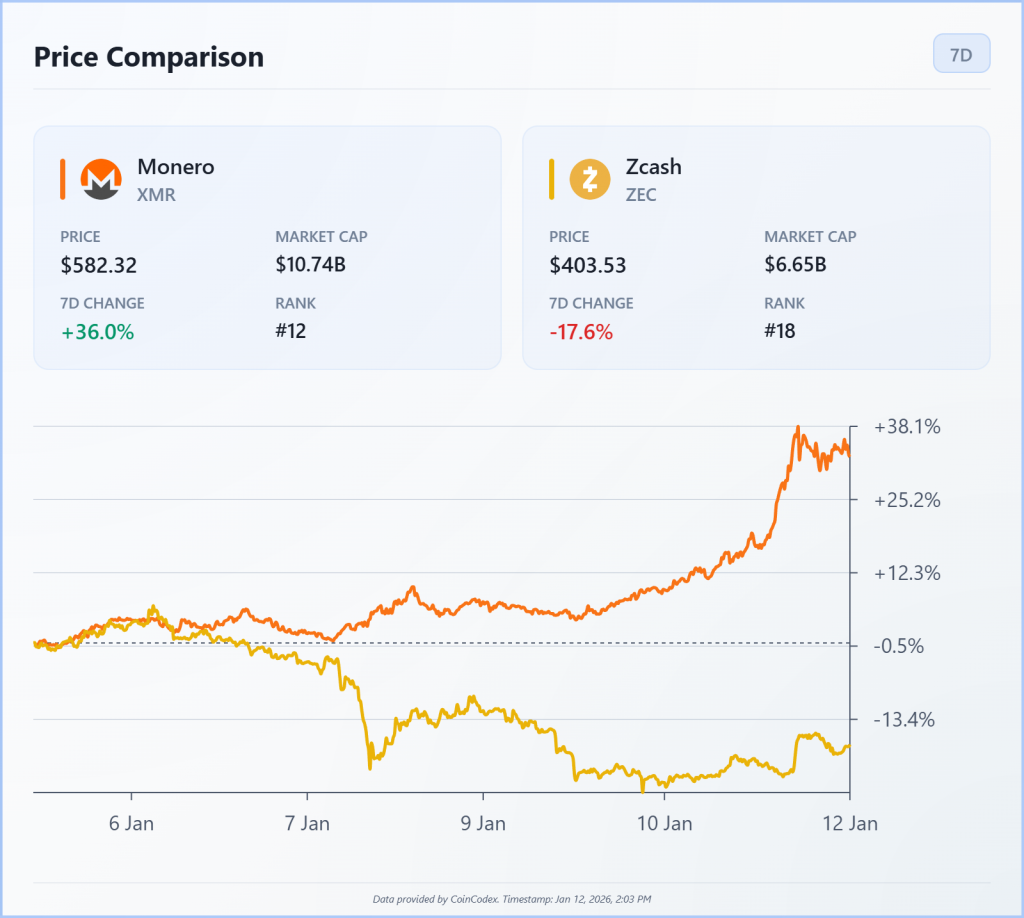
    Monero price comparison versus Zcash
    Monero price comparison versus Zcash. Source: CoinCodex

    From a technical perspective, XMR is now testing a historically critical zone. Previous attempts to break above the $500–$520 range have failed multiple times over the past decade, often followed by sharp corrections once momentum stalled. That history suggests near-term volatility remains likely unless Monero can decisively hold above former resistance. A confirmed breakout would invalidate the bearish fractal and open the door to higher targets around $750, based on long-term Fibonacci extensions. While pullbacks cannot be ruled out after such a steep rally, Monero’s reclaiming of its privacy crown and entry into price discovery place it among the more closely watched large-cap setups heading into 2026.

    XMR/USD chart highlighting prior failed breakouts and resistance zone
    XMR/USD chart highlighting prior failed breakouts and resistance zone. Source: TradingView

    9. Zcash

    ZCash (ZEC) is a privacy-focused cryptocurrency that was launched in 2016 by Zooko Wilcox-O’Hearn. It is a fork of Bitcoin, designed to enhance privacy and anonymity for its users. Unlike Bitcoin, where transaction details (such as sender, recipient, and amount) are publicly visible, ZCash allows users to choose between two types of transactions: transparent and shielded.

    Transparent transactions work similarly to Bitcoin, where all transaction details are recorded on the blockchain and visible to everyone. However, shielded transactions use a cryptographic technology called zk-SNARKs to allow fully private transactions. In shielded transactions, the details are encrypted, meaning that only the parties involved have access to the information, while the validity of the transaction is still verifiable by the network.

    ZCash is particularly valued by those who prioritize financial privacy and security, as it offers optional anonymity in a way that few other cryptocurrencies do.

    Why Zcash?

    Grayscale has taken steps to convert its long-standing Zcash Trust into a spot ETF by submitting an S-3 Zcash has extended its rally this week, trading near $521 and posting a 17% gain over the past seven days, as technical momentum and renewed interest in privacy-focused assets converge. Analysts point to a bullish ascending triangle formation on lower timeframes, a pattern that has been building for several weeks and typically precedes upside continuation. According to chart analysis shared by Ali Charts, a confirmed breakout above the former resistance zone could open the door to a 35% move, with measured targets clustering around the $650 level.

    Momentum indicators have supported the constructive setup. The MACD has remained positive for multiple weeks, while shorter-term moving averages continue to trend above longer-term averages, signaling sustained buyer control. Analysts note that price compression near resistance often reflects accumulation rather than distribution, particularly when supported by improving volume and broader sector strength. With ZEC already reclaiming key levels, traders are watching closely for follow-through confirmation.

    Beyond price action, onchain data highlights a deeper structural shift underway. According to recent metrics, Zcash’s shielded supply has stabilized at roughly 23% of total circulating ZEC, up sharply from around 8% at the start of 2025. Rather than fading as hype cooled, privacy usage has held firm, suggesting adoption is driven by practical demand instead of short-lived speculation. Large holders have also increased their ZEC balances during recent pullbacks, pointing to continued accumulation by long-term participants.

    Zcash’s shielded supply has stabilized near 23%, indicating sustained adoption of privacy-preserving transactions. Source: The Block

    The broader privacy narrative continues to gain relevance as crypto moves toward more real-world payment and settlement use cases. Public blockchains expose wallet balances and transaction histories by default, creating friction for everyday users and businesses. As stablecoins and onchain payments scale, privacy solutions like Zcash are increasingly viewed as necessary infrastructure rather than niche features. With improving technicals, steady onchain adoption, and a renewed focus on privacy across the sector, Zcash is emerging as one of the more notable large-cap performers heading into 2026.

    10. Uniswap

    Uniswap is a decentralized cryptocurrency exchange that pioneered and helped popularize the automated market maker (AMM) model. This innovative approach eliminates the need for traditional order books, enabling users to swap tokens directly on the blockchain in a streamlined, intermediary-free manner.

    The Uniswap protocol operates in a fully decentralized way, allowing anyone to create liquidity pools for any token. As a result, newly launched crypto assets are often traded on Uniswap before becoming available on centralized exchanges.

    Uniswap’s model has since been adopted by numerous decentralized exchanges across various blockchain networks. Despite this, Uniswap continues to lead the decentralized exchange space in terms of trading volume.

    Governance of Uniswap is handled by holders of the UNI token, who can propose and vote on protocol changes. UNI was initially distributed to past users of the protocol through an airdrop in 2020, and the token can now be bought and sold on many decentralized and centralized trading platforms.

    Why Uniswap?

    UNI has recently outperformed the broader market, rising 16.5% over the past seven days while many other leading crypto assets moved sideways. This rally appears to be fundamentally driven, as

    Uniswap founder Hayden Adams has advanced the long-anticipated UNIfication proposal to a final on-chain governance vote, a move that could significantly reshape how value accrues to UNI holders.

    The proposal seeks to enable protocol fees on Uniswap v2 and selected v3 pools on Ethereum, directing a portion of trading fees into an automated UNI burn mechanism. After years of delays due to regulatory uncertainty, proponents argue that the environment has changed, allowing the protocol to finally implement a fee structure that directly links token value to usage.

    A key component of the plan is a one-time burn of 100 million UNI from the treasury, intended to account for the value that might have accrued if protocol fees had been active since the beginning. Going forward, fees would be rolled out gradually to limit disruption for liquidity providers, with governance maintaining flexibility to adjust parameters as needed.

    The proposal also broadens value capture beyond Ethereum mainnet by funneling Unichain sequencer fees into the same burn process, tying UNI supply reduction to activity on Uniswap’s Layer 2 network, which already handles significant trading volume.

    Beyond token economics, UNIfication aims to unify governance, development, and operations under a single structure. Uniswap Labs would eliminate interface, wallet, and API fees, operate using governance-approved funding, and enter legally binding agreements to align its actions with the interests of UNI holders.

    If the proposal passes, UNI would evolve from a purely governance-focused token into one with direct, usage-based value accrual, bringing renewed attention to the asset as the vote progresses.

    11. BNB

    BNB (formerly Binance Coin) is a cryptocurrency created by the popular cryptocurrency exchange Binance. Binance is the largest cryptocurrency exchange in the world, allowing users to buy, sell, and trade a wide range of digital assets.

    BNB was initially one of the ERC-20 tokens on the Ethereum blockchain but has since migrated to its own blockchain, known as BNB Chain. BNB is used as a utility token within the Binance ecosystem and has a variety of use cases. For example, users can use BNB to pay for transaction fees on the Binance exchange, receive discounts on trading fees, participate in token sales on Binance Launchpad, and purchase goods and services from merchants that accept BNB as payment.

    One of the unique features of BNB is that it has a deflationary model. Binance uses a part of its profits each quarter to buy back and burn BNB tokens, reducing the total supply of the token over time. This mechanism is designed to create scarcity and increase the value of BNB over time, with the end goal of reducing the circulating supply of BNB from the initial 200 million to 100 million BNB.

    Why BNB?

    BNB reclaimed $900 this week after bouncing sharply from the $800–$820 demand zone, with multiple bullish technical structures now aligning behind a potential push back toward $1,000 in December. A double-bottom pattern on the 4H chart, combined with a clean breakout from a multi-week falling wedge, signals fading seller momentum and renewed appetite from dip-buyers. Liquidation heatmaps reveal over $112 million in short liquidations clustered near $1,020, suggesting a move toward that level could accelerate quickly if BNB breaks and holds above $900–$920.
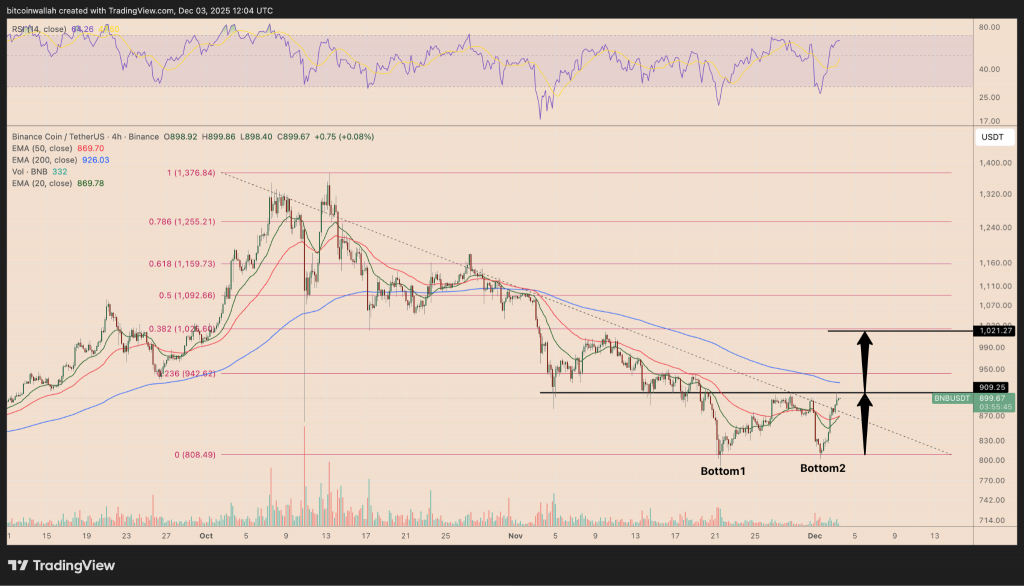
    BNB’s double-bottom and wedge breakout point toward a $1,000+ target
    BNB’s double-bottom and wedge breakout point toward a $1,000+ target. Source: Bitcoinwallah / TradingView

    However, BNB’s narrative this week also revolved around turbulence in the corporate treasury sector. CZ’s YZi Labs launched a formal attempt to overhaul the board of CEA Industries — the largest public BNB-holding company — accusing management of destroying shareholder value after the stock plunged 89% from its July peak. YZi aims to reverse recent bylaw changes, expand the board, and install its own nominees, arguing that CEA has failed to execute on its strategy of becoming the leading BNB treasury company. CEA responded by reaffirming its commitment to the BNB strategy while opening a dialogue with YZi to resolve concerns.
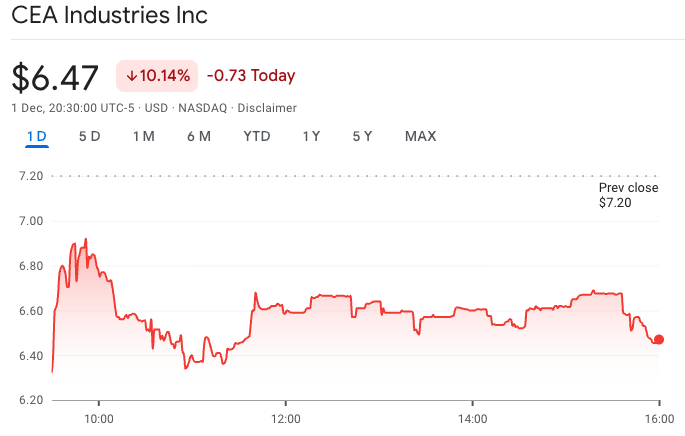
    CEA stock collapses as YZi Labs pushes for a board takeover
    CEA stock collapses as YZi Labs pushes for a board takeover. Source: Google Finance

    CEA stock collapses as YZi Labs pushes for a board takeover. Source: Google FinanceDespite governance drama and broader market pressure, BNB has held up better than many large-cap assets this quarter, outperforming even as it trades well below its mid-October all-time high of $1,367. CEA’s reported holdings of 515,054 BNB at an average entry of $851 place its treasury slightly underwater, yet BNB itself remains up 17.8% year-to-date, reinforcing its relative strength during the latest downturn. If bullish technicals continue to hold — and especially if liquidation clusters begin to trigger — analysts say BNB could feasibly revisit the $1,020–$1,115 range before year-end.

    12. Chainlink

    Chainlink is a decentralized oracle network designed to provide blockchains with secure, reliable data from external sources. It addresses the long-standing “oracle problem” by safely connecting on-chain systems with off-chain information, enabling many applications that wouldn’t be possible using blockchain data alone.

    Already the dominant oracle provider in decentralized finance (DeFi), Chainlink is also gaining traction in NFT projects and crypto gaming. For example, a DeFi protocol can pull price feeds from centralized exchanges through Chainlink to power its smart contracts, while NFT platforms often rely on Chainlink’s verifiable randomness to ensure fair minting processes and transparent distribution.

    Why Chainlink?

    Chainlink rallied 15% this week to $14.10, boosted by a major interoperability milestone: Solana and Coinbase’s Base have been connected using Chainlink’s Cross-Chain Interoperability Protocol (CCIP). The new bridge allows seamless asset transfers between Solana and the Base L2 ecosystem, giving developers the ability to integrate SPL tokens directly into Base applications. This marks one of the first production-ready bridges linking an EVM chain to Solana’s non-EVM architecture, reinforcing Chainlink’s role as the industry’s dominant cross-chain infrastructure provider. Despite the breakthrough, LINK traded slightly lower on the day, mirroring broader altcoin weakness.

    Chainlink also secured a significant step in institutional adoption as Grayscale’s spot LINK ETF debuted in the U.S., attracting $41 million in first-day inflows and posting “solid” trading volume, according to ETF analysts. While not a blockbuster launch like XRP’s, the ETF already manages $64 million in assets, showing that investor appetite is extending beyond Bitcoin and Ethereum into high-utility altcoins. Analysts noted the debut signals growing demand for regulated exposure to “long-tail assets,” especially those underpinning real-world tokenization infrastructure — a trend that plays directly into Chainlink’s strengths.

    Still, the LINK token remains down 73% from its all-time high, and the ETF launch alone has not reversed its long-term downtrend. But Chainlink’s strategic importance continues to grow: its oracle networks and CCIP are now core infrastructure for DeFi, tokenization protocols, and cross-chain applications across the industry. With Solana, Base, and multiple ETF providers integrating or backing the network, LINK’s recent strength suggests investors are beginning to reprice Chainlink as a foundational layer for the next phase of multi-chain development.

    Best cryptocurrencies to buy at a glance

     Native AssetLaunched InDescriptionMarket Cap*
    BitcoinBTC2009A P2P open-source digital currency$1.37 tln
    SolanaSOL2020Smart contracts platform with high speeds and low fees$45 bln
    EthereumETH2012The leading DeFi and smart contract platform$251 bln
    BittensorTAO2023Decentralized platform for machine intelligence$3.34 bln
    HyperliquidHYPE2024Decentralized perpetuals exchange with an efficient order book$9.2 bln
    XRPXRP2015The leading crypto remittance solution$80 bln
    ToncoinTON2021An efficient blockchain with Telegram messenger integrations$3.0 bln
    MoneroXMR2014A privacy-first cryptocurrency with fully obfuscated transactions$6.04 bln
    ZcashZEC2016Privacy-focused cryptocurrency$4.41 bln
    UniswapUNI2020A pioneering decentralized exchange protocol$1.93 bln
    BNBBNB2017The native coin of the Binance exchange$81 bln
    ChainlinkLINK2017The leading decentralized oracle protocol$6.3 bln

    Best crypto to buy for beginners

    If you are just starting out in crypto, it is advisable to stick to cryptocurrency projects that are less prone to volatility and are generally more established. While this approach does have a downside, as it becomes much more difficult to expect triple-digit or larger gains, the major upside is that you are not exposed to projects that have a chance of failing and, thus, losing your entire investment. 

    In order to identify projects that are stable and thus feature low volatility, you can start by following the parameters listed below:

    • The crypto asset has a market capitalization that places it into the cryptocurrency top 100 (roughly $500 million as of spring of 2026)
    • The crypto asset is available for trading on the best crypto exchange platforms and can be exchanged for fiat currencies
    • The crypto asset boasts healthy liquidity ($100M/day and more), which allows you to execute buy and sell orders quickly and without slippage 
    • The crypto asset is part of a reputable crypto project with clear goals, a realistic roadmap, and products and services that look to address real-world problems

    Some of the best cryptos to buy for beginners are those that follow the above criteria and have earned their standing in the crypto market due to robust security, popular products and services, and clear growth potential. Some beginner-friendly crypto investments are:

    • Bitcoin
    • Ethereum
    • Litecoin
    • Cardano
    • BNB

    It is worth noting that cryptocurrency investments are inherently risky, even if you stick to the biggest and most reputable projects. The reason for this is simple – the crypto sector is relatively new, and the landscape might look completely different in the future.

    Best crypto for long-term

    When deciding which cryptocurrency to buy for the long term, it’s important to consider projects that are well-established, have a strong community, are highly liquid, have a large market cap, and have a clear reason for existing (such as solving a real-life problem, introducing new functionality, etc.). Without these characteristics, a project might fail to survive in the long term, rendering it a bad long-term investment.

    It is worth noting that, typically, most long-term crypto investors are looking for projects that have the potential to generate decent returns but also provide a degree of investment stability. Roughly speaking, only the largest cryptocurrencies fit the bill, as others have a low market cap and liquidity that doesn’t bode well for a long-term commitment (unless you’re prepared to take on more risk).

    In addition to Bitcoin and Ethereum, there are a number of other cryptocurrencies that fit the criteria of being low-risk, long-term crypto investments.

    If you are planning to hold onto your digital assets for a longer period of time, it is best to take care of crypto custody yourself. Holding large amounts of crypto on an exchange can be risky, as we’ve seen over the years with the collapse of high-profile exchanges like Mt. Gox and FTX. Use one of the reputable crypto hardware wallets to store your crypto. Ledger hardware wallets, for instance, allow you to manage your crypto holdings easily and provide a much higher degree of security than crypto exchanges or even software crypto wallets.

    Best place to buy crypto

    One crucial aspect to consider when choosing which platform to use to buy crypto is the range of cryptocurrencies and trading pairs available. Since different exchanges support varying digital assets, it’s important to choose a platform that accommodates the specific cryptocurrencies you intend to trade.

    Additionally, assessing an exchange’s liquidity and trading volume is essential. Higher liquidity generally results in improved price stability and faster trade executions. Furthermore, it is prudent to examine the fees charged by the exchange, encompassing deposit, withdrawal, and trading fees. Comparing fee structures across different exchanges can help you identify the most cost-effective option that aligns with your trading style. With that said, here are some of the best exchanges on the market right now:

    • Binance – The best cryptocurrency exchange overall
    • KuCoin – The best exchange for altcoin trading
    • Kraken – A centralized exchange with the best security

    By diligently considering these factors, you can make an informed decision and select a cryptocurrency exchange that meets your requirements for security, variety, liquidity, and affordability.

    How we choose the best cryptocurrencies to buy

    At CoinCheckup, we provide real-time prices for over 22,000 cryptocurrencies, with the list growing by dozens each day. As you can imagine, making a selection of a dozen top cryptocurrencies to buy out of such an immense dataset can be difficult and will for sure lead to some projects that should be featured being omitted. To minimize the chance of that happening, we follow certain guidelines when trying to identify the best cryptocurrencies to invest in.

    Availability 

    One of the most important factors for any cryptocurrency investment is the crypto asset’s availability, meaning how easy it is to buy and sell it across various cryptocurrency exchanges. We tend to stay away from assets that are not available on major exchanges and require complex procedures to obtain.

    Market Capitalization

    Another important metric for identifying whether a crypto project is worth covering its market cap. A high market cap means that the project has reached a certain level of adoption from users, making it less risky to invest in.

    Growth Potential

    While this metric is mostly subjective, it is still an important metric on which we curate our selection. We won’t feature projects that we think are stagnating or have no real upside in the future.

    Purpose and Use Case

    We consider the purpose and use case of cryptocurrency, particularly in a real-world setting. Some cryptocurrencies focus on specific industries or applications, such as decentralized finance, gaming, or supply chain management.

    Team and Development

    The team and people involved in the project can tell you a lot about the potential of a particular cryptocurrency project. We examine the team’s experience, expertise, and track record and evaluate the development activity and updates to ensure the project is actively maintained and evolving.

    The bottom line: What crypto should you buy right now?

    The decision of which crypto to buy now is dependent on your own risk profile and investment goals. For some, investing in a crypto asset with a proven track record like Bitcoin is the only type of exposure to crypto they are willing to take on.

    Meanwhile, those with a higher risk tolerance might see Bitcoin as too stable, looking instead toward newer and smaller projects that carry a higher degree of upside. 

    If you are looking for more investment ideas, check out our crypto price predictions section.
  • 12 Best Crypto Exchanges 2026: Which Platforms Reign Supreme?

    12 Best Crypto Exchanges 2026: Which Platforms Reign Supreme?

    When venturing into the world of cryptocurrencies, selecting the right cryptocurrency exchange is crucial. With numerous platforms available, it’s essential to consider several different factors to ensure a smooth and secure trading experience. Arguably, the most important aspect to consider is the exchange’s reputation and credibility.

    Look for well-established exchanges with a proven track record of reliable service and robust security measures. Research user reviews and check if the exchange has experienced any major security breaches in the past to weed out unreliable and unsecured platforms.

    List of the 12 best crypto exchanges in 2026

    1. Binance – The best all-around exchange with high liquidity and plenty of additional features
    2. PrimeXBT – The best exchange for trading crypto futures and CFDs with high leverage
    3. KuCoin – An exchange that supports over 700 different coins, ideal for altcoin traders
    4. Kraken – A CEX known for its top-tier security, the best choice for safety-conscious traders
    5. OKX – A CEX with a wide array of features and products, the best alternative to Binance
    6. Bybit – The best exchange for trading crypto futures and crypto derivatives
    7. Coinbase – A USA-based user-friendly exchange with a strong security record
    8. Uniswap – The leading decentralized exchange for convenient token swaps
    9. Crypto.com – Versatile crypto trading platform with its own Visa card
    10. Hyperliquid – Highly efficient decentralized exchange with great UX
    11. MEXC – The best exchange for discovering and trading newly listed coins
    12. PancakeSwap – The leading DEX for the BNB Chain ecosystem and yield farming

    12 Best crypto exchanges: Unveiling the safest and most trusted crypto exchanges in 2026

    While the security of your funds should be your top priority, there are several other factors that make selecting your go-to cryptocurrency exchange a rather complex task. Another crucial consideration, for example, is the variety of cryptocurrencies and trading pairs offered by the exchange. Different exchanges support different digital assets, so ensure that the platform you choose supports the cryptocurrencies you intend to trade.

    Additionally, you should evaluate the exchange’s liquidity and trading volume. Higher liquidity usually translates to better price stability and faster execution of trades. Moreover, consider the fees charged by the exchange, including deposit, withdrawal, and trading fees. Compare the fee structures of different exchanges to find the most cost-effective option for your trading style.

    By carefully considering all these factors, you can make an informed decision and select a cryptocurrency exchange that aligns with your requirements for security, variety, liquidity, and affordability and allows you to pursue the best crypto investment opportunities around the clock.

    To further help you in your decision-making process, we present what we believe are the 12 best cryptocurrency exchanges for retail cryptocurrency traders in 2026:

    1.   Binance – The best cryptocurrency exchange overall

    Binance was launched by serial entrepreneur Changpeng Zhao (also known as CZ) in July 2017. In less than 6 months, CZ grew Binance into the largest digital asset exchange in the world by trading volume. Today, Binance is the largest cryptocurrency exchange worldwide, dominating the market in terms of both trading volume and user base.

    Why did we choose Binance?

    We have chosen Binance as the best cryptocurrency exchange overall due to its competitive fee structure, extensive selection of cryptocurrencies, and diverse range of trading products and features, catering to all types of cryptocurrency investors and traders. On Binance, users can engage in spot trading, margin trading, as well as futures and contracts trading of over 400 cryptocurrencies. 

    Binance supports fiat trading pairs and even offers a Binance Card, which allows you to easily spend your crypto for day-to-day expenses. The platform also offers additional features such as lending and staking, allowing users to earn a yield on their idle crypto assets.

    However, it’s important to note that Binance does not accept customers from the United States. US-based traders can resort to Binance.US, although this US-focused branch of Binance offers fewer features and lists a narrower range of cryptocurrencies. In addition, Binance does not have a clean sheet when it comes to the security of the funds, as the exchange’s wallets got hacked in 2019.

    Pros:

    • Unparalleled liquidity among all exchanges
    • Wide range of listed cryptocurrencies (400+)
    • Margin trading and crypto futures are available
    • One of the lowest fees in the industry (0.075% when paid with BNB)
    • Numerous staking and lending products offered
    • Crypto debit card with up to 2% cashback

    Cons:

    • Binance.US, which is available to United States residents, has much fewer features and lists fewer cryptocurrencies.
    • Experienced a hack in 2019, resulting in the theft of 7,000 BTC

    2. PrimeXBT – The best exchange for trading crypto futures and CFDs with high leverage

    Founded in 2018, PrimeXBT has become one of the leading platforms for trading cryptocurrency futures and contracts for differences (CFDs). It caters to both retail and professional traders who want access to a wide variety of asset classes under one roof — including crypto, commodities, forex, and stock indices — while maintaining a clean, user-friendly interface.

    Why did we choose PrimeXBT?

    PrimeXBT distinguishes itself with its focus on leveraged trading and advanced trading features. Traders can access leverage of up to 1000x on certain cryptocurrency products, significantly amplifying their market exposure. In addition to major crypto assets like BTC, ETH, and LTC, the platform supports trading on commodities (such as gold and oil), forex pairs (like EUR/USD and GBP/USD), and major stock indices including the S&P 500 and NASDAQ.

    The platform has competitive fees, with crypto futures trading fees starting at 0.01% for makers and 0.015% for takers, while CFD spreads start from 0.1%. PrimeXBT also integrates professional-grade charting tools, indicators, and technical analysis features, making it a suitable choice for experienced traders who rely on precision and flexibility.

    While it doesn’t offer spot trading and has a smaller selection of cryptocurrencies compared to large CEXs, PrimeXBT fills a valuable niche for users looking to trade with leverage across multiple asset classes.

    Pros:

    • Up to 1000x leverage for certain products
    • Competitive fee structure, with fees starting from 0.01%
    • Ability to trade a wide variety of assets beyond cryptocurrencies
    • Extensive range of trading tools and advanced order types

    Cons:

    • No spot markets
    • Relatively limited selection of supported cryptocurrencies

    3.   KuCoin – The best exchange for altcoin trading

    KuCoin is a prominent cryptocurrency exchange renowned for its extensive selection of cryptocurrencies, including low market cap coins that are often scarce on other major exchanges. This altcoin-focused exchange was established in 2017.

    Why did we choose KuCoin?

    With nearly 1,000 different cryptocurrencies available for trading, KuCoin reigns supreme among large centralized exchanges in terms of the availability of different digital assets. By offering margin trading, crypto futures trading, crypto lending, NFTs, and various other products, the platform also proves that it is not merely a simple exchange for low market cap altcoins. KuCoin also features “Beginner Zone,” a designated section for newcomers entering the crypto space, where they can learn about crypto and blockchain and earn crypto rewards along the way.

    KuCoin has gained recognition among the crypto community and is one of the largest cryptocurrency exchanges by trading volume, making it a reliable choice for users seeking a comprehensive crypto exchange experience. However, it should be noted that KuCoin is not licensed to operate in the United States.

    Pros:

    • An extensive list of supported cryptocurrencies (1,000+)
    • Offers spot trading, margin trading, and crypto futures
    • Competitive fee structure
    • Integrated NFT marketplace, launchpad, and beginner zone
    • Features several lending products

    Cons:

    • Not licensed to offer services to residents of the United States
    • Suffered a notable security breach in 2020

    4.  Kraken – The centralized exchange with the best security

    Kraken was founded in San Francisco, California, in 2011. Kraken was among the pioneers of the cryptocurrency exchange business and was one of the first Bitcoin exchanges to be listed on the Bloomberg Terminal.

    Why did we choose Kraken?

    We have selected Kraken as the best centralized exchange in terms of security because of its outstanding security track record. Over more than a decade of operation, the exchange has not reported a single compromise of its wallets. Besides being among the first exchanges to offer users security features such as 2-factor authentication, Kraken apparently also takes good care of users’ funds in the exchange’s cold and hot wallets. This solidifies Kraken’s position as one of the safest cryptocurrency exchanges.

    Although Kraken may not list as many cryptocurrencies as some competitors like Binance and KuCoin, it still offers a diverse selection, ensuring users can find the coins they desire, excluding those with very low market capitalization. The base trading fees are also a bit higher than with some other exchanges (makers pay 0.16% and takers pay 0.26%).

    Pros:

    • Unbeatable security track record
    • Excellent and prompt customer support
    • Lists several fiat-crypto trading pairs
    • The trading interface can be customized
    • Supports staking of several coins and tokens directly from the platform

    Cons:

    • Fewer listed cryptocurrencies compared to some competitors (around 200)
    • Trading fees are higher than those of some competitors

    5.   OKX – A versatile crypto exchange with a wide range of features

    Established in 2017 by Star Xu, OKX is not the oldest nor the youngest cryptocurrency exchange on our list. Nevertheless, since 2017 OKX has grown to become one of the prominent cryptocurrency trading platforms, consistently ranking among the top 5 exchanges in terms of trading volume.

    Why did we choose OKX?

    OKX impresses with its comprehensive range of features designed for both crypto investors and traders, offering an extensive selection of diverse cryptocurrencies. OKX’s trading platform manages to satisfy the needs of various crypto participants, including newcomers, Web3 enthusiasts, and traders seeking professional-grade trading capabilities.

    Users can engage in spot markets, margin trading, crypto futures, options, and other products, allowing for versatile trading with cryptocurrencies. Additionally, OKX provides staking and lending products for those interested in earning yield on their crypto holdings. OKX also has a designated dashboard that facilitates interaction with decentralized finance (DeFi) protocols across different blockchain networks.

    Pros:

    • OKX provides a full suite of features
    • Suitable for both beginners and professional users
    • Has low trading fees (Base fees are 0.14% for makers and 0.23% for takers)
    • Easy interaction with Web3 applications
    • Lists more than 300 cryptocurrencies 

    Cons:

    • Does not offer services to customers from the United States
    • It does not support fiat deposits (crypto can be bought using a credit card, though)
    • No fiat trading pairs

    6.   Bybit – The best exchange for trading crypto derivatives

    Established in 2018 as a cryptocurrency exchange specializing in derivatives products like futures, Bybit has evolved over the years to become a top-tier platform catering to diverse investors and traders.

    Why did we choose Bybit?

    Bybit is a derivatives-focused exchange renowned for its BTC/USD perpetual contracts, providing traders with leverage of up to 100x. The platform boasts live 24/7 multilingual customer support and offers exceptional order execution speeds, ten times faster than the industry average. Bybit stands out with its unique Bybit Launchpad, enabling users to participate in token sales from emerging crypto projects. The exchange also features copy trading functionality, which enables the automatic replication of trades made by high-performing traders.

    With a focus on comprehensive safety measures, financial industry-grade risk management, and an intuitive and customizable user interface, Bybit ensures a seamless trading experience for almost every kind of cryptocurrency trader.

    Pros:

    • Comprehensive futures and margin trading options with up to 100x leverage
    • Competitive fee structure (base fee is 0.1% for both takers and makers)
    • Copy trading mode and trading bot function
    • Offers opportunities for earning yield through lending products

    Cons:

    • Does not offer services to customers from the United States

    7.   Coinbase – The best exchange for beginner traders

    Coinbase was established in 2012 and has since then emerged as a prominent player in the cryptocurrency exchange market. In April 2021, Coinbase became a publicly traded company in the United States. As such it has to suffice much higher standards when it comes to transparency of its operations compared to privately held exchanges.

    Why did we choose Coinbase?

    Renowned for its user-friendly interface, Coinbase serves as a popular entry point for individuals looking to venture into the world of cryptocurrencies. The platform facilitates easy deposits through wire transfers and card payments, positioning it as an ideal platform for beginners. Coinbase also offers plenty of educational materials as well as a learning program, where users have the opportunity to earn cryptocurrencies by engaging with educational materials on different digital assets.

    Coinbase is headquartered in the United States and is therefore the exchange of choice for many U.S.-based traders. Additionally, Coinbase provides various fiat currency trading pairs, enabling direct digital asset trading against currencies such as USD and EUR. Last but not least, Coinbase boasts an exceptional security track record, with no reported instances of wallet breaches.

    Pros:

    • Publicly traded company in the U.S.
    • Exceptional security track record
    • Very easy to use and, therefore, perfect for onboarding beginners
    • Supports fiat deposits and withdrawals
    • Offers several crypto-fiat trading pairs
    • All trading pairs boast high liquidity

    Cons:

    • Higher fees than other CEXs (base taker fee is 0.6%)
    • Low leverage (only up to 3x) that is only available in Coinbase Pro

    8.   Uniswap – The leading decentralized exchange (DEX)

    Uniswap launched on the Ethereum mainnet in November 2018 and has been setting high standards for DEXs ever since. Today, Uniswap v3 is used by a large number of traders and repeatedly posts impressive trading volumes.

    Why did we choose Uniswap?

    We chose Uniswap to represent the decentralized exchanges due to its simplicity, transparency, and ability to facilitate token swaps directly on the blockchain through smart contracts. Utilizing Uniswap, users can perform trades directly from their own wallets without the need for intermediaries or completing KYC procedures. Uniswap naturally supports all ERC-20 tokens, but the emerging tokens usually have rather low liquidity. 

    Nevertheless, Uniswap has become a go-to platform for trading promising tokens before they are listed on centralized exchanges. While Uniswap offers high liquidity and potential for earning profits through liquidity provision, users should be cautious of potential scams (swapping valuable assets for fake tokens) and be aware of potential network congestion that leads to fee surges. Trading fees are 0.01%, 0.05%, 0.30%, 1% depending on the liquidity pool. In addition, the taker also has to cover the gas fees of the transaction.

    Pros:

    • Trading straight from your wallet without third-party involvement
    • The DEX with the highest liquidity
    • No registration or KYC procedures required
    • Allows liquidity providers to earn rewards

    Cons:

    • On average, fees are higher than on centralized exchanges
    • Fees skyrocket when the Ethereum network is congested
    • Scammers will try to sell you fake tokens

    9. Crypto.com – Versatile crypto trading platform with its own Visa card

    Crypto.com is a major crypto exchange that offers a full suite of services for cryptocurrency traders and investors. This includes spot trading, derivatives trading, staking, crypto swaps, a Visa card for spending cryptocurrency balances and much more. 

    Why did we choose Crypto.com?

    Crypto.com is a rock-solid choice for any cryptocurrency investor, as the exchange doesn’t have any major flaws and offers strong liquidity alongside a plethora of features. The exact features available to you will depend on where you live, as Crypto.com has a global presence and has to adhere to local regulations. 

    One of the highlights of Crypto.com is the exchange’s Visa card, which can be used to spend cryptocurrency balances in everyday purchases. The card’s base tier can be acquired for free, although it doesn’t offer any cashback. Higher tiers require users to lock up a certain amount of CRO tokens, but provide cashback rewards (paid in CRO). 

    If you’re someone who’s looking for a reputable exchange to buy and sell crypto and you value having access to more advanced features, Crypto.com is certainly worth considering. However, we should also mention that some of Crypto.com’s most attractive features require users to hold the CRO token, which could be a dealbreaker for some.

    Pros:

    • Large selection of listed cryptocurrencies
    • Reasonable fee structure
    • Users have access to the Crypto.com Visa card
    • Caters to both active traders and passive investors

    Cons:

    • Some of the exchange’s best features require users to hold CRO

    10. Hyperliquid – Highly efficient decentralized exchange with great UX

    Hyperliquid is a decentralized exchange built on top of a customized blockchain platform. Thanks to the blockchain’s focused design, Hyperliquid can handle a large number of orders (up to 100,000 per second) and provides low transaction costs combined with minimal slippage.

    Why did we choose Hyperliquid?

    Unlike most other decentralized exchanges, which are built using the AMM (automated market maker) model, Hyperliquid uses the more traditional orderbook model. This means that anyone who has experience with centralized exchanges is able to easily transition to Hyperliquid, as the user experience is quite similar to centralized exchanges.

    Currently, Hyperliquid can be used to trade over 100 different cryptocurrencies, and traders can access leverage of up to 50x. Like with centralized exchanges, traders on Hyperliquid can choose between market orders and limit orders. When it comes to the customization of limit orders, Hyperliquid supports GTC (good till cancel), IOC (immediate or cancel) and post-only orders. 

    On top of its basic trading functionality, Hyperliquid also provides copy trading. In addition, users can provide liquidity for Hyperliquid’s HLP vault (which handles market making and liquidations) to earn rewards. 

    If you’re interested in trading on a DEX but haven’t had much luck with the DEXes you’ve tried, Hyperliquid is certainly worth a try as it provides a very smooth user experience while listing a solid range of crypto assets and offering high leverage.

    Pros:

    • One of the most efficient and user friendly DEXes
    • Low fees and low slippage
    • Copy trading functionality
    • High leverage (up to 50x)

    Cons:

    • Operates on its own blockchain, which means users have to bridge funds
    • Number of available cryptocurrencies is much lower than on top CEXes and AMMs

    11. MEXC – The best exchange for discovering and trading newly listed coins

    MEXC is a rapidly growing cryptocurrency exchange that stands out for its massive selection of supported assets and its speed in listing new coins. With more than 2,670 cryptocurrencies and over 3,000 trading pairs, MEXC is often one of the first platforms to list trending tokens, including meme coins and other highly speculative assets. This makes it a go-to exchange for traders looking to gain early exposure to new market opportunities.

    Why did we choose MEXC?

    MEXC delivers a full suite of features that can rival many top-tier exchanges. Users can buy crypto with a credit card or bank transfer, trade in both spot and futures markets, and participate in savings programs to earn passive income. The exchange also hosts Launchpads and Kickstarter events that allow users to gain early access to promising projects.

    MEXC has its own native token, MX, which provides holders with reduced trading fees, access to exclusive rewards, and eligibility for Launchpad participation. On the trading side, the exchange charges 0% fees for spot trades and just 0.010% for futures takers, which is highly competitive.

    If your strategy revolves around catching new listings and exploring less established coins, MEXC is one of the best platforms available. However, if your focus is mainly on blue-chip cryptocurrencies like Bitcoin and Ethereum, larger exchanges with deeper liquidity might be a better fit.

    Pros:

    • Quickly lists new coins
    • Lists more than 2,650 different cryptocurrencies
    • Zero spot trading fees
    • Special benefits for MX token holders
    • Launchpad and Kickstarter platforms

    Cons:

    • Not as established as some other leading cryptocurrency exchanges
    • Liquidity can be poor for certain smaller coins

    12. PancakeSwap – The leading DEX for the BNB Chain ecosystem and yield farming

    PancakeSwap is a decentralized finance (DeFi) platform built on the BNB Chain, best known for its automated market maker (AMM). It’s the most popular and liquid decentralized exchange in the BNB Chain ecosystem, enabling users to trade tokens directly from their wallets without relying on a centralized intermediary.

    Why did we choose PancakeSwap?

    BNB Chain has become one of the most active blockchain networks, thanks to its low transaction fees and fast confirmation times, and PancakeSwap sits at the center of this ecosystem. Backed by strong support from Binance, it has grown into a top DeFi protocol with a total value locked (TVL) of over $1 billion, making it one of the largest AMMs in the industry.

    The platform is powered by the CAKE token, which plays multiple roles within the PancakeSwap ecosystem. Users can stake CAKE in Syrup Pools to earn rewards, provide liquidity to earn additional CAKE, and participate in governance by voting on proposals. Beyond BNB Chain, PancakeSwap has expanded to other networks such as Ethereum, Polygon zkEVM, Base, and Aptos, increasing its accessibility across the multi-chain DeFi landscape.

    While PancakeSwap has cemented its position on BNB Chain, adoption on other chains has been more modest. Still, its deep liquidity, broad feature set, and user-friendly design make it a clear leader for DeFi activity on BNB Chain.

    Pros:

    • The most liquid AMM on BNB Chain
    • Extensive product suite that goes beyond basic DEX functionality
    • Trading on BNB Chain is fast and relatively cheap

    Cons:

    • Hasn’t seen a lot of traction on other chains

    Our methodology for selecting the best crypto exchanges

    When assessing a cryptocurrency exchange, numerous factors demand consideration. Here are 7 aspects we focused on while selecting and ranking the top 12 cryptocurrency exchanges for 2025:

    • Security: When assessing cryptocurrency exchanges, security was the number one qualifying factor. We examined the security track record of each exchange and investigated the level of transparency regarding the reserve holdings of each exchange.
    • Longevity: We ranked exchanges that have been in business for an extended period of time higher on our list as compared to emerging platforms.
    • Trading fees: High fees can eat away a large portion of your profits, so we favored exchanges with lower fees. Trading fees as well as deposit and withdrawal fees, were taken into account.
    • Trading features: Exchanges that offer advanced features, such as leveraged trading through margin trading, futures, options, and other instruments, were given higher regard in our assessment.
    • Tailored user experience: We believe that a good cryptocurrency exchange should offer both a simple UI for beginners as well as advanced layouts, which give access to a broader range of customizable options for advanced users.
    • Additional products: Exchanges offering additional products like lending, staking, and NFT marketplace were given bonus points.
    • Availability: We evaluated only exchanges that are available in a large number of jurisdictions, leaving out niche country-specific platforms.

    How to select the crypto exchange that is best suited for you?

    You must be aware that because of every trader’s specific needs, the exchange that is the best for one trader might cause a lot of nuisance to another. This is why you should answer a few key questions yourself before continuing the search for the perfect exchange.

    • Are you an active trader, or do you perform just a few trades per month? If you assume you are going to perform a lot of trades, you should likely steer away from exchanges with high fees. If you only buy or sell crypto every once in a while, low trading fees should not be your top priority. Also, you can check our selection of the best cryptocurrencies to buy for the long term.
    • Which cryptocurrencies are you looking to trade? While most exchanges support most major cryptocurrencies, the support gets more and more limited the lower you move towards, the lower market capitalization coins. Therefore, make sure that the exchange supports your favorite cryptos (especially if you are into low market-cap altcoins).
    • Do you plan to keep the crypto on the exchange for longer periods? Although we strongly recommend moving your digital assets to a hardware wallet or other cold storage, active trading and waiting for a good investment opportunity can require having your funds on the exchange. If you plan to hold crypto in the exchange wallet for an extended period, make sure to prioritize the reliability and security track record of the exchange in your decision.
    • Will you trade using leverage or trade crypto contracts and derivatives? If you only want to trade on spot markets, the additional trading products are irrelevant to you.
    • How do you wish to deposit and withdraw your assets? Some cryptocurrency exchanges only offer crypto-to-crypto trading. Make sure your exchange supports crypto-fiat trading as well as fiat deposits if you want to fund your account using fiat currencies like USD and EUR. The same goes for withdrawals if you want to withdraw to your fiat bank account, for example.

    What is the difference between centralized and decentralized exchanges?

     Centralized exchanges (CEXs) and decentralized exchanges (DEXs) differ in their fundamental operating principles.

    • Centralized exchanges are entities that act as intermediaries between buyers and sellers and have custody over the users’ funds. The transactions and trades are verified by a centralized authority – the exchange itself. CEXs often have user-friendly interfaces, high liquidity, and support for various trading features. However, they require users to trust the exchange with the security and control of their funds.
    • Decentralized exchanges operate on a distributed network without a central authority controlling the trading process. DEXs leverage smart contracts to enable peer-to-peer trading directly between users. The biggest advantage is that users retain control over their funds and can perform trades directly from their wallets. DEXs also offer greater privacy, transparency, and resistance to censorship, as there is no single point of failure. However, DEXs often have lower liquidity and lack more complex trading products compared to their centralized counterparts. In addition, the user interference of DEXs is usually more clunky.

    The bottom line: These are the best crypto exchanges

    Regardless of your cryptocurrency trading habits and goals, it is very likely that the most suitable crypto exchange that will cater to all your requirements is among our selection. To sum up the large amounts of data provided in this article, we have compiled a selection of the top crypto exchanges along with their biggest advantages:

    BinanceKuCoinKraken
    Advantages– High liquidity
    – Low fees
    – Wide range of different products and features
    – Debit card with up to 2% cashback in BNB
    – Features more than 1,000 coins
    – Competitive fee structure
    – A variety of lending and other yield products
    – Exceptional customer support
    – Well-established reputation for maintaining high safety standards
    – Fiat currency pairs
    Best forBest exchange overallBest for altcoin tradingBest for security
    Trading feesUp to 0.1% for both makers and takers (0.075% when paid with BNB)Up to 0.1% for both makers and takers (0.080% when paid with KCS)up to 0.16% for makers, up to 0.26% for takers
    BonusesUp to $100Up to $500Bonuses not offered

    We sincerely hope that our article has assisted you in finding the optimal cryptocurrency exchange that aligns with your needs and preferences.If you want to move your crypto from an exchange account to cold storage, check our list of the best cryptocurrency hardware wallets. For an additional layer of security for your recovery phrase (used to recover crypto in case your hardware wallet is stolen or lost), you can protect it with purpose-made metal devices designed to protect recovery phrases from physical storage.

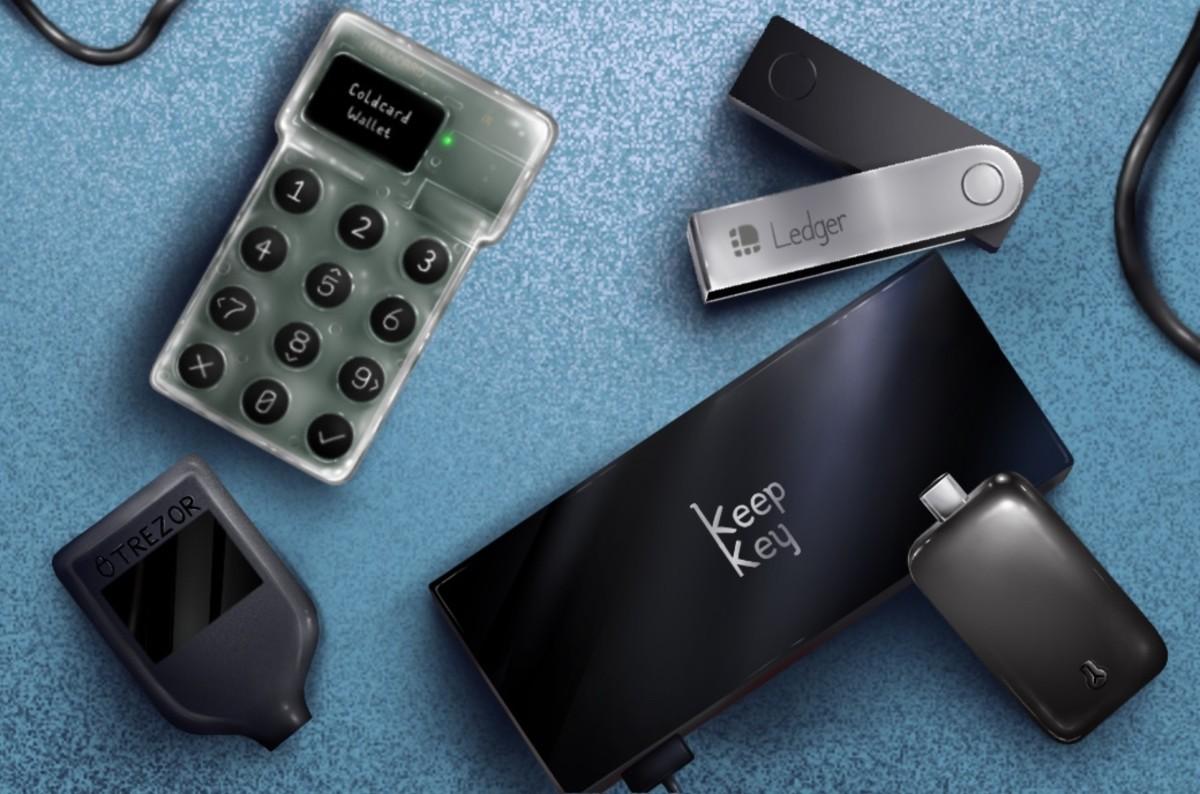
  • 15 Best Crypto Hardware Wallets: Top Crypto Storage Solutions for 2026

    15 Best Crypto Hardware Wallets: Top Crypto Storage Solutions for 2026

    10 Best Crypto Hardware Wallets: Top Crypto Storage Solutions for 2023

    While there are many ways to hold your cryptocurrency assets, not all types of wallets are equal in terms of safety. While leaving your coins on centralized exchanges is undoubtedly the most convenient way, it is also the least safe way to hold your precious digital assets. There are countless tragic stories of how investors lost sizeable crypto portfolios because they kept it on an exchange that went bust, the last infamous example being the collapse of FTX in November 2022.

    Compared to exchanges, even keeping your coins in web, mobile, or desktop wallets, where you are the owner of the private keys to your wallet, is a much safer option. Nevertheless, offline hardware wallets (also referred to as “cold storage”) are unequivocally the safest cryptocurrency storage method. Hardware crypto wallets are made of durable material and only connect with the network when you want to move the funds from or off them, which makes them extremely resilient to hacking attempts.

    List of the best crypto hardware wallets for 2026:

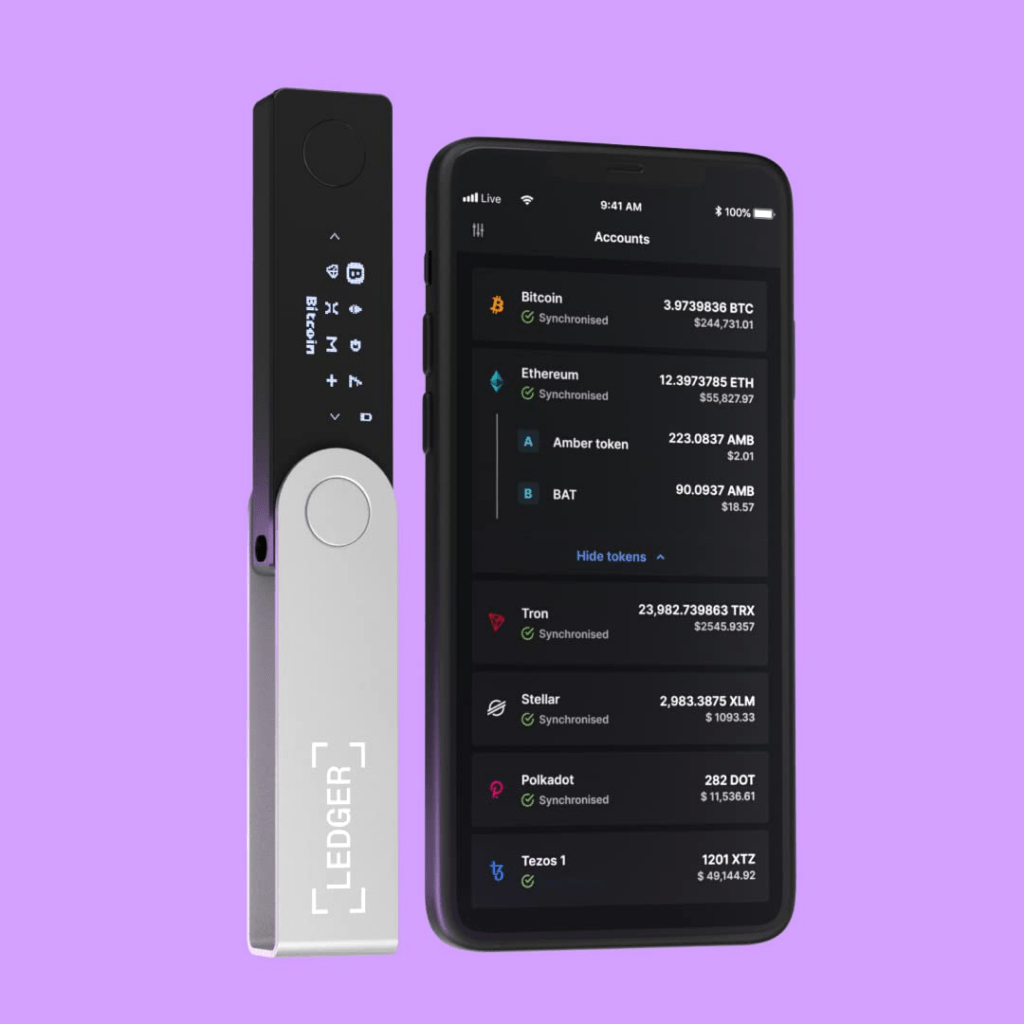
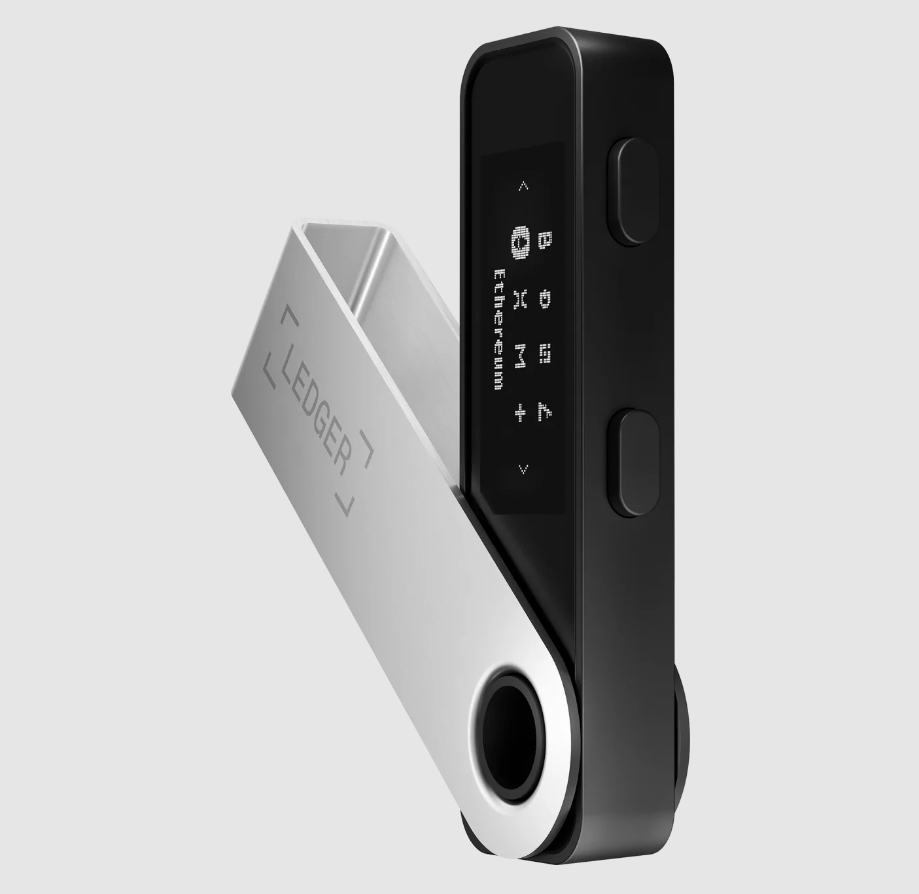
    1. Ledger Nano X – The best hardware wallet for most crypto holders
    2. Ledger Nano S Plus – A budget-friendly option from Ledger
    3. Trezor Safe 5 – Trezor’s flagship hardware wallet model
    4. Trezor Safe 7 – Next-generation Trezor wallet featuring enhanced security upgrades
    5. ShapeShift KeepKey – A cheap hardware wallet that does not compromise on security
    6. Trezor Safe 3 – A simple yet secure hardware wallet from Trezor
    7. Ledger Nano (5th Gen) – The newest Ledger model offering improved speed and performance
    8. NGRAVE ZERO – Powerful wallet with a myriad of security protocols
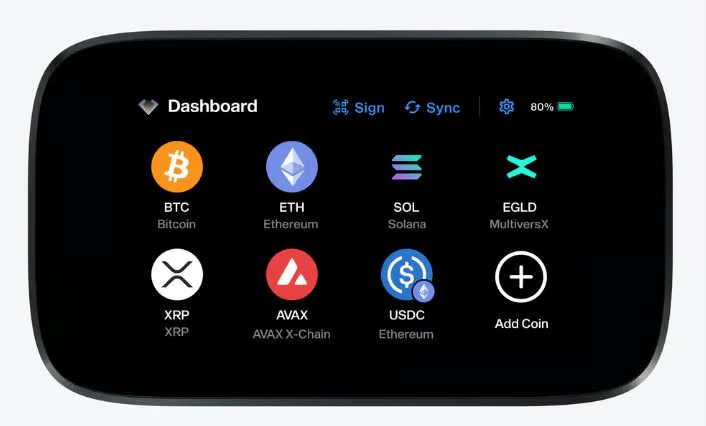
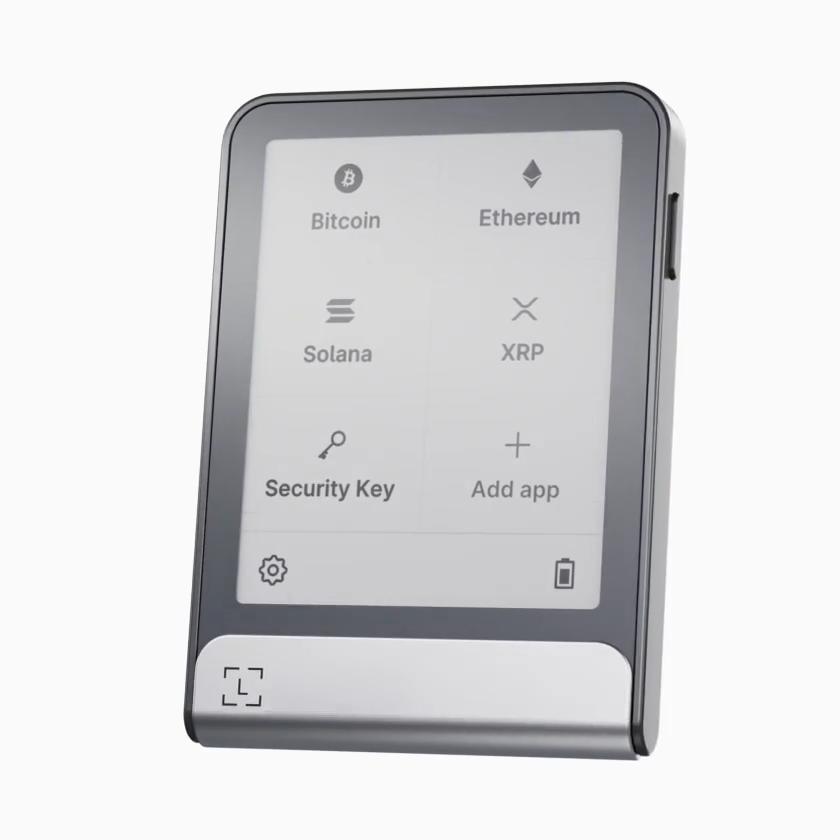
    9. Ledger Flex – A high-end option with an E Ink touchscreen display
    10. Cypherock X1 – A seedless hardware wallet with NFC-based multi-factor authentication
    11. Ledger Stax – A premium crypto wallet designed for advanced users
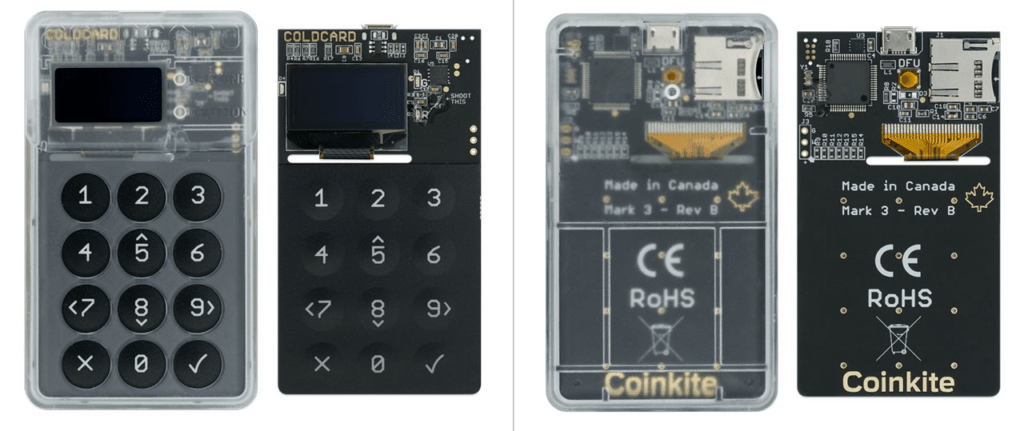
    12. Coinkite ColdCard Mk4 – A truly air-gapped crypto hardware wallet
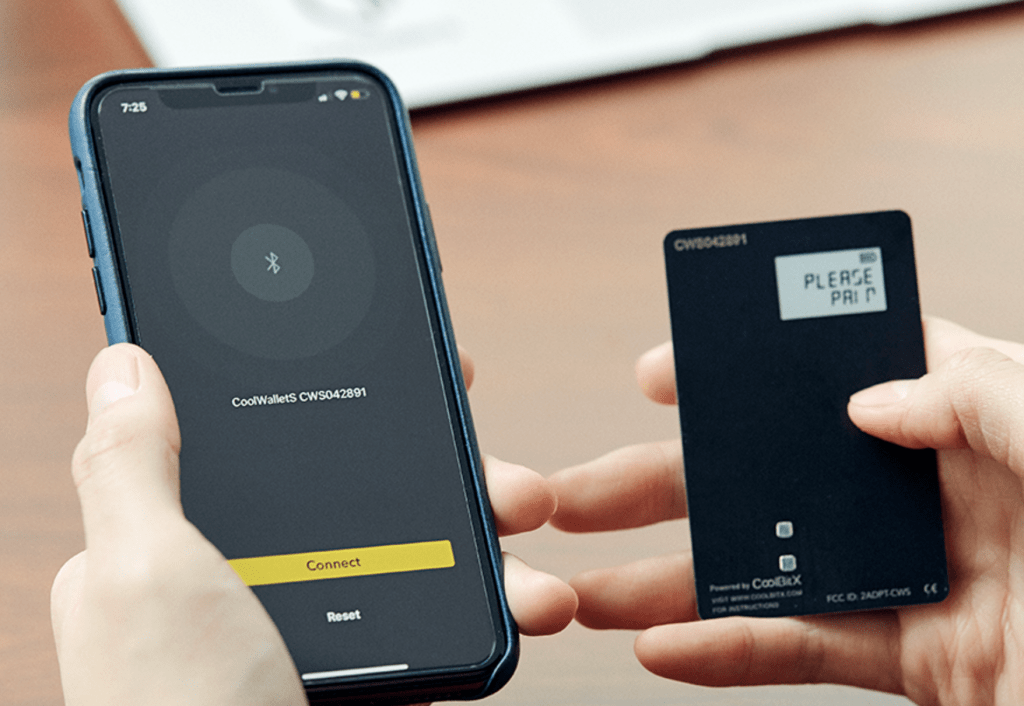
    13. CoolWallet S – A highly portable credit card-like crypto wallet
    14. SecuX V20 – A robust wallet with dual connectivity and a large responsive touchscreen
    15. Tangem – A simple and lightweight hardware wallet
    16. Keystone Pro – A secure hardware wallet powered by AAA batteries
    17. Shift Crypto BitBox02 – A crypto wallet capable of connecting to full Bitcoin nodes

    The 17 best crypto hardware wallets in 2026: A detailed overview

    Over the years, many different types and brands of hardware crypto wallets appeared on the market, which makes deciding on which one to buy increasingly difficult. Hardware wallets differ greatly in backup features, the number of supported blockchains, materials used, and also price. To make the decision at least a bit easier we have prepared an overview of the best crypto hardware wallets on the market today.

    1. Ledger Nano X – The best hardware wallet for most crypto holders

    Ledger Nano X is the flagship product of French company Ledger and is often considered to be one of the best and most versatile cryptocurrency hardware wallets on the market. This hardware wallet boasts a CC EAL5+ certified secure element chip and supports over 5000 cryptocurrencies and is therefore a suitable storage option for almost any cryptocurrency user. In addition, Ledger Nano X is compatible with almost all popular operating systems, including Android, iOS, MacOS, Windows, and Linux. The hardware wallet can be connected either via USB or Bluetooth, one of the biggest differences that sets it apart from the Nano S.

    The wallet uses Ledger’s proprietary Ledger Live software, which simplifies cryptocurrency management and seed phrase generation and restoration. A small display on the hardware wallet provides the user with immediate visual feedback, making processes more intuitive. In addition, the Nano X does not only support a huge number of cryptos but can also connect with a whooping 100 applications. Integration with hot wallets like Metamask and other Web3 wallets is another advantage of the Ledger Nano X, allowing users to access DeFi platforms and blockchain dApps.

    Last but not least, Ledger’s hardware wallets have not been exploited or found to have vulnerabilities, which provides a good illustration of the company’s commitment to top-tier security standards. Although the market price of $149 sets Ledger Nano X among the more expensive crypto hardware wallets, the Nano X’s superior security and dApp integrations make it the best hardware wallet available in 2025 

    Pros of Ledger Nano X:

    • Full self-custody and control over private keys
    • Open source code for transparency
    • Very intuitive, attractive user interface
    • Built-in exchange for top rates on coin swaps
    • Based in privacy-protecting Switzerland
    • Helpful developers provide direct support
    • Fully free with no transaction fees (of course, except for blockchain miner fees)

    Cons of Ledger Nano X:

    • Currently only adaptive web interface
    • Limited language support at launch
    • New project with a short track record so far
    • Open source design means independent auditing is needed

    2. Ledger Nano S Plus – A budget-friendly option from Ledger

    Ledger Nano S Plus is a highly secure hardware crypto wallet that offers many of the features of the more expensive Nano X but at a lower price point. Ledger Nano S Plus also supports over 5,500 cryptocurrencies and allows you to install up to 100 applications. It featured the same advanced security systems as its more expensive option, including a CC EAL5+ certified security element. This hardware wallet utilizes Ledger Live software that streamlines the process of creating a new wallet or transferring your old wallet to a new platform.

    On the other hand, the Ledger Nano S Plus has a storage capacity of 1.5 MB, which is slightly less than the Ledger Nano X, which has 2 MB. While most ordinary hardware wallet users should find 1.5 MB of storage more than enough, some might miss the Bluetooth support, which Ledger Nano S Plus also lacks. However, the USB-only connectivity of the Nano S Plus eliminates the need for a battery, which makes the Ledger Nano S Plus extra light (it weighs only 21 grams). The wallet comes in five different colors, including Matte Black, Mystic White, BTC Orange, Deepsea Blue, and Ice.

    The Ledger Nano S Plus is packed with features and is available at almost half of the price of the Nano X. This makes Ledger Nano S Plus one of the most popular hardware crypto wallets. In fact, the Nano S Plus seems to continue the legacy of its predecessor, the Nano S, which was a bestseller among hardware wallets, when it launched back in 2016.

    Pros of Ledger Nano S Plus:

    • Supports more than 5,500 cryptocurrencies
    • Top-tier security (CC EAL5+ certified chip)
    • Affordable (priced at $79)
    • Among best-selling hardware wallets

    Cons of Ledger Nano S Plus:

    • No Bluetooth connectivity
    • The device’s user interface and navigation can be complicated for novice users

    3. Trezor Safe 5 – Trezor’s flagship hardware wallet

    Trezor Safe 5 is an advanced next-generation hardware wallet designed to provide top-tier security while keeping usability at the forefront. It supports over 9,000 cryptocurrencies, including Bitcoin, Ethereum, and ERC-20 tokens, and allows users to send, receive, and stake assets directly through the Trezor Suite desktop app or compatible third-party wallets such as MetaMask.

    This model introduces the new 1.54-inch Trezor Touch color touchscreen with haptic feedback, offering a more intuitive and tactile user experience compared to previous versions. Built with open-source transparency, it features an EAL 6+ Secure Element for enhanced offline and online protection. The Trezor Safe 5 also includes a microSD card slot for additional security options, and its Gorilla Glass 3 screen paired with an anodized aluminum backplate makes it both durable and premium in feel.

    For backup, users can rely on a new 20-word recovery seed with optional Multi-share Backup support, making it safer to restore wallets in case of loss or damage. The device remains PIN- and passphrase-protected, ensuring that only authorized users can access stored funds. Connectivity is handled via USB-C, and while it supports Windows, macOS, Linux, and Android, there’s still no native iOS app.

    Priced at $169, the Trezor Safe 5 stands out as a secure and refined hardware wallet choice for those who prioritize both strong encryption and modern design.

    Pros of Trezor Safe 5:

    • Vivid color touchscreen with haptic feedback
    • Durable Gorilla Glass screen and aluminum backplate
    • Supports Multi-share Backup and microSD protection

    Cons of Trezor Safe 3:

    • No native iOS support
    • Pricier than entry-level wallets

    4. Trezor Safe 7 – Next-generation Trezor wallet featuring enhanced security upgrades

    Trezor Safe 7 is the newest flagship hardware wallet from Trezor, built with a strong focus on long-term, open-source security. Priced at $249, it is the company’s most advanced model to date and the first hardware wallet marketed as quantum-ready. The device uses a dual-chip architecture that pairs the open-source Tropic Zero One (TROPIC01) chip with an NDA-free EAL6+ secure element, allowing independent security audits without relying on closed components.

    This transparent hardware design sets the Safe 7 apart from most competing wallets. By removing NDAs at the chip level, Trezor enables full third-party inspection while maintaining a high security standard. The approach reinforces Trezor’s self-custody philosophy, giving users direct control over their private keys without sacrificing verifiability or protection.

    On the hardware side, the Safe 7 features a 2.5-inch edge-to-edge color touchscreen that is noticeably larger than previous Trezor models. The wallet is housed in a single-piece aluminum body with a Gorilla Glass 3 backplate and carries an IP54 rating for basic dust and splash resistance. Bluetooth Low Energy support and Qi2-compatible magnetic wireless charging add everyday convenience, while the built-in LiFePO₄ battery is designed to last significantly longer than standard lithium batteries.

    Using the Trezor Suite interface, users can manage over 9,000 cryptocurrencies, store NFTs, and access trading, staking, and third-party DeFi services from one dashboard. All wireless communication is encrypted and authenticated through the open-source Trezor Host Protocol (THP). The Safe 7 is available in multiple color options, with a Bitcoin-only edition for users who prefer a simplified setup.

    Pros:

    • Quantum-ready security architecture with a fully auditable dual-chip design
    • Open-source components without NDAs, enabling full third-party verification
    • Large touchscreen with durable aluminum and Gorilla Glass construction
    • Bluetooth connectivity and Qi2 magnetic wireless charging support

    Cons:

    • Premium price point compared to entry-level hardware wallets
    • Larger and heavier than older Trezor models due to the expanded display

    5. ShapeShift KeepKey – A cheap hardware wallet that does not compromise on security

    ShapeShift KeepKey is a sturdy hardware wallet that is among the cheapest hardware wallets on the market today. Although KeepKey devices sell for just $49 these wallets do not compromise on security. This ShapeShift product utilizes AES hardware encryption and 2-factor authentication, which puts its security on par with the wallets listed above. KeepKey can also deploy firmware updates without being connected to the internet. However, when you do need to connect the device to a computer and the internet, you should not have any problems as KeepKey supports most systems, including PC operating systems such as MacOS, Windows and Linux, and Android mobile operating systems. Through a large OLED display that occupies the entire front surface of the device, the user is constantly informed about what is going on with his wallet and transactions.

    Nevertheless, every bargain comes with some trade-offs. In the case of ShapeShift’s KeepKey, the biggest disadvantage is the fairly limited support of different cryptocurrencies. You will be able to store Bitcoin, Bitcoin Cash, Bitcoin Gold, Litecoin, Ethereum (together with Ethereum-based tokens), Dogecoin, Dash, and nothing else. The wallet is also unable to integrate with Web3 wallets or DeFi applications. This means that even less advanced users with a diversified crypto portfolio might quickly find that the cheap KeepKey falls short of meeting all their needs. If you are, however, just looking for secure and cheap cold storage of the above-mentioned coins, KeepKey is definitely the hardware wallet to consider.

    Pros of ShapeShift KeepKey:

    • One of the cheapest hardware wallets on the market ($49)
    • Large OLED screen
    • Allows password entry and QR code viewing
    • Open-source and simple-to-use software

    Cons of ShapeShift KeepKey:

    • Very narrow list of supported cryptocurrencies
    • No support for Web3 wallet or dApp integration
    • No multi-signature support

    6. Trezor Safe 3 – A simple yet secure hardware wallet from Trezor

    Trezor Safe 3 is a dependable and affordable hardware wallet built for users who want solid protection without paying premium prices. Maintaining Trezor’s open-source transparency, it introduces a Secure Element chip (EAL 6+) to protect private keys, even in the event of physical compromise. It supports more than 9,000 cryptocurrencies and integrates seamlessly with the Trezor Suite desktop app for managing, sending, receiving, and staking crypto assets.

    Priced at $79, the Trezor Safe 3 offers great value for users who prefer simplicity and robust functionality. The 0.96″ OLED display allows easy transaction verification directly on the device, while PIN and passphrase protection reinforce security. Though it lacks microSD and touchscreen support, it remains one of the most trusted midrange wallets on the market, compatible with Windows, macOS, Linux, and Android. It also supports Tor integration and coin control for those who prioritize privacy.

    Pros of  Trezor Safe 3:

    • Secure Element chip with advanced protection
    • Trezor Suite integration for staking and privacy tools
    • Lightweight, intuitive, and affordable

    Cons of Trezor Safe 3:

    • No touchscreen or haptic feedback
    • No native iOS app
    • Lacks microSD card support

    7. Ledger Nano (5th Gen) – The newest Ledger model offering improved speed and performance

    The Ledger Nano 5th Gen is the newest model in Ledger’s Nano series, positioned between entry-level wallets and the brand’s premium devices. Priced at $179, it delivers much of the functionality found in the Ledger Flex and Ledger Stax while remaining more affordable. It also reflects Ledger’s shift in terminology, with the company now referring to its devices as “signers” to highlight their role in securely authorizing transactions rather than storing assets.

    This model is the first Nano device to feature a 2.76-inch E Ink touchscreen, replacing physical buttons with a more modern interface. Security is handled by Ledger’s CC EAL6+ certified Secure Element, which isolates private keys from the rest of the system. Bluetooth and NFC support enable wireless use across supported devices, while the lightweight plastic body keeps the wallet portable, even if it lacks the premium feel of Ledger’s higher-end models.

    The Nano 5th Gen ships with a Ledger Recovery Key, allowing users to create a PIN-protected NFC backup of their recovery phrase. This offers a more durable alternative to paper backups and improves recovery options if the primary seed phrase is lost. Inside the box, users also get a USB-C cable and recovery sheets, with asset management handled through Ledger Wallet, where users can manage thousands of cryptocurrencies, stake supported assets, and connect to Web3 applications.

    Customization is another focus, with multiple color options and support for custom lock screen images. The E Ink display contributes to strong battery efficiency and provides easy access to device settings, security controls, and advanced features such as passphrase protection and PIN shuffling. Overall, the Nano 5th Gen is designed for users who want modern interaction and strong security without stepping up to Ledger’s most expensive devices.

    Pros:

    • First Nano model to feature a full E Ink touchscreen
    • NFC-enabled recovery backup with the Ledger Recovery Key
    • Strong key isolation using a CC EAL6+ certified Secure Element
    • Wireless functionality through Bluetooth and NFC

    Cons:

    • Plastic casing does not feel as premium as Ledger Flex or Stax
    • Priced higher than previous Nano models like the Nano X
    • Touchscreen interface may not suit users who prefer physical buttons

    8. NGRAVE ZERO – Industry-leading security with EAL7 certification

    If ultimate security is your priority, the NGRAVE ZERO sets a new standard, even for highly secure wallets like Ledger and Trezor. Operating entirely offline, it uses QR code communication, eliminating the risks associated with USB, Bluetooth, or any wireless connectivity. This ensures your private keys remain completely isolated from online threats. This level of security makes it one of the best air-gapped wallets

    The wallet boasts an EAL7 certification, the highest security standard in both the blockchain and financial industries. One of its standout features is its self-destruction capability—if the device is tampered with, it automatically wipes all private keys, leaving no trace for potential attackers. This kind of proactive security is unmatched.

    The full-color touchscreen is not just visually appealing but also highly functional, making navigation and transaction verification straightforward. Another innovative feature is its light sensor technology, which securely generates private keys directly on the device, avoiding pre-set recovery phrases. For added security, the wallet pairs seamlessly with the GRAPHENE metal plate backup, offering a recovery solution as durable as the wallet itself.

    However, the NGRAVE ZERO’s exceptional security and advanced features come at a price. At just over $400, it is one of the most expensive wallets available, which may deter budget-conscious users.

    Pros:

    • Air-gapped design with QR code communication for ultimate offline security
    • EAL7 certification—highest security standard in the industry
    • Self-destruction feature wipes private keys if tampered with
    • Light sensor technology for secure, on-device private key generation
    • Full-color touchscreen simplifies navigation and transaction verification
    • Durable GRAPHENE metal plate for robust backup and recovery

    Cons:

    • High price point of over $400
    • Lack of wireless or USB connectivity might be inconvenient for some users
    • Larger size compared to slim, portable wallets

    9. Ledger Flex – A high-end option with an E Ink touchscreen display

    The Ledger Flex is Ledger’s latest mid-to-premium hardware wallet, built to balance strong security with a more comfortable user experience. It features a 2.84-inch E Ink touchscreen that makes reviewing and confirming transactions easier than on Ledger’s Nano models. The wallet supports both USB-C and Bluetooth connectivity, allowing it to work seamlessly with desktop computers, laptops, and mobile devices.

    In terms of security, the Flex uses Ledger’s EAL6+ CC-certified Secure Element, which isolates private keys from the rest of the system. Users can install up to 100 crypto applications on the device and access more than 5,500 supported assets through third-party integrations. Asset management, staking, and dApp access are handled through Ledger Wallet, giving users a single interface for everyday use.

    At $249, the Ledger Flex sits at the higher end of the hardware wallet market. This pricing makes more sense for users who transact regularly or value the larger display and customization features, such as personalized lock screens with images or NFTs. For basic cold storage or infrequent use, the cost may be harder to justify compared to simpler Ledger models.

    For users willing to spend more, Ledger’s Stax offers an even larger display and additional premium touches at a significantly higher price. The Flex positions itself as a middle ground, offering many premium features without reaching flagship-level pricing, making it a practical choice for active crypto users who want both security and usability.

    Pros:

    • Large 2.84-inch E Ink touchscreen for easy transaction review
    • EAL6+ CC-certified Secure Element for strong key protection
    • Works across desktop, laptop, and mobile devices
    • Supports both USB-C and Bluetooth connectivity

    Cons:

    • Bigger and heavier than Ledger’s entry-level wallets
    • High price compared to most hardware wallets on the market

    10. Cypherock X1 – A seedless hardware wallet

    The Cypherock X1 is a revolutionary hardware wallet that removes the need for a traditional seed phrase, solving one of the biggest vulnerabilities in crypto security. Instead of relying on a single recovery phrase, it uses Shamir’s Secret Sharing to split private keys across four encrypted NFC cards, ensuring that no single card holds the complete key. To access your funds, you’ll need at least two of these cards, making it significantly more resilient against theft, loss, or hacks.

    Unlike many other hardware wallets, Cypherock X1 operates completely offline, connecting only via USB-C to sign transactions securely. It supports over 9,000 cryptocurrencies and integrates with MetaMask, allowing seamless DeFi and NFT transactions without compromising security.

    Pros:

    • No seed phrase required – Eliminates a single point of failure
    • Multi-factor authentication – Requires at least two NFC cards for access
    • Wide asset support – Compatible with over 9,000 cryptocurrencies
    • Offline security – No Bluetooth or internet connectivity, reducing attack risks
    • Works with MetaMask – Seamless integration for DeFi users

    Cons:

    • Requires managing multiple NFC cards – Losing too many can result in fund loss
    • No Bluetooth connectivity – Some users may prefer wireless transaction signing

    11. Ledger Stax – A premium crypto wallet designed for advanced users

    Ledger Stax is the most premium hardware wallet in Ledger’s lineup, built with a strong focus on design and usability. Created in collaboration with Tony Fadell, the designer behind the iPod, the device stands out with its curved E Ink touchscreen and high-end materials. Demand has been strong since launch, with early production batches selling out shortly after becoming available.

    The Stax features a large E Ink display that makes reviewing transactions far more comfortable than on Ledger’s Nano models. It supports Bluetooth, USB-C, and wireless charging, and includes customization options such as a personalized lock screen that can display images or NFTs. Compared to the Ledger Nano X, the difference is most noticeable in screen size and presentation, as the Nano X uses a much smaller display and does not support home screen customization.

    Security remains a core focus, with the Ledger Stax using a secure element chip certified under CC EAL5+ and EMVCo standards. Private keys are kept isolated from the rest of the system, and the device relies on a standard recovery seed for wallet restoration in case of loss or damage. From a software perspective, it offers the same core functionality as other Ledger wallets, including asset management, staking, and Web3 access through Ledger Wallet.

    At $399, the Ledger Stax is difficult to justify purely on features. While the design, display, and charging options are clear upgrades, the underlying software experience is largely the same as on the Nano X or even the more affordable Nano S Plus. The Stax is best suited for users who value premium design and a large screen, rather than those looking for the best value-for-money hardware wallet.

    Pros:

    • High-end design with premium materials
    • Large curved E Ink touchscreen display
    • Supports thousands of cryptocurrencies and NFTs
    • USB-C, Bluetooth, and wireless charging support
    • Can hold up to 100 applications at once
    • Secure element chip certified to CC EAL5+ standards

    Cons:

    • Significantly more expensive than most hardware wallets
    • Interface may feel unfamiliar at first
    • E Ink display refresh rate is slower than traditional screens

    12. Coinkite ColdCard Mk4 – A truly air-gapped crypto hardware wallet

    ColdCard Mk4 is a maximum-security hardware cryptocurrency wallet produced by the Canadian crypto hardware manufacturer Coinkite. It is one of the rare hardware wallets that can be used without ever being connected to a computer, as everything from wallet creation with seed generation to transaction signing can be done without connection thanks to the natively implemented PSBT (BIP174). Nevertheless, the ability to connect to a computer exists thanks to the USB-C connector at the bottom edge of the device. ColdCard Mk4 includes two secure elements, supplied by two different manufacturers, which additionally minimizes unknown vulnerability risks. The PIN is also entered through a full-size numeric keypad, which is a bit old-school but practical and a bulletproof input method.

    ColdCard Mk4 only supports Bitcoin, but the security and utilities of this Bitcoin cold storage are unrivaled. The device features expanded multi-sig capabilities allowing it to handle big and complex Bitcoin transactions. In Coinkite’s official store, this device has a price tag of $148.

    Pros of Coinkite ColdCard Mk4:

    • Full-sized physical numeric keypad
    • Bright OLED display
    • Two independent security elements
    • A truly air-gapped hardware wallet
    • MicroSD card support for backup and data storage

    Cons of Coinkite ColdCard Mk4:

    • A Bitcoin-only hardware wallet

    13. CoolWallet S – Highly portable credit card-like crypto wallet

    CoolWallet S is a portable and durable crypto hardware wallet that stands out from its competition mainly due to its design. It comes in the form of a credit card-sized device, that has a thickness of only 0.8 mm and weighs only 6 grams. In addition, this “crypto card” is also waterproof and tamper-resistant. The wallet features a small built-in screen and a button, which is used to confirm transactions. According to the manufacturer, the device should last up to 3 months with a single battery charge.

    The wallet connects via an encrypted Bluetooth connection to most mobile devices. On top of the advanced encryption standard AES256 that secures the wireless connection, the device utilizes both biometric and physical 2FA checks to ensure your assets’ safety and has an embedded EAL5+ certified secure element. Nevertheless, the device is easy to interact with and allows a new cold wallet to be created in under 5 minutes due to the simplicity and intuitiveness of the user interface. Furthermore, the wallet features a built-in cryptocurrency swap system. You will have to spend $99 to buy one sleek CoolWallet S but the company offers a small discount if you buy two devices. If you convince a friend to buy it, too, you will have to part with only $89 per device (or $178 for both hardware wallets).

    Pros of CoolWallet S:

    • Highly portable due to its unique credit card-like design
    • Easy-to-use interface
    • Encrypted Bluetooth connection
    • Long-lasting battery (up to 3 months)

    Cons of CoolWallet S:

    • Limited cryptocurrency support

    14. SecuX V20 – A robust wallet with dual connectivity and a large responsive touchscreen

    SecuX V20 is a robust and stylish cryptocurrency hardware wallet with many useful features and a premium feel. The V20 supports over 1000 cryptocurrencies, including Bitcoin, Tether, Litecoin, Ethereum, and Stellar, and has a responsive color 2.8″ touchscreen to ensure smooth interaction. The wallet, which supports multiple operating systems, can connect either via an encrypted Bluetooth connection or a wired USB connection. When you want to establish a connection between your hardware wallet and another device via Bluetooth or USB, the connection needs to be approved on the online interface called SecuXcess, which can be found within SecuXTech.

    SecuX V20 allows for the private keys to be created and stored offline but can also integrate with third-party wallets or apps if needed. Private keys and PIN codes are stored on an EAL 5+ certified secure chip. When turning on the SecuX V20 for the first time, the user is prompted to set a 4-digit PIN code, which is later used to interact with the wallet and confirm a transaction. Another rigorous safety measure that many hardware wallets, including V20, employ is the complete wipe-out of data on the device if an incorrect PIN code is entered 4 times in a row. The device allows users to create hidden wallets, which adds an extra layer of security. You can also set a really strong password, as the device supports hidden wallet passwords up to 99 characters long. SecuX V20 has a price tag of $120.

    Pros of SecuX V20:

    • 2.8″ highly responsive color touchscreen
    • Support for multiple passwords and multiple signatures
    • Support for most PC operating systems, Chrome, iOS, and Android
    • USB and encrypted Bluetooth connectivity
    • Hidden wallet feature

    Cons of SecuX V20:

    • A bit complicated interface
    • The bulky design makes it less portable

    15. Tangem – A simple and lightweight hardware wallet

    The Tangem wallet stands out with its unique, credit card-like design. Ultra-slim and portable, it lacks a screen and instead relies on NFC (near-field communication) to connect with your smartphone or other NFC-compatible devices.

    Despite its minimalist appearance, Tangem is powerful. It supports over 6,000 cryptocurrencies and 30 blockchain networks. With an EAL6+ security standard (one of the highest available) and thorough audits by Kudelski Security, your private keys are well-protected.

    One of its most practical features is its packaging: Tangem wallets are sold in packs of up to three cards, providing built-in backups if one is lost or damaged. Adding to its appeal, the wallet comes with an impressive 25-year replacement warranty, a rarity in the hardware wallet market.

    Priced at $55, it’s a cost-effective option. However, it does require an NFC-compatible device, so you’ll need a smartphone or tablet with this capability to use it.

    Pros:

    • Ultra-portable, credit card-sized design
    • Supports 6,000+ cryptocurrencies and 30 blockchains
    • High security with EAL6+ certification and Kudelski audit
    • Affordable price point of $55
    • Comes with a 25-year replacement warranty
    • Sold in packs for easy backup options

    Cons:

    • Requires an NFC-compatible device to function
    • Lacks a screen, which some users may find limiting
    • Dependence on a smartphone or tablet for operation might not suit everyone

    16. Keystone Pro – a secure hardware wallet powered by AAA batteries

    Keystone Pro is an air-gapped hardware wallet with a range of security-focused features, including an advanced fingerprint biometric authentication system. The device supports wallet backup using Shamir backups and will self-destruct wallet keys if it detects tampering attempts. This hardware wallet is exclusively air-gapped. It cannot be connected via Bluetooth or USB even if you wanted to, as it does not support such connections. Transactions are conducted through the use of a camera and QR codes, while the device also has a 4-inch color touchscreen that displays information about transactions and wallet addresses.

    Keystone Pro is available for purchase at the price of $149. Keystone also offers an Essential version of their crypto hardware wallet. For a cheaper option that lacks fingerprint authentication, a self-destruct function, and rechargeable batteries, the Keystone Essential is priced at $119.

    Pros of Keystone Pro:

    • Large touchscreen and camera
    • Support for air-gapped transactions
    • Long battery life (powered by 4 AAA batteries)

    Cons of Keystone Pro:

    • A small onscreen keyboard makes password input difficult
    • Bad build quality and cheap materials
    • No Bluetooth or USB connectivity
    • Fairly expensive ($169)

    17. Shift Crypto BitBox02 – Crypto wallet capable of connecting to full Bitcoin nodes

    BitBox02 is a simple and easy-to-use but secure cryptocurrency wallet that supports the most popular cryptos such as Bitcoin, Ethereum, and Litecoin but also more than 1500 less-known ones. The hardware wallet is controlled through the BitBoxApp, which features a straightforward user interface. The App’s and BitBox02’s source code is open-source and has been audited by an independent security company.

    This hardware wallet, which is produced by Shift Crypto in Switzerland, employs high-level security measures and has a dual-chip design to further increase the security of the crypto storage. What sets BitBox02 apart from most other wallets is the ability to use a microSD card with the wallet’s backup information, thus eliminating the need to enter a 12- or 24-word phrase every time you want to run the wallet. In addition, when connecting to the wallet through the BitBoxApp, users can opt into Tor forwarding, which further increases the security and privacy of the wallet. Worry not, the communication between your computer and your hardware wallet is also encrypted, which minimizes the risk of man-in-the-middle exploits and attacks. For Bitcoin purists, BitBox02 is also available as a Bitcoin-only firmware, which removes ballast code and further reduces the risk of exploits.

    Pros of Shift Crypto BitBox02:

    • OLED display and responsive touch controls
    • Open-source externally audited source code
    • Tor forwarding feature

    Cons of Shift Crypto BitBox02:

    • No app for iOS devices
    • Rather expensive (139€ or $153)

    The bottom line: There are plenty of options on the market for keeping your crypto safe

    By selecting a hardware wallet with a secure backup system that is built out of robust and durable materials, users can be confident that their crypto assets are safeguarded. It is also of key importance to check that the hardware wallet of your choosing supports all your favorite cryptocurrencies.

    The prices of commercial cryptocurrency hardware wallets range from around $50 to more than $200. But even the purchase of an expensive high-end hardware wallet packed with security features should not be hard to justify if you are holding a large crypto portfolio. If, however, your portfolio is considered small, you only hold a small number of different coins and rarely interact with DeFi apps, you could do just fine with a lower-end hardware wallet. 

    Just remember that each and every hardware wallet featured on our list is incomparably safer than keeping your coins on an exchange. Do remember (and live by) the age-old crypto saying: “Not your keys, not your coins!”

    If you really want to up your crypto security game to the next level, we suggest investing in metal crypto wallets for seed phrase storage. This method of storing your seed phrase is much better than writing it down on a piece of paper, as paper is susceptible to various forms of damage.

  • TRON Ranks #1 because of the recently launched $100M AI development fund — Top 3 Coins to Watch for Feb 13 — Feb 19

    TRON Ranks #1 because of the recently launched $100M AI development fund — Top 3 Coins to Watch for Feb 13 — Feb 19

    TRON Ranks #1 because of the recently launched $100M AI development fund — Top 3 Coins to Watch for Feb 13 — Feb 19

    Last week the cryptocurrency markets have seen the largest weekly drop in market capitalization this year. Although the drop was not major at all, the total market capitalization has fell from $1.09 trillion to $1.05 trillion, which is the largest weekly decline this year. More than anything, this decline could indicate that the sentiment on the cryptocurrency markets is turning neutral or even slightly bearish again. The reasons behind this could be fears of stricter regulation of cryptocurrencies and crypto services or even the conditions on the broader financial markets. Nevertheless, in our weekly Top 3 Coins to Watch articles, we try to shine a light on prospective projects and their respective coins and tokens regardless of the general market conditions. T

    3. Maker (MKR)

    Maker protocol was one of the earliest projects on Ethereum and remains the cornerstone of Ethereum’s decentralized finance (DeFi) ecosystem. This protocol, which launched already in 2015, allows users to lock up their Ethereum or other Ethereum-based assets as collateral to receive a loan in the form of Dai stablecoin. Dai, which is designed to trade as close to $1 as possible, is issued in a completely trustless manner. Its issuance and peg are governed by a complex system of Ethereum smart contracts. MKR is Maker Protocol’s governance token. Holders of these ERC-20 tokens can propose changes to the protocol and participate in governance polls.

    Maker is launching Spark Protocol, a fork of Aave v3 that will soon compete with its parent protocol

    On February 8, 2023, MakerDAO, the governing body behind the pioneering Maker Protocol, revealed its latest proposal, which suggests creating Spark Protocol. Developed and maintained by research and development company Phoenix Labs, Spark Protocol will be a front-end application that will enable users to interact with DAI. The first product from Spark Protocol, Spark Lend, will be a lending solution initially focusing on the most liquid, decentralized, and highest market cap assets.

    The protocol will utilize pricing oracles from Chronicle Labs and Chainlink for enhanced security. Additionally, MakerDAO will be launching etherDAI, a liquid staking derivative pegged to ETH, to further solidify its entry into the lending market. In must be noted that the Spark Protocol is a fork of the very popular Aave v3 protocol. While not directly tampering into Aave’s liquidity, the Spark protocol will inevitably hinder Aave’s market share by offering the same services as its parent chain. Spark Protocol developer Phoenix Labs has therefore announced it would send 10% of profits earned in the DAI market for the next two years to Aave. The launch of Spark Lend is planned for April, with no exact date provided. The entry of MakerDAO into the lending market could lead to increased competition and better rates and user experience for users in the ever-growing decentralized finance industry. In addition, with this move, Maker will no longer have to depend on other DeFi protocols for DAI stablecoin adoption.

    2. Lido Dao Token (LDO)

    The Lido DAO is a Decentralized Autonomous Organization that manages the Lido staking service protocol by deciding on key parameters such as fees and incentives. Lido is currently the most popular staking protocol for Ethereum 2.0, Solana and Kusama, and the second largest DeFi service in terms of TVL, according to DeFi Llama. At the moment, Lido’s 4.9% APR on staked ETH, has attracted already more than 5 million ETH worth over $7.8 billion. For context, the total market cap of all ETH staked in the Ethereum 2.0 contract is around $27 billion, according to Staking Rewards. In addition, there are also some SOL (Solana), GLMR (Moonbeam) and other tokens staked on Lido, which accounts for a total of $8.04 billion worth of assets locked in the Lido protocol. LDO is the governance token of the Lido DAO, granting its holders rights to vote on proposals of changes to the protocol.

    Decentralized staking protocols could benefit from the regulators’ crackdown on centralized staking services

    Last week, crypto exchange Kraken made headlines as it agreed to settle with the U.S. Securities and Exchange Commission (SEC) for failing to register its cryptocurrency staking product. The popular crypto exchange concurred to pay $30 million in penalties and discontinue offering staking services on U.S. territory. While the dispute was resolved swiftly, the SEC’s move clearly indicates that regulators are very disapproving of centralised entities offered unregistered crypto staking services. While this could cause headaches for platforms with similar offerings the regulator’s crackdown could prove beneficial for decentralized staking services such as Lido, which will be much more difficult if not impossible to regulate.

    In addition, Lido developers have recently presented the proposal for Lido protocol’s largest upgrade to date called Lido V2. By implementing a novel Distributed Validator Technology (DVT) the protocol will move to a new modular design, which will allow anyone to deploy staking on-ramps. In addition, the upgrade will bring improvements to withdrawals, allowing all stETH holders to withdraw from Lido at a 1:1 ratio. Launch of Lido V2 is estimated to hit the testnet sometime in March, while we can expect the deployment to the mainnet in March or April this year. The improved version of the protocol is expected to further cement Lido’s pole position among decentralized staking protocols.

    1. TRON (TRX)

    TRON is a decentralized blockchain platform that aims to build a global digital content entertainment system with distributed storage technology. The platform allows users to publish, store and own data in a decentralized manner, while also offering the ability to create and publish their own content. The project was founded by Chinese entrepreneur Justin Sun, and its development is overseen by the Tron Foundation, which was established in 2017. TRX is the native token of the TRON blockchain and is used to pay for transactions on the network and access various decentralized applications built on the platform. In addition, TRX is also used for decentralized governance purposes. Before the launch of TRON mainnet, TRX existed in the form of an ERC-20 token on the Ethereum blockchain. After the launch of its own blockchain in June 2018, TRON quickly grew to become a major player in the blockchain sector and has positioned itself as a competitor to Ethereum with a focus on providing high-throughput and scalability for decentralized applications and content platforms. Similarly to Ethereum, the TRON blockchain can also host custom TRON-based assets, issued using the TRC10 and TRC20 standards. TRX is currently the 16th largest cryptocurrency by market capitalization and the network’s popularity is still on the rise.

    Tron Foundation launches a $100 million AI development fund

    Last week the Tron Foundation announced the establishment of a $100 million development fund that will support the development and growth of artificial intelligence (AI) projects and initiatives and their implementation to the dApps running on TRON blockchain. Organizations working on AI-related TRON-based projects that are aligned with the mission and vision of the Foundation will benefit from both financial as well as technical support.

    Initially the AI development fund will focus on projects that are working on four key areas, these are the creation of AI service payment platform, an AI infused oracles, AI informed investment management services, and AI-generated content. However, the development fund is just a part of TRON’s wider push to integrate AI with its blockchain. Justin Sun, the project’s founder, recently tweeted that TRON will develop and offer an AI-oriented decentralized payment framework for AI systems such as the growingly popular ChatGPT. By providing resources and support to AI developers and organizations, the Tron Foundation aims to encourage the growth and adoption of AI technologies in a decentralized and open-source manner. This, in turn, is expected to contribute to the development of the wider TRON ecosystem and the growth of the TRON network.

  • Aave Ranks #2 as Aave v3 was deployed to the Ethereum mainnet — Top 3 Coins to Watch for Feb 6 — Feb 12

    Aave Ranks #2 as Aave v3 was deployed to the Ethereum mainnet — Top 3 Coins to Watch for Feb 6 — Feb 12

    Aave Ranks #2 as Aave v3 was deployed to the Ethereum mainnet — Top 3 Coins to Watch for Feb 6 — Feb 12

    The uptrend established in the first few weeks of 2023 appears to be dying out. Although the total cryptocurrency market capitalization climbed as high as $1.12 trillion during last week, all the gains were erased during the weekend, causing the total market cap to fall back to $1.09, this is exactly where it stood at the beginning of the week. Most of the biggest cryptocurrencies traded rather sideways throughout last week, which explains why the total market cap stayed stagnant. Among Top 10 cryptocurrencies, the biggest mover was OKB (OKB), which appreciated by almost 12% last week.

    3. Render Token (RNDR)

    Render Network is a decentralized cloud rendering platform that allows users to access high-performance computing resources in a secure and decentralized manner. The platform uses blockchain technology and its own cryptocurrency, the RNDR token, as the means of payment and reward for participating nodes. The RNDR token is used to incentivize the rendering of 3D graphics, animations, and simulations. With Render Network, artists, architects, and engineers can outsource their rendering needs to the network, rather than relying on a centralized cloud provider, providing increased security, cost-effectiveness, and faster rendering times.

    The project establishes Render Network Foundation and accepts the proposal to implement a burn-and-mint equilibrium tokenomics model

    On January 20, the Render Network announced that the project is launching Render Network Foundation, a dedicated non-profit organisation that will maintain and develop the core Render Network protocol and its community. In addition, RNDR token holders recently voted in favour of adopting a new tokenomics model, called burn-and-mint equilibrium. According to the new model, “rendering jobs-to-be-done” will be priced in USD and creators will have to burn the corresponding amount of RNDR tokens to pay for rendering. After burning RNDR, creators will receive non-transferable, non-fungible “Coupon Tokens” to track completed orders. Node operators will receive rewards in the form of base-asset issuance incentives based on the number of jobs they completed within a network’s epoch. The tokenomics model is called burn-and-mint equilibrium because if the demand stays constant the number of tokens burned equals the number minted. If, however, the usage grows in between, supply decreases and creates upward price pressure, and vice versa when the need for rendering power is in decline. The proposal for the change in tokenomics was accepted with outstanding unity as 100% of votes were cast in favour.

    Both events provided a boost to RNDR price, which has gained over 100% in the past week, outperforming all other top 100 assets in the same period. In addition, the Render Network’s token climbed 13 spots up on the list of largest cryptocurrencies by market capitalization last week alone. Currently the token is changing hands at a price of $1.70 but we believe it could hit $2.00 soon.

    2. Aave (AAVE)

    Aave is an Ethereum-based decentralized lending and borrowing platform that started out under the name “ETHLend”, a project launched by Stani Kulechov in 2017. Aave supports almost 20 different tokens and has unique and sophisticated features such as flash loans that make it stand out from its competitors. While Aave initially launched on Ethereum, the protocol has expanded to the Fantom, Avalanche, Polygon, Optimism, Arbitrum, and Harmony networks over the last couple of years and is now available on 7 chains. AAVE token is the protocol’s native token, which grants holders governance rights as well as discounts when interacting with Aave protocol. While the protocol is completely open source, its code is regularly audited by third parties and has been repeatedly deemed secure. With the launch of its third iteration – “Aave v3” – the protocol positioned itself as one of the top DeFi protocols. According to DeFi Llama, there are currently around $4.7 billion locked in the Aave protocol, out of which $1.1 billion are locked in Aave v3.

    Aave v3, one of the most popular liquidity protocols, has been deployed on Ethereum mainnnet

    The Aave protocol has recently received its most significant upgrade to date on the Ethereum blockchain as Aave v3 was activated on Ethereum mainnet on January 27. While Aave already run on Polygon, Avalanche, Arbitrum and Optimism, Ethereum mainnet deployment was of key importance for the lending protocol as Ethereum is the Aave’s largest market. Now liquidity providers that interact with Aave through Ethereum mainnet can also utilize advanced features such as high-efficiency mode (or e-mode) and isolation mode. In addition, gas fees are up to 25% lower on Aave v3. To migrate your positions from v2 to v3, follow the instructions from the Tweet below.

    AAVE price, which has been trending upward since the beginning of the year, is up by 60% year-to-date. AAVE token is currently changing hands at around $85. Nevertheless, this is still 87% below the token’s all-time high price of $665 achieved on May 18, 2021.

    1. Optimism (OP)

    Optimism is a popular Layer 2 scaling solution for the Ethereum blockchain that aims to enable faster, cheaper, and more scalable decentralized applications (dApps). To achieve its goal, Optimism uses a technology called Optimistic Rollups, which allows dApps to perform transactions off-chain and then settle them on-chain, greatly increasing transaction speed and reducing costs compared to traditional on-chain transactions. The OP token is the native cryptocurrency of the Optimism platform and is used for staking and governance. By holding and staking OP tokens, users can participate in the governance of the Optimism network (by voting on proposals regarding protocol upgrades, incentives, and the allocation of treasury funds) as well as earn rewards for helping to secure the network.

    The recently announced Bedrock upgrade will allow Optimism to stay at the forefront of Ethereum scaling for years to come

    On February 2 the Optimism Foundation has proudly announced Bedrock upgrade, which will provide a significant boost to the performance and functionality of the network. The revamped version of the Optimism protocol will reduce transaction fees by another 10% by further optimizing transaction batch compression. In addition, Optimism developers say that the upgrade will also handle L1 re-orgs better, thereby shortening delays of including L1 transactions in rollups. Full list of improvements featured in the upcoming upgrade can be found in the Bedrock Explainer.

    According to the upgrade proposal draft, the community will vote on the proposal after two weeks of discussion. If Bedrock gets approved by Optimism governance community, the upgrade will be implemented on March 15 at 9:00 AM PT. While the road to Bedrock deployment is still long, the markets have reacted very positively to its announcement as OP gained more than 45% in two days following the announcement. In addition, OP is up by almost 200% during the last month, making it one of the best performing tokens in this period.

  • Aptos Ranks #1 As the NFT Sector’s Renaissance Sparked Increased Activity on the Aptos Blockchain — Top 3 Coins to Watch for Jan 30 — Feb 5

    Aptos Ranks #1 As the NFT Sector’s Renaissance Sparked Increased Activity on the Aptos Blockchain — Top 3 Coins to Watch for Jan 30 — Feb 5

    Aptos Ranks #1 as the NFT sector’s renaissance sparked increased activity on the Aptos blockchain — Top 3 Coins to Watch for Jan 30 — Feb 5

    The uptrend continued throughout Week 4 of 2023, causing the total cryptocurrency market capitalization to climb from $1.07 trillion towards $1.09 trillion. While the uptrend appears to have slowed down last week, the vast majority of cryptocurrencies has ended the week in the green. In fact, from the Top 20 cryptos only ETH (Ethereum), and SHIB (Shiba Inu) ended last week in the res, posting losses of 1% and 1.5% respectively. AVAX (Avalanche) and MATIC (Polygon) on the other hand, both appreciated for more than 15% during the same period.  Who are going to be the gainers of this week?

    3. dYdX (DYDX)

    dYdX is a non-custodial decentralized cryptocurrency derivatives exchange. The same named DYDX token is a governance token for the dYdX exchange protocol. Token holders govern the dYdX Layer 2 protocol to align incentives between traders, liquidity providers, and partners. Aside from governance, traders are eligible for trading discounts of up to 50% when trading on dYdX provided they hold the required number of tokens. dYdX governance token, which launched in early September 2021, was airdropped to protocol users retroactively based on their trading volumes on the platform prior to its full decentralization. 25% of the initial token supply were distributed to users who traded on the dYdX in the form of trading rewards, while liquidity providers benefited from the reward pool that consisted of 7,5% of the initial supply. In addition, a community treasury was put in place to grow the ecosystem through grants and liquidity mining programmes.

    dYdX decides to postpone token unlocks for investors, employees, and consultants to the end of 2023

    dYdX has recently announced that the dYdX Foundation, dYdX Trading Inc. And certain other parties have signed an amendment which among other things extended the lock-up period of tokens issued to investors, employees, and consultants at dYdX governance token inception in September 2021. This means that the 150 million tokens (worth around $282 million) that would have released on February 3, will be locked for 10 more months (more precisely until December 1, 2023). 

    If the whole number of tokens were to be released in the beginning of February, this would have more than doubled the circulating supply of DYDX, which would inevitably affect the token’s pricing. It is therefore not surprising that the decision to postpone the unlocks was well received by investors and that the DYDX token appreciated by more than 30% last week. However, extending the locked period only shifted a significant part of the impact to the end of the year, when we will, whether you like it or not, likely see the significant dYdX market dilution.

    2. Uniswap (UNI)

    UNI is the governance token of the automated market maker (AMM) protocol Uniswap. UNI tokens are ERC-20 tokens that allow holders to decide on the future of Uniswap by voting on proposals. Uniswap – the platform, which facilitates quick swaps between various Ethereum-based tokens, has recently been struggling to keep its users and market share because of high fees on Ethereum. In March this year the project released Uniswap V3, a new and improved version of the AMM protocol on Ethereum mainnet. In July 2021 Uniswap tried to reduce the costs of trades by launching on two Ethereum Layer 2 networks: Optimistic Ethereum and Arbitrum. In its 4 years of existence, Uniswap has pioneered several DeFi functionalities and supported almost $1.3 trillion in cumulative volume.

    Uniswap DAO favours the deployment of Uniswap v3 on BNB Chain

    A recent survey of Uniswap DAO users showed that the community is clearly favouring a deployment of Uniswap v3 on BNB Chain. The community survey saw participation of 6,495 Uniswap addresses, which is the highest number of voters to participate in a single Uniswap Governance vote in the DAO’s history. 0xPlasma Labs, the proposer of the deployment of Uniswap v3 to BNB Chain noted:

    While the vote held earlier this month was just a “temperature check” to gauge how the community feels about the deployment, a “real” vote could be taking place very soon due to the overwhelming support of the integration. Uniswap expects that the integration with the BNB Chain could bring in more than $1 billion of additional TVL and increased trading volume by giving BNB Chain’s large and growing user base exposure to this AMM protocol. It is estimated that the integration could bring in from 1 to 2 million new Uniswap v3 users and new UNI holders. Once Uniswap v3 is live on the BNB Chain, we can therefore expect positive influence on Uniswap ecosystem and UNI price performance.

    1. Aptos (APT)

    The Aptos Lab officially launched officially launched Aptos mainnet in October 2022, after raising more than $350 million in funding from several prominent investors in early 2022. Aptos is therefore a relatively new but highly scalable Layer 1 network that was brought to life by a team of ex-Diem stablecoin (previously known as Libra project) developers. However, team members are not the only thing that Aptos has in common with Diem, as the new blockchain utilizes Move, a programming language that was initially developed for Meta’s Diem project. The low latency Byzantine Fault Tolerant (BFT) engine allows Aptos to reach consensus extremely quickly – we are talking about sub-second block finality. Combined with high scalability the team believes that Aptos is the most product-ready blockchain in the world that can withstand the industry’s move to Web3.

    Aptos surpassed 75 million transactions per week as the blockchain is gaining popularity among NFT creators and buyers

    Several collections that have attracted a large amount of attention have recently launched on Aptos blockchain, including Aptomingos, a collection of comic flamingos, and Aptos Monkeys, a collection of cute monkeys with jungle vibes. Combined with other NFT drops the sale of these non-fungible tokens generated tens of thousands in trading volume per day on Aptos. In addition, last week Aptos blockchain has facilitated more than 75 million transactions. The huge interest in Aptos NFTs seems to be the key fuel of the currently ongoing APT rally. But the growth of NFT sales on Aptos is not at all coincidental as the Aptos team had made a structured plan to improve operations on NFT data by dropping prices for dynamic NFTs (by up to 10x) and building gas-efficient data structures with end-to-end support already in 2022. According to the goals Aptos developers set last year, they also plan to deploy an advanced gas model that would separate storage and execution costs and thereby provide a purely demand-driven gas costs for execution in late Q1/early Q2 this year. To further popularise and promote Aptos as a NFT friendly blockchain, the Aptos team recently held an NFT meetup event and will be holding the Aptos World Tour event with the first out of three stops being in Seoul, South Korea next week.

    On the tailwind of increased usage that has resulted in extraordinary on-chain metrics, Aptos has gained more than 30% last week. In fact, Aptos is the most profitable cryptocurrency from the top 100 cryptocurrencies year-to-date, having gained more than 430% since the beginning of the year, whereas the second-placed Gala (GALA) trails with “just” a +260% price increase in the same period. During the bull run, on January 26, APT has also set its ATH price of $19.92. At the time of writing APT is trading 10% below its ATH at around $18 per token. While it seems that the bull run could continue for a bit, it should be noted that the extreme bullish activity could quickly turn into a sharp correction of the price of Aptos.

  • Nexo Ranks #2 as One of the Few Remaining Centralized Crypto Lenders Settles for $45 Million With the SEC — Top 3 Coins to Watch for Jan 23 — Jan 29

    Nexo Ranks #2 as One of the Few Remaining Centralized Crypto Lenders Settles for $45 Million With the SEC — Top 3 Coins to Watch for Jan 23 — Jan 29

    Nexo Ranks #2 as one of the few remaining centralized crypto lenders settles for $45 million with the SEC — Top 3 Coins to Watch for Jan 23 — Jan 29

    The third week of 2023 brought us the continuation of the uptrend, which carried the total market capitalization from $1.00 trillion at the beginning of the week to $1.07 trillion. Bitcoin is up by almost 10% last week, while the second largest cryptocurrency, Ethereum, has posted a weekly gain of a bit less than 7%. Top gainer from the Top 10 cryptocurrencies was OKB, which appreciated by 17% last week and thereby managed to overtake SOL (Solana) and re-enter the 10 largest cryptocurrencies by market capitalization. But you are likely asking yourself which coins are in for some interesting price movement this week? Read through and familiarize yourself with our Top 3 Coins to Watch in Week 4.

    3. FTX Token (FTT)

    FTX is a now defunct cryptocurrency derivatives exchange that offered futures, leveraged ERC-20 tokens and OTC trading but went bankrupt in November 2022. FTX Token (FTT) was the official token and the backbone of the FTX cryptocurrency derivatives exchange and its ecosystem, dropped from $26 to below $2 in a matter of a few days after the exchange’s collapse. The maximum supply of FTT was capped at 350 million tokens, but the FTX exchange used a portion of its profits to buy back and burn FTT, so the current circulating supply stands at 328.9 million tokens. While users could once utilize FTT as collateral for futures positions, for earning rebates on trading fees, or even stake tokens to earn additional rewards, the use cases of FTT have become very limited following the collapse of its issuer.

    New FTX CEO sends FTT price on the move again by hinting at a plausible exchange revival

    The FTT token price has seen a rapid decline of almost 95% after the FTX exchange turned out to be built like a house of cards and collapsed in November 2022. Furthermore, the collapse of the FTX exchange, did not only cause the price of FTT to plummet, but also caused the wipe-out of several billion USD from the total cryptocurrency market capitalization. But after trading below the $1.50 valuation for more than a month the FTT price is on the move and investors seem to be flocking in again. The reason for this revived interest is the appointment of John J. Ray as the new CEO of FTX, who in his first public interview after taking over the company revealed that he is considering resuming operation (in other words reviving the exchange and all its activities). The FTT price has increased by 60% over the past week and over 170% in the past month, outperforming almost all other top 100 cryptocurrencies over both periods. The main question remains – is it possible for the FTX exchange to resume operation?

    Slika, ki vsebuje besede besedilo, elektronika, posnetek zaslona, prikaz

Opis je samodejno ustvarjen
    FTT/USD price chart for the past 30 days demonstrating FTT’s bull run that caused it to appreciate by 170%.

    2. Nexo (NEXO)

    Nexo started out as a centralized lending and borrowing platform that allows people to take out stablecoin loans as well as fiat cash loans by depositing their crypto holdings as collateral. The platform also offers high yield interest accounts, which act as the source of liquidity for the platform’s loans. Through its history Nexo kept expanding its range of services, which now also include a cryptocurrency exchange with over 300 trading pairs and a Nexo Card, which allows you to spend your crypto without selling it. Nexo Token is the native cryptocurrency of the ecosystem and the basis of the Nexo loyalty program. Users who hold a larger percentage of their portfolio in NEXO can enjoy reduced trading fees as well as higher interest rates when lending and lower interest rates when borrowing. In addition, Nexo has also committed to buy and burning $50 million worth of Nexo Tokens as part of its most recent Buyback Program.

    Nexo settled the case with the U.S. SEC for $45 million

    After years of litigation, the cryptocurrency lender Nexo agreed to pay $45 million to settle a case with the U.S. Securities and Exchange Commission (SEC) over the unregistered offering of its crypto asset product, the company announced on Twitter:

    The SEC claimed that Nexo’s Earn Interest Product (EIP) constituted an unregistered securities offering, but since day one of the allegations Nexo has cooperated with the U.S. regulator and even voluntary stopped offering its EIP on U.S. territory. Nevertheless, the legal saga dragged out over the course of a few years and has only recently reached the end with Nexo agreeing to pay a monetary penalty of $45 million, payable over a 12-month period. Nexo’s representatives were content with the result and highlighted that the settlement was reached on a no-admit-no-deny basis. The SEC also confirmed the news in their own press release. NEXO token rallied on the news of the settlement, gaining 16% in a single day on January 20 and peaking at the price of $0.85 per token. At the time of writing, NEXO is changing hands at a price of a bit less than $0.84 and is up by 12% in last 7 days. In addition, Nexo is one of the few remaining centralized cryptocurrency lenders in the market, as its competitors Celsius, BlockFi, Vauld, Voyager, and several others either went bankrupt or massively restructured their businesses during the bear market of 2022.

    3. Kava (KAVA)

    Kava is a high throughput Layer 1 blockchain developed by Kava Labs. It is designed to use an innovative blockchain architecture of two co-chains working side by side to create a unified scalable network and facilitate a myriad of decentralized finance (DeFi) use cases. Kava’s own Tendermint consensus engine combines Ethereum’s smart contract capabilities with Cosmos’ interoperability to facilitate transactions for thousands of supported decentralized applications. To achieve cross-chain communication and asset transfers, the Kava ecosystem utilizes IBC Protocol and ChainLink’s decentralized blockchain oracle network. Kava Labs have also established close partnerships with industry leaders such as Binance, Kraken and Ripple. The platform’s native token KAVA is used to transfer value on the network and plays a key role in the governance of the blockchain.

    Coinbase listed KAVA just a few days before the scheduled launch of Kava 12

    Kava earned the top spot on our this week’s list due to the upcoming launch of Kava 12. According to Kava developers, the update that is scheduled to roll-out on January 25 will be a total game-changer.

    By implementing a new module called x/kavamint, the platform will give Cosmos chain DAOs far more control and flexibility over their emissions. In addition, Kava 12 will also improve the transparency of Kava DAO communities, giving all participants a clear insight into community portfolio and flow of funds. Kava 12 will also implement the ability to set burning mechanisms based tied to various on-chain parameters and a few other innovative features. The full list of features included in the new module can be found here. In addition, KAVA recently got listed on Coinbase. KAVA trading on the largest U.S.-based cryptocurrency exchange commenced on January 19, but KAVA pumped by more than 15% already the day before, when the listing was announced on Kava’s official Twitter. Kava representatives also highlighted that the listing will not only benefit KAVA but the whole Cosmos ecosystem. According to Kava developers, all Cosmos Inter Blockchain Communication (IBC) Protocol compatible projects will now enjoy a far shorter time to listing on Coinbase, which could be reduced from current 18 months to as short as 1 month. KAVA is currently trading at $1.05 and is up by 24% in the last 7 days and 83% YTD. Will this positive trend continue and push KAVA price even higher?

  • Cardano Ranks #1 as developers announce the launch of Cardano sidechains — Top 3 Coins to Watch for Jan 16 — Jan 22

    Cardano Ranks #1 as developers announce the launch of Cardano sidechains — Top 3 Coins to Watch for Jan 16 — Jan 22

    Cardano Ranks #1 as developers announce the launch of Cardano sidechains — Top 3 Coins to Watch for Jan 16 — Jan 22

    Cryptocurrency markets saw considerable upswing in the 2nd week of 2023, which has caused the total market capitalization of the sector to climb from $848 billion to over $1 trillion (an increase of more than 18% in a single week). The upswing was led by SOL (Solana), which gained more than 70% last week, but BTC, ETH and ADA also had an outstanding week in terms of price performance as all three coins appreciated by over 20%. Does this small bull-run mark the beginning of a reverse in the long-term market trend? Well, we don’t know about that, but one thing is for sure; cryptocurrency investors are starting to feel a bit more optimistic again.

    3. Osmosis (OSMO)

    Osmosis is a decentralized exchange (DEX) for the Cosmos ecosystem, which runs as an “appchain” on its own blockchain. This gives Osmosis greater control and much more flexibility compared to DEXs that must follow the code of a parent chain. Osmosis aims to become a cross-chain native DEX that connects all chains over IBC with the best trading and liquidity provision experience. To attain this goal, Osmosis is working with external developers to create, test and deploy features such as, margin, lending, credit, fiat on-ramps, DeFi vaults, NFTs, stablecoins, and more. OSMO, which is the protocol’s governance token, has a total supply of 1 billion and is currently changing hands at the price of around $0.85 per token. Since only 49% of all tokens are in circulation, this results in a total market capitalization of $425 million, which puts OSMO on the #80 spot.

    OSMO/USDT trading rolled-out on KuCoin on January 13

    After the listing on Binance in October, Osmosis got listed by another major crypto exchange last Friday, January 13. KuCoin announced the listing and enabled OSMO deposits a day prior on its official website and Twitter:

    While users can trade OSMO/BTC, OSMO/BUSD and OSMO/USDT trading pairs on Binance, KuCoin for now only supports OSMO/USDT trading. Nevertheless, the KuCoin listing could additionally increase OSMO trading volumes as well as bring new liquidity for the Osmosis project. The KuCoin listing comes off the heels of a very successful 2022 for Osmosis, which has been named the most active project on the Cosmos network. In 2022, Osmosis saw over $17 billion in trading volume, which is more than 9x the total TVL within Cosmos ecosystem. Throughout 2022, Osmosis maintained on average of over 70,000 unique monthly visitors, from whom more than half of them performed 6 or more swaps per visit. This indicates that Osmosis DEX is a key gateway to liquidity not only within the Cosmos ecosystem but due to its use of Inter Blockchain Communication (IBC) protocol also to other ecosystems. Cosmos developers claim that there is significant potential for developments and collaborations in 2023 as well, meaning that OSMO might also prove to be a good mid to long-term investment.

    2. Polygon (MATIC)

    Polygon, previously known as Matic Network, is a leading Ethereum Layer 2 scaling solution. The Polygon Layer 2 network consists of several simultaneously run proof-of-stake sidechains that regularly push the data to Ethereum to create network checkpoints. Currently, there two bridges that allow users to move assets between Ethereum and Polygon, the first one being the Plasma bridge and the second one the PoS Bridge. The Plasma bridge delivers supersonic speeds and throughput and allows for an easy and fast exit to Ethereum mainnet at the same time. Together with several other features and tweaks, Polygon provides a major scalability improvement to the biggest smart contract blockchain. By successfully overcoming Ethereum’s most limiting shortcomings Polygon has become attractive for DeFi projects and is establishing itself as one of the key DeFi networks.

    Developers aim to improve the network’s performance and stability through a recently announced Polygon hard fork

    On Thursday, January 12, the Polygon team announced a hard fork of the Polygon mainnet. The hard fork, which is set to improve the network’s performance by reducing the severity of gas spikes and by reducing the time to finality (the time it takes for a block to be finalized after a transaction is included in it), is slated for January 17.

    After the hard fork, Polygon network will double the denominator in the equation that calculates the gas fees, which will result in a much flatter distribution of gas fees around peak traffic times. In other words, the update aims to eliminate ridiculous gas price spikes. The second change will decrease the depth of blockchain reorganizations, as a single block producer will only produce 16 consecutive blocks as opposed to the current 64. At the time of writing, MATIC is trading at $0.985 and is up by 22% in the last 7 days. Nevertheless, several cryptos, including BTC and ETH posted a similar weekly gain, meaning that the news about the upgrade might not have been fully priced-in yet. In addition, MATIC price has recently spiked above $1 level but then quickly retraced back to sub $1 levels. Another confident surge above this psychological price could lead to a sustained trading above $1 or even higher valuation.

    1. Cardano (ADA)

    Cardano is a decentralized blockchain platform focused at creating a smart contract-enabled environment on which developers can build decentralized applications (dApps). By utilizing a proof-of-stake (PoS) consensus model, Cardano aims to deliver a more sustainable, scalable, and transparent operation compared to other smart contract blockchains. The project was started in 2017 by Charles Hoskinson, a mathematician who was once part of the Ethereum developer team. Together with a team of co-workers, Hoskinson raised $62.2 million for Cardano’s development through an ICO. Today, the development of the project is overseen by three main organizations: the IOG, the Cardano Foundation and Emurgo. Hoskinson and IOG strive to follow the principles of academic peer review in the project’s development process. The native asset of the Cardano blockchain is called ADA, but in 2021 the project rolled-out an update, which allows users to issue other tokens on Cardano blockchain as well. In September 2021 smart-contracts debuted on the Cardano mainnet, which was a major milestone for the ecosystem.

    Developing and deploying custom sidechains on Cardano will soon become a reality

    Cardano developers Input Output Global (IOG), formerly known as Input Output Hong Kong (IOHK), will be releasing a software kit later in January that will enable developers to deploy sidechains on Cardano.

    According to the IOG’s official announcement, the EVM-compatible and mission-specific sidechains will connect to the Cardano main chain through a bridge that allows asset transfer between the chains. The toolkit will allow developers of the sidechain to determine the sidechain’s own consensus algorithm and features. Nevertheless, the sidechains rely on the mainchain for security as the block finality is determined based on the main chain’s consensus. The sidechain toolkit has already been used to create a custom side chain as a proof-of-concept. IOG also revealed, that the toolkit is currently being audited and will be made available on public testnet later this month. Likely also because of the announcement, Cardano has been on a considerable upswing causing ADA to gain more than 20% in the past week. In addition, ADA looks poised for some further appreciation.

  • Dogecoin Ranks #2 as the Dogecoin Foundation allocates 5 million DOGE to a Core Developer Fund — Top 3 Coins to Watch for Jan 9 — Jan 15

    Dogecoin Ranks #2 as the Dogecoin Foundation allocates 5 million DOGE to a Core Developer Fund — Top 3 Coins to Watch for Jan 9 — Jan 15

    The cryptocurrency sector started 2023 on a positive note as its total market capitalization grew from $820 billion to over $848 billion during Week 1. While this only accounts for a bit more than a 3% increase, the reversal of the lasting slightly bearish trend is what we are the happiest to finally see. In addition, many blockchain projects are entering the new year with a large developmental momentum and several important updates are expected to be deployed to various top blockchains in Q1 2023. It really seems like a glimmer of optimism has finally shone on the cryptocurrency community at the beginning of 2023.

    3. Cosmos (ATOM)

    Cosmos is a network of blockchains that facilitates the interoperability between otherwise incompatible blockchain environments. Cosmos’ Inter-Blockchain Communication (IBC) protocol currently supports already 49 different blockchains. The Cosmos network consists of two layers – the Tendermint BFT (Byzantine Fault Tolerant), which combines the networking and consensus layers, and the application layer. In the application layer, developers can utilize the Cosmos Software Developer Kit (SDK) to translate the code from popular programming languages into one that is readable by the Cosmos protocol. The project’s success is best reflected by the rapid growth of the Cosmos network, which in less than four years grew from a small ICO into a thriving ecosystem.

    A set of security enhancements and governance improvements to be deployed to Cosmos in Q1 2023, new project roadmap reveals

    The Cosmos team recently published an update to the project roadmap, which revealed that Cosmos users may expect two major upgrades, namely the v8-Rho Upgrade and v9-Lambda Upgrade, in Q1 2023. While the Rho Upgrade will focus on improving interchain security by introducing an obligatory participation of provider chain validators, the Lambda upgrade will bring most changes to the Governance module and the Interchain Account Message Authorization module. In December 2022, the Cosmos project was commended for being one of the top blockchain projects by lead Ethereum developer Vitalik Buterin himself.

    In addition, Cosmos has a high number of active developers and has even claimed the title of the second most actively developed project, trailing only Polkadot in 2022. Should this strive for continued developmental be recognized by users and other developers, which seem likely, this could provide a big boost to the Cosmos network’s activity as well as ATOM’s price.

    2. Dogecoin (DOGE)

    Dogecoin launched in December 2013 as a joke born out of the Shiba Inu doge meme that went viral that same year. Despite its meme-inspired beginnings, the community quickly took a liking to the slightly inflationary digital currency boasting far lower transactions costs and throughput than some of the leading crypto networks, such as Bitcoin and Ethereum. In the 12 months between May 2020 and May 2021, the DOGE token had gone on a historic bull run that saw its price increase by more than 30,000%. The rally was driven mostly by Tesla CEO Elon Musk’s publicly shared bullish stance on the memecoin and subsequent exposure the token received from a broader audience of regular investors. Today, Dogecoin’s use cases expend far beyond just tipping and performing similar micro-transactions, as the world’s largest memecoin is widely being used for larger payments as well as in DeFi apps.

    5 million DOGE for Dogecoin Core development

    The Dogecoin Foundation has recently announced it is allocating 5 million DOGE, worth around $360,000 at the time of writing, to a dedicated Dogecoin Core Development Fund or in short, the CoreFund. The fund is essentially a multi-signature wallet that has five custodians, who are members of the Dogecoin Foundation Board or acitve/former Dogecoin Core developers: chromatic, Marshall Hayner, Michi Lumin, Patrick Lodder and Ross Nicoll. The wallet, which can be found here, is set to require three out of five signatures to confirm transactions. With this allocation, the Dogecoin Foundation has secured funds for the development of Dogecoin Core protocol, which is critical and to the benefit of the whole Dogecoin ecosystem. It should also be mentioned that DOGE emerged as one of the most resilient cryptocurrencies in the bear market of 2022. Among the Top 10 cryptocurrencies, DOGE was the third-best performing asset, dropping by “only” 58% throughout last year, only staying behind XRP and BNB, which posted yearly losses of 57.2% and 53% respectively. Most notably, DOGE performed way better than its main competitor SHIBA INU (SHIB), which dropped by 76% in 2022. Can Dogecoin’s resiliency to depreciation in 2022 turn into a tendency for appreciation in 2023 though?

    1. Solana (SOL)

    Solana is a smart contract enabled blockchain platform developed with a focus on scalability. Due to its high throughput of 65,000 transactions per second and absurdly low transaction fees (an average transaction on the blockchain costs just $0.00025), Solana is considered one of the strongest Ethereum competitors. Such a high blockchain efficiency is made possible by utilizing an innovative proof-of-stake consensus mechanism combined with proof-of-history (PoH) timestamping mechanism. These reasons make Solana very popular among various non-fungible token (NFT) projects and decentralized finance applications of all kinds. Blockchain developers also appreciate that Solana is backed by major investors such as Polychain and Andreessen Horowitz, which provide Solana Labs more than sufficient funds for the future development of the Solana ecosystem.

    Launch of BONK token on Solana sparks significant trading activity and investments

    Following a disastrous 2022, during which SOL lost more than 93% of its value, Solana is on the upswing in the early days of 2023. Some believe that the coin might have found its bottom and is now heading for recovery. This kind of thinking became especially widespread after the lunch of BONK on Solana attracted a lot of attention as well as investors and drove the price of SOL up by more than 30% in a few days.

    Bonk is a meme token modelled after Shiba Inu that launched on December 25 and peaked at $0.000005 after rallying by a few hundred percent. 50% of the BONK token’s supply was airdropped to Solana users and the airdropped tokens generated more than $20 million in trading volume according to data form the Solana decentralized exchange Orca. In addition, Solana network activity is surging because users are chasing high yield opportunities within the Solana ecosystem. While the surge may have been partly hype-driven SOL has managed to maintain the price of around $13 per token ever since. Furthermore, even several on-chain Solana metrics are recovering – the number of daily active Solana addresses, for example, is 3-times higher than it was in the pre-FTX collapse period. Do you also think that Solana trend is flipped and SOL is in for further growth?