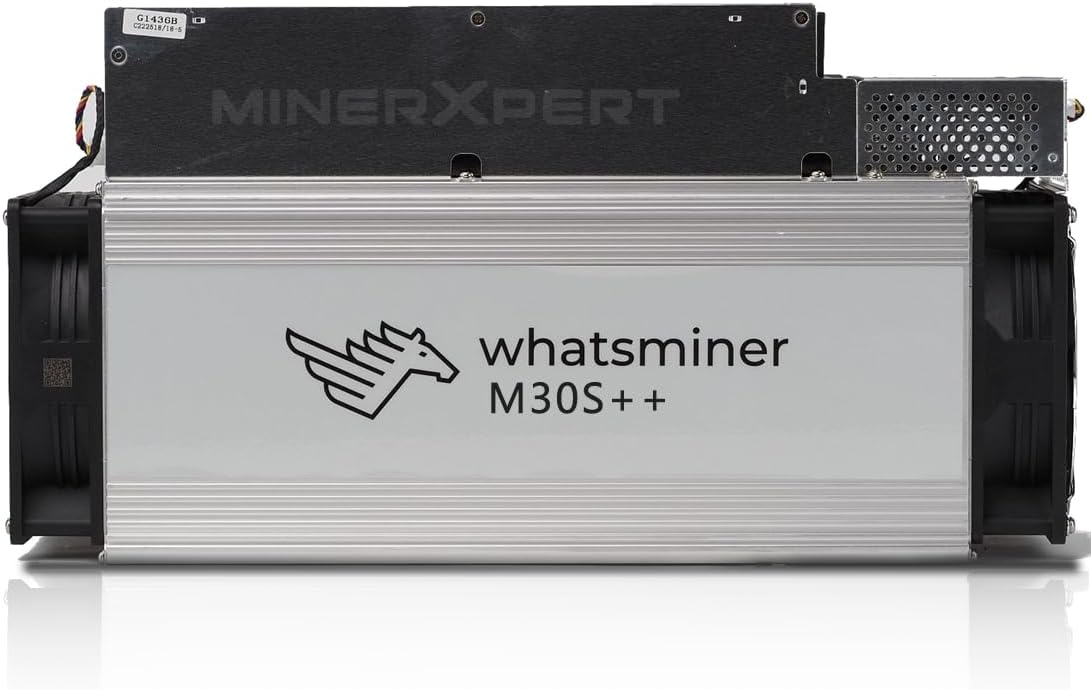
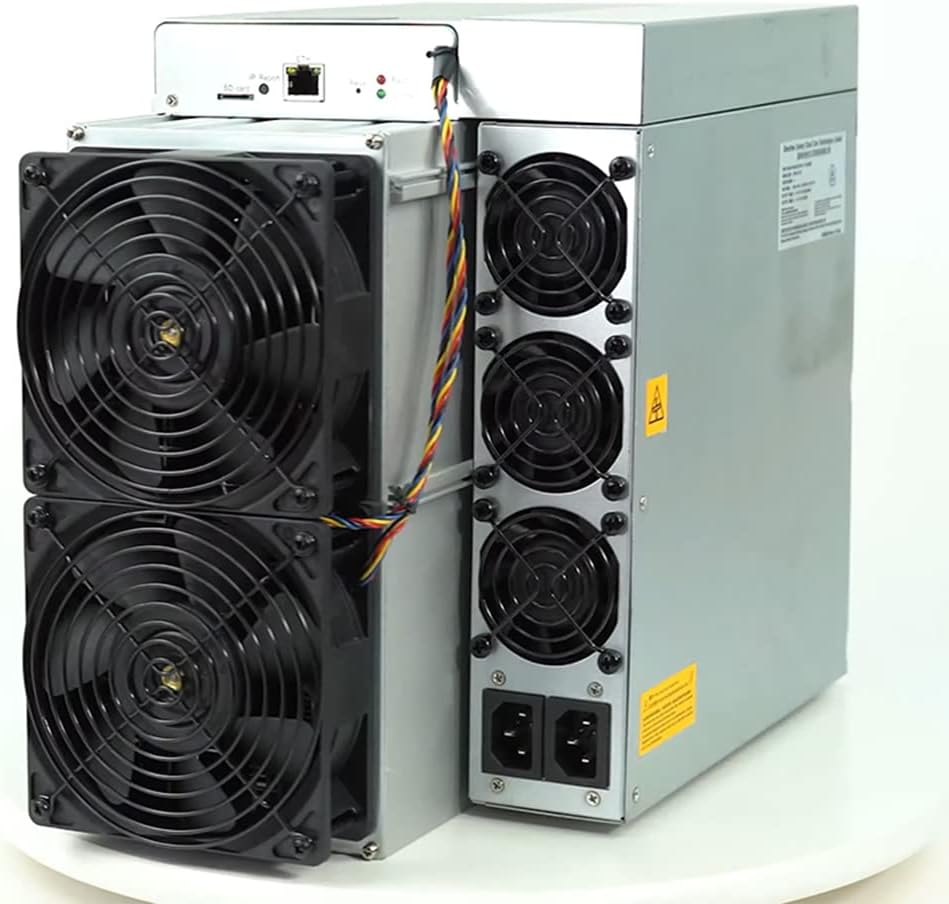
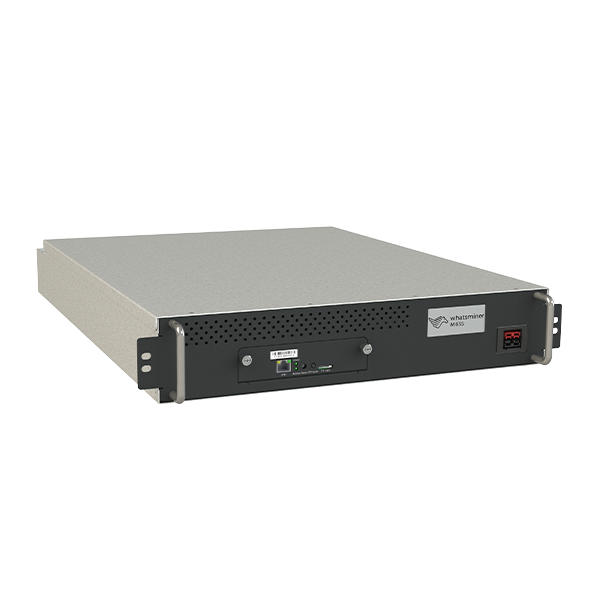
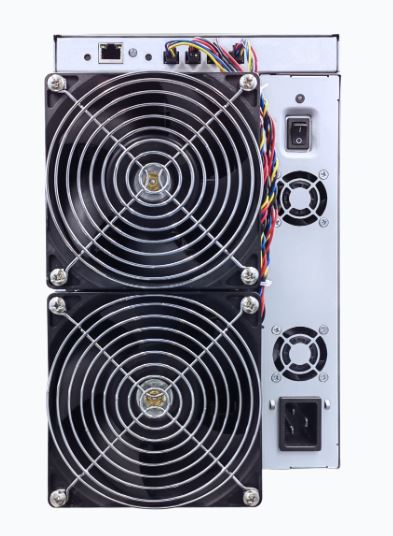
Cryptocurrency mining can be a very profitable business, but succeeding in this sector requires a well-thought-out plan, a significant amount of invested capital, and knowledge of the latest trends in cryptocurrency mining. We have selected the best ASIC miners available in 2026 to help you get started on the right foot.
Although Bitcoin mining is the largest sector of the cryptocurrency mining industry by far, we’ve decided to also feature ASIC miners designed for algorithms other than SHA-256. This is because mining cryptocurrencies other than Bitcoin can be more profitable if timed right, and we also wanted to highlight the diversity of options in the ASIC miner space.
Without further ado, here is our selection of the best ASIC miners in 2026:
Now, let’s take a closer look at each miner that made our list of the best ASIC miners in 2026.
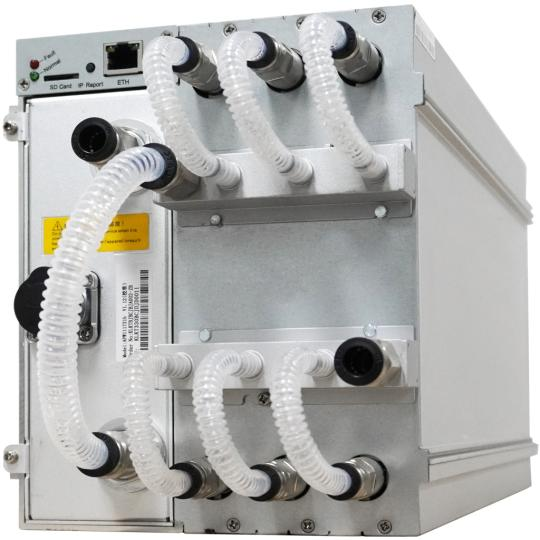
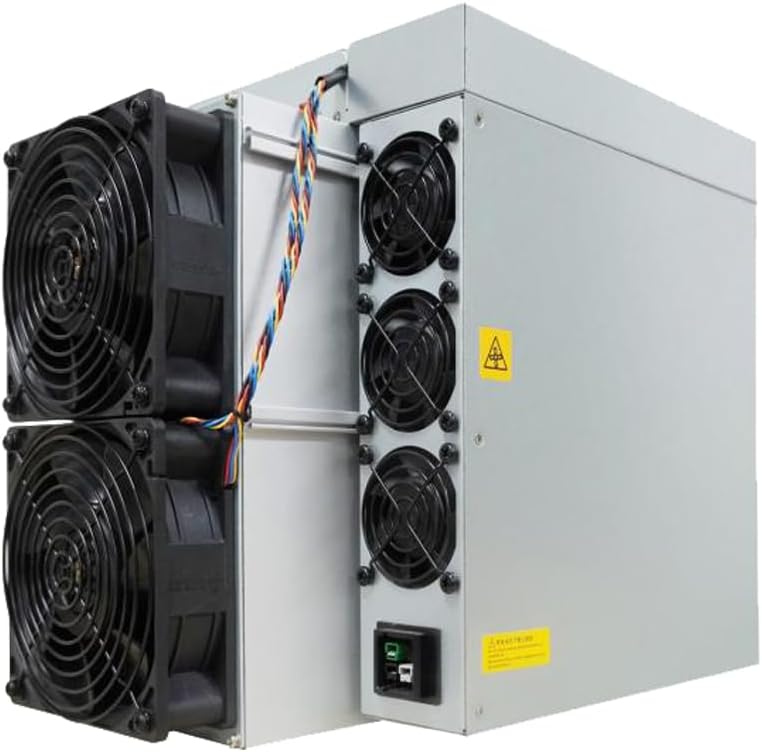
1. Bitmain Antminer S23 Hyd – Ultra-efficient hydro-cooled flagship from Bitmain
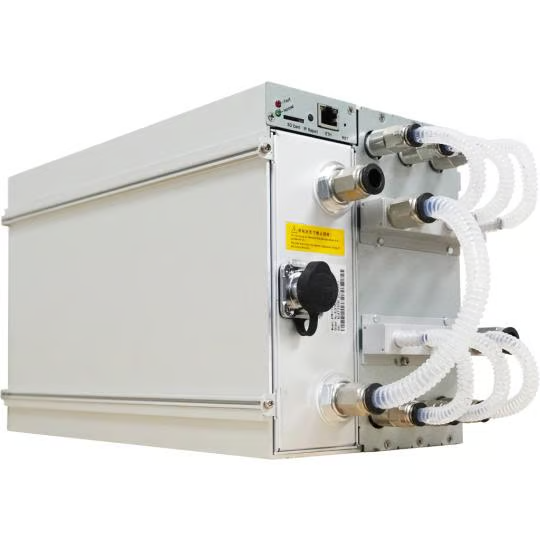
The Bitmain Antminer S23 Hyd is a next-generation, water-cooled Bitcoin miner designed for large-scale and industrial mining setups. It delivers a powerful hash rate of 580 TH/s while drawing 5,510W of power, achieving an efficiency of 9.5 J/TH. This makes it one of the most energy-efficient SHA-256 miners available at launch.
Released in January 2026, the S23 Hyd builds on Bitmain’s advanced liquid-cooling technology to provide improved thermal control and reduced noise compared to traditional air-cooled machines. Its design is aimed at professional mining farms that prioritize high performance, stability, and lower long-term operating costs.
Price
$17,400
Release Date
January 2026
Hash Rate
580 TH/s
Power Consumption
5,510W
Efficiency
9.5 J/T
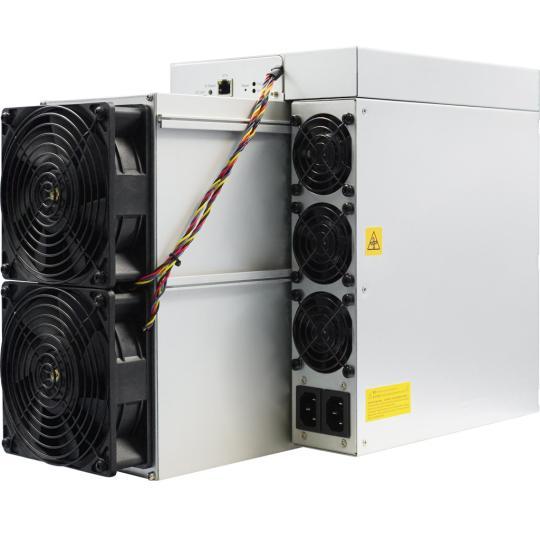
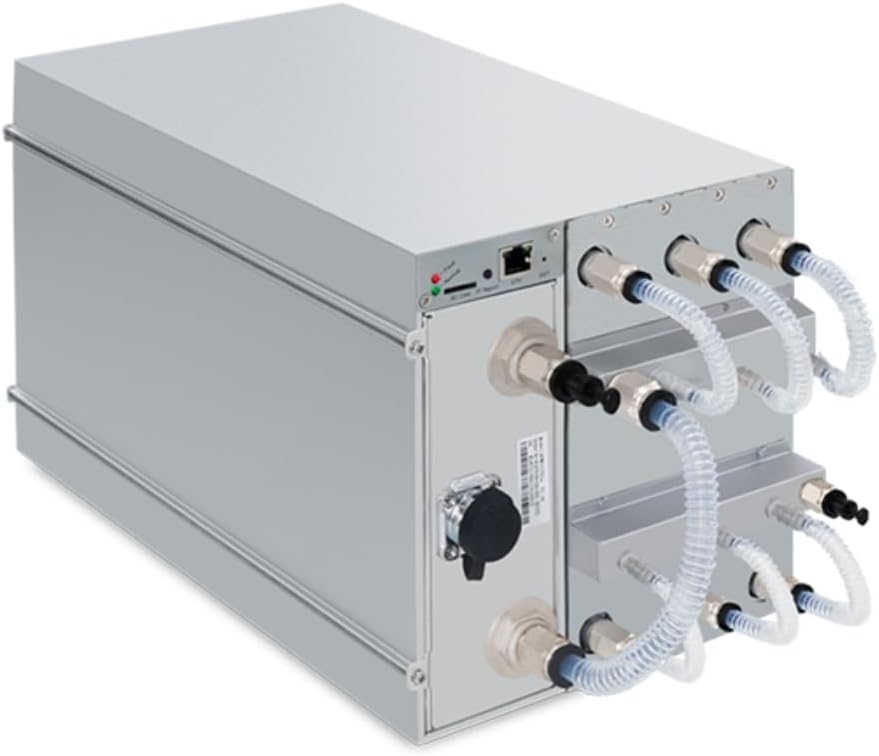
2. Bitmain Antminer S21 XP Hyd – The most profitable Bitcoin miner
Bitmain’s Antminer S21 XP Hyd is one of the most profitable ASIC miners for the SHA-256 hashing algorithm used by Bitcoin, Bitcoin Cash, Bitcoin SV, and other popular cryptocurrencies. This hydro-cooled miner can be cooled with antifreeze or water and outputs a hashrate of 473 TH/s with a power efficiency of 12 J/T.
Currently, Bitmain is accepting orders for the Antminer S21 XP Hyd at a price of $10,170 per unit. Although the price per unit is high, the Antminer S21 XP Hyd still represents a large chunk of the Bitcoin mining industry, which has become much harsher after the fourth Bitcoin halving.
Price
$10,170
Release Date
Q4 2025
Hash Rate
473 TH/s
Power Consumption
5,676W
Efficiency
12 J/T
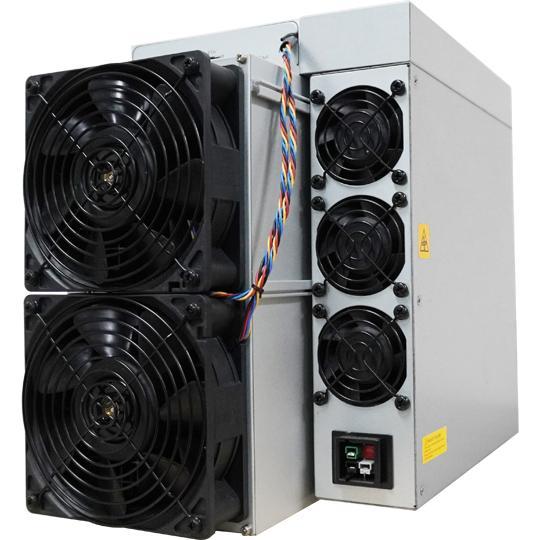
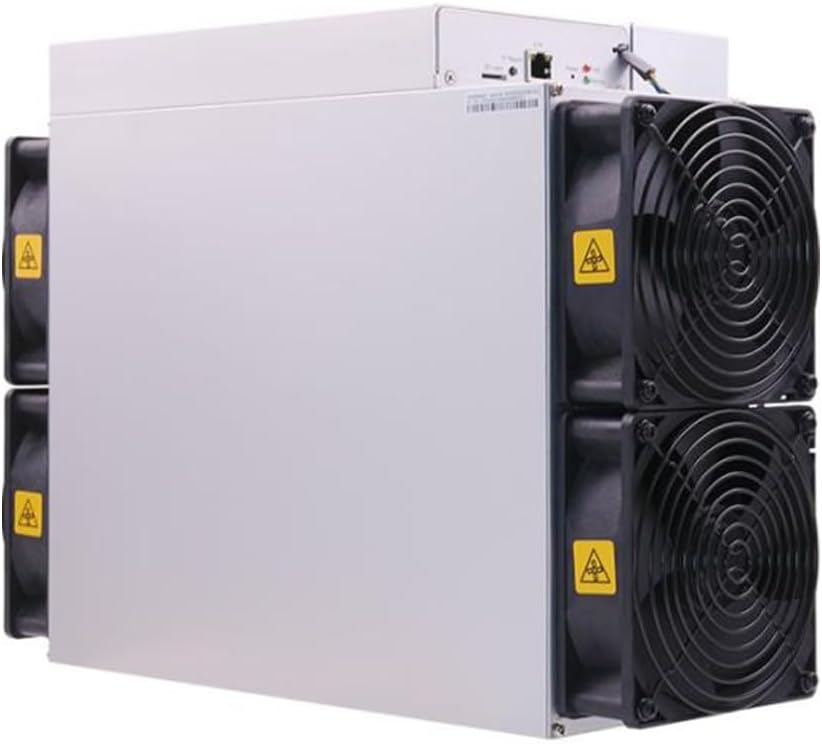
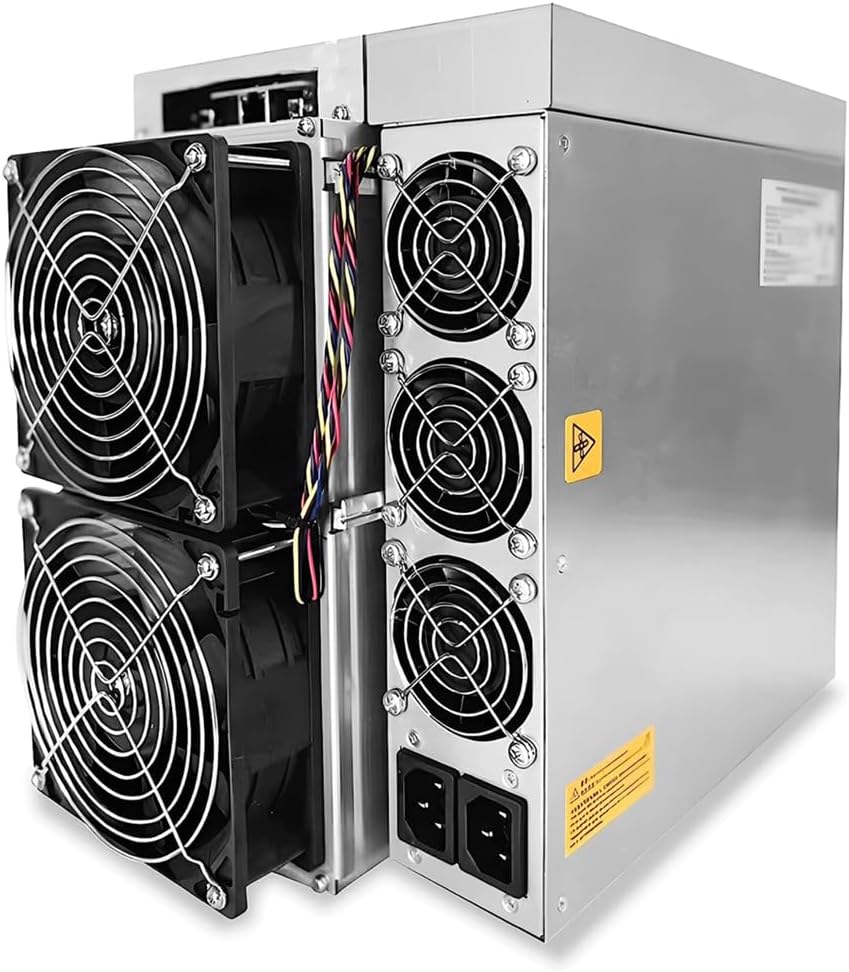
3. Bitmain Antminer S21 – Best all-rounder
The Bitmain Antminer S21 is one of the best all-around ASIC miners for the SHA-256 algorithm, making it suitable for mining Bitcoin, Bitcoin Cash, and similar cryptocurrencies. It delivers a hash rate of 200 TH/s while maintaining strong power efficiency at 17.5 W/Th, offering a solid combination of performance and energy savings.
Priced at around $4,599, the Antminer S21 is a great choice for both beginners entering Bitcoin mining and experienced users looking to upgrade their setups. With its efficiency-focused design and reliable output, it provides consistent profitability potential even amid rising network difficulty.
Price
$4,599
Release Date
February 2024
Hash Rate
200 TH/s
Power Consumption
3,500W
Efficiency
17.5 J/T
4. Bitmain Antminer KS5 Pro – Best Kaspa ASIC miner
The Bitmain Antminer KS5 Pro is currently the most powerful ASIC miner specialized for KHeavyHash, the hashing algorithm used by the Kaspa cryptocurrency. This air-cooled miner generates 21 TH/s, is rated at 3,150W and has a power efficiency of 150 J/T.
The Antminer KS5 Pro’s impressive power comes with a substantial price tag, as Bitmain is selling the miner at a price of $15,000 per unit.
With Kaspa being the most profitable cryptocurrency to mine at the moment, we can expect the competition in the Kaspa ASIC miner industry to intensify significantly in the coming months.
Price
$15,000
Release Date
October 2024
Hash Rate
21 TH/s
Power Consumption
3,150W
Efficiency
150 J/T
5. Canaan Avalon Made A1466 – High-performance Bitcoin miner by Canaan
The Avalon Made A1466 is a powerful Bitcoin ASIC miner produced by Canaan. This miner outputs 150 TH/s at a power efficiency of 21.5 J/T. The Avalon Made A1466, which is the flagship model of Canaan’s A14 series, is sold for roughly $1,800 by the manufacturer.
The Avalon Made A1466 is a solid choice for those who require a powerful Bitcoin miner at a relatively low price per unit.
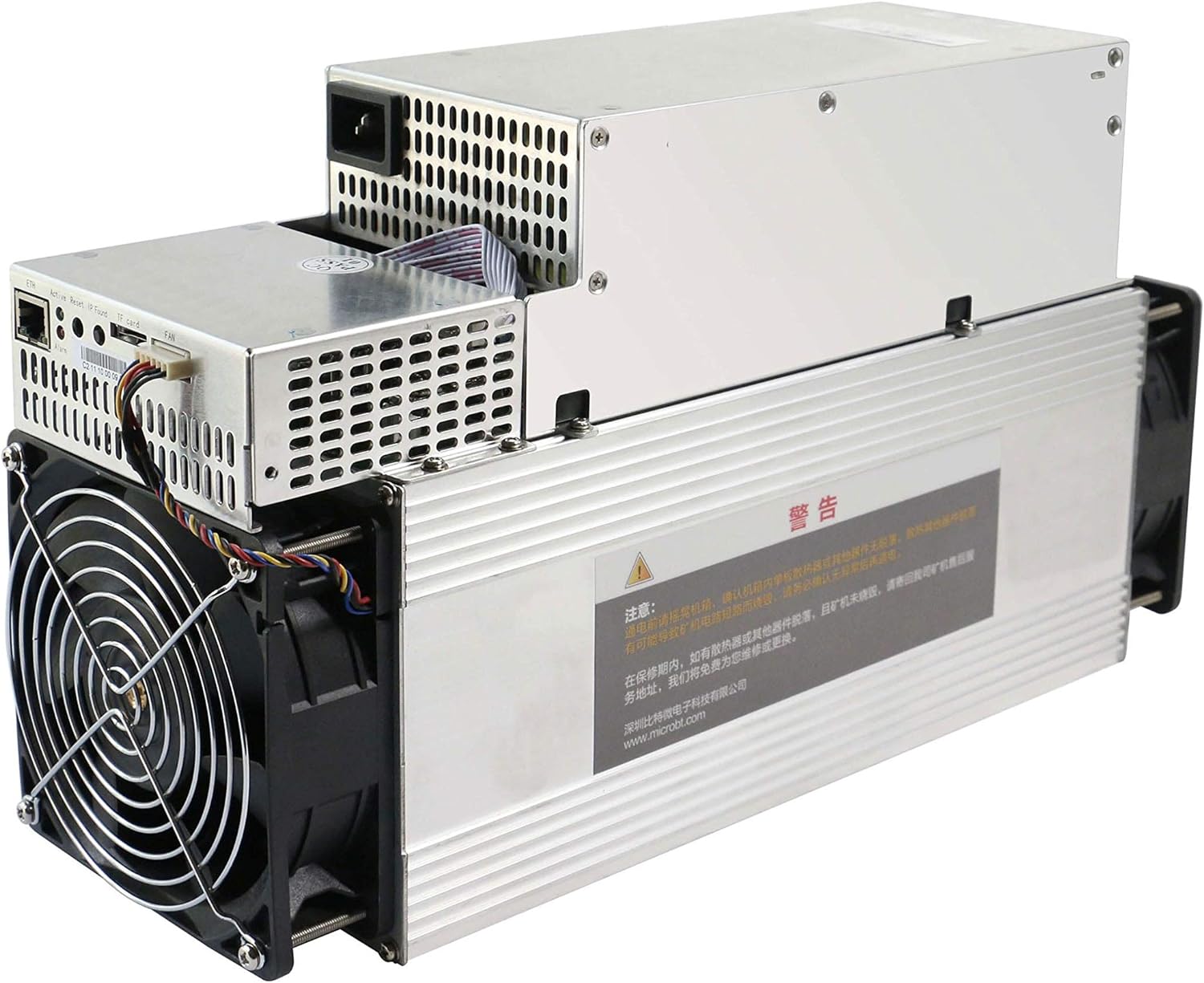
One of the best alternatives to Bitmain’s Antminer series is the WhatsMiner series produced by MicroBT. One of the company’s most powerful miners is the WhatsMiner M66. This immersion-cooled miner is sold for $4,767 by the manufacturer and outputs a hashrate of 247 TH/s. The miner has a power consumption of 5,452W and a power efficiency rating of 19.9 J/T.
Although this ASIC miner is certainly among the more powerful options available on the market, it also has a hefty price tag, which might not make it suitable for all miners.
Price
$4,767
Release Date
October 2023
Hash Rate
247 TH/s
Power Consumption
5,452W
Efficiency
19.9 J/T
7. Bitmain Antminer L9 – Best Scrypt ASIC miner
The Scrypt hashing algorithm is used by two of the most popular cryptocurrencies on the market – Litecoin and Dogecoin. Currently, the most effective ASIC miner for the Scrypt algorithm is Bitmain’s Antminer L9.
The Antminer L9 generates 16 GH/s at a power consumption 3,360W and an efficiency of 210 J/G. This air-cooled miner is designed to function at an operating temperature of 75 degrees Celsius.
Bitmain was selling the Antminer L9 at $5,584 per unit, though the miners sold out shortly after it’s September 2025 release.
Price
$5,584
Release Date
September 2025
Hash Rate
16 GH/s
Power Consumption
3,360W
Efficiency
210 J/G
8. Bitmain Antminer X9 – Best RandomX ASIC miner
Although Monero’s RandomX hashing algorithm was designed to be mineable by consumer-grade computer hardware, it can also be mined with specialized hardware. Bitmain’s Antminer X9 is currently the most powerful ASIC miner for Monero.
This miner, which Bitmain is selling for $5,600 per unit, outputs 1000 KH/s and has a power consumption of 2,472W. In terms of power efficiency, this air-cooled miner is rated at 2.47 J/K.
Price
$5,600
Release Date
July 2026
Hash Rate
1000 KH/s
Power Consumption
2,472W
Efficiency
2.47 J/K
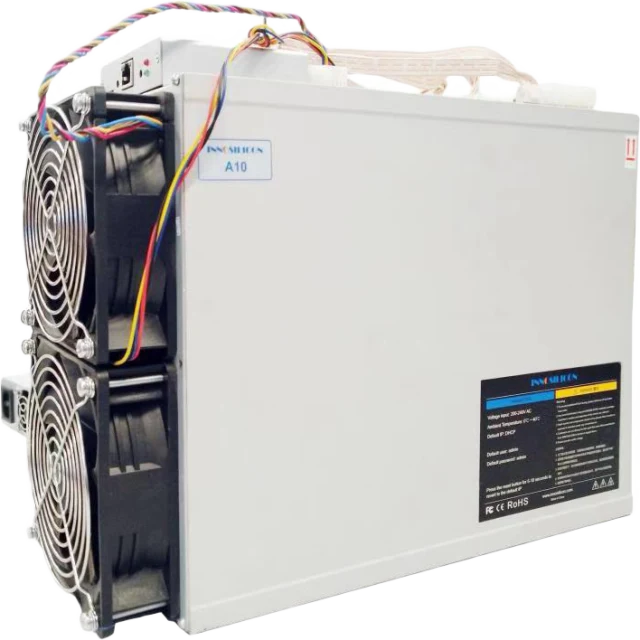
9. Innosilicon A10 Pro ETH – Solid EtHash miner
Although Ethereum no longer uses a Proof-of-Work consensus mechanism, there are still some notable cryptocurrencies using the EtHash hashing algorithm, for example Ethereum Classic. Innosilicon’s A10 Pro ETH is one of the most compelling options for miners that need an ASIC tailored for the EtHash algorithm.
The A10 Pro ETH outputs a hashrate of 500 MH/s and has a power consumption of 860W. The miner has an efficiency rating of 1.92 J/MH.
Price
$1,900
Release Date
May 2020
Hash Rate
500 MH/s
Power Consumption
860W
Efficiency
1.92 J/MH
9. Bitmain Antminer Z15 Pro – Best Zcash miner
The Bitmain Antminer Z15 Pro is a powerful ASIC miner designed for cryptocurrencies that use the Equihash hashing algorithm, such as Zcash (ZEC). The Z15 Pro is a compelling option for miners looking for a high-performance ASIC specifically optimized for Equihash mining.
The Antminer Z15 Pro delivers a hashrate of 840 KSol/s and has a power consumption of 2,780W. The miner has an efficiency rating of 3.31 J/KSol.
Price
$4,999
Release Date
June 2023
Hash Rate
840 KSol/s
Power Consumption
2,780W
Efficiency
3.31 J/KSol
FAQs
Now that we have showcased the best ASIC miners available on the market today, let’s answer some of the most common questions users have on the topic of ASIC miners.
What is an ASIC mining rig?
An ASIC mining rig is a device that is specialized to mine a specific type of cryptocurrency as efficiently as possible. ASICs (application-specific integrated circuits) are chips that are designed for a very narrow range of tasks, in contrast to the chips found in desktop computers, laptops and smartphones, which are capable of performing a variety of tasks.
When it comes to ASIC miners, ensuring a safe operating temperature is crucial. Depending on their design, ASIC miners can use air cooling, liquid cooling or immersion cooling.
Are ASIC miners profitable?
The profitability of ASIC miners depends on many different factors. This includes the cost of the ASIC miner itself, the cost of hosting and maintenance, electricity costs, the price trend of the cryptocurrency that’s being mined, and more factors.
Some cryptocurrencies such as Bitcoin can only be profitably mined with ASICs since consumer-grade computer hardware is not powerful enough to mine them effectively.
Can ASIC miners be used for anything else?
The chips powering ASIC miners are designed specifically to mine a certain hashing algorithm as efficiently as possible. Therefore, ASIC miners can not be used for any other purpose than mining the cryptocurrency / hashing algorithm they were designed for.
The bottom line
We hope that our roundup of the best ASIC miners has helped you find the best models for mining popular cryptocurrencies such as Bitcoin, Litecoin, Dogecoin, and Kaspa. Although cryptocurrency mining can certainly be profitable, running a successful mining operation requires a significant amount of capital, resources, and knowledge.
When you’re considering crypto contract trading, you can be overwhelmed by the numerous options available in 2026. Binance Futures stands out with its high liquidity and up to 125x leverage on selected trading pairs. Meanwhile, platforms like PrimeXBT and Bybit offer feature-packed interfaces and robust security measures.
We’ve selected 10 of the best crypto contract trading platforms based on key factors such as liquidity, selection of trading products, number of listed cryptocurrencies, and more.
Before we feature our picks for the best crypto contract trading platforms, let’s quickly refresh our knowledge of what crypto contract trading is all about.
List of the best crypto contract trading platforms in 2026:
Binance Futures – The best crypto contract trading platform overall
Deribit – The best platform for crypto options contracts
BingX – Crypto contract trading platform with rewards for new users
Phemex – Crypto contracts trading platform with an impressive selection of features
Gemini – A secure, U.S.-regulated way to access copy trading indirectly
Crypto.com – A user-friendly crypto contract trading platform with competitive fees
What is contract trading in crypto?
The term “contract trading” in a crypto context refers to the trading of derivatives, as opposed to spot trading. A derivative is a type of financial instrument that derives (hence the name) its value from an underlying asset.
There are different types of derivatives – in the cryptocurrency market, the most popular derivatives are futures contracts and options contracts. When you are trading Bitcoin futures contracts, for example, you are not actually buying and selling Bitcoin, but you are buying and selling a contract that derives its value from the price of Bitcoin.
Compared to spot trading, contract trading gives traders more flexibility and allows them to easily access leverage or go either long or short on a specific cryptocurrency. However, contract trading is more complex than spot trading and isn’t recommended for inexperienced traders.
Also, due to leverage, you should keep a close eye on and calculate crypto position size so that you don’t exceed your trading budget with any single trade.
The best crypto contract trading platforms in 2026
Without further ado, here is our selection of the best crypto contract trading platforms available on the market right now.
1. Binance Futures: The best crypto contract trading platform overall
When it comes to futures trading platforms in the crypto market, Binance Futures is probably the first thing that comes to mind. It’s the largest crypto exchange in the world, and the most liquid crypto contract trading platform on the market.
You can access over 350 perpetual futures contracts, making it one of the largest platforms for derivatives trading.
High leverage options are available. You can utilize up to 125x leverage on selected trading pairs. This flexibility is great for experienced traders, though newbies should be very careful.
Binance Futures features a competitive fee structure that starts from 0.05% for taker orders and even lower for maker orders. Also, users can reduce their fees even more by paying them with the BNB token.
The platform also offers options trading, which can unlock even more opportunities and strategies for the most advanced traders.
It boasts significant liquidity, with daily trading volumes exceeding $35 billion. This guarantees efficient trade execution and minimal slippage.
When you add advanced trading tools, including various order types and charting features, Binance Futures is a top choice for crypto contract trading.
Key features:
Offers high liquidity for crypto contracts
Users access over 350 perpetual futures contracts
Up to 125x leverage on select pairs
Competitive fees, reduced further with BNB token
Advanced trading tools with various order types and charting features
PrimeXBT offers an extensive multi-asset trading platform that offers a variety of trading products, including crypto futures, crypto CFDs, forex, indices, and commodities.
The platform offers leverage of up to 200x on its cryptocurrency futures.
When you use PrimeXBT, you’ll have access to a wide range of cryptocurrencies and advanced trading tools, including charts and market analysis.
The platform stands out from some other entries on our list for its user-friendly interface that simplifies the crypto futures trading process, which is something newcomers will appreciate. You can execute trades efficiently thanks to high transaction speeds.
Fees are another strong point of PrimeXBT. Taker fees start at 0.02%, while makers pay 0.01% on trading orders. Meanwhile, spreads for CFDs start at 0.1%, which is very competitive compared to many other similar platforms.
Finally, it’s worth noting that PrimeXBT offers a rich selection of educational materials aimed at helping new users on their derivatives trading journey.
Overall, PrimeXBT is a great platform for trading of various financial instruments, and that includes crypto contract trading.
Key features:
Multi-asset platform offering crypto futures, CFDs, forex, indices, and commodities
Leverage up to 200x for cryptocurrency futures
Advanced trading tools with market analysis and charting features
3. KuCoin: Versatile platform with over 800 supported cryptocurrencies
KuCoin is an interesting pick due to its expansive futures markets and versatile trading options.
This platform offers a wide range of trading pairs and contract types, as well as leverage positions up to 125x.
Key features include futures grid trading, which enables automated strategies to capitalize on market fluctuations. With support for over 800 cryptocurrencies (an extremely high number), KuCoin gives traders access to a diverse array of digital assets for both spot and futures trading.
KuCoin’s all-inclusive trading tools and flexible leverage options make it a compelling choice for both novice and experienced futures traders. Its extensive futures markets and advanced features like automated trading capabilities empower users to navigate the dynamic crypto market effectively.
Key features:
Over 800 supported cryptocurrencies for spot and futures trading
Futures grid trading for automated strategies
Leverage up to 125x for futures trading
Extensive trading tools and features for all types of traders
Automated trading capabilities for navigating the market
4. Bybit: A feature-packed crypto exchange with a strong crypto contract offering
Bybit is a global cryptocurrency exchange that was founded in 2018 and has over 2 million registered users by now. The exchange started off with a focus on crypto futures contracts, but they have since upgraded their suite of products and now also offer options trading, as well as spot trading.
Still, futures contract trading remains the focus of Bybit’s offering, and the exchange provides futures settled in the USDC and USDT stablecoins, as well as futures settled in the underlying cryptocurrency. Bybit has taken a page out of Binance’s book and provides futures contracts for well over 100 cryptocurrencies, which makes the platform suitable for all types of cryptocurrency traders.
An interesting feature of Bybit is copy trading, which allows users to copy the trades made by more experienced traders automatically. Of course, users can adjust the maximum amount of capital they’re willing to commit to a single trade.
Bybit offers competitive leverage options of up to 200x on select contracts. Also, their daily trading volume exceeds $1 billion, which shows high liquidity and popularity in the crypto derivatives market.
Key features:
Focus on crypto futures contracts and options trading
Copy trading feature allows automatic replication of experienced traders
Leverage up to 200x on select contracts
High liquidity with daily trading volume exceeding $1 billion
Support for futures settled in USDT, USDC, and underlying crypto
BitMEX is a pioneering cryptocurrency exchange that made significant advancements in the cryptocurrency derivatives sector and popularized crypto contract trading with high leverage.
Although BitMEX has seen a notable decrease in market share in recent times, it remains a solid crypto contract trading platform that primarily caters to experienced traders.
They offer advanced risk management tools and leverage options of up to 100x on perpetual contracts.
Primarily focusing on Bitcoin, BitMEX offers features that allow for significant speculation on price movements without requiring asset ownership. This platform’s robust trading engine can handle large volumes, making it a popular choice among experienced traders seeking liquidity.
BitMEX has a fairly complex fee structure. You can find the details on BitMEX website, but the short version is – it encourages high-volume trading. With enough trading volume, your fees will typically be lower than many competitors in the derivatives space.
They have also introduced its BMEX token, which operates similarly to other exchange tokens. BMEX token holders can access discounts on both taker and maker fees, with larger holders potentially qualifying for rebates on maker fees.
Key features:
Pioneering crypto contract trading platform
Up to 100x leverage on perpetual contracts
Advanced risk management tools
Encourages high-volume trading with fee discounts
BMEX token offers fee discounts and rebates for large holders
You want the Binance experience but without using Binance? Try OKX.
Much like Binance, OKX boasts an extensive selection of cryptocurrencies, listing more than 350 different coins at the time of writing.
As far as crypto contracts go, OKX provides perpetual swaps, futures, and options. In addition, the exchange also provides extra features such as copy trading and simplified crypto options.
With OKX, you have access to a wide range of diverse crypto contracts, with maximum leverage up to 125x.
What makes OKX extra appealing are its competitive fees. Maker fees start off at 0.08%, while taker fees begin at 0.1%. These trading fees can be further reduced based on the user’s trading volume and holdings of OKB tokens.
A unique aspect of OKX is its trading bot marketplace, enabling users to “follow” trading bots created by others. The creators of these bots receive a share of the profits generated by their bots. Of course, users also have the option to publish their own trading bots on this marketplace. In a way, it’s like copy trading, but instead of traders, you follow traders’ bots.
With its diverse offerings, cool features and competitive fees, OKX is a rich and versatile platform for trading crypto contracts.
Key features:
Over 350 cryptocurrencies and multiple contract types (perpetual swaps, futures, options)
7. Deribit: The best platform for crypto options contracts
Deribit is a top choice for options contracts, particularly in the Bitcoin options market. It leads the cryptocurrency options market, holding over 85% of the open interest in Bitcoin options at the time of writing.
Despite the fact that Deribit mainly offers options contracts for Bitcoin and Ethereum (though you can also trade MATIC, SOL, and XRP), it remains the top destination for cryptocurrency options trading.
Beyond catering to institutional-grade crypto derivatives traders, Deribit also has some beginner-friendly features. The exchange offers a free options trading course and a tool called Options Discovery, which aids traders who are new to options in understanding the mechanics of options through practical examples.
Deribit also has a testnet version of its trading platform, enabling traders to experiment with different strategies without exposing themselves to real financial risk.
Fees are starting at 0.03% for both maker and taker orders, capped at 12.5% of the option’s value. Leverage options are flexible, up to 100x for futures and 10x for options.
Whether you’re looking to hedge or speculate, Deribit’s advanced tools and deep liquidity make it an ideal choice for crypto trading.
Key features:
Leading platform for Bitcoin and Ethereum options contracts
Over 85% of open interest in Bitcoin options market
Free options trading course and Options Discovery tool for beginners
Testnet available for strategy testing without real financial risk
8. BingX: Crypto contract trading platform with rewards for new users
BingX is a cryptocurrency exchange with both perpetual and standard futures contracts. The futures contracts listed on BingX are settled in the USDT stablecoin.
Similarly to Binance, Bybit, and OKX, BingX also lists a huge selection of cryptocurrencies, allowing traders to access futures for most relevant altcoins.
A key highlight is the platform’s user-friendly copy trading system, which allows you to replicate the strategies of successful traders with ease.
Their fees start at 0.04% for contracts.
You can also enjoy a variety of order types, including market, limit, and stop orders.
BingX provides a rewards program for new users, and the bonuses can be quite high if you generate a lot of trading volume. The exchange also hosts the SuperX trading competition, which gives the best traders a chance to earn rewards in addition to their trading profits.
Key features:
Wide selection of cryptocurrencies for futures trading
User-friendly copy trading system
Low fees starting at 0.04% for contracts
Rewards program for new users and SuperX trading competition
Variety of order types, including market, limit, and stop orders
9. Phemex: Crypto contracts trading platform with an impressive selection of features
Phemex is a Singapore-based cryptocurrency exchangefounded in 2019. It’s carved out a niche for itself in the crypto contract trading space with its emphasis on speed and reliability.
It can manage up to 100,000 transactions per second.
Phemex supports a diverse range of cryptocurrencies and trading pairs, catering to various trader preferences and strategies. It offers competitive leverage options of up to 100x for specific futures contracts, allowing you to maximize your exposure to market movements.
The platform’s fee structure is flexible, with a maker fee of 0.01% and a taker fee of 0.06%..
They also have a full TradingView integration for traders relying heavily on technical analysis.
When trading contracts on Phemex, traders can access “hedge mode,” which allows them to hold a long position and a short position on the same contract simultaneously. The platform also provides copy trading, which can be a useful tool for less experienced users.
Phemex also features a simulated trading mode, which makes it possible for users to easily test out new trading strategies without taking on any risk. Overall, Phemex is one of the more beginner-friendly crypto contracts trading platforms on the market.
Key features:
Leverage up to 100x for specific futures contracts
Flexible fees: 0.01% maker, 0.06% taker
Full TradingView integration for technical analysis
Simulated trading mode for strategy testing without risk
Hedge mode for holding long and short positions simultaneously
10. Gemini – A secure, U.S.-regulated way to access copy trading indirectly
Gemini is an interesting pick due to its strong regulatory standing, security-first infrastructure, and institutional-grade custody services.
The platform is based in the U.S. and has built a reputation for prioritizing compliance and user protection. Founded by the Winklevoss twins in 2014, Gemini is especially well-suited for cautious retail traders and institutional investors looking for a trusted crypto exchange.
While Gemini doesn’t offer native copy trading, users can access copy trading indirectly through supported third-party integrations. The exchange also provides spot trading and OTC services, but it does not offer its own crypto derivatives products such as perpetual futures or options.
Gemini’s focus on transparency, insured custody, and regulatory compliance makes it a compelling option for users who prioritize safety and oversight over high-leverage trading features.
Key features:
U.S.-regulated cryptocurrency exchange with a strong security focus
Insured custody services for added protection
Spot trading and OTC services for retail and institutional users
Indirect copy trading access through third-party integrations
No native crypto futures, perpetual contracts, or options
Strong choice for institutional investors and compliance-focused traders
11. Crypto.com: A user-friendly crypto contract trading platform with competitive fees
Crypto.com is a popular cryptocurrency exchange that offers a range of trading services, including spot trading and crypto derivatives. The platform stands out for its modern interface, competitive fees, and user-friendly mobile app.
One of Crypto.com’s biggest strengths is its accessibility. The exchange provides a clean and intuitive trading interface, making it relatively easy for newcomers to navigate the crypto contract market. More experienced traders can also take advantage of advanced order types and charting tools.
Crypto.com offers futures and perpetual contracts for major cryptocurrencies, allowing traders to speculate on price movements without owning the underlying assets. However, its selection of contract trading pairs is somewhat limited compared to larger competitors like Binance and Bybit.
Trading fees are another advantage of Crypto.com. The exchange offers a competitive fee structure, with additional discounts available to users who hold or stake its native CRO token.
While Crypto.com provides decent liquidity, its derivatives trading volumes are generally lower than those of leading futures exchanges. This can result in higher slippage for less popular trading pairs, particularly during periods of high market volatility.
Overall, Crypto.com is a solid choice for traders who value ease of use, competitive fees, and a streamlined trading experience over an extensive selection of crypto contracts.
Key features:
User-friendly trading interface and mobile app
Futures and perpetual contracts for major cryptocurrencies
Competitive trading fees with additional CRO token discounts
Advanced charting tools and order types
Smaller selection of contracts and lower liquidity than leading derivatives exchanges
And that’s all, folks. Each crypto contract trading platform on our list deserves to be here. It doesn’t mean they’re all the same, it just means they all have something that makes them appealing.
Top platforms like Binance Futures, PrimeXBT, and Bybit offer high-speed transactions and competitive fees.
Consider your trading needs: OKX for extensive derivatives, Huobi for strong security, and Bybit for user-friendly features. Analyze platform specifics and make a well-considered choice tailored to your trading strategy.
If you’re looking for more high-quality platforms for trading cryptocurrency, make sure to check out our selection of the best crypto exchanges available on the market today.
Key Takeaways
Top-notch platforms: Binance, OKX, Bybit, and Deribit are among the top crypto contract trading platforms, offering various derivatives and robust security measures.
Leverage options: High leverage options are available on most platforms, often up to 100x or 125x, allowing traders to amplify their positions and potential returns.
Security features: Common security features include two-factor authentication, SSL encryption, multi-signature wallets, and cold storage to protect user assets.
Low fees: Competitive fee structures are offered by platforms like Binance, OKX, and Phemex, with low maker and taker fees starting from 0.01% to 0.08%.
User experience: Many platforms offer user-friendly interfaces and advanced trading tools, making them suitable for traders of all skill levels.
Are you looking to invest in cryptocurrencies but unsure which one to buy? With so many options available, it can be overwhelming to decide how to invest your money. That’s why we’ve compiled a list of the best crypto to buy now, based on factors such as project developments, price performance, and market capitalization, as well as the overall potential for growth.
In this article, we’ll take a closer look at the most promising cryptocurrencies, including staples such as Bitcoin and Ethereum, and a combination of several other promising crypto projects. We’ll discuss their features, advantages, and potential drawbacks, as well as provide insights into market trends. Whether you’re a seasoned investor or just starting out, this article will help you make an informed decision about the best crypto to buy now.
So, let’s dive in and explore the best cryptocurrencies to invest in October 2026:
The best cryptos to buy right now: Discover top investments for October 2026
The following three cryptocurrency projects highlight our investment selection thanks to important developments and upcoming events that make them especially interesting to follow in the near future. These projects are updated each week based on the most recent developments and trends taking place in the crypto market.
1. Bitcoin
Bitcoin (BTC) is the original decentralized digital currency, enabling peer-to-peer transactions without the need for intermediaries such as banks or financial institutions. It was created in 2009 by an unknown person or group of people using the pseudonym Satoshi Nakamoto. Bitcoin was the first digital currency to eliminate the double spending problem without resorting to any central intermediaries.
Bitcoin transactions are recorded on a public ledger called the blockchain, which is maintained by a network of computers around the world. This means that the transactions are secure and transparent, as anyone can view them, but they are also anonymous, as the identity of the participants in the transaction is not revealed.
Bitcoin is often referred to as “digital gold” or a store of value, as it has a limited supply of 21 million coins, and its value is determined by market demand. Some people also see it as a hedge against inflation or a way to diversify their investment portfolio. It is by far the largest cryptocurrency by market cap in the industry, accounting for the value of more than 50% of all digital assets in circulation combined, making it arguably the most popular crypto to buy.
Bitcoin is trading at $83,508 after a volatile week that saw the cryptocurrency briefly fall to $80,350, triggering nearly $1.1 billion in crypto liquidations. The sell-off followed reports that the US government had moved more than 12,000 BTC from previously seized holdings, raising concerns about potential selling pressure. Long positions accounted for approximately $1.05 billion of the liquidations, while short-term holders transferred more than 55,000 BTC to exchanges at a loss. Despite recovering above $83,000, Bitcoin continues to face resistance around 85,000–87,000, where repeated breakout attempts have failed.
Bitcoin price action compared with crypto market liquidations. Source: CoinGlass
On-chain data suggests that Bitcoin’s recent recovery has been driven more by existing investors than fresh capital entering the market. According to Glassnode, new money inflows reached approximately $4.9 billion in the 30 days ending October 5, accounting for less than 40% of the $12.8 billion increase in Bitcoin’s realized capitalization. Meanwhile, institutional accumulation remains in focus as Strategy continues expanding its Bitcoin treasury. The company recently purchased 334 BTC for $28.7 million, bringing its total holdings to 848,000 BTC, although it spent considerably more on preferred stock buybacks during the same period. Strategy chairman Michael Saylor has also hinted at further Bitcoin purchases, keeping investors attentive to upcoming announcements.
Bitcoin’s realized capitalization growth compared with new capital inflows. Source: Glassnode
Looking ahead, analysts are closely watching the $82,500 level, which has served as an important support area throughout Bitcoin’s broader uptrend. According to trader Rekt Capital, a weekly close below this level could push BTC back into its previous macro accumulation range, while reclaiming it would strengthen the case for another recovery attempt. On the upside, the 85,000–87,000 region remains a major obstacle, particularly as Glassnode data shows that short-term holders have been aggressively taking profits at higher prices. Although recent selling by newer investors could signal short-term capitulation, sustained upside momentum will likely require stronger capital inflows and renewed buying demand.
2. Ethereum
Launched in 2015 by Vitalik Buterin and a team of developers, Ethereum is a decentralized, open-source blockchain platform that allows developers to build decentralized applications (dApps) and smart contracts.
Ethereum has a wide range of use cases beyond just a store of value or medium of exchange. Ethereum’s smart contract functionality allows developers to build dApps that can run without the need for intermediaries, like centralized servers or institutions.
The Ethereum platform has gained widespread adoption and has become the backbone of the decentralized finance (DeFi) industry. DeFi applications built on Ethereum allow users to access financial services without relying on traditional banks or financial institutions. Ethereum’s smart contract functionality has also enabled the creation of non-fungible tokens (NFTs), which have gained popularity in the digital art and gaming worlds.
While Ethereum has a strong community and has been highly influential in the cryptocurrency industry, it also faces challenges, such as scalability issues and high gas fees. These issues have spurred the development of various Layer 2 scaling solutions. In the long run, future updates are supposed to massively increase Ethereum’s throughput bringing the transaction per second (TPS) figure from 15 to 100,000.
Ethereum is trading at $2,553 as investors focus on growing institutional holdings and the network’s upcoming Glamsterdam upgrade. One of the biggest developments comes from BitMine Immersion Technologies, which has accumulated approximately 6 million ETH, representing around 4.9% of Ethereum’s circulating supply. Chairman Tom Lee recently confirmed that the company will stop accumulating once it reaches 5%, requiring roughly another 100,000 ETH to complete its strategy. The announcement marks a shift from aggressive treasury accumulation toward managing its existing holdings, potentially reducing one source of institutional buying demand.
🚨BREAKING: Tom Lee says BitMine will "STOP" buying ETH at 5% "hard cap."
"We only need to get another 100,000 ETH to get to 5%," Lee said on stage at Token2049.
Meanwhile, Ethereum’s development roadmap continues to advance following the successful activation of the Glamsterdam upgrade on the Sepolia testnet. The upgrade introduces major improvements to network scalability and efficiency, including enshrined proposer-builder separation and block-level access lists, which are designed to enable more efficient block validation and parallel transaction processing. The Ethereum Foundation has also established a target gas limit floor of 200 million for Glamsterdam, compared with approximately 60 million currently, potentially allowing the network to process significantly more transactions. Developers will next test the upgrade on Hoodi before finalizing its mainnet activation date.
Ethereum’s Glamsterdam upgrade rollout schedule across testnets and mainnet. Source: Ethereum.org
Looking ahead, Ethereum’s outlook will depend partly on the successful deployment of Glamsterdam and whether institutional demand remains strong as BitMine approaches its accumulation ceiling. While the company’s decision to stop purchasing ETH could reduce near-term buying pressure, its substantial holdings and potential staking activity highlight continued institutional involvement in the ecosystem. A successful mainnet upgrade could also strengthen Ethereum’s competitiveness by improving transaction throughput and reducing network bottlenecks. Investors will be watching the remaining testnet milestones and BitMine’s final purchases as potential catalysts for ETH’s next major move.
3. NEAR Protocol
NEAR Protocol is a high-throughput Layer 1 blockchain that uses sharding to scale transaction processing while maintaining fast finality and low fees. In recent years, the project has expanded its focus beyond traditional smart contract applications toward cross-chain infrastructure and AI agents, with the goal of making it easier for both users and autonomous software to interact with assets and applications across multiple blockchains.
Developers can build smart contracts on NEAR using widely adopted programming languages, including Rust and JavaScript. The protocol also includes incentives for application developers, who can receive a portion of the transaction fees generated when users interact with their smart contracts. NEAR’s architecture is designed to scale dynamically as network activity increases, allowing additional capacity to be added through its sharding system.
One of the ecosystem’s most notable products is NEAR Intents, a multichain transaction framework that allows users to specify the outcome they want rather than manually determining how a transaction should be executed. Independent solvers compete to fulfill these requests efficiently, abstracting away much of the complexity associated with bridges, gas tokens and individual networks. In practice, NEAR Intents is primarily used for cross-chain cryptocurrency swaps, providing a unified execution layer for moving assets between otherwise separate blockchain ecosystems.
NEAR Protocol is trading at $5.73 after surging approximately 140% over the past 30 days, pushing the cryptocurrency into the top 20 digital assets by market capitalization. The rally has been supported by growing adoption of NEAR’s cross-chain infrastructure and the launch of the first US spot NEAR exchange-traded product. Bitwise introduced the fund on September 29 under the ticker NRR, giving traditional investors a new way to gain exposure to NEAR. Meanwhile, daily trading volume recently reached approximately $1.2 billion, reflecting increased market interest following the token’s sharp recovery.
One of the biggest drivers behind NEAR’s growing adoption is NEAR Intents, its cross-chain trading protocol, which has surpassed $31 billion in cumulative transaction volume. The ecosystem recently expanded through an integration with Infinex, allowing users to access Bitcoin, Dogecoin, XRP and other assets across multiple blockchains without manually managing bridges or separate wallets. NEAR Intents currently supports more than 100 assets across 31 blockchains, with transactions typically settling in around 30 seconds. The integration highlights NEAR’s growing role as cross-chain infrastructure, simplifying asset transfers and improving interoperability between otherwise disconnected blockchain networks.
NEAR Intents has processed more than $31 billion in cumulative cross-chain transaction volume. Source: NEAR Intents Explorer
Looking ahead, investors will be watching whether NEAR can maintain its recent momentum as adoption of its chain-abstraction technology continues to expand. The launch of Bitwise’s spot exchange-traded product could provide an additional channel for institutional demand, while integrations such as Infinex may help drive further transaction volume across NEAR Intents. The protocol also recently recovered all $3.8 million lost in an exploit affecting its deposit and withdrawal infrastructure, although the incident highlights the security risks associated with cross-chain services. While NEAR’s expanding ecosystem supports its longer-term outlook, the token’s rapid 140% rally also raises the possibility of short-term profit-taking as traders assess whether current valuations are sustainable.
4. Zcash
ZCash (ZEC) is a privacy-focused cryptocurrency that was launched in 2016 by Zooko Wilcox-O’Hearn. It is a fork of Bitcoin, designed to enhance privacy and anonymity for its users. Unlike Bitcoin, where transaction details (such as sender, recipient, and amount) are publicly visible, ZCash allows users to choose between two types of transactions: transparent and shielded.
Transparent transactions work similarly to Bitcoin, where all transaction details are recorded on the blockchain and visible to everyone. However, shielded transactions use a cryptographic technology called zk-SNARKs to allow fully private transactions. In shielded transactions, the details are encrypted, meaning that only the parties involved have access to the information, while the validity of the transaction is still verifiable by the network.
ZCash is particularly valued by those who prioritize financial privacy and security, as it offers optional anonymity in a way that few other cryptocurrencies do.
Zcash is trading at $1,315 as attention turns to the privacy network’s upcoming NU7 upgrade, which successfully activated on testnet on October 4. The upgrade will reduce Zcash’s target block time from 75 seconds to 25 seconds while introducing several other protocol changes, including the removal of version 4 transactions and a new Network Sustainability Mechanism. Developers will use the testnet period to evaluate the changes under real-world conditions before deciding whether to proceed with the planned mainnet rollout.
The Zcash ecosystem is also increasing its involvement in US crypto policy. Pretty Good Policy for Zcash (PGPZ) has registered to lobby Congress on three digital asset bills, including the Digital Asset Market Clarity Act and two crypto tax proposals. The organization is backed by a $750,000 grant from Zcash Community Grants, with $120,000 allocated to legal, lobbying, tax and compliance work. The initiative is focused on issues including Zcash ecosystem development, developer protections and financial privacy.
Looking ahead, the immediate catalyst for Zcash is NU7’s progression toward mainnet. Developers are scheduled to make a final activation decision and set the upgrade height on October 20, with mainnet deployment currently targeted for November 5. A successful testnet period would keep that timeline intact, while users with ZEC in the legacy Sprout shielded pool will need to migrate their funds before full activation because NU7 will make those holdings unspendable.
5. Uniswap
Uniswap is the leading decentralized exchange (DEX) built on Ethereum, allowing users to swap cryptocurrencies directly from their wallets without relying on centralized intermediaries. The protocol pioneered the automated market maker (AMM) model, which replaces traditional order books with liquidity pools supplied by users who earn fees for providing liquidity.
The protocol is governed by the UNI token, which gives holders the ability to propose and vote on changes affecting Uniswap’s development and ecosystem. Since its launch in 2020, Uniswap has become one of the largest decentralized finance (DeFi) applications by trading volume and continues to expand through innovations such as Uniswap v4, introducing customizable liquidity pools and new infrastructure for tokenized real-world assets and institutional adoption.
Uniswap is trading at $6.98 after rallying sharply alongside a broader rotation into altcoins and DeFi assets. UNI gained nearly 40% over the past week as trading activity on the recently launched Robinhood Chain surged, with Uniswap handling the vast majority of the network’s decentralized exchange volume. Daily DEX volume reached roughly $3 billion during one particularly active session, helping UNI break above a multi-year descending trendline as traders responded to the protocol’s improving value-accrual mechanics.
Uniswap trading activity on Robinhood Chain. Source: WuBlockchain
The key catalyst has been Uniswap’s fee switch, which uses a portion of protocol fees to buy and permanently burn UNI. Heavy Robinhood Chain activity recently resulted in approximately 184,000 UNI worth $1.15 million being burned in a single day, the first daily burn above $1 million. Cumulative DEX volume on Robinhood Chain has now surpassed $40 billion, while Uniswap reportedly generated nearly $79 million in trading fees from the network over a recent 30-day period. Tokenized stocks are contributing to this growth by increasingly using Uniswap’s higher-fee pools, strengthening the connection between UNI’s tokenomics and activity in tokenized assets.
Looking ahead, traders are watching whether UNI can maintain its breakout, with $6.35 identified as an important support area and the recent $7.48 high providing a near-term level to reclaim. Continued growth in Robinhood Chain activity could accelerate UNI burns and provide further support, although Uniswap’s increasing dependence on a single network introduces additional risk. Changes to Robinhood’s swap routing or fee structure, or regulatory challenges affecting the network, could reduce Uniswap’s fee generation and weaken the burn mechanism that has become a major catalyst for UNI’s recent rally.
6. Monero
Monero is a privacy-focused cryptocurrency designed to offer anonymous and untraceable transactions. Launched in 2014 as a fork of Bytecoin, Monero was introduced through a whitepaper written by the pseudonymous “Nicolas van Saberhagen.” Unlike Bitcoin or Ethereum, Monero conceals sender and receiver identities, as well as transaction amounts, through advanced cryptographic techniques such as stealth addresses and ring signatures. This strong focus on privacy has made Monero a favorite among users seeking true financial confidentiality.
Monero runs on a Proof-of-Work (PoW) consensus mechanism and is deliberately resistant to ASIC mining to support decentralization. It can be mined efficiently using consumer-grade hardware, and its privacy-preserving features also improve fungibility—individual XMR coins are indistinguishable from one another and can’t be blacklisted. Despite its strong standing within the crypto community, Monero has been the subject of regulatory scrutiny due to concerns over its potential use in illicit activities. Nonetheless, it remains the most widely adopted privacy coin in the market today.
Monero is trading at $537.03 after extending a seven-week rally that has made August its strongest month since April 2021. XMR has gained more than 46% since the start of the month and pushed decisively above $500 as demand for privacy-focused cryptocurrencies intensified. The advance has been particularly notable given Monero’s limited availability on major centralized exchanges, while similar strength across other privacy coins suggests the move is part of a broader rotation toward the sector.
Derivatives activity has accelerated alongside the rally, potentially adding to recent volatility. Monero open interest nearly doubled from around $131 million at the beginning of August to almost $260 million, approaching the historical high of $277 million recorded in January. Short liquidations have also significantly exceeded long liquidations, suggesting forced buying may have contributed to the upside. Meanwhile, THORChain has reportedly introduced native Monero support, enabling swaps between XMR and assets such as Bitcoin and Ethereum and potentially improving access to the cryptocurrency outside centralized exchanges.
Monero open interest is approaching its previous record as derivatives activity accelerates. Source: CoinGlass
Momentum remains firmly in favor of buyers, but the rapid advance has pushed XMR into overbought territory while derivatives positioning is close to record levels. That combination could produce elevated volatility if traders begin taking profits or leveraged positions unwind. On the other hand, sustained interest in privacy assets and improved accessibility through THORChain could provide fundamental support, leaving traders focused on whether Monero can consolidate its breakout above $500 after one of its strongest monthly performances in years.
7. XRP
XRP is a digital cryptocurrency that was created by Ripple Labs in 2012. It is used as a means of payment and transfer of value on the Ripple payment protocol, which is designed to enable fast and secure transactions between financial institutions as well as individuals.
XRP is unique in that it is not based on the blockchain technology used by many other cryptocurrencies. Instead, it uses a distributed consensus ledger called the XRP Ledger, which is maintained by a network of validators. This allows for faster transaction processing times and lower fees compared to traditional payment methods.
XRP has been popular among cryptocurrency traders and investors due to its high liquidity and clear potential for broader adoption, especially as a remittance solution. However, it has also been the subject of controversy and legal action, with US regulators alleging that it is a security and should thus be subjected to securities regulations. This has somewhat hindered the potential of XRP as an investment, and handcuffed Ripple’s growth as a company.
XRP is trading at $1.48 following a strong recovery that has brought renewed attention to the token, particularly among South Korean retail traders. XRP accounted for roughly 32% of 24-hour trading volume on Upbit as activity on the country’s largest crypto exchange surged, while the token gained around 35% over seven days. The rally has coincided with improving regulatory sentiment following Ripple CEO Brad Garlinghouse’s participation in White House discussions on US crypto legislation, alongside renewed whale accumulation.
XRP accounted for nearly a third of Upbit’s 24-hour trading volume as South Korean crypto activity rebounded. Source: Upbit DataLab
Derivatives markets have also become considerably more active, with XRP open interest reportedly climbing from around $2.3 billion to $3.56 billion. The increase followed XRP’s breakout from a two-week trading range and reports that large holders accumulated approximately 190 million XRP in a single day. Institutional interest has strengthened as well, with recent XRP ETF inflows adding another source of demand alongside the resurgence in retail trading.
The main question is whether XRP can sustain its recovery through continued spot demand rather than relying heavily on leveraged positions. Rising open interest can amplify price moves in either direction, leaving the market more exposed to liquidations if momentum reverses. For now, whale accumulation, returning Korean liquidity and improving institutional demand provide support for the rally, but traders will be watching whether these trends persist after the recent sharp advance.
8. Solana
Solana is a smart contract platform known for its distinctive architecture, enabling it to handle thousands of transactions per second while maintaining very low costs. It accomplishes this by using a combination of a unique Proof-of-History algorithm and a Proof-of-Stake consensus mechanism. SOL, the native cryptocurrency of the platform, is one of the cheapest to transfer, with users typically paying less than $0.001 per transaction.
Founded in 2018 by Anatoly Yakovenko, Solana’s mainnet went live in March 2020 and experienced a surge in adoption throughout 2021. Despite a significant drop in value during the 2022 bear market, Solana remains one of the most robust ecosystems in the cryptocurrency space and continues to be seen as a potential candidate for significant future growth.
Solana is trading at $75.59 as buyers attempt to defend the $73-$75 region following its recent breakout. The area previously acted as resistance and has now become an important test of whether SOL can maintain its short-term recovery structure. While the token has struggled to move decisively beyond the upper-$70s, holding current support would keep the focus on a potential rebound toward $80-$85.
$SOL The setup we had identified worked: SOL broke through the level and began its rally from there.
The price is now consolidating just above the area I had highlighted. As long as the 73–75 zone holds, the structure remains bullish and I see no reason to change the plan.
Technical setups remain mixed, with analysts outlining both direct-breakout and deeper-pullback scenarios. A move through resistance around $77-$78 and then $82.25 would strengthen the bullish case, potentially bringing $87 into focus before higher resistance around $98.40. Other traders see the possibility of SOL first revisiting the $67 area, where a brief breakdown followed by a quick recovery could provide another potential base for an upside move.
The broader outlook depends heavily on whether Solana can maintain its recent support levels. Losing $73 would weaken the immediate breakout structure, while a deeper decline below $66-$67 could shift attention toward the previous Fibonacci support near $63.89. Conversely, a sustained breakout above the low-$80s would provide stronger confirmation that buyers are regaining control, with $85-$87 representing the next meaningful upside zone before traders begin considering more ambitious longer-term targets.
9. Chainlink
Chainlink is a decentralized oracle network that enables blockchains and smart contracts to securely access trustworthy data from external sources. It is designed to solve the so-called “oracle problem,” which describes the challenge blockchains face when trying to obtain information that exists outside their own environments. By linking on-chain applications with off-chain data, Chainlink makes it possible to support use cases that could not rely on blockchain-native information alone.
Chainlink has established itself as the dominant oracle solution in decentralized finance and is also seeing growing adoption in areas such as real-world asset tokenization. DeFi protocols can use Chainlink to provide smart contracts with cryptocurrency price data from centralized exchanges, while RWA platforms can obtain accurate market valuations with a lower risk of manipulation. This can help tokenized real estate, commodities, and other assets maintain dependable and current valuations on-chain.
Crypto investors may want to keep a close eye on Chainlink as it continues to establish itself as essential infrastructure for tokenized finance. BitGo’s move to select Chainlink CCIP as the sole cross-chain infrastructure for WBTC and future assets issued by BitGo is a notable vote of confidence in Chainlink’s security and interoperability technology.
After a rigorous review, BitGo deprecated its legacy bridging provider & chose CCIP as its exclusive cross-chain infra given it’s the only solution that meets institutional security requirements. https://t.co/ceIBKawZm8pic.twitter.com/oEYtZtNuFU
Chainlink is already operating on a substantial scale. Its infrastructure has facilitated more than $32 trillion in transaction value, protects over $110 billion across DeFi and cross-chain applications, and underpins approximately 70% of oracle-dependent DeFi value worldwide. CCIP is expanding rapidly as well, with quarterly volume climbing to $4.9 billion in Q2 2026.
The bigger potential opportunity comes from the expansion of real-world asset tokenization. Standard Chartered forecasts that tokenized onchain assets could reach $4 trillion by the end of 2028 and believes Chainlink is particularly well placed to deliver the data, interoperability, and compliance infrastructure needed to support these assets.
This outlook prompted Standard Chartered to assign LINK a $200 price target for the end of 2030, partly based on projections that Chainlink’s fee generation could increase by roughly 25 times. A $200 LINK price would imply upside of more than 2,300% from its current level.
Chainlink’s expanding network of institutional relationships, including Swift, DTCC, JPMorgan, Mastercard, UBS, Fidelity and BitGo, further strengthens the investment thesis. The case is straightforward: if a larger share of the global financial system shifts onchain, Chainlink could emerge as one of the major infrastructure providers enabling that transition.
10. Cardano
Cardano is a decentralized, open-source blockchain platform designed for smart contracts and decentralized applications (dApps), with a strong emphasis on scalability, security, and sustainability. Launched in 2017 by Ethereum co-founder Charles Hoskinson, Cardano uses its native cryptocurrency, ADA, for transactions, staking, and network governance. Unlike many blockchain projects, Cardano follows a research-driven development process, with its core technologies undergoing academic peer review before implementation.
Cardano is powered by Ouroboros, one of the first peer-reviewed Proof-of-Stake (PoS) consensus mechanisms, allowing the network to achieve security while consuming only a fraction of the energy required by Proof-of-Work blockchains such as Bitcoin. The blockchain is divided into two layers: the Cardano Settlement Layer (CSL), which handles ADA transactions, and the Cardano Computation Layer (CCL), which executes smart contracts and decentralized applications through the Plutus platform.
The Cardano ecosystem supports hundreds of decentralized applications spanning decentralized finance (DeFi), NFTs, gaming, wallets, and other blockchain services. The maximum supply of ADA is capped at 45 billion coins, with staking rewards distributed to network validators who help secure the blockchain. As one of the largest cryptocurrencies by market capitalization, Cardano continues to evolve through a multi-stage roadmap focused on decentralization, scalability, governance, and interoperability, positioning itself as one of the leading smart contract platforms in the crypto industry.
Cardano is trading at $0.1876 after gaining nearly 10% as investors shifted their focus to the blockchain’s next major development phase. Following the successful Van Rossem upgrade in July, attention has turned to the upcoming Dijkstra era, which aims to significantly improve scalability through features such as Nested Transactions, Linear Leios and Peras. While these upgrades are not expected to reach mainnet until late 2026, the roadmap has strengthened confidence in Cardano’s long-term technical direction.
Intersect Weekly update #122 is out 🗞️
Inside: 🔹 Dijkstra era planning 🔹 New minPoolCost and Plutus memory action 🔹 Audited CC election results 🔹 CAP Portal alpha launch 🔹 Eryx ZK Bridge completion 🔹 Rare Evo, Tweag and more Catch up, keep up 👇https://t.co/wE07l7YCIypic.twitter.com/WrfNYCn9qO
The rally has also been supported by renewed accumulation from large investors. According to Santiment, whale wallets acquired more than 240 million ADA over the past five days, helping fuel a 22% price increase. The combination of growing whale activity and optimism surrounding Cardano’s development roadmap suggests investors are beginning to position ahead of future network upgrades, although analysts note that long-term price performance will ultimately depend on successful execution and broader ecosystem growth.
Despite the recent gains, Cardano remains well below its previous all-time high, leaving plenty of room for recovery if network upgrades translate into higher developer activity, stronger on-chain adoption and increased demand for the ecosystem.
11. Hyperliquid
Hyperliquid is a decentralized perpetual futures exchange built to rival centralized trading platforms in speed, liquidity, and user experience—all while remaining fully on-chain. Unlike traditional DEXs that often struggle with performance bottlenecks, Hyperliquid uses a custom high-performance layer-1 blockchain specifically optimized for trading. This allows it to offer ultra-low latency, high throughput, and a seamless trading experience without relying on external validators or rollups.
One of Hyperliquid’s key innovations is its order book-based model, which is uncommon among decentralized platforms. While many DEXs use automated market makers (AMMs), Hyperliquid implements a central limit order book (CLOB), giving traders more control over order execution and tighter spreads. This design makes it particularly appealing to professional and high-frequency traders who expect the responsiveness of centralized exchanges but want the trustlessness of DeFi. Its deep liquidity pools and tight integration with crypto-native assets further enhance its trading dynamics.
Hyperliquid’s HYPE token is trading at $63.27 after a strong multi-week advance, with momentum accelerating alongside rising ETF activity. US-listed HYPE ETFs from 21Shares (THYP) and Bitwise (BHYP) have now recorded nearly $41 million in total trading volume since launch, with daily turnover jumping roughly 50% this week. For newly launched ETFs, that kind of post-debut volume expansion is atypical, as most products see front-loaded interest before fading. Instead, HYPE-linked funds are building participation during a broader risk-off environment in equities, bonds, gold and even Bitcoin.
$THYP & $BHYP both with a 50% jump in volume (again) today, headed for a combined $40m in trading. A perfectly timed launch as EVERYTHING (stocks, bonds, gold, btc, cryptos) is down lately except the HYPE, which is up 27% since THYP's 5/12 launch. pic.twitter.com/RBlXwu54jB
The timing has amplified the narrative. While major asset classes have stalled or pulled back, HYPE has outperformed, rising sharply year to date and attracting capital rotation. The two ETFs posted their strongest combined net inflow day this week at $25.5 million, suggesting institutional exposure is increasing beyond launch-week speculation. At the same time, reports indicate wallets linked to Grayscale accumulated and staked roughly $25 million worth of HYPE, reinforcing the view that asset managers are positioning ahead of potential additional ETF approvals.
Structurally, Hyperliquid’s appeal extends beyond token price momentum. The protocol has captured a dominant share of onchain perpetual futures activity, positioning itself as a high-throughput derivatives venue rather than a single-asset trade. If ETF inflows persist and onchain volumes remain elevated, HYPE’s valuation case will increasingly hinge on sustained fee generation and ecosystem expansion. However, given the speed of the recent rally, near-term volatility should be expected as leveraged positioning adjusts to higher price levels.
12. BNB
BNB (formerly Binance Coin) is a cryptocurrency created by the popular cryptocurrency exchange Binance. Binance is the largest cryptocurrency exchange in the world, allowing users to buy, sell, and trade a wide range of digital assets.
BNB was initially one of the ERC-20 tokens on the Ethereum blockchain but has since migrated to its own blockchain, known as BNB Chain. BNB is used as a utility token within the Binance ecosystem and has a variety of use cases. For example, users can use BNB to pay for transaction fees on the Binance exchange, receive discounts on trading fees, participate in token sales on Binance Launchpad, and purchase goods and services from merchants that accept BNB as payment.
One of the unique features of BNB is that it has a deflationary model. Binance uses a part of its profits each quarter to buy back and burn BNB tokens, reducing the total supply of the token over time. This mechanism is designed to create scarcity and increase the value of BNB over time, with the end goal of reducing the circulating supply of BNB from the initial 200 million to 100 million BNB.
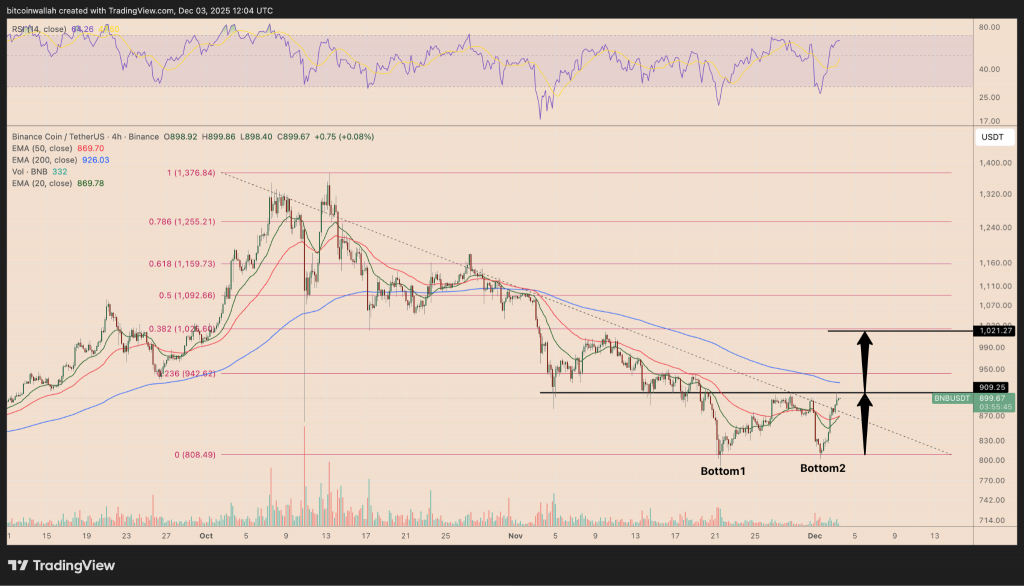
BNB reclaimed $900 this week after bouncing sharply from the $800–$820 demand zone, with multiple bullish technical structures now aligning behind a potential push back toward $1,000 in December. A double-bottom pattern on the 4H chart, combined with a clean breakout from a multi-week falling wedge, signals fading seller momentum and renewed appetite from dip-buyers. Liquidation heatmaps reveal over $112 million in short liquidations clustered near $1,020, suggesting a move toward that level could accelerate quickly if BNB breaks and holds above $900–$920.
BNB’s double-bottom and wedge breakout point toward a $1,000+ target. Source: Bitcoinwallah / TradingView
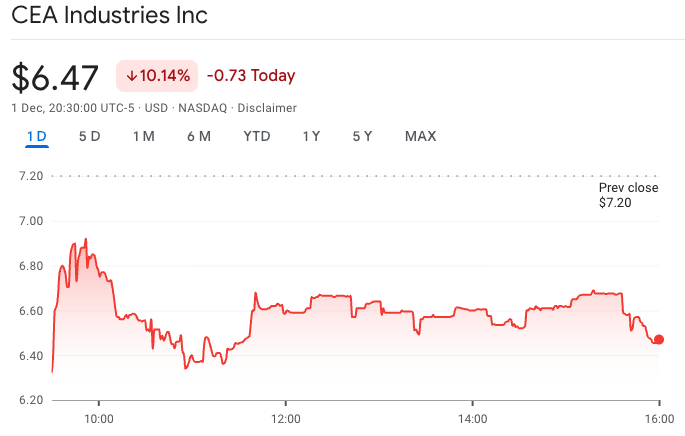
However, BNB’s narrative this week also revolved around turbulence in the corporate treasury sector. CZ’s YZi Labs launched a formal attempt to overhaul the board of CEA Industries — the largest public BNB-holding company — accusing management of destroying shareholder value after the stock plunged 89% from its July peak. YZi aims to reverse recent bylaw changes, expand the board, and install its own nominees, arguing that CEA has failed to execute on its strategy of becoming the leading BNB treasury company. CEA responded by reaffirming its commitment to the BNB strategy while opening a dialogue with YZi to resolve concerns.
CEA stock collapses as YZi Labs pushes for a board takeover. Source: Google Finance
CEA stock collapses as YZi Labs pushes for a board takeover. Source: Google FinanceDespite governance drama and broader market pressure, BNB has held up better than many large-cap assets this quarter, outperforming even as it trades well below its mid-October all-time high of $1,367. CEA’s reported holdings of 515,054 BNB at an average entry of $851 place its treasury slightly underwater, yet BNB itself remains up 17.8% year-to-date, reinforcing its relative strength during the latest downturn. If bullish technicals continue to hold — and especially if liquidation clusters begin to trigger — analysts say BNB could feasibly revisit the $1,020–$1,115 range before year-end.
If you are just starting out in crypto, it is advisable to stick to cryptocurrency projects that are less prone to volatility and are generally more established. While this approach does have a downside, as it becomes much more difficult to expect triple-digit or larger gains, the major upside is that you are not exposed to projects that have a chance of failing and, thus, losing your entire investment.
In order to identify projects that are stable and thus feature low volatility, you can start by following the parameters listed below:
The crypto asset has a market capitalization that places it into the cryptocurrency top 100 (roughly $200 million as of Autumn 2026)
The crypto asset is available for trading on the best crypto exchange platforms and can be exchanged for fiat currencies
The crypto asset boasts healthy liquidity ($100M/day and more), which allows you to execute buy and sell orders quickly and without slippage
The crypto asset is part of a reputable crypto project with clear goals, a realistic roadmap, and products and services that look to address real-world problems
Some of the best cryptos to buy for beginners are those that follow the above criteria and have earned their standing in the crypto market due to robust security, popular products and services, and clear growth potential. Some beginner-friendly crypto investments are:
Bitcoin
Ethereum
Litecoin
Cardano
BNB
It is worth noting that cryptocurrency investments are inherently risky, even if you stick to the biggest and most reputable projects. The reason for this is simple – the crypto sector is relatively new, and the landscape might look completely different in the future.
Best crypto for long-term
When deciding which cryptocurrency to buy for the long term, it’s important to consider projects that are well-established, have a strong community, are highly liquid, have a large market cap, and have a clear reason for existing (such as solving a real-life problem, introducing new functionality, etc.). Without these characteristics, a project might fail to survive in the long term, rendering it a bad long-term investment.
It is worth noting that, typically, most long-term crypto investors are looking for projects that have the potential to generate decent returns but also provide a degree of investment stability. Roughly speaking, only the largest cryptocurrencies fit the bill, as others have a low market cap and liquidity that doesn’t bode well for a long-term commitment (unless you’re prepared to take on more risk).
In addition to Bitcoin and Ethereum, there are a number of other cryptocurrencies that fit the criteria of being low-risk, long-term crypto investments.
If you are planning to hold onto your digital assets for a longer period of time, it is best to take care of crypto custody yourself. Holding large amounts of crypto on an exchange can be risky, as we’ve seen over the years with the collapse of high-profile exchanges like Mt. Gox and FTX. Use one of the reputable crypto hardware wallets to store your crypto. Ledger hardware wallets, for instance, allow you to manage your crypto holdings easily and provide a much higher degree of security than crypto exchanges or even software crypto wallets.
Best place to buy crypto
One crucial aspect to consider when choosing which platform to use to buy crypto is the range of cryptocurrencies and trading pairs available. Since different exchanges support varying digital assets, it’s important to choose a platform that accommodates the specific cryptocurrencies you intend to trade.
Additionally, assessing an exchange’s liquidity and trading volume is essential. Higher liquidity generally results in improved price stability and faster trade executions. Furthermore, it is prudent to examine the fees charged by the exchange, encompassing deposit, withdrawal, and trading fees. Comparing fee structures across different exchanges can help you identify the most cost-effective option that aligns with your trading style. With that said, here are some of the best exchanges on the market right now:
Binance – The best cryptocurrency exchange overall
Kraken– A centralized exchange with the best security
By diligently considering these factors, you can make an informed decision and select a cryptocurrency exchange that meets your requirements for security, variety, liquidity, and affordability.
How we choose the best cryptocurrencies to buy
At CoinCheckup, we provide real-time prices for over 40,000 cryptocurrencies, with the list growing by dozens each day. As you can imagine, making a selection of a dozen top cryptocurrencies to buy out of such an immense dataset can be difficult and will for sure lead to some projects that should be featured being omitted. To minimize the chance of that happening, we follow certain guidelines when trying to identify the best cryptocurrencies to invest in.
Availability
One of the most important factors for any cryptocurrency investment is the crypto asset’s availability, meaning how easy it is to buy and sell it across various cryptocurrency exchanges. We tend to stay away from assets that are not available on major exchanges and require complex procedures to obtain.
Market Capitalization
Another important metric for identifying whether a crypto project is worth covering its market cap. A high market cap means that the project has reached a certain level of adoption from users, making it less risky to invest in.
Growth Potential
While this metric is mostly subjective, it is still an important metric on which we curate our selection. We won’t feature projects that we think are stagnating or have no real upside in the future.
Purpose and Use Case
We consider the purpose and use case of cryptocurrency, particularly in a real-world setting. Some cryptocurrencies focus on specific industries or applications, such as decentralized finance, gaming, or supply chain management.
Team and Development
The team and people involved in the project can tell you a lot about the potential of a particular cryptocurrency project. We examine the team’s experience, expertise, and track record and evaluate the development activity and updates to ensure the project is actively maintained and evolving.
The bottom line: What crypto should you buy right now?
The decision of which crypto to buy now is dependent on your own risk profile and investment goals. For some, investing in a crypto asset with a proven track record like Bitcoin is the only type of exposure to crypto they are willing to take on.
Meanwhile, those with a higher risk tolerance might see Bitcoin as too stable, looking instead toward newer and smaller projects that carry a higher degree of upside.
Although more and more altcoins are created daily,Bitcoin remains a huge force in the overall crypto market, and at the moment of writing this, Bitcoin accounts for around 60% of the total crypto market cap. You want to mine crypto? Might as well go for the big one.
But what are the best Bitcoin miners out there? And, more importantly, how do you know which one is right for you? That’s what this article will cover.
You’ll need to select the best Bitcoin miners for 2026 to maximize your mining efficiency.
These mining rigs are engineered to provide optimal performance and potential returns based on Bitcoin price fluctuations and mining difficulty levels.
1. Bitmain Antminer U3S23H – The most powerful Bitcoin miner
The Bitmain Antminer U3S23H is a high-performance, hydro-cooled Bitcoin miner designed for large-scale and industrial mining operations. It delivers an impressive hash rate of 1,160 TH/s while consuming 11,020W of power, achieving an energy efficiency of 9.5 J/TH. This makes it a powerful option for professional miners looking to maximize their mining output.
The U3S23H uses Bitmain’s hydro-cooling technology to provide efficient heat dissipation and stable performance during continuous operation. Priced at $34,800 per unit, the miner is designed for professional mining facilities seeking high hash rates and efficient thermal management.
2. Bitmain Antminer S23 Hyd – High-performance Bitcoin miner with hydro cooling
The Bitmain Antminer S23 Hyd is a next-generation, water-cooled Bitcoin miner designed for large-scale and industrial mining operations. It delivers a hash rate of 580 TH/s while consuming 5,510W of power, achieving an efficiency of 9.5 J/TH. This places it among the most energy-efficient SHA-256 miners available at the time of its release.
Launched in January 2026, the S23 Hyd uses Bitmain’s liquid-cooling technology to provide quieter operation and improved thermal management compared to traditional air-cooled miners. The device is built for professional mining setups that aim to maximize output while keeping operating costs under control.
3. Bitmain Antminer S19j Pro+ – A great perfomer from Bitmain
The Bitmain Antminer S19j Pro+ remains one of the most reliable and efficient Bitcoin miners in 2026, offering an impressive hash rate of 122 TH/s that balances strong performance with dependable stability.
This versatile model consumes around 3,355 watts and includes advanced cooling mechanisms that help sustain consistent operation over long mining periods.
While it’s not the most powerful miner on the market, the S19j Pro+ provides an attractive balance of efficiency, cost, and durability—making it a smart choice for miners seeking steady returns without the premium price tag of newer models.
4. Bitmain Antminer S21 – Best value for the money
The Bitmain Antminer S21 stands out as the best value-for-money BTC mining rig on the list.
As one of the latest models in Bitmain’s lineup of ASIC miners, the Antminer S21 delivers outstanding computational power and easily outperforms most units from the previous S19 series. Despite its strong performance, it offers a solid efficiency-to-cost ratio, making it an appealing option for miners seeking high returns without overspending.
It’s worth noting that the Antminer S21 performs best in cooler environments, ideally between 0 and 30 degrees Celsius. Operating above this range can lead to increased power consumption and reduced overall efficiency.
5. Bitmain Antminer S19 XP Hyd – A Bitcoin mining powerhouse
The Bitmain Antminer S19 XP Hyd offers a remarkable hash rate of 255 TH/s, which makes it one of the most powerful Bitcoin mining rigs available in 2026. This rig is very efficient, so it allows for optimal energy consumption while maximizing mining output.
The innovative hydro-cooling technology significantly reduces operational noise levels, and as a result, this miner is quieter than you’d expect for a miner of this power. Launched in October 2022, it has quickly garnered a reputation for reliability and advanced performance in the competitive mining market.
The Antminer S19 XP Hyd is typically priced under $7,000. It’s a premium yet sought-after option for serious miners.
6. MicroBT Whatsminer M50S – A popular crypto mining rig from MicroBT
Among the top Bitcoin miners in 2026, The MicroBT Whatsminer M50S is another impressive crypto machine from MicroBT’s line of Bitcoin mining rigs. This mining rig operates at a hash rate of 127 TH/s, so it’s more than suitable for competitive Bitcoin mining operations.
Its power consumption is approximately 3,276 watts, which is a nice balance between performance and energy efficiency. The efficiency rating of the M50S is roughly 26 J/TH, indicating a moderate level of energy usage relative to its hashing capability.
Priced around $2,000, it positions itself as an appealing choice for miners who want effective performance without excessive costs.
7. Bitmain Antminer S19 XP – Slightly older but still capable miner
Yes, we’re back to Bitmain, but what can we say – there’s a reason they dominate the Bitcoin miners field. Their Bitmain Antminer S19 XP is a mining rig with an excellent price-to-performance ratio.
This powerful miner achieves a high hash rate of 141 TH/s and is one of the most efficient options available, despite it’s age.
You can expect to pay around $3,000 to $4,000 for the Antminer S19 XP. This is a very appealing price-to-performance ratio compared to most other options on the market.
This mining rig incorporates advanced cooling solutions to maintain optimal performance, ensuring durability and reliability during extensive mining operations.
Where the S19 XP excels is low power consumption while maintaining a high hashrate and excellent connectivity, which allows numerous S19 XPs to be used simultaneously for maximum mining output.
The S19 XP can be an excellent choice if you are thinking about joining a mining pool to secure the Bitcoin network (or Dogecoin, Litecoin, and other supported PoW networks).
8. MicroBT Whatsminer M30S++ – A proven option for Bitcoin miners
The MicroBT Whatsminer M30S++ miner boasts a hash rate of 112 TH/s, and has been one of the most popular MicroBT’s miners. Using the SHA-256 algorithm, the machine can be used to mine Bitcoin, Bitcoin Cash, and other cryptocurrencies that rely on the SHA-256 algorithm.
The Whatsminer M30S++ operates with a power consumption of 3,392 W, at an efficiency of 31.00 J/TH, which shows high effectiveness in terms of energy usage relative to its performance.
The Whatsminer M30S++ is known for its ease of use, allowing you to quickly set up and begin mining with minimal technical knowledge.
While the product has been in the market for almost four full years, it is still considered one of the best solutions out there in terms of the price-to-performance ratio.Its specifications make it a competitive choice in the market.
9. Bitmain AntMiner S19 Pro – An oldie but a goodie
Introduced in 2020, the Bitmain AntMiner S19 Pro remains a viable option for Bitcoin mining in 2026, thanks to its excellent power efficiency. With a hash rate of 110 TH/s, it operates at a power consumption of 3250 Watts, yielding an energy efficiency of approximately 29.5 J/TH.
This miner is designed with built-in power supply features, simplifying the setup process for users. It’s powered by the Bitmain BM1397 chip, which is a custom-designed ASIC chip for Bitcoin ASIC miners. Bitmain AntMiner S19 Pro also features a quadruple-fan cooling system that helps to keep it cool during operation.
The Bitmain AntMiner S19 Pro is recognized for its established reliability and performance metrics. Its average payback period ranges from 6 to 12 months, positioning it as a solid investment in the competitive mining landscape.
The only downside of the S19 Pro is that it is a bit older than some other products on our list and that it doesn’t necessarily boast the best ratio between power consumption and hash rate out there.
The Whatsminer M63S is the latest generation of MicroBT’s miners for the SHA-256 algorithm. The M63S generates between 406 – 416 TH/s of hashrate, making it one of the most powerful options on the market.
Utilizing the SHA-256 algorithm, the M63S is designed for serious miners looking to maximize their output while managing energy costs effectively. With a power consumption of 7308 watts, it achieves a power efficiency of approximately 18.5 J/T.
One of the most innovative features of the WhatsMiner M63S is its hydro-cooling system, which enhances cooling efficiency and operational stability. This system allows the miner to maintain optimal performance even under heavy workloads. This makes it suitable for large-scale mining operations.
The physical dimensions of the M63S are 86mm x 483mm x 663mm, and it weighs 27.5 kg, which is manageable for installation in various mining setups. The miner operates effectively within a temperature range of -5°C to 35°C.
While this is one of the most performant miners on the market, the M63S’ power comes at a price. At the time of writing, you can purchase the M63S for between $6,800 and $7,500.
11. Canaan Avalon Made A1466 – An efficient and stable Bitcoin miner from Canaan
The only item on our list that doesn’t come from Bitmain and MicroBT, the Canaan Avalon Made A1466 is the most profitable Bitcoin miner from Canaan at the time of writing.
It sports a hashrate output of roughly 150 TH/s, and its power consumption is rated at 3,230 watts. The power efficiency of the Avalon Made A1466 is 21.5 J/TH.
The miner’s design is robust, measuring 271 x 192 x 292mm and weighing 13kg. It makes sure that it can withstand the rigors of continuous operation in demanding environments.
The Avalon A1466 is equipped with a state-of-the-art cooling system that includes two powerful 12050 fans, ensuring optimal performance even in hot conditions. Its wide operating temperature range of -5°C to 35°C and humidity tolerance of 10% to 90% further demonstrate the miner’s versatility and reliability.
While Bitmain and MicroBT continue to dominate the Bitcoin mining space, Canaan’s Avalon Made A1466 could be a sign that competitors are beginning to catch up. Even though the Avalon Made A1466 can’t currently compete with the other top dogs in terms of efficiency, it might still be a good choice if you can get it for a good price.
Bitcoin mining profitability: Is mining Bitcoin still worth it
Bitcoin mining profitability hinges on several critical factors. These include:
Bitcoinprice fluctuations
Hardware costs
Electricity expenses
Network difficulty
You need to consider these variables to determine if mining Bitcoin is still worth it.
The ongoing fluctuations in Bitcoin prices significantly affect miners’ earnings, especially during bear or bull markets. High-end mining rigs typically have a payback period of 6 to 12 months, depending on the initial investment, operational costs, and market dynamics.
Electricity costs are another obvious factor. With average U.S. rates at approximately 16-17 cents per kWh, they significantly impact overall margins and potential profitability for miners.
Also, mining difficulty adjusts every two weeks based on network hash rates, so you must regularly monitor these metrics to assess your position within the competitive landscape.
Use mining profitability calculators, as these can help you accurately estimate returns based on your specific hash rates, power consumption, and current Bitcoin market conditions. These tools provide a clearer picture of whether mining Bitcoin remains profitable for you.
Choosing the right mining rig
Choosing the right mining rig is a vital step in making sure your Bitcoin mining operation is profitable and sustainable.
When selecting a mining rig, you should consider the hash rate, which directly affects your chances of successfully mining Bitcoin and is measured in terahashes per second (TH/s). A higher hash rate increases your likelihood of solving the complex math problems required for Bitcoin mining.
You also need to evaluate the energy efficiency of the rig, indicated by joules per terahash (J/TH), to minimize electricity costs, as this represents a significant portion of your overall operational expenses.
Assess the total cost of ownership, including the initial purchase price, electricity costs, and maintenance, to determine the rig’s long-term profitability. Also, consider noise levels, especially for home setups, as some mining rigs can be quite loud and may require additional soundproofing solutions.
Frequently Asked Questions
What factors should I consider when choosing a Bitcoin miner?
When choosing a Bitcoin miner, consider the following key factors:
Hash Rate: This measures the computational power of the miner and directly affects your chances of successfully mining Bitcoin. The higher the hash rate, the better.
Energy Efficiency: Look for a miner with a low energy consumption rate, measured in joules per terahash (J/TH). This minimizes electricity costs.
Cost of Ownership: Consider the initial purchase price, electricity costs, and maintenance. The total cost of ownership will help you determine the long-term profitability of the mining rig.
Noise Levels: Some mining rigs can be very loud, making them unsuitable for home setups without proper soundproofing.
How profitable is Bitcoin mining in 2026?
This really depends on several factors:
Bitcoin Price Fluctuations: The volatile nature of Bitcoin prices can greatly influence your earnings. The higher the price – the more profitable it is.
Electricity Costs: High electricity rates can reduce profitability, especially in regions where electricity is expensive. The average electricity cost in the U.S. is around 16-17 cents per kWh.
Mining Difficulty: This adjusts every two weeks based on the total network hash rate. A higher difficulty means it’s harder to mine Bitcoin.
Hardware Efficiency: High-end mining rigs usually have a payback period of 6 to 12 months, depending on the initial investment and operational costs.
Is it possible to mine Bitcoin using a mobile phone?
Yes, it’s technically possible to mine cryptocurrencies using a mobile phone, but it’s not really feasible due to the high computational power required. Bitcoin mining today requires specialized hardware, such as ASIC miners, which are far more powerful and energy-efficient than mobile devices. Mining on a mobile phone is more suited to altcoins using crypto mining apps.
The bottom line
Long away are the days when you could mine Bitcoin using your own personal computer with a regulator GPU or even CPU. Today, you’ll need powerful specialized hardware to mine BTC, and even with that hardware, mining a single Bitcoin can take a lot of time.
If you want to try mining crypto but don’t necessarily have the resources for a Bitcoin mining machine, you can consider trying out mining crypto on your mobile phone.
In 2026, the best ASIC miners showcase advanced technology and efficiency. Models like the Bitmain Antminer S21 XP Hyd and the Bitmain Antminer S21 lead in performance. The Antminer S19 XP Hyd offers innovative hydro-cooling technology, while the MicroBT Whatsminer M50S and the Antminer S19 XP provide excellent price-to-performance ratios. These rigs offer reliable operational capabilities, making them top choices for crypto mining.
In 2026, you’ll find numerous promising penny cryptos under 1 cent offering exciting investment opportunities. Shiba Inu (SHIB), with its robust community and potential tied to ShibaSwap, can’t be ignored. Amp (AMP), essential for secure digital payments, and Sia (SIA), which offers decentralized data storage, also hold significant promise.
Additionally, projects like SIDUS (SIDUS) in the Web3 gaming sector and meme coins such as Pepe Coin (PEPE) and Bonk (BONK) leverage cutting-edge technologies and entertainment value to deliver diverse avenues for growth.
But which ones of all the numerous penny cryptos are most likely to yield huge returns? That’s what this article aims to help with.
List of the best penny cryptos under 1 cent in 2026
Shiba Inu – All-encompassing crypto ecosystem with meme beginnings
Pepe Coin– Popular meme coin based on the Pepe meme
The 14 best penny crypto projects: Examining crypto coins under 1 cent with huge upside potential
When examining the best penny crypto projects under 1 cent, there are multiple categories and types that comprise our list. They include DeFi projects, NFTs, Meme coins, Gaming, and even Launchpads.
Each of these cryptocurrencies offers unique value propositions and high upside potential, and we believe them to be viable options for investors seeking substantial returns.
Shiba Inu (SHIB), currently priced at approximately $0.000005443, stands as a prime example of a penny cryptocurrency with substantial growth potential.
SHIB boasts a market cap of $3.21 billion, which shows significant investment and liquidity. Its strong community and ecosystem differentiate it from other penny cryptos, and its success has spawned a large number of copycats that are trying to be the next Shiba Inu. It’s also by far the largest cap on our list, and it has consistently stayed among the top 30 cryptocurrencies.
Future developments include integration within the ShibaSwap decentralized exchange, which aims to increase utility and use cases for the token.
SHIB exhibits high volatility, with a 24-hour trading volume of approximately 40%, appealing to risk-seeking investors.
As a prominent meme coin, Shiba Inu leverages community-driven growth strategies, making it a coveted investment with many positive price predictions for Shiba Inu.
2. Pepe Coin (PEPE) – Popular meme coin based on the Pepe meme
Pepe Coin (PEPE) has garnered significant attention in the meme cryptocurrency space since its April 2023 launch. As an ERC-20 token, Pepe Coin allows investors to participate in a vibrant ecosystem despite lacking unique utility among its meme coin counterparts.
Built around the popular Pepe the Frog meme, which has been a cherished part of internet culture since around 2008, Pepe Coin gained popularity within the cryptocurrency community shortly after its official release.
The Pepe Coin team describes PEPE as “the most memeable memecoin in existence” on their official website, presenting it as a competitor to other meme coins like Dogecoin and Shiba Inu. Notably, the team behind Pepecoin consists of anonymous members.
Pepecoin doesn’t offer any unique utility, as highlighted on its website. The team describes Pepe as being “fueled by pure memetic power” and emphasizes that the coin is “completely useless and for entertainment purposes only.”
Despite not having any major ambitions, Pepe Coin is the third most successful meme coin on the market, behind only Dogecoin and Shiba Inu.
3. Bonk (BONK) – Solana’s top meme coin
Bonk is a meme coin on the Solana blockchain, gaining major attention during its late 2022 launch when it was freely distributed to the Solana community. As outlined on the Bonk website, the project aims to diminish the influence of venture capital investors within the Solana ecosystem and restore power to “the people.”
The Bonk team reports over 130 integrations spanning gaming, gambling, decentralized finance, and NFTs. Notably, the Bonk community has developed multiple games where users can both spend and earn BONK.
Additionally, users can deposit their BONK into various DeFi tools to earn yield, participate in no-loss lotteries, and engage in other activities. Solana’s recent resurgence has also had a positive impact on BONK. In July 2025 alone, the token saw gains of over 300% against the US dollar. If Solana continues to build on its momentum, we could see Bonk becoming one of the best-performing meme coins on the market.
4. Amp (AMP) – Collateralizing digital payments with AMP
Amp (AMP) is a collateral token designed to facilitate secure and instant transactions in digital payments, making it a pivotal part of the Flexa payments network.
Currently valued at around $0.001, Amp has a market capitalization that reflects its growing adoption in mainstream payment systems.
The token’s functionality includes providing collateral to protect blockchain transactions against fraud and enabling instant transaction speeds. Amp’s unique utility in bridging crypto and fiat currencies positions it favorably for potential growth as more businesses adopt digital payment solutions.
As a penny crypto to buy, Amp offers substantial upside potential. This may make it an attractive investment with increasing demand for reliable financing mechanisms in the DeFi ecosystem.
Flare (FLR) is a Layer 1 blockchain designed to improve interoperability and provide decentralized access to data from other blockchains and the internet. Its infrastructure enables developers to build decentralized applications (dApps) that rely on secure and reliable external data.
Flare’s ecosystem is powered by the FLR token, which is used for transaction fees, staking, and network governance. The blockchain’s key features include the Flare Time Series Oracle (FTSO) and Flare Data Connector (FDC), which allow smart contracts to access real-world information and data from other blockchain networks.
Flare’s focus on blockchain interoperability and decentralized data solutions positions it for potential growth as demand for cross-chain applications and DeFi services increases.
As a penny crypto to buy, Flare offers potential upside driven by its expanding ecosystem and growing demand for reliable blockchain data infrastructure. However, its long-term performance will depend on developer adoption, network activity, and broader cryptocurrency market conditions.
6. Sia (SIA) – Decentralized data storage powered by smart contracts
Sia (SIA) stands out as a decentralized storage platform where users can monetize their unused hard drive space.
As a penny crypto currently priced at $0.001078, SIA offers an accessible entry point for investors.
Leveraging smart contracts, Sia guarantees secure and transparent transactions between storage providers and users.
With the growing demand for data storage, especially in cloud services, Sia’s cost-effective solutions position it for potential future appreciation.
7. Ravencoin (RVN) – Blockchain specialized for efficient asset issuance and transfers
Ravencoin (RVN), a fork of Bitcoin, has been crafted to streamline the creation and transfer of digital assets. We will admit, this is slight cheating, considering that RVN is priced slightly above 1 cent. Still, we feel RVN offers a good investment opportunity for those seeking significant upside potential with smaller investments.
It employs the KAWPOW algorithm, enhancing mining efficiency and decentralization. As of October 2026, Ravencoin has seen increased community engagement and adoption, signaling growing interest and practical use cases.
Ravencoin can fulfill a variety of use cases. The blockchain can be used to issue tokenized securities such as stocks, digital collectibles, fungible tokens, tokens representing physical items such as gold bars, and more.
Anyone who wants to create a new crypto asset on the Ravencoin network has to burn a specified amount of RVN coins. Assets issued on Ravencoin can have many parameters (such as the amount of decimal numbers, fungibility, etc.), allowing users to fine-tune the assets they issue for specific use cases.
Its strong focus on asset tokenization positions it favorably in the evolving blockchain environment, potentially driving demand and value appreciation. With its innovative technology and increasing adoption, Ravencoin stands out as a promising penny crypto under 1 cent with huge upside potential.
8. BitTorrent (BTT) – Decentralized file sharing powered by BTT
BitTorrent (BTT) is the epitome of a high-risk, high-reward investment opportunity. If you’re into tech at all and haven’t been living under a rock for the past decade, you’ve heard of BitTorrent.
What you may not have heard is that it was bought by Justin Sun (the controversial founder of Tron), and that ever since then, BitTorent has been focusing on using blockchain technology.
This decentralized file-sharing protocol leverages blockchain technology to enhance speed and efficiency. Essentially, it incentivizes users to share files via P2P (peer-to-peer) mechanisms, while utilizing a decentralized filing system.
With a substantial user base of millions, BTT boasts a robust ecosystem. The recent integration with TRON’s blockchain has streamlined transactions and enhanced service offerings.
9. eCash (XEC) – Blockchain payments on a “mankind scale”
eCash (XEC) is targeted at enhancing transaction efficiency while utilizing a unique consensus protocol.
It features instant transactions and secure payment functionalities, positioning it favorably in the evolving landscape of digital assets.
The project’s roadmap suggests continuous developments and huge ambitions. The eCash team is focused on a lofty goal – building a blockchain network on the so-called “Mankind Scale”, which would be able to process over 5,000,000 transactions per second (TPS).
Easier said than done, of course, but if the team comes anywhere close to that adoption goal, XEC, the native token of the eCash platform, could easily earn the title of the most promising crypto under a penny.
With a current price below 1 cent, eCash presents an accessible investment opportunity for those seeking exposure to cryptocurrencies with high upside potential.
10. Jasmy – IoT-focused project bringing data sovereignty to users through blockchain
JASMY (JASMY) is the native token of the Jasmy platform, a project focused on redefining data ownership in the era of the Internet of Things (IoT). Founded by former Sony executives, Jasmy combines blockchain and IoT technology to give individuals full control over their personal data. Instead of allowing large corporations to collect and monetize user information, Jasmy aims to build a decentralized system where users can securely manage and benefit from their own data.
One of the core ideas behind Jasmy is data sovereignty. The platform enables users to store personal information in secure, decentralized environments and decide who can access it. By shifting control from centralized tech giants to individuals, Jasmy seeks to create a fairer digital economy where data becomes a personal asset rather than a corporate commodity.
Jasmy operates on the Ethereum blockchain and introduces tools such as the Secure Knowledge Communicator (SKC) and the Smart Guardian (SG). These components are designed to facilitate secure communication between IoT devices while protecting sensitive information. This infrastructure supports practical use cases, particularly in industries where secure data exchange between devices is critical.
The JASMY token plays a central role within the ecosystem, powering transactions and incentivizing data sharing between users and businesses. Companies that want to access user data must compensate individuals through the platform, creating a marketplace for trusted data exchange.
We think JASMY stands out by targeting the growing intersection of blockchain and IoT, offering a clear real-world use case centered on data ownership and privacy in an increasingly connected world.
11. Baby Doge Coin (BabyDoge) – Taking on Dogecoin with transaction and tokenomics improvements
Launched in June 2021, BabyDoge operates with a deflationary token model, where 5% of each transaction is redistributed to existing holders, incentivizing long-term holding.
Baby Doge Coin (BABYDOGE) is a Dogecoin-inspired cryptocurrency (we know, who would have thought right) that seeks to improve upon the original meme coin with greater transaction speeds, hyper deflationary tokenomics, integrated staking system, and, well, adorableness.
During the 2022-2023 bear market, Baby Doge Coin added several new features, including a chess game and an AI image generator, revamped its website and token burning portal, and more. The token also outperformed more than 50% of the top 100 largest market-cap digital assets, including the likes of Dogecoin, Solana, and Shiba Inu.
If its performance during the past crypto winter is any indication, the meme coin could see a major price boost once the market trend reverses.
BabyDoge’s commitment to supporting charitable causes, particularly in pet rescue organizations, enhances its appeal to socially conscious investors.
With secured partnerships and marketing initiatives, this meme coin holds potential for significant price appreciation as community engagement grows.
All these reasons make it one of the likeliest meme coins to explode candidates.
12. Holo (HOT) – Avoiding centralized Internet authorities with Holochain apps
Holo (HOT) stands out in this space, serving as the native cryptocurrency of the Holochain platform. Specifically designed to support decentralized applications (dApps) with a focus on scalability and efficiency, HOT facilitates transactions within the Holo ecosystem while doing away with centralized entities.
With all aspects of our lives moving online at an increasing pace, we rely more and more on centralized entities like Google, Amazon, and Microsoft for both computational power and cloud storage. Holo (HOT) is the native token of the Holochain platform, which aims to disrupt the established paradigm.
At its core, Holochain is an open-source P2P framework that allows users to take advantage of hApps (Holochain apps) that connect their devices among themselves without having to rely on centralized servers.
Applications run on users’ devices, putting them in charge of their identities and data. Users who host hApps are rewarded with HOT, which creates clear and natural adoption mechanics that could help the token grow in price drastically as the network expands.
13. DigiByte (DGB) – DeFi ecosystem with a long and successful track record
DigiByte (DGB) is the oldest project on our list, launched more than a decade ago, in January 2014. That makes it older than Ethereum, crazy to think about.
DigiByte is a community-driven project that places emphasis on secure payments and communications. The DGB token acts as a medium of exchange between dApps and smart contracts on the DigiByte platform.
The DigiByte blockchain platform is split into three layers. The top layer acts as an app store of sorts and allows for the development and hosting of decentralized applications (dApps). The middle layer ensures security and administration as well as stores the public ledger.
Finally, the bottom layer facilitates communication and operating processes. DGB could turn out to be one of the cryptos under a penny that will explode as long as the DigiByte network continues expanding.
Despite its low price, DigiByte’s active development and increasing partnerships in various sectors make it a promising candidate for investors looking for high upside potential in penny cryptos.
14. Zilliqa (ZIL) – A powerful dApp platform powered by ZIL
Zilliqa (ZIL) is known for its sharding technology, which considerably enhances scalability. It’s a public blockchain platform designed to address the scalability limitations of other blockchains, such as Ethereum and Bitcoin.
With a focus on smart contracts and decentralized applications, Zilliqa’s innovative approach positions it favorably in the rapidly growing blockchain ecosystem.
The current market cap for Zilliqa is approximately $250 million, and yes, once again, the price is slightly higher than 1 cent, it’s currently standing at $0.0133.
Zilliqa has demonstrated promising partnerships and collaborations that could drive adoption, particularly in sectors like gaming and finance.
As blockchain scalability becomes increasingly necessary, Zilliqa’s solutions may enable broader utilization and adoption, leading to potential price appreciation under 1 cent.
When investing in penny cryptos under 1 cent in 2026, you should know that usually, it means you are entering a high-risk proposition. Yes, there is a chance for huge returns, and getting that 10x, 100x, or even a 1000x is not impossible if you know how to find new crypto with huge potential.
However, you should never allocate a big chunk of your portfolio into these kinds of projects. Try to aim to have no more than 3-5% of your portfolio in penny cryptos, as a way to counter the high-risk investments with safer ones.
Cryptocurrency is a relatively new form of digital money that has the potential to change the world. However, if we’re being realistic, many cryptocurrencies are not exactly convenient to use. High transaction costs are one of the biggest culprits for this, as sending a single transaction on Bitcoin or Ethereum can cost tens of dollars during periods of high congestion.
Thankfully, there’s quite a few cryptocurrencies that are highly efficient and will allow you to save money on cryptocurrency transaction fees. We’ve identified the cryptos with lowest fees and compiled a list of the cheapest cryptos to transfer.
List of the cheapest cryptos to transfer:
Solana – The fastest and most efficient smart contracts platform
Stellar – Highly efficient blockchain for transferring assets
XRP – A very fast cryptocurrency for value transfers
Monero – The leading privacy coin with efficient transactions
Algorand – Eco-friendly and fast smart contracts platform
Litecoin – A faster and cheaper counterpart of Bitcoin
NEAR Protocol – A smart contracts platform with sharding technology
Gram – A scalable crypto that’s closely integrated with Telegram
Exploring the 13 cheapest cryptos to transfer with low transaction fees
Here’s our list of the cheapest crypto to transfer. We tried to provide a selection that’s as diverse as possible, covering both smart contract platforms and simpler cryptocurrencies.
1. Solana – The fastest and most efficient smart contracts platform
Solana is a blockchain for smart contracts that is based on a highly scalable architecture. It utilizes a unique Proof-of-History mechanism combined with a Proof-of-Stake algorithm to deliver impressive throughput and very low transaction costs.
In real-world scenarios, Solana is handling about 5,000 transactions, although the platform has displayed the ability to handle as many as 65,000 transactions per second in testing.
A standard transaction on Solana will only cost you about $0.0024 in fees, which is some of the lowest crypto transaction fees you’ll find. More complex transactions such as NFT transfers or smart contract interactions cost slightly more, although not nearly as much as they do on Ethereum.
If you’re looking to explore decentralized finance, NFT protocols or blockchain-powered gaming but don’t want to spend a significant amount on money of fees, Solana is one of the strongest candidates on the market today.
Despite a turbulent 2022, the Solana ecosystem is still quite diverse and you’ll be able to find decentralized applications for practically every blockchain use case on the Solana blockchain.
2. Stellar – Highly efficient blockchain for transferring assets
Stellar is a blockchain platform that’s focused on highly efficient asset transfers. You can use the Stellar blockchain to make transactions with the platform’s native currency XLM, or use the protocol’s built in decentralized exchange functionality to seamlessly swap between the different assets issued on the Stellar blockchain.
Stellar was founded by XRP co-founder Jed McCaleb and Joyce Kim. Stellar’s architecture shares a lot of similarities with the technology underpinning XRP, although the two platforms have diverged to an extent since Stellar launched in 2014.
When using the Stellar blockchain, you’ll usually be paying around 0.0001 XLM per transaction, which is only a fraction of a cent in USD terms. In addition to the low cost, Stellar handles transactions very quickly, as you can expect your transactions to be finalized in between 3 and 5 seconds.
3. XRP – A very fast cryptocurrency for value transfers
XRP, a well-established cryptocurrency released in 2012, stands out from Bitcoin by employing the XRP Ledger Consensus Protocol instead of Proof-of-Work. This unique approach allows XRP to process transactions quickly and with very low fees.
However, some members of the crypto community criticize XRP for potentially lacking decentralization. This is because a significant portion of the XRP supply is held by Ripple, a US-based fintech company that integrates XRP into its cross-border payment solutions. In the early days, Ripple received 80 billion XRP (80% of the supply) as a gift from the XRP founders.
Although XRP doesn’t support smart contracts, it excels in facilitating efficient value transfers. As a result, XRP is commonly used for moving funds between different cryptocurrency exchanges.
When setting up an XRP wallet, it’s essential to consider that each account on the XRP Ledger must maintain a reserve of at least 10 XRP, which cannot be spent.
4. Dash – Cryptocurrency designed for everyday use
Dash is one of the longest-running projects in the cryptocurrency space, as it made its debut already in January of 2014. Dash, which stands for “digital cash”, aims to provide a decentralized peer-to-peer currency that’s still fast and cheap enough to be suitable for every day use.
In fact, most of the efforts of the Dash project are focused on integrations with merchants and promoting the use of DASH for everyday purchases.
To achieve its impressive efficiency, Dash combines Proof-of-Work with a masternode system. Dash is also capable of providing additional privacy to transactions through its (optional) PrivateSend feature.
A Dash transaction will cost you less than $0.0004 in fees, and transactions can be confirmed in under 2 seconds if you utilize the InstantSend feature, which leverages Dash’s network of masternodes.
If you’re looking for a simple cryptocurrency to use on a daily basis, Dash is a solid option. However, the project’s relevance in the crypto market has been fading in recent years, which has hampered Dash’s adoption as a payments platform.
Dogecoin is a meme coin that made its debut back in December of 2013. Thanks to its light-hearted and humorous approach to crypto, Dogecoin quickly captured the attention of the cryptocurrency community and it remains the biggest meme coin to this day.
However, Dogecoin is not just a joke. It’s a fully functioning digital currency that can be used for quick and cheap peer-to-peer payments. In addition, it’s supported by an impressive number of cryptocurrency exchanges and other businesses, which means it’s not too hard to find a place where you can use your DOGE.
To be sure, the Dogecoin network is not quite as robust as Bitcoin. However, it still offers more than enough security for everyday transactions, and has relatively low transaction costs.
In most cases, you’ll be paying less than $0.043 worth of Dogecoin per transaction, although fees can increase sharply during periods of high demand. Dogecoin is also relatively fast, as it has a block time of just 1 minute. So, your Dogecoin transactions should be completed about 10 times as fast as your Bitcoin transactions.
6. TRON – A smart contracts platform with low fees
TRON is a blockchain platform similar to Ethereum but utilizes a Delegated Proof-of-Stake (DPoS) consensus mechanism, enabling it to process transactions with minimal costs.
One of TRON’s key advantages is its extremely low transaction fees compared to Ethereum, making it a preferred choice for stablecoin transactions, particularly with USDT.
Although TRON’s decentralized application (dApp) ecosystem isn’t as expansive or diverse as Ethereum’s, it remains a viable option for those looking to engage in DeFi and other on-chain activities without incurring high transaction fees.
7. Nano – A cryptocurrency that charges no transaction fees
Nano is arguably the cheapest cryptocurrency to use, as it doesn’t have any transaction fees. This is enabled by Nano’s unique architecture, which doesn’t use a traditional blockchain architecture, but is instead a DAG (directed acyclic graph). In addition to practically eliminating costs, Nano’s DAG architecture also enables extremely fast transactions.
However, you have to keep in mind that even though Nano doesn’t have any transaction fees, using it in everyday situations can be a challenge as it simply doesn’t have that much adoption. At the time of writing, Nano is ranked 256th in the cryptocurrency rankings with a relatively modest market capitalization of $45 million.
8. Zcash – A privacy coin with low transaction fees
Zcash is one of the leading privacy coin options on the market. While the overall design of Zcash takes a lot of inspiration from Bitcoin (including the 21 million ZEC supply cap), it implements cutting-edge zero knowledge cryptography to enable fully private transaction.
In Zcash, transactions can be either public or private, depending on which address you’re using. So called t-addresses are fully transparent and quite similar to Bitcoin, while z-addresses offer full privacy — nobody can see how many coins you are sending and who you are sending your coins to.
A Zcash transaction under typical network conditions will only cost you about $0.35 worth of ZEC, and the protocol targets a 75-second block time, which is considerably faster than Bitcoin.
Zcash will be quite interesting to follow moving forward as there are serious plans to transition Zcash from its current Proof-of-Work consensus algorithm to a new Proof-of-Stake system. This would not only make Zcash much more environmentally friendly, but could potentially also open the door for scalability improvements which would result in faster and cheaper transactions.
9. Monero – The leading privacy coin with efficient transactions
Monero is currently the largest privacy coin on the market, boasting an impressive market capitalization of around $3 billion. Monero implements a suite of privacy-protecting technologies that obfuscate the amount and destination of any given transaction. Notably, privacy on Monero is not optional – all transactions are fully private. This makes XMR a highly fungible cryptocurrency, as it’s practically impossible to tag or blacklist specific XMR coins.
Despite its very strong privacy features, Monero is very efficient to transact with. Sending XMR will cost you less than $0.14 in fees, and the relatively swift block time of 2 minutes means you won’t need to wait too long for your transaction to complete.
However, you shouldn’t expect any fancy smart contracts feature from Monero, as the project is laser-focused on enabling straightforward peer-to-peer value transfers that are as private as possible.
10. Litecoin – A faster and cheaper counterpart of Bitcoin
Having launched already in October of 2011, Litecoin is one of the most established cryptocurrency projects on the market. Litecoin is similar to Bitcoin in many respects, although it implements a number of key tweaks designed to make it more efficient and suitable for everyday use.
Compared to Bitcoin, Litecoin has a 4x larger supply cap (84 million LTC) and a 4x faster block time (about 2.5 minutes). In addition, it uses the Scrypt hashing algorithm, instead of the SHA-256 algorithm Bitcoin is based on.
If you’re already comfortable with using Bitcoin, Litecoin will feel extremely familiar to use. When sending LTC, you’ll typically be paying only about $0.0033 in fees, and your transaction will be confirmed faster thanks to the quicker 2.5 minute block time.
11. Algorand – Eco-friendly and fast smart contracts platform
Algorand is a blockchain platform designed for smart contracts that operates on a Proof-of-Stake consensus algorithm. Founded in 2017 by Silvio Micali, a renowned computer scientist known for his contributions to cryptography, the Algorand project launched its mainnet in 2019. Over time, the platform has been upgraded to enhance its smart contract capabilities and support the issuance of custom tokens.
Algorand prides itself on being eco-friendly and efficient, with a focus on offering low transaction fees. The minimum transaction fee is 0.001 ALGO, meaning that 1 ALGO can potentially cover 1,000 transactions.
This feature makes Algorand an attractive option for users interested in exploring use cases like NFTs (Non-Fungible Tokens) and DeFi (Decentralized Finance) without having to contend with the high transaction fees associated with Ethereum and other platforms.
12. NEAR Protocol – A smart contracts platform with sharding technology
NEAR Protocol is a layer-1 blockchain that employs a sharding mechanism called Nightshade alongside a Proof-of-Stake consensus algorithm. It is designed to drive the mass adoption of web3 by offering strong scalability and developer-friendly features.
The project envisions NEAR as a web3 operating system, allowing developers to build applications in widely used languages like JavaScript while leveraging community-built components for greater efficiency. Additionally, NEAR makes onboarding easy even for users who don’t yet own cryptocurrency, making it an accessible entry point into web3.
Transactions on NEAR Protocol finalize in under three seconds and cost less than $0.01 in fees. As the Nightshade sharding implementation continues to evolve, NEAR’s scalability is expected to improve even further.
For those seeking an efficient smart contract platform, NEAR Protocol stands as a strong alternative to more established options like Solana and Polygon.
13. Gram – A scalable crypto that’s closely integrated with Telegram
Gram is the native cryptocurrency of the TON Blockchain, a Proof-of-Stake network designed with multiple scaling technologies to support large-scale adoption.
Gram relies on a Proof-of-Stake consensus mechanism run by validator nodes. While anyone can become a validator, doing so requires a substantial amount of Gram. Token holders who do not run their own nodes can participate as nominators by delegating their Gram to validators, helping them meet the required staking threshold.
Although the network now operates on Proof-of-Stake, Gram’s initial coin distribution was carried out through mining to ensure a fair launch.
The project is based on technology originally developed by the team behind the Telegram messaging app. They created a blockchain called The Open Network but halted development due to regulatory challenges. Today, Gram is community-led and independent from Telegram. However, the Telegram app continues to integrate Toncoin, most recently through Telegram-based clicker games and other in-app features.
The Gram Blockchain is highly efficient and cost-effective. A standard TON transaction costs around 0.0008 Gram in fees, which is under $0.001 at current prices. Sending Gram-based tokens, known as Jettons, costs slightly more at about 0.037 Gram, or roughly $0.49.
Toncoin is a practical choice for low-cost crypto transfers. It is listed on most major cryptocurrency exchanges and can also be used directly within the Telegram app. The network also supports the USDT stablecoin, further expanding its usefulness for everyday transactions.
Transaction fee comparison
Let’s take a look at how the cryptocurrencies we have featured square up against each other. As you can see, all of them are inexpensive to use, with some having practically negligible transaction costs. Please note that the transaction fees and speeds are estimates of what you can expect during normal network conditions. If there is a surge in demand for the blockchain you’re using, transaction costs will be higher, and speeds will be lower.
Native Asset
Market Cap*
Transaction Fees
Transaction speed
Solana
SOL
$64.52 billion
$0.03
3 seconds
Stellar
XLM
$6.79 billion
Less than $0.01
3-5 seconds
XRP
XRP
$87.41 billion
Less than $0.01
3-5 seconds
Dash
DASH
$657.84 million
Less than $0.01
1-2 seconds
Dogecoin
DOGE
$14.51 billion
$0.005
1 minute (1 confirmation)
TRON
TRX
$31.54 billion
Less than $1
3 seconds
Nano
XNO
$43.91 million
No fees
Under 1 second
Zcash
ZEC
$20.58 billion
$0.02
75 seconds (1 confirmation)
Monero
XMR
$10.07 billion
Less than $0.05
2 minutes (1 confirmation)
Algorand
ALGO
$1.05 billion
Less than $0.01
3 seconds
Litecoin
LTC
$4.94 billion
$0.01
2.5 minutes (1 confirmation)
NEAR Protocol
NEAR
$6.27 billion
Less than $0.01
3 seconds
Gram
GRAM
$4.11 billion
Less than $0.001
3-5 seconds
The bottom line
Hopefully, we helped you identify the best options available if you’re looking to send cryptocurrency with the lowest transaction fees. The cheapest crypto to send will allow you to make transactions at a cost of a fraction of a cent, and have your payments completed in a matter of seconds.
On-chain data shows that the top 50 largest addresses on the XRP rich list control about 40% of XRP’s circulating supply, worth about $25,15 billion at current market rates. Meanwhile, the top 10 largest XRP holders control nearly 10 billion XRP coins, worth $13.47 billion.
In this article, we are going to explore the current distribution of XRP among top addresses and examine who the largest XRP holders are.
XRP rich list by the percentage of holdings in 2026
As of October 2026, there are 63,090,000,000 XRP in circulation, with the XRP cryptocurrency’s market cap standing at $88.42 billion. The split between the top 50 addresses – each of which holds at least 200 million XRP – and the remaining addresses is roughly 60% to 40%.
XRP rich list distribution in 2026:
Top 10 XRP Addresses: 9,913,484,862 XRP (15.71% of circ. supply)
Top 10-50 XRP Addresses: 15,240,673,665 XRP (24.16% of circ. supply)
Remaining Addresses: 37,935,841,473 XRP (60.13% of circ. supply)
Total Addresses: 6,114,724
The ratio of circulating XRP supply between the top 50 largest addresses and the remaining 4.8 million is roughly 60–40.
The 10 top addresses on the XRP rich list
There is no indication that the largest XRP addresses belong to individual holders. Five addresses belong to large cryptocurrency exchanges, and four belong to Ripple. There is only one address that is unknown and could potentially belong to an unknown XRP whale, although it’s more likely that the address belongs to a company.
UPbit controls the most XRP out of all exchanges, with 12 addresses in the top 50 holding a combined 6.43% of all coins in circulation. They are also the largest holder of XRP, with 13 addresses in the top 50.
The bottom line: The top 10 addresses on the XRP rich list hold 16% of all circulating XRP coins
As of October 2026, most of XRP’s circulating supply is centralized in a couple of dozen addresses, with just the top 10 addresses holding nearly 16% of XRP. Moreover, the amount of XRP held by the top 50 addresses is slightly lower than the number of XRP held by the remaining 4.8 million users.
For comparison, the top 10 Bitcoin addresses hold 12.7% of the BTC circulating supply, which highlights Bitcoin’s high level of supply decentralization. It is worth noting that XRP is much more decentralized than some other cryptocurrencies – the top 10 addresses on Ethereum, for instance, control 61% of the circulating supply, whereas Dogecoin’s 10 largest addresses hold a staggering 44.2% of all DOGE.
XRP is a unique cryptocurrency that has one of the most devoted communities in the crypto and blockchain space. Although it could certainly be a strong performer in the future, it’s practically impossible for Ripple to reach $10,000.
In this article, we will explore potential future price targets for XRP and explain why you shouldn’t expect XRP to ever reach a price of $10,000, or anywhere close to it, for that matter. We will also consult some XRP price predictions to get a better idea of where the price of XRP could head in the near to medium term.
Could Ripple reach $10,000? Here’s why it’s impossible
The reason why XRP won’t ever reach a price of $10,000 is not complicated – the supply of XRP is simply too large. XRP has a maximum supply limit of 100 billion coins. While not all XRP coins are currently in circulation, the coin still has a substantial circulating supply of 63.09 billion.
Even if we take the more conservative figure of 63.09 billion circulating XRP coins, the implied market capitalization if XRP were to trade at $10,000 would be $630.9 trillion.
To illustrate why this figure is impossibly large, we should point out that the GDP of the United States is $25.4 trillion, and the world’s largest company, Nvidia, has a market capitalization of $5.67 trillion.
To draw a comparison from the cryptocurrency space, we can note that the highest market cap ever reached by Bitcoin was $2.48 trillion. If XRP traded at $10,000, its market cap would be 245 times larger than Bitcoin’s market cap at its historical peak.
So, even if XRP became the world’s largest cryptocurrency, it would be extremely unlikely to hit a price of $10,000. The only realistic scenario for that to happen would be a drastic reduction in the XRP supply through a redenomination or a major burn program.
Although a small amount of XRP is already being burned with each transaction, the burn rate is simply not fast enough to decrease the supply to an amount where $10,000 would be a realistic price target for XRP.
The XRP Ledger has been in operation for over a decade, but only about 12.2 million XRP have been burned through this mechanism. This is only 0.012% of the maximum supply of XRP.
Now, let’s consider various XRP price targets and what they would mean for the market capitalization of XRP. This is a good way to quickly gauge whether a certain price target is realistic or not. We calculated the figures both for XRP’s current circulating supply, as well as its max supply.
XRP price
Implied market cap (63.09B XRP)
Implied market cap (100B XRP)
$0.50
$31.55 billion
$50 billion
$1
$63.09 billion
$100 billion
$5
$315.5 billion
$500 billion
$10
$631 billion
$1 trillion
$50
$3.16 trillion
$5 trillion
$100
$6.31 trillion
$10 trillion
$500
$31.6 trillion
$50 trillion
$1,000
$63.1 trillion
$100 trillion
$5,000
$315.5 trillion
$500 trillion
$10,000
$631 trillion
$1 quadrillion
When it comes to speculating about the potential future valuations of altcoins, we believe that using the historical market cap of Bitcoin is the best idea since it’s a benchmark that has already been demonstrated as possible for a crypto asset to achieve.
To reach Bitcoin’s historical market cap peak of $2.48 trillion, XRP would have to trade at a price of $54.31 (assuming the current circulating supply of 63.09 billion XRP coins). We believe that this is the upper bound of what is possible for XRP to achieve, although it’s of course still unlikely, as it would require a 38.52x increase from the current price of XRP, which is $0.58 at the time of writing this article.
XRP price prediction for 2026 & 2027 – How high can XRP go?
According to our XRP price prediction, the price of XRP is expected to increase over the next year.
However, the medium-term outlook for XRP appears more promising, at least according to CoinCheckup’s price prediction. XRP is forecast to trade at an average price of $1.53 in October 2026 before experiencing a slight decline toward the end of the year, reaching $1.39 in December.
The outlook improves in 2027, with XRP predicted to gain momentum in the spring. The cryptocurrency is forecast to reach a maximum price of $2.16 in April, followed by an average price of $2.05 in May. Although some price fluctuations are expected throughout the summer, XRP could see a more substantial rally toward the end of the forecast period.
By October 2027, XRP is projected to reach an average price of $2.76, with a potential high of $3.21. This would represent a 130.78% increase compared to the reference price used in CoinCheckup’s forecast.
Will XRP go up?
It’s fair to say that XRP has been displaying an impressive performance in the past year, even when compared to other leading cryptocurrencies. While XRP is yet to improve upon the all-time high it set in early 2018, it came fairly close in July 2025, reaching $3.64.
An important factor that allowed XRP to approach its all-time high is the conclusion of the legal battle between Ripple and the U.S. Securities and Exchange Commission (SEC). The SEC accused XRP of being an unregistered security that Ripple issued and sold, a claim Ripple disputed.
The cloud of regulatory uncertainty hanging over XRP has naturally led to hesitation among some investors about investing in XRP. Additionally, in response to the lawsuit filed by the SEC, numerous cryptocurrency exchanges opted to delist XRP, aiming to sidestep potential regulatory complications.
Despite these challenges, the outlook for XRP might still be optimistic. Should the legal battle conclude in Ripple’s favor, it’s possible that XRP will start building up momentum in the markets.
Of course, we also have to mention fundamental developments that are improving the capabilities of the XRP Ledger.
For example, the Xahau sidechain allows developers to create smart contracts that can interact with objects and balances on the XRP Ledger. This functionality is implemented through a feature called Hooks. Thanks to Hooks, developers can write smart contracts in different programming languages, and the contracts are then compiled into WebAssembly.
In addition, many users might not know that the XRP Ledger now has an AMM (automated market maker) feature. This makes it possible for users to swap between different assets issued on the XRP Ledger, similarly to how Uniswap enables token swaps on the Ethereum blockchain.
The bottom line
Even though you shouldn’t expect Ripple to hit $10,000, XRP could certainly still have a bright future ahead of it. For realistic price targets, the best idea is probably to take a look at the historical market capitalization of Bitcoin and consider how certain XRP price targets would compare to it.
If you want to learn more about the crypto markets, make sure to take a look at our article showcasing the best cryptos to buy now.
Uniswap’s UNI token surged 20% in 24 hours, pushing the token above key EMA support levels and reigniting bullish momentum.
Open interest jumped 43% to $148 million while whale accumulation accelerated, signaling growing institutional participation.
The Stochastic RSI has entered overbought territory, raising the possibility of a short-term pullback before another attempt at $4.
Uniswap reclaims momentum after explosive 20% rally
Uniswap (UNI) emerged as one of the market’s top-performing cryptocurrencies over the last 24 hours, posting over 20% gain as buyers returned aggressively to the decentralized exchange token.
The rally pushed UNI above several key exponential moving averages that had acted as resistance throughout the recent correction. At the same time, trading volume surged sharply, confirming that the breakout was supported by meaningful market participation rather than isolated buying activity.
The recovery has significantly improved UNI’s short-term technical structure and shifted trader focus toward higher resistance zones, particularly the psychological level at around the $4 level.
Whales are accumulating as institutional demand returns
On-chain activity suggests larger market participants are becoming increasingly active.
Data shows whale wallets have continued accumulating UNI throughout the rally, a sign that larger investors may be positioning for additional upside. Historically, sustained whale accumulation during price advances has often supported trend continuation rather than signaling immediate profit-taking.
Institutional participation is also showing signs of strengthening.
Open interest across UNI derivatives markets surged 43% over the past 24 hours, reaching approximately $212 million. Rising open interest alongside rising prices typically indicates that fresh capital is entering the market rather than existing traders merely rotating positions.
Adding to the bullish narrative, the number of depositing addresses doubled during the same period, climbing to 378 addresses. The increase suggests heightened network activity and growing market participation as traders reposition around UNI’s renewed momentum.
Momentum remains strong, but traders should watch for overheating
While the broader picture has turned increasingly bullish, some technical indicators suggest the rally may need time to cool off.
UNI’s Stochastic RSI has moved into overbought territory, indicating that buying momentum has reached elevated levels. Historically, readings in this zone often precede periods of consolidation or short-term corrections as traders lock in profits.
That does not necessarily imply a trend reversal.
Strong rallies frequently remain overbought for extended periods when supported by robust volume and improving market sentiment. However, it does suggest traders should be prepared for increased volatility as UNI approaches major resistance.
The key question is whether buyers can absorb any near-term selling pressure without losing control of the broader uptrend.
Can UNI reclaim $4?
The next major test for bulls is becoming increasingly clear.
After reclaiming key moving averages and attracting fresh capital from both spot and derivatives markets, UNI now appears positioned for an attempt at the $4 psychological level.
A successful break above that zone would strengthen the case for a broader trend reversal and suggest a more bullish Uniswap price prediction. Rising open interest, whale accumulation, and improving participation metrics all support that possibility.
However, the overbought Stochastic RSI suggests the path higher may not be linear.
A brief pullback or consolidation phase could emerge before buyers attempt another push toward resistance. If that occurs while open interest and whale activity remain elevated, many traders would likely view it as a healthy reset rather than a bearish development.
As it stands, the bulls remain firmly in control. The challenge is whether they can maintain enough momentum to transform a strong 24-hour rally into a sustained move back above $4.